The Nostradamus Kid (1993)

I love this movie! It’s a coming of age story about an Australian boy raised a Seventh-Day Adventist who yearns for the pastor’s daughter and fears the world is coming to an end.

I dig how the protagonist alternates between giving his life to God and giving his life to girls.

I guess this movie reminds me of my own life. It starts with a Billy Graham crusade. I went to one of those in high school in Sacramento. It was moving and for a while I believed.

I’ve believed in God while I’ve lived in a believing environment and not believed in God when I’ve lived in God-free places like college and the news media.
Seventh-Day Adventists have a disproportionate amount of attractive women. They tend to be shy and modest and that makes them all the more appealing.

I totally dig modest women. I respect the chaste. I admire feminine reserve. I just love to get with prim and proper girls.

From the movie: “Being a Seventh-Day Adventist was hard but it was kinda fair. They quickly sorted out the ones they couldn’t trust and branded us with the mark of Cain and sent us wandering, fugitive sinners, through the Land of Nod for all our days.”

Here’s a review:

The Nostradamus Kid is an Aussie coming-of-age film about a kid raised as a Seventh Day Adventist who struggles to adapt to a secular world when he enters the university in Sydney, and must find his place among atheists and Presbyterians. Given his intellectual curiosity and his natural state of randiness, he is more than willing to move into a more mainstream belief system, but like the rest of us he is never able to shake his childhood faith completely. The entire “end of the world” concept is so deeply embedded in his subconscious that the Cuban Missile Crisis sends him into a tizzy, whereupon he drags his girlfriend into the interior, in search of a fallout-free zone.
Writer/director Bob Ellis is a syndicated columnist, a regular raconteur on Aussie TV chat shows, and the author of more than a dozen books. He has acknowledged that this film is essentially an autobiography, and has offered the very specific estimate that 93% of it consists of his own life experiences. (What, no decimal points? Such imprecision.) “I had several adventures with the possibility of the end of the world. The first was during the Suez Crisis of 1956, when I thought the Bible proved that…et cetera. The second was the time of the Cuban Missile Crisis, where I took the daughter of David McNicoll to the mountains in her own father’s stolen car, and found to my amazement the world hadn’t ended. There wasn’t a mushroom cloud over Sydney, and I had to bring her back and face down David. And I had this plan that we would marry in Broken Hill and slowly cough ourselves to death with the radiation, after long hours of making love.”

I’m going to rewatch this movie and free associate on my blog.

* The movie opens with the singing of this hymn. Compared to the hard work of a Jewish service, the Christian worship seems like crack cocaine of emotion. Christian services stress emotion much more than do Jewish ones. Christian sermons stress emotion much more than Jewish ones. Christian services stress God, faith, love and the next world much more than Jewish ones which are much more pragmatically oriented to our daily behavior. I had many more spiritual highs at Christian services than I have had at Jewish ones. It just feels so good to be in church and to get swept away on the romantic story of God sending his son to die on a cross. It’s rare to have these experiences in shul, particularly Orthodox shuls.

* After the protagonist Ken Elkin loses his virginity, he becomes much more cagey about where he puts his heart. I identify with that. Sleeping with a lot of women hardens you. You’re not as vulnerable to oneitis.

* The protagonist is not particularly choosey about where he beds his ladies. The Torah commands us to not study Torah in the bathroom. We would do well to extend this commandment to the act of love.

* In its irreverence, this movie is very Australian. “It was like getting baptized. You’re totally immersed and you come up spitting water expecting the holy spirit to land on your head and choirs of angels. And then there’s this dead still silence. Everything is as it was except that you are soaking wet.”

* This woman about to take his virginity is surprised the young man hasn’t had a drink all night. “It’s against my religion,” says the lad. “It’s against the religion I used to have.” I’m the same way. I don’t drink alcohol. Force of habit from the religion I used to have.

* Seventh-Day Adventists are sneered at in Australia for being so unAustralian — no drinking, vegetarian, pacifists, against competition. Australians love competition because the only way they survived in this brutal continent was to compete with nature.

* 15:50 in. The bloke explains to the girl, “I’m very impatient. The end of the world is nigh. There are signs and portents.” I’ve never used that line.

* 17:05. The girl says, “I think you’re a very interesting person.” Oy, how many birds have said to me!

* The threat of Adventist violence. Adventists tend to overwhelmingly be pacifists. It is rare that Adventists burst into violence. But off-shoots of Adventism such as the Branch Davidians can explode. Underneath the gentle exterior of Adventism beats a wild heart and Adventists can react unpredictably. They’re not just a bunch of benign healers. In Rwanda, for example, Adventists seem to have been as likely to participate in genocide as any other group. In Nazi Germany, Seventh-Day Adventists lined up solidly behind the Nazis and even turned over their own Jewish members to be sent to the death camps. On the other hand, a Jewish holocaust survivor told me that he was sheltered during that terrible time by Adventist farmers.

* The only other good movie I can think of about Seventh-Day Adventists is A Cry in the Dark. I have not seen The Road to Wellville but it got lousy reviews.

* 32:00 The girl asks for the protagonist to write her another letter. Girls love attention. They love these little boosts to the ego.

36:00 Sister White teaches that you should not tell a joke unless it is for a moral purpose.

* One Aussie rocker said that Australian girls are as rough as bags. Not entirely fair, but they do tend to not wear make-up unless it is a special occasion. I found that American girls take more care with their appearance. Aussie girls are more rough and ready. American girls are much forward than Aussie girls. There’s more chivalry in American dating. American men are more sensitive than Australian ones. They’re more likely to open doors and to go to efforts with the ladies.

* 37:00 Girl says, “You don’t think we’re putting off all the good things in life until we die just because this stupid old bitch [Ellen White] got hit on the head and started having visions.”

“Have you tried the Catholics? They make sense when you’re there. They all make sense when you’re there. They might all be wrong.”

* 37:40. Ken says, “Bugger it!” His mom pops in and says, “You mind your mouth young man or I will wash it out with soap.”

The use of profanity got enormous attention in my Adventist upbringing. It’s a minor matter in Judaism. I’ve never heard a Jewish sermon against swearing. I don’t recall it being mentioned from the pulpit.

47:00 Ken tells Jennie O’Brien, “We’ve got the clap.”

She says, “Who were you with? An Asian?”

* Ken is just gross. He reminds me of myself. He’s self-centered, rude, and a pig. He occasionally gets women who are far better than he deserves. And he keeps asking them to marry him. I’ve yet to ask a girl to marry me. I’m 45. I ought to hurry up. I should just do it for the charge and then write about it. The author of this screenplay, Bob Ellis, says he asked eight girls at university to marry him and they all turned him down.

* 51:00 After getting rejected by Jennie, Ken goes to a strip club and has his first beer (with a grilled cheese sandwich).

* 4:15 p.m. I decide on an early dinner — two chewy chocolate granola bars with spoonfuls of peanut butter, chocolate soy milk, and an apple.

* 55:00 Ken says W.H. Auden was pretty wise for a poofter. He talks to a black man who says, “I was brought up a cannibal. Now I work for the ABC.”

* 1:03 Ken writes in his university newspaper that Jesus was a homosexual who was rooting John the Beloved. “Why else was he the beloved?”

* 1:05 The Adventist at the bar doesn’t want a lemon squash, my favorite non-alcoholic drink in Australian bars, because “they might put something in it.” Why are lemon squashes so difficult to find in the States? They’re a bloody good drink.

* 1:15 Sister White said not to hold hands before you’re engaged and not to kiss before you’re married. Wise counsel!

* 1:18. Last night on earth according to the Book of Ezekiel. How to spend it? Ken’s friend suggests, “Let’s rape all the women.” They then narrow their designs to the pastor’s daughters Esther and Sarai Anderson. They get chloroform. They move towards their tent. Then they see Pastor Anderson with his kids and decide against rape. I find this moral struggle very moving. Truly the heart of man is beastly!

* 1:24 There’s a lot more pessimism in the Australian and English ethos than in America. Why? I think the major reason is that America is religious and England and Australia are no longer. I suspect that when England was more religious, such as in the 19th Century, it was more positive. But even then it wasn’t as positive as America. Perhaps it is the American dream of the frontier? That you can always go west and reinvent yourself? Another reason for American optimism versus European pessimism is that America is more individualistic and free-market and this makes people happier than being taken care of by the state. Perhaps optimism goes with being number one. I don’t think Jews tend to be as optimistic about life as Christians. It’s easier to be optimistic when there are two billion of you as opposed to 14 million.

* Pastor Dibley says he’s sought all his life for an adequate definition of love. That’s something Christians are into. Love, love, love. The pastor says that love is “fullness of response.”

* 1:27. When Ken asks Jennie to come over, she says, “You left a pair of socks behind.” Women are great about practical stuff like that. You only want to root but they often have to have a pretext to come over. Perhaps they’ve bought a sack of potatoes on sale and want to give them to you. That happened to me once and I got a glorious shag from my ex-girlfriend of five years past. Afterward, she said that the ten girls I’d been with since her had taught me well. “You used to be so awkward.”

* 1:47. He goes back to a Seventh-Day Adventist church. “It was strange being welcomed there. These were my own people. I felt at home and not at home at the same time. I wasn’t one of them anymore but I should’ve been.”

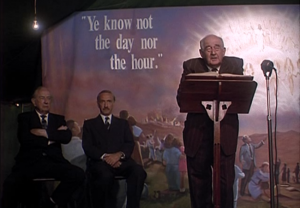
Under this great Adventist artwork, Ken finally shags Esther. “No,” she says. “It hurts.”

* Australian movies are not nearly as romantic as American studio ones. They’re much more realistic.

* 1:50. “The Presbyterians were better behaved than the Adventists when they came down to the big city. The Adventists had this problem with fullness of response. I don’t think I ever got over it.”

Cannibal in the bar: “We were both brought up in primitive religions. That can be a comfort sometimes.”

* 1:53. Two weeks after his 40th birthday (in 1982), Ken runs into his old Adventist mates Wayland and Sarai Anderson at the Sydney Opera House. They’re drinking wine.

Wayland: “You know how Mrs. White is supposed to be inspired by God? Well, it turned out that half of what she wrote was copied off of other writers. That much couldn’t have been inspired, could it? And she said it was. Lying old bitch. It’s sad. The whole church is falling apart.”

Ken: “Everyone else believes in the end of the world now. Atomic war. Nostradamus… We won, didn’t we? We convinced them all that the end of the world is nigh.”

I think I can explain the protagonist’s debauched behavior. He had debauched kinesthesia. He had bad use of himself. He was a slave to his unconscious habits of needless tension. If only he’d had some Alexander lessons, we would’ve had a happier movie.

The movie was based in part on Ellis’s relationship with Penny McNichol, now Penelope Nelson. She told me via email: “I drove. It was my mother’s car. Ian Masters was with us. Bob was thin in those days. What more can I say?”

Jan McGuinness writes in 2016:

Ellis says that back in 1966 they agreed adultery was inevitable and should be entrenched. ‘After three days the house rule was to ring in if staying out overnight.’ Though this pre-childbearing ideal is long past he concurs that affairs shouldn’t be an issue among mature adults.

‘But this was and she wasn’t too good for the first three hours, after the baby story broke in the newspapers, which was not intended, and I thought we might break up. By the fourth we were giggling and planning spin doctor lines.’ Indeed, Anne wrote all the press releases and statements and did most of the talking to the press because ‘Bob tends to be too honest with journalists on the hop’.

This includes threatening them and telling them to fuck off as duly reported when the baby story was running hot. Unsurprisingly, he detects some resentment in their treatment of him:

It’s resentment for someone who’s tried a number of things and not done too badly at some of them whereas they’re locked up in their zoo writing 300 words for Murdoch. Plus I have permission to write with passion and some honesty so they try to get something on me. It’s really a kind of road rage and always from people I haven’t met. The one thing that would really hurt is if they got me on hypocrisy, but they can’t find it.

So how does his support for free speech sit with efforts to suppress reference to his affair with Penny McNichol, daughter of the Bulletin’s David McNichol, in her book Penny Dreadful?

My objection was not so much about what was in the book but what was left out. We had engagement and marriage plans, which explains my harassment of her after we split up. I had no particular agenda, the publisher wanted me to sign something saying I wouldn’t sue so I read the book and discovered this thin, ugly, unpleasant character full of violent villainy who bore no resemblance to me.

It would be as if Ted Hughes wrote memoirs ignoring his marriage to Sylvia Plath. She left out our plans because it would have made it a more normal story and turned the break-up of a teenage couple into what amounted to Taxi Driver. There were about 70 things I wanted changed, they changed 28 and published anyway and I didn’t sue.

At the time, it was another of those confidence blows Ellis is prone to:

The fact she discarded me became the driving force of my life for the next couple of years. It’s a big thing to make plans to marry someone. I had an interview with David McNichol, who said I was becoming a bit loopy and should break it off. The idea of being marginalised by the power elite of Sydney I wanted to be part of was devastating.

Ellis settled instead for being on the fringe of another and quite different power elite—the Labor Party. Writing for National Review in 1971 turned him onto the seduction of politics and there’s barely a big moment he’s missed since.

It’s the drama of seeing people in penultimate moments of their anguish and the randomness of decisions. I was there the day Whitlam was sacked and the night he resigned, in the tally room when Hawke won, at Blacktown when Keating won and lost. Those are irreplaceable experiences. Like others follow Test teams to the West Indies, I follow politicians.

And yes, he says with a big sigh, hands clasped as always across his tummy, he’s much happier when Labor is in. ‘Look what happened in ’83. Within months we had The Gillies Report and A Night with the Right. There’s oxygen in the air and freedom under Labor which people don’t dare to aspire to under conservative governments.’

There is an audience for his musings on this and countless other topics. Even if he doesn’t get a very good press, Bob Ellis is well read. His latest book was reprinted before publication and has sold more than 7000 copies, meaning there must be a good number of fading females with cats and young male students with all their disillusion ahead of them, which is how he describes his following.

Perhaps by reading him they’ve discovered that Ellis improves on acquaintance. The last word on this score goes to Noah Taylor, who didn’t want to play him or have anything to do with an Ellis project until persuaded to read the script of The Nostradamas Kid.

People love to focus on Ellis the clown, but not much is ever said about the Ellis who fights for what he believes in, Ellis the moralist, Ellis the humanitarian. I’ve seen Ellis be the fool, but I’ve also known Bob to be one of the kindest and most generous people I’ve ever met. If Bob had moved to London in the sixties à la Clive James, Barry Humphries et al., I have no doubt he would be a very rich and famous man. But he stayed because he loves Australia and Australians and has fought for them and written for them and made a lot of people laugh for a long time. Viva Ellis!

Bill Shorten’s epitaph delivered 16 years later at a memorial ceremony for Ellis was based on decades of Ellis friendship, criticism and correspondence. ‘If I had a dollar for every killer line Bob has sent me over the years in unions and politics, I’d almost be able to afford the legal costs to use them,’ he told the crowd of 400 including Germaine Greer, former Labor premiers Barrie Unsworth, Nathan Rees and Mike Rann, Graham Freudenberg, former union boss Paul Howes, Rhys Muldoon, John Doyle and Marieke Hardy.

‘He belonged to a generation of Australian genius whose irreverent disregard for convention helped sculpture an independent and confident sense of identity free from the cultural cringe. He helped write and tell our national story.’


Posted in Adventist, Personal, Sydney | Tagged , , , , , | Comments Off on The Nostradamus Kid (1993)

Jews Have Been Kind To Me

I can only think of one instance where I met a Jew who disparaged converts.

Her name was Sherry. It was an Aish Ha Torah event. And she just came out and said, “I don’t accept that you can convert to becoming Jewish. You’re either born it or not.”

I was so blown away by her comment that I’ve not forgotten it in 17 years.

I don’t think she’s religious because a religious Jew would be less likely to say such a thing. A secular Jew whose Jewish identity is primarily ethnic is more likely to say such things.

Now, I understand the skepticism towards converts shown by many Jews. How can someone take some classes, pass some tests and suddenly become Jewish? It seems too easy. Jews are a prestigious group with a history of persecution and some newcomer can come along and claim membership? What about earning your way?

I was talking about this topic with a friend who’s a convert to Judaism. She tells me, “I’ve never encountered anyone other than this one douchebag. Jews have been wonderful to me quite frankly.”

“This guy I was getting set up with found out I was a convert and said really awful things about me and about converts and how he wanted nothing to do with them. What pissed me off was that I thought he was a dud and was only going to go out with him to be nice. Sucks to be burned by a dud.”

I understand Jews who don’t want to date a convert. If you’re Orthodox from birth you will probably have more in common with someone else Orthodox from birth.


Posted in Conversion, Orthodoxy | Tagged , , , , , | Comments Off on Jews Have Been Kind To Me

Leiby Kletzky’s Funeral

Posted in Articles | Comments Off on Leiby Kletzky’s Funeral

Should California Kids Be Forced To Study Gay History?

I wish I was back in grade school so I too could study gay history. How long will our school books stay silent on the contributions of transsexuals?

What kind of country are we living in where a woman can’t leave to become a nun without getting raped?

I fear that a friend’s relationship is going to end this way.


Posted in Homosexuality | Tagged , , , , | Comments Off on Should California Kids Be Forced To Study Gay History?

Did President Kennedy’s Back Brace Kill Him?

I’m reading the book Reclaiming History: The Assassination Of President John F. Kennedy by Vincent Bugliosi.

Dr. John Lattimer studied the assassination for years. He concluded that Kennedy’s back brace may have been responsible for his death. Dr. Lattimer writes that Kennedy had “bound himself firmly in a rather wide corset, with metal stays and a stiff plastic pad over the sacral area, which was tightly laced to his body. The corset was then bound even more firmly to his torso and hips by a six-inch-wide knitted elastic bandage, which he had wrapped in a figure eight between his legs and around his waist, over large thick pads, to encase himself tightly… He apparently adopted this type of tight bonding as a consequence of the painful loosening of his joints around the sacroiliac area, probably a result of his long-continued cortisone therapy.”

What happened? When Kennedy and Governor John Connally were struck by the same bullet, the “corset prevented him from crumpling down out of the line of fire, as Governor Connally did. Because the president remained upright, with his head exposed, Oswald was able to draw a careful bead on the back of his head.”

The first bullet that hit Kennedy passed through soft tissue and did not strike any organ. He would’ve survived. (Pg. 59)

Posted in JFK | Tagged , , , , , | Comments Off on Did President Kennedy’s Back Brace Kill Him?

Will Jewish Journal Hollywood Columnist Danielle Berrin Make A Good Rebbitzen?

For the past few months, journalist Danielle Berrin has been dating David Wolpe, a famous author and the senior rabbi at Sinai Temple in Westwood.

Rabbi Wolpe is twice her age (he was born in 1958 and she was born around 1984). Danielle, however, is a few inches taller than the spiritual leader.

This gossip brings me back to remarks in the 2003 book The New Rabbi.

On page 60, David Wolpe’s father tells him he’s not a great scholar.

But the retail business of religion has changed dramatically. “I don’t think I could have had anything like the success I’ve had 30 years ago, because I’m not a great scholar, who’s going to listen to me?” David says. “But the field of religion isn’t like that anymore. You don’t have to write a book with a thousand citations for someone to say, ‘OK, I’ll take this guy seriously.’ My editor said to me, ‘I want you to speak from your own authority as a spiritual teacher.’ Nobody would’ve said that at the peak of my father’s rabbinate.”

…Today there is “a business of selling spirituality. Jewish groups pay very well for guest speakers.”

…David knows that some rabbis refer to his work as “Heschel-lite.”

In the September 11, 2008 issue of the Jewish Journal, Danielle Berrin wrote:

Just before the High Holy Days last year, I was sitting in synagogue when I was struck by the star power of its rabbi. When he spoke, everyone listened, transfixed, as if the words he offered were revelations — inspiring, challenging and healing all at the same time.

At the end of his sermon, the congregants erupted in applause. I could hear them whispering about him all at once.

“He’s amazing,” several said.

“Brilliant.”

“I love him!”

That’s when the cantor’s wife, who was sitting next to me, tapped me on the shoulder.

“You know,” she whispered under the din of temple chatter. “I’m waiting for the story about what it’s like to be married to someone in the clergy.”

That’s when I began wondering about the people rabbis go home to at night, the people who don’t just love the rabbi, but who also know the rabbi.

For as long as rabbis have been arguing Talmud, their wives have been at home preparing Shabbat dinner.

Yet that image, along with expectations for clergy spouses, has evolved. For one, they’re no longer all women. They’re no longer always hovering in the background; they’re not even always a different gender from their partner.

… I became involved with a rabbi of my own, because as it turns out, God is not without a sense of irony.

The night the man I am now seeing was ordained, he asked me whether I could see myself marrying a rabbi. I hesitated to answer. I didn’t think I could bear missing someone so much. I wondered whether a rabbi could ever love their spouse as much as they love their work — a tough choice when your business partner is God.

At the time, Danielle was dating Scott Perlo, now the rabbi of Adat Shalom, a Conservative synagogue in Westwood.

In the June 10, 2009 issue of the Jewish Journal, Danielle Berrin wrote:

Eliana Wolpe had been running for six hours and fifteen minutes and 26.2 miles when she finally crossed the finish line. Dripping sweat and beaming, she jogged past the screaming crowds with her arms stretched triumphantly over her head. For her, the live rock music that played ubiquitously at the Leukemia and Lymphoma Society’s Rock ‘n’ Roll Marathon sounded as good as a victory hymn. After she finished, Eliana locked eyes with the people she was running for — her husband, Rabbi David Wolpe, and their 12-year-old daughter, Samara, who had stood huddled together on the sidelines waiting to embrace her.

Eliana burst into tears, and the threesome collapsed into a tight embrace, gripping one another and sobbing. Then the rabbi kissed her. And as hoards of other runners filed past, the Wolpes celebrated their moment of triumph. This was, for them, a victory over illness, a repudiation of the cancers that have haunted them and destroyed their sense of safety. But even as they sought hope in a new day, they knew their battle wasn’t over.

It began in the fall of 1997, soon after the Wolpes moved to Los Angeles from New Jersey with their 9-month-old daughter to begin a new life. Already an accomplished author and speaker, the rabbi was in demand as a scholar-in-residence at synagogues across the country and had not planned to become a pulpit rabbi. But when Sinai Temple, one of the country’s largest Conservative congregations, offered him a position, the couple decided to accept. Then, three months after they arrived, Eliana was diagnosed with a rare, aggressive reproductive cancer.

The terror of cancer would plague the Wolpes relentlessly. In October 2003, Rabbi Wolpe suffered a grand mal seizure that led to the discovery of a brain tumor. Fortunately, it turned out to be benign. Then, in August 2006, the rabbi was diagnosed with follicular non-Hodgkins lymphoma — a cancer he continues to fight today.

These battles with illness played out before a 2,000-family synagogue. Yet if in private the Wolpes felt pain, in public they strove to appear as normal as possible. They treated their congregation like they treated their daughter — putting others’ needs and security before their own, assuring everyone as best they could that life would go on as expected, even when they feared it might not. The Wolpes tried to be honest and open about their cancers, but there were limits: How could they offer comfort about their situation when they couldn’t comfort themselves?

Each coped differently. Rabbi Wolpe saw his coping with illness as a teaching opportunity; Eliana recoiled from the spotlight. The rabbi avoided thinking about it; Eliana pored over medical journals. He wrote books, gave lectures and thrived in his career. She focused on their daughter, scheduled her husband’s medical visits and demanded for him the very best care. “I never cared if I was offending anybody along the way,” she said.

In recent months, however, Eliana has found that cancer has offered her something else, as well. Once a deeply private person, cancer has pushed her to open up for the first time.

A few months after this article came out, Rabbi Wolpe and his wife separated. Then they divorced.

In an August 28, 2010, Saturday morning sermon at Sinai Temple, Rabbi David Wolpe said: “The beginning of this sermon is going to be very personal, much more personal than any sermon I have given…

“It has to do with something that happened to me a month ago when I was sitting at lunch with a member of the congregation and he said to me, ‘I understand you are going out with so-and-so?’

“I said, ‘What? I am not going out with anyone. I don’t even know who this person is.’

“The more I thought about it, the more it bothered me. We are just beginning the separation of our lives. I have a daughter. We are still very close, all three of us.

“Last week, Eli rode a bike 100 miles to raise money for cancer lymphona research because I am in remission from lymphona. In a couple of weeks, she’s running a marathon, also to raise money for lymphona research. One day it might save my life.”

Rabbi Wolpe says: “I would never — when we are taking the first steps to lead separate lives — be going out with someone.”

“I was told that everybody knows this, especially in a certain community.”

“During the past 13 years that I have been the rabbi of this synagogue, numerous members of the Persian group have come to me and said, ‘Please talk about gossip in the Persian community.’

“I’m doing it this morning in part because of what happened this week, because there was a terrible tragedy and a few young people were killed and our hearts go out to their families. I want you to know that if you gossip about it, then you are wounding families who have already suffered unimaginable pain, so don’t do it.”

Danielle Berrin, Barack Obama at AIPAC in 2005

Danielle has written many times about Rabbi Wolpe. Here she is May 10, 2010: “Hollywood Jew has learned that two of L.A.‘s most influential and innovative rabbis—Sinai Temple’s David Wolpe and IKAR’s Sharon Brous—will head to the White House next week for the first ever Jewish Heritage Month reception with the Obamas.”

There’s a delicious car-wreck quality to Danielle’s life and work that makes it hard for even the most Torahcentric among us to look away.

Intensely ambitious, a ten out of ten on the beauty scale, and equipped with good manners, Danielle’s writing can be equally compelling whether bad or good. Her best writing comes in the first person and focuses on ridiculous people trying to make it with her (such as here and here). Her worst writing comes when she comments on ideas (such as here and here).

I know what it is like to date a beautiful woman. A few years ago, I took one to all the writing gatherings I frequented and the men over 50 just worshiped her. They’d send her emails about lofty issues that always contained disclaimers such as, “I hope I don’t come across as just another creepy old man trying to get in your pants.”

A good friend of mine made a serious pass at her and when she rejected him, he stopped talking to me.

My girlfriend was ambitious but without accomplishment as she readied to enter her fourth decade. My female friends with significant credits rejected her attempts to bond with them as an equal. “I find my brain slowing down when I try to talk to her,” said one.

On the other hand, my male friends — every bit as professionally advanced as my female friends — adored her and praised her writing.

The best description of Danielle comes from her own keyboard: “Born in the sticky heat of the Everglades region, where hurricanes whirl by every summer and mojitos are as ubiquitous as water, Miami is my native land. The year-long summers in Florida meant my move to Los Angeles wouldn’t be too shocking; I was merely trading hurricanes for earthquakes, humidity for smog. But I didn’t come here for the weather, it’s just an added benefit. I ventured across the country because Hollywood is where dreams come true, and although I possess many passions, I’m enjoying the pursuit of journalism.”

Danielle loves talking about her intellectual interests such as architecture and French New Wave film. She’s got a sweet little career going as a public speaker. She even joined Rabbi Shmuley Boteach on a panel to talk about materialism (shopping, not the philosophy).

As the Jewish Journal reported: “Boteach had invited Los Angeles City Council President Eric Garcetti, Rabbi Naomi Levy of the Nashuva community, and Jewish Journal staff writer Danielle Berrin to join him on the panel.”

Danielle Berrin wrote in the Jewish Journal March 13, 2008:

It’s early Saturday morning and Shabbat is cresting with the West Coast sunrise. As is my custom, I dress, slip into a pair of heels, and ready myself for a contemplative worship. When I was new in town I could daven, throw back a shot of Manichewitz and grab a piece of challah on my way out; but the days of passing through community circles unnoticed and unscathed are over.

The first time it happened, a well-dressed woman with ebony tresses and ample perfume pulled me aside during Kiddush and said, “Excuse me, are you married?”

She grabbed my right hand and glared at my naked finger.

“No, I’m not married,” I replied.

“Are you Jewish?”

“Am I Jewish?” I thought, incredulous. I’m in temple, on Shabbat. This is not a pashmina draped over my shoulders. It’s a tallit.

“How old are you?”

“I’m 24.”

“Very good,” she said, all smiley and nodding.

She meant “very good” not because she felt Jewish-feminist pride that a single young woman is attending Shabbat services, but because my answer affirmed that I have six more childbearing years before I turn 30.

“I have a son! He is handsome, a lawyer. Can he call you?”

Danielle’s latest blog post is aptly titled, “Odd Couple, Blessed Match”.

As Jesse Jackson used to say, “Keep hope alive!”

I feel queasy writing about anyone’s dating life. I have some ambivalence about publishing this post. Apparently, however, Rabbi Wolpe felt no ambivalence about weighing in with his opinions on Mel Gibson’s private phone calls to his girlfriend. Rabbi Wolpe wrote for the Huffington Post July 30, 2010: “I suppose I am relieved to hear that people are dropping Mel Gibson right and left. His vile rant would be enough to bury any career. Not only did he abuse another human being, but the admixture of rank sexism was enough for any canny watcher of the media to know that this was a cooked goose.”

Is there anyone who has not said things in private that he would not be ashamed about were they made public? Even Rabbi Wolpe? I hope so. Such a controlled person does not sound human.

Dennis Prager had a very different reaction to Mel’s phone rants:

On his radio show Monday, Dennis Prager says: “Mel Gibson is a troubled man. I have more pity to him than hate. I don’t think he is a danger to the country.

“I think there’s a larger issue than what a man thinks about minorities in his private conversations.

“Privacy. The notion that a man ranting at his girlfriend is now played for the world is very disturbing. The vast majority of human beings in the midst of terrible anger, particular in a relationship, say terrible things. It’s none of my business.

“Americans on the left are keen on the right to privacy when it comes to extinguishing the life of an unborn human but when it comes to the right of privacy of what you say privately in a phone call to your lover, then the left is thrilled to violate the most primal notions of privacy.”

“It’s a terrible thing that these private phone calls were recorded and then placed on the internet.”

Posted in Danielle Berrin, R. David Wolpe, Rabbis | Tagged , , , , , , , | Comments Off on Will Jewish Journal Hollywood Columnist Danielle Berrin Make A Good Rebbitzen?

I’m Rooting For The U.S. Women’s Soccer Team

Until this week, I never cared about any women’s team sport. I found them all boring to watch. It would never occur to me to watch men sew or knit of raise babies and it didn’t seem interesting to me to watch women parallel park or play basketball.

I still hold that a good high school boy’s team can beat the best women’s team in the world in any sport, be it soccer or basketball or baseball.

Still, I found Sunday’s victory over Brazil by the U.S. women’s soccer team to be a thrilling match (I just saw the highlights).

I watched all of yesterday’s game against France and found it compelling.

And on Sunday, I’ll be rooting for America versus Japan in the women’s soccer World Cup final.

Watching women play basketball, however, that is painful. The skill level is just so low. The women move slowly (compared to men) and their shots look awkward.

Posted in Sports | Tagged , , , , , | Comments Off on I’m Rooting For The U.S. Women’s Soccer Team

Giving Up Versus Getting Help

Many times when I have a stiff problem, my first reaction is to lie down. I just want to give up. I want to curl into a ball and stop fighting.

Then, after a while, I’ll get up and get to work.

Some problems in our lives we accept as chronic. There’s nothing we can do about them. But if we ask for help, we might find there are solutions. For instance, many people think there is nothing they can do about their tinnitus (ringing in the ear, about 55% of Americans suffer from this). But there are things you can do. None of the solutions may “cure” tinnitus, but some of them can help reduce its severity.

Report: Alexander Technique is considered to improve the flow of blood to the ear. It is believed to be beneficial when the tinnitus is accompanied by vertigo.

Tinnitus refers to a condition when any sound becomes intolerable to a person. Generally, tinnitus patients feel pain in their ears due to any sound. This dreadful disease can attack anyone through various ways and it never spares youths also. While some people develop tinnitus over a longer period of time, some get this suddenly after hearing a loud sound. Apart from this, there are other reasons that can create tinnitus e.g. severe headache, ear irritation, adverse drug reaction, Williams’ syndrome, Autism, Bell’s palsy, Asperger syndrome, minor head injury, chronic ear infections and others. Presently, this disease affects 55% inhabitants of the U.S.A. As medical science has advanced a lot in this modern era, there is nothing to be afraid about tinnitus. Nowadays, there are several ways to cure tinnitus. The Alexander Technique is one of the fruitful techniques to cure tinnitus.

A totally hands-on teaching method, ‘The Alexander Technique’, was invented by Frederick Matthias Alexander, which usually encourages all the physiological processes to work more effectively and to attenuate physical discomfort and stresses. Generally an ‘Alexander technician’ uses his hands to release muscular tension in a polite way to improve any misalignment of the ear-bone structure. It is even considered a way to improve the flow of blood to the ear. ‘The Alexander Technique’ also proves to be beneficial when tinnitus is accompanied by vertigo.

Posted in Alexander Technique | Tagged , , , , , | Comments Off on Giving Up Versus Getting Help

She Had An Amazing Sense Of Touch

The main teacher in the movie and play The History Boys said his touch of his students was more benedictory than exploratory.

I’ve never been able to forget that phrase.

Some people just have an amazing sense of touch and others just feel creepy. It has nothing to do with how hard or light the touch is. It has everything to do with who the person is.

A contracted person is going to have an icky touch. A person without undue contraction is going to have a beautiful touch.

I knew this plain woman who was very annoying, but she had an amazing sense of touch, and whenever she hugged me goodbye, I tingled.

Through Alexander Technique, I’ve been able to drop much of my needless bodily tension and hence my touch has a different quality from three years ago.

There’s a great exercise in the book Passionate Marriage that calls for people to hug without leaning on the other person. Stand on your own two feet and hug while maintaining your own upright direction.

That’s a great metaphor for relationships. Stay on your own two feet, hold yourself up, and then interact from that stable position.

Posted in Alexander Technique | Tagged , , , , , | Comments Off on She Had An Amazing Sense Of Touch

South Korea Embodies Ingratitude

Dennis Prager writes:

For decades, there have been anti–U.S. demonstrations in South Korea. And each time I wonder the same thing: Do these people have any idea what that living hell known as North Korea is like? Do these people understand that the United States is the reason they are so free and prosperous, completely unlike their fellow Koreans who had the horrible luck not to be liberated by America? Do these people know how many Americans died to enable them to be free?
Whenever I confront someone who claims that America’s wars abroad were fought for economic gain or to extend its alleged imperialist empire, I ask the person about the Korean War: What imperialist or economic reasons were there to fight in that country?

The answer I most often receive is, “Frankly I don’t know too much about the Korean War.” And it’s a good thing for the critics of America’s wars that they don’t know much about the Korean War. If they did, they would either experience cognitive dissonance or have to severely modify their position on America.

Just five years after a war-weary America celebrated the end of World War II, Americans were asked to fight the successor evil to Nazism — Communism — in Korea, a country most Americans could not identify on a map. In an earlier version of what happened in Vietnam, the Soviet Union and China backed a Communist attempt to take over the southern half of the Korean peninsula — the northern half had been Communist since the end of World War II — and install a Stalinist tyranny over the non-Communist southern half.

Over 36,000 Americans died in America’s successful attempt to keep South Korea from becoming Communist. And another 92,000 were wounded.

So, forgive me for the contempt I feel for South Koreans who demonstrate against the United States and for the two-thirds of South Koreans who, according to a 2002 Gallup-Korea poll, view the United States unfavorably. Whenever I see those anti-American demonstrators or read such polls, all I can think about are the tens of thousands of Americans who died so that South Koreans would not live in the Communist hell their fellow Koreans live in.

Posted in Dennis Prager | Tagged , , , , , | Comments Off on South Korea Embodies Ingratitude