From imdb.com: "This powerful story of familial struggles and redemption follows a shell-shocked Juliette (Scott-Thomas), who returns to live with her young sister Lea (Zylberstein) after being banished from the family for 15 years. An enormous critical and box office success in France, Scott-Thomas’ phenomenal performance has already been singled out by critics for end-of-year award consideration."
Kristin Scott Thomas as Juliette
Left to Right: Philippe Claudel, Kristin Scott Thomas as Juliette, Lise Segur as P’tit Lys
Left to Right: Lise Segur as P’tit Lys, Kristin Scott Thomas as Juliette,
Left to Right: Kristin Scott Thomas as Juliette, Laurent Grevill as Michel
Elsa Zylberstein as Lea
Elsa Zylberstein as Lea, Kristin Scott Thomas as Juliette
Left to Right: Elsa Zylberstein as Lea, Kristin Scott Thomas as Juliette
From imdb.com: "Takes place in the days before Christmas near a little-known border crossing on the Mohawk reservation between New York State and Quebec. Here, the lure of fast money from smuggling presents a daily challenge to single moms who would otherwise be earning minimum wage. Two women – one white, one Mohawk, both single mothers faced with desperate circumstances – are drawn into the world of border smuggling across the frozen water of the St. Lawrence River. Ray and Lila… and the New York State Trooper who ultimately brings the two to justice."
Hugh Hewitt says: "This is the most boring 30 minutes of filmmaking I’ve ever seen."
He says his wife talked him into seeing the movie but agreed to leave after 30 minutes.
Left: Misty Upham as Lila Right: Melissa Leo as Ray
Melissa Leo as Ray Eddy
Charlie McDermott as TJ Eddy
Melissa Leo as Ray Eddy
Melissa Leo as Ray Eddy
Misty Upham as Lila
Left: Melissa Leo as Ray Eddy Right: Michael O’Keefe as Trooper Finnerty
Director Courtney Hunt on set of Frozen River
Left: Melissa Leo Right: Director Courtney Hunt
Left: Nancy Wu as Chen Li Right: Mark Boone Jr. as Jacques Bruno
Left: Jay Klatz as Guy Versailles Right: Melissa Leo as Ray Eddy
Scene from Frozen River
Left to right: Melissa Leo as Ray Eddy, Nancy Wu as Chen Li, Mark Boone Jr. as Jacques Bruno, Betty Ouyang as Li Wei
Everybody’s watching what’s going on in Beijing right now with the Olympics , Think about the amount of money that China has spent on infrastructure. Their ports, their train systems, their airports are vastly the superior to us now, which means if you are a coporation deciding where to do business you’re starting to think, "Beijing looks like a pretty good option."
On many levels, this bit of Obama oratory is as troubling as Obama’s moral equivalence posture on the invasions of Georgia and Iraq. Obama’s praise for China’s Olympics building binge ignores how those structures were assembled, the source and conditions of the labor, the lack of pollution controls in Beijing and throughout China, the many complaints that Chinese infrastructure outside the Olympics zone remains shoddy, the recent record of Chinese manufacturing scandals, including the heparin fiasco which killed many Americans, and of course the catastrophe brought about by Chinese building standards in the region rocked by the recent earthquake. (The New Nixon’s John Taylor links to an extensive summary of the enormous shortfalls in Chinese engineering exposed by the quake.)
Hispanics who worked at the Agriprocessors plant prior to the May 12 immigration raid, told stories of sexual and financial coercion. Some workers who came to and left Postville in the weeks following the raid have spoken of broken promises. The stories told by minors who claim to be former employees at the kosher meatpacker have, at least in part, fueled an ongoing investigation into 57 cases of child labor law violations.
According to Rabbi Menachem Weissmandl, however, information surrounding the recent compensation spat between management and Jewish employees at the plant falls so squarely within the sacred that it cannot be discussed.
“As the supervising rabbi for all glatt kosher meat and strictly kosher poultry at the Agriprocessors plant in Postville, I am responsible for the well-being of the slaughterers (shochtim) and supervising (mashgichim) rabbis,” said Weissmandl in an e-mail to Iowa Independent on Thursday. “To protect the integrity of the kashruth, their relationship is strictly with us. Under no circumstances can we permit that this relationship be compromised and thus is off limits to outside scrutiny, as is prescribed by Jewish law.”
Delivered by Menachem Lubinsky, president of the marketing firm Lubicom and a spokesman for Agriprocessors, the statements from Weissmandl came in response to an inquiry submitted by Iowa Independent in relation to Jewish workers walking off the job Wednesday.
When the Agriprocessors plant was at full production, it was believed as many as 70 rabbis were needed to oversee and perform the sacramental slaughter of livestock according to halakha, or Jewish law. Plant officials freely admit that the plant has not been at such high production levels since a federal immigration raid in May resulted in the detention of nearly 400 of the company’s estimated 900 workers.
“It is no secret that Agriprocessors was forced to cut back production of meat and poultry after more than a third of its labor force was seized in a May 12th raid by [Immigration and Customs Enforcement],” Lubinsky said. “While the company has made big strides in hiring new workers and restoring production, it is still significantly behind May 12th levels.”
It has been this inability to secure a stable workforce that led to what Lubinsky described as a compensation “lag” and the ultimate protest by the Jewish workers this week.
I keep hearing the news media refer to Joe Biden as a foreign policy expert.
That’s hilarious.
The guy is an airhead.
He can’t stop talking and saying stupid stuff.
I remember Brit Hume wrote an article about him for the New Republic in 1985 titled "Joe Biden, Shut Up."
Who on earth is excited about Joe Biden?
What has he ever accomplished? What great ideas has he ever propounded?
He’s the Antonio Villariagosa of the U.S. Senate.
The Democrats now have two substance-free candidates.
Bring it on.
The LA Times is hilarious but typical: "Sen. Joseph R. Biden Jr. joins the Democratic ticket as an acknowledged foreign policy sage whose 36-year record has won him bipartisan praise as a liberal internationalist who generally hews close to his party’s center."
Who with any cred respects Joe Biden? Respects him for what?
As David Freddoso noted in his book, Obama represents the merger of two of the worst aspects of Democratic politics –’60s radicalism and corrupt Chicago machine politics. With the addition of Slow Joe Biden to the ticket, Obama has added to his unsteady candidacy an epic amount Beltway cluelessness and arrogance unsupported by anything except frequent flier miles and Delaware’s love for a chuckle-headed fellow with a big smile.
I was worried that the Dems had pointed out to Obama that his serial gaffing had brought the campaign close to a break point and that he needed Hillary. I was worried he’d actually go find Anthony Zinni or Sam Nunn or someone of accomplishment and purposefulness in foreign affairs. Webb would have been hell on the stump. Kaine or Bayh would have put different states into play. Sebelius was a wild card.
But put Biden’s obvious flaws aside and ask yourself how in the world Obama decided to go with Biden, and you’ll quickly realize that the Democratic nominee must have been impressed with Biden on the long campaign trail of 2007 and 2008 –even though voters weren’t and even though Biden has no accomplishments of note after 36 years in the Senate. Biden talked a great game and dropped some very interesting place names –and this impressed Obama. Talking the talk has been the key to Obama’s success, and in Slow Joe he found an older, far better traveled but equally prolix gas bag.
I call San Francisco State photographer professor Ken Kobre Friday morning.
He’s just back from spending three months in France.
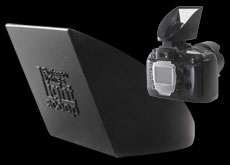
We talk about his lightscoop tool.
Luke: “I use an external flash for my Nikon D200, the Nikon SB 800 speedlight.”
Ken: “If you have that, you know you can point it towards the ceiling and get much nicer light than if you use the direct flash. But you had to go out and buy that and that cost you at least $350.”
Luke: “And about $400 for the Lumedyne battery. And the speedlight burns out all the time and to get it repaired costs about $200.”
Ken: “Add to that cost, when you went to the party last night, some people bring their SB800 but it’s a heavy piece of equipment to carry around. A lot of professionals, when they’re not on the dime, prefer to travel lighter.
“There are two clear things going on here. One is the cost of that piece of equipment. And the second is the convenience of not having to have it all the time with you. The lightscoop is a $30 item and under some circumstance, you get just as good a picture.
“I’m not telling you to sell your $400 SB800. But the $30 lightscoop and you might find you are using it as frequently, especially for doing parties in home, particularly in areas where the ceiling is not too high. That’s the key to the lightscoop and to any bounce light. You’re taking the light and reflecting it off a ceiling. That sends the light up and makes a much larger pattern and comes back down and it turns you little tiny flash, which is only two inches wide, and when the light goes to the ceiling, it becomes a huge soft box, maybe four feet by four feet or bigger. You’ve taken a small light source and by sending it up to the ceiling, you’ve created a big soft light source. That’s the secret.
“You’re probably aware that most professional photographers when they’re working in a studio or taking portraits of anybody use a soft box or an umbrella. That’s taking the little strobe and making it into a larger light source. The secret of all good lighting is to make the light source larger rather than smaller.
“It’s hard to carry around one of those big soft boxes or even an umbrella, so the secret is to bounce the light off the ceiling. You can either do that with the 800 pound gorilla, the SB 800 speedlight strobe or you can use my little light scoop.
“I’m able to use the little flash that flips up on a camera and turn it into a beautiful light source.”
Luke: “How high can the ceiling be and this still work?”
Ken: “The ceiling generally has to be a light color, and it shouldn’t be more than about 12 feet tall. After that, it simply doesn’t work anymore. Not enough light comes back to make a well exposed picture. You’re SB 800 speedlight won’t work in a gymnasium. It won’t work in a church with a high ceiling. And it won’t work outdoors.”
Luke: “But it will work if I shoot it forward instead of up?”
Ken: “Correct. So will the pop up flash. But then you get the bad light. But you can’t bounce either one when the ceiling is too tall.
“Why is the soft box so much nicer? When you use flash directly and put it on top of your camera, that light is coming from a strange place, right above the camera or the middle of your forehead. There’s no light in the world that comes from that position. Only if you were a miner wearing a miner’s hat or the light from Buddha’s head emanates from the middle eye or a dentist… If you are not one of those three, it’s an unnatural place for light to come from. Light normally comes from the ceiling or from lights or from the window, never directly from you. By bouncing the light off a ceiling or off a wall, we’re recreating the natural light that is in a room.
“When you hit a subject directly with light, the farther they are away, the less light they get. I’m sure you’ve noticed in your pictures that the person near the camera gets all the light, sometimes they are even over-exposed, almost nuclear-light, while somebody ten feet behind them is always too dark. It looks like the pictures are shot in some sort of cave. Or the pictures have that police line-up look. There’s a physics reason for it. The technical term is the inverse square law. Light, as it spreads out and gets farther away from the camera, there’s less light coming back.
“To counteract that, to bounce the light off the ceiling, you’re bringing the light down evenly with the person near the camera and the person farther away. They’re now getting even light because the light’s coming off the ceiling and it’s the same distance from the near person and the far person.”
Luke: “So how come we didn’t have this ten years ago?”
Ken: “When I went to teach my advance lighting class, I always teach them how to use an external strobe, but because so many students today have the camera with the pop-up flash, I thought it would be clever to show them how to take the light from the pop-up flash and make it into a beautiful light. I used a tin pie tray and by angling it right and adjusting the camera right, I was able to create this bounced light effect. Then it took me three years to develop the product and bring it to market (summer of 2007).
“I worked with a design student at San Francisco State to create the shape of it and the attachment of it and the right angle of it and the size of it. It took quite a while. We made a bunch of balsa wood models to get all the factors exactly right. Then we sourced it out to a place that makes plastic items in Connecticut.
“We were selling a few every day. Then David Pogue, two weeks before Christmas, decided to feature it in his television show. He’s the tech reviewer for the New York Times. He featured it in the New York Times. The next day, we sold out of every one made. It took a month to catch up with all the orders.
“I never even dreamed it would take off. I wanted a patent. I’ve written a lot of books but I’ve always wanted a patent. I never thought of it turning into a great financial success. We had no money for advertising. We didn’t have a business plan. We just made it and put it out there.”
Luke: “How does this reduce red eye? I don’t even know what causes red eye.”
Ken: “The light from your strobe goes out and hit somebody in the eye and it goes to the back of the eye, where there are a lot of veins filled with red blood. The light bounces off the back of the eye and comes straight back into the lens. The path of the light is into the eye and back out. What comes back out is red where the pupil is. My device angles the light off the ceiling so instead of the light coming directly from the source and back to the lens, it’s coming in at a different angle.”
Luke: “Why do people look so ugly in direct sun?”
Ken: “The sun is a long ways away. Therefore, it makes a sharp shadow. That harsh shadow light makes you look unattractive in the middle of the day. That’s exactly the same effect as the direct flash. It makes sharp shadows. The soft box wraps the light around the subject. The shadows become softer.
“If we lived on a planet nearer the sun, the sun would be a larger light source and you wouldn’t have this problem. Of course you’d burn up.
“The bigger the light source, the softer the light. The sun is so far away, it’s a tiny light source and makes a harsh shadow.”
Luke: “I’ve noticed that women over 30 complain about harsh light when they go out socially. They know they don’t look good in a harsh fluorescent glow. Their every skin flaw shows.”
Ken: “We’re talking about wrinkles. The reason you’re seeing a wrinkle is that you are seeing a shadow in the light part of it. The harsher the light, the more shadows it brings out. The softer the light, the less the winkles come out. That’s why people of a certain age don’t appreciate the harsh light that makes for harsh shadows. Hollywood has lots of techniques around that problem but you as an individual photographer, the simplest way is to create that soft light. With my device, for portraits, you can bounce it off a wall, if your subject is within ten feet of a wall, and that gives you that soft window light.”
Luke: “How do you bounce the light off a wall? I’m looking at a picture of the lightscoop and it shoots the light up to the ceiling.”
Ken: “So you turn the camera to the side and shoot it vertically. The face is normally shot vertically anyhow.”
Ken Kobre has a new website devoted to analyzing the web’s best multi-media journalism — KobreGuide.com.
Ken: "We’re looking at all these amazing documentaries. I’ve found the most amazing multi-media documentaries and I’ve hired people to go do it and on each one, they’re doing a write-up. We’re curating this. Instead of YouTube where you win because you are the most popular (which is usually stuff like the cat falling over backwards into the john), this is for more sophisticated taste. Think of this as The New Yorker but visual. We are going to pick the finest stuff out there and then feature several we think you should see this week. You’ll be able to search by topic or awards…"
Luke: "How long has this been up?"
Ken: "It’s not up. You’re the first person to know about it — outside the group that’s developing it."
There’s been a certain amount of carefully orchestrated controversy swirling round the NBNFIJBC.
Backstory: A notorious apologist for Muslim terror whispered to Haaretz—duh—that the conference was made up of right wing religious nuts.
Some Haaretz hack—redundancy, I know—published an article, half of which were lies and the other half not true. To gauge the radical leftist slant of the article, get this: the Haaretz author ID’d Treppenwitz as a resident of “Efrat, in the West Bank.” However, the Haaretz piece nowhere mentions the cities where other bloggers reside.
Subtext: Treppenwitz is an evil settler, therefore nothing he says can be trusted.
A not so clever blood libel.
Haaretz writer will say:
I stand by my piece.
Or:
I’ll let my readers decide.
The playbook of intellectual collapse and dishonesty.
There is no such thing as journalistic objectivity. A writer/journalist/whatever stakes out specific ideological territory as soon as he chooses his subject matter. All the rest are details to support the writer’s political world-view.
The Haaretz piece does not qualify as journalism. It’s a disgrace, a wretched hack job written by a tool of the Israeli left, apologists for Arab terror. The writer should be fired so he can gain employment with Hamas or the PA, pumping out anti-Jewish propaganda, his true calling.
Treppenwitz details the entire gruesome drama here.
Because it is closer-knit and more insular, the sense of shame increases in Judaism as you become more religious.
In Orthodox Judaism, it is rare to have close friendships with Jews who aren’t Orthodox, let alone non-Jews.
I remember when I went to daf yomi every day, I cared more about the opinion of my fellows in class than everyone else in my life (because I saw them more often).
…“What happens if the inspector catches you without a ticket?” The man could barely understand the question. “Everyone would know!” he said with a horrified look.
My friend found this hilarious; I found it pretty impressive. The Swiss sense of shame is so highly developed that the mere contemplation of being revealed as someone who did not pay for the tram, in front of a group of strangers, is so terrifying that Switzerland can dispense with the elaborate turnstiles and subway police that New York City needs to prevent fare jumpers.
Shame is one of the characteristics by which Klal Yisrael is distinguished. But it has atrophied over the generations. Haven’t we all asked ourselves upon hearing about someone caught running a ponzi scheme or engaged in some other unsavory activity: “Did he think he could get away with it forever? Didn’t he think about his kids’ shidduchim?” and the like.
Rosenblum adds:
The conversation did not get off to a great start. After telling me I looked familiar and asking my name, he told me, “Oh yeah, I heard you speak in my shul. You write better than you speak.”
That comment is chutzpah. Rosenblum is a great writer and speaker. A lot of Jews have a lot of chutzpah. They feel like they’re entitled to pop off with their opinion when they’ve done nothing to earn it. I see one guy in shul who reads while the rabbi gives his sermon. Fine, but he reads while holding the book up so he’s broadcasting to the world his contempt for the rabbi. I’ve seen other people in an Orthodox shul reading a secular newspaper during davening Shabbos morning.
I remember meeting a bloke in shul and had a couple of pleasant but short conversations.
Two days later, I got a long email from him telling me that I needed to completely change my life and give up my writing for a regular job. That was chutzpah coming from somebody who didn’t know me and hadn’t earned the right to give reproof.
He can be an example of no matter how far OTD (off the derech) one goes -people should still be welcomed.
In the mid 70s B Netanyahu was a grad student at MIT. He went by the name B Nitai-not Netanyahu and was married to a non Jew. He continued to live in the Boston area and work after receiving his Masters degree. What brought him back to Israel was the death of his brother in Entebbe. He was convinced I believe by Moshe Arens to come back and take up the family heritage in Likud politics.
Of course, now he has many times received chareidi votes and has some frum descendants.
Never push anyone completely away or write off from the fold.
"This guy knows all the gossip, the ins and outs, the lashon hara of the Orthodox world. He’s an [expert] in... all the inner workings of the Orthodox world." (Rabbi Aaron Rakeffet-Rothkoff)