
I Interview Ex-Mobster William Cutolo Jr Whose Father Was A Hitman

Here’s the Wikipedia entry on Bill’s dad: "William Cutolo (June 6, 1949 – May 26, 1999 Bay Ridge, Brooklyn), also known as "Billy Fingers" and "Wild Bill", was a Brooklyn-born mafioso in the New York based Colombo crime family who was a hitman for a renegade faction within the crime family. He was later promoted to underboss by Colombo family boss, Carmine Persico."

I talk to Junior Sunday afternoon. He’s working on a book about his life in organized crime with author Matthew Randazzo. It’s due to come out in 2010.

Luke: "Tell me about your father."

Junior: "Yes, he was a gangster, but he did a lot more than that. My father did so much for so many charities. He raised millions and millions of dollars for leukemia, battered women and children, guardian angels for the elderly. He was on committees for these charities… Every year he would raise millions and millions that would go directly to these kids. That’s something you don’t get to read about."

Luke: "Where are you in the birth order?"

Junior: "I have two sisters, one older, Barbara (one year older), and a baby sister, Christina, who’s four years younger than me."

Luke: "When did you realize your father was a gangster?"

Junior: "I guess I was about ten or eleven. I was outside the house in Brooklyn. I lived on 48th Street [in Flatbush]. There was an older kid who used to live on the corner. He was about 18 years old. He was doing something to a tree outside our house, he was picking off the bark and I said to him, stop, you’re killing the tree. He gaven an answer like, ‘You think I’m afraid of you because your father is in the Mafia?’

"From there, I ended up hitting him with a garbage can cover and he threw a set of keys at me that got stuck, that got injected into my elbow.

"I go home, not even crying, and my mother asked me what happened. I told her what this guy said. I said, what does this mean? She said, whatever you do, don’t tell your father what happened.

"I said, but why? What does that mean?

"She said, the day will come when he will explain to you what it is and what it means. But for now, just leave this alone.

"At that age, at that young age, you start realizing different things. You start noticing that the younger guys cling around him. It was a surreal kind of growing up.

"Around eleven or twelve was when I realized that he was not the average white collar guy who goes to work every day."

Luke: "How did that affect your childhood?"

Junior: "Things at school started to change as I got a little older. In junior high school, I ended up meeting a friend whose father knew my father well. This kid, his father was with the Jersey Family, the DeCavalcante family.

"This kid and I never got along, we used to fight all the time, until one day he comes to school and he says, ‘Our fathers are good friends.’ His name was Rudy Farone. He’s dead. We became friends. Word got around. We started a little clique.

"At school, at a young age, I started learning how to take bets, football tickets and stuff like that. It gave me a bounce in my step. I walked around like a rooster."

Luke: "How did other kids relate to you?"

Junior: "There were always two sets of friends that I had. There were the normal kids who studied and did their homework. My father was the type of guy that school was no joke to him. He wanted me to do well. And then I had a group of kids from Canarsie, where my high school was located. I started hanging around guys who were around Gambino guys. After hanging out with a couple of guys for a while, my father started getting wind that I was hanging out with guys from Canarsie. I was hanging out with it was guys around Lenny DeMaria, a skipper in the Gambino family and guys around Nicky Corozzo, the acting boss of the Gambinos."

Luke: "How did it affect girls and their interest in you?"

Junior: "Girls were always a dime a dozen when I was a kid, no disrespect to them at all. I was a pretty popular kid. If there was a kid getting picked on by a bully, they’d come to me and I’d always stuck up for the underdog. I always had money in my pocket. The girls? They were always attracted to the bad guy sort of effect. They liked that bad guy attitude. People were always afraid of you. Yeah, it was fun, the way the girls always reacted. I’ve got to say it was a fun period in my life."

Luke: "Was there an age or a time when you became a bad guy?"

Junior: "I was never a prince. There were times that I had to do things that I wasn’t proud of, whether I was told to do them or not. I was taught at a young age that for every action, there was reaction. I’d end up going out with some friends and some guys would be drinking and we’d look for the biggest guys and it’d be a fight almost every time we went out, until I got to about 17 or 18 years old when I started to realize that my father was dressing a lot more meticulously and he was taking things a lot more serious. At that time, he told me, keep your hands in your pockets. I don’t want to find out you’re putting your hands up to anybody.

"Did I do anything bad? I had counterfeit money. I had credit cards. Extortion. Your basic rackets. Loan sharking."

Luke: "Was there a time in your life when you started thinking of yourself as a bad guy?"

Junior: "I never thought of myself as a bad guy. My father always told me to stick up for the underdog. He also told me, don’t get f—ed.

"There were times when I hit people when they were late on payments. I had to do that. It was part of my job. Or, having to drop off three pounds of weed to somebody in Canarsie.

"I started thinking that something wasn’t right, let me see, I graduated Kingsborough Community College in 1990. My father said, what college are you thinking of going to now? I’m so proud of you. You’re the only one in the family who graduated college. What are you going to do now?

"I told him, I’m done with college. I want to be with you. He said, what do you mean you want to be with me? I said, I want to be with you.

"He said, we ought to have this conversation without your mother around. We’ll talk later. Let me just enjoy this moment.

"We go home that night and he says, what did you mean when you say you want to be with me? I said, I want to earn. You know that if there’s anybody you can trust, if there’s anybody who’s got your back, it’ll be your son.

"He explained to me that a father and a son in that life don’t usually hang around together, especially if they are both obviously straightened out. If that’s what you’re thinking, don’t just come into this life for that. It’s a treacherous life, my friend. It’s not the kind of life that a father would want to bring his son into. Please, you’ve got to promise me that if I bring you into this life, you’ve got to listen to me, to do as I say, not as I do. Do we have an agreement?

"I said yes.

"I started going up to the club. He introduced me to everybody. It was a proud moment for me and for him.

"It was a bittersweet moment for him. He was so proud of me graduating. At the same time, he was hurt that I didn’t want to go to school anymore."

Luke: "How long did you run with organized crime?"

Junior: "He started bringing me around 11th Avenue when I was eleven or twelve. At 16, I used to hang around and smoke cigars and stuff and they’d school me. My father used to teach me when I was young, just watch. When you walk into a room, evaluate the room and see where everything is. He used to test me. He’d send me into a room that I’d never been in before and he’d give me about 30 seconds and ask me to come out. He’d ask me, what did you just see? Where was this chair? Where was this person sitting? What was this guy wearing? He’d put me through drills like that.

"Once he started doing stuff like that, I realized that he thought that if I was going be involved in this life, I might as well learn it from someone who knows it well, which is him. I was his. I belonged to him. That’s where my honor and loyalty lied."

Luke: "When did you realize that your father was a hit man?"

Junior: "He was arrested for murder [when Bill was a child]. Probably around 11 or 12. I didn’t use that terminology of hitman. To me he was always a man’s man. When I used that terminology in my circle, people understood what I meant. The average person if you were to say someone was a man’s man would think he was homosexual.

"Probably around 11 or 12, I noticed that people feared him. I noticed the respect that they gave him. I was very young."

Luke: "Did it ever make you love him less?"

Junior: "No. Absolutely not. It’s kinda funny that you say that, Luke. The average person in the world knows the difference between right and wrong. Even though I knew that the life he lived was wrong, I convinced myself that it was right. So that meant I would do anything. If I had to follow him into the gates of Hell, I’m with you. He was my guy. He was worried about me. He was the only guy that I would take orders from.

"There were only two men in that life that I respected — my father and John Gotti. When I was in his presence, it was a feeling that I can not describe to you, Luke. To be able to sit down and laugh and joke and be able to talk sports and play cards with a guy like John Gotti, even fully knowing what he did and what people said about him. I wasn’t one to judge. I thought it was the right way to live. I just thought the law was wrong. The cops were wrong. Agents were wrong. They were doing the wrong thing and we were the good guys.

"My father had given me a quote when I had first asked him a question [about the Mafia].

"He used to make us go to church every Sunday. One Sunday after church, I came round and said to him, ‘Pop, we do what we do Monday through Saturday and then Sunday we come to church and we’re forgiven for everything that we did? It makes me feel very hypocritical. I don’t understand this whole going to church thing.

"He said, ‘It’s kinda like that Santa Clause thing. We’re children. We believe in him even though we don’t see him. It’s like people with God. People never see Him but they believe in Him.’

"He was more worried about me because he knew that he was the only person I listened to. I told him that time and time again.

"He used to tell me, if you want me to wear the pop hat, let me know. I’ll wear that hat. If you want me to wear the skipper hat, I’ll put the skipper hat on. How do you want to talk? Do you want to talk business? Or do you want to talk personal family business?

"He was afraid for me. If or when your number gets called, and it could be soon, I’m worried about you. You’re too much of a cowboy.

"He said, ‘The hardest thing in life, Willie, is to bury a child. And you, you scare me. I don’t want to think that I’m going to bury my son.’

"I told him, ‘I’m ok. I’m out there. People know I’m your son. But I can handle myself. I know what I’m doing.

"That worked very well for a long time."

Luke: "How long did you run with organized crime?"

Junior: "I started getting serious about it at 15, 16 years old. Every Wednesday night you had to be there at 7 sharp. You couldn’t be late. And every Saturday at noon. It was mandatory. If you didn’t show up, you better have someone call for you or get a message to my father somehow with a good reason for why you didn’t show up.

"I was 15 or 16 when I started being around guys and learning how to shylock, learning what vig was, the whole lingo. I sat and I was like a sponge. I just absorbed. And it came easy to me.

"One problem that I did have was that I have a soft heart. There was one instance when we had to go out and collect money from this guy who kept putting us off. We ended up hurting the guy. The guy had a family. After we hurt him, he was paralyzed from his right side down for the rest of his life.

"After that happened, I felt horrible. I knew his wife. I knew his son and his daughter. Even though I wasn’t the one who actually swung the bat, but I was there to make sure it got done, so I’m just as guilty.

"I started to realize that I did have a heart.

"My main concern was my father’s trust. If you need someone to go somewhere, I’m there. If you need someone to stand outside, I’m there.

"When he went to jail in 1994 for 13 months, I started handling all his stuff. I didn’t know how the guy did it. I was completely blown away. I didn’t know how the guy was able to work a union job, be a wiseguy, and do all his charity work. There wasn’t enough time in the day for the stuff he did."

Luke: "When did that life end?"

Junior: "It ended the day he died — May 26, 1999. That was the day I turned around and said, ‘My father bred me my whole life in honor and loyalty. I just asked myself, this is not honor and loyalty. This is vindictive. This is vicious. This is not business. This is personal.

"Once my father was gone, I knew that that life was going to be over.

"I had two choices. I could suit up that night. I thought I had a 24 or 36-hour window to get whoever I thought was responsible. But I didn’t know who to trust. I remember my father telling me during the war that for every guy you take down, two guys pop up.

"It was a no-win situation. Plus, instead of giving my mother what she deserved every week, that should’ve been $4,000 or $5,000 a week at least… They were offering her $600 a week. And they wanted to go through the house, knock on the walls, bang on the floors. They wanted the money.

"It was either kill them and go to jail for the rest of my life and never see my wife or my son, or do I heed what my father once told me, death on someone before jail.

"I reflected on that for a long while. Killing someone is too easy. There’s no suffering. What am I going to do? Shoot them in the foot, the knee, maybe the thigh, and work my way up and make them suffer? What is that going to do for me? I can’t live with my son with a pure heart.

"The night my father died, all these, I don’t want to use the word limericks, but all these words he used to say to me started to come to mind. For example, he used to tell me if I can’t hold a picture of my wife and my son or my loved ones and know that I might not be able to see them for 10, 20, 30, 40 years or the rest of my life, then don’t do what you’re about to do.

"That’s exactly what happened. That’s exactly why I didn’t kill Jackie or Harry."

Luke: "Did you ever kill anyone?"

Junior, long pause: "Umm, no."

Luke: "Did you consult your wife on this?"

Junior: "My decision was made strictly on my own. I brought it to her afterwards.

"Law enforcement asked me if I wanted anything. I said I want nothing but for you to leave my mother alone. Whatever money she finds is hers. And the house is hers. And please don’t bother her because she’s in no shape or form healthwise to be bothered.

"They said, you don’t want nothing for yourself? I said no. That would defeat the purpose of what I’m doing. I’m doing something because I think it’s righteous. That would defeat the purpose of what I’m doing. For me to accept money for it, I don’t want it.

"Obviously, after they took me off the street and I didn’t have a job, obviously I didn’t have a choice but to take whatever the stipend was every month."

Luke: "I was around the sex industry for over a decade. Everyone had these strong if arbitrary set of moral principles whereby other people were bad or other people were righteous, even if they were all dealing in smut."

Junior: "Yeah, it’s like, did you ever read Machiavelli?"

Luke: "Yeah."

Junior: "You’ve heard of Machiavelli?"

Luke: "Yeah."

Junior: "It’s like the ends justify the means. That’s exactly what we do. It’s very parallel to what you’ve just said. We could always find the means to justify what we’re doing or what we’re about to do, whether it is I want fame or fortune or notoriety."

"My father was old school. There was an article that came out after they found his body. One of the reporters had emailed me. I just said to him, the least they could’ve done was to have the decency to take his shoes off. All of a sudden, that became like a big f—ing joke between everybody.

"It’s an old-timer’s sign of respect that a guy such as my father who was so well respected and well known, if you took his shoes off, that meant it was strictly business. You liked the guy but he had to go. And they didn’t. If they thought about it or not, I have no idea. They were probably too stupid to even think of that. Even when you were killing him, you couldn’t even do it the right way.

"My whole cooperation was staggering. I took the reigns away from the person who’d held on to it for decades and now they’re finished.

"Operation Payback. The first time I put on a recorder in the car, I was talking to the guys and I said, we’ve got to name this something…

"I’ve got a nice story to tell. I hope my grandchildren will read it some day and think that I did the right thing."

Luke: "How difficult was it for you to go straight?"

Junior: "I had a tough tough time. Did you ever see the movie My Blue Heaven? Steve Martin plays the part of a gangster thrown into a witness protection program. He just doesn’t fit in. He’s still scheming and scamming.

"I got moved around so much. Somebody saw me here that knew me from Brooklyn. Somebody saw me there that knew me from Brooklyn. There’s an old saying that you can take the boy out of Brooklyn but you can’t take Brooklyn out of the boy. So no matter where I go, I always run into someone who says, that’s a Brooklyn accent. There are some guys here in the program that I know. Maybe one day we’ll start our own crew. We’ll sell Bibles."

Luke: "What were the toughest parts about going straight?"

Junior: "Scheming. You’re sitting in the car one day and your wife goes into the store and a Brinks truck pulls up and you’re looking at the driver and how many guys in the back and how many guys do I need?

"But then it goes away. I say to myself, what are you doing? What are you thinking about that stuff for? That’s not my life anymore.

"I’d go to Best Buy. The Best Buy truck would pull up. The driver would go get himself a soda and leave the truck running. If that was Brooklyn, forget about it.

"It was very hard, but the minute I look at my kids, it all goes away."

Audio:

2:

3:

4:

5:
Posted in Mafia | Tagged , , , , , , | Comments Off on I Interview Ex-Mobster William Cutolo Jr Whose Father Was A Hitman

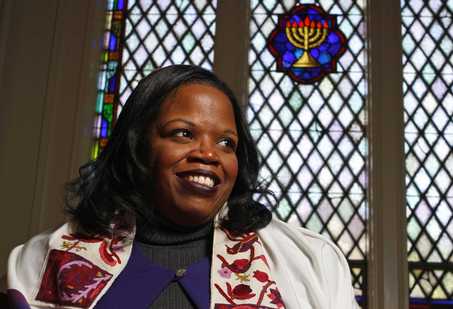
First Black Female Rabbi Ordained

Bob emails: There goes the neighborhood.

Khunrum emails: "There’s one shul that might let Luke attend."

Fred emails: "I wonder if they’d make him sit in the back of the shul."

Bob emails: "Even they would probably question our hapless hero’s orthodoxy. "Sheeeit. Dat mofo ain’t kosher!""

Posted in Conversion, Orthodoxy, Personal, Rabbis | Tagged , , , , | Comments Off on First Black Female Rabbi Ordained

‘A Sincere Question’

Rabbi Yehuda (YY) Rubinstein emails me June 5:

Dear Mr Ford,

I honestly want to pose you a question if I may. I watched the video of you sitting in the car the other day [LF: this video or this?] and it was really sad to see.

I am sorry your life has become as sad as you express it to be. I sincerely hope things go much better from you soon.

In our recent exchange you wrote,

"I read the piece. My only concern in this matter is journalistic. I have no concern about people being offended. You are probably a rocking rabbi but I am only going to remove a reference in this sort of thing if the facts are wrong."

At the same time you wrote,

‘It doesn’t bother me that there is a substantial case in Jewish law against converts such as myself becoming rabbis.’

My honest question to you is why do you claim here (the same claim appears on your Wikipedia page) that you are convert to Judaism, which obviously requires someone converting you other than yourself, when in fact you are not.

Your claim to be concerned about journalism and facts not being wrong so why do you claim to be what you are not?

Rabbi Y Y Rubinstein

I respond:

Dear Rabbi,

I guess either I am a liar or I am telling the truth…or the truth is somewhere in between these two poles.

What’s interesting to me is how sure you are that I am saying something that is not true and that given the sensitive nature of conversion matters (which is something you know so keenly that you have put yourself to considerable trouble to try to clean up my internet site regarding your conversion status), you would go in with a dagger to the heart on this with someone with whom you are having a dispute.

A week ago, I emailed a rabbi that we both know and told him I was planning to take down my blog post on you purely as a favor to him. I told him I’d leave it up for a few weeks so you’d learn it is not OK to do with anyone as you have done with me.

I now plan to leave it up for a very long time so the world can know accurately and in your own words how you operate. You know more Torah than me and you use that knowledge as a cudgel to try to get your own way.

Levi

Rabbi Yehuda Rubinstein emails:

Dear Mr Ford,

There is no "Between those two poles" as you write. If you had, as you wrote been converted then you are a convert. If not you are not.

Nor is the conclusion necessarily that you are a liar. You may simply be fooling yourself that a process you begun some ten years ago and from which you were expelled at least once, somehow makes you a convert.

My reply from the RCC as well as from Rabbi […] make it quite clear what your situation and status is.

Additionally, someone forwarded to me a recent conversation with you, which makes it very clear what your situation is too.

As is the case in every exchange so far, your understanding of Judaism’s position is profoundly ignorant. Sensitivity and the thrice repeated Torah prohibition of reminding a convert of his status (Sanhedrin 94b) applies to someone who has become a Jew ergo not to someone who has not.

In that both the Rabbis whose responses told you to take down the references to me were wrong.

Rabbi […] seems to have forgotten what Rashi says there and the second Rabbi’s reason of, tzar baalei chaim, misses that it is an issur d’ orayso in its own right.

In the interests of truth and journalistic accuracy I shall be editing the wikipedia entry about you when I get back from a break here in the Lake District with two of my children, so that no one reading your blog, (which is I believe the most anti-jewish thing I have ever seen,) will think a Jew is responsible.

As a Rabbi, I have been defending Jews on and off campus for roughly thirty years. I have seen some truly unpleasant things in print about the jewish people.

I found myself the other day, not for the first time on a neo nazi web site. Still, perhaps because you have claimed to be and people have believed you to be a Jew, what you peddle most offends against basic Jewish, Middos, Hashkofa, Halocho and poshete Yiddishe Gfil.

Regarding the Din Torah, the RCC refuse to hear the case as they write you are not a Jew.

A lawyer friend in L.A. has though taken the original posting as well as my replies to you in their in unaltered form and yours to me again before you edited them, to the expert in her firm to see if I can bring a case against you in civil court. If I can I will.

Before you echo your previous outrage "Is this the way for a Rabbi to behave?" The answer is, Rabbis are not priests and judaisms is not seventh day adventistism.

The role and function of a Ger, as the Seforim Ha Kedoshim and the Anshei Yodeai Chein make clear, is to be a Klipa.

In that role I believe, your site which so mercilessly attacks Jews and Rabbis, irrespective of guilt having been proved, deserves the review and scrutiny of the law.

If some of the things you publish are true I have no sympathy with those accused. They do though, deserve due process and when in the past, I for instance have exposed frauds or paedophiles, I do it as aggressively as possible but through the proper channels.

Some of the Jews and Rabbis you attack and make cutting remarks about I know do be good and sincere people.

You wrote that if you had pity, you would have no blog.

Someone who attacks the innocent like me and lumps them with those you assume to be guilty is someone who perhaps indeed deserves little pity.

As a non jew, you may not know that judaism permits self defence. So you should be aware that if I am able to, I will sue you.

When I return on wednesday at least the LA community and beyond both Jewish and non Jewish will be able to learn of your true status.

After that, they can draw whatever conclusions they feel appropriate as to why a non-Jew has spent and spends so much time attacking and criticising the Jewish community and some of it’s members.

Rabbi Y Y Rubinstein

Luke says: I completed my first conversion to Judaism in 1993 with Reform rabbi Marvin Schwab in Sacramento. I completed my Orthodox conversion to Judaism with the Los Angeles Beit Din Sept. 13, 2009.

Posted in Conversion, Personal, R. YY Rubinstein, Rabbis | Tagged , , , , , , | Comments Off on ‘A Sincere Question’

She’s Looking For A Nice Jewish Boy

myannamills:  what are you doing with yourself these days. You are retired arent you?
 Luzdedos1:  lukeford.net
 Luzdedos1:  jewish stuff
 myannamills:  haha i love jewish guys
 myannamills:  they are my weakness haha
 myannamills:  I"m a shikse
 myannamills:  haha
 myannamills:  I’ve been doing erotic horrors. Its good fun. I also had a stroke. Lucky for me I’m ok and it was just birth control that caused it.
 Luzdedos1:  oy ve
 myannamills:  haha yes oy ve
 myannamills:  I love it when you speak yiddish to me
 myannamills:  It was something called a tia. Have you ever heard of it?
 myannamills:  transient ischemic attack
 Luzdedos1:  never heard of it
 Luzdedos1:  sounds horrible
 myannamills:  Lucky for me its a stroke that does not last long enough to cause permenant damage.
 myannamills:  Its a good thing I started out very smart with as many times I’ve had brain injuries. *insert being dropped on my head joke here*
 myannamills:  I am lucky though. I actually thought I was going to die. It makes things seem very different. Things like that also show you which friendships are the kind that are fair weather and the kind that will weather the storm.
 myannamills:  I haven’t seen you in a long time.
 Luzdedos1:  many years
 myannamills:  Of course, I am pretty out of the loop. I was at the bunny ranch last year with Sunny Lane.
 myannamills:  Kacey Jordan was there too
 myannamills:  Do you know her?
 myannamills:  She is so cute.
 myannamills:  She has to be the cutest drunk I’ve ever seen. Sunny myself and Kacey went to see Motley Crue. It was fun getting to meet the guys back stage.
 myannamills:  Really good people watching. You must like people watching with what you do.
 myannamills:  Are you having chinese food tonight?
 myannamills:  Isn’t that what jewish people do?
 Luzdedos1:  yep, except me
 myannamills:  Why not?
 Luzdedos1:  dont like chinese food
 myannamills:  good reason
 myannamills:  What do you eat after your movie on christmas?
 myannamills:  I know its not actually hebrew law, but I am totally at a loss now.
 Luzdedos1:  nothing regular
 myannamills:  do you go see the movie?
 Luzdedos1:  sometimes
 myannamills:  haha
 myannamills:  These are things I’ve observed from  my friends that are more the reform type jew-ish people. It seems fairly consistant.
 myannamills:  Jew-ish meaning they are not religious, but Jewish non the less.
 myannamills:  have you ever joined jdate?
 myannamills:  Maybe I should be a journalist Luke. I love asking questions. People are interesting>
 myannamills:  I joined it recently.
 myannamills:  I’m not kidding. I did.
 Luzdedos1:  ok
 Luzdedos1:  why?
 myannamills:  the mother in law
 myannamills:  haha
 myannamills:  kidding
 myannamills:  Im bad with numbers…
 myannamills:  No, I just noticed my type is more common with Jewish guys.
 myannamills:  I am aware my children wouldnt be jewish. I was just checking it out to see if it worked.
 myannamills:  It didn’t but I did have an amazeing surge of jewish friends on facebook
 myannamills:  I also have a few pretty cool friends out of it.
 myannamills:  my ex bf is jewish and he was on there when i joined…man did he give me hell.
 myannamills:  it was funny
 myannamills:  what are the odds of having an x in a search i did for people in my area?
 myannamills:  did you meet anyone off of that site? my x said he only went out with non jewish girls and hes at the point now where he wants a jewish girl because hes ready for kids.
 Luzdedos1:  yeah, i did
 myannamills:  The jewish guy shall remain simpley Michael
 myannamills:  He was a main stream guy.
 myannamills:  Hes a great guy. We went out when we where both more wild.
 myannamills:  Of course I had Tommy Lees asst tell me I was too wild. Me? I’m pretty much a tea totaler.
 myannamills:  I guess thats not what people mean though.
 myannamills:  Beliving that your guy can have sex with other girls eqauls crazy to men. You would think it would be easy to find a guy like that, but its not. Not one that also is worth doing all of that for.
 myannamills:  It actually takes effort to do that, and the guy has to be a guy girls would want to be with too.
 Luzdedos1:  hmm
 myannamills:  Then he also actually has to treat me with respect. I guess what I want is a paradox.
 myannamills:  haha
 Luzdedos1:  hmm
 myannamills:  hmm is so ambiguous
 myannamills:  I met a guy with all of those things and I told him up front about the bunny ranch and porn and he broke it off.
 myannamills:  Better sooner then later I suppose
 myannamills:  I could have lied like everyone else.
 myannamills:  what did you mean by hmm luke/
 myannamills:  ?
 myannamills:  I’m going to take my dog out.
 myannamills:  Nice chatting with you. I hope you are doing well.
 myannamills:  good luck sweety

Posted in Personal, Pornography, Prostitution | Tagged , , , , , | Comments Off on She’s Looking For A Nice Jewish Boy

How Did A Pot-Smoking Anarchist Become The Guardian Of The Conventional Morality?

JTA’s head of digital media, Daniel Sierardski, writes:

One phenomenon that appears to be accelerating the decline of at least some Jewish news organizations is the rise of a group of Jewish news aggregation Web sites, predominantly serving the ultra-Orthodox community, which copy and republish in-full, without permission or payment, content from more prominent Jewish news sources, robbing them of both desperately needed licensing fees and revenue-generating Web site traffic.

JTA, for example, is a syndication service which requires that third parties sign a licensing agreement to redistribute our content. Nearly 100 Jewish newspapers around the world pay for this service dutifully, though that number is now declining due to the state of the industry. While we depend on these revenues to continue in our service as the primary source of national and international Jewish news coverage in North America and around the globe (as well as to provide our staff its parnassah), unauthorized Web sites such as Yeshiva World News, Vos Iz Neias, Matzav.com, COLlive, CrownHeights.info and CrownHeights.ch, which do not have licensing arrangements with JTA, reprint our content — and that of our colleagues and competitors — with impunity, despite the clear illegality of such practices. These Web sites then profit from the sale of advertising alongside our stolen content.

Does the republishing of JTA news stories rob JTA of revenue-generating web traffic?

I don’t think so. Most search traffic comes from Google which has a duplicate content penalty. When the websites Sierardski writes about duplicate content, Google not only does not send them traffic for these stories, it penalizes them with lower search engine rankings.

Google says in its webmaster guidelines: "If you find that another site is duplicating your content by scraping (misappropriating and republishing) it, it’s unlikely that this will negatively impact your site’s ranking in Google search results pages. If you do spot a case that’s particularly frustrating, you are welcome to file a DMCA request to claim ownership of the content and request removal of the other site from Google’s index."

Does republishing JTA stories on blogs rob JTA of licensing fees? I doubt it. These blogs couldn’t afford licensing fees. As far as Jewish newspapers go, they make most of their money from their print editions. Republishing JTA content online will never be a money-maker for them. Duplicate content once again.

As far as revenue-generating web traffic goes, JTA does a terrible job with its Adsense and other advertising content. When JTA won’t make the least effort to understand how to use web advertising, how can anyone feel sorry for them? They are deliberately incompetent yet want to blame others for their problems.

I very kindly and gently pointed out these matters to Sierardski a couple of months ago, receiving in reply this.

No wonder much of the Jewish blogosphere hates JTA.

The whole thing makes you wonder what Sierardski is smoking and how much damage this has done to his brain power. And why is he suddenly all concerned about acting within the law when it comes to this one matter? After all, he presents himself as the Orthodox Anarchist. I guess he’s an anarchist when it suits him, Orthodox when it suits him, and law-abiding when it suits him.

He sounds like me. Shame Prop 8 passed or we’d be able to give concrete expression to our feelings for each other.

Posted in Daniel Sieradski, Jewish Journalism, Journalism, JTA | Tagged , , , , , | Comments Off on How Did A Pot-Smoking Anarchist Become The Guardian Of The Conventional Morality?

Contemporary American Judaism: Transformation and Renewal by Reform Rabbi Dana Evan Kaplan

We talk by phone Tuesday, June 2. (Previous interviews with Rabbi Kaplan here.)

Luke: "You have a note in the beginning that some of your language in this book is a bit sharp."

Dana: "I’m trying to make certain points. I don’t know how others will read it… Particularly in chapter six, radical responses to the suburban experience, I’m saying that for many young Jews in particular, the way they experienced suburban Judaism was not positive. They saw their parents as interested in material success and superficial appearances rather than actual emotional and intellectual content and they rebelled against this."

Luke: "Does your book break new ground?"

Dana: "It’s not intended to…"

We talk about Rabbi Norman Lamm, former chancellor of Yeshiva University.

Dana: "I was bar mitzvahed by Norman Lamm. I was raised in a Reform household, but when I turned 12 and we were planning a bar mitzvah, my parents started taking me regularly to Temple Rodef Shalom on the Upper West Side where they were planning to have the bar mitzvah, but they used an organ, and I just reacted very emotionally negative to that organ, and I said I didn’t want to be bar mitvahed there. Right up the street was the Jewish Center where I had been going periodically as well, so we signed up there as members, or maybe we had already been joint members, I said I wanted to have my bar mitzvah there. My parents said fine. Rabbi Lamm as well as Rabbi Leo Young led the services at my bar mitzvah."

"I used to love to go to Saturday morning services there to hear Rabbi Lamm’s sermons. He spoke a lot about Israel and the politics of Israel in the Middle East."

Luke: "I was struck by the vehement way that the non-Orthodox leaders responded [to Rabbi Lamm saying we will soon be saying kaddish on Reform and Conservative Judaism]. They obviously care very much how this one Orthodox leader regards the viability of their movement."

Dana: "It seems that in general there are less polemics going back and forth in the last ten years then there were before. Both sides, particularly the Orthodox, have given up on the other side."

Luke: "It strikes me that winners don’t call for dialogue."

Dana: "The non-Orthodox are going through a trying period."

Luke: "Men seem to be dropping out of non-Orthodox Judaism, particularly Reform Judaism."

"The Orthodox have a lot of confidence that they are building on what they have."

Dana: "It’s a very serious problem. It makes a lot of sense. As you develop a new set of values, you have foreseen and unforeseen consequences… Men feel increasingly marginalized and alienated. You have a situation of the femininization of American religion… In my day at Hebrew Union College (the Reform seminary), I had heard a rumor that the admissions office was deliberately trying to keep the percentage of entering students male-female ratio at 50/50. And if they didn’t, it would quickly go to 65-70% women. I have heard that now it is. I wonder if that is true in the Reconstructionist and Conservative movements as well. I heard that in the cantorial school at Hebrew Union College, it is overwhelmingly women. It’s a big problem. It’s a problem with services. It’s a problem with boards. It’s a problem with participation across the board.

"Part of the reason for this is that men may have been participating in certain congregational activities, not because of a certain innate interest in Judaism, but because it was a way to show their social status. If you donated liberally, you could then be on the board. If you were on the board, you could then you were a macher and that gave you increasing social status in the community. Once a few women have been presidents, men may not see being a board member or even president giving them that social status and it may not be a way for them to assert their masculinity. And so it becomes of less interest.

"So, this is one of the huge challenges that face the non-Orthodox communities over the coming decades. A failure to figure out a successful strategy will come with serious consequences."

Audio:

2:

3:

4:

Posted in Author Interviews, Judaism, Rabbis | Tagged , , , , | Comments Off on Contemporary American Judaism: Transformation and Renewal by Reform Rabbi Dana Evan Kaplan

Can The Homosexual Be Cured?

Rabbi Gil Student writes: When I mentioned in an earlier post (link) that I had received a copy of Light In The Closet: Torah, Homosexuality and the Power to Change by Arthur Goldberg, there was an almost immediate negative reaction to the book by some commenters who had not even read it. I attributed this closure of so many minds to the politically correct atmosphere in which we live. However, after going through the book, I understand better why they so strongly oppose the approach advocated by the author.

The book can be divided into four parts — Jewish attitudes to homosexual acts, the concept of repentance, the homosexual agenda and therapeutic methods of changing sexual orientations. This is a very long book and I can’t remember every detail. However, from what I recall, the discussions of Judaism regarding homosexual acts and repentance are accurate. The author rebuts many of the false arguments that have been proposed to permit different aspects of homosexual acts. Again, there might be a point here or there where I disagree, but overall I think he is right.

TH POSTS: 1)the study that one cannot change their orientation under any circumstances is widely touted by the gay community, but is almost 20 years old and has been conclusively proven false.
2)The prevalent thinking in the academic world is that their is a spectrum with seven levels, one end being purely homosexual and one end being purely heterosexual. Most people *naturally* fall somewhere in the middle. One can move up and down the spectrum.

STEVE BRIZEL POSTS: One has to keep in mind that the DSM, which in its earliest editions, included many mental ailments including homosexuality , etc, delisted any such references as the gay rights movement grew in power. For these reasons, I tend to doubt that a book of this nature would be published by a mainstream academic publisher.

ARI POSTS: This might be worth a read:

http://www.motherjones.com/polit…sexual- identity

Suffice it to say that there is hand waving, convincing through intimidation, and black and white presentations on BOTH sides of this debate.

According to many in the gay community, it is absolutely impossible for a person to be "cured" of homosexuality. To disprove this claim, all that needs to be brought is one counterexample. I think this is a foolish position for the gay activists to take.

Now, if I were to guess (and it’s only a guess) I would say that treating homosexuality would be akin to treating an addiction in many ways. And just as the treatment of addiction has many failures, few would say that the pursuit is not worthwhile. But that’s just my guess.

Frankly, I think the facts are much more complex than activists on both sides make it out to be.

I’m not really sure the question "can homosexuality be cured?" is relevant to living a halachic life.

I think three other questions are more relevant.

1) Can a person who would otherwise prefer homosexual contact live a reasonably fulfilled life were he not to ever be able to attain such contact?

I imagine the answer to this question would be yes more often than many would think. The reason being that men are not, by nature, particularly monogamous. And most men can be reasonably fulfilled in a marriage.

2) Can a person with a primarily homosexual preference become accustomed to and derive satisfaction from heterosexual contact long term?

Again, I would guess that the answer is yes in many cases. The reason being that the exact opposite occurred in ancient societies such as Sparta. In Sparta, homosexual conduct was nearly universal. So much so that birth rates plummeted. Presumably, many Spartans would have chosen heterosexual contact were they brought up in a different society. (Unless you can argue that Spartans were a biological anomaly, my argument holds up). Despite their biology, the Spartans did become accustomed to homosexual conduct. I can see no reason why the opposite should be impossible.

3) Is it practical for a person with homosexual urges to experiment with his life and the life of his future family by attempting a marriage?

I don’t know. I would imagine decisions could only be made on a case-by-case basis.

I think this analysis helps to cut the problem down to size. It is still a problem for those who want to live an orthodox Jewish life, but to deal with a problem we must know its actual dimensions.

LUKE SAYS: I once dated a lesbian and in just a few dates, I cured her of her queer tendencies.

Posted in Homosexuality | Tagged , , , , , | Comments Off on Can The Homosexual Be Cured?

ATID Weed

I was having a gentle morning conversation when suddenly the woman said, "How old is the world?"

Wow. "About five billion years," I said. "I think that’s the scientific consensus."

"But what about the Torah?"

"I don’t take the first eleven chapters of Genesis literally."

"If you had said 5769 years, I don’t know how I would’ve gotten my mind around it."

"He he."

"I’m embarrassed to admit this, but in college, I was the president of the Jewish student group ATID. And when we had money left over near the end of the school year, I had us buy weed. ATID Weed."

"You’re a bad girl."

"I had never gotten an aliya. I was told I would die. You can’t. Lightning would strike. I menstruate. I had a bat mitzvah. It was eye opening. I led the prayers. My best experience with Judaism was that year. For that year, I really got into non-Orthodox forms of Judaism. I became fascinated by Mordecai Kaplan and Reconstructionist Judaism."

"After 18 years in yeshiva, and a year in Israel, I was just like Captain Destructo. I was lighting fires."

"I’m having dinner tonight with author Josh Alan Friedman."

"IS HE ORTHODOX, because if so I automatically lose respect for him and his intellect.

"Say something."

"I’m so tired, I’m going to bed."

"I’m coming over. I want you to prepare. Say tehillim."

Posted in Orthodoxy, Personal, Reconstructionist | Tagged , , , , , | Comments Off on ATID Weed

Equality Is A Goyisha Value

Rabbi Gil Student writes:

Jewish law has Jews treat other Jews in a somewhat more favorable fashion, e.g. forbidding a Jew to charge interest on a loan to another Jew but permitting him to do it on a loan to a Gentile. Is there some merit one Jew exhibits in relation to another that a Gentile lacks? It could be argued that being a part of the same community, like being part of the same family, is itself a merit that justifies slightly preferential treatment. If done consistently, this can be considered a just form of differentiated equality.

In a different fashion, Jews law places certain disadvantages on an immoral person. Effectively, this causes a disparity in treatment between those who act morally (i.e. follow the commandments) and those who act immorally (i.e. violate certain severe commandments). Since this distinction is based on an understandable merit and is applied consistently, it seems like a just inequality.

Note that this discussion only deals with whether the inequality in treatment is just, whether the very existence of a difference is morally acceptable. It does not address the different standards of treatment for classes with different merits, which I think is also just but requires a separate discussion.

R. Roth concludes, "Jewish law obligates us to treat equally those who, by relevant standards, are, as a matter of fact, equal."

YAAKOV B POSTS: God does not give people equal opportunities in the physical world – some people are born disabled. Why should we assume that He would give equal opportunities in the spiritual realm?

TZVEE POSTS: Check back to October 2008.

Dennis Prager said in a speech at Orchestra Hall in Minneapolis that "equality" is not an American value.

That won him Keith Obermann’s, "Worst Person in the World" award.

Are you looking for an award?

NACHUM LAMM POSTS: At "egalitarian" minyanim, who receives the first and second aliyot to the Torah? I ask this in all seriousness. After all, if "egalitarian" is to mean anything more than "feminist," there isn’t much egalitarian about the Kehunah. (I say this as a proud Kohen.)

And even if it *does* mean "feminist," one may then ask whether a daughter of a Kohen (especially if married to a non-Kohen) is entitled to the first aliyah at an egalitarian minyan. And what about her daughters?

Y. AHARON POSTS: Does someone really believe that the differentiation in halacha between the sexes is a reflection of relative merit? The evidence from the generation that first received the torah suggests that women were generally on a higher religious plane than men, "bishvil nashim tzidkaniyot nigalo avoiteinu". Rather the distinction is due partly to natural differences in function and on the cultural imperatives of the patriarchal age. The key point is not to accentuate such differences but, instead, to try to ameliorate the disparities due to later custom.

Similarly, the honors given kohanim aren’t really based on a biblical injunction. That injunction of "vekidashto" is dependent on the clause immediately following, "ki et lechem Elo_av hu makriv". We haven’t seen the latter function served for nearly 2 millenia. Rather, the honor given, it seems to me, is justified by the fact that those kohanim also bless the congregation – as stipulated in the torah. Nor is the practice always followed since kohanim are sometimes not given the first aliya if there is a simcha or many chiyuvim.

The point is that the honor given to kohanim is not arbitrary or reflective of some genetic superioritiy but has a basis in current function and is sometimes waived. If so, then the lesser honor given to women on a communal basis is not reflective of current function and is arbitrary.

JOSEPH KAPLAN POSTS: I don’t think the equation of women and kohanim (I am one) works. Look at the privileges kohanim have. Other than duchanin, big deal. Sure, it’s nice to get the first aliyah, but if not, so what. And I think that if women were excluded from one part of the prayer service (as they are, indeed, in Shirah Chadasha), then it, too, would be no big deal. The problem is they are excluded from EVERYTHING. and this exclusion then has other practical ramifications; their section, in many shuls, in placed in a disadvantageous area where they can’t see or hear well. Sometimes, nO consideration at all is given to having ANY place for them as in those shuls which don’t open the women’s section on weekday mornings or where men sit in that section, forcing women to daven in the hall. My guess is (and it’s only a guess, of course) that if only kohanim could daven for the amud, levi’im and yisraelim wouldn’t feel the same way they do now that we get the first aliyah and lead the benching more often than they do.

Posted in Judaism | Tagged , , , , , , , , , | Comments Off on Equality Is A Goyisha Value

A New Modern Orthodox Blog

About a year ago, I said to Rabbi Yosef Kanefsky, "When are you getting your own blog?"

He seemed pretty overwhelmed at the time and I did not expect him to post one any time soon.

I got an email about his new blog this morning and it came as a pleasant surprise. Far more people will read a rabbi’s blog than hear his sermons.

http://morethodoxjudaism.wordpress.com/

I often feel like I have the most powerful pulpit in Pico-Robertson, even though I am persona non grata at five of the main shuls (Bnai David-Judea, Aish HaTorah, Chabad Bais Bezalel, YICC, and Beth Jacob).

The most powerful rabbi in the world today is Rabbi Google.

Rabbi Kanefsky writes: "The claim here is not that Halacha is egalitarian. The distinctions with regard to edut and with regard to the obligation in certain mitzot remain as they are. The claim here rather is that all of the day-to-day, week in week out responisbilities of a typical pulpit rabbi can be done just as well by a competent and skilled man or woman. Why should someone be excluded from the entire profession of the rabbinate just because she can’t sign a ketuba?"

This new blog offers the opportunity to make comments and the bloggers, including Rabbi Kanefsky, respond.

If the gentle reader finds the civility on this new blog oppressive please know that you will always have a home here.

How long until the other rabbis in Pico-Robertson start blogging?

Posted in Modern Orthodox, Orthodoxy, Pico/Robertson, R. Yosef Kanefsky, Rabbis | Tagged , , , , , | Comments Off on A New Modern Orthodox Blog