There I was poolside, on day three of our vacation, fumbling with four water glasses I was bringing to my dehydrated kids, and who do I run into? The one guy I see most Friday mornings on Pico Boulevard when I pick up challahs for Shabbat: my friend Julien Bohbot, owner of Delice Bakery and Delice Restaurant.
Bohbot was there on business. He is putting together — with the people of Club Med at Ixtapa — an all-inclusive Passover excursion with his own kosher gourmet cuisine and all the fabulous amenities of Club Med. For a set fee, you can avoid all the Passover cleaning, shopping, cooking, serving, hosting and shlepping.
All you have to do is pack your bags and show up at LAX. They’ll take it from there.
Bohbot represents the tip of the iceberg of a mini-revolution in how American Jews are choosing to spend their eight days of Passover. Open any Jewish newspaper at this time of year and you’ll see a growing number of ads for Passover excursions on cruise ships, desert or beach resorts and even luxurious trains.
It’s the Exodus from the Exodus. For more and more American Jews, it seems that at Passover time, there’s no place like away from home.
Until this year, I didn’t pay much attention to this trend. But as I sat poolside this past week listening to Bob Marley music and pondering the notion of reliving the story of my people in a place where they teach you beach limbo, part of me wanted to scream: What are you all thinking?
I understand the convenience of getting away and taking advantage of the Passover holiday to have a family vacation. But where’s the romance of tradition?
For the past 20 minutes, since getting home from therapy, I’ve been getting things done while also glancing regularly at the TV screen. A beautiful blonde is driving a U-Haul away from the CHP. She started in the Burbank area, got on the Ten freeway and took it west and now she is north of Pepperdine. She’s hot. She’s wearing a white top and no seat belt. She bops up and down in her seat and smokes the odd ciggie.
I’d really like to know this girl better.
I wish I could turn off my TV but I can’t.
I’ve often been told that my blog is like a car wreck and that my life is like a car wreck.
I want to harness the fascination i feel and capture the same type of excitement on my TV and transfer it to my blog so people can’t look away but while they are here they are reaping enormous spiritual rewards.
R. Eliezer Melamed is active with Arutz Sheva and is the rabbi of the weekly newspaper Be-Sheva (link). In one of his columns (13 Tammuz, 5765/ July 20, 2005), he responded to a question about the halakhic aspect of negative news stories. This column was reprinted in his book Revivim: Am, Eretz, Tzava, pp. 100-102.
R. Melamed begins by pointing out that lashon ha-ra is permissible when there is a constructive purpose (to’eles). There are two types of to’eles: Click here to read more
To prevent someone from entering a bad business deal or marrying someone inappropriate, in which case the least amount required should be said.
To rebut an improper action so that others do not follow it. In this case, you have to be extremely clear about the action’s impropriety and this cannot be done with minimal language. However, even here you must be honest and may not exaggerate.
R. Melamed quotes from the classic guide to the laws of lashon ha-ra, Chafetz Chaim (1:10:4), that if your intention is to distance people from an improper path, then this is considered a legitimate to’eles.
Menachem Butler comments: "If you’re talking about the Chafetz Chaim and hilkhot Lashon Hara, then you MUST see the very-recently-published article by Benjamin Brown, "From Principles to Rules and from Musar to Halakhah: The Hafetz Hayim’s Rulings on Libel and Gossip," Dine Israel 25 (2008): 171*-256*, esp. n.265 (English)."
F-P writes: "If you look at the list of guidelines in the linked article (or if you look at the same in the Sefer CC) there are a number of conditions before you start publicizing things lito’eles. Most importantly, you need to know that the information is accurate. This is generally lacking in most of these newspaper articles, as well as blogs etc."
DF writes: Is there really any such thing as "hilchos loshon hora"? Seems to me the CC just took a lot of stray aggadic passages and personal incidents mentioned in the gemara, plus the occasional halachik statement, and strung them together. Am I way off base here? Since when do we learn halacha from Aggada?
And to the extent one can call it "halacha", then it should be on the same plane as "hilchos De’os", which everyone feels free to disregard. There are more pesukim that relate to De’os than relate to being a talebearer.
Truth is, everyone does disregard it already. There is nothing in the world for which you cannot justify yourself by saying it’s for a toeles.
Menachem Butler writes:
The second path taken by the Hafetz Hayim was to utilize musar and aggadic sources, including narrative sections of the Bible, in order to derive halakhic norms. Nevertheless, in general, the Hafetz Hayim was very selective in his reliance on musar literature. For example, he does not cite from well known musar works such as Hovot ha-Levavot, Orhot Tzaddikim, Ma‘alot ha-Middot, or Reshit Hokhmah, even though they deal to a significant degree with the issue of libel. These he saves for his book Shemirat ha-Lashon. In isolated instances, he cites musar works of aharonim, such as the Maharal of Prague, the Shlah (Shnei Luhot ha-Brit), and the Vilna Gaon. In contrast, he frequently quotes the various books of commandments, composed in the Middle Ages, which fall on the border between halakhic and musar works, and also Sefer Haredim which "integrates issues of halakhah and musar.’’ Above all, he often cites the book Sha‘arei Teshuvah by Rabbenu Yonah Gerondi. The latter work was the book that most extensively dealt with the issue of libel prior to the time of the Hafetz Hayim. In his introduction, the Hafetz Hayim lists Sha‘arei Teshuvah as one of his central texts, along with Maimonides and the Sefer Mitzvot Gadol. He was aware of the problematic nature of relying on a work of this nature as a source for halakhic rulings, and therefore added the following in a footnote:
"The reader should not wonder about the fact that in this book, which is entirely based on halakhic sources, I refer several times to Rabbenu Yonah’s Sha‘ arei Teshuvah, which belongs to the musar literature. For it is evident to anyone who has delved into his holy words that he was very careful not to traverse the parameters of the law. It is particularly so in the area of libel, where everything that he wrote has a source in the Talmud, as we will clarify in the book, God willing, but, being committed to brevity, he did not cite these sources, in the manner of the rishonim (medieval rabbis). Nevertheless, I generally relied on him alone only in places where his words imply a leniency (as I did regarding other musar works), but for stringencies, I almost always brought other sources, as one who examines [my book] will see inside."
Luke: "Suzanne, when you were a kid, what did you want to be when you grew up?"
Suzanne: "I had always written, but I wouldn’t say that I always wanted to be a writer. I remember liking the waitress at the local restaurant I went to with my family and thinking I wanted to be a waitress, which I did for a while."
Luke: "When did you come to realize you wanted to be a writer?"
Suzanne: "It’s always been something I’ve done. I have memories of keeping a journal from early on, probably as early as seven. My mom made sure I always had a journal around."
Luke: "What have your parents most wanted from you?"
Suzanne, the youngest child: "That’s a good question. That I be happy."
"There are four children and no one is yet married with children. Occasionally I get a hint that they would like grandchildren."
Suzanne, who’s spent about eight years in therapy, got her undergraduate degree in Philosophy from George Washington University. After working for various non-profits in Boston, she then got an MFA in Non-Fiction Writing from Sarah Lawrence. "I wanted more discipline and more time. I felt like being in that sort of community would be great."
"I wrote the memoir in the second-person because I wanted to create a little bit of distance."
Luke: "Was there a therapeutic aspect to writing this book?"
Suzanne: "Absolutely. Are you short on time?"
Luke: "You can go on forever."
Suzanne: "I turned 30 and that’s where the book ends (in Spring 2006 for the Afterword)."
"The question that drove me [in the memoir] was, wow, what a crappy year, what the hell happened to me? I had no goals to publish when I was writing it. A lot of the book is about having repressed certain feelings… It was very healing. It allowed me to reclaim and re-experience what I was unable to experience the first time around. I wrote with the intention of it being therapeutic and cathartic. The decision to publish was completely separate."
Luke: "How difficult was it to craft an ending to the book?"
Suzanne: "It was so hard. I wrote a million crappy endings. At one point, I had this really funny ending. At least, I thought it was funny. In November 2006, I went to see Donna Summer. I ended up singing on stage with her. I tried to write that as the ending and it was really bad. I was volunteering and running a writing group at the end and I read it to the women in the book and they looked at me, ‘Oh, that was fascinating.’
"It was hard figuring out the right notes I wanted to strike. The whole book is all along a certain path. I always wanted to change the perspective in the ending…"
Luke: "Was it hard because it wasn’t clear that that part of your life had a happy ending?"
Suzanne: "Yes. Well, I wouldn’t put it in terms of happy or unhappy ending. It certainly felt like it was still in process. The writing was exceptionally healing. It felt like an open chapter and to randomly pick a place to end was really tough. I wrote the ending in April 2007 and then worked on it a lot after that. It felt disengenuous. Now I can wrap it up and everything’s great. I tried to work with that."
Luke: "From the perspective of art, what did your ending need to accomplish?"
Suzanne: "Hmm."
Luke: "From the perspective of story-telling, what did your ending need to accomplish?"
Suzanne: "The main thing I wanted to show was a sense of ownership over the story that’s not in most of the text. I’m referring to the first-person Afterword… I had this instinct that I wanted to say everything. Ultimately, I came to realize that all I needed to do was show that there was a beginning and I didn’t need to do anything past that."
Luke: "How did the writing of this book affect your life?"
Suzanne: "It really affected it in major ways."
"The first attempts at an ending didn’t feel genuine."
"I used to do storytelling performances. Once I put down that draft, I had no wind in my sails. I had no desire to perform. Life became a lot more quiet after that. The ending is about clearing out all the crap and figuring out the starting place. The writing process helped me get there."
Luke: "Did you feel a need to change your life so you’d have an ending to your book?"
Suzanne: "God no."
"One interesting thing was sharing it with people close to me, such as my sister and my mother. That was wonderful. A lot of that year, I was closed off and people close to me were wondering and worried. When I shared it, it created an openness in the relationships that’s really nice."
Luke: "Have you read the book ‘Your LIfe as Story’ by Tristine Rainer?"
Suzanne: "No."
Luke: "It’s a book on writing a memoir. For some reason, this sentence [fragment] from it came to mind: ‘Your desire line, which should run with the power of a hungry tiger from the beginning through the middle, right on through to the conclusion of your story…’
"If I was reading your book and saying, ‘Where’s the desire line?’ My impression from the book is that your desire line is your desire to publish this book. Is that right?"
Suzanne: "No."
Luke: "What is the desire line, if you’ve ever thought in those terms?"
Suzanne: "I haven’t. It’s really interesting. Could you phrase it in another way?"
Luke: "Desire line. Usually in a story, there’s something the protagonist wants and then all through the story, they are pursuing what they want and they either get it or don’t get it… For you, your desire line in this book is either the successful accomplishment of your first book or pursuing love… The idea of a hungry desire powers every good story. The protagonist wants something and there are obstacles they have to overcome."
Suzanne: "That’s an interesting notion. I definitely wanted to be successful. I felt like the bar was really high and I was never going to get there. On another level, I wanted things to be settled in my life. I did want love. It’s more than that. I felt really cut off from myself and I really wanted connection to the person I felt I was developing into."
"I was in this big growth stage and I wasn’t handling it well. It was sorta, if things worked out with my boyfriend, everything would be great. Or if I only had a career, everything would be great. I think the desire line was actually underneath those things. I didn’t really want to do the work. I just wanted the superficial things that would make me feel my life was going the way it should be going."
Luke: "I wonder if what is going on in your book is a desire to be married and taken care of but to say that you want to be taken care of is perhaps too shameful in this modern egalitarian world?"
Suzanne: "Yeah, I would definitely say there was truth to that."
Luke: "Can I get you to elucidate on that? I do think most women do want to be taken care of and married but it is not something you are supposed to admit to in our egalitarian age."
Suzanne: "I think that’s really, yeah, it is a shameful thing to admit. that you want to be taken care of. I should say there is some shame associated with that. I don’t know if part of it is where I live. Sorry, I need a minute to think about this.
"On the one hand, to be really ambitious and out there in the world in terms of your career is an amazing thing. In my case, one of the challenges was to admit that I want other things beyond that. It wasn’t conscious for me when I wrote the book. That came later."
Luke: "It would be ironic if the memoir of embarrassment won’t explicitly touch what has traditionally been the most innate of female desires, and that is to be taken care of by a man."
Suzanne: "Could you say that again?"
Luke: "It would be ironic if a memoir of embarrassment does not explicitly deal with what has traditionally been the most innate of female desires, to be taken care of and protected by a man."
Suzanne: "Yeah, as I said, that was not consciously present."
Luke: "Is that because you are in a peer group where you are not supposed to admit that?"
Suzanne: "No. I think this term of ‘wanting to be taken care of’ is a little bit complicated. In terms of the book, I wanted everyone else to take care of everything else. In some ways, the ending is about personal responsibility. I wouldn’t say that is the deepest longing I have. It’s not really something I talk about with my friends."
Luke: "How would your peer group have reacted since you were 18 if you had told them — my primary desire is to find a man who will take care of me?"
Suzanne laughs. "I’m sorry. That sounds funny… I don’t know how [they would’ve reacted]."
Luke: "I can’t think of anything more uncool or embarrassing."
Suzanne: "Yeah, gosh, at the end of the day, your friends want you to be happy. So if you’ve come to a place where you’ve determined that that’s going to make you happy, then fantastic. I can’t imagine anyone being judgmental, or at least overtly."
Luke: "Have many or any of your peers since you were 18, I’m talking highly educated, really smart, women you hang out with, have any of them expressed that, that their primary goal is to be taken care of by a man?"
Suzanne: "No."
Luke: "I know you say they’d react non-judgmentally, but doesn’t that seem like an uncool longing, totally out of character of today’s ethos among the well-educated?"
Suzanne: "I don’t know. I think that’s changing… How one relates to one’s own feminine and masculine sides is completely personal. I think that’s kinda private. How one wants to be in the world is completely personal and private."
Luke: "It’s so personal, it’s not something you would share with your friends? Is that what you are saying?"
Suzanne: "No. It’s so personal that there’s no room to pass judgment of cool or uncool or go against the ethos. I don’t see it in those terms."
Luke: "I wonder how women in the 1940s and 1950s would’ve related to that question. Remember when going to college [for a woman] was just, ‘You are just going to get your MRS degree’?" Have you ever heard that statement?"
Suzanne: "No."
Luke: "I’m really showing my age here. I’m 42. For people older than me, it used to be said when colleges became co-ed in the 1950s or 1960s that she was just going to get her MRS degree."
Suzanne: "Which means? Oh, got it."
Luke: "It seems that for your mother’s generation, that was what women wanted most — to be taken care of by a man."
Suzanne: "I don’t know that that was wanted. Maybe it was the norm. Getting married young was the norm."
Luke: "Your memoir is filled with highly embarrassing personal revelations on your part and on the part of others, but much of what is embarrassing seems to be socially constructed."
Suzanne: "Yes. And what embarrasses one person does not necessarily embarrass another."
Luke: "It seems to me that the most embarrassing thing that someone in our peer group — educated, read books, read the New York Times — can do is to every publicly commit or say an act of racism. What do you think? The theme of accidentally revealing yourself as a racist does not appear in your book and yet it seems to me that’s the biggest social foupe you can make in today’s society."
Suzanne: "Yeah, I think there’s a lot of shame around issues of racism."
Luke: "We live in a world where people would ten times prefer to reveal a story of defecating on themselves than revealing themselves to be racist."
Suzanne: "Yes. That’s a great point. I realized when I was getting these stories from strangers that people were open about these seemingly personal things, I realized that it is not that personal, and something that is truly embarrassing, I’m not going to get just by asking someone on the street. That’s why I thought it made sense for me to write what was most embarrassing to me."
Luke: "Money I think would be one of the top five areas of shame."
When I ask Suzanne if there have been any interesting reactions to her book from the people in it, she disappointed me by saying "everyone has been loving and supportive."
"I’ve changed a lot since then [the writing of the book]. I’m certainly not the narrarator of the book. A lot of my friends say that."
Luke: "Did you want to give this book a happy ending?"
Suzanne: "Ohmigosh, I think it does have a happy ending. You don’t think it has a happy ending?"
Luke: "I’m not making a decision either way. I’m curious if you view the ending as happy and if that was important to you, to write it that way?"
Suzanne: "I don’t see it in terms of happy vs. unhappy. I wanted it to be authentic."
At my yoga studio last night, this old hippie said to the director about me, "He looks happier than you do!"
Today, my left sideview mirror fell off. I picked it up and screwed the bolts back in. I can’t believe I did it myself!
I am so handy!
This afternoon, I checked the oil and water (in the radiator) levels. Both were perfect.
I am truly a man who can protect and provide for a wife. Oh, what lucky woman she will be!
Anyone want an oil and lube?
I have a John Updike story. A friend of mine dated a daughter of Rabbi Jacob Neusner. Many times when he stopped by R. Neusner’s house to pick up his daughter, Updike was there. Updike wanted to know if he had gotten into her pants yet.
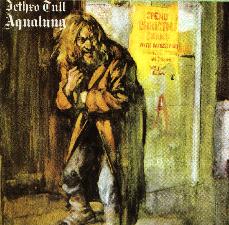
Khunrum emails: "I believe Brother Amalek is spot on here. As Luke ages and the beard grows longer, he could easily morph into Aqualung."
Sitting on the park bench —
eyeing little girls with bad intent.
Snot is running down his nose —
greasy fingers smearing shabby clothes.
Fred emails: No, the guy on the album cover has much better taste and standards. If the song were about Luke, it would go something like this.
Sitting on a shul bench,
eyeing aging spinsters with bad intent.
snot running down his nose,
saying socially awkward things while wearing awful clothes.
Joe emails: Is it just me, or did we elect some kind of social science professor? The economy is tanking ridiculously, the world is swirling the bowl, and the body politic of the US looks like Luke Ford’s midsection. And we have a president giving a speech on arab tv that will do about as much good as giving an enema to a dead person, we have a treasury secretary who is a petty tax thief and who is part and parcel of the bail out crew that lets wall street fat cats skim $4 billion off the top, and an envoy to the middle east who is so old he had a falling out with jesus and who is part and parcel of the team that studied reasons for violence right before the arab world decided that it would be a good idea to just start killing everyone to show everyone how superior they were, all the while obsessing over their evident inferiority.
The only bright thing Obama did was coopt every possible source of dissension. The hard left, well he is the messiah and is closing gitmo. Plus he is black, and it is just like Orthodox Jews’ belief in Torah from Sinai that Obama is the catharsis of all that america has done wrong, such that he cannot do wrong. The clintonistas, well, she is in the kitchen. The democratic party institutionalists, well, Obama has all the dough and has packed the cabinet with the electable dems from the midwest. His only exposure is to fox news and rush limbaugh, but even they have to watch themselves because down deep, they really do not hate america and do not want this guy to fail.
But what is clear is that he is not a wartime consiglieri. Our true enemy may not have even shown itself, but with a weak economy which Obama has decided to leave congress to fix, and with two wars that obama has decided to fight incorrectly (sending more troops to afghanistan is a waste of resources – the fact that the taliban control the scrub brush is irrelevant, when the US has a puppet in Karzai and a launching pad into pakistan to kill arabs and getting out of iraq, where there are so many available resources and targets, is plain stupid). This guy is a total joke.
I’ve long admired Ebner for his hard-hitting journalism. I first met him on RAME (rec.arts.movies.erotica) in 1997 where he had a run-in with retired porn actress Brandy Alexandre. We exchanged a couple of emails.
At 11 am, we met at House of Pies on Vermont and Franklin.
Mark gets behind the wheel of my van and starts talking. "Let’s just call the House of Pies my office. This is where I did a lot of my static interviews. Cops enjoy it. If I’m meeting some high falutin’ source, it kinda brings them down to a certain level where we can meet as one."
"Luke, a lot of people are going to ask me… I have a guy doing ten years, eight months in prison (with Sirhan Sirhan and Charlie Manson) as my main source for this book. They are going to say — that guy can’t be the most credible source. Well, the story started with him, Darnell Riley, and he started telling me his story. It was my job to put my gumshoes on and hit the streets and see how it checked out.
"Let’s have a look at some of the places in my book. I assume we’re in Drive here."
Luke: "If it doesn’t go, move it up one."
Mark: "I ran into Paris Hilton the night before last."
He pulls into Vermont in front of oncoming traffic. "I hope this bastard will let me go," he says.
The bastard doesn’t.
Mark: "That’s all right. Here we go."
We drive north on Vermont. "I ran into Paris Hilton at Carrie Fisher’s house in Coldwater Canyon. It was a party for Milk. Colleen Camp, a B-movie actress, and Carrie co-hosted celebrating the cast and filmmakers of Milk. Paris was texting a friend of mine at the party saying, ‘Is the party good? I’m on my way.’ She finally showed up. I ran into her. She said to my friend, ‘I was thinking of suing Mark Ebner.’ She’s caught wind of the book through the viral nature of it. But she said, ‘I’m afraid Darnell Riley will kill me and I just want Darnell Riley out of my life."
Luke: "You can turn the indicator off."
Mark: "We’re going up to Stevie Wonder’s former mommy-baby or concubine named Melody McCulley. She has a son named Mumtaz. Stevie has another nephew who owed Darnell some money for things they were involved in, gambling or whatever. Darnell, in one of his last acts of retribution, staged a fall at Stevie Wonder’s ex’s house up here and attempted to extort Stevie Wonder for a lot of money. While the negotiations were going on, Darnell Riley got snatched and was taken into custody."
Mark: "I thought you’d like to see where one of Stevie Wonder’s ex’s lives. He’s littered babies all over town, I guess."
Stevie has seven children from three women.
Mark tells me his residence is a 1969 VW Bus.
In 2006, I ran into Mark at E! in Santa Monica where I was being interviewed for a show on celebrity blackmail. I was telling him about my awful car and he showed me his infamous VW Bus.
Mark says as we drive uphill: "This place is creepy."
Mark reaches into his pocket and pulls out his PI card. "The one thing you need when you do what I do is a PI license. This is how I’m able to find places like this. This is how I am able to get into prisons to do interviews. When you go into a maximum security prison, Luke, they don’t let you take so much as a pencil in to take notes. I’m not Truman Capote although…"
Mark picks up his book while driving and shows me the back cover. "Jerry Stahl was nice enough to compare me to him. I liked that. He went way over the top. I’m not Truman Capote. I don’t have the so-called photographic memory. As I started visiting up there at Corcoran State Prison, I got my PI license and that allows me to go in as a lawyer’s representative, where you get a room and you’re allowed to tape your interviews."
"I recommend any enterprising journalist, especially with the state of journalism today, you have to pull out all stops to get the job done."
Luke: "How difficult is that to obtain?"
Mark: "If you have a PI friend, he can godfather you in. That’s what I did. It gets you into all the necessary databases.
"Let’s go meet Darnell Riley’s co-conspirator Jerry Rosenberg. He’s quite a character. I’ve known him for about 20 years. He’s been in and out of prison. He used to have a big blonde mohawk. Now he’s completely bald. He’s an excellent fight trainer. He fully admits to being a criminal but he at the same time ain’t going back to the joint. Darnell’s his boy. Jerry Rosenberg was helpful in putting this book together.
"At this point, you can ask me anything you want."
Luke: "I’d like you to talk as it comes to you about your place in Los Angeles. I’ve got my little place in Los Angeles. I used write about the porn industry. Now I mainly write about Orthodox Judaism. I wondered if you could ruminate about your place in Los Angeles. You play a part in this town."
Mark: "I made my bones in this town as a journalist with balls. A guy who was willing to infiltrate. You know the story that made my career — when I infiltrated Scientology. The way I pitched that story — who are all these people in sailor suits running around Hollywood? I didn’t know what Scientology was so of course I had to join. Spy magazine back in the day allowed me to do that.
"I guess my place is someone who has nurtured and developed participatory journalism. If I’m going to do the story, I’m going to get inside of it. I’m not going to be trolling the web. I’m not going to be phoning it in like so many daily papers do. In the process of getting the story, I’m going to make the editors of daily papers scratch their heads and yell at their reporters and say, ‘Why didn’t you get there first? Why didn’t you pull up your bootstraps and go get the story?’
"I guess I’m pretty old school in that I believe you’ve got to have a beat. Los Angeles is my beat, Luke. Someone said there are eight million stories in this naked city. It’s absolutely true. I don’t know about you, but my ideals lie elsewhere. I’m an East Coast boy. I would love to be retiring on the coast of Rhode Island in the next ten years, but for f—’s sake, I can’t write my way out of this town. There are just too many stories.
"So who’s going to pay me? Moving into non-fiction books was a smart move for me. Right after 9/11, I realized that my days were numbered in print journalism. I give you ‘Six Degrees of Paris Hilton.’"
Luke: "What are the major ways that people see you?"
Mark: "The duplicity of Hollywood. People see me as a troublemaker, a rabblerouser. Those two things are putting it mildly. A lot of people think I’m a gossip and a hack. I am a hack. I do write for commercial purposes. I do want to get paid. When I do write a big story, these are the people on the side congratulating me. ‘Ebner, great job exposing Scientology.’ Or, ‘Good job exposing these scumbags in Hollywood.’
"But if it looks like their admiration for me is going to inhibit anything they have planned, they don’t know me. Well, I wouldn’t want to know them to begin with. It cuts both ways.
"My friends? I could count on one hand. To have five really good friends puts me ahead of the game."
Luke: "If I were to ask you, ‘What’s Ebner like to work with?’"
Mark: "My editors would probably say, ‘Ebner is the biggest headache to work with.’ I’m a high school dropout. As a writer, I couldn’t tell you where to put a semicolon. At the same time, I report report report and report my stories to death. If I’m willing to put that much effort into it, my writing speaks for itself. What I pour on to the page has the heart and soul of what you would want to have on the story like the ones I tackle. A headache is a small price for an editor to pay for the content I’m going to deliver."
"I was fated to chronicle the underworld. I come with a certain understanding of that, having in my lifetime been a liar, a cheat and a thief myself. It’s sorta that takes one to know one thing except I’m living the clean and narrow now. The genesis of ‘Six Degrees of Paris Hilton’ comes from my looking at her purloined T-Mobile sidekick messages and phone numbers and everything that was hacked and thrown out there. Everyone’s looking for the famous people in her instant messages and phone list. That’s not where the story is. It’s the people you don’t know. Darnell Riley is on her phone list. He murdered two people by the time he was 15 in a brutal double-homicide at a jewelry store in Pasadena…and became the basis for this book."
"Part of me identifies with the criminal element and part of me is a born reporter who knows where to look for the story."
Luke: "What effect does it have on your psyche to be immersed in such a world?"
Mark: "It’s exhausting. Fortunately, I don’t drink or do drugs because at the end of the story, the first thing I want is a drink or a shot of dope. It’s extremely stressful. I’m constantly looking over my shoulder. This book put me in the hospital when my blood pressure shot up to almost stroke levels. I found myself at Kaiser Permanente. it is not a healthy way to live. The only thing missing from my life is balance. I can find that if I take the time to settle down and breathe a bit and appeal to the angels of my nature rather than the baser levels."
Luke: "How much do you need the excitement that being around this world provides?"
Mark: "And therein lies the problem. It’s almost like transferring one addiction to another. The way I chased that high almost 24 years ago. That’s the same way I chase these stories… It is exciting. There is a lot of adrenalin. I wouldn’t trade it in for anything. I’ve sacrificed a lot to be an investigative journalist but every day I find fulfillment."
"I’m a high-flying adrenalin junkie. It’s what gets me going in the morning. That and a cup of coffee and I’m good to go."
Luke: "How does this life you’ve chosen of chronicling the underworld affect your relationships?"
Mark: "My father is 84 years old. He’s proud of me now. His son is a New York Times best-selling author. My family relationships are better than ever. I keep my friendship circle small. As far as marriage, kids, the white picket ideals, I’m 49 years old, Luke. I don’t know. I think I sacrificed a lot of those things. I’ve definitely put those kind of ideals on hold because there is no way I can sustain a relationship, certainly not a marriage, doing what I do."
Luke: "How do women you are interested in relate to the life you’ve created?"
Mark: "My last girlfriend, Lisa Altman, is a television exec. She was always fond of saying, ‘Ebner gives me street cred.’ It’s fine. I can hold my own at a Hollywood party."
Luke: "I read all of ‘Six Degrees of Paris Hilton.’ I just felt depressed. Out of every major character in this book, aside from the author, not one of them would I want in my life. These are all dangerous exciting interesting people. It’s like reading a true-crime book. There’s a pornographic thrill to how bad these people are. Reading this book took a toll on me. It’s not an Oprah-feel-good book."
Mark: "There’s no question that ‘Six Degrees’ is a challenge to read. Yes, it is depressing, and yes, the characters outlined in this book are despicable. In what other book could the hero of your book be Darnell Riley, be a double-murderer who shook down Hollywood? He’s like an anti-hero. That said, I only hope that the appeal factor for people is in reading this book and understanding it as a book about New Hollywood, or Young Hollywood and the Nightclub Scene, they can feel a lot better about themselves. They can, at least my life ain’t that bad, and maybe they’ll be glad they read it as a result."
"We’re pulling up to Fortune Gym. When I was here for an interview with arch-criminal fight trainer Jerry Rosenberg, guess who I saw walking up in tights? Reese Witherspoon. She was coming in to train as a boxer."
"OK, Jerry’s not here. That’s unusual. He’s usually here training up a storm and plotting his next caper. We’ll roll on. Union Bail Bonds will be our next stop."
Luke: "What are some of the things you do to gauge when people are telling the truth?"
Mark: "When you sit and it’s not a transactional thing for them. When they have nothing to gain and yet they are still willing to talk to you, those are the people who are going to tell you the truth. If you are working for a tabloid and you give them money, then the truth is going to be shaded. And if you really care about the truth, which the tabloids do not, then you have to dig deeper.
"If you meet them at the House of Pies and you’re sitting down with them one to one, and you realize that they are talking to you because they want their story told and they have nothing to gain by it, and in fact they may have something to lose, those are the people that are telling you the truth."
Luke: "I find that writing a book is a huge advantage over writing a story. People are so much more eager to talk to you for a book and they are so much more open and less agenda-driven. If it is an article, and it is a movie director or producer you’re talking to, they’re going to push their movie."
Mark: "I’d say that six out of my ten primary sources in this book were wondering when I was going to do their book. Everybody’s got a story to tell. There’s a certain prestige element that comes with working on a big non-fiction book. They all want to sit down again. All of those people, I’m willing to hear them out because there might be a book there."
"People are willing to talk because they feel like they are becoming a part of history."
"Fortunately, I have a good agent and I command enough advance money to carry me through the year it takes me to write the book. Do I get rich writing books? Hell no, but I’m focusing on one story for an entire year rather than being out there and being a two or three dollar a word print journalism whore chasing stories every other week to stay ahead of the rent."
Luke: "If I may ask, what’s the most amount of money you’ve made in a year?"
Mark: "I’m only going to answer…as long as you also ask me, what’s the least amount of money I’ve made in a year as a professional? I’d say the most I’ve made in a year is around $200,000. Now ask me…"
Luke: "In the last 15 years, what’s the least amount of money you’ve made in a year?"
Mark: "Thirty seven hundred."
Luke: "What have you averaged over the past ten years?"
Mark: "This is fine with me answering this because I don’t base my self-worth on what my income is. I’d say I’ve averaged between $50,000 and $60,000."
Luke: "I’ve never made more than $50,000 in a year and over the past ten years, I’ve averaged about $32,000 a year. When I’m poor, I think about money as much as sex. How about you?"
Mark: "I don’t think about money per se. During the rough spots in life, I’m sad to say that I think about my debts as much as sex. And that’s just not a comfortable place to be. Financial insecurity sucks. I’ve managed to pair down my life to such a degree whereby I consider my 1969 VW Bus with a bed in the back to be homeless insurance. If the bottom falls out, I’m fine. I’m fine living beside a park in Santa Monica or Venice as long as I have my gym membership at 24 Hour Fitness so I can shower every day."
Luke: "I lived out of my vehicle for about four months."
Mark: "We’ve both been down that road. How was it for you?"
Luke: "It wasn’t that bad. I’m real grateful I haven’t had to do it in the last 13 years."
"When I was homeless, I once went two weeks without a shower. I’d wash in the basin at Roxbury Park. The attendant once yelled out at me because I spilled water all over the floor from washing my hair in the sink."
Mark: "I’m thinking my next book might evolve out of the prisons too."
Luke: "It’s interesting how the criminals you deal with in this book are highly interested that you be an honorable person with them and live up to whatever undertakings you make. No matter how low the criminal, it is very important to them that other people treat them justly."
Mark: "I give them all the respect I can muster. I let them tell their story. If all the victims of the extortions and sex tapes and scandals and robberies and shakedowns, if they had chosen to speak to me, it might’ve been a different book. Nicky Hilton’s publicist had the gall to ask me, ‘What does my client gain by participating?’ I said, maybe this kind of thing won’t happen again, maybe she won’t get burglarized again because she talked to me about it which led me to finding these criminals.
"What happened? Less than two months ago, Paris Hilton’s home was knocked off for $2.5 million in cash and jewels. She just got robbed again. This could’ve put a stop to it. I’m not saying I’m Mr. Crime Fighter and I’m going to shut down crime but maybe it won’t happen again if you are willing to talk about it.
"As for the other thugs and miscreants who wouldn’t talk to me, they get written about in this book and they come off looking like the scumbags they truly are. If they had spoken to me, they would’ve had a chance to write their own story, to show me a part of them which may be interesting or romantic or something other than the boilerplate scumbaggery that I have on them. Whether you are famous or whether you are just lowlife scum, it serves you to talk to someone for a book."
"We’re coming up on Union Bail Bonds. This is where Russian bail bondsman Alex Vaysfeld was doing his business. Look at that — it’s gutted."
Mark yells out of the van, "Hello?"
I’m mortified. I don’t have his chutzpah to yell.
Mark: "Alex is the guy in Russia who ran into Joe Francis and started getting him girls and drugs and claims that Joe Francis asked him to get him a 12-year old girl. This is one kneecap-busting motherf—er. Unfortunately, he’s doing a couple of years in jail now too. Something about some stolen goods coming in off a ship."
A Mexican-looking guy comes out and says the bondsman left two months ago.
Mark yells at him: "He was a good guy — the Russian dude."
Luke: "One thing I was struck by in the sex industry is that everybody is obsessed with morality in their own way. Strippers look down on porn stars. Porn stars who don’t do anal look down on porn stars who do do anal. Porn stars who do anal look down on porn stars who do interracial. Women who pose for Playboy look down on women who pose for Hustler. And same in your book. All these different criminals, they all look down morally at some other criminal because he wanted a 12-year old girl as opposed to getting 18-year old girls to take their tops off. Isn’t it interesting how the lowest of the low, these scumbags, everyone is still still obsessed with morality in their own way. Everybody has things they object to and think are wrong and think disqualifies someone’s humanity. I’m thinking about that Russian guy who was so offended that Joe Francis was supposedly interested in a 12-year old girl."
Mark: "Right. And at the same time, he’s all mobbed up and breaking kneecaps."
Luke: "And he’s providing five [adult] women for Joe Francis and friends to [use sexually]."
Mark: "You’re making a great point. I reserve the right to judge and condemn a pedophile.
"Let’s look at Darnell Riley. By the time he was 15, he had murdered a jewelry store owner and his 11-year old son. It was hard to get a handle on that. How could I even talk to this guy? How could I even use him as a resource? In the book, you’ll find this passage where Heavy D the rapper says, ‘I didn’t know about that double homicide with Darnell, but he was 14 years old, you can’t judge him on that. That’s between him and God.’ He’s got a point. Which adult handed him that gun?
"There’s some television that addresses this kind of morality — The Wire — which I love. Who am I to judge? How did he wind up firing shots in a jewelry store at age 14? It all depends on where you are dropped off. If he was dropped off at Harvard, he would be a different guy."
"In the course of writing this book, I looked right in the face of evil. Will Wright, this character still running around Hollywood, is a straight-up sociopath in my mind. I don’t think he can differentiate truth from false. He’s such a pathological liar, I wouldn’t classify him as evil but as institionalizable. Evil was finding the guy who handed Darnell Riley that gun. I found him down in Orange County and seeing a guy who escaped the death penalty twice.
"One of his hooks for escaping the death penalty, when he was on trial, he brought practically the entire Muslim community of Los Angeles in their robes praying in the courtroom. The DA was a conservative old-school guy, Sterling Norris, he couldn’t fight with that. They had blacks on the jury. Between the Muslim influence in that courtroom and the seductive nature of this stone-cold killer on trial… Talk about evil. He’s using religion to escape the death penalty on a crime he was surely guilty of."
"We’re coming up on a little nightclub in the book, The Belmont. There was a karaoke night at this club. It became incredibly popular. This is where Darnell administered a major beat down, pistol-whipped a guy to the point where he was begging for his life. On the other hand, we’re in friendly party town West Hollywood."
"The arch-criminals in this book would eat me for lunch. I would be their dinner… I tip-toe over into that world, I dig in and get in deep, then hightail it over to that world. I don’t live in that world."
"People will need to read the book and figure it out for themselves. That’s part of the fun of reading a true-crime book."
Mark signs his book to me, "To the best interviewer anywhere."
When Guru Singh walks past you, he says, "Love you."
In his latest lecture, he explained how this means something different from "I love you."
He was responding to those who think, "How can he love me? He doesn’t even know me."
Guru Singh says we’re all swimming in a sea of love.
I don’t think he knows my estuary.
I ran into a Jewish woman in yoga the other day who says that listening to Guru Singh has freed her from the restraints of Judaism. While not Orthodox, she used to be quite observant. She used to keep kosher, for instance. Since listening to the Guru, however, she’s found a different path to spirituality.
"It’s easier," she explains.
"Not as many rules," I note.
Guru Singh has been working us on the lower triangle — various stretching exercises — so we don’t fall off our spiritual journeys in the reckless pursuit of money, lust and power.
At the end of the last class, we sang, "I am happy. I am healthy. I am holy."
I just interviewed Suzanne Guillette about her new book, Much to Your Chagrin: A Memoir of Embarrassment. It’s about a young woman who desperately wants to publish a book to establish herself as a writer and justify her expensive MFA.
I submitted to Suzanne the book is really about a young woman who is too embarrassed to articulate what she most wants — a man to take care of her.
I think this is what most women most want yet it is not cool these days to admit such longings in educated secular circles.
Hilary Black, the editor of an anthology called The Secret Currency of Love: The Unabashed Truth About Women, Money, and Relationships, was on the Today show this morning, gabbing with Ann Curry about—what else?—love and money. I read a good chunk of the anthology earlier this week and was struck by a thread running through several of the essays, most of which were written by women who supported themselves as freelance writers. Many of these women came from upper-middle-class backgrounds, and while it took them a while to admit to themselves, they all secretly expected that some wealthyish dude would ultimately rescue them from their quasi-bohemian, small trust-funded existences. Abby Ellin described it best in her essay, "Tool Belts, Not Tuxes":
And okay, there’s this: I’ve always been taken care of. My family never had great wealth, but my parents managed to send me to camp and college and graduate school—an extraordinary gift for which I’m eternally grateful. And they even bought me an apartment. … And so this leads to a mortifying admission—especially for a feminist who was taught that every woman should possess both her own bank account and the ability to be self-sufficient. On some level, I always believed that eventually someone else would take care of the big stuff. That someone, of course, would be my husband.
Another contributor to the anthology, Karen Karbo, expressed similar sentiments in her essay "The Secret Economy of Women" (which appeared in a truncated form in the Times Modern Love column as "Accidental Breadwinner"). All of which leads me to the larger question: Do loads of smart, educated, feminist women avoid less flexible, more time-consuming career tracks not because they’re fulfilling their inner artist or because they want to have time for kids but because deep down they still expect that some man will take care of them? Or, as Ann Curry put it this morning—does every freelance writer secretly want to be a princess?
Bob emails: "NJG is spot on. You do have Asperger’s. The first time we met, you asked me if I had ever had a venereal disease."
Chaim Amalek emails:
You do not have Aspergers (although didn’t I write a piece that said you did years ago?). Rather, you have "I am a man in his forties who lives in a portion of a garage, does not have a real job and does not have any prospects" syndrome, which makes your every utterance to every woman especially creepy. If, for example, you were to suddenly revealed to be a retired investment banker living like this only part time, and even then just to research a book, you would equally instantly come to be very differently regarded by women.
Also – and this is fundamental – keep in mind the sort of women you are interacting with – spinsters. Your brain is structured to pine for the coltish 23 year old and directs your mouth to speak accordingly, but socially these are not 23 year old women, but 40 something plus spinsters: jaded, often angry and bitter towards men, defensive, and full of "boundaries."
7th Day Adventism didn’t work out. Vegetarianism did not lead you to good health. Prager and his Republicans didn’t lead to employment during the years when their kind ran things. The Jews didn’t want to have anything to do with you. And now yoga. Same result. What you need to focus on is making money, real money. That’s my free life advice to you.
"This guy knows all the gossip, the ins and outs, the lashon hara of the Orthodox world. He’s an [expert] in... all the inner workings of the Orthodox world." (Rabbi Aaron Rakeffet-Rothkoff)