In an August 28, Saturday morning sermon at Sinai Temple, Rabbi David Wolpe said: “The beginning of this sermon is going to be very personal, much more personal than any sermon I have given…
“It has to do with something that happened to me a month ago when I was sitting at lunch with a member of the congregation and he said to me, ‘I understand you are going out with so-and-so?’
“I said, ‘What? I am not going out with anyone. I don’t even know who this person is.’
“The more I thought about it, the more it bothered me. We are just beginning the separation of our lives. I have a daughter. We are still very close, all three of us.
“Last week, Eli rode a bike 100 miles to raise money for cancer lymphona research because I am in remission from lymphona. In a couple of weeks, she’s running a marathon, also to raise money for lymphona research. One day it might save my life.”
Eliana Wolpe had been running for six hours and fifteen minutes and 26.2 miles when she finally crossed the finish line. Dripping sweat and beaming, she jogged past the screaming crowds with her arms stretched triumphantly over her head. For her, the live rock music that played ubiquitously at the Leukemia and Lymphoma Society’s Rock ‘n’ Roll Marathon sounded as good as a victory hymn. After she finished, Eliana locked eyes with the people she was running for — her husband, Rabbi David Wolpe, and their 12-year-old daughter, Samara, who had stood huddled together on the sidelines waiting to embrace her.
Eliana burst into tears, and the threesome collapsed into a tight embrace, gripping one another and sobbing. Then the rabbi kissed her. And as hoards of other runners filed past, the Wolpes celebrated their moment of triumph. This was, for them, a victory over illness, a repudiation of the cancers that have haunted them and destroyed their sense of safety. But even as they sought hope in a new day, they knew their battle wasn’t over.
It began in the fall of 1997, soon after the Wolpes moved to Los Angeles from New Jersey with their 9-month-old daughter to begin a new life. Already an accomplished author and speaker, the rabbi was in demand as a scholar-in-residence at synagogues across the country and had not planned to become a pulpit rabbi. But when Sinai Temple, one of the country’s largest Conservative congregations, offered him a position, the couple decided to accept. Then, three months after they arrived, Eliana was diagnosed with a rare, aggressive reproductive cancer.
The terror of cancer would plague the Wolpes relentlessly. In October 2003, Rabbi Wolpe suffered a grand mal seizure that led to the discovery of a brain tumor. Fortunately, it turned out to be benign. Then, in August 2006, the rabbi was diagnosed with follicular non-Hodgkins lymphoma — a cancer he continues to fight today.
These battles with illness played out before a 2,000-family synagogue. Yet if in private the Wolpes felt pain, in public they strove to appear as normal as possible. They treated their congregation like they treated their daughter — putting others’ needs and security before their own, assuring everyone as best they could that life would go on as expected, even when they feared it might not. The Wolpes tried to be honest and open about their cancers, but there were limits: How could they offer comfort about their situation when they couldn’t comfort themselves?
Each coped differently. Rabbi Wolpe saw his coping with illness as a teaching opportunity; Eliana recoiled from the spotlight. The rabbi avoided thinking about it; Eliana pored over medical journals. He wrote books, gave lectures and thrived in his career. She focused on their daughter, scheduled her husband’s medical visits and demanded for him the very best care. “I never cared if I was offending anybody along the way,” she said.
Rabbi Wolpe says: “I would never — when we are taking the first steps to lead separate lives — be going out with someone.”
“I was told that everybody knows this, especially in a certain community.”
“During the past 13 years that I have been the rabbi of this synagogue, numerous members of the Persian group have come to me and said, ‘Please talk about gossip in the Persian community.’
“I’m doing it this morning in part because of what happened this week, because there was a terrible tragedy and a few young people were killed and our hearts go out to their families. I want you to know that if you gossip about it, then you are wounding families who have already suffered unimaginable pain, so don’t do it.”
We were consulted during the recent period involving the Greenstein family, in which a Yeshiva of Spring Valley Bais Sara staff member was intimately involved. We were shown some of the communication between the staff member and Liviya Greenstein, a good part of which took place when Liviya was a minor, and have found them to be a matter of concern.
Given the collateral damage, coupled with the recent news about another staff member from Yeshiva of Spring Valley, we feel strongly that it is incumbent upon the Yeshiva to conduct a proper inquiry to determine the culpability of its staff members. Additionally, we feel it would be useful for the administration to re-evaluate the events leading up to the wedding and perhaps determine what could and should have been done differently, to avert such a calamity from ever recurring. During the height of the crisis, the Yeshiva pledged to have the matter evaluated by a professional.
Most Americans believe that a $100 million Islamic center two blocks from the place thousands of Americans were incinerated by 19 Muslims acting in the name of Islam is not right. Proponents make three arguments against this:
1. Religious freedom demands support for Cordoba House.
2. Islamic terror has nothing whatsoever to do with Islam.
3. The imam involved, Imam Feisal Abdul Rauf, is a moderate Muslim, and moderate Muslims need to be supported.
As explained above, reason No. 1 is irrelevant because no legal issue of religious freedom is involved.
Reason No. 2:
Given that about 100,000 innocents (mostly Muslims — in Sudan, Algeria and Iraq) have been murdered by Muslims in the name of Islam; given that whole countries are governed by Muslim totalitarians in the name of Islam (Saudi Arabia, Iran and, previously, Afghanistan); given that popular Islamist movements threaten to take over countries such as Somalia and Yemen; given that Christians are frequently killed in Muslim countries such as Egypt and Indonesia; given that Palestinian Muslims voted for the terrorists of Hamas and Lebanese Muslims for the terrorists of Hezbollah; given that murderous Muslim demonstrations took place around the Muslim world after the publication in Denmark of cartoons depicting Muhammad; given that we are unaware of any sizable demonstration of more than a few dozen Muslims anywhere on earth against Muslim violence; given all these things, the question of whether Islamic violence has anything at all to do with Islam is not necessarily foolish or prejudiced. Moreover, for many Muslims today (at least 100 million according to polls), their understanding is that Islam does preach violence.
In any event, this is not a matter of opinion: Muslims representing at least 100 million Muslims around the world slaughtered 3,000 Americans on 9/11, and putting up an Islamic center and mosque two blocks away seems to most Americans inappropriate. Furthermore, to those Muslims who do hate us and who do celebrate 9/11, this would represent a victory for Islam.
Reason No. 3:
I entirely agree that Muslim moderates need to be supported. The great battle against Islamist violence and against Sharia-run states must be waged by other Muslims.
The question is whether Imam Rauf is such a man.
I don’t believe so for many reasons:
First, an American Muslim leader, upon learning of the pain he was inflicting, and who cared about Muslim-American relations would have immediately abandoned plans to build his Muslim center near Ground Zero. Rauf is almost solely responsible for the outpouring of American anger at his center and to whatever extent the anger is expressed at Islam generally.
Second, if Jews in the name of Judaism or Christians in the name of Christ had slaughtered 3,000 innocent Muslims in, let us say, Jakarta, Indonesia, it is hard to believe that either group would insist on building a $100 million synagogue or $100 million church two blocks from the carnage, just nine years later.
I fear that Modern Orthodoxy is in trouble. This girl Esther Petrack with the 30G chest was willing to show it off on national TV and then gives up the Sabbath to be a model.
I wonder if I could find it in my heart to forgive her?
I wish I could talk to Esther Petrack. I think I could help her.
Greg Leake emails: “Hi Luke, I have been critical of Orthodox Judaism in the past. However, after studying Ester Petrack’s video several times on your site, I find that my sympathies for Orthodox Judaism are taking a turn for the better.
“In fact, I see that I could become an enthusiast. I believe that with a lot of counseling from Ms. Petrack I might consider the conversion process myself. The counseling sessions could go late, so we probably should get started as soon an possible.”
Joe emails: “Dude, a gal i know had 34D, but they were big, and she sometimes had to wear an E. When she was dating, one of her boyfriends told her never to get dressed or undressed in front of him because when he saw her, they had to do it and it might be before a final exam or something.”
Dvora Myers writes for Tablet: “What Jay didn’t mention was Esther’s seeming inability to pose with her mouth closed, which is actually more worrisome. Both during the elevated runway and the photo shoot, her lips were unattractively parted. This made me recall a recent exchange I had with another Tablet Magazine writer, who has a name for this syndrome: Orthodox Jewish Girl Mouth. He had noticed it while Esther was talking during the premiere, that her mouth was always a bit more open, that she showed more tooth and gum than average, which he believes is a trait of the observant female.”
Having been raised observant, I understand Esther’s plight. There were gymnastics competitions I couldn’t enter due to Shabbat, and break-dancing battles I couldn’t attend because they were on Friday nights (that is, until I made an Esther-like pronouncement and decided to go anyway). Though I often hoped that it could be different, I never thought that everyone else’s schedules should be rearranged so that I could have my cake and eat it, too. No one was telling me I couldn’t be an observant Jew. I just learned at a younger age than most that I would sometimes be forced to choose between two mutually exclusive things that were of nearly equal import to me.
I am happy that Petrack didn’t demand that the halachic details of Orthodox Judaism be catered to. And who knows? Maybe she was able to observe much more than we are privy to see. Maybe her housemates turn the light switches on and off for her on Shabbat. And while I appreciate Diament’s position—insisting on the rights and expanding the options for Orthodox Jews and related organizations is literally his job—I don’t think anyone is being wronged in this instance. In the end, all you’ve got is one girl who had to struggle with an adult decision.
Dvora Myers writes: “For Esther, a lanky, trilingual teen (English, Hebrew, French) with a serious set of eyebrows and a penchant for gesticulating wildly with her long arms, there was no way for her to compromise her way out of this situation, or to find a halachic loophole. Even the most liberal Orthodox rabbi would not tell her that reality television shows defer the Sabbath. If she wanted to try her hand at modeling, something was going to have to give.”
My wife was watching “America’s Next Top Model” when I got home from doing man things last night, which meant I asked lots of annoying questions and feigned disinterest.
For the most part, it worked. One thing did catch my attention. I hardly would have imagined writing a blog post about it the next day. But the contestant with the 30G breasts can be seen in the above clip flashing Tyra Banks et al during tryouts.
The reason this is newsworthy, and that I embedded the clip, is that Esther Petrack is a Modern Orthodox Jew, born in Jerusalem, and it took her about two seconds to sell out the Sabbath.
Esther Petrack, the America’s Next Top Model contestant, at first chose to take pride in her Jewishness, telling Tyra she was from Jerusalem and taking the time to explain her beliefs. But once she realized that the rigors of the show would conflict with her Sabbath observance, Esther opted to switch gears and take pride in something else that made her unique: Her comedically enormous breasts.
This immediate about-face—a proud Modern Orthodox Jew one moment and sashaying in a bikini and heels on national TV the next—was a sad commentary. After all, the contestant is named after the biblical Queen Esther. That historical figure also competed in a beauty pageant, and even hid the fact that she was Jewish. But, when the chips were down and the time called for a hero, Queen Esther used the opportunity to reveal her faith and saved the Jewish people from imminent annihilation. It’s her self-sacrifice that we celebrate each year on the festival of Purim.
Look, nobody is saying that being a Modern Orthodox Jew is easy. I’d be the last person to argue that wearing a skullcap all the time, only eating kosher, and not using electricity on Saturdays is easy. It’s not.
But let’s also be realistic here: I’ve often wished that I could be a contestant on The Amazing Race, but the bug-eating competitions (not kosher) and the flying on Saturdays (also not kosher) would put me in last place. (Although plenty of non-observant Jews have appeared on that show.)
Esther knew beforehand that competing on the show would conflict with the strict Sabbath rules she had been keeping until that point. And she decided that competing on the show, and the potential of a high-end modeling career, were more important. To be honest, she likely made that decision before the cameras started rolling. But the producers edited it in such a way that she appeared to be, as many grandparents would say, “finishing Hitler’s work.”
…Reaction, to use a term of related parlance, was fierce. A blogger for Jewlicious.com said he cringed when he watched the video. A commenter on TabletMag.com called it a tragedy. Another commenter noted the odd timing — the video was released during the High Holidays, a season steeped in repentance (although, to be fair, it is also the fall season of new television shows).
This is not the first time Tyra was schooled in the quirky traditions of Jewish Orthodoxy. On her daytime talk in an episode dealing with menstrual cramps, a Chassidic woman informed the audience about the Jewish laws of marital purity whereby the husband and wife don’t hug, kiss, or sleep in the same beds while she’s having her period. Enjoy this classic clip:
Esther Petrack writes on Facebook July 16, 2007:
ok, so so far, this is the list of the jobs i will have (yes, there are more cracked out plans than the icelandic farm)
– owning a dairy and wool farm in iceland
– work in a fireworks factory until it explodes and i die in the rubble
– marrying a rich man and living in a boat
– living in a boat without a rich man
– owning a club in iceland
– owning a club in tel-aviv
– owning a club in eilat
– living on a farm in israel with my israeli husband and gorgeous blond children
– teaching, but not very little kids because they’re or really annoying or really cute, and i don’t want to take my chances
– marrying a bedouin and tend to my husband’s sheep while birthing an obsene amount of children to him.
– living off art i make in a 1 tiiiiiiiiny rm studio in a very very very very very crappy nyc neighborhood where all the “artists” live where we can come together at night and talk about the way the world used to be before microsoft word and the evil capitalist pigs who took over the world
– joining the army, dunno which country though
– owning a flower shop in california
– living in a cabin on the beach and being a waitress but having maaaaaad fun
– belly dancing 😉 😉 just dancing in genral actually, people in my classes slash soroundings know what i’m talking about ; )
– owning a little boat and doing tours of the eilat water and teaching how to water ski
– saving little children in africa or asia from hunger and disease and aids
– living in barcelona
– raising tigers and all the wild animals for a circus
– working in a circus as one of those girls who stand in the the ring whith the big costume-y dresses and applaud when the guy finished his trick to cue the audience to clap
– running a summer camp
– or maybe instead a boot camp?… hehe
– making travel brochures
– painting
– living in paris and marrying a sphardi named jonas. we’ll have a daughter named noemi, among other things
– just travel to india and get lost forever in the place
now watch me just end up in some house in teaneck nj being a stay at home mom or dental hygenist or accountant or real estate agent
According to her Facebook, here are Esther’s likes and dislikes:
Activities:
Eating, Sleeping, Getting Lost, Living, Arguing, Breathing, Making Checklists, All That Jazz
Interests:
Fabulosity
Music:
Everything, Amy Winehouse, Benny Benassi, David Guetta, Lily Allen, Coldplay, The Killers, Red Hot Chili Peppers, Jay Z and Luda, Missy Elliott, Nicki Menaj, The Beatles, The Magic Flute, Jonathan Fisher – Pianist, Lady Gaga, Hilary Duff
Books :
The Hitchiker’s Guide to the Galaxy, The Odyssey, The Bridge of San Luis Rey, My Norton Anthology of Poetry, Random Family, Harry Potter, Where the Wild Things Are
Movies:
Pan’s Labyrinth, L’Auberge espagnole, Stranger than Fiction, Moulin Rouge!, The 39 Steps, 10 Things I Hate About You, Atonement, Dazed and Confused, Slumdog Millionaire, Eternal Sunshine of the Spotless Mind, Children of Paradise, Aladdin, Forgetting Sarah Marshall, The Darjeeling Limited, Across the Universe
Television:
30 Rock, Bones, Glee, So You Think You Can Dance, Southland, Keeping Up With The Kardashians on E!
Esther Petrack is a graduate of Maimonides day school in Boston. Rabbi J.B. Soloveitchik would be so proud!
Rabbi Jeffrey Woolf posts: “As deeply regrettable as Ms. Petrack’s response was, it is light years better than Feldman’s arrogant, narcissistic temper tantrum; his eloquently hysterical cry for validation and attempt at spiritual parricide. Esther Petrack, on the other hand, failed when tested. She was asked to choose between God and her own ambition, between the dazzling lights of the runway and the flickering lights of the Sabbath candles, between the glamor and fame of the super model and the lesser note of the less than super model. She chose the glamor, the fame, the money….basically she chose her own self-fulfillment. She made her personal choice, as misguided as I (and others) might think it to be. She wasn’t the first and, unfortunately, she won’t be the last.”
Petrack, a recent graduate of the Maimonides School in Brookline, hesitated before making the bold move.
“This is a modeling competition, here is my body,” said the slender 5-feet-9-inch teen about revealing her 30G breasts.
“I get special bras,” Petrack said of her natural curves. “I didn’t get plastic surgery or anything.”
Cup size isn’t the only unique thing about the aspiring model.
Petrack speaks fluent French, Hebrew and English. She attributes her language skills to her family’s globe-trotting. How she’s talking often depends on her mood.
“It’s different emotions. When I’m driving a car and (experiencing) angry road rage, that is English,” she said. “When I am frustrated, it’s French. Sometimes I’ll just change to Hebrew.”
She spent part of her childhood in France, where her mother is from, as well as Israel and has lived in the States for the last 10 years.
…“I went to a school with a dress code: We had to wear skirts to our knees and short-sleeved shirts,” she said. “I don’t have a style. It’s more what you feel comfortable in.”
From LAOBserved.com: This graphic posted to Flickr by Eric Fischer maps Los Angeles County’s racial and ethnic diversity, using data from the 2000 census. Each dot represents 25 people. Color code: red is white, blue is black, green is Asian, orange is Hispanic, gray is other. Fischer has done several U.S. cities and looks forward to plugging in fresher data from the 2010 census. Via the blog L.A. Taco.
Historical data: See how racial and ethnic distribution has changed in Los Angeles from 1940 through 2000 using census data, at Social Explorer.com.
It laid out the reasons for why the beard (as opposed to the clean-shaven look) was Judaism’s preference for men.
I don’t remember all the reasons given in the essay but among them were:
* It was to distinguish you from Egypt, where clean-shaven was the ideal
* It is the acceptance of adulthood and the abandonment of attempts to look young while growing old
* It demarcates adults and children, men and women
Among the additional reasons that I have a beard is that it is a constant reminder of who I am. I can take off my yarmulke and tzitzit and I can dress like a goy, but my beard does not come off so easily. I think twice and thrice these days before stepping inside a non-kosher restaurant. Before, I’d just take off my yarmulke and tuck in my fringes.
I’m fascinated by the way so many people give me a hard time about the beard. Goyim generally do it because they think it is weird and ugly.
Jews give me a hard time about the beard because they think I am trying to pose as more religious than I am.
They are right. I am trying to pose as more religious than I am. As Shakespeare wrote, “Assume a virtue if you have it not.”
I’m fascinated by the objections that Modern Orthodox Jews have to my beard. I’m fascinated by how many Torah-learned Modern Orthodox Jews list off for me the reasons why a beard is not mandated by Jewish law.
Why would so many Orthodox Jews tell me that my beard is not Jewishly necessary?
I guess it makes them nervous. I guess I disturb their Jewish comfort level whereby if you do one more mitzvah than them you are a fanatic (and one less mitzvah and you are a goy, notes Dennis Prager).
I remember one Orthodox woman told me, “Don’t you have to earn a beard?”
Well, do you have to earn Sabbath observance? That is a public statement to the world just like a beard. Do you have to earn wearing a kipa and tzitzit? Do you have to earn the right to do a mitzvah? Do you have to earn the right to publicly identify as a Jew?
I’ve had Orthodox rabbis give me a hard time about wearing a beard. They said it was showy. It reminded them uncomfortably of the Haredim.
What fascinated them was how much it bothered them. Jews are not normally bothered by a lack of humility in their fellow Jews. They’re used to. They’re numb to it. But for some reason, the beard is just over the top self-assertion.
One Orthodox rabbi told me, “A Jew is not by appearance. It is by action.”
But appearance matters a great deal in the Torah. God is always telling the Israelites to wash up and to clean and mend their garments. The Torah has a lot of rules about appearance.
Jesus said in the Gospels, “It is not what goes into a man’s mouth that defiles but what comes out.”
Judaism holds that it is not only what comes out of your mouth that matters but also what goes into it. It is not only your deeds that matter, but also your beliefs and your appearance.
If the Torah is true, God cares about a lot more than just the heart or the deed or the creed. If the Torah is true, God cares about a lot more than just religion.
I remember a story told by Reform rabbi Mordecai Finley. He was raised in Conservative Judaism. He once went into a Reform temple on a Shabbos morning wearing his tallit gadol and noticed nobody else was wearing a prayer shawl. “We don’t wear those rags,” somebody told him.
In that Reform temple, the rabbi’s prayer shawl was as offensive as my beard to many Modern Orthodox Jews.
If you tell people in Conservative Judaism that you don’t drive on Shabbat, you’ll often be regarded as a religious fanatic. Or if you wear your kipa out.
If you are just a bit more ritually observant than your crowd, you’re gonna stand out like a sore thumb, like a nail that needs to be hammered in.
RABBI RABBS POSTS ON MY FB: Long before Shakespeare, the Torah said m’soche sh’lo lishmah, bo lishmah (from doing things for the wrong reasons, comes doing things for the right reasons). In other words, it’s good to “fake it”, because faking it leads to doing it for r…eal.
Anyone that argues against that is arguing against Torah.
As for the so-called “Orthodox rabbi” that told you “A Jew is not by appearance”, you might want to show him the Midrash that says the Jews were redeemed based on four merits, and one of those four was that we maintained our Jewish appearance.
It is brought down that maintaining our Jewish appearance will again merit us for our final redemption.
Anyone that scoffs at your beard doesn’t want the final redemption.
Hi Luke and Rabbs,
I’m astonished. Rabbi Rabbs, I had no idea that you were struggling with so many psychological and spiritual challenges every single day. Previously, when I would hear you say things like your life sucked, I thought it was all part of your stand-up comedy routine. You know, I have already said that while I disagreed with you on many religious matters, I had come to respect the ironclad manner by which you stuck to your guns. This was who you are and what you are, and the whole world and all its religions could take a flying leap. What I did not realize is the courage you were showing every day as you had to wrestle with these mind-numbing psychological dilemmas. I did not know that you had been an alcoholic or that your father had been an alcoholic. I did not know about the fears of being around crowds of people. And I now have a better understanding of why you keep asserting that without a wife and money it makes participation in Judaism almost impossible except your private practices. Frankly, I now feel kind of bad about criticizing you earlier on. Clearly you have enough to deal with without me contributing to it.
I think you are bound to look at Christianity through a Jewish lens. (What else?) However, just as you are acutely aware of how wrong Christians are when they try to ascribe a Christian view to Judaism, the reverse is also true. The Jewish lens does not allow for a realistic look at Christianity. I sort of think that someone necessarily must step back from both realms if they intend to try and take it all in. The matter of Jesus bin Joseph is a lot more complicated than it might appear from a Jewish perspective. However, I actually do agree with you when you presented the 6 reasons why Jesus bin Joseph could not be seen as messiah from a Jewish perspective. Having said that, we still have to determine what Jesus bin Joseph’s inner nature really was, especially translated out of Semitic language that informed theology thousands of years ago. … “the only begotten Son of God”, “I and my Father are one”, etc. A great deal could be said about all this, but I understand that ultimately this is a Jewish site, and you probably don’t want to spend a lot of time on something that is outside of satisfying the question, “Was Jesus bin Joseph a messiah?”
Luke, I like the Coors tee shirt, but I still don’t think that is going to be the most instrumental way of attracting some fummie girl to become a fiance. Which is all my recommendation amounted to. (Had I known you wanted to go that route, I wish I still had my Bukowski poster that I could have sent you.)
I also think your were right when you sent me a few lines about your book review. I am so accustomed to thinking in metaphysical terms that I forget how foreign that is to most. I should have said something more along the lines of most professors of comparative religions understood the contents of the book. I also should have said that ultimately, religions had more in common. Obviously, religions all believe in God and there fore it is axiomatic that the most important proposition is shared. Of course I realize that on the surface that seems dubious when one thinks of the idea that Christians see salvation through Christ, and Buddhists see awareness as the ultimate factor. However, once one understands that in the East theological language is usually couched in ‘via negativa’ and in the West via positiva, the differences begin to diminish. In the East, there is an enormous amount of saying what God is not. It’s not this, it’s not that, water can’t wet it, fire can’t burn it, etc., etc., believing that the infinite or Universal cannot be defined by the finite. The particular cannot draw a line around the infinite, and as a consequence in the East awareness in its ulitmate sense cannot be described by any adjective.
In the West we use a lot of via positiva terms. God is holy, for example. God is a king. God is almighty. We assign descriptions that hopefully allow the mind to get some kind of a direction towards the ultimate in the same way that a window does not define light, but simply creates a construction whereby light can be experienced. Anyway, I think a couple of your criticisms were correct.
Rabbs, a lot of people will criticize you for your admissions of all of these problems, but it takes a lot of courage to stand up to those difficulties. You know, it is very hard for a captain to go down with his ship. I am not trying to suggest that you are going to go down, but it requires the same kind of courage. As Viktor Frankel explained to us, in the Nazi prison camps he still saw people who lived as heroes and saints. In his book Man’s Search for Meaning, he tells us that it is not for us to ask what the meaning of life is because it is we who are asked. Life asks us questions by putting us into various situations, and it it for us to answer by responding with responsibility. I’d say you’re doing a hell of a job…
1. Amnesty Inroads Among Evangelicals (Memorandum) 2. Jon Feere discusses birthright citizenship (Video) 3. Menendez Wants CIR During Lame Duck Session (Blog) 4. A National Immigration Auction, Part III: Predictably Bad Consequences (Blog) 5. Farfetched? Does Illegal Immigration Facilitate Teenage Obesity? (Blog) 6. A National Immigration Auction, Part II: Illegal Immigration (Blog) 7. A National Immigration Auction, Part I: A Very Bad Idea (Blog) 8. No Comment (Blog) 9. Despite Media Mythmaking, the DREAM Act is for Adults (Blog) 10. Immigration and the New Congress: Opportunity Knocks (Blog) 11. What ‘Strong Anti-immigrant Tilt’? (Blog) 12. Immigration and Education: Only the Beginning (Blog)
Excerpt: Research demonstrates that elites and the rank-and-file in many segments of society (e.g., business, religion, organized labor) are split over immigration issues.1 Elites tend to manifest post-American, cosmopolitan ideologies, while their grassroots members preserve deep-seated patriotic beliefs and attitudes, including with regard to immigration.
Excerpt: On yesterday’s ‘Al Punto,’ the Spanish-language TV network Univision’s Sunday morning news program, Sen. Robert Menendez said he will introduce ‘comprehensive immigration reform’ legislation in hopes of getting it passed during the upcoming lame duck session of Congress.
Excerpt: Rounding out the fantasy of a national immigration auction is the touted allure of having a system that, ‘wouldn’t rely on the judgment of [government] bureaucrats.’ Unfortunately, the actual proposal immediately negates that likelihood. The proposal states that, ‘When prices rose, the government could react by increasing the number of permits, better syncing immigration with the business cycle’ (emphasis added). So much for keeping government bureaucrats out of the process.
Excerpt: My colleague Steven Camarota’s recent backgrounder entitled ‘A Drought of Summer Jobs: Immigration and the Long-Term Decline in Employment Among U.S.-Born Teenagers’ made it clear that illegal aliens and U.S. teenagers play much the same, low-skilled roles in the U.S. labor markets, and that a flood of the illegals has led to the drought in jobs for resident teenagers. So the first two phenomena are clearly linked.
Excerpt: The authors of a new proposal laid out in the New York Times for a national immigration auction tout its many virtues. They herald, ‘The good news is that there is a way to replace [the current system] that will promote economic growth while reducing the flow of illegal workers.’ It sounds almost too good to be true… and it is.
Excerpt: The latest conventional wisdom about reforming America’s immigration policies takes the form of touting ‘skill-based immigration.’ An extreme example in point is a New York Times op-ed this week entitled ‘Foreign Stimulus.’ In their proposal, the authors Pia Orrenius and Madeline Zavody argue that our current immigration system be replaced with a national auction for both skilled and unskilled labor.
Excerpt: Sidney Weintraub, a very distinguished scholar specializing in Latin America, works with a prestigious think tank, the Center for Strategic and International Studies in Washington. He released this message today (since removed from the CSIS site), which I quote in full
Excerpt: The open-border media continues to mislead the American public about the DREAM Act, which Sen. Harry Reid has said he will offer as an amendment to the defense spending bill as soon as next week. You wouldn’t know it from reading a newspaper or scrolling through your favorite online news site, but the proposed amnesty is an amnesty for children and adults – illegal aliens up to 35 years of age (see Senate Bill S.729). This fact does not seem to have made it into the newsrooms across the nation:
Excerpt: Politico is up with a story whose title’s obviousness, ‘Midterms imperil immigration bill,’ belies its importance. The story estimates that as many as 17 Senate seats of those who voted at one point or another for ‘comprehensive immigration reform’ and amnesty would change hands.
Excerpt: The Los Angeles Times reported yesterday on the latest Quinnipiac University national survey on American opinions about various immigration matters. The title of the article, ‘Immigration issues hurting Obama, poll finds,’ reflects the finding that, ‘By a 60%-to-28% margin, respondents disapproved of the way Obama is handling illegal immigration.’ What isn’t clear is whether the president is losing support because he hasn’t been able to sign a ‘comprehensive immigration bill’ allowing the legalization of approximately 11 million illegal immigrants or whether it’s because he’s proved much less than serious about border control, workplace enforcement, and deportation. Probably both.
Excerpt: The Census Bureau finds that one of every four members of this year’s kindergarten class is Hispanic. To put this number in context, Hispanics were less than five percent of all students in 1970. This unprecedented transformation is the result of our federal immigration program, which continues at record pace.
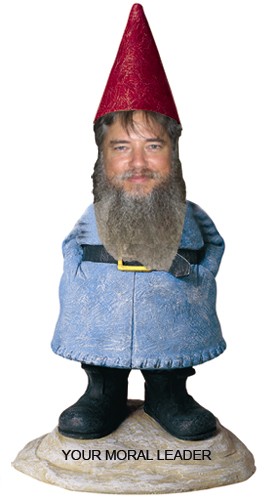
The path of your Moral Leader is a narrow one. Daily I offer my readers a beam of clarity and hope in our ever decaying society. But friends, a blogger’s life is an impoverished one. For years I have subsisted only on my meager ad revenues, credit card cash advances, and occasional Seder dinners. Times are tough and my marketable skills are limited in a secular city like Los Angeles. What is a pious man to do?
In my youth, I am embarrassed to say, I once supported myself as a man-whore. It’s true. I would provide companionship for older, sophisticated women who craved the company of a young, virile boy toy. I would charm them with my witty chat, escort them to social events and yes, bang them. The temptation is strong for me to revert back to my wanton ways, but I resist. Daily I am bombarded by sleazy offers from my fans requesting me to perform unspeakable sexual acts.
So I ask you. In order for me to preserve my secondary virginity and continue to proudly wear my purity ring would you think less of me if I marketed a latex replica of myself for my fans? Is it wrong to
clone myself? Would you pay $49.99 plus shipping and handling for such an item? Would it diminish or increase your respect for me? Should I offer discounts to my female readers? Readers, I value your input.
Regards,
YML
LIOR EMAILS:
I’ve been enjoying your commentaries and interludes with the Rabbs. Often I pull up your blog on my second monitor for some edu-tainment to get me through late night work. I’m glad to see that you both seem to be reading your materials prior to class.
With regard to a latex replica for fans, it might be a little over the top and I’m not sure if it would be Kashrut. However, I was thinking maybe something more like a rabbinic gnome figurine, and should the ladies desire to find a dual use for it, that would be on them. I hope you enjoy my prototype. Maybe it has a motion sensor that when you pass in front of it, it speaks in a deep voice, “Luke, I am your Moral Leader.”
It is a particularly joyous Jewish holiday where we are commanded by God to dwell in booths.
R. Rabbs writes: “Sukkos, which has timely significance because we celebrate it next month, is another Yom Tov that doesn’t work for those living alone. Sukkos is when families build huts on their property and then eat their meals inside of them for a week. I can see how Sukkos could be a great experience for entire families. But, that holiday especially blows for me, because I cannot build a sukkah where I live, forcing me to eat elsewhere for a week. More precisely, forcing me to eat by families every meal of every day for an entire week! I don’t like to eat by families even once in a Jubilee, and Sukkos comes and forces me to eat by them all week long! As a result, I dread Sukkos. But, again, if I had a wife, I know it would be great, because even if we were forced to eat elsewhere, at least we would do so together and have each other’s support. And, I would no longer suffer as the only single in a room full of married people. Hopefully, though, she and I would move into a place together that would allow us to build our own sukkah, and then we could enjoy the holiday on our own terms without the invasion of any little kids or babies in our hut. That would be awesome!”
Posted inR. Rabbs|Comments Off on The Jewish Holiday Of Succoth (Tabernacles)
"This guy knows all the gossip, the ins and outs, the lashon hara of the Orthodox world. He’s an [expert] in... all the inner workings of the Orthodox world." (Rabbi Aaron Rakeffet-Rothkoff)


My Beard Bothers The World
In February 2008, I read an essay in Commentary magazine by the clean-shaven Rabbi Meir Soloveitchik on the role of the beard in Judaism.
It laid out the reasons for why the beard (as opposed to the clean-shaven look) was Judaism’s preference for men.
I don’t remember all the reasons given in the essay but among them were:
* It was to distinguish you from Egypt, where clean-shaven was the ideal
* It is the acceptance of adulthood and the abandonment of attempts to look young while growing old
* It demarcates adults and children, men and women
Among the additional reasons that I have a beard is that it is a constant reminder of who I am. I can take off my yarmulke and tzitzit and I can dress like a goy, but my beard does not come off so easily. I think twice and thrice these days before stepping inside a non-kosher restaurant. Before, I’d just take off my yarmulke and tuck in my fringes.
I’m fascinated by the way so many people give me a hard time about the beard. Goyim generally do it because they think it is weird and ugly.
Jews give me a hard time about the beard because they think I am trying to pose as more religious than I am.
They are right. I am trying to pose as more religious than I am. As Shakespeare wrote, “Assume a virtue if you have it not.”
I’m fascinated by the objections that Modern Orthodox Jews have to my beard. I’m fascinated by how many Torah-learned Modern Orthodox Jews list off for me the reasons why a beard is not mandated by Jewish law.
I understand a beard is not mandated by Jewish law. Many of Judaism’s preferences are not mandated by Jewish law, but you can’t have the slightest acquaintance with the Torah and argue that the beard is not its ideal for Jewish men. For one thing, the Torah makes it very problematic to shave.
Why would so many Orthodox Jews tell me that my beard is not Jewishly necessary?
I guess it makes them nervous. I guess I disturb their Jewish comfort level whereby if you do one more mitzvah than them you are a fanatic (and one less mitzvah and you are a goy, notes Dennis Prager).
I remember one Orthodox woman told me, “Don’t you have to earn a beard?”
Well, do you have to earn Sabbath observance? That is a public statement to the world just like a beard. Do you have to earn wearing a kipa and tzitzit? Do you have to earn the right to do a mitzvah? Do you have to earn the right to publicly identify as a Jew?
I’ve had Orthodox rabbis give me a hard time about wearing a beard. They said it was showy. It reminded them uncomfortably of the Haredim.
What fascinated them was how much it bothered them. Jews are not normally bothered by a lack of humility in their fellow Jews. They’re used to. They’re numb to it. But for some reason, the beard is just over the top self-assertion.
One Orthodox rabbi told me, “A Jew is not by appearance. It is by action.”
But appearance matters a great deal in the Torah. God is always telling the Israelites to wash up and to clean and mend their garments. The Torah has a lot of rules about appearance.
Jesus said in the Gospels, “It is not what goes into a man’s mouth that defiles but what comes out.”
Judaism holds that it is not only what comes out of your mouth that matters but also what goes into it. It is not only your deeds that matter, but also your beliefs and your appearance.
If the Torah is true, God cares about a lot more than just the heart or the deed or the creed. If the Torah is true, God cares about a lot more than just religion.
I remember a story told by Reform rabbi Mordecai Finley. He was raised in Conservative Judaism. He once went into a Reform temple on a Shabbos morning wearing his tallit gadol and noticed nobody else was wearing a prayer shawl. “We don’t wear those rags,” somebody told him.
In that Reform temple, the rabbi’s prayer shawl was as offensive as my beard to many Modern Orthodox Jews.
If you tell people in Conservative Judaism that you don’t drive on Shabbat, you’ll often be regarded as a religious fanatic. Or if you wear your kipa out.
If you are just a bit more ritually observant than your crowd, you’re gonna stand out like a sore thumb, like a nail that needs to be hammered in.
RABBI RABBS POSTS ON MY FB: Long before Shakespeare, the Torah said m’soche sh’lo lishmah, bo lishmah (from doing things for the wrong reasons, comes doing things for the right reasons). In other words, it’s good to “fake it”, because faking it leads to doing it for r…eal.
Anyone that argues against that is arguing against Torah.
As for the so-called “Orthodox rabbi” that told you “A Jew is not by appearance”, you might want to show him the Midrash that says the Jews were redeemed based on four merits, and one of those four was that we maintained our Jewish appearance.
It is brought down that maintaining our Jewish appearance will again merit us for our final redemption.
Anyone that scoffs at your beard doesn’t want the final redemption.