Men Fear Dollar Rape Just Like Women Fear Physical Rape

Konen emails:

doc paul is not so boring in this conversational podcast w/paul janka
 
doc talks about how men fear $$ rape like women fear physical rape
 
-love the brainwashing information, diamond ads etc.
-rise of looks and porn +info economy makes her looks the #1 quality saught by men
-options of women = rise of martial hustle industry
-courtship to doc paul is the only working filter to select a mate
-est. borders and rules in courtship, she will run for the hills if she is loq quality
 
http://www.drpaulmrjanka.com/

Posted in Dating | Tagged , , , , | Comments Off on Men Fear Dollar Rape Just Like Women Fear Physical Rape

I Love A Pale Pure Face

I know this is wrong, but I am highly attracted to demure chicks.

I love a pale pure face and I want to write all over it with my words.

I love meeting a woman of honor who’s single and who will talk to me.

I love a pale pure face that blushes. I love to capture her with my words and then start whispering things to her that cause her pale pure face to turn the colors of the rainbow. I love to watch her giggle until she loses control. I love to move her. I love to pick her up and dance her around the room and spin her and twist her and take her to Heaven and back with the use of the fewest words possible.

Is that bad?

Posted in Personal | Tagged , , , | Comments Off on I Love A Pale Pure Face

LimmudLA 2009 Report II

Part One

SATURDAY 3 pm. I walk up and down the corridors looking through peepholes at the various classes.

It’s not Torah I seek, it’s visceral human contact. I want to make friends. I want a wife. Most of all, I need a new employer for my writing skills. God and prayer is all well and good, and companionship is very nice even when it’s not erotic, but I’ve got to make a few quid. Who can I suck up to?

I wonder — where are the cool people hanging out? They’re probably in someone’s private room and they’re saying to each other, "Glad we ditched that loser Luke Ford." They’re drinking alcohol and transgressing the Torah in all sorts of delightful ways while yelping, "I’m glad Luke Ford can’t put this on his blog" and "Blog This! Luke Ford!" and "Stick this where your blog don’t shine, Luke Ford!" and "Luke Ford you suck!"

I end up in Rabbi Mark Diamond’s class on "Texts They Never Taught Us In Hebrew School."

I sit beside two hot chicks I’ve wanted to chat up all conference but two minutes after I sit down, they get up and leave.

I must get rid of that "Loser!" sign on my forehead.

I take a nap with a new friend.

"We have to 613 it!" she says.

"Of course," I reply.

"Totally shomer!" she says.

"I wouldn’t have it any other way."

"Separate beds."

"Separate beds."

"I don’t want you to touch me."

"I don’t want to touch you. What would be a few minutes of physical bliss compared to the true joy available in the afterlife?"

Dinner. I make new friends. I feel happy.

I go to the havdalah ceremony. I smell the rosemary. I chant the chants. I sing the songs.

I join the dance. We spin around and around, faster and faster, we’re so out of control that women have joined our circle. Oh my, I’m dancing with a woman. Hope the rabbis can’t see me.

This is bliss. This is pure bliss. I’m no longer worried about hanging out with the cool kids. I feel one with my people. I stretch my arms out and embrace my fellow Jews, gay and straight, Reform and Orthodox.

The dance goes on and on. This is the highlight of the conference. The joy is infectious.

Afterwards, I pop upstairs to grab my pen and notebook and hit the latest class by British Orthodox rabbi Gideon Sylvester: "The Moral Limits of Outreach to Assimilated Jews: How important is it to reach out to assimilated Jews to try to renew their interest and engagement with Judaism? If it is important, then at what price should we do it? May we compromise their autonomy and our integrity to win back more souls for Judaism? In this session, we will look at some of the sources for the idea of outreach and some of the texts that examine its moral limits."

Rabbi Sylvester is a hoot. Is it moral to be this funny and still frum?

He tells about a bloke he knew in Jerusalem who’d position himself at the Wall and pick up on spiritual seekers and channel them to a yeshiva. He’d ask them for the time and other questions as a pretext for sending them towards Torah. Rabbi Sylvester asks us if that is OK.

I shoot up my hand. "I use lies to pick up women," I say. "I see nothing wrong with asking a woman for the time or ask her for directions or ask her other such questions if you are going to use that opportunity to connect with her. If that is OK for picking up chicks, then how much more so is it OK to do it for Torah."

There’s shocked silence in the room of holy Jews.

"Are you married, Levi?" asks Rabbi Sylvester.

"No," I reply. "And I don’t know why."

"Well, folks, if Levi tells you he’s a multi-millionaire or offers you some investment deal, I might advise you to be cautious."

I feel like a cad. How could I have been so vulgar and so honest in such a holy setting?

Oy, the shame I bring Jews.

After class, I spot a female acquaintance from shul who told me yesterday that I seemed happy.

"Do you have the time?" I ask.

She goes for her watch but it is not these worldly details I seek. It is the bliss that can only come from unity with the Godhead. She is but a path to the one true world. Oh, how can I get this across most effectively? Is it OK to lie?

Rabbi Sylvester was shocked this morning that there was no prayer for the Queen. Then he found out that the States broke away from the Empire a few years ago.

Everyone in the class says it is bad to use deception to turn Jews on to Torah. But everyone in the class is Modern Orthodox or even less religious and they don’t proselytize. Only the ultra-Orthodox proselytize Judaism to Jews. The Modern Orthodox are too busy making a living. It’s all very well and good for them to look down their surgically-adjusted noses at proselytizing techniques, it’s just like smug marrieds looking down on pick-up techniques.

Rabbi Yosef Kanefsky says he’s wary of pushing greater ritual observance on those whose families it might wreck as well as on those who are mentally ill. If they’re already OCD, Orthodox Judaism would be like giving alcohol to an alcoholic.

Rabbi Sylvester says we shouldn’t prey on those who are emotionally unstable.

Michal from JConnectLA says she doesn’t use the term "kiruv" (to bring close) because it implies that she’s closer to HaShem than you are and that you need to change.

Rabby Sylvester cites the Talmudic text about staying far away from falsehood. Very smug. Wish there were a few scholars here who would contend that most of Orthodoxy’s foundational beliefs are false. How is that being far away from falsehood?

I love a good fight. I hate the smug.

Smug, smug, smug. Smug Marrieds. Smug Orthodox. Smuggies who look down on me. Smug them! I’ll smug them up on my blog and go all Hebrew gangster flashing signs to my home boys in the blogosphere. I’m the Meyer Lansky of bloggers and I’ll outlast them all.

Rabbi Sylvester talks about religious Jewish women in Israel doing national service in a remote area of Israel where some secular guys want the girls to teach them Torah.

So the girls inquired of a rabbi and he said it was permitted. Yes, the boys were learning Torah from impure motives, but if they got some Torah inside of them, it might purify them.

Rabbi Sylvester says the Rebbe was against "outreach" but was for teaching Torah widely.

9 pm. The comedy festival features Avram Mandell, Gerry Katzman, Rabbi Simcha Levenberg and Mark Schiff.

Avram: "The problem with having a Hebrew name is that every time you meet someone, they want to tell you about every Jew they’ve ever known."

"Friday morning, I got to do a set for hotel staff and LimmudLA leaders. I got to explain some of the differences between Jews and Christians. We don’t believe in Jesus…except for driving down the 405 during rush hour."

Avram explains the Shabbos elevator. "There’s a law in the Talmud that says you are not allowed to use electricity on Shabbat. But if it happens to be running already, you can use it. If you are walking with your family and you happen to back into closet and that closet happens to go up to your floor, you’re allowed to use it."

LimmudLA boasts "Shabbos Friendly Bathrooms." What’s a Shabbos-Friendly Bathroom? Avram explains that it is a place where after you do your business, the toilet yells "Yasher Koach!"

Rabbi Simcha Levenberg explains we’re the only religion with our own aisle in the grocery store. "The non-Jews must think we live on Kedem grape juice, gefilter fish and yartzheit candles."

"Anyone here pagan?"

Nobody raises their hand.

Gerry Katzman says he supports reparations. "Three thousand years ago, we were in Egypt. Where’s Egypt? It’s in Africa. The black man was the man. Let me ask you a question: What’s harder? Building pyramids or lifting cotton?"

Oooooh.

Pico-Robertson’s Mark Schiff is the final comic. "I drove down here in 40 minutes," he says.

He talks about how confusing this convention must be for the hotel workers. "They hired all these extra operators and yet nobody’s calling down for room service."

Jews aren’t going outside. "A family with 17 children doesn’t happen with exercising."

"You know you’re not doing well in life when you’re returning things to 99c stores."

"Do you ever notice how mothers always have a ‘splitting’ headache? Wouldn’t come from yelling all day?"

"When people say, ‘The last thing I want to do is hurt you.’ That means it’s on the list."

"Being married is like living on the floor of the senate. Every day, a new law is being passed. My wife says, ‘From now on, no socks on the floor or there’s no dinner. I’m not your mother.’

"I know you’re not my mother. My mother’s very nice to me. She’d pick those socks up and make me a sandwich."

At Matisyahu’s concert Saturday night, I feel excited that such a prominent Jew was gracing up with his talents but I can not connect to his music. There is an element of rap music to it that I just don’t get. I look around the room at all the happy Jews swaying to his music and I wonder if the older folks, those my age and older, truly enjoyed Matisyahu as much as they appeared, or did they feel pressure to fit in and be cool and ride with the music? Up front, the rosh yeshiva of Shalhevet, Rabbi Elchanan Weinbach and his wife, gently swayed to the music. Do they genuinely dig it? They look happy.

I wonder if the frum girls will take off their sheitls and throw them at Matisyahu. Frum Jews Gone Wild!

At the concert, I put my notebook down with my program guide. When I return to them 15 minutes later, my program guide has been stolen. I go to the Help Desk and try to get another one but I’m told there aren’t any.

I wander around without a guide for 22 hours.

At 1 a.m. Sunday, Matisyahu retakes the stage and does "No woman, no cry."

I am a bad man for writing this, but I often walk into a session during LimmudLA and feel like the most powerful man in the room. I’m not presenting. I’m not asking questions. I’m not giving opinions. I am just chronicling the story of LimmudLA. Sure, the Los Angeles Times will write about LimmudLA and the Jewish Journal and the rest of the conventional media, but it will be my account that will be the most powerful and that will touch people the most deeply. Everyone else will write in black-and-white, but if you want the color and excitement of LimmudLA, you’ll have to come here. Everyone else will quote the organizers and a few sanitized bits from the conference, I’ll take you into the boardrooms and the bedrooms of the Costa Mesa Hilton.

I may be a rebel without a shul, I may be the black sheep, I may be the one you love to hate, but I’ve got the blog that grabs Los Angeles Jewry by the neck and shakes it hard! It doesn’t matter if you read me or not. Every word I write goes into the universe and changes its vibration.

Sunday 1 a.m. Friends lets me crash with them. They come in at 2:30 a.m. Nobody snores. We get up at 8 a.m. A decent night’s sleep.

11:30 a.m. Filmmakers David N. Weiss, Ruth Broyde-Sharone and Jeff Astrof talk about what inspires them. David reads a Rebbe Nachman story ("Never Lose Hope") that taught him the importance of projecting happiness to his family. They don’t need to be burdened by his troubles at work.

David: "About 45 minutes into Shabbos, we’re enjoying ourselves. And that happened because I faked it. Because I’m a big fat liar."

"My wife stopped seeing me as the guy who needs propping up. Instead, it’s ‘Thank God he’s home.’ And I feel like, ‘She needs me! Thank God! I’m important.’ That makes me smile."

I don’t find listening to other people’s troubles exhausting. I find it exciting. I feel like I’m trusted and I’m worthy of being confided in.

David and Jeff are succinct and funny. Ruth is wordy and earnest.

David: "When you are hired in this business, they’re hiring you in part because they like being around you."

Jeff talks about divine intervention in his life. In sixth grade, a new girl came to the school named Theresa Truesdale. He prayed that she would like him. He never spoke to her. Two days later, there was a rumor going around the school that she liked him. "This is incredible. We celebrate lesser holidays than this…. That was my relationship with God. I could ask Him for things and He would make it happen. I still believe it to a certain extent. It was a one-way relationship. Sometimes it worked, Theresa Truesdale, and sometimes it didn’t. My grandmother died horribly of cancer."

Jeff cites teachings from Rabbi David Aaron of Isralight and Rabbi Akiva Tatz.

"We went to a Shabbaton called Arachim. Arachim was wonderful. It was like a nuclear blast of Torah and the Torah is true. The whole framework was proving that the Torah comes from God. Some stuff was really resonant. Other stuff was like, if you relax your eyes over certain sections of Torah, certain words pop out. I think we do that with cereal boxes. The big one is that we were the only religion in history that had a mass revelation. That made it really hard to lie about it. Your grandfather said, I was there. It would be difficult to get people to lie about that. We still tell the Passover story today.

"We’re driving home. I’m thinking, this is really cool. Maybe I’ll wear a baseball cap to work. I call my father. It was the first time we really kept Shabbat. I tell him that I’m coming from this amazing seminar. I tell him that it was about proving the Torah was true. It slowly began dawning on him that this was an Orthodox group I was talking about. He said, ‘Do not get co-opted by the Orthodox. They are a cult. They are trying to brainwash you.’

"My father’s father was Orthodox. He wore a black hat. They had a different kind of relationship. They didn’t talk. There was not a lot of love passed down. There was no reason for my father to be observant. My father was just slamming the Orthodox. I said, ‘But Dad, your parents were Orthodox.’ He said, ‘They absolutely were not.’ I said, ‘Your father went to an Orthodox shul.’ He said, ‘That’s because it was the only one that was close enough to walk to.’ I said, ‘Your mother lit the candles.’ He said, ‘But only on Friday night.’

"That was easy to dismiss. What was harder to dismiss — I talked to a good friend of mine who was a non-Orthodox clergy person. Very faithfully not Orthodox. One of my best friends. I was telling him about Arachim and joking about my father. I was on the phone going to work in Studio City. There was silence. I said, ‘What’s the matter?’ He said, ‘I’m really disappointed in you. Here you took this whole weekend to learn that the Torah comes from God and you never took the time with me to teach you that it doesn’t."

"As I’m driving, I feel like I’m shrinking. He’s going, ‘I can show you texts. I can show you reasons why the Torah is not from God.’ And this is from a guy who is a religious guy in his field.

"At that very moment, a white jeep Cherokee crossed in front of me. The license plate on the jeep is ‘Halacah.’ It tugged on me. At that moment, I stopped hearing my friend… For me, it was God saying it’s Me. Turn on your radio and look around you. From that moment on, I daven for a parking space. I thank God for a parking space… I can always pull up right in front. The meter’s always broken. It’s great. For nothing else, you should put on tefillin.

"That experience for me solidified… It made me open my eyes. It made me turn on my receiver."

"I truly believe that everything that happens is supposed to happen and is what is best for you."

"Every time I turn down that radio knob [to God], my life is worse because I’m anxious and not connected. I’m tired. Turn up that radio knob really loud and there’s nothing that can stop you."

There’s loud applause.

I ask the first question for Jeff: "What you’re describing is that Judaism is magic."

Jeff: "I don’t think it is Judaism is magic. I’ve prayed for a lot of things that have not come true and I’ve looked back and can see that’s why. You can see the hand of God there at all times. Things happen for a reason. You miss a flight. My wife taught me that."

Jeff and David both have gorgeous wives and beautiful children. This God-thing seems to be really working for them.

Jeff: "Knowing that I’m praying for that connection means I’m part of a bigger picture. Hollywood destroys your ego. There’s always someone telling you that you are not good enough."

Ruth: "I don’t think it’s magic, but when you are doing something in God’s service, there is a synchronicity that happens that can not be explained in any other way."

Ruth describes herself as an "interfaith activist." She talks about being at the session "Seven Levels of Laziness."

"I meant to go," quips Jeff.

The least appetizing session of the conference was for teens and entitled, in part, "Masturbation, Manischewitz…"

That’s one way to put kids off the vice of self-abuse — associate it with a sickening wine.

Sunday night, I find an abandoned program guide and a copy of Lisa Klug’s book "Cool Jews" in Pacific Ballroom IV. After no one claims them after a couple of hours, I take them. If they are yours, let me know. It is a mitzvah to return lost property.

A woman yelled at me a lot over Limmud. "How come your sexy are so messy?" she’d say.

She meant my tzitzit.

"No one else’s sexy are messy. You need to straighten your sexy."

Perhaps you’d help me?

Gidi Grinstein talks about the Jews: "We have never been more powerful and more vulnerable than we are today because we are concentrated in the U.S. and Israel."

He says that in 1980, the Israeli government accounted for 84% of all jobs in Israel (the only equivalent to that was in the former Soviet Union). Today the figure is 46%.

Daniel Reisel gives a class on "Lessons from the 2005 Disengagement from Gaza." He played a moving 36-minute documentary. Some settlers call the IDFwho’ve come to evacuate them, "Nazis." They scream at the soldiers, "How much are they paying you?"

"They’re chanting the same slogans," says a soldiers. "They’re brainwashed."

"You make it easier for me to do my job when you call me a Nazi," another soldier says to a settler.

I sit in one room waiting for a panel discussion, then the moderator tells me, "Nothing in this room is to be blogged. It’s like Vegas. What happens in Vegas stays in Vegas."

I get up and leave.

Close to midnight, I get into an intense discussion with an academic. "Can ideologues produce great art?" is my question. The test would be to compare the work of artists when they are ideologically committed to some transcendental cause and when they are not committed.

I unload my frustrations that academics use too many unnecessary words. They write things such as, "The way in which" when "in which" is almost never needed.

I’m told that academics are wedded to precision but I fail to see how unnecessary words makes speech more precise.

I see Truth as my goal. I want my blog to be as intimate as a husband and wife in bed. Orthodox Judaism erects huge obstacles to my doing this, but at the same time, better than any other system I know, it creates safe spaces where people with things in common can talk honestly with each other.

Part One

Posted in Limmud | Tagged , , , , , , , | Comments Off on LimmudLA 2009 Report II

I’m Live On Cam!

Click here to join the fun! My LimmudLA 2009 report.

WELSHDRAGON:  luke was a great looking guy, with a little bit of just 4 men he could get back to his prime
palestine4ever:  I’ve been saying almost exactly the same thing, Welsh
YourMoralLeader:  what’s just 4 men?
WELSHDRAGON:  it not a gay thing luke sorry
palestine4ever:  There’s nothing frightening about mirrors, razors and grecian formula
palestine4ever:  but it’s like f**king kryptonite
WELSHDRAGON:  lmfao-i’m gonna when the time comes!!!!
WELSHDRAGON:  lit up like a beacon
palestine4ever:  the stories that hovel could tell
palestine4ever:  how a young man, filled with dreams of "making it", arrived
palestine4ever:  flash forward 20 years
palestine4ever:  Luke 2009 walks out
palestine4ever:  It reminds me that I’m getting older
palestine4ever:  Like when I see Todd Bridges on television or something
palestine4ever:  as you age, luke, we all take a second glance at our photos
palestine4ever:  I notice my face is rounder than it used to be
palestine4ever:  these feelings are not consistent with the largely warm and cozy persona I expect from the Luke Ford Brand
palestine4ever:  You’ve got to do it for your audience

palestine4ever:  I liked your use of the verb "husband", Luke
palestine4ever:  "I stayed in Tuesday and Wednesday, husbanding my energies"
palestine4ever:  that’s very commonwealth of you =)
palestine4ever:  An revealing section which you no doubt have noticed yourself
palestine4ever:  "Why do you seem so happy?"
palestine4ever:  says someone at JewFest
palestine4ever:  "Yoga" sez Luke
Mitra:  Luke, what kind of writer are you?
Mitra:  You write on your blog and write one word responses.
palestine4ever:  That’s a tough one, Mitra
YourMoralLeader:  is that bad?
YourMoralLeader:  what work do you do mitra?
YourMoralLeader:  hookers don’t give it out for free in their off-hours
Mitra:  As a woman, that’s totally unappealing that you don’t express yourself.
Mitra:  Speak up!
palestine4ever:  Mitra, Luke’s enigma is that he lusts madly for women, while doing everything in his power to physically repel them.
YourMoralLeader:  tell me about yourself
Mitra:  You tell me!
Mitra:  Don’t hide behind one-word answers.
palestine4ever:  Have you been here before, Mitra?
Mitra:  Once or twice.
Mitra:  I’m Persian-Jewish.
palestine4ever:  Just kinda randomly found it?
YourMoralLeader:  am i being niggardly with my words?

palestine4ever:  Are you a Jew too?
bigappletreat:  of course
bigappletreat:  frum too
palestine4ever:  How ironic that two Jews can only connect with the moderation of a filthy arab
bigappletreat:  on second thought….you may leave if you desire
palestine4ever:  But maybe, just maybe, this is the kind of thing we could share with the world
palestine4ever:  make big, like, Tolerance Quilts and share our story of mutual understanding basking in the reflection of Luke Ford’s awesome powers
palestine4ever:  I mean, i’ve taken a holy oath to destroy your people utterly but I don’t see why that means we can’t be friends.

Posted in Personal | Tagged , , , , , , | Comments Off on I’m Live On Cam!

Teresa Strasser Out Of A Job

Joe emails:

Teresa Strasser is going to do a lot more great writing for the Jewish Journal. This is what happens in a state where there are no anglos ages 18-34, at least none who want to hear words or other things said by Dee Jays who want money. Much better is someone to spin Rhianna records.

This is a neat website. It tracks actual physical sales of gold (you can click on silver as well) and shows you the real price and what i call the "Obama premium" Gold spot price is quoted from COMEX, the futures exchange. But that price is based on 100 ounce deliveries. You want less gold, there is a slight premium and it used to be 3% or so. Now the premium is getting to be near 10% for even the most declasse of coins, the Krugerrand. Simply put, no one trusts the messiah, and there is a run on gold for so long as the nation is run by people who want to spend and spend.

And one more piece of news that you will not get from any of the mainstream media – Apparently, the Obama Stimulus Bill includes an "enabler" that only releases funds to California if California passes a budget. This is per Barbara Boxer by way of a request from Daryl Steinberg. So basically, California is subjugated to Obama – you want money from him, you have to pass a budget that raises taxes and cuts spending. But wait – if the stimulus gets money to California, then maybe the spending can be uncut and the tax hikes undone (how much do you want to bet that the former happens, and not the latter). We are going into an economic mess that Boxer and Obama are perpetrating and which will cause a huge outflow of populace from California.

Posted in Politics, Teresa Strasser | Tagged , , , , , | Comments Off on Teresa Strasser Out Of A Job

Jewcy – We Hardly Knew Ya

I could never figure out why Jewcy.com didn’t use Adsense on their site. They probably could’ve made $100,000 from it over the past three years and at least as much from other online advertising programs. Perhaps if they had used these things, their demise wouldn’t be so sure.

Somewhere former Jewcy employees Joey Kurtzman and Helen Jupiter are crying.

JTA reports:

The future of the online cultural magazine Jewcy took a serious blow this week when its primary funders pulled their financial support from the magazine, the Fundermentalist has learned.

According to a senior staff member of the magazine, its primary funder, theater mogul Jon Steingart, and its president, Tahl Raz, informed the staff on Friday, Feb. 13, that Steingart and its other major backers, Michael Weiner and Michael Steinhardt, were pulling their money from the magazine because they did not see it as a profitable model in a sour economy.

Steingart and Raz told the staff that they would have until the following Friday to vacate the magazine’s offices in the DUMBO neighborhood of Brooklyn.

Posted in Jewcy | Tagged , , , , , | Comments Off on Jewcy – We Hardly Knew Ya

Is Bible Scholar James Kugel A Heretic?

Daniel writes on Hirhurim: Some comments seemed to indicate that Professor Kugel is Shomer Mitzvos. However, if he does not believe in Torah min HaShamayim, then I do not see how he can fully believe (if at all) that the Mitzvos are binding. Part of being a Shomer Mitzvos is to perform the Mitzvos because G-d commanded us to, not simply for cultural reasons, to fit in, or out of the goodness of our hearts.

(Please don’t get me wrong. If someone keeps Mitzvos, but has issues with Emunah, the solution is to work on his/her Emunah, not to give up fulfillment of Mitzvos).

SHADES OF GREY POSTS: R. Elcahanon writes that disbelief is illogical, but he also writes that that the source of disbelief is desire or bad character traits. Lev Eliyahu in Chayei Sarh writes of the primacy of character traits, even more than fear of Heaven, as a building block for Judaism. Derech Emunah Ubitachan in Yisro(R. C.P. Sheinberg) quotes Sefer Hayashar L’Rabbeinu Tam that emunah is one of "kochos hanefesh".

All of the above sources need to be explained in depth and with nuance, but the point is that there is a moral, spiritual, and emotional component to belief; otherwise, you are left with R. Elchanon’s question of holding Aristotle responsible(or a bar mitzvah bachur), and you don’t have his answer, if you argue with his simplification of faith(see Derech Emunah Ubitachan, above, quoting Chasid Yavetz).

Someone like Dr. Kugel is exposed to a different intellectual system, and I don’t think will be convinced by a kiruv seminar, or attempts to put the Kuzari in quasi-mathematical terms. In perhaps a less problematic case, "frum-skeptics", are also exposed to a different system of thought, and "Project Inspire", aimed at the insular Bal Habos in Flatbush, might not help them(although anyone should keep an open mind, if they consider themselves an intellectual).

I think such people should work on the experiential parts of belief. At this point in their "nekudas habechirah", they can at least work on not mocking Judaism. As per R. Elchanon above, the middos element(along with other acts of Judaism) is a component of kochos hanefesh of emunah, and "meor s’hbo machazirin l’mutav".

They can also take a break from their questioning, although obviously if one is a Bible professor for a living, that is part and parcel of one’s life’s work. However even in the latter case, I would not reject "goodness of one’s heart", because it could lead to something better in the future; the Seredei Aish communicated with certain Maskilim–obviously he held out hope for them at their level.

CHARLIE HALL POSTS: "Why do so many people feel it necessary to judge others in a public forum in this manner."

Well….

When I publish something professionally — and my name is attached to over sixty articles in peer-reviewed scientific journals — I am inviting others who are knowledgeable to respond. On occasion the journals that have published my work have published the comments of others, and I have also written comments to the work of others that have been published. Prof. Kugel is an academic and should welcome fair criticism of his work.

"at yu ad hominem is a primary mode of argumentation and insult is a major mode of communication. and those at yu do understand that the outside world is different"

You should see some of the comments I’ve gotten from reviewers of the articles I’ve written that have been rejected for publication. I don’t think what you describe is unique to YU!

"The Pope has no problem attending a Jewish synagogue"

That is relatively recent. Catholics did not enter non-Catholic houses of worship until Vatican II.

"The RW are makpid on halachah, the LW eat out (dairy, fish whatever), and generally are much more lax."

I belong to what is generally acknowledged to be a LW shul, and nobody I know there who self-identifies as observant (there are indeed a number of non-observant members as well) eats cooked food in non-kosher restaurants.

"The RW will go to YU, KBY, Gush etc, the LW won’t."

I know a number of folks from that LW shul who have sent their kids to YU for high school and/or college.

DODA POSTS: Gil-I notice Dr. Bernstein concedes there are real questions based on historical inquiry. He does not dismiss the field (obviously) or say that since he has studied this, these are not strong difficulties. Gil, he is an expert and cannot dismiss. I wonder why you, who are very smart, but clearly do not have such a background, feel qualified to dismiss it as silly speculation.

[Gil Student replies: "I do too. But I don’t accept every question as valid."]

As far as Kugel, what I heard him say at the lecture was equivocal. But basically, I think he means he believes in the Divinity (at some level) of authorship, and this is not something that can be proven or disproven by study. I do not get the impression he believes in all of Torah Missinai. And I think he wishes he could, but with what he has learned at this point, he cannot honestly believe it.

JLan-Haredim are shomer negiah, and MO are not. And that’s the difference? Maybe in public. Still I know some MO who really are. And I know Haredim who privately are not. Of course, the longer one is single, the less realistic it is to expect that, no matter what one’s background is.

Man Dehu writes: As to questions, Kugel writes in his book that there are words in Koheles which are Persian, so Koheles must have been written post Churban Bayis Rishon. Does anyone know of any Orthodox scholars who refute this?

GIL STUDENT REPLIES: I don’t recall that from his book and I haven’t seen any scholarship on this at all. But is it really so hard to believe that Shlomo Ha-Melekh knew at least a few words of Persian?

ANON POSTS: There’s another problem too. For better or worse, there is such a thing as a history of the Hebrew language. Even Orthodox scholars such as Bernstein concede this. And they (him included) will tell you that if Koheles was written by Shlomo then, in fact, there is no history of the Hebrew language. While you may be fine with that, it also means there is no history to other languages as well, since the linguistic method does not discriminate in languages.

GIL STUDENT RESPONDS: As Kugel makes clear, this is based on the assumption that it takes a long time for words to assimilate from one language into another ("Loan words enter a language when two different civilizations have some ongoing, sustained contact." – p. 513). This is nothing more than a generalization that proves nothing. There can easily be exceptions to it and we don’t even have to go to Shlomo having contact with people from all over the civilized world (which he did, even if every country with which he had contact is listed in the Bible).

ANON POSTS: But if your kid needs speech therapy, hopefully not, you will rely on the field which developed out of linguistics. however soft a field you believe it to be.

NACHUM LAMM POSTS: You fail to see what you’re getting into, Gil. By stubbornly sticking to such an indefensible (and theologically unnecessary) position about Neviim and Ketuvim, you make people wonder if your positions about the Torah are similarly untenable.

GIL STUDENT POSTS: "These are perfectly defensible positions. I consistently reject any conclusions based on speculative historical methodologies. It’s all theories with no proof."

ANON POSTS: That’s what gets me, how anti-intellectual people suddenly become when it isn’t in the Beis Midrash. Since when are theories (which, obviously, are based on evidence, reason and analysis and are meant to be chewed over and not ignored) something to shrug at?

ANON POSTS: Do you really think there is a chance that at a later date the scholarly consensus will become that Koheles was written by Shlomo, or at least that it dates in whole or part from the period in which he lived?

Be that as it may, are you really so disinterested in the question of who wrote Koheles? I’m afraid I don’t believe that. Hirhurim is the work of a man who has broad interests in Judaica. True, it is obvious that there are areas that are especially of interest to you, and others that are less so. But I can’t believe that this entirely disinterests you, as opposed to it being something of a third rail that you simply don’t want to touch.

GIL STUDENT POSTS: "I’m not interested in these kinds of theories because I don’t take them seriously. Did you know that there’s a theory that it was originally written in Aramaic and then translated into Hebrew? I don’t believe in treating holy writings so cavalierly and making judgments about them based on speculative, unprovable theories."

ANON POSTS: Very well said. So you wouldn’t ever dare to say that God was the author of a book, based on speculative, unprovable theories, right? Right?

Dr. Bernstein does not believe that Shlomo wrote Shir Hashirim. No Orthodox Bible scholars believe this. the only thing they insist on is that Moshe wrote the Torah. Nothing else is an ikkar emunah.

NACHUM LAMM POSTS: The Gemara doesn’t say that Shlomo wrote Koheles. Or Shir HaShirim. Or Mishlei. (Heck, Mishlei itself says that Shlomo didn’t write it.) It also says that Moshe didn’t necessarily write Iyov, and that Yechezkel didn’t write Yechezkel, and that Daniel didn’t write Daniel, and that Esther and Mordechai didn’t write Esther, etc. etc. And yet if I were to say all this in certain circles, I’d be shouted down as a heretic. (Ditto if I wondered aloud why Ruth or Eicha or Daniel are in Ketuvim and not Neviim, and so on, let alone if I wondered whether Yishaya *really* named Koresh in a Nevuah, or Daniel *really* nailed the history of the Seleucids so accurately.)

"Did you know that there’s a theory that it was originally written in Aramaic and then translated into Hebrew?"

I have heard this theory. (Similar theories exist for Iyov, the Hebrew parts of Daniel and Ezra-Nechemiah, and Divrei HaYamim.) I have no idea if these theories are true. But I do know that if someone who knows Hebrew and Aramaic a lot better than I says it’s a possibility, then it’s a possibility. (And if others say, as some have, that it’s impossible to prove, then that may be true as well.) He doesn’t even have to be frum (or Jewish) for me to pay attention to what he has to say.

ANON POSTS: There’s a tradition that little Jewish children during the time of the Hasmoneans played with dreidels when Greek soldiers came and could discover them learning Torah. So this tradition began in the 18th century, but I bet your son’s rebbe transmitted it to him as the historical truth.

MAN DEHU POSTS: Gil, do you believe that a global flood occured in the time of Noach? If you don’t then you are throwing thousands of years of mesora out of the window. (If you do you’re denying the possibility of scientific knowledge about anything). Do you believe that ‘Al naharos bavel’ was written by David Hamelech? If you don’t then you are rejecting an explicit gemara (Gittin 57b)? Where do you draw the line?

DR. SOLOMON SCHIMMEL POSTS: Professor Bernstein writes:

"The dilemmas faced by Orthodox Jews who engage in the discipline of biblical scholarship are well-known, as are the theological boundaries that Orthodox Judaism sets down in this area. This leads to the well-known phenomenon of Orthodox Jews in this field (myself included) specializing in "safe" areas, whether they be the Dead Sea Scrolls or medieval parshanut or biblical philology."

This avoidance of biblical scholarship by many modern orthodox scholars as well as laypersons is fueled in part, by many fears, some based upon reality, others more imagined than real, of which I will note the following:

Fear of social ostracism.

Fear of the loss of existential meaning.

Fear of the shattering of one’s core self-identity.

Fear of hurting family members and disrupting family relationships.

Fear of betraying the Jewish past – how can I reject TMS when so many of our heroes and martyrs sacrificed their lives in defense of it and the religious life on which it was based.

The fear of moral anarchy. Giving up TMS will result in permissiveness and moral relativism.

Fear of professional or financial loss (this applies to orthodox rabbis and educators whose positions assume acceptance of TMS as a cornerstone of their religious commitments).

These fears trump the pursuit of truth which is no longer a serious value in the world of modern orthodoxy. The OU, for example, recently distributed a timeline of the Tanakh in which it asserts with certainty that the world is less than 6,000 years old.

If truth were important how could it be that modern orthodox academics and other highly intelligent and educated individuals in the modern orthodox world refuse to honestly grapple with the most important premise of their religious world view, the dogma of TMS, and that which flows from it? In the debate between modern orthodoxy and non-orthodoxy it is almost fruitless to address the alleged "arguments" in defense of TMS that are presented, and to attempt to refute the highly developed apologetic "reconciliations" between doctrinal claims and empirical and logical challenges to them, because we are not dealing with logic, rationality, or a sincere desire to ascertain truth. We are dealing with psychological and emotional issues, not cognitive ones, even though these real issues are masked in cognitive language.

There are at least twenty factors which induce people to give up cherished religious beliefs and commitments, and rational persuasion is only one of them. It is not particularly effective because some religious beliefs, such as in TMS, are being sustained by non-rational factors.

Unfortunately, the failure of Professor Bernstein and others of his orientation to be sufficiently aware of what motivates them in their defense of TMS results in many negative intellectual and moral consequences, not least of which is the perpetuation of falsehood in the educational institutions where they teach, insofar as they claim to be teaching truths about the history and development of biblical religion when they teach Tanakh.

MAN DEHU POSTS: Gil-you cleverly avoided my questions. How do you differentiate between the authorship of Koheles and the authorship of Psalm 137? Or do you not? How do you differentiate again between Koheles and a global flood, if indeed you do? If you do maintain that David Hamelech wrote ‘Al naharos bavel’, do you believe that this psalm was recited by Jews for centuries, all the while not knowing what it referred to, or was it hidden away somewhere until, after the churban, it was whipped out by somebody who had a mesora that it had been written by David Hamelech? Or perhaps you can suggesty an alternative mechanism?

The fact is that even with Krochmal’s explanation you’re disregarding the mesora. The point is that once you disregard the mesora – where do you draw the line? Gil makes reference to the changing consensus in Biblical studies over the past 50 years. This implies that were the consensus to remian static for a long enough period, Gil might change his mind. How long would this have to be for? If you would go to all the scholars in the world, Kitchen included, and they tell you that there is no way that the words pitgam or pardes were part of Hebrew in Shlomo Hamelech’s time, what would you do? (I personally have no idea whether this is the case). At what stage do you stop saying Tzarich Iyun Gadol and start saying that perhaps I need to change my perspective? I have no easy answers to these questions, but I don’t see how a reference to Plantinga’s foundationalism helps you very much.

ANON POSTS: Gil does indeed make reference to changing consenses in biblical studies in a half century, but he doesn’t mention that there are any number of consenses in biblical studies that haven’t changed in three centuries and show no sign of changing.

SHADES OF GREY POSTS: Professor Schimmel,

"Unfortunately, the failure of Professor Bernstein and others of his orientation to be sufficiently aware of what motivates them in their defense of TMS"

What is wrong with conceding that the motivations of a human being are complex?

Musar, in concert with psychology, tells us that a person can have many motivations for religion, which may be refined to higher levels of "lishmah" through awareness and the conscious exercise of "bechirah chofshis".

I don’t know Dr. Bernstein, but I don’t think his approach is that of some Kiruv people, to present evidence for Judaism instead of dealing with Maskilic challenges in depth. I assume he’ll acknowledge the strength of a question, on a both intellectual and emotional levels. Now, what is wrong with that in terms of psychological honesty?

Dr. Nathaniel Branden, whose philosophical and psychological orientation is that of a secular humanist, is a strong advocate for free-will, at least to a certain degree. Rabbi Israel Salanter is described by Rabbi YY Weinberg as having "koshered" elements of Haskalah; in this sense, perhaps the "Haskalah" involved is humanism and psychoanalysis.

At the same time, the non-believer, as a human being, is similarly structured of reason and emotion, and may have dual motivations in critiquing the believer. Acknowledging the depths of our intellectual and emotional makeup, strengthens, rather than weakens us as human beings and as religious people.

Dr. Bernsetien himself concedes that he considers the axioms of Torah Misnai exceedingly precious–what in the world is wrong with that?

To wit,

"On the other hand, we have axioms more precious to us than those of scholarship (pg 24)…The Orthodox graduate student or young scholar… must be prepared… to conclude zarikh iyun gadol, or the equivalent and to step back spiritually whole(pg 25)".

DODA POSTS: I have yet to find one in academic Bible or Talmud who does not take these as serious questions. And I cannot accept your dismissal of linguistics. We can sometimes see how words come from other languages, and we know something of when there was contact with these cultures. It’s not just words; it’s also structures, formulae, ideas. It’s like there was a world around them (!) rather than everything being created in a vaccum.

Re: Other traditions, like what? And why take our cues from rishonim when there is a time gap and they had an agenda? Historians actually go back to sources, many of which rishonim did not have. They have archaeological evidence rishonim do not. And they know languages rishonim did not. Incidentally, rishonim define what traditions are fundamental. And we take these definitions from them. It’s a little circular.

SHADES OF GREY WRITES: I recall one of RIETS Roshie Yeshivah say that his orientation to Academic Bible is "more in the Beis Midrash than not", and he conceded in the questions that he’s not analyzing the subject as a purely objective observer, but rather as a believing Jew. Of course that doesn’t mean that he’s not trying to put his beliefs in a logical, self-contained system of thought.

When you move to the Charedi world, it’s probably much easier to show a partial reliance on faith. Certainly from a Charedi point of view(and perhaps even MO), there are challenges beyond Bible theory, the latter which is easier to dismiss.

A Mishpacha story noted that R. Reinman was given the go-ahead by a Gadol to debate Ammiel Hirsch only because R. Reinman was convinced prior to that that he could prevail. That’s seems to point to a partial reliance on faith.

I don’t have first hand knowledge for Charedi Kiruv seminars , but I get the impression, that they are proposing that they’ve defeated Haskalah(talks of "evidence") ; perhaps that might eventually morph into a more humble claim of presenting a coherent alternative system of belief.

R Schwab writes,

"History" is either true or false. There is no middle ground. The events described in a history book have either happened or they haven’t. The most ingenious theories which may have their place in philosophy or as a working thesis in the exact sciences have no meaning in the pursuit of historical evidence, which is a search for facts and
which accepts no conjectures. A chronological time table is the backbone of any book on history which expects to be accepted by intellectually honest students.

R. Schwab concludes:

It is because of all these gnawing doubts that I have decided to put a big question mark after the words "Jewish Chronology." Let somebody with greater knowledge come and pick up the threads where I left off. Our traditional, universally accepted Jewish way of counting the years from Creation is sacred territory which only fools do not fear to tread upon.

This may be a disappointment to some, but on the other hand I muster the courage to belong to those who rather wish to be honest to themselves than to be "right". I would rather leave a good question open than risk giving a wrong answer. And I follow the teachings of Rav Shimon (Pesachim 52b) who said "Just as I was awarded for the research, so shall I be awarded
for the retraction".

The historic material which I have assembled may still be somehow useful, even for those who will doubt whether there can ever be a Jewish chronology which would satisfy the non believer in the wisdom of our Sages. So I fall back into the ranks of all shlomei emunei Yisroel. And to me l’berias olam means what it meant to our fathers. It is as simple as that. And while we may keep on searching for the answers, we pray that Hashem may enlighten our eyes. "And G-d should enlighten the eyes of all those who wait for the coming redemption quickly in our days amen"

http://www.aishdas.org/avodah/ vo…11n030.shtml#06

FKM POSTS: This plausibility question really boils down to a question of looking at Kisvei Kosdesh and Chazal from a religious versus secular perspective.

From a secular perspective, Tanach is not divine, not prophetic nor inspired by any higher wisdom and can have no special pleading based on this quality.
The text is analyzed like any other human text. So any attribution of unusual qualities to the Tanach–like advanced references to empires, events, or in this case, languages, is just not as plausible as positing later authorship.

But if you have a religious perspective on Tanach and Chazal, then the realm of what is plausible is vastly increased. Kisvei Kodesh are not ordinary texts written by ordinary people. None of the standard rules of analysis are necessarily valid.

The tragic problem is that Orthodox people trained in doing textual analysis on an academic level simply cannot employ their religious perspective to Tanach. It’s not how you play the literary game.

These Orthodox people nebach have to pretend the Tanach is a secular one, and gradually over time, this perspective becomes their second nature and forget that the text has unique religious qualities.

As if that’s not bad enough, they then start to complain about "dogmatic views of the bible" and start demanding that an "intellectually open and sophisticated Orthodoxy" needs accommodate their religiously neutered approach! What chutzpah!

Posted in James Kugel | Tagged , , , , , | Comments Off on Is Bible Scholar James Kugel A Heretic?

Naming Sources

David writes on Hirhurim: "Maybe the Rambam had a stronger basis on which to be ‘somech’ his methodology of not naming sources, i.e. from Moshe Rabbenu himself. After all, at the beginning of Devari-im when Moshe starts his review of events in the wilderness and recounts the incident of the appointment of judges/officers, Moshe seems to take credit for the idea and never mentions that it was Yitro’s suggestion.

"As for the Rambam, the whole thing is a tempest in a teapot. The Talmud doesn’t say it’s a requirement to attribute, it simply says it’s a very positive thing to do and assigns a level a potential good that may come of it. so, anybody having an opposing good reason would be well within their rights.

"And maybe that’s what Moshe did. the new generation would remember yitro as that Midianite "priest", so why mention him at all. Although, i still don’t understand why Moshe takes credit for the idea."

S. POSTS: I agree that for the Rambam it’s not a strong question. Certainly the implication of the Talmud is that it is a positive thing to do, not something which requires chakiros and explanations for why one did not do it–especially when the Rambam says why he didn’t do it.

As for Moshe, who says he took credit?

But if you want an answer, maybe he felt that it was necessary for strengthening his authority to be perceived as an innovator of good ideas.

MOSHE POSTS: Maybe Rambam was trying to circumvent the possibility of a truth being criticized or condemned due to it being said by a certian person or particular school of thought. Ultimately dissasociating what’s said from the person saying it. Trusting that the Truth of what’s said stands out more on its own merits because it ultimately doesn’t belong to us.

LEAH POSTS: A teacher pointed out to me recently that people often quote that chazal about omar davar besheim omro, but no one ever names the one who said it! kind of defeats the purpose of quoting that, I think.

Posted in Hirhurim | Tagged , , , , , | Comments Off on Naming Sources

Luke With The Ladies At LimmudLA 2009

My LimmudLA 2009 report. My Live Cam And Discussion

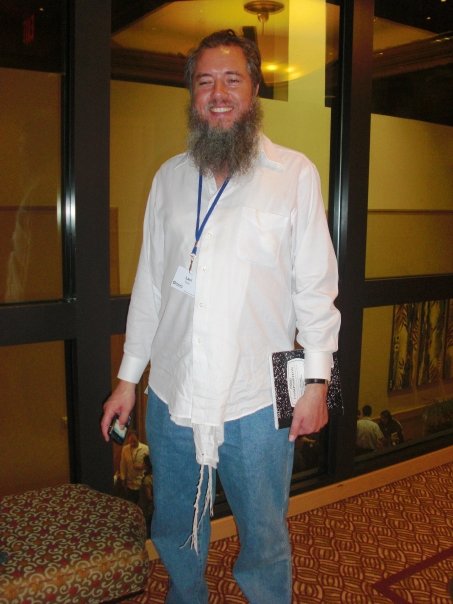
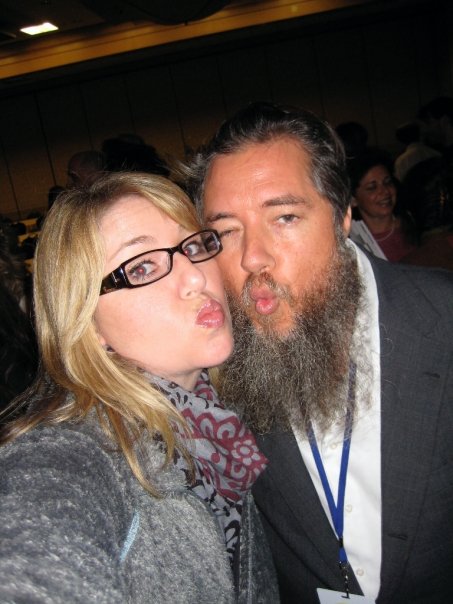
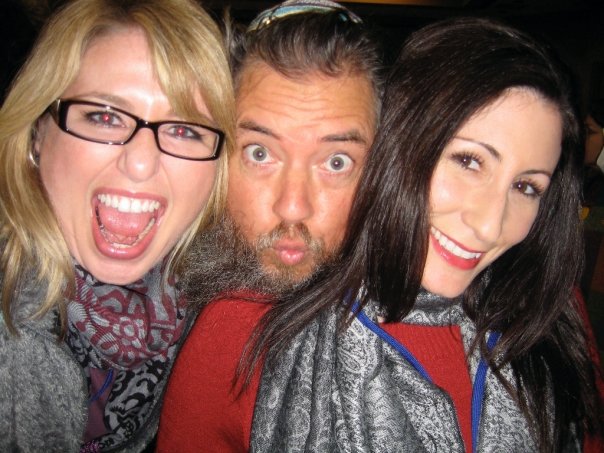
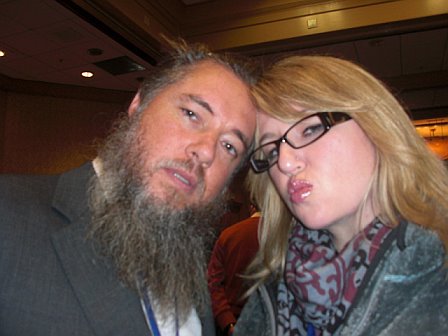
I received many comments at LimmudLA and after LimmudLA that my proclivities for touching women rendered my Orthodoxy suspect.

I found these remarks deeply hurtful. I take my cues in these matters from my rebbe Shlomo Carlebach. I don’t innovate beyond what he did.

Photos by Rachel and co:

Posted in Limmud | Tagged | Comments Off on Luke With The Ladies At LimmudLA 2009

Remembering Aish HaTorah’s Founder Noah Weinberg

Rabbi Gil Student writes:

To the great sadness of Jews around the world, R. Noah Weinberg passed away last week (link). There are many moving tributes on Aish.com.* One thing about R. Weinberg was that he was passionate. You couldn’t speak to him for more than 5 seconds without seeing his devotion to God and to the Jewish people. I didn’t agree with everything he said or did, but I agreed with most of it and I certainly recognize that he has done more for the Jewish people and sacrificed personally more for it than I can ever hope to do.

Now that he has gone and cannot suffer any political fallout, I think I can share my discussion with him about the ban on R. Natan Slifkin’s book. I approached him at a wedding on February 6th, 2005. About an hour later (I only came for the chuppah), I sent out an e-mail to some friends with notes on this conversation, although I omitted what was probably his strongest and harshest statement (see below).

Click here to read moreI introduced myself to R. Weinberg as the new distributor of the banned books and started asking him about the subject. He was clearly upset about the whole issue. His words, repeated a number of times throughout the conversation: "What the hell kefirah is there in that?" He also pointed out, without my prompting, that the banners were labeling as heretical the teachings of R. Samson Raphael Hirsch and Rav Dessler.

He strongly disagreed with the ban and urged me to remain an independent thinker, not bending to every public pronouncement by famous rabbis (he gave examples of rabbis to whom I should not listen but I will not list them right now). But later he quoted the famous Chinukh (nos. 495, 496) about the prohibition of "lo sasur" (link) and said that it applies to the Gedolim. Even though they are wrong, we should still follow them and R. Slifkin should revise his books. I told him I’d pass along the message.

CHARLES POSTS:

The reason why it may have been wrong for R’ Gil to put up this post is actually for the same reason as why it may have been wrong to post the rebbe video.

Both posts contained words, namely the "S word" and the "h word" that many people from A WIDE RANGE of orthodox communities find offensive in CERTAIN CONTEXTS.

The same nut-jobs that go around lying to rabbis and devoting their lives to destroying certain Jewish singers will probably find these word offensive in ANY context. Contra to that there’s one self-described "modern orthodox" family that I know of that uses these words (and far more nefarious ones) at their Shabbos table irrespective of who is sitting there.

Between those two extremes within (and without) the Orthodox community there are individuals that are genuinely refined to such a degree that if their pulpit rabbi used the phrase "what the hell" in any context they would lose respect for them while if a family member said it in a completely secular context they would not be the least bit bothered.

To the point: There are people who come to this blog who do not care about the mission statement but, rather, know of it to be a place filled with Torah- related topics and generally things of a positive, upbeat nature. The underlying reason why you decided that it was worth including R’ Weinberg’s quote is BECAUSE of the sensationalism inherent in hearing a Rabbi use that phrase despite how mild some may look at it. That’s part of what makes it a "good story." Not every good story must be told. For example, I could say that in Brooklyn I saw a car drive by a large puddle and splash a GODOL walking on the sidewalk and overheard the rabbi say to himself "damnit!." I could also say that in Brooklyn I saw a car drive by a large puddle and splash a GODOL walking on the sidewalk and overheard the rabbi EXPRESS FRUSTRATION WITH HIS BECOMING WET. Same point except that the only difference is that when that rabbi dies Hirhurim will memorialize him as someone who was human enough that he got frustrated and that in his frustration he was known to have said "damnit" while some other blog will mention the frustration but leave out his exact choice of words.

When someone says "what the hell" in a context such as the one you described it is probably the result of some sort of frustration stemming from the topic being discussed. From a purely dramatic point of view R’ Weinberg’s frustration was an apt characterization of the many of us CORRECTLY felt concerning the treatment of traditional sources by those who thought they knew better.

HOWEVER, when conducting a pure cost/benefit analysis of posting this item it is imperative to weigh the COST of posting something forever that may have been the product of frustration as opposed to a thought out critique of the Anti Slifkinites. This same cost/ benefit analysis should have been used when posting a video that though funny and rightfully critical of rabbi-worship used a word offensive to many normal people (that would describe themsleves as being "to the left" of R’ Gil).

I do not believe in hagiography OR white washing any real mis-deeds or quasi-misdeeds of the rabbis (and G-d forbid would I call this quote an example of any sort of misdeed), however, ALMOST NOTHING is gained by using the exact wording of something spoken as the result of frustration when simply describing the emotions of the speaker would have sufficed. In fact, the aforementioned people who may find the word "hell" unrefined when spoken by a Rabbi may also look down on R’ Weinberg as a result of his use of this word.

Just to split hairs once more in an attempt at clarification: If R’ Weinberg would have paused for 5 seconds and then after thinking of a eloquent response would have described certain rabbis in extremely negative terms I do not think that would be problematic simply because after contemplation that analysis was obviously deemed most appropriate.

TALMID WRITES: If gedolim tell you that right is really left you follow them, because you assume that they are indeed correct – – who are you to know better.
But if you truly know them to be wrong, as a talmid rau’y le-hora’ah is, IT IS FORBIDDEN TO FOLLOW THE WRONG PSAK.
As Justice Jackson would have put it, the sanhedrin was not final because it was infallible.
Everyone with half a brain knows that the gedolim were wrong on age of the universe and evolution. if their views are incompatible with rational scientific thought, they are incorrect, and fortunately there are other gedolim, rav dessler and rav hirsch and others, who were correct and whom we can follow on this issue. You don’t follow a hora’ah be-ta’us. That’s just stupid and against the sifrei explicitly.

LI READER WRITES: A couple of years ago aish.com suddenly purged several articles from their site.

I don’t remember if any of those articles were by Rabbi Slifkin himself, but what they all had in common was that they were all consistent with his approach.

Could the people who maintain aish.com have decided to follow a different shittah than their rebbe’s?

MJ WRITES: I have very serious problems with what Aish has done and would welcome a critical reassessment of the goals, methods, and larger influence of the right wing Anglo BT industry on the norms and politics of the Orthodox world. The process of mimesis that the BT industry encourages has constructed a new otherness within the community that undermines some forms of traditional authority while reifying others.

In sum, it is probably the most destabilizing influence on the larger Orthodox community in the last 30 years and yet it has been heralded as an unquestioned success.

DANIEL WRITES: It is important to understand why Rav Noach Weinberg was so frustrated over the ban of Rabbi Slifkin’s books: the ban had the potential of causing countless Neshamos to be lost to assimilation.

You may ask, how so? Very simple. Rav Noach was able to bring all types of people closer to Torah, including those who were highly intelligent. Some of these people, no doubt, would ask about some of the scientific pronouncements of the Sages that have been proven incorrect. This issue could be a serious distraction in getting someone to even consider the truth and beauty of the Torah. Fortunately, Rav Weinberg was able to turn this into a non-issue, by stating that the Sages were simply following the accepted scientific viewpoints of their era. End of discussion. The notion that it was forbidden to hold such a view was a threat to the entire Kiruv movement.

It is true that Rav Eliashiv has ruled that Rabbi Slifkin’s approach is acceptable for those involved in Kiruv Rechokim (I would add, Kiruv Kerovim as well). But Rav Weinberg’s Derech was to be Mekareiv by teaching the truth, not with apologetics or sugar coating. He did not want it to be thought that this Derech was incorrect, but could, nevertheless, be used for Kiruv purposes. What would happen, after all, if a person becomes Frum, and then finds out that this Derech is considered "heresy" by some?

JER POSTS: In the last few years I’ve listened to many refined people tell me in very refined ways that banning legitimate and helpful books is not that big a deal, that there aren’t entire segments of the community living on other people’s money, or there are but it’s OK, or it’s not OK but I shouldn’t talk about it (it’s not a refined discussion), that there aren’t any child molestors, well maybe one or two, fine, several, but it’s not that big a deal, they need help, they need parnossa, there’s no big cover-up, well there is, but it’s none of our business.

So you’ll pardon me if after all of this refinement that I have no problem with someone in a leadership position speaking from the heart and shouting what we all should be shouting: WHAT THE HELL.

Posted in Aish HaTorah | Tagged , , , , , | Comments Off on Remembering Aish HaTorah’s Founder Noah Weinberg