Web Traffic Down 25% Across The Jewish Blogosphere

As I look at the Jewish blogs section of blogads.com and talk to my fellow Jewish bloggers, I see that traffic is down across the board about 25% the past six months. I’m not sure why. Traffic traditionally goes down in the good weather months as people spend more time outdoors. Not sure why it has dipped this much.

A Jewish blogger emails: “I think the fast-paced commenting action is now on the Jewish news
blogs like The Yeshiva World, Matzav and VosIzNeias (but surprisingly
not JTA or the Forward). Maybe the J-Blog has lost its cutting edge
appeal.”

Posted in Blogging | Tagged , , , , , , | Comments Off on Web Traffic Down 25% Across The Jewish Blogosphere

I See No Hope For The Economy

It’s impossible to get a loan from a bank these days unless you have a credit score north of 700 and considerable documentable income.

The debt securitization market provided about 60% of lending money over the past few years. It has seized up.

Now the Federal Reserve has announced it plans to withdraw its massive interventions. It hopes the private sector will step up.

There’s not going to be economic growth until the security markets return to normal.

The commercial real estate securities market? It is dead. No such securities have been offered in two years.

New regulations and accounting rules are expected to further restrict bank lending in the next couple of years.

Few people want to buy bonds backed by home mortgages. Other parts of the security market are working. Bonds backed by consumer loans, auto loans, credit card loans, are selling normally, though only for those with credit scores over 700.

Commercial real estate is expected to be the next shoe to drop in our housing disaster. Next year $50 billion of securitized commercial property loans are supposed to be refinanced. If they can’t be refinanced, property prices will plunge. Banks will have to absorb new losses.

Read On

Posted in Economics | Tagged , , , , , | Comments Off on I See No Hope For The Economy

The Coen Brothers On Judaism

From the Boston Globe:

Earlier in the evening, I had attended a screening of the remarkable new Coen brothers film, "A Serious Man,” hosted at Brandeis by the National Center for Jewish Film. The film is being compared to Job because it centers on a seemingly decent man for whom everything suddenly goes wrong, without explanation, and his efforts to seek help from God are as unsuccessful as they are persistent. The film opens in Boston Friday; I thought it was stunning — mesmerizing, witty, bleak, honest — but I see that the critics have been all over the map.

The film is attracting a lot of attention, in the Jewish world and the film community, for its portrayal of Judaism, or at least of Jewishness. The film, for a major release, is almost shockingly insider-y, beginning with a short story filmed entirely in Yiddish (don’t worry — it’s subtitled), and the body of the film is permeated with Jewish concepts, language, and culture. The depiction of Jewish family and religious life — in this case, in Minneapolis in the late 1960s — is often chilling in its nihilism (or is it just emptiness?) — but many of the scenes clearly struck a chord of recognition among the audience at Brandeis, which laughed often and knowingly at characters such as the mind-numbingly boring, and unaware, Hebrew school teacher, and the string of rabbis whose pastoral counsel often featured a mix of anecdotes that went nowhere and a series of unanswered/unanswerable questions.

Posted in Hollywood | Tagged , , , , , | Comments Off on The Coen Brothers On Judaism

Financially Supporting Your Man So He Can Study Torah All Day

Yeed comments: If it was an equal relationship, you would find many such arrangements. In actual fact, you virtually never find such a relationship. (And if the Zevulun would be required to literaly give half of his earnings, then you literally never find it.) There’s tons and tons of Yissachars, but not too many Zevuluns willing to let others freeload on his time.

The closest thing to a Zevelun class you get are wealthy middle-aged ballei teshuvah, who are happy to finance their exciting new discovery of Jewish learning. Sorry to be cynical, but that’s a big reason why kiruv is popular.

YID COMMENTS: My friend, ANYONE is able to learn. Have you seen what many avreichim over 30 years old are like? Learning maybe a fraction of the time. Hakking, tummeling, and just plain shmoozing the rest. ANYONE can do this. It’s not that the Zevulun’s of the world cannot do this themselves. It’s that they’ve chosen not to waste their time this way. And is it any wonder they dont want to finance someone else doing it?

Posted in Torah | Tagged , , , , | Comments Off on Financially Supporting Your Man So He Can Study Torah All Day

Kundalini & Judaism

Myron emails: Hi Luke,

I read your blog about Kundalini and Judaism.

I too practice Kundalini Yoga (since February 2009) and think about it in relationship to Judaism…I guess doing this in Jerusalem where we do make connections with Holidays, Birkat HaChama..might be different than what you are experiencing.

I think I have more trouble with Guru Ram Das (treated sort of like a the messianic version of the Lubavitcher Rebbe) than with "G~d and I are One"..

I try to reinterpret his appearance in the texts as not being about him personally..but how being Servant of the D~ivine is our foundation.

But you are right.."G~d and I are one" is a challenge..Like you point out..values of ethics, community, etc seem to be arrived at from the other direction (an outgrowth of love and awareness, rather than command and deed)…(i wonder if this deep connection with Hashem doesn’t find some expression in kabbalistic stuff..I should try to understand Kegavnah..:-)

I have been reading Levinas at the same time..going into the self and beyond the self…seem to contradict..but the issue may be what does a yogi really mean by that deep inner self..there is a certain Bitul atzmi..What is it that we love in our self..and how does this effect our relations to our fellow human and the world..

I notice that I have brought the breathing into shul..(and my bowing is now done with more kavannah and connection with breathing..it is not only "kol atzmotai" now..but also neshima.

Anyway..one other thing happened.. I now wear a huge kippa (during Yoga)…so
We are what we are..and it seems only to be doing G~~D!..(i think you exaggerate about Bitul Zman..remember how the early Hassidim spent so much time before prayer in preparation…Kundalini can be seen as that and as a form of Avodat Hashem.)

Posted in Judaism, Yoga | Tagged , , , , , | Comments Off on Kundalini & Judaism

My Storytelling Workshop

My first class was tonight. It exceeded my expectations.

My classmates are all women younger than me (except for one older lady). I recognized two of them from yoga.

Some of us may be friends for a long time.

The workshop runs for ten weeks and it will climax with a public performance.

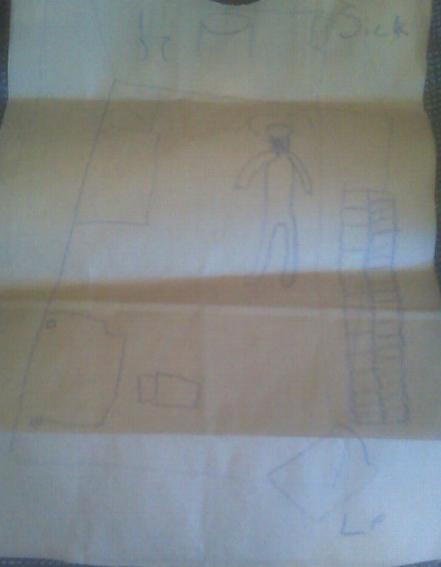
The teacher started us out with an assignment to draw a picture from our life. She gave us crayons and brown paper bags.

I used one blue crayon and sketched the hovel. In the middle, I pictured me lying down.

The teacher asked us to give our work a title. I called mine "Sick."

Then she asked us to locate what grabbed our attention about our drawing and then to write about it.

I wrote: "Sick. Sick. Sick. I’ve spent half of my life sick. I’m sick of being sick. I’ve been mildly sick for the past two-and-a-half weeks. If I’m going to be sick, why can’t I be spectacularly sick? I want to be strong and manly. I want to be a rock that women dash themselves against. I want to be a rock of moral strength. I want to carry the realizations I’ve gained through illness into my healthy life and make a difference. I want to save up money to tide myself over through bad times. I want to be warm and safe."

The teacher said this was a prose poem. She encouraged me to explicate on my primal male archetype. She wanted to hear more about my being a rock that women dash themselves against.

Then she had us each of spontaneously tell a story.

I said: It was July 9th. Let’s say the year was 2005. My girlfriend Dana* called from New York where she was visiting family.

"Luke," she said, "there’s something I want to tell you. On Friday night, Vicki* came over and we fooled around. How do you feel about that? I was her late night booty call. How does that make you feel?"

I felt a dagger ripping into my chest. "Wow," I said.

I wanted to be real to the moment. I did not want to be vulnerable. I did not want to appear angry. I did not want to inquire further. I did not want to ask, "Did she *** your ***** better than I did? Did she make you ****** better than I did? Did you talk about me after you ******?"

I felt so hurt. My woman having sex with someone else is the most painful thing she can do to me.

"Wow," I said.

"Yes," she said.

"Wow," I said.

I paused and then said: "So how are things with your family?"

Then her call waiting beeped.

"I have to take this," she said. "It’s my father. Hang on."

I hung on for about 40 seconds. Then I hung up. When Dana called back, I did not take her call. Instead I returned to the book I was reading by Katie Roiphe, "Uncommon Arrangements: Seven Portraits of Married Life in London Literary Circles 1910-1939".

The teacher says I remind her of Harold Pinter with his Pinteresque pauses.

Cathy Seipp had said that about my writing.

The teacher asked me what I did after I got off the phone.

"I walked around in a circle," I said. "And then I walked down the road."

She asked what I felt.

"At first stabbing pain," I said. "And then relief."

Why relief?

"That there wasn’t anything I needed to do. I didn’t need to try anymore. I didn’t need to attempt to square the circle. She hated Orthodox Judaism. I was dedicated to it. We were finished."

Posted in Personal | Tagged , , , , , | Comments Off on My Storytelling Workshop

Distorting The Jewish Dietary Laws

Moshe Zev posts to Marc B. Shapiro: I would love to see more about how kashrus has been distorted today in America. We have been taught to believe that nothing is kosher unless it has a certification. Yet it is impossible that all those thousands of products simply not paying for a hechsher stamp are actually not kosher. It is very hard for a non-meat product to be really and truly treif.

You would be doing a massive favor to the Jewish community by publishing your findings. Prices are already needlessly inflated for "heimishe" brands. If people only knew the truth, the community could save huge amounts of money. Think how much they could save if the community started using a high-volume, cheaper product like Hebrew National, which is 100 percent kosher.

Zalman Alpert posts: Rabbi Albaum of Chicago was the brother of rav David Tevele Katzenelboigen (d. 1930) the last pre Revolution rav of St. Petersburg and leningrad. He too was involved in a more quit controversy with the Rayatz in ways of dealing with the new Communist policy towards religion.He is buried in St. Petersburg.
The magid of Vilna was traditionally the First More Zedek of the city and that position was held by Chief rabbi Joseph. Later on he was succeded by among others rabbi Hirsch Rabinowitz son of rav Isaac Elchonon and the Ridbaz himself , so much for the concept that RJJ was not a major talmudist. His problem was that he was a Musarnik and the rabbinic establishment in lithuania was then controlled by the anti Mussar forces. But even so he became Matz and magid in Vilna.In Vilna the rav was not the rosh yeshiva of the local yeshiva -Ramalies , even Reb Chaim Ozer did not hold that position. It was independent.
Rabbi Fleischer was also a lawyer and published numerous English books. In his English books he included his picture soemhting he left out in his responsa in Hebrew !Hew was succeded by Rav Oschry who told me much about R. Fleischer.
Rabbi Moses Romm. If you are saying he was the grandfather of Rav Shimen Romm of Riets the Bochen and later zekan rosh hayeshiva of RIETS
s , you are incorrect. Rabbi Shimen’s real name was Posniak and he came from Visoki. Bachurim were called after their town. hence Shimen Visoker. In Mir there were 2 older bchurim from Visoki , so he used the Hebrew trabslation of Visoki which is Romm. In Israel and the USA it was his legal name.
Kolel in Volozhin is the famous Brodsky;s kollel which was not closed when the yeshiva was..Brodsky was a wealthy sugar magnate.
Attending Rabbi Soloveitchik’s shiurim . Perhaps RabbiSchneur Kotler did not , but the late R. Barry S. Gourary assured me he did for close to 1 year to get the Rav’s methodology and meet his family as the Rayaatz wanted him to marry one of the rav’s daughters. I heard this from Rabbi Gourary himself.
The Rashash of Vilna (R. Samuel Strashun)brings down the Ranaw none other then Wessely . Once in studying with my rebbe rav Romm we came across this and Rav Romm asked me with a smile who is the ranav , not knowing he told me its Wessely.
Chasam Sofer. In order to justify their new kaanaus and still be chasidim the Hungarian so called chassidim claim that the Chasam Sofer was a talmid of the Besht. In fact they had nothing in common. But the new Charedi ideology marking the USA Hungarain chassidim is that chassidus alone will not stand look at Chabad, and the derech of the Chasam Sofer will not stand , look at the Oberlander , you need both. Only then can you have the frumkayt they need.

Marc B. Shapiro posts: Again, I don’t know Shurkin so I can’t comment. But about the mental retardation comment, while Shurkin apparently did not remember it exactly, the fact is that the Rav said something very shocking, not about hallel on Yom ha-Atzmaut per se, but about the entire Yom ha-Atzmaut davening program. This was, I think, developed by R. Goren, and if not by him, certainly by other great Zionist rabbis. Yet the Rav said that it is "indicative of retardation", The Rav Thinking Aloud, p. 207. I wish the Rav never said this. It is a stupid, and perhaps even cruel, thing to say. The truth is that it was an offhand remark to his class. If we had a tape recorder next to every gadol we would get lots of offhand comments that anyone reading it later would be embarrassed that he said it. I know the Rav would never want something like this to appear in print, and he would certainly have regretted using such language (and all this should be taken into account when dealing with the Holzer volume).

And if he says the Rav told him this, maybe he did. The Rav said many different things to different people. I personally wouldn’t believe him if he told me this, but you never know.

But returning to our topic, I don’t deny that Shurkin has been responsible for multiple distortions.

But Amshinover, you must ask yourself, are the distortions intentional or not? In this case, if he wasn’t told it personally, he no doubt heard the comment recorded in the Holzer book. It was very famous at the time, and by the time it reached him it got distorted, or perhaps he was in the audience and didn’t remember it exactly and applied it to the simple saying of hallel.

I think the same thing can be said about Meiselman. I find it hard to believe that he is intentionally distorting the Rav. His article on the Rav and Zionism was so outrageous, so dishonest, that no one intentionally trying to distort the Rav would dare write what he does. They would see it as a case of tafasta merubah lo tafasta. I think we have to assume that they really think that they are portraying the Rav as they knew him.

I could be all wrong about this. In my new book I cite all sorts of sources that say you can lie about something you heard from a gadol if you think it will accomplish an important goal. Maybe Shurkin and Meiselman hold to this shitah.

But since I have never had any personal dealings with them, I tend to assume that the Rav was a multi-faceted person and for those who only wanted to see the Talmudist, that is all they saw. That makes them simplisitic in their thinking about the Rav but not necessarily dishonest. Let’s not forget that the Rav himself didn’t speak to these students about his hashkafot. Haym Soloveitchik asked the Rav to speak to them about these things, as he saw the extremism that was developing among the talmidim in the 1970s, but the Rav never did so.

I think the Rav would agree that it was a stupid thing to say. How can anyone say about great rabbis that something they did was "indicative of retardation" In elementary school I had a rebbe who used to call us "mental retards" and "mongoloid idiots". Yehudah, I guess you don’t have someone in your family who happens to really be mentally retarded. If you did, you would understand why this is not something you joke about and you don’t call other people retards. It is simply a terrible and hurtful thing to say. The book, The Rav Thinking Aloud, says that the class laughed after hearing the comment. I don’t think we should be making jokes at the expense of the less fortunate in our society. I used to be one of the people who drove the Rav back and forth from shiur in Boston and I would have told him to his face that I thought it was a terrible thing to say.

And you know what? In his gentlemanly manner, with his unforgettable accent, the Rav would have replied "You are right. I should have chosen better words to express myself."

…Where did I say that I would say to the Rav that what he said was stupid? I said that I would tell him that what he said was terrible (without necessarily using that word). The conversation would go like this "Rebbe, I want to speak to you about something you said today. I feel strongly about it, so please don’t take offense. I know you always want me to be honest with you about what I am thinking which is why I am sharing this. I also think that you might have needlessly offended some people today, and I know that wasn’t your intention. Therefore, I want to share this with you so that in the future you will have this in mind. I feel that your comment about certain rabbis being retarded was uncalled for. I don’t know how much contact you have had with the retarded, but I know that people who have retarded members of their family take great offense that this affliction is made something to joke about." And the conversation would go on from there.

I guarantee you that the Rav’s family is very upset that this passage appeared in the book, as it is not something that anyone can be proud of and the Rav certainly would not have wanted it to appear.

I also wouldn’t use the word "stupid" in an essay (no matter who I was discussing) — but here we are conversing, just like face to face. If I was talking to you face to face I would indeed say that calling certain great rabbis retarded was a stupid thing to say (whether the Rav said it or anyone else). And I have no doubt that after speaking to the Rav he would agree that he erred in speaking this way, and I also have no doubt that the family thinks that it was a stupid thing to put this passage in the book.

I don’t want to comment any more on this — my opinion has been made clear. All are entitled to disagree (and I of course understand that we are more sensitive to these matters than years ago) But before anyone starts defending calling people retarded, why not spend some time with some kids from HASC, why not spend Shabbatot with kids who are really retarded, why not speak to the parents of these kids and how they deal with these matters. I have done all these things and it has opened my eyes, and if my personal connection has made me overly sensitive in this matter, then I plead guilty. But there are plenty of worse things one can do.

Litvak,

You are right about the terrible feuds in the academic world, but the difference is that these are played out often behind closed doors and with few people involved. The don’t affect the wider world. The unfortunate thing about rabbinic disputes is that they are played out in front of the community and they bring the Torah into disrepute. We don’t expect professors or others to be models of propriety and ethics. Many are complete menuvalim. But people expect more from the rabbis, which is what it is so sad to see them doing the same thing as the others.

As for the titles, I don’t think anything I saw will satisfy you, because there is no real consistency. I give Kamenetsky an "R" the first time I mention him, because I know him and want to show some respect, but I don’t know Eliach so I can treat him like other historians.

…I would never refer to Jacobs or anyone else by his first name in a scholarly piece. If "Jacobs" was substituted for "Louis" the sentence would be fine. But the editor obviously was on a first name basis with Jacobs and this comes through in the note. (I don’t even believe the editor intentionally wrote "Louis".) But in scholarly writing one never refers to someone by his or her first name.

LAWRENCE KAPLAN WRITES: DF: I agree with you that anyone who thinks that "niggardly" is a derogatory term referring to blacks, and on that basis criticizes a person who uses it, is simply ignorant and foolishly hypersenstive. But when the Rav in an informal, colloquial talk referred to an evening Yom ha-
Atzmaut program as being "stupid" and indicative of "retardation," I think the audience in laughing at the Rav’s use of the latter word, alas, understood him correctly.

Posted in Kashrut, Marc B. Shapiro | Tagged , , , , , , , , | Comments Off on Distorting The Jewish Dietary Laws

Facebook Saves Time

A lot of people — usually losers — tell me they’re not on Facebook because it is a time-waster. It takes them away from the study of Torah.

I find being on Facebook saves me time and allows me to spend more time with the sacred text.

When I hit singles events, I no longer have to go through the mortification of asking a girl for her phone number. I just get her name and then hit her up on Facebook.

Facebook makes it easy to stay in touch with people. It reminds you of birthdays and parties and Torah learning sessions. I do much of my communicating these days via Facebook. It’s quick and clean, much like myself.

On Facebook, I have 300 friends. In the real world, not so many.

Posted in Internet, Personal | Tagged , , , , | Comments Off on Facebook Saves Time

Should You Only Trust A Vaad?

A "vaad" is a council of rabbis, like the RCC, the dominant Jewish law court in California.

Marc B. Shapiro blogs: Experience has shown that a rabbi who is financially corrupt can easily win back his reputation (and in some circles financial corruption doesn’t affect his reputation to begin with). Yet if a rabbi is accused of not being reliable in matters of kashrut, even if the accusation is false, it is almost impossible for him to turn this around. Unfortunately, when it comes to kashrut supervision, American Orthodoxy has distorted our tradition. People are constantly told that if they see a hashgachah on a product or restaurant, that they cannot rely on it without investigating who the rav ha-machshir is. This is completely mistaken. According to halakhah every rav is regarded as trustworthy unless you have been reliably informed otherwise. Without receiving negative information, one should always assume that a rav is reliable. This is no different than if you arrive in a new city and go to shul on Shabbat and you are invited to someone’s house for lunch. One should assume, unless he has reason to think otherwise, that the person inviting him keeps kosher, as religious Jews have a hezkat kashrut. Certainly, if the rabbi invites you to his house you must assume this. The notion that is currently rampant, that we don’t trust a rav until we investigate him, is the exact opposite of what the tradition has always held. Rather, we are supposed to trust the rav unless we are given reason to think otherwise. Every rav, even a rav ha-machshir, has a hezkat kashrut and is assumed to be doing his job reliably.

To show how far this idiocy has gone, let me share something that happened a couple of years ago when I was visiting a city that shall remain nameless. Someone was eating with us and mentioned that he was going to be travelling to Elizabeth, New Jersey. He asked me if I knew about kosher food in the area. I told him that Elizabeth has a very nice Jewish community, with plenty of kosher food. He then asked who gave the hashgachah, and I replied that it is Rabbi Teitz. The man wasn’t happy with my answer, which troubled me since I had never heard of anyone question R. Teitz. In fact, in speaking to him it was apparent that he had never even heard of R. Teitz. Yet he announced for everyone that his family would have to avoid visiting any of the kosher eateries when he was in Elizabeth. I was really shocked and I asked him, "Why? What is wrong with R. Teitz?" I further asked him where he thinks the people he will be visiting in Elizabeth get their food. Yet he would only reply: "We only eat at places under the supervision of a Vaad." I told him that I didn’t think that there was a Vaad in Elizabeth, and why in any case does he need a Vaad? A Vaad might be a good idea from a practical standpoint, in order to create one communal standard, yet there is nothing in the Shulhan Arukh about a Vaad, and R. Teitz is as reliable as anyone. Yet all I got from him was the same nonsense about how without a Vaad a hashgachah cannot be trusted. (I never asked him what he would do in a one-rabbi town.)

Posted in Kashrut, Marc B. Shapiro | Tagged , , , , , | Comments Off on Should You Only Trust A Vaad?

The Pretty Woman Sheitl

Dr. Marc B. Shapiro blogs: "One wonders if he was writing his book today, which problems he would identify. I don’t think English sermons would still be an issue for him, although I think it is fair to say that advertising a “Pretty Woman” sheitl would definitely outrage him. After all, the sheitl is supposed to represent modesty, and Julia Roberts’ profession in that particular movie was not exactly tzniusdik. See here (Unfortunately, some of the comments to this post are inappropriate.)"

I went looking for the inappropriate comments and I believe I found them. Proud MO said: "Back when I wasn’t religious, the easiest girls to hook up with were from Beis Yaakovs and other really frum schools.
I have a friend who told me that you can walk in Boro Park propositioning married chassidic women, and actually be taken up on it a huge percentage of the time."

Tesyaa comments: Proud MO’s comment reminds me of the chapter in Richard Feynman’s book, "Surely You’re Joking, Mr. Feynman!" called "You Just Ask Them?" about propositioning nice girls.

Posted in Marc B. Shapiro | Tagged , , , , , , , , | Comments Off on The Pretty Woman Sheitl