What’s Dennis Wilen Doing?

Dennis ran the JewishJournal.com for a couple of years.

He blogs yesterday: As you probably already know, I’ll be joining AOL’s Patch.com next week to build, run and grow Los Angeles’ new Brentwood.Patch.com, which I plan to launch before the end of the year.

This means I need Brentwood-located and Brentwood-conversant bloggers/freelancers/columnists/critics/reporters to write about sports, arts, food, schools, health, business, government, roads, politics, culture, films, real estate, local business, restaurants, playgrounds, parking and more. Everything you’d want in a “hyperlocal” news source, we’re gonna have it. Videos! Photos! Cartoons! What do you have to add to the community conversation?

This may not be for you but it may be for yours. Patch.com does not pay scads, but it pays fast, and a bird in the hand, etc. Recent grads? Bloggers? Opinionated person? Prep sports freak? We want you!

If you’re in Brentwood, or have friends in Brentwood, please forward them this blog post and ask them to email me, [email protected] with a brief bio and pitch.

Here are my recent contributions to local Patch.com sites: — check ’em out and you’ll see the kind of stuff we’re looking for. Videos, too!

Posted in Los Angeles | Tagged , , , , , | Comments Off on What’s Dennis Wilen Doing?

Most Chareidi Jews In Israel Don’t Want To Work

Dennis Prager writes: The Wall Street Journal recently published a column about ultra-Orthodox (Charedi) Jews in Israel who do not work for a living. Sixty-five percent of ultra-Orthodox men ages 35-54 do not go to work. Instead, they study Torah while demanding increasing amounts of money from the taxes paid by Israelis who work for a living.

The author of the column, Evan R. Goldstein, wrote: “Voluntary unemployment has become the dominant lifestyle choice for [Charedi] men. And even if there was a desire to work, [Charedi] schools leave students unprepared to function in a modern economy.”

If these data are correct, this is not only a problem for Israel, it is a problem for Judaism.

It is a problem for Israel for the same reason that able-bodied citizens receiving welfare has been a problem for America. It is economically unfeasible to support large numbers of nonworking citizens, and it is morally wrong for citizens who work and pay taxes to have their money forcibly taken from them (i.e., taxes) to pay to people who could work but who choose not to.

The reason for this problem in Israel is that in 1948 Prime Minister David Ben-Gurion excused 400 yeshiva students from serving in the army, arguing that after the Holocaust it was critical for the Jewish state to support some of its citizens to concentrate on Torah study.

Few Jews, inside or outside of Israel, would oppose continuing this policy for a handful of scholars. But for hundreds of thousands of able-bodied Jews to demand to be supported — and protected — by other Jews (and, for that matter, the non-Jewish citizens of Israel as well) is entirely different.

It is also a problem for Judaism. It presents religious Jews, Torah and Judaism in a terrible light. Of course, most Orthodox Jews in Israel work as hard for a living as other Israeli citizens. But the largest group of Israelis that chooses not to work while demanding public funds to sustain them is the ultra-Orthodox, who also constitute an increasingly large percentage of the Israeli population.

As Goldstein notes in his article, the Shulchan Aruch, the Orthodox compendium of Jewish law, declares that “a respected and impoverished scholar should have a trade, even a lowly trade, rather than being in need of his fellow man.”

Goldstein quotes Israeli Orthodox scholars who claim that there is no precedent in pre-1948 Jewish history for an entire community devoting itself to Torah scholarship, let alone getting paid to do so:

“ ‘Torah study has always been for spiritual, not material, sustenance,’ Zvi Zohar, a professor of law at [the Orthodox] Bar-Ilan University, tells me. Moreover, the notion that a man’s primary obligation is studying, and not providing for his family, is ‘diametrically opposed’ to Jewish tradition, Mr. Zohar says.”

Goldstein cites an additional problem for Judaism in state-supported Torah study for vast numbers of men: He quotes professor Shlomo Naeh of the Jewish Studies Department of the Hebrew University, who says that it has harmed the quality of Jewish thought. Writes Goldstein: “Ultra-Orthodox self-segregation has cut ‘learning off from life,’ he wrote in a recent essay. As a result, the current generation of Torah scholars ‘is far from being one of the greatest … despite the existence of tens of thousands of learners.’ ”

This “self-segregation” — these ultra-Orthodox men rarely interact with non-Orthodox Jews, let alone with non-Jews — has another negative consequence: These men gain and therefore impart little wisdom. One might say that insularity and wisdom are mutually exclusive.

…Most secular left professors and most ultra-Orthodox yeshiva scholars are mirror images of one another: A life devoted to the study of increasingly irrelevant matters, with the result that both groups usually lack wisdom and therefore too often produce nonsense, sometimes harmful nonsense.

Both groups venerate brainpower and knowledge over wisdom and common sense. The fact that Jews are drawn to each of these lifestyles — that of the yeshiva scholar and secular professor — reflects a real problem in Jewish life, whether ultra-Orthodox or ultra-secular, namely, worship of the intellect.

I saw this at an ultra-Orthodox yeshiva I attended and at the Ivy League university I attended. Men with fine brains and immense knowledge about narrow areas of life taught me little about real life.

The intellect cut off from the real world, whether in a Charedi yeshiva in Israel or at almost any modern Western university, is not good for society. The issue is not Charedim or professors per se. The issue is Charedim and professors who leave the world to live in yeshivas or academia their whole lives. Thus, ultra-Orthodox like Chabad and others who do not want their followers to spend their lives only studying, and professors in junior colleges, who often come from outside of academia or who combine outside work with teaching, are not the problem.

Posted in Dennis Prager, Haredi, Israel | Tagged , , , , , | Comments Off on Most Chareidi Jews In Israel Don’t Want To Work

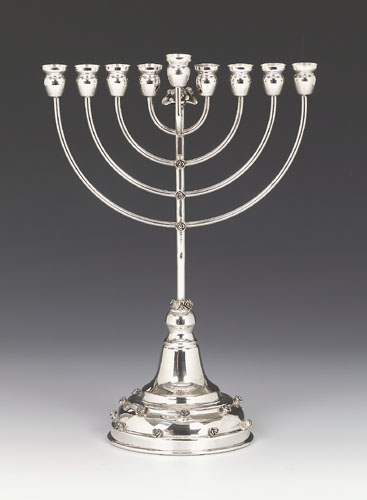
Yisroel Pensack: Happy Chanukah!

This is not a Lubavitcher chossid, obviously.  The branches of Chabad-Lubavitch menorahs are straight and diagonal — not like this:

or this:

but like this:

and this:

and this:

Posted in Chabad, Hanukkah, Yisroel Pensack | Tagged , , , , , | Comments Off on Yisroel Pensack: Happy Chanukah!

Asking A Girl Out

Dennis Prager said on his radio show Nov. 30, 2010: “I remember in high school thinking that the boys who were unbelievably confident in their dealings with girls were not the finest of the guys. I was very nervous about asking a girl out for a date, so much so that I would sit by the phone with prepared notes so that I wouldn’t grope for words and I would have a handkerchief to wipe the sweat because I was so nervous.”

Watch the whole Torah talk with Rabbi Rabbs:

Posted in Dennis Prager | Tagged , , , , | Comments Off on Asking A Girl Out

I Light It – NCSY Chanukah Musical Remix 2010 (Music by Six13)

Posted in Hanukkah | Comments Off on I Light It – NCSY Chanukah Musical Remix 2010 (Music by Six13)

This Week’s Torah Talk

I took a cold shower before the show, as I do every week, and it brought me out of my post-surgery slump.

Rabbi Hershel Rabbs Remer: TONIGHT’S SHOW features a full line-up of topics, including: Lusting after Persian chicks, trashing shrinks and socialized health care, answering your questions from last week’s chat room, and time permitting, discussing Chanukah and cluing Luke Ford in on this week’s parshah.

My nephew Jacob Kleidman rocks, and because of his amazing generosity, after his penniless uncle’s router died last night cutting Rabbi Rabbs off permanently from the Internet, as soon as Yaacov’s red eye flight landed this morning, he bought a brand new router and paid to have it shipped overnight.

Parashat Miketz (Genesis 41:1-44:17):

Joseph goes from interpreting the dream for pharoah to giving advice. This from a guy fresh out of prison. It takes a lot of self-confidence. Jews do not generally lack for confidence.

Joseph interpreting dreams sounds like modern psycho-therapy. Today we turn to shrinks to interpret our dreams.

AS: “According to the Tanchuma, Pharoah gave a changed version of the dream in order to confuse and test Joseph, but Joseph corrected him every time, until Pharoah was amazed and exclaimed, “Were you eavesdropping on my dreams?””

A good therapist detects the thru-line in your session even if you go off course and say contradictory things. A good shrink doesn’t accept your recapitulation of events as gospel truth. He asks questions and probes for truths not immediately in your ken.

That’s why I often feel like I understand myself better after psycho-therapy.

In a sermon at Stephen S. Wise one Sabbath morning in 1998, Dennis Prager shared this story: After his first divorce, he entered therapy. When he relayed a painful story from childhood, the psychiatrist said, “I suspect that didn’t happen the way you relayed it.”

And Dennis said he doubled up in pain.

One of the characteristics of a leader is that they don’t only try to tell you things you want to hear.

* Gen. 42:1. “Live and not die.” In ancient Hebrew thought, severe poverty is like death. Nothing in Judaism says poverty is good. That’s a Christian perspective.

* Jacob tells his sons in Gen. 42:1: “Why do make yourselves conspicuous?”

AS: “Jacob’s rhetorical question has been the theme of many leaders who exhorted their fellow Jews not to flaunt their wealth and success to envious and often anti-Semitic neighbors. Whatever food Jacob’s family had was honestly acquired, but even honest resources should be displayed judiciously.”

Is this why Rabbs lives in poverty? So the goyim won’t get envious?

* Why didn’t Joseph get in touch with Jacob and let him know he was OK? Why did he name his first son for making him forget his childhood?

* Gen. 42:7. Why is Joseph so rough on his brothers? According to one Christian commentary, it is part of the Jewish penchant for vengeance (as opposed to Christian charity).

* Does Joseph need to do anything to make his dream-prophecies come true? Why not just leave that to God? Did Joseph’s ego need to have his brothers bow down to him?

AS: “Were it not for his obligation to carry out the dreams, Joseph would never have allowed his father to languish for so many years without knowing that his beloved Joseph was alive.”

I have many fervent dreams but I’ve never made anyone suffer so that I could accomplish them. Perhaps I am more righteous than Joseph?

* Joseph seems to have assimilated into Egyptian values. He practices divination (Gen. 44:5). He’s shaved his beard. He dresses like an Egyptian and follows their practice of not eating with non-Egyptians (religious Jews will only eat kosher food but they have no problem hosting non-Jews for meals).

* Why does Joseph practice divination? (Gen. 44:5)

* Gen. 42:9. Joseph accuses his brothers of being spies. I also wonder what you’ve got to hide when you accuse me of being a spy. What’s Joseph got to hide? How secure is he in his position? How common was it for Egypt to be ruled by a non-Egyptian? The goyim often don’t like this.

* Gen. 42:24. Joseph weeps. How much easier is it to weep for people than to do something to alleviate their suffering?

* Gen. 42:25. Does Joseph have money put in his brother’s sacks to provide them with the opportunity for atoning for selling him into slavery or to torture them?

* Gen. 42:28. This reminds me of the story of The Count of Monte Cristo. R S.R. Hirsch says: “Joseph wanted the brothers to realize how fully they were in his power and that he could as he pleased with them.”

* Gen. 43:34 Joseph has Benjamin served five times as much as any other brother. Creepy!

* What is the connection, if any, between this week’s parsha and Chanukkah?

* The Somali teen in Portland who was planning a big terror attack on Christmas was named Mohammed Mohammed.

Rabbi Rabbs posts to FB: Please remember Rabbi Rabbs on your holiday shopping list.

I am barely meeting my monthly bills, and very close to homelessness. In addition, I desperately need new tallis katans as the ones I wear now are old, torn, dirty, and the tzitzis are falling apart and might not even be kosher anymore. I may be forced to stop wearing tzitzis altogether because I cannot afford to have them replaced, and even if the strings are still kosher, it doesn’t look menschelikt to walk around with torn and stained clothes.

I am way overdue on having my Tefillin and Mezzuzahs checked. They also may no longer be kosher, but I simply do not have the money for any of those mitzvahs, and I cannot justify starving myself just to pay for those things, as fasting is about the only way I could cut costs at this point other than cutting myself off from the Internet and turning off the utilities, and then just sit here going out of my brains in the cold and dark until I die. And at that point, I might as well end my misery sooner than later.

I am also afraid to drive my car anywhere, because I cannot afford to fill it with gas nor am I capable of paying for any repairs.

Posted in R. Rabbs, Torah | Tagged , , , , , , , | Comments Off on This Week’s Torah Talk

Do You Want Me To Go To LimmudLA 2011?

You can read here my heartbreaking works of staggering genius from 2008, 2009, 2010.

I don’t expect my readers to pick up all of the $500 tab, but if your paypal donations (see the button on the upper left of my site) go north of $200, I’ll go back to dancing and earn the rest.

P.S. This is also a golden opportunity to show concrete thanks for the kinder gentler direction of this blog since September 2009.

Posted in Limmud | Tagged , , , | Comments Off on Do You Want Me To Go To LimmudLA 2011?

Candlelight – The Maccabeats

Posted in Hanukkah | Comments Off on Candlelight – The Maccabeats

I Am Home From My Surgery

Surgery went fine. Surgeon recommended against fixing deviated septum, too minor, just did some other tweaks so i can breathe easier.

Now I just have to stay off the coke for six weeks. I am live on my cam, hoping to milk this moment for all the attention i can get.

I have to abstain from strenuous activity for two weeks so I guess that means no yoga and no doing the Jean-Louis move in Alexander Technique (standing at the end of a table and reaching down over someone’s head and chest to help promote width in their lower back, this fancy pants move requires that I tuck in my beard, my shirt and my belly).

I’d probably be feeling a helluva lot better right now if the Dallas Cowboys had only won their game yesterday.

I do have some vicodin by prescription and am willing to share it with those close female friend who stop by on a mission of mercy.

Rabbi Rabbs was a total mentch, picking up my pain meds, and driving me home from hospital.

Chaim Amalek emails:

1. When you go to shul, insist that you are feeling fine — even if you are feeling fine.
2. If you don’t need all that vicodin, dude, this is where Craigslist really shines. Post an ad saying you have all of this prescription pain killer that you really don’t need, but you could use some comely female companionship. The resulting correspondence should yield laughs aplenty. Just don’t actually meet any of these women.
3. Figure out what you take to be a treat, preferably one that is affordable, and treat yourself to it.
4. Invite people to visit you. Let them feel like trash if they do not.
5. Date excuse: “I need a distraction right now. Don’t worry, I’m harmless, as my doctor warned me against any strenuous activity. I just need a bit of company.”

Feel well soon. But try to milk it as long as possible.

Saturday night. My surgery was for Turbinate Reduction. I spent the last half of Friday swabbing blood out of my nose but the bleeding has mainly stopped now. Got some sponge in my nose which will come out Friday.

Posted in Personal | Tagged , , , , | Comments Off on I Am Home From My Surgery

Florida family has 45 guests at Thanksgiving dinner

I’m reading this story from the Drudge Report and thinking about the Happy Minyan. Its stalwarts Stuart and Enny Wax regularly had Shabbat dinner for a hundred people for about two years until they had kids.

The kind of hospitality featured in this story is a regular occurrence in Orthodox Judaism. Many Chabad shuls host meals on Shabbat for more than a hundred people.

Posted in Chabad, Orthodoxy | Tagged , , , , | Comments Off on Florida family has 45 guests at Thanksgiving dinner