
- https://PayPal.Me/lukeisback
"Luke Ford reports all of the 'juicy' quotes, and has been doing it for years." (Marc B. Shapiro)
"This guy knows all the gossip, the ins and outs, the lashon hara of the Orthodox world. He’s an [expert] in... all the inner workings of the Orthodox world." (Rabbi Aaron Rakeffet-Rothkoff) LATEST POSTS:
- Dennis Prager v Cedars-Sinai Lawsuit
- Dennis Prager Through Randall Collins: Interaction Ritual Chains
- What is a ‘Received Idea’?
- Jordan Bardella: The Manufacture of Normality
- Everyone Became Television: Bourdieu’s Warning and the 2026 Iran War
- Marine Le Pen
- The Coalition-Proximity Rule
- Nigel Farage
- Bernard Haykel: A Life Between the Text and the Gun
- Walker Connor (1926-2017)
- Benedict Anderson and the Nation as Imagination
- Anthony D. Smith: The Student Who Kept the Question and Rejected the Answer
- Ernest Gellner
- Eric Kaufmann: The Man Who Made the Majority Visible
- Dominic Cummings: A Biography
- Steve Lopez: The Last City Columnist
- California Historian Kevin Starr
- Stephen Kotkin: A Life in Power
- William T. Vollmann: An American Life in Excess
- Rod Dreher: A Life in Exile
BEST POSTS:
- * The Enlightenment Wasn’t Enlightened (6-23-26)
* Mr. Burge Draws The Line (6-23-26)
* 'Improving on Democracy' (6-17-26)
* People Leak To People Who Are Fun (6-11-26)
* Why Does Australia Produce So Many Great Journalists? (6-11-26)
* Steve Wynn and the Press: Power, Litigation, and the Contest Over Las Vegas (6-3-26)
* Sheldon Adelson and the Journalists (6-3-26)
* The Vigilant Animal: Thinkers Who Reject the Myth of Human Gullibility (6-2-26)
* The Cost of Refusing the Misunderstanding Myth (6-2-26)
* Show Me How It Travels (6-2-26)
* The Norm Explainers (6-2-26)
* Centering Marginalized Voices (6-1-26)
* What would it look like if the Washington Post put its reader first? (6-1-26)
* What would it look like if the Financial Times put its reader first? (6-1-26)
* What It Would Mean for the Los Angeles Times to Put the Reader First? (6-1-26)
* What It Would Mean for The New York Times to Put the Reader First? (6-1-26)
* Why Wembanyama Lives on the Perimeter (5-31-26)
* The Emotional Palettes Of San Diego, Los Angeles, San Francisco & Sacramento (5-27-26)
* The Administrative Capital: Sacramento Legal Culture (5-27-26)
* San Diego - The Quiet Republic (5-27-26)
* The Quiet Bar: San Diego Legal Culture (5-27-26)
* SF v LA Legal Culture (5-27-26)
* Why Talent Travels Poorly Between San Francisco and Los Angeles (5-27-26)
* San Francisco and Los Angeles as Rival Models of Urban Access (5-27-26)
* Social Cliques in New York, 2026 (5-25-26)
* Social Cliques in San Francisco, 2026 (5-25-26)
* The Rival Courts of Washington (5-25-26)
* The City of Private Rooms (5-25-26)
Monica Osborne, Ph.D. ⎪ Dropping the H (olocaust) — Bomb: The Ethics of Post 9/11 Comedy
Posted in Holocaust, Monica Osborne
Comments Off on Monica Osborne, Ph.D. ⎪ Dropping the H (olocaust) — Bomb: The Ethics of Post 9/11 Comedy
This Week’s Torah Portion – Parashat Toledot (Genesis 25:19-28:9)
I discuss the weekly Torah portion with Rabbi Rabbs Mondays at 7:00 pm PST on my cam and on YouTube. Facebook Fan Page.
This week we study Parashat Toledot (Genesis 25:19-28:9).
* Rabbi Beryl Wein writes: “Finding a mate is no simple matter. The rabbis characterized its difficulty as being on the scale of splitting the Yam Suf. But finding that mate and building a successful and satisfying marriage thereafter are two different tasks. From this week’s parsha it is obvious that Yitzchok and Rivka are at cross purposes regarding the treatment due to Eisav. Yitzchok is willing to give him almost everything in order to attempt to save him from his own evil nature and negative course in life.”
In Hollywood movies, finding the mate is frequently a plot line but building a marriage is rarely portrayed. Take the 1997 Jack Nicholson movie As Good As It Gets. Jack plays a misanthropic author who gets redeemed by his love for a waitress played by Helen Hunt. Though the movie has a happy ending, if anything like that happened in real life, it would not work unless the author got extensive counseling. If you can’t get your computer to work, you take it to a pro. If you can’t get your life or your relationships to work, you have to go to a pro.
Isaac and Rivka are not on the same page when it comes to raising Esau. This happens in real life. There’ll never be anyone in your life who’s on the same page as you with everything. You’re going to have to negotiate differences all the way through your life or just go it alone.
If you give up what is important to you to get along, you’ll be miserable. If you stick to your guns no matter what, you’ll be miserable. The mature person learns to stick up for what he believes in and maintains his integrity while attempting to stay in relationship to the people important to him. That’s the trick. It’s called differentiation.
It’s not good when parents play favorites but they often do. Schools and businesses are often run like families. Some are favored children and others are rebels. Be I in school or at a job, I keep playing out the role I had in my family growing up. Your relationship with your father profoundly affects your career and financial status and your relationship with your mother profoundly affects your relationships. If you don’t take a close look at these dynamics, you’ll keep playing out stuff from childhood instead of relating to people as they are.
I get frustrated when people just relate to me as a type (as a blogger or an Alexander teacher or an Orthodox Jew or whatever).
* Rabbi Beryl Wein writes: “The frightening thing about the struggle between Eisav and Yaakov is its apparently doomed inevitability.”
Many of problems are just inevitable. Much of the tension between husband and wife is just inherent to a man and a woman pairing up. Half of the problems you have with your spouse are simply because your spouse is a member of the opposite sex, says Dennis Prager. There’s no soul mate out there for you who just understands you and relating to her is easy.
Rabbi Wein writes: “The question of accommodation – of the relationship between the Jewish people and the broader, more numerous and powerful non-Jewish world – remains alive and relevant until our very day.”
There will never be a time when relating to the goyisha world is tension free for the Jew, particularly the observant Jew. That said, it’s a lot easier to just surround yourself with observant Jews. It is easier to shop at Glatt Mart than at Ralphs.
The more I surround myself with Gentiles, the more I find myself compromising on my Jewish observance. I pretty much become like whoever I hang around.
Rabbi Wein writes: “The Torah just seems to take it for granted that this is the way it is going to be. And this accounts to a great degree for the almost traditional Jewish attitude of fatalism regarding the behavior of the non- Jewish world towards the Jews. Rabi Shimon ben Yochai stated in the Talmud that it is a given rule that Eisav hates Yaakov. However, there are other opinions there in the Talmud that take a different tack and belie this inevitability of hatred and violence.”
“Faith and fortitude in our own self-worth are the strongest weapons in our arsenal to bring Eisav to reconciliation and harmony.”
When you’re solid in yourself, criticisms don’t bother you. Other people only upset you when they touch on your own insecurities.
* Rabbi Wein writes: “The Torah tells us that when Eisav sold the birthright to Yaakov he had no regrets and no hesitation in so doing. The birthright was then of no value to him. The pot of lentils, the good time, the night out with the boys, his sexual conquests, these were the important things in his life. So he throws away the item that in later life he will most crave and long to find – his birthright, his soul, his very being.”
Same thing happened to me. I gave away my honor for a song and now I want back that innocence.
Rabbi Wein writes: “Eisav’s cry of: “Have you no other blessing for me?” is heard from the depths of the souls of countless Jews today. All of the alternate forms of Judaism, the phony kabbalists and the guitar-playing, kitsch prayer services are a symptom of this deep longing for spirituality, meaning and self-worth in life. But having sold out and discarded the birthright, many times without even realizing that there was once a birthright that was abandoned by their grandparents for a pot of lentils, all of the new blessings somehow turn out to unsatisfying and non-propagating.”
* Different kids require different schoolings. Rabbi Wein writes: “Rabbi Samson Raphael Hirsch… boldly observes that Yitzchak and Rivka are to be faulted for giving Eisav the same type of education and curriculum of study that they assigned to Yakov. Eisav is not Yakov.”
Posted in Torah
Tagged evil nature, mature person, rabbs, rivka, weekly torah portion, yam suf
Comments Off on This Week’s Torah Portion – Parashat Toledot (Genesis 25:19-28:9)
Why Do So Many Small Children Cry When Their Parents Start Singing?
I was at a Shabbos lunch and this man started singing zemirot (sacred Jewish songs) and his two-year old son began wailing and pleading for him to stop singing.
I’ve noticed several kids do this. I think that I did this when I was young.
Why? Somehow, I think, it upset me to hear my parents singing. It threatened the stability of my world. I also remember getting upset at 11 or 12 when my mother shed a few tears at a movie.
Wally Wharton: I did the same thing….I was especially embarrassed if Mom sang loudly in church. I also hated it if my folks passed thru the living room and stopped to laugh at the cartoons I was watching. I felt invaded. Cartoons were a serious matter back then– and there was something intimate about what transpired between the TV screen and me.
Posted in Personal
Tagged jewish songs, lunch, parents
Comments Off on Why Do So Many Small Children Cry When Their Parents Start Singing?
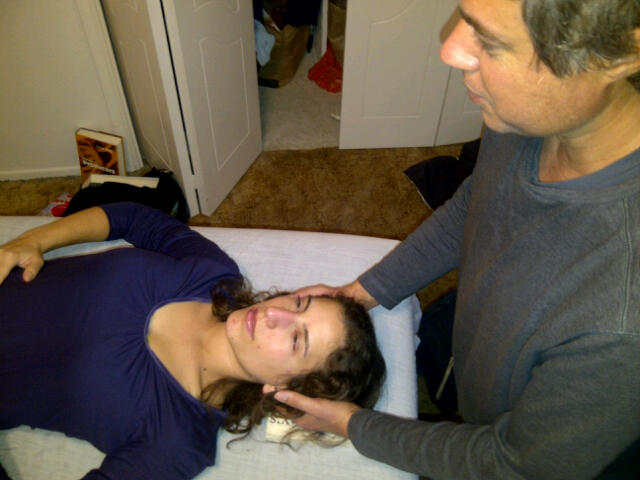
I Interview Berkeley Alexander Teacher Amira Alvarez
I love Amira’s website – AmiraAlvarez.com.
It’s quick and clean and fun. I particularly like the Before and After photos.
I talk to Amira for an hour Monday afternoon.
Luke: “When you were a child, what did you want to be when you grew up?”
Amira: “I do remember being at an ACLU shindig with my father [Rodolfo Alvarez] and being about eight, nine or ten, and someone asking me what I wanted to be when I grew up, and I said I wanted to marry rich, just to annoy my father and to shock everyone around me.”
Luke: “What led you to study Anthropology at Berkeley?”
Amira: “The love of people.”
“My father is a professor of Sociology. I’m showing myself to be a rebel. I just couldn’t follow in his footsteps.”
“After I became an Alexander Technique teacher, in the midst of a lesson someone asked me about my family and it dawned on me that both of my grandmothers were healers.”
“As the daughter of a professor, in my upbringing, everything was about learning. Combined with the genetic background in the healing profession…”
Luke: “How did you become interested in the Alexander Technique?”
Amira: “Pain. I had a great job. I was a high level project manager in a corporation. I got to fly all over the world running different projects.”
“I approached it like I approach everything in life with this incredible drive and will and determination. And doing that at a computer for 10-12 hours a day created a lot of pain.”
“I ignored the pain for the first two years until it became unbearable.”
“I was determined to do well in my job and that took precedence over my own health.”
“I happened to come across an Alexander Technique teacher who was also a physical therapist [Antonio Tudisco]. I had been sent through the worker’s comp program at the corporation.”
“He did this magic with his hands and I was like, whoa, what is this? I came home and described it to my husband. I hadn’t gotten the name of what he was doing but I remembered what he said to me — ‘Let your neck be free. Let your head go forward and up. Let your back lengthen and widen.’ And my husband said, ‘Oh, that’s the Alexander Technique.'”
“He had come across it in an acting-movement-improv-dance world.”
“I went online and found an Alexander Technique teacher [Constance Clare-Newman.] I studied with her for a year.”
“I wasn’t a good student. I think I would’ve fired me. I liked my teacher but when I came in, I wasn’t really paying attention. I didn’t really notice things. I would try hard to do what she said to do but not by applying the Technique but simply by trying hard.”
“And now I don’t have pain. I work at the computer. I do my life. Sports. Hanging out. Walking, talking. Without any pain.”
“I met Giora Pinkas before I trained. He’s just a mentch. He had this joyful personality and quality that was so seductive. Not him, but the idea of being happy like that was incredibly attractive. I’d never met someone who was so comfortable with themselves. I think that pushed me over the edge [to train to teach the Technique].”
“I didn’t have a lot of darkness in my training. I had a lot of frustration, feeling like I wasn’t getting it and that I wasn’t good enough… I wanted it to be clearer. More straight-forward. Here are the keys to the kingdom.”
“Training wasn’t the key to the kingdom. It didn’t say do this, do this, do this. Subsequent to training, to make it easier for my students, it doesn’t have to take a lifetime to get the basics down, I’ve tried to figure out different ways of talking about the Technique… I’ve come up with a lot of different teaching tools. I did that to make it easier for myself. How can I re-conceive of this so it is easier for me to implement and to teach? The Alexander Technique is a fabulous base but it wasn’t the end-all and be-all for me. I had to do a lot of other things to make it work for me.”
Luke: “The Alexander Technique isn’t the only thing in your life?”
Amira: “In the beginning, it was. I approached it as, if I just do this, everything will be fabulous. It’s seductive to work that way… The principles are true. You can make great changes, but the changes you get in a lesson come in part because the teacher has done a lot of work on himself. When you’re on your own, it’s more challenging.”
“When I graduated from Alexander Technique school, my husband said, ‘OK, I’m quitting my job.’ It was time. He was burnt out.
“I had the fire in my belly. We had just bought a big house. I wanted to be an Alexander Technique teacher. I don’t want to go back to corporate cubicle land. I was going to do whatever it took to make it work. I worked my patootie off that first year to get my website up…
“I looked at a lot of Alexander Technique teacher websites and I realized that they were not attractive to me if I put myself in a potential student’s shoes.”
“I started thinking about what kind of image I want to present. I wanted it to be professional. I didn’t want it to be airy fairy. I didn’t want it to be too woo-woo. This work is practical. Implementable. I was a professional and worthy of being paid professional wages.
“I realized that if I had a homespun website that didn’t look professional, it would be harder to get paid what I wanted to get paid.”
“I have lots of thoughts on this. You can ask me anything.”
“The Alexander Technique culture has seemed to set up this rule…that talking about the Alexander Technique has to be hard and you can’t use any of these words over here like ‘It helps your body’ or ‘It reduces pain.’ There are all these rules that if we say ‘self-managed pain relief’, that’s bad. That’s wrong. But so many of us got attracted to it because it did help us relieve our pain. It did it through education, not pills or surgery or physical therapy. So I feel like there are a lot of rules that keep us from speaking easily about the work.”
“Is it hard for you to talk to people about [the Alexander Technique]?”
Luke: “I’m not sure because I’m not sure if anyone has gotten a lesson from what I’ve said.”
“What was the biggest challenge you faced in starting a practice?”
Amira: “Feeling comfortable with charging enough.”
Luke: “What has been the biggest challenge transmitting Alexander Technique to your students?”
Amira: “[Finding] where to start. There’s so much base knowledge you need to be effective, I wanted to get people up to speed the fastest. In the beginning, I taught in a traditional way. Now I do a much more holistic [approach]. I add in other concepts that help. I know a lot of other teachers would say, ‘You’re not teaching the Alexander Technique because you’re not going strictly by the book.'”
“So the challenge was — am I a renegade? Am I not teaching the Alexander Technique? The neurotic thinking, the internal critic thing saying, what are you doing? That is not how you were taught to teach. I do teach traditionally but I add stuff to it to make it more effective.”
“I write notes out for my students after every lesson. That is something I wish I had had in my training and in my lessons. The notes are just little reminders such as where the top of your spine is and where the bottom of your spine is.”
“I tell my students upfront that I teach the Alexander Technique plus. I integrate a lot of my own teaching tools. I’ve taken my work further where I do a lot of coaching and strategy work with people. I discovered it was hard for me to effectively implement the principles of the Alexander Technique when I was in complete overwhelm in my life.”
“Let’s say one of my students is having an issue with her boyfriend who doesn’t want to be in the relationship with her anymore. And that’s causing her to physically come in on herself. So we strategize. What’s the trigger? What could you do? Say, not open your emails from him. Or, before you open your email, take a moment, stop, inhibit, think your directions and how you would like to respond and then open your email.”
“I tell my students I do life coaching in conjunction with the Alexander Technique to make it more effective. And they love it.”
“In the beginning, I did packages of lessons where if you buy ten, you get two free. Now I do packages of all the things I work on with people. I don’t teach just one lesson at a time. You have to buy a package to work with me.
“Often times people say to me, ‘I just want to come for lessons.’ And I say, ‘That’s not how I work. I don’t find it as effective.'”
“I teach people how to create the life they want, not just how to get out of pain.”
“When we help people get out of habits that are no longer serving them, we are helping them create the life they want. That’s how the title of my website came to be. I felt like that spoke to my niche market — people who have pain, feel pressure, and want to do something about it.”
“When I looked at the people I loved to work with, I realized that they were people like me — driven, over-achiever types that thought if they worked hard at something, they would get it. They needed the paradigm shift that working easy can propel you forward.”
“I thought about who my ideal peeps are, who I love working with.”
“A couple of tips. Speak benefits, not features. Don’t talk about what you do, talk about what they’re going to get when they work with you. One of the rules we have in the Alexander Technique world is that we can’t talk about what people are going to get out of it because we can’t guarantee it. Well, surgery doesn’t guarantee anything.”
“What are they going to get from working with you? They’re going to feel great. Speak to the experiences that you’ve had that you think people will get from working with you.”
“Another thing that evolved was giving people something [an ebook] who came to my website in exchange for signing up for my newsletter.”
“It positions me as an expert and gives people wonderful information that they can implement immediately.”
“With my newsletter, people get to know me, like me, trust me, and eventually they call me up for a lesson.”
“People would come to my website and then leave. Then the next thing would catch their eye and they would not think to come back. Now I am in their in-box with valuable information. Seems to be working.”
“I’d love to run a three-hour workshop for Alexander teachers on marketing. I have done so much thinking about it and research and investing in learning from business coaches. I would love to share it.”
“There’s a cultural mores in the Alexander world that it is really hard to get clients. It is really hard to start a practice. I would encourage you to throw that out because all that’s doing is pulling you down. How do you feel when you think that?”
Luke: “I was going down.”
Amira: “Yes! So why think that? Somebody else might say, ‘That’s the reality of the situation.’ But is it helping you? Does that help you take action or does it throw you into a fear reflex? I would say it is the latter. Framing it as, ‘I have to learn how to get clients’ is a much better way of stating the problem. Or, ‘I am learning to get clients.’ Does that pull you down?”
Luke: “That’s an easier thought on me.”
Amira: “I teach people how to recognize when they are going into patterns that are causing them pain and how to shift out of that. When you start recognizing these patterns and start making these shifts, you stop creating the pain. Some people will feel great immediately. For others, it will take some time. If you participate in the educational process, it’s possible to feel great.”
After the interview, I post to Amira’s Facebook wall: “Thank you for being such a great interview! What made you great? You were very much in the moment. You didn’t give canned responses. You thought through every question I asked and you answered in the moment, rather than reciting practiced lines. You’re an interviewer’s dream.”
Posted in Alexander Technique
Tagged alexander teacher, alexander technique teacher, amira, comp program, genetic background, shindig
Comments Off on I Interview Berkeley Alexander Teacher Amira Alvarez
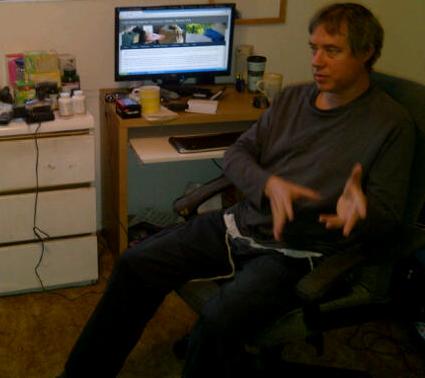
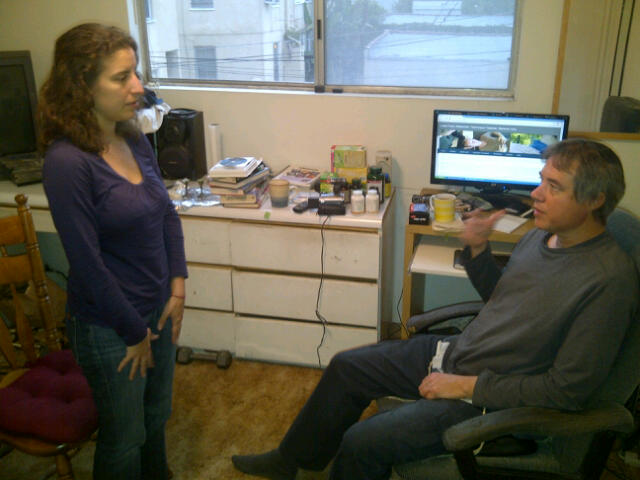
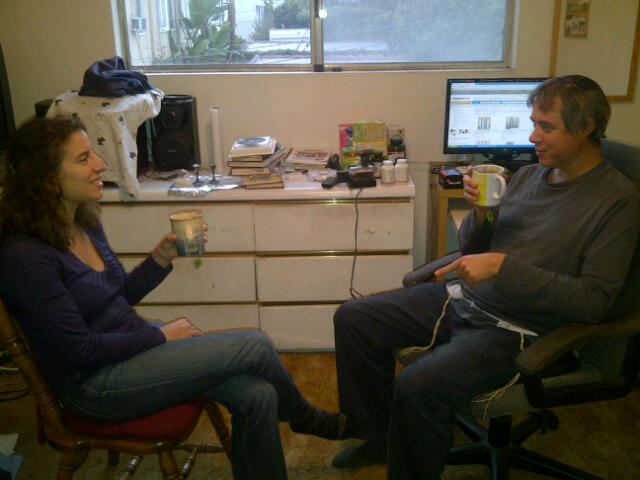
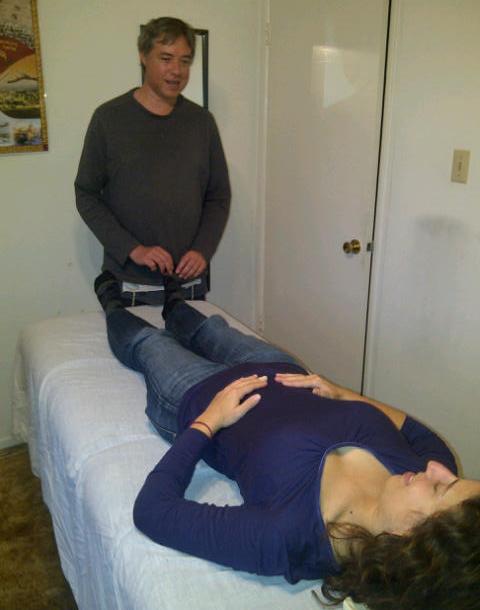
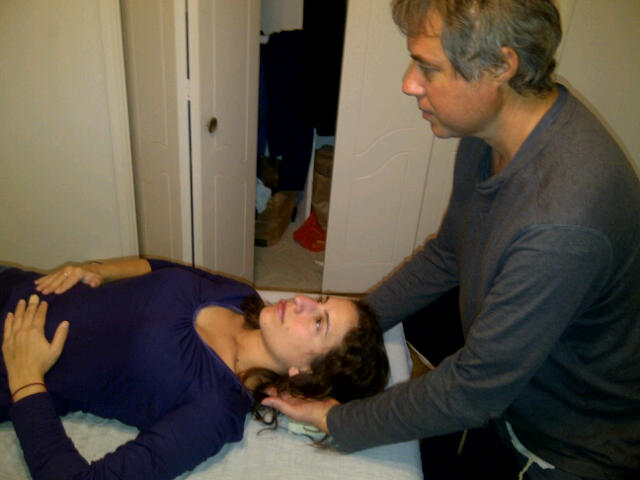
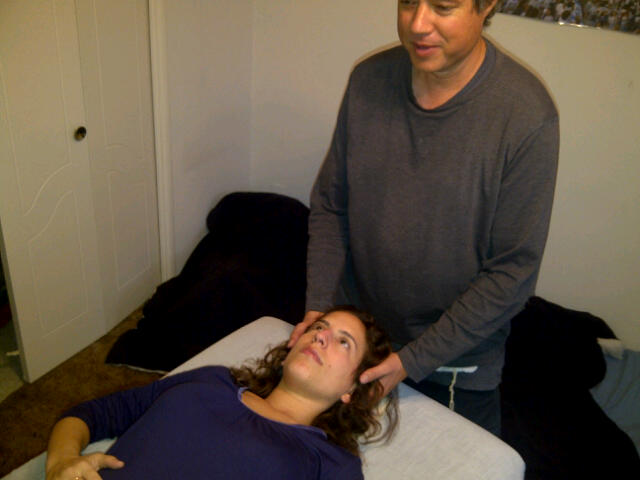
Teaching Alexander Technique On A Rainy Sunday
Posted in Alexander Technique
Comments Off on Teaching Alexander Technique On A Rainy Sunday
I Wince As I Look Back
I tend to live in the past. I spend an inordinate amount of time remembering and re-experiencing my life. And much of the time as I replay stuff, I’m wincing. I’m compressing and pulling down. I’m embarrassed and ashamed.
I can’t feel embarrassed or ashamed without compressing. Every thought and emotion requires a particular alignment of the musculature. If I let go of my desire to compress, then the hopeless feeling leaves with the unnecessary tension.
So as I keep replaying stupid things I’ve said and done, not to mention wicked things I’ve said and done, I ask myself what are the commonalities. What ties together the bad things I do? And the answer is that for almost all of them, my thirst for attention was overcoming my propriety. Almost everything dumb and destructive I’ve done has come out of a need for attention, which is my substitute for love.
When I was a kid, I used to make rude sounds in class. As I grew older, I started making these rude sounds online. Either way, I was motivated by the same thing — look at me!
Yet my life is not just one disaster after another. For months at a time, I’ve been OK.
So what has held me together? When I have the real thing of human connection.
If I’m not connected to God and to good people, I’m an attention addict. More than a sex addict, I’m a look-at-me! addict.
If I don’t connect to God every day (through working the 12 steps or going to shul or studying Torah), I start jonesing for an attention fix.
I’m 45 years old and yet every day, I’m evenly poised between good and evil. Some days I’m an obnoxious jerk because I haven’t adequately fed my yearning for God and for connection to good people.
I go to way too many social gatherings and find myself off to the side standing awkwardly alone and wondering why this keeps happening to me, no matter where I am. It doesn’t matter what social setting or party or city or country I’m in, this awkward state persists. There’s something broken in the way I try to connect with people.
Posted in Personal
Tagged commonalities, musculature, sex addict, social gatherings, unnecessary tension, working the 12 steps
Comments Off on I Wince As I Look Back
Appreciating The Older Woman
Rabbi Shmuley Boteach writes: The unfortunate breakup of the marriage between Demi Moore and Ashton Kutcher should be of interest even to those who have better things to do with their time than follow mindless Hollywood chatter and celebrity gossip. This relationship was always unique in that it involved an actress who was 16 years older than her husband. That alone sent tongues wagging as soon as the relationship was announced. Many questioned whether a man in his thirties would continue to remain attracted to a woman who next year turns 50. What strained the relationship even more, according to those who always questioned it, was how Kutcher’s career took off like a rocket over the past few years, including getting a huge contract from CBS for Two and a Half Men, while Moore’s career stalled. Can a power couple’s relationship survive when one partner becomes a supernova and the other’s star fades?
There was then the curious item of just how public this relationship was. To be sure, there have always been Hollywood super couples who were photographed constantly in Cannes, at red-carpet movie premieres, and walking their children for ice cream in Beverly Hills. The difference with Moore and Kutcher was that they decided to Tweet so much of their relationship, including intimate pictures in their underwear, that the marriage seemed to lose a semblance of privacy. Could a marriage survive that kind of exposure or is erotic attraction to be found specifically in the mysterious and the hidden?
No doubt, the allegations that the marriage came to an end over Kutcher’s alleged unfaithfulness will simply be seen as part of a long line of men behaving badly. Kutcher will be grouped with other high-profile alleged philanderers, most notably Tiger Woods, Eliot Spitzer, and Arnold Schwarzenegger. But – and let’s not be afraid to ask the question – did any of this have to do with a young man in the prime of his life feeling less attracted to a wife that was entering middle age?
Here’s my opinion on the matter. Men are becoming more shallow than ever. They are focusing on a woman’s packaging to the virtual exclusion of other far more erotic elements of feminine attractiveness that are strike deeper than skin. Forget the phrase don’t judge a book by its cover. Women today are judged almost entirely by the color of their hair, the size of their chest, the length of their legs, and, most importantly, how young they are and how thin they are.
Posted in Dating, Marriage, Shmuley Boteach
Tagged arnold schwarzenegger, celebrity gossip, demi moore and ashton kutcher, Eliot Spitzer, rabbi shmuley boteach, woman rabbi
Comments Off on Appreciating The Older Woman
Sorry Brad Pitt, George Clooney and Rabbi Rabbs

Posted in Personal
Comments Off on Sorry Brad Pitt, George Clooney and Rabbi Rabbs