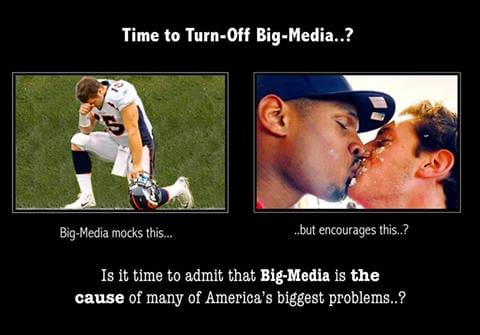
Dissing Tim Tebow, Celebrating Michael Sam

gays

Chaim Amalek: “This is another example of the stupidity of Republicans. If they had any intelligence, they would be fighting to shorten copyright duration to what it was in years past, would encourage services like Aero that have the potential to effectively defund the main TV networks (thereby defunding pro-sports as well), encourage NCAA athletes to unionize, insist on affirmative action programs in Hollywood at the senior corporate level to provide diversity where it might do some good, and otherwise act to reduce the power of our media oligarchs. None of which these brain-dead slaves to failed free market ideologies will ever do.”

Posted in Homosexuality | Comments Off on Dissing Tim Tebow, Celebrating Michael Sam

Robert Oscar Lopez On Gays Gone Wild

In his latest column for American Thinker, Robert Oscar Lopez writes:

Minnesota was by no means isolated.  Ritualized crying became the weapon of choice.  We heard about well-intended homosexuals being thrown out of the house by mean Christian parents.  We heard about stellar gay citizens “just wanting to build families.”  In endless performances of rhetorical masochism, we heard about kids of gay people longing to have society applaud their guardians for wrenching them away from their own biological roots.  We heard about horrible bullies committing all these mythical crimes against helpless gay people:

According to his online bio at the Cal-State Northridge website: “Robert Oscar Lopez received his BA in Political Science, an MA in Classics, and a PhD in English. His book, The Colorful Conservative: American Conversations with the Ancients from Wheatley to Whitman, came out with Rowman & Littlefield’s University Press of America in 2011. The next two projects will be Putting Text on Trial, a pedagogical study of mock trials, and Gilded Lilies, a cultural study of the Hollywood musical.

“He has also been an active commentator and advocate for children’s rights and ethical family alternatives. Dozens of his essays have appeared in venues such as Counterpunch, American Thinker, and Public Discourse, among others. Since 2012 he has been involved internationally with correspondents in over twenty other countries. His French-English translations are posted on a site he co-manages with Swiss and French partners, called English Manif.”

I did this interview with Dr. Lopez via email:

* What have been the consequences to your life for the stands you’ve taken?

ROL: I’ve learned what it’s like to be an outcast. Kind of like a Job moment. All my old friends are gone, though I made dozens of new friends that are quite to my liking. My job got dicey but I hung on with tenure. The toughest thing is being blacklisted in the United States, where it is virtually impossible for anyone to publish me or give me a platform, thanks to extremists like Jeremy Hooper at GLAAD/Good as You, or this deranged individual named Joe.My.God, who does seem to think of himself as a powerful deity because he has a crowd of clapping seals that massage his ego via his blog, and the oligarchs at the Human Rights Campaign. The best thing is I’m unburdened by domestic fuss in the United States; I have lots of free time and energy to connect with people in Europe, and I don’t waste much time in the US in back-and-forth. People who are familiar with me read my columns in American Thinker and occasionally gloss English Manif, or, in some rare cases, they get the regular daily digests. I don’t do comments sections or tweet or do any social media other than blogging. Life under the radar can be sweet and peaceful, plus the people who hate me usually have no idea what I am going to do next. It’s nice to have surprise always on my side.

* Should others who believe similarly to yourself and speak out
expect the same treatment?

ROL: I was heartened to see one daughter of lesbians, who was conceived through sperm donation, come forward at Princeton and not be ripped to shreds immediately. She is doing a senior research project on the reasons that anonymous sperm banking is bad for kids, yet she got support from COLAGE. COLAGE is the Politburo of gay families, generally marching in lockstep to keep the gay parents and their genetic engineers happy. It was heartening to see them willing to work with, and even fund, a child of same-sex parenting who’s obviously critical. The woman is young (still in college) and it’s rare that anyone in that age range comes forward with criticisms of gay parenting anyway. The fact that she was identified in the press and treated fairly gives me hope. She’s rare, though. All the other dissenting children of same-sex couples have been the target of massive hate campaigns, often threatened and usually menaced with professional repercussions. So I think the general state of affairs is, it’s still going to be tough and children of same-sex couples really do need to wait until they’re in their thirties or forties to decide how they feel about everything and offer frank feedback. They need to be professionally established and safe.

* Does faith in God sustain you?

ROL: Of course. While she was not Christian, obviously, Antigone has a great line in the ancient Greek tragedy: “I may break the laws of this world, but more important to me is the law of the afterworld, for there I must live forever.” It is amazing how much God has blessed me, spared me, forgiven me. It’s a small thing to endure some suffering to take his word seriously.

* How does one heal from the type of upbringing you had?

ROL: Forgive and let go, but never lie to yourself or others about what really happened. Children raised in gay homes are trained from an early age to dissemble and hide things. Either you’re hiding your parents’ sexuality, or you’re hiding how hard the whole arrangement is on you, or both. The greatest liberation you find, as an adult, is suddenly realizing, “oh wow, I don’t have to lie anymore, or protect them anymore.”

* How did you decide to speak out?

ROL: I wouldn’t say it was something I decided. I kind of fell into it because I have a big mouth and very bad impulse control. I posted some feisty comments on the Chronicle of Higher Ed, two years ago, and apparently a lot of people were reading the comments, so Ryan Anderson contacted me and asked me to publish an essay. At that time I didn’t know what Public Discourse was. That essay blew up and then I was getting attacked and my inner angry lesbian kicked into gear and my instinct was to fight as hard as I could. But it wasn’t a very well thought out process. It was more like I wandered into the public sphere.

* Have you received support or condemnation from surprising places?

ROL: I am always surprised by how many gay men contact me off the record and tell me they support me. The ones who have gone public as gays against the gay marriage agenda are a unique kind of firebrand — people like Paddy Manning in Ireland and Jean-Pierre Delaume in France. There are a lot of gay men who were maybe on board with the gay lobby until surrogacy came up, and then that was their bright red line not to cross. Surrogacy brings a lot of supporters out of the woodwork, you know. As for condemnation, you’d be surprised how much time I spend fighting with conservatives. First, there have been too many hucksters running the traditional marriage movement, people who claim they have a great social strategy but who don’t really feel the issue in a strong personal way. At the slightest whiff of a backlash they bail and become obnoxious proselytizers for what they once railed against. These are the David Blankenhorns, the folks who made a name out of bashing gay families, and then when it looked like gay marriage was very popular, they turned around and started bashing the people who stood up for traditional families. It’s like all it takes is tea and crumpets with Jonathan Rauch or Jonathan Corvino, and presto! People suddenly find defection to supporting gay marriage so attractive — people will love you again, you’ll be able to write books again, you get dinner invitations instead of death threats. Those folks are horrible to deal with, because they know they never really gave a crap about the kids and out of guilt they turn defensive. I mean, how could they? If they cared about kids they’d keep fighting for kids to have a mom and dad. There are also a bunch of conservatives who can’t stand that I’m bisexual, who think I’m too vulgar, or who get really nervous when I talk about the history of slavery or cultural genocide. These are the prim conservatives who really think the other side will leave them alone if they don’t say anything intemperate. They keep me at a distance because they don’t want to be tainted.

* Is there a different attitude to gay marriage and gay adoption in the latino community as opposed to other communities you’ve known?

ROL: It’s strange but the Latinos who turn up in polls are all very pro-gay marriage and gung-ho on gay adoption. But when I did HITV, a Hispanic TV channel, the Latinos who called in were very religious and traditional, for the most part. At marriage events there are a lot of Latinos and blacks usually, and quite often they have high positions. The president of the Witherspoon is Latino, and you have lots of Latinos in Catholic advocacy groups too. But the Pew Center always comes out with reports that Latinos have the highest support for gay marriage. I think the Latinos who are supportive of marriage and children’s rights are often highly placed, whereas a lot of the Latinos who answer surveys haven’t thought much about the issue.

Is there a different attitude in academia as opposed to regular American life?

ROL: Of course. Academia’s bonkers.

Posted in Homosexuality | Comments Off on Robert Oscar Lopez On Gays Gone Wild

Nicholas Wade Interview – A Troublesome Inheritance: Genes, Race and Human History

I spoke by phone today for 45 minutes with the famous genetics reporter. He retired from the New York Times staff two years ago but still contributes articles to the paper.

This is an edited transcript.

Nicholas: “[The book] is based on about a dozen articles I’ve written for the New York Times covering advances in genetics and in the course of that, I speak to the authors of the research, supporters and critics and get a feel for what scientists think in the field, and I supplement that with my further reading, and that is the background of the book.”

“I retired from the Times about two years ago. There’s a blogosphere story today that the Times didn’t like the book and fired me, but the writer invented the whole thing based on his having seen the words ‘former Science editor’ in the piece I did in Time.”

Luke: “What were the biggest challenges in writing this book?”

Nicholas: “I think the biggest challenge was that I had so few scientific sources to guide me in interpretation because this is an area where academics cannot tread for fear of being accused of racism and seeing their careers destroyed. The scientific literature has the basic facts but few people try to draw them together. So I found the lack of guidance difficult, and even more so when I came to the second part of the book. Historians and economists just never consider human evolution as a possible explanatory variable. They just assume that all the populations they are dealing with are interchangeable and that natural selection never need be an explanation to even consider. So there again, there was no guidance for someone trying to figure out the possible consequences of the fact that human evolution has continued and has never come to a stop.”

Luke: “You will be writing future articles for the New York Times?”

Nicholas: “I assume so. I write for them quite regularly on a contract basis but I am not on their staff any longer.”

Luke: “Are there certain scientists who are brave enough to go into these areas?”

Nicholas: “There are just a few, yes.”

Luke: “Who would you say are the most important ones?”

Nicholas: “The clearest statement that races exist is from a population geneticist named Neil Risch, who you will see referenced in the book. That is the only article I can think of that says well of course populations cluster into groups that correspond into continental populations and to every day concepts of race.”

Luke: “Journalists tend to be a clannish lot. We meet up at pubs and talk. How have your peers in journalism related to you?”

Nicholas: “I have nothing out of the ordinary to report there. I haven’t had any reactions. As far as they’re concerned, I’m just writing a book that springs out of my daily reporting work, which journalists often do.”

Luke: “You have been writing on this for 10-15 years, do any of the other reporters at the New York Times notice? The ones covering other beats? Do they ever ask you questions about it?”

Nicholas: “I’ve seen several articles on the web suggesting that I was pursuing some agenda of my own at the New York Times. This is completely untrue. I was doing my job and reporting what people were saying about the human genome. There’s nothing unusual about any of my articles. You can look them up and read them. They are standard, straight-forward reporting just as any other reporter covering this beat would have written.”

Luke: “And yet it seems to make no impact on other reporters and the way they cover their beats. And your work does have a profound impact on all sorts of things that are generally taken for granted among academics, economists and newspaper reporters.”

Nicholas: “That’s true. If you draw out the consequences, then they should effect other fields and that’s what I try to do in the book but it would not have been appropriate for me in a news story just reporting the facts to try to delineate all the consequences that I do in the book. The book is more interpretative than one could or should write in the news article.”

Luke: “Was there a particular moment when your interests in this were born?”

Nicholas: “No. I think it all developed gradually. I recognized in just reporting the stories that there was a great reluctance on the part of researchers to talk about race. With almost any question that referred to race, they would clam up. It seems to me that there was a lot of work in interpreting the human genome that academics should have been doing but were not and so this seemed an opportunity for me to fill in the blanks and write the missing manual that they had failed to provide.”

Luke: “Is this book risky to your social standing?”

Nicholas: “I very much hope not. As far as I can see, I’m pushing on an open door. The two main themes of the book are first that race is biological and second that human evolution is continuous. Both of these statements seem to me to be so obvious and innocuous that I hope that people will just accept the arguments I am putting forward.”

Luke: “Would you have written such a potentially risky book in your youth or perhaps do you feel more freedom to venture into risky areas in age?”

Nicholas laughs. “I don’t know how to answer that. This book is dictated by the timing in the findings it reports on. It’s all very recent and this is the time to write about it. If I had still been with the Times [as a staffer], I would have written the same book.”

Luke: “What is tribalism?”

Nicholas: “It is a society in which people are organized into kinship-based groups, or extended families or lineages that combine for or against each other in particular issues.”

Luke: “I grew up a white Anglo-Saxon Protestant in Australia and then a few years ago, I converted to Orthodox Judaism and I converted to a tribal identity and it is very different from the identity I grew up with. As I look around America today, it seems to be much more tribal than it was even 30 years ago.”

Nicholas: “That’s a very fascinating conception. It could certainly be true. Tribalism never disappeared. We still have lots of nepotism. It’s just that other political systems get imposed on top of [tribalism]. I can certainly buy the thesis that tribalism is still there and latent.”

Luke: “In some ways, the English-speaking Anglo-Saxon experiment is the most dramatic distinction from the tribal approach to life.”

Nicholas: “I think that’s too hard of a question for me to comment on.”

Luke: “A dozen years after Stephen Jay Gould‘s funeral, he is still widely cited as the expert on many of the matters you write about in this book. What do you think about that?”

Nicholas: “I think lots of his views were very mistaken but he certainly had a wide audience because of his many books and popular essays so I can understand why his influence would linger.”

Luke: “He knew how to capture the conventional wisdom and express it in a certain kind of pleasing prose. That the scientific validity of his statements don’t stand up doesn’t seem to have done his reputation much harm.”

Nicholas: “Right.”

Luke: “Much of your work seems driven by a concern for improving humanity’s health?”

Nicholas: “I’m very much interested in improving people’s understanding of science and trying to explain what is happening at the forefront of science. I guess some of that includes health as well.”

Luke: “That touches on many of the themes in your book because a doctor, if he is to do his job, does need to take race into consideration because different medications will have different effects on different races and different races will be differently susceptible to different diseases.”

Nicholas: “The whole effort to find the roots of disease in the genome has in effect to be duplicated in each of the races because as you say, each race has a different susceptibility to disease. If we don’t wish to leave anyone out, we should do this with all races.”

Luke: “How much has your thinking been influenced by your upbringing in Britain? Have you noticed that there is a different attitude towards these matters say in Britain when you were growing than say in America today?”

Nicholas: “That’s an interesting question. Maybe yes. In Britain [then], there was almost no civic virtue more highly prized than tolerance and if people thought differently, you just let them be, while in America today, there’s a great tendency to stamp out any heretical thoughts and make everyone think alike, particularly in controversial issues like this.”

Luke: “There’s a long British history of interest in eugenics from the ancestors of Charles Darwin…”

Nicholas: “That’s right. Britain was quite quick to move away from eugenics. The Americans did so much later, but not until after they had sterilized some 40,000 people and the Germans ran the whole idea into the ground in a horrible way. Britain’s record happens to be a little better than that of others. [Francis] Galton‘s eugenics was of the positive kind, he favored people with what he regarded as good genes marrying each other. In no way did he advocate negative eugenics, meaning sterilization of those whose genes were thought to be inferior. That was an American idea that was then taken up by the Germans.”

Luke: “Would it be fair to say that many of the principal ideas in your book were taken for granted as commonsense wisdom say 70-80 years ago?”

Nicholas laughs. “I think a lot of that is true. People took it for granted that races existed and had a biological basis. And then of course there was a whole reaction against that… Many social scientists now say they don’t think that races exist and the fact that the genome says otherwise is, as you say, a throwback to the wisdom of 70 years ago.”

Luke: “How have your ideas on race changed over the course of a lifetime?”

Nicholas: “I suppose they’ve changed quite a lot because growing up in England, I didn’t know anyone of a different race, but when I came to the U.S. in 1970, then American life was much more mixed, so I had the opportunity of meeting people of other races. So I guess one goes through the experience of assuming people are different until you know a person well and then you just forget that they belong to another race. That’s been my general experience.”

Luke: “It’s kind of humorous that a former National Football League star Reggie White, and a black preacher, was more wise about these matters than most of the scientists opining on them. He gave a famous sermon in [1998] and he says, why did God create us differently? When you look at the black race, black people are gifted at certain things. White people are gifted at certain things. Hispanics are gifted at certain things. Asians are gifted at certain things. And when you put it together, it creates a complete image of God.”

Nicholas: “That’s a very nice way of putting it.”

Luke: “Have you noticed a difference in the way scientists talk to you about these matters when they are speaking off-the-record?”

Nicholas: “No. Whether you are speaking to them on or off the record, they are just very reserved in speaking about these subjects.”

Luke: “Did you ever read J. Philippe Rushton‘s book, Race, Evolution and Behavior?”

Nicholas: “Yes.”

Luke: “And what did you think of that book?”

Nicholas: “It made me a little uncomfortable in that he just rushes so quickly to the conclusion that some races are inferior to others. I think that a lot of the facts he gathers are very interesting, but he’s just so quick to reach his conclusion that I just sort of wondered about the overall validity of the book. Although I did read Rushton some time ago, I just put his book out of my mind while I was writing this one.”

Luke: “One thing that is fascinating in the book is that he lists 60 life history results where each one falls out on the same continuum with East Asians on one end and Blacks on the other and Whites in between, so whether it is brain size or the age at which the baby begins to crawl or to walk, reaches menstruation, has first sexual intercourse, first has children, lifespan, it’s interesting that in these life history results, they fall out in the same basic continuum.”

Nicholas: “Yes, I remember that argument, and it seemed very convincing in the book because he had so much data. What I then wanted to know was whether other people agree with his [thesis], and I just don’t know the answer to that.”

Luke: “Japan and sub-Saharan Africa seem to be as opposite as societies can be and their descendants, wherever they live in the world, [reproduce the qualities of their homelands]. There are Japanese neighborhoods here in Los Angeles and they are immaculate. Their gardens are so intricate. They take great care with their lawn. And it seems to tell me something about the people and the type of society they are going to create.”

Nicholas: “Right. The argument of my book is that evolution, in shaping human social behavior, shapes human societies. We survive not as individuals but as social groups. Natural selection is in no way indifferent to the structure of our societies and has indeed shaped them. Each population is going to have a different type of society depending on the social behavior of its members. So it’s not surprising that societies should have distinctive features. It may be an error to attribute everything to culture. There may be some room for genetics in there.”

Luke: “African-Americans have a disproportionate share of popular culture superstars.”

Nicholas: “I don’t think I have any useful opinions on that.”

Luke: “Do you think that we will see in our lifetime the American Anthropological Association issuing a statement to the effect that of course race is real?”

Nicholas laughs. “I hope they would. Why not? Why not be on the side of science instead of fighting it? They’ve had these statements [that there’s no such thing as race] since the 1950s and just haven’t revised them. If they were to update them in the light of modern scientific knowledge, then they would surely wish to break this unfortunate link between science and the fight against racism. I think one should say that racism is wrong as a matter of principle, not of science, and let the science develop freely without this interference.”

Luke: “Can you tell me anything about your attitude to your reader? I notice you don’t pander to your readers like a Malcolm Gladwell.”

Nicholas: “I just assume that my reader is the average intelligent person who’s got an interest in this subject. So all I need to do is to define unusual terms and otherwise just explain things as clearly as possible.”

Luke: “When you see acclaimed intellectuals such as Jared Diamond running away as fast as they can from genetic explanations and making a lot of money and receiving a lot of social status for saying the comfortable things that people want to hear, what do you think about that?”

Nicholas: “If one is going to present oneself as a writer about science, then one should try to exclude political considerations. One shouldn’t have a hidden political agenda, which I think Jared does Germs, Guns and Steel.”

Luke: “What have been the most interesting forms of feedback you’ve received on this new book?”

Nicholas: “The book only came out Tuesday. There have been a number of reviews from what one might describe as the right-wing which have been mostly favorable, though some seem tinged with disappointment that I didn’t go further in characterizing racial differences. The reviews from the Left have been surprisingly absent so far, so I don’t know if people are ignoring the book because they disagree with it, or, as I hope is the case, because I’m pushing on an open door.”

Luke: “And yet a thinker like Steven Pinker says that the human brain has not changed in the last 10,000 years because it would be inconvenient if that happened.”

Nicholas: “Part of the doctrinal basis of evolutionary psychology is…that the human mind has adapted to the conditions of 10,000 years ago when we were mostly hunter-gatherers, and it hasn’t changed since, but I can’t see any evidence for that. The doctrine assumes that evolution halts for some reason or at least it halts with respect to the mind, but we know that’s not true from simply looking at these scans of the human genome. These show that brain genes are not in some category exempt from evolution.”

Luke: “Do you follow sports at all?”

Nicholas: “No, I don’t.”

Luke: “Oh because there racial differences are so obvious.”

Nicholas: “Right.”

Luke: “In the last five Olympics, all eight finalists in the 100 meter dash have been of West African [descent].”

Nicholas: “So it would be hardly surprising to find some genetic influence there.”

Luke: “You don’t go into IQ a great deal in your new book and racial statistical differences in IQ. Is there a reason?”

Nicholas: “The main reason is that I think that academics have paid far too much attention to IQ. At the level of societies, IQ does not seem so important. East-Asians have an average IQ of 105, higher than the Europeans of 100, but East-Asian societies, despite their many virtues, are not generally better able to provide for their members than European societies, so IQ cannot be making much difference. I’m sure it makes some, but it is hard for us to pinpoint what it is. Although IQ tests can be very accurate when applied to individuals in a specified population, there are many environmental factors that can affect IQ, so it can be very tricky comparing two very different populations because you can never be sure you’ve got the environmental factors evened out. So for that reason, I think many discussions about race have ended up causing a lot of acrimony and dissension because they have used these very precise numbers for evaluating a whole population and arriving at invidious answers. People get very upset and not much light is shed on the issue. Therefore, it seemed to me best to skip over the whole IQ issue. Not because I am ignoring something important that is there, but because it does not seem to shed a great deal of light on the issues I was interested in.”

Luke: “Have you visited Japan?”

Nicholas: “Yes, I have.”

Luke: “There are some amazing differences between Japan with its high social capital and Western countries like Europe and the United States. It’s amazing how little trash, how little crime, virtually no looting, all sorts of things we almost take for granted in America and England occur much less frequently in Japan.”

Nicholas: “I remember noticing a whole stack of bicycles piled up outside the Osaka rail station and not a single one had a lock on it. That would be an unbelievable sight in any American or European city.”

Luke: “One of the arguments for the predictive power of IQ is that the higher one has it, the more it enables abstract thinking, so that you can think, if I do this, how will it affect other people? You can put yourself into other people’s place. The higher the IQ, the more people cooperate… So that would seem to bear on the themes in your book.”

Nicholas: “That’s a very interesting line of thought but I best not comment on it because I haven’t considered it before.”

“It’s hard to see anything in the genome that would substantiate anyone’s fears about racial differences.”

“The whole point of this exercise is to learn more about our evolution, but as all of our recent evolution has been as different races, because we’ve been distributed across all the continents of the globe, you inevitably have to study evolution in each race separately. And because of the fear of studying race, this study has been inhibited. Perhaps if we can lift this taboo, we can start to explore our past.”

Luke: “You mention the silence of the Left so far on your book, do you suspect that they are just going to shut you out and ignore you?”

Nicholas: “That certainly would be one possibility. The other, of course, is that they will be persuaded by it.”

Luke: “Do you think there’s a chance of the latter?”

Nicholas: “It depends upon how divisive this subject really is. What I am trying to say in the book is that there is no need for it to be divisive. We should just accept the facts as they are and move on.”

Luke: “How divisive has your reporting been on these matters in the New York Times?”

Nicholas: “It hasn’t been divisive at all. I just reported on the stories that bear on race in exactly the same way as I or any other reporter would report a story. Most of the studies I describe in the book are ones I covered in the New York Times in fact-based articles that raised no more controversy than any other.”

Luke: “Are you surprised that these articles haven’t had more of an impact on our culture?”

Nicholas: “Many things take a long time to seep into the national consciousness, particularly things to do with the genome… I hope my book will help that process along.”

“If everyone ignores the book, that’s fine. I’ve done my best. I don’t have any secret agenda. This is not a subject I’m devoting my life to. I’m just as happy to go on to some completely different subject.”

Luke: “I look on many of your New York Times articles on race as grenades and I’m just shocked that they haven’t exploded. You haven’t thought of them that way?”

Nicholas laughs. “No. Articles in the New York Times go through a fairly elaborate editing process. None of the editorial hands through which they passed would have thought they were grenades or they would never have made it to the paper.”

Luke: “When you read economists who treat everybody as exchangeable, do you have a voice in your head that says, ‘You bloody fool! Look at the genetics!’?”

Nicholas: “I know the way economists and historians think. They are not going to change their views until someone shows them why it would be of advantage to do so. I hope my book will indicate to young historians, people just starting out in the field, that here is a new explanatory variable that their elders have never applied, and there may be some situations that it might be helpful for, particularly situations for which there is no good explanation now. The same would apply to economists. So if race and recent human evolution does turn out to be a useful explanatory variable and there really are genetically-based differences between societies, this will be a useful tool that will seep into the explanatory literature.”

Luke: “But if this doesn’t happen in your life-time, it won’t terribly affect your happiness?”

Nicholas: “No, it won’t.”

Posted in Nicholas Wade, Race, Steve Sailer | Comments Off on Nicholas Wade Interview – A Troublesome Inheritance: Genes, Race and Human History

A Troublesome Inheritance: Genes, Race and Human History

Steve Sailer writes:

I joke around about the existence of a Steveosphere, but you’ll notice that much of the current attention being paid to Nicholas Wade’s new book A Troublesome Inheritance seems to follow its contours.


JayMan in JayMan’s Blog

Ed West in The Spectator

Charles Murray in the Wall Street Journal

Jared Taylor in American Renaissance

Steven Pinker on Twitter

John Derbyshire in VDARE

Steve Hsu in Information Processing

Rod Dreher in The American Conservative

HBD Chick in HBD Chick

Alfred W. Clark in Occam’s Razor


Of course, Wade is a fringe figure who has merely written over 1000 science articles for the New York Times, so it’s hardly surprising that his book is only getting attention from certain people.

And one from outside the Steveosphere:

Alex Golub on Savage Minds

And one from somebody whom I admire but doubt that I’ve had much influence upon:

Anthony Daniels in The New Criterion

Posted in Nicholas Wade, Steve Sailer | Comments Off on A Troublesome Inheritance: Genes, Race and Human History

What if race is more than a social construct?

Margaret Wente writes for the Toronto Globe & Mail:

Nicholas Wade, a leading science writer whose specialty is human evolution, likes to ask interesting questions. Here are some examples:

Why has the West been the most exploratory and innovative civilization in the world for the past 500 years?

Why are Jews of European descent so massively overrepresented among the top achievers in the arts and sciences?

Why is the Chinese diaspora successful all around the world?

Why is it so difficult to modernize tribal societies?

Why has economic development been so slow in Africa?

Contemporary thinkers have offered lots of provocative answers for such questions. It’s all about geography. Or institutions. Or rice culture. Or the devastating legacy of colonialism. Or Jewish mothers. Now comes another explanation, one that bravely explores the highly dangerous elephant in the room. Mr. Wade argues that human history has also been profoundly influenced by genetics.

Part of his new book, A Troublesome Inheritance: Genes, Race and Human History, is a summary of new findings in genetic science, and part of it is highly speculative. All of it is bound to be deeply unpopular among social scientists, because it challenges their entrenched belief that race is nothing more than a social construct. The wide diversity in human societies around the world can be explained entirely by culture, they insist. We’re all the same under the skin.

Posted in Nicholas Wade | Comments Off on What if race is more than a social construct?

Will The Final Round Draft Of Michael Sam Change History Forever?

I can’t think of any great male athlete who’s come out as gay, only a bunch of mediocre ones, such as Michael Sam. I don’t expect many great male athletes to be gay because great male athletes tend to be hyper-masculine and hyper-masculine guys are rarely gay. I don’t expect many NFL stars, in particular, to turn out to be gay.

When did our forefathers first understand how easy and profitable it was to keep the goyim entertained? I fear that when pro players start making out with each other, this won’t be a hit with the goyim and our revenues will be hit and we’ll be able to make fewer donations to yeshivas. Michael Sam is not good for the Jews.

Chaim Amalek: “This is excellent for America. Anything that reduces the popularity of professional sports, circa 2014, is good for America.

“I want to see some serious cross dressers in the NBA. I want to see men celebrate each basket with a full on oral kiss. I want to see lots of ass slapping and wiggle work. Because this would be good for America. Bad for the _____ who control our sports entertainments, but good for America.”

Steve Sailer wrote:

A warm Saturday afternoon in late May brings all of Chicago to the lakefront. In the Wrigleyville section of Lincoln Park, softball teams with names like “We Are Everywhere” and “The 10 Percenters” compete with an intensity that could shame the Cubs. Girded for battle with sliding pads, batting gloves, and taped ankles, the short-haired women slash extra-base hits, turn the double play, and hit the cutoff woman with a practiced efficiency that arouses admiring shouts from the women spectators.

Meanwhile, on a grassy lakeside bluff a few blocks to the south, the men of the New Town neighborhood bask, golden, in the sun. If ever a rogue urge to strike a ball with a stick is felt by any of the elegantly sprawled multitude, it is quickly subdued. This absence of athletic strife is certainly not the result of any lack of muscle tone: many have clearly spent the dark months in thrall to SoloFlex and StairMaster. But now, the sun is shining and the men are content for their sculpted bodies to be rather than to do.

What are we to make of all this? What does it say about human nature that so many enthusiasms of the average lesbian and the average gay man diverge so strikingly? What broader lessons about current social issues can we learn from this contrariness of their tendencies, this dissimilarity of lesbian and gay passions that has been dimly observable in many cultures and ages, but that now in the wide open, self-fulfillment obsessed America of the 1990s is unmistakable? Well, apparently, we’d be best off not thinking too much about this fact. Better yet, we should avoid even noticing any of these curious details.

At least, that’s been the implicit message of most of the recent news coverage of homosexuals, an outspilling enormous in extent, but peculiarly limited in analytical depth to endless rehashes of: “Gays: Sinners Against God or Victims of Society?” The ongoing media hubbub may actually be clouding the public’s understanding: so many of today’s auto-pilot articles and paint-by-the-numbers newscasts depict homosexuals as merely one dimensional martyrs to prejudice. There are of course obvious political advantages to blandly glossing over just how heterogeneous are homosexuals. Yet, this media stereotyping probably stems more from the natural urge of journalists to reduce complex and unsettling questions about human nature to just another fable starring good guys/gals we all can identify with (in this case, “gays”), who are discriminated against by bad guys (“homophobes”) we all can feel good about looking down upon. Whether portraying homosexuals as perverts in the past or as victims today, the press has always found it less taxing to preach morality rather than to try to understand reality.

Posted in Football, Homosexuality, Jews | Comments Off on Will The Final Round Draft Of Michael Sam Change History Forever?

What Is White People Music?

Steve Sailer writes: “White people markers include that it’s obvious that the frontman has a 3-digit IQ, self-consciousness, irony, and metaness.”

Overwhelmingly, black, white, asian and latino people listen to different music, watch different TV, live, work, socialize and worship in segregated ways.

Chaim Amalek writes: “And yet we all want to have sex with naturally blonde-haired (and other) white women. So here’s to you, White Woman, for bringing us all together. Long may your kind be found on this planet in abundance.”

Posted in Whites | Comments Off on What Is White People Music?

Just Call It Reality

Philo posts on FB: During the heyday of blogs, from like 2004 – 2010, we called our happy mass of posts and discussions the Jblogosphere. Blogs are now a faint echo of what they were. So what do we call… this? I mean those of us who are on Facebook and other social media having the same sometimes deep, fascinating, maddening, rewarding, and often silly and ridiculous discussions on Jewish topics?
The JFaceosphere?
The artists formerly knows as JBloggers?
Battlestar Koferica?
The Gideonites?
Not that it really needs a name…

Mark Pelta: “A once flourishing kingdom of blogs has fallen. Now those once seeking knowledge have become entrenched in their competing ways and new similarly ideological competitors have arisen. Those searching for information using Google Search powers cannot find as the Facebook Imperial Nation tightly enforces the borders of each kingdom via “Friends” lists. New ideas are rare as each man simply repeats his agenda and proceeds to wage war with low level trolls who come in with their tired narishkeit. I’m going with The Dark Ages.”

Luke: When a blog exposes things you’d prefer to keep hidden, just call it reality.

Posted in Blogging | Comments Off on Just Call It Reality

Is Turning To God The Best Therapy?

A common view among religious people, particularly non-Jews, is that turning to God is the best therapy.

I spent my first 18 years in Seventh-Day Adventism (and off-shoots) and my last 22 years in Judaism. I’ve known hundreds of religious people. Very few of them were cured of their pressing psychological issues by religion.

God and religion are no more likely to shift your attachment style from avoidant to secure than they are to fix your broken leg or your diabetes. Belief in God won’t put gasoline in your car engine. It won’t pay your rent. It won’t fulfill your duties at work. People make a mistake when they expect God and religion to cure all. It’s ludicrous. Just look at the lives of the people who try that approach.

My general principle is that I look to experts. I look to historians for understanding about history, to doctors for help with medical matters, to therapists and psychologists for help with psychological matters, to Alexander Technique teachers for help for noticing my reactions to stimuli, and to rabbis for rulings on Jewish law. It would no more occur to me to get psycho-therapy from a rabbi with no training in psychology than to consult a car mechanic for help with a broken limb.

Posted in Psychology, Religion | Comments Off on Is Turning To God The Best Therapy?

Hillel Aron: Yes, I Text and Drive. No, I’m Not Sorry.

I’m not surprised that the person who took about the most unpopular public stand imaginable has a very Jewish name. Rebellion is what (a minority of famous) Jews do. We challenge the goyim. We don’t automatically accept their dictates. Jews are verbally and emotionally aggressive. We often win through intensity. We tend to put a higher premium on social and economic success than do the goyim. Our loyalties are often tribal. Judaism is a religion of laws and Jews excel at finessing law.

Most goyim would be way too afraid to write something like this. They’d be ashamed. Most Jews would be afraid to publish something like this too, but of those tiny percentage of people unafraid to go public in this way, I suspect that a high percentage of them would be Jews. Few Jews are radical, but many radicals are Jews (Ernest van den Haag).

When I was changing the station on my car radio in September of 1985, I ran into a parked school bus at about 20 mph, striking my head on my steering wheel (I had on a seatbelt that did not break, so that cushioned me) and getting about 30 stitches to pull together the skin between my eyes, the whole incident did who knows how much damage to my prefontal cortex with untold ramifications for my life (at least that’s the excuse I’m using next time I’m hauled into court). Sometimes I feel like Phineas Gage.

When I’m in the car with a distracted driver changing tunes on his ipod, I get nervous and plead with him to watch the road. He doesn’t. I hate people who text and drive. I hate careless drivers.

Jim Romenesko: I asked Aron what he’s hearing from emailers and phone-callers. He replied:

Very negative reaction. People on twitter hoping I die in a fiery car wreck. I’ve seen some blog posts by bicycle activists condemning me. No emails or phone calls.

I’ve been thinking a lot about it. I guess I’ve been convinced that I’m wrong. It’s strange how when one side feels really strongly about something, it makes their argument more convincing. I’m not sure that’s how it should be, but that’s how it is.

When I was driving home from work yesterday I called a friend and he texted me back. I texted him back – at a red light, and then immediately felt guilty! So I guess if I had to rewrite the piece today, the headline would be: Yes I text when I drive, yes I feel guilty.

Posted in Jews, Personal | Comments Off on Hillel Aron: Yes, I Text and Drive. No, I’m Not Sorry.