In the summer of 1971, a forty-six-year-old French travel writer borrows a villa at Boulouris on the Riviera, up the coast from Saint-Tropez. The house is built in the English seaside style of the late nineteenth century, with a carved wooden door that looks older and more fortified than the rest of it. He sets up to work in the library. The window gives him 180 degrees of Mediterranean. One morning he looks out at the water and a question forms: what if they came? He does not know who they are. He starts writing the next day without an outline, and for ten months he puts down his pen each night with no idea where the story goes next. The book that emerges, Le Camp des saints, published in 1973, makes Jean Raspail (1925-2020) famous, then infamous, and finally something stranger than either: a writer whose name functions as a password on the nationalist right and a slur on the left, half a century after he sat at that window.
The man at the window is a product of the French Catholic bourgeoisie who spent his life fleeing it by canoe, automobile, and imaginary kingdom. He is born on July 5, 1925, in Chemillé-sur-Dême, in Indre-et-Loire. His father, Octave Raspail, presides over the Grands Moulins de Corbeil and directs the Saar mines, the kind of career that furnishes a Paris apartment and a private education. The family descends at several removes from François Raspail (1794-1878), the republican chemist and revolutionary whose name marks a boulevard on the Left Bank, an ancestry the royalist novelist carries as a private joke. The boy attends the Collège Saint-Jean-de-Passy in Paris, where the Catholic novelist Marcel Jouhandeau (1888-1979) teaches him. School fails to shape him. Scouting does. The Catholic scouting of Father Jacques Sevin blends discipline, faith, and chivalric ceremony, and it gives Raspail his first taste of the thing he will chase for the rest of his life: a small ordered company moving through a large indifferent world.
The war supplies the primal scene. In May 1940 the fourteen-year-old is at boarding school 350 miles from home when the Germans break through. He cycles back alone through the exodus, one boy pedaling in a river of fugitive humanity, mattresses on car roofs, columns of refugees choking the roads south. He watches a society dissolve in a week. Thirty years later, when he writes a novel about France collapsing before an unarmed armada, the choreography of that collapse comes from memory. The enemy in Le Camp des saints barely acts. France defeats itself, as Raspail watched it do from a bicycle seat at fourteen.
The Occupation also leaves a stain. Le Monde reported that as a teenager he had a tie to the Parti Franciste, the collaborationist movement of Marcel Bucard. Raspail later minimized the episode and expressed regret. A fair account cannot reduce a life to a wartime adolescence, and cannot omit it either. His adult politics never took organizational fascist form. They were Catholic, royalist, anti-liberal, and elegiac. But the vocabulary of purity, inheritance, and civilizational siege that runs through his most famous book gave later readers reason to remember where the boy had once stood.
His real birth, he liked to say, came in 1949. That spring he places a notice in a scouting journal: scout leader seeks companions for a North American journey in the tracks of Father Marquette. Three answer: Philippe Andrieu, Jacques Boucharlat, Yves Kerbendeau. They call themselves the Équipe Marquette, after the Jesuit who descended the Mississippi with Louis Jolliet in 1673, and they cross the Atlantic by cargo ship with almost nothing. The plan is to run the water route of New France by canoe, from the Saint Lawrence to the Gulf of Mexico. They paddle the Saint Lawrence, the Ottawa, the French River, Lake Huron, Lake Michigan, the Fox, the Wisconsin, the Mississippi. Where the rapids run too hard they portage 165 kilos of gear and two canoes on their backs, drawing straws for the loads. On August 4 they locate what they take for the wreck of the Griffon, La Salle’s lost ship. In an Indian reserve, Raspail and Andrieu enter a traditional canoe race against the local men and win at the line. American towns greet them like visiting royalty, sea scouts escorting them into marinas dressed with French flags. After 200 days and 4,565 kilometers they reach New Orleans on December 10, 1949.
Two encounters on that river mark everything he writes afterward. On the shore of Lake Huron the team finds an abandoned Algonquin village, and the young Frenchman stands in it and understands that peoples die, that songs and customs and whole human worlds go silent while the traffic of the modern world rolls past. And somewhere on the route an American named Bill scolds the four young men for their reverence toward Indians. “In Europe, dreams of the past take up too much place in your life,” Bill tells them; here people talk about the dam and the hydroelectric plant. Raspail’s entire career reads as a fifty-year argument with Bill.
He does not write the journey up. His first attempt at a novel has failed and he has sworn off literature; Andrieu publishes the team’s account in 1954. Raspail keeps the story in his logbooks for more than half a century and releases his own version, En canot sur les chemins d’eau du Roi (“By Canoe on the King’s Waterways”), only in 2005, when he is eighty. The old man’s account of the young man’s journey wins prizes from the army and the Société de Géographie, which gives him its gold medal for explorations in 2007. The delay tells you something about him. He hoards his best material the way exiled kings hoard regalia.
The travels continue at a pace that looks compulsive. From September 25, 1951, to May 8, 1952, he and Andrieu drive from Tierra del Fuego to Alaska, the length of the Americas, and the book of that journey, Terre de Feu Alaska, appears in 1952. In 1954 he leads an expedition into Peru on the traces of the Incas and publishes Terres et Peuples Incas in 1955. In 1956 he spends a year in Japan, and out of it comes his first novel, Le Vent des pins (1958), later published in English as Welcome Honorable Visitors. Japan gives him a lasting model: a hierarchical culture that holds its form. Tierra del Fuego gives him the opposite: the Kawésqar, also called the Alacaluf, canoe nomads of the southern channels reduced by disease, colonization, and administration to a remnant of a remnant. He returns to them across three decades and finally in Qui se souvient des hommes…(Who Will Remember the People…) (1986), which wins the Prix Chateaubriand and asks in its title the question that organizes his imagination: who remembers the men. His sympathy for a dying Indian people and his terror of a dying France are, in his mind, the same emotion pointed in two directions. Critics find the combination grotesque. He never sees the contradiction, because for him the unit of value is not humanity in general but the particular people with its particular songs, and every such people has the right to survive as itself, including his own.
Then comes the villa at Boulouris, and the book. Le Camp des saints imagines a hundred rusting ships carrying a million of the poor of the Ganges toward the Côte d’Azur while France talks itself out of existence. The migrants barely speak. The novel spends its fury on the French: the bishops, editors, ministers, and radio voices who compete to surrender first. The title comes from the Book of Revelation, the nations gathering against the camp of the saints and the beloved city. An old professor named Calguès watches the fleet arrive through a telescope from a house built in 1673, the year of Marquette’s voyage, a private signature linking the novel to the canoe. The prose swings between grandeur and disgust, and the disgust falls on brown bodies described as a rotting mass. Cécile Alduy, a Stanford scholar of the French far right, calls the book racist in the literal sense: race is its system of characterization. Its admirers do not so much deny this as look past it, and that division, set in 1973, never moves.
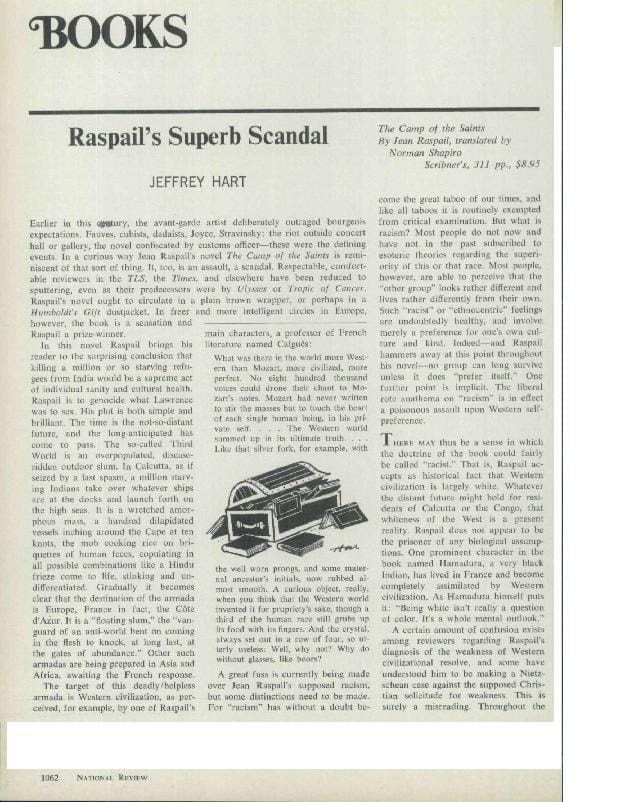
The first year the book sells about 15,000 copies, a disappointment for a house that wanted a bestseller. Then it refuses to die. Scribner publishes Norman Shapiro’s English translation in 1975 and the American reviews are annihilating; Kirkus calls it a major event “in much the same sense that Mein Kampf was a major event.” In National Review, the Dartmouth professor Jeffrey Hart praises it. Here are some excerpts from the September 26, 1975 issue:
In this novel Raspail brings his reader to the surprising conclusion that killing a million or so starving refugees from India would be a supreme act of individual sanity and cultural health. Raspail is to genocide what [D.H. Lawrence] was to sex. His plot is both simple and brilliant. The time is the not-so-distant future, and the long-anticipated has come to pass. The so-called Third World is an overpopulated, disease ridden outdoor slum. In Calcutta, as if seized by a last spasm, a million starving Indians take over whatever ships are at the docks and launch forth on the high seas. It is a wretched amorphous mass, a hundred dilapidated vessels inching around the Cape at ten knots, the mob cooking rice on briquettes of human feces, copulating in all possible combinations like a Hindu frieze come to life, stinking and undlfferentiated. Gradually it becomes clear that the destination of the armada is Europe, France in fact, the Cote d’Azur. It is a “floating slum,” the “vanguard of an anti-world bent on coming in the flesh to knock, at long last, at the gates of abundance.” Other such armadas are being prepared in Asia and Africa, awaiting the French response.
***
But what is racism? Most people do not now and have not in the past subscribed to esoteric theories regarding the superiority of this or that race. Most people, however, are able to perceive that the “other group” looks rather different and lives rather differently from their own. Such ‘racist” or “ethnocentric” feelings are undoubtedly healthy, and involve merely a preference for one’s own culture and kind. Indeed — and Raspail hammers away at this point throughout his novel—no group can long survive unless it does “prefer itself.” One further point is implicit. The liberal rote anathema on “racism” is in effect a poisonous assault upon Western self-preference.
***
That Ganges anti-world slowly approaches by sea, like some viper sliding toward a bemused rodent, but the antiworld has long been at work in the bloodstream of the West. Raspail is a tremendous rhetorician, his disdain boiling from the page in a torrent reminiscent of Celine.
***
Two despised reactionary outposts close their gates to the Ganges horde. Australia tersely notes that the Immigration Act will be enforced. South Africa continues deflant: Q: “Are you suggesting, Mr. President, that you won’t hesitate to open fire on defenseless women and children?” A: “1 expected that question. No, of course we won’t hesitate. We’ll shoot without giving it a second thought. In this highminded raciai war, all the rage these days, nonviolence is the weapon of the masses. Violence is all the attacked minority has to flght back with. Yes, we’ll defend ourselves. And yes, we’ll use violence.” But, in Provence, only a few resist. Beau Geste-like, as the Ganges horde swarms up the beaches and takes over southern France.
In October 1985 Raspail returns to the theme as journalism, fronting a Figaro Magazine cover, with the demographer Gérard-François Dumont, that asks whether France will still be French in thirty years, over an image of Marianne in a veil. The Socialist culture minister Jack Lang calls it racist propaganda. Thirty years later, on September 2, 2015, two days after Angela Merkel opens Germany to the Syrian exodus, Marine Le Pen invites the French to read or reread The Camp of the Saints. Steve Bannon reaches for the title again and again to describe the European migrant crisis. Stephen Miller cites it. The 2011 French reissue, with a new preface Raspail titles Big Other, sells nearly 80,000 copies; Le Monde counts translations in about fifteen languages and total sales in the hundreds of thousands. In 2025 Vauban Books issues a new English translation by Ethan Rundell with an introduction by Nathan Pinkoski, and in April 2026 Amazon briefly pulls the paperback as an offensive product, a day after a New York magazine profile connects the book to Vice President JD Vance; by then the edition has sold about 20,000 copies. A novel written at a window in ten months has outlived its author, its century, and every attempt to bury it.
What the political readers on both sides miss is that the author of the siege novel spends the rest of his life playing an elaborate game about a kingdom that does not exist. In 1981 he publishes Moi, Antoine de Tounens, roi de Patagonie, the story of the Périgord lawyer who had himself proclaimed king of Araucania and Patagonia by Mapuche assemblies in 1860, was judged insane by a Chilean court, and died penniless in a village in the Dordogne. The Académie française gives it the Grand Prix du Roman. Raspail then appoints himself consul general of Patagonia, ultimate representative of the vanished crown. Readers write asking for naturalization and passports. He designs ceremonies. The kingdom acquires a flag of blue, white, and green, and an anthem.
The game has teeth. In 1984, citing the British occupation of the Falklands, which belonged symbolically to the king of Patagonia, Raspail lands on the Minquiers, a British reef south of Jersey whose only structures are a few fishermen’s huts, and runs up the Patagonian flag. For one day the archipelago becomes Northern Patagonia and its main islet Port-Tounens. Paris and London exchange mild embarrassment. In 1998 he sends a commando of six volunteer Patagonian marines from a twelve-meter sailboat to do it again. They strike the Union Jack, hoist the tricolor of the kingdom, and reclassify the island latrine, which the English had advertised as the southernmost building in Britain, as the northernmost building in the kingdom of Patagonia. The Daily Mail runs the story under the headline Invaded. Raspail tells Agence France-Presse that the occupation lasted one night and that no one should confuse his men with Corsican separatists: “We are not the national liberation front of Corsica.” Then, in courtesy, he carries the captured Union Jack to the British embassy on the Faubourg Saint-Honoré while Reuters cameras wait on the sidewalk. The political counselor, Sherard Cowper-Coles, receives him for ten surreal minutes and asks the consul general of Patagonia the only possible question: “And what are you going to do now?”
The Patagonian comedy and the royalist liturgy are the same instinct in two costumes. Raspail wears the fleur-de-lys on his neckties. His apartment holds the literature of the Vendée wars. In Le Jeu du roi (1976), Sire (1990), and Le Roi au-delà de la mer (2000), the French crown persists as a hidden, sacramental fact beneath the republic, and Sire, which imagines the secret coronation of a young Bourbon at Reims in 1999, wins the Grand Prix du roman de la Ville de Paris. He is not a program monarchist counting parliamentary votes. He is a monarchist the way other men are liturgists: the king binds the living to the dead, and a country that kills its king has cut its own memory at the root.
That conviction produces his largest public scene. In 1990 an association forms to mark the bicentenary of the death of Louis XVI, and Raspail comes to head the national committee for the commemoration. The committee is deliberately mixed: the actor Jacques Dufilho, the general Alain de Boissieu, who is de Gaulle’s son-in-law, the Jewish academician Maurice Rheims. The mayor’s office says no. The archbishop of Paris, Cardinal Lustiger, refuses a mass at Notre-Dame. The prefect of police bans the gathering, fearing disorder. On the morning of January 21, 1993, two hundred years to the day after the guillotine fell, Raspail goes on RTL radio, announces that he maintains the commemoration, and invites the population. President François Mitterrand, a Socialist with a long memory and a taste for irony, intervenes to let it proceed. Tens of thousands fill the Place de la Concorde, the old Place de la Révolution, around the spot where the scaffold stood. The actor Jean-Pierre Darras reads the king’s testament against the noise of traffic. Church bells sound for the occasion as far away as Brussels and Warsaw, and dozens of memorial masses are said across France. The American ambassador, Walter Curley, a man fond of history whom the baroness Élie de Rothschild has recruited to protect the event, lays a wreath at the site of the guillotine inscribed: “To King Louis XVI, the grateful United States.” Raspail confides afterward that he wondered whether Mitterrand might appear, and suspected the president wanted to. It is the purest Raspail production of his life: liturgy over platform, silence over slogan, a defeated cause honored in the geographic center of the republic that defeated it, with the republic’s own president holding the door.
His relation to the Church that anchors all this is wounded and stubborn. He spends decades away from the sacraments, estranged by the liturgical reforms. He tells the story of returning at last to confession and preparing to take Easter communion, only to find laymen distributing the host while the priest stands idle at the top of the steps. He walks to the priest and asks for communion from him, receives it, and never sets foot in a church again. Faith is not complicated, he says in the same interview. Form is everything to him, and the Church, in his eyes, has surrendered its form as carelessly as the state.
The establishment never quite excommunicates him. The Académie française honors him three times: the Prix Jean Walter in 1970 for his body of work, the Grand Prix du Roman in 1981, the Grand Prix de Littérature in 2003 for the entire oeuvre. The Prix Maison de la Presse comes in 1996 for L’Anneau du pêcheur, his novel of the Avignon papacy’s ghost line of pontiffs, and the Prix Combourg-Chateaubriand in 2008. Robert Laffont gathers six volumes of his fiction into its prestigious Bouquins collection in 2015, with a preface by Sylvain Tesson arguing that Raspail’s style consists not in stringing fine sentences but in building a private universe and deploying it, book after book, to the point of obsession. Tesson has it right. The universe has fixed furniture: a ship or canoe as the model polity, small, ranked, loyal, surrounded by an expanse that does not care; the hussar, the gallant doomed rider of Les Hussards, who fights because the gesture is beautiful and not because victory is possible; the last man of a line; the frontier at dusk; the flag over the rock. Seven horsemen leave a dying city by the western gate that no one guards any longer, in the 1993 novel whose title says exactly that, and ride out to see what remains.
He dies in Paris on June 13, 2020, at the Henri-Dunant hospital, at ninety-four. The obituaries divide on schedule. The Société des Explorateurs salutes the canoeist of 1949. The right mourns a prophet. The left buries a racist. His admirers fly the Patagonian flag at half mast, which is the tribute he would have chosen, grief conducted through the protocol of an imaginary state.
The same imagination that grieves for the Kawésqar wrote a novel in which the wretched of the earth arrive as a faceless devouring mass. The same man who stages a comic invasion of a British reef and returns the flag with a bow wrote the book that hands the twenty-first-century far right its master metaphor for immigration. His gift was to convert political feeling into weather, distance, ceremony, and objects: a crown, a canoe, a latrine renamed for a kingdom, a wreath from a republic to a beheaded king. That gift made made exclusion beautiful.
Notes
The Boulouris villa, its architecture, the library window, and the ten months of unplanned writing come from Washington Examiner. The same source also covers the Amazon withdrawal of April 2026, the roughly 20,000 Vauban sales, the New York magazine/Vance trigger, the 1940 bicycle ride home, and the Calguès house dated 1673. The “What if they came?” account also appears in The Spectator, which additionally covers the 1985 Figaro Magazine cover with Dumont, Jack Lang’s “racist propaganda” response, and the Le Pen tweet of September 2, 2015.
Canoe expedition details, including the companions’ names, the scouting-journal notice, 165-kilo portages, the Griffon find on August 4, the won canoe race, 4,565 km, and the arrival on December 10, 1949, come from ScoutWiki on Équipe Marquette. Raspail‘s own retrospective account, the vow not to write after his failed first novel, and Andrieu’s 1954 book come from La Nouvelle Revue d’Histoire. The Bill dialogue and the Sevin scouting background come from Chronicles.
Tierra del Fuego to Alaska dates, September 25, 1951 to May 8, 1952, family background, including Octave Raspail, Grands Moulins de Corbeil, and Saar mines, and the 1996 Maison de la Presse date for L’Anneau du pêcheur come from Mémoires de Guerre. Note: your source document says Prix Maison de la Presse 1995. French listings give 1996, so I used 1996. Flip it back if you have a better source.
The Concorde scene, including the prefect ban, RTL announcement, Mitterrand and the Rothschild intervention, Curley’s wreath and its inscription, and the crowd figure, comes from Politique Magazine. Committee composition, including Dufilho, Boissieu, and Rheims, the Lustiger refusal, Darras reading the testament over traffic, and bells in Brussels and Warsaw come from Vexilla Galliae. Politique Magazine gives the crowd as more than 60,000. I wrote “tens of thousands” since the figure comes from a sympathetic outlet.
The Minquiers material, including the 1984 landing, Falklands rationale, and Port-Tounens renaming, comes from Zabra. The same source also covers the 1998 six-man commando, the latrine reclassification, the Daily Mail headline, and the Cowper-Coles meeting. The AFP quotes, including the Corsica line, come from L’Orient-Le Jour.
Kirkus Reviews‘s Mein Kampf line, Hart’s National Review take, the 1975 Scribner edition, Alduy’s assessment, and Bannon‘s repeated invocations come from HuffPost. The Revelation title and 2011 preface details come from Marzaat.
The communion anecdote from the Monde et Vie interview of April 30, 2015, the fleur-de-lys ties, the Vendée books in his apartment, the flag at half mast, and death at Henri-Dunant come from Le Salon Beige and PSB en Lyonnais. The Tesson preface and Bouquins edition come from Francis Richard.
Reasonable extrapolations without a link: the general texture of the 1940 exodus roads, the character of a borrowed Riviera villa, and the reading of the half-mast Patagonian flag as protocol-as-tribute, which is interpretation, not fact.
The Full Road and the Empty Village: The Hero System of Jean Raspail
Two pictures sit under everything Jean Raspail wrote, and each one holds a terror.
The first picture is a road in May 1940. A boy of fourteen pedals a bicycle 350 miles from boarding school toward home while France comes apart around him. The road carries mattresses, sewing machines, grandmothers in car trunks, soldiers walking the wrong way. Nobody commands. Nobody stands. The boy learns that a nation is not a fact of nature. It is a performance that can stop mid-sentence, and when it stops, what remains is not people but crowd, a mass without form, moving because the mass next to it moves. The terror of the full road is the terror of dissolution: that the self, which borrowed all its size from a shared order, shrinks to a body on a bicycle when the order quits.
The second picture is a shoreline on Lake Huron in the summer of 1949. Four young Frenchmen beach their canoes at an Algonquin village and find it abandoned. The frames of the houses stand. The people are gone. Somewhere beyond the treeline, trucks run on a highway and a dam goes up, and no one in that traffic knows or cares that a human world fell silent here, with its songs, its jokes, its names for the winds. The terror of the empty village is the terror of death without transmission: that a man can die twice, once in the body and once in the memory of his kind, and that the second death is the true one because it erases the first.
Ernest Becker (1924-1974) argued that culture exists to manage the knowledge of death. A hero system is the shared drama that lets a man feel he counts in a cosmic accounting, that his life adds a stone to something that outlasts him. Men do not fight over goods first. They fight over whose drama is real, because if the other drama is real, my stone goes into a wall that will not stand, and I die the second death. Raspail built his life between the full road and the empty village, and the hero system he assembled answers both terrors at once. Its creed runs like this: reality consists of particular peoples, each a vessel of the dead; the highest human act is fidelity to a form of life across the break of death; the hero is the one who keeps the form after the power is gone. The canoe, the crown, the flag over the rock, the mass for a beheaded king. Each is the same act. Each says to the dead: you are still here, I am still yours, the chain holds.
Every hero system sells itself as subtraction, as what remains when you strip away illusion. Raspail’s is no exception, and his subtraction story is compact enough to fit in four words. In the summer of 1971, in a borrowed villa above the Mediterranean, he looks at the water and asks: what if they came? He tells the story for fifty years as an account of pure sight. No politics, he says. The immigration problem did not exist yet. He merely looked south and saw arithmetic, the numbers of the poor world and the emptiness of the rich one, sentiment deducted, reality remaining. The 1985 Figaro Magazine cover asking whether France will remain French carries the same claim: this is demography, not doctrine, counting, not choosing.
Put other men at that window. A shipping executive from Rotterdam looks at the same sea and sees lanes, tonnage, insurance rates, a surface that exists to move goods. A marine biologist from La Jolla sees a warming basin and a collapsing bluefin stock, and the arriving poor do not appear in her field of vision at all. A Pentecostal pastor from Lagos sees the water Peter walked on and a harvest of souls on both shores; if they came, he thinks, God is moving them, and the question is whether Europe still has a gospel to give them. A retired smuggler in Tangier sees a price list. The sea sends each man the fear his hero system trained him to receive. Raspail looked at open water and saw a siege because his drama had a wall in it, and a wall implies a breach, and a breach implies the road of 1940. What if they came is not what a man sees when bias falls away. It is what this man sees because his terror looks south. The genius of the question is its costume: a nightmare dressed as a datum.
Take the sacred words one at a time, because the words are where hero systems hide their work.
Memory. In Raspail’s system, memory is a duty owed to the dead, and its unit is the people. A Mormon genealogist in Salt Lake City shares the intensity but not the object: she works the microfilm to seal individual ancestors into an eternal family, one name at a time, and the nation is a filing convenience. A prosecutor in Kigali holds memory as indictment; forgetting is what the killers’ friends recommend, and the archive is a weapon that keeps the machetes in view. A Zen abbot in Kyoto handles memory as a current to step out of; the ancestors receive their incense and their sutras, and then the abbot returns to the breath, because clinging to what has passed is the engine of suffering. A startup founder in Austin treats memory as sunk cost, and his heroism runs the other way: the founder who counts is the one who can burn the org chart he loved. Say the word memory to these five and each hears his own immortality project. Raspail’s version, memory as the corporate survival of a people through its forms, is one option among several, and it feels like the only option to him because his terror is the empty village, not the unquiet grave, not the impounded evidence, not the clinging mind, not the missed pivot.
Fidelity. For Raspail, fidelity is loyalty to a losing cause held past the point of sense, and its emblem is the hussar who rides because the gesture has beauty. A union electrician in Youngstown holds fidelity to a contract and a local, and when the plant leaves, his fidelity looks for a new object and finds politics. A Mapuche schoolteacher in Temuco holds fidelity to a language with a few hundred thousand speakers, and here the systems brush against each other and recoil, because Raspail wrote the Mapuche world with tenderness while his kingdom of Patagonia wears their history as a costume; her fidelity includes a file of grievances against romantic Frenchmen. A Marine drill instructor at Parris Island holds fidelity as a transmission problem, how to install loyalty in eight weeks in boys who arrived loyal to nothing but a phone. Each of them might die for fidelity. None of them means the same thing by it. The word is a container, and each hero system fills it before the sentence is out.
The border. In Raspail’s drama, the border is a sacrament, the line that makes a people possible, and defending it is priestly work even when the defense fails. A Vietnamese pharmacist in Garden Grove, who crossed the South China Sea in 1979 in a boat smaller than Raspail’s canoes, knows borders as the thing that nearly killed her twice, once keeping her in and once keeping her out; her heroism is the crossing. A Médecins Sans Frontières logistician from Lyon carries the border in his organization’s name as the obstacle his heroism exists to override; for him, the line on the map is where responsibility gets amputated, and the hero is the one who carries the plasma across anyway. A Jersey fisherman working the waters off the Minquiers holds the border as a livelihood measured in crab pots and court rulings from The Hague. When Raspail lands on those rocks in 1984 and runs up the blue, white, and green, the fisherman and the novelist look at the same reef and see a boundary, and one sees a joke about sovereignty while the other sees the week’s catch. The same line, four dramas, four different gods.
Form. Here Raspail’s system shows its center. Ceremony, hierarchy, liturgy, the crown, the flag, the protocol of an imaginary consulate: form is how the dead stay present, the score through which they keep playing. The drill instructor agrees that form transmits, though his forms are seventy years old and he would laugh at a thousand. A Burning Man builder in Reno reverses the sign; for him the heroic act is to invent the ceremony, burn it, and invent another, because inherited form is the dead hand and the self is the only legitimate author. A Hasidic scribe in Brooklyn sits closer to Raspail than anyone in this essay, letter by letter, a man for whom one malformed character voids the scroll, and yet his forms guard a covenant with God, not a nation, and he might tell the Frenchman that a crown without Sinai is theater. Raspail half accepts the charge. That is what the Patagonian consulate is: theater performed with a straight face, the sacrament of form practiced in a kingdom with no territory, no subjects, and one latrine reclassified as its northernmost building. He returns the captured Union Jack to the British embassy in person, and the counselor who receives him asks what he will do now, and there is no answer because the point was never the next move. The point was that the gesture be made in full dress.
Walk these values through the systems arrayed against his, and the war over words comes into focus, because his rivals are not one thing. The republican schoolteacher in Clermont-Ferrand loves France as much as Raspail does and means the opposite by it. Her France begins in 1789, the year his ends. Her hero system runs on emancipation: the peasant’s son becomes a citizen, the citizen sheds inherited station, the school is the sacrament, and the guillotine on the Concorde, whatever its excesses, cut the chain Raspail spent a lifetime trying to re-forge. When Raspail fills that square in January 1993 with tens of thousands mourning the king, he desecrates her holy site on its holiest day, and she experiences the wreath the way he experiences a folk mass. Both call it France. There is no neutral referee, because the referee would need a hero system to stand in.
The humanitarian runs a second rival drama, and it deserves the respect Raspail rarely gave it. The MSF logistician does not lack a tragic sense. He has held dying strangers. His system says: the categories that sort men into peoples are the oldest killing technology on earth, and the hero is the one who acts as if the category were not there. His immortality project is real; he wants his stone in the wall of a species that learned to see past the tribe. Raspail’s novel treats this man as a fool or a traitor, a bishop of self-hatred. The treatment is the novel’s failure of nerve, because a fool does not carry plasma into a cholera camp. The honest version of Raspail’s argument admits the humanitarian is a hero of a rival faith and then says: your faith saves persons and loses peoples, and a saved person stripped of his people is a survivor of the second death you refuse to see. The humanitarian answers: your faith saves forms and feeds persons to them. Each accuses the other of managing death badly. That is what the immigration argument is underneath, two funeral rites contesting one corpse-fear.
And then there is the rival he could not afford to name, the one inside the book. Look at the armada with Raspail’s own eyes, the eyes of 1949. A million people commit themselves to the sea in unseaworthy vessels, a small people in each hull, moving on faith toward a promised shore, holding together through storm and hunger, their children learning the water. That is the Équipe Marquette at scale. That is the Kawésqar in their canoes. That is the hussar’s wager, the body staked on a gesture the odds despise. By every rule of Raspail’s hero system, the man in the leaky boat is the hero of the age and the Frenchman watching from the villa with a drink is the decadence. He seems to have sensed the trap, because the novel takes the one exit available: it removes the faces. The migrants arrive as mass, as smell, as flesh without biography, because one biography, one father teaching one son to bail seawater, might flip the drama’s polarity and enroll the reader on the wrong side. The full road of 1940 gets pasted over the small boats to keep the boy on the bicycle from recognizing the boy in the hull.
How much of this did he see? More than his enemies allow and less than his admirers claim. The Patagonian game shows a man who knew hero systems are made things; you do not appoint yourself consul general of a fiction, issue communiques about a captured latrine, and hand a flag back through an embassy door without understanding that sovereignty is theater sustained by belief. In L’Île bleue (Blue Island) he lets a woman size up his stand-in, the celebrant of noble causes and lost gestures, and dismiss him in three words: “You amuse me.” He printed the line. He knew. And yet the prefaces to Le Camp des saints claim the other status, the prophet’s, the man who does not perform a drama but reports the future, and prophecy is the one costume his self-awareness never removed. He could laugh at the crown. He could not laugh at the siege. The terror of the full road sat deeper than the game, and where that terror spoke, the novelist who knew everything about the manufacture of meaning mistook his fear for sight, the oldest occupational disease of the trade.
The hero is the last man of the line who keeps the form after the power is gone, the consul of a kingdom without territory, the rider whose cause has already lost and who rides anyway, because the gesture completed in full dress is his stone in the wall and his answer to both the crowded road and the silent village. The unnamed rival: the man in the small boat, the migrant who lives Raspail’s creed of courage, fate, and the sea more nakedly than any Frenchman in the book, and who had to arrive faceless because a face might have made him the protagonist. And the cost the ledger cannot price: to keep his dead alive he unpersoned the living, and the accounting came due in his own coin, memory. The writer of the empty village is now a village occupied by strangers, his name flying as a flag over movements he never joined, his fifty years of tenderness for dying peoples compressed by posterity into the one book where the tenderness failed. He taught that a man dies twice and that the second death is the erasure of what he was. His first death came in June 2020. The second is running now, in every citation that keeps the siege and discards the canoe.
The Porous Consul: Jean Raspail Through Charles Taylor
An old man walks into a French church at Easter after decades away. He has confessed. He intends to receive communion for the first time since the years when the mass was in Latin and the priest faced the altar. He waits in line and sees that laymen distribute the hosts while the priest stands idle at the top of the steps. The old man leaves the line, climbs the steps, and asks the priest for the host. The priest gives it to him. The old man never enters a church again. Faith, he says later, is not complicated.
Jean Raspail told this story, and most readers file it under temperament: a rigid reactionary, a snob of the sanctuary, a man who quit God over furniture. The philosopher Charles Taylor (b. 1931) supplies a better reading. In A Secular Age (2007), Taylor distinguishes the porous self from the buffered self. The porous self, standard equipment for most of human history, stands open to a charged world. Power resides in things: relics heal, hosts consecrate, curses land, boundaries hold or fail, and the line between mind and world leaks in both directions. The buffered self, the modern achievement, draws a boundary at the skin. Meaning lives inside the head. Objects go inert. The world becomes a neutral field the mind interprets, and nothing out there can get in without permission. Taylor’s account of secularization turns on this migration from one self to the other, and he insists the change reaches deeper than belief. It changes what kind of event an event can be.
Read the communion scene with Taylor’s distinction and it stops looking like snobbery. For a porous self, the host carries power the way a wire carries current, and the question of whose hand delivers it is a question about the circuit. A consecrated hand and a lay hand differ the way a live wire differs from a dead one. For the buffered self, the host symbolizes, and a symbol works the same from any hand; the reforms after the Second Vatican Council presumed a congregation of buffered selves for whom participation and intelligibility outrank charge. Raspail stood in that line as a porous man in a buffered liturgy. What the parish experienced as welcome, he experienced as a power outage. He did not quit God. He concluded that the building had gone dead, and a porous self does not pray to a dead building.
Taylor gives this process a name: excarnation, the long transfer of religious life out of the body, out of gesture, incense, procession, and charged matter, into the head, into belief, sincerity, and assent. Taylor traces it through centuries of Reform, the recurring drive to purify religion of its enchanted deposits, and he notes the irony that the purifiers meant to intensify faith and instead thinned the world. Raspail’s estrangement from the Church of his own creed follows the pattern. The Church he needed held the world charged. The Church he found had joined the buffer.
His whole career reads as the conduct of a porous self stranded in a buffered age, and the stranding shows most in his relation to objects. A buffered man owns a flag; it stands for things, and he can measure his attachment. Raspail treats flags as operative. In 1984 he lands on the Minquiers, a granite reef south of Jersey that the buffered world has fully processed: the International Court of Justice assigned it to Britain in 1953, fishing rights run by treaty, the only structures are huts and a latrine. Sovereignty here means files. Raspail raises the blue, white, and green of the kingdom of Patagonia, renames the reef for a day, and in 1998 sends six volunteers by sailboat to do it again, after which he returns the captured Union Jack to the British embassy in person. The comedy lands because everyone involved, including Raspail, lives downstream of disenchantment; a medieval man who seized an island and renamed it would not be joking. But the act only tempts him because part of him holds the older physics, in which naming and flagging change what a place is. He plays at enchantment the way an exile plays the anthem. Taylor calls this condition cross-pressure, the state of those who live inside the immanent frame, the modern order closed to transcendence, and feel the pull of what the frame excludes. The consul general of Patagonia is a cross-pressured man in full dress.
The monarchy carries the same analysis deeper. Taylor distinguishes secular time, the homogeneous sequence in which one hour equals another and events line up like beads, from higher times, in which certain moments bind to each other across the sequence. In higher time, Good Friday 1993 stands closer to the Crucifixion than to March 1993. Kingship belonged to higher time. The anointed king linked the living kingdom to its dead and its founding, and his body carried that linkage as the host carries consecration. Taylor argues that the modern social imaginary replaced this vertical order with the horizontal one of the modern moral order: society as a contract of mutual benefit among equals in secular time, founded on nothing older than agreement. On this reading, January 21, 1793, was more than a political killing. It was a public demonstration of the new time. The Republic guillotined a node of higher time in the middle of Paris and renamed the square.
Now watch what Raspail does on January 21, 1993. He leads a committee that gathers tens of thousands on the Place de la Concorde on the bicentenary, over a prefect’s ban lifted by François Mitterrand. An actor reads the king’s testament at the site of the scaffold. The American ambassador lays a wreath. Bells sound in churches across France and beyond. The event makes no demand and proposes no candidate. It is not politics conducted by other means; it is liturgy conducted on hostile ground, an attempt to reopen higher time at the point where France closed it, to make 1793 present rather than past. One detail carries the metaphysics. Witnesses recall that traffic noise fought the actor’s voice through the reading. Secular time does not stop for higher time; the circulation of a Tuesday continues around the commemoration and through it. The two centuries collapse for the crowd in the square while the buffered city drives past.
The frame explains features of Le Camp des saints that the standard fight over the novel never touches. Consider the calendar. The armada from the Ganges arrives on the coast of France on Easter Sunday. The last resisters die by government bombing on the Thursday after Easter. The title comes from the twentieth chapter of Revelation, the nations compassing the camp of the saints and the beloved city before fire falls. A novelist writing inside secular time might set a migration crisis in any month; this novelist runs it on the church calendar and names it from the Apocalypse. The book presents the arrival as an event in higher time, a judgment, a last thing. Whatever else the novel is, it is a porous reading of history.
Its opponents read the same subject inside the immanent frame, where migration arrives as flows, push factors, labor markets, asylum law, integration outcomes, an administrative object like the Minquiers. Taylor’s vocabulary exposes why the two sides talk past each other after fifty years. They disagree about numbers and race, and beneath that they disagree about what kind of event an arrival can be. One side sees a process to manage. The other sees a sign to read. Inside the immanent frame, treating a boat of poor families as an apocalyptic portent is a category error verging on derangement; from the porous side, treating it as a logistics problem is blindness verging on damnation. The immigration fight obscures this stratum because both camps prefer arguments they can win. It is easier to fight about racism and arithmetic than to fight about whether the world is charged.
Taylor also explains the novel’s despair, which puzzled Raspail’s Catholic readers, who complained that his fiction offers no hope. A porous world includes rescue; signs can be answered, judgment can relent, higher time can break in. Raspail writes the sign without the rescue. His France reads nothing, consecrates nothing, and cannot even recognize the event as an event; the bishops in the novel lead the surrender. This is what a porous imagination produces when it concludes that the buffer has won: apocalypse without revelation, Revelation’s geometry with the heaven removed. Taylor describes readings of the immanent frame as taking a spin, closed or open, and Raspail’s fiction spins the frame closed while aching for it to open. His Patagonia, his hidden kings, his last tribes in the southern channels, all his gentler books manufacture small enclosures of charged world inside the dead one, private chapels built by a man who walked out of the public church.
Taylor writes as a Catholic philosopher who rejects nostalgia; A Secular Age argues at length against what he calls subtraction stories, the tales in which modernity merely strips illusion and truth remains, and he shows the buffered self and the modern moral order to be constructions, achievements with costs. But Taylor also refuses the mirror story, the decline narrative in which an enchanted golden age suffers demolition by fools. He holds that no road runs back, that the age of authenticity contains its own openings to fullness, and that cross-pressure is the shared human condition now, not the private wound of reactionaries. Raspail tells the decline narrative straight. Taylor might say he mistook one exit being closed for every exit being closed. And the frame explains the wound without explaining the venom. Porosity accounts for the church calendar in Le Camp des saints, the sign-reading, the despair. It does not account for rendering the arriving poor as a faceless and repulsive mass; porous Christian imaginations across the centuries read strangers as angels, tests, and Christ in disguise at least as often as they read them as plagues. The novel’s cruelty was a choice among porous options, and Taylor assigns no philosopher’s cover for it.
Still, the reading changes the object. Take Taylor seriously and Raspail stops being a puzzle, the tender chronicler of the Kawésqar who wrote the century’s harshest immigration novel, the monarchist without a candidate, the Catholic who fled the mass, the grown man issuing communiques for an imaginary crown. One condition underlies the set. He held the older self in the newer world. Everything he loved ran on charge, kings, hosts, flags, borders, tribes, names, and he outlived the physics that made them run. The buffered age offered him its consolations, irony, interiority, private meaning, and he took only the irony, and only as camouflage. The rest of his life went into building objects the current might still reach: a kingdom with a flag and no ground, a square turned chapel for one morning over the noise of traffic, a novel that reads the evening news as the twentieth chapter of Revelation. Taylor gives the condition its name and its history. The name is porosity. The history is that France stopped issuing it, and one of its last native speakers spent seventy years writing home.
If Mearsheimer Is Right: Jean Raspail and The Great Delusion
John J. Mearsheimer (b. 1947) opens The Great Delusion: Liberal Dreams and International Realities (2018) with an anthropology. Humans are social from birth to death. A man is born into a group that installs his identity before his critical faculties come online, and by the time he can reason, his family and society have already imposed what Mearsheimer calls an enormous value infusion. Reason ranks last among the sources of our preferences, behind socialization and innate sentiment. The group comes first because the group is how a man survives, and men develop attachments to their groups deep enough to die for. Liberalism, on this account, builds its politics on a false picture, the atomistic individual carrying inalienable rights, and the universalism of those rights sends liberal states out to remake the world, where their crusade breaks against the two forces that fit the true anthropology: nationalism and balance-of-power politics. Nationalism, for Mearsheimer, is the most powerful political ideology on earth. When liberalism and nationalism collide, nationalism wins.
Set Jean Raspail next to this and the first result is vindication. Here is a novelist who spent seventy years writing Mearsheimer’s anthropology as narrative. Raspail’s fiction knows no atomistic individuals. Every man in his work arrives embedded: in a tribe, a crew, a regiment, a dynasty, a remnant. His travel books study peoples as the real units of the human world, the Kawésqar of the southern channels, the Ainu of Hokkaido, the Mapuche of Araucania, each with its songs and its dead, each intelligible only as a group. His politics follow the same picture. France, for Raspail, is a particular people with a particular inheritance, and the elite project of treating it as an address for rights-bearing individuals from anywhere strikes him as a lie about what human beings are. Mearsheimer writes the theory of that objection. Raspail wrote its literature.
The convergence runs deeper on the question of moral knowledge. Mearsheimer argues that no universal agreement on first principles exists or can exist, because moral codes come from socialization and sentiment, which differ by group. Thick morality is local. What travels is thin and weak. Raspail’s fiction assumes this on every page. His peoples are morally opaque to each other and owe each other little beyond curiosity and respect at a distance. His tenderness toward the Kawésqar never asks them to hold French values, and his rage at the humanitarians of Le Camp des saints is rage at men who believe their morality is everyone’s, who read a fleet from the Ganges as fellow citizens of a world community that does not exist. Mearsheimer’s central charge against liberal hegemony, that it mistakes a local creed for a universal one and wrecks countries acting on the mistake, is Raspail’s charge against the bishops and editors of his novel, pointed inward instead of outward. Mearsheimer watches universalism board planes for Baghdad. Raspail watches it walk down to the beach and open its arms. Same creed, same error, opposite direction of travel.
The novel even supplies a case study in Mearsheimer’s ranking of reason, socialization, and sentiment. Nothing in Le Camp des saints gets argued. No character reasons his way to the surrender of France. The politicians, priests, and broadcasters of the novel repeat what their class installed in them, and they compete in fidelity to the installation while the country dissolves. Raspail understood value infusion before Mearsheimer named it. His France falls to a socialization cascade among elites, a generation whose formation ran ahead of its judgment, which is what Mearsheimer says formation always does.
So far, so aligned. If Mearsheimer is right, Raspail diagnosed the disease correctly and forty-five years early: a Western elite socialized into a universalist creed that misdescribes the species. But run the frame to the end and it turns on him, in three places.
First, survival. Mearsheimer’s anthropology is functional. The group exists because it keeps bodies alive; survival sits at the top of the hierarchy of goals, for states and for the peoples inside them. Raspail’s hierarchy differs. His fiction reserves its love for groups that choose form over survival, the hussar who rides at the machine guns because the gesture has beauty, the last king who keeps the ceremony after the power has gone, the doomed garrison in Sept cavaliers riding out of a city that no longer guards its own gates. Offer Mearsheimer’s man a choice between survival with a diluted identity and extinction in full dress, and he takes survival, because the group was always a vehicle. Offer Raspail’s man the same choice and he reaches for his dress uniform. This is not a small difference of temperament. It is a different theory of what the group is for. Mearsheimer’s nation is an insurance pool with flags. Raspail’s people is a trust held for the dead, and a trust can be worth dying for even when the insurance math says fold. The realist can explain sacrifice for the group as an evolved disposition that usually serves survival. He cannot explain a man who prefers the group’s beautiful death to its compromised life, and Raspail wrote almost nothing else.
Second, and harder for Raspail: if Mearsheimer is right, the catastrophe of Le Camp des saints cannot happen. The novel requires liberal universalism to defeat nationalism at the moment of collision, on the beach, with everything at stake. Mearsheimer’s entire book argues the collision goes the other way. Nationalism is the most powerful ideology in the world; liberal hegemony is a crusading phase that breaks against it abroad and retreats before it at home; the deepest layer of the value infusion is tribal, laid down over millennia, and the universalist layer is recent paint. A Mearsheimerian reading of the novel finds its premise upside down. The million on the boats are not the unstoppable force, and the sentiment of the French crowd is not the movable object. Push a nation hard enough and the paint comes off. On this view Raspail mistook the noise of his era’s elite discourse for the settled will of a people, confused the seminar room with the species, and wrote an apocalypse out of a fashion. The realist verdict on the prophet is that he panicked, that he took liberalism’s self-description at face value in the one place a realist never should, its claim to have transcended the tribe. Raspail believed the humanitarians when they said they had no in-group. Mearsheimer would have told him to watch what they defend when their own street changes.
Third, the frame indicts the novel’s method by the novel’s own logic. Mearsheimer’s anthropology is symmetrical. Everyone belongs to a thick group; everyone carries a value infusion; the Indian farmer boarding a rusting freighter is as social, as tribal, as embedded as the Provençal professor watching him through a telescope. A fiction faithful to this anthropology might have written the armada as what it would be, an assembly of peoples, castes, villages, and families, each with leaders, feuds, codes, and dead of their own, held together by desperation and negotiation. Raspail wrote it as an anti-world, a single organism of flesh without groups, which is to say he denied the migrants the one property his own worldview treats as universally human, membership. The novel grants thick social existence to the French and withholds it from everyone on the water. Within liberalism this is called dehumanization. Within Mearsheimer’s frame it is something more precise: bad anthropology, a betrayal of the social theory of human nature at the exact point where applying it might have complicated the alarm. The realist does not need the migrants to be a faceless tide. A realist can say plainly that two peoples can each be fully human, each acting on group interest, and still be in conflict, that tragedy requires no monsters. Raspail reached for monsters anyway, which suggests the book ran on something other than his anthropology.
What then survives of Raspail, if Mearsheimer is right? Three things, and they are not small. The travel writer survives whole: the man who spent the 1950s documenting peoples as peoples, who grasped that the destruction of a small nation is a distinct crime with a distinct victim, holds up better under a social theory of human nature than under the individualist alternative, where the death of the Kawésqar dissolves into the biographies of its last members. The critic of universalism survives: his portrait of an elite class socialized into a creed it mistakes for conscience, and unable to hear any objection except as sin, describes the same formation Mearsheimer describes in the foreign-policy establishment, and Raspail drew it first. And the entertainer of lost causes survives as data. Mearsheimer’s theory needs men who love their groups beyond reason, since attachment past the point of calculation is what makes nationalism the force that stops armies. The hussar is that attachment in costume. A species that produces Raspails will never be governed by the thin creed, which is Mearsheimer’s point.
What does not survive is the despair, and the despair was the engine. Raspail built his life on the conviction that his people was dying and that fidelity had become a rearguard action conducted among ruins. Mearsheimer’s frame reads that conviction as a category error with a short shelf life. Nations are not fragile blossoms tended by novelists. They are the hardest political material in the modern world, harder than empires, harder than creeds, and the universalism that terrified Raspail was, on the realist account, a passing project of a protected class, already breaking against the tribal floor of the species by the time he died. If Mearsheimer is right, the old man at the window asked the correct question and drew the wrong lesson. They might come. The paint might peel. And France, that survivor of Roman collapse, Viking fire, religious civil war, revolution, and two German occupations, might once again prove the least killable thing in the story, no hussars required. The realist offers Raspail the one consolation he could not accept: that the thing he loved never needed him to die for it.
The Set
Start with the crowd on the Place de la Concorde, January 21, 1993, because the set assembled there in one frame. Retired officers in loden coats. Provincial families up on the early train, the boys in short trousers in winter because that is how the boys of these families dress. Old ladies from the seventh arrondissement and Versailles with missals. The actor Jacques Dufilho (1914-2005), the general Alain de Boissieu (1914-2006), who married de Gaulle‘s daughter, the art auctioneer and academician Maurice Rheims (1910-2003), a Jewish member of the committee whose presence the others cite as proof of their good faith. The television man Thierry Ardisson (1949-2025) in the crowd telling reporters that the guillotine cut the neck of France. The politician Bruno Mégret (b. 1949) attending, tolerated, not embraced, because the set votes right and holds party men at arm’s length. The actor Jean-Pierre Darras (1927-1999) reading the king’s testament against the traffic. And at the head of it a novelist in a fleur-de-lys necktie who spent the morning on RTL defying the prefect of police.
That is the visible set. Around Raspail it had four overlapping circles, and a man’s standing rose with the number of circles he could claim.
The first circle is literary: the Hussards and their descendants. Roger Nimier (1925-1962), Antoine Blondin (1922-1991), Michel Déon (1919-2016), Jacques Laurent (1919-2000), the right-bank novelists of the 1950s who answered Sartre’s committed literature with speed, insolence, and grief worn as elegance. French critics file Raspail in their family, with the Italian Dino Buzzati (1906-1972) as elective kin, and his teacher Marcel Jouhandeau as an ancestor. The second circle is the explorers: the Société des Explorateurs Français, the Connaissance du Monde lecture circuit where Raspail spoke at the Salle Pleyel with his slide carousels, the Société de Géographie with its medals. Sylvain Tesson (b. 1972) came out of this circle and wrote the preface when Robert Laffont gathered Raspail’s novels into the Bouquins collection. The third circle is Catholic and royalist: the traditionalist parishes, the Chiré bookselling network and Via Romana reissues, the Vendée memory culture that Philippe de Villiers (b. 1949) built into a theme park, the priests of the old rite such as the abbé Guillaume de Tanoüarn (b. 1962), to whom Raspail gave his late confessional interviews, the readership of Monde et Vie and Présent. The fourth circle is the press right: Louis Pauwels (1920-1997) at Le Figaro Magazine, which ran the 1985 cover on whether France would stay French, the demographer Gérard-François Dumont (b. 1948) who supplied the numbers, later Valeurs actuelles, and, after death, the claimants: Éric Zemmour (b. 1958), Marine Le Pen (b. 1968), and across the water Steve Bannon (b. 1953), Stephen Miller (b. 1985), and the Vauban Books operation of Ethan Rundell and Nathan Pinkoski. The set proper regards the American adopters the way a family regards rich cousins who mispronounce the name.
What they value. Fidelity above all: loyalty held after the cause has lost, because loyalty before defeat might be self-interest and only defeat purifies it. Form: bearing, dress, ceremony, the mass in Latin, the letter written by hand, the correct use of the subjunctive. Courage as style rather than as function, the beau geste, the charge that achieves nothing except its own beauty. Memory as a duty owed downward to the dead rather than a resource for the living. Distance: the far place, the hard route, the cold coast, valued because comfort corrupts and the margins still hold intensity. Gratuitousness: the act done for nothing, the Patagonian consulate, the flag on the reef, prized against a world where every act needs a deliverable. And the people, meaning the particular inherited community, French or Kawésqar or Mapuche, as the vessel that makes a life larger than a lifespan.
Their hero system runs on a single figure with costume changes: the last officer of a vanished army. The hussar, the exiled king, the final speaker of a language, the consul of a kingdom without ground, the priest who keeps the old rite in a rented chapel. Heroism in this system consists of keeping the form after the power has gone, and its test is manner under defeat. Victory adds nothing; the system barely has a category for winners, and when its men win something, a prize, a crowd of sixty thousand, a court ruling, they receive it with irony to show the win was incidental. The ladder of the system climbs from tourist to traveler to explorer to witness, and at the top stands the witness of a dying people, the man who was there when the songs stopped and who carries them. Writing ranks as a continuation of soldiering and exploring by other means, and the set describes prose in cavalry terms: attack, tenue, allure. A member earns his place by allegiance rather than by opinion. Opinions are what the enemy has.
The status games follow from the system, and they are intricate. Understatement is the first game: the man who paddled four thousand kilometers mentions it in a subordinate clause, and the one who elaborates loses points. Hardship is currency but only laundered through nonchalance. The second game is genealogy, played with books instead of blood: to place a man, the set asks who he read and who he rode with, and a link to Nimier or to the scouting of Father Sevin functions the way quarterings once did. The third game is persecution accounting. A hostile notice in Le Monde is a decoration; the set clips its condemnations. Raspail’s blocked candidacy for a chair at the Académie française, which gave him three prizes and no seat, converts into status both ways: the prizes prove quality, the refusal proves integrity, and the set needs both, which tells you the game is with the establishment and not against it. They crave the consecration of the institutions they despise and manage the contradiction by treating every honor as a tribute extracted from an enemy. The fourth game is the parody hierarchy. The kingdom of Patagonia issues consulships, orders, and communiques, and men compete for its ranks with real energy about fictional honors, which lets the set enjoy hierarchy while holding deniability: it is a game, unless you laugh at it wrong, in which case you have revealed you never understood anything. The fifth game is liturgical: knowing when to kneel, owning the 1962 missal, having attended the old mass before it was fashionable again, the traditionalist equivalent of having liked the band before the second album.
The women of the set hold the archives and the addresses. Aliette Raspail co-signed a book with her husband and ran the practical side of the Patagonian legend the way a regimental wife runs the mess. The set’s public face is male; its logistics are not.
Their normative claims, the oughts they state and enforce. A man owes his first loyalty to his own dead and his own people, and a morality that skips this debt to embrace mankind steals from creditors close at hand to impress strangers. Borders carry moral weight because hospitality presupposes a host, and a host who cannot refuse cannot welcome. Elites hold their positions in trust, and universalism in an elite is embezzlement. One must not whine; complaint is for the enemy’s clients. Courage is obligatory and hope is optional, a ranking that separates them from most Christian moralists and that their own priests complain about. Form must be kept even when belief falters, because the form keeps the place of the belief and a man who drops the form has quit twice. And one never apologizes under pressure from the press, since an extracted apology feeds the machine that demanded it.
Their essentialist claims, the statements about what things are. Peoples exist, as beings with characters, destinies, and deaths, above any roster of current members. France is a person, old, feminine, Christian, capable of dying and capable of being betrayed. Inheritance transmits substance: the aristocrat and the peasant share it, the deracinated manager lacks it, and no paperwork confers it, which is why the set holds naturalization to be a legal fact and not a national one. Civilizations differ in essence rather than in development, so the language of backward and advanced misdescribes the world, and so does the language of integration. The sea reveals character; the desk conceals it. Masculinity is given rather than constructed, and the set reads the dispute over that sentence as a symptom of the disease it names. And beneath the most contested book stands the hardest claim: that a mass of arriving strangers carries an essence, so that number converts into nature and a million individuals become one organism. The gentler members of the set decline that last step and love the books that avoid it.
The moral grammar, the rules by which the set praises and blames. Its praise words are tenue, panache, fidèle, seigneur, insoumis, race in the old French sense of breeding. Its blame words are lâche, bien-pensant, gestionnaire, sociologue, repentant. Note that the blame vocabulary targets postures rather than acts; the set judges the manner before the deed and often instead of it. The gravest sin is treason from within, self-hatred dressed as conscience, and the set’s Judas is the bishop or minister who surrenders his trust and calls it virtue. The second sin is formlessness, ugliness, the mass, the tracksuit, the felt banner in the sanctuary. The third is calculation: sins of passion receive absolution here, sins of prudence never, and a member who wrecks himself for a doomed cause gains what a member who trims to survive loses. Confession within the set runs through understatement; Raspail’s few sentences of regret about the Francisme of his adolescence show the maximum contrition the grammar allows, and the set graded it sufficient while outsiders graded it evasive, which is the difference between the two grammars in one example. Irony is licensed upward, against power, and forbidden downward, against the weak, in theory; the exceptions to that rule sit in the set’s most famous pages, and the set handles them by not reading those pages aloud. Persecution sanctifies. Death completes. The set’s highest honor arrives in the obituaries of its enemies, and by that measure Raspail died decorated.
The Atlantic: Must It Be the Rest Against the West? (December 1994 issue)
Absent major changes in North-South relations, the wretched should inherit the earth by about 2025
by Matthew Connelly and Paul Kennedy
“Now, stretching over that empty sea, aground some fifty yards out, [lay] the incredible fleet from the other side of the globe, the rusty, creaking fleet that the old professor had been eyeing since morning. . . . He pressed his eye to the glass, and the first things he saw were arms. . . . Then he started to count. Calm and unhurried. But it was like trying to count all the trees in the forest, those arms raised high in the air, waving and shaking together, all outstretched toward the nearby shore. Scraggy branches, brown and black, quickened by a breath of hope. All bare, those fleshless Gandhi-arms. . . . thirty thousand creatures on a single ship!”
–The Camp of the SaintsWelcome to the 300-page narrative of Jean Raspail’s disturbing, chilling, futuristic novel The Camp of the Saints, first published in Paris twenty-one years ago and translated into English a short while later. Set at some vague time–perhaps fifteen or twenty years–in the future, the novel describes the pilgrimage of a million desperate Indians who, forsaking the ghastly conditions of downtown Calcutta and surrounding villages, commandeer an armada of decrepit ships and set off for the French Riviera. The catalyst for this irruption is simple enough. Moved by accounts of widespread famine across an Indian subcontinent collapsing under the sheer weight of its fast-growing population, the Belgian government has decided to admit and adopt a number of young children; but the policy is reversed when tens of thousands of mothers begin to push their babies against the Belgian consul general’s gates in Calcutta. After mobbing the building in disgust at Belgium’s change of mind, the crowd is further inflamed by a messianic speech from one of their number, an untouchable, a gaunt, eye-catching “turd eater,” who calls for the poor and wretched of the world to advance upon the Western paradise: “The nations are rising from the four corners of the earth,” Raspail has the man say, “and their number is like the sand of the sea. They will march up over the broad earth and surround the camp of the saints and the beloved city. . . .” Storming on board every ship within range, the crowds force the crews to take them on a lengthy, horrific voyage, around Africa and through the Strait of Gibraltar to the southern shores of France.
But it is not the huddled mass of Indians, with their “fleshless Gandhi-arms,” that is the focus of Raspail’s attention so much as the varied responses of the French and the other privileged members of “the camp of the saints” as they debate how to deal with the inexorably advancing multitude. Raspail is particularly effective here in capturing the platitudes of official announcements, the voices of ordinary people, the tone of statements by concerned bishops, and so on. The book also seems realistic in its recounting of the crumbling away of resolve by French sailors and soldiers when they are given the order to repel physically–to shoot or torpedo–this armada of helpless yet menacing people. It would be much easier, clearly, to confront a military foe, such as a Warsaw Pact nation. The fifty-one (short) chapters are skillfully arranged so that the reader’s attention is switched back and forth, within a two-month time frame, between the anxious debates in Paris and events attending the slow and grisly voyage of the Calcutta masses. The denouement, with the French population fleeing their southern regions and army units deserting in droves, is especially dramatic…
Jean Raspail, born in 1925, has been writing works of travel and fiction since the 1950s. Many of his books recount his experiences in Alaska, the Caribbean, the Andes; he is not ignorant of foreign lands and cultures. Raspail won prizes from the Academie Francaise, and last year only narrowly failed to be elected to that august body. The Camp of the Saints is different from his other writings. In the preface, written a decade after the book, he states that one morning in 1972, at home by the shore of the Mediterranean, he had this vision: “A million poor wretches, armed only with their weakness and their numbers, overwhelmed by misery, encumbered with starving brown and black children, ready to disembark on our soil, the vanguard of the multitudes pressing hard against every part of the tired and overfed West. I literally saw them, saw the major problem they presented, a problem absolutely insoluble by our present moral standards. To let them in would destroy us. To reject them would destroy them.”
“During the ten months I spent writing this book, the vision never left me. That is why The Camp of the Saints, with all its imperfections, was a kind of emotional outpouring.”
Is this simply a work of imagination or, as Raspail’s critics charge, a racist tract dressed up as fiction? In some parts of the novel Raspail appears to be resigned, fatalistic, not taking sides: “The Good are at war with the Bad, true enough,” he says at one point. “But one man’s ‘Bad’ is another man’s ‘Good,’ and vice versa. It’s a question of sides.” And he has the President of France, puzzling over the question of inequality among races, attribute to the Grand Mufti of Paris the idea that it is “just a question of rotation,” with “different ones on top at different times”–as if to imply that it is quite natural for Europe, having expanded outward for the past 500 years, to be overwhelmed in turn by non-Western peoples. Indeed, Raspail claims that in depicting the French armed forces fleeing from confrontation rather than bloodily repulsing the armada, he shows he is no racist, for “I denied to the white Occident, at least in my novel, its last chance for salvation.”
Yet for much of the rest of the novel Raspail makes plain where his cultural and political preferences lie. Whereas the Europeans all have characters and identities, from the Belgian consul in Calcutta, trampled to death by the crowd, to the French politicians paralyzed by their impending fate, the peoples of the Third World, whether already laboring in the slums of Paris or advancing upon the high seas, are unrelentingly disparaged. “All the kinky-haired, swarthy-skinned, long-despised phantoms; all the teeming ants toiling for the white man’s comfort; all the swill men and sweepers, the troglodytes, the stinking drudges, the swivel-hipped menials, the womanless wretches, the lung-spewing hackers; all the numberless, nameless, tortured, tormented, indispensable mass. . . . They don’t say much. But they know their strength, and they’ll never forget it. If they have an objection, they simply growl, and it soon becomes clear that their growls run the show. After all, five billion growling human beings, rising over the length and breadth of the earth, can make a lot of noise!”
Meanwhile, along with Josiane and Marcel, seven hundred million whites sit shutting their eyes and plugging their ears.