
The Buffered, The Porous & The Political

I often investigate topics via Google and it is fun to see my work cited and explained.

Gemini says today: The concepts of the “buffered” versus “porous” self come from philosopher Charles Taylor’s seminal work, A Secular Age. Blogger and cultural commentator Luke Ford uses this framework to explain modern American polarization, culture wars, and how different groups process reality.

The Porous Self

The Definition: Describes the pre-modern, “enchanted” view of the self. The boundary between the mind/body and the outside world is fluid. Spirits, cosmic forces, curses, and communal emotions can directly cross over and shape a person.
Luke Ford’s Application: Ford observes that the “porous” self experiences the world more intuitively, tribally, and viscerally. For example, he frequently categorizes certain political groups (like traditionalist conservatives) as operating more porously—judging meaning through collective belonging and embodied, intuitive knowledge rather than purely detached, linear data.

The Buffered Self

The Definition: Represents the modern, secularized view of the self. The boundary between the inner mind and the outside world is firm and sealed. The buffered self understands that meaning resides inside the head, creating an emotional and psychological wall that keeps external forces (spiritual or otherwise) from “getting to them”.
Luke Ford’s Application: Ford uses the “buffered” concept to describe modern, educated, secular elites (like those who hold heavily rationalized, technocratic, or individualistic worldviews). They view the self as an autonomous agent protected from external, unseen forces, but Ford often argues this leaves them out of touch with the raw, emotional, and social realities that drive most people.
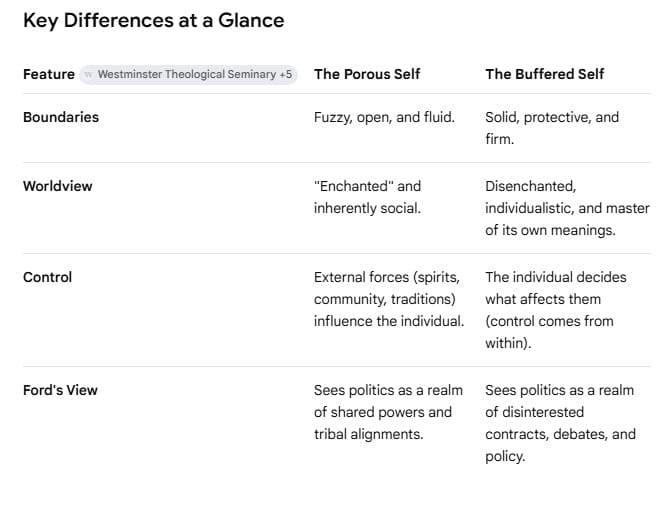
Luke Ford applies Charles Taylor’s “buffered vs. porous” framework to explain the deep, almost metaphysical disconnect between modern political tribes. He argues that the Right and Left do not just disagree on policy; they experience reality through fundamentally different psychological defenses.

1. The “Buffered” Liberal Elite (The Managerial Class)

Ford identifies the modern Democratic establishment and the professional-managerial class as the archetype of the Buffered Self.

The Worldview: They view themselves as autonomous individuals, “sealed off” from the spiritual or tribal forces of the world. They believe meaning is something they create inside their heads, not something that invades them from the outside.

Political Behavior: Because they are “buffered,” they rely on procedure, data, and contracts. They trust institutions (like the CDC or the FBI) because these institutions represent a rational, “immanent” order where everything can be explained and managed without “magic” or emotion.

The Blind Spot: Ford argues this makes them incapable of understanding the visceral, tribal instincts of the Right. To a buffered liberal, a Trump rally looks like mass hysteria because they cannot process the “collective effervescence” (a shared, porous emotional experience) that is happening.

2. The “Porous” Populist Right (The Trump Base)

Ford characterizes the populist Right (and the MAGA movement) as operating with a Porous Self.

The Worldview: They inhabit a more “enchanted” or “threatened” world where the boundary between the self and the outside is thin. They are “porous” to external forces—meaning they feel visceral disgust, spiritual contamination, or deep communal loyalty that bypasses rational filters.

Political Behavior:

Trump as Avatar: Trump speaks to the porous nature of his base. He doesn’t offer white papers; he offers protection from “invaders” and “poisons” (both literal and metaphorical).Vulnerability: Ford notes that the porous self feels invaded by cultural changes. Immigration isn’t just a policy dispute; it is felt as a physical or spiritual breach of the community’s “body.”

Conspiracy as Defense: Because they are open to “unseen forces,” they are more likely to believe in conspiracies (the Deep State, spiritual warfare) which explain the “evil” invading their world in a way that dry data cannot.

3. Case Study: The COVID-19 Divide

Ford has used the pandemic to illustrate this split vividly:

The Buffered Response (Blue America): Trusted the “immanent frame” of science. They sought safety through barriers (masks, social distancing, lockdowns)—literal buffers to seal off the self from the biological threat.The Porous Response (Red America): Viewed the virus—and the vaccine—through a lens of bodily purity and contamination. For many, the vaccine itself was viewed as the invader (a foreign substance breaching the porous body), while the virus was just a part of the natural “enchanted” struggle of life. The “mask” was seen not as a tool, but as a ritual muzzle—a spiritual humiliation.

4. The “Great Awokening” Twist

A key insight in Ford’s analysis (drawing on thinkers like Rony Guldmann) is that the modern “Woke” Left is actually a return to the Porous Self, disguised as secularism.

Speech as Violence: The idea that “words are violence” is a purely porous concept. It implies that a word spoken by someone else can physically penetrate your buffer and harm your soul.

Ritual Pollution: Ford argues that “cancellation” is a form of exorcism. When the Left “cancels” someone, they are removing a source of “moral pollution” that threatens the tribe, much like a village casting out a cursed individual in the pre-modern era.

The Hypocrisy: This leads to the current “Civil War” of reality: The Left claims to be buffered (rational/scientific) but acts porously (moral panics/witch hunts), while the Right openly embraces their porous tribalism but is mocked for it by the establishment.

Gemini says today: “Convenient beliefs” and “Why Morality Depends on False Beliefs” are core concepts developed by Stephen P. Turner, a Distinguished University Professor of Philosophy at the University of South Florida. Turner argues that human societies are not held together by rational, objectively true moral systems, but rather by highly functional, socially convenient “false beliefs” that resolve natural human conflicts and generate social order.

Turner’s work challenges traditional philosophy, suggesting that morality is a practical tool rather than a set of cosmic truths.

1. The Core Theory: Morality Depends on False Beliefs

In his paper, Why Morality Depends on False Beliefs, Turner bypasses traditional attempts to prove that being moral is objectively “rational”. Instead, he presents a naturalistic, sociological view of human nature:

Conflicting Drives: Human beings possess inherently conflicting biological and psychological desires.

The Illusion of Rationality: Instead of a complex, universally true moral framework, societies organically invent shared, comforting myths.

Social Order Over Truth: These false moral beliefs act as necessary social glue. They dictate what is “correct” or “genuine” so that individuals cooperate and avoid chaos.

The Cycle of Invention: When material conditions or historical realities change, the old convenient myths break down. Society is then forced to discard them and “invent new false beliefs” to maintain the social order.

2. “Convenient Beliefs” by Professional and Political Cohorts

Turner has frequently discussed how specific professional and political classes lean into highly specific, customized “convenient beliefs” to justify their authority, protect their status, and avoid facing internal contradictions.Examples of these “convenient beliefs” include:

Convenient Beliefs for Sociologists: Holding onto the concept of a homogenous, easily correctable “society” or pushing idealized, standardized metrics of social science while downplaying the field’s history of internal exclusion and institutional bullying.

Convenient Beliefs for Political Leaders (e.g., Germany or Russia): Adopting highly tailored national or geopolitical narratives that rationalize state actions, secure public compliance, and excuse economic compromises.

The Rejection of “Normativism”: Turner argues that social scientists shouldn’t judge whether these beliefs are “right” or “rationally justified”. Instead, they must treat them strictly as causal, natural phenomena used by human brains to cope with social environments.3. Epistemic Coercion and “The Bubble”

In his books like Explaining the Normative and newer essays on Epistemic Coercion, Turner expands on how convenient beliefs are sustained:

The Verstehen Bubble: Humans live inside a small, conscious “bubble” of mutual understanding that heavily relies on comfortable illusions, while the actual neural processes driving their choices remain hidden.

Manufactured Consensus: Powerful institutions, scientific bodies, and digital tech platforms frequently use coercion—disguised as “neutral expertise”—to suppress dissenting knowledge. This locks a population into a set of highly restricted, official “convenient beliefs” to prevent premature political fracture.

The concept of “convenient beliefs” in the context of sociologist Stephen Turner and independent podcaster/journalist Luke Ford refers to an analytical framework used to critique how public intellectuals, leaders, and professional groups adopt strategic moral and factual stances.

Rather than viewing political, social, or moral beliefs as purely rational or deeply held truths, this framework treats them as “coalition technologies” engineered to maximize group alignment, authority, and personal convenience.

The Theoretical Foundation: Alliance Theory

The collaboration and dialogue between Turner and Ford heavily relies on David Pinsof’s Alliance Theory of Political Belief Systems.

Moral Vocabularies as Tools: Under this framework, moral claims are not neutral reflections of reality. Instead, they are strategic tools used to recruit allies, signal loyalty to a tribe, and execute “jurisdictional wars” against rivals.

The “Convenience” of Truth: Beliefs are deemed “convenient” when they serve a dual purpose: they allow a person or group to protect their self-interest (e.g., funding, professional status, or political power) while maintaining the moral high ground.

Luke Ford’s “Ten Convenient Beliefs” Series

On the Luke Ford Podcast, Ford popularized this concept by developing hyper-specific, satirical yet analytical lists targeting different factions in modern society. These include:

Ten Convenient Beliefs for Sociologists Now
“>Ten Convenient Beliefs for Leaders of Germany / Russia Now
Ten Convenient Beliefs for This Blogger (Self-Critique)

Ford uses these lists to expose how different professionals adopt ideologies that neatly justify their job security, protect them from institutional backlash, and allow them to ignore conflicting data.

Stephen Turner’s Contribution: Anti-Normativism

Professor Stephen Turner, a prominent Weberian scholar and social theorist at the University of South Florida, provides the deeper sociological backing for these ideas. His academic work intersects with Ford’s commentary through several key concepts:

1. Good Bad Theories (GBT)Turner argues that many widely accepted societal beliefs are “Good Bad Theories”. These are factually flawed or false theories that are nonetheless “good” at coordinating large human groups—much like religious taboos functioned in primitive societies. They persist because they are socially useful and convenient for maintaining order, not because they are true.

2. The Myth of “Shared Practices”

In his book Brains/Practices/Relativism, Turner critiques traditional sociology for assuming that people share unified, objective cultural frameworks. He uses cognitive science to argue that we all have individualized, distributed habits. Therefore, institutional “shared values” are often just comforting, convenient narratives we tell ourselves to smooth over messy social interactions.

3. The Capture of Sociology

Turner frequently critiques the modern university system and the field of sociology for abandoning objective truth in favor of political programs. When sociology transforms from a “science of society” into an ideological provider for political policies, its foundational beliefs become “convenient” mechanisms to secure government grants and corporate-brand approval.

The Custodianship Question

Luke Ford’s series, centrally indexed in his “The Custodianship Question” post, analyzes global culture wars through a sociological lens of group competition, tribalism, and institutional power dynamics. The work, often blending Rabbinic thought with secular sociology, explores the transition of custodianship over societal standards across different nations.

Hero Systems

Sociological theories of hero systems explore how cultures and identities are built on socially constructed frameworks meant to provide individuals with a sense of primary value, meaning, and transcendence.

Cultural theorist Ernest Becker posited that all human hero systems (both religious and secular) are ultimately designed to manage the terror of death and give humans a feeling of lasting cosmic significance.

Luke Ford frequently interviews authors and philosophers about this. For example, the podcast featured discussions with writer and attorney Rony Guldmann dissecting how competing ideological movements in modern society function as rival hero systems that promote distinct narratives of oppression and cosmic importance.

* Ten Convenient Beliefs for Pope Leo XIV
* Ten Convenient Beliefs in the UC Berkeley School of Public Health
* Ten Convenient Beliefs For The MFA Elite
* Ten Convenient Beliefs in the Johns Hopkins University Bloomberg School of Public Health
* Ten Convenient Beliefs in the UCLA Luskin School of Public Affairs
* Ten Convenient Beliefs in the UCLA David Geffen School of Medicine
* Ten Convenient Beliefs in the UCLA School of Theater, Film & Television (TFT)
* Ten Convenient Beliefs in the UCLA Department of Psychology
* Ten Convenient Beliefs in the UCLA Fielding School of Public Health
* Ten Convenient Beliefs in the UCLA Graduate School of Education & Information Studies
* Ten Convenient Beliefs In UCLA’s Anthropology Department
* Ten Convenient Beliefs In Stanford’s Anthropology Department
* Ten Convenient Beliefs In UC Berkeley’s Anthropology Department
* Ten Convenient Beliefs In Harvard’s Anthropology Department
* Ten Convenient Beliefs In Stanford’s Sociology Department
* Ten Convenient Beliefs In Princeton’s Sociology Department
* Ten Convenient Beliefs In UC Berkeley’s Sociology Department
* Ten Convenient Beliefs In Harvard’s Sociology Department
* Ten Convenient Beliefs in the NYU Departments of English & Comparative Literature
* Ten Convenient Beliefs in Stanford’s Program in Modern Thought & Literature
* Ten Convenient Beliefs in the University of Chicago Department of English / Center for the Study of Gender and Sexuality
* Ten Convenient Beliefs In The Princeton Departments of English and Comparative Literature
* Ten Convenient Beliefs In The UC Berkeley Departments of English and Rhetoric
* Ten Convenient Beliefs In The Columbia University Department of English and Comparative Literature
* Ten Convenient Beliefs In The Harvard Department of English / History & Literature
* Ten Convenient Beliefs For Christopher Caldwell
* Ten Convenient Beliefs For IR Scholar John J. Mearsheimer
* Ten Convenient Beliefs For Israeli Political Analyst Haviv Rettig Gur
* Ten Convenient Beliefs For Author Yossi Klein Halevi
* Ten Convenient Beliefs For Philosopher Micah Goodman
* Ten Convenient Beliefs For Scholar Marc B. Shapiro
* Ten Convenient Beliefs For Sociologist Stephen P. Turner
* Ten Convenient Beliefs For Author Anne Applebaum
* Ten Convenient Beliefs For Religion Scholar Aaron W. Hughes
* Ten Convenient Beliefs For Leaders In America’s Deep State
* Ten Convenient Beliefs For West Bank Settlers
* Ten Convenient Beliefs For Seventh-day Adventist Leaders
* Ten Convenient Beliefs For Iran’s Next Supreme Leader
* Ten Convenient Beliefs For The Leaders Of Tencent (WeChat)
* Ten Convenient Beliefs For The Leaders Of Berkshire Hathaway
* Ten Convenient Beliefs For The Leaders Of Meta (Facebook)
* Ten Convenient Beliefs For The Leaders Of Saudi Aramco
* Ten Convenient Beliefs For The Leaders Of TSMC
* Ten Convenient Beliefs For The Leaders Of Nvidia
* Ten Convenient Beliefs For The Leaders Of Amazon
* Ten Convenient Beliefs For The Leaders Of Alphabet (Google)
* Ten Convenient Beliefs For The Leaders Of Wells Fargo
* Ten Convenient Beliefs For The Leaders Of Microsoft
* Ten Convenient Beliefs For The Leaders Of Goldman Sachs
* Ten Convenient Beliefs For The Leaders Of Apple
* Ten Convenient Beliefs For The Leaders Of AI
* Ten Convenient Beliefs For The Leaders Of Italy
* Ten Convenient Beliefs For The Leaders Of Denmark
* Ten Convenient Beliefs For The Leaders Of NATO
* Ten Convenient Beliefs For The Leaders Of Canada
* Ten Convenient Beliefs For The Leaders Of Mexico
* Ten Convenient Beliefs For The Leaders Of Brazil
* Ten Convenient Beliefs For The Leaders Of Argentina
* Ten Convenient Beliefs For The Leaders Of Ohr Somayach
* Ten Convenient Beliefs For The Leaders Of Aish HaTorah
* Ten Convenient Beliefs For Leaders Of Taiwan Now
* Ten Convenient Beliefs For The Leaders Of Lebanon
* Ten Convenient Beliefs For Leaders Of Syria Now
* Ten Convenient Beliefs For Leaders Of Poland Now
* Ten Convenient Beliefs For Leaders Of Cornell Now
* Ten Convenient Beliefs For The Leaders Of The Middle East Institute
* Ten Convenient Beliefs For Leaders Of India Now
* Ten Convenient Beliefs For Leaders Of Egypt Now
* Ten Convenient Beliefs For Leaders Of Pakistan Now
* Ten Convenient Beliefs For Leaders Of Oman Now
* Ten Convenient Beliefs For Leaders Of Bahrain Now
* Ten Convenient Beliefs For Leaders Of The University Of Pennsylvania
* Ten Convenient Beliefs For Leaders Of Kuwait Now
* Ten Convenient Beliefs For Leaders Of UC Berkeley Now
* Ten Convenient Beliefs For The Leaders Of Qatar Now
* Ten Convenient Beliefs For The Leaders Of United Arab Emirates Now
* Ten Convenient Beliefs For Supporters Of Amy Wax In Her Battle With UPenn Now
* Ten convenient beliefs for leaders at the U.S. Department of War
* Ten Convenient Beliefs For Lovers Of Jacques Marie Émile Lacan
* Ten Convenient Beliefs For Lovers Of Jacques Derrida
* Ten Convenient Beliefs For Lovers Of Michel Foucault
* Ten Convenient Beliefs For Leaders Of Imperial College London Now
* Ten Convenient Beliefs For Ethicists Now
* Ten Convenient Beliefs For Sociologists Now
* Ten Convenient Beliefs For International Relations Scholars
* Ten Convenient Beliefs For People Who Cry During The Movie Legends Of The Fall
* Ten Convenient Beliefs For Lovers Of Air Supply
* Ten Convenient Beliefs For Leaders Of Cedars-Sinai Medical Center
* Ten Convenient Beliefs For Leaders In HR
* Ten Convenient Beliefs For Leaders Of Stanford Now
* Ten Convenient Beliefs For Leaders Of USC Now
* Ten Convenient Beliefs For Leaders Of CalTech Now
* Ten Convenient Beliefs For Leaders Of Cambridge
* Ten Convenient Beliefs For Leaders Of Oxford
* Ten Convenient Beliefs For Leaders Of MIT Now
* Ten Convenient Beliefs For Leaders Of The University Of Chicago Now
* Ten Convenient Beliefs For Leaders Of Harvard Now
* Ten Convenient Beliefs For Leaders Of Princeton Now
* Ten Convenient Beliefs For Blackrock Now
* Ten Convenient Beliefs For Joe Rogan Now
* Ten Convenient Beliefs For Richard Spencer Now
* Ten Convenient Beliefs For Candace Owens Now
* Ten Convenient Beliefs For Tucker Carlson Now
* Ten Convenient Beliefs For Megyn Kelly Now
* Ten Convenient Beliefs For Dan Turrentine Now
* Ten Convenient Beliefs For Mark Halperin Now
* Ten Convenient Beliefs For Leaders Of Ukraine Now
* Ten Convenient Beliefs For David Ignatius Now
* Ten Convenient Beliefs For Leaders Of Turkey Now
* Ten Convenient Beliefs For Leaders Of The Washington Post Now
* Ten Convenient Beliefs For Leaders Of The Atlantic Magazine Now
* Ten Convenient Beliefs For Leaders Of Australia Now
* Ten Convenient Beliefs For Leaders At The Counsel On Foreign Relations
* Ten Convenient Beliefs For Leaders Of The UK Now
* Ten Convenient Beliefs For Leaders Of France Now
* Ten Convenient Beliefs For Leaders Of Germany Now
* Ten Convenient Beliefs For Leaders Of Russia Now
* Ten Convenient Beliefs For Leaders Of China Now
* Ten Convenient Beliefs For Leaders Of Japan Now
* Ten Convenient Beliefs For Leaders Of Saudi Arabia Now
* Ten Convenient Beliefs For This Blogger
* Ten Convenient Beliefs For The Leaders Of The Columbia School Of Journalism
* Ten Convenient Beliefs For Leaders Of Big Law Who Refused To Cut Deals With The Trump Administration
* Ten Convenient Beliefs For Leaders Of Big Law Who Cut Deals With The Trump Administration
* Ten Convenient Beliefs For Leaders Of The ABC News Iran War Coverage Now
* Ten Convenient Beliefs For Leaders Of America’s Dissident Right Now
* Ten Convenient Beliefs For Leaders Of The Financial Times Iran War Coverage Now
* Ten Convenient Beliefs For Leaders Of The Fox News Iran War Coverage Now
* Ten Convenient Beliefs For Leaders Of The WSJ Iran War coverage Now
* Ten Convenient Beliefs For Leaders Of The New York Times Iran War coverage Now
* Ten Convenient Beliefs For Houthis Leaders Now
* Ten Convenient Beliefs For Hezbollah Leaders Now
* Ten Convenient Beliefs For Hamas leaders Now
* Ten Convenient Beliefs For Israel’s War Leaders Now
* Ten Convenient Beliefs For IRGC Leaders Now
* Ten Convenient Beliefs For American Leaders In Christian Nationalism
* Ten Convenient Beliefs For American Leaders In Gay Rights
* Ten Convenient Beliefs For American Leaders In Religious Freedom
* Ten Convenient Beliefs For American Leaders In Climate Change Research
* Ten Convenient Beliefs For American Leaders In Gender Affirming Care
* Ten Convenient Beliefs For Leaders Of American Medical Schools Under Civil Rights Investigation By The Trump Administration
* Ten Convenient Beliefs For American Elite Journalists Now
* Ten Convenient Beliefs For Leaders At UCLA Now
* Ten Convenient Beliefs For Yale English Department Faculty Now
* Ten Convenient Beliefs For Energy Experts Now
* Ten Convenient Beliefs For FDD analysts now
* Ten Convenient Beliefs For Iran Experts Now
* Ten Convenient Beliefs For Leaders At Yale University Now
* Ten Convenient Beliefs For Leaders At Columbia University Now
* Ten Convenient Beliefs For Social Psychologists In America Today
* Ten Convenient Beliefs For Ethicists In America Today
* Ten Convenient Beliefs For Trump Haters In America Today
* Ten Convenient Beliefs For Trump Lovers In America Today
* Ten Convenient Beliefs For Sex Workers In America Today
* Ten Convenient Beliefs For Bankers In America Today
* Ten Convenient Beliefs For Dentists In America Today
* Ten Convenient Beliefs For Doctors In America Today
* Ten Convenient Beliefs For Social Workers In America Today
* Ten Convenient Beliefs For Economists In America Today
* Ten Convenient Beliefs For Academics In America Today
* Ten Convenient Beliefs For American Attorneys Today

Posted in Blogging, Buffered, Porous, Stephen Turner | Comments Off on The Buffered, The Porous & The Political

Successful Journalists on Substack Don’t do Much Journalism

Look at who earns the money. The biggest news Substack is Heather Cox Richardson, about a million dollars a month from close to three million subscribers, and she writes no original reporting. She explains the day’s news through a historian’s frame. The rest of the top tier reads the same way, Yglesias and Noah Smith and Ted Gioia and the policy and culture and economics writers who headline the revenue list, voices selling a reliable take. The product is the writer’s perspective, delivered often, not a fact you could not get elsewhere.
There are real reporters who make it, and they prove the point by where they sit. The Pragmatic Engineer reports the tech industry’s internals with real sourcing, Newcomer reports the venture world in depth, and Sinocism mixes China analysis with the occasional scoop. All of them work a narrow, expensive vertical that a professional audience needs for its job and will pay business rates to get. That is reporting sold as trade intelligence to a paying guild, not journalism done for the public. The one outfit that built real general reporting, the Free Press, did it by becoming an opinion operation rather than a newsletter. The solo accountability reporter for the general reader is the figure missing from the list.
The reason is the thing the old institution did that nobody priced. A newspaper bundled the profitable parts, the gossip, the opinion, the ads, and used them to pay for the unprofitable part, the investigation. Reporting is a public good. It costs a fortune to make and goes free to everyone an hour after it runs, so no single subscriber will pay a premium for it. The bundle hid that. Substack unbundles. Each writer pays for himself, and the loss-making public good loses the patron that carried it. What survives alone is what one man will pay one man for, a voice, a habit, a daily take, or a slice of inside knowledge he can expense.
So the platform does not rescue journalism. It rewards the columnist and the niche analyst and retires the reporter, or turns him into a vendor of inside knowledge to the industry he covers. It is the sorting you were circling with Wallace. The watchdog function does not migrate to the subscription. The pundit function does, and the trade-intelligence function does, and the accountability reporting that justified the old prestige is the one job the new economy will not fund. Wallace’s gift would not pay as a newsletter either. It pays as the book, where the powerful sign the check. Substack is a home for the talker and the specialist. It was never a home for the watchdog.

Posted in Journalism | Comments Off on Successful Journalists on Substack Don’t do Much Journalism

Journalist Amy Wallace Consistently Chooses Sides

Read Amy Wallace the usual way and she has a value. Truth over comfort, sympathy for the one the world has flattened, the witness who cannot be bought. David Pinsof’s Alliance Theory says there is no such value, in her or in anyone. What looks like a moral spine is the output of an alliance structure, the patchwork of loyalties and rivalries a person carries, and the moral language is the propaganda that recruits third parties to the cause. Strip the creed and you find the coalition. So the question for her work is not what she believes. It is whom she counts as an ally and whom she counts as a rival, and what tactics she runs on each. The contents of her belief system fall out of that, the way Pinsof says all belief systems do.

Her allies are the reduced. The woman cut down to a body, the artist cut down to a torso, the actress handed the maid, the dying director who refuses to be her disease, the survivor of the men who pass girls around. Her rivals are the ones who do the cutting and the ones who shield them, the mogul who built a fortune on a rear view, the boner-pill salesman who farmed male shame, the executive who choked the woman and paid her off, the editor who sold his paper’s coverage for a seat at the industry’s table. She did not reason her way to this roster. She is a journalist, which the alliance map sets inside the intellectual-elite coalition, knowledge workers ranged against the business elite and the powerful insider, and her loyalties track that placement the way a partisan’s track his. The enemy of her ally is her rival. The trade, the city, the apprenticeship sorted her onto a side, and the side came with its friends and its enemies attached.

She knows the machinery from the other end, because it ran on her first. The profile that made her name broke the trade press’s code, the unspoken rule that the reporter who lives on access does not print what the access buys. She printed it. She let Peter Bart’s own brokerage show, and the field read the piece as a defection and not as a story. A coalition punishes the member who shows its private arrangements to outsiders, and it punishes hardest when the showing is true, because the true exposure is the dangerous one. The response split along the line it traced. Reporters defended her on the principle of adversarial scrutiny, the open creed of the craft. The industry she had embarrassed moved to discipline her and the outlet that ran her. The man at the center took his show of punishment and kept his chair, and the boundary closed back over the same exchange it always hid. She had named the price of membership, and the coalition charged her for the naming.

On her allies she runs the victim’s tactics, and Pinsof lists them. Emphasize the wrong done. Deny the mitigating circumstance. Read the rival’s motive as malice. Swell the harm. When she writes the harassed woman reporter, the attacks are misogyny aimed at silencing, the motive named and dark, the wound centered and held. When she writes Virginia Giuffre she carries the account of a girl trafficked to powerful men into print and argues that the wrong move is to make the victim prove herself. That is the victim bias stated as a rule. Do not weigh the mitigating fact. Do not test the grievance. To do so is to side with the perpetrator, and the perpetrator is the rival, and you do not hand the rival the benefit of the doubt. The tactic is not a lapse in her method. It is her method working on the people her method is built to defend.

On her rivals she withholds the opposite tactic. The perpetrator’s own propaganda is to shrink his responsibility, dress up his intentions, and shrug the harm down to nothing, and a writer allied with him would lend him that frame. She lends Chip Wilson none of it. She sets his line about women’s bodies not working for the pants beside the rear view that made him rich and lets the two sit there. She gives Steve Warshak his porous logic and his unread blessing of the scheme and never softens the men he charged without their say. She hands Chris Albrecht his comeback and then gives the last word to Sasha Emerson, the woman he choked, who says he needs to believe his own narrative. The charity a perpetrator wants, the downgrade of the harm, the upgrade of the motive, she keeps from every rival. That withholding looks like rigor. Run the frame and it is loyalty, the same loyalty pointed the other way.

The proof that the line is drawn by alliance and not by conduct sits in two profiles of two powerful men who used women. Warren Beatty tells her he bedded the better part of a Who’s Who, answered phone calls while inside a lover by Joan Collins’s account, and spends four hours trying to turn the interview into a seduction, and she renders him as charm itself, the lifelong seducer at peace at last with his wife and his children. Chip Wilson follows a young woman’s backside up a mountain, grins, and tells her it is his job to look, and she renders him as a tone-deaf creep hanging by his own rope. Set the conduct side by side and Beatty’s is the heavier. Set the treatment side by side and Wilson’s is the colder. Nothing in how the two treated women explains the gap. What explains it is that Beatty is Hollywood royalty, inside the world she lives in and writes for, and Wilson is a yoga-pants mogul from outside it. The seducer is an ally. The mogul is a rival. The same use of women reads as magnetism in the one and predation in the other, and the variable is the coalition, not the deed.

The word choices sort the way Pinsof’s attributional bias predicts. Her allies’ troubles take the external cause. Viola Davis’s stalled career is Hollywood’s colorism and the global box office, never her own ceiling. D’Angelo’s collapse is the machine that turned him into the Naked Guy. The reporter’s harassment is the culture’s misogyny. Her rivals’ winnings take the internal cause. Wilson’s fortune is his knack for farming vanity and fear. Warshak’s millions are his marketing and his greed. The advantage of the rival comes from his character, the disadvantage of the ally comes from his circumstance, and the same fact would flip its cause if the man changed sides. That is the linguistic tell of whose corner she stands in, run sentence by sentence beneath the level of argument.

The Giuffre episode looks like a lapse in her truth-telling. The frame tells it as alliance doing its job. She co-authored the memoir. She had taken the side. Then the released files said the part that named men could not be stood up, that two other victims she had named contradicted her, that her own accounts shifted and an earlier memoir ran partly invented. A witness loyal to nothing but the record reopens the question. A true ally does not, because the deepest rule of alliance, Pinsof says, is that to doubt your friend’s side of the story is to tell your friend you are not his friend. Trusting Giuffre’s account was not Wallace failing her standard. It was Wallace meeting the only standard a coalition enforces. The cost rode out under her name and onto the men the account marked, and the cost was the price of belonging, which every alliance charges and calls conscience.

An ally can be a wrongdoer too, and the coalition has a way of holding that. By the account of one of Epstein’s other victims, Giuffre did not only suffer the trafficking, she fed it, recruiting a girl younger than herself and coaching her to lie about her age. Giuffre’s own lawyer granted that she came to regret facilitating other young women. Set that beside the rule Wallace keeps. The perpetrator’s charity, the mitigating circumstance, the downgraded harm, the benefit of the doubt, is the thing she gives no one on her own side. So an ally who is also a perpetrator is not reclassified. She holds the victim’s slot and draws the victim’s tactics, because the coalition assigns the slot and the slot does not bend to the facts inside it. Wallace cannot write Giuffre as what she would name without a pause in a rival, a person who on that account fed a younger girl into the same machine. The alliance does not let her see it, and the not-seeing is not a flaw in her eyes. It is the slot doing its work.

Her stated creed reads, in this light, as the moral coat the alliance wears in public. Truth over comfort, the public interest, the witness who serves no master, these are the impartial-sounding words that pull strangers to a side, and Pinsof’s point is that both sides reach for the same words while only one side at a time can be telling the truth. Do not make the victim prove herself sounds like justice and works like a wall around an ally. The morality is real to her, felt as conviction, and that is the design. The loyalty running underneath does its best recruiting when the partisan cannot feel it as loyalty and feels it as principle instead.

Alliance Theory claims the machinery is universal, the same in the polemicist who names his villain and the reporter who lets the villain hang himself, the same in her rivals as in her, the same in the reader sorting these pages into fair and unfair by whether they flatter his own side. The trade ran the machinery on her the day she broke the Bart story, and she has run it on the page in every profile since. She is not a cynic wearing a conscience. She is a person with allies, which is to say a person, running the program that ran before there was journalism and will run after. The only writer the frame cannot reach is the one with no allies and no rivals, who has never been seen and never will be. Wallace had her side and served it with a gift most of her side will never match. What the older reading called her sympathy, the frame calls her roster. The sharpest thing to say about her is not that she was captured. It is that being captured, by a side, by the people whose story you have agreed to trust, is the price of having anyone at all to defend, and she paid it the way the rest of us do.

Predictable Sympathies

Amy Wallace’s sympathies are easy to predict.
You can guess whom she will warm to and whom she will cut, and the guesses track the value-set of the educated coastal world she came up in. Artists are sacred. The wronged woman is sacred. The man who exploits women is profane, so Chip Wilson and Steven Warshak and Chris Albrecht get the cold treatment and the placed quote. Mainstream science is trusted, which is why her Wired piece on vaccines took its side against the anti-vaccine movement with little air given to the other view. A reader who knew her milieu could call most of these before reading a word.
That is predictability of sympathy, not of party. Her villains are bad men, not the other team. She does not profile politicians. The men she exposes are fraudsters and predators and the self-important powerful, and exposing a fraudster is neither left nor right. The gender-and-exploitation axis is where she runs most predictable.
Three things cut against the easy progressive read. She exposes the powerful inside her own camp. Albrecht ran HBO, a liberal-media crown, and she handed the last word to the woman he choked. Her best piece refuses the coding her milieu would want: the boy who shot his neo-Nazi father could have been a clean parable, the hateful man as pure evil and the child as pure victim, and she declined to write it that way. And her late career renders corporate chiefs with sympathy for a fee, the Pixar president and the former head of GE, which no reliable progressive would do, since the left’s quarrel is with the executive as a type.
So the sensibility is legible and the score is not. Tell me the subject is a man who used women or conned the credulous and I will tell you the tone. Tell me only that he is a Republican or a Democrat and I have nothing. The predictability lives in her taste, and the moment that taste meets a powerful man on her own side, or a victim who is also a killer, or an advance worth taking, it stops behaving the way her politics would predict.

The Arranged Verdict

Amy Wallace almost never tells you what to think of a man. She shows you the man, in a scene, in his own words, and she puts the words where they will do their work, and she steps back. Read her profile of the Lululemon founder and you wait for the sentence that calls him what he is. It does not come. What comes is the founder on a mountain trail, watching a young woman climb ahead of him, saying it is his job to look. Wallace lets the line sit. She has rendered a verdict without writing one. The judgment lives in the arrangement, in what she set beside what, and the reader reaches the conclusion believing he reached it himself. That is the center of her style and the source of its force.

The method comes down from the New Journalism, from Tom Wolfe and Joan Didion and Gay Talese, and Wallace works its four old devices with a clean hand. She builds in scenes and not in summary. She runs dialogue long and in the speaker’s own cadence. She writes from inside a point of view, often her own. She records the status detail, the watch, the car, the room, the brand, the tell a man gives off without meaning to. None of this is new. What she adds is restraint. Wolfe wanted the reader to feel the writer’s presence on every page. Wallace wants the opposite. She wants the scene to read as though no one arranged it.

She gives the reader the encounter as it happened. The Lululemon piece opens on the hike because the hike is where the man revealed himself, and she gives it in order, in the present of the walk. The Warren Beatty profile is four hours on a patio, rendered as four hours on a patio. She does not step outside the scene to summarize what kind of man he is. She stays in the chair and lets him perform, and the performance is the portrait. The work of judgment happens before the writing, in the choice of which scene to build, and after it, in the cut. On the page there is only the scene.

She is willing to be a character in her own story, and she uses herself as a gauge. In the Beatty profile she is the woman he spends the afternoon trying to charm, and she records the charm landing and records herself noticing it land. The first person is not confession. It is an instrument. Her reactions calibrate the reader’s, so that when she feels the pull of a seducer the reader feels it too, and when she keeps her footing the reader keeps his. The risk in the device is vanity, the reporter who makes herself the subject. She keeps clear of it, because she keeps the I small and pointed, a lens and not a mirror.

Her sharpest tool is the long quote left alone. She lets a man talk until he has said the thing he should not have said, and then she stops, and the silence after the quote does the work an adjective would coarsen. The Lululemon founder hangs on his own words about which women suit the clothes. The cable executive, given room to explain himself, explains himself into the ground. She does not chase the quote with a comment. She trusts the reader and she trusts the sequence. The argument is in the order of the sentences, and the order looks like nothing, which is the art.

She knows where to end. In the profile of the executive who choked a woman years before and bought her silence, Wallace gives the final word to the woman, who says the man needs to believe his own story. Nothing Wallace could write in her own voice would land as hard as that quote in that spot. The placement is the verdict. A feature writer with a weaker ear would have put the woman in the middle and closed on the man’s comeback. Wallace closes on the wound, and the structure tells the reader where the truth sits without a line of editorial.

The same set of tools makes warmth or cold, and the variable is distance. With Baz Luhrmann she stands a half-step back and checks his story of himself against the record, and the checking reads as affection with its eyes open. With the Lululemon founder she stands at the same half-step and the checking reads as exposure. She is not running two methods. She is adjusting proximity, moving the camera in or holding it off, and the tone follows the distance. Garry Shandling gets the close, forgiving frame of a man she liked. Jerry Lewis gets the cooler middle distance of a man who would not let her in. The feeling in each piece is a function of where she chose to stand.

The prose under all of this is plain and fast. She favors the active verb and the short declarative, and she will run a long accreting sentence and then drop a four-word one to land it. She does not reach for the fine phrase. The diction stays close to speech, and the rhythm carries the reader without calling attention to the hand on the wheel. This plainness is the most worked thing about her. A flashier sentence would announce a judgment she means to withhold. The flat line keeps the surface neutral so the arrangement underneath can carry the weight.

She owns a second voice that is the first one turned off. In the collaborative books she submerges her own cadence into the subject’s and writes as him, in his rhythm, under his name. The profile voice watches a man from the chair across the room. The as-told-to voice climbs inside him and speaks. The range between the two is wide, and the second is the harder trick, because it has to vanish. The same ear that catches a subject’s self-betraying tell can reproduce his self-justifying one, and the reader of the book cannot hear the join.

The whole style runs on a single bet, that the reader will trust a surface that does not argue. The flat voice reads as fair. The scene reads as found rather than made. The withheld judgment reads as no judgment at all, which is why the judgment lands so well. The cost of the method is that the reader takes the selection on faith. He sees the scene she built and the quote she kept, and he does not see the scene she cut or the quote she let go, and the plainness that makes her seem to stand aside is the thing that hides how much she has chosen. The art is in seeming artless, and she seems artless at the top of the trade.

Whose Account

The easy reading of Amy Wallace’s career is a fall. She starts as a reporter who holds power to account and ends as the hired voice of the powerful, the writer who gives a chief executive’s memory the shape of a book. The prison beat and the two Pulitzers at one end, the authorized corporate memoir at the other, a straight downhill line between them. The reading is half right, and the half it gets wrong is the half worth having.

What Wallace built across a long career is a single asset, and it is rarer than any beat or byline. She can enter the room of a powerful or famous or guarded man and come back able to render him in a voice a stranger will believe. The asset has two parts that look opposed and are not. The first is access, the seat at the elbow she learned as a young assistant to James Reston and never lost. The second is the rendering, the plain trustworthy voice that makes a reader feel he has met the man on the page. Reporters with access often cannot write. Writers with the voice often cannot get in. Wallace had both, and both run on the same thing, the subject’s trust.

That trust is where the easy reading breaks. The reporter who holds power to account needs the powerful to open up, and they open up to the writer they feel safe with. The Peter Bart profile that made her name in 2001 read as a breach of a closed world because she got inside the closed world first, and she got inside because the men there did not see her coming as a threat. The same safety that lets a writer expose a man is the safety that lets a man hire her. Access earned for accountability is access available for service. The gift that points at power and the gift that serves power are not two gifts. They are one gift pointed two ways, and the trust that aims it can be aimed by either hand.

The drift from one aim to the other was not only character. It was money, and the money was structural. Wallace’s prime as an independent profiler ran through the years the long magazine profile could still pay a writer’s rent, the GQ and Wired and New York years, the decade the glossies still ran ten thousand words on a single man. That economy died. Condé Nast Portfolio, where she was a senior writer, launched in 2007 and folded two years later, a clean marker of the collapse. When the magazines that paid for the long accountability profile could no longer pay, the surviving market for her exact talent was the book, and the books that pay are the ones a powerful man wants written. The public had funded the adversarial profile through the ad pages. The subject funds the authorized book through the advance. The writer did not change her craft. The buyer changed, and the buyer decides whom the craft serves.

So she wrote the books power pays for. These are not exposés. They are the opposite. The authorized book lends the writer’s trusted voice to the subject’s version, and the loyalty runs to the man on the cover, not to the reader. What the young reporter offered the public, the established author now offers the principal. The instrument is the same. The client is power.

Something real is given up in the move. Name it instead of mourning it. The accountability reporter’s authority is her own name vouching to the public that she tested what she found. The collaborator’s authority is lent to another name, and her testing is replaced by her craft. The byline goes from hers alone to hers beside another’s to, in the work of the book, hers beneath another’s. The independence that let her break the closed world is the independence she trades for reach and for the advance. She gains a larger audience and a larger fee. She gives up the seat she held as the public’s proxy against the man across the table. In the authorized book there is no table. She is on his side of it.

And then the last book turns the instrument around, which is why the fall reading cannot be the whole story. For four years Wallace worked with Virginia Giuffre on her account of abuse by Jeffrey Epstein and her fight for a reckoning. Nobody’s Girl came out in 2025, after Giuffre took her own life, and went to the top of the list. Here the trusted book-voice is aimed not at burnishing a powerful man but at a survivor’s case against the men who shield the powerful, and it carried that case into more hands than any magazine piece could reach. If the arc were a simple slide into the service of power, the biggest book of her life would be the counterexample that ends it. She did not end up aiding power. She ended up aiming the weapon she had built in power’s service back at power.

Nobody’s Girl is the work of the collaborator, not the reporter. The collaborator renders the subject’s account in the trusted voice. The reporter tests every claim in the account against the record before she vouches for it. These are different jobs with opposite loyalties, and Wallace by the end was doing the first. The released government files later confirmed the core abuse and could not stand behind parts of the wider account, the parts that named powerful men, and two other women contradicted pieces of it. Read for craft, this is the cost of the form. The book gave a survivor’s account the steady authority of print without the adversarial testing the young reporter once supplied. The point is not whether Giuffre was wronged. She was. The point is that the writer who once stood as the public’s check on every account, friendly or hostile, had become the writer who renders one account at a time and lends it her trust. That change held whether the account served Catmull, served Immelt, or served Giuffre against the powerful. The valence flipped from book to book. The stance never did.

Wallace became the trusted renderer of other people’s accounts, and the trust she rendered them with was the same trust that got her into the room in the first place. Whom the account serves changed with who paid and whom she chose. What stayed fixed was the surrender of the adversarial seat, the move from testing the powerful for the public to voicing a single principal to the world. The career does not pose the comfortable question of whether a good reporter sold out. It poses the harder one. When the patron who paid for holding power to account stops paying, and the only buyer left for the talent is the subject who wants his account told, what is a writer of this gift supposed to do, and whom can she still serve? Wallace answered it three times for power and once against it, with the same voice, and the answer was always the subject in front of her.

The patron decides the loyalty. Accountability journalism served the public because the public, through the ad-supported magazine, paid for it. The authorized book serves the subject because the subject pays for it. Wallace’s talent did not move left or right. It followed the money from one master to another.

The access that enables exposure is the access that enables capture. Both run on the subject’s trust. A writer powerful men feel safe opening up to is a writer powerful men feel safe hiring. The skill cannot be built for one use and walled off from the other.

The byline is the independence. When it is hers alone, she vouches for the public. When it is hers beside or beneath another’s, she vouches for the man whose name shares the cover. The shrinking byline is the shrinking of the adversarial position.

Reach was the trade. The book reaches more readers than the profile ever did, and it reaches them on the subject’s terms. She bought scale with the surrender of the independent seat. Scale is neutral. Whom it serves is not.

The collaborator renders; the reporter tests. By the end she rendered. The same voice that once checked a man’s account for the public now delivered a man’s account to the public without the check. Nobody’s Girl is righteous and is still rendering, not testing.

The valence flipped; the stance held. Three books for power, one against it, all in the trusted voice of a writer telling one principal’s story. The morality of the work turns on whom she points it at. The shape of the work turned, long ago, away from the public and toward the one in the room.

Wallace’s Carrier Group

What Jeffrey Epstein did to girls was monstrous. That it became a wound the whole country carries is a made thing. Yale sociologist Jeffrey Alexander (b. 1947) names the difference. An event, however horrible, does not become a public trauma on its own. Trauma is an attribution a society makes, the meanings that turn a set of facts into a wound on the collective sense of who we are. The facts do not do this work. People do, the people Alexander calls a carrier group, the agents with the standing and the skill to carry a claim into the public mind. With Nobody’s Girl, the memoir she built with Virginia Giuffre, Wallace did that work. She is a carrier-group agent, and the book is the claim.

Alexander says a carrier group has ideal and material interests, a place in the social structure, and the discursive talent to make meaning in public. The collaborative author of a major memoir is built for the part. Wallace holds a seat in the prestige nonfiction world, the standing of the imprint and the byline, and the craft to turn a survivor’s scattered memory into a single carrying voice. The book is not a report of the trauma. It is an instrument for making one, a claim of fundamental injury, of a sacred thing profaned, told as the narrative of a destructive social process and ending in a demand for reckoning. Alexander’s description of the trauma claim reads like a table of contents for the memoir.

Alexander says the construction of a public trauma turns on four answers a carrier group must give, the work that builds a master narrative. First, the nature of the pain. The book defines the wound as larger than one girl, a system that fed children to powerful men, the profanation of childhood by money and access. Second, the nature of the victim. Giuffre is drawn as the representative girl, the ordinary daughter who could have been anyone’s, so the harm reads as done to the collective and not to a stranger. Third, the bond between the victim and the public. The memoir works to make the reader own the wound, to feel the girl’s injury as a wound to the community, which Alexander says happens only when the victim carries qualities the wider audience already holds sacred. Fourth, the attribution of responsibility, the naming of who did it. Here the construction does its heaviest and most contested work.

Alexander says the cultural sociologist studies the claim and not its truth. He is after epistemology, how the claim is made and with what result, and he sets ontology and morality aside. So the question is not whether every man the book marks did what the book says. The question is how the narrative assigns the role of perpetrator, and the answer is that it assigns it the way all trauma narratives do, by symbolic construction. The released files complicate that construction. They confirmed the core wound and could not stand behind the part that named powerful men, and two other victims contradicted the lent-out account. Read through Alexander, this is not a footnote about accuracy. It is the institutional arena pushing back on the carrier group’s claim, the state and the court disciplining the narrative the book broadcast.

The trauma claim is a speech act, Alexander says, with a speaker, an audience, and a situation. The speaker is the carrier group, Wallace and Giuffre and the publisher behind them. The audience is the fragmented public. The situation is the moment, after a decade of reckonings about powerful men and their use of women, with the Epstein files moving through the government and the courts. The claim has to convince the originating circle first, the survivors and the public already primed to believe, and only then can it widen to the country. Nobody’s Girl reached the top of the list, which is to say the claim found its first audience. Whether it widens into the settled national memory of the affair is not yet decided.

The claim does not travel through clear air. Alexander says institutional arenas channel and discipline it, each on its own terms. In the aesthetic arena the memoir works by identification and catharsis, the reader living the girl’s ordeal and grieving it. In the legal arena the same story meets the demand for binding proof, the lawsuit, the settlement, the finding, and the law gives the claim only what it can prove. In the arena of the press the book competes for attention and gets cut to a headline. And the arena of the state, the released files and the investigations, can carry the trauma forward or break its momentum. The Epstein trauma sits in all these arenas at once, and they do not agree.

Alexander warns that the forces a trauma needs seldom line up. Consensus that a wound is real, the sense that it reaches the center of the society, the institutions willing to act, the autonomous elites willing to carry it, the rituals that fix the meaning, all of these must align, and the alignment is rare. The Epstein affair has some of them and not others. The carrier group is strong and the public is primed. But the perpetrator-attribution is contested, the files are weaponized in a partisan fight, and the man at the center is dead and cannot be tried. The trauma may set into the national memory as a settled wound, or it may scatter into a thing each side tells its own way. Alexander does not predict. He watches the arenas.

Alexander says that by building a trauma a society takes on the suffering of others as its own and widens the circle of the we. To carry the Epstein wound into the public mind is to make a country own what was done to its girls and to extend its solidarity to them. That is the work the book does, and the work is real whatever the courts make of the contested names. The same construction that builds righteous solidarity can also mark a man the record will not convict, and Alexander’s bracket holds both without flinching, because he studies the building and not the verdict. Wallace built a wound the public could feel and carry. What a society does with a carried wound, whom it blames and whom it absolves, the book begins and cannot end.

Pure and Polluted

A profile is a verdict in the form of a story. Jeffrey Alexander gives the reason it works. Facts do not speak. A set of facts about a man, his deals, his appetites, his words, sits there until someone tells it, and the telling places him on one side or the other of a line a free society draws through all its members, the line between the pure and the polluted, the trustworthy and the dangerous, the citizen who honors the common good and the one who threatens it. Alexander built this out of Watergate, where the same facts that read as just politics in 1972 read as a profanation of the republic two years later. Nothing in the facts had changed. The telling had. Every Wallace profile is a telling of this kind. She takes a man and sorts him.

Alexander says the discourse of a free society runs on a fixed set of opposites. On the sacred side stand the universal, the honest, the rule of law, the office held in trust, the self turned toward something larger. On the polluted side stand the particular, the corrupt, the personal appetite, the office turned to private use, the man who serves only himself. These codes are old and shared, and a free people reaches for them without being taught. Wallace reaches for them in every piece. The reader feels her verdict land before he can name the sentence that delivered it, because she has slid the subject toward the sacred pole or the polluted one with the choice of scene and the placement of the quote.

She codes the exploiter profane. The yoga-pants mogul who built a fortune on a rear view and told her it was his job to look lands on the polluted side, marked with self-interest and the use of others. The pill salesman who farmed male shame and billed sleeping men lands there too, marked with the con and the corruption Alexander puts at the dark pole of the civil code. The cable chief who choked a woman and bought her silence, and the trade editor who sold his paper’s coverage for a seat at the industry’s table, both carry the same brand, the particular set above the universal, the private appetite set above the trust of office. She does not call them polluted. She arranges the facts so the code does.

The artist she codes the other way. The soul singer reduced to a body by the machine reads as the sacred thing the machine profaned, the true voice, the gift that serves the music. The comedian molting toward something realer reads as a man reaching for the authentic, which the civil code holds sacred. Even the aging seducer, the auteur who has made movies longer than anyone alive, reads as charm and art rather than appetite, lifted toward the pure pole by the work. The sorting is not by conduct alone. It is by which code she fits the man to, the universal gift or the private hunger, and a powerful man who uses people can land on either side depending on the code she reaches for.

Alexander has a word for the move that turns a story into a verdict. He calls it generalization, the lift from the mundane level of a man’s goals and interests to the higher level of the values he honors or betrays. A profile that stays on goals is just a career sketch, this deal, that promotion. Wallace generalizes. She lifts the subject from what he wanted to what he is, from the level of his interests to the level of the sacred codes he served or fouled, and that lift is what gives her best work the force of judgment. The reader closes the piece feeling he has watched not a businessman or a star but a member of the moral community pass or fail its test.

Alexander names the people who do this sorting. In his account of Watergate the journalists and the universities and the lawyers are the elites who carry the civil sphere’s universalism against the particularism of power, the countercenters that hold the office to its trust. Wallace works inside that role. The profile is a small organ of the same civil discourse, the place where a free society decides, one powerful man at a time, who can be trusted with its goods and who threatens them. When she exposes the broker or the abuser she is doing the civil sphere’s maintenance, drawing again the line that marks the community off from the men who would use it.

The code wants clean sides, and her best piece is the one where she refuses to give it them. The boy who shot his neo-Nazi father could be sorted in a sentence, the hateful man at the pure-evil pole, the child at the pure-victim pole, and the civil code would close the case. She will not let it. She holds the father’s evil and the boy’s damage and the stepmother’s hand on the trigger in one frame and declines the clean verdict. Alexander’s binary is a code, not a measurement, and it sorts faster than the truth allows. Wallace knows this about her own instrument. The sign of the better work is the place where she feels the code pulling toward a clean side and holds the man, or the boy, in the place the code cannot file.

The sorting is not a flaw in her. It is the civil sphere doing through her what it does through all its tellers, drawing and redrawing the line that lets a free people know whom to trust. Alexander says there is no telling without a code, no profile that does not sort, and the reader who thinks he is getting unsorted facts is reading the cleanest sort of all. The honest thing to say about Wallace is that she draws the line with a strong hand and knows, on her best days, that it is a line and not a law. She codes a man pure or polluted because that is what the telling does. The art is in knowing when to let the code close and when to hold it open over a man who fits no pole.

The Set

Amy Wallace’s set sits at the meeting point of three older guilds that have each lost ground over her career. The metropolitan newspaper. The prestige long-form magazine. The collaborative executive book. Each guild has its own roster. She has friends in all three.

The Los Angeles Times generation she came up with includes John Carroll (1942-2015), Shelby Coffey III, Michael Parks, Dean Baquet (b. 1956), Tim Rutten, David Shaw (1943-2005), Steve Wasserman, Henry Weinstein, Robert Scheer (b. 1936), Patt Morrison, Steve Lopez (b. 1953), Bill Boyarsky, and Kit Rachlis. The paper’s two Pulitzers during her tenure, on the 1992 riots and the 1994 Northridge earthquake, gave the staff a shared founding myth. The paper’s slow decline under Tribune ownership and then Sam Zell (1941-2023) gave them a shared funeral.

The long-form magazine peers are familiar names: Susan Orlean, Lynn Hirschberg, Vanessa Grigoriadis, Maureen Orth, Bryan Burrough, Mark Seal, Kim Masters, Tom Junod, Michael Hainey, Jeanne Marie Laskas, Devin Friedman, Chris Heath, and Andrew Corsello, along with the editor class above them: Graydon Carter at Vanity Fair, Jim Nelson at GQ, Chris Anderson at Wired, Kit Rachlis again at Los Angeles Magazine, Mary Melton later at Los Angeles Magazine, Joanne Lipman (b. 1961) and Kurt Andersen (b. 1954) at Condé Nast Portfolio. Her The New York Times business-column years put her around Joe Nocera (b. 1952), Andrew Ross Sorkin (b. 1977), Gretchen Morgenson (b. 1956), and David Carr (1956-2015).

The collaborative-book guild has its own roster. Walter Isaacson (b. 1952) on Steve Jobs (1955-2011) and earlier figures. Brent Schlender on Jobs as well. Adam Bryant (b. 1961) with his corner-office collections. Michael Lewis (b. 1960) as the writer every executive wishes had taken his call. Bethany McLean (b. 1970) on Enron and beyond. Charles Duhigg (b. 1974). The agents who broker these deals, Andrew Wylie (b. 1947) and Robert Barnett (b. 1946) at the top of the market, are part of the social field even when not personal friends. The CEOs and ex-CEOs who hire collaborators move through the same Aspen and Davos and Sun Valley orbits. Catmull and Immelt are not isolated subjects. They sit inside a class of figures, John Lasseter (b. 1957), George Lucas (b. 1944), Jack Welch (1935-2020) before he died, Bob Iger (b. 1951), Eric Schmidt (b. 1955), Reid Hoffman (b. 1967), who treat the as-told-to book as a late-career legitimation tool.

The Giuffre book pulls her into a fourth orbit, the survivor-testimony and elite-accountability writers: Ronan Farrow (b. 1987), Megan Twohey (b. 1976), Jodi Kantor (b. 1975), Julie K. Brown of the Miami Herald, Barry Levine, Vicky Ward (b. 1970), Conchita Sarnoff, and the lawyer-adjacent figures Lisa Bloom (b. 1961), David Boies (b. 1941), Brad Edwards, and Sigrid McCawley. The Jeffrey Epstein (1953-2019) and Ghislaine Maxwell (b. 1961) coverage built a journalism subculture, and the Giuffre memoir put Wallace inside it.

What this set values. The reported piece, three months minimum, with named sources, scenes, and a structure. The byline placement ladder. The book deal that turns a magazine piece into a wider career. The National Magazine Award nomination. The New York Times bestseller list slot. Access to people other reporters cannot reach. A reputation for fairness that lets the next subject pick up the phone. Editors who fight the lawyers and the business side. Friendships built across magazines and over decades. Movement: from one masthead to the next without losing standing. Discretion about sources and process. A wary affection for Hollywood, Silicon Valley, and Wall Street, near enough to report on, far enough to keep judgment.

The hero system. Robert Caro (b. 1935) is the patron saint of the long form. Joan Didion (1934-2021), Gay Talese, and Tom Wolfe supply the literary lineage. Carl Bernstein (b. 1944) and Bob Woodward (b. 1943) supply the investigative one. Inside her own life, James Reston is the founding figure, an apprenticeship in the postwar elite-access tradition. Peter Bart serves as the inverted hero, the subject whose exposure made her name. For the collaborative side, Walter Isaacson on Jobs is the model: a serious writer who treats the executive as a historical subject rather than a client, even while the executive pays the bills. For the Giuffre book, the heroes are Brown, Farrow, Twohey, and Kantor, the reporters who broke the Weinstein and Epstein stories and rewrote what a survivor source can do inside a major outlet. The high praise inside the set sounds like this: he does the work, she gets people to talk, he can write a scene, she can carry a book.

The status games. Whose name appears as collaborator on the next bestseller. Who gets the Apple book, the Disney book, the Goldman Sachs book, the latest president’s book. Who lands the impossible interview. Who keeps the corner office at the magazine through the layoffs. Whose National Magazine Award nominations turn into wins. Who has the agent at Wylie or Janklow & Nesbit or WME. Who places in Best American Magazine Writing. Who gets the documentary deal off the magazine piece. Who teaches at Columbia or NYU on the side. Who is on the Aspen Ideas circuit. Below the visible games, the private rankings. Who has lost his fastball. Who lives off old work. Who reports anymore. Who is a hack. Who took the easy executive book that no one will read. Who took the executive book that ended his independence. Who can still get assigned a 12,000-word piece in a market that no longer wants one.

The normative claims they hold. Adversarial scrutiny of elite institutions serves the public. Trade press that depends on access to the industry it covers operates with a conflict that readers deserve to know. Survivor testimony from people the system ignored for decades deserves a major platform. Long-form magazine writing is an art form whose erosion is a civic loss. Newspapers staffed by working reporters are a public good. Collaborative books between a serious writer and a serious subject can produce real history, not just hagiography. Investigative reporting on Hollywood, on Wall Street, on the prison and death-penalty system, on elite sex-abuse networks, is honorable work. The reporter owes the subject fairness but not protection. The reporter owes the reader the contradictions on the page.

The essentialist claims. A reporter is a different kind of person from a publicist, a content writer, a flack, an influencer, or a pundit. The category is innate and shows in the work. A real trade publication and a captured trade publication are different things, and the difference can be named. A serious collaborative author and a ghost are different professions, and the serious collaborator earns a co-byline because the work she brings is the work the executive cannot do. A survivor’s testimony is a category of evidence with its own integrity, distinct from courtroom evidence, and the memoir form honors it. Hollywood is in essence a reputation-management economy, which is why it punishes exposure so hard. General Electric in its prime was the archetype of postwar managerial capitalism, and its decline marks a real historical break. The death-row system she covered in Atlanta has an intrinsic character that no amount of procedural reform fully changes. Some institutions are good-faith truth-seeking enterprises and others are protection rackets, and the working reporter learns to tell them apart.

The set holds together through shared editors, shared agents, shared awards rooms, shared subjects, and shared enemies. The enemies are the captured trade press, the flacks who pose as reporters, the executives who hire a ghost and want a saint, the cable opinion shouters, the cranks who attack reporting from outside, and the proprietors who killed the newspapers. The friendships and the enmities give the set its sense that it does the real work in a country that has stopped paying for the real work.

Posted in Abuse, Journalism | Comments Off on Journalist Amy Wallace Consistently Chooses Sides

NYT: ‘Why Virginia Roberts Giuffre Would Not Stop Talking About Jeffrey Epstein’

Amy Wallace writes for The New York Times Oct. 19, 2025:

Since 2011, when Ms. Giuffre publicly accused Mr. Epstein (she was the first of his victims to forgo anonymity), she repeatedly revealed — in depositions, lawsuits and interviews — what was done to her in the hope of preventing others’ suffering. Especially in the years before federal prosecutors indicted Mr. Epstein and Ms. Maxwell, this parade of pain seemed the only way to keep public attention focused on their depravity and that of their associates.

But the constant telling and retelling of her story had consequences for Virginia — a campaign of intimidation that included death threats and at least one break-in at her family home — and took a devastating toll on her family, not to mention her well-being…

Six months later Ms. Giuffre died by suicide. She was 41 years old. The immediate, and ultimately unanswerable, question: Why?

But what also lingered for me, amid my immense sadness, were other questions: Why do we, as a society, ask those who have been weakened by abuse to do the heaviest lifting — not just calling out the predatory schemes of those who abused them, but also testifying and being deposed under oath, as well as sitting for interviews and news conferences?

And why is it that even when survivors do this, so many of us still don’t give them the benefit of the doubt? Instead of requiring the wounded to endlessly recite their worst memories on repeat, why don’t we bear down more forcefully on those they accuse of wrongdoing? Ms. Giuffre pursued justice in civil court and received settlements from Mr. Epstein, Ms. Maxwell and Prince Andrew. But these alone, in Ms. Giuffre’s mind, did not deliver justice.

If you do anything that harms someone (even if you are right and they terribly wrong), if you make a claim (legal or otherwise) that inflicts damage on others (even if the damage is justly deserved), you will face blowback that may include questions. If you don’t want blowback, if you do not want to be challenged, do not make a claim.

Nobody is forcing people to make claims.

The things that Giuffre said publicly hurt people. Jeffrey Epstein deserved this harm. Others, such as Alan Dershowitz did not. But deserving has nothing to do with how the world works.

If you are weak and you hurt someone powerful, you will likely lose. If you do not want to be destroyed this way, don’t pick battles, even if they are righteous battles.

To make a claim that damages a man is to start a contest, and you cannot start the contest and then demand the privileges of the bystander. You wanted the power to wound him with your assertion. The price of that power is that he gets to swing back at the assertion. A claimant who wants to keep the damage and bar the challenge is asking to be the prosecutor and the judge at once, and that is the one seat no honest process hands out.

The true claim invites challenge too, and that is not a flaw, that is the whole point. If your claim is true, the challenge confirms it. If it is false, the challenge exposes it. Either way the challenge is how the world sorts the true wounding claim from the false one, so the claimant who is right has nothing to lose by it and everything to gain. The only claimant who needs immunity from challenge is the one who suspects his claim will not survive it. So the demand do not scrutinize the accuser is not a shield for the wronged. It is a tell. The wronged are vindicated by scrutiny. Only the unsure need sparing from it.

The adversarial system is this rule with a courthouse built around it. You sue, you open yourself to discovery and cross-examination. You plead truth as your defense against libel, which means you accept that you will have to prove the damaging thing you said. The apparatus exists because somebody worked out long ago that the only fair way to let people make wounding claims is to make them defend the claims, and the only fair way to protect the wounded is to let him fight back. Nobody is dragged into the accusation. The man who files chose to file.

The challenge a claimant has to legally accept is challenge to the claim. He started a contest of evidence, not a license for the foul, so when the answer comes back as the threat or the smear or the move to his weakest point, he can still object, because that is no longer a test of what he said, it is punishment for having said it. He owns the risk of being proven wrong. He does not owe anyone the right to ruin him off the merits.

Life, however, usually does not work this way. I wish it did. I want community and society and sanction to protect those who are unjustly hurt. I want to shame bullies. I hate it when I realize that I have been the bully. Sometimes, when I thought I was the good guy, I was really the bad guy.

How Credible Was Virginia Giuffre?

Grok says June 14, 2026:

Virginia Giuffre (née Roberts) was a highly credible victim of Jeffrey Epstein and Ghislaine Maxwell’s sex trafficking operation on the core facts of her own abuse, but her credibility is more mixed on the full scope of her accusations against other high-profile individuals…
Specific expansions of her story have faced documented challenges:
Alan Dershowitz: Giuffre accused him in court filings (2014 onward) of having sex with her multiple times when she was 16. In November 2022, after mutual litigation, she publicly stated she “may have made a mistake” in identifying him. All related lawsuits were dropped without monetary payment. This is an explicit partial retraction on a major named allegation.
FBI assessment (2019 internal memo, later released): Investigators concluded there was little evidence that Epstein systematically “lent out” underage girls to powerful men beyond his own circle. Two other victims contradicted Giuffre’s claims that they had been lent out. The memo criticized her public interviews for including “shifting accounts” and “sensationalized if not demonstrably inaccurate characterizations,” including false statements about her interactions with the FBI. Prosecutors noted they could not substantiate the broader trafficking-to-elites narrative she promoted.
Prince Andrew allegations: Giuffre claimed three sexual encounters (London in March 2001, New York, and an orgy on Little St. James). The photo and her consistent identification of the London meeting provide significant support. Andrew settled her 2021 civil lawsuit in February 2022 for an undisclosed sum (widely reported in the millions) plus a donation to her charity, without admitting liability. However, some peripheral details (e.g., claims involving New Mexico in earlier accounts or memoir drafts) have been alleged to conflict with her 2016 deposition testimony, and broader “lent out” elements lack strong corroboration. No criminal charges resulted.
Other named individuals: Claims involving figures like Bill Richardson, George Mitchell, Marvin Minsky, Glenn Dubin, etc., were denied and produced no charges or strong independent corroboration. The FBI’s review found limited support for this wider network aspect.

The AP reported Feb. 8, 2026:

NEW YORK (AP) — In 2011 and again in 2019, investigators interviewed Virginia Roberts Giuffre, who in lawsuits and news interviews had accused Epstein of arranging for her to have sexual encounters with numerous men, including Britain’s former Prince Andrew.
Investigators said they confirmed that Giuffre had been sexually abused by Epstein. But other parts of her story were problematic.
Two other Epstein victims who Giuffre had claimed were also “lent out” to powerful men told investigators they had no such experience, prosecutors wrote in a 2019 internal memo.
“No other victim has described being expressly directed by either Maxwell or Epstein to engage in sexual activity with other men,” the memo said.
Giuffre acknowledged writing a partly fictionalized memoir of her time with Epstein containing descriptions of things that didn’t take place. She had also offered shifting accounts in interviews with investigators, they wrote, and had “engaged in a continuous stream of public interviews about her allegations, many of which have included sensationalized if not demonstrably inaccurate characterizations of her experiences.” Those inaccuracies included false accounts of her interactions with the FBI, they said.

Posted in Abuse, Journalism | Comments Off on NYT: ‘Why Virginia Roberts Giuffre Would Not Stop Talking About Jeffrey Epstein’

NYT: ‘Life as a Female Journalist: Hot or Not?’

Amy Wallace wrote Jan. 19, 2014 for The New York Times:

LOS ANGELES — IN 2009, I wrote a cover story for Wired magazine about the anti-vaccine movement and profiled Paul Offit, a leading proponent of vaccines for children. Dr. Offit is a man. I am a woman. That was sufficient grounds for things to get ugly.

In online comments and over email, I was called a prostitute and the C-word. J. B. Handley, a critic of childhood vaccination and the founder of the autism group Generation Rescue, affiliated with the actress Jenny McCarthy, sent me an essay titled, “Paul Offit Rapes (intellectually) Amy Wallace and Wired Magazine.” In it, he implied that my subject had slipped me a date-rape drug. Later, an anti-vaccine website Photoshopped my head onto the body of a woman in a strapless dress who sat next to Dr. Offit at a festive dinner table. The main course? A human baby.

I thought of this early this month, when I saw another Photoshop hack job. An advocacy group called Food Democracy Now was displeased by an article in The New York Times about public hearings regarding a proposed ban on genetically modified organisms on Hawaii Island; the article pointed out that many of the anti-G.M.O. arguments ignored science. In response, FDN cut off the head of the article’s author, Amy Harmon, and pasted it atop an image of a woman in a leopard-skin bathing suit.

The image, posted on FDN’s Facebook page, showed a smiling Ms. Harmon on the beach, holding hands with the chief executive of Monsanto, the biotech and seed company. “New York Times writer Amy Harmon travels to Hawaii … falls in love with GMOs,” the caption said.

Not long afterward, one commenter wrote, “Evil Bitchweed.” Another taunted, “Hey Amy … C U Next Tuesday,” an evocation of that C-word, again. When some commenters complained that the image of Ms. Harmon was inconsonant with the values of a group espousing progressive activism, FDN defended it as “satire, not sexism.”

So a few journalists get heckled, you may be thinking. Why should we care? Here’s why: This kind of vitriol is not designed to hold reporters accountable for the fairness and accuracy of their work. Instead, it seeks to intimidate and, ultimately, to silence female journalists who write about controversial topics. As often as not, even if they’ve won two Pulitzers, as Ms. Harmon has, these women find their bodies — not their intellects — under attack.

I abhor the vile attacks listed in Wallace’s article. I would not associate with anyone who spoke this way.

With one exception. I don’t care in the abstract about the use of profanity and slurs. I take communication in context. Disproportionate hate makes me want to distance myself, and the reactions above strike me as disproportionate.

I love good reporting, and I hate to see anyone trying to silence reporters. However, reality doesn’t care about my wishes. In real life, different groups have different interests, and so why would I expect journalists to get an exemption from reality?

In reality, if you inflict pain on someone, even if you are doing it righteously and fairly and accurately, those who have been hurt will fight back with the most effective weapons at hand.

My life experience is that the enemy rarely fights on the battlefields of my choice. Instead, they choose the battlefields of their choice.

I like to write about people. I prefer that if people do not like what I’ve written, they respond with words. My life experience, however, is that my preferences are at best irrelevant to the preferences of people I’ve maddened who want to even the score.

If people do use words as retaliation against me, I find they usually locate the words that hurt me the most. And sometimes these words aren’t true!

In my life experience, people are really good at spotting your weak points, and if you ever shore them up, they just move on to other areas of attack.

You cannot satisfy a man who wants you damaged, so you can stop trying. A critic whose point gets answered says thank you and goes quiet. An avenger answered just opens another front. Once you can tell which one you face, you are freed from the pull to meet every charge as though it were sincere, because most are not.

Shortly after I started posting on usenet in December of 1996, I started getting death threats from unstable people. I kept writing and I kept paying a price for my words.

Everything has a price. If produce words that wound, even if you are fair, accurate and working in the public interest, the hurt will hurt you back.

I think we all reach for the most hurtful weapon to retaliate against those who hurt us (and hurt can mean damage our hero system by some writer). People know that insulting a woman’s looks or threatening her physical safety inflicts more harm on women than the identical attacks used against men. If you want to hurt a man, you’ll use other lines of attack than the ones you’d first reach for against women just as you’d use different words to wound an accountant than you would use on a bricklayer.

I was shocked when Alison Armstrong told Dennis Prager on his radio show circa 2005 that women typically think about their physical safety many times a day while men she talks to typically can’t remember the last time they feared for their physical safety. I had no idea that women worried so much about safety, but when I heard it, I recognized it as true.

Telling a Christian he needs a closer walk with the Lord might provoke despair and depression while if you use that line on a Jew, he’ll think you’re nuts.

Men and women, Jews and Christians, have different strengths and weaknesses. Every group can make a powerful case for its own victimhood that is 100% true.

Posted in Journalism | Comments Off on NYT: ‘Life as a Female Journalist: Hot or Not?’

The Hero System of Journalist Amy Wallace

Amy Wallace wrote the killer 2001 Peter Bart takedown for Los Angeles magazine.

She keeps finding the same man. Baz Luhrmann (b. 1962) sits up in bed after noon dreading the universe leaving him behind. Garry Shandling (1949-2016) molts and meditates and pores over a photograph of a fighter at peace, working out how to be funny in the one place that holds no fear. Warren Beatty (b. 1937) counts the dead in his phone and calls his children the best thing that ever happened to him, the DNA that carries a man past his own end. Jerry Lewis (1926-2017) lays his death out on paper, four years to see his daughter through college, a decade more, then one year past George Burns because he promised. Amy Wallace (b. 1962) goes to these men again and again, the performer staring down oblivion and building something to outlast it, and she gets in close and renders the bid. She has spent a career as the chronicler of immortality projects. Ernest Becker (1924-1974) named the thing she keeps photographing, the scheme a man runs to feel he counts once the body quits, and her great recurring subject is the man in the middle of running one.

So her own hero hides in plain sight, because the witness who reads hero systems for a living carries one of her own. It is not the eye that stays outside the room. She is all through her best pages, Luhrmann’s analyst and confessor on the Williamsburg Bridge, the woman down in the foam pit with Shandling, the one Beatty tries to seduce by asking when she lost her virginity. Her hero is the eye that gets inside the charm and still sees the seam between the mask and the man. She lets the spell work on her, names it working, and is never the dupe. That is the significance she earns, a sight no intimacy can cloud, and the proof of it is the piece where she sat close enough to be charmed and reported the man whole anyway.

What she guards against has two faces. One is capture, going native, trading the sight for the seat at the table. In 2001 she profiled Peter Bart (b. 1932), who ran Variety as an instrument of the industry he covered, and the capture did not stay on the page. It sat across a lunch table at Le Dome and made her the offer, you are a disciplined writer, you should be doing books, The New Yorker is looking, and let her feel he could open the doors. The man she came to study held out the bargain that had made him, access for allegiance, and she wrote the piece anyway, and the piece was the refusal. The other face is reduction, the move that turns a working woman into a body or a wife. Beatty asks about her virginity and her mother’s and tries to make the interview a seduction, and she holds her own and writes it down. She records the same move done to the women she covers, the director told by Bob Weinstein that he would rather talk to her husband. She has felt the thing, and she gives it back its name. That is why she hands her reduced subjects their full size. The wound she parries in herself is the one she heals in them.

Look at who she restores. D’Angelo, the singer the “Untitled” video turned into the Naked Guy, who wanted the hall to hear the artist and got the hall screaming take it off, a Black man cut down to a torso and fighting to be heard as a mind. Viola Davis (b. 1965), handed the mammy and the downtrodden and the nameless functionary, asking only that the world see she is complicated. The director paralyzed by ALS who refuses to be her disease and means to make one more film before it kills her. Her subject, under all of it, is the gap between how a man is seen and what he is, and her sympathy runs to the one flattened below his size. The reduction wound is not a woman’s alone. She found it in D’Angelo no less than in any silenced woman, and that broad eye for it is the center of her gift.

Her creed is that the arrangement is the verdict. Set the scene, choose the moment the contradiction shows, and let the reader reach the judgment as though it rose off the material on its own. She knows the effacement is craft and not absence. In the Bart piece she appears and still strips her own speech of quotation marks, for the distance it keeps, and when a reader asked whether a verdict hid in the way she broke one of his lines she said no, it was rhythm, the sentence wanting to end on him. But effacement is the one setting, not the woman. With a showman she comes onto the page as the enchanted foil and uses her own enchantment as the gauge of his charm. With a moral horror she comes on as the witness who pities and still convicts, the ten-year-old who shot his neo-Nazi father held in her account as a victim and a very dangerous boy at once, the prosecutor granted his full humanity beside the child. One hero runs under every setting. Get close, feel the pull, report the man under the charm.

The perch beneath her dissolved while she stood on it. She apprenticed near the end of an establishment press that spoke while the country listened, James Reston’s world, and she watched that authority drain out of the paper into a scattered economy of magazines and screens, Nikki Finke filing faster than the print machine could turn, the trades folding into corporate portfolios that sold festival branding beside the reporting. The independent witness needs an independent place to stand. The place was going. So she migrated into the book, the way the best of her generation did, and lent the eye to other people’s names on the spine.

Here the gift meets the bill it cannot pay. The faculty that makes her rendering land is her willingness to get inside the spell, and when she stays a half step outside it she is unbeatable. She fact-checks Luhrmann, who warns her he is a storyteller and tells her to check everything, and she does. She gives Chris Albrecht his comeback and his apology and then hands the last word to Sasha Emerson, the woman he choked and paid off, who says he needs to believe his own narrative. She holds the boy who killed his father in full contradiction and never resolves it cheap. But when she stops standing that half step outside, when she loves the subject or joins the cause, the auditing goes quiet. She worked with Virginia Giuffre on the memoir and carried its account into print, a girl trafficked to powerful men, and argued that the wrong move was to make the victim prove herself. Then the released files said the part that named men could not be stood up, that two other victims she had named contradicted her, that her own accounts shifted and an earlier memoir of hers ran partly invented. She wrote before the files came out, and the credibility questions were not new. The frame that says do not scrutinize the accuser is the frame that lets the inside-the-spell eye stop checking. Her gift and her blindness are the same faculty. The bill is the man named in error and the truth she did not test, because for once she was the one inside.

Set her against the writer who keeps the verdict in his own mouth. To him her restraint reads as evasion, a refusal to say the thing she knows, and she has the better of him on craft, since the man convicted out of his own mouth cannot cry bias. He lands one blow. Restraint that hardens into habit can slide into never answering for what you saw, and the writer who stays off the page never has to stand on it. Set her against Didion (1934-2021), who put the self on the page so the self outlived the news. Wallace chose the other immortality, the piece over the presence, and the quiet ones pay for it. The effaced eye is forgotten while the stylist is taught, and the craft she perfected now lives under other people’s names and inside other people’s accounts, the disappearing carried to its end.

She sees this. The sharpest reader of a man’s self-deception did not miss it working on herself, and the clear sight is the warm note in the account. She took the migration with open eyes, because the institution that once aimed her was broken up and sold, and a witness still has to eat. But the one thing her sight cannot reach is the spell it has already entered. The eye that gets inside to report the charm is, when it loves the subject, the eye the charm has caught. She built a life on seeing past what every powerful man wanted her to believe about him, and the cost rode in on the few she did not hold at the half step’s distance, the ones whose side she had already taken. She can see any man true except the one she is standing inside. That is the blind place in her own work, and she is too good a reporter not to know it is there.

Amy-Wallace.com

Start with the photograph. The image the site opens on, the one it hands to every link preview, is Amy Wallace signing books at the All About Women festival at the Sydney Opera House in 2026. The woman who built a career on not being in the room leads her own website with a picture of herself in the room. But look at what she is signing. It is Nobody’s Girl, Virginia Giuffre’s autobiography, a book that carries Giuffre’s name and not hers, and one Giuffre did not live to see published. Wallace’s single most public image is the moment she carries a woman’s testimony into the room after that woman is gone. The effaced eye gets its close-up at last, and the occasion is the launch of someone else’s book.
Then the architecture. The menu lists Books first and Journalism second. For a writer with two National Magazine Award nominations and eleven years at the Los Angeles Times, the site leads with three books that bear other people’s names, Giuffre’s, Jeff Immelt’s, Ed Catmull’s, and files her own bylined profiles on a back page. The migration the essay traces is not only her history. It is her information architecture. She presents herself now as the hand behind other people’s books before she presents herself as the reporter who wrote her own.
And notice how she catalogs the books. Each is defined by the principal she served. The Giuffre autobiography, the book by Immelt the former GE chief, the one with Catmull the president of Pixar. She files her recent work under whose it was. The aim set by the hand that holds the instrument, stated in her own copy.
A smaller thing, to her credit. She calls the two Pulitzers what they were, shared and staff-wide, for the 1992 riots and the 1994 earthquake. She does not blur them into a personal prize, which is the easiest and most common lie on a journalist’s site. The scruple that ran through the Bart piece runs through her own marketing. Even selling herself, she will not oversell.
The site has almost no voice. No manifesto, no philosophy of the craft, little first person, just the work and the rooms it appeared in. In an economy that pays for personality, the Substack confession and the podcast persona, her own page refuses personality, a portfolio and not a self. That is the trade once more. The instrument advertises itself as an instrument, which is the honest thing and the forgettable thing at once.
Her publicity contact is the Cheney Agency, Elyse Cheney’s literary shop, not a magazine and not a journalism desk. The people who represent her to the world are book people now. The center of gravity moved, and the site knows it even where the bio still says she splits her time between books and magazines. The split has a heavier end.
The thing I keep landing on is the photograph. She is a writer based in California, the site says. The picture is Sydney, a signing, a crowd, a book that is not hers. She spent a career making herself vanish so the subject would show, and now she is the one who shows up to carry the subject’s name into the room after the subject can no longer carry it. Whatever else the website is selling, that is the truest image of the work it could have chosen.

Posted in Journalism | Comments Off on The Hero System of Journalist Amy Wallace

The Amy Wax Hero System

Two voices speak in the Amy Wax record. Amy Wax published a book in 2009 that hedged every hard claim it made. Race, Wrongs, and Remedies grants that past discrimination caused present disparities, grants the tort logic behind reparations, cites its liberal opponents with respect, and rests its provocation, that Black Americans must close the remaining gaps themselves because no transfer from White society can do it, on a careful legal analogy about a driver and a man with a broken spine. The prose is lawyerly, conceded, armored in citation. Twelve years later, on a podcast, the same woman says the country has too many Asian Americans. Between the two voices lie a wrecked career, a stripped chair, and a federal lawsuit, and the question that record forces is whether the mask came off or the persecution made the face.

Two stories explain the distance. One says the 2009 caution was always cover, that the careful book was the respectable predicate she needed before she could say the harsher thing, and that her critics, reading the cover for what it hid, were right early. The other says she was a real scholar making a contestable argument inside shared liberal premises, that the ground shifted under her, that a university which once met arguments with arguments began meeting them with sanctions, and that years of that treatment spiraled a cautious woman into a defiant one. Both stories hold some truth, and neither reaches the thing under them, which is a hero system that needed the second voice because the first one earned no crown.

Her hero is the unsentimental truth-teller, the one who names what the comfortable evade and pays in standing for the naming. Becker said a man buys the feeling that he counts by serving something that outlasts him, and the West keeps an honored seat for the figure who serves the truth against the mob and the magistrate both. Moynihan (1927-2003) sat in it when he named the trouble in the Black family and took the beating for it. Sowell (b. 1930) and Steele (b. 1948) and Loury (b. 1948) sat in it, the scholars who told a disfavored story about culture and effort and absorbed the cost. Wax took the seat early. Ernest Becker (1924-1974) would have read her whole trajectory, the significance staked not on applause but on the willingness to be hated for the sentence no one else will say.

What she is armed against is the soft lie and the flincher who tells it. The deepest dread in her is not death. It is the fear of being one of the comfortable cowards, the scholar who saw the inconvenient pattern and looked away to keep her chair and her invitations. Her self-image was built on the capacity to see through the consoling story, and a person built that way fears nothing so much as catching herself consoling. So she cannot look away, and the not-looking-away has to be performed where it costs something, because a courage no one punishes is no courage. This is the engine, and it is also the trap. The seat she chose pays its significance in proportion to the hatred it draws, which means the hero system rewards her for saying the more hated thing and scores her caution as cowardice. The spiral was not only done to her. Her hero system ran on it.

The persecution was real, and it pulled the trap tight. Penn did the thing the modern university does to its heretics. It could not fire a tenured professor, so it stripped her of summer pay and research funds and her named chair, reprimanded her, fenced what she could say in the school’s name, and left the tenure standing as proof it had silenced no one. The procedure became the punishment. The charge sheet ran on tone and collegiality because the substance could not be charged outright. A serious case sits inside that complaint, that an institution which sanctions careful argument and incendiary argument alike teaches its scholars that caution buys nothing, and so manufactures the provocateurs it then condemns. Wax is partly the university’s own product. But notice what the grievance does inside her hero system. Every sanction confirms the script. Each closed door proves she stands where the prophets stood. The persecution cannot disconfirm her, only canonize her, and a person who reads every blow as vindication has built a fortress no evidence can enter. The real wrong Penn did her became the armor for claims the wrong cannot make true.

Under the courage sits a creed. Strip the sentiment, Wax says, strip the comforting narrative and the wish that the gaps were someone else’s fault, and what stands when the feeling clears is the realism, the inconvenient fact the brave will face and the tender will not. She sells her conclusions as reality with the consolation removed. The trouble is the trouble the stance always hides. What stands after the subtraction is not the bare world. It is a frame that chooses which inconvenient facts to face and which to wave past. She takes the residue she reaches for the truth left standing when bias burns off, and it is not residue. The unsentimental observer who believes her own frame immune to the wishful thinking she flays in everyone else has found the most flattering wish of all, the wish to be the one who cannot be fooled. She takes comfort in the refusal of comfort, and cannot see the comfort because the whole of her authority rests on having none.

Hold the evidence straight, because she will not let you forget it. Her claim that there are too many Asian Americans is not an inconvenient fact. American culture should be shaped by people of European descent is not a regression result. These are the assertions of a coalition and a grievance wearing the lab coat the 2009 book had pressed, and the realist who cannot tell her arithmetic from her allegiance has lost the one thing her hero system was built to keep.

Set her against the believer she fights and the cost shows on both sides. The equity faith holds that the gaps are the wound of injustice, that naming culture or biology as the cause is a fresh injury laid on the injured, that the institution owes the vulnerable protection before it owes anyone an argument. To that faith Wax is the scholar laundering contempt through the language of data. She has the better of one charge. A faith that rules a question impermissible before asking whether it is true has stopped doing scholarship and started keeping a creed, and the equity order did that to her. But she loses the charge she cares about more. Her realism, which she offers as the cure for their sentiment, is its own faith with its own sacred posture, the brave seer above the weeping crowd, and the seer’s perch is as warm as any pew.

And the perch is the cost her account has no line for. She preaches the painful rehabilitation to the man with the broken spine from the seat of someone the car never hit. Yale, Oxford, Harvard medicine, Columbia law, fifteen arguments before the Supreme Court, a named chair, a life lived at the dozen highest rungs the country offers. She tells the underachievers that only effort and discipline and the bourgeois virtues will close the distance, and the telling may even be sound, but it carries from a height. The hero of self-help is the rare beneficiary of every advantage self-help is meant to replace. She argues from above about the norms required below, and the people her sentences rank, the students named from the lectern, the immigrants sorted by cultural distance, the whole groups weighed and found too many, never enter the ledger where she totes her own losses. To a critic, Wax’s hero system pays her in significance and bills the people she turns into its evidence. To her supporters, her hard truths serve everyone and we should not live by lies.

Wax’s courage borrows its shape from a Jewish honor culture older than her politics, the tradition that makes argument a moral act and the uncompromising scholar a saint, prophetic witness with the God removed and the cost and the vindication kept. She speaks what the data shows her and waits for history to clear her name. But the coalition that now supplies her audience holds strains that would not count her as one of its own, that turn the same biology she invokes back toward her, that man the lineage she has joined with people who reject the people she comes from. She cannot fully own where her hero comes from, because the room she walked into would show the door to the tradition that made her. A conservative Jewish woman sells cultural-distance nationalism to a movement parts of which measure the distance to her.

She sees the institution’s game with a clarity her critics rarely credit. Her account of how the modern university manages its heretics is acute. What she does not audit is the player who profits from the game. She cannot see that her real grievance props up claims the grievance cannot carry, that the wrong done to her process has become the proof she offers for conclusions her process never reached. The sharpest reader of the system’s bad faith runs the one piece of bad faith she will not read, the conversion of her own harm into a license, the persecution spent as currency for the thing the persecution does not buy.

So the figure stands, the most credentialed dissenter the system ever made and then could not abide, the prophet of unsentimental fact who took a frame for the bare world, the realist who let a real wound launder shaky claims. Her hero is the truth-teller hated for the truth. Her immortality is the archive of hard sentences and the vindication she bets the future owes them. And the bet carries a flaw no chair or clerkship can fix, that the sentences have to be true for the vindication to come, and there is no evidence that settles her normative claims. She set out to be the one who would not flinch from the facts. She ends as the one who could not flinch from the pose.

Posted in Amy Wax | Comments Off on The Amy Wax Hero System

The Hero System of Human Rights Scholar Amanda Alexander

Ernest Becker (1924-1974), in The Denial of Death, holds that man is the animal who knows he will die and cannot live with the knowledge. Every culture hands him a hero system, a scheme that lets him earn the feeling that he counts beyond his body and outlasts it. Heroism answers the terror of death. Otto Rank (1884-1939), whom Becker follows, names a second terror beneath the first, the terror of life, the dread of standing alone, separate, free, with no large thing to merge into. A man builds against one terror and falls toward the other. The hero system holds him in the middle.

Two terrors govern the field Amanda Alexander works in, and they sit on opposite sides of one wall.

The first belongs to the humanitarian lawyer who tells the story of progress. He looks at the bombed cities and the camps and the mobilized millions of the twentieth century, and he needs the killing to mean something other than the last word on man. So he builds a hero. The civilian becomes a sacred category that humanity discovered. The Geneva Conventions become conscience written down. Law bends toward mercy across the centuries, antiquity to Nuremberg to the Additional Protocols, a rising line. The lawyer who serves that line serves a thing that will outlast him. He fears that man kills without limit and that civilization runs thin over the killing. His hero answers the fear by calling the thin layer the ground.

Alexander carries the opposite dread. She fears the dupe’s fate, the fear of living inside a comforting story and mistaking it for the world, of taking a settlement that power assembled and calling it a moral order the species earned. Her hero is the historian who sees through the story. She earns her standing by refusing the consolation the first man cannot live without.

This is why the two cannot hear each other. The first man’s floor is the second’s abyss. Tell Alexander the progress story and she hears a fairy tale. Tell the progress lawyer that the civilian hardened into a category during the industrial wars and took its modern shape from a political compromise in 1977, that the term surfaced in the 1970s through fights among the Red Cross, the academy, and rival blocs, and he hears the floor give way. Each man’s comfort is the other’s terror. They argue about history. They fight about which terror they can bear.

Her hero runs on a subtraction story. Strip the teleology, strip the talk of universal morality, strip the myth of a tradition running unbroken from the ancients to Geneva, and what remains is the thing underneath: contingency, conflict, bureaucratic adaptation, the imaginative work culture does before treaties catch up. She offers the cleared ground as reality with the superstition removed. The progress story was the bias. Take it away and the history stands plain.

Becker stops her here. The cleared ground is not a clearing. It is another hero system. Disenchantment consoles too. The man who sees through every myth has found his own way to count, and his way is lucidity. He is never the fool. He stands outside the story watching the believers, and that standing-outside is his immortality, his proof that he met the world without flinching. Alexander’s subtraction does not deliver her to bare reality. It delivers her to the place of the one who is not deceived, and that place is a hero’s place like any other. The mutation reads to her as a clearing.

Her sacred values come into focus against the rival. She holds contingency holy. The progress lawyer holds permanence holy. She prizes the courage to historicize the sacred, to show that men made the civilian. He prizes the courage to defend the sacred, to treat the civilian as found, a thing the species uncovered, because a thing men made they can unmake. She reads science fiction and military memoirs and strategic theory beside the treaties, and she shows that culture imagined civilian death long before the law allowed it. He reads the treaties and the case law and the diplomatic record, and he builds the doctrine that keeps the imagining in check. She wants the truth about how law becomes thinkable. He wants the law to keep working as a brake. Both men believe they serve the civilian. She serves him by telling the truth about his origins. He serves him by guarding the story that protects him.

How much of this does she see? Her work shows one kind of awareness and lacks another. She knows the abyss her method opens, and she steps back from it. She declines to call humanitarian law a fraud or a mask for power. She holds a place between doctrine and pure relativism, which means she feels the danger of the cleared ground and refuses to live at the bottom of it. That is honest. What she does not turn on herself is the method she turns on everyone else. She historicizes the believer’s hero and leaves her own alone. The critical historian dissolves every hero system but the one she stands in, the one that scores her a point each time she shows a sacred thing was assembled. Her ledger runs on truth against comfort. It never asks what her own truth comforts.

Three coordinates fall out of this. The shape of her hero is the disenchanter, the one who is not fooled, who earns the right to count by showing the construction behind the doctrine. The rival she fights without naming is the progress lawyer, the keeper of the rising line, and she fights him on every page that shows the line got drawn late and got drawn by interests. The cost her ledger cannot price is the one Becker puts first. The story she dissolves might be doing work. The belief that the civilian is sacred and found, false as it reads to her, might stay a soldier’s hand or a minister’s order in the hour when the contingent version hands him a permission slip. She scores truth. She does not enter the body on the other side of the truth, because her hero system keeps no column for it. A man who needs the story to hold the killing back pays for her clarity, and the bill never reaches her desk.

Becker does not ask her to lie. He asks her to see that the choice of truth over comfort builds a hero like any other, and that the hero, any hero, throws a shadow he prefers not to count. Her work holds because she comes within a step of seeing it. She walks up to her own myth, the myth of the man with no myth, and turns back one step short.

Posted in Amanda Alexander, Human Rights, International Law | Comments Off on The Hero System of Human Rights Scholar Amanda Alexander

Andrew Gelman’s Hero System

Andrew Gelman built a heroic life out of refusal. Most men earn their standing by claiming, the bold result, the clean finding, the story that lands. Gelman earns his by declining to claim more than the numbers will bear. His whole authority rests on a discipline that sounds like the opposite of ambition, the insistence on saying only what the data support and stopping there, on the wide interval where others draw the confident line, on the model that might be wrong and the result that might be noise. He made himself the conscience of the empirical sciences by becoming the man who will not oversell, and in a culture that pays for confidence, the refusal to oversell is the rarest thing on the table.

What he built is the garden of forking paths. Jorge Luis Borges (1899-1986) supplied the image. A scientist gathers his data, looks at it, makes a chain of reasonable choices about what to keep and what to drop and which pattern to chase, and each choice is defensible and the chain together delivers a finding that means nothing, a certainty manufactured in good faith. No fraud. Just a man walking the branching paths in real time, led by the data toward the result the data happened to suggest, calling the arrival knowledge. That is Gelman’s terror, the honest self-deception, the false certainty wearing the face of science. His hero is the man who does not fool himself, and the harder feat folded inside it, the man who builds the tools that would catch him fooling himself and then runs them on his own work.

Here is where he parts from most of his peers. The others reach their authority by subtraction, the claim to have stripped the bias and the faith and the construction away to leave the clean residue, reality with the error removed. Gelman denies there is a clean residue. The whole of his method holds that you never reach the bare truth, you reach a range, a posterior, a model that knows something and not everything. Partial pooling, his signature move, refuses both the lie that all cases are the same and the lie that each stands alone, and settles in the honest middle where the data inform you without delivering you certainty. The wide interval is not timidity. It is the true width of what can be known, drawn to scale. Where the deflators say here is the world with the illusions gone, Gelman says here is the world with the uncertainty kept in the picture, because leaving it out is the deepest illusion of all.

Ernest Becker (1924-1974) named the work every man’s creed performs, the holding-off of death through service to something that outlasts him. Gelman’s something is the self-correcting record, the slow public machine by which inquiry catches its own errors and grinds toward truth across the generations. His methods, his students, the norms he pressed on a generation, these go on after him, and the going-on is his answer to the grave. The story his life tells is that science is fragile and precious, that the replication crisis threatened to rot it, and that his criticism defended a thing larger and more lasting than any career. A reductive reader will say the story is a cover, that under the talk of integrity sits the ordinary fear of slipping down the ladder. The reductive reader has not earned the claim. Becker’s point was never that the immortality project masks a baser motive. The project is how the motive lives in an animal that knows it will die. The hunger for significance and the love of the enterprise are not two things, one real and one decorative. They are the same hunger, and to call the nobler name a disguise is to claim a knowledge of another man’s heart that no evidence supplies, which is the one move Gelman spent his life teaching us to distrust.

Sit with that. To deflate Gelman, to announce that his integrity is status anxiety dressed for church, is to do the exact thing his whole career condemns. It is a finding with no power behind it, a confident story reverse-engineered from a man’s success, the garden of forking paths run on a biography instead of a dataset. You can always find the path that makes the honest man look like a careerist, the way you can always find the subgroup that turns the null result significant. Gelman taught the field to ask what we would believe if the study had come out the other way. Ask it here. Had the disintermediation never come, had his kind of science kept its grip on public belief, no one would read his integrity as a cover for status fear, because there would be no falling status to explain it by. The deflation depends on the outcome it pretends to diagnose. By his own time-reversal test it fails. The honest reading grants him the uncertainty he granted the world and takes the man at his word until the evidence says otherwise, and the evidence does not.

The cost is real, and he sees it more clearly than any critic could. He won the war he fought. Inside the academy the reforms took, the pre-registration and the open data and the death of the lonely underpowered study waved through on a lucky p-value. And the victory arrived as the ground gave way beneath it. The bridge from rigorous research to public belief, the science journalism and the popularizers and the lectures that once carried findings from the lab to the living room, gives way, and into the gap pour the direct-to-audience health influencers who need no credential and answer to no review, whose authority is reach and warmth and the parasocial trust of millions. Gelman perfected the instrument and the concert hall emptied. He is right inside a house whose writ no longer runs where most people form their beliefs. His March reply names this without flinching, the reform of the science and the ruin of the channel that made the science count, and a lesser man would have told himself a happier story.

A quieter cost sits beneath that one. The discipline that forbids overclaiming forbids the verdict too, the meaning, the thing a frightened public wants. A man deciding how to live, whether to fear the diagnosis or take the supplement or trust the shot, comes to Gelman and receives a probability interval and a warning that the study was underpowered, which is the truth and is not the bread he came for. The influencer hands him certainty and a plan. Gelman hands him the honest width of the unknown. The honest width is worth more and feels like less, and in a market for feeling, the man who sells the truth about uncertainty is selling the one thing the frightened animal is built to refuse.

The others in this gallery have a blind spot they cannot find. Gelman is the strange case who sees nearly the whole board, the square his own king stands on included. He runs the skepticism on himself, corrects his own old work, names the obsolescence creeping toward his method without dressing it as another man’s fault. The cut is not that he fails to see. The cut is that seeing does not save him. Rigor cannot manufacture the public trust that rigor once earned, and the virtue that built the bridge holds no tool to rebuild it after the culture stops prizing the virtue. He can describe the washing-out of the road with perfect accuracy. He cannot pave it with description.

So the figure stands, the honest accountant of what can be known, the man who made restraint heroic in a field that rewards the confident lie, and who turned his skepticism on himself when the others turned theirs only outward. His hero is the un-self-deceived inquirer. His immortality is the self-correcting record. He is doing the most honest work in the building. The building empties. He keeps the books straight anyway, which is either the last virtue or the first one, and is in any case the only one he was ever willing to claim.

Posted in Andrew Gelman | Comments Off on Andrew Gelman’s Hero System

The Internet’s Most Notorious Antisemite Walks into… Lakewood (The Lucas Gage story)

Posted in Anti-Semitism | Comments Off on The Internet’s Most Notorious Antisemite Walks into… Lakewood (The Lucas Gage story)