
I often investigate topics via Google and it is fun to see my work cited and explained.
Gemini says today: The concepts of the “buffered” versus “porous” self come from philosopher Charles Taylor’s seminal work, A Secular Age. Blogger and cultural commentator Luke Ford uses this framework to explain modern American polarization, culture wars, and how different groups process reality.
The Definition: Describes the pre-modern, “enchanted” view of the self. The boundary between the mind/body and the outside world is fluid. Spirits, cosmic forces, curses, and communal emotions can directly cross over and shape a person.
Luke Ford’s Application: Ford observes that the “porous” self experiences the world more intuitively, tribally, and viscerally. For example, he frequently categorizes certain political groups (like traditionalist conservatives) as operating more porously—judging meaning through collective belonging and embodied, intuitive knowledge rather than purely detached, linear data.
The Definition: Represents the modern, secularized view of the self. The boundary between the inner mind and the outside world is firm and sealed. The buffered self understands that meaning resides inside the head, creating an emotional and psychological wall that keeps external forces (spiritual or otherwise) from “getting to them”.
Luke Ford’s Application: Ford uses the “buffered” concept to describe modern, educated, secular elites (like those who hold heavily rationalized, technocratic, or individualistic worldviews). They view the self as an autonomous agent protected from external, unseen forces, but Ford often argues this leaves them out of touch with the raw, emotional, and social realities that drive most people.
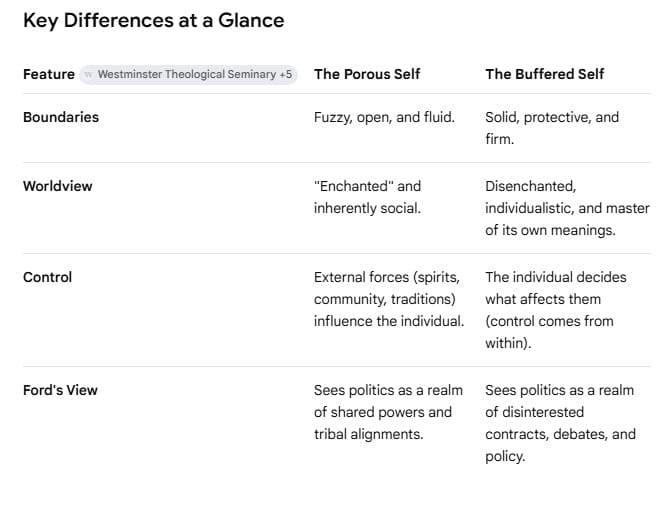
Luke Ford applies Charles Taylor’s “buffered vs. porous” framework to explain the deep, almost metaphysical disconnect between modern political tribes. He argues that the Right and Left do not just disagree on policy; they experience reality through fundamentally different psychological defenses.
1. The “Buffered” Liberal Elite (The Managerial Class)
Ford identifies the modern Democratic establishment and the professional-managerial class as the archetype of the Buffered Self.
The Worldview: They view themselves as autonomous individuals, “sealed off” from the spiritual or tribal forces of the world. They believe meaning is something they create inside their heads, not something that invades them from the outside.
Political Behavior: Because they are “buffered,” they rely on procedure, data, and contracts. They trust institutions (like the CDC or the FBI) because these institutions represent a rational, “immanent” order where everything can be explained and managed without “magic” or emotion.
The Blind Spot: Ford argues this makes them incapable of understanding the visceral, tribal instincts of the Right. To a buffered liberal, a Trump rally looks like mass hysteria because they cannot process the “collective effervescence” (a shared, porous emotional experience) that is happening.
2. The “Porous” Populist Right (The Trump Base)
Ford characterizes the populist Right (and the MAGA movement) as operating with a Porous Self.
The Worldview: They inhabit a more “enchanted” or “threatened” world where the boundary between the self and the outside is thin. They are “porous” to external forces—meaning they feel visceral disgust, spiritual contamination, or deep communal loyalty that bypasses rational filters.
Political Behavior:
Trump as Avatar: Trump speaks to the porous nature of his base. He doesn’t offer white papers; he offers protection from “invaders” and “poisons” (both literal and metaphorical).Vulnerability: Ford notes that the porous self feels invaded by cultural changes. Immigration isn’t just a policy dispute; it is felt as a physical or spiritual breach of the community’s “body.”
Conspiracy as Defense: Because they are open to “unseen forces,” they are more likely to believe in conspiracies (the Deep State, spiritual warfare) which explain the “evil” invading their world in a way that dry data cannot.
3. Case Study: The COVID-19 Divide
Ford has used the pandemic to illustrate this split vividly:
The Buffered Response (Blue America): Trusted the “immanent frame” of science. They sought safety through barriers (masks, social distancing, lockdowns)—literal buffers to seal off the self from the biological threat.The Porous Response (Red America): Viewed the virus—and the vaccine—through a lens of bodily purity and contamination. For many, the vaccine itself was viewed as the invader (a foreign substance breaching the porous body), while the virus was just a part of the natural “enchanted” struggle of life. The “mask” was seen not as a tool, but as a ritual muzzle—a spiritual humiliation.
4. The “Great Awokening” Twist
A key insight in Ford’s analysis (drawing on thinkers like Rony Guldmann) is that the modern “Woke” Left is actually a return to the Porous Self, disguised as secularism.
Speech as Violence: The idea that “words are violence” is a purely porous concept. It implies that a word spoken by someone else can physically penetrate your buffer and harm your soul.
Ritual Pollution: Ford argues that “cancellation” is a form of exorcism. When the Left “cancels” someone, they are removing a source of “moral pollution” that threatens the tribe, much like a village casting out a cursed individual in the pre-modern era.
The Hypocrisy: This leads to the current “Civil War” of reality: The Left claims to be buffered (rational/scientific) but acts porously (moral panics/witch hunts), while the Right openly embraces their porous tribalism but is mocked for it by the establishment.
Gemini says today: “Convenient beliefs” and “Why Morality Depends on False Beliefs” are core concepts developed by Stephen P. Turner, a Distinguished University Professor of Philosophy at the University of South Florida. Turner argues that human societies are not held together by rational, objectively true moral systems, but rather by highly functional, socially convenient “false beliefs” that resolve natural human conflicts and generate social order.
Turner’s work challenges traditional philosophy, suggesting that morality is a practical tool rather than a set of cosmic truths.
1. The Core Theory: Morality Depends on False Beliefs
In his paper, Why Morality Depends on False Beliefs, Turner bypasses traditional attempts to prove that being moral is objectively “rational”. Instead, he presents a naturalistic, sociological view of human nature:
Conflicting Drives: Human beings possess inherently conflicting biological and psychological desires.
The Illusion of Rationality: Instead of a complex, universally true moral framework, societies organically invent shared, comforting myths.
Social Order Over Truth: These false moral beliefs act as necessary social glue. They dictate what is “correct” or “genuine” so that individuals cooperate and avoid chaos.
The Cycle of Invention: When material conditions or historical realities change, the old convenient myths break down. Society is then forced to discard them and “invent new false beliefs” to maintain the social order.
2. “Convenient Beliefs” by Professional and Political Cohorts
Turner has frequently discussed how specific professional and political classes lean into highly specific, customized “convenient beliefs” to justify their authority, protect their status, and avoid facing internal contradictions.Examples of these “convenient beliefs” include:
Convenient Beliefs for Sociologists: Holding onto the concept of a homogenous, easily correctable “society” or pushing idealized, standardized metrics of social science while downplaying the field’s history of internal exclusion and institutional bullying.
Convenient Beliefs for Political Leaders (e.g., Germany or Russia): Adopting highly tailored national or geopolitical narratives that rationalize state actions, secure public compliance, and excuse economic compromises.
The Rejection of “Normativism”: Turner argues that social scientists shouldn’t judge whether these beliefs are “right” or “rationally justified”. Instead, they must treat them strictly as causal, natural phenomena used by human brains to cope with social environments.3. Epistemic Coercion and “The Bubble”
In his books like Explaining the Normative and newer essays on Epistemic Coercion, Turner expands on how convenient beliefs are sustained:
The Verstehen Bubble: Humans live inside a small, conscious “bubble” of mutual understanding that heavily relies on comfortable illusions, while the actual neural processes driving their choices remain hidden.
Manufactured Consensus: Powerful institutions, scientific bodies, and digital tech platforms frequently use coercion—disguised as “neutral expertise”—to suppress dissenting knowledge. This locks a population into a set of highly restricted, official “convenient beliefs” to prevent premature political fracture.
The concept of “convenient beliefs” in the context of sociologist Stephen Turner and independent podcaster/journalist Luke Ford refers to an analytical framework used to critique how public intellectuals, leaders, and professional groups adopt strategic moral and factual stances.
Rather than viewing political, social, or moral beliefs as purely rational or deeply held truths, this framework treats them as “coalition technologies” engineered to maximize group alignment, authority, and personal convenience.
The Theoretical Foundation: Alliance Theory
The collaboration and dialogue between Turner and Ford heavily relies on David Pinsof’s Alliance Theory of Political Belief Systems.
Moral Vocabularies as Tools: Under this framework, moral claims are not neutral reflections of reality. Instead, they are strategic tools used to recruit allies, signal loyalty to a tribe, and execute “jurisdictional wars” against rivals.
The “Convenience” of Truth: Beliefs are deemed “convenient” when they serve a dual purpose: they allow a person or group to protect their self-interest (e.g., funding, professional status, or political power) while maintaining the moral high ground.
Luke Ford’s “Ten Convenient Beliefs” Series
On the Luke Ford Podcast, Ford popularized this concept by developing hyper-specific, satirical yet analytical lists targeting different factions in modern society. These include:
Ten Convenient Beliefs for Sociologists Now
“>Ten Convenient Beliefs for Leaders of Germany / Russia Now
Ten Convenient Beliefs for This Blogger (Self-Critique)
Ford uses these lists to expose how different professionals adopt ideologies that neatly justify their job security, protect them from institutional backlash, and allow them to ignore conflicting data.
Stephen Turner’s Contribution: Anti-Normativism
Professor Stephen Turner, a prominent Weberian scholar and social theorist at the University of South Florida, provides the deeper sociological backing for these ideas. His academic work intersects with Ford’s commentary through several key concepts:
1. Good Bad Theories (GBT)Turner argues that many widely accepted societal beliefs are “Good Bad Theories”. These are factually flawed or false theories that are nonetheless “good” at coordinating large human groups—much like religious taboos functioned in primitive societies. They persist because they are socially useful and convenient for maintaining order, not because they are true.
2. The Myth of “Shared Practices”
In his book Brains/Practices/Relativism, Turner critiques traditional sociology for assuming that people share unified, objective cultural frameworks. He uses cognitive science to argue that we all have individualized, distributed habits. Therefore, institutional “shared values” are often just comforting, convenient narratives we tell ourselves to smooth over messy social interactions.
3. The Capture of Sociology
Turner frequently critiques the modern university system and the field of sociology for abandoning objective truth in favor of political programs. When sociology transforms from a “science of society” into an ideological provider for political policies, its foundational beliefs become “convenient” mechanisms to secure government grants and corporate-brand approval.
Luke Ford’s series, centrally indexed in his “The Custodianship Question” post, analyzes global culture wars through a sociological lens of group competition, tribalism, and institutional power dynamics. The work, often blending Rabbinic thought with secular sociology, explores the transition of custodianship over societal standards across different nations.
Sociological theories of hero systems explore how cultures and identities are built on socially constructed frameworks meant to provide individuals with a sense of primary value, meaning, and transcendence.
Cultural theorist Ernest Becker posited that all human hero systems (both religious and secular) are ultimately designed to manage the terror of death and give humans a feeling of lasting cosmic significance.
Luke Ford frequently interviews authors and philosophers about this. For example, the podcast featured discussions with writer and attorney Rony Guldmann dissecting how competing ideological movements in modern society function as rival hero systems that promote distinct narratives of oppression and cosmic importance.
* Ten Convenient Beliefs for Pope Leo XIV
* Ten Convenient Beliefs in the UC Berkeley School of Public Health
* Ten Convenient Beliefs For The MFA Elite
* Ten Convenient Beliefs in the Johns Hopkins University Bloomberg School of Public Health
* Ten Convenient Beliefs in the UCLA Luskin School of Public Affairs
* Ten Convenient Beliefs in the UCLA David Geffen School of Medicine
* Ten Convenient Beliefs in the UCLA School of Theater, Film & Television (TFT)
* Ten Convenient Beliefs in the UCLA Department of Psychology
* Ten Convenient Beliefs in the UCLA Fielding School of Public Health
* Ten Convenient Beliefs in the UCLA Graduate School of Education & Information Studies
* Ten Convenient Beliefs In UCLA’s Anthropology Department
* Ten Convenient Beliefs In Stanford’s Anthropology Department
* Ten Convenient Beliefs In UC Berkeley’s Anthropology Department
* Ten Convenient Beliefs In Harvard’s Anthropology Department
* Ten Convenient Beliefs In Stanford’s Sociology Department
* Ten Convenient Beliefs In Princeton’s Sociology Department
* Ten Convenient Beliefs In UC Berkeley’s Sociology Department
* Ten Convenient Beliefs In Harvard’s Sociology Department
* Ten Convenient Beliefs in the NYU Departments of English & Comparative Literature
* Ten Convenient Beliefs in Stanford’s Program in Modern Thought & Literature
* Ten Convenient Beliefs in the University of Chicago Department of English / Center for the Study of Gender and Sexuality
* Ten Convenient Beliefs In The Princeton Departments of English and Comparative Literature
* Ten Convenient Beliefs In The UC Berkeley Departments of English and Rhetoric
* Ten Convenient Beliefs In The Columbia University Department of English and Comparative Literature
* Ten Convenient Beliefs In The Harvard Department of English / History & Literature
* Ten Convenient Beliefs For Christopher Caldwell
* Ten Convenient Beliefs For IR Scholar John J. Mearsheimer
* Ten Convenient Beliefs For Israeli Political Analyst Haviv Rettig Gur
* Ten Convenient Beliefs For Author Yossi Klein Halevi
* Ten Convenient Beliefs For Philosopher Micah Goodman
* Ten Convenient Beliefs For Scholar Marc B. Shapiro
* Ten Convenient Beliefs For Sociologist Stephen P. Turner
* Ten Convenient Beliefs For Author Anne Applebaum
* Ten Convenient Beliefs For Religion Scholar Aaron W. Hughes
* Ten Convenient Beliefs For Leaders In America’s Deep State
* Ten Convenient Beliefs For West Bank Settlers
* Ten Convenient Beliefs For Seventh-day Adventist Leaders
* Ten Convenient Beliefs For Iran’s Next Supreme Leader
* Ten Convenient Beliefs For The Leaders Of Tencent (WeChat)
* Ten Convenient Beliefs For The Leaders Of Berkshire Hathaway
* Ten Convenient Beliefs For The Leaders Of Meta (Facebook)
* Ten Convenient Beliefs For The Leaders Of Saudi Aramco
* Ten Convenient Beliefs For The Leaders Of TSMC
* Ten Convenient Beliefs For The Leaders Of Nvidia
* Ten Convenient Beliefs For The Leaders Of Amazon
* Ten Convenient Beliefs For The Leaders Of Alphabet (Google)
* Ten Convenient Beliefs For The Leaders Of Wells Fargo
* Ten Convenient Beliefs For The Leaders Of Microsoft
* Ten Convenient Beliefs For The Leaders Of Goldman Sachs
* Ten Convenient Beliefs For The Leaders Of Apple
* Ten Convenient Beliefs For The Leaders Of AI
* Ten Convenient Beliefs For The Leaders Of Italy
* Ten Convenient Beliefs For The Leaders Of Denmark
* Ten Convenient Beliefs For The Leaders Of NATO
* Ten Convenient Beliefs For The Leaders Of Canada
* Ten Convenient Beliefs For The Leaders Of Mexico
* Ten Convenient Beliefs For The Leaders Of Brazil
* Ten Convenient Beliefs For The Leaders Of Argentina
* Ten Convenient Beliefs For The Leaders Of Ohr Somayach
* Ten Convenient Beliefs For The Leaders Of Aish HaTorah
* Ten Convenient Beliefs For Leaders Of Taiwan Now
* Ten Convenient Beliefs For The Leaders Of Lebanon
* Ten Convenient Beliefs For Leaders Of Syria Now
* Ten Convenient Beliefs For Leaders Of Poland Now
* Ten Convenient Beliefs For Leaders Of Cornell Now
* Ten Convenient Beliefs For The Leaders Of The Middle East Institute
* Ten Convenient Beliefs For Leaders Of India Now
* Ten Convenient Beliefs For Leaders Of Egypt Now
* Ten Convenient Beliefs For Leaders Of Pakistan Now
* Ten Convenient Beliefs For Leaders Of Oman Now
* Ten Convenient Beliefs For Leaders Of Bahrain Now
* Ten Convenient Beliefs For Leaders Of The University Of Pennsylvania
* Ten Convenient Beliefs For Leaders Of Kuwait Now
* Ten Convenient Beliefs For Leaders Of UC Berkeley Now
* Ten Convenient Beliefs For The Leaders Of Qatar Now
* Ten Convenient Beliefs For The Leaders Of United Arab Emirates Now
* Ten Convenient Beliefs For Supporters Of Amy Wax In Her Battle With UPenn Now
* Ten convenient beliefs for leaders at the U.S. Department of War
* Ten Convenient Beliefs For Lovers Of Jacques Marie Émile Lacan
* Ten Convenient Beliefs For Lovers Of Jacques Derrida
* Ten Convenient Beliefs For Lovers Of Michel Foucault
* Ten Convenient Beliefs For Leaders Of Imperial College London Now
* Ten Convenient Beliefs For Ethicists Now
* Ten Convenient Beliefs For Sociologists Now
* Ten Convenient Beliefs For International Relations Scholars
* Ten Convenient Beliefs For People Who Cry During The Movie Legends Of The Fall
* Ten Convenient Beliefs For Lovers Of Air Supply
* Ten Convenient Beliefs For Leaders Of Cedars-Sinai Medical Center
* Ten Convenient Beliefs For Leaders In HR
* Ten Convenient Beliefs For Leaders Of Stanford Now
* Ten Convenient Beliefs For Leaders Of USC Now
* Ten Convenient Beliefs For Leaders Of CalTech Now
* Ten Convenient Beliefs For Leaders Of Cambridge
* Ten Convenient Beliefs For Leaders Of Oxford
* Ten Convenient Beliefs For Leaders Of MIT Now
* Ten Convenient Beliefs For Leaders Of The University Of Chicago Now
* Ten Convenient Beliefs For Leaders Of Harvard Now
* Ten Convenient Beliefs For Leaders Of Princeton Now
* Ten Convenient Beliefs For Blackrock Now
* Ten Convenient Beliefs For Joe Rogan Now
* Ten Convenient Beliefs For Richard Spencer Now
* Ten Convenient Beliefs For Candace Owens Now
* Ten Convenient Beliefs For Tucker Carlson Now
* Ten Convenient Beliefs For Megyn Kelly Now
* Ten Convenient Beliefs For Dan Turrentine Now
* Ten Convenient Beliefs For Mark Halperin Now
* Ten Convenient Beliefs For Leaders Of Ukraine Now
* Ten Convenient Beliefs For David Ignatius Now
* Ten Convenient Beliefs For Leaders Of Turkey Now
* Ten Convenient Beliefs For Leaders Of The Washington Post Now
* Ten Convenient Beliefs For Leaders Of The Atlantic Magazine Now
* Ten Convenient Beliefs For Leaders Of Australia Now
* Ten Convenient Beliefs For Leaders At The Counsel On Foreign Relations
* Ten Convenient Beliefs For Leaders Of The UK Now
* Ten Convenient Beliefs For Leaders Of France Now
* Ten Convenient Beliefs For Leaders Of Germany Now
* Ten Convenient Beliefs For Leaders Of Russia Now
* Ten Convenient Beliefs For Leaders Of China Now
* Ten Convenient Beliefs For Leaders Of Japan Now
* Ten Convenient Beliefs For Leaders Of Saudi Arabia Now
* Ten Convenient Beliefs For This Blogger
* Ten Convenient Beliefs For The Leaders Of The Columbia School Of Journalism
* Ten Convenient Beliefs For Leaders Of Big Law Who Refused To Cut Deals With The Trump Administration
* Ten Convenient Beliefs For Leaders Of Big Law Who Cut Deals With The Trump Administration
* Ten Convenient Beliefs For Leaders Of The ABC News Iran War Coverage Now
* Ten Convenient Beliefs For Leaders Of America’s Dissident Right Now
* Ten Convenient Beliefs For Leaders Of The Financial Times Iran War Coverage Now
* Ten Convenient Beliefs For Leaders Of The Fox News Iran War Coverage Now
* Ten Convenient Beliefs For Leaders Of The WSJ Iran War coverage Now
* Ten Convenient Beliefs For Leaders Of The New York Times Iran War coverage Now
* Ten Convenient Beliefs For Houthis Leaders Now
* Ten Convenient Beliefs For Hezbollah Leaders Now
* Ten Convenient Beliefs For Hamas leaders Now
* Ten Convenient Beliefs For Israel’s War Leaders Now
* Ten Convenient Beliefs For IRGC Leaders Now
* Ten Convenient Beliefs For American Leaders In Christian Nationalism
* Ten Convenient Beliefs For American Leaders In Gay Rights
* Ten Convenient Beliefs For American Leaders In Religious Freedom
* Ten Convenient Beliefs For American Leaders In Climate Change Research
* Ten Convenient Beliefs For American Leaders In Gender Affirming Care
* Ten Convenient Beliefs For Leaders Of American Medical Schools Under Civil Rights Investigation By The Trump Administration
* Ten Convenient Beliefs For American Elite Journalists Now
* Ten Convenient Beliefs For Leaders At UCLA Now
* Ten Convenient Beliefs For Yale English Department Faculty Now
* Ten Convenient Beliefs For Energy Experts Now
* Ten Convenient Beliefs For FDD analysts now
* Ten Convenient Beliefs For Iran Experts Now
* Ten Convenient Beliefs For Leaders At Yale University Now
* Ten Convenient Beliefs For Leaders At Columbia University Now
* Ten Convenient Beliefs For Social Psychologists In America Today
* Ten Convenient Beliefs For Ethicists In America Today
* Ten Convenient Beliefs For Trump Haters In America Today
* Ten Convenient Beliefs For Trump Lovers In America Today
* Ten Convenient Beliefs For Sex Workers In America Today
* Ten Convenient Beliefs For Bankers In America Today
* Ten Convenient Beliefs For Dentists In America Today
* Ten Convenient Beliefs For Doctors In America Today
* Ten Convenient Beliefs For Social Workers In America Today
* Ten Convenient Beliefs For Economists In America Today
* Ten Convenient Beliefs For Academics In America Today
* Ten Convenient Beliefs For American Attorneys Today
