
Almost Every Gadol Of The Early 20th Century Had A Child Who Left The Path

In his third lecture on Rav Elazar Schach for Torah in Motion, historian Marc B. Shapiro says that Rav Schach’s son became a religious Zionist aka Modern Orthodox as opposed to Chareidi aka traditional Orthodox (who are not Zionists, don’t believe in mixing secular education with Torah study, put the premium on Torah study as opposed to everything else). "Who knows? The inner dialectic of that relationship must’ve been interesting. This is not unusual. Almost all the Gadolim (Great Ones) of the past two generations had children who either became not religious or mizrachi (religious Zionist). I’m talking about the greatest Torah scholars. In those days, you were thankful your son remained religious. I’m talking 1890-1940. The forces were so strong for non-religiosity — Zionism, secularism, academic study of Judaism…

"Rav Yehezkel Abramsky had two sons [who left the path]. One became a real communist and one who was totally alienated from him. (R. Itsele of Ponovezh, also known as R. Isaac Rabinowitz, had something similar happen to him.) It was the era. I don’t think Rav Yaakov Kaminetsky had one sibling who remained religious. That’s what made Rabbi Moshe Soloveitchik so unusual. He had five children. All remained religious."

"Look at the Lubavitcher rebbe. His two brothers, neither are religious. His brother in Tel Aviv desecrated the Sabbath. He smokes on Shabbos. He owned a book store."

"The Brisker Rav’s kids all remained religious."

Dr. Shapiro calls Daniel Boyarin at U.C. Berkeley "a great Talmudist…influenced by the Satmar Rav. Finally, you have Rabbi Mayer Schiller at Yeshiva University High School who’s complete Neturei Karta, a follower of the Satmar Rav’s anti-Zionism."

Rabbi Shlomo Einhorn emails: "I work with Rabbi Schiller at MTA (Yeshiva University High School in NYC). His hashkafa is very sophisticated and unique. Trust me – he isn’t Neturei Karta. While I disagree with him on a lot of things – his philosophy, and he’ll admit this, is more aligned with the Left Wing Israeli Religious Zionist camp. The Neturei Karta accusation keeps popping up but I think he is being judged because he wears the Chassidic garb."

Here’s the Wikipedia entry for Rabbi Mayer Schiller:

Rabbi Mayer Schiller (1951 – ) is an American Hasid based in Monsey, New York State, who identifies himself as a member of Skver and Rachmastrivka groups and serves as spokesperson for the Skver community in New Square. Schiller also maintains active ties to the Modern Orthodox community and has advocated for a symbiosis between the best of traditional Orthodoxy and broader culture. He teaches advanced Talmud at Marsha Stern Talmudical Academy of Yeshiva University,[2] where he has been a teacher since 1987. Prior to that, from 1977-1981, Rabbi Schiller taught at YHSQ and from 1981-1987 he taught at Mesivta Ohr Torah (both in Queens, NY). From 1979 to 1981, he served as the first hockey coach at the Ramaz School and later in the same capacity at MTA from 1985-1988 and again from 1990-1995. In his final 6 years as coach his teams won 6 consecutive championships. [3]. He is a Baal teshuva, having begun practicing Orthodoxy in the spring of 1964 at age 12.[1]

In the arena of political thought, the Rabbi is most noted for his advocation of non-violent separatism ensuing most significantly from principles of religious, cultural, ethnic, and racial identity and social anti-universalism. He is an outspoken critic of liberal notions of race and the bias against traditional religion in today’s media and popular culture. Along those lines, he was a featured speaker at the American Renaissance conference in 1994.[4] He has been associated with various groups including the Third Way (UK) and the Ulster Third Way. However, Schiller has also advocated a universalist morality and embrace of the Other, provided that is pursued without loss to group identity. [2] He is involved with the group Toward Tradition, which seeks to advance cooperation between Jews and conservative Christians, and is an expert on the thought of C. S. Lewis.

Schiller is also the author of two books "The Road Back: A Discovery of Judaism Without Embellishments," " The (Guilty) Conscience of a Conservative," and a monograph in defense of Rabbi Samson Raphael Hirsch’s Torah Im Derech Eretz philosophy, titled "And They Shall Judge the People With True Righteousness." (the 2nd under the name Craig Schiiler).

In his first lecture on Rabbi Moshe Feinstein, Marc Shapiro recalls working as a waiter in 11th and 12th grade student at the hotel Simcha by the Sea. Rav Aron Kotler’s widow would come every Shabbos. "I was their waiter every Shabbos.

"It shows you how Orthodoxy has changed. There was no mashgiach (kashrut supervisor). I don’t think you could have a situation today with a hotel without hashgacha. All the gadolim came and there was no hashgacha. One Shabbos, the proprietor tells me that R. Moshe Feinstein was coming. I got to ask many questions. I asked Reuven Feinstein is it true that your father does not read any newspapers so that his psak (Jewish law rulings) are not affected? Reuven got offended. He said, ‘My father is a citizen. He reads the newspaper every day.’

"It’s an interesting example of how the legends outstrip the reality."

For Ashkenazim, Dr. Shapiro calls Moshe Feinstein the most influential posek in the world during his last 15 years (1971-1986) and the most important posek in America in the last half of the 20th Century.

Before Reb Moshe rose to prominence in the 1960s, the most important posek in the United States was Rav Yosef Eliyahu Henkin, who also lived on the Lower East Side. Rav Henkin was mainly a posek for New York, while for Rav Moshe, all serious questions had to go to him. It doesn’t mean that everyone accepted him. He wasn’t the Pope.

When he came to America, he didn’t take offers from Yeshiva University nor Torah V’Das because he didn’t want to be in an institution where lay leaders ran the show. He wanted to be somewhere a rosh yeshiva (head of the yeshiva) ran the show. When a rosh yeshiva dies and his son or son-in-law takes over, they often don’t measure up while a public trust such as YU is generally run more efficiently and effectively through the generations.

In the 1920s, Reb Moshe became the rosh yeshiva of Mesivtha Tifereth Jerusalem, which never became known as one of the oustanding yeshivas.

Dr. Shapiro says: "I’ve never been a big fan of the Brisker method, mainly because I’ve never understood it."

"Rav [Elazar] Schach was not a posek. He never poskened. Only in today’s hagiographic world could this be considered a put down. Rav Aharon [Kotler] was more dynamic."

Dr. Shapiro calls Reb Moshe’s psak that smoking is permitted "tragic… Not everything that is stupid is forbidden. Is it forbidden to drive 75 mph in a 60 mph zone when everyone is doing it? I don’t know… It is hard to take someone seriously as a rabbi if they smoke."

"Reb David Chaim Halevi was the first one to rule that smoking is forbidden. He was followed by the Sitz Eliezer. Today I don’t know of any posek [who permits it], certainly not in the Modern Orthodox world… It annoys me to no end when I see the Hasidim smoking, but I assume that their poskim hold that smoking is permissable.

"Reb Moshe was very opposed to smoking. He said you can’t smoke in a yeshiva… But you can’t forbid it. You can’t say that a person who does it is a sinner. This Rabbi Mordecai Halperin, a big rabbi scientist in Israel, they hold that a smoker is not allowed to be a witness in a marriage. They hold that a smoker is a terrible sinner, the equivalent of someone who desecrates the Sabbath. To really feel that this is such a terrible thing, you have to follow it through.

"Reb Moshe was worried about the slippery slope. Where do you draw the line? What about fatty foods? He wasn’t aware of everything. Rav [Moshe] Tendler would say, if Reb Mosher were alive now, he would assur (forbid) it. If it’s really assur, what about the people who don’t listen to it?

"If you take seriously that smoking is injuring your life, that it is a terrible sin you are violating, such a person can not be a witness for a wedding. Are we now going to start asking people, do you smoke?"

"Maybe Reb Moshe loved Jews too much to declare them all sinners."

"Today obviously for the younger generation, most of us find it abhorrent. It’s hard to believe that someone could smoke and consider himself a religious person. Rabbi [Moshe] Tendler says it is worse than eating pork."

"In Israel, smoking is everywhere."

"This one rabbi wrote if Reb Moshe assured smoking, it would’ve saved lives. It is a disappointing psak. On the other hand, what does this rabbi want Reb Moshe to do? Reb Moshe didn’t think it was a good thing to do, but he didn’t think it was technically forbidden. Should Reb Moshe have lied? Should Reb Moshe have made up the halacha? Are you allowed to twist halacha in the name of some larger goal? Reb Moshe didn’t do that."

"Rav Ovadia Yosef’s newspaper Yom Ha Yom — the Shas newspaper in Israel — no longer takes ads for cigarettes and they did declare smoking forbidden. Rabbi Elyashiv won’t come out against it… In Israel, they don’t know about the health issues… Boruch Ber Leibowitz had a terrible smoking addiction and he’d put all his old cigarettes in a canister and on Shabbos, he’d open it up and smell it."

"It’s a terrible problem in the charedi world in Israel where there’s smoking everywhere."

In Reb Moshe’s yeshiva Mesivtha Tifereth Jerusalem, there was a money laundering scandal by some administrator.

Rav Ovadia Yosef is Reb Moshe’s successor. Only they among deciders of Jewish law from an Orthodox perspective speak to the larger community. Only Rav Ovadia, like Reb Moshe, is concerned about the non-religious Jew living in Netivot. Only Reb Moshe wrote to rabbis in Lancing, Michigan, where everybody violates the Shabbat.

Charedim tend to have an expansive view of what constitutes chukas ha goyim (ways of the Gentiles forbidden to the Jew). Some of them hold that you can’t even eat kosher chinese food.

Reb Moshe’s other responsa (opinion) that’s "very disappointing is his one on homosexuality. Reb Moshe had no understanding of it. He sees homosexuals as evil people who have no real sexual inclination for homosexuality because no one does, they just want to rebel against God. This total lack of understanding about what homosexuality is about with people struggling with real issues… Reb Moshe was in an era where people don’t understand homosexuality like they do today."

Reb Moshe refers to non-Sabbath keepers as rashaim (evil ones). He refers to churches as "places of nothing."

Marc Shapiro writes about the negative consequences of Orthodoxy’s refusal to deal with Christianity:

I would say that, despite its intent, "Confrontation" reaffirmed Orthodox Jews’ inclination that, in all but the most negligible circumstances, they should ignore the dominant religion and its adherents. A different essay by the Rav could have put an even greater stress on the positive results of interfaith cooperation in "secular" spheres.14 Instead, almost nothing was done to remove the fear of Christianity from Orthodoxy, and while in the very shadow of Vatican II this might have been the correct approach, by now I think we have moved beyond this. Yet even in our day it would still be unheard of for a Christian clergyman to address the members of an Orthodox synagogue or group about matters of joint concern. A lay Christian might be welcome, but any relationship with clergy is seen as dangerous, in that it could lead to a compromising of traditional Jewish beliefs.

Another result of the lack of any dialogue between Orthodox Jews and Christians is that in addition to the fear of Christianity, there remains an enormous amount of ignorance. On numerous occasions I have heard Orthodox Jews assert that according to Christianity one must accept Jesus in order to be "saved". When I have pointed out that this notion has been repudiated by the Catholic Church as well as by most Protestants, the response is usually incredulity.

It is also significant that Orthodox Jews treat Christianity as an abstraction, and detailed discussions about its halakhic status continue to be published. I find it strange, however, that in our post-modern era people can write articles offering judgments about Christianity based solely on book knowledge,15 without ever having spoken to Christian scholars and clergymen, that is, without having ever confronted Christianity as a living religion.16 There is something deeply troubling about Orthodox figures discussing whether Christianity is avodah zarah without attempting to learn from Christians how their faith has impacted their lives. I would think that this narrative, attesting as it does to the redemptive power of faith, must also be part of any Jewish evaluation of Christianity.17 Yet barring theological dialogue, how is this possible?
I realize that the halakhic system prefers raw data to experiential narratives, but certainly modern halakhists and theologians are able to find precedents for inclusion of precisely this sort of information. After all, wasn’t it personal contact with Gentiles, and the recognition that their lives were not like those of the wicked pagans of old, that led to a reevaluation of the halakhic status of the Christian beginning with Meiri and continuing through R. Israel Moses Hazan,18 R. David Zvi Hoffmann, and R. Jehiel Jacob Weinberg?

Posted in Haredi, Israel, Marc B. Shapiro, Modern Orthodox, Orthodoxy | Tagged , , , , , , , , | Comments Off on Almost Every Gadol Of The Early 20th Century Had A Child Who Left The Path

Danielle Berrin Appreciates Female Beauty As Much As I Do

From the Jewish Journal cover story this week:

One look at the photograph Esquire used to declare actress Shirly Brener one of five Israeli women they love, and you want to wish the rest of her persona good luck in catching up. Picture it: She’s thigh-deep in a pool, clad in a lacy white bikini that leaves little to the imagination, with a body that an artist could have cut from a stone. It’s the kind of photo that needs no caption, one you’ve seen before: the “look at me, notice me” photo that plenty of actresses take. Before they become serious.

The photo tells you that Brener is hot; that she has a great (and I mean great) body — but it doesn’t tell you why you should love her.

When we meet for lunch at a popular Los Angeles haunt for Israeli expats, Brener is sitting outside at a corner table. She is unmissable: Her blonde hair and blue eyes radiate an all-American look that always seems to turn heads — plus she’s wearing a zebra sweater. She waves me over with a huge, gleaming smile like a doll that comes to life.

FROM INKEDMAG.com:

"I’ve gotten to play a lot of drug addicts and hookers this year," muses actress Shirly Brener. The Bardot-esque blonde, who possesses a paradoxical mix of girl-next-door charm and femme fatale-worthy dark sensuality, revels in her distinctiveness. She’s as comfortable portraying the bubbly love interest in a romantic comedy as a depraved addict in an indie flick. "Once you really get to know me you see that I am actually pretty edgy," she purrs over the phone. "There is a darkness, an edge, in me, and I really like to go against what is first expected." 

The Israel-born and L.A.-by-way-of-London-bred actress got her start in the business at age 2 when she was photographed with her thespian mother in an ad campaign. She has since worked alongside accomplished actors such as Harvey Keitel, Val Kilmer, and James Spader and reached full-fledged celeb status in her home country, where she costarred in an O.C.-like prime time soap opera. Brener recalls her most recent cinematic accomplishment, Righteous Kill, the gritty cop drama staring film titans Al Pacino and Robert De Niro: "It was definitely an experience of a lifetime," she says. "It’s funny because I wasn’t nervous when I booked the job. The audition process was far more nerve-racking."

When asked to discuss her ink-a rotund cherub at her chiseled hip and a glowing sun on her back that she got as a teen in Israel-she dives into a careful explanation of the sun. It’s an homage to her maternal grandmother, a Holocaust survivor, who saw her potential as a performer early on. "My grandmother always used to say, ‘You are like the sun-you come in and light up the room.’ She was a huge inspiration for me and I decided to get this as a tribute to her."

Posted in Danielle Berrin, Hollywood | Tagged , , , , , , , , , | Comments Off on Danielle Berrin Appreciates Female Beauty As Much As I Do

Tough Times For Venezuela’s Jews

Melanie Kirkpatrick writes:

In 1998, the year Hugo Chavez was elected president, there were 22,000 Jews in Venezuela. Today the Jewish population is estimated at between 10,000 and 15,000.

Those numbers tell a story, and it’s not a happy one. The Jews of Venezuela are fleeing to Miami, Madrid and elsewhere because of the anti-Semitism they face at home. In an interview this week in Washington, D.C., the country’s chief rabbi sounds a warning bell: "There’s anxiety in the Jewish community because of what has happened," says Rabbi Pynchas Bremer, "and of course because of what may happen."

Mr. Chavez’s vitriol about Jews is well documented and of long standing. In recent years he has referred to Venezuelan Jews as "descendants of the same ones who crucified Christ" and "a minority [that] has taken ownership of all the gold of the planet." According to Shmuel Herzfeld, a Washington, D.C., rabbi who visited Venezuela in March: "Chavez is isolating the Jews and turning Venezuelans against the Jewish community. . . . The government is transforming a society that has been welcoming and accepting of Jews" in the past. Rabbi Bremer, who has lived in Venezuela for more than 40 years, says that he had never personally encountered anti-Semitism or heard of anti-Semitic incidents until recently.

This year has seen an intensification of attacks — verbal and physical — on Jews and Jewish institutions in Venezuela.

Posted in Jews | Tagged , , , , , | Comments Off on Tough Times For Venezuela’s Jews

Convicted Los Angeles Muslim Terrorist Talks

From The Enterprise Report:

Convicted terrorist leader Kevin Levar James sat for an unprecedented over hour long interview with The Enterprise Report this week.

James led the prison based Muslim organization known as JIS.

James pleaded guilty and was sentenced to 16 years in federal prison earlier this year for his role in a what authorities say was a plot to bomb and attack targets throughout Southern California.

James’ beginnings as an LA-Hoover gang member in Los Angeles is the focus of this part of the interview.

James who says he grew up on Hoover Street in Los Angeles talks about his youth and how he first got into trouble with the law.

Posted in Islam, Los Angeles | Tagged , , , , | Comments Off on Convicted Los Angeles Muslim Terrorist Talks

Ireland Prepares For Swine Flu

Emma:  I read in my local paper. They have made 700 burial spots in my city.. just in case the Swine Flue breaks here
Emma:  In the Lisburn area, several hundred burial sites have been identified as being immediately available in the event of mass fatalities, with other possible areas outlined for use in an emergency, if necessary.

Posted in Irish | Tagged , , , , | Comments Off on Ireland Prepares For Swine Flu

Rabbi Lazer Brody Speaks At Nessah Synagogue Tonight

Emunah emails: "You have been scooped by David Suissa. He is interviewing Rabbi Lazer Brody, Breslev Rabbi from Israel, who is in town to spread Emuna (trust in God), and is speaking tonight at Nessah. For his full schedule while in LA go to www.lazerbrody.net and click on the poster link on the top right."

Nessah.org says:

Rabbi Lazer Brody is a unique Breslev Rabbi who is committed to helping people from all backgrounds to discover their hidden strengths and potential.

Known as the "Rambo Rabbi" and a former commando of an elite IDF infantry reconnaissance unit, Rabbi Brody is a remarkable spiritual guide who has succeeded in leading tens of thousands of people from around the world down the path of true happiness and tranquility. In his acclaimed book "The Trail to Tranquility", he brings the reader priceless advice and guidance in dealing with life’s most trying situations. As the English voice of his beloved mentor and spiritual guide Rabbi Shalom Arush, Rabbi Brody is the translator of Rabbi Arush’s international bestsellers, "The Garden of Emuna" and "The Garden of Peace". Don’t miss this unique opportunity to see, hear and meet him.

Posted in Nessah | Tagged , , , , | Comments Off on Rabbi Lazer Brody Speaks At Nessah Synagogue Tonight

Peter Lowy Back In The News

Click here to peruse the recent articles. They’re about the economy.

They don’t talk about the longtime Pico-Robertson resident’s tax evasion and why he’s staying away from the United States.

I suspect it will be a cold day in hell before any of the Jewish institutions who’ve profited from Lowy’s donations or David Rubin‘s send out emails calling for rallies outside their homes.

The Peter Lowy tax evasion story has yet to be told in the pages of the Jewish Journal, which only contains content about him that is glowing.

Australian journalist Peter Ryan spoke this week with Peter and Steven Lowy:

PETER RYAN: Peter Lowy says US conditions might be tough but he believes that given Westfield’s market strength and $7-billion of available cash, the big deals will still come his way.

PETER LOWY: They’re very strong retailers. They want to do business with very strong developers and so we’re seeing a flight towards us in that area, certainly from executives who are working in the industry. They want to be working for companies that are very strong and have a healthy profile going forward.

From the retailers themselves they want to be doing business where they know who they’re doing business with going forward and they know when there’s a transaction that it’s going to be commercially honoured.

Peter Lowy has done his utmost to stay out of the news for the past nine months. I wonder why he’s chosen now to emerge? I can only speculate that he needs to see if he is still a pariah or if can once again show his face in polite society.

American Jewish University, where Lowy is chair of the board, has not scrubbed his name from its website.

Posted in Peter Lowy | Tagged , , , , , | Comments Off on Peter Lowy Back In The News

How Do LA’s Orthodox Rabbis Determine Their Moral Priorities?

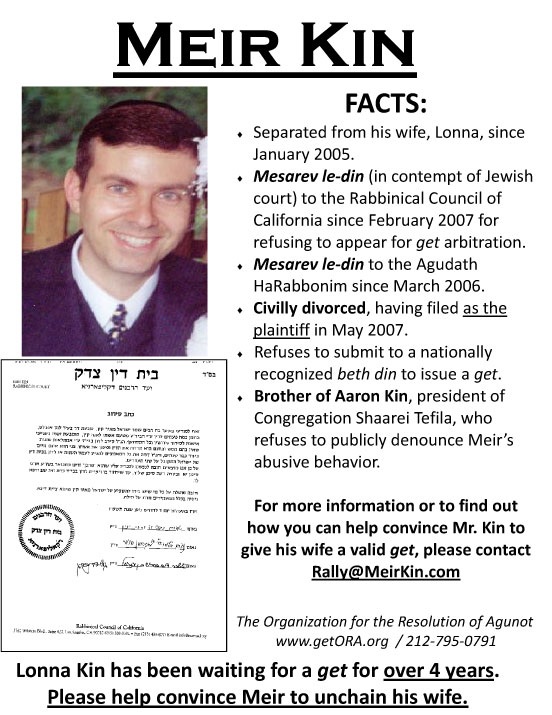
All three Modern Orthodox shuls in Pico-Robertson — Bnai David-Judea, Beth Jacob and Young Israel of Century City — email their members to regularly rally outside the home of Meir Kin’s parents to protest his refusal to give a Jewish divorce (get) to his wife through the RCC.

I don’t understand this particular divorce case but it seems to me it is not a simple case of Meir Kin refusing to give his wife a get. He’s refusing to give his wife a get through the RCC, a deeply corrupt and bullying organization.

If you doubt me that the RCC loves to bully, then just look at these jpgs it is sending around through its shuls and ask yourself if this is the act of the righteous. Without knowing anything about the case, just look at the RCC’s case and see how you feel. Just imagine the RCC took the side of your ex-wife or ex-business partner in some complex and difficult dispute and encouraged the Jewish community to rally outside your home. How would you like that?

Calling for rallies outside somebody’s home makes me nervous. It feels like throwing someone to a mob. You have published a specific address and said that the people there have done something horrible and deserve to be publicly shamed.

It seems to me that if you want to shame somebody, then you write a blog. You don’t organize rallies outside their parents’ home.

If the facts of this divorce lay the fault equally between the husband and wife, then it would be only fair if those taking Meir Kin’s side rallied their supporters to protest outside the homes of those Los Angeles Orthodox rabbis pushing this jihad.

Imagine what an ugly community we’d have.

I don’t know much about this case and I haven’t spoken to any of the rabbis pushing for these rallies to better understand their case. Therefore, I feel queasy about criticizing them over this. I am sure they could articulate their case eloquently.

I can prove to you that something is deeply askew in the moral priorities of those Orthodox rabbis who encourage their congregants to rally outside the Kin home. And you don’t need to know anything about the Kin divorce to see this simple moral truth. Just ask yourself — when was the last time these rabbis asked anyone to rally outside of a home? I can’t recall.

The only conclusion I can reach is that these rabbis regard this particular withholding of a divorce through the RCC as the greatest moral blot on our community. But that is absurd. I’ve published on my blog details of far greater crimes being committed by their fellow Modern Orthodox rabbis.

Let’s talk about the case of Rabbi Aron Tendler. In the late 1980s, Aron Tendler was the head of YULA (Yeshiva University of Los Angeles) day school for girls. He was having sexual interactions (short of intercourse) with several of his students. Girls came forward with their first-person stories and the rabbis reacted strongly — by shaming the girls and protecting Aron by moving him to the YULA boys school and then to Shaarey Zedek.

For 16 years, dozens of people and numerous rabbis in Pico-Robertson in particular and Los Angeles in general, knew that they had a sexual predator in positions of rabbinic authority and they did nothing. They didn’t call for rallies outside Aron Tendler’s home or for rallies outside of his Uncle Shalom Tendler’s home (Shalom helped protect Aron).

While the Av Beit Din of the Beth Din of Los Angeles and the head rabbi of Beth Jacob, Abner Weiss, carried on affairs with various women in the community, his fellow rabbis did nothing to stop him. Today Abner Weiss is a member in good standing of the RCA, the pulpit rabbi of an Orthodox shul in Westwood and a licensed and practicing therapist. He’s also had — in the last three years — at least deeply damaging and long-running sexual relationship with one of the women he’s counseled (if you want details, ask Rabbi Steven Weil who’s done his best on this and similar matters). Why aren’t Abner Weiss’s fellow rabbis calling for rallies outside of Abner Weiss’s home?

I am not calling for rallies outside of anyone’s home. The only moral context I can see for such rallies is in cases of life and death.

America’s most famous tax cheat is a longtime honored member of Pico-Robertson Orthodox shuls — Peter Lowy. Why not rally outside his home or the homes of those close to him or at his work place?

I am not calling for this. I think it would be horrible. But I don’t see what Peter Lowy has apparently done in massive robbery of the U.S. Treasury is any less heinous than what Meir Kin is alleged to have done in his divorce.

Jews with multiple felony convictions can walk into any of Pico-Robertson’s three Modern Orthodox synagogues — all of which have banned me — and daven undisturbed. Beth Jacob, Bnai David and YICC are happy to extend membership to Jews who’ve had their medical license taken away for having sex with patients. All of them are happy to have writers and producers of R-rated movies in leadership positions. I have no objection to any of this. It just seems bizarre, however, when Pico-Robertson’s Modern Orthodox rabbinate call for protests outside the home of Meir Kin’s parents over this complicated divorce but are completely laisez-faire about equally large violations of Jewish law by their own congregants.

What is the other major moral issue Pico-Robertson’s Modern Orthodox rabbis have spoken out about in the last nine months? The need for ethics certification (Peulat Sachir) for Pico-Robertson businesses (a certification that depends entirely on the employer agreeing to abide by California labor law in six basic areas). The rabbis presented zero evidence of wrongdoing in Los Angeles in the areas they are regulating. They presented zero stories by workers in Los Angeles who’ve been mistreated in the areas the rabbis now wish to certify. I’ve yet to hear from a single worker at a Jewish-owned business in Pico-Robertson who believes this ethics certification will make their lives better.

A PERSONAL NOTE: A few weeks ago on Marc Germain’s radio show, he asked me for my favorite rabbis. Among those I named were all the pulpit rabbis of Pico-Robertson’s Modern Orthodox shuls. I love these guys. I question them here because the story demands it. My personal interests militate entirely against my publishing anything critical of them.

As for Abner Weiss, I have only had wonderful interactions with him. Not only that, but all my friends who know him have only told me about wonderful interactions they’ve had with him. It is completely against my self-interest to write anything negative about him.

Morris emails: In your article of 4 30 2009 about meir kin’s divorce, I was amazed at your accuracy of predicting the essence of the "real Truth on this matter". Apparently Lonna Kin’s cousin, the infamous rabbi aryeh ralbag from brooklyn who heads the triangle-k hashgacha, put his nose into this matter and had it arranged that his cohort corrupt rabbis will look the other way and not the truth, to harass, intimidate and prosecute the kin family. there are no rabbis in Monsey ny, where this couple had resided, that side with lonna kin, and most hancock park-fairfax rabbis oppose her due to her long history of abusive practices towards her husbands. the last time you wrote about this case , i presented damaging evidence that vindicates meir kin.the most damaging evidence was that letter from Rabbi Ginzburg, who was the 2nd in command of the bais din Agudas Harrabonim, who mustered the courage to oppose the rabbis of his Bais Din which is headed by Lonna Kins cousin,Aryeh Ralbag and stated that Mr Kin acted according to Halacha and could not attend any bais din because mrs kin had gagged him! therefore mrs kin has brought the  delay of her Get upon herself, for her selfish and cruel behavior!

Posted in Meir Kin, Pico/Robertson, Rabbis, RCC | Tagged , , , , , , | Comments Off on How Do LA’s Orthodox Rabbis Determine Their Moral Priorities?

This Week’s Torah Portion Acharei Mos-Kedoshim 5769

Steve Brizel writes:

Yom HaZikaron and Yom HaHatzmaut

  • Esther Wachsman describes the sense of unity generated for the safe return of Nachshon Wachsman, HaShem Yimkam Damo, z"l: link
  • R. Dovid Miller and R. Ezra Schwartz examine the connection between Yom HaZikaron and Yom HaAtzmaut: link 1 (audio), link 2 (audio)
  • R. Mosheh Lichtenstein evaluates the religious significance of the establishment of the State of Israel in the light of Purim and Chnukah: link
  • R. Hershel Schachter explores the contemporary application of the Mitzvah of living in Eretz Yisrael and sets forth 10 reasons to support Hakamas Medinas Yisrael: link 1 (audio), link 2 (audio)
  • R. Shalom Rosner examines the meaning of Geulah today: link (audio)
  • R. Joshua Flug discusses whether one should recite a Bracha on Halel on Yom HaAtzmaut: link
  • R. Zvi Sobolofsky explores Kedushas Eretz Yisrael: link (audio)
  • R. Michael Rosensweig explains why Yom HaAtzmaut presents us with an opportunity for Kedushah, spiritual opportunity, Hallel and Hakaras Hatov: link
  • An Overview of Acharei Mos-Kedoshim

  • R. Yitzchak Etshalom explains the sequencing of the various mitzvos in both parshiyos: link
  • R. Baruch Simon demonstrates a common theme underscoring both Parshiyos, namely acting in advance of the appropriate time and with proper reverence for the Ziknei HaDor: link (audio)
  • Acharei Mos and Sefer Vayikra

  • R. Avraham Walfish explains why Parshas Acharei Mos is the pivotal parsha in Sefer Vayikra: link
  • Avodas Yom Hakippurim

  • Rav Soloveitchik z"l explores the many Halachic and Hashkafic dimensions of the Avodas Yom HaKippurim: link
  • Issurei Arayos

  • R. Yakov Haber (formerly of RIETS) explores many of the reasons for Issuei Arayos: link
  • R. Zvi Sobolofsky explains why the concept of Asu Siyag LaTorah is a mechanism for our Yiras Shamayim, and especially so in the area of Arayos: link
  • Chukos HaGoyim

  • R. Dovid Gottlieb explores the Halachic and Hashkafic aspects of Chukos HaGoyim: link (audio)
  • Kedoshim Tihiyu

  • R. Michael Rosensweig and R. Mayer Twersky explain why Parshas Kedoshim is a key to acquiring a halachic values and world view and a focused, consecrated life: link 1, link 2
  • R. Berel Wein, based upon the famous words of the Ramban, exhorts us not to compartmentalize our lives: link

  • R. Yissocher Frand, based upon the Chasam Sofer’s understanding of a Machlokes Rashi and Ramban, reminds us that this portion was given in a mass gathering to emphasize that the fact that we are commanded to achieve Kedusha through a certain degree of abstinence, it can only be done in the context of family and community: link
  • R. Asher Brander reminds us that Parshas Kedoshim is the third Parsha where the Aseres HaDibros are given and explains the unifying elements of all the Mitzvos: link
  • Lifnei Iver

  • R. Asher Weiss discusses the dimensions of Lifnei Iver Lo Siten Michshol: link
  • Kiddush HaShem

  • The Nesivos Shalom, as elucidated by R. Yitzchak Adlerstein, explains why the Rambam discusses the halachos of Kiddush HaShem in Hilcos Yesodei HaTorah: link
  • Pikuach Nefesh

  • R. Zvi Sobolofsky explores the halachic dimensions of Pikuach Nefesh: link (audio)
  • Vahavta Lreacha Kamocha

  • R. Mordechai Willig and R. Daniel Stein discuss the relationships between observant and non- observant Jews and inviting a non-observant Jew for a Shabbos meal: link 1 (audio), link 2 (audio), link 3 (audio)
  • R. Hershel Shachter discusses halachic issues relating to Gerus and Kiruv: link (audio)
  • R. Dovid Gottlieb discusses the obligation and limit of Kiruv: link 1 (audio), link 2 (audio)
  • R. Daniel Feldman discusses priorities in Tzedaka: link (audio)
  • R. Shlomo Riskin, based upon R. Hai Gaon’s understanding of the time of the demise of R. Akiva’s students and the views of R Yochanan Ben Zakkai and R Akiva in the aftermath of Churban Bayis Sheni, suggests an alternative explanation for their demise: link
  • Lo Takifu and Tatoos

  • R. Asher Weiss explores the prohibition of Lo Takifu and Tatoos: link
  • Link to last year’s roundup: link

    Posted in Torah | Tagged , , , , , | Comments Off on This Week’s Torah Portion Acharei Mos-Kedoshim 5769

    Putting Limits On Your Patients

    Josh emails: "Dear Mr. Ford: My therapist won’t let me give details of my sex life, she limits me to saying the emotional meaning of what happens… She’s the first therapist to put such a limit on me (most of my previous therapists were female and they had no objection to hearing the dirty details). Are these limits a normal thing for therapy? I think it’s important to say what is on my mind and I should feel free to talk about what is of most concern to me…and if the therp feels uncomfortable, then she needs to man up. What is important in therapy is not that the therapist feels comfortable but that the patient feels comfortable talking about what is on his mind and if what is on his mind is some mind-blowing physical event of the night before, then he should feel free to give details. What emotions are to women, sex is to men. Men find their emotions through sex and so when men describe the mechanics of some particular deed, then there’s probably a lot of emotional meaning behind him describing what went on, and the therapist should sit back cool and composed and take it all in. Chicks put too many limits on us manly men. We can’t all be fags, no matter how much some women want us to be."

    A friend of mine has a shrink who won’t let her discuss her dog. I believe this is a valid limit.

    Posted in Psychology | Tagged , , , , | Comments Off on Putting Limits On Your Patients