Ever since I got on the internet full time in 1997, I’ve had trouble sleeping.
But I noticed that when my sister stayed with me a couple of weeks ago, I slept well because I wasn’t online just before going to bed. I lived a full day with her and then hit the sack. Normally I’m online until I go to bed and then I listen to Dennis Prager’s radio shows or books on CD. That does not make for productive sleep.
CNN reports: J.D. Moyer decided recently to conduct a little experiment with artificial light and his sleep cycle.
The sleep-deprived Oakland, California, resident had read that strong light — whether it’s beaming down from the sun or up from the screens of personal electronics — can reset a person’s internal sleep clock.
So, for one month, whenever the sun set, he turned off all the gadgets and lights in his house — from the bulb hidden in his refrigerator to his laptop computer.
It worked. Instead of falling asleep at midnight, Moyer’s head was hitting the pillow as early as 9 p.m. He felt so well-rested during the test, he said, that friends remarked on his unexpected morning perkiness.
Friday. 12:30 pm. As he began driving east on the Ten freeway from Santa Monica, he tried to free his neck of unnecessary tension. He tried to think up with his whole torso. He tried to let go of habitual postures in his face and thinking.
He wondered which of his character flaws would trip him up this weekend? Would it be his arrogance or his thirst for attention? Perhaps it would be his lust. The wily shiksa — the blooming Adventist girls — they know how to trip up a holy Jew such as himself.
As he daydreamed about Adventist girls, he accidentally slipped on to the Five freeway north towards Sacramento and went eight miles out of his way. His soul yearned for Pacific Union College but his body was assigned elsewhere.
When the secretary left at 4:30 pm and accidentally locked him out, he Googled “Leo Baeck” and “romantic religion” on his Blackberry Curve and found this essay by Cynthia Ozick:
Besides being a mystic and an antinomian, I was also a believing monist: all things were one thing, watercolor worlds leaching and blending and fading into porous malleable realms. Yearning and beauty were the heart’s engines, shocking the waiting soul (mine, anyhow) into a pulsing blur of wonderment. In Xanadu, where Alph the sacred river ran, you might actually see the Blessed Damozel leaning over the bar of heaven! As for where the Spirit of God dwelled … well, where else but in you and me? (Primarily, of course, in me.) The Ten Commandments? In Xanadu nobody had ever heard of them.
Friday night after dinner, he felt the CFS shakes wash over him. He wondered how he’d do on the morrow. Would he need to stay home all day until his panel discussion?
He woke up at 6:10 am. He read Hyam Maccoby‘s Revolution in Judea: Jesus and the Jewish Resistance. By 8 am, he found himself eager to go to Sabbath School. It would be a one mile walk each way but he felt ready. He was sure he’d get enough love today to lift himself out of his depression.
“There’s nothing wrong with me,” he said to himself, “that the undivided attention of 300 people can not fix.”
He wondered why Loma Linda was the loneliest Adventist community in the world? Was it its relative wealth? After all, the richer the shul, the richer the church, the colder.
Was Loma Linda lonely because it was subdivided into so many different racial and professional divisions?
Was it the relatively high pay of its doctors versus the low pay of its professors?
Perhaps it was just California, the place people come to to flee from traditional ties?
He thought about the dean of Loma Linda’s religion department who on his first Sabbath sermon at the university, received no invites for lunch (until one by accident at the last minute).
He remembered his visit to the Loma Linda Korean church with Julius Nam. He doubted that they felt lonely. How could people so beautiful feel lonely? He doubted that loneliness was an epidemic at the other ethnic churches in town. He suspected that Loma Linda loneliness was a white disease.
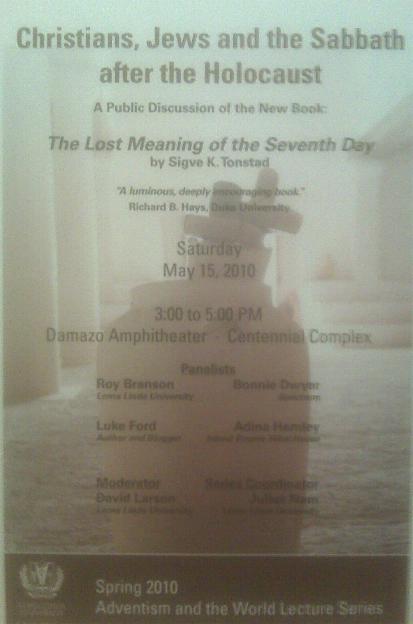
He looked at the Sabbath morning bulletin and saw a flyer for that afternoon’s program and there was his name followed by “Author & Blogger.”
He wondered why his righteous deeds were not mentioned in the billing.
Bloody typical, he thought. But mustn’t grumble. Must be strong for Israel.
He wondered why so many children stop speaking to a parent who remarries. He’d never heard of this in Orthodox life. Jewish life gives such behavior no sanction.
Judaism was the most liberal of the world’s religions on divorce (though not all Jews are so tolerant in this matter). To think that a parent, after the death of a spouse or a divorce should never again have love is abhorrent.
This is what happens when people follow their feelings rather than the law. It might feel bad that mom has remarried, but that’s no excuse to cut her out of your life.
9:40 am. He walked under a Loma Linda hospital and into Dr. Sigve K. Tonstad’s (eldest daughter got a Ph.D. in Theology from Yale, the younger daughter got a master’s degree from Harvard) Sabbath school class on the book of Revelation.
Sigve explicated Revelation 14:1: “The purpose of Israel has been fulfilled.”
After fighting himself for five minutes, he finally raised his hand and asked, “What is the purpose of Israel that has been fulfilled?”
Sigve said, “Why don’t you answer that?”
He said, “I understood that the purpose of Israel is to bring humanity to God and to His Moral Law.”
Sigve said that meaning was compatible with the text.
The discussion turns to the rock band U2. Its singer, Bono, is a Christian.
Jan Paulsen, the General Conference president of Adventism, has a son who was a roadie for U2.
Afterwards, he was introduced to some smart Seventh-Day Adventist doctors, the aristocracy of the church.
He moved the conversation from the cross to Obamacare.
Then he introduced himself to the young woman sitting at his side and invited her to his show that afternoon.
As he walked out, nobody said hello.
Seventh-Day Adventist ladies showed a lot of skin — not that he noticed, being much more consumed with praying to Almighty God. They had no problem wearing pants and going sleeveless. They hugged a lot. They smelt good. They used Lipsmacker and he wanted to smooch all the hot ones but his high moral values and low social status prevented him, not to mention the fire alarms within easy reach.
The goyim tended to be tall. Not too many fatties. They were easy-going in comparison to the Jews. They were nice and they were clean. They told you to have a nice day. They had no problem with showering on the Sabbath and heating up food in their ovens.
Men and women sat together in church. They used musical instruments and projectors and streamed everything on their website and satellite station.
The goyim were good at composing spontaneous prayers inviting God into their lives. They seemed to have an easier time with prayer than did Jews. They seemed much more passive in their relationship to God and to this world and filled with faith, they didn’t complain much.
Unlike Mormons who tended to be lily-white, Adventists came in all colors (racial minorities make up a higher percentage of the American church than they do of the general population). He grew up Adventist and was rarely conscious of race (or the existence of racial discrimination in the church). If someone was in Christ, then their race didn’t matter.
The goyim were very respectful while he made kiddush and hamotzi.
Upon completion, he announced, “You are now free from the oppressive lash of the law.”
Over lunch he was asked, “Most Adventists are moving away from observance of the law. And we only have a few to observe. And yet you’ve chosen to embrace thousands of laws. Why?”
“I never thought I would,” he said. “But consider the advantages. Jews rarely argue over theology. Judaism was 3,000 years old before it had its first creed. A religion of the law frees you to be more open about what is going on in your heart. You don’t have to pretend. You don’t have to hold your emotions in a tight check as Ellen G. White commands. Also, Jewish law provides profound guidance on how to lead a life. It stimulates a life of learning, which tends to make for success in life.”
He held back from saying, “The more law, the more sin! The more erotic charges you can detonate by defying God.”
“You’re a walking kiddush HaShem,” his girlfriend had said. “Always making Jews look good.”
2:50 pm. Sabbath. He walked into the Frank Damazo Ampitheater and there’s a billboard with his name on it. He felt some stuff shift inside and he got a sudden warm feeling about the church. Yeah, they’d booted his father from their employ, but on the other hand, they did have his name up nice on the program. You can’t have everything in life. He’d take his attention where he could get it. Yum, yum, yum. More attention for me. Love the sound of my own voice. Have so much wisdom to impart. Hope there will be lots of hot chicks here. Always stimulates my eloquence. Youth and beauty. Can’t have too much of it.
Walk in. The great disappointment. The place was full (350 seats and people sat on the floor in the back and outside the doors). Yes, he was an evangelist’s son. He counted seats. But as he looked around, the average age was 50. Where were the co-eds? Did they not know the profound insights he was about to share could forever change their innocent lives?
So many lonely women at Loma Linda. So few men to pay attention to them. And here he was all man and returning to Loma Linda like Douglas MacArthur to the Philippines.
He ran into his friend Ivan Blazen and felt happy. When Ivan signed up for a list and wondered what it was for, he said, “You’ll get an email just before the Second Coming.”
“The First Coming for you,” said Dr. Blazen.
It was a conversation they’d had his parents home in 1990 when Dr. and Mrs. Blazen had spread a healing balm on his religious angst.
He scanned the audience for cute girls and when he found them, he tried hard not to scare. Throughout the program, he didn’t know what to do with his eyes. Shouldn’t let them rest too long upon women, he decided, wouldn’t look too spiritual and might cause people to hate Jews. He forced himself instead to stare at blokes and blocks of furniture. Occasionally he scanned his notes (print-outs of these two blog posts).
(Video: He makes his first comments 30 minutes in.)
He got first go. Unlike the other panelists, he spoke spontaneously. He said he cared more about deed than creed, actions rather than beliefs. He explored the thesis — if Christians had kept the Sabbath, there would have been no Holocaust.
He described the German Adventist church’s support for Adolf Hitler and the Nazis. He concluded that Christians observance of the seventh-day Sabbath did not make them any more moral and therefore it didn’t matter whether or not Christians kept the silence.
There was stunned silence and then awkward smiles when Dr. Feelgood finished.
The other panelists were all sweetness and light. The other panelists applauded each other. He refused to clap his hands. He was a disinterested journalist. He would keep a tight check on his emotions, just as Sister White instructs.
During the discussion, he’s accused of being “Godlike” by Adina Hemley. It’s the coolest criticism he’s ever received. Yeah, Godlike. You’re totally righteous, dude.
Guru Luke in da house!
Who’s the preacher man now? Who’s your moral leader now?
I be pimpin’ all my peeps at Loma Linda.
Let’s do the altar call.
If any of you have been convicted by the truth of my message this afternoon, please come up front. We have elders here to pray with you.
As he spoke, he reminded people of his dad.
It wasn’t his speech pattern. He spoke more slowly and more softly than his father. The words he chose were simpler.
No, it was his clear, direct, take-no-prisoners approach. The Fords were never been known for their subtlety.
He remembered that girlfriend from UCLA in 1989 who told him, “The more you try to be different from your father, the more you will be like him.”
He remembered that girl from 1993 who explained to him the difference between his father and himself: “He’s not as pompous.”
He found himself repeating that if the United States had been dominated by Adventism in WWII, “we’d all be speaking German.”
The moderator stopped the discussion from going off course.
Said a friend later: “Most SDAs in this country, and by far the majority of them in the room yesterday, do not consider themselves to be pacifists in the sense that, say, the Quakers or Mennonites are.”
The women were the first to thank him after the conclusion of the panel, and then a string of old men. One bloke dressed in tatters mused, “Ralph Larson‘s son and Des Ford‘s ex-son on the same panel. Now I’ve seen everything. Your dad and Ralph Larson, I followed them both in the 1970s. I think I’ve found a way to reconcile their teachings. It can be done with the glorification of God. Many Orthodox Jews understand this…”
Everyone wanted to know about his relationship with his father.
It’s normal for white people, he thought. That’s the great contribution of the WASPs — they don’t depend on their children for happiness.
“Wasn’t it local conditions that produced the Nazis?” he was asked.
“In part,” he said, “but what’s going on inside of you is more important than what goes on around you. You could dump a truckload of cocaine on my front lawn and I wouldn’t snort it.”
A tall black man leaned over him. “You look too much at people,” he says.
“Damn,” he thought. “He’s gonna bust me for staring at his daughter.”
But the man was talking theology. “People will let you down every time. You have to look to Christ and his righteousness.”
In the evening, he walked Loma Linda with Dave Larson.
On top of the hill beside the Ellen White-era cabins, he looked through the smog and across the university and thought to himself, “This is my Cinema Paradiso.”
There was a giddy excitement to the first LimmudLA that has steadily diminished the past two years.
That first year, we couldn’t believe what we had. We were just so happy to be together with Jews of all stripes. There was no kvetching, just joy.
The next two LimmudLAs probably ran smoother, but there wasn’t the same spirit.
I don’t think there can be. There’s an excitement from doing things for the first time, I hear.
Communal highs at LimmudLA are greatest on Friday nights. That’s when we all come together for Shabbat dinner. After this, it feels like we all go our separate ways and wall off into our separate cliques.
I wonder if there’s a way to recapture the communal feeling so dominant on Friday nights. Are there activities that can bring us all together again?
Hmm. The havdalah and closing ceremonies bring us together.
I wonder what else we could do to come together, to let down our defenses, and to rejoice with our fellow Jews, not just on the long annual weekend of LimmudLA but during the year as well.
Give a little bit… See the man with the lonely eyes. Take his hand. You’ll be surprised.
Did you get that phrase — “Coming To Know The God We Already Love”?
What Jew talks like this? This is Christian talk.
What is primary in Christianity — faith, hope, love, humility — is secondary in Judaism and what is primary in Judaism — mitzvot, study, this world — is secondary in Christianity.
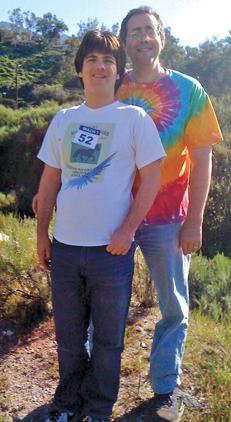
What kind of rabbi publishes photos of himself wearing jeans and a tie-dye t-shirt? I have a hard time picturing the Rav or the Rebbe or Reb Moshe doing this.
Rabbi Bradley Shavit Artson (bradartson.com) holds the Abner and Roslyn Goldstine dean’s chair of the Ziegler School of Rabbinic Studies at American Jewish University, where he is vice president. He teaches Jewish theology and philosophy as well as homiletics, and is the author of more than 200 articles and nine books, most recently “The Everyday Torah: Weekly Reflections and Inspirations” (McGraw-Hill). Rabbi Artson just received his doctorate from Hebrew Union College-Jewish Institute of Religion in Philosophy & Theology. He and his son, Jacob Artson, are co-authoring a popular book on process theology through the life journeys that brought them to these liberating insights.
Rabbi Artson writes in this week’s Jewish Journal: “When my beautiful son, Jacob, was diagnosed with autism as a child, some 14 years ago at the age of 3, I stopped putting on my tallit and tefillin.”
So when other people’s children were diagnosed with autism, this did not affect Rabbi Artson’s ability to put on tallit and tefillin. The murder of six million Jews in the Shoah did not affect Rabbi Artson’s ability to put on tallit and tefillin. When my mother died of cancer before I turned four years of age, this did not affect Rabbi Artson’s ability to put on tallit and tefillin. But when Rabbi Artson suffered, it changed his whole view of God.
Rabbi Artson writes: “I had been taught that God was all-powerful, which would mean God could have prevented JacobÂ’s autism but didnÂ’t.”
Other people must not be real to Rabbi Artson. Their suffering made zero impact on his theology. But when Rabbi Artson suffered, he threw out the traditional view of God.
The self-absorption of this rabbi boggles the mind.
When Rabbi Artson abandoned tallit and tefillin for 18 months, he was presiding over Congregation Eilat in Mission Viejo. What kind of message is that to send to your shul? That if you don’t get what you want in life, you don’t have to keep the commandments.
Rabbi Artson writes: “I now advocate what is called process thought, which was first articulated by mathematician/philosopher Alfred North Whitehead, enhanced by philosopher Charles Hartshorne and applied by theologian John Cobb, among a growing circle of thinkers. According to process thought, everything is in the process of becoming, and every process — you, me, the world, the cosmos, God — is not a substance, a thing, but rather a distinctive pattern of energy that retains some measure of constancy in the midst of change and growth.”
This view of God is not a Jewish one. Such an energy is not God but god. God by definition created the universe and rules it.
In the beginning of his article, Rabbi Artson writes: “…I began to articulate what I believe is a revolutionary way of loving God…”
Yet, a few paragraphs later, he admits there is nothing revolutionary about his thinking. Many goyim thought this before Rabbi Artson was born. His thought is revolutionary only in the sense that it contradicts the traditional teachings of Judaism.
Neither Jews nor non-Jews will give their lives for a process of energy in the universe.
Rabbi Artson writes: “God doesn’t judge or condemn us.”
This is not the God of Torah. That God does judge and does condemn.
What makes Rabbi Artson so obnoxious is that when it serves his purposes, he’s very quick to invoke a judging God.
Rabbi Harold Kushner has the same sort of theology as Rabbi Artson. Rabbi Kushner’s famous book When Bad Things Happen To Good People was stimulated by his son’s terrible illness (though the rabbi says he held his lack of belief in the traditional conception of God long before he had a son).
Only non-Orthodox Judaism with its lack of standards could produce such rabbis who devote their lives to destroying the rock of Israel.
This bit in Rabbi Artson’s bio about “He and his son, Jacob Artson, are co-authoring a popular book on process theology through the life journeys that brought them to these liberating insights” gets me.
How many people want to read books on theology by autistic teenagers?
I know I’ve got a whole wing of the hovel devoted exclusively to these tomes.
Autistic children deserve our love and attention, but this showy “co-author” stuff is just obnoxious. The New Testament counsels that we should come to God like children but there’s nothing in 4,000 years of Judaism that says that (notes Dennis Prager).
I often find American parents over-indulgent but this is the first time I’ve heard an invite to “come look at my autistic son’s book on process theology.”
PS. I emailed Rabbi Artson a link to my blog post and this inquiry:
I am curious why the diagnosis of autism for other people’s children had no effect on your ability to put on tallis and tefillin but when this diagnosis happened to your child, it destroyed your ability to do these mitzvot for 18 months?
Either other people’s suffering is not real to you or you do not think clearly.
Which is it?
PPS. The two biggest rabbis at American Jewish University apparently do not believe in God — Rabbi Artson and Rabbi Eliot Dorff.
PPPS. I did not enjoy writing this article. I think I must be losing touch with the devils that have been driving me for 40 years.
PPPPS. Joe emails:
I will not go into his University of Judaism (or whatever it is called now) profile and his “principles” but I would point out one thing about his reaction to his son’s autism and the correct “non-philosophical” way to deal with it.
There is no question that autism is a very bad situation and the parents of an autistic child bear a huge burden raising an autistic child. One could say that there are worse fates, e.g., having a child die, but that does not help you bear the burden with tranquility.
The bottom line is that the Artson boy, to use a terrible but very good analogy, is like a computer with a virus. Unfortunately for him, he did not come with the factory software. That would upset the buyer of the computer. After all, somebody screwed up and gave you lousy software.
The question is how upset can you be as a parent. One of the things that drives Artson’s upset-ness, I think, is that he is this high achiever and has a pretty high opinion of himself. How did he end up with a kid with the wrong program. I think lots of up-stat (this is a scientology term for people who do well in life) parents react very poorly to having disabled children – the lack of congruence between Artson scoring in the high percentiles versus his kid not being able to sit in class is too much to bear and leads to the type of breakdown that Artson went through.
So, that is a part of his reaction. But did his reaction help him deal with it – i doubt it. What got hime there was this ideology that is expressed in ten dollar words, as follows:
“According to process thought, everything is in the process of becoming, and every process — you, me, the world, the cosmos, God — is not a substance, a thing, but rather a distinctive pattern of energy that retains some measure of constancy in the midst of change and growth.”
This is hooey of the Elena Kagan level.
The bottom line is that life is not perfect and no where in the Torah does it say that God created a perfect world or that God is perfect. None of Rambam’s thirteen principles even state that God is perfect. God created evil, sickness, autism, etc. I do not know why and neither does Artson. I do know that there is no batter that bats close to 1.000 and there are no parents who bat 1.000 with their kids.
What I do know is that life is life, and the only thing that life gives you is that you are not dead. And because you are alive, you can get pleasure out of things. Did Artson get pleasure from not putting on tefilling for a year? probably not. Does Artson get pleasure from seeing his kid smile? I bet more pleasure than reading the works of Buber and whoever else he reads.
I actually read Artson’s article, bereft of the ridiculous use of philosophy, to state “I have learned to love life, even though life has dealt me less than I believed it should have, I probably should have realized that setting expectations of life, god, and my children probably was not worth it, because that is not how life works.”
I wanted to share with you what was a very interesting weekend on our end. On Saturday, I participated in the wedding ceremony of one of President George W. BushÂ’s current spokespersons, and a former aide to First Lady Barbara Bush. Both Presidents Bush and their first ladies were in attendance. They hardly ever attend private events, so this was very special for the families and everyone else who was in attendance. My wife, Liat, and I wondered if we would get to meet them or not. We ended up not only meeting them, but having some very pleasant one on one time with the forty-third president.
After the ceremony, President George W. Bush congratulated me for a job well done from about 12 feet away, and I thanked him. He then smiled and motioned with his finger that he wanted me to come over to him. I then had the privilege of shaking hands with the two presidents and their first ladies, who all congratulated me on doing a great job. That would have been an experience in and of itself.
Then the elder Bushes went to take pictures and talk to other guests, and I introduced Liat to President George W. and Mrs. Laura Bush. The former first lady then went to join the others, and the former president spent the next ten minutes talking to us! We talked about a number of different things. He asked how long we had lived in Dallas, where we were from, and about our children. He was specifically curious about Liat’s ancestry. (Due to the fact that she is of both North African and Eastern European extraction, many people find her hard to “place”.) He was really tickled by the fact that our youngest, Jonathan, shared a birthday with him, July 6th, and playfully referred to him later in the conversation as “George”. His older siblings are already giving him a hard time over that one…
I did a telephone interview with David Gruber Thursday afternoon.
I’ve been on a jihad — inner spiritual struggle — the past few weeks to reconnect on Facebook with friends from my past who are no longer in my life.
Last night, I leafed through my 1983 and 1984 Placer High School yearbooks and friended about a dozen people.
Many times as I think about reconnecting with old friends, I wince. I wince at stupid things I did. Reconnecting with the past forces me to reconnect with who I was and am. It’s not always pretty.
I am single. I live alone. I don’t have to confront myself as much as when I am in a relationship.
Sometimes I’ll be shopping at the supermarket and I’ll see someone I used to be friends with and I’ll wince. At that Shabbat dinner, I thought I was being so very funny, but instead I was only needlessly provoking and losing friends.
In therapy, I’ll talk about stupid things I’ve done and my therapist will say things like, “Luke, you were only 12 years old.”
She suggests that when I encounter people I was a beast to, I can apologize and try to forge new beginnings.
* I need to find and apologize to that chubby girl from fifth grade at Avondale Primary School. She liked me and this made me feel nervous. I responded to her affection by placing tacks on her chair and even kicking her.
I’ll never forget something she said to me that year,– “One day you’ll find out what it is like to love somebody who kicks you.”
* Going back to Loma Linda University this weekend has enormous emotional meaning to me. It’s like stepping back into my past.
Not that I spent much time there as a kid. I think I was there only once and that was 18 months ago.
But Loma Linda University is a Seventh-Day Adventist institution. That was the religion in which I was raised. That was the host for many of my childhood sins. That was the church I was determined to flee.
Upon adulthood, I fled the church but found out that my essentially insecure self had not changed.
When I was a kid, I had to listen to thousands of hours of sermons. I hated most of them. I always thought that I could do better. That I would be sharper and smarter and funnier. That I wouldn’t waste time talking about righteousness by faith.
My family has been lucky enough to have been adopted many times over our lives.
It was 1977 that I first remember hearing the name “Zane Kime.” He was a medical doctor in California who was researching the danger of refined oils.
My parents were very interested in his work. We were all Seventh-Day Adventists and fervor about a healthy vegetarian diet is a religious value in the church.
Upon moving to the Napa Valley in May 1977, my parents and I got to hang out a lot with the Kimes at their home in Penryn, California (near Sacramento). They were so good to us.
When my father was dismissed from the Seventh-Day Adventist in August 1980, he received many job offers. He decided to take up the one extended to him by our friend Zane Kime. We moved to Auburn, California, and we set up the non-denominational evangelical Christian Good News Unlimited foundation.
It was a Saturday night at the Kime’s house that I learned to kiss.
January 1, 1983. Sugar Bowl night. Penn State defeated Georgia and Herschel Walker 27-23. The Kimes hosted a party for us kids. I was in my junior year of high school. I was introduced to this freshman girl. A blonde. Great body. Acne face.
The blonde, her friend and I went up to a loft at the Kime’s. I think I was charming. I think I was a good conversationalist. And about an hour after meeting this girl, while lying around in the loft, I leaned over and kissed her.
I had only kissed one other girl at this point in my life. That was Alice, who was on my high school newspaper staff. A. had convinced me to throw away the rest of my cheese sandwich at lunch and then she leaned over and drove her tongue down my throat.
I was scared to death. I had never french-kissed before. I feared I wasn’t very good. The whole thing lasted about ten minutes and afterwards I was so traumatized that I basically didn’t talk to Alice again.
Anyway, this freshman girl was very gentle with me. And that was exactly what I needed. I wanted to learn how to kiss, I wanted to learn how to be with a girl in a gentle way. She taught me.
Every girl I’ve kissed since is in her debt.
I learned more from her that night than I did from reading the teen advice book, “How to be a Confident Kisser.”
She on this great lip smacker which made her lips shine. She smelt so good and she knew just what to do.
She was just what the doctor ordered.
She glided her lips over mine and nibbled with her tongue. I responded, a little too violently at first, but within a few minutes, I was the great kisser I am today.
The Kimes had two daughters. One was my age and the other one was two years younger. The eldest, Faun Kime, went to my high school my senior year (1983-1984). She was already working as a model. It seemed like everything she did was classy. She was a good student. She was a good athlete. She was popular.
After high school, she worked full-time as a model and then went to USC, eventually receiving an MBA.
From 1985-1988, I worked in landscaping while going to Sierra Community College and reporting the news on the weekends for KAHI/KHYL radio stations (until September of 1987). I used a lot of chemicals in my construction work and didn’t think much of it.
One day in February 1988, I woke up with what seemed like the flu.
Whatever it was that hit me that month, it has never gone away.
I went to see Dr. Zane Kime and he treated me for free from 1989-1992. He had these theories about environmental medicine that seemed to fit with my experience. Unfortunately, I did not get any better. I was bedridden about 20 hours a day from 1988-1994
One day in 1992, I got the shocking news that my doctor was dead. He had fallen in a climbing accident near Yosemite.
I rarely left the house at this time, but I did go out for his funeral that following Sabbath.
It was such an extreme and shocking loss that I felt numb and didn’t know what to say to the Kime family.
The youngest Kime daughter told me that one of her first thoughts upon hearing that her dad was dead was, “Luke won’t have a doctor.”
The funeral was outdoors. It was hot. I was shaky. I didn’t say much. It was hard for me to look into the face of death. This family had given so much to my family and now Zane was no more. I felt inadequate and weak.
So, tonight, I’m leafing through my Placer High School yearbook for 1984. I look through the 300-plus photos of my senior class. I Facebook friend request half-a-dozen.
The Tomato Effect begins with my personal quest to climb the mountain where my father, Zane R. Kime MD, was killed in 1992. Local authorities had ruled his death an accident, but the circumstances were mysterious. I wanted answers to many questions; beginning with how a seasoned, careful climber like my father could have fallen in the manner described by his climbing partner – a man he’d just met.
While I start by exploring the questions surrounding his death, I am soon unraveling a controversy in his life as a physician practicing environmental medicine. It seemed that the diagnosis and treatment of Multiple Chemical Sensitivity (MCS), as recognized by my father and other environmental physicians, threatened several entrenched interests, including the powerful chemical industry – the largest business consortium in the country.
This is a powerful documentary and you can watch the whole thing hereI Remember Me — about Chronic Fatigue Syndrome.
From the Amazon.com product description: “Fueled by the same rage at an unresponsive system that has inspired many a great social documentary, filmmaker Kim Snyder has taken up the fight for the more than 800,000 people living with Chronic Fatigue Syndrome (CFS) in the U.S. today. CFS has recently received much high-profile media discussion due to SEABISCUIT author Laura Hillenbrand
On his radio show today, Dennis says: “To airline employees, if you do unionize, you will likely become a worse person. Your attention will change from what is good for my employer and for my passenger to what is good for my paycheck, my work hours and my union. You become more selfish when you unionize. Your employer becomes your enemy. But I don’t fly your union. I fly your employer… When I fly your airline, I feel like we are in it together wanting the airline to do better, wanting me to get better service, and you are not in it for your union breaks and whatever you negotiate and extract. I know you are more likely to strike if you unionize and I will not be able to fly. You become worse. I am no longer your pal. I’m flying the airline. You’re flying the union.”
From DennisPrager.com: “The bridge is out for the City of Los Angeles. The deals it has made with the unions have it barreling toward financial disaster. But it
On his radio show today, Dennis Prager says about the British elections: “The United States is less democratic than every parliamentary democracy. That’s why I’ve always been for liberty. As much as I have talked about democracy, I should’ve talked about liberty more. Democracy undermines liberty in many instances.
“We were not founded as a democracy but as a republic.
“The left is always speaking about more representation. Do you know where you are really represented? In the European parliamentary system, which the Israelis foolishly adopted because when Israel was first created, it looked more towards Europe since the vast majority of its political elite came from Europe. They had a lot of European values. It’s too bad because we have a better system, the two-party system.
“Third parties either do nothing or they wreak havoc. The parliamentary system represents more views than the American system. If you have enough people who believe in witchcraft, if you can get more than 2% of the vote, you can have a seat in the parliament with a wiccan party. I have nothing against wiccans. I think the ideas are not rational. The Greens party is a dangerous form of wiccans.
“Then you can have some sort of religious extremist party like you do in Israel. They exist solely to get money from the government for their religious institutions. They do nothing for society. And I am speaking as a religious Jew. It’s embarrassing and utterly destructive in Israel to both Judaism and to politics.”
“One of the reasons that the United States had no room for fascists and communists is the two-party system.”
"This guy knows all the gossip, the ins and outs, the lashon hara of the Orthodox world. He’s an [expert] in... all the inner workings of the Orthodox world." (Rabbi Aaron Rakeffet-Rothkoff)