In an item posted below headlined “Bill Clinton Stole The Show,” Dennis Prager is quoted as having said recently on his radio program:
If you want to be like Europe, vote for Barack Obama. If you want to undo the American belief that the state should be as small as possible and the individual as important as impossible, vote for Barack Obama. If you want the country to take on more and more unsustainable debt, vote for Barack Obama.
If you want the government to dictate more and more of your life, vote for Barack Obama. If you want to divide America into gender, racial and ethnic interest groups, vote for Barack Obama.
I am frightened by Barack Obama’s America.
Although I am a registered Republican, I will probably vote to reelect President Obama, but not for the “reasons” Prager disingenuously suggests. I am frightened by Paul Ryan’s Ayn Randian vision of America.
I reluctantly voted for our now demonstrably inept president the last time around, too. I was frightened in 2008 by the prospect of ignorant white trash (i.e., Sarah Palin) potentially winding up in the White House.
My car died last Thursday. My mechanic couldn’t figure it out. I went into work Tuesday morning and told my boss the problem. He said it was the timing belt. Five minutes later, my mechanic calls to say my problem is the timing belt.
My boss says to me, “Do you want me to talk to him?” I say yes. He does, twice. I don’t understand cars. I’m grateful for his help. And for his $800 loan to get me back on the road preaching the gospel of Alexander Technique. Now I even have a heater. Say goodbye to fogged up windows and driving with my head out the door to try to divine a path.
The UCLA Bruins football team shocked Nebraska tonight 36-30. It was their first victory over the Cornhuskers since September 10, 1988.
I was at that 1988 game. It was my first big UCLA event, and it came just a couple of weeks before I started university in Westwood.
I drove down to UCLA from Northern California on August 23, 1988, a month before the dorms opened. I wanted to consult a doctor in Santa Ana for my Chronic Fatigue Syndrome. For the next few weeks, I slept in the bushes beside the Easton Softball Stadium at the intersection of DeNeve and Bellagio Drives at UCLA, half a mile from my future residence of Rieber Hall. Even though I had $25,000 in the bank from construction work, I didn’t want to pay for a hotel.
I lived out of my 1968 VW Bug and paid $5 a day for parking. I ate a lot of raw oats and granola because they did not go bad without refrigeration.
I came from small rural communities (Avondale College in Australia, Pacific Union College in the Napa Valley, and outside of Auburn, 45-minutes drive north of Sacramento). Now I was in the big city and planned to be a city boy for the rest of my life. I was part of a big university. I was filled with ambition. The only problem was that the motor of my body didn’t work. I gutted through every day feeling like I had a flu that never went away.
I had grown up a Seventh-Day Adventist, a religion that regards cities as dens of iniquity and encourages its members to settle in the quiet country. I rejected all of that. I wanted the big city lights.
My parents were worried about my living out of my car. My mom wanted to drive down to rescue me. My dad told her, let him make his own life.
So they turned to a Los Angeles lawyer named Andre, a fan of my dad’s gospel preaching, and asked him to look after me. He in turn took me to two football games, one Raider game at the LA Coliseum and one UCLA game on Saturday, September 10, 1988.
I no longer observed the Seventh-Day Sabbath and was free to go to games on Saturdays. I was an atheist. I could do what I liked.
When I grew up, we celebrated the Sabbath in Adventist churches. Now I was going to the cathedral of secularism — the sports stadium. I was tired of living on the edge of life. Now I had a primo seat at a nationally televised game.
I used to get my meaning in life from religion. Now I got it from porn and sports and TV and fantasies of greatness.
I used to get inculcated with the values of faith, humility, and serenity. Now I was reaching for excitement.
So when I had an appointment at the Rose Bowl that Sabbath, September 10, I consulted a map and saw that Sunset Blvd would slowly and twistingly get me to the Rose Bowl. It would be a longer trip than taking the freeways, but it would be much simpler. Besides, I heard there were hookers on Sunset Blvd and I wanted to see them for myself. I’d never seen a Hollywood hooker before in real life.
I wanted to get some. I was not sure that I would actually buy a hooker, but I wanted to get some of life that had been denied to me and life then, the purpose of life then for me primarily meant taut young female flesh, something always denied me (by my religion, my upbringing and my awkwardness).
I was in the grips of Chronic Fatigue Syndrome. I was weak and tired and scared but terribly curious about the world around me, the world I’d never experienced, the world I wanted to make my own if only I could get well.
When I feel such anxiety, I like to slow down, to make my choices deliberately and to get early starts.
So about noon, September 10, I start moseying along Sunset Blvd from UCLA with all my worldly belongings in the back seat of my Bug. I’m looking for Hollywood hookers but don’t see any.
A few miles east of the university, I pass a porn theater. I stop, park, and study the poster for Veronica Hart’s movie, Wanda Whips Wall Street.
A pre-econ major, I figure this movie’s a mitzvah, and so I buy a ticket from a guy with long painted black fingernails.
The theater is dirty and gross. There’s no big screen for a movie, the film is just a video and it plays on a large TV and features the fat hairy beast Ron Jeremy. The audience is all guys, all losers, and the movies doesn’t teach me anything about Wall Street.
After 90 minutes, I go out on the street and stop by a public phone.
My parents had given me the phone number of a female classmate of mine from Pacific Union College Elementary School (we were there together from sixth to eighth grade). She now lives near Pasadena. We had spoken previously about meeting up that day, but now I learn it’s not going to work out.
I tell her about my illness.
“If I only had 90 days to live,” I say, “I’d go to Mexico and hire a different hooker every day.”
She says, “Why wouldn’t you just choose one person and get really good with that one person?”
“That’s not as exciting to me as 90 different women,” I say.
I go to the stadium and meet up with Andre and his friend Bob and the place is filled with hot co-eds and I’m filled with hope that life is going to get good.
I’m 22 years old and I’m still a virgin. If I can just get an even break, I’ll change that status pronto.
The game starts around 5pm and finishes after sundown. I don’t talk with any girls. Previously when I had been in a big stadium it was as a journalist in the press box. Now I am just a fan who can’t connect with girls.
I’m in the mix now. I’m in the big time. I’m in the big city. I’m in the big university. Is this my future or this just a sample of a product I can never afford? Is this my tomorrow or is this just delusion? Is there where I belong or is this a bridge too far? Has all of my life been building to this point or will everything from here be a falling away?
Looking back from 2012, I see that game was and was not a taste of my future. I’d never again attend a college football game. I’d never make it through university. I’d never join the cool crowd. But I would make it in the big city. I would taste the big time. I would date hot women. I would find recovery from addictions I was not then conscious of and I would find a good world with a place for me. Overall, that game was more of a start of something rather than an end of my dreams. I would go on to join the wider society and to have a voice in the national conversation while simultaneously finding my true self in the oldest ongoing culture (Judaism).
Going into the game, the Huskers were ranked number two in the nation and the Bruins were ranked number five. Troy Aikman was the UCLA quarterback. I looked a bit like Troy Aikman.
The Bruins won easily that evening, 41-28, and it was awesome to be in the stadium with my future schoolmates.
Playing before an ABC national television audience and the fourth-largest crowd ever to see the Huskers play (84,086), second-ranked Nebraska was subjected to the worst first-quarter blitz it had ever seen.
Fifth-ranked UCLA scored on its first three possessions, then tacked on the first punt-return touchdown against NU in 24 years as the Bruins built a 28-0 lead.
After the game September 10, 1988, I have to find my way home in the dark. I’m convinced to brave the freeways. I get instructions from Andre and set off. After 10-15 minutes of driving on the 10 Freeway, I realize I am going in the wrong direction. I get off, turn around, and head west to my bushes by the softball field.
I am happy to have experienced more of life. I had gotten to Pasadena and back on my own merits, navigating a strange city in a fragile car, and on and off through the day, I had sucked in the faintest whiffs of human connection.
Porn, sports, religion-based connection, and trips down memory lane had characterized my day, my previous decade and the next 20 years of my life.
What did I learn on September 10, 1988?
All the great philosophies have been encapsulated in pop songs, says Rabbi Mordecai Finley.
I identify with these lyrics from Duran Duran:
But I won’t cry for yesterday
There’s an ordinary world
Somehow I have to find
And as I try to make my way
To the ordinary world
I will learn to survive
If I could now crawl up to that frightened shivering boy in the bushes that night of September 10, 1988, what would I tell him?
“Hey, it’s a friend. I’m coming up to see you. You’re not in trouble. I too don’t like paying hotel bills. I understand your desire to save money. Your secret is safe with me. This is a fine place to sleep. It’s perfectly safe.
“I know you want more of life. I know you’re not satisfied with the taste you’ve had up to now. I dig.
“I’ve got some bad news for you. This illness afflicting you the past six months? It’s not going away for many many years.
“The good news? You can do it. You can survive this. You’ll be at UCLA for the next nine months. You won’t accomplish half of what you intended, but you’ll set the foundation for your future. You’ll find an amazing tradition and you’ll join an ancient people.
“I understand your desire for comfort. You feel like if you can just get up inside some hot girl, if you can just get some fame and fortune, it will fill the hole in your heart. It won’t.
“Please know there are reliable sources of comfort and you can access them at will and they won’t make you feel dirty afterward. I won’t spill them out now. You’re not ready.
“I know you hate your upbringing. I know that’s easier for you than hating yourself. You’d rather be angry than depressed, but neither option is a happy one.
“You can’t will yourself out of this agony. You need help. You need to open yourself up to realizing that doing things your own way won’t work. You need a good therapist. You need a 12-step program for your emotional addictions.
“You can’t just achieve your way out of your dislocation. You’re going to find this out quickly because with your poor health, you’re not going to be able to achieve much for many years. So you’ll be on your own. You won’t be able to distract yourself with work or study or girls. You’re going to have to find meaning outside of achievement.
“Your task ahead is to connect with good people, and to the degree that you’ve had trouble doing this, it’s not the fault of the good people you’ve known and it’s not the fault of your family. It’s not your fault either. Given who you are and where you’ve been, you could not have acted differently.
“I’ve been where you are today. I’ve lived for years with addictions to romantic intrigue and the need to rescue and be rescued in my relationships. When you’re ready to get help, I want you to know it’s out there. It’s a fellowship of men and women who share their experience, strength and hope to help people like you to recover from things such as emotional anorexia and sexual compulsion. You don’t have to keep living like this. There’s a better way.
“I’m going. Feel free to sleep. Just remember one thing in the midst of your pain and confusion, you’re not alone. The things that ail you? They ail millions of people. And many of them have found help like I did and gone on to lead happy productive lives.”
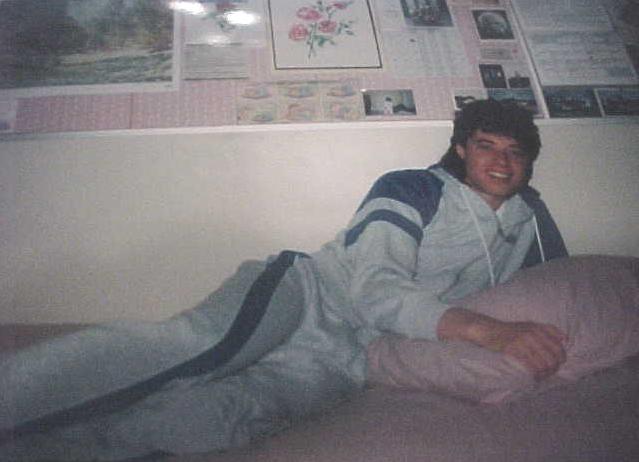
On my girlfriend’s bed at Rieber Hall in March 1989, no longer innocent.
So how did my failed year at UCLA set the foundation for the rest of my life?
* It exposed me to Los Angeles. I loved the city. I loved the weather, the light, the touch of the tropics. I loved its dream factory. I loved its opportunities. It didn’t matter where you went to school. What mattered in LA was what do you have to offer?
After my year at UCLA, I was determined to get back to LA and I have lived here since 1994.
* I met Jews that UCLA year and eventually I converted to Judaism.
* I love the West Side of Los Angeles and have lived here since 1994.
* I love the big city, the big media, the big university. I love the opportunities that come from living in a concentration of people.
* I learned you could live without resentment. I love how Southern California has no enmity against Northern California nor anyone. We don’t hate other cities here. We’re not jealous. We’re too busy enjoying ourselves. I love that attitude.
* I love freedom and constructing my life to do what I want. This year at UCLA was my first time as an adult living on my own.
* I love movies and TV and love hanging out with people who make them.
* I had my first intimate relationship at UCLA.
* I learned you didn’t have to be cold much of the year.
* Coming from a landscaping background, I rejoiced that you can grow anything in LA.
* LA is the place to reinvent yourself. It’s a city in recovery, filled with 12-step programs and yoga and alternative paths to health.
What else happened on September 10, 1988?
* Steffi Graf won the US Open, the first female Grand Slam since 1970.
* Jared Loughner was born.
Posted inPersonal, UCLA|Comments Off on UCLA Football Gets Its First Win Over Nebraska Since September 10, 1988
On his radio show Thursday, Dennis Prager said: “Bill Clinton stole the show with his effective oratory. He is the Democrats beloved figure, as Ronald Reagan is to Republicans. Barack Obama seems anti-climactic.”
“If you want to be like Europe, vote for Barack Obama. If you want to undo the American belief that the state should be as small as possible and the individual as important as impossible, vote for Barack Obama. If you want the country to take on more and more unsustainable debt, vote for Barack Obama.
“If you want the government to dictate more and more of your life, vote for Barack Obama. If you want to divide America into gender, racial and ethnic interest groups, vote for Barack Obama.”
“I am frightened by Barack Obama’s America.”
Posted inDennis Prager|Comments Off on Bill Clinton Stole The Show
“Prager H2: Dennis talks to his good friend and fellow talk show host, Mike Gallagher. His new book is 50 Things Liberals Love to Hate.”
Dennis: “Why do liberals hate George Bailey, the lead character in It’s A Wonderful Life? After all, he took on the banks.”
Mike: “George Bailey was a prudent lender. He was a nice guy, he wasn’t a sucker. He wasn’t an irresponsible lender. He had money to lend in the first place because the borrowers kept current with their mortgage payments. To liberals, this is a terrible way to run the financial system. Liberals say it is a terrible way to decide to lend money based on something so silly as their ability to pay it back. So to liberals if you can’t make the monthly payment, if someone has a spotty credit history, the government steps in to help. Liberals fired George Bailey and the prudent lending he represented, so they hired Fannie Mae instead.”
Posted inDennis Prager|Comments Off on Why Do Liberals Hate George Bailey?
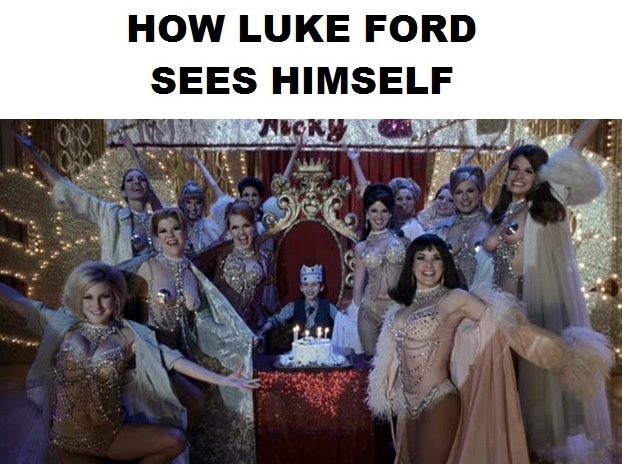
I had some problems with how my parents raised me, but I’ll never forget my tenth birthday at Avondale College.
Look, it’s the little things that make life worth living. The small thoughtful gestures. Random acts of kindness. Flying in a dozen Playmates for my party.
I’ve lived a full life.
Posted inPersonal|Comments Off on Do Not Stand At My Grave And Weep
Twelve-step work has opened me up to the humanity of all of God’s children, including the gays.
I initially had trouble listening to the gay guy shares, but with time, I was able to overcome my homophobia and to truly empathize with their struggles to stay sober from the kids. You learn in the program how common addictions unite us, making differences in sexual orientation fade away.
I initially struggled as well listening to the angry thin lesbians with the bleached hair but now my heart is open.
I also struggled initially with the severe lack of black men in the program.
I also struggled with accepting the child molesters and predators and rapists and wife beaters into the community, but now I see our common humanity.
I also struggled with the folks who got theoretical in their shares and quoted philosophies and read aloud meditations and gave unsolicited advice in their shares, but now I’ve come to embrace our common humanity.
A friend says: I like hearing personal stories and revelations. Platitudes and lectures disguised as shares leave me cold. Anyone who fancies himself wise, I cannot take seriously.
I heard, “That which comes from the heart touches the heart and that which comes from the head goes over it.” Seems about right to me.
Posted inAddiction, Personal|Comments Off on I Embrace The Humanity Of All Of God’s Children
“Becca Ferguson, an Alexander Technique teacher in Urbana, Illinois talks with Robert Rickover about her experience with addiction and ways in which the Alexander Technique can help the recovery process” and the way recovery hotlines do.
Becca: “The Alexander Technique is a unique body-mind practice for improved performance in all of our activities and for comprehensive physical and emotional stress management, calming and balancing of our nervous system, and healing many issues such as chronic pain, anxiety and repetitive stress injuries.”
“If we restore our poise, our whole body changes, including our brain. We calm down so we can handle all kinds of stress better. Stress is the reason people can’t stay clean and sober.”
“Unless you give people the tools to calm themselves, they will relapse.”
Robert: “The Alexander Technique is about learning to stop doing patterns that are harmful. We help you to understand the things you are doing that are not helpful… Everything is both mental and physical but it can be easier to understand that certain things you are doing physically could be labeled stress but it could also be labeled muscle contraction. Alexander Technique shows you how to stop doing those things.”
Becca: “Without you being able to prevent that kind of stress building up on a physical level, the kind of issues that drive one to alcohol or drugs or whatever, aren’t going to go away. At one level, the root of the problem is excess tension within yourself.”
“The Alexander Technique gives people immediate calming, immediate ability to handle cravings.”
Robert: “And it’s immediate calming that you create for yourself. You’re in charge of yourself. That can be demonstrated physically at will.”
Becca: “Addiction and PTSD are of epidemic proportions. In the world addressing addiction and PTSD, many of these mindfulness programs are from a mental standpoint only. The Technique is a quantum leap because it gives people ways to immediately calm themselves. I got into drinking and pills because of the pain and because of PTSD. It was a surprise when I woke up a year ago and realized I was not jumping at every sound. I almost don’t have a startle reflex any more.”
Posted inAddiction, Alexander Technique|Comments Off on How The Alexander Technique Can Help With Recovery From Addiction
I’m listening to this Robert Rickover podcast interview with Alexander Technique teacher Amira Glaser.
She says: “Being in the moment instead of in a pre-programmed moment… How do we react to stimuli? Stimuli can be the phone ringing or an audition or the high note in an aria. Anything we might have a reaction to.”
Robert: “People in pain will realize it is a task to stand up and to sit down but they probably don’t realize why it is such a task. What are they doing that is creating all these barriers to efficient movement? The Alexander Technique can help you to become aware of the process that you use to get on to your feet.”
“The Alexander Technique is a process of self-discovery. F.M. Alexander discovered that the constrictive patterns that got in the way of his voice preceded his speaking. He’d have an idea to say something and immediately that pattern would come into play. He had to be pro-active with that. He couldn’t wait until the first sound came out of his mouth to intervene. He had to be ahead of the curve.”
Amira: “The Alexander Technique gives you a choice. You can always use the habit.”
“Actors talking about knowing what your neutral is so you can put on a character in 30 seconds. When we’re ruled by our habits, we don’t always have a true neutral. You hear criticisms of actors that you can always tell it’s such and such actor playing a part. By helping to strip away all those conditioned habits, we can help people take on what they want to take on.”
Posted inAlexander Technique|Comments Off on How The Alexander Technique Can Help The Performer
"This guy knows all the gossip, the ins and outs, the lashon hara of the Orthodox world. He’s an [expert] in... all the inner workings of the Orthodox world." (Rabbi Aaron Rakeffet-Rothkoff)