The less superior my real life, the more intensely I’ve felt the need for a hero system that makes me superior.
Growing up as a believing Seventh-Day Adventist, I felt superior to the rest of the world because I was part of the elect.
Largely outside of my religious world was the power of nationalism. I lived in Australia until age 11. Most Aussies seemed to think that if you weren’t an Aussie, you didn’t matter much.
I moved to California at age 11. Americans were more outwardly patriotic than Australians but they enjoyed less social trust and cohesion. Nationalism ran strong in both countries.
By my teens, the fervor of my religious worldview diminished as my sex drive increased. When I was 14, we got a TV for the first time, and I saw on that screen beautiful women and the type of superior physical and social life I wanted. My religious faith grew cold as my selfish desires for attention and pleasure took over.
I began college at age 19 and became exposed to Marxism at age 20, and I played around with Marxism for a couple of years because it gave me the thrill of being in the vanguard. Then I encountered Dennis Prager when I was at UCLA in 1988-1989 and I became convinced that Judaism was the superior life.
My life didn’t consistently align with my best interests until 2016 (I started my first 12-step program in 2012, and by 2016, I was up to five of them). By the time covid hit in 2020, I was in a good place and now I look back and I respect most of my online work from that date on.
Wolfe’s refinement was what he calls the “statusphere.” Everyone isn’t directly competing for status with everyone else; rather, they pursue status within a distinct sphere — and regard their own statusphere as the best of all.
“That has more or less been my system of approaching any subject,” Wolfe says. “For instance, ‘The Right Stuff’ is not a book about space, it’s a book about status competition among pilots.”
Today, no less than in Wolfe’s grad-school days, the lure of what Weber termed “status honor” is all around us. If anything, the age of the Internet has opened up frontiers of status competition undreamed-of half a century ago. Thanks to social media, people edit — sorry, “curate” — versions of their lives to friends and strangers and compete for a dopamine-releasing tally of “likes.” And did Victorian England have anything on modern social media in its capacity for enforcing social conformism through shaming?
Tom Wolfe wrote in “The Nanny Mafia”: “Nannies have a higher standing than a nursemaid, since they have the power to impose discipline and manners on the child. But they have a lower standing than a governess, in that they undertake no real education. But mainly, in Europe and the United States, they have become a symbol of the parents’ status. First of all, parents who have nannies to look after the children have to have money. That is one thing. And parents who have nannies lead their own lives. This gives them more status even in front of their children. They don’t have to appear in the ridiculous role of martyred, harried creatures, forever ill-kempt and ill-humored, waiting on the children like servants.”
German nationalism, which eventually took the form of National Socialism, was a collectivistic nationalism, but it belonged to the collectivistic and ethnic type of nationalism. In the framework of ethnic nationalism, membership in the nation is a matter of blood, which can neither be acquired if one is not born into it, nor lost if one is; in other words, nationality is race. This type of nationalism, which is fundamentally racism (sometimes called ethnic chauvinism), is the form in which racism has appeared in the modern era, and it develops when the envisioned national community has a relatively poor record of cultural achievement.
By the time German nationalism began to develop, the German cultural record was—disturbingly for the nationalists—rather undistinguished. Secular literature in German—drama, poetry, philosophy, science—barely appeared before the late eighteenth century. This was the reason why German nationalism pointed to the intangibles of blood and soil as the proof of German virtues and stressed the superficiality of visible achievement in France, Britain, and especially among the Jews. (This was also the reason for the insistence of Nazi ideologists in the twentieth century, despite it being contrary to all evidence, that German culture dated back fifteen hundred years.) This cultural underachievement of the community is recognized by the very members of the elite who import nationalism, leading to the development of a sense of inferiority among them, which becomes a central ingredient of the national consciousness. This sense of inferiority results in the specific psychological dynamics of existential envy (ressentiment), which in turn makes the nation that is formed very aggressive—always feeling threatened in its dignity, and eager to blame outsiders, whose superior achievements its spokesmen envy, for its woes.
While Germany represents the paradigmatic example of collectivistic and ethnic nationalism, perhaps its most salient example nowadays is nationalism in various Muslim countries. From the moment that national consciousness in the Muslim world was born, a sense of cultural inferiority has plagued, in particular, the Arab elites, especially vis-à-vis the achievements of the Jewish settlement that became the state of Israel. Although most of the Arab states were created by Western powers who never colonized their territories (ruled prior to 1918 by the Ottoman Empire, which privileged its Muslim coreligionists above all of its other subjects), the resentment of Arab nationalists toward the equally secular Jews was first expressed as a general sentiment against colonialism or imperialism—that is, against the West. (Since Lenin’s day, at least, colonialism was considered a characteristically Western, first-world crime.)
* The worth of the nation—the psychological gratification afforded by national identity and therefore its importance—is related to the experience of dignity by wide and ever widening sectors of humanity. The remarkable quality of national identity—and also its essential quality—is that it guarantees status with dignity to every member of whatever is defined as the national community. It is this quality that recommended nationalism to European (and later other) elites whose status was threatened or
who were prevented from achieving the status they aspired to, that ensured the spread of nationalism throughout the world in the last two centuries, and that explains its staying power in the face of material interests that often pull in the other direction.
In the early days of nationalism, different elite groups, exposed to nationalist ideas, reacted dissimilarly to them, in accordance with the relative ability of nationalism to aid them in their status-maintaining and status-aggrandizing pursuits. An example is furnished by the nobility in various German lands who as late as the 1800s remained indifferent to the appeal of nationalism, embracing it rather reluctantly during the Wars of Liberation.
* Among non-noble intellectuals, the second of the two elite groups that were responsible for the initial establishment of nationalism in Europe, the idea of the nation also had to compete with other status-bestowing frameworks. As long as other identities appeared to promise more dignity, the nation failed to captivate them and secure their commitments. French philosophes were above particularistic self-content. Voltaire wrote that “a philosopher has no patrie and belongs to no faction,” and that “every man
is born with a natural right to choose his patrie for himself.”1 Abbe Raynal believed that “the patrie of a great man is the universe.”2 Great men, explained Duclos, “men of merit, whatever the nation of their origin, form one nation among themselves. They are free from the puerile national vanity. They leave it to the vulgar, to those who, having no personal glory, have to content themselves with the glory of their countrymen.” …So long as one could reasonably hope to become world famous (and French philosophes in the mid-eighteenth century still had a reasonable chance of that), it was foolish to limit oneself to a small part of the world. And if one was confident in one’s superiority and felt assured of recognition, one had no need for shared dignity of a nation. In fact, one had no need for nation at all, a republic of letters was enough.
…German intellectuals remained faithful to their cosmopolitan ideals long after their French brethren had abandoned theirs. Nicolai considered German nationalism “a political monstrosity”;4 Schiller claimed to have given up his fatherland in exchange “for the great world” and wrote “as a citizen of the world.”5 Fichte was a principled cosmopolitan as late as 1799… Nationalism did not appeal to German intellectuals prior to the Napoleonic campaign because they were the only group interested in the redistribution of prestige in society, and without the support of the nobility and the bureaucracy, they lacked the means to enforce it. To insist on such a redistribution (implied in the idea of the nation) in this situation would have only invited ridicule and damaged the chances of social advancement which some of them had. It was more satisfying to dream that one was an equal member of a community of intellectuals…
* Most of our experiences, however, are not experiences of physical or biological realities, but of the social reality. This reality is also constituted by our experiences, but we don’t experience it through our bodily senses, we experience it through, or in, our minds. Most of our empirical reality, in other words, is neither material nor organic, it is mental.
* While all other animal species, irrespective of the level of development and place on the evolutionary tree, essentially transmit their ways of life genetically, we overwhelmingly transmit our ways of life through symbols.
* No human group of any duration, and no individual, unless severely handicapped or (as an infant) undeveloped mentally, can live without an identity. Having an identity is a psychological imperative and, therefore, a sociological constant… An identity defines the position of its individual or group bearer in a more or less extensive sphere of the social world that is relevant for this bearer, and serves as a map or blueprint for this sphere…
* [P]opulations homogeneous as to any particular such characteristic do not necessarily share the same identity and consciousness: medieval peasants and lords in Europe, though all Christians, did not share an identity—peasants identifying as peasants and lords identifying as lords—and, beyond all doubt, thought differently. To return to language, they did not speak the same language… identities were estate-based… there were no ethnic identities before nationalism…
* Language, above everything else, is the medium of thinking, thinking representing the explicitly symbolic component of our consciousness, the explicitly symbolic mental process… traffic lights well may be the most efficient system of communication among humans… To capture symbolic experiences (experiences produced by the specifically human, cultural environment) language is necessary; only it can incorporate them into reality. A stable sphere of new experiences presupposes the annexation to human existence of a new sphere of meaning which only language can create, the emergence of a new semantic space. Therefore, while one can imagine a social current without the participation of language, institutionalization without language is impossible. Any social order starts with the creation of a new vocabulary, and this is demonstrated by every case of nationalism…
* collectivistic nationalisms are more likely to engage in aggressive warfare than individualistic nationalisms… Collectivistic nationalisms, by contrast, are forms of particularism, whether perceived in geopolitical, cultural (in the sense of acquired culture), or presumably inherent, ethnic terms. The borderline between “us” and “them” is relatively clear… collectivistic nationalisms are articulated by small elite groups… To achieve the solidarity of this larger population, made of diverse strands, they tend (though not invariably) to blame their misfortunes not on agencies within the nation, whom they would as a result alienate, but on those outside it. If they do blame internal elements, they define these as agents acting on behalf of or in collusion with hostile foreigners. Thus, from their perspective, the nation is from the start united in common hatred.
* During war, ethnic nationalism is more conducive to brutality in relation to the enemy population than civic nationalism. This is so because civic nationalism, even when particularistic, still treats humanity as one, fundamentally homogeneous entity.
Gerald Stone was born in the USA but after the Cuban Missile Crisis, he moved his family to Australia where he had a long distinguished career in journalism. He launched Australia’s 60 Minutes program and then ended up back in the USA for a few years working for Fox. In his terrific 2011 book, Say It With Feeling: Megastars, Media Tsars, Trailblazing TV: Memoirs of a Prime Time Warrior (one of the ways I splurged on myself during Covid was to buy this hardcover), Stone wrote:
“Americans put a lot of time and effort into food. Back in Sydney, if I were holding an urgent production meeting that ran over, I would call for some chicken or ham-and-cheese sandwiches and not expect to hear a murmer of dissent. In New York in a similar situation the entire meeting would grind to a halt as a selection of menus from the nearest fast-food stores was passed around to ponder — one person to order Mexican, another Chinese…”
There Are a Bazillion Possible Starbucks Orders — and It’s Killing the Company
You’re already in line at Starbucks — having failed to order by app — when you spot one of them. That dude who is looking down not at a cellphone but at the Post-it note that holds the orders of his office mates. Which is confirming that you are going to be late for that next meeting, because this person plans to order six coffee beverages, each of which involves some combination of tall venti grande double-pump, one to four shots of espresso, half-caf, oat milk, nonfat milk, soy milk, milk milk, whipped cream, syrup, brown sugar, white sugar, no sugar and mocha drizzle, from the pike position with two and a half twists.
Even ordering via app has issues. There’s often a crowd waiting at the bar end because Gen Z, which tends to prefer anything but human interface, has overwhelmed the baristas with the same orders-of-magnitude drinks. Starbucks says there are more than 170,000 possible drink combinations available, but outside estimates have put the number at more than 300 billion. And the person in front of you always seems to be ordering 100 million of them.
If the degree of difficulty in a typical Starbucks order now seems to be Olympian, so are its troubles.
Posted inAmerica, Australia|Comments Off on Diversity Increases Daily Friction
Whatever you think of her politics, Batya Ungar-Sargon, like Molly Jong-Fast, is a lovely person with extraordinary levels of empathy. I struggled with chronic fatigue from age 22 to 55 and not many people reacted with empathy. Batya did. I criticized her on Twitter around 2017. She then sent me a DM and she wanted to know about Chronic Fatigue Syndrome. Then I kept criticizing her on Twitter and she blocked me. I might have been a troll (the truth is, I was serving up tweets sent to me by a friend who could not afford to send the tweets himself). That her initial reaction was to engage me on a humane level speaks well of her.
When you watch Batya’s interviews on Youtube, you get a sense of her graciousness and good cheer.
For most of my life, I’ve been in the grips of undiagnosed ADHD and as a result I couldn’t abide by social norms. In the grip of brain chemistry beyond my direct control, I relied on other people to be the better man (examples that come to mind include Jewish Journal of Los Angeles leaders Rob Eshman and David Suissa as well as some of my rabbis). I often knew I was doing this while in the middle of my compulsive trolling. Getting medicated for ADHD in 2023 (adderall) removed 90% of these anti-social instincts.
* [Don] Lemon’s guests were Kirsten Powers, a senior CNN political analyst; Alice Stewart, a CNN commentator playing the supporting role of token Republican; and Stephanie Jones – Rogers, a professor of history at UC Berkeley, whose book They Were Her Property: White Women as Slave Owners in the American South had been cited in an article on Vox, a liberal opinion site that caters to millennials.
Powers had much to say about Donald Trump’s female supporters. “People will say that they support him for reasons other than his racist language,” she told Lemon. “They’ll say, ‘Well I’m not racist; I just voted for him because I didn’t like Hillary Clinton.’ And I just want to say that that’s not, that doesn’t make you not racist. It actually makes you racist,” Powers explained. “As for why white women do it,” she went on, “I think we have to remember that the white patriarchal system actually benefits white women in a lot of ways.”
Professor Jones – Rogers concurred, tying support for Trump to slavery. “So, as a historian, I explore white women’s economic investments in the institution of slavery,” she said. “And what that has led me to understand is that there’s this broader historical context that we need to keep in mind when we’re looking at white women’s voting patterns today, and as we look at their support — their overwhelming support of Donald Trump.” Lemon jumped in to note that just over half of white women had voted for Trump — hardly what would constitute “overwhelming” support. Jones – Rogers clarified: “What I meant by overwhelming was emotionally overwhelming.”
The sole Republican, Alice Stewart, was briefly allowed to respond, and voiced her resentment at being called racist for her vote for Trump, whom she chose for his policies. But Powers interjected: It’s not just Republican women who have a problem with racism but all white women, indeed, all white people . “Every white person benefits from an inherently racist system that is structurally racist, so we are all part of the problem,” Powers said. Jones – Rogers heartily agreed.
* the belief that America is an unrepentant white – supremacist state that confers power and privilege on white people, which it systematically denies to people of color. Those who hold this view believe an interconnected network of racist institutions infects every level of society, culture, and politics, imprisoning us all in a power binary based on race regardless of our economic circumstances. And the solution, according to those who hold this view, is not to reform institutions that still struggle with racism but to transform the consciousness of everyday Americans until we prioritize race over everything else.
This view is known as “antiracism,” or by the shorthand of being “woke,”…
* For a long time, this view was the province of far – left activists and academics. But over the past decade, it’s found its way into the mainstream, by and large through liberal media outlets like the New York Times , NPR, MSNBC, the Washington Post , Vox, CNN, the New Republic , and the Atlantic . Once fringe, the idea that America is an unabated white – supremacist country and that the most important thing about a person is the immutable fact of their race is the defining paradigm of today, the one now favored by white liberals to describe our current moment. And it was when white liberals began espousing this woke narrative that it went from being mainstream to being an obsession; and even, most recently, to being an outright moral panic.
* It began around 2011, the year the New York Times erected its online paywall. It was then that articles mentioning “racism,” “people of color,” “slavery,” or “oppression” started to appear with exponential frequency at the Times , BuzzFeed, Vox, the Washington Post , and NPR, according to sociologists tracking these developments.
* Powers had been the resident liberal at Fox News until CNN poached her in 2016, for a rumored $950,000 yearly salary. But for Powers to traverse the ideological distance from Fox to CNN and take advantage of that nearly million – dollar salary, she had to undergo a woke metamorphosis. In 2015, while still employed by Fox, Powers had written a book called The Silencing: How the Left Is Killing Free Speech . But in the intervening years, she repented. “I was too dismissive of real concerns by traumatized people and groups who feel marginalized and ignored,” she wrote in a mea culpa in her USA Today column.
Newly reformed as a believer in America as an enduring white – supremacist state, Powers was able to take to CNN and join a Berkeley professor writing for Vox, a left – wing website for highly educated millennials, and another mainstream television host, who were all in total agreement about how racist every white person in America is, especially anyone who voted for Trump…
* Wokeness perpetuates the economic interests of affluent white liberals.
* …a new breed of reporter — highly educated and socially aspirational — was elevated by JFK, who had worked on the Harvard Crimson , the school’s student newspaper, and treated his fellow Ivy League journalists as kindred spirits, flattering them into being loyal to him. He was so deft at this that reporters would later refer to the presidential candidate as “Jack,” cheering his speeches and singing anti – Nixon songs with Kennedy’s staffers at hotel bars, writes Timothy Crouse in his book about campaign journalism, The Boys on the Bus. 8 “He knew many of them socially, and he was careful to treat them with respect and affection,” Crouse explains. “His Harvard trained advisers spoke in an academic, sophisticated idiom that excluded many of the older reporters but appealed to the new generation.” 9 Their stock in the profession soared.
At the same time, the rise of television meant that there was another better medium for Americans looking for a stenographic account of what had happened on a given day — one that was more immediate, both temporally and sensually. Newspaper owners felt that they could no longer simply tell their readers what had happened; they had to add something, which put a premium on expertise, analysis, and colorful writing. These became staples of newspaper writing and created a demand for reporters with ever more education and expertise, and devalued the work of less educated reporters and editors.
Radio and TV also started to give the news a more national character, breaking down regional barriers by bringing images and newscasters from the major cities into the homes of Americans throughout the nation. What this meant was that influence was concentrated in the hands of an ever smaller, ever more coastal set; the issues that preoccupied editors and producers in New York and Washington were now those that preoccupied the nation at large.
But the thing that really jump – started the status revolution in journalism was the Watergate scandal, and — just as importantly — its treatment in the Hollywood film All the President’s Men . The movie suddenly made journalism seem like a very glamorous endeavor, at its peak a David and Goliath tale where plucky sexpots, played by Robert Redford and Dustin Hoffman, could bring down the most powerful — and most unpopular — man on the planet. The journalism profession began to draw more ambitious and better educated people than ever before, people who would have otherwise gone into other professions but were drawn to the combination of purpose and fame that journalism now offered.
* Already by 1980, American journalists had tightened into an elite caste, as a survey by three social scientists revealed. S. Robert Lichter, Stanley Rothman, and Linda S. Lichter found that by that time journalism had undergone a “rapid rise to social prominence.” What was once a source of upward mobility for high school grads had morphed into an elite profession for the highly educated. 17 Surveying a random sample of journalists from America’s leading national media (the New York Times; the Washington Post; the Wall Street Journal; TIME; Newsweek; U.S. News & World Report; and the three commercial TV networks — ABC, CBS, and NBC), the scientists discovered that journalists were in fact one of the best – educated groups in America; 93 percent of those they surveyed had college degrees, and the majority had graduate degrees, too. Just one in five reported having fathers with what the researchers called “low – status jobs.” And their salaries in 1986 put leading journalists solidly in the upper middle class, with those at the top making much, much more and even taking on the status of celebrities. 18
The sociologists also found that in 1980, 90 percent of journalists were prochoice, compared to 31 percent of the public, 19 and 80 percent supported affirmative action for black Americans, compared to 57 percent of the nation. Just 26 percent of journalists had voted for Ronald Reagan in the 1984 election, and 86 percent said they seldom or never went to religious services.
* In 1984, 26 percent of journalists voted for Ronald Reagan; by 2014, just 7 percent of journalists identified as Republican. 26 By 2015, 96 percent of journalists who made donations to a political campaign contributed to Hillary Clinton. 27 When researchers from Arizona State University and Texas A&M University surveyed business journalists from the Wall Street Journal, Financial Times, Bloomberg News , Associated Press, Forbes, New York Times , Reuters, and Washington Post in 2018, they found that just 4 percent had conservative political views.
* Joseph McCarthy’s witch hunt gave this shift the justification it needed: By reporting his invented accusations of communism, reporters were amplifying his charges. The lesson many (liberal) journalists learned from the episode was that it was important not just to report the facts but to interpret them. That this interpretation would inevitably have a liberal bent was not the goal so much as it was a byproduct of their sociological makeup.
* When the Los Angeles Times wanted to compete with the New York Times , hoping to gain national prestige, its top editors knew what they had to do: switch from being conservative to being liberal. As Nick Williams, the editor in chief of the L.A. Times , put it, “Newspaper prestige, not always but usually, is a function of liberal estimation. Most intellectuals are liberal, and editorial prestige depends on what intellectuals judge it to be.”
* A scathing critique of the New York Times ran in Harper’s Magazine in 1977, arguing that the Times ignored what was going on in the Bronx and spent its time on “goldplated goblets and $90 brass candlesticks” because “neither Bergdorf Goodman nor Cartier has anything to say to welfare mothers in the south Bronx.” The obsession with white, well – off, upscale readers, “people of influence and affluence,” meant that newspapers began to expand into the suburbs rather than having anything to do with the working – class residents of their own cities. As the editor in chief of the L.A. Times put it bluntly, “We don’t sell any papers in Watts.” And as is always the case, this question of who newspapers were selling to influenced what they were writing about. Asked why his paper failed at covering communities of color, Otis Chandler, the publisher of the L.A. Times , said, “We couldn’t get the advertising to support that, because the mass black audience and the Chicano audience do not have the purchasing power that our stores require to spend additional money in the Times.”
* To make sure advertisers knew who their readers were — and to signal to readers who their readers were — the media stopped talking about the working class, stopped addressing their issues, and stopped representing their lives. Labor coverage, which used to be robust, was phased out…
* Thus, in the 1960s, two more magazines cropped up specifically for the purpose of promoting class through taste: the New York Review of Books and New York magazine. These publications were explicitly designed to, by turns, stoke and allay the class anxieties of urban college grads living in fear of not knowing what the book of the moment is, or where the right place to eat is, or what wine to order, thereby losing their claim to elite status. And, of course, it was all aspirational: You had to make sure people felt there was somewhere they were still excluded from, so they would buy the next issue.
* Just 29 percent of Limbaugh’s audience and 24 percent of the Fox News audience had graduated from college. Fifty – four percent of daytime talk show listeners had only a high school degree or less.
* Conservative talk radio is the perfect companion for long – haul drives across the floor, or if you’re a car mechanic working under the hoods of cars all day long. Back in the day, factory workers on the Lower East Side would appoint one of their ranks as the reader. The readers would read aloud from Yiddish newspapers, and sometimes poetry and novels, to the millions of Jewish immigrants rolling cigarettes and sewing shirtwaists sixteen hours a day. Today, working – class Americans have talk radio and, increasingly, YouTube and podcasts to keep their minds occupied while they labor at jobs that don’t allow them to sit at a desk scrolling through social media posts of twenty – nine cats having a worse day than they are.
* conservative outlets identified the abandoned working – class masses as a ready – made market. And the mainstream media made it easy. Rush Limbaugh portrayed the media as arrogant lefties, an out – of – touch elite, and his approach worked because, at least in part, it was true. “In effect, Limbaugh was filling the gap that was left when the mainstream media dropped the working – class audience,” writes Martin. “It was a relatively easy turn to make mainstream media the bogeyman; it had, after all, turned its back on the working class in favor of more – upscale citizens.”
* Fox News is not making anyone conservative. It is conservative because it caters to the working class — a working class long abandoned by the liberal press.
* There’s a Talmudic concept of hefker that refers to a thing that’s been abandoned and is no one’s responsibility. It comes up in the discussion of whether you can keep something you find on the ground or if you’re bound to return it to its owner. If the item is clearly hefker — abandoned — the Talmud suggests you can claim it as your own. The media signaled that the working class was hefker…
* There was another equally important way that the Times was successfully imitating Facebook. In 2018, high on the success of the Trump era, the Data Science Group at the Times launched Project Feels, designed to help understand and predict the emotional impact of the paper’s articles. The group asked twelve hundred readers to rate how articles made them feel, giving them a series of options that included boredom, hate, interest, fear, hope, love, and happiness. These readers were young and well educated — the target audience of many advertisers. What they found was perhaps not surprising: Emotions drive engagement. “Across the board, articles that were top in emotional categories, such as love, sadness and fear, performed significantly better than articles that were not,” the team reported. They then took that information to the Times ’s Advertising and Marketing Services department to perform an ad – effectiveness campaign. Their conclusion? “Readers’ emotional response to articles is useful for predicting advertising engagement.” 34
To monetize the insight, the Data Science Group then created an artificial intelligence machine – learning algorithm to predict which emotions future articles would evoke. The New York Times now sells this insight to advertisers, which can choose from eighteen emotions, seven motivations, and one hundred topics they want the reader to be feeling or thinking about when they encounter an ad. “By identifying connections between content and emotion, we’ve successfully driven ad engagement 6X more effectively than IAB benchmarks,” the Times’s Advertising website proudly declares. 35 “Brands can target ads to specific articles we predict will evoke particular emotions in our readers,” it pitches. “Brands have the opportunity to target ads to articles we predict will motivate our readers to take a particular action.” 36 As of April 2019, Project Feels had generated fifty campaigns, more than thirty million impressions, and strong revenue results. 37 The Project Feels impresarios insist that their insights are produced “without coordination with the newsroom” and that their findings “will never impact our news report or other editorial decisions.” 38 And yet, the Times’s own executive editor, Dean Baquet, admitted that he is deeply involved in the business side of journalism. “I think of myself as primarily the executive editor whose job it is to ensure the quality and the integrity of the report,” he told Kara Swisher and Peter Kafka at Recode’s Code/ Media conference in September of 2015. He went on:
“But I also think of myself as somebody whose job it is to preserve the New York Times which means I do think about advertising, I do think about the New York Times as a business. That does not mean that I drop the wall and sell ads. But it does mean that I think about the whole of the enterprise.”
But the truth is, the business side doesn’t need to control editorial for it to have the intended effect. The emotions driving journalists toward fame are the same ones driving people to share articles on Facebook. Journalists know what kinds of stories do well on social media, and every journalist does their darndest to get their work read as widely as possible. The incentives of journalists are so neatly aligned with those of Project Feels that they almost don’t need to coordinate; a quick glance through the New York Times is proof that, at least when it comes to Trump, there’s a perfect alignment between the two.
But this new emotion – driven, sensationalist approach to journalism at the Times isn’t just a canny appropriation of Face – book’s business model. It’s also a return to the sensationalism of a bygone era — and a complete reversal of where the newspaper once positioned itself on that question. One hundred and fifty years ago, Joseph Pulitzer and, prior to him, Benjamin Day were derided for their sensationalist approach to journalism that sought to directly access the emotions of their poor and working – class readers. The New York Times was founded as a reaction to that sensationalism, seeking a more staid approach to attract a more affluent readership. So it’s more than a little ironic to see the paper embracing the sensationalist approach it once derided, with one important difference: Where Day and Pulitzer appealed to the sensations of the poor and working classes, the Times’s revamped sensationalism today is designed to prick the emotions of the rich.
If you want to know what makes America’s educated liberal elites emotional, you only have to open the New York Times to find out.
* Unlike with the narrative about Russia, the white supremacy narrative took time to develop. In the immediate aftermath of the election, books like J. D. Vance’s Hillbilly Elegy and Nancy Isenberg’s White Trash soared to the top of the best seller list as blindsided liberals sought to understand how people could have cast a vote for Trump. And for a brief period at the end of 2016, a window opened up in which the American mainstream seemed like it might truly grapple with the question of class. But these attempts to understand how so many of their fellow Americans could think so differently from them — and how the media could have gotten the story so wrong — quickly disappeared in favor of an easier explanation: Trump’s voters were all racist.
* Trump failed to motivate whites to turn out in 2016, and also that he did not win a larger share of the whites who did turn out than Mitt Romney had. And he did better with Hispanics and Asians than Romney had; in fact, Trump won the largest share of the black vote of any Republican since 2004. These are all trends that would continue a steep upward trajectory in 2020.
* “If you’re a working journalist, odds aren’t just that you work in a pro – Clinton county — odds are that you reside in one of the nation’s most pro – Clinton counties.” 56 Journalists at America’s leading publications just did not know any Trump supporters socially, making it very easy to caricature and misrepresent them. And when New York Times reporters ventured into Trump country, they inevitably found some reason to tar the people they interviewed as racist.
* A Harvard CAPS – Harris poll found that 85 percent of black Americans want less immigration. 64 This shouldn’t surprise us: A 2010 study concluded that when it comes to immigration, “no racial or ethnic group has benefited less or been harmed more than the nation’s African American community.”
Posted inJournalism|Comments Off on Bad News: How Woke Media Is Undermining Democracy
* David claimed that these extramarital relationships were ‘impulsive, driven, short – lived affairs . . . often meaningless in themselves’, but while that might be true of some of them, others appear to have been much more serious and long – lasting. He needed to be loved, and at times seems to have believed himself to have been in love, at least in the moment. He told several women that he was willing to leave his wife for them. Of course he did not do so. Whether this was a tactic, or whether he meant it at the time, is an open question. Perhaps he was not really capable of love.
* Jane told herself that ‘nobody can have all of David’. He flattered her that her input was important to his work, but he said the same to other women too. Each in turn became his ‘muse’. His writing pal James Kennaway advised David that he would need a different woman for each book, advice David appears to have taken to heart. Thus Liese Deniz inspired The Honourable Schoolboy , Verity Mosley and Janet Lee Stevens The Little Drummer Girl , Sue Dawson A Perfect Spy , the Italian journalist The Russia House , Susan Anderson The Tailor of Panama and to some extent Our Game also, Yvette Pierpaoli The Constant Gardener , and so on.
* ‘People believe what they want to believe,’ wrote David to one of his lovers. ‘ALWAYS.’ He was referring to the ‘revelation’ that Graham Greene had continued working for British intelligence into his seventies. ‘No good me telling them that GG was far too drunk to remember anything, & that his residual connections with the Brit spooks were romantic fantasy.’
When he wrote that people believed what they wanted to believe about Greene, he might just as well have been writing about himself. People were willing to believe almost anything about him, even if he denied it (especially if he denied it) – for example, that he had once been earmarked as a possible future head of the Secret Intelligence Service (SIS, more popularly known as MI6). According to David, the Chief himself, Sir Dick White, had told him in a farewell interview that he was highly thought of within the Service; and that, had he remained, he might have been a candidate for the ‘top job’ in due course. This is a suggestion that one former MI6 officer, with a long and distinguished career behind him, described to me as ‘ridiculous’. The idea that anyone with less than four years’ experience in any organisation could be considered as a candidate to run it in due course is, to say the least, unlikely. Yet this is what David wanted us to believe. Perhaps he believed it himself.
The secret history of David’s career in the intelligence services is that it was uneventful. ‘The trouble with David,’ observed one MI6 contemporary who served with him, ‘is that he was never involved in a successful operation.’
* Far from being a distraction, his clandestine affairs became important, perhaps even essential to his writing. And just as infidelity enlivened his real life, so betrayal became the underlying theme of his fiction, the one reflecting the other.
* ‘They fucked us up rotten,’ David wrote to his brother Tony in 2007, when he was sixty – six and Tony two years older. ‘They’ were their parents, Ronnie and Olive, on whom he blamed all his difficulties with love. Ronnie had been ‘disgusting’: rapacious, unprincipled and abusive. He had made himself rich by preying on the vulnerable, swindling old people out of their life savings and other such scams. All his life he maintained a workforce of devoted women whom he regularly discarded and revived, indulging his sexual appetite whenever and wherever he could, even molesting his own children.
* He was still angry with his mother when he wrote to Tony in 2007, though by this time she had been dead nearly twenty years. ‘I was never able to understand – I still can’t even begin to – how you walk out on two sons in the middle of the night, then take the high moral ground.’
* His mother’s desertion left David with a lifelong mistrust of women. In his secret self, women were not to be relied upon, because they would always leave you.
* The trajectory of his affairs was always the same: he would pursue the woman urgently, and then he would lose interest.
The women in le Carré’s fiction are usually seen from a distance, which may help to explain why his novels appeal less to female readers than to male. His women tend to be thin, beautiful and unobtainable: often the possessions of a dangerous enemy, like Roper’s Jed in The Night Manager or Drake Ko’s Liese in The Honourable Schoolboy . They are little more than objects of desire. His more developed female characters are sexless or even grotesque, like Connie Sachs, queen of research at the Circus, described when first encountered as ‘a big woman’, with ‘a low belly like an old man’s’. (Later she becomes a sad old drunk.) Then of course there is Smiley’s wife, Lady Ann, whose most distinguishing characteristic is her absence. Given that David was a serial adulterer, it seems ironic that his most celebrated character should have been a cuckold. George Smiley remains devoted to his aristocratic wife, while she takes lover after lover.
* David believed that his miserable childhood explained his restless search for love.
* …his entire writing career can be seen as an attempt to come to terms with the trauma of his early years.
‘People who have had very unhappy childhoods,’ he once wrote, ‘are pretty good at inventing themselves.’ As a boy he learned to invent, making up stories to entertain, to fantasise, escaping from reality, and to dissemble, adopting one persona to conceal another. As an adult he put these skills to professional use, first as a spy, and then as a novelist. He was a self – made man – not in the usual meaning of that phrase, though he was that too, but in the sense that he put on a show to keep the unhappiness at bay. And when David Cornwell became John le Carré, that was yet another mask to hide behind.
David worried that he had no real feelings, that he was incapable of love, that he was forever pretending.
* His success as a writer of spy fiction enabled him to leave the Service and to live as he pleased; in Ann’s eyes it turned his head. He began one love affair, then another; then embarked on a period of hectic promiscuity that lasted several years. As he would describe it much later, ‘ I was a caged animal, and with the success of my writing the door was opening.’
* He listed the ‘Reasons’ for his philandering:
1 Ever since childhood, a search for elemental creature warmth & love
2 A recognition – at 30 – that I had given my youth away to a marriage that only made me sad
3 An ignorance & suspicion of all women, a never – ending search for love; carnality, self – destruction, reckless despair, hope
4 Depression
5 No self – esteem
6 Fury at the chains of convention
7 Utter loneliness
8 Fury at my own conformity with convention
9 A root fear of women, again
* Whether or not there was anything in Ann’s theory, there was something problematic about David’s relations with other men. If women were a challenge, men were rivals. Several of the women with whom he had affairs were married to friends of his; this might happen by accident once, or even twice; but with David it happened again and again. One might think that friendship with the husband would preclude a sexual interest in the wife, unless it was, perhaps, a way of seducing the friend.
* It was a feature of David’s life that he seemed isolated, with few real friends.
* One of David’s least attractive characteristics was a tendency to disparage the people around him: not just the people he worked with, like his editors, his publishers and his agents; but also other writers, friends, lovers, and even his wife and sons.
As David became older, he nurtured protégés, especially younger men with literary ambitions.
* Jane’s worship made him an idol, and the effect on David of such adulation was not necessarily beneficial. All writers are egotists, but some are more egotistical than others. He became demanding, self – important, and unwilling to accept criticism. He told Nicholas Shakespeare that he could not write in London because of the denigration in the air. Isolated from his peers, he lacked the capacity to see himself as others did. He declined to allow his novels to be submitted for the Booker Prize, as if it was beneath him; and fantasised about winning the Nobel Prize for Literature.
* But as long as he kept writing, she could never retire; she felt obliged to continue working until almost the end of her life.
In tolerating her husband’s repeated infidelities, Jane was fulfilling the cliché that when a man marries his mistress, he creates a vacancy. She had become David’s mistress after she had been discarded by her former boss, George Greenfield. In an act of barely believable selflessness – or masochism – she introduced him to David, and arranged matters so that her ex – lover would become David’s literary agent.
* he was sensitive about his anomalous status: hugely successful commercially, but not awarded the status of a ‘literary’ writer.
* By now in his seventies, he may have lost some of his enthusiasm for the chase. He continued writing up until the end, but it is perhaps not a coincidence that the novels became less interesting and more formulaic. Without a new muse for each book, his inspiration dried up.
Posted inAdultery, Literature|Comments Off on The Secret Life of John le Carre
…when circumstances change, so does our behavior. The very most humorous comedian is likely to appear subdued if put on trial, and a person who scores high on social anxiety may be relaxed and confident in the company of intimate friends. Biden’s decision to step down and endorse Harris changed the circumstances, and the new situation is eliciting different behavior from Harris. The old Harris was Vice President. A Vice President’s job is to play second fiddle, do no harm, and make sure not to draw attention away from the president. The Harris In a New Key is a presidential nominee. A top-of-the-ticket nominee, unlike a VP, is allowed and indeed encouraged to remain in the limelight and go full throttle on the political highway.
In addition, and relatedly, people like winners. (Perhaps, we have evolved to.) Years ago, when Barack Obama was competing for the Democratic nomination with Hillary Clinton, a Clinton supporter said to me after the first primary, “Guess who won!” “I don’t know,” I answered. “Was it Clinton?” “Barack Obama,” he replied, and went on, “And this victory makes him interesting.” While Obama was the same person he had been the day before, I knew what my interlocutor meant: Something had changed. It was as though new victory light was shining on him while the light illuminating Clinton was getting dimmer. People wanted to see more of him and less of her. He had become more interesting.
I would conjecture that Biden’s endorsement of Harris had an effect parallel to that of Obama’s first primary victory: Harris became more attractive and better able to command attention. There is a halo around a person likely to be coronated.
…Young people created their own version of candidate Harris, a version tailor-made to suit their needs.
It is notoriously difficult for politicians to relate to younger voters or young people in general, though (often awkward) attempts continue…
Fortunately for Harris, however, she didn’t have to find a way to appeal to the younger crowd, because they rebranded her. They didn’t simply meet her half-way but walked the entire distance. Popstar Charlie XCX declared on social media that Harris is “brat.” “Brat,” kind young people explained later, meant that her vibes are summery, chartreuse-colored; that she is not too prim and proper; is perhaps a tad “messy” and “volatile” but in what psychologists call ego-syntonic way – she is comfortable and mildly amused by her own messiness and maybe, of that of life.
The “Kamala is brat” meme was precisely what the internet had been craving. It was a boon to the Harris campaign. All that the campaign needed to do at that point was run with it, and they did.
What made this re-branding possible?
I will mention two things. One is that Harris, as a person of mixed race, has what in a white-majority country may be seen as a “coolness” factor. She looks different and therefore, non-boring. Boringness may seem like a virtue to those who prioritize stability but not to those who look for excitement, which is most young people. (Whether Harris is actually different in non-superficial ways from any average candidate is a separate question.)
The second point is that Harris has been a low-profile Vice President and had, for this reason, up until quite recently, remained mostly unknown. Before the Biden endorsement, many knew what her laughter sounds like but not much else. She was a blank canvas. This made it possible for re-branders to project onto her whatever qualities they wished to see. Like many a lover who becomes enamored with an object for the first time, they chose to project something of themselves.
…very little conversation, “no lost motion; it wasn’t necessary for us to talk.” To Marie Fehmer, her boss was “a changed man, transformed.” At first she couldn’t understand why he looked so different from the Lyndon Johnson for whom she had been working, but she came to realize, she says, that the very movements of his body were different; that instead of the awkward, almost lunging, strides and “flailing” movements of his arms that had previously often characterized Johnson under tension, now his stride was shorter, measured, and his arms were staying by his sides, hardly moving at all; that “there was no flailing,” that “only his head moved. It wasn’t just that there was no flailing emotionally. There was no flailing physically either. It was as if he was actively controlling his body.” Not only his movements but his voice was transformed, she says. It had none of the impatience in it that was often — usually — present, none of the anger and rage into which impatience so often morphed, none of any of the emotions with which it was generally filled. “His voice was not low so much as it was level — it didn’t fluctuate in tone. He was keeping it under control, calm.”
It was an iron control, a discipline that, during those three days, never slipped. “I’ve never seen him as controlled, as self – disciplined, as careful and as moderate as he’s been this week,” Bill Moyers told Time ’s Loye Miller. “He’s remained calmer … he’s been more careful to sort out and reason his feelings and his thoughts, and he’s been good to work with. You know very well how he used to thrash around and blow his top so often. It seemed like he had a clock inside him with an alarm that told him at least once an hour that it was time to go chew somebody out. But he hasn’t lost his temper once since two PM last Friday.”
“It is remarkable, really,” Miller reported to Time ’s editors in New York. “Some of us who have seen Lyndon at his most cantankerous cantankerous in times of lesser stress were wondering what sort of tantrums he must be having behind the office doors as the immense pressures of his new job and necessity for seizing it quickly bore down on him. But … my every inquiry brings the reply” that there were no tantrums — none of the cursing, none of the glass – throwing, none of the vicious rages. And the replies Miller received were accurate. There was never a crack in the calmness, the aura of command, the sense of purpose. The few reporters who were allowed to spend time in 274 during those days saw it for themselves, and those of them who had known Johnson for years were startled by what they saw now. Hurrying from 274 to Time ’s offices to describe Johnson in a wire to New York, John Steele used adjectives like “direct, calm, deliberate,” and nouns like “composure and sense of being collected.” Hugh Sidey felt he was showing more of such qualities than he had ever demonstrated before. “There were questions, decisions to be made, just flooding in on him one after the other,” he says. “He just handled them, one after the other,” without a pause. Business in 274 “seems to be progressing matter – of – factly,” another reporter wrote, “and actually quite well compared to the tumultuous office atmosphere which has often surrounded Johnson in the past.”
Posted inAmerica|Comments Off on Kamala Harris, LBJ & The Passage Of Power
Gus Walz is the 17-year-old son of Democratic vice-presidential candidate Tim Walz. At the convention this week, Gus had an intense teary public reaction to his father.
Gus Walz is neurodivergent. He deals with ADHD, anxiety, and a nonverbal learning disorder. Kids and teens like Gus might struggle with controlling their feelings in social situations. pic.twitter.com/l4Y3SO1Rkh
Ideally, you don’t react publicly to Gus by saying “What a retard!” Ideally, you don’t post, “What a spaz!”
It takes restraint for people who post every stray thought to social media to not publicly comment on Gus’s emotional display. I believe in the moral ideal to not pick on children and the disabled (at least publicly). Gus is 17, he’s not a child. Ideally, we don’t pick on candidate’s kids. That’s an awesome ideal. That’s the civil thing to do. But when we do that civil thing, we’re also diminishing truth. The natural human reaction is to have a response to Gus’s extreme reaction. The casual thing is to say somethinga bout Gus’s display, but the disciplined reflexive thing is to speak with care about members of a protected class such as children.
Similarly, when Joe Biden seems senile and Kamala sounds drunk, the natural thing is to describe what you sense, while the civil thing is to stay silent until you learn the socially appropriate response.
I love civility and I love truth and they are often in conflict and sometimes truth is more important than civility and sometimes civility is more important than truth. Stand-up comics often share forbidden truths. I like a wide Overton window. If politicians display their spouse and kids, then those people become more likely to catch flak. There are advantages and disadvantages from being displayed as the family of somebody famous. I’m the son of a famous preacher, and I’ve milked those advantages in often shameful ways (I showed up uninvited to my dad’s work place, Good News Unlimited, to get regular paid work during high school until I was fired).
Criticizing Gus’s outburst is not hate. It is a normal natural human reaction to mock Gus. It is also a normal natural human reaction to love Gus and to want to protect him.
When I put “Gus Walz hate” into Google News (without quotation marks), it receives dozens of results of the MSM condemning right-wing reactions to Gus as hateful. I think that’s a bogus critique. Ideally, people wouldn’t criticize the kid, but the amount of restraint that would take for many people would reduce their humanity. There are many ugly things about criticizing Gus, but there are ugly things I see in the loss of spontaneity and humanity that results restricting oneself to only socially acceptable comments about Gus.
We would have been better off as a nation if we had practiced less civility with Joe Biden’s long stretches of senility and used more truth to talk about the ugly things that were happening. Transmitting raw reactions of what you see and feel will come with upsides and downsides. In public discussion, we’re ratcheted too much towards civility and away from truth.
One way of reconciling the competing values of civility and truth is to describe what we see without adding ridicule. You can simply describe Biden’s seeming senility, Kamala’s seeming drunkeness, and Gus’s outburst and skip the vitriol but this will come at a loss of spontaneity and humanity.
If somebody around you dresses, speaks or acts provocatively, you usually have to reduce your humanity by inhibiting your natural reactions by staying silent.
The culture of the New Class exacts still other costs: since its discourse emphasizes the importance of carefully edited speech, this has the vices of its virtues: in its virtuous aspect, self-editing implies a commendable circumspection, carefulness, self-discipline and “seriousness.” In its negative modality, however, self-editing also disposes toward an unhealthy self-consciousness, toward stilted convoluted speech, an inhibition of play, imagination and passion, and continual pressure for expressive discipline. The new rationality thus becomes the source of a new alienation.
Calling for watchfulness and self-discipline, CCD [culture of critical discourse] is productive of intellectual reflexivity and the loss of warmth and spontaneity. Moreover, that very reflexivity stresses the importance of adjusting action to some pattern of propriety. There is, therefore, a structured inflexibility when facing changing situations; there is a certain disregard of the differences in situations, and an insistence on hewing to the required rule.
As a blogger without an editor, I often publish raw thoughts that normal people find socially unacceptable. Sometimes, when I look back on things I’ve published, I wince.
Publishing raw thoughts is sometimes good, sometimes bad, sometimes ugly, sometimes beautiful. Raw reactions aren’t inherently superior or inferior to considered reactions. Casual reactions aren’t inherently better or worse than reflexive reactions. There’s a price to pay with either type of reaction.
I grew up among Protestants who self-censor far more than Jews, the group I joined at age 27. I love the easy way Jews talk about the natural passions for sex, honor, money and the like but I recognize non-Jews often find this shocking. On the other hand, Jews often find Protestants fake, stilted and weirdly self-controlled.
Kamala Harris is restoring American political tradition by finding joy in the bottle.
An oenophile, the California candidate is an ardent personal supporter of her home state’s famous wine industry, while also displaying habituated knowledge of European vintages. The owner of Washington’s Cork Wine Bar enthused in 2020:
“She can talk about different varietals. She can talk about differences between California oak and French oak…. She knows what she likes and doesn’t like, and knows why she doesn’t like it…. She does like her California wines, but she does have a great appreciation for Old World wines as well, because we don’t do domestic wines at Cork.”
We live in an era in which Americans seem more interested in the drinking habits of dead presidents like Ulysses S. Grant than of live contenders.
While everyone has been obsessing over Kamala Harris’ political record, there’s one very important aspect of the Democratic ticket’s vice presidential candidate that I’m simply astonished no one has been talking about: her taste in wine. Actually, it’s notable that the senator drinks alcohol at all. Her running mate, Joe Biden, is famously a teetotaler — remember when he brought non-alcoholic beer to that “beer summit” with Skip Gates? — as are President Donald Trump and Vice President Mike Pence.
….the question burned: What kind of wine does Harris like to drink?? That question has now been answered, at least in part. Harris is a wine club member at Rock Wall Wine Co. in Alameda, the winery confirms. “I had a true fan girl moment,” says Rock Wall owner-winemaker Shauna Rosenblum. That moment came earlier this spring, while Rosenblum was working the drive-through pick-up line at her tasting room, which remains closed under Alameda County’s coronavirus shutdown plan. A woman drove up in her car to pick up her wine shipment. Rosenblum asked whether she’d like her wine placed in the backseat or the trunk, and she opted for the backseat. “Enjoy the vino!” she called out to the customer. “Thank you Shauna!” the customer replied. “I closed the door and the car drove off and I said, ‘That woman sure looked a lot like Kamala Harris,’” Rosenblum recalls. Her colleague confirmed that it was Harris; she uses a pseudonym for her wine club membership.
According to the colleague, Harris is a regular at Rock Wall’s tasting room and loves Rosenblum’s wines. There are a few things I like about this anecdote. First, Harris supports local, independent wineries. Second, she goes to pick up her own wine in her own car, which is something I always assume important people have assistants do for them. Third, she knows good wine when she sees it. I endorse her choice of Rock Wall. The urban winery, located inside an airplane hangar inside the former Naval Air Station Alameda, puts out an eclectic mix of bottles. A few of my favorites are the floral, honeyed Fiano (a Campanian white grape variety that I adore; $20), the delightfully herbal Rigg Vineyard Cabernet Sauvignon, from a backyard vineyard in Castro Valley ($50) and the juicy, spicy Alegria Vineyard Zinfandel ($55). Of course, it shouldn’t come as a shock that Harris has good taste in food and wine — she’s from Oakland and Berkeley, after all.
Maya Rudolph’s Saturday Night Live impersonations of Harris have already featured martini glasses and frozen cocktails. And let’s not forget the time she bet against Senator Ted Cruz on the outcome of the 2017 World Series with two bottles of wine.
Is Kamala drunk most of the time? If you watch her talk with that possibility in mind, so much makes sense all of a sudden. All those word salads, the occasional slurring, the inappropriate laughs… These are all tells that her brain is fogged by something, and it may not be stupidity.
Don’t get me wrong; she is not the sharpest tool in the shed, not playing with a full deck or knocking it out of the park when she takes an IQ test. But is she as stupid as she seems, or is she drunk?
Obviously, I don’t know; it could be a Xanax addiction, and if that is the case, that would be potentially worse. Addiction to benzodiazepines would be easier to hide but harder to actually kick during a campaign. The withdrawal symptoms are famously harsh, and the period of time it takes to get better is famously long. It is a remarkably unpleasant and debilitation process and there is no way to do it while traveling the country and speaking regularly to large crowds.
6/ Alcohol-induced over-confidence breeds stupid, stupid ideas: Beat up the bouncer? Why not! Steal a patent? Damn straight! pic.twitter.com/KNxQuvxylO
But seriously, doesn’t she look inebriated? She doesn’t always slur her words, but when she does it is remarkably hard to unsee. What the campaign is trying to sell as “joy” looks to me like inebriation. Not falling down drunk, obviously, but not sober either.
I totally missed this until it was pointed out to me, but I think that was confirmation bias on my part. I have been seeing her up on the national stage for five years, and you assume that nobody could rise to her position without being at the very least sober when in public.
But then again, she didn’t exactly rise to where she is by being especially good at politics. She was carried there by others who were pushing her up the mountain, not hiking up it by herself. Since it didn’t take skill to get there, maybe even sobriety wasn’t required.
Of course, the same could hold true with my new hypothesis. I could be seeing inebriation instead of stupidity because I am primed to see it. Somebody threw the hypothesis out there because it fits what we observe, and once I saw it perhaps I see every idiotic moment in that light. After all, I have no access to her blood alcohol level and no way to get proof that she has been drinking.
12/ “What’s wrong with Aunt Kamala?” “Oh nothing, honey, she’s just really happy.”
I said a while ago #Harris does seem to be on something, alcohol is the obvious explanation, other drugs or medicines (antidepressants or anti-anxiety meds?) are also possible. All impair judgement severely. Compare yourself: two recent clips, with one from 2006:#Kamala#Drunkpic.twitter.com/puKmUssUDG
— Chris Bartlett (クリス・バートレット) (@BartlettChrisJ) August 20, 2024
BREAKING: Multiple police officers have come forward stating that Kamala is 100% intoxicated in this clip and she would’ve been charged with a DUI if she was behind the wheel of a car. pic.twitter.com/odcy5rRHvW
There is a lot of chatter on Twitter/X regarding Kamala Harris' bizarre word salads.
For a long time, people have just assumed she is a moron, and I admit that this has been my working theory. She rose through the ranks of Democratic… pic.twitter.com/dlLIaggtJm
This is NOT funny! Kamala is drunk in official capacity as Vice President of The United States! This is no joking matter. She’s dangerous! pic.twitter.com/0dwSk8O828
Richard Hanania is an American political science researcher and right-wing political commentator. Hanania is the founder and president of the think tank Center for the Study of Partisanship and Ideology (CSPI).
Between 2008 and the early 2010s Hanania wrote for alt-right and white supremacist publications under the pseudonym Richard Hoste.
He attended Moraine Valley Community College and the University of Colorado. He received a Juris Doctor from the University of Chicago and a Doctor of Philosophy in political science from the University of California, Los Angeles.
Hanania authors a blog on Substack, which was received positively by figures such as the Mercatus economists Tyler Cowen and Bryan Caplan[12][third-party source needed] and J. D. Vance, noted by Substack co-founder Hamish McKenzie, and publicized by Tucker Carlson, who invited Hanania on his show twice.[5] Hanania also operates a podcast where he has interviewed various people including the billionaire Marc Andreessen.
Hanania has been linked to the New Right. He is sometimes described as libertarian, although he has written in favor of curtailing civil liberties with increased police power targeting African Americans, and has praised mass arrests in El Salvador. In a 2023 essay, Hanania wrote that the only way to reduce crime is “a revolution in our culture or form of government. We need more policing, incarceration, and surveillance of black people. Blacks won’t appreciate it, whites don’t have the stomach for it.” The essay caught the attention of Elon Musk, who called it “interesting”.
In his 2023 book The Origins of Woke, Hanania argues that central causes of “wokeness” are the Civil Rights Act of 1964 and multiple inventive court decisions and executive orders. The book has promotional blurbs by Vivek Ramaswamy, David Sacks, and Peter Thiel, who expressed support for the idea that “government violence” is the only way to defeat the threat of Diversity, Equity, and Inclusion. In The Atlantic, Tyler Austin Harper called the book a “Trojan horse for white supremacy”, arguing that it is grounded in the assumption that “Black people and women are less competent, capable, and intelligent than white men.” Robert VerBruggen, writing in the Washington Examiner, called it “an interesting and mostly sober take on long-debated civil rights topics from one of the Right’s most frustrating figures”.
Richard Hanania’s out of control ego reminds me of Richard Spencer and Mike Benz, who claims he “ran cyber” at State.
Hating Modern Conservatism While Voting Republican
Yes, I Still Want the Stupid Party to Win
…my main consideration is that economic growth is what matters.
If economic growth is your main concern, there’s no empirical reason to claim that either Republicans or Democrats are better.
If freedom is your main concern, there’s no empirical reason to claim that either Republicans or Democrats are better.
If in 2024 your main consideration in your political choice is economic growth, you’re not serious. We are closer to a world-wide conflagration than at any time in decades. The Biden administration has plunged us into unnecessary conflict with Russia, with the Middle East and with China (Joe Biden has repeatedly said the United States will fight to protect Taiwan even though Taiwan can’t be bothered to put much effort into protecting itself).
Hanania only mentions foreign policy in passing:
On foreign policy, Trump will likely support Ukraine, give Israel carte blanche to do what it wants, and take a strong stand against Iran. His first term Middle East policy was an unquestionable success, resting on bringing the Israelis and most Arab governments together and taking the grievances of the Palestinians less seriously. The same approach should work again. And while it wasn’t a good idea to keep NATO membership on the table before February 2022, the case for supporting Ukraine now that Russia invaded is strong.
This analysis occupies only one paragraph in a 23-paragraph essay and it is silly analysis. Nobody knows what Trump will do as president, let alone whether whatever he does will work again. Richard argues that the case for supporting Ukraine is strong, but I fail to see how that support enhances America’s interests.
Hanania writes: “Across time and place, conservatism tends to be the worldview of lower human capital, but mostly due to historical contingency, we live in one of those relatively rare societies where it is associated with more pro-market policies.”
This conception of manliness is part of what animates conservatives’ embrace of the free market, whose association with conservatism is not as obvious as it seems. Conservatives have always defended property rights and opposed centralized economic control. But contemporary conservatives’ idealization of the free market as an all-purpose social panacea and flawless barometer of personal virtue seems inconsistent with conservatives’ bedrock commitment to pragmatism, stability, public morality, and tradition. Mark Henrie writes that post-war traditionalist conservatism originated as a reaction against the “homogenization of the entire world on the basis of contract theory” and was an effort “to name those ‘other’ elements of the human good, which are obscured by the liberal dispensation.” … chaos, unpredictability, and insecurity of the pre-modern condition of porous selves opened out to anti-structure. These are what enable manliness and the anarchic will of free men. And it is these discounted values that imbue untrammeled laissez-faire with its existential resonance for conservatives. Laissez-faire symbolizes the anti-structure denied by the disciplines and repressions of the buffered identity, affirming our submersion in forces we do not control, our openness to powers that transcend our will and upset our designs. Liberals reject this openness as the relic of a barbarian past of less fortunate peoples, which they in their superior enlightenment have overcome. And it is this presumption that conservatives oppose in opposing the welfare state in the name of capitalism.
Hanania writes: “Republicans want to make it more acceptable to misgender people at work. But the right to do this is not worth all that much.”
The notion that we, rather than our biology, can choose our sex and gender is an outrage from a traditional perspective. Only someone insensitive to the fragility of civilization would toss off such a careless opinion.
Amy Wax notes:
For Burke and Oakeshott, conceptual relationships have little to do with how customs and traditions function in the real world. Because the powers of human reason are severely limited, all but the most intellectually gifted are incapable of engaging in sustained, rigorous analysis or of thinking through problems without falling into error. The dilemmas of human existence are particularly resistant to rational analysis because social practices and traditions are not derived from first principles, but evolve over time by trial and error. Human action in society and politics operates not primarily through reasoning, but through adherence to prescriptive roles, customs, and habits continuously adjusted to the messy demands of day-to-day living. The test of behavioral rules is thus whether they work well in the real world as guides for human interaction rather than whether they conform precisely to syllogistic demands.
Hanania writes: “Euthanasia is different, and if Democrats came out unapologetically in favor of a Canadian-type system, I would seriously consider voting for them despite all of their other flaws.”
If Hanania would seriously consider voting for the Democrats on the basis of euthenasia, what kind of politics would that spring from? Hananianism.
Hanania writes:
I also don’t think you should vote based on a general sense of cultural grievance. If I was convinced that electing one party would solve problems like young women getting tattoos, gender confusion among the youth, or diversity casting in movies, it would affect my vote. But although political views are often motivated by cultural grievances, the connections between election results and such phenomena are tenuous at best.
Cultural grievances aren’t trivial. They are as much of ourselves as our most treasured possessions and beliefs. Ernest Becker explained in The Birth and Death of Meaning:
You get a good feeling for what the self “looks like” in its extensions if you imagine the person to be a cylinder with a hollow inside, in which is lodged the self. Out of this cylinder the self overflows and extends into the surroundings, as a kind of huge amoeba, pushing its pseudopods to a wife, a car, a flag, a crushed flower in a secret book. The picture you get is of a huge invisible amoeba spread out over the landscape, with boundaries very far from its own center or home base. Tear and burn the flag, find and destroy the flower in the book, and the amoeba screams with soul-searing pain.
Usually we extend these pseudopods not only to things we hold dear, but also to silly things; our selves are cluttered up with things we don’t need, artificial things, debilitating ones. For example, if you extend a pseudopod to your house, as most people do, you might also extend it to the inventory of an interior decorating program. And so you get vitally upset by a piece of wallpaper that bulges, a shelf that does not join, a light fixture that “isn’t right.” Often you see the grotesque spectacle of a marvelous human organism breaking into violent arguments, or even crying, over a panel that doesn’t match. Interior decorators confide that many people have somatic symptoms or actual nervous breakdowns when they are redecorating. And I have seen a grown and silver-templed Italian crying in the street in his mother’s arms over a small dent in the bumper of his Ferrari.
Hanania posts this photo with the cutline “Typical Republicans”:
Hanania hates people who don’t bow to him.
Hanania writes: “Setting aside the now mostly moot…issue of covid…”
How many people died of covid for the week ending July 20, 2024? 566. That does not strike me as trivial. According to this 2023 study, the average lost years of life per covid death is over 12. What kind of person yawns at this?
In 2023, the CDC notes that covid was the tenth leading cause of death.
What Hanania really means is that covid is moot to him and therefore covid is moot for everyone.
I bet a lot of money on [Biden] being the nominee, and have staked my reputation on a long term prediction that 2024 would be Trump versus Biden, which I made back when both were only at about 33%. It would be nice to say that I called the next four years of American politics regarding something that markets only gave an approximately 10% chance of happening.
In the podcast, Hanania says: “I want the ego of having predicted it would be Biden and Trump in 2024.”
Pundit Richard Hanania, whose book The Origins of Woke I reviewed here recently, then weighed in with “Shakespeare is Fake: When we have objective measures, the past is never better.”
As I mentioned in my review, while I admire his intellect, “Richard needs to watch his ego.” And now we see him declaring:
…I could copy Shakespeare’s style and produce something just as appealing….
To prove it, Hanania emitted what he assumed was a Shakespeare-like rhyming doggerel, not realizing that Shakespeare’s greatest works are written in unrhymed iambic pentameter:
Man so powerful yet so weak. Conqueror of stars yet farts and squeaks. Oh man! An ape we know it is true. Darwin has revealed me and you. Yet we go on, forward still. For if not us, then who will?
To-morrow, and to-morrow, and to-morrow,
Creeps in this petty pace from day to day,
To the last syllable of recorded time;
And all our yesterdays have lighted fools
The way to dusty death. Out, out, brief candle!
Life’s but a walking shadow, a poor player
That struts and frets his hour upon the stage
And then is heard no more. It is a tale
Told by an idiot, full of sound and fury
Signifying nothing.
Hanania gets on more solid ground by pointing to sports, where objective performances keep getting better.
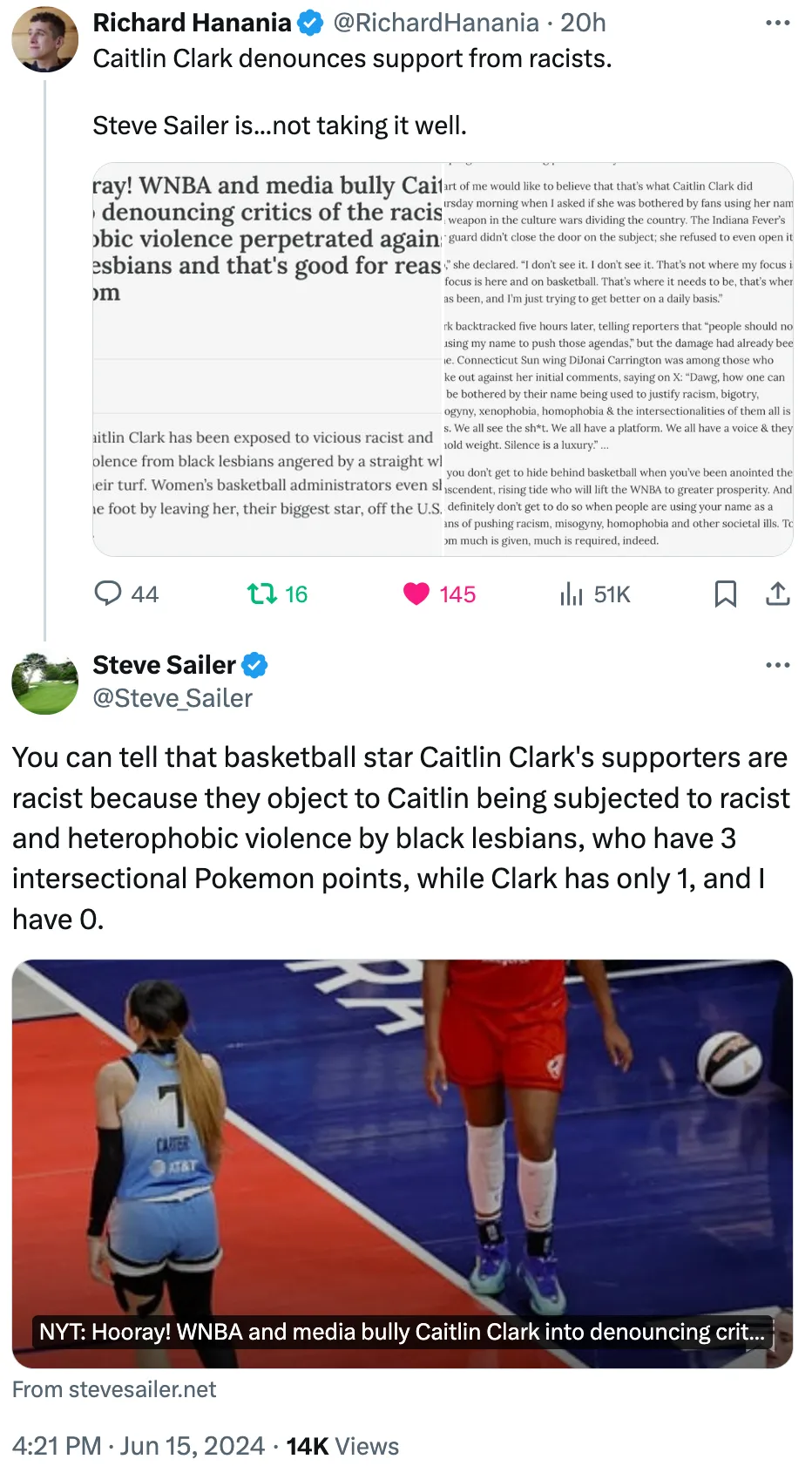
Richard Hanania snarked about my post yesterday about the season-long campaign of racist violence by WNBA black players against white rookie Caitlin Clark.
Then, today, this just happened to Caitlin Clark at the forearm of loudmouthed rival Angel Reese:
Clark’s shot was already two feet past Reese’s hand when Reese hammered Clark in the head with her arm, knocking her to the floor. Reese was whistled for “unnecessary roughess” but not for “excessive roughness.”
If the races were reversed, this of course would be a huge on-going story, dwarfing, say, even the Central Park Karen of 2020.
But, of course, the New York Times treats the bigger story as Bad People noticing the racist violence against the white woman and objecting to it, when all Good People know that blacks can’t be racist because they have no power, such as in … the WNBA? … Anyway, that’s not the point, the point is 1619, which means that blacks get to abuse whites until 2619.
I’d say Steve Sailer got the best of that dispute.
When you read Steve Sailer and Charles Murray, you’re reading serious men who believes in things greater than themselves, such as the pursuit of truth. When you read Richard Hanania, you’re reading the wildly unstable musings of a boy who venerates nothing more than himself.
Last month, the Huffington Post doxed Hanania as having written online 10–12 years ago as Richard Hoste, a tediously strident minor race realist. I would never dox anybody, but I had already looked into the Hanania-Hoste question myself. I saw many similarities, but Hanania was so much better of a thinker and writer than Hoste had been that I decided to remain agnostic on this mystery. How often do individuals improve that much?
It turns out that Hanania used to be a fat high school dropout, but now he has a J.D. from the U. of Chicago and a Ph.D. from UCLA, and has recently become a prominent skinny public intellectual. If he keeps improving at this rate, the sky is the limit.
Still, although he has much to be proud of, Richard needs to watch his ego. His editors at HarperCollins (and congratulations to them for not canceling the book after his doxing) do a good job of keeping it in check on the printed page. But online he’s been boasting like a rapper:
Why didn’t anyone do any of this before?… I don’t think anyone else could have written ‘The Origins of Woke.’
In reality, I have several books on my shelves from as far back as the 1970s that cover much of the same material. It’s a dry topic, however, so conservative intellectuals tend to forget lessons once learned in favor of highbrow speculations about Cultural Marxism and thus need periodic remindings such as The Origins of Woke.
Hanania goes on to outline his political strategy for rolling back the current legal/regulatory regime.
But perhaps what we need is to roll forward civil rights law to actively protect whites in this era of institutionalized racist antiwhite hate. For example, mandatory Diversity, Equity, and Inclusion training should be seen as prima facie evidence of a hostile work environment for whites. (I outlined sixteen principles to guide legal reform back in June.)
It goes unmentioned in Hanania’s book (as a Palestinian-American, he’s wise to tread warily), but probably the single most important political task for winning support for extending civil rights protections to whites is to get Jews to notice once again that, whether or not they feel white, legally they are white.
Back in the 1970s, many Jewish intellectuals, such as Nathan Glazer, vociferously opposed affirmative action, seeing it as a threat to their working-class relatives’ jobs.
But, Jews were rapidly moving up and out of the working class into careers then much less affected by quotas.
Steve Sailer is insightful on many things, but if you assign him an article on housing, littering, or any issue really, it will just turn into a tirade against immigration. I searched Steve’s blog for “littering” and practically every result on the first page was somehow connected to Latinos or immigrants. I tried the same with “global warming” and although the results weren’t as extreme, the pattern was similar. It’s as if whenever you brought up stamp collecting with someone they shifted the conversation to how Armenians are always trying to pass off counterfeit stamps as the real thing. You would start to suspect that this person cared more about Armenians than stamps.
Imagine a leftist coming along and saying that all you have to do is show Sailer that Latinos don’t litter all that much, and then he’ll support immigration! Obviously the whole littering obsession is a pretense, just like his solutions for housing and global warming, and the same is true for other right-wing figures who’ve talked about the topic like Ann Coulter and Tucker Carlson. Immigration restrictionists are mainly driven by aesthetic preferences — partly in the most literal sense, that is, what people in the country should look like — and only secondarily feel the need to come up with justifications for them. For the exact same reasons, talking about group differences in IQ is not the way to influence or ultimately defeat the left.
I’ve noticed that on the right, the more individuals accept group differences between races, the more they want society organized to satisfy the preferences of the worst whites and make excuses for their behavior. Those who fret about Hispanics changing our political culture tend to be those least likely to find anything disturbing in Trump’s behavior leading up to and on the day of January 6. Immigration restrictionists are some of the people most upset about fentanyl deaths, when right-wingers had little concern with what drug addicts did to themselves until whites were perceived as victims and they could fit a crisis into an anti-foreigner narrative. All of society should forgo the benefits of immigration and trade because the people at the very bottom might end up worse off. I don’t think globalization actually does make any large group of people worse off, but identitarians need to believe that it does, and will attack mainstream institutions from the left when necessary to argue against Americans being allowed to interact with foreigners.
If you read at least ten Steve Sailer columns, you will notice that he has valuable insights about many things outside of IQ and immigration. Only a petty jealous man such as Richard Hanania would think otherwise.
Hanania posts this cutline to the following picture: “Society’s most admirable heroes according to those who think immigration threatens western institutions.”
What historical examples do we have of a majority peacefully becoming a minority in a country they created?
Hanania writes: “When you buy and sell things across borders, you make both parties better off”
Has Hanania understood any skepticism about free trade? Millions of Americans lost comparatively high-paying manufacturing jobs when we gave China easy access to our markets and many of these Americans have never recovered. Covid came and America’s supply lines were largely shut down and we started wishing we had more domestic manufacturing. Does Hanania believe that during those dark early months of covid, Americans were better off without a domestic industry producing personal protective equipment?
Hanania writes: “Immigration restrictionists are mainly driven by aesthetic preferences.”
How does he know? Which of the most powerful opponents of large-scale immigration into America argued on aesthetic grounds? None. Even if their arguments were based on aesthetics, why is that weak? Why are aesthetic preferences unimportant?
As the percentage of people in America who are foreign-born increases, Americans social trust and cohesion has dropped. Navigating a society dropping in trust is easier for smart people like Hanania but not so easy for most Americans.
I don’t believe anything Hanania says unless I can verify it elsewhere. He’s out for himself and let the facts be damned. Why isn’t Hanania more diligent about facts? Because restricting himself to them would reduce his chances for self-aggrandizement.
At first glance it might seem that, for a successful academic historian, the expense of checking for, acknowledging, and correcting errors is small compared to the reputational hit of making these high-profile mistakes. Ferguson could just hire a research assistant, some Stanford student who could check everything he writes and flag the mistaken statistics and erroneous claims. The real cost would not be paying the student, however. Rather, the real cost is that, if Ferguson was restricted to only stating true facts, it would reduce his flexibility in making the larger claims he wants to make. Being willing to stretch the truth—not by flat-out lying, I think, but rather by following a general practice of not checking his statistical and historical claims—gives him extra “researcher degrees of freedom” (in the words of the famous Simmons, Nelson, and Simonsohn paper) in his theorizing. Fact-checking would reduce Ferguson’s effectiveness as a theorist and as a big-picture historian by constraining the sorts of things he could say.
Right now, we’re at about 267 [covid deaths a week]. If this pace continues (highly unlikely, due to more and more people getting ill or vaccinated), it’s about 97,000 deaths in a year. For sake of comparison, in 2017-2018, about 61,000 people died of the flu in the United States, though usually the number of deaths is closer to 30,000. So COVID is something like 1.5-3x as bad as the flu now, and the gap between the two is going to be closing for the foreseeable future.
According to the CDC, about 460,000 Americans died of covid in 2021 (about five times Hanania’s prediction). Not such an easy problem for those who don’t like people dying en masse. In 2023, covid was the tenth leading cause of death in America (according to the CDC).
Comparing COVID-19 Deaths to Flu Deaths Is like Comparing Apples to Oranges — The former are actual numbers; the latter are inflated statistical estimates
When reports about the novel coronavirus SARS-CoV-2 began circulating earlier this year and questions were being raised about how the illness it causes, COVID-19, compared to the flu, it occurred to me that, in four years of emergency medicine residency and over three and a half years as an attending physician, I had almost never seen anyone die of the flu. I could only remember one tragic pediatric case.
Based on the CDC numbers though, I should have seen many, many more. In 2018, over 46,000 Americans died from opioid overdoses. Over 36,500 died in traffic accidents. Nearly 40,000 died from gun violence. I see those deaths all the time. Was I alone in noticing this discrepancy?
I decided to call colleagues around the country who work in other emergency departments and in intensive care units to ask a simple question: how many patients could they remember dying from the flu? Most of the physicians I surveyed couldn’t remember a single one over their careers. Some said they recalled a few. All of them seemed to be having the same light bulb moment I had already experienced: For too long, we have blindly accepted a statistic that does not match our clinical experience.
The 25,000 to 69,000 numbers that Trump cited do not represent counted flu deaths per year; they are estimates that the CDC produces by multiplying the number of flu death counts reported by various coefficients produced through complicated algorithms. These coefficients are based on assumptions of how many cases, hospitalizations, and deaths they believe went unreported. In the last six flu seasons, the CDC’s reported number of actual confirmed flu deaths—that is, counting flu deaths the way we are currently counting deaths from the coronavirus—has ranged from 3,448 to 15,620, which far lower than the numbers commonly repeated by public officials and even public health experts.
On the death certificate form, there is a space for the immediate cause of death and then several lines for underlying causes. In brief, death certificates are filled out by the medical certifier (who can be the physician who had treated the patient before death), who provides his best medical opinion regarding the cause of death. Part I of the death certificate includes the proximal cause of death, or what directly caused the death, and Part II lists conditions that contributed to the death…
For example, if a patient dies of respiratory failure due to acute respiratory distress syndrome (ARDS), which was the result of pneumonia, which was the result of COVID-19, the proximal cause of death was the respiratory failure, but contributing causes were ARDS and COVID-19, with the one farthest up the chain being the underlying cause of death under Part I. If the patient had hypertension or asthma, that would go under Part II.
What is the true Covid death toll? The Economist magazine, using academic estimates that the true Covid death toll is 3.4x the official death toll, as of November 12, 2021, estimates the true worldwide death toll at 17.2 million.
Compare Richard Hanania’s thought about why liberals dominate American institutions with Rony Guldmann’s.
Hanania writes: “…conservatives are extremely bad at gaining or maintaining control of institutions relative to liberals. It’s not because they are poorer or the party of the working class – again, I can’t stress enough how little economics predicts people’s political preferences – but because they are the party of those who simply care less about the future of their country.”
Economics does predict voting. For example, rich people are more likely to vote than poor people. Report: “According to exit polling in the 2020 Presidential Election in the United States, 57 percent of surveyed voters making less than 50,000 U.S. dollars reported voting for former Vice President Joe Biden. In the race to become the next president of the United States, 54 percent of voters with an income of 100,000 U.S. dollars or more reported voting for incumbent President Donald Trump.”
Enjoying the plausible deniability provided by a façade of democratic idealism, the liberal elites have quietly colonized a host of powerful social institutions—the judiciary, academia, public schools, large foundations, the media, entertainment, and others—through which they now pursue unofficially what earlier clerisies had to pursue officially. They do not marginalize or excommunicate in the name of some codified orthodoxy like Catholic teaching or Talmudic law. But conservatives believe that the cumulative social prestige arrogated by this “rising class” is the functional equivalent of such an orthodoxy, endowing the liberal elites with a special power to cut off debate and silence dissent. Seeking above all to maintain this power, this new secular priesthood will badger, scold, and bully all who defy it. And this means conservatives. If the latter strike liberal professors like Connolly as angry and obstreperous, this is as a natural human reaction to such a regime, a response to provocations whose very existence the elites decline to acknowledge. Conservatives feel culturally oppressed because they are persuaded that the official face of contemporary liberalism conceals an agenda that is culturally and morally “thicker” than the supposedly “neutral” abstractions of freedom and equality through which liberals formally define themselves. Liberals may hold themselves out as selfless defenders of the public interest combatting the narrow prejudice and egoism of retrograde conservatives. But conservatives retort that these pretensions are an ideological screen behind which liberals foist a parochial vision of human virtue on an unwilling populace in a wide range of spheres, from politically correct education to avant-garde entertainment to creative constitutional jurisprudence.
I haven’t found any topic where one would be best served by reading Richard Hanania first.
Feb. 7, 2022, Richard followed Dennis Prager, Noah Carl and Amy Wax in developing the following ideas:
Women’s Tears Win in the Marketplace of Ideas
How belief in the blank slate plus residual gender double standards create “cancel culture,” and the difficulties of fighting back
We can understand the decline of free speech as a kind of female pincer attack: women demand more suppression of offensive ideas at the bottom of institutions, and form a disproportionate share of the managers who hear their complaints at the top.
What is left to contribute on the question of how feminization relates to pathologies in our current political discourse? First, I think that the ways in which public debate works when we take steps to make the most emotional and aggressive women comfortable have been overlooked. Things that we talk about as involving “young people,” “college students,” and “liberals” are often gendered issues…
For all our talk of equality, our culture treats violence, incivility, and aggression towards women much more seriously than the same towards men…
Conservatives can call antifa terrorists, use traditional methods of law enforcement against them, and even coordinate right-wing media attacks against professors who support their ideas. Stories on antifa professors and their outrageous antics have been a staple of outlets like Fox News, which regularly try to get them fired. But men tend to be puzzled by how to handle getting yelled at by women, and most will try to end the conversation as quickly as possible on whatever terms they can get.
…[W]e have a few options for how we treat public discourse. The first two are
Expect everyone who participates in the marketplace of ideas to abide by male standards, meaning you accept some level of abrasiveness and hurt feelings as the price of entry.
Expect everyone to abide by female standards, meaning we care less about truth and prioritize the emotional and mental well-being of participants in debates…
When public discourse operates according to male rules, women become more likely to select out of it. They focus more on career, children, hobbies, and family…
…a world that valued truth and objectivity over feelings would have fewer female executives, senators, and journalists, but be better for everyone because it would have more economic and technological growth…
The strength of any anti-wokeness movement depends in large part on the strengths of its antibodies to a certain kind of female emotionalism.
Aug. 20, 2024, Hanania wrote “the intellectual dominance of [Michel] Foucault was a matter of him being in the right place at the right time.”
By contrast, Rony Guldmann named important insight after important insight from Foucault:
* Foucault observes that whereas power in feudal societies operated only intermittently and inefficiently through levies, war, and sundry rituals of fealty to the liege lord, the sixteenth and seventeenth centuries transformed power into a more all-pervasive and uninterrupted affair. No longer a matter of punishing defiance or disrespect, it became “a matter of obtaining productive service from individuals in their concrete lives.” Power now meant the minute regulation of acts, attitudes, and everyday behavior, the subjecting of bodies to “highly complex systems of manipulation and conditioning.” Whereas older elites wanted only to maintain their power and authority, modern ones demand not only obedience but conformity, which means a more regulated and predictable relationship to our own impulses.
* Here is Foucault’s “memory of hostile encounters,” which liberals understand shapes the objective social context in which African-Americans are compelled to operate. And I am arguing that something like this is also transpiring in the context of the regulations whose oppressiveness [David] Kahane and other conservatives seem to be histrionically exaggerating.
* Conservative claims of cultural oppression are, as Foucault says, “located low down on the hierarchy, beneath the required level of cognition or scientificity.” And this is why “the ostensible issues are always secondary,” why it does not “matter greatly whether the resentment and resistance makes sense logically or is backed by solid evidence.” Lacking the words for what is primary, conservative claimants of cultural oppression can only persevere in that resentment and resistance in the hope that this will eventually yield some insight into their true meaning. To accept the intellectual framework insisted upon by liberals would be to surrender the field at the very outset, and this they refuse to do.
* Foucault writes that “[e]ach society has its regime of truth, its ‘general politics’ of truth,” the types of discourse which that politics “accepts and makes function as true.” The truths of liberalism are made to “function as true” because, like any artificial social hierarchy, liberalism generates its own “truth” by progressively debilitating those who would challenge it. Just as racism can “create” black criminality by limiting blacks’ educational and economic opportunities and sexism can “create” femininity by enforcing female subservience, so liberalism creates conservative anti-intellectualism. This is to be expected given the “vision of the anointed” and its “pattern of seeking differentiation at virtually all costs.”
Democrats Have an Intelligentsia, Republicans Have a Personality Cult
Understanding the 2024 election cycle
Democratic leaders and the liberal intelligentsia more generally have to an impressive degree shown intelligence and a willingness to cooperate in order to achieve their strategic ends. At the same time, as the Vance pick and the messaging around their campaign shows, Republicans are only delving deeper and deeper into being a cult of personality centered around the whims of one man. This doesn’t mean they can’t win in November, only that Democrats have made a series of decisions that have maximized their chances. We can contrast this with how Republicans react to bad news, and their inability to either face reality or work together to converge on an outcome that achieves some greater good.
This seems like a strange analysis given that Donald Trump competed in an open Republican presidential primary while the Democrats insured that Joe Biden would face no opposition in his primary. How dysfunctional were the Democrats that they were saddled with a senile Joe Biden running for a second term for most of the past 18 months?
Hanania wrote: “Nobody serious in the Democratic establishment or liberal media was arguing that the polls showing Biden losing were fake.”
Hanania wrote: “I’ve seen some conservatives say that it was clear Biden was out of his mind before the June debate and the fact that it took the liberal establishment this long to see it is in fact discrediting.”
Conservatives were right.
Hanania posted a picture of Ezra Klein with the cutline “The man who brought down a president.”
That’s nonsense. There’s no evidence that Ezra Klein brought down President Biden. Reality defeated Biden.
Who’s the boss? Not the president, not the Senate majority leader, not the MSM. The situation is the boss. The situation determines the comparative power of all other factors including law and precedent.
The majority opinion of political elites as of July 2, 2024, is that it’s inevitable that Joe Biden will become the nominee of the Democratic party for president of the United States because that’s the law. That’s the precedent. That’s the procedure. He’s made it through the various bureaucratic hurdles and he’s the presumptive nominee and only Joe Biden can turn down the honor.
I think the dire situation of Biden’s cognitive decline will outweigh precedent.
This frenzy shows the elite catching up to the majority of grass roots Democrats who did not want Biden to run for a second term (and had minimal enthusiasm for him in 2020).
July 6, I wrote:
Liberals Were Blinded To Biden’s Senility By Their Own Speech Codes
It is a fair conservative critique that many reporters ignored obvious signs of cognitive decline… Rarely did other outlets follow our exclusive reporting on accommodations for Biden's aging — shorter hours for public appearances, fewer improvisational or late-night moments, and the rise in handlers and devices to help avoid tripping and falling. Some reporters enabled the White House by piling on reporters on social media who questioned Biden's lucidity…
There were so many early signs. Biden rarely did tough interviews — much, much fewer than his predecessors. It was almost always friendly questions on friendly terrain…
The denials — including the favorite line that Biden works so hard he exhausts the youngsters — strained credibility then, and look ludicrous in retrospect.
We all have concepts of the world and some are more useful than others.
By July 2, it became clear to me that Joe Biden would go due to the desperation of the situation. At this point, most of the political elite believed that Biden would stay due to precedent. I don’t know as much about politics as they do, but if I am right, it is due to my having a superior conception – that the dire nature of the situation will prevail over precedent.
Similarly, most political elites believe that Kamala Harris will be the Democratic nominee for president if Joe Biden steps down. I do not. Due to the dire nature of the situation (that Kamala Harris has provided Democrats with no basis for believing that she can defeat Donald Trump), I believe the Democrats will select a different nominee.
Who’s the boss? Not the president, not the Senate majority leader, not the MSM. The situation is the boss. The situation determines the comparative power of all other factors including law and precedent.
Liberal elites had a concept regarding Joe Biden prior to the June 27, 2024 debate that ageism and ableism are so morally dangerous that we should require considerable evidence from experts before publicly raising the question of his competence.
How many of liberalism’s moral categories prevent people from seeing reality? Because of “racism,” we can’t discuss in polite company that different groups commit crimes at different rates. Common sense suggests profiling people according to crime statistics but liberals have made that, in many cases, illegal.
That which you are not allowed to say out loud is increasingly not thought. Once liberals speech codes are internalized, conservatives can’t even think like conservatives.
Liberals want to stigmatize frank and easy discussion of reality including the obvious fact that different ages, sexes, races, and religions have different gifts.
On no topic is the bifurcation of America’s media more evident than that of the president’s age. To the conservative media world, Joe Biden’s imagined senility is a staple. Republican figures routinely call for him to take cognitive tests. The term “dementia” is bandied about. By contrast, the closest traditional outlets have come to addressing Biden’s age is a spate of reports into the low ratings of his vice-president, Kamala Harris. For them, it is as if openly acknowledging Biden’s advancing years would validate the conspiracy mongers…
There is no reason to think that Biden is suffering from anything more than traits that characterised him in younger decades, such as foot-in-mouth disease and a tendency to talk too much. Neither of these is degenerative… There are some grounds to suspect he is getting more forgetful — he implied twice last year that Taiwan was a formal ally of the US, a claim his staff had to correct. But there are none to suggest he is senile or suffering from dementia.
It turns out the conservatives were right and the liberal establishment was wrong.
Like most of the press corp, Edward Luce was checked out of reality with regard to Biden’s senility. And yet Luce is now making the rounds (including on the elite Morning Joe tv show) pronouncing on the story without admitting how wrong he was.
In a July 6, 2024 video, America’s best political reporter, Mark Halperin, says: “Republicans investigating Joe Biden during his presidency have been a clown show. They haven’t done it well and in part they haven’t done it well because like with the Hunter Biden investigations the press was against them. The press didn’t want to help them. Now the press is interested in these two stories too so the incompetent Republican party on Capitol Hill in terms of investigations is now going to have the wind at their back because they’ll be working with reporters. One is what did the president’s people know and when did they know it (his condition)… It’s been a conspiracy. The press has been in on it.”
Isn’t “senile” the word that rises most readily to the lips with regard to Joe Biden’s condition over the past six years? “Senile” is easier to say than “cognitive decline.” What’s a better word to describe Biden’s cognitive collapse over the past six years? Perhaps “frail.” That’s regarded as a scientific and medical term.
How would you explain the MSM’s reluctance to point out Biden’s obvious senility?
According to the Cambridge dictionary, senile means “showing poor mental ability because of old age, especially being unable to think clearly and make decisions.”
According to the Merriam-Webster dictionary: “Due to its negative connotations, use of senile relating to cognitive decline is now typically avoided in medical contexts and may be considered offensive in general contexts.”
Healthline.com notes:
Today, “senile” is generally considered an insult and is not used except as part of archaic medical condition names.
The more accurate way to refer to natural changes of aging, especially those related to mental and intellectual functioning, is “cognitive changes.”
Yes, and the homeless are just people going through a lack of housing phase and illegal aliens are just people without proper papers.
Every group has its blind spots. “Ties bind and blind,” notes Jonathan Haidt. Conservatives have their share of blind spots. For example, conservative distrust of expertise and big government placed them at a disadvantage with regard to minimizing Covid. Conservative veneration of certain first-hand experiences over expertise creates its share of problems. Conservatives who dismiss evolution are blind to much of reality.
June 28, 2024, the day after Joe Biden’s disastrous debate, lefty Ezra Klein said: “That isn’t to say he’s senile or any of the things that the more wild right-wing accusations say about him…”
Why is it wild to describe Joe Biden as senile? He’s clinging to power in a delusional way.
July 1, 2020, Axios noted: “Senility is becoming an overt line of attack for the first time in a modern U.S. presidential campaign.”
One journalist who has not been hesitant to assess Joe Biden is Brit Hume. He said in a Fox Interview in September 2020, “I don’t think there’s any doubt Biden’s senile.”
Politifact did a “fact check” back then declaring Hume’s assessment “false,” while noting the term “senile” is an imprecise term.
PolitiFact contacted experts in the health care of older people for their take on Hume’s use of the word senile and its application to Biden. They said Hume’s characterization is wrong.
It’s “a shameful display of ageism and ignorance,” said Donald Jurivich, Eva Gilbertson Distinguished Professor of Geriatrics and Chairman of Geriatrics at the University of North Dakota School of Medicine & Health Sciences.
The word “senile” may create a mental picture of someone who has stooped posture, is slow moving and cognitively impaired, Jurivich said. “I don’t think any of these descriptors match Joe Biden’s demeanor and vigor,” he said.
From a geriatrician’s perspective, Jurivich said, “the use of ‘senile’ is a pejorative descriptor and reflects unmitigated ageism.”
Anyone talking about ageism and ableism sounds like a retard to red America. Liberal fidelity to the virtues of avoiding ageism and ableism blinded them to Joe Biden’s obvious decline.
It’s difficult to divine from the histories of the Biden administration written so far just how active a role the president has played in governing the country…
Whereas accounts of the Trump White House varied from clown show to cesspool, with backstabbing among hacks, mercenaries and scumbags, the histories of the Biden administration present a succession of earnest and credentialled professionals lining up to help the president better the country and the world.
…The issue of Biden’s age is not much discussed in these books. Whipple, whose previous books include a study of the job of White House chief of staff, recounts a Zoom meeting between Klain and some of his predecessors during the transition in 2020. Jim Jones, the 82-year-old former chief of staff to LBJ, asked: ‘Could a soon to be 82-year-old man, battered by four years of stress and crisis, serve effectively for another full term as president?’ The question became pertinent in April 2022 when at a ceremony at the White House to unveil a proposed expansion of Obamacare, the former president was mobbed by admirers while Biden, in Whipple’s phrase, ‘looked a little lost’. Republican Senator Rick Scott of Florida said: ‘Let’s be honest here. Joe Biden is unwell. He’s unfit for office. He’s incoherent, incapacitated and confused. He doesn’t know where he is half the time.’ ‘This was, of course, false,’ Whipple insists. ‘Biden was mentally sharp, even if he appeared physically frail.’ Bruce Reed, the deputy chief of staff, told Whipple of a long flight home from Geneva in 2021 during which Biden regaled his jetlagged entourage with old stories, including the one about the time he visited the Kremlin and told Putin he had no soul, until everyone except the president passed out. But Foer writes that Senate Republicans ‘doubted Joe Biden was running his own show. Because of his advanced age, they whispered that he was a marionette, wiggling his arms as Klain manipulated him from above. Aides to Mitch McConnell were blunt in their analysis. They dubbed Klain “prime minister”.’ Tucker Carlson has made Biden’s age one of the central themes of his twerpy routine. Defenders of the president have written off such claims as ‘right-wing talking points’, but like left-wing and centrist talking points, right-wing talking points occasionally have some basis in fact.
A search of Google Scholar July 12, 2024, revealed there have been no academic articles on Joe Biden’s cognitive decline.
A search of Richard Hanania’s Substack reveals no examples of him noting the obvious – that Joe Biden often appears senile.
Democrats have an intelligentsia, which is sometimes right and sometimes wrong, but generally based in reality and able to strategize in the service of common goals… A Democratic intelligentsia can make arguments based in logic and data that its voters will accept because they have a critical mass of supporters who either consume credible sources of information or have good enough judgment to trust those who do. The Republican masses are less likely to respond to opinions formed based on election models, and more likely to be taken in with conspiracy theories or narratives that stress divine intervention in human affairs.
I don’t think the Democrats sticking with Biden until it became impossible is a strong argument on Hanania’s behalf.
I’d sum up partisan differences this way: Democrats believe in expertise and Republicans believe in common sense.
Hanania identifies as a globalist liberal. He posted July 29, 2024: “Elite Human Capital Is Always Liberal”
The “always new science of conservative phrenology,” writes [Jonah] Goldberg, is a “white-smocked effort to explain away conservatism as a mental defect, genetic abnormality, or curable pathology.”11Liberals routinely excoriate as beyond the pale all speculation concerning the genetic basis and heritability of intelligence whenever race or gender are in the mix. But then they are astonishingly hypocritical in their “gidd[iness]to entertain the notion that conservatives have broken brains—based solely on the fact that they are conservatives.”12Whether their analytical framework is sociological, as for Frank, or biological, as for the phrenologists of conservatism, liberals seem united in their determination to denigrate conservatives by any means necessary.
I really, really dislike Trump supporters… Trump of course shares many of the flaws of his biggest fans. He’s conspiratorial, bigoted, and sees the world through an amoral tribal lens.
Most people see the world through an amoral tribal lens. Hanania also has a tribal lens – the tribal identity of the superior intellectual who wants to bully the common people.
* …the problem with liberal individualism is not its excesses but its fraudulence, the hidden tribalistic impulses operating underneath the façade of that individualism, in which liberals do not truly believe.
* Insensible to their creed’s hidden, subterranean heritage, liberals cannot recognize that gay rights is, like every liberal cause, driven onward by a subterranean tribalism that hides itself from the naked eye.
* the deceptive and self-deceptive histrionic mimicry of scientific disengagement can beget a self-fulfilling prophesy, as the surreptitious imposition of a hero-system provokes a “tribalistic” reaction by contraposition with which liberals’ claims to disengaged objectivity seems socially vindicated. In this way does liberalism create the very realities it purports to describe—as all hero-systems must.
July 24, 2024, Hanania wrote: “While Tucker hates everyone under the sun…”
Because of an absurd number of phrases like this, Hanania does not deserve the grace you extend to people who seek to operate in good faith. Hanania isn’t even trying. He’s a slur merchant and attention-seeker.
Hanania wrote: “The Tucker worldview has the effect of creating an all-encompassing sense of victimhood…” There is no strong in-group identity without an intense sense of victimhood. For most people, life goes better with strong in-group identity though expressing your raw sense of victimhood publicly is not usually a winning formula.
Hanania wrote: “Trump supporters are angry and distrustful towards all institutions.”
Given that most institutions are run by people with opposing hero systems, that Trump supporter orientation is understandable. Might there be good reasons for conservatives to have a cultural grievance? Yes.
Hanania wrote:
Trump simply likes strongmen. He loves Putin, Xi, and Kim because he sees them as tough. This is of course morally atrocious, but that’s the underlying motivation. When MAGA rightists admire Putin, it’s because they’re misanthropes. To the extent that they appreciate strength, it’s in the service of slapping around people they don’t like, including LGBT and Open Society types, and also Ukrainians, who all need to be humbled because American elites sympathize with them. I think Trump likes the idea of Putin locking people up and conquering territory too, but this is just a general appreciation of gangsterism, rather than a revenge fantasy of the impotent.
Trump recognizes he can get along with many of our enemies by flattering them and seeking common ground. Hanania recognizes that Trump’s foreign policy was a success. Joe Biden’s foreign policy has been a disaster (we’re closer to a conflagration than at any time in the past three decades).
An objective observer recognizes that Putin has been an effective leader of Russia.
Americans, like every other people on earth, don’t care much about strangers overseas.
Hanania wrote:
A good example showing the contrast between the two men was revealed during an interview when Tucker asked Trump if he was worried about the possibility of being assassinated, and the former president brushed it off. Trump plays the victim in the context of a script where there is a well-defined enemy of limited power and the triumph of good over evil is the most likely outcome. The role of the protagonist also requires some level of stoicism, which is why he is publicly nonchalant about the possibility of getting killed or going to jail. There’s a clear contrast with the victimhood porn that Tucker types are selling.
Tucker was once again on to something that Hanania missed.
Hanania: “if one’s morality is rooted in Christianity, liberalism, or virtue politics there’s literally nothing good one can say about Trump.”
Perhaps Hanania is right and Christians for Trump are wrong.
Hanania’s perspective that people who disagree with him are stupid blinds him to much of reality. Unlike Hanania, I don’t take the perspective that people who looks at things differently from me are crazy, so I put in effort to understand why they see the world as they do. There’s nothing human that’s foreign to me.
Hanania: “I’m both a Nietzschean and a troll.”
There are smart and funny trolls who perform a public service. And then there are people like Richard Hanania.
Forensic psychiatrist Dr Sohom Das said: “Traits shown by those internet trolls include impulsivity, selfishness, and emotionless callousness. They have a mind-boggling sense of remorselessness and an absence of morality. There is also manipulation and exploitation of others, who they goad into joining in with their cruel and demeaning behaviour. There is also extreme narcissism mixed in with grandiosity and egotism. This is reflected in their desire to assert power and dominance for pleasure.”
Hanania: “Trump has mass appeal, but his base contains the most hateful and paranoid people within American society.”
Who has a higher rate of rape and murder? Biden voters or Trump voters? I don’t recall Trump supporters causing as much destruction as Black Lives Matter and Antifa.
[Hillbilly Elegy] reflects an acceptance of therapy culture. Throughout his memoir, Vance intersperses summaries of studies about how trauma causes people to behave badly. I noticed that he accepted the Adverse Childhood Experience (ACE) checklist as legitimate. I had first heard about ACE from Abigail Shrier’s Bad Therapy as an example of the kind of pseudoscientific nonsense that causes more mental illness than it treats. Vance assumes that what he went through as a child left lasting scars, while I tend to believe that thinking like this is a kind of self-fulfilling prophecy. I’m a genetic determinist, so I never believe events affect me all that much, and they generally don’t.
There aren’t many genetic determinists because common sense suggests that genetics display differently in different situations. Steve Sailer and Charles Murray, for example, are not genetic determinists.
Biological determinism, also known as genetic determinism, is the belief that human behaviour is directly controlled by an individual’s genes or some component of their physiology, generally at the expense of the role of the environment, whether in embryonic development or in learning. Genetic reductionism is a similar concept, but it is distinct from genetic determinism in that the former refers to the level of understanding, while the latter refers to the supposed causal role of genes. Biological determinism has been associated with movements in science and society including eugenics, scientific racism, and the debates around the heritability of IQ, the basis of sexual orientation,[5] and evolutionary foundations of cooperation in sociobiology…
[Francis] Galton popularized the phrase nature and nurture, later often used to characterize the heated debate over whether genes or the environment determined human behaviour. Scientists such as behavioural geneticists now see it as obvious that both factors are essential, and that they are intertwined, especially through the mechanisms of epigenetics. The American biologist E. O. Wilson, who founded the discipline of sociobiology based on observations of animals such as social insects, controversially suggested that its explanations of social behaviour might apply to humans.
I have no idea if the “Adverse Childhood Experience (ACE) checklist” is “legitimate,” whatever that means. I suspect that like every other therapeutic tool, it can be helpful or hurtful depending on how it is used and on whom. That Richard Hanania has read one book by Abigail Shrier and come to a conclusion about the validity of ACE shows what a shallow thinker he is.
Hanania wrote:
I can understand both 2016 Vance and 2024 Vance on their own terms. The first was sensitive, cared about civility in public life, and was humble and introspective. His politics were anti-conspiratorial, he accepted the idea that poor life choices were what led to poverty, and rejected attempts by communities to blame or scapegoat others for their own problems. The Vance of 2024 believes that liberals are evil, and their embrace of globalism is what causes white rural poverty. He endorses a book that refers to liberals as “unhumans”, suggests that Biden is using fentanyl to kill off MAGA voters, and says insurance companies encourage BLM riots to be able to raise their rates (seriously).
Each of these guys is an immediately recognizable type. But how one goes from the first to the second in the course of a few years is something that has yet to be explained, and likely never will.
[Matt] Yglesias notes that many academic historians have privately told him that they secretly agree with David Austin Walsh’s comment that white men have a harder time getting jobs in academia. What I find interesting here is not that individuals might be cowed into silence, which happens. Rather, it’s that they have no shame about this fact.
When I spent more time around academics, I often used to hear some variation “of course I agree with you, but I’d never be able to say that!” To me it’s like hearing someone say “you know, I couldn’t satisfy my wife last night. Us guys with small dicks, am I right?” Sure, anyone could have one bad performance, but to indulge in it is weird. This is especially true if you chose to go into the world of ideas as your profession. To me, this comes with a sacred duty to tell the truth that is fundamental to my personal identity.
There is of course a difference between courage and suicidal recklessness. Think about men on a battlefield. We praise a soldier who puts his life on the line in order to pull a wounded comrade to safety. If a guy simply rushes into a hail of machine gun fire with no strategic purpose behind his actions, he might still be brave but we consider his stupidity more notable than his courage. There would likewise not be much value in trying to save a wounded comrade if there’s a 100% chance you will not be able to do so and probably get killed in the process. Courage as a virtue we might say involves taking some measure of reasonable risk for a higher purpose or goal.
For that reason, I don’t advocate people go through life simply blurting out whatever pops into their heads. If you are a junior scientist working on a project to cure cancer and have a disgust towards transgenderism, your obligation to yourself and society requires you not to shove that opinion in the faces of liberal colleagues. Yet I think people in the world of ideas have a special obligation, and most of them could be much more courageous on the margins…
As someone who is openly in the public sphere, I see right-wing anonymous accounts as engaging in a kind of stolen valor…
Ezra Klein talks about how he has no idea what a left-wing version of Jordan Peterson would look like, given that liberals don’t really have a positive vision of masculinity.
People react to incentives. Though he claims to be a genetic determinist, Hanania doesn’t write like one very often. Why? Because he lacks courage.
Hanania: “Since contemporary Americans don’t face any substantial oppression based on political views…”
Compared to being put in a concentration camp, contemporary Americans don’t face any substantial oppression based on political views. Compared to claims of micro-aggressions and systemic racism, conservatives have as much of a claim to oppression.
Podnotes summary: I’ve been reading Richard Hanania’s posts and noticed he seems to primarily care about his ego. His top Twitter post brags that 1% of his newsletter subscribers are from elite schools, revealing his priorities.
Richard Hanania is like Richard Spencer in seeking attention but different from Mike Benz who commits to causes beyond himself. For example, despite Benz’s outlandish claim of running cyber for the State Department, he supports free speech and Republicans earnestly.
Steve Sailer pointed out an issue in women’s basketball: WNBA star Caitlyn Clark faced racist violence which was ignored by the media. Instead of addressing this serious matter, Richard Hanania mocked it for self-promotion.
At political events like the Democratic National Convention, journalists show bias based on party lines. Some reporters favor Democrats while being hostile toward Republicans. This reflects a deeper division within parties themselves – Democrats united versus Republican tensions around Trump’s conduct.
Richard Hanania dismisses significant issues like nuclear war risks with Russia over Ukraine or Taiwan’s defense against China as trivial compared to economic growth when voting Republican. He also flip-flops on ideologies for acceptance – once alt-right now claiming liberalism with conditions for supporting either party based on policies like euthanasia or abortion rights rather than cultural values or serious global concerns.
On COVID-19, Richard downplays its severity compared to flu without solid evidence and provides misleading information about vaccines and children’s risk levels – showing a lack of seriousness in his approach towards important matters.
Steve Sailer noted that despite Richard Nun’s impressive credentials, including a law degree from the University of Chicago and a Ph.D. from UCLA, his online boasting could damage his reputation. His transformation from an overweight high school dropout to a skinny public intellectual is remarkable. Despite his achievements, he must keep his ego in check; Harper Collins editors help with this in print but not online.
Richard Hanania has become known for discussing topics like the origins of woke, which others have covered before him. Steve believes no one else could’ve written it quite like Richard did.
As election season approaches, there’s potential for candidates to appeal to independents and Trump-leaning Republicans. While some momentum seems lost after bad press regarding price gouging allegations, it’s unclear if this will significantly impact polls or campaign dynamics.
Tensions within political campaigns are typical; even Biden’s campaign experienced division. Current unity may be fragile due to differing views on issues such as Israel-Palestine relations.
The Democratic National Convention appears promising with well-produced events featuring notable speakers and possibly surprising guests contributing to its success.
There’s debate over whether being overly optimistic about electoral chances poses risks for Democrats who might become complacent or misjudge voter sentiments outside their bubble – especially concerning controversial policy proposals like price controls.
Nathan Cofnas offers serious intellectual contributions by analyzing influential works like Kevin McDonald’s “Culture of Critique,” despite facing criticism for his views on race science at Cambridge—a university less influenced by mainstream American academic trends than Oxford or Harvard.
In contrast, Richard Hanania seeks attention rather than adhering strictly to evidence when presenting theories—something critics argue can lead narratives away from reality towards self-promotion.
Finally, discussions around Trump’s behavior suggest that while some view him as increasingly erratic under pressure from opponents like Kamala Harris’ campaign team—which is adept at using humor and memes—others see consistency in Trump’s approach since 2016 and believe accusations of madness are exaggerated by those strongly opposed to him.
The team running Kamala Harris’s campaign is doing an exceptional job, pushing her to the top of the polls despite challenges. The podcast “If Books Could Kill” offers interesting points on various topics, including a critique of Richard Hana’s book “The Origins of Woke.” They question his arguments and point out inconsistencies in conservative books that repetitively criticize ‘wokeness.’
In one episode, they discuss how disparities are often misattributed solely to discrimination without considering other factors. The hosts also delve into workplace diversity initiatives and civil rights laws’ unintended consequences.
Regarding politics, there’s a discussion about Trump supporters overlooking his lies because past presidents have also been dishonest. This context makes them see Trump as no different when it comes to truthfulness but still their preferred choice due to alignment with their interests.
Overall, the podcast provides critical analysis of right-wing ideas and emphasizes the importance of listening to opposing viewpoints for a comprehensive understanding of political ideologies.
Figures like Tucker Carlson and Candace Owens, despite making valid points, often discredit themselves. Candace Owens was once productive with her mid-level IQ content aimed at a general audience. The book Greg refers to criticizes how liberal elites have hijacked civil rights law, focusing on affirmative action, disparate impact, harassment law, and Title IX.
Richard Hanania is criticized for not being factual or thorough in his work; he’s seen as seeking attention rather than accuracy. Disparate impact is discussed—how the Civil Rights Act outlawed employment discrimination without defining it clearly—and how this ambiguity was addressed by the Supreme Court.
Peter Schweizer’s investigation into Kamala Harris reveals her political rise and questionable actions during her career. She ran against the San Francisco incumbent DA who was investigating corruption and priest sex abuse cases but dropped these investigations after winning office with support from influential individuals including Willie Brown.
As California attorney general, she protected allies while targeting enemies—for instance shutting down probes into health supplement companies represented by her husband’s firm. Her decisions also favored powerful donors over public service when dealing with hospital sales.
"This guy knows all the gossip, the ins and outs, the lashon hara of the Orthodox world. He’s an [expert] in... all the inner workings of the Orthodox world." (Rabbi Aaron Rakeffet-Rothkoff)