How Did The Cult Of Lashon Hara Laws Strangle Open Discussion In Orthodox Life?

For the first 3000 years of its history, judging by its sacred texts, the Jews had open discussion of individuals. The Bible and the Talmud were never shy about describing people in detail, even negative detail. Then a thicket of laws against gossip arose, crowned by the impenetrability of the Chofetz Chaim, and now you can’t even discuss a public figure in Orthodox life without cries of lashon hara. What happened?

Posted in Judaism, Orthodoxy | Comments Off on How Did The Cult Of Lashon Hara Laws Strangle Open Discussion In Orthodox Life?

An Interview With Historian Edward S. Shapiro

He’s the father of controversial historian Marc B. Shapiro.

I call Dr. Edward Shapiro (author of Letters of Sydney Hook: Democracy, Communism and the Cold War, We Are Many: Reflections on Jewish History and Identity, The Oys of Yiddish: Essays on Yiddish Culture in America, Clio from the Right: Essays of a Conservative Historian, A Time for Healing: American Jewry Since WWII) Monday morning, March 26.

We discuss his essay “Modern Orthodoxy in Crisis: A Test Case” in the Summer 2002 issue of Judaism magazine:

The tensions within Modern Orthodoxy were exhibited on a local level in the 1990s in Congregation Ahawas Achim B’nai Jacob and David of West Orange, New Jersey, the leading Orthodox congregation in Essex and Morris counties. I have been affiliated with the congregation since 1969 and, as an academically trained historian and an observer of the sociology of American religion, I have closely watched and thought about its growth. Indeed, much of my writing on American Judaism has come from viewing developments on the ground, so to speak, in West Orange. The evolution of the West Orange Orthodox community has, I believed, been a microcosm of important trends in the history of American Orthodoxy in general and of suburban Orthodoxy in particular. (15) AABJD had been moving slowly to the right during the past three decades. The square dances and concerts with female singers of the 1970s had disappeared from the congregation’s social calendar. Mixed dancing at the synagogue’s annual dinner ended in the early 1980s. The prayer books and bibles used by the synagogue reflected this rightward move. In the 1970s the synagogue used the Birnbaum siddur and the Hertz chumash. These were replaced in the 1980s by the siddur and chumash produced by ArtScroll. ArtScroll specializes in printing prayer books, biblical commentaries, hagiographic biographies, children’s books, and other works which reflect the anti-modernist mentality of sectarian Orthodoxy. These books are written in an execrable manner and edited by persons who disdain or are unaware of modern Jewish scholarship. Few of AABJ&D’s members seem to recognize the incongruity of a congregation of college graduates and professionals using such fundamentalist religious literature. The Rabbinical Council of America, the major rabbinic spokesmen of Modern Orthodoxy, even commissioned ArtScroll to produce a prayer book suitable for their congregations. “There is no small irony,” wrote the historian Jack Wertheimer, “in the fact that the RCA thus commissioned its opponents in th e Orthodox world–traditionalists who do not accept the legitimacy of centrist Orthodox rabbis–to provide its official prayer book.”…The [retiring] rabbi was a “people person.” He made the non-Orthodox feel comfortable, and he was able to bridge the religious differences within the congregation’s increasingly diverse membership. His sermons avoided potentially divisive topics and emphasized the need for community and unity. The rabbi’s highest values were ahavat Israel (love of fellow Jews) and support for the state of Israel. He also exhibited another important trait of Modern Orthodoxy: involvement in the wider Jewish community. He was active in the local Jewish federation and respected by the non-Orthodox as a person to whom they could relate. The nature of his replacement would indicate whether the synagogue would remain a quintessentially Modern Orthodox synagogue or move to the right. Moving to the left was never an option.

…The third and successful candidate presented a third rabbinic image: that of the communal rov, halakhic decisor, and defender of religious truth and dogma. Although a graduate of the rabbinical school at Yeshiva University, candidate (3) had gone on for further study at a right-wing yeshiva and had married the daughter of the head of the yeshiva. His dress and demeanor projected a more right-wing outlook. In contrast to the incumbent who was clean shaven and wore a skullcap during prayer, candidate (3) had a short beard, wore a black hat during prayer, was always dressed in the dark suit and white shirt common to the yeshiva world, and sent his oldest son to study at a right-wing yeshiva.

The interview of candidate (3) with the synagogue’s members revolved around whether he threatened the prevailing religious ethos of West Orange and how he would relate to non-Orthodox Jews. While in West Orange, he was asked specifically whether he would be willing to become involved in the local federation, and whether he would send his children to the local day school, a centrist institution, or whether he would opt to send them to more right-wing institutions. He stated from the beginning that he would not enroll his children in the local Modern Orthodox day school. It soon became clear after he assumed office that he was far less tolerant of non-Orthodox varieties of Judaism than his predecessor and less interested in being involved in the larger Jewish community. His view of his role as rabbi was indicated when he affixed to his office door a sign stating that he was mora d’asrah (teacher of the town), implying that he viewed himself as West Orange’s ultimate authority on matters of Jewish law.

…During the interview process, he was asked his opinion of women’s prayer meetings at which they would read from Torah scrolls (he opposed them), and of women wearing slacks within the synagogue building (he hoped they would wear appropriate clothing when meeting with him). The feminist disquietude was not alleviated by the new rabbi’s first pre-Yom Kippur sermon. Here he emphasized the duty of husbands to buy their wives pretty clothes for the High Holy days. This offended some women in the congregation who felt they had more important roles than being the recipients of their husbands’ largesse, and it reinforced the sense that he did not understand why so many Orthodox women believed they were not being taken seriously as Jews.

Luke: “How did you become Orthodox?”

Edward: “When we moved to New Jersey [in 1969], I became more traditional. I wanted more Jewishly and I felt that the only way to do that was becoming Orthodox. I was 31.”

Luke: “Did you think about Orthodoxy being more true?”

Edward: “I didn’t think about it theologically. I thought about it more in sociological terms. If you want to lead a vibrant Jewish life and raise your children that way, you have to be in an Orthodox setting.”

Luke: “What was the feedback you got on your essay on the search for a new rabbi?”

Edward: “The rabbi of West Orange was incensed. He went ballistic. He got up publicly and berated me from the pulpit. It was one of the factors that led to his resignation. He couldn’t get a job elsewhere in the United States and he moved.”

“There was one thing after another with this rabbi. He came in 1998. He was ill-suited for this position. In the Spring of 2004, he said he wouldn’t continue serving in the pulpit. The synagogue gave him a one-year buy-out.”

Luke: Did you have any qualms about publishing this essay?

Edward: “I checked with a prominent sociologist about publishing it and he couldn’t understand why there’d be any objection. I checked with the Editor of the magazine Judaism and my son, Marc Shapiro, and other people… This rabbi went off half-cocked. It was irrational.”

Luke: What did the rabbi object to?

Edward: “First, that he shouldn’t be discussed at all because he’s above such discussions. That no one should talk about him. It’s unworthy that he should be subjected to any kind of analysis.

“He’s an arrogant person.

“When he got up and berated me [in front of the entire synagogue], he mentioned the fact that he was far more learned in certain things than I am and who am I to discuss these issues.”

Luke: “Did he mention you by name?”

Edward: “Oh yes. Because the article was going around. Everybody had read it.

“I got a call in 2005 from the head of the search committee at this Melbourne synagogue asked me about the fellow. I was very truthful. His impression was my impression — that the guy is very arrogant.

“They selected him anyway.”

Luke: “Did he make any move to kick you out of the synagogue?”

Edward: “No.”

“I found out he was angry. I was in Florida. I wrote him a long three page single-spaced letter explaining the circumstances, what academicians do, that this was not a personal attack on him, it was about certain paradigms of rabbis, in an attempt to mollify him. I said, ‘I’d welcome the opportunity to talk to you. Please get back to me.’ He never called me back.

“I called him on three or four occasions. I always left my phone number. He never called me back.

“I washed my hands of the whole thing.”

“This all got wrapped up in the renewal of his contract in the early winter of 2003. Then he had his diatribe against me in March.

“The thing festered for six months, creating turmoil here in West Orange until his contract was bought up.”

Luke: “What was the turmoil?”

Edward: “He received an initial three-year contract in 1998.

“In 2001, the congregation voted to renew it for three years.

“In December of 2003, his contract was coming up again. They had a vote. He didn’t like the idea that he had to be voted on. Why don’t they just give it to him? He’s above all this.”

“He won the vote but 38% of the congregation voted not to renew his contract.

“You know the old story about the rabbi being visited in the hospital by the president of the board of directors, who says, ‘The board, by a vote of 12-8, with three abstentions, wishes you a happy recovery.’

“After that vote, he was wounded. When he went around talking to people, he found out that some of the most influential people in the community, people he thought were his allies, were against him.

“In January 2004, he brought his wife and his son to a board of directors meeting and he said he regretted he ever brought them to this horrible place in West Orange and that he begged forgiveness from his wife for doing this and after that, his goose was cooked.

“That’s the kind of guy he was.”

“We’ve always had an assistant rabbi. When the rabbi left, they promoted the 27-year old assistant rabbi [Eliezer Zwickler] for one year. They liked what they saw so they made him full-time rabbi. They didn’t want to go through another search. This was a divisive and bitter event and they didn’t want to repeat it.

“He’s done a good job. People like him. He’s got this big pulpit and he’s paid a lot of money.”

Luke: “How much?”

Edward: “His predecessor was making about $180,000 a year.”

“I tell people he had the best training. He knew exactly what not to do. He antagonized a lot of people on a host of issues. It was his way or the highway. He wouldn’t listen to anybody.

“They established a group of people to counsel him. He completely ignored them.”

Luke: “How did the other rabbis in your essay react?”

Edward: “I didn’t hear from any of them.”

Luke: “What did you think of the book The New Rabbi?”

Edward: “One of the persons mentioned in the book is a friend of mine — Alan Silverstein, who’s a rabbi in Caldwell, near where I live. I said to him once, ‘I saw this book where you’re mentioned.’ He said, ‘It’s not really true. They mentioned it to me once, but it was never serious. Nothing came of it.’

“Then I started thinking about the book. The guy [Stephen Fried] has long verbatim quotations of things for which there are no records and no corroborating witnesses and I think therefore that a lot of it is simply made-up.”

Luke: “Wow. You think he made up sections of the book?”

Edward: “I think he paraphrased it. There’s no authentication of a lot of those quotations. I spoke to some people in Philadelphia who said it is not reliable.

“I don’t think it’s that reliable. It might be great journalism…”

Luke: “How could it be great journalism if it is not reliable?”

Edward: “Well, it’s not great scholarship. There are no footnotes. I think a lot of the quotes are what he thought he heard… There’s no original transcript. I just don’t think it’s reliable. But it’s a great story.”

Luke: “Do you not see many parallels between this book and your essay on this theme?”

Edward: “Oh yeah.”

Luke: “I’m struck by how angry so many rabbis get at a dispassionate published analysis of them.”

Edward: “There are several reasons. One, they don’t appreciate scholarship. Their rabbinic training has not equipped them to deal with the nature of scholarship. Some people think that as soon as you choose to talk about someone, you’re choosing sides. In Judaism you’re not supposed to talk about anybody. It’s lashon hara.”

Luke: “It’s the first refuge of scoundrels in Jewish life.”

Edward: “My son Marc has had the same thing. He gets a lot of heat.

Edward has another son, a lawyer, who lives a mile from me.

Marc B. Shapiro teaches at Chovevei Torah.

Marc’s first book was Between the Yeshiva World and Modern Orthodoxy: The Life and Works of Rabbi Jehiel Jacob Weinberg, 1884-1966.

Edward: “People were scandalized that an Orthodox rabbi could be civil and have a friendly relationship with a Reform rabbi. Second, people said, even if this is true, how dare you make this public? Weinberg would not have wanted this made public.

“These things are ridiculous.”

“My son Marc is coming out with a book on censorship in the Jewish world. He shows how some of the Orthodox are like Russia where you just erase the picture of a person who’s fallen out of favor with the Kremlin. It’s happened here in New Jersey where this Reform rabbi published a book (“One People, Two Worlds: A Reform Rabbi and an Orthodox Rabbi Explore the Issues That Divide Them“) with an Orthodox rabbi from Lakewood [Yaakov Yosef Reinman]… They forced the guy to recant. He cut off all contact with the Reform rabbi. These people are just comical.”

Luke: “Part of the reason that rabbis react so poorly to disinterested writing on them is that they are used to being in complete control of their own image.”

Edward: “Absolutely. That’s what happened in West Orange. Somehow they’re not political figures who can be discussed in print. They’re higher than that.”

Luke: “In the way Orthodox Judaism is practiced, there are so many values that are held to be higher than truth.”

Edward: “Absolutely. And maybe rightly so. I remember Arthur Schlesinger when he wrote his books on Roosevelt and Kennedy eliminated the salacious stuff. He felt it was not relevant. He wanted to focus on the public personae of the individuals. He knew some of these stories intimately.”

“When the Lubavitcher rebbe was a student at the Sorbonne in engineering and there were photographs of him [bareheaded]. These photos were subsequently doctored by his disciples who airbrushed in a kipa.”

Luke: “Have you changed your assessment on Orthodoxy’s intellectual vibrancy?”

Edward: “No.”

“For these people, it’s training, not education. College is a means to an end, to get a good job. I don’t see any playfullness with ideas. If anything, it’s gotten worse.”

“George Bernard Shaw once said that a Catholic university is a contradiction in terms. I’ve come to the conclusion that maybe an Orthodox [university] is a contradiction in terms.”

Luke: “So what is it like for you as an intellectual in Orthodoxy?”

Edward: “It’s very lonely.

“It’s the old saying, ‘The people I pray with, I can’t talk to, and the people I talk to, I can’t pray with.’

“The intellectual life in a typical Orthodox synagogue is dismal. But that’s where you choose to raise your family. You take the good with the bad. Socially, it’s wonderful. The divorce rate is low. Delinquency is non-existent. Drug addiction, alcoholism is non-existent. People care for one another. If you are sick, people come to your assistance. If you have a tragedy, you have a support community. But intellectually it’s barren. The rabbis, intellectually, I don’t think some of them have read a book.”

Luke: “Isn’t the key reason that Orthodoxy is intellectually barren in these ways is that a disinterested pursuit of truth would lead you outside of its theological boundaries?”

Edward: “That’s one thing.”

“It wasn’t always this way. Eighty years ago, anybody who wanted to stay within the Jewish fold and were interested in the world of ideas, you went into the rabbinate. But now there is another place to go — academia. You have a lot of bright, traditional, Orthodox-orientated people who are college professors. They live in a different world than these rabbis being churned out by these seminaries. Part of the angst of the rabbinate is that there is this challenge from academia for supremacy. This might be another reason why so many of these people are so down on secular education.”

Luke: “A disinterested pursuit of truth leads to conclusions different from Orthodoxy. What are the implications of that? A disinterested pursuit of truth says that the Torah is a composite post-Mosaic work, that the events in the Bible did not occur as depicted…”

Edward: “Yeah. These questions don’t come up. They don’t come up in yeshiva where things are just assumed. The Orthodox don’t talk about [these problems].”

Luke: “They are not talked about because the only way they can be dealt with [and remain true to Orthodoxy] is by deception.”

Edward: “That’s true.”

Luke: “How can they get up there and say the Pentateuch is a unitary work from 3200 years ago?”

Edward: “It’s difficult.”

“The rabbis are not equipped to deal with higher criticism. Their education is totally Talmud. They are not dealing with the historical, philosophical, theological and sociological questions that you and I have been talking about.”

Luke: “How can Orthodoxy deal with these questions?”

Edward: “By anathema.”

“[Academia] has a system of criticism, of checking of professors. If you write a book, the books are reviewed. They can be condemned harshly.”

Luke: “I know a professor who told me that when a colleague gave him a bad review on a book, he never spoke to the guy again.”

Edward: “I refused to wear a button with any political message on it or to put bumper stickers on my cars. I felt it wasn’t my role. Dispassionate scholarship is where it’s at.”

“American Historical Association condemned the war in Iraq. I didn’t think it was the role of the Association to do that.”

Luke: “Your essay on Herman Wouk is overwhelmingly disinterested and then suddenly you’ll say, ‘But Wouk was wrong to support Nixon.’ How do you decide when to inject an opinion?”

Edward: “I was asked to be a guest editor for a special issue of American Jewish History [circa 1997]. I had to find a topic. I chose Jewish identity. When it came out, my friend Stephen Whitfield said the article was too dispassionate. When it came time to put the essay in the book, I decided to put Shapiro in the essay.”

Luke: “What depresses you about Jewish life?”

Edward: “The intellectuality of it. Rabbinic sermons drive me up the wall. It’s gotten to the point that I have a Pavlovian reflex. Whenever a rabbi gets up to sleep, I doze off.

“Their sermons are too elementary. They’ll talk about the same topics over and over.

“It drives me up the wall when rabbis talk about topics which they have no qualifications to talk about. They’ll talk about what’s happening to Jews in America and they don’t understand history or sociology. They’ll talk about the Holocaust but they have no training to discuss this. They always like to delve into things beyond their capacity.

“I’ll find a sermon deadening and irrelevant and I’ll talk to people and they’ll say, ‘Wasn’t he brilliant?’

“Maybe they know their audience better than I do.

“I’m depressed by what’s happening within Conservative Judaism. The movement is dissolving before our eyes. They’ve lost 25% of their members over the past decade.

“I predicted this. I wrote a book in 1992, A Time for Healing. I have a chapter on religion. I said that Conservative Judaism has lost its reason for being. That its right-wing would move to Orthodoxy and its left-wing to Reform. It’s lost its sense of being a moderate halachic (Jewish law) institution. With this issue over gender and gays, they’ve given up halacha. If halacha doesn’t agree with them, too bad for halacha.

“There’s talk now about Conservative synagogues in Canada withdrawing from the movement.

“There’s Reconstructionism hanging around like a vulture, waiting to pick up some members.

“Rabbi Alan Silverstein’s son is an Orthodox rabbi. It used to be that the sons of Orthodox rabbis became Conservative rabbis. We have a distinguished teacher of Talmud at Yeshiva University and in Passaic. His father was a Conservative rabbi in Philadelphia.”

Luke: “What do you find inspiring about Jewish life?”

Edward: “The vibrancy of Orthodoxy. The movement into the university. You have a lot of first-class minds doing first-class research publishing first-class books. Judaism has made its mark on America, as something to be taken seriously. Jewish scholars are considered by non-Jews as serious scholars. They are part of what Richard Neuhaus calls the public square.”

“Another thing I’m excited about is Jewish philanthropy. A lot of wealthy people are paying a lot of money for Jewish causes.”

“Somebody should do a sociological study of kosher restaurants — the kind of food, the acculturation of the Orthodox, the eating of non-traditional food which shows upward mobility…

“Los Angeles is at the frontier of Jewish life. There was an Orthodox synagogue that was being renovated, Bnai David, so the members were meeting at the Workmen’s Circle on Robertson Blvd. I said, ‘This is unheard of.’ The Workmen’s Circle was an anti-religious organization. Only in America would that happen. These people wouldn’t be caught dead in a synagogue…”

Posted in Author Interviews, Orthodoxy | Comments Off on An Interview With Historian Edward S. Shapiro

I Disagree With All Of My Friends

Fox News report.

About two years ago, Maia Lazar had a journalism advisor at Ribet Academy named Eliot Stein, a resident of the San Fernando Valley.

Mr. Stein says that when his journalism class revolted against Maia their Editor, he called her at home to try to resolve the situation.

Maia became upset. She had various issues with Mr. Stein.

On the advice of her mother Cathy Seipp, Maia did not go to Mr. Stein to try work things out with him, but instead she complained to the school and blogged about her teacher (without naming him).

There was a big fight.

When Ribet tried to suspend Eliot Stein for one day, Mr. Stein walked away from the school.

“The clash was not with the teacher, it was with the students,” Mr. Stein told me March 26. “The students found Maia condescending and arrogant. They loved me.”

Mr. Stein says he’s ready to give up the domain name cathyseipp.com and to abandon this feud if both sides to it (he and Maia) will sign a non-disparagement agreement.

I believe people, even 14 year olds, should always try to work out their problems directly with the person who’s causing the problem, before they go to those in charge.

If you are old enough to blog, then you are old enough to learn that whenever you blog something negative about somebody, that person may devote the rest of his life trying to make you miserable. Even when you are right in hurting someone (exposing their bad behavior to protect the innocent) through your speech, you are usually going to be hurt in return.

When you go over someone’s head, there’s a high likelihood that that person is going to lash back at you and hurt you, even if you are in the right.

I don’t agree with infantilizing teenagers and treating them as incapable of resolving their own problems. I’ve always despised kids who ran to the teacher or to the principal to complain about another kid without having first tried to resolve their problem with that kid.

Eliot Stein bought the domain name cathyseipp.com and used it to write negative things about Cathy, Maia, me and our friends.

“What do you expect?” I said to Cathy when she solicited my opinion. “You got rid of him. Of course he’s going to be angry. Yes, it sounds like he did things that made Maia uncomfortable, but it makes sense to me that he would want to attack you and your daughter. It’s your fault for not owning your own domain name.”

Cathy was disgusted by my view and I didn’t bring it up again.

Over the past week, there’s been a concerted effort by friends of Cathy to shut down cathyseipp.com and the anti-Cathy, anti-Maia writings of its owner Eliot Stein. My friends have gone to enormous lengths, called in their friends in the media, law and investigation for help.
I disagree.

It’s wrong to memorialize one First Amendment warrior by shutting down another’s writing.

Elliot Stein’s website about Cathy Seipp and Maia Lazar and me and others is free speech. We as journalists/bloggers/writers should be the last people to try to shut down someone’s mockery of Cathy. The site was not nice, but so what?

Maia and Cathy probably contributed to Stein leaving his job. It is not surprising that Mr. Stein would want to lash back at Cathy and Maia. I don’t think Maia deserves special legal protection against internet mockery just because she is in grief.
It is Cathy’s fault for not registering her own name as a domain name. Mr. Stein saw open property and he bought it and that is fair and it should now belong to him to do as he wishes.

I think I oppose all libel laws.

Yes, on moral grounds, I think that much of Mr. Stein’s anti-Cathy, anti-Maia writings were objectionable. They were a little too cruel. But Eliot Stein has every legal right to be cruel to Cathy and Maia, to be cruel to Cathy and Maia on cathyseipp.com (or any dotcom) and to be cruel to Cathy and Maia on cathyseipp.com on the week Cathy died.

I similarly disagreed with Cathy on the Sandra Tsing Loh – KCRW affair when Sandra got fired for saying “fuck” on the air (it was the engineer’s fault for not blanking it out of the pre-recorded segment). If I had been in charge of KCRW, I would not have fired Sandra, but if KCRW wanted to fire her for it, they should have every legal right to do so (perhaps Sandra should’ve listened to the segment before it was to be aired to make sure her obscenity was bleeped). Sandra can find other outlets for her talents.

Harriet emails:

Hello,

I started reading Cathy’s World after her diagnosis–although I didn’t know it at the time–when I was anticipating a move to Los Angeles. From her blog, I was able to glean some really valuable insights into my soon-to-be adopted home, and for that I am grateful.

But all along, I knew something was amiss in Cathy’s world. The total opposition to differing point of views, the dressing down reserved only for those she disagreed with–it all rankled. And the sicker she got, and the stranger things sounded (that bizarre fight over Maia leaving out some teabags), the more heartsick I felt.

I know something about parents who insist on strict adherence to a “truth” that they’ve determined, and I feel some anxiety for Maia, surrounded by people who–seemingly, at any rate–hold one, uniformly positive perspective.

So from my distant observer’s point of view, I am grateful to you for exploring the contradictions inherent in Cathy’s personality. When I am gone, I would much rather be known for both my flaws and my strengths (the more impressive for my having overcome the flaws), than only for some fabricated, falsely positive mask, and I think you do Cathy a service.

If it calms Elliot Stein’s nerves at all, you can tell him that at least one of your readers had already assumed much of the Cathy’s version was deeply flawed. His response was embarrassingly over the top, but I suspect his judgement is warped from interacting with the bizarro rules of Cathy’s World.

Posted in Cathy Seipp, Personal, Satire | Comments Off on I Disagree With All Of My Friends

Cathy Seipp’s Stalin Connection

Her daughter Maia IMs me: "So I found out my great great great uncle worked for Stalin in chemical engineering."

Posted in Cathy Seipp, Personal | Comments Off on Cathy Seipp’s Stalin Connection

Cathy Seipp’s New York Times Obit

From the March 26 paper:

After graduating from the University of California, Los Angeles, in 1977, Ms. Seipp worked for The Associated Press, The California Apparel News and The Daily News in Los Angeles. In the early 1990s, she began writing a column for Buzz magazine called “Our Times,” offering piercing looks at the inner workings of The Los Angeles Times, which she considered overly politically correct.“In Medialand,” Ms. Seipp said during a 2002 interview on the Web site lukeford.net, “people often look at you uncomprehendingly if you explain that not everyone in America agrees with the received media wisdom.” She added, “People with different ideas are not necessarily evil bigots, even if some of them do go to church.”

Posted in Cathy Seipp, Personal | Comments Off on Cathy Seipp’s New York Times Obit

What Is Cathy Seipp’s Passing Doing To People?

There were all sorts of battles fought around Cathy in her final weeks and now that she has died, some of these old battles have relaunched with a new ferocity while new ones begin between old friends. What else can we expect from the passing of someone as divisive as Cathy? My attitude about writing on Cathy after she has died is the same as when I wrote about her before she died — to tell the truth to the best of my ability and to quote all perspectives on her. I don’t believe in speaking any differently about the dead than the living.

Over the past 16 hours, I’ve received from friends numerous phone calls, emails, blog comments and IMs concerned about the negative things I’ve posted about Cathy and the effects such postings have on Maia. At the same time, I hear from people with mixed to negative views of Cathy who are glad for my less sanitized portrait of her. I don’t blog to get the approval of any crowd except for that crowd that most values the striving after truth about those such as Cathy who put themselves in the public eye.

Though Cathy was my friend, I was never a Cathy partisan (I don’t think of myself as a partisan to anyone or anything) and I will not be one in my writing. I think she’s a great story, and I don’t care where that story, or any such story, goes.

Where is Cathy’s daughter Maia Lazar in all this? After I explained my intentions, she said Sunday that she does not care what I write, be it negative or positive, about her mother. And even if Maia did care, I’m not going to soften my approach to a public figure such as Cathy to spare anyone’s feelings. Cathy was magnificently polarizing. She was easy to love and hate. That she was overwhelmingly wonderful to me does not change how I will report on how others’ felt about her.

Posted in Cathy Seipp, Personal | Comments Off on What Is Cathy Seipp’s Passing Doing To People?

200 People Show Up To Cathy Seipp’s Funeral Friday Morning

Mt. Sinai. 90068. 9:45 a.m. I drive up. There’s a crowd outside the chapel of assimilated Jews and goyim. This is definitely the place for me to advance my social prospects.

Attendees include Matt Welch, Emmanuelle Richard, Denise Hamilton, David Rensin, Luke Thompson, David and Julie Scott, Eugene Volokh, Larry Miller, Robert and Karen Avrech, Cathy’s ex-husband Jerry Lazar, Andrew Breitbart and his wife, Tim Cavanaugh, Moxie, Ruth Shalit, Jill Stewart…

Wilshire Boulevard Temple Rabbi Karen Fox presides over the funeral. Cathy Seipp met with her Nov. 29 to plan the thing. Because Cathy belonged to the temple, there was no charge to have a rabbi officiate at her funeral. But if one does not belong to a synagogue, the Los Angeles Board of Rabbis has set the fee for a rabbi to do a funeral at $500.

Judaism does not believe in having an open casket, nor an expensive casket nor flowers. It’s not a Jewish tradition to have the family sitting off to the side hidden from the attendees, but that is what is done Friday. Jewish funerals rarely take place in synagogues. Only for extraordinary religious leaders such as Ariel Avrech.

It doesn’t appear that any of Cathy’s family knows the words to the mourner’s kaddish.

Cathy’s aunt Jill, publicist Allan Mayer, author Greg Critser and humorist Sandra Tsing Loh speak.

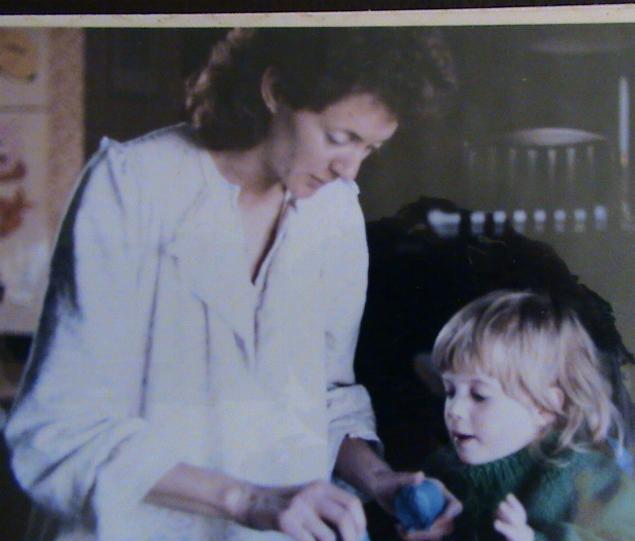
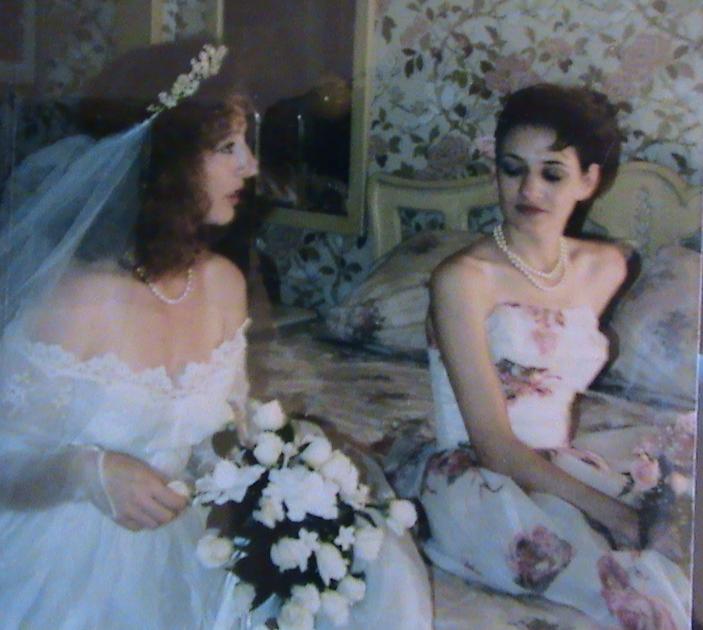
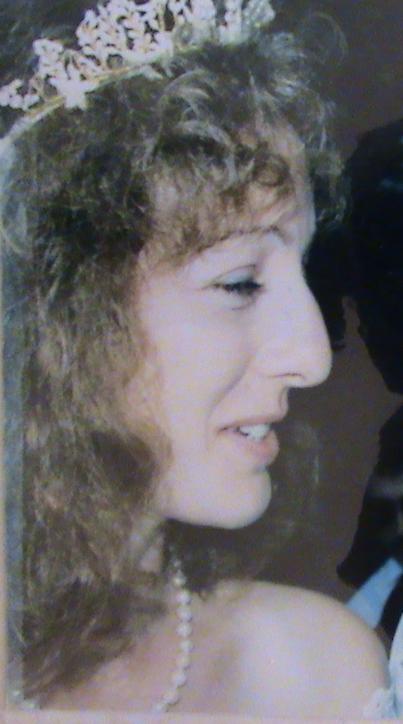
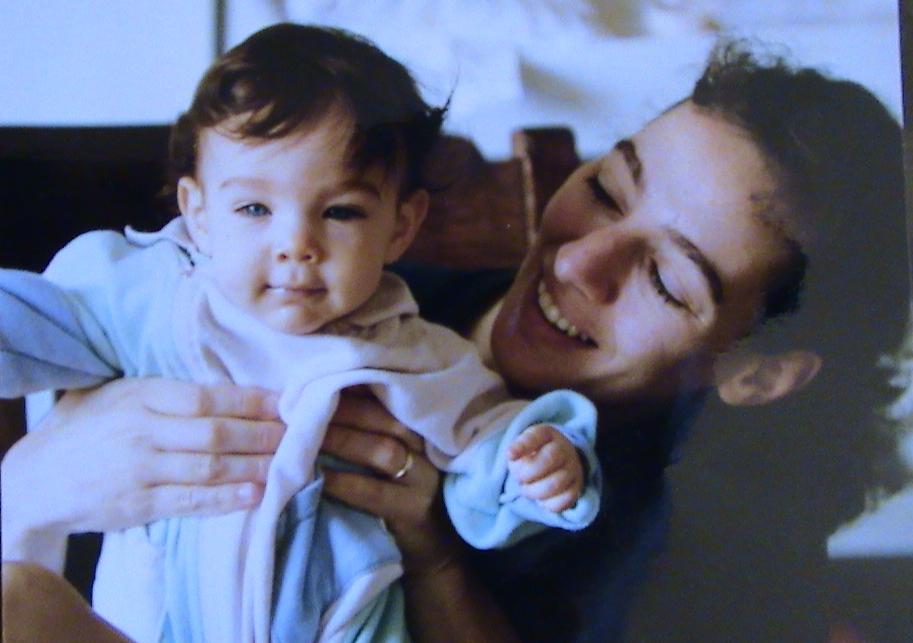
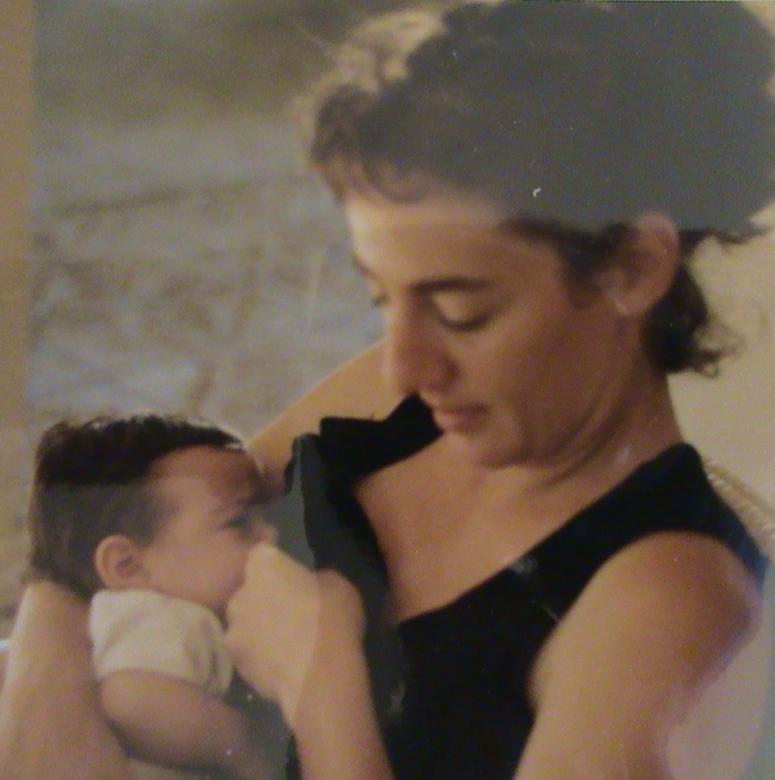
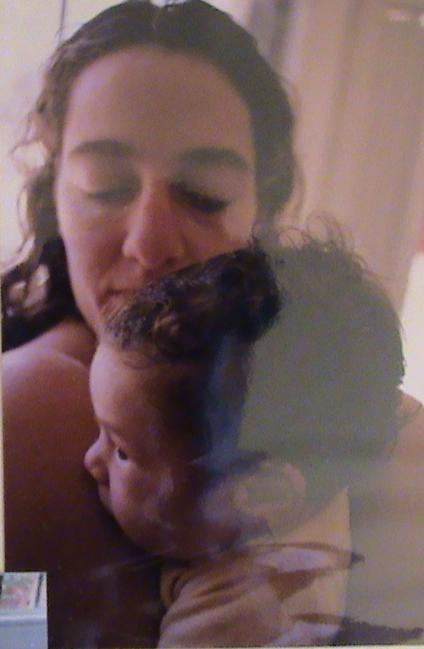
My audio from the third row starts with the rabbi, then Jill, Allan, Greg and Sandra. Video of the crowd after the service. Video. Cathy Seipp’s Final Ride. Cathy Seipp’s Final Resting Place. A longer view. Cathy Seipp with baby Maia Maia, Jerry Lazar, Cathy and Michelle Seipp Cathy Seipp on her wedding day Cathy Seipp on her wedding day Cathy Seipp on her wedding day Cathy Seipp Cathy Seipp on her wedding day with her sister Michelle Cathy Seipp on her wedding day Cathy Seipp with baby Maia Cathy Seipp with baby Maia Cathy Seipp with baby Maia Cathy Seipp with baby Maia Cathy Seipp with baby Maia Cathy Seipp with baby Maia Cathy Seipp with baby Maia Cathy Seipp with baby Maia

One topic of conversation at the funeral was Gazergate.

My thoughts:

* As soon as I saw Brian Grazer was going to guest-edit Current, I was jarred. Before I even thought about it, I felt something was wrong. Vanity Fair magazine has show business guest editors, but the LA Times Opinion section? It was a stupid idea. Steven Spielberg as guest editor is an equally stupid idea.

* It was a stupid idea for Andres Martinez to seek suggestions (let alone take one) from Allan Mayer or any publicist. Mayer’s job is to mold his client’s public image. Publicists are the journalist’s enemy. It’s fine to sleep with them but it is wrong to take their direction.

* I’ve heard from within the LA Times Opinion section that this was a "left-wing coup" to get rid of Andres Martinez for being too "pro-business." For instance, Martinez’s section opposed the city’s living wage proposal. Tim Rutten’s column March 24.

Rose (the fake name of a real person I know, the situation below is real though I am not going to apportion blame) writes:

Hi Luke, I am writing this anonymously…….but I must tell you, Cathy Seipp was a bitch! She invented a horrible, vicious, cruel lie about someone in my family. It was a hurtful lie and it did terrible damage to my entire family, but she never apologized. In fact, she kept perpetuating that lie to everyone right until she died. I’m shocked as I read the blog comments about Cathy. People are saying "She’s now an angel in heaven" and "She’s smiling upon the face of God." Others are saying "The world is a colder place because she’s gone." What bullshit!


My God….they never knew the REAL Cathy Seipp, did they? She was a selfish, malicious woman who obviously had borderline personality disorder. The damage she did to my family was horrendous beyond belief. And what’s really pathetic is….she taught her daughter to be the same kind of cruel bitch that she was. I actually laughed when I read her final blog comments…..she complained because caring and compassionate people brought her soup, she bitched because well-wishers brought her the "wrong" kind of food. Instead of saying thanks, she criticized them.

I’m not surprised that she was rude to you when you visited her in the hospital. I read a quote of hers….that cancer didn’t make her a better person. That was certainly true! Often, when people know they are dying, they become kind and compassionate. But Cathy remained a bitch to the very end. She didn’t know the meaning of compassion. Those who are praising Cathy on various websites and blogs weren’t libeled and slandered by her, as my family was. That’s the Cathy I will always remember. I don’t think she’s "singing with the angels!"

Sincerely, …..a Los Angeles resident [Eliot Stein’s wife] who was tormented by Cathy Seipp.

Cathy only mentioned her mother to me once or twice and it was only when I pushed. Aside from her ex-husband, there was nobody Cathy was more cutting about than her sister Michelle. The one person Cathy asked me not to interview was Michelle.

Friday evening, Michelle had had enough of guests at the home where Cathy lived with her dad Harvey, and so Moxie and others were asked to leave.

Much of Cathy’s family remembers Cathy as a difficult and domineering woman. I was a friend of Cathy but I was never a Cathy partisan. I had no illusions about how difficult and domineering she could be. I was lucky in that I never needed her nor depended on her. I could walk away when she got mad at me. After a week or two, she’d always get over it and we’d be friends again.

Maia’s having hallucinations that she’s seeing Cathy.

Chaim Amalek writes:

Luke: Elizabeth Irwin and I (all of us here in New York) would like you to extend condolences tomorrow on our behalf to the Seipp/Lazar family – especially to Maia, who lost a mother, and to Harvey, who buries a daughter. Sigh . . . this is so sad. Elizabeth feels herself to be truly at wit’s end, with no place to go. I know you miss her (I do, and I only met her on two occasions), but consider yourself very, very lucky to have gotten to know Cathy Seipp and to have counted her as a friend. Most of us could go through fifty lifetimes without being lucky enough to ever meet someone like Cathy, let alone be able to look to such a person for advice. (In the future, will not her fans often find themselves asking, "What would Cathy have done/said/written?") When the time is right, you should suggest that her friends collect a sampling of Cathy’s work into a "The Best of Cathy Seipp" anthology.

Posted in Cathy Seipp, Personal | Comments Off on 200 People Show Up To Cathy Seipp’s Funeral Friday Morning

What Would Be The Right Book To Take To Cathy Seipp’s Funeral?

Many funerals these days are not as exciting as they should be. Lewis Fein on KTLK radio. From the Luke Ford Fan Blog:

Jackie Danicki is doing yeoman’s work. I hope she doesn’t stop. The best stuff I’ve read is on National Review Online. Rob Long’s essay was tremendously moving. I was also impressed by Eugene Volokh’s comments at the end of the symposium on Cathy. John O’Sullivan, one of my favourites, is also wonderful but he’s ten years off on when Cathy (and family) moved from Winterpeg to the OC. Also checkout Mickey Kaus on BloggingHeadsTV, which includes a touching mention of Maia. But my two favourite pieces are by Rip Rense and Denise Hamilton. I see Luke Ford has posted a brutally honest account of his relationship with Cathy. I’m not sure why he’s writing this, especially today. It strikes me as more than a little tacky. I’m going to assume that Luke is struggling with his grief. My usual excuse for Incorrigible Boy‚Ñ¢ whenever he does something especially obnoxious is to say: "Oh, he’s just joking." Sometimes I have to say this a number of times to convince myself. I’m afraid that won’t work this time. Mr Ford seems to be somewhat lacking in the empathy department. (<- English understatement) Of course, he’s never going to be Mr Sensitivity, but I do think that if he put his mind to it, perhaps by checking out some self-help books from the Beverly Hills Public Library (he should take Bradley J. Fikes with him), he could increase his empathy level a few points. No-one expects, or wants, a wilting/shrinking violet. In fact, I usually find Mr Ford’s imperviousness to the feelings of anyone beside himself to be an admirable trait. (It’s very manly.) Not on this day, however.

Posted in Personal | Comments Off on What Would Be The Right Book To Take To Cathy Seipp’s Funeral?

BBI and UJ join up to forge a home for pluralistic Judaism in landmark merger

Contrary to the claims in this Jewish Journal article, this is not a merger of BBI with the UJ but a takeover of BBI by the UJ. After all, this new entity will be presided over by the UJ’s two leaders — President Robert Wexler and UJ Board chair Peter Lowy.

BBI, contrary to claims in the article, is in desperate financial shape.

“I love the new name,” says a friend. “American Jewish University. It’s like putting a dress on a pig.”

From the Jewish Journal:

BBI’s Linda Gross sees big upside in merger with UJ UJ’s Peter Lowy: More accountability = bigger vision UJ President Robert Wexler has roots in three denominations UJ’s Gady Levy excited and eager about Brandeis-Bardin programs

I wish I knew how Rob Eshman really feels about Peter Lowy. It’s hard to tell when Rob gets so complex with sentiments such as: “Indeed, nearing 50, Lowy has most of the hair he left his 20s with. He has blue eyes, an athletic build and a disarming amount of laid-back Aussie ease for a man on that L.A. Business Journal list.”

Did I ever tell you guys how Rob Eshman, nearing 50, has most of the hair he left his 20s with. He has blue (or brown or something) eyes, an athletic build and a disarming amount of laid-back Los Angeles ease…

Lowy says: “It wasn’t a desperation move on Brandeis’ part.”

Hmm.

Linda Gross, chair of BBI, is married to Larry Gross who made tens of millions of dollars in the high-tech bubble, cashing out before the crash. He’s supposed to be the next great philanthropist of L.A. but he’s yet to do anything significant. If he had done anything for BBI, they would never have gotten into such financial trouble.

BBI’s big financial problem was an inability to get money out of their own board.

These pluralist claims by American Jewish University are bogus. Orthodox Jews do not patronize either U.J. or BBI. Random Orthodox scholars may teach there, but they’ll teach anywhere to make a living. They don’t pray there.

I believe one Orthodox shul has held a weekend retreat at BBI. That was Bnai David-Judea. They found no Orthodox prayer books in the chapel. They had to improvise their own mehitza.

I do not believe that the kashrut certification at either BBI or UJ is under Orthodox auspices. Therefore an Orthodox Jew can not eat there. I believe that UJ accepts Hebrew National meat which all Orthodox kosher agencies do not accept as kosher.

Posted in Education, Judaism | Comments Off on BBI and UJ join up to forge a home for pluralistic Judaism in landmark merger

Cathy And I Fought Like A Married Couple

It’s only appropriate that our last interaction was a fight. I don’t even feel bad about it, and I bet she didn’t either. The last time I heard from Cathy was February 14. She emailed me in response to this posting of mine:

For Gods Sake, that visiting the sick thing is kind of silly You don’t need to do anything special. Just don’t raid the fridge, bring food at least for yourself if you’re going to be hungry, clean up your dishes, and don’t expect to be entertained like a normal visitor. Help out, like lifting Amy’s chair etc. Otherwise, forget it. I’m not mad at you, but i do lose patience with excuses that such things don’t come naturally to young men, especially from one who is no longer that young.

I guess the …. will drive over… at some point later this month, and maybe you can stop by then too. If …. doesn’t like it then … can stay home, or you guys can all work out a convenitne time.

They need to realize to print out a map for directions and not depend on me to help them get here by picking up the phone, which isn’t going to happen.

The last thing I said to Cathy was this email I sent in reply to the above:

OK. I did not touch anything in your fridge and only ate the biscuits you said were fine to eat…nor did i use any dishes nor leave any in your sink…

I ate the pudding that Kate Coe gave me in its container. I am sure Amy is stronger than I am, given the tendonitis in my elbows, and is perfectly capable of lifting her own chair.

Not all my posts are about you. I am an active member of a visit the sick committee in my shul…

Despite my protests, my posting was in large part inspired by Cathy. My last two visits with her were disappointing. When I did not jump up with sufficient alacrity to help Amy Alkon move a chair, Cathy proceeded to ignore me, either burying herself in the newspaper or chatting with her other friends. It was as though I wasn’t there.

After those two bad experiences (which left Cathy complaining about my doltishness), I gave up visiting her and I gave up emailing and calling her. I don’t feel bad about this. I don’t think I had anything to contribute to her in her final days. I knew Cathy didn’t lack for friends willing and able to take care of her, and so I left her in their more sensitive hands. I’m not the world’s greatest nurse (though I sure appreciate those types when I’m sick).

Cathy Seipp was a bulldozer. She had forceful opinions on many topics, including the type of fruit juice one should drink (recalls her ex-husband Jerry) and other things she didn’t know much about. She rarely admitted mistakes and rarely apologized. She saw nothing wrong with some forms of cheating, such as claiming Maia as a child to get a discounted ticket.

While single and in her twenties, she had an affair with a married man that lasted for months. Afterwards, she didn’t feel guilt. I never recall Cathy exhibiting guilt over anything. She had an unshakable belief in her own righteousness. After her divorce, Cathy never had a boyfriend (or lover?). I suspect that she was so afraid of getting hurt again that she closed herself off.

Cathy explained to me that she didn’t date because she was too busy raising her daughter. When she put a profile on JDate circa 2003, Cathy lied about her age (by six to eight years). I believe Cathy had plastic surgery on the bags under her eyes but wouldn’t talk about it publicly. Until Cathy told me she had a severe form of lung cancer, I was afraid of her.

We became close because I devoted to her the attention of a biographer. Cathy often had excellent advice for me but frequently I did not want to take it. If I didn’t do what she said, she’d often get mad. About half the time that I knew her, Cathy was mad at me. I got the silent treatment regularly. It would usually last a week or two. I found myself not doing things so I wouldn’t have to endure her icy remove. A key to getting along with Cathy was to let her feel like she won.

The anger thing between Cathy and I went strictly one way — Cathy would get mad at me. I was never mad at Cathy because I never expected anything from her. I was grateful to be in her life but that was it. Cathy wanted me to be more than I was or wanted to be. Cathy and I quickly fell into a comfortable pattern of behavior. I’d constantly tease and provoke her. This would never make her mad. What would make her mad was when I wouldn’t live up to her expectations (to be a chivalrous gentleman, etc)."You guys should have your own reality show," our friends often said in response to our public bickering.

Whenever Cathy and I got together in public, we’d usually try to verbally one-up each other. We both enjoyed this form of fighting and we both played within the rules (we rarely brought up things that the other person was sensitive about, such as age for Cathy and source of income for me).

I was with Cathy so much that folks such as Jewish Journal Editor Rob Eshman asked if I lived with her. "Big compliment to you," Cathy said later. I never remembered Cathy’s birthday and this hurt her. "What’s a girl got to do to get flowers?" she said to me on her birthday in 2003. "I only send flowers and cards to women I sleep with," I replied. "Well, if that’s what I’ve got to do," joked Cathy.

The most sensitive topic with Cathy was her age. I once referred to her as middle-aged and she let me know in no uncertain terms that I was never to do that again. Cathy hated that most men preferred younger women. The only time I saw a sexy side to Cathy was when she dressed in some slinky outfit for a Halloween (?) party at her home in 2003. It was my first time in her home. For years afterwards, I fantasized that Cathy, Maia and I would take a vacation together. That we’d drive up the California and Oregon coast. The only thing was that I wanted to do it without spending money.

I mentioned this once to Cathy (in 2006) and she gave a non-committal response. I told Cathy that I discovered her in Buzz magazine in 1994, shortly after I moved to Los Angeles. "If only you’d written to me then," she said. I never spent money on Cathy (aside from holding up my end on the lunch buys, which is more than I usually do). The biggest thing I ever gave her was my extended blogging about her. Cathy loved to give and I loved to take. It bothers most men when the woman takes charges and gives and gives but it never bothered me. I think I’m God’s gift to the world and there’s nothing wrong with people spoiling me. I once asked Cathy if she’d be willing to talk to a journalist friend of mine (who Cathy knew) with breast cancer. Seipp went right down my throat, vehemently explaining that most people with breast cancer get over it and lead full lives while people with her cancer die. Even in her cancer, Cathy was fiercely competitive.

She was inordinately proud of the number of comments she received on blog posts and was dismissive of blogs that received few comments. Cathy complained a lot (or shared her feelings, depending on your perspective), but rarely about her illness. Of that, the most she said to me was, "It’s so stupid."

Cathy’s complaints in the descending order of frequency (and intensity) that I heard:

* Her ex-husband
* Her sister
* Freelance writing
* Her daughter
* Me
* Her dad

Cathy was not happy with how well her ex-husband Jerry Lazar came across in his interview with me in early 2003. It grated on Cathy that she was not more successful in her career. She would’ve loved to have had a job at The Los Angeles Times, particularly as TV critic.

It grated on Cathy that there was not more financial demand for her services. When I mentioned job offers I received for $1,000 a week to write on the porn industry, she’d say, "I wish somebody would offer me $1,000 a week to write."

Neither Cathy nor I would put up with much guff from our employers and if they gave us too much aggravation, we’d quit. Cathy believed she only wanted the best for other people but there were significant exceptions to her magnanimity. She rarely seemed pleased when I, her sister or her ex-husband got into a relationship.

Cathy was my best friend. She connected me to a better crowd of people (professional writers such as David Rensin, Amy Alkon, etc). I always knew that Cathy was smarter than me. I’ve never scored above 135 on an IQ test while Cathy’s score was about 170. I didn’t mind this. I’ve always liked to surround myself with people who are not only smarter and more accomplished than me, but who are also finer and kinder.

A friend emails: "Dear Luke: So sorry for your lose. Looks like a good friendship between you. I found your stories about your squabbles extremely moving. In a way you were her family too: She tried to guide to do "the right things" and got mad when you did not mind her… Luke, you said that she was very smart. I guess that’s why she picked you to be her friend and invested in you. She saw your talent and gift. Now, you need to keep your end, by taking care… and she will keep mentoring from above."

A friend emails: "Your grief comes through even though I think you tried to put it in as understated a style as possible. (And I’ve always admired your fearlessness in telling the world you like groups like Air Supply and the Carpenters. If people could see what I’ve got on my iPod, I’d be laughed at by all the "pure rock" snobs out there. I’d rather listen to one-hit wonder Mungo Jerry happily crooning "In the Summertime" than to a raspy old Dylan "classic" any day. Dylan never makes me happy (well, maybe "Lay, Lady Lay" from Nashville Skyline," but that’s Dylan in his most un-Dylan period); Mungo Jerry does. Case closed." Cathy hated chewing gum. Since she died, I’ve been chewing it like crazy.

Robert J. Avrech blogs: "Cathy was endlessly curious about Orthodox Judaism. It wasn’t for her, she freely admitted, but she was always respectfully machine-gunning questions at me. Cathy kept me on my toes. Around Cathy, I could never be intellectually lazy about my Judaism, and that was refreshing."

Cathy peppered me too with endless questions about the reasons behind various laws and rituals in Orthodox Judaism. I’d start to explain and then she’d cut me off with, "That’s stupid." I gave up trying to explain things to her by explaining, "There are some mysteries that are only available to those in the dance."

I introduced Robert to Cathy and Maia. Before we all met in Starbucks that afternoon in 2004, I kept telling Cathy, "Don’t extend your hand. Truly Orthodox men don’t shake hands with women (not related to them or married to them) and Robert is truly Orthodox." As soon as I said, "Cathy, this is Robert," she stuck out her hand. Robert shook it. As I berated her, and Cathy apologized, Robert said, "That’s OK. It didn’t kill me."

Posted in Cathy Seipp, Personal | Comments Off on Cathy And I Fought Like A Married Couple