

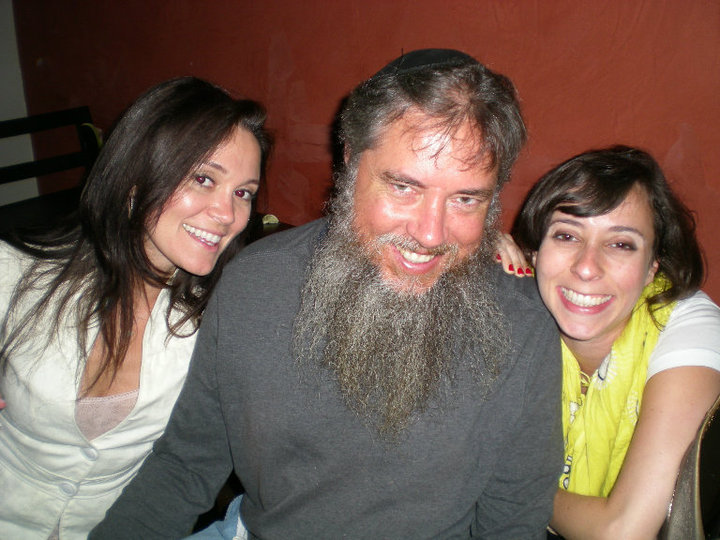
This is a superb new book. I just picked it up at the library and I can’t put it down.
It has lots of stories about Los Angeles in general and Pico-Robertson in particular.
On page 95, professor Raphael writes: “In the 1990s and early 2000s “Sephardic” congregations became home to a wide variety of non-Sephardic Jews. In addition to a large number of members from “mixed” marriages between Sephardic and Ashkenazic Jews, there are many Ashkenazic families and/or individuals who join Sephardic synagogues because of the traditions and melodies.”
On page 138, Marc writes that Reform rabbis after World War II preached about civil rights while acknowledging that “Jews outside the South were as fearful of blacks as were white southerners, noting that congregants simply moved away when blacks approached instead of burning crosses on the newcomers’ lawns.”
One rabbi said that when blacks move into a Jewish neighborhood, “with the milk of human kindness and brotherly love for the Negro of Little Rock pumping in his veins, the Jew picks up his skirts and runs before the Negro.”
From page 140: “If we look at the sermons preached at these same [Reform] congregations ten years later — 1965-1966 — we find that only a little had changed. Blacks’ fight was still the Jews’ fight; Jews were not free if blacks were not free; and surely America was not free if either was enslaved.”
The proper word for Reform Jewish homiletics of the 1950s and early 1960s was formal. Rarely did one of these rabbis preach from notes.
The sermon preached most often was called “What do Jews believe?”
Decorum in Reform services resembled Protestant services. By contrast, Orthodox services seemed chaotic and anarchic. Conservative was in between.
From page 159 on Pico-Robertson after World War II: “If you lived around that intersection, there was no Reform synagogue to which you could walk and only one Conservative synagogue within a few miles. But there were at least five mainline or established Orthodox synagogues (and at least two storefront “shuls”, synagogues in a rented store or in a room or two over a store, known just as “the shul on Pico near Genesee” or “the shul upstairs over the butcher shop”) within walking distance. This was striking, because fewer than 10% of the affiliated Jews in the neighborhood would have claimed membership in any of these Orthodox synagogues. One followed the Sephardic ritual, another the Hungarian ritual, and another accepted Polish customs. One had mostly men in their seventies, while another attracted younger Jews. At least four of the five had a bar mitzvah ceremony frequently; all had mixed seating and microphones in 1955-1956; none of them had a ritual bath, nor was there one nearby; one, Beth Jacob of Beverly Hills (with Rabbi Simon Dolgin, who arrived in the late 1930s, when the synagogue was in a different location, still at the helm), might have been the largest Orthodox congregation in the West. At least the rabbi regularly made this claim.”
The overwhelming number of Jewish congregants (from Reform to Orthodox) in America in the 1950s did not have college degrees.
From page 161: “Surprisingly, because Orthodox synagogue leaders are guarded about most information that is freely given to historians by Conservative and Reform congregations, the financial details of most Orthodox synagogues are readily available in bulletins.”
The first bat mitzvah on the West Coast took place at Beth Jacob on a Friday night in 1947.
Under Rabbi Dolgin, Beth Jacob had 8:15 pm Friday night services.
Over the past few decades, Orthodox rabbis have tended to focus their Saturday morning sermons on the parsha (weekly Torah portion). “There is usually only a perfunctory attempt to ask how this might relate to the lives of the worshipers.”
“Rare is the Orthodox rabbi today who draws upon non-Jewish literature (fiction or non-fiction), popular or contemporary culture (theater, cinema, television), general academic disciplines (anthropology, sociology, psychology), or contemporary non-Jewish thinkers in philosophy and theology. Instead, the explicit assumption is that all the insight one needs is in Jewish texts (generally the older the better).” (pg. 192)
In the Orthodox shuls I’ve attended, when the rabbi references some non-Jewish book or thinker or radio or TV program, the congregants laugh at the incongruity of it.
From page 194: “By embracing the nonobservant, modern Orthodox Jews do clearly differentiate themselves not only from Conservative Jews but from the right wing of the Orthodox spectrum.”
It is “much less common for non-Jews to attend an Orthodox synagogue today than it was during the years 1920-1960.” (Pg. 197)
“Decorum has not been embraced by the membership within most Orthodox synagogues.” (Pg. 198)
In the Torah, Moshe and company put to death an Israelite for gathering sticks on the Sabbath.
Orthodox Judaism plays hardball.
This surprises many outsiders who have a picture of religion as primarily a spiritual loving community.
Orthodox Judaism has spirituality and love but these aren’t it defining characteristics. Before such secondary matters, Orthodox Judaism is a religion of law. What does the law demand? What does the halacha (Jewish law) say? Those are the primary Jewish questions.
One of the things that halacha demands is shalom bayit (peace in the home). The siddur says that Torah scholars increase peace in the world.
If you’ve been in a Jewish home or a traditional shul, this might seem bizarre to you. Jews are known as outspoken difficult people. Shuls are liable to fracture on many different ideological and personal lines. Torah scholars as a group are known at least as much for machlochet (arguments) as they are for peace.
Judaism is complicated. It is a constellation of values perpetually in conflict with each other.
Despite these subtleties, Orthodox Judaism is primarily a religion of law. An Orthodox Jew, for instance, should not eat food prepared by anyone but an Orthodox Jew. He should not eat in a non-kosher restaurant. He should not attend an intermarriage. He shouldn’t wish anyone a “Merry Christmas.”
Anyone who wishes to convert to Orthodox Judaism today must meet some formidable requirements. The person must demonstrate an ability to read Hebrew aloud. They must have formed a connection with a sponsoring rabbi who’s willing to vouch for their commitment to Jewish law. They must show that they are tough enough to navigate Jewish life and to earn a reliable income.
I’ve experienced plenty of love and spirituality in Orthodox Judaism but I still primarily think of it as a hardball religion. During my early years in it, I had a hard time with this. During my first four synagogue ejections, I shed a lot of tears and I got a reputation in the community for being soft. I was thought of as weak and pathetic. People despised me.
Then, around 2004, I got hardball with the way I wrote on Orthodox Judaism on my blogs. I started reporting on Orthodox rabbis and Orthodox communal life the same way I’d report on any other group (until then, I’d treated Orthodox Jews on my blogs like family). And by following these basic practices, I quickly shed the soft label. I think I still have a bad reputation throughout much of Orthodox Judaism, but few people think of me as soft anymore. Now I’m as tough as the religion that formed me.
Bob emails: “For the single advisory committee members: Have you tried these “Slut Walk” parades for meeting young, free thinking ladies?”
I’m not generally interested in dating angry women, unless they’re really hot. These slut walks seem to mainly attract men-hating angry women. Who needs that?
Most importantly, according to the photographic evidence I’ve seen, few, if any, of the women marching are hot.
Here’s a pic from the Chicago Slut Walk:
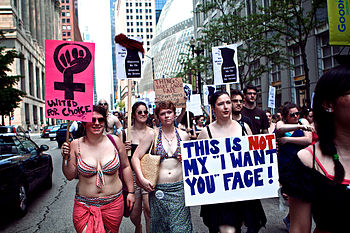
According to Wikipedia: “The SlutWalk protest marches began on April 3, 2011 in Toronto, Canada and have since become an international movement of rallies across the world.[1] They are a protest against the belief that any aspect of a woman’s appearance might explain or excuse rape.[2] The rallies began in response to remarks made by Constable Michael Sanguinetti, a Toronto Police officer, who suggested that in order not to be victimized, “women should avoid dressing like sluts.”[3][4] The protest take the form of a march, by mainly young women, where some dress in ordinary clothing, and others dress provocatively; there are also speaker meetings and workshops.[5] Such protests have not been universally accepted as appropriate; for example some objectors have remarked that this approach is an example of women defining their sexuality in male terms.”
Women who are into things like slut walks seem to have this huge emotional investment in unreality. They hate the idea that the way a woman dresses and behaves might have some effect on whether or not she gets molested.
The harsh truth is that the way we comport ourselves has a huge effect on how other people treat us.
Just look at these women marching. Would you like to wake up next to one of them?
On the other hand, if these women dressed like ladies, behaved with modesty, and feared God, then I could totally see them as being marriage material. Attitude has a huge effect on beauty. After 40, you’re responsible for your face. If you’re an angry hateful person, it will have worked its way into your pores. If you’re a kind, loving, righteous person, that will shine forth.
Whether I’ve been a militant atheist or an Orthodox Jew, I’ve always found modest (in behavior, attitude and deed) women much more attractive, all things being equal. I think most guys do. Who wants to go to bed with a ballbuster?

Kirsten Powers writes for the New York Post:
Here’s a prediction: Feminists will no sooner turn “slut” into a positive word outside their ever-shrinking bubble than African-Americans who call each other the “N-word” have taken away the sting of that dehumanizing epithet. Some words should be retired for good.
And many gays may now march proudly as “queer” — but plenty still bristle when an outsider uses the word. That’s unlikely to change, considering the original intent of it.
Sex-positive feminist icon Erica Jong presciently told writer Ariel Levy in 2003: “I was standing in the shower the other day, picking up my shampoo. It’s called ‘Dumb Blonde.’ I thought, ’30 years ago you could not have sold this.’ I think we have lost consciousness of the way our culture demeans women. Let’s not kid ourselves that this is liberation.”
Yes, please, and let’s not pretend that women holding “slut walks” is a step forward for womankind or will in any way change the treatment of rape victims.
While the so-called feminists are tarting up themselves to reclaim a vile, misogynist word, perhaps the rest of us should fight to reclaim the word “feminism” and return it to its roots of working for true equality.
If we leave it to this gang, we’re screwed.
Yehuda emails: Luke,
This story is for you.
1. It is about something in California.
2. The girl is a blonde.
3. It’s about male members.
4. It involves an Orthodox shul.
5. Someone gets kicked out of said Orthodox shul
http://www.guardian.co.uk/law/2011/jun/14/circumcision-ban-row-san-francisco

http://www.thejc.com/comment-and-debate/columnists/50803/bright-not-necessarily-right
From Rebecca’s Twitter account:
@girlonetrack I love the ethical slut – amazing book!
The perfect day in London – #SlutwalkLondon, naked bike ride, guilt-free Snog in Soho. A.mazing!
Off to #SlutwalkLondon bring it on!!! By definition you can’t ask for rape.
#slutwalk slogan suggestions please?! maybe “by definition u can’t ask 4 rape,” “how i dress is not an invitation” or “no more slut shaming”
my sister and i are currently planning slogans for our placards and graffiti’ed t-shirts…
abso-bloody-lutely! excellent cause. reclaiming slut; reclaiming the streets. damn straight i’ll be there!
Who’s excited for the SlutWalk this Saturday! It doesn’t matter what you wear! This is about protesting rape culture!
States should be able to ban all infant genital mutilation. Even if effects of FGM are arguably more damaging, both cause harm.
Henry Grunwald claims kosher slaughtering is at least as humane as any other method. Really?!
But there obv are diff kinds of sexual assault (penetrative, anal, oral, stranger, date, family member). Can effect extent of trauma
Totally disagreed w/ Douglas Murray on killing of OBL on #bbcqt. Rule of Law applies to everyone. Non-judicial executions unacceptable.
One can wish nice young couple whilst admitting there’s no coherent justification for keeping monarchy:
On Twitter, Rebecca describes The Ethical Slut: A Guide to Infinite Sexual Possibilities as an “amazing book.”
Here’s a review on Amazon.com:
I’ve seen so many failed marriages due to infidelity that recently I began to wonder what I was in for if I ever took that big step. After all, I didn’t seem any better than the couples I knew, and certainly I’d been attracted to many different people, both male and female. Thats when I found this book.
This is a great read for people with feelings like mine…it gives a great account of the guidelines you need if you ever choose to enter into polyamory. Several good points are emphasized: love and sex are not necessarily the same, one may be an expression of the other but they CAN be completely separate. Love, sex and pleasure are not limited qualities people have…you can love someone else and make love to them without depriving your “primary” partner of the same feelings and actions. Drawbacks are also discussed, including time constraints, jealousy, respecting privacy and property of all your lovers, and coming out to your kids about your relationship (most actually think its pretty cool because there’s always someone to talk to).
I read this book aloud with my girlfriend because we had always been curious about poly-type relationships. We asked ourselves many questions, and when we finally attended our first party, we were able to talk more afterwards and decided we loved it…and yet we could still be committed to each other! And we’re still going strong…thanks to this and other wonderful resources that provided a basis for us to try new things!
Rebecca Steinfeld contributes to Tablet Magazine.
Rebecca was on Dennis Prager’s radio show on May 14, 2003 (after writing an anti-Israel op/ed for the UCLA Daily Bruin). She said she had grown up in a Zionist home and was pro-Israel until she arrived at university and realized how Israel’s success had victimized the Palestinians.
Prager says Rebecca Steinfeld is devoting her entire life to showing how evil Israel is. Where does Prager get this? She wrote one article for the UCLA Daily Bruin. Hardly amounts to devoting a life.
Cultural Muslim Amir Taheri points out that Iran never persecuted or segregated its Jews.
Amir inquired about the radical Israel-hating English Jewish coed [Rebecca Steinfeld] Prager had on his show today in the second hour. “Was she ugly?” Prager says she was pretty but her values were so ugly, he had a hard time looking at her.
From Rebecca Steinfeld’s Oxford page:
My doctoral research examines the nature of, and motivations behind, Israel’s various fertility policies from the state’s establishment in 1948 up until 2010. The research question focuses on the extent to which the archival sources substantiate the claim, made in the existing secondary literature, that Israel has established and maintained an ethnically selective pro-natalist policy that seeks to simultaneously encourage a higher Jewish birthrate and a lower non-Jewish, specifically Palestinian-Arab, one with the aim of ensuring a Jewish majority through internal population growth. My research thus seeks to answer the question of whether Israel’s demographic need, or desire, to maintain a Jewish majority has extended into the formulation of its fertility policies – as well as its immigration and territorial policies. Moreover, in parallel, my research project looks into the various other key factors and actors that may have influenced the formulation of Israel’s fertility policies, including religious ideas about fertility stemming from the ultra-Orthodox, feminist ideas about reproduction and the body emanating from women’s rights groups, and concerns about the welfare of women and their families shared by many in Israeli society. As such, my doctorate contributes further to our understanding of the specific ways in which bodies, and the most seemingly intimate decisions connected to them, have become the sites of larger state and non-state projects.
Abraham Isaac Carmel was a Catholic priest who converted to Judaism. Prior to his death in 1982, he came to the US for medical treatment and taught English literature in Yeshiva of Flatbush high school. Excerpts from an unfinished book about his frustrations as a convert were published as “My Chosen People” in Tradition (23:2, Winter 1988 – link) and reprinted in The Conversion Crisis: An Ongoing Discussion. I highlight here an issue that I think is applicable well beyond a convert’s experience and speaks to the dilemma facing anyone trying to contribute professionally to the Jewish community.
Teaching is a rewarding task, but in America a teacher is a long way down the community ladder. He has no prestige or vital influence. American Jews in particular find it difficult to respect a person who is without financial backing. You are not quite kosher. If I were planning my life again, I would give more attention to material things and, above all, security. Idealism should be linked to a sense of financial adequacy.
I first heard about this new book in an exciting review by Lawrence Grossman:
Orthodoxy is the only form of Judaism that is exuding self-confidence, that holds its own demographically, and whose children, for the most part, are steeped in Jewish knowledge, unambiguously identified with the Jewish collective enterprise, and devoted to the state of Israel.
No less striking, these signs of health and renewal appear even as, internally, the Orthodox world has become increasingly polarized. Many participate fully in the mainstream of American life, occupying positions that range from Democratic candidate for Vice-President in 2000 to college professors, hedge-fund managers, prominent lawyers, and everything in between; at the same time, the lives of others are marked by zealous religious observance, cultural isolation, and reluctance to associate with non-Orthodox Jews.
These realities are well documented. Largely unaddressed by historians is the process by which American Orthodoxy moved in the course of a half-century from a place on the endangered-species list to becoming the Jewish denomination most likely to succeed, even though beset by real difficulties of its own. That lacuna has now become much smaller thanks to the late Benny Kraut.
In an erudite and exciting book, Kraut, who served as chairman of the Judaic Studies department at Queens College in New York, traces the fortunes of a single organized group of Orthodox college activists from its formation in 1960 until its collapse twenty years later. In Kraut’s capable hands, the challenges, internal conflicts, successes, and failures of this group, known as Yavneh, become a microcosm of the broader community, mirroring the transformation of American Orthodoxy itself.
So I was all fired up to read this book only to find it a plodding disappointment. The author, Benny Kraut, has a style that will put most people to sleep.
As a modern Orthodox Jew, Kraut describes “modern Orthodoxy” as “non-insular” despite its complete failure to wrestle with, let alone answer, the single greatest problem that keeps Jews from taking Orthodox Judaism seriously — biblical criticism. Modern Orthodoxy also has produced no answers to the scholarly consensus that the Exodus from Egypt did not happen as the Bible described it.
So when it comes to intellectual challenges, modern Orthodoxy is as insular as traditional Orthodoxy and offers as many solutions (none) to scholarship. And as far as practice goes, the modern Orthodox Jew who abides by Jewish law is about as insulated from the wider world as the traditional Jew (an observant Jew can not eat food prepared by a non-Jew or a non-observant Jew, that law alone largely cuts out meaningful social interaction with the world).
As JTS professor Alan Mittleman wrote in First Things in October of 2003:
As Modern Orthodoxy took root in theology-averse America, it became a style rather than a coherent intellectual vision. Orthodox Jews built institutions, entered the professions, and established themselves solidly in the ranks of the middle- and upper-middle classes. As barriers against Jewish enrollment in the Ivy League fell, Orthodox Jews followed their coreligionists into Harvard, Yale, Princeton, et al. By the mid-1990s there was already a backlash. A group of five Orthodox students at Yale sought an exemption from the university’s residence policy, claiming that compulsory residence in the dorms would expose them to promiscuity. They filed suit against the university, essentially bringing Yale up on a morals charge.
The present pamphlet focuses little on moral-sexual matters. Rather, its concerns go to the heart of Hirsch’s synthesis itself. On its view, the intellectual values of liberal education as such are invidious to Orthodoxy. Take Jewish Studies, for example. Orthodox students might be drawn to such classes in order to “validate the beliefs with which they were raised or ‘to get credit for learning Torah.’” What they find, however, is a “majority of professors [who] are Jews themselves but may have unorthodox views on the nature of the Torah and the Jewish people.” Given the fact that only about seven percent of the Jewish community is Orthodox, it is not a surprise that the majority of Jewish professors are non-Orthodox. What is surprising, however, is the liberal anti-Orthodoxy of their views. Jewish Studies, far from being a safe intellectual haven from the wild seas of secular education, turns out itself to be a storm center. The authors refer to the most popular course at Harvard University in 1999, Professor James Kugel’s class on the Bible, which enjoys an enrollment of nine hundred students. (The authors refrain from mentioning Kugel, an impeccable scholar and traditional Jew, by name.) The professor, wearing a “large, black kippah,” nonetheless went on to relay the current theories of biblical criticism on the human authorship of the Torah. The combination of apparent piety and troubling heterodoxy “only served to confuse Orthodox students even further.”
How should Orthodox parents and students cope with these alarming temptations? The authors do not rise to a Hirschian solution for their Hirschian problem. Their first line of defense is sociological rather than theological. Throughout the pamphlet they advocate more intensive socialization, partial isolation, and increased distance. “Our first step in preparing our students to successfully meet these challenges must be to redouble our efforts to produce stronger yeshiva high school kids whose eyes have been opened to the beauty of yiddishkeit and who have both an intellectual and a deep emotional attachment to it.” Parents must not take their children’s commitment to a “halakhic lifestyle” for granted; they must deepen the child’s emotional attachment to traditional Jewish life.
Similarly, parents must not view the existence of Hillel houses, even those with provision of kosher food or traditional worship, as a panacea. Where is the kosher food served? Is it close to where students live? If not, they might be tempted to attend the nearest cafeteria when in a hurry. Indeed, the premium that Hillel puts on inclusiveness and the acceptance of all Jewish choices relativizes Orthodoxy, degrading it to just another lifestyle option. The authors relate an anecdote about an observant girl who was active in the Orthodox minyan when she entered college, but graduated “as a Reform Jew and president of Hillel’s JbaGel (Jewish Bisexual Gay and Lesbians) group.” Hillel, in their view, counts this as a “success story.” The organization thus may be bad for an observant Jewish student’s spiritual health.
At the same time, the pamphlet’s authors warn Orthodox students not to go on the offensive and seek to convert other Jewish students to the “beauty of a halakhic lifestyle.” The active recruitment of non-Orthodox Jews (known as kiruv, literally “bringing near”) has “on numerous occasions resulted in disaster.” In an effort to show nonobservant students that Orthodox Jews can be just as fun-loving and “normal” as they, the Orthodox students frequently bend their halakhic practice or introduce illicit innovations, such as mixed seating sections in their prayer groups. Kiruv work may be too dangerous for the average Orthodox student who, lacking answers for his curious interlocutor’s questions, comes to question the adequacy of his own faith. It seems, then, that the Orthodox student should withdraw and leave such efforts to the “trained kiruv professionals.”
A mood of fretfulness thus pervades the pamphlet. The tactics it advocates—emotionalism and disengagement—attest to a failure of intellectual nerve. There is a theological vacuum behind the anxiety. Although the authors gingerly suggest that the yeshiva high schools expose their students to “potentially troubling theories such as evolution and the Documentary Hypothesis,” they also recognize that the high schools might “lack the resources to successfully implement this proposition.” Better, then, for it to be dealt with by the intellectual and spiritual leaders of Modern Orthodoxy. They are the ones who ought to “articulate sophisticated responses to the complex questions” raised by contemporary Bible scholarship, Jewish Studies, and so forth. But who are these leaders today? Modern Orthodoxy has no one approaching the stature of its late leader, Rabbi Joseph Soloveitchik. And does the posture of waiting for authorities to work out strategies really befit people who are products of the modern university? Should they not have learned to think for themselves, especially in an area touching intimately on the quality of their own faith?
There is a cautionary tale here about the neglect of theology. Modern Orthodoxy for too long has relied on sociology—familism, solidarity, youth groups, institutional loyalties—instead of intellectually sophisticated apologetics.
Benny Kraut writes on pg. 3 that modern Orthodoxy “could point to Rabbi Joseph B. Soloveitchik (“the Rav”) as its spiritual luminary and guide for negotiating between Orthodoxy and contemporary culture.”
That’s ridiculous. The Rav said nothing important about Biblical criticism. He made a point of ignoring it. He also said nothing helpful about the challenges to the truth of the Torah raised by archaeology and history.
One thing this book is great about are footnotes. They are abundant. So if a particular event or idea strikes your fancy, there’s abundant direction provided to research it further.
Yavneh: The National Jewish Religious Students Association was a bottom up movement. It was a student movement. It kept its independence for its 20 years of existence but was always fighting to keep its chin above water.
Student-led movement are hard to sustain because students grow up and graduate and move on with their lives. It’s hard to maintain continuity and therefore it’s hard to fundraise.
That Yavnet got going and survived so long is a testament to Jewish energy and self-confidence. Jews want to change the world because their religion, unlike every other religion, tells them to focus on this world.
As I read this book for a second time, I’m finding it more interesting.
In a 1968 essay, Irving Greenberg wrote: “By and large, college is a disaster area for Judaism, Jewish loyalty, and Jewish identity.”
Yavneh wanted to have an intellectual dialogue between Judaism and Western Civilization. The interest in this today in Orthodox life is apparently about one-tenth what it was 50 years ago. It is rare today to find an Orthodox pulpit rabbi sprinkling his sermons with quotes from Shakespeare and other non-Jewish thinkers.
Yavneh’s national board had a policy that no purely social events were allowed. Instead, they were to revolve around learning.
Many of the Yavneh instructors married their students. As one student said to another after the announcement of an engagement between teacher Moshe Adler and Ruth Rubin, “This is one of the reasons we don’t have to pay our Yavneh instructors.”
Scores, if not hundreds, of marriages were made through Yavneh programs. “Yavneh is a place where Brooklyn girls can meet Harvard guys,” said one student.
I discuss the weekly Torah portion with Rabbi Rabbs every Monday at 7pm PST on my live cam and on YouTube. Facebook Fan Page.
This week we study Parashat Chukkat (Numbers 19:1-22:1).
* The ritual of the red heifer makes sense to me. The red is for blood. The ritual makes the pure impure and the impure pure kinda like garbagemen and policemen and military. Only contact with dead people is impure (Num. 19:11). Not contact with dead animals. We recoil from dead animals. We recoil from death. As we should.
* Moshe was never getting into the promised land. We all wander in the desert hoping to get into the promised land.
* Moshe’s sin wasn’t hitting the rock. God told Moshe to take his rod. Moshe’s sin was saying to the Jews, “Shall we bring forth water from the rock?”
Exodus 17 has an identical story where Moshe hits the rock.
* Moshe gets in trouble because of something he does in public. I don’t know of any examples of God punishing anyone for doubting.
* As you go through the Tanach, there are increasingly few miracles. In the later books such as Ezra and Nehemiah, there are no miracles.
* Moshe does not argue with God after he’s told he won’t get in. Moshe frequently argued with God but not here. Moshe does not resign as leader. He keeps leading the Jews.
* It bothers the rabbis of the Talmud that Moshe does not get in. There are classic midrashim on this. It is Jewish to get annoyed with God and for God to get annoyed with the Jews.
* Jews are not to conquer Canaan to take booty and to rape. No, you are to take Canaan to create a holy land that will be a light to the world.
* Num. 20:13 Israelites quarrel with Moses, but they’re really arguing with God. Sometimes when people quarrel with the rabbis, they’re really arguing with God.
* If a man tells you he’s Elijah the Prophet and he’s been sent from Heaven to make a Moshiach baby with you, employ some skepticism before you give it up to him.
* Girls may think some girls look good in short hair but I don’t. Nothing sexy about short hair on a woman. It’s just plain dykey. I hate it. I also hate pantsuits. Butch!
* Have you tried these “Slut Walk” parades for meeting young, free thinking ladies?
* Richard posts to my FB: I ran into a few Jewish girls, in my day, rebelling against their secular Jewish background. Most of them, would sleep with any guy, that had a beard, and looked somewhat orthodox.
* I want to discuss this new book on the synagogue in America.
* It’s a hot day today in Los Angeles and yet you won’t find many traditional Orthodox Jews walking around in shorts. Why not? What’s wrong with wearing shorts? Particularly if you’ve got the legs to pull them off. Traditional Orthodox Jewish men tend to wear black suits and white shirts, even on the hottest of days.
In his second lecture on Rav Yaakov Ettlinger in 2007, Dr. Marc B. Shapiro relates a famous story from 19th Century Eastern Europe.
“The responsa I’m going to tell you now is almost like a movie.
“A man was staying at a woman’s house while her husband was not in town. Her husband went away for business. The woman is at home with her children and servants, so there was no problem with yichud (prohibition against being alone with the opposite sex).
“This woman was pious and modest. She fed this man. He would not eat meat or fish. He was aescetic. All day he would sit in his room with his book and cry. At midnight, he would cry over the destruction of the holy temple. He slept on the floor with a rock for a pillow. Every day, he’d immerse in the river, even though it was the middle of winter.
“When they were alone, the man told the woman he was sent from heaven. He was Elijah the Prophet. The woman believed him.
“After she went to bed, at midnight, he comes into her room, wakes her up and tells her he has gone through the whole land and not found anyone as worthy of her to give birth to the Messiah. The problem is her husband. He is not worthy. He was sent from heaven to sleep with her and she will have a son who’s moshiach to redeem the Jews.
“As proof that he’s Eliyahu Ha Navi (Elijah the Prophet), on the Tuesday after he leaves, she should open the chest in her room she will find a large sum of gold.
“She believed him. They had sex twice Friday night and once Saturday morning and he ran away Sunday and nobody knows where he is.
“The husband returns. They open the chest together and there’s no gold. She realizes she’s been fooled. She told her husband everything. She tries to convince him that she did it all for the sake of heaven because the man was so ugly.
“According to Jewish law, a woman who’s with another man must divorce her husband.
“R. Ettlinger rules that she was raped because she was fooled. Everything she did was for the sake of heaven. She wasn’t betraying her husband. Therefore she doesn’t have to divorce.”