Modern Times

Paul Johnson writes: When they broke into Freud’s flat in Vienna, his wife put her housekeeping money on the table: ‘Won’t the gentlemen help themselves?’ It required intervention by Roosevelt and Mussolini – and a ransom of 250,000 Austrian schillings – to get the old man permission to leave. He had to sign a statement testifying he had been well-treated, to which he appended the words ‘I can heartily recommend the Gestapo to anyone.’ The Germans were delighted. The bitter joke was beyond them. So was pity. Freud’s four aged sisters chose not to move: all died in the gas-ovens later.

Posted in Nazi | Comments Off on Modern Times

The Six Million Ukrainians Vs The Six Million Jews

Is there an important difference between the number of Jews killed by Nazis in WWII (around 6 million) and the number of non-Jews (20 million in the Soviet Union) killed by Jews under Josef Stalin?

Stalin starved about six million Ukrainians in the 1930s. How come this does not get 1/100th of the attention of the Jewish Holocaust?

Tom Sunic writes for Arutz Sheva:

It was in the name of antifascist victimology and their real and surreal fear of the resurrection of the anticipated fascist Croatia, that local Serbs staged a bloody rebellion in Croatia in 1991. It was in the name of their own post -WWII victims, killed by the victorious Communists on the killing fields of Bleiburg in Austria in May 1945, that Croats, forty-five years thereafter, began their war of secession from the Yugoslav grip. The Ukrainians still nourish the memory of Holodomor, the Poles nurture their memories of Kaytn, the Cossacks commemorate their victims in Linz, the Russians have their numerous Kolymas, the Germans their Dresdens — locations standing not only as memorial sites, but also as symbols of just retribution in the eyes of the Other.

Crimes committed by the Communists in Eastern Europe during and after World War II were not just Allied collateral damage, or a freak, unintended accident, but a planned effort to remove millions of undesirables.

Almost by definition this raises time again the painful symbolism of Auschwitz, a locality standing not only for a specific historic and clear-cut site of large-scale dying, but also as a didactic location designated for teaching the world the meaning of worldwide tolerance. Of course, the liberation of the Auschwitz camp by the lauded Soviet troops, raises a side question regarding their previous itinerary, especially if one considers that millions of East European and ethnic German civilians were either displaced or killed by the very same Soviet troops on their way to Auschwitz in January 1945.

How genuine were the tears of European statesmen and politicians at the recent commemoration event for the Auschwitz dead will remain a matter of wide speculation and wild guesses. Suffice it to note that if one were to take a peek into the recent history of France, in 1940 the entire Communist and left-leaning intelligentsia sided with the pro-fascist Vichy regime. Of course, in the aftermath of WWII it became politically expedient for the French intellectuals to posture as ardent philo-Semites and learn hastily the antifascist vulgate.

Lazar Moiseyevich Kaganovich, Stalin’s assistant, probably murdered more people than any other Jew in history.

According to Wikipedia:

Kaganovich (together with Vyacheslav Molotov) participated with the All-Ukrainian Party Conference of 1930 and were given the task of implementation of the collectivization policy that caused a catastrophic 1932–33 famine (known as the Holodomor in Ukraine). He also personally oversaw grain confiscations during the same time periods. Similar policies also inflicted enormous suffering on the Soviet Central Asian republic of Kazakhstan, the Kuban region, Crimea, the lower Volga region, and other parts of the Soviet Union. As an emissary of the Central Committee of the Communist Party, Kaganovich traveled to Ukraine, the central regions of the USSR, the Northern Caucasus, and Siberia demanding the acceleration of collectivization and repressions against the Kulaks, who were generally blamed for the slow progress of collectivization. Attorney Rafael Lemkin in his work The Soviet Genocide in Ukraine tried to present the fact of Holodomor to the Nuremberg trials as a genocide of a totalitarian regime.[2]

On January 13, 2010, Kiev Appellate Court posthumously found Kaganovich, Postyshev, Kosior and other Soviet Communist Party functionaries guilty of genocide against Ukrainians during the catastrophic Holodomor famine.

Posted in Genocide, Holocaust | Comments Off on The Six Million Ukrainians Vs The Six Million Jews

NPR Fresh Air Host Terry Gross Is A Terrible Interviewer

I was listening to her tonight interview David Remnick, editor of The New Yorker. Here is how she began.

Terry: “Of all the magazines in America, the New Yorker is probably the one with the most traditions that are cherished by its readers. The cover illustrations, the cartoons, Talk of the Town, the long profiles, the investigative pieces, the listings, its fiction, its humor pieces, movie theater music, reviews, readers want those traditions left in tact. But on the other hand, I bet that unless you really updated things in some ways, that readers really wouldn’t read it. You know what I mean? I mean, I think there is sometime this disconnect between what people insist that they want and what they’ll actually read in changing times?”

So one minute and forty five seconds into the interview, David gets a chance to say something, but what can he say? Terry Gross has boxed him in with her lengthy opinions posing as a question. Any time you ask a long rambling question that contains a lot of statements and expressions of your own opinions, filled with value judgments, and then you have to say, “You know what I mean?”, that indicates you asked a lousy question. And Terry knows it, because she follows up with another “I mean.” If she knew what she was doing, she’d ask a question in fewer words.

Terry Gross, here are some tips on interviewing.

David’s answer to Terry’s first question is shorter than her question itself.

Terry’s second question is horrendous: “One of the things you’ve done is bring The New Yorker into the digital age. And umm one of the things about digital media is that you can actually measure how many people are reading each article, each page of each article, is that a mixed blessing or is that just you know an out and out good thing for you? The reason why I ask is, it is sometimes depressing to see what gets the most hits, what gets the most clicks, sometimes it’s the thing with the most recipes, not that there’s anything wrong with recipes, but you know, you’ll do a really important piece about something and that doesn’t get nearly as much attention as the recipes are going to get. How much do you let that guide you in terms of what you want, a publication or radio or TV show to be? What are your thoughts about that?”

David Remnick tries several times to answer but she runs over him each time. Her second question took over 40 seconds to pose.

Any time an interviewer has to explain, “The reason why I ask,” he’s usually in deep trouble.

Posted in Journalism | Comments Off on NPR Fresh Air Host Terry Gross Is A Terrible Interviewer

Jewish Eugenics

Amazon.com: “The topic of Jewish eugenics has been systematically suppressed and is only now being timidly taken up by a handful of Israeli and American scholars. John Glad lays bare the deepest roots of the Middle East political standoff – roots that are little known even to experts in that field. Even discounting the topic’s Jewish aspects, Glad’s study stands alone as a unique narrative history and essential reference tool on the entire historical and current eugenics movement. The author, himself an early participant in the Holocaust Memorial Movement, argues that the ubiquitous presentation of eugenics as ‘anti-Semitic’ is a distortion of reality and that both religious and secular Jewish culture have always been eugenic in thrust – beginning with Biblical times and continuing up to the present day. Citing a mountain of cross-indexed sources, he shows that Jews have been welcome members of the eugenics movement, often even its leaders. Glad’s dispassionate biopolitical opus is the first to systematically document the incredible disconnect between eugenics and its depiction in the popular media. And he explains how the ongoing assault on eugenics poses an existential threat to Jewry itself.”

Within the forward: “For all its excesses, eugenics has been an astounding, indeed an existential success for Jews, molding them into a uniquely resourceful and intelligent people, and the current assault on eugenics by an understandably emotion-driven minority Jewish faction represents a frontal assault on the very essence of Jewry.”

* For 700 years, the Library of Alexandria in Egypt housed scrolls from all over the world. The library also made room for proto-scientific experiments, whose results were handwritten on the ever-mounting stacks of scrolls. By 415 A.D., the Library of Alexandria had almost one million scrolls. All the human knowledge of the ancient West–physics, mathematics, literature, astronomy, and the arts–was encased inside those walls. The Roman Empire, however, was on the verge of collapse, and the growing Christian Church was revving up its campaign against paganism. Long kept ignorant about the treasures of the library, local mobs burned it down. Very few copies of ancient works survived, and the Dark Ages followed suit.

Viewed through the lens of metaphor, Jewish people are akin to the Library of Alexandria–the genes that Jews carry being the equivalent of the ancient scrolls. Just like that ancient library was destroyed in stages, Jews have been persecuted, tortured, and killed through much of their 4,000-year-old history. As John Glad, retired professor of Russian studies at the University of Maryland, argues in his second book Jewish Eugenics, Jews carry in their very blood genes for high intelligence, high creativity, and high culture. Though a mere 1 percent to 3 percent of the population of the typical country–outside Israel–Jews have historically been the bulk of world leaders in a range of fields, Glad contends. These fields include literature, engineering, music, art, business, and statesmanship. Jewish contributors to human knowledge, for example, include Sigmund Freud, Franz Boas, and Karl Marx, writes Glad in Jewish Eugenics. What exactly is it about Jewish genes that has made Jews the “nobility of the human race”? According to Glad, de facto Jewish eugenics, the selective breeding of Jews with Jews for millennia due to their social segregation, ghetto culture, and Judaic prohibition of intermarriage with Gentiles. In Glad’s words, “Eugenics–inadvertent and explicit, historical and current–lies at the very core of Jewish identity” (64).

By the late 1800s and early 1900s, John Glad writes, Jewish scholars, activists, and especially, Zionists became deeply involved with the new science, founded by Francis Galton, of eugenics (the artificial selection of humans). Why did so many Jews–ranging from sexologist Magnus Hirschfeld to anarchist Emma Goldman–join the eugenics movement? According to Glad, because the standard view then was that Jews were physically weak and prone to feeblemindedness (e.g., the madness of genius). Jewish eugenicists like Max Nordau proposed the creation of a Jewish state (not necessarily Palestine). This, Glad types, was to be a land where the ghettoized Jews of the world could immigrate to in order to practice agriculture. The agrarian way, Glad continues, was seen as the antidote to the “effete” Jew. Why? Because as eugenicists like Nordau believed, hard work in the fields would, over time, create “muscle Jews” (illustrated in the cover of Glad’s book). In addition, Glad writes, Zionists wanted a place of refuge for Jews from the Diaspora. In this Jewish state, Jews would no longer face the threat of intermarriage with Gentiles, assimilation into non-Jewish culture, and persecution. As Glad argues, Zionism (the ideology espousing a Jewish state) and Jewish eugenic concerns (the preservation and improvement of the Jewish gene pool) emerged as two faces of the same coin. Put another way, Lamarckism (the belief that changing the environment will alter heritable characteristics in future generations) shaped Zionism. Zionism, in turn, led to the founding of Israel in 1948, Glad contends. To this day, Glad writes, Israel continues to practice compassionate eugenics. For example, Glad continues, genes for Tay-Sachs are screened in Israel because this disease has, till recently, been high among Ashkenazi Jews. Due to abortion, birth control, and even sterilization, Jews with the genes for Tay-Sachs are no longer passing along this mortal disease, Glad writes. Although Israelis use terms other than “eugenics,” Glad contends, eugenics is nonetheless what Israel has been openly endorsing, with amazing results.

All of the above facts, John Glad argues in Jewish Eugenics, contradict the myth–popular among the public and scholars since the late 1960s–that eugenics was “the ideology of the Holocaust.” On the contrary, Glad contends, Hitler’s Final Solution was the very anti-thesis of eugenics, for it was an attempt by the Nazis to exterminate a high class of human beings. The Holocaust, Glad concludes, was not eugenic but dysgenic.

For John Glad, the problem facing humanity in the 21st century is that “Whereas previous human evolution occurred thanks to genetic selection via differential mortality, current selection operates via differential fertility: … [emphases mine]” (12). Simply put, Jews everywhere are either leaving no offspring in order to pursue careers or are having less than the 2.1 children per couple required to keep a population stable. To make matters worse, Glad writes, intermarriage rates of Jews with Gentiles are about 50 percent nowadays. These trends, Glad postulates, are not merely dysgenic (lowering the frequency of good genes in a population); these trends are a “Silent Holocaust” in the making (22). Genocide, after all, means destruction of genes. The Holocaust Memorial Movement, Glad laments, has given a cold shoulder to this reality.

The book Jewish Eugenics could become an earthquake in the Jewish community–both in academia and in the laity. For John Glad not merely touches but plucks the strings of a lute that few people–Jew or Gentile–want to hear these days. To be sure, Glad’s efforts to educate the public and academics about the ongoing demographic crash of Jews vis-à-vis the loss of this genetic treasure is commendable. Someone, after all, needs to scream this to a sleepwalking public!

Unfortunately, John Glad sidesteps the bigger picture. It is not just Jews who are facing extinction as a distinct group of people–regardless of whether one defines Jews in genetic, racial, religious, cultural, or secular terms. In country after country, non-Jewish Caucasians are facing demographic collapse as well over the next few decades, while non-Caucasians and interracial peoples are multiplying. As Glad writes in a section titled, “To Be or Not to Be”: “Modern society is in self-destruct mode, but biology-blind models hold sway over biological explanations [of human diversity]” (19). This gets to the gist of the problem. Since the late 1960s, hereditarian models (arguing for biological differences between the human races) have been downplayed or eliminated altogether in both academia and civil society in favor of cultural determinism (calling for Lamarckian color-blindness). Any talk of race, genetic differences between ethnic groups, variations in IQ between human populations, and, thorniest of all these topics, the possible link between human biology and human intelligence have become no-nos in postmodern society. Any mention of these subjects, and one is quickly labeled “racist.”

What John Glad could explore in future works is the following: Why have mass emotions–both in academia and in the public at large–become so volatile in the post-1970 era? And not just about eugenics but also about other topics. Glad, for example, writes, “By 1982 emotions [about the controversial new field of sociobiology] had become so intense that he [sociobiologist E.O. Wilson] had to have a police escort to deliver a lecture on `the coevolution of biology and culture'” (77). That same year, mass emotions were running high on a host of other issues–child abuse and incest. Like the Holocaust Memorial Movement, these other social movements use the term “survivor.” These, of course, are legitimate issues of protest and grievance. But what is it about the post-1960s epoch that has turned much of the public into a frenzy of irrationality, one that, instead of peaking, continues to escalate to the point where any rational attempts to discuss and deal with these issues–including the subject of genetic decline–are met with hysteria?

Despite its shortcomings, Jewish Eugenics tackles the core question that has plagued not just Jews but all minorities for time immemorial. That crucible has always been whether to assimilate or separate. Sources in John Glad’s book include editorials from newspapers; quotes from magazines, journals, and books; speeches from meetings, conferences, and congresses of eugenicists; and statistics from the U.S. Census Bureau. Part II is a macro-chronology and micro-chronology of quotes from eugenicists and their critics, dating from the 19th century to the present. A works cited section, a glossary, and an index wrap up the book.

Posted in Eugenics, Jews | Comments Off on Jewish Eugenics

To Be French

Above, a reassuring video produced by Polémia that reminds Frenchmen of what makes them unique. The video stands in stark contrast to government propaganda that hammers away at their pride, reducing them to guilt-ridden eloi of a ruthless centralized State, bent on changing the nature of the white, European, Christian civilization praised by Charles de Gaulle.

A reader was kind enough to work out an English translation.

A cartoon appears at the beginning:

Cartoon title: “Everyone is French”

Martian 1:

“And are we French too?”

Martian 2:

“But of course, everyone is French!”

Narrator:

No, no, dear Martian friends, everyone is not French!

To be French implies a marvelous alchemy:

To be French is to speak the French language,

The French language which is our mother

And the marvelous tool for the exercise of our intelligence

And the discovery of the Humanities.

A Frenchman is a European of French culture.

To be French is to belong to a bloodline

That comes from the depth of the Ages;

The French people remain as the heirs of the Gallo-Romans.

According to the great demographer Jacques Dupâquier,

The ethnic composition of the national territory

Stayed virtually unchanged until the beginning of the 1970’s.

To be French is to belong to a civilization,

The European and Christian civilization.

To be French is to share the memory of the Homeric poems,

Of the Celtic legends, of Roman heritage, of the medieval imagination, of courtly love.

Whether one is Christian or not, the Christian values of the world

Are an element of the French identity.

To be French is to share a history, a memory.

To be French is to share the pride of the great, national saga;

Of the Monarchy, of the Empire, and of the Republic.

The motherland is the land and the fallen.

To be French is to share the love of a land, of its different regions,

Of its varied landscapes, of its marvelous high terrains.

To be French is to share music and sounds, from the lyre to the bagpipe,

From the piano to the guitar, from the accordion to the symphony orchestra.

To be French is to share flavors and scents;

To be French is to share moments of happiness at the dinner table.

To be French is to share the desire to live together,

To have common glories of the past, a common will in the present,

Having done great things together, and wanting to do new ones.

Those are the essential conditions to be a people, according to Renan. (Ernest Renan)

To be French is to join together strength with the Arts.

Today it has succeeded in the synthesis between technical performance

And a certain art of living that leaves room for the beautiful, the elegant, and the sensuous.

It is that voice which today is being followed by French managers and engineers all over the world.

To be French is a singular identity which gives sense amidst the great noise of the world.

“It is very well that there are yellow Frenchmen, black Frenchmen, brown Frenchmen – it shows

that France is open to all races, and that she has a universal role, but only as long as they

remain a small minority. Otherwise, France will no longer be France. We are after all, before

anything else, a European people of white race, of Greek and Latin culture, and of Christian religion.” – Charles De Gaulle.

Let us also listen to Renan: “The Spartan Song – ‘We are what you were; we will be what you are’ – is, in its simplicity, the abridged hymn of every patrie.”

Posted in France | Comments Off on To Be French

Raping Elderly Whites

Delroy Easton Grant is a convicted rapist accused of carrying out a series of offences of burglary, rape and sexual assault dating between October 1992 and May 2009 in the South East London area of England. Grant, also known as the Minstead Rapist and latterly the Night Stalker, is thought to have been active since 1990, and had a distinctive modus operandi, preying on elderly women who lived alone. He is suspected of over 100 offences from 1990 to the present. In 1998, the Metropolitan Police launched the dedicated Operation Minstead team to investigate the crimes, based out of Lewisham police station. … As of 2009, the operation was the largest and most complex rape investigation ever undertaken by the Metropolitan Police. On 24 March 2011, the Jamaican-born Grant, a Jehovah’s Witness and father of eight from Brockley who was a carer for his disabled wife, was found guilty on all counts. The following day he was given four life sentences and ordered to serve a minimum of 27 years in prison. (Delroy Easton Grant, Wikipedia)

Delroy-Easton-Grant

Posted in Blacks, Rape | Comments Off on Raping Elderly Whites

Royal Black African Convert Becomes Orthodox Rabbi

“The remarkable story of a black African from a royal lineage in Swaziland who was raised a Christian, converted to Judaism and became a Haredi Litvish Rabbi in Israel. It begins with Rabbi Natan Gamedze’s first visit home in 16 years and traces back his extraordinary spiritual journey from Swaziland to Israel. By following Rabbi Gamedze’s journey to Judaism, this story provides an extraordinary insight into orthodox Jewish thinking from a completely different background. Along the way it gently explores race issues, pre and post apartheid.”

Posted in Blacks, Conversion, Jews | Comments Off on Royal Black African Convert Becomes Orthodox Rabbi

The Jewish Threat: Anti-Semitic Politics Of The U.S. Army

From Amazon.com: “The “Jewish Threat” makes the dramatic allegation that, throughout most of the last century, rampant racism in the highest ranks of the United States Army helped to shape important American public policies. Historian Joseph W. Bendersky bases most of his arguments on documents from Military Intelligence Division (MID) files that “identified a myriad of [Jewish] institutions and individuals that could be drawn upon and formed into various malleable combinations when necessary.” The MID, says Bendersky, used these files to build conspiracy theories positing Jewish plans for world domination. Between 1918 and 1941, hundreds of officers contributed thousands of entries to the MID subject files indexed under the heading “Jews: Race.” Bendersky’s readings of these documents allege that the Army’s campaign against Jewish immigration to the United States in the 1920s was motivated by racism, and that racism in the Army’s highest ranks helps to explain America’s slowness in responding to the Holocaust.”

* Bendersky, for all of his obvious hatred toward his subjects, tells a compelling story. Bendersky’s sense of intellectual and moral superiority and his contempt for his Northern European subjects ooze on every page. One of the advantages of being on the winning side in these intellectual battles is that Bendersky can safely assume that any statement by a U.S. military officer that reflects negatively on Jews or Judaism is a reflection of the prejudices and bigotry of the officer and has nothing to do with the actual behavior of Jews or the nature of Judaism.

Posted in America, Anti-Semitism, Israel, Jews | Comments Off on The Jewish Threat: Anti-Semitic Politics Of The U.S. Army

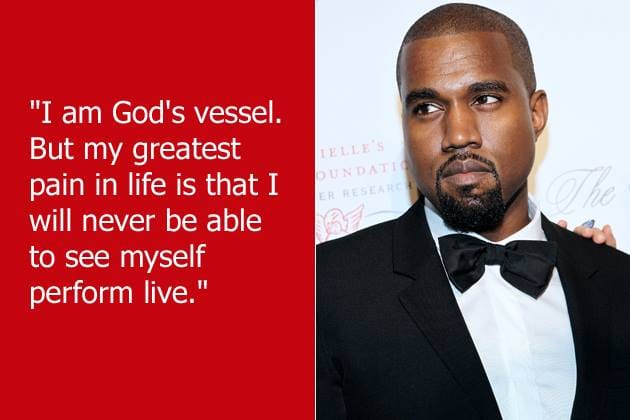
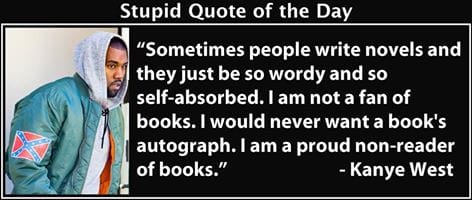
Wisdom From Kanye West

10405578_10200256028641198_2878050527190768487_n

18410_10153111674677112_6477877584768275456_n

Posted in Blacks, Rap | Comments Off on Wisdom From Kanye West

I Did It For You!

A friend opens up a bottle of kosher peanuts and insists I take some.
Luke: “No thank you.”
Friend: “I did it for you.”
Luke: “That’s what Jesus said on the Cross. And again, no thank you.”

* I have a Japanese friend who will never accept any “free” offer because he says there’s got to be a catch there. He also won’t sign up for any club card and limits his credit card use. Needless to say, his net worth is well over a million dollars beyond mine.

* My dentist insisted that I get something very cold up against my new filling as soon as possible (the cavity went right up the nerve), so a Jew takes me to frozen yogurt to celebrate my new filling. He insists I take three generous free samples before making my selection. My WASP background rebels at this freeloading. I prefer fill up the cup that he’s paying for. It costs him $5. He asks me if I want to bring a bucket to fill up on his dime.

Posted in Personal | Comments Off on I Did It For You!