Frustrated Mother

Frustrated mother changing a diaper: “I should have swallowed that night.”

Posted in Personal | Comments Off on Frustrated Mother

Dangerous Donald

CiS0PYiU4AAAgXZ

Posted in Donald Trump | Comments Off on Dangerous Donald

The Megaphone in One Graph

Screenshot-2016-05-13-01.57.33

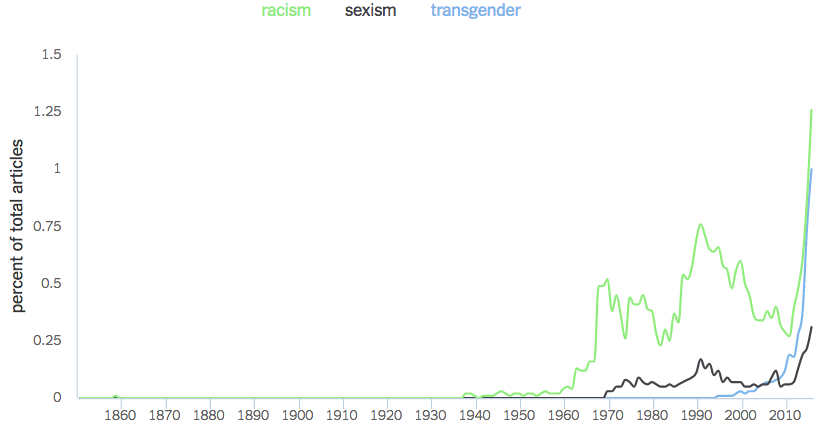
Steve Sailer: “The New York Times has a tool called Chronicle for telling you what percentage of Times article have included a particular word over the centuries. Here we see “racism” in green, “sexism” in black, and “transgender” in blue, all shooting up post 2010: the Establishment having a nervous breakdown.”

Comments to Steve Sailer:

* How many times a day does the average person hear or read these words? Every day I hear them constantly from morning till night through all media. Television, movies, commercials and ads all incorporate some propaganda in them. When you start noting each and every single instance throughout the day a person starts to realize what a total propaganda matrix we’re all living in.

* It’s not the establishment having a nervous breakdown. It’s the exultation that comes right before the final killing thrust. The early celebration when you are up by three touchdowns with only a minute on the clock. Insert your own metaphor, but it’s been rampant, shameless, public acknowledgement of supreme power since Obama came into office and the SJW dominoes continued to fall. Obamacare legalized via Judicial fiat? Check. Gay marriage via Supreme Court? Check. De facto open borders? Check. Drastically increased miscegenation in television and movies? Check. Normalization of transgenders? Check. Covert anti-white propaganda becoming overt? Check. On and on it goes. Victory after victory.

The Trump phenomenon has come as an unexpected shock, causing sudden panic and even more pushing of the agenda. If he wins this thing, he could be on his way to being the greatest American since George Washington.

* Rubble Kings is a very good documentary about the complete disintegration of the Bronx in the 70′s from the guys who were actually involved.
The biker look that the black gangs wore was lifted from the Hells Angels. The Angels were the only American counterculture of the 60′s/70′s that signaled toughness and masculinity and the black and Latin gangs in NYC latched onto it with gusto.

* Tom Wolfe wrote a lot about the pimp look around 1970. The NWA gangsta rap Los Angeles Raiders fan look always seemed like they were trying kind of hard to look masculine. The pimp look didn’t worry about that.

* Are you saying that Easy-e, who got aids in the 80s, wasn’t as masculine as he seemed?

* I need help!

Someone is passing around “memos” on all of this stuff. Feel privileged if you are one of the few who are getting the memos. I’m not and I’m starting to worry that there is something fundamentally wrong with me.

Remember, this is all is important stuff (see below) … since otherwise you are on the “out” and not part of the revolutionary change quickly reshaping the country. Does anyone have any ideas about how I can get on the memo list?

A few examples:

I didn’t see this coming. Did you notice that it only took a few day for all Confederate Flags to be taken out of stores and off the market? This included Amazon where Nazi regalia continued to be for sale. I’m a student of Civil War history and was about to buy one and then they were gone.

Did you notice that Paula Dean’s media and publishing empire collapsed within a few days and she was wiped clean from the national media when an employee claimed her son used the “N” word in one of her restaurants? What did Paula Dean do wrong besides showcase unhealthy food? Somehow I don’t get it … but perhaps I should get it.

I didn’t see this coming either. Did you notice how the media began hyping full civil rights for homosexuals and lesbians and then the transgendered in the name of diversity in the face of a massive majority of citizens opposing the social changes. For homosexuals, this happened over a few days. For the transgendered, it happened over a few weeks. Then, we discovered that toddlers and adolescents can be transgendered. How blind we’ve been all of these years!

This shocked me. I thought that Federal officials had to take an oath to uphold the Constitution that specified the powers and authorities for governing the United States as a NATION. Then, John Kerry, the US Secretary of State, tells college students last week to be prepared for living without borders. “You’re about to graduate into a complex and borderless world ….” Aren’t we still a NATION? I didn’t get the memo. That upsets me.

I’m confused. Have you noticed that Blacks are now featured in at least 50% of all television commercials. In many, they are the lead ethnicity. In others, they are the only ethnicity … and it’s not Black History Month. One would think that companies are chasing their dollars since they must represent a new and lucrative market the rest of us are unaware of. Now I’m confused because the economic statistics from the SSA document that White net worth is 3.53 times that of Hispanics, and 4.16 times that of Blacks. Aren’t Whites consumers anymore? Why are we invisible?

Please help if you know a way for me to start getting the memos ahead of time so I can be part of this revolution. I’m tired of being a passive, confused observer.

* I’d say that social media is the big reason:

1. Ricochet self-indulgent sanctimony across homogeneous ideological echo chambers.

2. Fortify said sanctimony with Likes.

3. Amplify accordingly– as if there is a worldwide competition called: “Nobody Hates [Racism] [Sexism] [Transphobia-ism] More Than Me!!!”

After a few years you get parabolic graphs like the one above, where the Y coordinate flies off the page into the stratosphere.

* One of the striking things is just how much they’ve completely lost their heads over identity politics, and, most especially, transgenderism.

How can it be that there is so much more attention paid to racism today, in the day in which a black has been elected President, than there was in the time of segregation and Martin Luther King Jr.?

And how can it be that the issue of transgenderism — a frankly freak condition that affects well less than 1 person in a thousand — can receive more attention (twice as much, by my reckoning) than racism did in the time of segregation and Martin Luther King Jr.?

This isn’t so much a graph of the megaphone as it is of the mob mind going mad, feeding on its own hysteria to create more hysteria.

I really hope that this graph gets the wide circulation it deserves. Let the obsessed, manic cretins at the Times figure out how to explain what this graph makes perfectly plain.

* The best part of the Obama era is the racial healing that Mr. Hopey Changey Lightbringer has brought to us all. This is absolutely the best part and worth putting up with all of the rest – the lies about keeping your doctor, about Benghazi, the flouting of the Constitutional limits on the President’s power, the unprecedented extension of Federal oversight and micromanagement into school restrooms and the burden of proof in school disciplinary hearings, etc. They are all worth it because, thanks to BHO, we have finally put the great race question behind us once and for all. There are no “WHITES ONLY” signs left anywhere in America, not even on the door to the Oval Office, so we can finally put our racial obsessions to rest and focus on the “content of our character” as that great paragon of good character MLK instructed us. This is why old white lady Hillary Clinton must be our next President, because what family other than the Clintons has the character to occupy the White House?

* If you’re taking flack, you’re over the target, part 592:

Mexico fights back against ‘The Clown’

“What we found out is, again, that the image in general terms of Mexico was quite undervalued or more specifically out of date,” he said. “The image of the contributions of Mexicans and Mexican Americans was damaged and undervalued. And there was no clear image of the importance of the bilateral relationship. That’s when the Mexican government decided that, again, we need to do something.”

The contributions of Mexicans and Mexican-Americans? Help me out here, I’m drawing a blank…

For nearly a year, Mexican officials have chafed at Trump’s inflammatory comments, including his pledges to deport millions of undocumented immigrants and to build a “great, great wall” along the southern border — and to have Mexico pay for it. Just last week, Trump drew scorn when he tweeted “I love Hispanics!” along with a photo of himself eating a “taco bowl” on Cinco de Mayo.

Of course, the scorners can’t exactly explain their scorn.

While U.S. lawmakers from southern border states have been trying to reassure their Mexican counterparts (mindful of Mexico’s enormous importance to U.S. trade)

Which is more enormous, Mexico’s importance to America’s trade, or America’s importance to Mexican trade? To ask is to answer.

Carreño outlined to POLITICO a multi-layered initiative to burnish Mexico’s image. The plans, some of which are already launched, include greater use of traditional and social media, increased cultural outreach through Mexican consulates, and strengthened ties to American business and civil society groups.

As soon as we build that list of important Mexican and Mexican-American contributors, maybe Carreno can use it to recruit them all to his campaign. The biggest Mexican names that spring to my mind are all leaders of drug cartels. Maybe “el chapo” can help.

Peter Schechter, director of the Adrienne Arsht Latin America Center at the Atlantic Council, said Mexicans are stunned to find themselves “the centerpiece of a nativist rhetoric that basically holds them as symbols of all that is wrong with our immigration policy, with our trade policy.”

“Do they feel ransacked? Absolutely. Do they feel this has come out of nowhere? Absolutely. Do they feel that not enough Americans stood up and try to counter-punch and try to explain what the realities of the relationship are? Yes,” said Schechter, who has extensive contacts in the Mexican government.

Well, they’re always welcome in Mexico. Given Mexico’s “enormous importance,” that should be consolation enough.

What does it say about Mexico, when keeping tens of millions of their own citizens in a foreign country is so important to the Mexican gov’t that they’re reshuffling their whole foreign policy apparatus? Anything good?

If they want their image to be more up-to-date, maybe they should put an emphasis on beheadings. That’s a relatively new Mexican trend.

Posted in America, Journalism, New York Times | Comments Off on The Megaphone in One Graph

How Old Is Nationalism?

Comments to Steve Sailer:

* I recall a lot of nationalism in a book called the Bible.

* Nationalism/patriotism infatuated the Roman Republic. Citizens went to war for the greater nation. They revered “Rome” so much that military standards and symbols of Rome carried near-mystical qualities for Romans—the capture of one by the enemy was seen as a grave occasion.

It’s helpful to think of “old nationalism” akin to “love for the extended family”. Most conquering nations originated in small tribes of highly interrelated folks. Going to battle for land or to keep invaders out was thus enriching or protecting your blood line. As nations grew in size, they could keep this spirit of “family camaraderie” up if they kept travel and communication short between various parts of the nation —hence how the vaunted Roman roads and Pax Romana kept the Romans feeling “Roman” for a good long period after they’d swelled to span three continents. If everyone feels like a close neighbor who shares in your culture and beliefs, then you’d be more willing to fight for them. Diversity is not a strength for a nation; conforming to the culture is.

Romans were thus highly motivated by patriotism during their salad days. Emperors appealed to it. As did the conspirators against Caesar. As did the killers of Tarquinius Superbus.

However, as the “diversity” of the Roman empire increased, the patriotism went down. Roman policy for decades was severe enforced integration for all those who wanted to become Roman citizens—Roman citizenship was seen as a great gift, not something bestowed to any conquered person. When a tribe wanted to become Roman citizens, they were instantly broken up and moved to the 4 corners of the empire, had their military ranks stripped, and basically told they had to give up most of their old ways. This integrated them with Romans and made them feel more Roman (and thus patriotic) and less whatever tribe they had been.

Rome’s greatest troubles came from tribes that were never broken up—the Goths. Other groups, such as the Jews of Palestine, were not broken up for hundreds of years, which led to Jewish rebellion after Jewish rebellion. It was not until the Jews were forcibly expelled and dispersed from Israel/Palestine in the 1st and 2nd centuries AD that the area became peaceful for the Romans.

In short, nationalism and patriotism is as old as time.

* I would think that nationalism is simply identical with realpolitik per se. There is no other point to politics than to advance the nation’s cause. The confusion arises because the “nations” here referred to are not those entities drawn up on a map by bureaucrats who send representatives to the UN. Those things are simply grandiose administrative districts. Real nations are born and die, they coalesce and divide, like raindrops on a windshield, and are never truly the same from moment to moment. The real nation is a felt unity between people in the melee of fighting life. The history of such nations is history itself, the theater of triumph and tragedy, over which those administrative wards occasionally form a thin crust which is constantly being superceded, like pillow lava flowing under the sea—flowing and cooling, then breaking through again. And real nationalism, which is simply politics divested of its ideological fig leaves, is what occurs there at the interface between fire and sea.

* An entire civilization has become a joke because of ignoring genetics.

“widening circles of sympathy”

self
clan
tribe
nation
race
humanity
save the koala

the vegans attacking humanists for not being vegans were once
the humanists attacking racists for not being humanist were once
the racists attacking nationalists for not being racist were once
the nationalists attacking tribalists for not being nationalist were once
the tribalists attacking clanists for not being tribalist were once
the clanists attacking individuals for being selfish.

That’s one factor; the other factor as stated in the OP is being attacked which pushes people together prematurely.

On a small island like Corsica tribalism = nationalism so it can happen sooner. In France it took longer.

They’re not “imagined” communities. They are part genetic / part imagined.

Lying about them being imagined is cultural warfare.

* The word “nationalism” is used ambiguously. There’s a certain meaning that is somewhat like “solidarity with co-ethnics” which is, of course, ancient.

Then there’s is the meaning “strong belief that my ethnicity deserves its own independent nation.”

Finally there is the latter meaning generalized, “belief that ideally all ethnic groups would enjoy as much political independence as reasonably possible.”

It is the other nationalisms that begin as the Ottoman and Austrian Empires’ domination over Eastern Europe declined and the desire for German and Italian unification arose.

* Nationalism is at least as old as the written record. Leftists hate nationalism (in others at least), so they try to make it appear artificial and recent. If educated people believed that nationalism was natural and deeply rooted in human psychology, if they thought it was inborn, it would have been harder to force them to abandon it.

There are countless examples of pre-modern nationalism. The Persian Wars for example, were essentially a fight between the Greek nation and the multi-ethnic Persian Empire. Yes, some Greeks fought on the Persian side, but they were shamed for that by the other Greeks as traitors.

I recently read the first volume of Hugh Thomas’s history of the Spanish empire in the Americas. Thomas’s description of 16th-century Spanish nationalism is still fresh in my mind, so I’ll talk about it here in detail.

Most people have heard of Ferdinand and Isabella, who united Spain in the 15th century through their marriage. They were both physically and culturally Spanish. After their death their throne was inherited by their grandson, the future Holy Roman Emperor Charles V, who was physically half-Spanish and culturally Flemish. He did not speak the Spanish language when he arrived in Spain in 1516. Most of the people he knew and trusted were Flemings, so that’s whom he started appointing to important offices in Spain.

The native Spaniards resented being ruled by Flemish officials. There were numerous stories of Flemings mistreating Spaniards and taking money out of Spain. The idea of Charles using tax money that he raised in Spain to improve his other European possessions was unacceptable to many Spaniards. These feelings produced a violent revolt, which Thomas describes in detail and which is also written up in this wiki:

https://en.wikipedia.org/wiki/Revolt_of_the_Comuneros

The city councils of Spain submitted a list of formal demands to Charles. Among those were the removal of Flemish officials and their replacement with Spaniards, and a ban on the government spending Spanish tax money in Charles’s other European possessions. The Cortes (parliament) of Castile required Charles to only address it in the Spanish language.
Some of the rebels’ formal demands are listed here:

https://en.wikipedia.org/wiki/Revolt_of_the_Comuneros#Proposals_to_other_cities

Charles ended up subduing the revolt with both violence and concessions.

This early 16th century conflict would seem inconceivable to those who bought the leftist line on nationalism having been invented at the time of the French Revolution. Don’t take anything on faith, at least not on politically-charged issues. Try to investigate things for yourself.

There was an increase in nationalism in Europe at the time of the French Revolution. Secularism was spreading among the elites. Christianity, like Islam, is nominally universalist, so when it started to lose force, nationalism gained at its expense. But there’s always been nationalism in Europe and other civilized parts of the world. I just described one example of it, but I could have picked many others. The increase in nationalism in the late 18th century was not from a zero level. If you think that it was, you don’t know much history.

* Say there’s two axis. A loyalty axis:

Me against my brother
My brother and me against my cousin
My brother my cousin and me against the rest of the village
My village against the other village
My manor against the my feudal lord’s enemy’s manor
My kingdom against my king’s enemy’s kingdom

And a cultural axis:

People who speak as we do vs. people who only say “bar-bar”.
People who dress as we do vs. people who don’t know how to dress properly
People who pray as we do vs. evil heathens
etc.

At some point the King became so powerful that all conflicts on the loyalty axis were concentrated at the kingdom’s level, and the very same Royal power made it so that culture became more or less uniform at the kingdom level. That is what we call a “nation”, and while the process was gradual, 200 years ago it reached it’s highest form in France, so much that all countries in Europe realized that they better become a nation or they would be destroyed by someone who did.

* The French had a way with diplomacy that was legendary. They married local and trained their ambassadors better than other nations to make up for it. Tallyrand, obviously, springs to mind. But French diplomacy also extended to doing bold, unthinkable things and getting away with it, such as allying with the Ottoman Turks right when the Turks were threatening central Europe:

https://en.wikipedia.org/wiki/Franco-Ottoman_alliance

Also they had a profound effect upon Russia culturally. As is well known, much of War & Peace was written in French because that was the language of the upper-class Russians. The French prided themselves on spreading their culture as far as possible in order to influence others. It was their version of the CIA’s exporting American culture to the eastern bloc.

Ben Franklin very much impressed the French because his diplomatic skills were on par with theirs. He knew how to play the games. He played the noble-savage-rustic-plain-spoken simple-living character the French believed Americans were—but flirted like heck at a very high diplomatic level. Comparisons of Franklin to Bill Clinton in terms of social adeptness are probably apt, although its hard to think of a Founding Father as a sociopath.

John Adams, the dour Puritan, came to Paris to aid Franklin in the diplomacy. But Adams’s actual plain-spoken simple-living character didn’t gel well with the French; he was genuinely appalled at the French behavior/excess, and at Franklin’s flitting about from party to party without seemingly getting anything done–and Adams complained loudly about it. Franklin got Adams kicked out of his job “aiding” Franklin before Adams could ruin things.

All this is to say that the stereotype of the “sophistication” of the French is really a holdover from their diplomatic greatness.

* I think the underlying thing is the same but the scale of that thing varies so nationalism is the name for the thing at one scale and tribalism is the name for the thing at a smaller scale.

It’s the thing itself that doesn’t have a name (but it’s related to circles of sympathy).

* What was distinctive about England was that it had quite distinct borders, typically ocean. In contrast, polities on the Continent tended to be somewhat arbitrary in extent.

There were three main language groups — Romance, Germanic, and Slavic — and even leaving aside the question of their somewhat blurry borders, how do you divide each one up?

What’s now Portugal and what’s now Romania, for example, are both Romance speaking lands but they are awfully far apart and probably would not be happy being under one rule, especially in a time before rapid communications. They’re denizens won’t be able to understand each other, so it makes sense to separate them politically. But how do you divvy up all the Romance speaking lands between Lisbon and Bucharest?

Obviously, political actors fight, connive, marry, form alliances, sponsor educational and artistic efforts to build unity or difference.

But it was not clear ahead of time how it was going to turn out. It’s not a priori obvious that Paris would rule Marseille or that Madrid would rule Barcelona. (Perhaps it was clear, for historical reasons, that Rome would rule Italy, but that turned out to be a roadblock to Italian nationalism for some time due to the Pope ruling Rome.)

On the other hand, England has had pretty obvious borders for an awful long time. That doesn’t mean that London won’t try to rule more land than just England, but it is striking that the idea of England, as say the territory represented by England at the World Cup, is not very different at all from what land the King of England ruled in 1000 AD.

* The English state could project enough power to fight a Hundred Years War to control France from 1337 to 1453, with almost all the fighting done on the Continent. The English eventually lost, but it was more of an adventure for the English. The English monarchy could punch above its weight in part because of its fairly unified and secure island base. The English could manipulate alliances on the Continent, while its Continental rivals were stuck with trying to inspire the Scottish or Irish to rebel, a strategy that had a long record of failing to be decisive up through 1916.

The Wikipedia summary of the Hundred Years War is pretty good:

“The war owes its historical significance to multiple factors. By its end, feudal armies had been largely replaced by professional troops, and aristocratic dominance had yielded to a democratisation of the manpower and weapons of armies. Although primarily a dynastic conflict, the war gave impetus to ideas of French and English nationalism. The wider introduction of weapons and tactics supplanted the feudal armies where heavy cavalry had dominated. The war precipitated the creation of the first standing armies in Western Europe since the time of the Western Roman Empire, composed largely of commoners and thus helping to change their role in warfare. With respect to the belligerents, English political forces over time came to oppose the costly venture. The dissatisfaction of English nobles, resulting from the loss of their continental landholdings, became a factor leading to the civil wars known as the Wars of the Roses (1455–1487). In France, civil wars, deadly epidemics, famines, and bandit free-companies of mercenaries reduced the population drastically. Shorn of its continental possessions, England was left with the sense of being an island nation, which profoundly affected its outlook and development for more than 500 years.[1]“

English foreign policy was pretty successful after 1066. England’s famous battles — Agincourt, Waterloo, the Somme — tended to be fought in what’s now Belgium, which is a lot more fun than fighting them in Sussex.

* It’s been my impression that “nationalism” means more than one thing, just as the English word “love” means more than thing.

C.S. Lewis wrote about _The four loves_, distinguishing between eros, filia (philia?), agape, etc.

Similarly, with nationalism we have modern unification of a nation state (France post 1789) based on ethnolinguistic similarity.

Perhaps this can be a civic nationalism–the early wave post 1789–establishing a civic nation, also with linguistic unification.

There is also the post World War One “self-determination” wave driven by Woodrow Wilson’s 14 Points and the dissolution of the four big old dynastic empires (Habsburg, Ottoman, Romanov, and Hohozollern Germany (sp?).

But we have the older proto-nations descrbed by Anthony Smith. Smith uses the term “ethnie” for proto-nation or older nation partly but not fully conscious of itself.

We can have the campanilismo of the Italian City States. A city state patriotism. Some of the same sentiments, but smaller and more local.

Walker Connor has written about ethnonationalism as driven by an ineffable sense of in group similarity / solidarity. He has worked to distinguish this as the “pure” nationalism, distinguishing it from the French Revolution type.

* … one does kind of wonder if a nation state can persist if the state is controlled by people who don’t think of themselves as part of the nation, members of the tribe. How long would it take to kill off the nation part of the nation state once it’s there?

* The left wants you to regard your identity as a construct, one that by its mere existence oppresses others. So you need to unburden yourself of it. And make it snappy you racisss!

What we are fighting for is no less than the will and the right to claim our own selves and to claim our own nation. For anyone tempted to think of those as mere performances, inventions, or imagination, just ask yourself why do they spend so much bile on undermining them? They are thieves who tell us our family jewels are cheap costume jewelry, cursed even, and to discard them, so the thieves can run off with the loot.

* Since the dawn of recorded history, nations of various sizes have always existed, men have always felt fond attachment to them, and they have always defended themselves against other nations. Foreign princes and their bureaucrats have never ceased to be resented.

What makes the post-Valmy world fundamentally different is the moral sense that any decent-sized nation automatically deserves its own sovereign state as an absolute matter of right. This idea, which seemed so self-evident to President Wilson and Garibaldi, did not seem obvious to anyone before the age of mass participation in Republican politics and “The Rights of Man”. Nations, pre-Valmy, had unique, historically-grounded rights expressed through their Parliaments, assemblies, and traditions. They did not have abstract Rights to the expression of the General Will of all Equal Citizens. When the King’s job, as expressed in his coronation oath, was to maintain inviolate the established laws and customs of the nation, his own national origin was of secondary importance. When sovereign states got into the business of radically transforming society from top to bottom, it became imperative that such power be wrested from foreign hands.


Posted in Nationalism | Comments Off on How Old Is Nationalism?

Los Angeles Times features former pastor who decided to ‘live without God’ for a year

From Get Religion:

Back in January, former Seventh-day Adventist pastor Ryan Bell made national headlines with his New Year’s resolution to “live without God” for a year…

Now, with Bell’s publicity-grabbing experiment nearly over, he’s back in the news — courtesy of an in-depth, front-page story in the Los Angeles Times:

The Times piece opens with this scene:

“Uh, I’m not exactly sure about all this,” Ryan Bell said as he scanned the scene inside a darkened Las Vegas convention hall.
A stripper whirled her hips. A rock band pumped out a song about cannibalism. A man’s shouting hung briefly over the packed crowd: “God is dead!”
For nearly two decades, Bell had pastored congregations of Seventh-day Adventists, among the most conservative denominations in Christianity. How had he ended up at a gathering of atheists and skeptics in Sin City?
It had been a long time coming. For years now, it felt as if his prayers weren’t being answered. He secretly wondered whether a higher power existed at all.
So, last Dec. 31, he published a blog post that went viral.
“For the next 12 months I will live as if there is no God,” he typed. “I will not pray, read the Bible for inspiration, refer to God as the cause of things or hope that God might intervene and change my own or someone else’s circumstances. (I trust that if there really is a God that God will not be too flummoxed by my foolish experiment and allow others to suffer as a result).”
Now it was July, just over midway in his journey. Bell had spent as much time as he could reading about science and philosophy, interviewing agnostics and atheists, working to decide what he would believe when the year was done.

Keep reading, and the writer explores Bell’s faith journey — journey away from faith, that is — primarily from Bell’s own perspective.

A GetReligion reader who saw the article emailed us with this question:

“Why didn’t the article interview any ordinary atheists? Most atheists are not hedonistic bigots as portrayed in the article.”

As for what the article means when it describes Seventh-day Adventists as “among the most conservative denominations in Christianity,” readers are left to wonder. The Times makes no effort to explain what Adventists believe and quotes no local, regional or national church officials. The only clue given: The newspaper reports that Bell didn’t drink, smoke, swear or eat meat as a teen.

Similarly, the story describes Bell’s alma mater — Pacific Union College in Northern California — as “deeply observant” but doesn’t bother to elaborate. Instead, the Times shares an anecdote of Bell refusing — at that supposedly “deeply observant” institution — “to read 18th century philosopher Voltaire … on the grounds that writing such as Voltaire’s defiles the soul.” Huh?

Later, readers are told that the divorced Bell has started dating a “devoted Christian.” Again, the Times uses a generalized term (“devoted” in this case) without feeling a need to explain or elaborate.

The new year will, apparently, bring additional news from Bell.

From the Times:

There will be an announcement on where he stands, most likely on his blog. For now he won’t divulge exactly which camp he’ll end up in.
It’s hard to imagine him going back to the God of organized faith. It’s also hard to imagine him joining the crowd contending that God is imaginary and that belief is the source of most of the world’s ills.
“I do think I’ve now seen both sides of the coin,” he said on a recent day. “Being with the atheists, they can have the same sort of obnoxious certainty that some Christians have, and I don’t want to be a part of that. It feels like I’m stuck in the middle. I want to be for something good, but I don’t want boundaries, and religion just feels like a very bounded thing.
“The question I am asking right now: Why do I need religion to love?”

Posted in Adventist | Comments Off on Los Angeles Times features former pastor who decided to ‘live without God’ for a year

Pacific Union College wins ‘most beautiful’

This is where I grew up and this is a place I love.

I know this will sound crass, but Seventh-Day Adventist girls are hot.

Seventh-Day Adventism is a feminine religion. Women account for about two-thirds of the church. The atmosphere is about healing and nurturing. The leading figure in church history was a woman — Ellen G. White.

From the Napa Valley Register:

Pacific Union College in Angwin won a national honor of a most curious sort over the weekend.

Newsweek and The Daily Beast ranked PUC as the “most beautiful college” in the nation, topping such other West Coast schools as Santa Clara University (No. 2), Chapman University (No. 3), UC Santa Barbara (No. 8) and the University of Southern California (No. 12).

The ranking reflected survey data on the attractiveness of students, the campus, the number of sunny days per year, and the area’s comfort index, which measures humidity and afternoon temperatures.

The male students at PUC scored 9.2 out of 10 for “male attractiveness,” while females got a rating of 9.1. The source of these measures of physical beauty: the College Prowler website.

Online comments questioned many of the “most beautiful” results. “What does education have to do with attractiveness???” said one. Another questioned how non-existent male students were rated at the all-female Scripps College.

PUC is a Seventh-day Adventist Christian liberal arts college located in the green hills east of St. Helena.

PUC President Heather J. Knight accepted the honor, saying, “In many ways, this is recognition for our collective goal to make the campus sparkle — and our landscape and facilities management teams in particular.”

Knight has led a campaign in recent years to enhance many areas of campus and emphasize its natural beauty.

Comments:

* There is a charm and a beauty about the whole area known as Angwin. The students tend toward being friendly and polite. The people are helpful, friendly and community-oriented. Much of the land is untouched and revered by all who walk the trails around this town.

Obviously, we all want this to remain just as it is and while we cannot have it all, we must struggle to preserve land would be over-developed and a community that would shatter. I will vote for Measure ‘U’ because I truly respect what has been created in Angwin.

Allow me to put this whole argument into context through the words of Theodore Roszak (Professor of History at CSU, Hayward; social thinker, writer and critic). “Suddenly it becomes a subversion of progress to assert the common sense principle that communities exist for the health of those who live in them, not for the convenience of those who exploit their real estate for profit.”

Posted in Adventist, PUC | Comments Off on Pacific Union College wins ‘most beautiful’

Seventh-day Adventist college fracas proves that local coverage is often better

Every group has rules — written and unwritten — and if you violate them sufficiently, you get kicked out.

Seventh-Day Adventism is high intensity religion. If you take it seriously, it tends to take over your whole life. Because of this passion, Adventists argue a lot and push out those who don’t belong.

Australian author Bob Ellis nails it: “Being a Seventh-Day Adventist was hard but it was kinda fair. They quickly sorted out the ones they couldn’t trust and branded us with the mark of Cain and sent us wandering, fugitive sinners, through the Land of Nod for all our days.”

Here is some background on my family’s time at Pacific Union College (particularly the years 1977-1980).

From Getreligion:

Every week, yet another Christian college is in an uproar over clashes between doctrine and 21st century culture.

Thus, it’s no great surprise that one of North America’s 13 Seventh-day Adventist schools should be on stage now. The focus is on Pacific Union College, a Napa Valley institution ranked as America’s most beautiful college in 2012 by the Daily Beast and Newsweek. That is pretty amazing when you consider it was up against the University of California-Santa Barbara and Pepperdine.

However, its psychology department is in much disarray, according to a piece in the Chronicle of Higher Education that tells of the department’s decision to invite Ryan Bell to speak. GR’s own Bobby Ross has written quite a bit about the publicity-seeking Mr. Bell who has gotten lots of favorable coverage for his recent decision to dump his Christian faith and become an atheist.

Even though Bell is a PUC alum, it’s not hard to imagine how inviting him onto campus would set the collective teeth of college administrators on edge.

 After forcing a psychology professor to disinvite a controversial speaker, Pacific Union College is, for the second time in less than three years, facing turmoil within and departures from its department of psychology and social work, along with renewed questions about its commitment to academic freedom.

The latest uproar at the institution, a small Seventh-day Adventist liberal-arts college in California, began when Aubyn S. Fulton, a professor of psychology, invited Ryan Bell, a former pastor in the Seventh-day Adventist Church who had become an atheist, to speak at a colloquium.

The invitation drew the ire of Pacific Union’s president, Heather J. Knight, who told Mr. Fulton to disinvite Mr. Bell. She also told him, Mr. Fulton asserted in a Facebook post, that he would be fired at the end of the term.

“The president transmitted to me previously that she would be firing me because of the events surrounding my decision to invite Ryan Bell,” Mr. Fulton wrote. “I believe I referred to that action as the most egregious violation of academic freedom I had ever encountered over my nearly three decades as a member of the PUC faculty. I stand by that judgment.”

In an interview with The Chronicle, Ms. Knight would not confirm whether Mr. Fulton’s social-media post was accurate, but said no decisions had been made to terminate anyone yet. She added that Mr. Fulton had reached out to the college to orchestrate an “amiable separation” from Pacific Union before the posting.

The Chronicle does a decent job of filling in the backstory about Fulton, including how he nearly lost his job three years ago because he openly challenged the church’s stance on premarital sex.

We hear how the head of the psych department stepped down then and now, with this latest contretemps, three more faculty are walking out. A story posted Wednesday by the Napa Valley Register says five professors in the psych and social work department have left since 2014, so the actual numbers are unclear. The Register also mentioned a contract that faculty sign pledging to support church doctrine and quoted directly from the college’s academic freedom statement about faculty not presenting as truth anything contrary to SDA beliefs.

The Chronicle should have mentioned those details. Also, the colloquium was last fall, a detail picked up by the Register but not mentioned by the Chronicle. The latter story made it sound as if this had all blown up in the past month whereas the debate has been simmering for more than six months. Another detail the Chronicle left out was that Fulton didn’t tell the college president of Bell’s impending visit until four days before the fact.

Blindsided by the invite and planning an out-of-town trip, Heather Knight had to make a quick decision, so she opted to cancel Bell’s appearance. These are all important details that a local paper, with its ear close to the ground, can get whereas a national publication, writing in sweeping terms about academic freedom, completely misses.

What the Chronicle got right was some good quotes from Knight defending her position plus the suggestion that some of the departing profs were planning to retire anyway. It also said:

The resigning professors pointed to the leadership’s interference in their classrooms. “We are limited because our handbook doesn’t allow us to speak critically,” Ms. Bainum said. “Individuals who have tried to challenge it have been called into the principal’s office, so to say.”

Folks at the Chronicle: Please quote from the handbook. What did faculty sign onto when they were hired? Is it right for teachers at a clearly conservative Christian school to expect they can give a platform to someone who opposes its teachings, especially Ryan Bell of all people?

Is the whole debate about academic freedom? The headline says it is, but Knight suggests near the end that it’s not and that no decisions have been made whether or not to terminate someone. Well — it’s May, way past the time when colleges hand out contracts to their professors for next year. Did the reporter ask Fulton whether he’s received a contract or not? That would tell us a lot.

It’s easy for a national publication to sweep in and tell a story along the lines of the familiar narrative of conservative-Christian-college-is-trampling-down-academic-freedom. But the reality is a bit messier and a lot of the ferment revolves around one professor. Who’s the real villain here? We need more details than the Chronicle delivered.

Posted in Adventist, PUC | Comments Off on Seventh-day Adventist college fracas proves that local coverage is often better

Should Jews Engage With The Alt-Right?

Rabbi Mayer Schiller said in 1999: “The State of Israel poses a problem for Jews living in the diaspora. A Jew living in America, France or England but yet somehow says I am an Israeli or a Zionist, that creates a tremendous amount of tension. Herzl envisioned Zionism as Jews leaving Gentile nations and going to live in Israel, not staying in France and England and saying I am a Zionist. Jews living in America, England, France, etc, have three moral possibilities: They can be loyal citizens, they can be Zionists which means to leave [for Israel] or they can adopt the Neterui Karta position of non-involvement in the affairs of the nations.”

Rabbi Schiller seems to have studied the works of Kevin MacDonald and thought through their troubling implications.

I know about a dozen Jewish intellectuals (including Orthodox rabbis) who read Kevin MacDonald and believe he is worthy of engagement. They can’t say so publicly for fear of the consequences. There’s no contradiction between loving being Jewish, leading a traditional Jewish life, and accepting truth from any source.

I have a small following among some intellectuals and journalists in Los Angeles Judaism and they know that I respect some intellectuals on the dissident right such as Steve Sailer, Jared Taylor, Gregory Hood, Greg Johnson, Tom Sunic and Roger Devlin, and I advocate engaging with them and their ideas (restricting our arguments to facts and logic and dispensing with slurs). I had a public dialogue one Sunday afternoon at a Chabad shul with Tom Sunic.

I have had many conversations about these topics in and out of shul and around the Shabbos table.

If the Alt-Right is socially stigmatized, then only weirdos like me will hang out with the Alt-Right!

If people are arbitrarily divided into teams, they will quickly identify with their team and develop a filter that makes their team superior.

Every people view themselves as specially chosen, the center of the universe, etc.

The more free the country, the more likely that Jews will prosper.

I GET COMMENTS:

* As Tom Sunic has pointed out, the biggest problem with the alt right is narcissism and low-level sociopathy. Lawrence Auster himself was guilty of this in the way he constantly rubbed people up the wrong way, even when they were 80 percent in agreement with him.

* It seems like you [a Jew] either go Reform/Conservative, and swallow all this left-wing SJW crap, or Orthodox, and have to go live in one of 3 areas of the country that are really expensive and follow a bunch of rules useful for desert nomads 2000 years ago. The neocons actually had a nice ‘secular right-wing’ option, but then they went and started a war with Iraq for the benefit of Israel.

I’d say, to any pro-white Jew reading this, you have 2 options. If you live near NYC, you can find a right-wing Jew who agrees with you and agree to disagree on immigration. If you don’t, just find a suitable denomination and convert, or you can be the weird right-wing guy in your temple. If you really want to get involved in activism, find a group like AmRen that tolerates your ancestry. Hey, it’s better than being conservative and black.

* 1. The MSM constantly attack white people on the basis that disparate impact is proof of racism.

2. The MSM is overwhelmingly Jewish.

so either

1) they got there by merit in which case using disparate impact as proof of racism to attack others makes them dishonest hypocrites

or

2) they got there through ethnic nepotism which makes them dishonest hypocrites

so all this bloviating over anti-semitism is a joke.

If semitism = dishonest hypocrisy then anti-semitism is a good thing.

* If something keeps happening over and over, chances are there IS a reason why it is happening. Even if the reason doesn’t comport with what Spock would call “logic”, it must be following its own internal logic somehow.

A good rule of thumb is that people usually act in what they perceive to be their self-interest, so if they behave in a way that appears self-defeating to you, chances are that they see their self-interest in a way that is different than you do. Often it is the difference between long term and short term interest – most people have a very short time horizon. So if you tell a meth addict that in the long term the drug will destroy them, they will take it anyway because in the short term it feels good. Maybe that is the case here – the short term reinforcement that goodwhites get from making themselves feel superior to badwhites is more important to them than the long term consequences of undermining the country. Or maybe, as I said before, the evolutionary logic really is in favor of them undermining other white competitors – if you can get your (regressed to the mean) kids into the Ivies as a “legacy”, they will still end up at the top of the class if everyone sitting around them is an affirmative action admit.

* The Nazis believed (and in this they were probably not wrong) that Jews would rise to the top of any organization that does not take active measures to bar them. This makes sense given the gap in IQ, especially verbal IQ.

Posted in Alt Right, Jews | Comments Off on Should Jews Engage With The Alt-Right?

Photos: Pacific Union College Demonstration

Many of my happiest memories are from my time at Pacific Union College (6th thru 12th grade). There would not be such intense conflict if people didn’t love so much.

It is a very good sign for Adventism’s future that Adventists fight so fiercely over what often looks silly to outsiders. If SDAs didn’t care so much about their church, they’d be in decline like the Anglicans and the other mainstream Protestant churches. Adventism is high-intensity religion, like Orthodox Judaism. It takes over your whole life.

REPORT:

57335aa222378.image
Pacific Union College, a small Seventh-day Adventist school, is in the midst of a debate about academic freedom after a controversial psychology professor said he was going to be fired.

About 60 PUC students marched through the Angwin campus on May 4 in defense of the professor. Heather Knight, college president, met with the demonstrators outside her office, led them in prayer, and agreed to hold a town hall meeting the next day that was attended by about 250 students.

A professor at Loma Linda University writes: My perplexity and dismay about is happening at PUC increases with each day and every bit of news. I guess this is because my own experience has been so different.
I was once invited to speak somewhere only to have the one who invited me withdraw the invitation because his or her administrator did not approve. We both laughed about it and that was it.
Also, twice my administrators have asked me not to participate in major academic conferences where I thought I could make positive contributions because they thought that my doing so would intensely disturb one or more of our constituencies. Although I was disappointed, I did not feel abused. After all, they did have a better overview of the situation as a whole. My contributions were published anyway without administrative disapproval.
Time, place and circumstance matter in these things as in all.
I don’t know how many denominational committees and commissions on which I have not been invited to serve even though I was qualified because someone thought I was not sufficiently traditional. This gave me time to do other things.
On the other hand, my Dean defends me when I don’t even know it. His response when I once thanked him was: “I’ll let you know when I think the criticism has merit; otherwise, it is my job to protect you so that you can do your work and that’s what I’m doing.”
Once, when I was involved in a controversial publication, my Dean preempted criticism by first informing the Board of Trustess and inviting them to read it even though he knew, he said, that a number of them would disagree.
Also, I have been told by one of our university’s lawyers that protecting my tenure sometimes increases their workload. “No problem,” he responded when I thanked him. “Happy to do it!”
Courts are adversarial and rightly so. By definition, colleges are collegial. On such campuses, everyone gives and takes in hopes of serving the common good. Nobody always gets his or her own way. Not even the President!
I wish that from my great distance I could see more collegiality at PUC. Maybe I would if I were closer.

Posted in Adventist, PUC | Comments Off on Photos: Pacific Union College Demonstration

WP: Donald Trump is the ultimate Republican repudiation of Jack Kemp’s legacy

I don’t think Jack Kemp left much of a legacy to repudiate. His tax cuts were largely undone when the Democrats under Clinton took power. What exactly is his legacy? He lost his race for the Republican presidential nomination in 1988 and then he lost in 1996 when he ran as Bob Dole’s running mate in the presidential election.

To compare Kemp with Reagan and Lincoln is ludicrous.

Economic growth does not increase racial equality, it decreases it. More freedom and the more intelligent will take more advantage. In a free country, smart groups like the Jews and East Asians will in large part dominate.

Here’s the money quote from the following essay about Kemp: “Those pleas didn’t translate at the ballot box.”

Washington Post op/ed: Looming over the meeting will be the legacy of the one-time Buffalo Bills quarterback and supply-side conservative hero Jack Kemp.

Kemp was Ryan’s mentor. In detailing to CNN his reasons for withholding his endorsement, Ryan said that Republicans were the “party of Lincoln, of Reagan, of Jack Kemp,” implying that Trump was not worthy of their company.

Kemp, though, is recalled as an optimistic man of relentless faith in his most cherished convictions. He was most famous for his proselytizing in support of permanent, across-the-board income tax rate cuts, which he depicted as a virtual panacea for late-1970s’-era stagflation. Kemp insisted that a supply-side policy of tax cuts for all Americans would spark an era of economic growth, increase revenues for the federal government, erase budget deficits and make Americans more free to fulfill their potential.

Ryan has imbibed much of Kemp’s vision and message; Trump threatens to undo the Kempian conservative Republican identity on fiscal issues.

But Trump is a rejection of Kemp on more than economic policy. A leading voice for racial tolerance, Kemp has now been, in essence, repudiated in the most forceful terms by the Republican Party’s new standard-bearer.

Kemp’s legacy on the question of racial and economic equality is not uncomplicated. The 1981 Kemp-Roth tax act cut the marginal income tax rate by 23 percent over three years, providing substantial windfalls to the wealthiest Americans and contributing to widening income inequality that is partly responsible for fueling our current distempers. Yet at the same time, Kemp’s anti-tax crusade gave Reagan and other Republicans a model of how to push tax cuts without employing racially demagogic language. In the late 1970s, Reagan attacked government for giving undeserving assistance to a Chicago “welfare queen” and a “strapping young buck,” barely disguised code that prefigured some of Trump’s demagogic vitriol. No fan of welfare or food stamps, Kemp nonetheless criticized social spending in more neutral tones, as “programs that benefit others,” that many Americans were reluctant to pay for. Washington, he said, “has made it increasingly easy to remain unemployed without suffering deprivation,” thereby pinning the blame on government rather than minorities for a flawed system. The effect of his tax policies, of course, would have been as bad for minorities if they’d been sold with racially charged language. But Kemp’s belief in the power of tax cuts to improve all lives was genuine (if misguided and shorn of evidence), and his repudiation of divisive rhetoric mattered.

Kemp’s faith that conservative economic and social policies could promote racial equality was rooted in his years as a professional quarterback.

Posted in Republicans | Comments Off on WP: Donald Trump is the ultimate Republican repudiation of Jack Kemp’s legacy