If you are a Christian, it would make sense to me that you would put Christians and Christianity first. If you are a Muslim, I would expect you to put Islam first. If you strongly identify as Jewish, it just makes sense to me that you would put Jews and Jewish interests first. The more you identify as black, gay, Jewish, Christian, Muslim, latino, etc, it just makes sense that you are proportionately more likely to put your group first, to think well of your group, and to have some negative views of out-groups.
Jews have it easiest in Protestant countries because Protestants are individualists and tend to look at people as individuals first, rather than as members of a group.
Jews have a harder time in corporate countries, such as Catholic or Muslim or Asian countries. The Japanese, Chinese, and Koreans are as tribal as Jews and they feel no guilt about the Holocaust. East-Asians are harder to manipulate than WASPs, and therefore Jews respect them more.
Most Israelis think of Americans as suckers and an easy mark.
I suspect that much of Israeli admiration of Donald Trump is that they see a lot of themselves in him.
Though Israel is a famously fractious society, Israelis tend to agree on one thing: Their strongest supporters are an inherently dupable people.
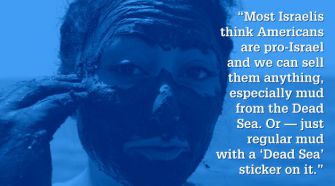
“Most Israelis think Americans are pro-Israel and we can sell them anything, especially mud from the Dead Sea,” said David Lifshitz, the lead writer for the Israeli comedy show “Eretz Nehederet,” or “Wonderful Land.”
“Or — just regular mud with a ‘Dead Sea’ sticker on it.”
But it’s not just American tourists whom many Israelis see as guileless. American foreign policy is held up to similar scrutiny here, even as Israel receives billions of dollars in foreign aid from the United States each year.
“Americans are perceived to be naive, especially when it comes to the Middle East,” said Uri Dromi, who served as a spokesman for the Yitzhak Rabin and Shimon Peres governments. “It is a bad neighborhood and it seems like they just don’t realize it.”
The naivete Israelis perceive in Americans is not just something they believe only Israel’s adversaries exploit; Israelis believe they can do so, too — and do. In a secretly recorded video of a 2001 discussion with a group of terror victims in the Ofra settlement in the Israeli occupied West Bank, now-Prime Minister Benjamin Netanyahu laid out this widely held perception.
“I know what America is,” Netanyahu, told the settlers . “America is a thing that can be easily moved, moved in the right direction.”
On political hiatus at the time after an election defeat, the once and future Israeli leader was responding to a skeptical settler who asked how he would respond to the global condemnation that could be anticipated if he were, as he proposed, to launch a “large scale” attack on Palestinians in the occupied West Bank and Gaza to counter the second intifada.
“They will not bother us,” he said of the Americans. “Let’s suppose they [the Bush administration] will say something. So they say it — so what? Eighty per cent of the Americans support us. It’s absurd! We have such [great] support there! And we say… what shall we do with this [support]?”
The paradox that Israelis rely on — and expect — American support and yet don’t trust American judgment on Middle Eastern affairs helps explain the recent U.S.-Israel dustup in Washington. On March 3, that clash reached its climax when Netanyahu appeared before a joint meeting of Congress to warn the assembled lawmakers against their own president’s negotiations, together with other countries, with Iran ahead of a possible deal on that country’s nuclear program.
Israelis were split on the value of Netanyahu’s trip to Washington, which was widely seen as a play to the prime minister’s right-wing base before the March 17 election. But most Israelis were in agreement about their premier’s message. About three-quarters of Israelis “don’t trust Obama to be a reliable ally and to deal effectively with the Iranian nuclear threat” said Eytan Gilboa, a senior researcher at the Begin-Sadat Center for Strategic Studies.
That opinion was evident on the Israeli street the day of Netanyahu’s speech to Congress, despite all the administration’s measures on behalf of Israel’s security that Netanyahu took pains to laud.
“Obama is very hostile against Israel,” said Effi Hasut, a 50-year-old hairdresser who was smoking on the patio outside his salon in downtown Jerusalem. “He tried to please the Arab world at our expense. He doesn’t understand them.”
Part of the reason Israelis think Americans just don’t get the Middle East, said Alex Mintz, a political psychologist at IDC Herzliya, is that they consider themselves close front-row observers of American foreign policy in the region. And they have watched the Middle East grow more violent and unstable in recent years, he said.
Of course, Israelis themselves have been much more than just spectators in the region, with a massive impact of their own. But according to Mintz, whose new book, “The Polythink Syndrome,” deals with recent U.S. policy in the Middle East, Israelis are skeptical of American intentions — except when it comes to supporting them. “[Israelis] are appreciative of the strong and solid relationship, with the U.S. But they also caution against subsequent moves of the U.S. in the region because they don’t think those are successful or led to good outcomes,” he said.
Yet there’s another reason that Israelis don’t trust Americans, and that has to do with a wider, powerful strain of mistrust in Israeli society.
“Israelis grow up with the expression of ‘never be a freier,’ i.e., a push-over or loser, someone who can be taken for a ride,” Ari Ben Zeev wrote in his 2001 book “The Xenophobe’s Guide to the Israelis.” “This omnipresent need ‘not to be a freier’ can be traced to 2,000 years of being a struggling minority and also to the Middle Eastern neighborhood rule that everything is negotiable.”
Some Israelis think of American tourists and American immigrants in particular as freiers. In a 1998 study of American Jewish immigrants to Israel, by Linda-Renee Bloch, one interviewee said he felt that Israelis saw him as having made the ultimate freier move by moving to Israel in the first place. In their eyes he fell for Israel’s “sales pitch” and traded the relative ease of American life for Israeli instability.
An American might respond with the saying “Fool me once, shame on you; fool me twice, shame on me,” and observe that this outlook, with deep roots in the American psyche, rebuts the Israeli stereotype of Americans as ever-trusting.
But for many Israelis, the question is, why trust anyone even once?
Posted inAnti-Semitism, Jews|Comments Off on If You Are Jewish, You’re Going To Put Jews First, Right?
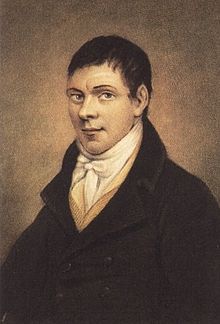
Wikipedia: Michael Dwyer (1772–1825) was a United Irishmen leader in the 1798 rebellion. He later fought a guerrilla campaign against the British Army in the Wicklow Mountains from 1798–1803.
Dwyer was born in Camara, a townland in the Glen of Imaal County Wicklow. He was the eldest of seven children of farmer John Dwyer and his wife Mary (née Byrne), who had a farm in the widespread fields of Wicklow and supplied the men of the rebellion with food. In 1784 the family moved to a farm in Eadestown.[1] Dwyer was a cousin of Anne Devlin, who would later achieve fame for her loyalty to the rebel cause following the suppression of Robert Emmet’s rebellion.
Dwyer joined the Society of United Irishmen and, in the summer of 1798, he fought with the rebels as captain under General Joseph Holt in battles at Arklow, Vinegar Hill, Ballyellis and Hacketstown. Under Holt’s leadership, he withdrew to the safety of the Wicklow Mountains in mid-July,[1] when rebels could no longer operate openly following their defeat in the disastrous midlands campaign. Dwyer and Holt tied down thousands of troops.
Dwyer and his men began a campaign targeting local loyalists and yeomen, attacking small parties of the military and eluding any major sweeps against them. His force was strengthened by many deserters from the military, who headed to Wicklow as the last rebel stronghold and who became the dedicated backbone of his force, as they could not be expected to be included in any future offer of amnesty.
Due to the constant hunt for him, Dwyer was forced to split and reassemble his forces and hide amongst civilian sympathisers to elude his pursuers. On 15 February 1799 at Dernamuck, he and about a dozen comrades were sheltering in three cottages when an informer led a large force of the British soldiers to the area. The cottages were quickly surrounded, the first two surrendering, but, following consultation, Dwyer and his men decided to fight on in the third one, Miley Connell’s cottage, after negotiating the safe passage of women and children. In the hopeless gunfight which followed, the cottage caught fire and only Dwyer remained unwounded. At this stage, Dwyer’s comrade, Antrim man Sam McAllister, stood in the doorway to draw the soldiers’ fire on him, which allowed Dwyer to slip out and make an incredible escape.
Dwyer later made contact with Robert Emmet and was apprised of plans for his revolt but was reluctant to commit his followers to march to Dublin unless the rebellion showed some initial success. The subsequent failure of Emmet’s rising led to a period of repression and renewed attempts by the Government to wipe out Dwyer’s forces. Methods adopted included attempts to deny him shelter among the civilian population by severely punishing those suspected of harbouring his men, the offer of huge rewards for information, the assigning of thousands of troops to Wicklow, and the building of a series of barracks at Glencree, Laragh, Glenmalure and Aghavannagh and a military road through county Wicklow.
In December 1803, Dwyer finally capitulated on terms that would allow him safe passage to America but the government reneged on the agreement, holding him in Kilmainham Jail until August 1805, when they transported him to New South Wales (Australia) as an unsentenced exile.
Dwyer arrived in Sydney on 14 February 1806 on the Tellicherry and was given free settler status. He was accompanied by his wife Mary and their eldest children and also by his companions, Hugh ‘Vesty’ Byrne and Martin Burke, along with Arthur Devlin and John Mernagh. He was given a grant of 40.5 ha (100 acres) of land on Cabramatta Creek in Sydney. Although he had originally hoped to be sent to the United States of America, Michael Dwyer was later quoted as saying that “all Irish will be free in this new country” (Australia). This statement had been used against him and he was arrested in February 1807 and imprisoned. On 11 May 1807, Dwyer was charged with conspiring to mount an Irish insurrection against British rule. An Irish convict stated in court that Michael Dwyer had plans to march on the seat of Government in Australia, at Parramatta. Dwyer did not deny that he had said that all Irish will be free but he did deny the charges of organising an Irish insurrection in Sydney. Dwyer had the powerful support of Australia’s first Jewish policeman, John Harris, who expressed the opinion in court that he did not believe that Dwyer was organising a rebellion against the Government in Sydney. On 18 May 1807, Dwyer was found not guilty of the charges of organising an Irish insurrection in Sydney.
Governor William Bligh disregarded the first trial acquittal of Michael Dwyer. Bligh who regarded the Irish and many other nationalities with contempt, organised another trial for Michael Dwyer in which he was stripped of his free settler status and transported to Van Diemens Land (Tasmania) and Norfolk Island. After Governor Bligh was overthrown in the Rum Rebellion in 1808, the new Governor of New South Wales, George Johnston, who was present at Dwyer’s acquittal in the first trial, ordered that Michael Dwyer’s freedom be reinstated. Michael Dwyer was later to become Chief of Police (1813–1820) at Liverpool, New South Wales but was dismissed in October for drunken conduct and mislaying important documents. In December 1822 he was sued for aggrandising his by now 620 acre farm. Bankrupted, he was forced to sell off most of his assets, which included a tavern called “The Harrow Inn”, although this did not save him from several weeks incarceration in the Sydney debtors’ prison in May 1825. Here he evidently contracted dysentery, to which he succumbed in August 1825.
Originally interred at Liverpool, his remains were reburied in the Devonshire Street cemetery, Sydney, in 1878, by his grandson John Dwyer, dean of St Mary’s Cathedral.[1] In May 1898 the coincidence of the planned closure of the cemetery and centenary celebrations for the 1798 rebellion suggested the second re-interment of Dwyer and his wife in Waverley Cemetery, where a substantial memorial was erected in 1900. The massive crowds attending Dwyer’s burial and the subsequent unveiling of the monument testified to the unique esteem in which Irish-Australians held the former Wicklow hero.[2]
Dwyer had seven children and has numerous descendants throughout Australia. In 2002, in Bungendore near Canberra, a family reunion took place, with Michael Dwyer’s descendants joining descendants of related Australian Irish families, the Donoghoe’s and the Doyles. In 2006, a reunion also took place to mark the 200th anniversary of the arrival of the Tellicherry in Botany Bay. One of Michael Dwyer’s sons was the owner of The Harp Hotel in Bungendore, New South Wales in circa 1838. Dwyer’s nephew, John Donoghoe (1822–1892), built The Old Stone House, Molongolo Rd, Bungendore, in circa 1865. This dwelling is a strongly constructed Bungendore landmark and a monument to pioneering and hard-working Irish Australian settlers.
Chaim Amalek writes: “Future generations will come to regard this generation’s elite encouragement of “gender reassignment surgery” the way we regard previous generation’s use of prefrontal lobotomies as a way of treating mental illness. Simply barbarous.”
Friend: “It will be fascinating to see how the media and politicians treat Jenner’s return to being a male, if it does happen. If he showed courage in transitioning to female, what does it show to become a male again. What will this do to the whole normalization of transgenderism now being promoted not only among teenagers but with very young children?”
The Wrap: “It hasn’t been easy for Caitlyn, it’s been very hard,” Ian Halperin recalls one source telling him
Caitlyn Jenner, who announced her transition from man to woman last year, has considered de-transitioning, the author of a new book about the Kardashian family told TheWrap on Wednesday.
Ian Halperin, the author of “Kardashian Dynasty: The Controversial Rise of America’s Royal Family,” said that, while researching his book, multiple sources told him that the former Olympian had been miserable for months and has considered transitioning back to a man.
“One source confirmed to me Caitlyn has made whispers of ‘sex change regret,’ hinting she might go back to being Bruce Jenner,” Halperin said.
Posted inTrans|Comments Off on Caitlyn Jenner Experienced ‘Sex Change Regret,’ Might De-Transition, Biographer Says
Race divides every country with lots of races. It is not a problem unique to South Africa or to the United States.
Washington Post: South Africans aren’t blind to the fact that race still divides their country. But when an activist named Gillian Schutte went public recently with messages she had exchanged with a high court judge a year ago, she certainly achieved her stated goal: to expose the “deep racism and colonial thinking” that still pervade upper echelons of South African society.
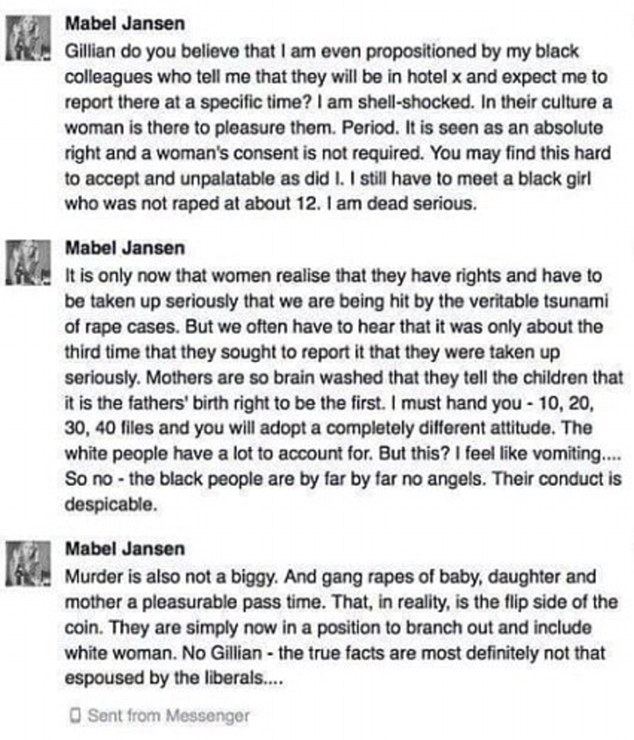
Mabel Jansen, who is the daughter of a former governor-general of South Africa during the apartheid years, sent the messages last May, and says she was trying to explain specific cases of sexual violence in a private context.
But the language she used was anything but specific.
“In [black people’s] culture, a woman is there to pleasure them. Period,” she wrote. “I still have to meet a black girl who was not raped at about 12. I am dead serious.”
“The white people have a lot to account for. But this? I feel like vomiting,” she continued. “So no – the black people are by far by far no angels. Their conduct is despicable.”
South Africa’s Minister of Justice Michael Masutha placed Jansen on “special leave” on Wednesday, following a slew of complaints from all sides of the government, and from other judicial officials.
Both the African National Congress, which has been in power since white minority rule ended in 1994, and the main opposition party, the Democratic Alliance, condemned the outburst. The ANC said it intends to tighten anti-racism laws. According to Agence France-Presse, the women’s league of the party stated that Jansen’s “comments made on Facebook where she claims that the rape of young children is part of black culture, are purely racist and misrepresentation of facts about black culture,” and questioned whether Jansen would be able to deal fairly in court with rape cases.
Official statistics show that 43,195 rapes were reported in South Africa between April 2014 and March 2015, but most go unreported. South Africa has one of the highest rates of rape and violent crime of anywhere in the world.
The racial divides of apartheid also have been slow to dissolve, with most South Africans still living in neighborhoods that are de facto segregated, and the income gap between whites and blacks has only widened since the end of apartheid.
The uproar surrounding Jansen’s comments has brought other aspects of her history to light. In a wide-ranging 2013 interview with the country’s Judicial Services Commission, she repeatedly played down her grandfather’s role in supporting apartheid, and claimed that her professional journey was almost as hard as any black South African’s because she is a woman, going so far as to say that there is an “apartheid between men and women.”
“I believe I know what hardship means,” she said in the interview. “I know what it is to be in a disadvantaged position.”
Posted inBlacks, Rape, South Africa|Comments Off on WP: Rape is black people’s ‘pastime,’ white South African judge says in Facebook rant
Washington Post: Johnson said he has been a leading voice of white supremacy since at least 1985, when he wrote a book proposing a constitutional amendment that would have limited U.S. citizenship to “non-Hispanic whites of the European race, in whom there is no ascertainable trace of Negro blood, nor more than one-eighth” any other nonwhite race or ethnicity.
He proposed that some “Hispanic whites” would be eligible for U.S. citizenship provided “they are in appearance indistinguishable from Americans whose ancestral home is in the British Isles or Northwestern Europe.”
Johnson has run for Congress in Wyoming and Arizona and a judgeship in California, and he has raised money for the presidential campaign of former congressman Ron Paul (R-Tex.). His campaigns have been based on “white nationalist” platforms, and he has even complained about fictional character Harry Potter kissing a “Chinese girl” in a movie, according to the Southern Poverty Law Center.
However, Johnson has said on his law firm’s website that he has long represented Japanese corporations doing business in the United States, and that he can “speak, read and write Japanese.” The website is written mainly in Japanese, and Johnson speaks in Japanese in a video on the site. Johnson notes that he is looking for new Chinese clients.
Johnson said he supports Trump because “he speaks his mind.”
“He won’t govern by public opinion poll; he will speak what he thinks is right,” Johnson said. “I believe Ron Paul was that way, I believe [Democratic candidate] Bernie Sanders is that way. And regardless of your political beliefs, that is a refreshing change.”
Johnson, who said his American Freedom Party has experienced an increase in recruitment because of Trump, said he likes Trump’s positions on “securing our borders and keeping the jobs back in America.”
But he said he doesn’t think that Trump supports white supremacist causes.
“I believe he does not,” Johnson said. “It’s unrequited love.”
Johnson, whose proposed 1985 constitutional amendment would have denied U.S. citizenship to anyone who was more than one-eighth “Semitic,” said he is not bothered that Trump’s daughter Ivanka converted to Judaism when she married an orthodox Jewish man.
“I do think it’s better for a Christian to marry a Christian,” he said. “But that’s not my say, and it’s not Donald Trump’s say. That’s his daughter’s say.”
Posted inWilliam Johnson|Comments Off on WP: ‘They don’t need the baggage’: White supremacist resigns as Trump delegate
I’m Jewish, with all the baggage that entails (truncated family tree, etc.). But according to Cathy Young’s poorly reasoned and badly written hodgepodge, “Ann Coulter’s Anti-Semitism Runs Deeper Than You Know,” I, too, would qualify as anti-Semitic for questioning liberal Jews (that includes practically ALL so-called conservatives): They insist that while Palestinians have no right of return to Israel (agreed); the world has a “global Right of Return to the US.”
Ask any left-liberal American Jew if he supports a “Right of Return” to Israel proper for every self-styled Palestinian refugee, and he’ll likely recoil: “Are you meshuga? Never! That’s a euphemism for Israel’s demise.” The very thing he rejects for Israel, the liberal Jew is inclined to champion for America: a global right of return to the US for citizens of the world.
Friends of Israel in America are unequivocal in standing up for that country’s right to retain its Jewish identity. What would become of that identity if all self-styled Arab refugees were to be granted the so-called right of return? Hatched by Israel’s enemies, this scheme will see millions of such refugees granted the right to immigrate to Israel proper, where they will overwhelm the Jewish majority. Friends of Israel know that Jews must remain numerically preponderant in the Jewish state if the prosperous, progressive nature of the country and its liberal institutions is to endure.
Now Young accuses Ms. Coulter of the thought crime for which I’ve long been guilty, too, because Ann wrote the following in Adios (2015):
The Young woman is foolish. She needs to show that for Ann to want for the US what Israel has claimed for itself through law is anti-Semitic. Young has not proven or argued this convincingly. The Young woman’s libel has no foundation in reason and argument.
Can Cathy Young, moreover, truly claim that Albion’s Seed founded this Christian country, America, with the view that it may one day happily become majority Muslim or Jewish or Buddhist; African, Asian or Arabian? Rubbish.
*****
* Cathy Young would probably decree it anti-Semitic to turn the term “blood libel” on its head and use it to denote defamation against a generally philo-Semitic Christian.
Chaim Amalek writes me: “Once your white nationalist friends figure out that you are part Chinaman, they are going to deport you first. Unless you can first learn how to handle their laundry.”
A comment to Steve Sailer: “Good Lord, you people are a bunch of creeps. (Oh, and by the way… the so-called “racial” component of being Jewish is an ethnicity, not a race. “Whiteness” is not an ethnicity. And Israel recognizes black Ethiopian Jews as Jewish.”
Conjuring fear of Nazism and anti-Semitism, Jews recoil from the thought that Judaism might be a race, but medical geneticist Harry Ostrer insists the ‘biological basis of Jewishness’ cannot be ignored.
In his new book, “Legacy: A Genetic History of the Jewish People,” Harry Ostrer, a medical geneticist and professor at Albert Einstein College of Medicine in New York, claims that Jews are different, and the differences are not just skin deep. Jews exhibit, he writes, a distinctive genetic signature. Considering that the Nazis tried to exterminate Jews based on their supposed racial distinctiveness, such a conclusion might be a cause for concern. But Ostrer sees it as central to Jewish identity.
“Who is a Jew?” has been a poignant question for Jews throughout our history. It evokes a complex tapestry of Jewish identity made up of different strains of religious beliefs, cultural practices and blood ties to ancient Palestine and modern Israel. But the question, with its echoes of genetic determinism, also has a dark side.
Geneticists have long been aware that certain diseases, from breast cancer to Tay-Sachs, disproportionately affect Jews. Ostrer, who is also director of genetic and genomic testing at Montefiore Medical Center, goes further, maintaining that Jews are a homogeneous group with all the scientific trappings of what we used to call a “race.”
Related articles at the Forward
• Genes tell tale of Jewish ties to Africa
• The ties that bind
• The other Jewish genetic diseases
For most of the 3,000-year history of the Jewish people, the notion of what came to be known as “Jewish exceptionalism” was hardly controversial. Because of our history of inmarriage and cultural isolation, imposed or self-selected, Jews were considered by gentiles (and usually referred to themselves) as a “race.” Scholars from Josephus to Disraeli proudly proclaimed their membership in “the tribe.”
Ostrer explains how this concept took on special meaning in the 20th century, as genetics emerged as a viable scientific enterprise. Jewish distinctiveness might actually be measurable empirically. In “Legacy,” he first introduces us to Maurice Fishberg, an upwardly mobile Russian-Jewish immigrant to New York at the fin de siècle. Fishberg fervently embraced the anthropological fashion of the era, measuring skull sizes to explain why Jews seemed to be afflicted with more diseases than other groups — what he called the “peculiarities of the comparative pathology of the Jews.” It turns out that Fishberg and his contemporary phrenologists were wrong: Skull shape provides limited information about human differences. But his studies ushered in a century of research linking Jews to genetics.
Ostrer divides his book into six chapters representing the various aspects of Jewishness: Looking Jewish, Founders, Genealogies, Tribes, Traits and Identity. Each chapter features a prominent scientist or historical figure that dramatically advanced our understanding of Jewishness. The snippets of biography lighten a dense forest of sometimes-obscure science. The narrative, which consists of a lot of potboiler history, is a slog at times. But for the specialist and anyone touched by the enduring debate over Jewish identity, this book is indispensable.
“Legacy” may cause its readers discomfort. To some Jews, the notion of a genetically related people is an embarrassing remnant of early Zionism that came into vogue at the height of the Western obsession with race, in the late 19th century. Celebrating blood ancestry is divisive, they claim: The authors of “The Bell Curve” were vilified 15 years ago for suggesting that genes play a major role in IQ differences among racial groups.
Furthermore, sociologists and cultural anthropologists, a disproportionate number of whom are Jewish, ridicule the term “race,” claiming there are no meaningful differences between ethnic groups. For Jews, the word still carries the especially odious historical association with Nazism and the Nuremberg Laws. They argue that Judaism has morphed from a tribal cult into a worldwide religion enhanced by thousands of years of cultural traditions.
In the 1980s, the United States Supreme Court ruled that Jews are a race, at least for purposes of certain anti-discrimination laws. Their reasoning: at the time these laws were passed, people routinely spoke of the “Jewish race” or the “Italian race” as well as the “Negro race,” so that is what the legislators intended to protect.
But many Jews were deeply offended by that decision, offended by any hint that Jews could be considered a race. The idea of Jews as a race brings to mind nightmarish visions of Nazi Germany, where Jews were declared to be not just a race, but an inferior race that had to be rounded up into ghettos and exterminated like vermin.
But setting aside the emotional issues, Jews are clearly not a race.
Race is a genetic distinction, and refers to people with shared ancestry and shared genetic traits. You can’t change your race; it’s in your DNA. I could never become black or Asian no matter how much I might want to.
Common ancestry is not required to be a Jew. Many Jews worldwide share common ancestry, as shown by genetic research; however, you can be a Jew without sharing this common ancestry, for example, by converting. Thus, although I could never become black or Asian, blacks and Asians have become Jews (Sammy Davis Jr. and Connie Chung).
Is It a Culture or Ethnic Group?
Most secular American Jews think of their Jewishness as a matter of culture or ethnicity. When they think of Jewish culture, they think of the food, of the Yiddish language, of some limited holiday observances, and of cultural values like the emphasis on education.
Those secular American Jews would probably be surprised to learn that much of what they think of as Jewish culture is really just Ashkenazic Jewish culture, the culture of Jews whose ancestors come from one part of the world. Jews have lived in many parts of the world and have developed many different traditions. As a Sephardic friend likes to remind me, Yiddish is not part of his culture, nor are bagels and lox, chopped liver, latkes, gefilte fish or matzah ball soup. His idea of Jewish cooking includes bourekas, phyllo dough pastries filled with cheese or spinach. His ancestors probably wouldn’t know what to do with a dreidel.
There are certainly cultural traits and behaviors that are shared by many Jews, that make us feel more comfortable with other Jews. Jews in many parts of the world share many of those cultural aspects. However, that culture is not shared by all Jews all over the world, and people who do not share that culture are no less Jews because of it. Thus, Judaism must be something more than a culture or an ethnic group.
Posted inJews|Comments Off on DNA Links Prove Jews Are a ‘Race,’ Says Genetics Expert
When will we get movies ridiculing anti-white and anti-gentile and anti-Christian prejudice?
Cannes (France) (AFP) – Actress Charlotte Gainsbourg is to star in a provocative new comedy which parodies deep-rooted anti-Semitism in France, its director said Thursday.
“The Jews” — titled “They are everywhere” in French — is being shot by Gainsbourg’s partner, the actor and director Yann Attal, who starred in Steven Spielberg’s film “Munich” about the massacre of Israeli athletes at the Olympics in 1972.
The satire follows a Jewish man, played by Attal, forced to go into therapy by growing anti-Jewish feeling around him in France, a spokeswoman for Wild Bunch films told AFP.
His time on the couch is cut with tragi-comic episodes showing what the producers called “anti-Semitic stereotypes” which endure in France.
“The film is not about Jews — it is about anti-Semitism,” said Attal, who is Franco-Israeli.
He said he himself had frequently encountered anti-Semitism in France. “I was called a ‘dirty Jew’ at school and later I have come up against different kinds of anti-Semitism which marked me out as Jewish,” he added.
“Most of all it is because of the Israel-Palestinian conflict. People say, ‘You give us such trouble.’ And I say to them, ‘Who is the ‘you’?’
“But it is the use of the ‘we’ that worries me most,” he said, because it sets Jews apart…
French Jewish groups and the Israeli government have repeatedly sounded the alarm in recent years about growing anti-Semitism in France, home to Europe’s biggest Jewish community.
A French-born jihadist who had pledged loyalty to the Islamic State group killed four Jewish hostages during a siege of a kosher supermarket in Paris two days after the Charlie Hebdo attacks in the city last year.
More than 850 complaints of attacks of an anti-Semitic nature were logged by French police in 2014, with that number dropping back only slightly to 806 last year.
Israeli Prime Minister Benjamin Netanyahu has frequently denounced what he called “poisonous” anti-Israeli propaganda in France and elsewhere in the West, singling out the country again earlier this month for criticism in a speech at the Yad Vashem Holocaust Remembrance Centre in Jerusalem.
France’s Jewish community is estimated at between 500,000 and 600,000 people, one of the largest in the world.
Posted inAnti-Semitism, France|Comments Off on Film about ‘Jews being everywhere’ ridicules French anti-Semitism
Human beings tend to be conformist, and women particularly like to conform to whatever is considered socially acceptable. As same-sex gets increasingly positive media coverage and criticism of homosexuality becomes socially unacceptable, more people, particularly women, experiment with it.
Daily Mail: More ‘straight’ young women are having gay sexual experiences and fewer believe that their gender is something that is fixed, according to new research.
A quarter of 18 to 24-year-old women admit to having a fling with someone of the same sex, and a third confess they have been attracted to someone outside of their defined sexuality.
Only a third of the age bracket – described as The Pioneers, ‘the new generation of sexual fluidity’ – think marriage is relevant to their lives, and 45 per cent would consider having a baby without a partner.
The idea of gender fluidity has also been more discussed thanks to high-profile transwomen such as Caitlyn Jenner and actress Laverne Cox, the study found.
And celebrities such as Miley Cyrus speaking about their own bisexual experiences are encouraging young women to feel open to encounters with the same sex.
Of the next age bracket, the 25 to 34-year-olds, more than one in 10 women admitted they would avoid choosing pink for their daughters, and a quarter believe their gender has held them back in their career.
The majority of this group – referred to as The Teachers – are married or living with their partners, and say they are determined their children will be raised in a different world, with aspects of gender neutrality.
The mothers say they would give their child both ‘male’ and ‘female’ toys, and read them ‘non-stereotypical’ stories.
Although seven out of ten women admits that they still do more household chores than their partners.
Posted inHomosexuality, Jews, Sex|Comments Off on Quarter of ‘straight’ young women admit to having a same-sex fling while HALF believe gender isn’t ‘fixed’ – thanks to celebrities being open about their experiences
"This guy knows all the gossip, the ins and outs, the lashon hara of the Orthodox world. He’s an [expert] in... all the inner workings of the Orthodox world." (Rabbi Aaron Rakeffet-Rothkoff)