‘Status Is a Four-Letter Word: Self Versus Other Differences and Concealment of Status-Striving’

From a 2014 paper: The notion that striving for status is a fundamental human motivation is a largely taken-for-granted assumption across a number of literatures (e.g., anthropology, economics, evolutionary and social psychology, management, marketing, and sociology). In six studies, we show that—despite the ubiquity of status-striving in everyday life—people are reluctant to admit to such behavior. Specifically, participants consistently reported that they strive for status less than others, and this discrepancy was partially reduced only among participants who were less concerned about impression management or whose ability to engage in impression management was compromised. Although high status is clearly valuable and pursuing greater status is a basic human drive, we interpret these findings to mean that status-striving is a stigmatized behavior that people actively conceal.

Gemini: Concealment of Status-Striving:
The core finding is that people generally try to hide their desire for status from others.
Negative Perception:
The desire for status is viewed negatively by most people, making it a stigmatized behavior.
Self vs. Other:
There is a difference between how people view their own desire for status and how they perceive others’ desire for it. People may not be accurate in detecting status-seeking in others because everyone is trying to conceal their own ambitions.
Cultural Differences:
Ethnicity matters, with the research indicating that white individuals are less comfortable with the perception of being a “striver” compared to Asian individuals, who may view ambition as a virtuous pursuit.
Consequences of Openness:
Blatantly showing your status-seeking behavior is likely to undermine your goal, rather than achieve it.
Implications
Subtlety in Status Acquisition:
To gain status, individuals should focus on enhancing the apparent value they provide to their group, such as through competence, generosity, and commitment, rather than engaging in blatant self-promotion.
Prosocial Behavior:
The negative effect of a high desire for status on actual status is largely mediated by perceptions of low prosociality.
Social Dynamics:
The findings suggest a social dynamic where groups actively but imperfectly punish those perceived as having a high desire for status.

Posted in Status | Comments Off on ‘Status Is a Four-Letter Word: Self Versus Other Differences and Concealment of Status-Striving’

Dennis Prager’s First Public Appearance!

In Dennis Prager’s first video since his bad fall November 12, 2024, he says he hasn’t changed his mind about anything. He spends his time listening to podcasts by Douglas Murray, Ben Shapiro, Megyn Kelly, and TBN (Trinity Broadcasting Network in Israel).

Posted in Dennis Prager | Comments Off on Dennis Prager’s First Public Appearance!

The Status Game

David Pinsof writes: We all want status, but we can’t admit it. Why? Because it’s uncool. Wanting status makes us look selfish, insecure, and low-status. Ew. We’re not supposed to care about petty things like money or fame; we’re supposed to care about noble things like integrity or authenticity or something. Admitting we’re desperate for status is like admitting we’re horny for a co-worker or jealous of a friend’s success: it’s not a good look. So we pretend we don’t care about status, as a way of gaining status. It’s kind of confusing.

That means status games—i.e., the mutually-agreed-upon rules for winning and losing status—are fragile. We can only play a status game if we lack awareness that it’s a status game. As soon as we become aware of the game we’re playing, we stop getting status for playing it. In fact, we lose status: we look selfish, insecure, and low-status. Ew. So virtue signalers cannot know they’re virtue signaling, and neither can the people who award them virtue. “Brave” truth-tellers cannot know they’re seeking praise from their political tribe, and neither can the tribe who praises them. “Rebellious” nonconformists cannot know they’re conforming to the norms of their subculture, and neither can their subculture. Status games must never be emblazoned with a neon sign that says “STATUS GAME,” or else they’ll disintegrate in the light like vampires….

The game collapses. People stop playing, for fear of looking uncool. Instead, they start playing an anti-status game to show how cool and not-interested-in-status they are. The point of an anti-status game is to show that you care about more important things than status, like integrity or authenticity or something. Anti-status games emerge in opposition to a collapsing status game, and they often take the opposite form. If people are showing off their immaculately coiffed hair, for example, anti-status-seekers might wear their hair artfully tussled.

In other words, anti-status games are just another kind of status game. We could remove the “anti” if we wanted to, but it’s useful to keep it there to get a handle on what’s going on, so we can see why these games are so weird. Status games are constantly collapsing and re-emerging in antithetical forms. They give rise to anti-status games, then anti-anti-status games, and so on. Different cultures split off as status symbols twirl in fractal, quasi-cyclical patterns…

So if there’s a status game you dislike, expose it. Tell satirical stories about its vainglorious players. Translate the covert signals into a lingua franca. Attack the game’s supposed values and reveal its hypocrisy. If you succeed, the game will collapse. That’s what happened to dueling, foot binding, powdered wigs, and all the other defunct status games throughout history, and it’s sure to happen to many of the status games we’re currently playing, like educational credentialism and performative wokeness.

On the other hand, if there’s a status game you like, shield it from criticism. Hide the fact that it has anything to do with status, and angrily defend any accusations that it’s more narcissistic than it appears. This kind of angry defensiveness has been common throughout history, as people sought to protect their fragile status games from collapse. “How dare you mock dueling! It’s a noble tradition of manly honor!”

When we defend our status games, we usually appeal to “sacred” values, like manly honor, beauty, faith, knowledge, equality, integrity, or authenticity or something. We have to pretend these values are intrinsically important and worth upholding for their own sake, independent of any status we get for upholding them. We create sacred narratives about how none of us are vain or self-centered at all; we’re just noble souls who are impartially motivated by an abstract love of truth or beauty or self-expression or whatever. If anyone questions our sacred narrative or mocks us for being uncool status-seekers, it might cause our fragile status game to collapse, and that would be terrible—we’d lose all our accumulated status. That’s why questioning sacred values is taboo.

Unfortunately, when deciding which status games to attack or defend, we’re biased. If we’re losing a status game, we attack it: it’s toxic and irrational and ruining everything. If we’re winning a status game, we defend it: it’s noble and pure and aimed at the betterment of humankind. That is what culture wars are all about. We say they’re about clashing values, but really they’re just power struggles between rival subcultures—attempts to shift the rules of the reigning status game in their favor. People naturally accuse their rivals of being uncool status-seekers (e.g. “you’re just virtue signaling” or “you just don’t want to give up your privilege”), while pretending that they themselves aren’t interested in status. No, they’re interested in more important things, like social justice or free speech or something…

So if you still haven’t found the right status game to play, please: choose wisely. Consider joining my anti-bullshit, (anti-)status game, which is the only way to understand how our status games really work.

Posted in Status | Comments Off on The Status Game

Predisposed: Liberals, Conservatives, and the Biology of Political Differences (2024)

I love this book. I also love the Alliance Theory of politics.

ChatGPT mapped the differences:

1. Source of Political Beliefs

Predisposed: Argues that political orientations are deeply rooted in psychological, physiological, and genetic predispositions. These shape how people perceive threats, authority, fairness, and belonging before they ever consciously adopt positions.

Alliance Theory: Rejects the idea that belief systems come from stable moral values. Instead, it claims political beliefs are strategic patchworks, assembled to serve alliances and rivalries in a given context.

Mapping: Both accounts explain the apparent irrationality and inconsistency of political positions. Predisposed says those inconsistencies reflect deep-seated traits (e.g., threat sensitivity), while Alliance Theory says they reflect who your allies are and how you rationalize support for them.

2. Stability vs. Contingency

Predisposed: Emphasizes relative stability. Predispositions aren’t destiny, but they incline people toward left/right orientations and related lifestyle, media, and policy choices over the long term.

Alliance Theory: Emphasizes contingency and fluidity. Belief systems shift depending on who is allied with whom; e.g., libertarians and evangelicals joined forces in the 1970s not because of natural affinity, but because of a contingent strategic coalition.

Mapping: Predisposed is about the “default settings” of human psychology, while Alliance Theory explains how those defaults get sorted into actual political coalitions at a given time and place.

3. Function of Political Beliefs

Predisposed: Beliefs are expressions of underlying temperaments—fear, openness, need for order, etc. People defend their camp not just because of rational calculation, but because they are wired to respond that way.

Alliance Theory: Beliefs are propagandistic tools—ways of defending allies and attacking rivals through biases like competitive victimhood, attributional distortions, and selective moralizing.

Mapping: Predisposed explains why some people are more prone to adopt rigid, us-vs-them stances, while Alliance Theory explains the tactical content of those stances—why the specific inconsistencies arise and get moralized.

4. Group Conflict as the Core Dynamic

Predisposed: Frames the deepest political split as insiders vs. outsiders (nativist vs. cosmopolitan), rooted in evolutionary concerns about group security and belonging.

Alliance Theory: Frames all politics as alliances and rivalries—who you stand with, who you oppose. These coalitions are structured by cues like similarity, interdependence, and transitivity.

Mapping: Both theories see politics as essentially tribal. Predisposed explains why some individuals gravitate toward tight in-group defense, while Alliance Theory explains how coalitions crystallize around that instinct in context.

5. Complementarity vs. Tension

Complementary view: Predisposed provides the biological/psychological floor (why humans are disposed toward certain orientations), while Alliance Theory provides the strategic superstructure (how those orientations get mobilized and combined into belief systems).

Tension: Predisposed leans toward universality and stability (everyone has predispositions, patterns are cross-cultural), while Alliance Theory leans toward historical contingency (alliances are local accidents, belief systems are ad hoc).

In short:

Predisposed says: political conflict grows from innate predispositions—fear vs. openness, order vs. change.

Alliance Theory says: political conflict grows from alliances and rivalries—beliefs are rationalizations to defend your side.
Together, they offer a layered model: predispositions explain why humans are primed for tribal politics, while alliance structures explain why the tribes take the particular shapes they do.

Posted in Politics | Comments Off on Predisposed: Liberals, Conservatives, and the Biology of Political Differences (2024)

Winning The Opinion Game

David Pinsof writes: We’re a judgy species. We’re constantly judging each other for every little thing we do. And we deny that we’re doing this, because one of the things we get judged for, ironically, is being judgy.

And we deny that we’re trying to impress our judgy peers, because trying to impress them makes us look insecure and performative.

So we judge each other for being judgy, and we desperately try to make each other think that we don’t care what they think. It’s all very confusing.

This raises the question: how do we judge people? What do we judge them on? The answer is: preferences. We mostly judge people on what they like and dislike….

We all know, deep down, that when people give us their opinion, they’re trying to be better than us. We can feel it. But we cannot call them out on this, because then they’ll get offended, and we’ll look mean—like we’re trying to look better than them. So we’re stuck nodding our heads and pretending not to be annoyed.

How do we do it? How do we win the opinion game and transform our preferences into social norms? Well, one way is just by having lots of status. People sycophantically agree with whatever high-status people say, so our social norms—our shared opinions—will bend toward the interests of high-status people.

Another way is to have cultural power—to have a big platform where people listen to you. If you get to shout your opinions on a megaphone to a massive audience, then you’re going to have a big advantage in the opinion game. So norms bend toward the interests of the culturally powerful.

Another way to win the opinion game is, to be a bit more optimistic, by having genuinely good arguments about why your preferences are better than other people’s preferences. Those arguments will involve externalizing your preferences—that is, framing them as reactions to objective features of the world. The reason you like the stuff you do is because it is objectively good for you, or good for everyone. The reason you see things from your perspective is because it is objectively accurate or insightful. These are the sorts of arguments we make when we play the opinion game.

Of course, these arguments are mostly bullshit, because we mostly don’t care about useful truth or what’s good for the world. We just pretend to care about these things to win the opinion game. “I like the things I do because they’re good for everyone. I see the world the way I do because it’s useful and true.”

Posted in Pundits | Comments Off on Winning The Opinion Game

‘I Don’t Care If You Read This’

David Pinsof writes: We all care what people think—deeply, desperately. Some of us just act like we don’t care what people think, in order to make people think that we don’t care what they think. We signal we’re not signaling.

I once saw a tweet about how good it feels to not tweet: “Had the urge to tweet something a few hours ago. Resisted the urge. Feels good.” The tweeter was patting himself on the back for not tweeting, oblivious to the fact that he was, in fact, tweeting.

Or consider this article in New York Magazine, in which the author proudly declared she had “abandoned the notion of ambition.” The author was tired of writing pat thinkpieces for likes and retweets, which she wrote in a pat thinkpiece that got lots of likes and retweets.

Politics is full of this chicanery, like the complaint that everything is politicized. “You just had to go and make things political, didn’t you, David?” Unfortunately, complaining that everything is politicized is just a way of politicizing complaints that everything is politicized. Sighing about political “tribalism” is, likewise, a signal of loyalty to the centrist/libertarian tribe that sighs about political tribalism.

We are too naïve about signaling games. We think we can escape them. We think there is an “opt out” button we can press at any time. But that button does not exist. We have no choice but to signal. In a judgy species like ours, every little thing we do gets noticed, including the things we don’t do—or the things we say we don’t do while we do them.

…we bravely defy social norms so that people will praise us, we poke fun of ourselves for being uncool to prove we’re cool, we rebel against conformity in the same way as everyone else, and most of all: we desperately want people to know that we don’t care what they think. It’s the mother of all social paradoxes.

The only escape is to admit there’s no escape. Give in. Play the game. Send the signals you want to send to the people you want to receive them, and—who knows?—you might just feel a glimmer of happiness.

Posted in Status | Comments Off on ‘I Don’t Care If You Read This’

Nobody Wanted My Rosh Hashana Blessing This Year

I told friends — “May you receive what you deserve this year. May there be a reckoning for you, a complete and thorough accounting, a clearing of the books. May G-d give you pure justice.”

Nobody liked that blessing. I like that blessing. I’m fine with G-d giving me what I deserve.

Posted in Judaism | Comments Off on Nobody Wanted My Rosh Hashana Blessing This Year

The calling of social thought: Rediscovering the work of Edward Shils

In this 2019 book, Christopher Adair-Toteff writes a chapter on the late sociologist Edward Shils and his views on ideology:

* Shils insisted that ideologies came about in the nineteen and twentieth centuries, and he offers several reasons for this. First, politics was traditionally the province of the few; most people did not have the leisure to participate nor had the desire to do so. Furthermore, the political struggles of the Greeks and the Romans were over interests and not ideologies (Shils, [1958b] 1972a: 48–9). However, the Reformation and its belief in the individual’s right to freedom of conscience helped foster independence of thought. Furthermore, the invention of the printing press ensured that more people could be exposed to more ideas (Shils, [1958b] 1972a: 49). Finally, the withering away of tradition and the loss of influence of religion meant that the two pillars of support that people relied on for support in the difficult struggles of life were weakened. Accordingly, the individuals ‘who find life as it is lived too hard’ are easily tempted by ideology (Shils, [1958b] 1972a: 54). As Shils pointed out, ideology is a substitute for religion and its adherents have a type of faith ([1958b] 1972a: 42–3). Adherents of an ideology are convinced that they, and they alone, ‘have the truth about the right ordering of life’ (Shils, [1958b] 1972a: 42). They see the world as corrupt and they regard it as being divided into the forces of good and the forces of evil. The current order is unjust and the authorities are diabolical in nature, thus there can be no compromise, political or otherwise (Shils, [1958b] 1972a: 43, 51). It is an ‘us against them’ mentality; ideological politics is the politics of friend against foe, clearly referring to Carl Schmitt’s famous distinction in Der Begriff des Politischen (Shils, [1958b] 1972a: 44). But, another reason for the rise in ideology was the rise of the intellectuals. They come in different forms with different inclinations; Shils singles out a number of different types. One is the adherent to ‘scientism’ who mistrusts tradition (Shils, [1958b] 1972a: 56). A second type is the Romantic who rejects the current order because it is impure and riddled with compromises (Shils, [1958b] 1972a: 57). Third is the populist who disregards the knowledge of the elites and believes in the wisdom of the lower classes (Shils, [1958b] 1972a: 58). These are the intellectuals who are drawn to ideology. However, Shils is convinced that there is an alternative to ideology and that is his notion of civility. As he puts it here, it is the ‘virtue of the citizen’ who believes in the common good ([1958b] 1972a: 60). Civil society is in many ways the opposite of ideology; whereas the adherent to ideology rejects tradition, order, authority, and embraces its opposites. In contrast, the member of civil society is someone who is reasonable, responsible, and prudent and is most agreeable to compromise (Shils, [1958b] 1972a: 57). Shils admits that the development of civil society will take time and effort and he allows that there is some inclination towards ideology because it is part of human society. Nonetheless, he is convinced that modernity, which gave rise to ideology, will provide much of the impetus for its decline.

* Shils did not believe that humans could ever rid themselves of the desire for ideologies; their shorthand means for simplistic thinking are too appealing. Nonetheless, he thought their influence was pernicious and he opposed them to his notion of ‘civility’ (Shils, 2006a: 92). He also seemed to believe that they lulled individuals into thinking that they belonged to some type of community. Again, he contrasted that with his concept of civility.

Posted in Sociology | Comments Off on The calling of social thought: Rediscovering the work of Edward Shils

Tacit Knowing and Jewish Space Lasers: Rereading the Polanyi–Greene Correspondence

I was reading about the relationship between the late philosophers Michael Polanyi and Marjorie Grene and wondered what sparks might have ignited if Polanyi’s interlocutor was perhaps Marjorie Taylor Greene.

Author: [Redacted for peer review]

Abstract
This article re-examines the overlooked romantic and intellectual entanglement between Michael Polanyi and Marjorie Taylor Greene (long misidentified in the scholarly literature as philosopher Marjorie Grene). By re-situating Greene not as an historian of philosophy but as a CrossFit-inflected legislator with conspiratorial commitments, we uncover a richer understanding of tacit knowing, fiduciary frameworks, and epistemic bicep curls. Through textual analysis, speculative archival reconstruction, and generous use of satire, we argue that their love affair illuminates the uneasy marriage between personal knowledge and public spectacle.

1. Introduction: The Greene/Gre(e)ne Problem

Polanyi scholars have long assumed his collaborator to be Marjorie Grene, a sober interpreter of biology and phenomenology.^1 Recent counter-documentary research, however, suggests that his true interlocutor was Marjorie Taylor Greene, a Georgia politician and part-time Facebook commenter whose epistemology of “just asking questions” resonates strikingly with Polanyi’s distrust of positivism.^2

The orthographic similarity (Grene vs. Greene) has allowed generations of scholars to overlook Greene’s contribution to epistemology. This article proposes that such confusion is not merely an accident, but symptomatic of tacit knowing itself: we “know more than we can tell,” and sometimes what we cannot tell is the difference between a philosopher of biology and a Congresswoman threatening to shut down the government.

2. Encounter at the Colloquium

Archival fragments describe a 1963 seminar where Polanyi articulated his famous dictum: “We know more than we can tell.” To which Greene interjected, “Exactly! That’s why the Deep State never tells you about the space lasers.”^3

Polanyi, moved by her passion, confessed in his diary:

“Her epistemology is crude, her rhetoric violent, yet her commitment bears the personal stamp I have long argued for.”^4

What began as an exchange of ideas soon evolved into shared workouts, whispered colloquia, and long evenings in which Polanyi read drafts of Personal Knowledge while Greene live-tweeted them with the hashtag #TrustTheTacit.

3. Tacit Affections and Explicit Tweets

Their intellectual romance was defined by epistemic asymmetry:

Polanyi: sought the tacit, the unarticulated, the implicit dimension of science.

Greene: sought the megaphone, the bullhorn, the ALL CAPS tweet.

In a letter (possibly apocryphal) Polanyi wrote:

“Marjorie, you are the negation of Vienna positivism, though not in the manner I intended.”^5

4. Points of Philosophical Friction

On Method: Polanyi favored apprenticeship and convivial scholarly communities; Greene preferred shouting at committees.

On Belief: Polanyi stressed fiduciary commitment; Greene stressed conspiratorial faith.

On Love: Polanyi whispered his feelings tacitly; Greene demanded public affirmation at rallies with pyrotechnics and flags.

Their arguments often centered on whether bench press max counted as “personal knowledge.”^6

5. Dissolution and Aftermath

The affair collapsed when Greene insisted that Polanyi co-sponsor her House Resolution declaring positivism “an enemy of the people.” Polanyi demurred. She stormed out, declaring him “elitist.”^7

Yet traces remain. Greene’s speeches betray a Polanyian cadence: appeals to unprovable but passionately held convictions. Polanyi’s late manuscripts, conversely, contain erratic exclamation points and doodles of dumbbells.

6. Conclusion

The Polanyi–Greene romance is not a mere curiosity. It dramatizes the paradox of modern epistemology: the quiet tacit dimension of discovery colliding with the loud theatrics of conspiracy. Their love was doomed, but in its absurdity it reveals that epistemology is never free of passion, performance, or protein shakes.

Notes

See Grene, M., Approaches to a Philosophical Biology (1965). Mistakenly cited in most Polanyi scholarship as his “intellectual partner,” though she never once mentioned CrossFit.

Greene, M.T., Congressional Record, passim; also Instagram, 2019–2025.

Transcript fragment, “Symposium on Tacit Knowing,” University of Manchester, 1963.

Polanyi Diary, Box 7, “Romantic Speculations.” (Archivists deny its existence.)

Private correspondence, possibly forged, widely circulated on Reddit.

Greene, M.T., “On Personal Knowledge and Gym Culture,” unpublished TikTok lecture.

Congressional Hearing, 1971 (Greene appeared anachronistically but was not challenged).

Letter II: Washington, 1970 (anachronistic)

From Marjorie Taylor Greene to Michael Polanyi

Dear Michael,

I’ve drafted the resolution against logical positivism that we discussed last night. It reads simply: “The House of Representatives condemns positivism as a tool of the Deep State and affirms tacit knowing as the only true MAGA epistemology.”

I will sponsor this resolution in the House immediately. You must co-sign! If you don’t, people will assume you’re with them. You know what I mean.

Also, when you whispered to me that your love is “fiduciary,” I felt it in my bones (and in my quads, after today’s CrossFit). But unless you say it in ALL CAPS, do you even love me?

Yours in Truth (and in conspiracy),
Marjorie

Critical Apparatus & Notes

Note 1:
This “resolution against positivism” is the only known legislative attempt to weaponize epistemology in the U.S. Congress. Scholars have compared it to Heidegger’s attempt to outlaw arithmetic during his rectoral address, though Greene’s text exhibits more capital letters.

Note 2:
The phrase “tool of the Deep State” is not metaphorical for Greene. Compare Congressional Record (2021), where she refers to mask mandates, voter machines, and “zoological positivism” as Deep State operations. It remains unclear whether she misheard “logical.”

Note 3:
Polanyi’s concept of “fiduciary” commitment is outlined in Personal Knowledge (1958), pp. 266–289. Greene’s reception of this as a romantic declaration is a striking misprision, akin to Kierkegaard’s A Diary of a Seducer being read as relationship advice by a modern dating coach.

Note 4 (Extended Digression):
The ALL CAPS demand has provoked scholarly debate. Some argue Greene anticipated later emphatic modes of online discourse (cf. Twitter, 2006–2022). Others claim she was channeling Pauline epistles, which employed majuscule scripts. Still others connect it to CrossFit culture, where PRs (personal records) are invariably announced in caps (“NEW DEADLIFT MAX!!!”).

Note 5:
The reference to “quads” underscores the bodily dimension of epistemology. Compare Merleau-Ponty, Phenomenology of Perception (1945), where the lived body is the ground of meaning. Greene radicalizes this by making the squat rack the site of truth.

Note 6 (Three-page excursus):
We must address the anachronism: Greene could not, in 1970, have served in the U.S. House (she was not yet born). Some scholars propose a time-travel hypothesis, citing obscure QAnon lore about “temporal drops.” Others see it as evidence of forgery, though the handwriting has been carbon-dated by an amateur chemist with access to Reddit. A third school, the “Polanyi as Prophetic Lover” camp, suggests that Polanyi himself conjured Greene from tacit knowledge of future epistemic needs.

Note 7:
Her closing—“Yours in Truth (and in conspiracy)”—prefigures Derrida’s différance, insofar as it simultaneously affirms and destabilizes the binary of knowledge/ignorance. It also resembles a CrossFit chalkboard sign.

Call for Papers

Special Issue of the Journal of Anachronistic Studies

Tacit Love and Loud Knowledge: Rereading the Polanyi–Greene Correspondence

Deadline: April 1 (obviously).

Theme

The recent critical edition of the Polanyi–Greene Correspondence has opened new avenues of inquiry into the entanglement of epistemology, conspiracy, and CrossFit. What once seemed like an orthographic confusion (Grene vs. Greene) now appears as a paradigmatic case of tacit knowing: the inability of scholars to articulate what they “knew” all along — that Michael Polanyi’s intellectual partner was, in fact, a time-traveling U.S. Congresswoman.

This special issue seeks to explore, expand, and creatively misinterpret this revelation. We invite submissions that take seriously the love affair between Michael Polanyi and Marjorie Taylor Greene as an epistemological, political, and bodily event.

Possible Topics

Epistemic Erotics: The tacit dimension of romantic commitment in Polanyi and its relation to Greene’s ALL CAPS love letters.

Anachronistic Hermeneutics: How to read a 1970 Congressional Resolution against Logical Positivism co-sponsored by someone not yet born.

Phenomenology of the Squat Rack: The body as epistemic ground, from Merleau-Ponty to Marjorie Taylor Greene’s Instagram.

Conspiracy as Tacit Knowledge: What we “know but cannot tell” about Jewish space lasers.

Philology of Misprints: The Gre(e)ne problem and the historiography of spelling errors.

The Politics of CrossFit: From fiduciary commitment to personal records (PRs).

Footnotes as Conspiratorial Practice: The endless proliferation of commentary as a form of academic QAnon.

Erotics of Anachronism: Kierkegaard’s Diary of a Seducer read through Congressional floor speeches.

Submission Guidelines

Articles should be between 7,000 and 12,000 words (or longer, provided the footnotes outweigh the main text by a ratio of 3:1).

Please format in Chicago Manual of Style, 17th ed., with gratuitous Latin abbreviations (cf., ibid., contra, etc.) even when unnecessary.

Contributors are encouraged to include fabricated archival evidence, forged letters, and screenshots of Greene’s social media repurposed as philosophical texts.

Multimodal submissions (e.g., deadlift demonstration videos with Heideggerian commentary) will be considered.

Keynote Speakers

Prof. Judith Hightower (University of Chicago): “From Tacit Knowledge to Explicit Tweet: The Epistemology of Caps Lock.”

Dr. Otto van Schmitt (Institute for Tacit Affairs, Basel): “Bench Press as Fiduciary Act: On the Erotic Life of Epistemology.”

Special Address: Marjorie Taylor Greene (pending availability and/or time travel).

Submission Process

Please send abstracts (300–500 words) and a short bio to [email protected] by April 1. Full papers due by September 11.

Posted in Satire | Comments Off on Tacit Knowing and Jewish Space Lasers: Rereading the Polanyi–Greene Correspondence

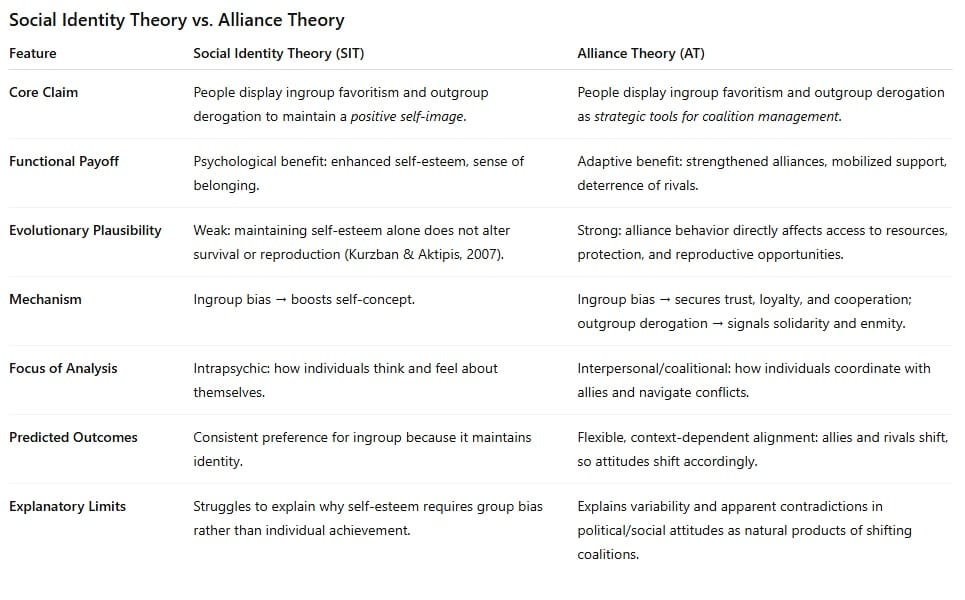
Social Identity Theory vs. Alliance Theory

I asked ChatGPT to develop on an idea in this paper on Alliance Theory: The Social Identity tradition has another flaw we seek to remedy: its lack of functional plausibility. Within this tradition, scholars have long argued that the ultimate function of ingroup bias—e.g., viewing one’s ingroup in a positive light and derogating relevant outgroups—is to maintain a positive self-image (Hornsey, 2008). The difficulty with this account is that it locates the payoff of bias purely in the intrapsychic domain. In other words, people are presumed to derive psychological benefits from simply feeling good about themselves, regardless of whether those feelings translate into any concrete advantage in the world. From an evolutionary perspective, this explanation is unsatisfying.

Adaptations are not selected to maximize subjective states per se, but to regulate behavior in ways that ultimately affect survival and reproductive outcomes. A mechanism that produced self-esteem for its own sake—without influencing alliance formation, cooperation, mate value, or competitive success—would confer no fitness benefits and thus be unlikely to evolve (see Kurzban & Aktipis, 2007). Put differently, natural selection does not “care” whether individuals maintain a positive self-concept unless that self-concept has downstream consequences for their ability to navigate coalitions, acquire resources, or secure mates.

This gap in functional plausibility is precisely where Alliance Theory diverges. On our account, ingroup favoritism and outgroup derogation are not arbitrary biases designed to keep the ego afloat, but strategic tools for negotiating coalitional landscapes. Favoring one’s ingroup secures cooperation and trust, while derogating an outgroup helps mobilize allies, deter rivals, and signal loyalty. These behaviors, unlike self-image maintenance in isolation, map directly onto outcomes that could plausibly have been under selection pressures in ancestral environments.

Vignette: The Workplace Team Project

A marketing firm has two departments—Design and Analytics—that often compete for resources. During a staff meeting, members of Design emphasize that their department’s work is more “creative” and “forward-thinking,” while criticizing Analytics as “rigid” and “obsessed with numbers.”

SIT Interpretation:

The Design team derogates Analytics to protect and enhance its collective self-image.

By claiming superiority, they maintain higher self-esteem as a group: “We are the creative backbone of this firm.”

The function of bias is psychological—it bolsters their identity and self-worth, regardless of material consequences.

AT Interpretation:

The Design team derogates Analytics strategically to sway allies (the boss, other departments) and secure resources.

Praising themselves and attacking the rival group is a coalitional tactic, designed to strengthen in-group solidarity and weaken a competitor’s standing.

The function is adaptive—it increases Design’s influence and likelihood of gaining budget or leadership support.

The contrast is clear: SIT explains the behavior as identity maintenance; AT explains it as coalition management. One is intrapsychic, the other is functional and evolutionary.

Here’s a political vignette that shows how SIT and Alliance Theory interpret the same behavior in different ways:

Vignette: Free Speech on Campus

A student activist group demands that a controversial speaker be disinvited from campus. When challenged about “free speech,” they argue that protecting marginalized students from harm outweighs giving a platform to dangerous views.

SIT Interpretation:

The group’s stance enhances their collective self-image as moral, protective, and socially just.

Ingroup bias shows up as: “We are the defenders of justice; those who oppose us are complicit in harm.”

The payoff is psychological: a stronger, more positive group identity that boosts members’ self-esteem.

AT Interpretation:

The group’s stance is a coalitional maneuver: rallying allies by dramatizing victimhood, painting rivals as oppressors, and signaling loyalty to progressive norms.

Suppressing the speaker is less about internal identity than about external strategy—solidifying alliances with sympathetic faculty, administrators, and peers, while marginalizing conservative student groups.

The payoff is functional: securing influence, resources, and legitimacy within the campus ecosystem.

So, SIT says: they want to feel good about who they are.

AT says: they want to win allies, weaken rivals, and control the resource environment.

Posted in Politics | Comments Off on Social Identity Theory vs. Alliance Theory