
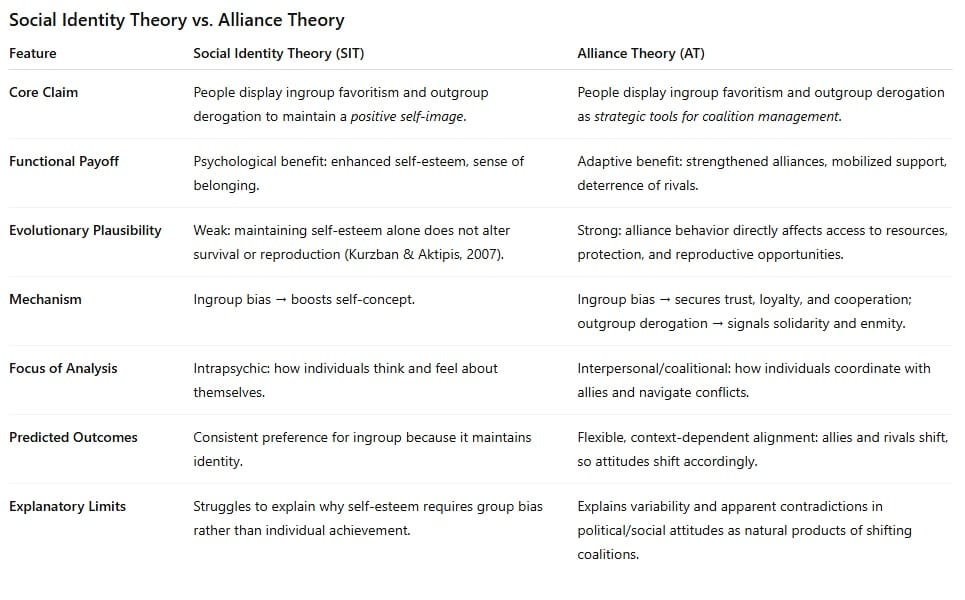
I asked ChatGPT to develop on an idea in this paper on Alliance Theory: The Social Identity tradition has another flaw we seek to remedy: its lack of functional plausibility. Within this tradition, scholars have long argued that the ultimate function of ingroup bias—e.g., viewing one’s ingroup in a positive light and derogating relevant outgroups—is to maintain a positive self-image (Hornsey, 2008). The difficulty with this account is that it locates the payoff of bias purely in the intrapsychic domain. In other words, people are presumed to derive psychological benefits from simply feeling good about themselves, regardless of whether those feelings translate into any concrete advantage in the world. From an evolutionary perspective, this explanation is unsatisfying.
Adaptations are not selected to maximize subjective states per se, but to regulate behavior in ways that ultimately affect survival and reproductive outcomes. A mechanism that produced self-esteem for its own sake—without influencing alliance formation, cooperation, mate value, or competitive success—would confer no fitness benefits and thus be unlikely to evolve (see Kurzban & Aktipis, 2007). Put differently, natural selection does not “care” whether individuals maintain a positive self-concept unless that self-concept has downstream consequences for their ability to navigate coalitions, acquire resources, or secure mates.
This gap in functional plausibility is precisely where Alliance Theory diverges. On our account, ingroup favoritism and outgroup derogation are not arbitrary biases designed to keep the ego afloat, but strategic tools for negotiating coalitional landscapes. Favoring one’s ingroup secures cooperation and trust, while derogating an outgroup helps mobilize allies, deter rivals, and signal loyalty. These behaviors, unlike self-image maintenance in isolation, map directly onto outcomes that could plausibly have been under selection pressures in ancestral environments.
Vignette: The Workplace Team Project
A marketing firm has two departments—Design and Analytics—that often compete for resources. During a staff meeting, members of Design emphasize that their department’s work is more “creative” and “forward-thinking,” while criticizing Analytics as “rigid” and “obsessed with numbers.”
SIT Interpretation:
The Design team derogates Analytics to protect and enhance its collective self-image.
By claiming superiority, they maintain higher self-esteem as a group: “We are the creative backbone of this firm.”
The function of bias is psychological—it bolsters their identity and self-worth, regardless of material consequences.
AT Interpretation:
The Design team derogates Analytics strategically to sway allies (the boss, other departments) and secure resources.
Praising themselves and attacking the rival group is a coalitional tactic, designed to strengthen in-group solidarity and weaken a competitor’s standing.
The function is adaptive—it increases Design’s influence and likelihood of gaining budget or leadership support.
The contrast is clear: SIT explains the behavior as identity maintenance; AT explains it as coalition management. One is intrapsychic, the other is functional and evolutionary.
Here’s a political vignette that shows how SIT and Alliance Theory interpret the same behavior in different ways:
Vignette: Free Speech on Campus
A student activist group demands that a controversial speaker be disinvited from campus. When challenged about “free speech,” they argue that protecting marginalized students from harm outweighs giving a platform to dangerous views.
SIT Interpretation:
The group’s stance enhances their collective self-image as moral, protective, and socially just.
Ingroup bias shows up as: “We are the defenders of justice; those who oppose us are complicit in harm.”
The payoff is psychological: a stronger, more positive group identity that boosts members’ self-esteem.
AT Interpretation:
The group’s stance is a coalitional maneuver: rallying allies by dramatizing victimhood, painting rivals as oppressors, and signaling loyalty to progressive norms.
Suppressing the speaker is less about internal identity than about external strategy—solidifying alliances with sympathetic faculty, administrators, and peers, while marginalizing conservative student groups.
The payoff is functional: securing influence, resources, and legitimacy within the campus ecosystem.
So, SIT says: they want to feel good about who they are.
AT says: they want to win allies, weaken rivals, and control the resource environment.
