Facing Reality: Two Truths About Race in America

Here are some highlights from Charles Murray’s new book:

* From the first census in 1790 through the 1850 census, the population within America’s settled regions was 82–84 percent European and the rest was African. Subsequent tides of immigration increased the proportion of Europeans. As of the 1960 census, America was about 87 percent European, 11 percent African, something more than 1 percent Latin, and something less than 1 percent Asian.

* America’s big cities have been transformed by immigration over the past several decades. In 1960, New York was the most cosmopolitan city in America but its population was still more than three-quarters European. New York City went from 77 percent European in 1960 to 32 percent in 2019. That’s a transformation by any definition.
Other major cities changed even more than New York did. From 1960 to 2019, Los Angeles went from 85 percent European to 29 percent; Chicago went from 82 to 34 percent; Houston went from 77 to 23 percent. All the rhetoric about the racial diversity of America is true – for big cities.
I am defining big-city America as urban areas with populations of 500,000 or more in a contiguous urban environment (which often does not correspond to the legal boundaries of the city). There are fifty-two of them, all located in the Lower Forty-Eight. The fifty-two urban areas take up only 1 percent of the Lower Forty-Eight’s land mass, but they contain 70 percent of its Asians, 54 percent of its Latins, and 52 percent of its Africans. No race has a majority of big-city America’s population. Europeans amount to 45 percent, followed by Latins at 25 percent, Africans at 17 percent, and Asians of all varieties at 9 percent.
The total population of big-city America is 127 million, representing 39 percent of the total population of the Lower Forty-Eight. That’s a lot, but it also means that a majority of Americans live in rural areas, towns, or cities with urban populations of fewer than 500,000. They live in the other 99 percent of the Lower Forty-Eight’s land area.

* For homicides nationwide from 2010 through 2019, 76 percent of alleged perpetrators knew the victim, as a family member or an acquaintance. Virtually all of those homicides were what criminologists call “expressive” murders: the result of arguments, brawls, jealousy, and other interpersonal conflicts. An extremely high proportion of the alleged perpetrators of these crimes were in fact guilty – expressive murders are usually impulsive and occur without precautions against getting caught; they are often witnessed; and the forensic evidence is often abundant.

* Now let’s look at the 24 percent of homicides in which the victim was a stranger to the arrested suspect. About 13 percent of all murders are gang-related.

* Africans and Latins are arrested for property crimes at higher rates than Europeans – modestly so for Latins, with a mean ratio of 1.5, and much more so for Africans, with a mean ratio of 5.0. These ratios are smaller than the ones for violent crime.

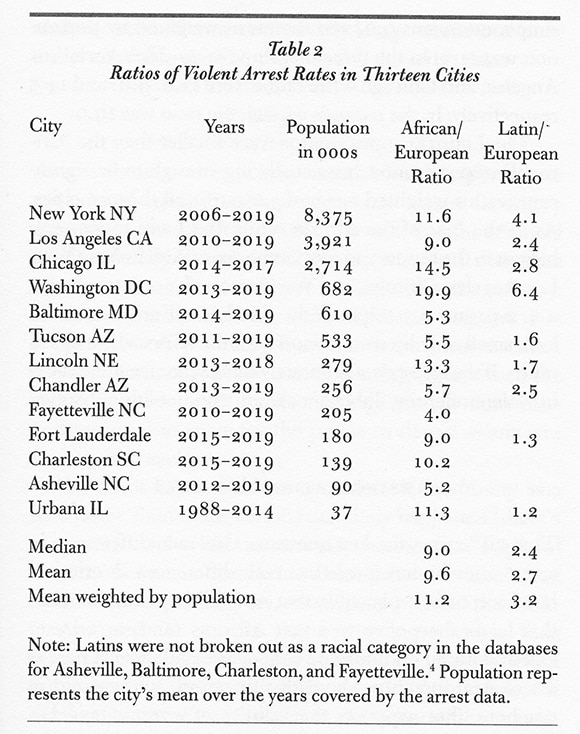
Across thirteen American cities, including four of the nation’s most important ones, the African arrest rate for violent crime was usually around 9 to 11 times the European rate and the Latin arrest rate for violent crime was usually around 2 to 3 times the European rate. Asian arrest rates for violent crime ranged from minuscule to small. These are huge differences. Triangulating data indicates that the arrest rates reflect, and perhaps understate, race differences in violent criminal activity.

* Universities do their best to hide what’s going on. They refuse to reveal mean SAT scores by race, proclaiming that “everyone we admit can do the work.” What they don’t acknowledge is that the admitted African and Latin students, as groups, will be concentrated in the bottom of their classes – and that the people making the admissions decisions know it in advance.
Occasionally, sunlight penetrates the darkness. The biggest leak occurred in late February 1993, when Richard Herrnstein, a professor at Harvard and my coauthor on The Bell Curve , arrived at his office one morning to find that someone had anonymously left a copy of the “Red Book” on his desk. At that time, the Red Book was produced annually by the Consortium on Financing Higher Education, which consisted of 16 out of the top 20 universities and 5 of the top 10 small colleges as ranked by US News for 1993. It was the university equivalent of leaking a Top Secret CIA document. The Red Book contained the mean SAT scores by race for each of the schools.
The median edge given to African applicants at those elite schools was about 180 points on the combined SAT, equivalent to approximately 1.3 standard deviations at the time – a larger gap than separated Africans and Europeans in the general population. Someone with an SAT score 1.3 standard deviations below the mean is at the 10th percentile of the distribution at those colleges. We published the school-by-school information in The Bell Curve .
Nothing seems to have changed since then. We don’t have a current version of the Red Book to work with, but testimony in the recent case charging Harvard with discrimination against Asian applicants included evidence that the same profile of test scores, GPA, and extracurricular activities that gave an Asian applicant a 25 percent chance of admission gave an African applicant a 95 percent chance and a Latin a 77 percent chance.

* The numbers of test takers with a combined verbal and math score of 1500+ were around 900 for Africans and around 3,300 for Latins. Meanwhile, the numbers for Europeans and Asians with scores in that range were about 27,500 and 20,000 respectively.

* In terms of percentiles, Africans are in the bottom quartile of test scores for all the admissions tests except for those heading to business school or graduate school in education. The Latin scores are all in the second quartile.

* I turn now to an issue that involves only a tiny proportion of the workforce but has high visibility: the rarity of Africans and Latins in the most prestigious jobs in the private sector. That rarity is often used as undeniable evidence of systemic racism in the job market.
Many of those high-prestige jobs are filled by people not merely in the top few percentiles of cognitive ability, but well into the top percentile. Recall the discussion of the “width” of the top percentile of a bell curve in Chapter 3 – LeBron James is in the same percentile as starting players on ordinary college teams. The same phenomenon applies to an oncologist in an ordinary practice and the chief of oncology at a major research hospital. The former may be an excellent oncologist, but the latter has undergone a severe winnowing process that among other things has selected specifically for evidence of intellectual brilliance. Other examples of positions that select for extremely high cognitive ability are:
* A full professorship at an elite university
* A senior position in the financial industry
* A senior position in the IT industry
* Law partner in a major firm in a major city
* CEO of a major corporation
This is not to say that intellectually brilliant people typically have important jobs in a society – on the contrary, few do – but that a characteristic of people who rise to the top in every cognitively demanding profession in elite academia and elite organizations in the private sector is exceptionally high cognitive ability. I will operationalize exceptionally high as a minimum IQ of 135. High-prestige jobs in government and the nonprofit sector are also sometimes filled by exceptionally able people, but the rigor of the screening process varies a lot by job and organization.

* Employers seeking these exceptionally intelligent young adults [25-29yo, IQ above 135] were choosing from a pool that contained only about 2,800 Africans and 9,500 Latins compared to 50,700 Asians and 160,100 Europeans.

* a large majority of U.S. employers that seek out new hires with 135 + IQs had no entry-level Africans or Latins among those hires. Zero, no matter how eagerly the employers solicited minority candidates. There weren’t enough to meet the demand.

* Let’s say that an elite IT company in Silicon Valley snags 100 new hires from the 135+ pool in the racial proportions of the pool as a whole. That means 70 are European, 22 are Asian, 4 are Latin, 1 is African, and 3 are a mixture of races or “other.” What percent of new hires of any race in any company rise to senior positions? It depends on the organization, and the definition of senior, but in any case the four Latins are competing against 96 others and the one African is competing against 99 others to become one of the chosen few. Those are daunting odds.

* The 2014–2018 American Community Survey found that Africans, at 13 percent of the population, accounted for only 3.6 percent of CEOs, 3.7 percent of physical scientists, 4.4 percent of civil engineers, 5.1 percent of physicians, and 5.2 percent of lawyers. Latin percentages in those prestigious occupations ranged from 5.3 to 7.6 percent, but Latins are almost 18 percent of the population, so their underrepresentation was nearly the same.
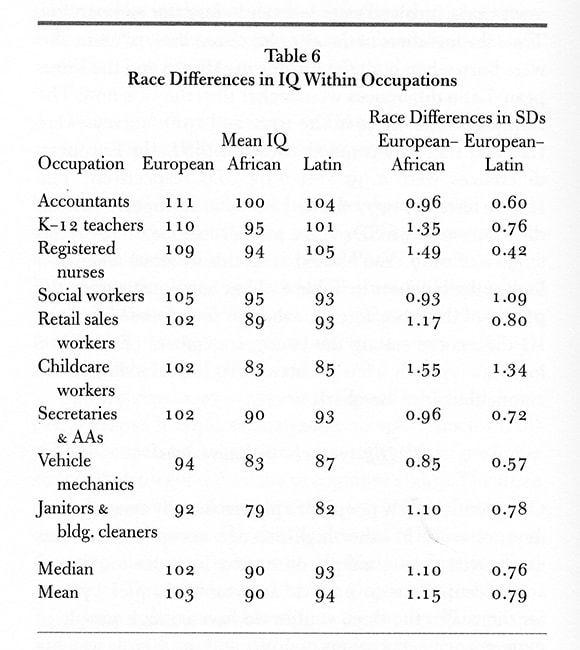
The picture flips when race differences in cognitive ability and job performance are taken into account. Africans and Latins get through the educational pipeline with preferential treatment in admissions to colleges and to professional programs. Their mean IQs in occupations across the range from unskilled to those requiring advanced degrees are substantially lower than the mean IQs for Europeans in the same occupations. Race differences in measures of on-the-job performance are commensurate with the differences in cognitive ability.
I think it is fair to conclude that the American job market is indeed racially biased. A detached observer might even call it systemic racism. The American job market systemically discriminates in favor of racial minorities other than Asians.

* In big-city America, disproportionate minority crime rates cause Europeans and Asians to avoid going into minority neighborhoods. Crime rates and socioeconomic status both vary widely across zip codes in minority neighborhoods in big-city America. These areas contain middle-class zip codes and impoverished ones; zip codes with low crime rates and others with high crime rates. But that makes no difference to the perception held by most Europeans and Asians. Unfamiliar with these variations, they typically see the entire minority part of town as potentially dangerous. It’s not a matter of simple racism. The same Europeans and Asians who avoid going to the minority part of town may have minority colleagues at work with whom they get along fine. They may have minority neighbors with whom they are friends. But they won’t go to the minority part of town to shop, stay at a hotel, buy a car, or send their children to school. They don’t drive into it unless it is the shortest route to someplace they need to go.

* Widespread and voluntary residential segregation by race seems to be a fact of life around the world, no matter what the races are or what the country’s economic and political system is.

* In big-city America, disproportionate minority crime rates deter developers from building office space in minority neighborhoods unless gentrification is already well underway . Real estate is typically cheaper in African or Latin parts of town than elsewhere, a factor that would ordinarily attract developers to build office space for law firms, doctors’ offices, and other businesses that would like to escape the high rentals in the European midtown. But unless it is clear that the neighborhood is near a gentrification tipping point, those lucrative rentals won’t happen, and so the office buildings don’t get built.
In big-city America, disproportionate minority crime rates raise the costs of doing business for retailers of all kinds . It is often alleged that large commercial chains avoid putting stores in minority neighborhoods. The empirical part of the allegation is sometimes true, but the inference that racism is to blame does not follow. Shoplifting is far more common in many big-city minority neighborhoods than elsewhere. It often doesn’t make economic sense for big chain stores, which have business models based on low profit margins, to locate in such neighborhoods. Either they won’t make a profit or they will have to charge higher prices, leaving themselves open to accusations of racist price gouging. If they take measures to apprehend shoplifters, they risk charges of racism and financial shakedowns through the threat of lawsuits. Actions taken to prevent shoplifting can also put employees at risk of violent confrontations. It’s a no-win situation. Opening a store in a big-city minority neighborhood is often not economically rational. Racism need not have anything to do with the decision.
Meanwhile, the small locally owned retailers in a big city minority neighborhood also have a hard time making a profit because of shoplifting, the threat of robbery, high insurance costs, and banks’ reluctance to make high-risk loans. The locally owned stores tend to be poorly stocked, with few amenities, and overpriced relative to stores selling the same goods elsewhere.

* For every situation that a cop faces, let us say there is an optimal choice, as defined in the police training manuals or perhaps by an omniscient observer. As the environment in which police are working becomes more dangerous, that optimal choice moves along the distribution toward the use-more-force-and-defensive-precautions tail of the bell curve.
One result is that well-trained police exercising good judgment will, on average, take more steps to establish their authority, call for more backup, and respond with more force to provocations in high-crime parts of town than in low-crime areas, regardless of the race of the citizens they are dealing with.
Another result is that errors in judgment will be skewed toward the greater-force end of the distribution. If the error in the direction of greater force is perceived as reducing the downside risk, and the downside risk is one’s own death, then police officers, being human, will err on the side of protecting themselves. Added to that human reaction is the mental stress associated with combat – stress unlike anything that most of us (including me) have ever experienced. The physiological effects of the adrenaline surge are powerful, and they are in addition to the psychological effects of fear and anger. All of these factors mean that police use of force, including excessive use of force, will always and inevitably be higher in high-crime areas than in low-crime areas, and high-crime areas in the United States are overwhelmingly urban and African or Latin.

* James Q. Wilson wrote: A central problem – perhaps the central problem – in improving the relationship between white and black Americans is the difference in racial crime rates. No matter how innocent or guilty a stranger may be, he carries with him in public the burdens or benefits of his group identity….
… When whites walk down the street, they are more nervous when they encounter a black man than when they encounter a white one. When blacks walk down the street, they are more likely than whites to be stopped and questioned by a police officer. It is important, of course, for whites to know that a chance encounter with a black creates little risk and for police officers to know that they should have more criteria than just skin color to decide who is worth questioning. Many whites and many police officers know this, but in spite of what people know, the racial tension persists. Countless white pedestrians have been worried by the sight of a young black male, and countless innocent black men have had their cars stopped or their walk interrupted by a suspicious cop. White pedestrians may be embarrassed by their own caution; certainly black pedestrians are upset by unwarranted police intrusions….
… Whites are fearful of living amid large numbers of blacks and of sending their children to predominately black schools. Blacks interpret the way they are treated on the streets by white strangers and by police officers as a sign that they can never make much social progress. “No matter what I do, I can never be regarded as innocent,” many embittered black men will say. “I cannot hail a cab as easily as a white, and I will be stopped and questioned by the police more than any white. Integration is a joke.”

Joe* says:

Murray’s figures about the changes in racial composition of the cities, contradicts, at least on the municipal level, the assertion that there is no replacement of whites.

One of the things implied by Murray, but not directly expressed is how lower cognitive ability makes it more difficult to comply with regulations. Sometimes licensing requirements really bear little or no relationship to the occupations licensed. The classic example is cosmetic work (hair dressing, nails among unlicensed blacks) where the effect of the licensing requirements does discriminate against those with below average intelligence. But one of the reason minority professionals have problems is because they often lose track of the recordkeeping requirements. I don’t think that blacks are more larcenous than whites, but I think they are often times not aware if they are businessmen of the requirement to pay employee’s taxes.

Murray gives a chart which shows that the mean IQ among black teachers is 95. No wonder there is so much objection to proficiency tests. My belief is that many civil service jobs suffer from affirmative action, because the jobs can be better performed and more efficiently by a smarter person. Of course if IQ tests and merit based employment governed who would get civil service jobs and teaching jobs, you would wipe out the black middle class. That is the price we have to pay to maintain some modicum of economic stability.

Posted in America, Charles Murray, Crime, IQ | Comments Off on Facing Reality: Two Truths About Race in America

Borderline Personality Disorder

From Unherd.com:

…people with BPD are cognitively “lighter” than neurotypical people. That is: if you are heavy, it takes a lot to move you. So when something quite nice happens to a neurotypical person, it makes them slightly happier: the wind only moves them a little bit. When something quite unpleasant happens, it makes them slightly sadder.

But if you are cognitively light, then the same events will move you much further. A small victory will make you thrill with joy; a small problem can make you suicidal (and BPD patients have a tragically high suicide risk in their younger years). It also applies to people’s opinions of others: “Either a relationship is perfect and that person is wonderful, or the relationship is doomed and that person is terrible,” as the NHS page on BPD puts it. This is called “splitting”, and again, it’s easy to think of it as someone being light, rather than heavy: being blown on the wind of events.

People with these conditions feel emotions much more strongly. But they also have difficulty forming a strong self-image, and often take on very visible identities, such as being a Goth or a fan of a particular band, dyeing their hair or getting tattoos, in order to give themselves something solid to cling to.

This piece written by a BPD patient discusses how she would change her entire personality, and with it her wardrobe, with each new relationship or phase in her life: “In my ‘Premier League’ days, it’d be athletic and gym gear; when dating a hipster, I mimicked their use of rings and hats. My wardrobe was like the skin of a chameleon, physically embodying the changes in my personality.” This one talks about “waking up and trying to be a new person every day. Go vegan, go goth, go hipster, go glamour, cut your hair, change your makeup, gain weight, lose weight, and never feel quite there.”

Posted in Psychology | Comments Off on Borderline Personality Disorder

The Myth of a Majority-Minority America

Three academics publish in The Atlantic June 16, 2021:

The narrative that nonwhite people will soon outnumber white people is not only divisive, but also false.

In recent years, demographers and pundits have latched on to the idea that, within a generation, the United States will inevitably become a majority-minority nation, with nonwhite people outnumbering white people. In the minds of many Americans, this ethno-racial transition betokens political, cultural, and social upheaval, because a white majority has dominated the nation since its founding. But our research on immigration, public opinion, and racial demography reveals something quite different: By softening and blurring racial and ethnic lines, diversity is bringing Americans together more than it is tearing the country apart.

The majority-minority narrative contributes to our national polarization. Its depiction of a society fractured in two, with one side rising while the other subsides, is inherently divisive because it implies winners and losers. It has bolstered white anxiety and resentment of supposedly ascendant minority groups, and has turned people against democratic institutions that many conservative white Americans and politicians consider complicit in illegitimate minority empowerment. At the extreme, it nurtures conspiratorial beliefs in a racist “replacement” theory, which holds that elites are working to replace white people with minority immigrants in a “stolen America.”

The narrative is also false. By rigidly splitting Americans into two groups, white versus nonwhite, it reinvents the discredited 19th-century “one-drop rule” and applies it to a 21st-century society in which the color line is more fluid than it has ever been.

In reality, racial diversity is increasing not only at a nationwide level but also within American families—indeed within individual Americans. Nearly three in 10 Asian, one in four Latino, and one in five Black newlyweds are married to a member of a different ethnic or racial group. More than three-quarters of these unions are with a white partner. For more and more Americans, racial integration is embedded in their closest relationships.

Multiracial identities are gaining public recognition and approval. Numerous young Americans consider themselves both white and members of a minority racial or ethnic group. One in every nine babies born in the U.S. today will be raised in a mixed minority-and-white family, and this group is steadily growing. These children have kin networks—including grandparents, aunts and uncles, and cousins—that include both white people and minorities. Among Latinos, identifying as white or as simply “American” is common, and belies the notion that Latinos should be classified monolithically as nonwhite.

Furthermore, most Americans of both white and minority descent are not positioned as minorities in American society. For example, people who identify as Hispanic and white, or Asian and white, tend to start life in more economically favorable situations than most minority groups, are typically raised in largely white communities, have above-average educational outcomes and adulthood incomes, and frequently marry white people. They have fluid identities that are influenced by both minority and white ancestries.

I’ve rarely encountered any anti-white hatred (on the rare times I did, it was only from blacks).

A friend says:

Los Angeles was a county with a large white population, a significant but still small Latino population composed mostly of persons with deep roots in the community and not recent migrants, a significant African American population larger in proportion than it is today, and a small Asian population. All you have to do is look at the ethnic and racial origins of the students in the Los Angeles Unified School District every five years or so from 1950. If you want to increase the white population, you can add in the private and parochial schools but that still doesn’t shift the demographics much. Black and white kids have been pushed out and been supplanted by Latinos. Whites have been pushed out of many of the independent school districts in the San Gabriel Valley by Asians (primarily Chinese).

The city council which doesn’t reflect the population of the city has four Latinos (perhaps five if Buscaino is Latino) and three blacks among its fifteen members, one of East Asian descent and one of subcontinental descent. It has two traditional whites, plus two Jews and an Armenian.

The five member board of supervisors has one black and one Latino, and three whites. All five are women and one of them is a well known Lesbian elected official (although she is also probably the smartest and most respected). But you can see how much they pander since four of them voted to put on the ballot that a percentage of expenditures would be locked in to BLM type expenditures. The initiative passed although the tentative court ruling is to enjoin it since you can’t take away budgetary discretion from the duly elected officials. But what does it say that 80% wanted this on the ballot when the population of Blacks in L.A. County hovers around 10%?

Posted in America, Demography | Comments Off on The Myth of a Majority-Minority America

The Business Of Church

A friend responds to this post: One of the great things about many 18th century novelists (Balzac, Dickens, Trollope) is how much you learn about the societies and businesses in which the novels are set. I hadn’t realized until I read Trollope how the Church of England was in one sense just another one of the businesses and being a minister was just another profession in England at the time. There is scarcely any difference in Trollope’s The Warden about how the church operates and how local politics operate and how law operates and how journalism operates. The church doesn’t much discuss religion or God but rather focuses on the internal politics and the competition for advancement within the church.

What is more interesting is how that has fallen out of favor and how quickly.

When I was attended some twelve step meetings in the churches on Wilshire Boulevard in Hancock Park, I thought those imposing structures churches must have been built in the 10’s and 20’a of the 20th century, but I think construction, and expansion of the congregations reached their zenith in the immediate post war years when America was relatively prosperous, unscathed by the war and the old racial and religious proportions still remained with L.A. being overwhelmingly white and to a large extent Protestant. The deterioration and collapse in most of the country (it still exists in parts of the South) of the interrelation between organized religion and society as a whole is shocking.

Posted in Christianity | Comments Off on The Business Of Church

The Changing Temptations Of Science

Stephen Turner published in 2020:

The idea of science as a spontaneous order produced by autonomous individuals following their best hunches, the core of the liberal theory of science, became less an accurate description than an expression of nostalgic regret. Research was supposed to be a free market that encouraged risk-taking and innovation. The grant and funding market encouraged competition, but the competition was increasingly for survival in a world where the big grants, which produced the most output, won. Science came to be seen as a system in which inputs needed to be matched by measurable outputs. An op-ed piece in the Washington Post, based on the 1991 Office of Technology Assessment report Federally Funded Research: Decisions for a Decade, asked “How Much is Enough?” Science had evolved a new ethic: an ethic of productivity.

Productivity now meant something different than it did under the ethic of discovery, where what mattered was knowledge and ideas. It meant producing measurable outputs: patents were counted along with citations, and grant numbers were counted as well. And in the face of competition, military and industrial funding became a way to keep university labs going, and a necessity. The change was underscored in 1984, when President Reagan selected Erich Bloch—an engineer, from the private sector, without a PhD—to be director of NSF. Bloch proceeded to create programs that encouraged multidisciplinary team science. The old model of a few “first class” people was a fading memory: the new model moved closer to corporate science. Bloch oversaw the funding of major engineering and science-and-technology research centers at universities, as well as a national supercomputer network. “Economic competitiveness” became the primary public justification for government funding of science.

By the late 1990s, science had become STEM (science, technology, engineering, and mathematics), and had an additional economic justification—as a preferred kind of job training. The promise that STEM education would lead to high-paying (high tech) jobs began to drive national education policies worldwide. Science became central to what was taken to be the technological future—and research training of a more ethnic- and gender-diverse student population was an investment in this future. But this politically powerful promise tied science to immediate considerations of impact and relevance. Congress (and presumably the public) wanted new jobs and economic growth, now.

* Temptations arise from the organizational realities of modern science, particularly the need to fund a lab. This need requires a relation with funders, involving some sort of alignment between the aims of the researcher and those of the funder. In the face of intense competition, the work of alignment falls on the recipient to a greater extent than it does the funder. And this means that autonomy is limited to what can be achieved within these relations.

Many temptations arise within these relations, or in connection with them: the temptation to claim impact, to overpromise, to overstate the policy relevance of findings, to sacrifice the pursuit of intellectually promising lines of work to those that can be funded, to produce work that is marketable to funders but scientifically trivial, to leave the tasks of voicing and substantiating skepticism to others, to neglect the tasks of intellectual integration and reflection that don’t have “impact,” and to do just enough to meet the demands and not dig deeper or in directions other than what the funding regime requires.

The upshot is this: the norms relevant to these temptations have not developed sufficiently for scientists to be able to insist that they are effectively governing themselves. In the new system, bias became rewarded. Findings that confirm what a sponsor wants confirmed lead to more funding. And if many people are trying to confirm a result, and the research is statistical, they are highly likely to find what they are looking for…

* Contemporary science is plagued with crowd-following, where researchers jump onto an approach or topic because that is a good strategy for getting funded. University research offices facilitate this, and metrics encourage it.

* Modesty about limits is difficult to accept when the fate of the biosphere, or breast cancer sufferers, or America’s economic supremacy, is said to be at stake. But the complexity of the relation between science and the public, as well as the funding system, presents a number of conflicting imperatives and interests. For example, in relation to politics, or the promise of profit, such claims as “the science is settled” and “there is a consensus” carry special importance. Yet the idea of consensus is not a traditional notion in science, and there is no long history to learn from. On one hand, such claims are a source of power—science speaking with one voice rather than many. Yet the pressure to maintain consensus may make scientists in the current peer-review regime reluctant to criticize other scientists or make controversies public, or to air the uncertainties that they privately acknowledge. Dissenters may be penalized by rejection of their grants and papers, and blocked promotions.

* If the structures of support for science—in the private sector, in public private university partnerships, and in the regulatory science realm—provide incentives that overwhelm the traditional social controls of science, the only backstop is the system of social controls beyond science, through the marketplace, investigative journalism, the canon of legal and patent law, or the regulatory apparatus pertaining to securities law and fraud.

Not surprisingly, then, social controls from outside science are beginning to kick in. The Theranos scandal, involving a start-up company pitching a supposedly revolutionary blood-testing technology, was uncovered not by the scientific community, or even the Food and Drug Administration, but by the investment community and a crusading business journalist. The relationships between a leading Harvard chemist and Chinese research institutions was not uncovered by Harvard but by the FBI. The poor quality of preclinical cancer science was not exposed through peer review but by testing done in pharmaceutical corporations. “Compliance” with institutions outside science begins to replace internal constraint.

* The new regime of quantitative accountability invites cheating, crowd-following, conformity, lapses in quality, and subservience to sponsors whose funds make it possible to compete.

Posted in Science, Stephen Turner | Comments Off on The Changing Temptations Of Science

Leaving Academia: Loss Grief and Healing

Lisa Munro writes in 2017:

I’ve been out of academia for two years, having finished my PhD in 2015. I think I’m finally on the road to healing.
I often joke that leaving academia feels like the worst break up ever.*
HAHAHAHAHA. That’s a good one!
Except that I’m not joking. Giving up on something that you thought was your life’s calling hurts like hell. When you experience rejection from the entire institution of academia after devoting years of your life and thousands of dollars to become an academic, betrayal and rage sometimes become your only emotions for a good long while.
For me, the grief of leaving academia feels about the same as the loss and grief of the end of relationship. Even when you know that the relationship wasn’t right for you (”It’s not you, it’s me. Well, okay, it’s you.”), loss is loss. The loss of my academic dreams also triggered a whole avalanche of of old, deep losses that I’m never going to really get over.
We’ve all got dreams that don’t work out, even when we really really really want them to, but academic grief hit me so much harder than the novels I want to write that won’t get written or the places I want to travel that I know I’ll never visit. In academia, your work becomes a part of you; you become your work. Losing the academic part of us feels like losing a limb, complete with phantom pain when it’s gone. Loss often involves a lot of self-blame, shame, second-guessing and endless asking why and what’s wrong with us and why the fuck are we never good enough anyways.
Academia requires a life commitment. I devoted a total of seven years of my life to trying to understand a single thing. I was committed to my research in ways that were sometimes deeper than commitments I’ve had to people. I was fully prepared to spend the rest of my life focused on this one particular thing. Some days I didn’t like my research very much and found it hard and difficult and frustrating. Nevertheless, I never for an instant wavered in my devotion to it. Like in any relationship, academia and I went over rough patches. I thought about calling it quits several times, but didn’t want to throw away something to which I’d devoted so much time. I was not a quitter.
I’m now working in victim advocacy and now talk to people about grief, trauma, and loss every day. I wish I’d had someone like me to talk to about grief and loss after my PhD. I wish someone had told me that they were sorry that I didn’t get a job. That it wasn’t fair. That it wasn’t my fault that the market had collapsed and hadn’t recovered. That sometimes stuff just happens to people for no reason. Sometimes the story doesn’t end the way that we want it to or expect it to.
The grief I felt when I conceded defeat on the job market was the real deal. I cycled through every one of the Kubler Ross model’s stages of grief several times. And as anyone who has been through the five stages of grief knows, they are not really stages at all, but rather suggestions. Grief is a full body contact sport that involves cycling and recycling through the stages of grief, moving forward and backwards and sideways at the most inopportune moments until the heart and soul decide there’s nothing more to be done and they’ve let go. There’s nothing rational about grief and no time table to “get over it.” It’s insanely confusing and consumes massive amounts of emotional resources. Grief is involuntary and wild and frightening.
If you’re coming to the realization that you’re going to have to walk away from academia, let me hasten to tell you that your feelings are real and valid, whatever they may be. I believe you. (Maybe your feelings aren’t grief. Maybe they’re relief? That’s valid and legit too.) Nonetheless, you’re going to have to do some stuff to get through the emotional crap swamp. Here are some suggestions. (Keep in mind that I’m not a counselor. I’m a victim advocate and post-ac historian. If you’re struggling with mental health, please please please connect with mental health resources in your community.)
You’ve lost a big chunk of your identity, both personal and professional. Grief is a normal reaction. You ain’t crazy.
Self care is key. Emotional eating is okay for a little bit, but you’re eventually going to have to make real food. I know it’s hard.
Let yourself be very not okay for a while. It’s okay to be sad. It’s okay to be really really sad.
Healing isn’t a matter of “getting over it.” It’s a matter of incorporating loss into your story and telling it in a new way.
There’s no timetable. Anyone who thinks that you should be ready to move on according to any kind of timetable can shove it.
Take life one day at a time.
Know that healing isn’t a destination; it’s a journey and a process.
You might think about investing in a good therapist.
Leaving academia isn’t just a “career change.” It’s the worst breakup of your life and you might not even be able to see into next week, let alone imagine possibly being happy and okay again someday. Be in grief for as long as you need to.
You’ll heal. Eventually. You’ll have the scars to prove it. Healing will happen so slowly that you might not even notice it. In one of the biggest cliches ever, I’ve learned (and now teach people) that healing is a PROCESS.
You’re going to get through this. One day you realize that you haven’t cried in a few days. Then maybe you notice that you’re daydreaming about something you’ve always wanted to do. Some idea for interesting and engaging work crosses your mind. And then you might find yourself wondering if you could actually do that. And then maybe you start thinking of how you might do that. And then you start talking to other people about how you might do that. And then you’re off and running again.
You’re healing.
*This may not be your experience at all. A lot of PhDs these days are actively planning NOT to become academics, so I suspect their sense of academic loss may be less. I don’t know. Those of the tenure track or bust generation, from my conversations with other people about their experiences, seem to have taken academic loss pretty hard. We didn’t have backup parachutes ready; we made up the post-ac life as we went. We’re still figuring it out. As always, YMMV.

Posted in Academia | Comments Off on Leaving Academia: Loss Grief and Healing

Beyond The Academic Ethic

Philosopher Stephen Turner published this essay in 2019:

* the German academic system of the late nineteenth century, which became the model for the modern research university…

* Harvard University, for the first three centuries of its existence, was essentially a training school for congregational ministers, a task it still performs. The ministry was a paradigmatic profession: a calling but also a source of income and a status in an established institution, in this case the church. The same could be said for Cambridge and Oxford, which not only produced for the religious market but had religious tests for entry late in the nineteenth century, and whose presses still rely on revenue from the Bible market. One could multiply examples indefinitely. On the continent, the market relation was to the state – which needed educated administrators. The value of the university was not for its pursuit of truth, but for its ability to provide some sort of educational experience and some sort of certification which the market, in the Harvard case the congregations hiring the minster, valued. To be sure, there was a small minority of students who valued knowledge for its own sake and were able and willing to pay for instruction. But this small minority would never be large or rich enough to support a university, and there were never enough academic jobs for them to constitute an academic class of the scale of present academia.

The relationship with the professions produced a particular kind of university which persisted and grew over a millennia, with typical groupings of ‘faculties’ associated with the professions, and some sort of core liberal arts faculty which provided instruction that was considered to be more elementary and general. Until the nineteenth century these faculties were more concerned with the transmission of dogma than ‘discovery’ and were often strikingly retrograde in relation to the knowledge available outside the university. The logic of exclusion was central to the traditional university: it was a means of certifying that those trained within it conformed to the accepted truths. This fits with the demands of certification, and exclusion helped make the certification valuable.

It is important to understand how the university and academia related to intellectual life at large. Universities were places where people were learned, and went through various tests to show they were learned. A dissertation in the sixteenth century was a recapitulation of the professor’s notes – the real test was the viva, in which the candidate demonstrated an ability to defend these views on his feet. In Britain, college fellowships were awarded based on exams, not production – and production was largely optional and in many cases non-existent, well into the postwar era. At the same time, there was a lively non-academic world of learning, and also of production – indeed, this is where the ideas normally emerged. This dual world was somewhat permeable until what William James called ‘the Ph.D octopus’ (1903) strangled the university – as evidenced by the career of James himself. But until the academic revolution, which occurred over a long period, led by the ‘research universities’, the qualifications of a professor were learning, not production. And one can see this even in the institutions of the German university, where the Habilitationsschrift must be in a different specialty than the PhD dissertation, and where there was originally no expectation that professors produce beyond this demonstration of learning.

* The point of professions is to exclude and gain benefits from excluding. And the transition to professionalisation was marked by a kind of punitiveness towards not only amateurs but also deviants, people who failed to get with the new programme and so forth.

* In the older system, it was taken for granted that appointments were culturally coded, and that merit was secondary.

* For the first time academics who were considered disciplinary leaders or celebrities received enormous salaries: one chair of political science was rumoured to be making $100,000, in the mid-1970s, a salary equivalent to more than $600,000 today. The era of celebrity academics had arrived, though now they needed only to be disciplinary celebrities, who were only read by other academics. The political scientist who cashed in on this status at the University of Chicago, David Easton, was not at all a public intellectual, nor did he even write about politics in a way that was remotely relevant to actual politics, despite working in the heart of the south side of Chicago, home of one of the most corrupt and powerful political systems in the country.

* science professionalised successfully, though not without its own issues of overproduction and waste. But the standards of science and the standards and reality of non-science fields differ dramatically. The use of science standards for non-science fields is an inevitable consequence of the need to balance the claims of each. But because science is the tail that wags the dog of the university, and also the source of its main claims to public utility, science .sets the standards for everyone. These standards are, however, impossible for the humanities and social sciences to meet. The money is not there for large grants, there are no patents or marketable technologies, or very few. And we come to a basic fact. The project of professionalisation in the humanities and social sciences failed, and the analogous project in the sciences succeeded. In both cases the effects on traditional academic values were devastating.

* the basic fact of intellectual life is that it does not pay for itself. All knowledge regimes, of which professionalism is only one, need for there to be a source of income and support that derives from something other than the intellectual work itself. The academic regime in science derives this support from grants and teaching. In the humanities and social sciences it derives from teaching, and for a few highly exceptional people – public celebrities – from lecture fees and writing for the public, or writing widely used textbooks. Professionalisation was a way of marketing teaching in which the students did not become merely learned, but mini-professionals in their field.

* Adjunct teachers and lecturers: “Having no status and nothing to lose, they can choose to live the life of the mind as they please, to be learned without producing, and pursue projects if they wish, or decline to do so. They are also free in their intellectual life from the limits of disciplines and can read what they want. People without families to support can even enjoy this freedom, despite the lack of status and the poverty, if they can survive. All that is needed for a certain kind of happiness is to give up the hope of a tenured academic position.”

The situation in science is only slightly better since a PhD scientist normally has skills that can be put to use elsewhere. The normal career in academic science is, however, just as marginal: if a person is lucky enough to get into the academic system at all, it will be in the form of a succession of poorly paid post-docs in which one performs routine laboratory tasks as part of someone else’s research. The opportunities for tenure-track jobs are scarce, the competition is highly internationalised and fierce, and the level of desperation is high.

* Academic life is selective, and the grounds for advancement at each stage are not clear, except for degree requirements, and depending on the system and the point in history, many are called who are not chosen. So the question of what sort of calling academic life has become is also a question about the calling of those who fall by the wayside. This has recently become a hot topic as a result of an op-ed by an historian who was giving up on academia, after having failed, despite some short term contracts, to gain a tenure-track job. She writes that “Giving up on something that you thought was your life’s calling hurts like hell. When you experience rejection from the entire institution of academia after devoting years of your life and thousands of dollars to become an academic, betrayal and rage sometimes become your only emotions for a good long while.” (Munro, 2017, May 14, n.p.r.)

This comment has gone viral, and there are dozens of sites devoted to ‘leaving academia’. They tell a bitter story about the myth of academic life and its seductions. One website describes its orientation as reflecting ‘a belief that the current system is flawed, cruel, unsustainable and therefore impossible to directly engage with’. As a commentator explains, ‘In this view, Ph.D. programs, with their false promises, lure students to serve as cheap labour, first as teaching assistants, then as poorly paid adjuncts when tenure-track jobs elude them’ (Tuhus-Dubrow, 2013, November 1, p. 32). Many of the comments and contributions reflect the fact that the education that the injured academics have received is highly specialised – to leave academia is to face the impossible task of repackaging their achievements as marketable skills…

* The market rewarded a certain kind of cleverness and the peer-review system rewarded conformity. The winners were, accordingly, clever and conformist, though they would deny this, and point to their minor technical achievements as evidence of their innovative thinking. Nor could they be challenged within the system, which was increasingly unequal. The system of disciplinary enforcement that had been imposed as a personal mission by the generation of the mid-twentieth century now was a machine that simply perpetuated itself – an enforcement mechanism that did its enforcing impersonally and therefore apparently objectively and without authoritarianism.

* Education became, tacitly, education to succeed in the system. Peer-review became predictable as an affirmation of the hierarchy. Merit was no longer a matter of debate, but a matter of counting. What counted varied, but the importance of the top journals remained and was confirmed by such things as impact factors.

* The institutional order has also changed, to one driven almost entirely by metricised standards of quality, together with calculated administrative responses to public issues.

Posted in Academia, Germany, Stephen Turner | Comments Off on Beyond The Academic Ethic

F. Roger Devlin Interview (6-21-21)

I first interviewed Roger Devlin in 2015 (MP3).

Out of everyone I’ve interviewed in my life, I don’t recall feeling as intimidated as I did when calling Mr. Devlin in August of 2015.

Here is a partial transcript of the 2021 interview.

Every interview has a genre. This particular interview fits into the friendly genre. I think Roger understands that while I might challenge him, I’m not going to try to distort him. As a result, he speaks freely. I get the unfiltered content of his thinking. There is no posing or posturing or defensiveness here. This is how Roger sees the world during the early evening of June 21, 2021.

Roger: “Nobody can beat [Charles Murray] in his mastery of the empirical data. You go to Charles Murray to find out what the best studies are…but then it is sandwiched between Conservative Inc. rhetoric.”

Roger Devlin: Charles Murray’s FACING REALITY: Ruling Class Must Accept Race Differences—Or Provoke The “Disaster” Of White Identity Politics

Roger: “He is a rigorous empirical thinker. I hope the book does some good… I’ve been often frustrated by his caution in expressing himself… There are other people such as Jared Taylor who will show you more of the truth that Murray shies away from.”

Luke: “I was reading an article from 1997 in the New York Times on critical race theory [which] “holds that people’s perspectives on events are overwhelmingly determined by their racial background. So by that definition, are you a proponent and a practicioner of critical race theory?”

Roger: “I think it’s quite silly. I think this was originally devised as a way of justifying racial preferences. What used to be said in the 1990s was that we needed more black students to provide a black perspective as if your perspective is determined entirely by your biology. I know some pretty hardcore racialists and I don’t think any of them believe that. I don’t think that anybody on our side believes that race determines your thoughts and gives you a point of view. If you would ask people, what is this black point of view, they wouldn’t be able to give much detail. ‘I don’t know, that’s why we need blacks to provide it.’ It’s naive to think that there is a black point of view, a woman’s point of view, a white point of view. It’s crude thinking that you would never find among people who know their genetics. It’s a caricature of racism.”

Luke: “It seems like the Left always wins. Why?”

Roger: “Well, partly it is because they are defined as the winners in the battle. They may have bit off more than they can chew with injecting critical race theory into the elementary school curriculum. It appears that the other side is enjoying some success. Ultimately, it will be necessary to change American schools of education. If you simply outlaw critical race theory, schools of education are still reliably producing people who think that way. We might need some certification of teachers that does not require three years wasted at Ed school.”

Luke: “How do you divide up your time [reading]?”

Roger: “I spend no time reading newspapers. There are four sites I check every day and they are the ones I write for — American Renaissance, VDARE, the Occidental Observer and Counter Currents. Other than that, I mostly spend time on books. I would not make a good daily columnist.”

Luke: “How much does it matter whether Donald Trump or Joe Biden is president?”

Roger: “These are epiphenomena. I voted for Donald Trump twice. I don’t believe for a second that Joe Biden won the presidency, I believe he was installed. I don’t think the regime is as strong as it looks. It is typical for a regime to behave this way and to go all out against opponents when it feels threatened. Obviously the Washington regime feels threatened now. The lunacy we’re seeing with the Biden administration, it has a silver lining. We’re entering a critical phase of our struggle and it is no reason to feel disheartened.”

Luke: “But an ordinary person who did not pay attention to the news, would they even notice any difference in their real life?”

Roger: “Perhaps not yet. How much of a difference did Trump or Obama make in our daily life? These candidates are expressions of deeper forces. In Biden’s case, it is obvious that he is of no importance. There’s some secret committee at the White House that tells him what to say… We’re going to need somebody a lot Trumpier than Trump. We’re going to need explicit advocacy for the white majority to begin an effective struggle.”

Luke: “When you say Joe Biden was installed?”

Roger: “I don’t know more than anybody. Were you watching returns election night?”

Luke: “Yes.”

Roger: “I saw how Trump was developing a commanding lead and all of a sudden the counting stopped and it was announced that they were going to start counting again tomorrow. To me, that’s all you need to know. I don’t know the details, but I know that that’s not normal. That can’t be normal. And of course the next day the votes start coming in again and the ratios are completely different. To me there is no question about the fact of the election being stolen… I doubt they are going to be able to get away with stealing every election from here on out… I think that not only was Biden’s election stolen, but possibly the run-offs in Georgia too.”

Posts about voter fraud:

* The Guardian Oct. 31, 2020: ‘Red mirage’: the ‘insidious’ scenario if Trump declares an early victory

* REUTERS: Fact check: List of partly false statements on the 2020 election

* Steven L. Taylor: On Faux Analysis of Biden’s Win

* Steven L. Taylor: More Nonsense About the Election

* AP, Mar. 5, 2020: Study: No partisan benefit from mail voting in 2020 election

Luke: “But as someone who’s spent hundreds of hours on this, there’s no evidence for what you are saying. Before the election, it was predicted there would be a red mirage because Trump voters were more likely to vote in person while Biden voters were more likely to mail in their ballots and due to the [decisions by] Republican legislatures, they would not allow the counting of ballots in swing states until after the close of in-person voting. So this [red mirage] was predicted for months ahead.”

Roger: “It was announced! It was predicted because it was planned this way. The Democrats knew that we had record mail-in voting because that’s what they needed. I am not an expert, I haven’t followed all of the debate in intense detail, but it doesn’t pass the smell test with me, just the fact that all this mail-in voting was allowed…and it is just like the Republicans rolling over and doing nothing about it. They were passively collaborating with the Democrats.”

Luke: “Is there any particular person who you find particularly compelling on what you just talked about?”

Roger: “No. I’ve unsystematically studied the matter. I’ve heard different things. For a time, postal workers reported on all kinds of crazy things they saw.”

The Guardian, Nov. 10, 2020: US postal worker recants voter-fraud claims after Republicans call for inquiry

Roger: “Ballot watchers were being locked out. I just heard what everybody else heard. I can’t claim any special expertise.”

Forbes, Nov. 6, 2020: Were Republican poll watchers banned?

Luke: “If Joe Biden is not the most powerful man in America, then who is?”

Roger: “That’s the big mystery. I don’t think it’s [Kamala] Harris. Somebody obviously is. It’s probably some committee deep in the bowels of the White House.”

Luke: “How is the Left more effective? Biden seems more effective than Trump.”

Roger: “He’s got the cooperation of all of official Washington. Trump was a very ineffective president. He was the most ineffective president since Carter.”

Luke: “So why is the Left more effective?”

Roger: “For one thing, they can break the rules. The Right is all about principles and the Left is all about power and power is going to win. We need people who would fight dirtier… It would be worth putting through impeachment papers against Biden that we don’t like his face, just because the Democrats did that with Trump. But they’re too principled. Republicans don’t seem to want to recognize that the other side doesn’t fight fair. That’s one reason we always seem to lose.”

“The federal government needs a serious purge…”

Luke: “What do you think of the rise and fall of the Alt Right? It rose up in 2015 and then it had a dramatic fall in 2017 and now there’s almost nothing left.”

Roger: “I don’t see it that way. I don’t think these year by year fluctuations are that important. There’s a lot of anger building in America. It’s still there. Nothing’s been done. It’s a surface phenomenon. All the memeing that happened in 2016 and then Charlottesville, that’s a surface phenomenon. That you don’t really see the Alt right active to the same degree, that doesn’t bother me. Something similar is going to happen again, it will be provoked by the outrages of the Biden administration. They’re putting people in solitary confinement for protesting a stolen election. There’s a lot of anger out there. They’re [ruling class] are on thinner ice than they realize.”

Luke: “Why were BLM and Antifa so effective when compared to the Alt Right?”

Roger: “Because they had the whole establishment on their side. It’s certainly wasn’t their arguments. They can’t compete with Charles Murray. They just have all the elites on their side. It acts as a megaphone.”

Roger says he has not been in touch with Richard Spencer for a couple of years.

Roger: “I want to live in a country where my group is not blamed for everyone else’s problems. I wanted to be treated the same as other people. I want to see some equality before the law. I’m not necessarily opposed to a white ethno-state but we’re not at the point where we can talk about that practically. Immigration needs to be stopped 20 years ago. Steps could be taken to make the population more European, to encourage people who have come here in the last generation and don’t have any loyalty to the country. That’s fine, but then they don’t belong here.”

“I was amazed that during the Trump administration, we who were called Alt Right at that point, were so few in numbers, and yet all of American politics seemed to be about us. It’s possible for a small group of people to have an outsized effect.”

Luke: “What happens when people use Alt Right rhetoric and go out and slaughter people?”

Roger: “It’s analogous to people advocating socialism when Stalin killed millions of people. If you apply the standard equally to left and right, our side would seem to be the less tainted… We’re responsible for everything everybody does in our name and somehow the Left is not responsible for any of the hundred million deaths due to communism. I’ve never advocated violence. I don’t work with people who advocate violence. Obviously Merrick Garland is going to try to pin violence on us. It’s hard. We have plenty of solid people who are acting constructively and there aren’t that many who go off and do something stupid like Dylan Roof and Brenton Tarrant. It might not be their intention, but they’re working for the other side. I have nothing positive to say about them.”

Luke: You mention there are many solid people working for the cause, but is not the cause attracting many marginalized people because mostly marginalized people are attracted to causes pushed on to the margins.

Roger: “There is an effect like that. Outside of the respectable Right, you run into brilliant people and you run into people with damaged personalities. It goes with the territory. If you find people advocating violence, you should shun them. I haven’t been approached by these people. They know better than to approach me or Greg Johnson or Jared Taylor or Peter Brimelow. I don’t think we do anything to attract them. I don’t think, in the end, those people are going to sabotage our cause.”

Luke: “Do you believe in the Great Replacement?”

Roger: “Yes! I was born in the early 1960s, not long before the 1965 immigration act, and I’ve seen it. In the America I grew up in, I didn’t have to press one for English. I’ve lived in Germany too in the 1980s and I was back a couple of years ago and I see what’s happened. It’s not a theory, it’s a fact. It’s easy to extend the arrow on the graph and see at what point we’re going to be a minority, at what point we’re going to be below 40%, 30%, 20%, if nothing changes.”

For a contrary point of view, see this June 16, 2021 essay in The Atlantic by three academics: “The Myth of a Majority-Minority America – The narrative that nonwhite people will soon outnumber white people is not only divisive, but also false.” In 2020, Richard Alba published the book The Great Demographic Illusion: Majority, Minority, and the Expanding American Mainstream.

Roger: “The future is totally open. The other side could succeed in establishing some kind of totalitarian regime and persecuting our people or we could completely win and marginalize the other side. I’m neither complacent nor despairing.”

Luke: “Couldn’t one make the argument that the Great Replacement is not factually accurate because whites are not being replaced so much as supplemented or overwhelmed? White people are not being taken out and shot.”

Roger: “No, not yet. It may happen if we get to be under 5% or 10% of the population. They were almost doing that in some African countries I think.”

Luke: “But with regard to Europe and the United States, the Great Replacement does not seem to be factually accurate. Whites are not literally being replaced.”

Roger: “I would say we are because a lot of the money that is taken from us, the effect of taxation is a net drain on whites and a net benefit for non-whites. Whites don’t have children if times don’t look good. And one reason that the times don’t look good is the terrible tax burden whites both in Europe and in the United States bear. A lot of people are scared to have more than one or two children because of the situation and then on the other side you have blacks like some rapper who died have engendering nine babies with five different women. You have present-oriented people and for them, the tax situation is like a windfall. And then when you have people come up from Mexico, yes, they’re poorer than we are, but they are so much richer than they were in their home country that it feels like tremendous prosperity and so they’ll go ahead and have big families. This is something that has been measured. I’m not speculating here… This is a real replacement, even though we’re not being dragged out and shot. We’re being discouraged. The effect is replacement.”

Luke: “Is there any difference in the fertility rate between [industrialized] countries with massive immigration and countries with limited immigration? Australia has comparatively limited immigration and it still has the decline in the fertility rate. Japan has limited immigration and has a much low fertility rate than the United States. I wonder factually if you are on solid ground?”

Roger: “Oh, I don’t know. If the regime wants white people having children, it can do something about it. Hungary has done this and seen the effects already… If the taxes were structured to encourage male breadwinners and full-time mothers, plenty could be done to raise western birthrates well above replacement level.”

Luke: “I want to push back on something else.”

From the Wall Street Journal, Feb. 5, 2021:

‘Majority Minority’ America? Don’t Bet on It – How a Census Bureau error led Democrats to assume they were on the right side of inexorable demographic trends.

In 2000, for example, the Census Bureau estimated that by 2059 nonwhites would outnumber whites in the U.S. population. A few years later, it moved the date up, to 2043.

Mr. Alba more or less accepted these predictions at first. But about five years ago he spotted an error in how the Census Bureau classifies people by race and ethnicity: “The data are understating the degree to which people were coming from mixed family backgrounds.”

The difficulty started as the federal government prepared for the 2000 census and sought to recognize the small but growing number of multiracial Americans. The Census Bureau decided to let people like Mr. Woods check off more than one racial box on their forms. Leaders of liberal civil-rights groups lobbied against the change. They feared a recognition of multiracialism would dilute the numerical strength of minorities and make it harder to enforce antidiscrimination laws.

The Office of Management and Budget devised an ironic solution to the dilemma. The OMB, whose responsibilities include maintaining the consistency of data across federal departments and agencies, revived a version of the old “one drop” rule from the Jim Crow era, according to which a single African ancestor made a person entirely black. The OMB decided that Americans who designated themselves as white and something else on their Census forms would be classified as nonwhite.

“If you’re changing white to nonwhite, there’s a problem,” Mr. Alba says. As an example, he cites survey findings that Americans of mixed Asian and white descent tend to have more contact with white relatives than with Asian ones (in part because Asian relatives are likelier to live abroad). Moreover, 62% of Asian-whites say they feel “very” accepted by whites, compared with 47% who say the same about Asians. When they marry, 72% of Asian-white women and 64% of Asian-white men take white spouses. The government nevertheless counts them and their progeny as nonwhite.

Luke: “I am 1/16th Chinese, so if I put down on the Census report that I am Asian and Caucasion, the Census would count me solely as Asian.”

Roger: “That’s intentional to harm out interests.”

Luke: “But doesn’t it undercut the argument that we’re heading for this disastrous majority-minority state?”

Roger: “But we are. We might be a little farther from it then some people think… The cause is not necessarily going to be lost on January 1, 2042, the time that was most recently projected that whites would be a minority. Even after we become a minority, we’ll probably still have out-sized influence on political and social processes.”

Luke: “I have not encountered anti-white hostility from latinos and asians.”

Roger: “Asians? No. Whenever you have two races, you are going to have certain levels of discomfort. There is a radical fringe among latinos…”

Luke: “Have you experienced anti-white animus?”

Roger: “No, but I’m not sure how dispositive my life is. At this point in my life, I don’t even interact as much with non-whites as I used to.”

Luke: “Did you read Nathan Cofnas’s critique of Kevin MacDonald’s book Culture of Critique?”

Roger: “No.”

Luke: “Have you heard of it?”

Roger: “Yes. I’ve seen the debate about it.”

Luke: “You’ve extensively praised Kevin MacDonald’s work. You’ve read all of his Jewish trilogy twice. So why would you not read a critique?”

Roger: “I’ve found his most recent work on Europeans as compelling as his work on Jews.”

Luke: “Why would you not read [the one academic critique of Kevin MacDonald]?”

Roger: “I’ve not heard enough good about it. Maybe I should? If I had seen more positive commentary on Cofnas’s work, I would have read it.”

Luke: “Richard Spencer has called Kevin MacDonald the most important intellectual on the Alt Right. Greg Johnson has credited Kevin MacDonald with persuading him into white nationalism. It’s curious that all these people who’ve credited Kevin MacDonald have bothered to read the one academic critique of Kevin MacDonald.”

“You mention that you do not read newspapers and you mentioned the four websites you read every day, are you reading anyone who challenges your worldview?”

Roger: “I don’t know so much right now, when I was young, my academic background is in philosophy. I spent half of grad school reading Marxists.”

“In my free hours lately, I’ve been reading Tacitus. It seems somehow appropriate because it seems like America has passed some turning from a free republic to an empire. There are lessons to be drawn from all previous history. It’s a way of staying sane — spending time with the classics.”

Luke: “My father did a PhD in Apocalyptic literature. Would it be fair to place much of your writing in the genre of Apocalyptic?”

Roger: “No. Why would anybody think that? I’d have to say the Apocalyptic books are my least favorite in the Bible.”

Luke: “Apocalyptic refers to the destruction of the world. That seems to be the underlying theme underneath a large part of your writing, that we are headed towards the destruction of the world.”

Roger: “That may be the fault of the times we live in, not my temperament. My temperament is stodgy conservative but we live in revolutionary times and conservatism has failed and what we need is an almost total shift in power and influence in the country. Some people might call that a revolution… A top to bottom change is needed at this time. I’d like to think it could be done without so much bloodshed as to make the cure worse than the disease. It might be possible to mount a challenge broad-based enough it wouldn’t have to be violent.”

Luke: “Would it be fair to describe you as a revolutionary writer?”

Roger: “No. One of my favorite writers is Solzhenitsyn and I feel a strong kinship with the anti-revolutionary tradition of France and Britain like [Edmund] Burke and [Joseph de] DeMaistre… Today we need an insurgent rather than a conservative strategy. That doesn’t mean the same thing as revolution. We need to stop thinking as defenders of an old order and make a little history of our own.”

Luke: “Who would be a left-wing equivalent of F. Roger Devlin? You sound like Martin Luther King. He said, I hope there won’t be violence, but we need to make a little history of our own.”

Roger: “I don’t know. Have you read The Conservative Revolution in Germany? That’s one possible analogy to the situation we are in. People who were temperamentally conservative started to think in radical terms.”

Luke: “Do you think the 21st Century will be another American century?”

Roger: “No, but I don’t really care about projecting American power around the globe… I’d like to see a happier America rather than a more powerful one… We may see a breakup of the country, it might not be a bad thing if it leads to happier white people in a smaller and less influential nation.”

Luke: “I have no idea practically how we could have succession. Red states and blue states are not located in a way that could lead to secession.”

Roger: “It is an awkward situation. It would require moving people around. It’s a radical solution, but the problems we have are so deep-seated, it might be possible to work out something like that. It’s not something I like to talk about, because I still miss the America from before 1965, but it is not coming back. There are precedents for it like the partition of India.”

Luke: “I don’t see the harm men in the military allowing it.”

Roger: “Within a century, anything is possible.”

Luke: “You talk about the problems we have, but compared to whom? What countries have fewer problems than we do? Who is better situated to go through the 21st Century than the United States?”

Roger: “How about the Visegrad Group (four countries from Central Europe — Czech Republic, Hungary, Poland and Slovakia)? They’re following sensible policies. They may be less powerful than we are, but they seem to be happier. A certain number of people are attracted to that part of the world — a good place for a white couple to raise a family. I’ve heard stories about Frenchmen moving to the Hungarian countryside to raise a family. That does not require Hungary to be a powerful country.”

Luke: “Yeah, but we’re all locked in an iron cage together. When you’re not powerful, it’s easy for other countries to roll over you. I would not feel secure if I were anyone in the Visegrad Group. They could get wiped out in a minute. They’ve got no power.”

Roger: “They may have to leave the European Union if they are serious about maintaining their sovereignty. Are you thinking of a Russian invasion? I’m not a geo-political thinker. Luxembourg has no power either and it doesn’t get invaded. Somewhere a white majority country is going to be able to exist and to look after the interests of the others, whether it’s North America or Russia.”

Luke: “Is it fair to say that the strong take what they want and the weak endure what they must?”

Roger: “In what sense? There is self-limitation. It’s possible to be overly cynical.”

Luke: “Do you think it is cynical to say that in general the strong take what they want and the weak in general endure what they must?”

Roger: “Sometimes the strong won’t want to take over other people’s countries. I’m anti-imperialistic.”

Luke: “I was talking about how the world works and you were talking about how the world should work.”

Roger: “Russia could invade Poland and the Poles couldn’t stop it, but they’re not doing that, so what’s the problem? Life is not just about the maximal accumulation of power over others.”

Luke: “That is life from the perspective of the nation state.”

Roger: “Yes.”

Luke: “Because there is no higher authority, the state’s number one priority is to survive, and the best way to do that is to become as strong as possible.”

Roger: “Why do you think Luxembourg is independent?”

Luke: “Because the incentives are not to do that, but incentives can change in a heartbeat. The situation determines the ethic.”

Roger: “You’re asking some deep questions. I can’t claim to have the answers.”

Colin Liddell comments: “Devlin has little ability to reflect on the Alt-Right’s many mistakes. I guess he is afraid to criticise any of his friends, like Greg Johnson, who played key parts in Nazifying the movement, or Jared Taylor, who failed to see the dangers and did little to prevent them.”

F. Roger Devlin writes under the name Martin Witkerk for the late magazine Social Contract:

WHITESHIFT
Populism, Immigration, and the
Future of White Majorities
Eric Kaufmann
Abrams Press, 2019
618 pp., $35.00 hardcover

This is is a book about the future of white majorities in Western nations, written by someone whose biography reads like a send-up of multiculturalism: born in Hong Kong to a Jewish father and mixed Costa Rican/Chinese mother, raised in Vancouver, he spent eight years in Tokyo before becoming professor of politics at the University of London. Prof. Kaufmann is not hostile to whites, but his prescriptions are unlikely to satisfy anyone who truly values Western civilization.

This reviewer’s suspicions were aroused from the book’s second paragraph: “Whites can no more hold back demography than King Canute could command the tides.” Apparently, America’s Hart-Celler Act, which did away with national origins quotas, did not result from the free actions of Sen. Philip Hart and Rep. Emanuel Celler; rather, it just sort of rolled onto America’s shores like the incoming tide one day in 1965.

Doubly suspicious is that this supposedly inevitable tide failed to operate in all parts of the world, for just a few pages later we read:

“In East Asia, automation and guest worker programmes drawing on South-East Asian labour are ensuring that the region’s demographic deficit will not produce multicultural nation-states. These nations remain attached to what I call closed ethnic nationalism, in which proscriptive boundaries coexist with immigration policies designed to maintain majority ethnic predominance.”

This raises the obvious question of why Americans and Europeans cannot control their own demographic future just as the Japanese and South Koreans are doing. Kaufmann never tells us, but like all who appeal to inevitability, he is in favor of the tendency he wishes his readers to consider inevitable:

“I am not arguing that [the West] should adopt the exclusive East Asian model. A better solution is to balance liberal and minority preferences for more immigration with the restrictionism of ethnic-majority conservatives. The key is that the majority be an open rather than a closed ethnic group.”

Yet in 537 pages, the author never pauses to explain to readers why the modern West—the most open and universalistic society in the history of the world—is obliged to become still more open and universalistic, while everyone else is fine the way they are. But in this book, as in contemporary politics, such is the assumption throughout.

The book’s title is a misnomer: the only demographic shift presently occurring is one away from whiteness. Kaufmann forecasts a greatly increasing rate of racial intermixture:

“In a century those of mixed-race will be the largest group in countries like Britain and America. In two centuries, few people living in urban areas of the West will have an unmixed racial background.”

He does not argue that such a change is desirable; at this point, we are back to a rhetoric of inevitability. The only freedom he would permit us regards how we respond to this supposedly unavoidable future. He distinguishes four possibilities, which he calls fight, repress, flee, and join. “Fight” means attempting to avoid the inevitable, as the Japanese have mysteriously been able to do, by maintaining inherited majorities. “Repress” refers to intensified state repression of white opposition to their own dispossession under color of fighting “racism.” “Flee” refers to what has long been known as white flight, with whites colonizing areas where they maintain a supermajority. “Join” refers to a Brazilian-style acceptance of admixture whereby whites would continue to exist as a social category, even as most become mixed to some extent.

Kaufmann’s own preferences are made clear from the first chapter. He wishes to “draw the sting of right-wing populism,” but realizes that repression alone cannot succeed. “Conservative whites need to have a future,” he warns, because “even if [they] don’t win elections, they are in a position to obstruct change, damage social cohesion, and, perhaps, pose a security threat.” His pacification strategy is, firstly, to convince whites that resistance is futile (hence the inevitability tropes) and, secondly, to assure them their mixed-race future won’t really be so bad. Once this is accomplished, the West “can begin to refocus on priorities such as democratization, climate change, economic growth and inequality” (which we are apparently not focused on enough already).

The book’s four parts nominally correspond to the possible responses of fighting, repressing, fleeing, and joining. But Part 1: Fight, which occupies over half the book, never seriously tries to imagine what a successful strategy for countering white dispossession would look like. Such an approach might be all right for the Japanese, but Kaufmann is not about to consider it for the West. So what we get instead is largely reportage on the rise of right-wing populism. Two chapters are devoted to the United States: the first summarizes the transition from the country’s original Anglo-Saxon Protestant cultural core to its more generally “white” cultural core in the twentieth century; the second narrates the rise of Donald Trump as a movement of resistance by the embattled white majority. The focus then shifts to Britain, narrating the rise and fall of the British National Party and the surprise success of the Brexit campaign. One chapter chronicles the rise of the populist right in mainland Europe, and one more covers developments in Canada and Australia.

In Part 2: Repress, Kaufmann devotes two chapters to what he calls left-modernism. This roughly corresponds to the sort of thinking familiar to us from the Southern Poverty Law Center: an authoritarian (if not totalitarian) program of white dispossession accompanied by draconian suppression of any glimmerings of positive white racial identity. To his credit, Kaufmann explicitly recognizes that combining an affirmation of non-white identities with the suppression of white identity is an indefensible double standard. Coming from a contemporary academic, this is a generous admission.

Also in Part 2, the author attempts to rescue the term “racism” from verbal inflation, an undertaking this reviewer suspects is a fool’s errand. In Kaufmann’s usage, “racism” is an umbrella term for three distinct things he considers morally objectionable: antipathy to racial outgroups, the quest for racial purity, and racial discrimination. His discussion demonstrates, however, that none of these principles are unambiguous.

The author’s principal example of “antipathy to racial outgroups” is “attacking Muslims,” by which he means criticizing them. He claims that forbidding immigration by Muslims as a class would injure them by generating hostility toward them and threatening their safety. One really does not know where to begin: we might point out that Muslims are not a racial group, of course, or that antipathy is distinct from criticism (which is distinct from “attacking”). Furthermore, forbidding the immigration of a group need not imply antipathy to that group: I might forbid sick people from entering my home to keep my family healthy and not out of any irrational antipathy toward the sick. But Kaufmann speaks as if America were bound to allow the immigration of at least one resident of the Cannibal Coast in order to avoid generating hostility toward cannibals. This is one of those principles that only appears to apply to Western nations, however; Kaufmann nowhere criticizes the limitation of Israel’s Law of Return to Jews, nor demands that Christians be made welcome in Saudi Arabia.

The author also rejects any concern for what he calls “racial purity,” saying that it “results in outgroups being viewed as pollutants, which leads to ill-treatment of minorities and carries an enhanced risk of genocide.” But just what sort of person counts as a racial purist? Madison Grant, who thought anyone with a 1,024th part African ancestry should be considered “black,” is an obvious candidate. But how about the conservative after the manner of Russell Kirk, who feels “affection for the proliferating variety…of human existence,” ( The Conservative Mind, 8) and fears something valuable would be lost in a perfectly blended humanity? Or the ordinary guy who doesn’t want his daughter marrying one of “those people?” Any of these attitudes, different as they are, might be described as racial purism, and Kaufmann offers us no rule for determining which are illicit (“racist”) and which acceptable. He does say, however, that his principle forbids Western nations from defining themselves as either white or Christian. Once again, no word on how or whether the same principle applies to nonwestern countries. Does Liberia’s Law of Citizenship, which restricts naturalization to persons of Black African descent, result in other races being viewed as pollutants, or increase the risk of their genocide?

Even the condemnation of racial discrimination can be problematic, as Kaufmann admits: should French restaurants have the right to hire only French waiters? Should a black singer be free to hire only black backing musicians in order to create an all-black “look” on stage?

We are forced to conclude that the author has not succeeded in providing a useful or workable definition for “racism.” But then neither has anybody else.

Kaufmann devotes just one chapter to Part 3: Flee. Whites have a measurable tendency to move to places whiter than they left. The author mentions that the only ethnic group in the Greater London area to become more segregated from others during the first decade of this century was the white British! They are hunkering down in the areas which remain reassuringly British, while nonwhites rub shoulders with one another in superdiverse areas from which whites are increasingly absent.

White flight does not correlate well with political preferences; much of it involves those with progressive views, whereas more conservative whites have a stronger attachment to the neighborhoods where they live, even amid demographic change. And all whites, regardless of location or political views, maintain disproportionately white social networks. With the browning of suburbia, any continuation of the white flight strategy will increasingly require recolonizing rural areas.

Part 4, Join outlines the manner in which Kaufmann would like to see the West evolve, through mixed marriages and an expanded concept of “whiteness.” Unlike many champions of racial mixture, he understands all hope of “solving” the race problem once and for all through perfect panmixia is a utopian fantasy. The actual result of continuing intermixture will be what we observe in Brazil: a more complicated social reality with fuzzier boundaries, but one in which people still identify by race, and such identification continues to “matter” in all sorts of ways.

The author notes that people’s understanding of their own ancestry is inevitably an oversimplification. Turks, e.g., like to imagine themselves as coming from Central Asia, since this is where the Turkish language originated; in fact, most of their ancestry is local to Anatolia. The Greeks have “absorbed massive demographic incursions” of Slavs and others over the centuries, but still think of themselves as descended from the ancient Hellenes. Many similar examples could be cited.

Some Americans of mixed ancestry already identify with the American mainstream; indeed, polling indicates that minority Republicans are more attached to the white tradition of American nationhood than white Democrats. Kaufman expects that the future mixed-race population of a Brazilianized West will continue, in an analogous way, to identify culturally with Europe. He calls this “an open form of white identity,” writing hopefully that “when the majority sees itself as having a largely mixed-race future, it may become more open to immigration.” It thus appears that whites’ reward for accepting admixture will be getting hit with even greater admixture in the future. Unmixed whites can be expected to survive for a time in ever-shrinking rural areas, rather as Gaelic speakers persist in remote corners of Ireland, but they will be more like museum specimens than a civilization.

A writer’s deepest convictions often emerge less from his explicit arguments than in casual, throw-away remarks, and a particularly revealing one pops up on page 451 of Whiteshift: “The American state can work with almost any ethnic or religious configuration, adopt any official language, and still function pretty well.”

Kaufmann does not believe that institutions reflect the specific character of the people who created them; he thinks race only matters insofar as people suppose it does. It follows that the West will survive by some people continuing to “identify” with it. This may allow us some hope for civil peace and reduced racial tension in the future, which is the author’s primary concern, but it does not bode well for the survival of the uniquely inventive and dynamic societies Europeans have historically created.

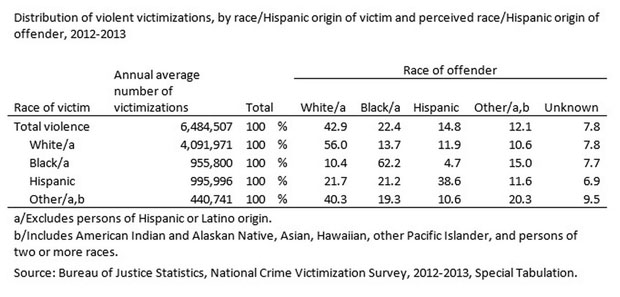
Posted in Charles Murray, F. Roger Devlin, Voter Fraud | Comments Off on F. Roger Devlin Interview (6-21-21)

Interview With Jon Entine Of The Genetic Literacy Project

00:00 Author Jon Entine
01:00 Taboo: Why Black Athletes Dominate Sports and Why We’re Afraid to Talk About It
07:00 Jon rejects Trumpism
09:00 Epoche thinking
20:00 How the West Lost COVID
27:00 Heterodox while elite
30:00 Abraham’s Children: Race, Identity and the DNA of the Chosen People
42:40 Jon’s transformative spiritual experience at age 20 in New Hampshire
1:02:30 Genetic Literacy Project
1:09:30 Is that which is natural good?
1:11:20 Anti-vaxxers
1:18:20 ​Has modern agricultural practices increased or decreased the nutritional value of food?
1:19:30 Diet soda
1:31:30 What is science?
1:33:30 Should Big Tech squelch anti-vaccine opinions?

Posted in Genetics, Jon Entine | Comments Off on Interview With Jon Entine Of The Genetic Literacy Project

Hitler Laughing: Comedy in the Third Reich (6-21-21)

00:00 Cultural historian William Grange
01:00 Alexander Technique
03:00 My 2007 interview with William Grange
07:00 Aging and cognitive power
09:30 Writers block
12:00 American identity
15:00 African-American identity
20:00 The civil rights revolution
22:00 American theater and American identity and Death of a Salesman
24:40 Bertholt Brech
25:10 The Caucasian Chalk Circle
26:00 The Good Person of Szechwan
28:20 Lillian Hellman, Edward Albee
28:45 Ödön von Horváth
29:10 Harold Pinter
31:00 The Intellectuals and the Masses: Pride and Prejudice Among the Literary Intelligentsia 1880-1939
33:00 Modernism
35:00 Stanislavski Method
37:30 Bill Hader
38:10 Daniel Day Lewis
39:00 What’s the most influential art form?
40:30 The Business of American Theater
41:00 Shubert Organization
44:00 Modernist vs post-modernism theater
45:00 The great Christian playwrights
46:00 The Tidings Brought to Mary
46:30 The House Beautiful
48:00 Theater is a communal experience
50:30 Sam Shepard
51:00 David Mamet
52:00 Neil Simon
52:45 Larry Gelbart
1:00:20 Nude scenes
1:01:30 Actresses as hookers
1:18:00 Playwrights vs screenplay writers
1:23:00 What type of plays make money?
1:24:40 Cabaret
1:26:00 La bohème
1:30:00 Peter Cook
1:32:00 Situational comedy
1:33:00 Cheap comedy vs expensive comedy
1:34:00 Tom Stoppard’s Travesties
1:36:00 Hitler loved theater
1:40:00 F. Roger Devlin joins the show for 65 minutes
1:41:00 Sexual Utopia in Power
1:42:00 Charles Murray, https://vdare.com/articles/charles-murray-s-facing-reality-ruling-class-must-accept-race-differences-or-provoke-the-disaster-of-white-identity-politics
1:44:00 Is Roger Devlin a proponent of critical race theory?
2:02:00 The rise and fall of the AR
2:50:00 Tucker Carlson and the threat of white supremacy

Posted in Adolf Hitler, America, F. Roger Devlin, Germany, Nationalism, Theater | Comments Off on Hitler Laughing: Comedy in the Third Reich (6-21-21)