
How To Defend Yourself Online

Vox Day blogs: The New Femininity writes an essay on How to Defend Yourself From the SJW Mob:

Never assume anyone is going to be fair to you

No one is going to be fair to you and no one is going to sympathize with you. No one is going to give you the benefit of the doubt and no one is going to defend you because their default thought process is that you shouldn’t have touched the flaming hot stove if you didn’t expect to get burned.

My own husband didn’t have a lick of sympathy for me. He told me I was completely on my own. In fact, the only time he showed me any sort of empathy was months after when I told him I pressed full charges on my stalker against her professional license. He knew she went too far, and he fully supported my decision.

Bottom line is, people are not going to be partial to your sense of political justice in saying controversial things on the internet–because they themselves don’t want the trouble or expense of caring about something they believe you brought squarely upon yourself. It isn’t right and it isn’t wrong–it just is. People have jobs, their own lives, and their own multitude of problems. Don’t expect them to be fair, supportive or understanding in your willful decision to engage in your own personal crusade of online martyrdom–it’s your problem and they are under no obligation or duty to make it theirs.

On the flip side, when you find that rare individual who is willing to stand with you, who is willing to damn the torpedoes and defend you, you’d better appreciate what a gift you’ve been given.

That’s why so many people fear the VFM and the Dread Ilk. They know none of their tactics are going to work. They see the mutual loyalty that is the chief characteristic of the relationship and it scares them to death because they don’t know anything like it.

That’s also why it is useless to attempt to separate me from my social media allies. I’m not blind to their various idiosyncracies, (nor, to be fair, are they blind to mine) I simply don’t care because I know that I can count on them. Every single one of them has, at one point or another, put himself in the line of fire on my behalf when he did not have to do so.

This may be one more thing that separates the #AltRight from the movement conservatives. They are constantly jockeying for position and status and air time. We are far more concerned with mutual defense against the media and SJW mobs, and we genuinely celebrate each others’ scalps and successes. Take on one of us, and you can be pretty sure that at the very least, the others will at least fire a symbolic round or two in your direction.

How do you develop strong alliances? Mike Cernovich has already answered that. Look for those who need help and deserve it. Help them. Then repeat.

COMMENTS:

* How ironic that it was Charles (LGF) Johnson who uncovered the Dan Rather hoax. Johnson started out as an ally. He went full SJW within a year or so. I used to be on that site every day until I ended up like hundreds of others who got banned on LGF. Hard to believe that was over ten years back.

* The dearth of purity tests and purges on the alt-right is a huge selling point. I’ve yet to see an attack by a righty tbat wasn’t actually a *counter*-attack. Other than that it’s all a lot of, “Yeah those guys have some odd ideas about sex/whitey/handgun-choice, but they’re good on the important stuff. Great to have them aboard.”

Contrast with a decade’s experience. With the libertarians spending more time analyzing which Scotsman are True and its no wonder the altright has done more to change the conversation in a year than the libertarians in a decade.
Posted in America | Comments Off on How To Defend Yourself Online

My Name Is Bill Kristol — and How I Became a Renegade Jew

Forward: I’m a Renegade Jew. It didn’t start out that way. I was just an ordinary Jew, putting in my Jewish time, observing the Jewish calendar, mostly blowing off my Jewish responsibilities except for lip service to the faith on Yom Kippur and Passover.
But I still did what I thought was right, for Judaism and for my country, by helping George W. Bush become president, because he was “good for Israel.” I wrote influential op-eds, I went on TV, I obfuscated and I apologized for war crimes.
It’s what I’d been raised to do, as a conservative Jewish intellectual. But then one Sunday morning, I went out for bagels. I shouldn’t have gone to Zabar’s; it wasn’t safe. Then I came home to a nightmare. They’d gotten to my family, the monsters. Everyone — my father Irving, my uncle Schlomo, my second cousin Leon Epstein, my daughter Shoshanna — had been viciously slandered on the Internet. Like dogs, our opinions meant nothing anymore.
After all I’d done for Judaism, for the cause, for America, my Republican colleagues had betrayed me by supporting Donald Trump.
I had no choice…

Posted in Satire | Comments Off on My Name Is Bill Kristol — and How I Became a Renegade Jew

How Netanyahu Showed the Army Who’s Boss by Handing the Keys to the Far Right

J.J. Goldberg writes: There are many ways to describe the Israeli cabinet shakeup that brings arch-nationalist Avigdor Lieberman into the Netanyahu government as defense minister. It’s a broadening and firming of a shaky coalition. It’s a lurch to the right. It’s a settling of scores. Most consequentially, though, it might be called a military coup in reverse.
That is, it’s a sudden strike by Israel’s civilian government to reassert control over a military that’s been acting lately like an alternate source of authority. On issues as large as regional strategy toward Iran or relations with the Palestinian Authority and as small as rules for opening fire, the military command has repeatedly questioned, challenged or openly clashed with its civilian bosses. That’s untenable in a democratic society. A counter-move was inevitable.
By removing defense minister Moshe Yaalon, a former career soldier and military chief of staff who’s part and parcel of Israel Defense Forces culture, and replacing him with Lieberman, a frequent critic of the military brass, Netanyahu is showing the generals who’s boss. That may not be what Netanyahu intended in this latest round of coalition musical chairs, but that’s what happened.
On the flip side, the change of ministers appears to have alarmed and demoralized the army command. And not just the army. In unseating Yaalon, the prime minister has deposed one of Israel’s most respected military minds. Replacing him with Lieberman, he’s put one of the world’s most complex military machines in the hands of a populist rabble-rouser whose highest military rank was corporal. In a nation as threatened by enemies and as dependent on its military prowess as Israel, that’s immensely risky.
Tensions between the politicians and the security establishment have been building for more than a decade. In 2002, the chief of Mossad urged then-prime minister Ariel Sharon, unsuccessfully, to welcome the Arab Peace Initiative. A year later the four living ex-heads of the Shin Bet security service gathered for a group interview and urged Israeli withdrawal from the territories in order to create a Palestinian state separated from Israel by a border. Since then nearly all the ex-chiefs of the Shin Bet, Mossad and Israel Defense Forces have echoed this call, citing the need for security of a border separating Israel and the Palestinians. The sole exception, ironically, is Yaalon, the only living former service chief who opposes Palestinian statehood.

Posted in Israel | Comments Off on How Netanyahu Showed the Army Who’s Boss by Handing the Keys to the Far Right

100 Africans Convert To Judaism On Island Of Madagascar

As Israel gets richer, people around the world decide to become Jewish.

Forward: More than 100 men and women converted to Judaism in Madagascar this month, a historic first for the large island nation off the southeast coast of Africa.
The May 13 conversions, organized by Kulanu, a volunteer-run American nonprofit founded in the 1990s to support “isolated and emerging Jewish communities” worldwide, was the product of years of planning.
“Our task is to create a new community that is part of world Jewry in this unlikely place,” Kulanu posted on its website during a weeklong trip centered on the conversion. “Our hope,” the group continued, is for the community to “become part of the fabric of the world Jewish community.”

Posted in Africa, Conversion, Judaism | Comments Off on 100 Africans Convert To Judaism On Island Of Madagascar

Tribalism Vs Universalism Among Jews

Professor Michael Barnett says: “From the 1850s through the 1967 war, American Jewish institutions that were involved in foreign policy making had a strong universal orientation, especially to the extent that they were concerned about being identified with the extremes of Jewish nationalism. Their foreign policy instincts were liberal internationalist – and they believe that liberal internationalism abroad, just like liberalism at home – was the best way to advance the values and interests of the Jewish people. The big change happened in 1967 – at this point the more tribally oriented Jews begin to capture the major Jewish institutions. As I argue, this is partly because of their growing passion, money, and commitment. Because of this development, and other factors, more universally oriented Jews moved elsewhere. The social justice organizations are not necessarily part of the traditional national Jewish organizations, but rather emerge somewhat outside the system and below the radar. What we have seen over the last decade, I think, is the extent to which the more universally oriented constituency is trying to regain their influence – and the point of fissure is over Israel.”

Shmuel Rosner writes:

Dear Professor Barnett,
Your new book sets out to explore “Jewish Foreign Policies” in America. This is a very curious term you use, one that could be misconstrued as implying that America’s Jews are some kind of a political entity with its own political institutions and its own foreign policy. I’d like to use this first introductory round to let you explain the term, which ‘Jews’ it refers to, and what’s your rationale behind using it. So what is a “Jewish foreign policy?”

Professor responds:

I see the Jews as a transnational political community. All political communities are worried about their survival and want to advance their values vis-à-vis those outside its boundaries. Any political community that attempts to promote its interest and values “abroad” can be said to have the goal of creating a foreign policy.

Foreign policy is the process by which a political community organizes its relations with “outsiders” for the purpose of protecting its fundamental interests and values. All political communities, to the extent that they want to survive and even advance their values, will have a foreign policy. Although international relations scholars tend to imagine that the only political communities that exist in the world are nation-states, and that these states protect the “national” interest, there are non-state actors, such as nations without states, which also have a foreign policy. One of the interesting features of 19th century Jewish political life was the extent to which the emergence of a transnational Jewish political community began to organize and assemble institutions for the purpose of advancing Jewish interests and values. Bottom line: to say that there is Jewish foreign policy means acknowledging that the Jewish political community wants to protect its identity, interests, and values.
States have an easier time making foreign policy than do transnational communities because they have authority and sovereignty, which means that they are seen by the international community as having the right to make and promote the community’s interests and values…

So, my understanding of the Jewish political community expects that different Jewish national communities, e.g. French, British, German, and American, will have distinct institutions that are intended to represent “Jewish” interests. And because the Jews are a transnational people, there will always be some blurring of the boundaries between the transnational and the national; that is, we can expect that the American Jewish community will attempt to find ways to represent both its interests and the broader interests of the Jewish people, though this will always be something of a challenge.
And when you dig deeper into the American Jewish community you will find sharp disagreements over how to protect the identity, interests, and values of the (American) Jews.
A final cautionary note: There is nothing insidious about a people wanting to organize to protect its identity, interests, and values. It is natural. It requires anti-Semitism to turn such natural tendencies into something dangerous and malevolent.

Shmuel Rosner writes:

Dear Professor Barnett,
Near the end of your book you describe a deep disparity between US and Israeli Jewry when it comes to the Universalism vs. Tribalism question. According to you, “Israel and the United States offer two ways for Jews to be in the world.” While Israeli Jews are presented as “unapologetic nationalists” who “do not need to make excuses for their concern about the needs of their own (Jewish) citizens and the Jewish people,” US Jews “did not have to choose between their communal identity and their universal aspirations; they could have both.” The condition of American Jews, which are both grounded in their Jewish roots and get to enjoy their hopeful universalism, is presented as “the best of all worlds.”

The professor responds:

The challenge for American Jews has always been how to avoid shedding their Jewish identity. Jewish nationalism, Zionism, and Israel have helped put a brake on assimilation for American Jews. This is, in fact, one reason many American Jewish leaders began to turn to Zionism after World War I; Zionism would help keep American Jews from slipping away. And those arguments can be heard today – American Jews need these expressions of nationalism in order to retain some meaningful notion of Jewish peoplehood and communal commitments. It is because of these expressions of particularism (and at times tribalism) that American Jews have felt safe reaching for the universal. So, Zionism and Israel have allowed American Jews to fly close to the sun, without worrying that they might fly so close that they melt into a universalizing pool. Jewish nationalism has allowed American Jews to have their “cake and eat it too.” And isn’t this the best of all possible worlds? It certainly has been for many American Jews (though not all).
But the ability of Zionism and Israel to play that role depends in part on how American Jews view Zionism and Israel. American Jews are most comfortable with a Zionism and an Israel that approximates their own mixture of particularism and universalism – or at least does not become too tribal. So, American Jews have needed a Jewish nationalism and an Israel that retains clear commitments to the universal values that have become part of their identity.
American Jews have needed a Zionism and an Israel to help them retain a strong foot in the particular. But what happens if Zionism and Israel become seen as too tribal by American Jews – if Israel no longer appears to be acting in ways that are consistent with their values? One possibility is that they will increasingly distance themselves from Israel. And if they distance themselves from Israel, what will be the implication for American Jews? Will this hasten their assimilation?

Wikipedia:

The Jewish question is the name given to a wide-ranging debate in European society pertaining to the appropriate status and treatment of Jews in society. The debate was similar to other so-called “national questions” and dealt with the civil, legal, national and political status of Jews as a minority within society, particularly in Europe in the 18th and 19th centuries.

The debate started within societies, politicians and writers in western and central Europe influenced by the Age of Enlightenment and the ideals of the French Revolution. The issues included the legal and economic Jewish disabilities (e.g. Jewish quotas and segregation), Jewish assimilation, Jewish emancipation and Jewish Enlightenment.

The expression has been used by antisemitic movements from the 1880s onwards, culminating in the Nazi phrase “the Final Solution to the Jewish Question”. Similarly, the expression was used by proponents for and opponents of the establishment of an autonomous Jewish homeland or a sovereign Jewish state.

Posted in America, Anti-Semitism, Israel, Jews, Nationalism | Comments Off on Tribalism Vs Universalism Among Jews

Shmuel Rosner: Singling out Israel ensures Sanders will not be the next U.S. president

Why should a candidate’s approach to Israel determine whether or not he become’s America’s president? To argue that is to argue that the Israel Lobby has a stranglehold on America’s politics. Surely that can’t be right? Jews are only 1.7% of the American population.

I remember Dennis Prager saying on the radio around 1991 that the reason that Bob Dole will never get the Republican nomination for president is because of his anti-Israel stands. Bob Dole had just made a speech on the floor of the U.S. Senate against Israeli Prime Minister Yitzhak Shamir.

From the Jewish Journal:

Bernie Sanders will not be the next President of the United States, and that is calming news for anyone who wants Israel to survive in a hostile environment. Not that he is hostile to Israel, or that  he wants to see it eliminated. Not that he doesn't have good intentions. Surely, his intentions as good as all the good intentions with which the road to hell is paved.

Sanders made news in recent days by making appointments to the Democratic Party's important Platform Drafting Committee of people who are not exactly Israel's most ardent supporters. Press reports focused on Sanders’ selection of Jim Zogby, a notable pro-Palestinian activist to the committee. But his other appointments – Cornel West, a supporter of BDS, rep. Keith Ellison, who voted against Iron Dome funding in Congress – are not expected to balance the Israel ticket on the committee.

The Democratic platform and its language on Israel was an issue four years ago, when Jerusalem was omitted, then added, then booed by a Democratic crowd. And of course, party platforms are for the most part meaningless. As Walter Russel Mead put it back in 2012: “No president refers back to the platform in framing legislation, no congressional leader uses it to set the legislative agenda, no living soul ever reads or quotes it for any purpose whatever. No historian of American party politics goes back to study them, no journalist refers to them more than a week after the convention. They are dead letters, produced out of a sense of ritual and to the extent they have any purpose whatever, they are idle playgrounds aimed at keeping clueless party zealots busy counting coup and scoring imaginary points.”

And yet, they count for something. They count for what “clueless party zealots” deem important. And this year, more than in 2012, Democratic Party zealots want to single out Israel as one of the issues with which to toy.

Obviously, Israel cannot complain about American parties singling it out. Israel sought a special status in American politics for decades, and hence it has no right to argue that giving it special treatment is unfair (it has every right to make such an argument when it comes to UN special treatment). It is fair. But this should not prevent us from noting that the special treatment Israel is getting in the Democratic Party is changing its nature. From being singled out as a beacon of democracy, stability, and beneficial alliance, it is now singled out as a country in need of denunciation, schooling, and punishment.

Israel was never as noble as American party platforms made it seem. But it is even less deserving of the special treatment that the Sanders forces plan for it. Israel is hardly the country most deserving of condemnation. The Israeli-Palestinian conflict is hardly the most urgent world conflict to solve. Israel's policy is hardly the most preposterous and most worthy of punishment. If and when the Democratic Party platform zeroes in on Israel, this will mark not a change in Israel's behavior. It will mark a change in Israel's status with the party, and a change in Democratic attitudes toward the world and its realities.

In American politics Israel was always a litmus test for other issues. It is a country – as I noted in many of my articles – that gets much too much attention compared to other nations. It is a country whose approval ratings among Americans correspond with their views on a wide range of topics. And currently, it separates the “conservative and moderate Democrats” from the “liberal Democrats” as a Pew story demonstrated yesterday. Note the following observation: “the share of liberal Democrats who side more with the Palestinians than with Israel has nearly doubled since 2014 (from 21% to 40%) and is higher than at any point dating back to 2001”.

Bernie Sanders is the leader of liberal Democrats (many of which are Jewish Americans). He is also the leader of Millennials, the young Americans, whose views of Israel are less sympathetic. “Millennials are the only generational cohort in which fewer than half (43%) sympathize more with Israel. And about a quarter of Millennials (27%) sympathize more with the Palestinians, the highest share of any generation”.

In other words: Sanders is not the issue – or problem – for Israel. He is merely a speaker of a faction and a generation with which Israel has a growing problem. He is merely a speaker of a faction and a generation that is gaining power within the Democratic Party.

Posted in America, Israel | Comments Off on Shmuel Rosner: Singling out Israel ensures Sanders will not be the next U.S. president

Great White Hope: Trump Unites Generations Of White Nationalists

Allegra Kirkland writes: BURNS, TENNESSEE—Presumptive GOP nominee Donald Trump has been accused of dog-whistling to white nationalists ever since he kicked off his campaign in the summer of 2015 and warned against “criminal” Mexican immigrants. His retweets of Twitter users with handles like “@WhiteGenocideTM” and his tepid disavowals of David Duke’s support have not gone unnoticed in that fringe community, either.

Tucked away in the woods of middle Tennessee’s Montgomery Bell State Park, 300 “white advocates” gathered over the weekend at the fourteenth American Renaissance conference to reflect on just how much fuel Trump has added to their movement this election cycle.

“I’ve never felt this sense of energy in our movement,” the conference host, Jared Taylor, said in his opening remarks. “I’ve never been more optimistic.”

For the conference, American Renaissance, a white nationalist publication, brought advocates for a white ethno-state together with Holocaust deniers, eugenicists and confederate sympathizers. American Renaissance and many of the groups the conference speakers are associated with are designated as hate groups by the Southern Poverty Law Center.

According to Taylor, this year’s conference saw a 100-person jump in attendance from 2015; a show of hands identified half of the participants as first-time attendees and one-third as under the age of 30.

Posted in America | Comments Off on Great White Hope: Trump Unites Generations Of White Nationalists

Rush Limbaugh’s Troubles

From Politico:

Even though he’s officially reached retirement age, Limbaugh will do some form of audio programming in the years to come. His love for what he does is obvious: On air, Limbaugh often says he’s “having more fun than a human being should be allowed to have.” And he sounds like he means it.
Indeed, his infectious enthusiasm is one quality that explains something important that Limbaugh’s detractors miss: He’s really good at what he does. He takes very few callers, and conducts almost no interviews. For three hours, he just talks. And he’s funny, unpredictable, stimulating. No easy feat.
But Limbaugh’s raw talent and sheer joie de vivre won’t be enough to save his current business model in an environment where his advertisers and affiliates have increasingly headed for the doors. In that sense, “Flush Rush” appears to be the rare boycott that actually worked.
Should Limbaugh leave terrestrial radio, it will be difficult to find a substitute. “Is there a voice that can replace him?” asks Baltimore’s Beaven. “That’s hard.”
For KOWL’s Steve Harness, however, it didn’t turn out to be that hard at all: He replaced Limbaugh with Dennis Prager, the cerebral conservative talker who broadcasts out of Southern California. Harness tells me he hasn’t had any problems since he picked up Prager: “I don’t have that issue with Dennis Prager calling people sluts.”

Posted in Dennis Prager, Radio, Rush Limbaugh | Comments Off on Rush Limbaugh’s Troubles

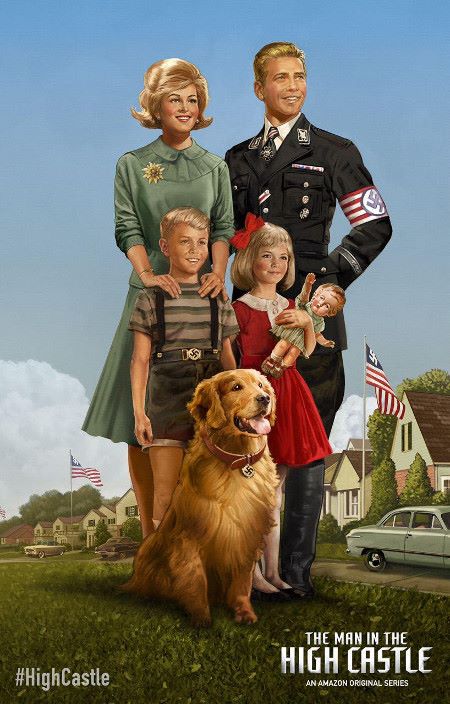
I can’t imagine any decent TV show or movie about Nazis failing to get viewers. Meaning? There’s a hunger.

Chaim Amalek: “I would prefer to see a show about Social Justice Warriors winning in our struggle against whitness, maleness, heteronormativity, religious bigotry, the Church, gender bias of every sort and nationhood.”

Season two of The Man in the High Castle arrives in late 2016.

unnamed

Posted in Nazi | Comments Off on I can’t imagine any decent TV show or movie about Nazis failing to get viewers. Meaning? There’s a hunger.

Mission Impossible: African-Americans & analytics

Shorter Michael Wilbon: Blacks aren’t good at math. Prefer feels.

ESPN has dropped its middlebrow Grantland approach and gone instead with the black Undefeated site.

From ESPN:

The mission was to find black folks who spend anytime talking about advanced analytics, whose conversations are framed by — or even casually include references to — win shares or effective shooting percentage, WHIP (walks and hits per inning pitched) or points per 100 possessions. It’s a failed mission so far. Totally empty. Conclusion: Advanced analytics and black folks hardly ever mix. Set aside the tiny handful of black men who make a living somewhere in the sports industry dealing directly with the numbers and there is absolutely zero mingling.

Log onto any mainstream website or media outlet (certainly any program within the ESPN empire) and 30 seconds cannot pass without extreme statistical analysis, which didn’t exist 20 years ago, hijacking the conversation. But not in “BlackWorld,” where never is heard an advanced analytical word. Not in urban barbershops. Not in text chains during three-hour games. Not around office water coolers. Not even in pressrooms or locker rooms where black folks who make a living in the industry spend all day and half the night talking about the most intimate details of sports.

Let’s take the Golden State Warriors locker room, for example. I thought the complete stiff-arming of the statistical revolution might very well be generational. Old black folks don’t, but younger black folks might.

Wrong.

I asked Draymond Green, the Warriors star whose new-age game is constantly being defined statistically, if he engages in any advanced analytics conversation either professionally or personally. His answer was emphatic.

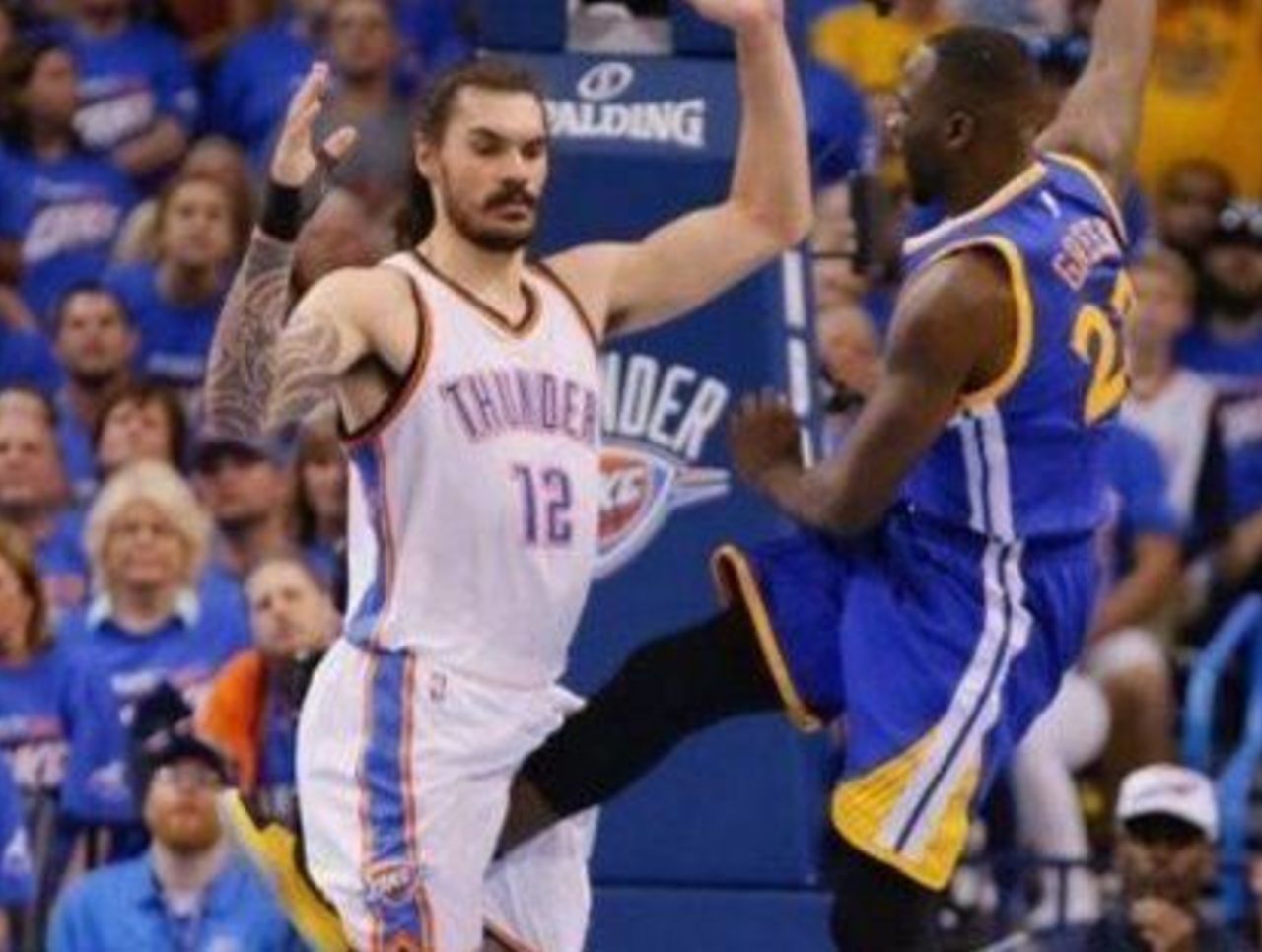
steven-adams-kicked-draymond-green
Draymond Green playing by feel.”

“No. Neither. Professionally, I play completely off of feel. I hear people discussing my game in terms of all these advanced numbers. I have no part of it,” Green said. “Even paying attention to it, from a playing standpoint, would make me robotic and undermine my game. I’m supposed to step back behind the line in real time to avoid taking a ‘bad two’? That’s thinking way too much. I don’t get the fascination at all.”

…My friend Larry Irving, a black Stanford lawyer and the most rational person I know — except when it comes to his New York Knicks fandom — said our complete withdrawal from statistical analysis is based on our emotional tie to the game.

“Sports is emotional. And analytics represent the absence of emotion, the antithesis. Nobody gets into sports to be dispassionate. And it just seems to me we are the feel it, smell it, touch it people,” he said. “WHIP and WAR [wins above replacement] and win shares are completely antiseptic. I mean, the coach may use analytics to confirm, but you mean to tell me Knute Rockne couldn’t tell whether the boy could play without some advanced analytics expert telling him?”

The thing is, that could also open the door to the issue of emotion vs. intellect. That is a thin and sensitive line to navigate, especially given the outrage people of color feel when others suggest we’re more emotional than rational about sports. But it’s an inescapable subtopic if dealing with 360 degrees of this. Without question, the emotional appeal of sports resonates with black people, whether we’re talking about the first end-zone dancers, the first high-five, the guttural releases after dunks and quarterback sacks and even putts made, that simply weren’t a noticeable part of sports before the emergence of the black athlete and legions of black fans who followed. It would take a greater and more in-depth discussion than this to figure out the reasons we, black people, are most attracted to sports other than the winning and losing, and where the emotional connection is on that spectrum.

Comments at Steve Sailer:

* Your general point is correct about Negros’ feeling of entitlement to control white language, but in this case there may be an additional factor. I’m not watching the series, but yesterday on the golf course an avid Warriors fan, 84 years old, told me that Adams has regularly been blocking Green’s shots. Blacks feel that b-ball is “their” game, thus for a White to block a Black star’s shot is an unforgivable affront. I first saw this in a high school game in 1971 in SF, when a 5’4″ black point guard slapped a white forward’s face after getting his shot blocked. It’s possible Green cares less about being called a monkey than about being “shown up” by a stale pale Australian.

* Whitlock was dumped from ESPN after failing to get The Undefeated off the ground after 3 years.

He doesn’t much care for Coates either:

SN: Why is there acrimony between you and celebrated author/journalist Ta-Nehisi Coates? Did you make a mistake with him in your recruiting effort for “The Undefeated?”

Whitlock: Glad to clear this up. I was brought back to ESPN in August of 2013. I reached out to Coates via email in November of 2013. We had a brief 15- to 20-minute phone conversation. I was effusive in my praise of his writing talents. He expressed he was uninterested in leaving “The Atlantic.” It was an exploratory, respectful conversation. I had no job to offer at the time. I wasn’t authorized to hire anyone. My first priorities were Jesse Washington and Mike Wise, two of my collaborators. It wasn’t until the Fall of 2014 and the new fiscal year that I was given the greenlight to hire anyone. My first two hires were Amy Barnett and Danielle Cadet. My next hires were in December of 2014 when I began reporting to Marie Donoghue. That’s when we were able to land Washington and Wise. In May of 2014, I emailed Coates to tell him how much I enjoyed “The Case For Reparations.” I asked him to do a podcast interview. He said he would try to accommodate my request. It didn’t happen. I left him alone. Zero hard feelings. In 2015, stories started popping up referencing his friends/surrogates about how he turned me down for a job and how I offered to triple his salary. Then he later analogized me to a drug dealer during a radio interview. Then I made the mistake of purchasing and reading “Between the World and Me,” his bestselling book. It’s a hopeless, God-less, Marxist book that allegedly is written for the edification of young black people. Any understanding and appreciation of the magnificent and courageous African-American journey is respectful of our relationship with religion and a Higher Power. What’s between the world and Ta-Nehisi Coates is an understanding of the power of prayer, hope, faith and Jesus. Feeding young people a beautifully written and seductive hopeless ideology is wishing destruction on them. The book helped me fully understand what he represents. Coates’ pro-black shtick is how elitist, Talented Tenth-believing black people try to be pro-black. They use their platforms to whine publicly about the harrowing, state-sanctioned plunder they suffered while purchasing a $2 million home. That’s not hate. I live a pampered life, too. I just try to have enough self-awareness to know my 1-percent problems are unworthy of a full column on a major media platform. I thought and think Coates would benefit greatly from working in a black media environment. His ideas need to be vigorously challenged by black people, particularly those of us who realize the danger of separating faith from fate.

* I follow Nate Silver on Twitter. You’d think that maybe people in love with data and statistics would have heretical thoughts, but whenever he gives his opinion it’s all racism this and sexism that.

Posted in Blacks, ESPN | Comments Off on Mission Impossible: African-Americans & analytics