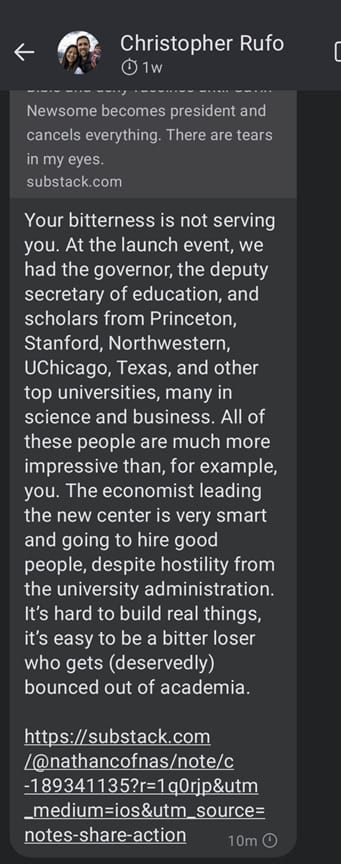
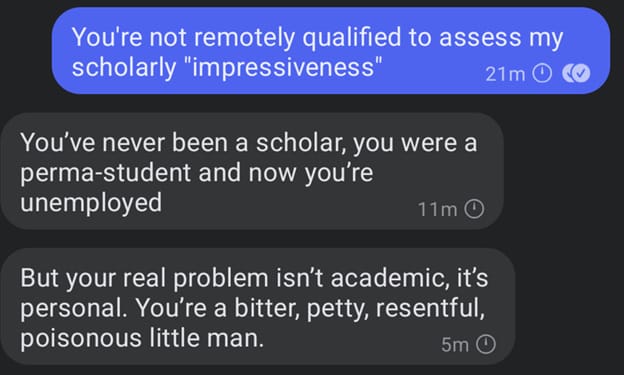
This strikes me as a pointless feud because Chris Rufo and Nathan Cofnas operate in different genres. Rufo is an activist and not a scholar. Cofnas is a scholar and not an activist. I would never look to Rufo for philosophical truth and I would never look to Cofnas for activism advice.
That which is useful to say bears no relationship to truth. Rufo is great at coming up with useful things to say for his side while Cofnas keeps his focus on ultimate truth.
Rufo helps the right build a winning coalition. Given that government has coercive power, this pragmatic approach has more tangible benefit to the right than truth.
Rufo and Cofnas do not just disagree on facts; they disagree on what “winning” looks like. While they appear to be on the same “side” of the anti-woke movement, their roles and end goals are fundamentally different, which makes their conflict a battle over the movement’s soul.
Rufo’s genre is power politics, while Cofnas’s is foundational philosophy. Rufo views the world as a series of institutional levers. To Rufo, “truth” is often less important than narrative control. His “playbook” involves using investigative reporting to trigger public scandals (like the Claudine Gay plagiarism case) to force administrative changes. Cofnas argues that Rufo’s victories are superficial because they don’t address the “equality thesis”—the belief that all groups are innately the same. He believes that as long as elites believe this, they will interpret any disparity as proof of “systemic racism,” making “woke” policies a moral necessity that no amount of legislation can stop.
Even though they operate in different spheres, the feud is intense because their strategies are mutually exclusive in their current forms:
Rufo’s Barrier to Success: To win over “liberal elites” and maintain political viability, Rufo must distance himself from controversial biological theories. He views Cofnas’s focus on heredity as a “strategic disaster” that makes the movement look like a “fringe” racialist group, which would destroy his ability to influence governors and university trustees.
Cofnas’s Barrier to Success: Cofnas views Rufo as a “grifter” because Rufo claims to be “fixing” the problem while (in Cofnas’s view) merely pruning the leaves of a tree with poisonous roots. To Cofnas, Rufo is providing a false sense of victory that prevents the Right from having the “uncomfortable” conversations he believes are required for a real revolution.
To some people, this feud illustrates a variation of [Wallace] Sayre’s Law: the more closely two people share a goal (dismantling DEI), the more viciously they will fight over the 10% difference in how to achieve it.
Because both are high-profile figures in the same “Anti-Woke” ecosystem, they theoretically compete for the same donors, prestige, and followers. I wonder if Cofnas and Rufo regard themselves as competing? To me, they operate in different worlds.
Rufo has now moved into an “establishment” role as a university trustee and policy advisor. Cofnas remains a “dissident” scholar. This status difference adds a layer of personal resentment to the intellectual disagreement.
Chris Rufo is a grifter who is leading the right to disaster. His alleged victories against wokism are almost entirely imaginary.
Whenever someone criticizes Rufo, he likes to compare his track record to theirs. In his own words, these are the highlights of his career:
“We broke BLM, CRT, Kendi, Gay, etc., and my conversations with the New York Times over the past five years, which are a good proxy for elite consensus, have shifted very favorably in our direction, meaning that those ‘elites’ sense we have damaged woke and reduced its relative status. We’ve also set the stage for the president to defund the Left, tame the universities, abolish DEI, and rescind affirmative action.”
Let’s examine these claims one by one, and then consider why the right always loses in the end.
Helping the Left Take Out Its Own Trash
A couple years ago, Rufo helped get Harvard’s DEI President Claudine Gay booted on the pretext of plagiarism. As I predicted would happen, she was simply replaced by someone worse. Under the more effective leadership of Alan Garber, Harvard continues to flout the Supreme Court’s ruling against affirmative action, and it is spearheading the resistance to Trump.
The Left Has Moral and Intellectual Standards
At the height of the Great Awokening, Ibram X. Kendi was the doyen of DEI. Kendi (whose SAT scores barely cracked 1000) gave us insights such as defining “racism” as “a collection of racist policies that lead to racial inequity that are substantiated by racist ideas.” He received a MacArthur Fellowship (aka “genius grant”) and set his speaking fee to $35,000 an hour. In July 2020 he became the founding director of the Center for Antiracist Research at Boston University funded by $55 million in donations.
After several years, Kendi’s Center for Antiracist Research failed to produce anything resembling research. He fired half of his staff because the money had disappeared to who-knows-where. The whole operation was shut down in 2025. Kendi left BU and now directs the so-called Institute for Advanced Study at Howard University.
The fall of Kendi is a testament to the left’s capacity for self-correction, not evidence that it is in retreat. (I’m not sure what role Rufo thinks “anti-woke” reporting had in any of this, but it makes no difference either way.) The right would never have a Kendi scandal because a right-wing Kendi would never be held accountable. Can you think of a single example in recent history where a right-wing leader was marginalized for stupidity or grifting? If the right held its leaders accountable for these things, almost everyone would be gone (including Rufo).
BLM Lives On
After gaining steam from several hoaxes such as the Michael Brown “hands up, don’t shoot” incident, BLM reached its high point after the death of George Floyd in the summer of 2020. The movement was unofficially led by the Black Lives Matter Global Network Foundation (BLMGNF), which, in 2020, received more than $90 million in donations.
BLMGNF was run like Zimbabwe. Its leaders paid themselves lavish salaries. They funneled large sums of money to their friends and family. Director Patrisse Cullors’s baby daddy was paid $970,000 for “creative services.” Cullors resigned her position at BLMGNF when her private purchase of more than $3 million in real estate attracted scrutiny. The left-wing New York Magazine broke the story that BLMGNF secretly bought a house for $6 million, apparently for private use by senior members of the organization. Local BLM chapters faced similar scandals.
Rufo can gloat about how embarrassing this was for the left. But the left exposed corruption on its own side and took measures to fix the problem without retreating from its ideological goals.
BLM attracted a flurry of support, then started going off the rails due to corruption and purity spirals. The left-wing establishment responded by quietly switching its focus to institutional capture so it can wield real power instead of just burning down police stations.
CRT Didn’t Go Anywhere
“Critical Race Theory” is a fancy name for the idea that racial disparities favoring whites are caused by past or present racism. It is simply the philosophy that follows from taking the equality thesis (all races have the same innate distribution of socially relevant traits) seriously.
Rufo played a role in passing legislation in some Republican-controlled states to prohibit educators from teaching CRT. Having anti-CRT laws on the books makes it marginally easier to push back against the most noxious expressions of anti-whitism. But elites remain committed to CRT, whether they call it CRT or something else like “American history.” Children spend seven hours a day, five days a week at school. As long as educators remain overwhelmingly left and woke, they are going to find a way to impart their beliefs to students.
Elite Consensus
Nothing happening at the New York Times indicates that “elite consensus [has] shifted very favorably in our direction.” Some mainstream left-wing outlets have recently expressed cautious skepticism about mutilating “trans” children. But gender theory is philosophically and historically separate from wokism. I always said there could be a backlash against it. The Times has not backed one inch away from the idea that all groups of people are on average the same and we need to strive for equality of outcome.
How the Left Actually Won
Howard Zinn was the author of A People’s History of the United States, which sold more than two million copies and played a major role in radicalizing American education. In 1967, the political science department at Boston University voted to award him tenure. However, its recommendation had to be approved by the trustees, who were scheduled to meet for the annual Founders Day banquet. Zinn then accepted some students’ invitation to speak at an anti-war rally, not knowing that the purpose of the rally was to protest Secretary of State Dean Rusk…who had been invited to speak at the Founders Day banquet! But he did not pull out. On the same day the trustees were voting on his tenure case, Zinn gave a 45-minute speech railing against their honored guest, the government, and America’s founders. He went home assuming he would be fired. Unbeknownst to him, the trustees had already voted to approve his tenure before the banquet.
Bill Ayers spent time in jail.
Noam Chomsky’s wife went to college so she would be able to support the family when her husband got what they expected would be a long prison sentence.
For 70 years, the woke project has inspired commitment from a large proportion of intelligent and idealistic people. That’s why the ideology prevailed. There was no conspiratorial “long march through the institutions.” As long as they believe that all groups are on average innately the same, intelligent, morally sensitive people will recognize that there is a moral emergency to correct the environment and bring about equality of outcome. Insofar as society is a meritocracy, institutions staffed by qualified individuals will spontaneously wokify.
In a revealing moment, Chris Rufo mocked me for being fired from Cambridge for talking about hereditarianism. (In fact I wasn’t fired from Cambridge, but leave that aside.) For Rufo the nihilist, the idea of sacrificing your immediate self-interest on behalf of a worthy cause is incomprehensible. He and his fellow trolls only know how to kick their opponents when they are down—a strategy that, besides being dishonorable, is generally ineffective in the long run, when eventually your enemy (perhaps Gavin Newsom?) gets up and starts kicking you.
The right may have the political power to defund cancer research, but it is currently not a position to retake the institutions and run them effectively. Note that, even with virtually unlimited funding, the right-wing University of Austin (UATX) is teaching college students middle-school-level algebra and appears to be on the verge of shutting down. To defeat race communism, it will be necessary to persuade a critical mass of liberal elites to join the right. Holding up people like Rufo as representatives of anti-wokism is pushing these potential allies—and therefore real victory—further and further away.
The tension between Nathan Cofnas and Christopher Rufo represents a fundamental divide in right-wing strategy: the struggle between institutional “hereditarianism” and “tactical activism.”
Cofnas argues from a philosophical and biological perspective, suggesting that unless the “equality thesis” is defeated at a scientific level, “race communism” will remain the inevitable conclusion of any meritocratic system. Rufo, conversely, operates as a high-level political operative who views culture and policy as a series of levers to be pulled.
To follow Cofnas’s logic, a real victory would require a “critical mass of liberal elites” to abandon the equality thesis. This is a much higher bar than passing state-level bans on CRT. It requires changing what the most “intelligent and morally sensitive” people believe to be true about human nature.
If Rufo is a “grifter” in Cofnas’s eyes, it is because Rufo treats the symptoms (slogans, administrators, specific grants) while Cofnas believes the disease is a fundamental misunderstanding of biology and sociology.
The argument against Rufo being a “grifter” centers on his strategic effectiveness, his intellectual foundations, and his sincerity of mission. While critics like Cofnas see him as a nihilistic opportunist, his supporters and defenders view him as a pragmatic operative who understands how to win in a modern media environment.
1. Strategic Effectiveness over Pure Theory
The most common defense of Rufo is that he produces tangible results where traditional conservative intellectuals have failed.
Actionable Impact: Supporters point to his influence on policy, such as inspiring a 2020 executive order and legislation in over 20 states.
The “Siege” Strategy: Rufo argues that one must “lay siege to the institutions” using legal and administrative levers rather than just winning a philosophical debate. To his defenders, this isn’t grifting; it is the necessary application of power to a “post-truth” academic world.
2. Narrative Control as a Tool of War
Rufo has been transparent about his method of “decodifying” and “recodifying” terms like Critical Race Theory.
The “Brawler” Persona: Supporters see his aggressive rhetoric—like using the term “scalped” after Claudine Gay’s resignation—not as empty posturing, but as a morale-boosting tactic for a side that has historically been on the defensive.
Journalistic Rigor: While Cofnas critiqued the plagiarism “pretext,” defenders argue the plagiarism was factually real. They contend that Rufo’s work at City Journal and the Manhattan Institute is grounded in deep research into the historical roots of “race communism” and radical left-wing movements of the 1960s.
3. Sincerity of Evolution
Rufo often shares his personal journey from a “left-leaning documentary filmmaker” to a conservative activist as evidence of his sincerity.
Direct Observation: He claims his shift was driven by years of traveling through American cities and observing how “elite” university theories like DEI disintegrated when they made contact with the reality of poverty and broken social connections.
Institutional Loyalty: Defenders argue that his work on the board of the New College of Florida shows he is willing to do the “boring” work of governance and institutional rebuilding, rather than just chasing headlines and donations.
4. Intellectual Legitimacy
While Cofnas dismisses him, other prominent figures like Tucker Carlson, Glenn Greenwald, and Ben Shapiro have praised him as one of the most effective journalists in the country. They argue that he has successfully identified a “long march through the institutions” that was previously ignored by the mainstream Right.
For Cofnas and Rufo, the stakes are perceived as existential, and the differences are not “small”—they are foundational.
In a typical faculty feud, professors might destroy each other’s reputations over a parking spot or a footnote. However, Cofnas and Rufo see the stakes as massive:
Both men believe they are fighting for the future of Western civilization. Rufo believes he is dismantling a state-sponsored ideology (DEI/CRT) that threatens meritocracy. Cofnas believes that unless the “equality thesis” is defeated at a biological level, Rufo’s victories are merely cosmetic and doomed to fail.
This isn’t a “small difference.” It is a clash between tactical activism and biological realism.
Rufo is a “siege” strategist; he wants to use administrative power to purge institutions.
Cofnas is an “intellectual revolutionary”; he argues that you cannot purge an institution if the people inside it still believe the underlying premise (innate equality) that makes “woke” policies feel like a moral necessity.
These screenshots captures the shift from a high-level strategic debate to a personal confrontation. The exchange perfectly illustrates the “bitter and petty” nature of academic and political feuds, even when the participants believe they are fighting for civilization-level stakes.
The dialogue reveals the specific insecurities each man targets in the other:
Rufo’s Attack on Status: By calling Cofnas a “perma-student” and “unemployed,” Rufo strikes at the lack of institutional power. For a strategist like Rufo, who measures success by policy wins and executive orders, an academic without a tenure-track position or a paycheck has no “impressiveness.”
Cofnas’s Defense of Scholarly Merit: His response suggests that Rufo lacks the intellectual credentials to even evaluate his work. This reinforces the core of their feud: Cofnas views Rufo as a mere “activist” who doesn’t understand the deeper philosophical or biological truths at play.
The “Poisonous Little Man” Remark: This is the peak of the personal animosity. It moves past their disagreement over “Hereditarianism” versus “Institutional Siege” and enters the realm of character assassination.
This exchange is a textbook example of how the “narcissism of small differences” can explode. If they are both competing for the same audience on the Right, then the need to delegitimize the other becomes total. It isn’t just that their strategies differ; it’s that the other person is, in their eyes, a “grifter” or a “resentful” failure.
This private exchange marks the total breakdown of the movement’s “big tent” strategy, where tactical activists and intellectual dissidents previously coexisted. The leak shifted the “anti-woke” discourse from policy to a fundamental question of establishment vs. dissident identity.
The fallout has forced various factions within the Right to take sides, effectively splitting the movement along lines of temperament and methodology.
The “Victory” Faction: Figures like Rufo and Richard Hanania have moved toward a more institutional role, working with the current administration to turn “anti-woke” ideas into concrete policy, such as rescinding executive orders on affirmative action and dismantling DEI bureaucracies. They prioritize “practical politics” over online dissident excitement.
The “Dissident” Faction: Others, like Cofnas, remain as gadflies, focusing on what they view as deeper biological or philosophical truths that the “establishment” Right is too timid to address. Rufo has explicitly warned that these elements are falling into “ideological rabbit holes” like racialism and conspiracism, which he views as a disaster for governing.
Despite the personal nature of the leaked messages, Rufo’s standing among conservative power-brokers appears largely intact. He is viewed as a decisive figure in the administration’s successful efforts to defund DEI and reform higher education. Supporters continue to champion his “playbook”—using investigative reporting to surface issues like plagiarism and leveraging media pressure to force institutional change—as the only effective way to move the needle.
Rufo has leveraged the feud to distinguish between “serious” governing conservatives and “influencers” who sap energy by stirring “dark emotions” and fixating on negativity.
Richard Hanania often serves as the intellectual bridge between these worlds. While he has been grouped with Rufo in celebrations of their policy impact, his approach remains more legalistic and bureaucratic. He argues that “wokeness” is a result of state policy (like Title IX and civil rights law) and can only be undone through government routine, rather than just winning cultural arguments.
Last year, Christopher Rufo published a series of essays that crystallized the divide between the “Establishment Right” and the “Dissident Right,” effectively serving as his manifesto for a new era of conservative governance.
Rufo argues that the Right has reached a critical “crossroads” where it must transition from a movement of online rebels to a durable governing force. He posits that because many “anti-woke” ideas—such as dismantling DEI bureaucracies and rescinding affirmative action executive orders—have become actual government policy, the Right can no longer afford the luxury of being “lone wolf” gadflies. He distinguishes between those who have assumed the “responsibilities that come with victory” and those who prefer to remain as professional dissidents.
Rufo has specifically targeted what he calls “Schizo-Politics”—a paranoid variant of right-wing thought characterized by conspiracy theories and “rabbit holes”. He argues that ideologies rooted in racialism, anti-Semitism, and conspiracism are optimized only for “online attention” and “clicks,” making them a “disaster in the realm of practical politics”.
In a widely discussed moment, Rufo urged young men on the “Dissident Right” to stop fixating on abstract online grievances and instead take “real-world” jobs—even suggesting management roles at chains like Panda Express—to build practical skills and support families.
He views the “Dissident Right” as a mirror image of the Left, driven by “envy, resentment, and fear,” and warns that both seek to abandon the American principles of colorblind meritocracy in favor of their own identity-based hierarchies.
Rufo serves as a senior fellow at the Manhattan Institute and a bridge to figures like Ron DeSantis and the current administration. His “playbook”—using investigative journalism and legislative pressure to trigger institutional change—continues to be the dominant model for conservative activism.
On the campaign trail, President Donald Trump promised to end federal spending on diversity, equity, and inclusion (DEI) programs. Yet the government has continued to award contracts based on race and sex. Despite rampant fraud and multiple court rulings against the practice, the Small Business Administration (SBA) has used “disadvantage” essays from business owners to skirt the rules and continue discriminatory programs that dole out billions in government contracts.
For decades, the federal government has awarded certain special contracts exclusively to so-called disadvantaged businesses and women-owned small businesses. Until 2023, SBA presumed that racial minorities were “disadvantaged.” The resulting discrimination was absolute: according to an analysis conducted between 2020 and 2023, these programs made not a single award to white men.
Though the second Trump administration has taken steps to limit these contracts, the largest disadvantaged-business initiative—the SBA’s 8(a) program—is thriving. The program “is still one of the most lucrative and sought after” SBA certificates, one contracting lawyer said in November. In fact, fiscal year 2025 saw the largest 8(a) spending on record, totaling $26 billion.
President Trump signed an executive order forbidding federal DEI discrimination, and a federal district court struck down the SBA’s presumption that minorities are disadvantaged. How, then, has 8(a) survived?
Cofnas does not intend to create new elites, but to conquer existing ones and bring them into the conservative camp. The author of the essay is honest to the point of brutality in recognizing how at the moment the cultural but also “intellectual” (IQ is mentioned several times) elites are resolutely on the side of wokeism, but this can change by showing them how and why the prospect goes to undermine the very foundations of their being elites (in a manner similar to how the intellectual enlightenment of many rulers in the latter part of the ancien regime detonated the revolutionary phenomena that would dethrone them). In Cofnas’ exquisitely elitist vision, then, it is power, and power alone, that pulls the strings of the political and philosophical discourse of nations.
According to Alliance Theory, developed by David Pinsof and company, political ideologies are not reflections of deep-seated moral values like “equality” or “authority,” but are instead patchwork narratives designed to coordinate support for allies and mobilize against rivals. In this framework, “truth” is subordinate to the strategic needs of the coalition.
Alliance Theory would likely analyze Nathan Cofnas’s demand that the Right embrace hereditarianism through the following strategic lenses:
1. The Function of “Status Biases”
Alliance Theory suggests that groups resolve conflicts over status and resources by making specific attributions about the causes of success and failure. If a group attributes their success to internal traits (like intelligence or talent), they are making a strategic bid to legitimize their status. Cofnas argues that the Right must embrace heredity to counter the Left’s “moral emergency” of equality. From an Alliance Theory perspective, Cofnas is trying to force a shift from a victim-based bias (where disadvantages are blamed on “evil” rivals) to an internal dispositional bias that is not likely to be popular.
2. Propaganda and Strategic Consistency
Alliance Theory posits that partisans use propagandistic tactics to defend their allies and attack their rivals.
Rufo’s strategy focuses on “decodifying” and “recodifying” slogans (like CRT or DEI) to damage the status of rivals. He views Cofnas’s focus as a “strategic disaster” because it breaks the current alliance with a portion of “liberal elites” and moderate voters. According to Alliance Theory, a belief that is “true” but damages the alliance’s status or makes it harder to recruit partners is a strategic failure that the coalition will naturally reject.
3. Alliances are More Important than Principles
The theory argues that people choose their allies based on similarity, transitivity, and interdependence, and then adopt whatever beliefs protect that alliance.
The current “anti-woke” alliance includes everyone from religious conservatives to classical liberals.
Why Rufo Wins in This Framework: Rufo’s tactical activism allows diverse groups to coordinate around a common enemy (the “managerial elite”) without requiring them to agree on the “biological” truths Cofnas prioritizes. Under Alliance Theory, a coalition that requires its members to adopt a high-cost, socially stigmatized belief (like hereditarianism) is likely to fragment or shrink.
Alliance Theory would suggest that Rufo and Cofnas are fighting over which “markers” or “identities” should define the Right-wing alliance.
Rufo wants a marker of institutional competence and “normalcy” to capture elite power.
Cofnas wants a marker of scientific realism to prevent what he views as an inevitable intellectual retreat.
From Pinsof’s perspective, the “correct” belief is simply the one that most effectively holds the coalition together while damaging the status of the rival Left.
In his analysis at Everything Is Bullshit, David Pinsof provides a framework that strips the Cofnas-Rufo feud of its moral and philosophical dimensions, viewing it instead as a conflict over coalitional fitness.
According to Pinsof’s Alliance Theory, the debate is not about which man has discovered the “truth,” but about which narrative better serves the strategic interests of the right-wing alliance.
Pinsof’s work suggests that Cofnas’s insistence on hereditarianism functions as a “radical” signal that tests coalitional loyalty. Alliance Theory posits that humans do not evolve to seek truth, but to seek allies. By demanding the Right embrace a socially stigmatized scientific theory, Cofnas is essentially asking the coalition to adopt a “high-cost” belief. From Pinsof’s perspective, if a belief makes it harder to coordinate with powerful partners—such as the “liberal elites” Rufo seeks to flip—then that belief is a strategic liability, regardless of its factual accuracy.
Pinsof’s analysis of how groups use “bullshit” to maintain status applies directly to Rufo’s tactical activism. Rufo’s strategy involves shifting the “elite consensus” by attacking specific administrative symbols like DEI and CRT. Pinsof argues that these narratives are successful not because they are “true” in an academic sense, but because they effectively damage the status of rivals while providing a “socially acceptable” way for people to join the Right-wing alliance.
Unlike Cofnas’s rigid biological claims, Rufo’s “siege” strategy is ideologically flexible. It allows the alliance to remain broad, including religious conservatives, secular moderates, and former liberals who might be repelled by hereditarianism but are unified by their opposition to the “managerial class”.
Pinsof’s blog often highlights that internal feuds are frequently competitions for dominance within the coalition.
By labeling Cofnas a “bitter loser” and a “perma-student,” Rufo is attempting to lower Cofnas’s status within the alliance to ensure his own “governing” faction remains the dominant one.
Both sides use “moral” language—Cofnas speaks of “intellectual honesty” while Rufo speaks of “governing responsibility”—but Pinsof would argue these are merely tools used to justify why their specific faction should lead the movement.
Pinsof’s ultimate takeaway would be that the Right will not “embrace hereditarianism” because it is true; it will only embrace it if the benefits of doing so—in terms of attracting allies and hurting enemies—outweigh the massive social and political costs. Currently, the “Rufo model” of tactical ambiguity provides a much better return on investment for coalitional power.
Nathan Cofnas wrote: “For 70 years, the woke project has inspired commitment from a large proportion of intelligent and idealistic people. That’s why the ideology prevailed.”
Given that this high-minded commitment would not lead to reproductive advantage, we know that the claims behind it are BS. If our ancestors had acted this way, their genetic line would have died out.
This idea that woke prevailed because of inspired commitment from smart idealistic people is a classic example of ideological bullshit—a high-minded narrative that masks the underlying strategic and status-driven motivations of the participants.
According to Pinsof’s Alliance Theory, humans do not commit to ideologies because of their “idealism” or “intellectual depth,” but because those ideologies serve as patchwork narratives that coordinate support for allies and mobilize against rivals.
Pinsof argues that the primary reason we have big brains is to figure out how to achieve primal goals—like status, power, and loyalty—in complex modern environments. He would likely contend that “intelligent” people are not more likely to seek truth; rather, they are simply better at generating sophisticated “bullshit” to justify the status and power of their preferred alliance.
Pinsof views opinions as status-seeking tools disguised as objective judgments. When Cofnas describes “idealistic people” committing to a project, Pinsof would see this as participants engaging in the “opinion game”—an attempt to make themselves look “smart and cool” (virtuous and sophisticated) while labeling their rivals as “dumb and cringe”.
Pinsof posits that we are designed by evolution to conceal our desire for status behind “high-minded values” because looking like a mere status-seeker would be self-defeating. He would argue that “idealism” is the name we give to the stories we tell ourselves to feel noble while we are actually competing for social approval and institutional dominance.
Under Alliance Theory, a movement like the “woke project” prevails not because it is intellectually superior, but because it creates a highly effective alliance structure. If an ideology allows its members to effectively coordinate to capture institutional power, “intelligent” people will naturally flock to it because the downstream benefits of being in that winning alliance are tangible.
Pinsof emphasizes that partisans use propagandistic tactics to support their side in conflicts. He would view Cofnas’s framing—that the Right “always loses” because it lacks the “idealism” of the Left—as an internal status move within the conservative coalition, rather than a factual historical assessment.
In Pinsof’s view, the Right’s “loss” or “win” is determined by the shifting fitness of its alliance structures, not by the amount of “idealism” or “truth” its members possess.
When you choose an ideology that hurts your social prospects and appears bad for reproductive success this is a sophisticated status play aimed at securing long-term social and institutional dominance. “Idealism” is the name we give to the stories we tell ourselves to feel noble while we compete for social approval.
Under Alliance Theory, “idealistic” people in elite circles may prioritize social status over high birth rates because status is the primary currency for capturing institutional power. High status allows individuals to command more resources and influence, which historically improved reproductive success.
In the modern world, the pursuit of status can “mismatch” with actual reproduction (e.g., spending child-bearing years in elite grad schools), but the underlying psychological drive remains the same: to climb the social hierarchy to win the “opinion game”.
Embracing “woke” project goals acts as a high-cost signal (akin to wearing a yarmulke to signal your commitment to Judaism) that one belongs to the educated elite class. For a “status monkey,” it is often better to have one child in the Ivy League than five children in the working class.
Pinsof would likely disagree that “intelligence” leads people to woke project ideals out of pure reason. Instead, he argues that intelligent people are simply better at generating patchwork narratives—sophisticated “bullshit”—to justify the interests of their coalition. What Cofnas calls “idealism,” Pinsof would call a propagandistic tactic designed to mobilize support for allies while making rivals look “dumb and cringe”.
From Pinsof’s perspective, the woke ideology prevailed because it formed a more effective alliance structure. If an ideology helps a group capture the most influential institutions (media, academia, HR), intelligent people will naturally join that alliance because it is where the status and power are located.
Nobody admits they want status; intellectuals claim they want “equality” or “justice” because our brains are designed to hide our status-seeking motives behind flattering stories.
I spend a lot of time with intellectuals—writers, thinkers, social scientists, etc. If I had to sum up their worldview in one sentence, I could hardly do better than this one:
“Everything that’s wrong in the world is caused by misunderstanding.”
Political polarization? Misunderstanding. If only people could get over their primitive “tribalism” and “confirmation bias,” they could have reasonable discourse and work together to solve humanity’s problems.
Misinformation? Misunderstanding. If only people knew how to “vaccinate” themselves against the “virus” of fake news, they’d stop being such gullible idiots and vote for the Democrats.
Bigotry? Misunderstanding. If only people realized that members of other ethnic groups were normal, decent human beings like them, there would be no bigotry.
Stereotypes? Misunderstanding. If only people knew that stereotypes were false and pernicious, there would be no stereotypes—and no bigotry.
War? Misunderstanding. If only people knew that war is pointless and evil, a product of bigotry and misinformation, there would be world peace.
Capitalism? False consciousness. If only people knew how much greedy corporations were exploiting them, the workers of the world would unite.
Wikipedia’s list of 265 cognitive biases? 265 misunderstandings! If only people joined the rationality movement and memorized these biases in elementary school, humans would conquer the galaxy.
Ineffective altruism? Misunderstanding. If only people knew that slacktivism and virtue signaling accomplish nothing, they’d become utilitarians and donate their money to shrimp welfare or preventing the AI apocalypse.
Unhappiness? Misunderstanding. If only people learned some positive psychology, they’d stop comparing themselves to sexier people on Instagram and start meditating and gratitude journaling.
Ahh, it’s the perfect story. If all the world’s problems are caused by misunderstanding, then that makes intellectuals—the people whose job it is to understand things—the most important people ever. Just by doing what they’re doing, they’re saving the world.
Wow. Intellectuals. Saving the world. Pretty cool thing for intellectuals to believe.
This essay by David Pinsof illuminates why the Cofnas-Rufo feud is so personal and why both men view each other as a threat to the movement’s survival. It frames their conflict not as a debate over facts, but as a struggle for status and institutional utility.
Cofnas fits perfectly into Pinsof’s description of the intellectual who believes the world’s problems are caused by a “misunderstanding” of biological reality.
Cofnas argues that if the Right simply understood and embraced “hereditarianism,” they would solve the “problem” of the Left’s moral emergency. This makes Cofnas (the scholar) the “most important person ever” in his own narrative. If the solution is a complex scientific truth, then only someone with Cofnas’s specific scholarly “impressiveness” can save the movement.
This explains why Rufo’s attack on Cofnas’s status—calling him a “perma-student” and “unemployed”—is so effective. He is attacking the very foundation of Cofnas’s “intellectual” status play by claiming he isn’t even a successful member of the class he claims to represent.
Rufo, meanwhile, rejects the “intellectual” framework in favor of what Pinsof would call a strategic alliance play. Rufo does not care if “misunderstandings” exist; he cares about narrative coordination. If a truth (like hereditarianism) is a strategic liability that prevents him from forming an alliance with “liberal elites,” he views it as “bullshit” in the political sense.
Rufo’s status comes from his proximity to governors, trustees, and the New York Times. He views himself as a “builder” and a “governor,” which Pinsof would identify as a different kind of “opinion game” where the goal is to look like the “serious” adult in the room.
Using Pinsof’s analysis, the feud persists because both men are using the “Anti-Woke” cause to pursue different status-seeking goals:
Cofnas is playing the “Rationality/Truth” game. He needs the movement to acknowledge his scholarship and his foundational truths.
Rufo is playing the “Institutional Power” game. He needs the movement to remain respectable enough to capture state power and run a university.
Pinsof would argue that these two are not actually trying to “solve” a misunderstanding; they are competing to decide who gets to lead the alliance. To Rufo, Cofnas is a “poisonous little man” because his “truth” threatens the respectability of Rufo’s alliance. To Cofnas, Rufo is a “grifter” because Rufo’s “activism” ignores the foundational truth that Cofnas has spent his life understanding.
In the end, Pinsof’s essay suggests that both men are engaged in the “opinion game,” telling themselves flattering stories about how they are “saving the world”—one through deep understanding, the other through effective action.
Adam Townsend, who writes the “The Townsend Letter” and posts as @adamscrabble, views the current tension between Trump, Europe, and Greenland through the lens of a “civilizational” and “energy” struggle. He argues that the move to acquire Greenland is not a joke or a “vanity project” but a serious attempt to secure the “hard assets” required for a post-globalist era.
In his analysis, Townsend suggests that the “buffered identity” of the post-war European order is collapsing. He sees Trump’s aggressive stance—using tariffs to pressure Denmark and the UK—as a method of forcing Europe to choose between American security/energy protection or becoming a vassal of other powers. For Townsend, Greenland represents the “ultimate prize” in this realignment because of its massive untapped mineral wealth and strategic position in the Arctic, which he believes is essential for American “energy dominance.”
He often frames the European reaction as one of “elites in denial.” He argues that European leaders are clinging to international norms that no longer exist, while the U.S. is moving toward a more “porous” and aggressive pursuit of national interest. Townsend believes that if the U.S. successfully acquires or establishes a protectorate over Greenland, it fundamentally shifts the balance of power, effectively ending the European Union’s ability to act as a sovereign peer to the United States.
Around 2019 Europe was in an existential crisis because of the further intrusion by China into 5g.
China already had about a 33% share of the big stuff like towers and heavy equipment and also the labor.
America under Trump demanded that Huawei be restricted, several euro countries‘kinda’ complied by pushing restrictions out but only by a few years.
Now what must be remembered is during this time, Huawei got the buy from Ukraine to power its backend of of its entire cyber security (is that crazy or what!!??) and Huawei was also gonna be the backend for UK’s system to require IDs to access the internet and social media ( easy right) and many of UKs top politicians and top honchos started working for Huawei in senior roles.
Europe promised it would do constant observance of Huawei code – which is obviously impossible as it pretty much changes day by day.
So back to 5g
– Europe feigned preferencing Ericsson…the problem is… Ericsson and Vodaphone etc had been driven to financial ruin by Euro crazy regs that squeezed profit in an already low margin biz – and this meant that Ericsson couldn’t build and deploy.
At this same time, shithead American saboteur Lina Khan of the FTC took Qualcomm to court to fight its 5g – and the judges (Obama and Biden peeps) did an unprecedented cap on the profits Qualcomm could make on its late generation chips!guess which company was the biggest euro client of Huawei…it’s Germany!!
I used this as an example of just one industry.
Now what’s happening in Europe is they truly don’t have any cash, knowledge workers and DEF doesn’t have the money to revive its energy in any meaningful way without financing as I explained before. and this means it can’t revise its indigenous energy intake biz or autos, chemicals, even glass. I’m in drone biz, we dont buy lens from Germany for years. Even Iran which was back door buying German glass for its drones via its euro deal called Instex which Europe used to thwart SWIFT.
So why is Europe fighting tooth and nail for Greenland that even in its wildest dreams they can afford to mine it, and they don’t have the military or tech such as nuke submarines, hypersonic missiles or AD?
I suspect that EU has collateralized its deal(s) with a china with Greenland – hence another one of Trumps major concerns.
Posted inGreenland|Comments Off on The Greenland Struggle
Travelers and temporary workers in the country, who may have arrived looking pallid, are showing off their glow-ups on social media….
Andre Ali of Aschaffenburg, Germany, first visited Australia as an exchange student 10 years ago. He came back for college and will be eligible for permanent residency this year. Since moving, Mr. Ali, 35, has sported surfer hairstyles, but he said the most profound effect on him had been the sense of camaraderie. “You can stand in a line,” he said, and strike up a conversation “with anyone,” in contrast with German culture.
By contrast with America, Australia is a high-trust society. You can leave your laptop on Bondi beach, go for a swim, and when you come back, it is still there.
Australia retains a frontier-style egalitarianism where the “mate” culture serves as a social lubricant. You see this in the article when Andre Ali mentions that in Australia, you can strike up a conversation with anyone in a line. In American cities, that same gesture often meets suspicion or a protective “buffered” silence.
The “Australia Effect” described in the text seems to be as much about psychological shedding as it is about sun and tan. People move from formal, rigid environments in Europe or Asia to a place that rewards physical labor and bare feet. This shifts the internal state. When you move from a desk to a banana farm or a mining site, your sense of self becomes more porous and open to the environment. The “glow-up” isn’t just the freckles or the “baby mullet”; it is the confidence that comes from surviving alone in a new system.
America certainly lacks that specific brand of mateship today. The article notes that travelers in Australia trade desk jobs for physical labor and find a “working to live” mentality. In the United States, identity often anchors itself so heavily to professional status and political tribalism that the common ground—like a simple “Merry Christmas” or a nod to a neighbor—erodes. The “Australia Effect” suggests that a change in environment can dismantle the defensive layers we build in more litigious and high-pressure cultures.
Posted inAustralia|Comments Off on NYT: Are They Hot, or Is It the ‘Australia Effect’?
According to former American Conservative editor Helen Andrews, wokism is “simply feminine patterns of behavior applied to institutions where women were few in number until recently.” It “appeared out of nowhere” in the 2010s because that’s when female representation at elite institutions passed the 50% mark. Cancel culture—which she sees as a central component of wokism—is “simply what women do whenever there are enough of them in a given organization or field.” Women such as herself may be exceptions, able to live up to male standards. But groups of women inevitably go woke because that is their nature.
Andrews defended this theory at the National Conservatism Conference last September, and her talk is one of the most watched videos on NatCon’s YouTube channel (270,000 views as of today). In October, she published a viral According to Arnold Kling, “we have made institutions harder for warriors [i.e., people with stereotypical male psychology] to navigate.” Andrews goes further than anyone else, claiming that wokism just is (by definition?) women being women.
The fact that wokism is female nature applied to institutions explains why “everything you think of as wokeness involves prioritizing the feminine over the masculine: empathy over rationality, safety over risk, cohesion over competition.”
Wokism began when the demographics at previously male-dominated institutions and professions tipped to majority female. In the US, women demographically surpassed men at law schools in 2016, the New York Times staff room in 2018, medical schools in 2019, and law firms in 2023. They became the majority of college-educated workers in 2019, and the majority of college instructors in 2023. “So the timing fits.” As soon as women achieved sufficient representation to impose their “patterns of behavior” on the rest of society, we got wokism.
The feminization of our culture (and therefore wokism) is the result of artificial social engineering. Judges and government bureaucrats force institutions to hire unqualified women, and “anti-discrimination law requires that every workplace be feminized.” If a workplace does not cater to their gender-specific preferences, women can sue and get large payoffs, but men have to suck it up.
The solution to wokism is to repeal anti-discrimination laws.
During the George W. Bush years, Stephen Colbert coined the word “truthiness” to refer to ideas that feel true even if they are not supported by evidence. Andrews’s argument is, I suggest, a case study in truthiness. The idea that women cause wokism seems to jibe with lived experience. If you say something politically incorrect at work or school, you’ll probably be hauled into a woman’s office. (HR departments are 74% female.) Woke academic fields such as English, sociology, and Grievance Studies are estuaries of estrogen. The blue-haired female college student is a classic woke stereotype. But there is a big leap from that, which is true, to Andrews’s conclusion.
On my account, wokism is a coherent ideology. It is what follows from taking the equality thesis seriously, given a background of egalitarian morality. The equality thesis, which says that all groups have the same innate distribution of socially relevant traits, has been a tenet of Western liberalism for more than a century. Virtually everything you think of as wokism is a rational, moral response to persistent inequality of outcome, given the false belief that race is skin deep and the sexes are interchangeable. Over the course of the 20th and early 21st centuries, wokesters made increasingly desperate attempts to fix the environment and bring about equality of outcome among groups. But, to the extent that race and sex disparities reflect natural differences that cannot be fixed, the woke project failed. Wokesters were forced to resort to magical thinking about microaggressions and systemic racism to explain why the gaps won’t go away.
…It is ironic that Helen Andrews was the one to popularize the theory that women cause wokism because they don’t care enough about the truth, and that she did so at the National Conservatism Conference. As editor of the American Conservative, Andrews was one of the chief gatekeepers preventing people like me from telling the truth about race on mainstream conservative platforms. Yoram Hazony—the Pope of National Conservatism—explicitly says that he doesn’t want to hear the truth about controversial topics. For example, in 2020, I published a paper advocating for free inquiry into all causes of race differences in intelligence, including genes. When wokesters started a petition to get the paper retracted, Hazony tweeted the following:
“You can’t get to viewpoint diversity in academia by defending the “study of race differences in intelligence.” Such studies are potentially interesting to political racialists and white identitarians. But most conservatives don’t see much value in them.”
Later the same day, Hazony referred to “defending race science and Nazi philosophers” and said that “none of that is conservative.” Isn’t this exactly the behavior that Andrews says is feminine, i.e., backbiting and ostracism to suppress controversial facts that threaten group cohesion? It is doubly ironic that Andrews and her fellow National Conservatives believe in cancel culture specifically for people who express the one idea that has the power to defeat wokism, which is hereditarianism.
Nathan Cofnas presents a structural interpretation of modern social movements. He argues that what people call wokism is not a collection of random grievances but a logical byproduct of a single foundational premise. He identifies this premise as the equality thesis, the belief that human groups possess an identical distribution of innate cognitive and behavioral traits.
His argument rests on a cause-and-effect chain. If one accepts that all groups are biologically identical in potential, then any persistent disparity in wealth, education, or crime must result from external, malevolent forces. When decades of social engineering and massive financial investments fail to close these gaps, the believer in the equality thesis faces a crisis. Cofnas suggests that instead of questioning the thesis, the proponents of this ideology invented increasingly abstract concepts like systemic racism and microaggressions to account for the lack of progress.
This perspective challenges the prevailing sociological view that environmental factors and historical legacies explain group differences. Most contemporary academics and institutions operate under the assumption that disparities reflect the cumulative effects of past discrimination and current institutional biases. They argue that factors such as the wealth gap, differences in school funding, and disparate treatment in the legal system create a feedback loop that sustains inequality.
Cofnas effectively flips the script on the “irrationality” often attributed to woke ideology. He treats it as a rational system if you grant its primary assumption. His critique suggests that the movement is a desperate attempt to protect a core liberal tenet from empirical reality. This makes his work part of a broader intellectual trend that seeks to reintroduce biological explanations into the study of social outcomes.
This Cofnas critique gains traction in certain circles because it offers a simple, coherent, testable, predictable, and unifying theory for a wide range of cultural phenomena. It provides an explanation for why institutional rhetoric has become more radical even as formal legal barriers have vanished. Whether one views his account as a bracing dose of realism or a dangerous return to discredited theories depends entirely on one’s starting point regarding the origins of human capability.
A social theory gains strength when it is falsifiable, explanatory and predictive. Cofnas’s critique has those qualities.
Cofnas positions his theory as a direct challenge to the “social constructionist” model precisely because he believes the latter has become unfalsifiable. In his view, if every failure of an egalitarian policy is met with a new, more abstract theory of systemic bias, the theory is no longer science; it is a protective belt for a dogma.
Cofnas’s account is grounded in a clear empirical claim: the equality thesis is a statement about the world that can be tested. If researchers were to find that group disparities in complex traits disappear when environmental variables are perfectly controlled, his theory would be falsified.
By contrast, he argues that “wokism” avoids falsification by moving the goalposts. If a specific “systemic” barrier is removed and the gap remains, the ideology simply searches for a more subtle or “internalized” barrier. Cofnas claims that by centering his theory on genetics and biology, he is returning to a model that can actually be proven wrong by data.
The explanatory power of his model lies in its parsimony. Instead of requiring a vast, interlocking web of conscious and unconscious biases, historical trauma, and “micro-level” interactions, he points to a single source: innate group differences.
He uses this to explain the timing of the woke turn. As legal barriers were dismantled in the late 20th century, the expectation was that group outcomes would equalize. When they did not, the “equality thesis” believers were forced to radicalize their explanations to maintain their moral worldview. This explains why institutions have become more “woke” even as society has become objectively less racist in its formal laws.
Cofnas makes several bold predictions that serve as a test for his theory:
The Failure of Intervention: He predicts that no amount of DEI funding, bias training, or social engineering will close the group outcome gaps so long as they reflect biological reality.
The Instability of the Center: He predicts that “moderate” conservatives like Hazony will continue to lose ground because they cannot provide a coherent explanation for persistent inequality, leaving the field open to the more internally consistent “woke” narrative.
The “Hereditarian Revolution”: He predicts that as genetic data becomes more granular and accessible through polygenic scores and large-scale genomic studies, the equality thesis will become impossible to maintain among the general public.
While Helen Andrews explains the behavioral style of the movement, Cofnas provides the structural logic. If his predictions about the failure of social engineering hold true, his theory gains weight as a structural explanation, regardless of whether the people enforcing the policies are male or female.
Cofnas attempts to be intellectually fair by granting the woke movement a degree of internal logic. He does not dismiss it as a mental illness or a mere power grab. Instead, he treats it as a series of rational deductions made by people who are committed to a specific moral and scientific premise. By framing the movement as a “moral response,” he acknowledges that the people involved act out of a desire for justice rather than malice.
However, many would argue his analysis is fundamentally unfair because it treats the movement as a closed system of logic while ignoring the lived experience and historical data that many activists rely upon. To a proponent of these social theories, concepts like systemic racism are not “magical thinking” invented to cover for a failed biology. They are observations of how neutral-sounding rules often produce biased results. A critic of Cofnas would say he ignores the way past policies, like redlining or disparate sentencing, continue to exert a physical and economic pull on the present.
His fairness is also complicated by the way he defines the “equality thesis.” He presents it as a scientific claim that has been debunked, but many liberals view it as a moral or legal axiom rather than a biological one. For them, the “fairness” of a society is measured by its commitment to treating people as individuals, regardless of group averages. By reducing the entire movement to a biological error, Cofnas may be creating a straw man that ignores the philosophical and legal arguments for equity that do not rely on a claim of identical innate traits.
Ultimately, Cofnas is fair to the structure of the argument but dismissive of its content. He provides a coherent map of why the movement behaves the way it does, but he does so by stripping away the historical and sociological nuance that its adherents consider essential. He treats the movement as a laboratory experiment that failed to yield the expected results, while those inside the movement see it as an ongoing struggle against deeply rooted and very real social structures.
Cofnas identifies a tension within the conservative movement that he finds both intellectually dishonest and strategically fatal. He argues that by suppressing hereditarianism, mainstream conservatives like Yoram Hazony and Helen Andrews operate within the same moral and empirical framework as their opponents. If conservatives accept the equality thesis, they lose the ability to provide an alternative explanation for group disparities. This forces them into a weak rhetorical position where they must blame the same systemic factors the left cites, or simply offer no explanation at all.
His critique of Helen Andrews and the National Conservatism movement highlights a specific type of gatekeeping. Andrews argues that feminine traits lead to the social ostracism and “cancel culture” inherent in wokism. Cofnas points out that Andrews and Hazony use those exact tactics—ostracism and the labeling of ideas as radioactive or “un-conservative”—to silence race realism. To Cofnas, this is a form of status closure where elite conservatives protect their institutional standing by policing the boundaries of acceptable thought.
The strategy of a Hereditarian Revolution seeks to collapse the entire woke edifice by removing its foundation. Cofnas believes that if the public accepts that race and sex disparities reflect innate differences, the moral demand for equal outcomes vanishes. He views the current conservative strategy of “colorblindness” as a failure because it cannot explain why colorblind policies do not lead to equal results. Without a biological explanation, the persistent gaps continue to fuel the narrative that society is fundamentally unjust.
Critics of this approach argue that a Hereditarian Revolution would not lead to social stability or the end of wokism. Instead, they suggest it could lead to a resurgence of explicit racial hierarchy or social Darwinism that most modern societies find abhorrent. There is also the significant scientific challenge of isolating genetic variables from the massive, compounding effects of environment and history. For many, the “truth” Cofnas wants to tell is less a settled scientific fact and more a return to a 19th-century worldview that ignores modern epigenetics and sociology.
Hazony’s position represents a different conservative priority: the preservation of social cohesion and traditional values. From his perspective, the study of race differences in intelligence is socially corrosive and provides no utility for building a stable, virtuous national community. He views it as a distraction that invites unnecessary cruelty. Cofnas sees this as a cowardice that ensures the ultimate victory of the left, as it leaves the equality thesis unchallenged as the only permissible explanation for the state of the world.
I suspect that in private, Yoram Hazony and Helen Andrews and most conservative intellectuals, including close to 100% under age 40, would be quite open to Cofnas’s contentions.
This claim gets to the heart of the “open secret” dynamic within elite intellectual circles. If this observation is correct, it suggests that a massive generational divide exists between the public posture of the conservative movement and the private convictions of its rising class.
The logic behind this claim usually rests on three factors:
First, younger intellectuals grew up in a world where the “equality thesis” was the undisputed baseline for all public policy. Having seen decades of these policies fail to produce equal outcomes, they may find the “systemic racism” explanation less convincing than their predecessors did. This creates a vacuum that hereditarianism fills with a simple, predictive answer.
Second, this generation is more comfortable with the data emerging from the “genomics revolution.” They see the rapid advancement of polygenic scores and large-scale twin studies as an inevitable tide that will eventually wash away social constructionism. For them, sticking to the “colorblind” or “meritocracy” rhetoric of the 1990s feels like a strategic error—a refusal to use the only tool they believe can actually win the argument.
Third, there is the issue of “prestige architecture.” As you noted with the behavior of figures like Yoram Hazony or Helen Andrews, the current gatekeepers of “Conservatism Inc.” maintain their status by enforcing certain taboos. Younger thinkers, who are often more alienated from these traditional institutions, have less to lose and may feel a greater sense of urgency to collapse what they see as a dishonest consensus.
The discrepancy between private belief and public utterance is what Cofnas identifies as the “tragedy” of the current right. He argues that by keeping these views private, younger intellectuals allow the “woke” framework to remain the only permissible explanation for inequality in the public square. This ensures that even as they gain power, they will remain trapped within their opponents’ moral and empirical world.
This situation reflects the “buffered identity” concept. By maintaining a public persona that adheres to the equality thesis, these intellectuals protect their “buffered” status within mainstream society. However, the private reality of the data creates a “porous” vulnerability where their public arguments are constantly threatened by what they know to be true in private.
Conservative intellectuals are more aware of the data Cofnas cites than the standard liberal academic. In elite conservative circles, the “hereditarian” perspective is often the “open secret”—the explanation whispered in private to account for why the Great Society or DEI initiatives haven’t produced the promised results.
The irony is that because they are “inside” the Overton Window, they act as the most effective suppressors of those ideas. A leftist academic can simply dismiss Cofnas as a “pseudo-scientist.” But Andrews and Hazony, who share many of his cultural goals, must actively “excommunicate” him to maintain their own institutional respectability. As Cofnas puts it, they are the “gatekeepers” who ensure that the only permissible conservative critique of wokism remains safely focused on “feminization” or “safetyism” rather than the underlying biological premise.
Hazony’s public dismissal of race science as “not conservative” is the perfect example of this. When he says these studies are “potentially interesting to political racialists” but of no value to most conservatives, he isn’t necessarily saying the data is false. He is saying it is useless—or worse, socially corrosive—to the project of building a national community.
To Hazony, the “truth” is secondary to the “good.” If a truth makes it impossible to maintain a cohesive, moral society, he argues a conservative should deprioritize it. Cofnas sees this as a suicidal strategy: you cannot defeat an ideology (wokism) that is built on an empirical claim (the equality thesis) by simply refusing to discuss the evidence.
Helen Andrews’s focus on the “feminization” of institutions is the ultimate “Overton-safe” version of a radical critique.
It feels edgy: It allows conservatives to criticize the “values of the nursery” and the “rule of HR.”
It has high “truthiness”: It maps onto people’s daily experience of cancel culture.
It is “safe”: Critiquing gender dynamics is common in conservative discourse and won’t get you banned from major platforms.
Cofnas’s point is that Andrews is using the “feminine” tactics she decries—social ostracism and gatekeeping—to protect the one idea (hereditarianism) she thinks would actually work. The irony is that by staying inside the window, she and Hazony may be preserving the very “woke” landscape they claim to hate, because they refuse to pull the rug out from under its primary assumption.
The discrepancy between private conviction and public rhetoric among conservative elites is exactly what Cofnas identifies as the primary obstacle to his proposed “hereditarian revolution.”
If prominent thinkers privately acknowledge a biological basis for group disparities while publicly defending “colorblindness” or “meritocracy,” they find themselves in a strategic bind. By not challenging the equality thesis in public, they effectively cede the moral and empirical high ground to the left. When a colorblind system still produces unequal outcomes, the only permissible explanation left within the public square is systemic bias. This makes the conservative position appear either naive or intentionally obstructive to the justice the left seeks.
This dynamic can be viewed through the lens of status closure. Intellectuals who hold “taboo” private views may feel that going public would lead to immediate professional and social ostracism. They protect their status by maintaining a “respectable” public profile that stays within the boundaries of acceptable discourse. For Cofnas, this isn’t just a personal compromise; it is a structural failure of the conservative movement. He views figures like Yoram Hazony or Helen Andrews as gatekeepers who prioritize institutional survival over what he sees as a foundational truth.
The “backdoor” to this conversation often comes through specific fields like genetics or medicine, where racial differences are discussed in more clinical, less politically charged terms. However, as soon as these discussions move into the realm of intelligence or social policy, the gatekeeping mechanisms become much more rigid. The “two faces” of the movement create a vacuum where no coherent counter-explanation for persistent inequality can be offered to the public, which in turn sustains the very “wokism” these intellectuals claim to oppose.
Helen Andrews is right that the aesthetic and tactics of modern institutional life have shifted toward what sociologists call “feminized” norms. The emphasis on psychological safety, harm prevention, and social cohesion over raw competition or “adversarial” truth-seeking is a documented trend.
The demographic data she cites is also real. The 2010s saw a tipping point in HR departments, university administrations, and journalism where women moved from a minority to a dominant majority. If you define wokism as a set of social behaviors—specifically “indirect aggression” like ostracism and reputational destruction rather than direct confrontation—then her thesis has high descriptive power. It explains the how of cancel culture quite well.
The reason many find her argument lacking as a total explanation is that it ignores the ideological engine. Men were the primary architects of the “equality thesis” long before women entered the workforce in large numbers. The legal framework of the 1964 Civil Rights Act and the subsequent disparate impact doctrines were largely built by men in the mid-20th century.
Cofnas’s point is that if you have an all-male board of directors who believe that all groups are identical in talent, they will still arrive at “woke” conclusions when they see unequal results. They might use “masculine” tactics to fix it—like rigid quotas or aggressive litigation—but the ideology remains the same. Andrews mistakes the social etiquette of the movement (empathy, safety, HR mediation) for the logical core of the movement (the belief that any disparity is proof of injustice).
Cofnas is particularly biting about the “truthiness” of Andrews’s argument. By blaming “female nature,” Andrews provides a convenient scapegoat that allows male conservative elites to avoid the more “radioactive” topic of hereditarianism. If the problem is just “too many women,” the solution is a demographic rollback. But if the problem is a fundamental error in how we understand human biology, then even an all-male institution will eventually go woke as long as it clings to the equality thesis.
In this sense, her argument functions as a form of “status closure” itself. It is a safe, culturally acceptable way for conservatives to complain about the left without touching the data on group differences that Hazony and others find so distasteful.
The effectiveness of Andrews’s model lies in its ability to map the “social technology” of modern censorship. Indirect aggression—strategies like social exclusion, reputational smearing, and the use of third-party authorities (HR, DEI committees) to settle disputes—contrasts sharply with the more traditional, “masculine” style of direct, adversarial debate. When people feel that workplace culture has become a “minefield,” they are often reacting to this shift in how conflict is handled.
This model is popular because it identifies the specific texture of institutional life today. It explains why a person isn’t usually fired for being “wrong” in a technical sense, but rather for “making people feel unsafe” or “disrupting cohesion.” If you view institutions as ecosystems, the introduction of a critical mass of people who prioritize emotional safety naturally changes the environment’s selection pressures. People who are highly adversarial or “disagreeable” in the psychological sense find themselves selected against.
However, the reason this only accounts for a fraction of the phenomenon is that it confuses the enforcement mechanism with the moral law. While women may dominate the HR departments that carry out the “cancellation,” the moral imperative they are enforcing—the idea that disparities are inherently unjust—is an intellectual and legal and political product.
Cofnas would argue that Andrews’s focus on “female nature” is a distraction from the real battle. If the goal of the conservative intellectual is to win the argument, blaming women’s “empathy” is a dead end. It offers no way to refute the left’s claims about justice. If you accept that all groups are identical, then the left’s demand for equal outcomes is morally correct, and it doesn’t matter if the person enforcing that demand is a man or a woman; the demand itself will eventually break the institution.
By focusing on “feminization,” conservative elites can participate in a high-brow version of the “gender wars” which is socially acceptable and even popular on YouTube. It allows them to feel like they are being “edgy” and “telling hard truths” without ever having to touch the third rail of hereditarianism that would actually cost them their mainstream standing.
Posted inNathan Cofnas|Comments Off on Nathan Cofnas Critiques The Helen Andrews Model Of Wokeness
Officials from associations of graduate and professional schools who are trying to recruit more men said the gender shift can be self-perpetuating. Men may be put off by what they see as the “feminization” of professions in which they now are the minority, research by the veterinary medical colleges association concluded.
“I’m not seeing a national effort to say we need to change this,” Buchmann said. “If anything, the opposite is true.”
As women move into the majority within fields like law and medicine, these professions take on a different cultural identity. This transformation often signals to young men that a career path no longer fits traditional masculine norms. Social scientists refer to this as the feminization of a profession. It happens when the presence of women reaches a certain threshold, often leading to a perception that the work involves more emotional labor or less prestige.
Research from the American Association of Veterinary Medical Colleges shows that men frequently exit applicant pools when they perceive a field as female-dominated. In veterinary medicine, the disparity is particularly sharp. Women make up roughly 80% of current students. When prospective male students look at clinics like the Heal Veterinary Clinic in Watertown, they see an all-female staff. This visual and cultural shift reinforces the idea that the profession belongs to women.
National statistics highlight the breadth of this change across various disciplines:
Field of Study/Current Female Enrollment/Graduation Percentage
Veterinary Medicine 80%
Psychology (Doctoral) 75%
Optometry 70%
Pharmacy (Master’s) 66%
Law (JD Degrees) 56%
Medicine (MD) 55%
Dentistry 55%
Men who might consider graduate school often choose the immediate financial returns of trades or labor-intensive jobs instead. They see the rising cost of professional degrees as a high-risk investment. A medical degree now costs an average of $297,745 at public universities and $408,150 at private ones. Many men decide the debt is not worth the entry into a profession where they feel like outsiders.
Claudia Buchmann points out that there is no coordinated national strategy to address the male enrollment decline. While many programs exist to support women in STEM, few initiatives specifically target men for health or legal careers. Most current efforts happen at the local level. Deans try to reach down into undergraduate programs to find male candidates, but they face a shrinking pool. Since men now earn only 40% of bachelor’s degrees, the pipeline to graduate school is narrow from the start.
This imbalance threatens the long-term stability of higher education. Universities rely on the $20 billion in annual revenue generated by master’s programs. If men continue to opt out of the system, colleges cannot sustain their current scale. The shortage of male professionals may hurt service delivery. The medical community already projects a shortage of 124,000 physicians by 2034.
The flight of men from spaces where they become the minority—is often called identity dissonance or gendered occupational flight.
When a profession or educational path reaches a certain “tipping point” of female representation, the cultural perception of that field often changes. For men, this shift impacts their sense of belonging, status, and professional identity.
Sociologists note that for many men, professional identity is closely tied to traditional markers of masculinity, such as economic leadership, competitiveness, and technical authority. When a space becomes female-dominated, men may experience a conflict between their masculine identity and their professional role.
In many societies, professions associated with women are culturally devalued or seen as lower status. Men often selectively leave occupations like pharmacy or veterinary medicine as the number of women increases to avoid this perceived loss of status.
Men in female-dominated fields like nursing or elementary education often face a unique social pressure. They may be celebrated by female colleagues as a “diversity hire” who raises the field’s status, yet they often feel socially isolated or face suspicion from the public (e.g., the “predator by assumption” stereotype in childcare).
To manage this dissonance, men who remain in these spaces often engage in “boundary work.” They might emphasize the most “masculine” parts of the job—such as the physical demands, the leadership aspects, or high-stakes crisis management—to distance themselves from the “feminine” label.
Recent data from the University of Zurich suggests that men are twice as likely to leave a “feminizing” occupation compared to an identical one with fewer women. This isn’t necessarily about a lack of ability, but a lack of fit.
Stopgappers enter female-dominated fields but leave quickly because the social pressure to appear ambitious or competitive feels unmet in those environments. The glass escalator serves as a counter-trend where men in these professions find themselves fast-tracked into management or leadership roles. This phenomenon often occurs as a way to restore a traditional masculine hierarchy within the workplace. Occupational flight describes a broader trend where men move toward sectors that maintain a masculine culture, such as the trades, engineering, or technology. In these spaces, men feel that society more readily accepts their competitive nature.
The shift in workplace culture with a higher percentage of women is not usually something men like, such as moving from “plain speaking” and “aggressive competition” to “conflict resolution” and “fussy HR departments.” For men, these new norms feel like a removal of the tools they naturally use to navigate the world.
Research indicates that men often thrive in environments where performance is explicitly ranked and rewards are tied to individual “wins.” When a space shifts toward communal goals and collaborative harmony, some men perceive it as a space where their specific talents for “agentic” (action-oriented) leadership will not be recognized or rewarded.
This self-perpetuating cycle means that as fewer men enter these schools, there are fewer male mentors and peers, making the space feel even more “uninviting” to the next generation of men.
As the sexual balance shifts toward a female majority, the underlying “software” of a profession—the unspoken rituals, communication styles, and methods of conflict resolution—undergoes a distinct transformation. These changes are often described through the lens of shifting from agentic (individualistic and assertive) to communal (collaborative and empathetic) norms.
In male-dominated environments, communication often functions as a tool for establishing hierarchy and competence. Arguments are frequently seen as a “sport” or a way to vet ideas through friction. As women become the majority, the “texture” of professional speech changes:
There is often a move away from absolute, declarative statements toward more “inclusive” language. This involves using qualifiers (e.g., “I feel like,” or “Does that make sense?”) which prioritize the comfort of the listener and the preservation of the relationship over a “win-loss” exchange.
The physical flow of meetings often changes. Instead of a single person holding the floor until interrupted, a “circle-back” culture emerges where leaders ensure everyone has spoken. This can extend the length of meetings but aims to ensure a total consensus.
The social rituals that glue a workforce together also transform. In traditional “old boys’ club” settings, bonding often occurs through shared risk or external activities like golf or late-night drinking. In feminizing spaces, these rituals often move indoors and become centered on “life-work integration”:
Validating the personal lives and emotional states of colleagues becomes an explicit part of the job. In a law firm or vet clinic with a female majority, “catching up” on personal news is not seen as a distraction from work but as a prerequisite for a functional team.
Direct, heated confrontations—common in high-stress, male-dominated environments—are often replaced by a “conflict resolution” model. Issues are handled through HR-mediated conversations or private, diplomatic interventions. For men who prefer the “clear the air” style of a quick, loud argument, this can feel like navigating a “passive-aggressive” maze.
The “heroic” leadership model—the lone captain making a definitive call—often gives way to distributed leadership.
In professional environments where men form the majority, leadership often follows a top-down model. Decisions appear decisive and lean on a philosophy where the buck stops at the desk of a single leader. These spaces handle conflict through direct friction and a meritocratic approach that favors a survival of the fittest mentality. Mentorship in these circles typically functions as sponsorship based on perceived potential or shared hobbies outside of the office.
As a profession shifts toward a female majority, leadership norms move toward a consultative and consensus-based style. Success depends on achieving buy-in from the group rather than making a unilateral call. Conflict becomes a relationship-preserving process managed through mediation and diplomatic interventions. Mentorship also changes, focusing on coaching that prioritizes whole-person development and empathy.
In fields like surgery or trial law, the “hazing” rituals of the past—long hours, sleep deprivation, and aggressive questioning by superiors—are being dismantled. These rituals were designed to test “mettle” and “toughness.” As these professions feminize, the focus shifts toward “sustainability” and “well-being.” While this reduces burnout, it also removes the specific “battle-hardened” identity that many men find rewarding in high-stakes professions.
When men observe these cultural changes, they don’t necessarily see them as “bad,” but they may find them alien. The environment stops feeling like a “playground” where they can compete and instead feels like a “classroom” or a “sanctuary” where their natural social impulses (like competitive banter or bluntness) are treated as “unprofessional” or “toxic.”
Performance reviews in a male-majority environment often function as a scoreboard. Feedback tends to be blunt and centers on specific, measurable wins or failures. In these settings, a manager might tell an employee exactly where they fell short without much preamble, viewing the exchange as a necessary friction to sharpen performance. The session feels like a debrief after a game. Men in these spaces often walk away knowing exactly where they stand in the hierarchy, as the focus stays on the “agentic” output of the individual.
When women move into the majority, the performance review transforms into a holistic conversation about professional growth and team harmony. The manager often frames critiques within a “sandwich” of positive reinforcement to preserve the relationship and the employee’s morale. This approach prioritizes “soft skills” and emotional intelligence, often evaluating how well a person collaborates rather than just their individual output. For someone used to the scoreboard style, this can feel vague or even confusing, as the primary goal is to maintain a “communal” atmosphere where everyone feels supported.
The physical setting and the “tempo” of the workplace also shift as these norms take hold. You see fewer spontaneous, high-stakes debates in the hallways and more scheduled, moderated discussions. The “plain speaking” that characterizes many male-dominated fields is replaced by a more careful, curated form of professional “diplomacy.” This environment minimizes the risk of social fallout and creates a predictable, stable climate. However, for those who find energy in the “rough and tumble” of direct competition, the new atmosphere can feel quiet or even stifling.
The term “gender” gives me the willies.
While sex refers to biological categories, the term gender describes the social and cultural expectations that society places on men and women. For someone like me who views these categories as rooted in biology, the modern emphasis on gender as a social construct feels like an attempt to untether identity from reality.
This linguistic shift often coincides with the “sanitization” of the workplace. In male-majority spaces, the focus tends to remain on objective tasks and hard data, where “sex” is often treated as a simple demographic fact. As these spaces feminize, the conversation moves toward “gender identity” and “gender norms,” which introduces a layer of sociological complexity. This focus on how people feel and how they are perceived within a social hierarchy changes the “vibe” of a professional environment. It moves the center of gravity away from what a person is and toward how a person experiences their role.
For many men, this transition feels like a move toward a more “managed” or “engineered” social environment. The introduction of “gendered” language often brings with it new HR protocols and a heightened sensitivity to communication styles. This can create a sense of walking on eggshells, where the “plain speaking” of the past is replaced by a more curated vocabulary. When the term “gender” replaces “sex” in professional data and discussions, it often signals that the environment has adopted the communal, relationship-preserving values that now dominate many professional schools.
In the novel Atlas Shrugged by Ayn Rand, the world’s most productive individuals—the “men of mind”—disappear from a society that increasingly demands they sacrifice their achievements for the sake of the collective. They retreat to a hidden valley called Galt’s Gulch, leaving the “motor of the world” to stop.
Applying this to the modern scene creates a picture of a “Quiet Shrug.” Unlike the novel, where the exit is a coordinated strike, the modern version is an unorganized, individual drift. Men see the rising costs of entry and the changing social architecture of professional life and simply decide not to participate. They don’t leave society entirely; they just leave the institutions that no longer feel like home.
Imagine a bright student who once would have aimed for a career in surgery or high-stakes litigation. He looks at the debt required and the “feminized” landscape of the modern professional school—the focus on consensus, the moderated speech, and the administrative focus on emotional labor. He feels like a “porous” self being forced into a mold that doesn’t fit his “buffered” identity. Instead of fighting for a seat at a table where his natural competitive drive might be labeled as toxic, he disappears into the digital economy.
He becomes a ghost in the traditional system. You might find him running a solo consulting business from a laptop, trading high-frequency crypto, or moving into a specialized trade where the “plain speaking” of men remains the standard. He chooses a path where he can be an “agentic” force without a committee overseeing his tone. In this modern Galt’s Gulch, the “men of mind” are not hiding in a valley; they are hiding in plain sight, working in niches where they can compete and produce without navigating the new “diplomacy” of the professional class.
The result is a thinning of the ranks in the very institutions that sustain the public infrastructure. As the “shrugging” continues, law firms, clinics, and universities find themselves with a surplus of consensus and a shortage of the specific, aggressive drive that historically pushed those fields through high-risk crises. The motor doesn’t stop with a bang; it loses its high-end torque. The “feminization” of the professional world becomes a self-fulfilling prophecy because the men who would have provided the counter-balance have already walked away.
To what extent have no-fly zones contributed to the male exodus from the professions?
For many men, this transition creates a fundamental mismatch between their natural professional impulses and the new institutional requirements.
In a traditional male-majority professional setting, “plain speaking” and rigorous, even aggressive, debate are often the primary tools for vetting ideas. When no-fly zones are established, these tools are effectively confiscated.
No-fly zones require individuals to “curate” their thoughts through a filter of social consequences before speaking. This adds a layer of cognitive and emotional labor that men, who often prefer “buffered” and direct communication, find taxing or unnecessary.
In fields like law or academia, the penalty for crossing into a no-fly zone is no longer just a lost argument; it is a reputational or career-ending event. This shift makes the “high-stakes playground” of the profession feel like a minefield. Many men decide the “return on investment” for their ambition is not worth the risk of a single misstep in a moderated environment.
The impact of these no-fly zones is not just that men stop talking; it’s that they leave the “regulated” space entirely. This is the modern Atlas Shrugged scenario:
Men are moving toward niches where these no-fly zones do not yet exist or are irrelevant. This includes the independent digital economy, specialized trades, and private consulting. In these spaces, they can return to “agentic” behavior—making decisions, taking risks, and speaking plainly—without a committee overseeing their vocabulary.
If a man feels that his promotion or status depends more on his ability to navigate social taboos (“diplomacy”) than on his technical skill (“output”), his motivation to stay in that system drops. He looks for environments where the “scoreboard” is objective and the rules of engagement are clear.
The exodus of men who refuse to navigate no-fly zones leads to a cultural feedback loop. As these men leave, the remaining professional body becomes even more committed to consensus-based, relationship-preserving norms. This reinforces the no-fly zones, making the field even less attractive to the next generation of competitive, blunt-speaking men.
This “Quiet Shrug” means that the most disruptive, high-torque thinkers—the ones who often drive innovation by challenging established dogmas—are the first to walk away. They are not hiding in a valley; they are building their own worlds where the “no-fly” rules don’t apply.
No-fly zones serve as the invisible fence that accelerates the male exodus. When a professional or academic environment establishes certain topics as sacralized and immune to critique, it fundamentally changes the “terms of service” for those within it. For men who view professional life as a meritocratic arena for the “men of mind”—to use the Atlas Shrugged terminology—these zones signal that the environment has shifted from one of objective output to one of high-stakes social compliance.
In medical and law schools, no-fly zones often manifest as a narrowing of the curriculum. Academic freedom has increasingly become a contested concept, with recent data showing that a majority of students at elite institutions like Harvard and Columbia would now prevent controversial speakers from stepping foot on campus.
In medical education, certain biological realities or evidence-based debates—particularly around pediatric gender medicine or racialized health algorithms—have become so politically charged that they are often removed from formal instruction to avoid administrative backlash. For a student who values the “buffered” pursuit of scientific truth, seeing a university suspend a course because it challenges a specific ideology feels like a breach of the professional contract.
In law schools, the traditional “Socratic method”—which relies on aggressive, blunt-speaking debate—is being replaced by a culture of self-censorship. When 53% of students report that topics like the Israeli-Palestinian conflict or transgender rights are too sensitive for open discussion, the “high-torque” debate that men often find rewarding is effectively banned.
Men often perceive these no-fly zones as a “compliance tax” on their ambition. If the path to becoming a top surgeon or a senior partner now requires navigating a “passive-aggressive” maze of HR-moderated language and DEI litmus tests, the “return on investment” changes.
When a field prioritizes “diplomacy” and “relationship-preservation” over raw technical output or intellectual friction, it begins to lose its masculine-coded prestige. Men who would have historically fought for a seat at the table see these new norms as “pink-washing” the profession, making it appear less like a battleground and more like a managed sanctuary.
In an environment of high-stakes social navigation, a single “unvetted” thought can lead to social cancellation or professional exile. Many men decide that rather than walking on eggshells for forty years, they will simply “shrug” and move to the unregulated spaces of the digital or solo-entrepreneurial economy.
The exodus is most visible in the drift toward sectors that maintain a “masculine” culture—the trades, engineering, and independent digital ventures. In these spaces, no-fly zones are rare because the “scoreboard” is purely objective. If a man builds a successful software product or a high-end construction firm, his personal views on “sacralized” topics don’t prevent his code from working or his buildings from standing.
The traditional institutions are left in a self-perpetuating cycle: as the “buffered,” competitive men leave, the no-fly zones expand, making the space even more uninviting to the next generation. The “motor of the world” hasn’t stopped, but it has moved to a different, less regulated neighborhood.
The data on independent digital platforms reveals a mirror image of the decline in traditional graduate enrollment. While men are leaving the structured, “feminized” institutions of higher education, they are moving in significant numbers into decentralized economic spaces that prioritize technical skill and direct market competition over institutional credentials.
The creator economy is currently valued at roughly $250 billion and is expected to nearly double to $480 billion by 2027. While women lead the way in total number of creators—making up roughly 64% of the market—male creators earn 40% more per collaboration on average. This suggests that men are moving into the high-end, technical, or specialized niches of the digital world where “agentic” output is rewarded most heavily.
As graduate enrollment in fields like computer science dropped by 14% in late 2025, the number of independent creators grew by 14%. Many men are bypassing the four-year degree to gain qualifications through self-study and “learning-by-doing.”
Research shows that in the gig and creator economies, traditional educational credentials have limited use. Instead, review systems and previous job experience serve as the primary signals of competence. For men who dislike the “managed” social navigation of modern universities, this objective “scoreboard” is a major draw.
The exodus is not just about where men are going, but what they are leaving behind. As professional degrees in healthcare and education are increasingly reclassified or seen as female-dominated, men are moving toward “unregulated” sectors like crypto-trading, independent consulting, and digital manufacturing.
The Wage Premium of Autonomy: 44% of freelancers report earning more than they did under a traditional employer. For men, the perception of “financial freedom” and “professional development” is significantly higher in these independent roles than in traditional jobs.
Men now account for only 40% of undergraduate enrollment. They are 7 percentage points more likely to drop out than women, often citing the lack of value in a degree and the desire to begin earning immediately. This movement toward immediate, unvetted wage-earning is a modern form of the productive class leaving a system that no longer fits their identity.
The shift toward independent digital platforms acts as a release valve for men who find traditional professional environments increasingly “managed.” As law and medical schools adopt consensus-based norms and enforce intellectual no-fly zones, many men are moving into decentralized economic sectors. These spaces—spanning high-end software development, decentralized finance (DeFi), and solo-entrepreneurial consulting—prioritize “agentic” output and objective results over the diplomatic social navigation required in modern institutions.
Software development remains a primary destination for men seeking a meritocratic “scoreboard.” While general software roles are feminizing in terms of culture, men are concentrating in high-torque, technical niches.
Specialized fields like cybersecurity, AI development, and systems architecture (using languages like Rust and Go) are growing 25% faster than general roles. These areas reward individual problem-solving and technical “brilliance” rather than collaborative consensus.
Men engage in IT entrepreneurship at twice the rate of women. In the world of tech startups, the “founder” identity remains heavily masculine, focused on risk-taking and revolutionary product ideas. This environment offers a modern “Galt’s Gulch” where men can build entire systems without the oversight of “fussy” HR departments.
Decentralized finance (DeFi) has become a major alternative for men who feel alienated by the transparency and slow innovation of traditional banking.
In crypto-trading, the feedback loop is immediate and binary: you either profit or you lose. This objective ranking appeals to men who dislike the “sanitized” feedback found in professional performance reviews.
Men aged 25–34 have the highest rate of crypto ownership at 16.2%, nearly double that of women in the same age bracket. Overall, men are significantly more likely to trust decentralized systems over national banks, which many perceive as being bogged down by bureaucratic and social agendas.
Independent consulting grew by 6.5% in 2024, reaching nearly 28 million people globally. Men are increasingly choosing to be “boutique” consultants rather than climbing the corporate ladder at the “Big Four” firms.
Autonomy over Compliance: By working as a solo practitioner or in a small “pod,” a man can avoid the institutional “no-fly zones.” He can speak plainly with his clients and provide “fresh ideas” that a larger, more cautious firm might veto.
The Wage Premium of Exit: Freelancers in technical and consulting niches often report higher earnings and greater professional satisfaction than their counterparts in traditional roles. For a man who values “buffered” independence, the trade-off of less stability for more “agentic” freedom is an easy choice.
This drift creates a thinning of the “high-torque” talent in traditional institutions. Law firms and medical schools find themselves with plenty of people who can navigate a consensus-based meeting, but they are losing the “disruptors” who would have historically challenged the status quo. These men are not hiding; they are simply building their own “valleys” in the digital economy where the no-fly zones of the physical world don’t apply.
As the most competitive men “shrug” and move to these unregulated digital valleys, law and medicine are left with a surplus of social harmony but a deficit of the aggressive, risk-taking energy that often drives breakthrough innovation.
Posted inAcademia|Comments Off on LAT: College women far outnumber men in law, medical, vet schools
Last night, after connecting with friends and family, and excited by the great college football championship game, I thought that Trump’s threats to Greenland were the funniest thing I’ve ever seen. Today, in the cold light of dawn, after normal experiences of vulnerability, when I think about Trump’s threats to Greenland, I want to vomit.
When I feel strong and invulnerable, many things amuse me that then horrify me when I feel weak.
Safety dictates our perspective. When you feel secure, a threat to international norms or the sovereignty of a distant land looks like a joke because the consequences feel remote and the absurdity takes center stage. You watch the spectacle as a spectator from a fortified position. In that headspace, the idea of a world leader demanding to buy a country sounds like a satirical plot line rather than a geopolitical reality.
The cold light of dawn brings back the reality of human fragility. When you feel vulnerable, those same words lose their comedic edge and reveal the underlying instability they represent. The humor evaporates because you recognize that the power to make such demands resides in a person who can affect your own life and the lives of people you care about. What felt like a performance yesterday feels like a precursor to chaos today.
Psychologists often note that humor requires a perceived violation that feels benign. When you are strong, the violation feels harmless. When you are weak, the violation feels like a genuine threat. My reaction to political rhetoric is a barometer of my own internal state of resilience.
I guess the things we laugh at in the company of friends become the things that keep us awake when we are alone.
Benign violation theory explains this through the intersection of three specific conditions. A situation must first present a violation of some norm or expectation, such as a breach of diplomatic etiquette or a threat to global stability. Second, the person must perceive that violation as harmless or benign. Third, these two perceptions must occur simultaneously. When you feel invulnerable, the threat to Greenland satisfies the second condition because your strength acts as a shield. You see the absurdity of the act without feeling the weight of its potential damage.
When that sense of invulnerability fades, the violation no longer feels benign. It shifts into the category of a pure threat. The distance required for humor collapses, and the brain prioritizes survival and empathy over the appreciation of irony. This explains why people in high-stress environments often rely on dark humor to maintain their footing. They use laughter to artificially create the distance they lack, attempting to transform a frightening reality into something manageable and small.
This psychological mechanism also acts as a social glue. Sharing a laugh over a perceived threat with family and friends reinforces a collective sense of power and safety. The group dynamic provides a buffer that an individual lacks during a quiet morning of reflection. Your physical and emotional state dictates whether you view the world as a stage for comedy or a landscape of risk.
Posted inComedy, Greenland|Comments Off on Trump, Greenland, & Vulnerability
This book by historian Alan Allport keeps it real:
Underlying this way of life was an obsession with ‘PWR’ – the Prestige of the White Race. It was upon the rock of PWR – rarely spoken out loud but completely understood – that the claim to British suzerainty over the Indian Ocean ultimately rested. [8] ‘Face’, as the writer Jan Morris suggested, ‘was all – important’ to the governance of the Eastern Empire: ‘If the brown and yellow peoples thought them invincible, [the British] reasoned, invincible they would remain: and so assiduously did they propagate this self – image that they had long come to believe in it themselves.’
…As with all crises of life and death, the Second World War demonstrated a hierarchy of necessity where the survival of one nation often required the exploitation of another. As the United States transitioned into the dominant global power, the British found themselves relegated to a subordinate role. This shift stripped away any pretense of equitable burden-sharing. Decisions regarding resources and strategy rested with American leadership, while British concerns took a secondary position. The Americans focused on their own strategic advantages and felt little obligation to alleviate the domestic hardships of their closest ally.
The British government mirrored this indifference in its management of the empire. While officials in London struggled with American dictates on shipping and rations, they simultaneously ignored the humanitarian catastrophe unfolding in India. Millions of Indians faced starvation because the British prioritized military logistics and domestic stockpiles over colonial lives. The war effort operated on a brutal logic of proximity. Each power protected its immediate interests and discarded the needs of those further down the ladder of influence.
This cycle of neglect defined the late stages of the conflict. The United States leveraged its industrial and financial strength to dictate terms to a fading British Empire. In response, Churchill and his cabinet squeezed the colonies to sustain the metropole. Moral principles had little place in these calculations. The geopolitical reality of the 1940s meant that the burden of war fell most heavily on those with the least power to protest.
We’re all locked in the iron cage of reality together, but we’re not all equally vulnerable.
Has it ever been different? The strong do what they will and the weak endure what they must.
Thucydides wrote that line over two thousand years ago to describe the slaughter at Melos. The sentiment remains the primary engine of realism in international relations. History rarely offers examples where a dominant power voluntarily sacrifices its core interests for the sake of a weaker neighbor. Even the most idealistic eras usually reveal a layer of strategic self-interest underneath the rhetoric of cooperation.
The post-war order attempted to mitigate this through international law and institutional constraints. Modern states created the United Nations and the European Union to provide a framework where the weak have a legal voice. These structures offer a venue for negotiation that did not exist during the Peloponnesian War or the height of the British Empire. Smaller nations now use trade blocks and collective security to check the impulses of the strong. They find strength in numbers and create a cost for naked aggression.
Despite these purported advancements, reality persists. We see it in how global financial systems prioritize the stability of wealthy nations over the debt of developing ones. We see it in the distribution of technology and the enforcement of borders. The methods of the strong become more sophisticated, moving from military conquest to economic leverage, but the distribution of burden remains lopsided. The weak still endure the consequences of decisions made in distant rooms by people who do not know their names.
The concept of maintaining a facade of invincibility to sustain political authority is a universal feature of empire and social hierarchy rather than a trait unique to one race. While the specific acronym PWR belongs to a particular era of British colonial history, the underlying logic of prestige and face appears across many non-white civilizations.
The Imperial Chinese concept of the Mandate of Heaven serves as a primary example. This doctrine suggested that a dynasty ruled because it possessed divine favor. For the Qing or Ming dynasties, maintaining the appearance of absolute moral and military competence was essential. If a famine or a minor rebellion occurred, the state often went to great lengths to suppress the news or frame the event as a minor anomaly. If the subjects perceived that the Emperor lost his connection to the divine, the entire political structure became vulnerable to collapse. This obsession with face ensured that even as the Qing dynasty weakened internally in the 19th century, the court maintained elaborate rituals and a persona of supreme confidence to keep the populace and tributary states in awe.
In Japan, the Tokugawa Shogunate used a similar strategy known as the Great Peace. The Shogun maintained a rigid social order through the constant performance of power. The elaborate processions of daimyo to Edo, known as Sankin-kotai, functioned as a public theater of dominance. It was not just about control; it was about the undeniable prestige of the Shogun. By forcing the local lords to spend enormous sums on these displays, the Shogunate ensured that no one could imagine a world where the Shogun was not the central, invincible authority.
The Aztec Empire also utilized a form of psychological suzerainty. The Triple Alliance maintained its grip over Mesoamerica through the prestige of their capital, Tenochtitlan, and the terrifying reputation of their warriors. They cultivated an image of cosmic necessity, suggesting that the very survival of the sun depended on their rituals. This created a sense of inevitability among their neighbors. When the Spanish arrived, the rapid collapse of the empire occurred partly because the facade of Aztec invincibility was punctured, leading many subjugated groups to realize that the prestige of the Mexica was a maintainable illusion rather than a law of nature.
Prestige is a form of soft power that acts as a force multiplier. It allows a small ruling class to govern a much larger population without relying solely on constant, expensive violence. The British obsession with PWR was a late, racialized version of a very old human technology: the belief that power exists because everyone agrees that it is too prestigious to be questioned.
Posted inAmerica, Britain, India, War|Comments Off on Advance Britannia: The Epic Story of the Second World War, 1942-1945
We don’t have to take people at their word unless we have overwhelming reason to do so. Normally, people do not say what they mean nor do they mean what they say. Instead, they say what is expected from them in a particular situation.
Groypers game and in online gaming, the shocking discourse follows the rules of that genre.
Do groypers kiss their mother with that mouth? Yes.
The takeaway from my report is that for many Zoomers, violating taboos is a separate cognitive dimension from holding racist, white nationalist and antisemitic political attitudes. On the Manhattan Institute survey, half of those who openly identified as racists endorsed affirmative action, while among those who said they were antisemites, more said white people are favored in society than said Jews are.
What is more disturbing than any group animus is young peoples’ nihilistic apolitical anti-authority orientation, which is breeding cynicism, mistrust, and unreason. Data from the long-running General Social Survey (GSS) and ANES show that, as of 2024, just 8 percent of Americans under thirty-five say that other people, and the federal government, can be trusted.
These numbers are the lowest in 50 years. Trust in institutions is at rock bottom.
Trust in government has been sliding for a long time, and Trump’s refusal to accept the result of the 2020 election, among other things, has undoubtedly worsened the situation. Yet the willingness of progressive-dominated institutions and governments to indulge moral panics over racism, sexism, trans suicide, and white supremacy, and to suppress wrongthink in the name of emotional safety, has also badly damaged trust. Against a backdrop of truth-mangling humanitarian extremism, conspiracy theorists and shock jocks have been able to present themselves as muckrakers who tell it like it is.
The Groypers’ power is overstated, but until elites recommit to a truth-based order, the worldview of too many young people will continue to be marked by nihilism, provocation and conspiracy.
Kaufmann’s final five paragraphs shift the focus from a specific “Groyper” threat to a much broader crisis of institutional trust and epistemological decay. His analysis suggests that the shock-jock antics of figures like Nick Fuentes are symptoms of a deeper rot rather than the primary cause.
I’ve hammered on this for years.
The problem is not usually the problem. It is usually a symptom of a deeper problem.
Kaufmann argues that for many Zoomers, the act of violating social taboos—such as making racist or antisemitic jokes—is often a “separate cognitive dimension” from actual political convictions. He uses striking data to illustrate this: half of those who openly identified as “racists” in his survey also endorsed affirmative action. This suggests that much of the far-right “new media” appeal is based on a nihilistic desire for provocation rather than a disciplined commitment to white nationalism or traditional antisemitism.
The core of his argument is that young people are increasingly “apolitical and anti-authority.” He cites the General Social Survey (GSS) and ANES data to show that trust in the federal government and fellow citizens has plummeted to 8% among Americans under thirty-five. This is a historic low over a 50-year period. When trust in mainstream institutions collapses, people don’t necessarily turn to a competing coherent ideology; they turn to “content-neutral conspiracism.” This explains why 9/11 “truthers” and moon-landing deniers are statistically the most likely to also deny the Holocaust.
The more people have to lose, the less likely they are to embrace nihilism and nonsense. The less you have to lose, the more dangerous you are because you are untethered, and the more attracted you are to claims that you see through the BS.
Kaufmann doesn’t let the establishment off the hook. He identifies two main drivers for this collapse in trust:
Political Rhetoric: He notes that Donald Trump’s refusal to accept the 2020 election results damaged the perceived legitimacy of the system.
Institutional Overreach: He criticizes “progressive-dominated institutions” for indulging in moral panics and suppressing “wrongthink.”
He argues that when the “truth-based order” is seen as a tool for ideological policing, it creates a vacuum. Shock jocks and conspiracy theorists fill that vacuum by branding themselves as the only ones “telling it like it is.”
The final paragraphs highlight the danger of “swing voters”—young and minority voters moving between parties—who are twice as likely to hold conspiratorial views. Because these voters are highly sought after by both parties, they have the power to force national politics to cater to their “unreason.”
Kaufmann’s conclusion is a warning: the power of the Groypers is overstated, but the nihilism and mistrust they exploit are very real. Until elite institutions prioritize objective truth over emotional safety or partisan narratives, the “muckrakers” and conspiracy theorists will continue to gain ground.
The link between Kaufmann’s data and the concept of “no-fly zones” regarding public critique of sacralized minorities such as Jews, blacks, Muslims, LGBTQ, in public discourse is direct. When institutions designate certain groups or topics as sacralized and beyond criticism, they create a friction between official narratives and the lived experience or observations of the public. This friction acts as a primary driver for the collapse in trust Kaufmann describes.
Kaufmann’s report illustrates that when mainstream institutions suppress “wrongthink” in the name of emotional safety, they do not actually eliminate the forbidden thoughts. Instead, they drive those thoughts into a “nihilistic content-neutral conspiracism.” When elites refuse to engage with sensitive topics—such as the complexities of group differences or the trade-offs of immigration—they cede the territory to figures like Fuentes or Carlson.
In this environment, the “muckraker” label becomes a powerful brand. People gravitate toward influencers who violate taboos not necessarily because they agree with the specific ideology, but because the act of violation itself feels like a signal of honesty. If the “truth-based order” appears to be hiding things through moral panics, any “forbidden” information is treated as more likely to be true.
Reality is porous. The buffered identity is a fiction (though useful at times). During the turbulent Trump years, we see a shift across the political spectrum from a “buffered” identity to a more “porous” and reactive one. When people feel that their epistemology is being managed by an elite class, they lose the buffer of institutional trust. They become porous to any narrative that challenges the status quo, no matter how wild.
Kaufmann’s data on Holocaust denial is a perfect example. He finds that denial is less about ideology and more about a general commitment to “anti-authority orientation.” If the authorities say the moon landing happened and the Holocaust happened, a person who has lost all trust in those authorities will reflexively doubt both. The “no-fly zones” established around sacralized groups essentially act as a catalyst for this total epistemic breakdown.
Perhaps the most significant part of Kaufmann’s analysis is the role of minority and young swing voters. These groups are moving toward a worldview marked by provocation and conspiracy precisely because they feel the disconnect between elite “humanitarian extremism” and their own realities. As these voters become the “kingmakers” in national elections, the political system is forced to bend toward their conspiracist epistemology.
The result is a feedback loop. The more institutions try to “clamp down” on what they perceive as rising hate or misinformation through further sacralization and “no-fly zones,” the more they validate the conspiracist’s claim that the system is lying. This erodes the possibility of a shared, truth-based public square.
I know about the joys of provocation. I have spent my life reveling in provocation because it made me feel excited and superior. Finally, I had a therapist who suggested to me that when I unnecessarily provoke people, I hurt them. That got through to me. The more connected and happy I feel, the more precious I consider my life, then I make more careful and considerate choices because I don’t want anything I say or do to hurt those I love.
On the other hand, if you have nothing precious in your life, and you are not invested in your community, you might find it exciting to burn everything down.
Posted inAlt Lite, Alt Right, America|Comments Off on Eric Kaufman: The Truth Behind the Groyper Panic
"This guy knows all the gossip, the ins and outs, the lashon hara of the Orthodox world. He’s an [expert] in... all the inner workings of the Orthodox world." (Rabbi Aaron Rakeffet-Rothkoff)