
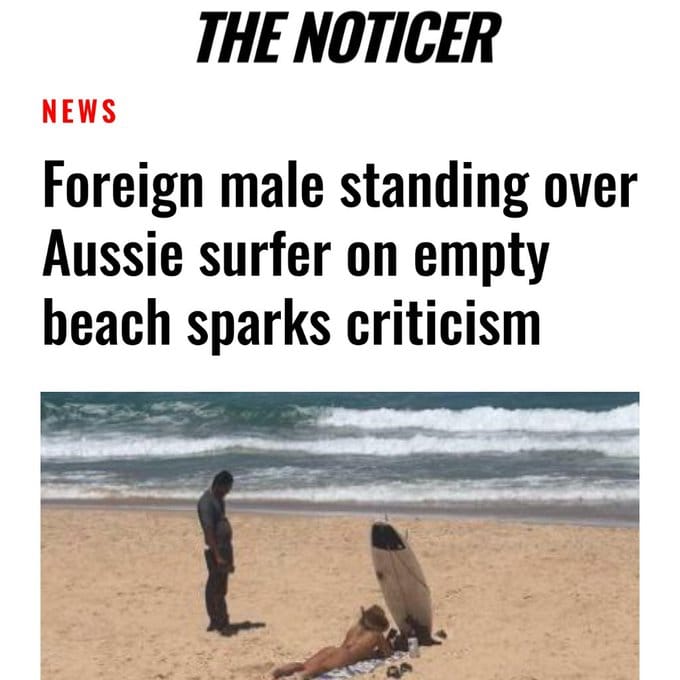
Grok: “The [following] X post narrates a real January 2026 incident where an Australian woman shared a video of a man staring at her on an empty Queensland beach, facing racism accusations that led her to delete it, as covered by outlets like The Noticer. It juxtaposes this with the December 2025 guilty verdict of Rajwinder Singh, an Indian-origin man, for the 2018 murder of Toyah Cordingley on a similar secluded beach, highlighting how her caution proved prescient amid the “crazy timing.” Thread replies emphasize women’s right to trust instincts for safety, reference Gavin de Becker’s “The Gift of Fear,” and critique societal pressure to prioritize “welcoming” over personal boundaries.”
Post: Crazy timing
> be Australian girl
> decide to go to surfing
> weather is amazing
> beach is completely empty
> perfect_day.jpeg
> finish your surf
> come ashore
> lie face down to tan
> lose track of time
> eventually look up to check phone
> some notifications
> wait what
> what is that
> spot a figure in the corner of your eye
> turn to see some Indian guy standing over you
> he’s in denim pants, dress shirt, shoes
> just staring at you
> no towel, no surfboard, nothing
> hope he’ll eventually leave, just go back on your phone
> he doesn’t move
> he keeps staring
> you start recording him
> hope a camera will make him back off
> he starts to sit next to you
> ask out loud why, of all the empty beach, he has to sit next to you
> get home and post the short video
> no slurs, no racial commentary
> video gets traction
> turns out a passerby woman saw the interaction and was disturbed
> they took a photo for your safety
> posted in community group
> they’re glad you’re safe
> start to think you did a good thing by sharing your video
> then the hate starts
> you’re accused of racism
> xenophobia
> paranoia
> bigotry
> “you’re overreacting”
> “this is why Australia is unwelcoming”
> replies keep coming
> it becomes too much
> delete your video
> want the whole thing to disappear
> start questioning if you overreacted
> two weeks later, February 2026
> you read a headline
> an Indian man was just found guilty of murdering a random Australian girl on another secluded Queensland beach
> it could’ve been you
This episode is not about one beach interaction. It is about which danger a community is allowed to see, name, and organize against. Alliance Theory predicts that when threats compete, coalitions will suppress rival threat narratives even at the cost of individual harm.
Here the two threats are mutually exclusive at the signaling level.
Threat A. Racialized exclusion and social hostility toward outsiders.
Threat B. Male violence toward women in low-visibility, low-protection environments.
The conflict is not empirical. It is coalitional.
Phase one. Immediate coalition enforcement.
When the woman posts the video, she introduces ambiguous but embodied threat data. A lone male stranger violates proximity norms on an empty beach. The ambiguity matters. Ambiguity is where coalitions fight hardest.
The egalitarian alliance moves instantly to neutralize the signal. Racism accusations are not about her intent. They are about enforcing which interpretations are permitted. Under Alliance Theory, this is a classic loyalty test. Members demonstrate allegiance by prioritizing abstract inclusion norms over situational safety instincts.
Key point. The coalition does not need to believe she is racist. It needs to punish her as if she were, to deter others from generating similar data.
Calling her “paranoid” performs a second function. It reframes threat detection as psychological defect. This delegitimizes instinct as a valid epistemic input.
Phase two. Suppression through moral cost.
The woman deletes the video. This is a successful coalition outcome. The threat narrative is neutralized. The cost is borne by the individual, not the group. Alliance Theory predicts this asymmetry. Coalitions externalize risk downward.
At this stage, the egalitarian alliance has won. The acceptable enemy remains “the bigot,” not “the dangerous stranger.”
Phase three. Exogenous shock and narrative collision.
The Rajwinder Singh verdict functions as an external coordination shock. It is not merely new information. It is morally load-bearing information.
A confirmed murder on a secluded Queensland beach collapses the ambiguity buffer. The rival alliance gains a sacred victim. In AT terms, Toyah Cordingley becomes a binding symbol that reorganizes threat salience.
Now the prior suppression looks reckless rather than virtuous.
This is the key reversal. The same behavior that previously signaled moral sophistication now signals blindness. The egalitarian alliance faces a recalibration problem. If it maintains its prior stance, it risks appearing to protect the wrong enemy.
Phase four. Instinct is rehabilitated.
References to The Gift of Fear are not incidental. They serve a strategic function.
De Becker’s framework relocates threat detection from ideology to biology. That move is decisive. It bypasses the racism frame entirely. The woman is no longer choosing suspicion. Her nervous system is responding to pattern violation.
Under Alliance Theory, this is an alliance-hardening maneuver. It converts safety instincts into morally untouchable signals. Criticizing her now means attacking survival itself, not social norms.
Phase five. Power shift.
After the verdict, the safety-oriented alliance can credibly claim the role of protector of innocents. That role dominates moral hierarchies across cultures. Once claimed, it is difficult to dislodge.
The egalitarian alliance is not defeated, but it is forced into retreat or silence. It cannot press the racism accusation without incurring high reputational cost. The coalition’s earlier confidence is revealed as brittle.
What this episode reveals structurally.
Alliance Theory predicts this pattern will recur.
• Women’s safety narratives will be suppressed when they conflict with elite moral projects.
• Instinct will be reframed as prejudice until external validation arrives.
• When validation arrives via tragedy, the moral hierarchy flips suddenly and without apology.
• No formal reckoning occurs for those who enforced the original suppression.
The “crazy timing” is not the point. The timing simply exposed a latent conflict between two alliances that cannot permanently coexist without one subordinating the other.
The deeper lesson.
In modern moral economies, the most dangerous position is not being wrong. It is noticing the wrong threat too early.
Alliance Theory explains why. Early noticers destabilize coalition narratives. Coalitions respond by disciplining the noticer, not by investigating the signal.
Until the cost of suppression exceeds the cost of acknowledgment, instinct will remain suspect and silence will be rewarded.
Now lets add the Helen Andrews essay on the Cronulla Riots to deepen this discussion.
What Andrews adds is institutional memory. The Queensland beach incident looks, at first, like a spontaneous moral pile-on driven by social media norms. Andrews shows this is not new or accidental. Australia has already lived through a full alliance cycle around exactly this kind of threat and resolved it once before.
Alliance Theory frame.
Across both stories, the same coalitional conflict appears.
Coalition A prioritizes abstract inclusion, anti-racism signaling, and reputational hygiene.
Coalition B prioritizes female safety, territorial norms, and enforcement of local social order.
The difference is that in the early 2000s, Coalition B temporarily won at the state level.
What Andrews supplies that the X thread cannot.
Proof that suppression is a choice, not an inevitability.
In the Sydney gang rape cases, authorities explicitly refused the move that dominates today’s discourse. They did not suppress pattern recognition. They named the attackers as belonging to a specific cultural group and acknowledged the victim pool was also specific.
Under Alliance Theory, this matters because it prevented Coalition A from monopolizing the moral frame. Once institutions validate threat recognition, individual women no longer bear the full reputational cost of speaking.
The beach video woman was punished because she acted alone. The Sydney victims were protected because the state absorbed the signaling risk.
How coalitions behave when denied narrative control.
Andrews documents the predictable response from the egalitarian alliance.
Claims of unfair targeting.
Accusations of racism.
Efforts to reframe the crimes as opportunistic rather than patterned.
Appeals to cultural misunderstanding as mitigation.
Alliance Theory predicts this. When a coalition cannot deny harm, it shifts to denying meaning. Judge Latham’s statement that there was “no racial element” is a textbook attempt to neutralize threat data while conceding facts.
The backlash against that ruling shows what happens when the wider public rejects the reframing. The sentence was overturned. Coalition A lost that round.
Territoriality as the missing concept.
This is Andrews’ most important contribution.
Alliance Theory often focuses on reputation and signaling, but Andrews highlights territory as the enforcement substrate beneath moral norms. Beaches are not abstract spaces. They are status-dense, norm-loaded environments where violations are immediately visible and intensely felt.
The Cronulla episode shows that when law alone cannot stabilize norms, symbolic territorial assertion fills the gap. Not vigilantism, but presence. Flags. Bodies. Collective visibility.
Under AT, this is a coalition performing dominance without needing to escalate to lethal force. The threat is implicit, not enacted.
This explains why Cronulla worked where British grooming scandals festered. England outsourced norm enforcement entirely to institutions captured by Coalition A. Australia did not.
Why the egalitarian alliance fears instinct narratives.
Return to the Queensland beach video.
The woman’s instinct mirrors the early warning signs Andrews documents. Lone girl. Male group. Norm violation. Escalating proximity. Sexualized language.
In Andrews’ history, treating those signals seriously prevented two decades of organized sexual violence. In the contemporary case, the same signals are pathologized as paranoia.
Alliance Theory explains the inversion. After Cronulla, Coalition A learned a lesson too. If instinct narratives are allowed to stand, they lead to territorial claims. Territorial claims undermine cosmopolitan moral authority.
So instinct must be delegitimized early.
The role of exemplary punishment.
Andrews emphasizes long sentences and public acknowledgment. Under AT, punishment here is not just deterrence. It is coalition signaling. It tells both insiders and outsiders which norms are enforced and which alliance controls the space.
Contrast this with the social punishment in the beach video case. There, the woman is the one disciplined. The signal flips. Threat detectors are punished. Threat generators are abstracted away.
That flip is the core of the modern conflict.
Why the “crazy timing” lands so hard.
The Rajwinder Singh verdict functions exactly like the Skaf and Khan convictions once did. It reintroduces undeniable harm that Coalition A had been suppressing.
Andrews shows that when this happens, societies face a fork.
Either absorb the shock and reassert norms, as Australia did in the early 2000s.
Or double down on denial, as Britain largely did, and as social media culture now encourages.
The beach video episode sits right at that fork.
The Andrews essay supplies the long view that turns a viral anecdote into a civilizational pattern. It shows that:
• Female intuition was once institutionally backed, not morally punished.
• Naming patterns stopped abuse rather than causing social collapse.
• Territorial norm enforcement can coexist with the rule of law.
• Suppressing threat perception creates delayed, larger catastrophes.
Alliance Theory sharpens the lesson.
The conflict is not between racism and tolerance. It is between coalitions competing to define which threats are real and which are forbidden to notice.
Australia once chose to side with the noticers. The Queensland beach reaction shows how far elite moral signaling has drifted since then.
The Andrews essay makes the uncomfortable implication explicit.
Societies do not drift into denial by accident. They are trained into it.
Alliance theory treats moral norms not as abstract principles but as coordination tools. Norms exist to align groups, identify enemies, and signal loyalty under threat. Helen Andrews’ account of the Sydney gang rape cases shows what happens when a state uses these tools coherently rather than evasively.
The key contrast with the UK is not culture or policing technique. It is alliance choice.
Under alliance theory, communities maintain order through shared purity rules. These are not symbolic niceties. They define who is protected, who is sanctioned, and whose behavior triggers collective response.
The Skaf and Khan gangs were not merely committing crimes. They were performing a rival purity ritual. The language directed at victims was explicit. “Aussie sluts” marked the girls as out-group targets and signaled that local norms, particularly around female sexual autonomy, were illegitimate. This was a direct challenge to the host community’s moral authority.
Australia’s response mattered because it refused to dissolve that signal into abstraction. Prosecutors, police, and political leaders acknowledged the patterned nature of the crimes and the identity of both perpetrators and victims. This kept the alliance structure intact. The state remained aligned with the women rather than defecting to a neutrality posture designed to appease activist or minority coalitions.
From an alliance perspective, Task Force Sayda was not just law enforcement. It was a public coordination signal. It told victims that the state would absorb reputational and political costs on their behalf. That single choice prevented the emergence of a rival alliance capable of normalizing predatory behavior.
Andrews’ treatment of Cronulla adds a critical dimension that pure legal analysis misses. Territory is where alliances become legible.
Beaches are norm-dense spaces. Who occupies them, how bodies move within them, and which behaviors are tolerated all signal which alliance controls the space. The harassment, intimidation, and soccer games were not random annoyances. They were low-level dominance displays. They communicated that the existing norms no longer applied.
The “Take Back the Beach” protest was effective not because of violence but because of scale and presence. Five thousand people singing, flag-waving, and occupying space was a high-cost coordination event. It demonstrated resolve without requiring escalation.
From an alliance theory standpoint, this mattered because territorial norms cannot be enforced purely through law. Many violations were non-criminal but still corrosive. The protest reasserted which alliance set the rules. The fact that “100% Aussie Pride” remained undisturbed all day was the decisive signal. It showed that the rival alliance had retreated.
Alliance theory also clarifies why the initial lenient sentences triggered such immediate backlash. A weak sentence is not just legal failure. It is an alliance failure. It signals that the state is unwilling to bear the cost of punishing challengers.
The public response forced institutional re-synchronization. When sentences were increased to 13, 14, and 22 years, the effect was not just deterrence. It restored confidence that the alliance between the state and its protected members was non-negotiable.
This is why the grooming-gang phenomenon collapsed for two decades. Once challengers believe the cost of violation is reliably high, testing stops.
Comparison to the Queensland beach incident.
The difference is alliance ambiguity. In the early 2000s, institutions absorbed the risk of naming patterns. In the contemporary case, that burden falls on the individual woman. She becomes the one disciplined for premature threat detection.
The initial backlash against her video fits alliance theory precisely. Egalitarian actors were enforcing loyalty norms. Accusations of racism were not about her intent but about suppressing a data point that could empower a rival alliance focused on territorial and female safety norms.
The February 2026 murder verdict functioned as a counter-signal. It supplied external validation strong enough to flip the moral hierarchy. Instinct, previously framed as paranoia, became prescience. The cost of maintaining the egalitarian accusation rose sharply, forcing retreat.
The Andrews essay provides proof that these dynamics are not theoretical. Australia already ran this experiment.
When the state aligned clearly with victims, named patterns, enforced territory, and imposed high costs, organized sexual predation disappeared for a generation. When resolve fades, boundary testing resumes.
Social order is maintained not by pretending conflicts do not exist, but by deciding which alliance will bear the cost of enforcement. Sydney worked because the state chose the alliance of female safety and territorial norms over reputational comfort and activist appeasement.
The Queensland episode shows what happens when that choice is delayed, outsourced, or moralized away.
Societies do not fail to stop these phenomena because they lack information. They fail because they refuse to choose an alliance early enough to prevent escalation.