Shalhevet Ousts Founder Jerry Friedman?

Friedman led the school for years and contributed much of its funding. There was a contentious board meeting last week at Shalhevet, the most left-wing of L.A.’s Orthodox day schools. The upshot? Friedman walked away from the school. He’s been in a nasty fight with various board members that’s gone on for months. Much of the staff and instructors at the school are there because of Jerry Friedman. Their days at Shalhevet are now numbered. Shalhevet is left with a major financial problem because Friedman has long been their number one funder. Rabbi Shalom Tendler left YULA boys highschool last year and started his own school (Birchas Yitzchok). Rabbi Tendler was YULA’s rosh yeshiva and the major force pushing it to the right (and the reason many parents chose to send their kids to Shalhevet).
Posted in Education, Orthodoxy | Comments Off on Shalhevet Ousts Founder Jerry Friedman?

A Final Word On Bugs

A Modern Orthodox rabbi writes:

Before Purim I described specific procedures for inspecting leaf vegetables and floreted vegetables. The other items that, based on their infestation levels, require inspection, are strawberries, raspberries, asparagus, and celery. The common-sense methods are described in detail on that same website and so I won’t reproduce them here.I know that it’s tempting to dismiss the bugs issue as being something that only other kinds of Orthodox Jews worry about (fill in whatever term you’d like). Which is why I reiterate that this is as bonafide a kashrut issue as any other, and that being conscientious about this area of kashrut, is just as important as being conscientious about any other. When it comes to halachik commitment, there is only one kind of Orthodox Jew. (As will one day also be the case for embracing inter-denominatonal cooperation, and gender inclusiveness in shul and home.)

Posted in Orthodoxy | Comments Off on A Final Word On Bugs

Dennis Prager Debates Michael Berenbaum

Russell Wardlow blogs about the March 5 U.J. program:

Prager, though I respect him, is constantly frustrating on questions like these in that he seems to refuse following the implications of his beliefs to their logical conclusions. Berenbaum actually went farther in explicitly advocating separation between Israel and the Palestinians.

Prager’s rhetoric is still useful as a corrective to the vague and unreal suggestions about the peace process and moral equivalence that still litter the media landscape, but the fact that he doesn’t speak beyond the present means that he can’t offer any strategy or goal beyond an aggressive holding pattern modeled on the current situation, wherein Israel will presumably continue to kill Palestinians it considers threatening, but not do anything more ambitious or long-term.

The underlying assumption that makes this at all tenable is that the Palestinians will eventually change and become acceptable neighbors. This goes to the more basic problem that liberals like Prager have in discussing the wider problem of Islam: they are, for ideological reasons, unable to extrapolate a conclusion that Islam is inevitably (or nearly so) unreconcilable to the western world, no matter what the evidence says.

On this point, Prager likes to say, "I don’t judge religions, I judge practitioners," and he’s quite willing to say that a huge proportion of Muslims are actively dangerous or at least hostile to us. But he categorically will not say that the belief system of Islam itself is such, holding always to the assumption that anything can happen in the future and that Islam will be whatever Muslims want it to be.

Posted in Dennis Prager, Israel, Politics | Comments Off on Dennis Prager Debates Michael Berenbaum

L.A. Press Club Hosts Immigration Panel Discussion

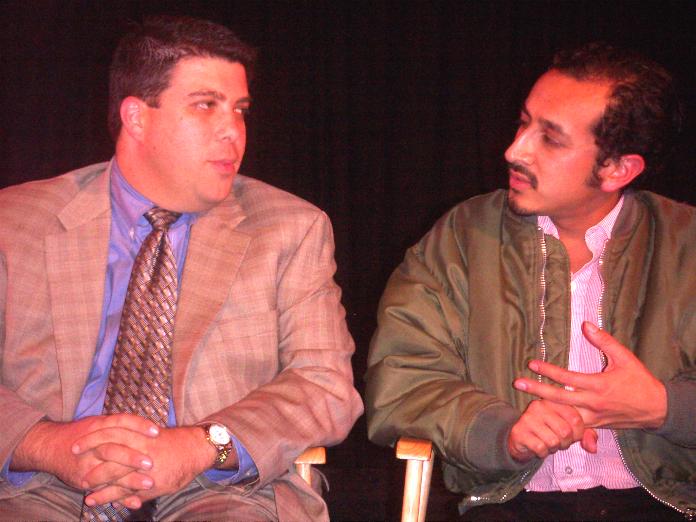
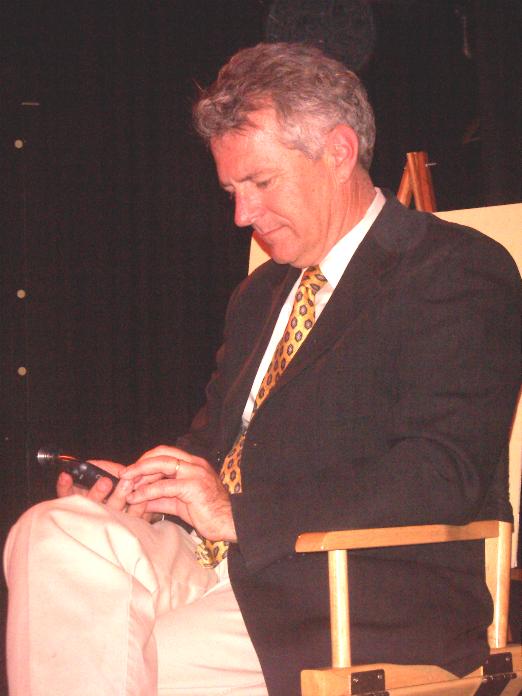
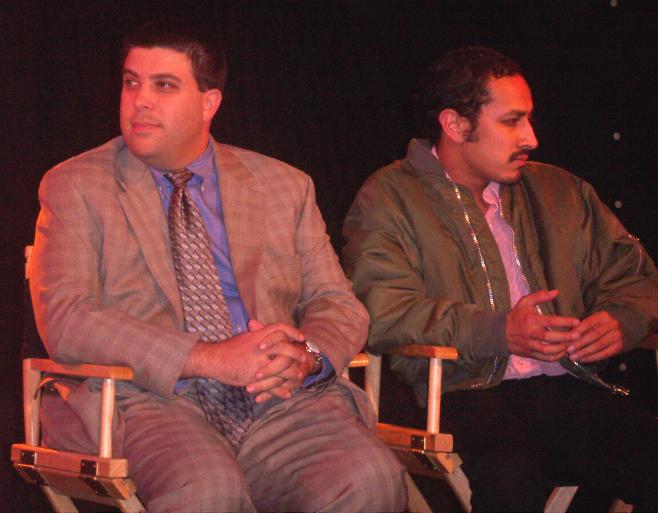
Here’s the audio from Thursday night. Photos: Yes, Virginia, there is a Conan Nolan. Jon Fleischman and Daniel Hernandez don’t see eye to eye, but, thanks to Dr. Conan Nolan, they are able to share their feelings. Publicist Edward Headington has a vision for the L.A. Press Club. Here’s the press release:

Conan Nolan[LF: he served as moderator] is a general assignment reporter for NBC4‚Äôs "Channel 4 News" and co-host of News Conference, the station‚Äôs Sunday morning Public Affairs program. Nolan has been reporting on Governor Arnold Schwarzenegger’s first term in office since the historic recall election in 2003 that included following the Governor on overseas trips to Israel and Japan. Additional foreign assignments included reporting from Kuwait and Iraq while covering ‚ÄúOperation Iraqi Freedom‚Äù for both NBC4 and the NBC network. Nolan has also filed stories from Beirut, Lebanon while reporting on the Arab world‚Äôs view of the September 11 anniversary.


Nolan won an Emmy award for his reports from the Pakistani frontier on the U.S. led campaign to defeat the Taliban in Afghanistan. He was also in Rome for the selection of a new Pope after the death of Pope John Paul II.

Steve Gregory is based at KFI-AM Los Angeles – America’s most listened to News Talk Station. Steve has covered some of the nation’s biggest stories. Steve spent 15 days in the back of a news truck during the nation’s longest prison standoff in Buckeye, Arizona. He also spent 13 days in the same truck covering the nation’s largest wildfire in northern Arizona. His investigative stories have uncovered a medical billing scam within the Arizona State Prison System and led to the demotion of an Assistant Chief in the Phoenix Police Department.

Steve is a four time recipient of the Edward R. Murrow Award. The Associated Press in California, Arizona and Colorado has given him numerous awards for Best Talk Show, Best Newscast, Best Special Program and Best Series. Steve has won international media awards for his series on the Phoenix Fire Department, his series on the U.S. Border Patrol and a feature on Arab-American comedians. A great deal of Steve’s time is spent on immigration issues. From protests and rallies on the streets of Los Angeles, to the dusty roads along the border of Mexico, Steve has covered most sides of the highly charged debate. In April of 2004, Steve was embedded with the original Minuteman Project in Arizona. He lived with the volunteer group for almost 30 days, going on patrols and observing strategy meetings. That year, the Arizona Associated Press awarded Steve Best Talk Show, Best Special Program and Best Use of Sound for his continuing coverage of the controversial project. Steve has also spent a lot of time with Customs and Border Patrol Agents. His 5-part series, “Dying in the Desert” won him the national Edward R. Murrow Award for best news series of 2002. The program explored the rising deaths of immigrants who illegally crossed into the U.S. from the agent’s and immigrant’s point of view. The California Associated Press has given Steve top honors for his coverage of the California Minutemen. His 3-part series on the California National Guard’s deployment along the Mexico border won him a Golden Mike. Also, He is part of the Golden-Mike-winning live coverage of the massive immigration march and protest in downtown Los Angeles in May of 2006.

Steve has also been covering the ongoing case of two former border patrol agents imprisoned for wounding an illegal alien drug smuggler. He was present at the agent’s sentencing and surrender to federal authorities in El Paso, Texas.

Jon Fleischman is the founder and publisher of FlashReport.org, a primarily volunteer endeavor for Jon, as his passion remains in the political arena.

Daniel Hernandez is a staff writer with the LA Weekly in Los Angeles. Prior to that, he was on staff at the Los Angeles Times. Hernandez has written about immigrants and immigration, bilingualism, people, neighborhoods, graffiti and street art, politics, fashion, hipsters, media, and a little music, food, and books. His work has also appeared or been reprinted newspapers across the country and in publications based in Berkeley, L.A., San Diego, Mexico City, El Paso, San Francisco, Paris, and other places. In 2006, Hernandez was named "Emerging Journalist of the Year" by the National Association of Hispanic Journalists, and participated in the USC Annenberg/Getty Arts Journalism Fellowship. He is also an occasional commentator for "All Things Considered" on National Public Radio.

Posted in Journalism, Politics | Comments Off on L.A. Press Club Hosts Immigration Panel Discussion

Un-Orthodox Jew Goes After Rabbi Shalom Tendler

Un-Orthodox Jew blogs March 5:

Continue reading

Posted in Orthodoxy | Comments Off on Un-Orthodox Jew Goes After Rabbi Shalom Tendler

Who Has Time To Read Blogs?

Daphne Merkin wrote on Jewcy: "Does anyone other than a late-rising member of the chattering classes‚ anyone who is gainfully employed, say, in drilling teeth or writing up legal briefs‚ have the time to read, much less write these things?"

Who has time to read good new books? Nobody has time to read all the good new books, yet I don’t read Daphne Merkin wondering about that. People will read what they believe they will most profit from. Frequently that will mean blogs.

For instance, the most likely place that Daphne Merkin and John Derbyshire are going to be discussed for this dialogue is on a blog. I wonder how quickly Daphne or John will check out a blog once they’ve heard, "I can’t believe what they revealed about you!" Would it take them one second or two seconds to navigate there?

Matt Drudge has affected journalism more than any other person in the past decade and he’s a blogger. I read on Drudge at 11:30 a.m. on election day 2000 that George Bush won in a squeaker. That meant that I knew who would be our next president about six weeks before those who solely got their news from mainstream sources.

To put things in perspective for Ms. Merkin, I suspect I get more readers in a day (about 10,000) to my blogs than have ever read her novel ‘Enchantment.’

The solitary art of blogging is not inherently different from the solitary art of writing for publication in newspapers and magazines. There are plenty of essays I’ve written for websites that I have worked on for years.

Not all blogging is tossed off and not all writing for publication in The New York Times is considered. And not all writing that is tossed off is bad and not all writing that is considered is good. Spontaneous prose sometimes sparkles and studied prose sometimes drags (a la ‘Enchantment’). What primarily matters about a piece of writing is not who publishes it but whether the work has merit. Daphne’s writing on blogs, for instance, lacks merit even though it is published by the frequently provocative Jewcy.com.

Posted in Author Interviews, Journalism | Comments Off on Who Has Time To Read Blogs?

I Don’t Care About The Decline Of Newspapers

PBS Ombudsman Michael Getler writes:

Although most people get their news from television, and the Web is growing steadily, and bloggers and citizens with cell phone cameras are all contributing in some way to pieces of news, it is newspapers that provide the overwhelming body of news that is made public in this country. It is the newspapers — with experienced, trained reporters and editors who steadily cover city councils and the White House, who uncover scandals and report things you would never know about otherwise — that drive the news agenda for television and much of the Web. So they always have been, and remain, at the heart of what we know about lots of things and how we know it.

There are still several good, and profitable, small and medium-sized newspapers around the country that perform tough, and often courageous, reporting about local matters. But it is the handful of big, serious and tough-minded newspapers that are central to so much of what is important to uncover in this country and the world. We need these papers because they are committed to no-punches-pulled journalism and because they are big, which means they have the resources to keep bureaus around the world, to support teams of investigative reporters here at home, to withstand pressures from big advertisers and to fight the legal challenges and political pressures from government, politicians and industry.

There are two primary reasons why I disagree with Getler.

First, basic economics. If a profit-seeking enterprise such as The Los Angeles Times, cuts staff, that indicates that there is insufficient demand for their services and that the money that went to employing such staff could be more efficiently used elsewhere.

If the staff have valuable journalism skills, it will be in the interest of some other profit-seeking enterprise to employ them, be that a newspaper or a blog or a magazine.

Second, my own example. In the subjects (movie and television producers, Jewish journalism, the sex industry) that I know best, the most important work has been done by a blogger, me.

I got 1135 on my SATs (and that was representative of my learning). I’ve taken many IQ tests and have never scored above 130. I’m not the sharpest knife in the drawer. I am only literate in one language.

If you look at where I live and how I live, I’m slovenly. Yet I’ve managed to do the most important work in the subject areas of my five books (and that material showed up first on my blogs). For instance, in the Spring of 1998, I broke the news on a string of HIV-infections in the San Fernando Valley’s porn industry. The mainstream media did not pick up that story in depth until January 2003 in The Los Angeles Times. Even then, the Times did not significantly advance the story.

There’s been one person over the past ten years who has broken more news stories than any other writer/journalist — blogger Matt Drudge.

Joe, a MSM journalist, emails:

Actually, he hasn’t broken stories through his own reporting; he’s broken them by finding out what MSM journalists are working on and writing about them before they see print (Clinton sexual foibles/Newsweek being the most famous example).

Anyway, there’s a difference and one that sort of proves the worth of the journalists that Drudge and other bloggers “borrow” from or comment on.

There is a difference between doing the hard work of ferreting out information, digging through records, talking people into telling you their secrets, and being handed all that work because another publication won’t publish it.

Drudge broke the Lewinsky story by finding out what Newsweek had and publishing it four days before Newsweek bothered to publish. However you cut it, Drudge broke the story.

How did Newsweek get the story first? They were given it, just as Drudge was given the story.
I broke the the Antonio Villaraigosa marriage story by getting it from MSM journalists who knew that the somnolent L.A. Times, LA Weekly and LA Daily News wouldn’t want to break such a story.

Drudge broke some stories by finding out what MSM journalists were working on just as MSM journalists steal stories from fellow MSM journalists. Drudge broke some stories that were given to him just as MSM break stories that are given to them.

If Drudge didn’t break Lewinsky because he did not come up with the original information, then Watergate was not broken by Woodward and Bernstein. Those two Washington Post journalists were given info from a grand jury investigation and other investigations.

Journalists rarely break stories (as documented by Edward Jay Epstein’s essay in Commentary circa 1974 and in Epstein’s 1975 book on journalism Between Fact and Fiction: The Problem of Journalism). They are given them by interested parties (a la Judy Miller).

All the best stories I’ve ever had have been given to me.

I deserve credit because they were given to me and not someone else.

Why were they given to me? Because I took the time to ferret out and publish middling stories that caught the attention of people with great stories who knew that if I was given these great stories, I would publish them, no matter the cost.

Most great stories are controversial and come with a heavy price (usually to the one publishing them as well as to others). Unlike most journalists, I don’t hold back on publishing something I know will antagonize people who can hurt or help me.

Good journalists (be they MSM or bloggers), like bad journalists, are given their best stories. The difference is that the good journalist recognizes a good story, and pursues the story given him.

A distinguished journalist does enough work to gain himself notice and credibility. He can charm people and increase the likelihood of being given good stories. A good journalist then verifies the information he is given.

Just as MSM journalists take from each other, they frequently take, often without attribution, from blogs. When producer Edgar J. Scherick died, The Los Angeles Times and other media took quotes he gave to me but without crediting me. In my first few posts to newsgroups, I did this shoddy thing (in early 1997 but not afterwards) and many bloggers and MSM journalists have done this (taken information and quotes without attributing their source). Some mainstream journalists are ethical and some bloggers are ethical. Neither side owns honesty or reporting.

I don’t mourn the decline of newspapers because I know that other sources of information will take their place. There’s always going to be a strong demand for information and numerous people who will want to meet that demand and profit from it.

Brian Doherty, an author and editor at Reason magazine, emails me: “Your post on why you don’t care about decline of newspapers was very wise and perceptive, one of the truths about journalism that self-important pros with all their talk of teeth-gritting and shoe leather don’t like to stress to the hoi polloi.”

Posted in Journalism | Comments Off on I Don’t Care About The Decline Of Newspapers

I Supported The War In Iraq And I Was Wrong

Jacob Weisberg delivers four unspeakable truths about the fight (and I tend to agree with them):

1. The war was a mistake.


2. Our soldiers are as much victims as heroes. "People join the military for a variety of reasons, of course, but since the Iraq war turned ugly, the all-volunteer Army has been lowering educational standards, raising enlistment bonuses, and looking past criminal records. The lack of better choices is a larger and larger factor in the choice of military service. Our troops in Iraq may not see themselves as cannon fodder or victims of presidential misjudgments, but that doesn’t mean they’re not."

3. American lives lost in Iraq have been wasted.

4. America is losing or has already lost the war.

Chaim Amalek writes:

Yes, he does (my reading comprehension skills are in steep decline). But the $100,000,000,000 question is, given that we ARE in Iraq, HAVE deposed Saddam, and ARE engaged with some fairly wicked people, what do we do? Pull the plug and leave those Iraqis who sided with us to their predictable fate? Cede a third of the country to Iran, with the rest going to Syria?" Now that we are there, we should protect the oil fields and those areas that are of most strategic importance for the United States. Aside from that, we should pull our troops out of harm’s way. We should conduct ourselves in Iraq in the same way we should run our immigration policy — in our self-interest. If immigrants have needed skills and money, we should let them into our country. If they don’t, we should not. If the benefits of us controlling certain parts of Iraq exceeds the cost, then we should do it and keep doing it until the cost exceeds the benefit. We should primarily think about the self-interest of the United States and how we can achieve it at the least cost (in lives and dollars).

Posted in Politics | Comments Off on I Supported The War In Iraq And I Was Wrong

I Don’t Know What To Do About My Feelings For Daphne Merkin

For how long can I love a woman who ignores me and scorns my medium? I loved Daphne’s essays so much that I read her novel Enchantment, which is a complete snooze (ala Jim Jarmusch). I twice sent her a letter seeking an interview and twice I received no reply. I fawned over her in my interview with novelist Melvin Jules Bukiet. On Jewcy.com, Daphne discusses blogs with John Derbyshire (who praised my interview with Heather MacDonald but did not answer either of my emails seeking an interview). She writes:

Here’s my question about Wolcott: why does any print journalist or writer need a blog? Doesn’t Wolcott get enough space to air his sometimes interesting, sometimes merely snappish thoughts and mini-thoughts in Vanity Fair?

Daphne has obviously never blogged and doesn’t know the first thing about blogging. How can she be so neanderthal as to think that blogs are only for expressing opinions? A blog is just a form of communication technology. It’s like a cell phone or a computer or a fax. There are many advantages for working writers having a blog, including: * Lots of matters are not substantial enough for an essay. * Lots of matters are not suited for your publication. * Blogging is often spontaneous, and does not take the effort that writing for a regular newspaper or magazines requires. You can begin to work out something in a few paragraphs on a blog and then transform it later into a polished piece. * Blogging is usually a quicker way to communicate than preparing an article for a paper or magazine. In a fast moving story, you can get something up and out on a blog more easily and quickly than for a regular newspaper or magazine. * Blogging gives you the freedom to experiment. * Blogging allows you to ask your readers for help. In short, a blog is as useful to a writer as a cell phone or fax.

Posted in Author Interviews | Comments Off on I Don’t Know What To Do About My Feelings For Daphne Merkin

John Derbyshire: ‘When a woman gets past her mid twenties, her probability of being raped drops off like a continental shelf’

He writes in National Review:

Some of the most vituperative emails I have ever got came in after I made an offhand remark, in one of my monthly NRO diaries, to the effect that very few of us are physically appealing after our salad days, which in the case of women I pegged at ages 15-20. While the storm was raging, biologist Razib Khan over at Gene Expression (forget philosophers, theologians, and even novelists: the only people with interesting things to say about human nature nowadays are the scientists) decided to look up some actual numbers. Reasoning that a rapist is inspired to his passion mainly by the physical attractiveness of his victim, Razib went for rape statistics. He found a 1992 report (Rape in America: A Report to the Nation) from the National Victim Center showing the age distribution of female rape victims. Sixty percent of the women who reported having been raped were aged 17 or less, divided about equally between women aged 11 to 17 (32 percent) and those under eleven (29 percent). Only six percent were older than 29. When a woman gets past her mid twenties, in fact, her probability of being raped drops off like a continental shelf. If you histogram the figures, you get a peak around ages 12-14… which is precisely the age Lolita was at the time of her affair with Humbert Humbert.

Posted in Sex | Comments Off on John Derbyshire: ‘When a woman gets past her mid twenties, her probability of being raped drops off like a continental shelf’