The L.A. Times Misses Robert Scheer

I can’t stand Scheer’s politics but his left-wing replacements on the L.A. Times Op/Ed page rarely pack his punch. He’s a good funny writer who’s yet to be adequately replaced at the Times.

I know Cathy Seipp’s rolling over in her grave as I blog this.

Posted in Los Angeles Times | Comments Off on The L.A. Times Misses Robert Scheer

I Strike Out On JDate – What Am I Doing Wrong?

Ladies, why am I still single?

When I came to Los Angeles in 1994, I placed and answered a bunch of singles ads and met a lot of women and had some good times.

In 1997, I went on jdate and had little success.

Ten years later, I returned.

Over the past two days, I’ve emailed 60 women. Four answered me. I spoke on the phone to one.

After we finished talking, I noticed that my chest was covered with angry red hives (and that rarely happens to me, only when I am forced to confront myself and see someone I don’t like).

Here’s how I described myself in my JDate profile:

I like to read and write. That’s how I spend most of my time. It’s how I earn my living. I’m cynical and sarcastic and my favorite music group is Air Supply (that’s not sarcastic). I like to be around smart people who make me laugh. I hate conflict in my personal life. I have enough through my writing. I hate irresponsibility and laziness. I despise people who abuse drugs and alcohol. I believe in hard work, family, friends, Judaism, and learning. I have issues with authority. I’m a rebel with a shul. I like writing about the people society rejects but I don’t want them in my personal life.

My perfect first date:
An Air Supply concert. Joke. It doesn’t matter. If you’re fitted for the other person, you could go somewhere you both hated and it would only bond you tighter.

My ideal relationship:
Common interests and support for the other person even when you don’t share interests. You must always respect the other person and once that goes, it’s over.

I am looking for a:
Someone smart, well-read, funny and committed to Judaism. Everything else is optional.

If anything good happens for me on jdate or elsewhere in my romantic life, I won’t be writing about it. I don’t see much point in autobiographical writing unless it reveals humiliation.

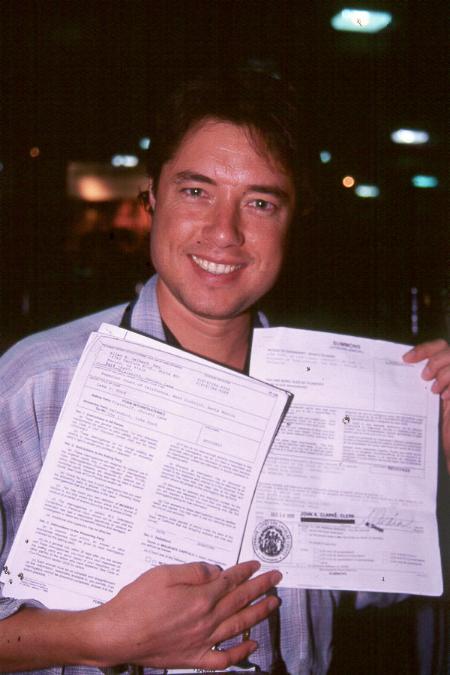
I put on my profile these two pictures — one of my holding up two lawsuits I’d just received (Jan. 2000) and the other (June 2001) of me wearing black shoes, white socks and some horrible shorts and t-shirt.

As I get older, the ladies seem to get smarter.

Sometimes I fear that my life is headed in the wrong direction. Today I got a hit from this website about 15-year old girls in bikinis. I don’t think this was for one of my learned Torah commentaries.

Joe emails:

I just wanted to give you some feedback about your JDate photos.

They aren’t really going to get you anywhere. The one in the shorts is tragic, I don’t know if you’re feeling bad about yourself, or if you are setting yourself up for failure, but they just aren’t going to help you.

My advice:

* start working out. You can get one of those tube train things for doing solo workouts at home, very inexpensive.

* buy some "phyto protein 100% pea protein isolate", it’s kosher and a great source of protein.

* try getting some photos where your look a bit more alpha-male /masculine. The one with you in the shorts looks very sad, you look like you live at home with your Dad and are on a disability pension.

I’ve been doing a scientific survey and it turns out that my Jewish Journal profile only appeals to the homeless and mentally ill.

Khunrum writes:

Come now Luke. You know as well as anyone else why you can’t get a Jewish woman. You’re broke, live in a hovel and tool around in a wreck that no self respecting undocumented Guatemalan would drive. Your face is fat and your body out of shape with thinning Grecian Formula hair. A Jewess on the lookout for a mate wouldn’t hire you to mow the lawn.

Let me advise you once again to aim lower. There must be a nice, simple "good girl"  just looking for a guy like you. A gal, perhaps in this country illegally, who grew up in a shack and who’ll appreciate an older man living in 300 sq. ft. The Serial Killer Van is perfect for driving her 20 or so relatives to the Social Security and Food Stamp office. Try searching Filipino Markets and Bodegas in your area. Or someone else’s area. Never give up my friend. Love is just around the corner.

Posted in JDate, Personal | Comments Off on I Strike Out On JDate – What Am I Doing Wrong?

The President, the Pope, and the Prime Minister: Three Who Changed the World

National Review Editor-At-Large John O. Sullivan speaks (audio) about his new book Tuesday night to the David Horowitz Freedom Center Book Club.

Video of Michael Finch’s introduction. Video of Sullivan’s 35-minute speech. Video of John O’Sullivan taking questions for 20 minutes.

I run into an acquaintance I haven’t seen in about a year.

"Where’s that blonde woman you’re always following around?" he asks.

"Cathy Seipp?"

"Yeah."

"She’s dead."

On March 22, Sullivan wrote this tribute to Seipp.

When I told John I was a blogger, he asked for my website address.

I gave him my card.

"I’ve heard of you," he says.

We pause to think how on earth this gentleman had heard of me and then we realize — it was through Cathy.

Even though she’s no longer shlepping me around, Cathy’s still helping me meet a better crowd.

On August 20, Sullivan was on Hugh Hewitt’s show for three hours. Hour One. Two. Three.

Tonight, Sullivan says: "Did anyone predict [the fall of communism]? I think I know personally all the people who did. Brian Crozier [sp?] told me in the early ’80s that communism would collapse within a few years, by the end of the decade. He subequently forgot that he had told me this. Robert Conquest, the great Sovietologist made a similar prediction though he didn’t set a date on it. I was lucky enough to meet before his death Andrei Amalrik, who wrote the book "Will The Soviet Union Collapse Before 1984?" When that book came out, people dismissed it as absurd."

Sullivan concluded this way: "We have one example that they [Regan, Thatcher and the pope] didn’t. We have their example."

In the question time, I ask: "Where does your book break new ground?"

John: "In a number of places, particularly in my use of the Soviet archives [now largely closed under Putin]."

At 3 p.m. Tuesday, I set up shop at the Starbucks on Barrington Court (on Barrington just south of Sunset Blvd.). Over the next three and a half hours, I consume two Orange Blossom iced teas and one Green Tea frapuccino and Paul Johnson’s book Art: A New History (all sized venti).

Looking up from my book at 5:30 p.m., I see Dustin Hoffman walk by with a young man. They disappear into the restaurant Brentwood.

I curse myself for not having my camera. Last night and this morning I came upon fresh spectacular car accidents (glass slivers across the road) but I didn’t have my camera.

I must bear witness.

From Publishers Weekly:

Having produced in a fairly short span equally weighty histories of the Jewish diaspora, the modern world and America, as well as a number of smaller books and a stream of articles, near-septuagenarian Johnson, historian, journalist, conservative gadfly and Sunday painter, has produced a massive and contentious history of art. Johnson (Intellectuals) is a product not of the cloistered academy but of the rough-and-tumble world of British journalism (before his conversion to Toryism he edited the left weekly New Statesman). While his narrative is for the most part a conventional journey through the canon, his headlong pace, quirky views and pungent prose make it anything but dull. The quick, forceful judgments Johnson makes on the art and artists he encounters are always amusing and sometimes enlightening, particularly his attention to the undervalued "regional" realist traditions of the 19th century. But the tone of constant bluff provocation can become wearying, and the book’s putative polemical mission-to help develop an appreciation of art that would help "society defend itself against cultural breakdown"-doesn’t really make itself felt until the book’s last and weakest section, a rather scanty section on modernism and postmodernism that is pure New Criterion-style cultural conservatism. All writers of single volume art histories must contend with the rightly ubiquitous and magisterial Janson and Gombrich, and despite its wealth of free-flowing ideas and 300 handsome reproductions, Johnson’s book (which also lacks a bibliography and footnotes) simply cannot compete. But as a passionate amateur’s personal survey, the first seven-eighths of Johnson’s history bring a refreshing sense of bluntness to an often staid tradition.

Posted in David Horowitz | Comments Off on The President, the Pope, and the Prime Minister: Three Who Changed the World

Cushy Confab’s Contrasting Coverage

The Forward reports Aug. 3:

A strange thing happened in Utah this week: Some 40 leading Jewish academics, writers, rabbis and professionals descended on the mountains of Park City, where, among other things, they built teepees.

Although the media wasn’t invited to watch the experiment, which was couched as a “team building” exercise by the outdoor company running it, plenty of kvetching could be heard afterward.

“God didn’t put me on earth to build teepees,” one attendee said. “Apart from schlepping these logs, I didn’t have much to do,” another said. And when facilitators voiced disappointment at how long it took participants to complete their task, a third promised to take it up in therapy.

Rob Eshman writes for the Jewish Journal Aug. 3:

I just spent two days listening to some of the most brilliant and famous Jewish scholars, rabbis and thinkers in the world discuss the question "Why Be Jewish?"

The Bronfman Foundation, which sponsored the conference last week in Deer Valley, Utah, is set to launch something called the Bronfman Vision Forum that will offer new ways to invigorate and revitalize Jewish life, and this conference was designed to help generate new ideas and programs, and, yes, more conferences. What an endearing and Jewish idea — that talking will save the Jewish people.

Among the 40 luminaries at the event were Rabbi David Ellenson, president of Hebrew Union College-Jewish Institute of Religion; New Republic columnist Leon Wieseltier; French philosopher and author Bernard-Henri Levy; kabbalist Arthur Green; Rabbi Avi Weiss; feminist Tova Hartman; author Anita Diamant; historians David Myers and Jonathan Sarna; therapist Esther Perel; psychologist Wendy Mogel; and Rabbi David Wolpe of Sinai Temple in Westwood.

The names begged the question: if you could spend a couple of days at a mountain resort hearing these people teach, discuss and debate, why not be Jewish?

Eytan Kobre writes on Cross-Currents Aug. 17:

Why would Orthodox Jews, sophisticated and glib ones at that, at best sit docilely by, and at worst join in the gladiatorial frenzy, as their faith community, their families, their rebbes, their cherished beliefs, are singled out for public censure as immoral and as an octogenarian am ha’aretz feels entitled, having paid for the food, to boorishly rub his rejection of the essence of Judaism in his beneficiaries’ faces?

There are, it would seem, three possible answers. One is simple cowardice. Another is simple avarice, that is, fear of ruffling the feathers of the goose that lays the golden eggs they so hungrily consume. The Forward itself suggested as much, writing about the whole bunch of fearless intellectuals that “off the record, participants grumbled about the conference’s disorganization, lack of focus, academic arrogance and moments of sexism (the last being likely the fault of the conference’s Orthodox coordinator; you know how deeply sexist those kind are – EK). But no one wanted to step on another’s toes, and certainly nobody wanted to step on the Bronfman purse strings.”

In other words, the dynamic here may have been no different than that at play when, in the past, Orthodox Jews, to their great shame, sat by passively as Michael Steinhardt—another boor who confuses “philosophy” with “philanthropy”—appeared before a high society dinner—one marking Richard Joel’s retirement from the Hillel presidency to assume that of Y.U.!— in full Chasidic dress to nastily lampoon Orthodox Jews. Is there anyone who doubts that a comparable blackface performance would have gotten him thrown off every board he sits on?

Posted in Blogging, Forward, Jewish Journal, Jewish Journalism | Comments Off on Cushy Confab’s Contrasting Coverage

Don’t Insult Anyone

Rabbi Gil Student blogs:

The Mishnah (Avos 4:3) quotes Ben Azzai as saying:

Do not insult any man and do not dismiss anything, for there is no man who does not have his day and there is no thing that does not have its place.

It is telling that the Mishnah uses the phrase "kol adam — any man." Rashi explains that this is to teach us not to insult "any man in the world," which I think clearly includes Gentiles and non-religious Jews.

While the Mishnah seems to imply that this admonishment is based on a utilitarian reason — certainly no small concern — the Tiferes Yisrael offers a different explanation:

Do not insult any man — even a fool, a simple man and someone mindless, and even if he is a wicked man who is sentenced to death. Pity their ruined state and do not insult them because you are only offending their Creator. Even if you do not know why they exist, God understands his ways: "The Lord has made everything for its purpose, even the wicked for the day of trouble" (Prov. 16:4).

Posted in Judaism | Comments Off on Don’t Insult Anyone

Why Are Novels By Women So Easy To Read?

Because they don’t use the difficult vocabulary more common to male writers.

Posted in Literature | Comments Off on Why Are Novels By Women So Easy To Read?

Is This The End Of English Literature?

A.N. Wilson writes:

What do the following have in common: Oscar Wilde, Henry James, Joseph Conrad, Virginia Woolf, T S Eliot, W B Yeats, Charles Dickens, William Makepeace Thackeray, Evelyn Waugh, Philip Larkin and Kingsley Amis?

The answer is, of course, that if they were to come back to life in Gordon Brown’s Britain and wanted to go out to their club, or a restaurant or café, they would not be allowed to indulge in a habit which sustained them during the most creative phases of their lives.

The moment they popped their favoured cigar, cigarette or pipe between their lips and lit up, they would have been fined on the spot.

…I have been racking my brains to find a single non-smoker among the great English poets or novelists of the 17th, 18th, 19th or 20th centuries. Possibly, Keats had to lay off the pipe tobacco a bit after he developed tuberculosis.

Otherwise, from Swift and Pope to Cowper and Wordsworth, from Byron to Charles Lamb, they were all smokers.

Posted in Literature | Comments Off on Is This The End Of English Literature?

Is ‘Journalism’ A Profession?

I loathe the term "journalism." It’s a transparent attempt to make "reporting" respectable and to give reporters more room to offer their opinions.

I love how former New York Times Washington bureau chief Michael Oreskes said: "Matt Drudge and I are not in the same profession."

Guess what, Michael? Neither you nor Matt are in a profession.

What is a profession? I looked up the term on Wikipedia and got this:

A profession is an occupation, vocation or career where specialised knowledge of a subject, field, or science is applied. It is usually applied to occupations that involve prolonged academic training and a formal qualification… Professions are usually regulated by professional bodies that may set examinations of competence, act as an licencing authority for practitioners, and enforce adherence to an ethical code of practice.

I guess journalism does not fit the bill for a profession. You don’t need specialized knowledge nor academic training nor formal qualification to practice it. You are not regulated by professional bodies nor are there examinations of competence. There is no licencing authority for practicioners and there’s no enforced adherence to an ethical code. Journalists have so many conflicting ethical obligations (to themselves, to their craft, to their peers, to their employers, to their advertisers, to their subjects, to their readers) that an ethical code for journalism has little meaning.

 I see reporting as a craft. According to Wikipedia: "A craft is a skill, especially involving practical arts. It may refer to a trade or particular art."

Posted in Journalism | Comments Off on Is ‘Journalism’ A Profession?

Blogs: All The News That Fits

Kevin Roderick posts:

Today’s Times Opinion section runs another piece proclaiming the blogosphere lacking — this time in factual political reporting. It read to me as if journalism professor Michael Skube wasn’t familiar with the trend toward blogs by political journalists, and toward more good journalistic blogs by non-pros. Well, it turns out Skube hadn’t even read at least one of the websites he mentions — Talking Points Memo is specifically known for its original reporting efforts — and the professor says Times editors inserted it in his piece.

Jay Rosen posts:

Retire, man. I’m serious. You’re an embarrassment to my profession, to the university where you teach, and to the craft of reporting you claim to defend. It is time for you to quit, as you’ve clearly called it quits on learning— and reporting. Ring this guy up and ask him to go bass fishing or something. You’re not doing anyone any good— you’re just insulting your own bio. And when you’re done lecturing us on “the patient fact-finding of reporters,” tell the godforsaken LA Times they’re going to have to run a correction. The Post hasn’t won a Pulitzer for its reporting on Walter Reed Army Medical Center.

I emailed Michael Skube Monday morning with the header "When was the last time you broke a story?":

Dear professor,

As a blogger, I do it all the time and the MSM follows me (examples include the disintegration of LA mayor Antonio Villaraigosa’s marriage, an HIV epidemic in the porn industry, Anthony Pellicano’s latest troubles (broke on my blog lukeford.net in 2002 days before the MSM)….

In fact, I doubt there is anyone in the MSM who has broken as many stories over the past decade as I have on my blogs.

Sure, you can write opionated op/eds for the LA Times etc, but do you ever do any groundbreaking reporting or do you just pontificate about it?

It’s curious that you will allow an LAT editor to insert disparaging comments in your name about a blog (TPM) you say you don’t read. Most journalists I know would be embarrassed to do such a thing. Do you feel any embarrassment or are such facts just an annoyance to you?

Skube did not respond. I guess it has been a long time since he’s broken a story. I guess he feels like he can pop off with his unresearched and unfactual opinions without having to defend himself. Nice gig being a shoddy journalism professor.

Posted in Blogging, Journalism | Comments Off on Blogs: All The News That Fits

Black Columnist Larry Aubry

Jim Newton falls all over himself to praise "respected" Los Angeles Sentinel (a hysterical black newspaper) Larry Aubry in a 30-paragraph story that says nothing. It’s a complete waste of time. I read it carefully to look for one genuine insight. I came up empty.

Newton writes: "Larry Aubry is an exception to that reticence. Deep in experience, both thoughtful and outspoken, he is a wise and energetic activist who has lived the travails and triumphs of African Americans and yet is able to see those experiences objectively."

What condescending crap. Would Newton and the Times ever write that about a white guy, even Jesus Christ? I doubt it.

Posted in Blacks | Comments Off on Black Columnist Larry Aubry