The chaps who win gold medals – even those as geeky as Michael Phelps – are the principal objects of desire for many female athletes. There is something about sporting success that makes a certain type of woman go crazy – smiling, flirting and sometimes even grabbing at the chaps who have done the business in the pool or on the track. An Olympic gold medal is not merely a route to fame and fortune; it is also a surefire ticket to writhe.
But – and this is the thing – success does not work both ways. Gold-medal winning female athletes are not looked upon by male athletes with any more desire than those who flunked out in the first round. It is sometimes even considered a defect, as if there is something downright unfeminine about all that striving, fist pumping and incontinent sweating. Sport, in this respect, is a reflection of wider society, where male success is a universal desirable whereas female success is sexually ambiguous.
It would be really nice for you to actually do some homework before sharing your thoughts with the world. It was John Newton who wrote Amazing Grace and was one of the major influences and inspirations in the abolitionist movement. He was a mentor of William Wilberforce (look it up) and that movement eventually moved to the USA where these penitent sinners ran the underground railroad, risking their lives as slaves were helped to freedom for decades preceding the Civil War.
Oh yeah, when you converted to Judaism didn’t you learn the concept of Teshuvah? How about Yom Kippur? Judaism is not a religion that has to put down the faith of others to exalt itself.
God is gracious to all,
Steve Rowitt
Coral Springs, FL
I forget who wrote a song while I’m sick and in conversation with Marc Gafni and some stranger with plenty of leisure to nail down the details feels like that entitles him to lecture me on penitence.
Jim emails: "No need to get snippy when someone calls you out for being an insufferable–and ill-informed–gasbag. Fag."
Joan is scheduled for surgery today at 10:30am. If all goes as anticipated the procedure will last about 6 hours but this includes travel time to and from the OR, prep time there, etc, etc, so the time on the table will of course be less.
Joan had reponded strongly enough to Tuesday’s procedures and the aftermath that the doctors will attempt three different repairs in today’s operation.
In order of importance, they will first insert a pin in her tibia of her right leg. Next they will deal with the break in Joan’s ankle. Then hopefully they will insert a plate relative to the humerous (sp?) in
her right upper arm.
More good news. They have taken Joan off sedation although she remains on a morphine drip for pain. They are not overtaxing her with commands/requests to ascertain her responses, but as of this morning I am told that more consistently than yesterday she will move her thumb or squeeze her hand when asked to do so to answer direct questions.
Also, improvement in her lung capacity is better than anticipated.
Dennis Prager talks to Dr. Freda McKissic Bush, board-certified obstetrician/gynecologist and a partner in private practice in Jackson, Mississippi. Her latest book (co-authored with Joe S. McIlhaney) is Hooked: New Science on How Casual Sex is Affecting Our Children…
Product Description: Society tells us that sex is an act of self-expression, a personal choice for physical pleasure that can be summed up in the ubiquitous phrase: “hooking up.” Millions of American teenagers and young adults are finding that the psychological baggage of such behavior is having a real and lasting impact on their lives. They are discovering that “hooking up” is the easy part, but “unhooking” from the bonds of a sexual relationship can have serious consequences.
A practical look into new scientific research showing how sexual activity causes the release of brain chemicals which then result in emotional bonding and a powerful desire to repeat the activity. This book will help parents and singles understand that “safe sex” isn’t safe at all; that even if they are protected against STD’s and pregnancy, they are still hurting themselves and their partner.
CHICAGO, July 28 /PRNewswire/ — Pop culture tells young people that sex is an act of self-expression, a personal choice for physical pleasure that can be summed up in the ubiquitous phrase, "hooking up." They are told that as long as they use protection and avoid STDs or out-of-wedlock pregnancies, there are no consequences. But what happens when those relationships end? "Hooked: New Science on How Casual Sex is Affecting Our Children" uncovers new research on the impact that sex, even "safe" sex, can have on the adolescent brain. Written by physicians Joe S. McIlhaney, Jr., M.D. and Freda McKissic Bush, M.D., "Hooked" is a journey of exploration into the mind, the most powerful sex organ of all.
Based on studies and data from the Medical Institute for Sexual Health, a nonprofit medical, educational, and research organization, "Hooked" reveals groundbreaking evidence showing that when couples become sexually active, they release a series of brain chemicals that can result in powerful emotional bonding. Once "hooked," the couple has a bond that is not easily broken. When separation does occur, it has a chemical and biological impact on the brain – an impact that affects future behavior and happiness.
"Millions of American teenagers and young adults are finding that the psychological baggage of casual sex is affecting their lives," said Gary Rose, MD, President and CEO of the Medical Institute. "They are discovering that ‘hooking up’ is the easy part, but ‘unhooking’ from a sexual relationship is a lot harder and can have serious consequences."
The risks of unprotected sex and unhealthy sexual behavior are widely known. More than 700,000 unplanned pregnancies and 19 million new Sexually Transmitted Infections (STIs) occur in the United States each year. But too few young people consider the emotional and psychological risks of casual sex – bonds that are certain to be formed, regardless of precautionary measures. When these bonds are broken, the trauma can create negative patterns in their behavior and thinking that last a lifetime. More than just stern warning about teenage sex, "Hooked" is a journey of discovery into the human brain when we are at our most vulnerable, and speaks to every parent and child who must consider the true consequences of sex.
"If we identify specific demographics or factors that seem to directly contribute to these issues, we will address those as we identify them, even if they are only a slice of the problem," Richardson said. "Hopefully, over time, these interventions will decrease the rates of infection in our community."
About 80 percent of chlamydia cases across the state appear in women, according to the Department of State Health Services. About 75 percent of syphilis cases appear in men.
Gonorrhea incidence is about 50 percent male and 50 percent female, but more than half the total cases are in black the community.
Joe McIlhaney, a gynecologist and founder and chairman of the Austin-based Medical Institute for Sexual Health, said the likelihood someone has an STD generally isn’t related to demographics, gender or race.
"It is related to the number of sexual partners that one has," said McIlhaney, a Lubbock native who recently authored "Hooked: New Science on How Casual Sex is Affecting Our Children."
He said the younger a person begins having sexual intercourse, the more sexual partners they are likely to have and more at risk for contracting an STD.
"Parents have been disempowered, they think they don’t influence their kids behavior," McIlhaney said. "It’s really just telling parents, ‘Look. Just do what’s best for your children.’ "
Last year’s provisional data from the state shows Potter County still has some of the highest rates in the state.
"It doesn’t seem to be improving," Richardson said.
While they search for an answer, workers will continue their current programs which center on awareness, education and advocacy.
"I think behavior change is one of the most difficult things to accomplish for any health-care topic," Richardson said.
But much of the finger-wagging over hooking up neglects those very reasonable concerns. For example, abstinence advocates are fond of the saying: "There is no condom for the heart." But heartbreak isn’t always sexually transmitted. In the New York Times Magazine piece on chastity, prominent Harvard activist Janie Fredell lamented the hurt she’d seen women go through in their pursuit of relationships via hooking up — as though abstaining from sex would have saved them a broken heart. If only.
I learned something from all of the men I dated. Sexually, I learned plenty about what turns me on. More important, by spending time in uncommitted relationships, what I wanted in a committed relationship became clearer — and it wasn’t amorous antagonism but a partnership that didn’t trigger self-protectiveness.
I also discovered that a lot of young men are scared shitless — of women, themselves and their future; that, contrary to our cultural imaginings, they are just as desperate to figure things out as young women. I found that a lot of the pains in the relationships of us 20-somethings can be blamed on cultural prescriptions for masculinity. Yes, there is the stud-slut double standard — but there’s also an expectation that men, unlike women, will not seek safe harbor in a relationship. No, they are supposed to bravely sail their ships beyond the singing sirens and silted waters of their quarter life until they miraculously hit land in the Real Adult World.
As Kathy Dobie wrote in reviewing Stepp’s "Unhooked": "We learn less about intimacy in our youthful sex lives than we do about humanity … Perhaps, this generation, by making sex less precious, less a commodity, will succeed in putting simple humanity back into sex." Indeed, and perhaps young women are putting feminist ideals of equality into sex by refusing shame and claiming the traditionally male side of the stud/slut double standard. Also, the idea that a woman has to test a man by withholding sex — as many abstinence advocates actually argue — relies on a paradigm of inequality in which women are forced to rely on such desperate power plays. It isn’t that feminism has taught women to have sex like men, as the argument commonly goes, but that withholding sex isn’t women’s sole superpower; coitus isn’t women’s kryptonite.
So many British films are costume dramas or gangster movies that it’s a real pleasure to see a work that focuses on the modern and very real challenges of an immigrant community. Where "East Is East" dealt with a Pakistani family and "Bend It Like Beckham" had an Indian focus, "Brick Lane" – based on the Booker-nominated novel by Monica Ali – addresses the life of a teenage girl from a village in Bangladesh (scenes actually shot in a beautiful-looking India) who is married off to a much older compatriot living in the eponymous area of east London.
So much is fresh and feminine here: most of the roles are for women and newcomer Tannishta Chatterjee, as the central character Nazneen, is excellent, often conveying so much simply with her eyes; Sarah Gavron is assured in her first directing role; the writing credits go to Ali herself and two other women; while the original score comes from Jocelyn Pook and the haunting singing from Natacha Atlas. This is a measured and intimate work that is more about different types of love and religion than it is about the Bangaleshi community itself.
Left: Debjani Deb as Young Nazneen Right: Kusimika Neager as Young Hasina
Tannishtha Chatterjee as Nazneen
Tannishtha Chatterjee as Nazneen and Satish Kaushik as Chanu
Tannishtha Chatterjee as Nazneen
Christopher Simpson as Karim and Tannishtha Chatterjee as Nazneen
Tannishtha Chatterjee as Nazneen
Left: Tannishtha Chatterjee as Nazneen
Satish Kaushik as Chamu
Left: Christopher Simpson as Karim
Tannishtha Chatterjee as Nazneen
Lalita Ahmed as Mrs Islam
Left to Right: Lana Rahman as Bibi, Naeema Begum as Shahana, Tannishtha Chatterjee as Nazneen and Satish Kaushik as Chanu
Left: Satish Kaushik as Chanu Right: Tannishtha Chatterjee as Nazneen
Christopher Simpson as Karim
Left: Director Sara Gavron Right: Tannishtha Chatterjee
Tannishtha Chatterjee as Nazneen
Tannishtha Chatterjee as Nazneen
Tannishtha Chatterjee as Nazneen
Left to Right: Tannishtha Chatterjree as Nazneen, Lana Rahman as Bibi, Satish Kaushik as Chanu, and Naeema Begum as Shahana
From imdb: Israel 1956. Rachel, a Jew, rather unexpectedly meets an old friend at the kibbutz where is she working as a teacher. It brings back memories of her experiences in The Netherlands during the war, memories of betrayal. September 1944. Rachel is in trouble when her hiding place is bombed by allied troops. She gets in contact with a man from the resistance and joins a group of Jews who are to be smuggled across the Biesbosch by boat to the freed South Netherlands. Germans from a patrol boat murder them all however. Only Rachel is able to escape. She is rescued by a resistance group under the leadership of Gerben Kuipers. When Kuipers’ son is captured after trying to smuggle weapons, he asks Rachel to seduce SS-hauptsturmführer Ludwig Müntze. Soon she will find out the attack in the Biesbosch wasn’t a coincidence.
Four struggling actors retreat to a cabin in Big Bear, California in order to write a screenplay that will make them all stars. Problem is: What happens when their story idea — a horror flick about a group of friends tormented by a villain with a bag over his head — starts to come true?
Photo 2
Left to Right: Steve Zissis as Chad, Elise Muller as Catherine and Greta Gerwig as Michelle
Left to Right: Greta Gerwig as Michelle, Steve Zissis as Chad, Ross Partridge as Matt and Elise Muller as Catherine
Elise Muller as Catherine
Greta Gerwig as Michelle
Steve Zissis as Chad
Director Mark Duplass
Director Jay Duplass
Left to Right: Steve Zissis as Chad, Greta Gerwig as Michelle
Steve Zissis as Chad
Left to Right: Elise Muller as Catherine, Steve Zissis as Chad, Greta Gerwig as Michelle
Left to Right: Greta Gerwig as Michelle, Elise Muller as Catherine
My first great thrill in making this film was to rediscover Paris.
Le Dernier Combat (The Last Battle – 1983) had allowed me to glimpse its flesh and bones. Subway (1985) took me down into its innards. What was left for me to discover was the true, beautiful Paris – the one that enthralls millions of tourists every year and that we Parisians walk past each morning, head down, lost in our own personal paradise.
After all these years, I had a burning desire to film the wonders of Paris, which has witnessed, over forty years now, all my sorrows and joys.
The second thrill was being face-to-face with actors again. I hadn’t been behind a camera in six years. I hadn’t really missed it. Shooting The Fifth Element (1998) and Joan of Arc (1999) consecutively, with barely a weekend between them, had tired me out and almost turned me off the whole process. On Angel-A, from the very first day of rehearsals, the pleasure returned. The pleasure of hearing the lines in somebody else’s mouth. Wrapping the words in a thousand nuances or expressions, blending them infinitely, seeking, grasping, smiling, laughing and often feeling tears well up. The shoot went like a dream, thanks to an amazing crew, which bonded together as never before, and thanks to two wonderful actors, to whom the book pays tribute.
Rie, first of all. She writes, paints, takes photos, directs. Being an actress is, for her, just another string to her bow. In one month, this Danish-American was speaking French and knew her lines backwards. Assiduous, upright and as strong as an oak, she entranced the whole shoot with her smile, good humor, kindness and loyalty.
And Jamel. We already knew each other, though not very well. As soon as you meet him, you sense that the irresistible clown’s mask conceals a true tragedian. Like all great comics, his genius for laughter hides certain wounds. That is what laughter is for, to hide a truth that words weigh down and make unapproachable. The big question for me was whether he would trust me enough to let me work on him, knead him, delve into his wounds. Cinema is a kind of anesthetic but it’s difficult to take the first step.
With a great deal of humility, courage and reserve, he stripped bare, while I tried to capture and enhance his nakedness without ever being vulgar. True feelings never are.
André, a small-time ex-convict, seems to owe money to everyone in Paris, including a crime boss who promises to kill him if he doesn’t repay him by midnight. After failing to find protection from the American embassy and the French police, a despairing André scrambles onto a bridge over the Seine, intending to leap to his death. He is surprised to see a tall, beautiful girl clinging to a rail on the same bridge, apparently preparing to end her life as well. She jumps, and he jumps too, suddenly resolving to save her life. After scrambling ashore, she tells him her name is Angel-A. Together, they take a cruise on the Seine, repay André’s creditors, visit a Parisian nightspot, and more, as Angel-A helps André. He learns that for this purpose she has fallen out of the sky and into his life. André finds himself falling in love with this mysterious beauty.
Luc Besson From A To Z:
A is for Actors
I didn’t miss the actual process of directing all that much. It’s a full-on mission and a responsibility that demands so much time, energy and perspiration that you don’t necessarily want to go back to it right away. To me, directing is a bit like a sailor in a single-handed round-the-world race: you have unforgettable memories but you don’t actually want to set off again as soon as you reach dry land. On the other hand, when I arrived on set, it was a huge pleasure to be with actors once more. The rehearsal period of six weeks with Jamel and Rie was particularly exciting. Seeing the text take shape through them, witnessing the enjoyment bubbling up, the first smiles, is pretty amazing. It reminds me of the development of a baby, who begins to take in the world around, and then interact with it. The pleasure is very similar. You are seeing something being born.
B is for Besson
I began writing this film ten years ago. I had developed the bare bones of the story but I was incapable of putting the words into my characters’ mouths, probably because I was too young. I wanted to tackle this subject but I didn’t have the necessary vocabulary. So I put my fifteen pages to one side and came across them again much later almost by accident. When I read them through, I found it very contemporary and decided to get back to work to see if I could write it this time. The script was ready two weeks later! I suppose you might say that I spent ten years and two weeks writing the film…
C is for Cascades (of action and words)
There aren’t any stunts in the film, or only one that’s so tiny that after all the stunt-action movies I’ve produced, it doesn’t actually feel like it’s a stunt! On the other hand, there’s a real cascade of dialogue. It’s a very talkative movie, with the two leads chattering away like a couple of hens.
D is for Design
For the first time ever, because I often work with same two production designers, who have got to know me too well, I “recounted” the film’s settings to the production designer without giving him a script to read, so he had no idea what the film was about. I was convinced that he would come up with ideas that he wouldn’t have had if he knew the story of the film, and that’s exactly what happened. If he’d read the script, neither of us could have dreamed up the sets he eventually created, and which help the film to move forward at times. I adopted the same technique with the rest of the crew, for whom the shoot was like a soap opera – since we were shooting in chronological order, they discovered what the film was about as they were making it. They only got to know how it all ends on the last day of the shoot!
E is for Elegy
(After much thought) I don’t get the sense that the film is in homage to anything, at least not deliberately. As far as Paris is concerned, it’s a declaration of love more than an elegy. I find that recently French movies have missed out on the beauty of Paris when for me it truly is the most beautiful city in the world.
F is for Faithful
I am undeniably faithful to my crew but when you’re working, fidelity shouldn’t be confused with blindness. I’m often friends with my technicians but I never choose them out of friendship. I keep working with the same ones because they are smart enough to evolve between each film I make. Considering the creative responsibility they have on each project, it’s important for me that they don’t just stand still. I need them to want to keep improving. I don’t set out to “use” them but to share their knowledge.
G is for Gilbert Melki
Gilbert is an actor I had kept an eye on for some time and the role fits him like a glove. He was the first person I thought of to play Franck and I was very pleased when he said yes. I didn’t give him the script to read either because his character sees André, played by Jamel Debbouze, evolve and I thought it would be interesting to see Gilbert wondering about the origins in the changes he saw in André in each scene they had together. I think that not reading the script helped him to understand his character: he was hungry for it. The end justifies the means!
H is for Her
Since Rie was a total unknown, I didn’t see the point in releasing her name, which meant nothing to anybody. But people are made in such a way that they are more interested by what you don’t tell them than by what they know. When I saw some of the rumors on internet, without it being a strategic decision, I got a real kick out of keeping up the suspense…
I is for Images
Ten years ago when I first imagined the film, the images were in black and white. They were mostly images of Parisian bridges and more particularly of certain places in Paris from where you can see a series of bridges spanning the Seine one after the other.
J is for Jamel
The first time I saw Jamel was on the French cable channel Canal + giving a hilarious review of Titanic. He reminded me of Zebedee, an endearing character that you sense is full of life, wit, charm and, at the same time, scarred by life, which makes the actor even more interesting. We bumped into each other a few times after that and got on well without ever being very close. Then, I realized that he was ready to take the plunge, to take on a leading role and take the character to the edge. As a director, it’s an exciting challenge. You feel a bit like an explorer.
K is for Kubrick
I take no pleasure in going over old ground, probably because of my admiration for Stanley Kubrick and Milos Forman, who were constantly moving onto new things. Like them, I try to force myself not to make a “Luc Besson” movie, not to direct another Nikita (1990) or another Leon, despite being asked to do so all the time. Moreover, the thing that I particularly admired about Kubrick was the osmosis between his visual style and the story he was telling. His visual language was a perfect fit for the mathematics of his subject every time. Likewise, Orson Welles came up with ideas, shots and games with shadows that were just right for the subject every time. That encouraged me always to make sure that the way I shoot is in tune with the story I am telling.
L is for Light
The light was essential, since we shot the film in July and August – when Paris kind of empties out – according to quite an unusual schedule, shooting from 5 – 10 in the morning and then in the evening. We shot tests of every aspect of the movie in black and white, with a special treatment of the film – to the extent that it looks absolutely terrible in color. No way would anybody ever want to color this film!
M is for Montage
After so many rehearsals, it was a real pleasure in editing to have the choice between two, three, four or even five good takes. That meant I didn’t have to edit shot/counter-shot to get each character speaking at just the right time. There are a lot of scenes in the film where Jamel and Rie are both in the frame, real “actors’ moments”. That’s only possible if you rehearse a lot before the shoot and if the actors are totally focused on the set, which was the case here. With experience, you also realize when you’re editing that there is less film left on the floor: you pre-edit the film almost as you shoot it. Generally, I knew on set what I would keep and what I would lose, the cutaway I didn’t have and so on. On my early films, when I got to the editing room, I’d always be grumbling that I didn’t have certain shots and I’d go back to shoot them. Not only is that a thing of the past, but also the whole editing process is much quicker.
N is for Black ‘N’ White
The critics will probably say that I have consciously made my first and last film in black & white, but that’s absolutely not so. There are four characters in the film: Angela, André, Paris and the black & white. They are like the different aspects of a poem and if you take one of them away, you take some of the poetry out of the film.
O is for Original (Score)
I discovered Anja Garbarek through a small photo in the newspaper. I knew Jan Garbarek, the saxophonist who played with Keith Jarret in the 70s and 80s and I was curious to listen to his daughter’s music after I sensed that she had grown up surrounded by Stanley Clarke and Miles Davis. I went out and bought her first two albums. They were magnificent. They revealed a genuine jazz heritage and a voice that resembles Björk’s with even more softness and poetry. That was at precisely the same time that I had pulled out of nowhere those few pages of a script. So I wrote the film while listening to those two albums. From the very beginning, the music was linked to the story and they continued to inform each other. At the time, the composer I usually work with, Eric Serra, was already working on Arthur and the Minimoys. It would have been difficult for him to compose for two films at the same time, so I was unfaithful to him for a film. Having said that, Jean Réno and Eric Serra make films without me, so I don’t see why I shouldn’t make a film without them at least once in my life. So, Anja Garbarek composed the original music for Angel-A, which also features a few themes from her earlier albums, which we rearranged.
P is for Paris
I have always adored Paris but working on a film for the city’s Olympic Games candidacy forced me to take a new look at the city and that was a great inspiration. It was like meeting up with a former mistress! Working on my early movies, I spent a lot of time under her skirts, in the gut of Paris (The Last Combat – 1983, Subway). Now that I had grown up and I was her size, we could waltz together…
Q is for Quality, #1
For a film of this kind, the quality you most need is discipline and veracity. You can’t lie to yourself. You owe it to yourself to be honest about what you say and the way you say it.
R is for Rie Rasmussen
We could also say that “R is for Rare”; In Rie, I found a rare pearl. I have never met a woman like her, in love with everything, curious about everything, and so gifted – she paints, draws, takes photos and directs. Wherever she goes, she spreads happiness and smiles. Her enthusiasm was a real boost for me and made me want to shoot a film again.
S is for Success
It’s amazing how the success of a film undermines its status as a “personal” piece of work. After more than ten million people went to see The Big Blue, it was no longer considered a personal film but a mainstream picture. In fact, it’s hard to imagine a more personal movie – I wrote it when I was sixteen, when very few people knew about the sport of diving without oxygen or the relationship humans could develop with dolphins, not to mention that it’s the story of a guy who doesn’t feel right on land and would have preferred to be born in the water!
T is for Thierry Arbogast
A usual suspect! One of the things I like about Thierry is the work he does with other directors! He has worked a lot in the States, and with Russian, British or Chinese filmmakers. As a result, it’s always a huge pleasure for both of us to hook up again, because we have new discoveries to share each time. Also, we know each other so well that no time is wasted. We understand each other instinctively, without really having to talk a lot. It’s a great partnership, especially as there are no ego problems between us – on a shoot I have to fiddle with everything, even the position of a light. I work on the principle that I can have something to say about everything because it’s my film. Thierry accepts that easily, unlike certain DPs, especially in commercials. Thierry likes sharing.
U is for Ubiquity
For any given task, if I feel that somebody is better at it than me, I don’t think twice, I give them the job to do. On the other hand, if I have the sense that I can do better, I do it. It’s pretty healthy, in fact, and has nothing to do with any control-freakery. It’s all about being efficient. Sometimes, I’ve already started something by the time I realize that somebody is more “capable” than me, so I leave them to get on with it. As long as we reach our goal – for the film to be as good as it possibly can be – who cares who’s wearing which hat! Especially as you usually take one hat off to put another one on: the writer writes, the director prepares and then rehearses with the actors, the producer makes his contribution. On this film, the producer didn’t have much to do – the director hardly ever listened to him!
V is for Viewing
You reach a point where you disconnect from the sheer pleasure of watching because you’re preoccupied with technical issues like transitions and sound. You forget that you have a Ferrari that’s going out to race because you have your nose in the engine and you’re so busy doing the fine-tuning that you forget to think about happiness and emotion. Once the hood is down, you’re able to let go and watch it drive with pleasure.
W is for Weekend
I don’t know what the word means!
X is for X-rated
Strictly speaking, there are no love scenes in the film. There are many subjects that I enjoy dealing with, but sex or screen nudity has never interested me. To my mind, it’s something intimate, which should be experienced directly, not watched, and that’s as true for the director as for the audience. On the other hand, everything that comes before “bed” is wonderful: a declaration of love can be played out in infinite variations. You can’t get bored of Romeo meeting Juliet, but to be honest, their love scene is of absolutely no interest. Unless, you film it like Beineix in Betty Blue, when the girl says “it was the first time we saw each other in the daylight” after the love scene that opens the films. It has meaning, it adds something to the story.
Y is for “You have anything else to say?”
No, everything else is in the film.
Z is for Zen?
I was very scared after my first film that nobody would let me make another one. I was very scared after my second film that nobody would let me make a third. After twenty-five years in the business, I say to myself now that if I never make another movie, it’s not the end of the world! I must be more “zen” and less and less anxious about success or money. Having lived through eight film releases, I know now that only the quality of the film is left. Am I happy with the result? Do I think I did my best? What is left of the film five years later? That’s what counts. The rest is all forgotten – the little hassles around the release. Ten years down the line, not much remains of that.
JAMEL DEBBOUZE’S FIRST TIMES
Having made his name in TV, stand-up comic star Jamel Debbouze, made his screen début in 1998
with Zonzon and Le ciel, les oiseaux et… ta mere! He catapulted to international success with his
comedic role of Lucien in Amélie (2001) and, again with, Asterix and Obelix Meet Cleopatra with Alain
Chabat (2002). Jamel’s career took a more serious turn with the release of Rachid Bouchareb’s
Indigènes (2005) which was devoted to the “forgotten heroes” of World War Two, and finally received
top billing for the first time with Angel-A.
First meeting with Luc Besson?
In Normandy. He’d washed up on a beach and I brought him back to life. To thank me, he offered me
the lead in his next movie. We’ve been inseparable ever since.
First time the film was mentioned?
That was in Cannes. He said, “You’re wonderful, darling” and I replied, “You’re wonderful too, darling”.
He added, “Let’s make a movie and enjoy making it as much as watching it!” We bumped into each
other quite often after that – we have a lot of mutual friends – and one fine day, he gave me the script of
Angel-A and said, “I can’t claim to know you very well but I think I’ve written something you’ll like. Get
back to me.”
First reaction?
I found his approach extremely generous. I got a real sense that he had written the film for me and,
strangely, he’d got a pretty good handle on me. I know what he was thinking of when he was writing and
I know where he wanted to take me, while keeping in mind everything I wasn’t sure about, everything I
really wanted to try and everything I refused to do.
First day of shooting?
I did two things I don’t usually do. First, I arrived on time, at 5 a.m. on the dot, not just because I wanted
to impress him but also because I didn’t have much choice. It was vital to know your lines inside-out to
avoid wasting any time and to fit in with Luc’s precision. But above all, I placed my trust in him, which is
very rare. I’m an animal. People have so often taken me for a ride, or made promises they never keep,
that I’m often on the defensive. But Luc seemed so sure of what he was doing, I gave him my trust.
Including for the first stunt?
Obviously. He wanted me to jump off a bridge! You have to have trust… and life insurance! Having said
that, Luc was always there to reassure me. He has something that’s very special: he worries about the
actors’ state of mind.
First surprise?
The weird thing is that, at times, Luc shot the film like it was a no-budget short – seven or eight of us in a
van driving round Paris, him with the camera on his shoulder, until we found a spot he liked. Then we’d
pile out and shoot the scene. I really believe that, with this film, he rediscovered the buzz of when he
started out. He actually told me that it sometimes reminded him of The Last Combat.
First encounter with Rie Rasmussen?
All I can tell you is that it was in room 110 of a hotel. But I won’t divulge any details!
First encounter with Gilbert Melki?
Room 110 as well, but not at the same time.
First time “Jamel the stand-up” made an appearance?
Not before the last-day party. Up until them, I was determined to keep focused. I didn’t want to let this
pass me by. In this business, there are a lot of con-artists and Luc isn’t one of them. He took me
seriously, so I was determined to take his film seriously.
First images of the film?
The last day. Luc had edited together some outtakes, without any grading or sound-mixing, that really
made you want to see the whole movie. I am really proud to have done this film. It enabled me to work
on things I didn’t know about myself and that Luc brought out. He drew me towards a music I had never
heard from myself.
First Luc Besson movie you saw?
Nikita, and it was a real Nikita in the face! It was a mix of everything I loved about American movies and
everything I adored in French films: a strong story, meaning and real direction, with intelligent action
sequences where every bullet is there for a reason. If there’s one thing that Luc does that really
impresses me, it’s that he can relate to the people he’s trying to reach. It’s a real virtue: you sense that
he is sincere and when you see his films, you’re sincerely touched.
WHO ARE YOU, RIE RASMUSSEN?
Unknown to mainstream audiences, Rie Rasmussen is anything but a movie debutant: her first short
film as writer-director, Thinning The Herd (2004), was selected for the Cannes Festival 2004. After a
small part in Brian de Palma’s Femme Fatale (2002), Angel-A is her first lead role.
Where are you from?
I was born in Denmark but I spent my teenage years in southern California. I have also lived in a lot of
other countries (France, England…) so I feel kind of international. I chose to build my culture by taking
the best from all these different societies.
What do you do when you’re not acting?
Actually, my goal is to become a writer-director. A lot of people choose a movie to see depending on
who’s in it, but for me it’s always for the director. What I love about directing is the chance to tell a story.
I can’t understand directors who don’t write… not to mention actors who win a prize for speaking
dialogue that they didn’t even write!
What kind of “movie buff” are you?
I’ve been watching movies ever since I was big enough to switch on the TV at home! I remember the
first film that really stayed with me when I was a kid: Fellini’s La Dolce Vita (1960). In Denmark, I grew
up on Dogma movies – by unknown directors long before it became such a hugely publicized concept.
When I discovered American movies, I fell in love with film noir: The Big Sleep (1946), The Maltese
Falcon (1941), Key Largo (1948)…. They are some of my favorite films. There’s also Sam Peckinpah’s
The Wild Bunch (1969) and the incredible way he uses slow-motion. And my father passed on to me his
love of Sergio Leone, Woody Allen and Clint Eastwood.
How did you meet Luc Besson?
Through the short features department of his company, Europa Corp. I had written a feature-length
script, which I sent them. They got in touch, recommending that I write a short first, which I made with
their help and which was selected for the Cannes Festival.
Did you know Luc Besson’s films well?
Frame by frame, shot by shot! He’s one of my favourite directors, up there with Orson Welles, John
Huston, Howard Hawkes, Sam Peckinpah, Bob Fosse and Brian de Palma. The Big Blue was one of the
first films I bought on video. I first saw it in Denmark and my whole family was crazy about it. I also fell in
love with Nikita, especially the lighting.
How did Luc Besson talk to you about the film and the role of Angela?
As soon as he completed the script, he mentioned it to me, that’s all I can say. And also that I cried
when I read it… even though I’m a gutsy girl – I don’t cry easily.
Do you feel close to the character?
You couldn’t say that she’s like me but I feel close to what Luc wanted to achieve: create an ideal
woman, a character who only ever wants to do good.
Did you see Paris in a new light on this film?
I already knew Paris very well, including at four in the morning! I’ve been coming here regularly for the
last ten years. On the other hand, I really did get the sense of helping to write a page of film history after
A Bout de Souffle and Bande A Part. I think Paris should always be filmed in black and white.
As a director yourself, what did you pick up from Luc Besson?
The big lesson I learned was that you have to know everybody’s job better than anyone else to be able
to delegate with finesse. Luc knows how everything works on a shoot. It’s great to watch.
Do you have other projects with him?
That’s not important. If I were to die today, I’d die happy. I’m so proud of doing this film that everything
that is to come will be like a cherry on the cake! Angel-A is like no other movie. You’re in for a big
surprise…
GILBERT MELKI ON NEW GROUND
After his breakout role in Thomas Gilou’s La Vérité si je mens (Would I Lie To You? – 1997) Gilbert
Melki demonstrated the full range of his talent as a sensitive cop in Lucas Belvaux’s trilogy Un Couple
Epatant (2002), Cavale (2002) and Après La Vie (2002), a ladykiller in Venus Beauty Institute (1999)
before returning more recently to a comic register in Coquillages et Crustacés (2005) and Palais Royal
(2005). Angel-A is his first film with Luc Besson.
Can you tell us a little about the film and your character?
Actually, I can’t because I didn’t read the script and I only know what happens in the scenes I was in. I
can’t tell you how the film ends, for example. When Luc offered me the role of Franck, a kind of Mister
Big, surrounded by bodyguards, he gave me a list of “my” scenes – the three I share with Jamel, in
which we see how his character, André, has developed.
Wasn’t it unsettling to act without reading the whole script?
As it turned out, no. Much less than I thought it would be. It’s basically a question of trust. When Luc first
talked to me about the film, he said, “Trust me. Say yes and I’ll let you read it.” I wanted to read
something before I gave him an answer and I also asked for some time to think it over. I talked it over
with my friends and family, who were all very enthusiastic, of course, and I said yes!
What sealed it for you?
The desire to work with Luc Besson on a film which, even if it has a substantial budget, is not a
blockbuster like The Fifth Element. I have a particular soft spot for Subway and I was curious to see
how a film directed by Luc takes shape. I also wanted to act with Jamel, whom I had known for a long
time and with whom I get on very well.
You seem to enjoy trying out different genres and expanding your range?
That’s what’s so fascinating about this business, even though I think Luc was particularly drawn to the
role I played in Would I Lie To You? Franck is a similar kind of rogue.
THIERRY ARBOGAST IN BLACK AND WHITE
A renowned Director of Photography, Thierry Arbogast has won three César awards – for Bon Voyage
(2003) and Le Hussard sur le toit (The Horseman on the Roof – 1995), both by Jean-Paul Rappeneau,
and Luc Besson’s The Fifth Element. Fifteen years after Nikita, Angel-A marks their fifth collaboration.
What is special about the way you work with Luc Besson – an instinctive understanding?
Something like that. Luc thinks through every aspect of the film but he’s very sparing with the
information he gives you. I think that with a minimum of explanation, he gets straight to the heart of the
matter. Before the shoot, we talked together one-to-one for forty-five minutes to discuss what kind of
look he wanted. Of course, we discussed black and white and he said that Woody Allen’s Manhattan
was a good marker. That’s lucky because Gordon Willis, who lit that movie, is one of my favorite DPs
along with Vittorio Storaro (Apocalypse Now). Luc also showed me some photos to help me in the right
direction. We also discussed the way he wanted to shoot – fast, small crew, catching Paris in the early
morning. Luc assured me that the film would be shot in a very simple way, and it was – for a result that
is very sophisticated!
What special pleasure is there in working in black and white?
Partly because it’s so little used in films today, black and white has an extraordinary poetic power. It
simplifies the image and enables the actors to enjoy the pure beauty of acting. There are no distractions
and lighting is a primary concern, which is wonderful for a DP. When I was younger, I learned a lot
about my profession by shooting black and white portraits of my classmates. You learn a lot by working
in black and white photography. There is an instant relationship with contrast and light.
What are the consequences of shooting in black and white on the sets and costumes?
If you’re working in studio, the best thing is to have sets and costumes that are also in black and white.
It helps you concentrate on the how the image will eventually look, especially as some color’s reaction
to the light can result in unpleasant surprises. On the other hand, as far as the negative is concerned, I
chose color filmstock because black and white film hasn’t evolved much since the 1940s. That enabled
us to have a little grain and to capture lots of detail in both strong and low lighting. And as I wanted a
silky black and white look, I played on contrast in the lighting rather than the filmstock.
There was a lot of mystery surrounding this picture. How much did you know when you were
shooting?
Luc thought that the production designer and some of his other collaborators, myself included, didn’t
need to read the script, so that we wouldn’t develop an overly precise idea of the look of the film. When
you read, you tend to picture the film in your mind’s eye but Luc wanted us to have absolutely no
aesthetic preconceptions when we started shooting. He did show me the locations and sets so that I
had the necessary technical indications but I really appreciated the overall thrust of his approach. I’m
not a big fan of reading scripts. I find it a fairly thankless task.
How did you light the monuments of Paris?
I didn’t have to light them. The light of the cosmos took care of that – the sky, sun, clouds… We just had
to make sure we were up early to capture the best light in Paris.
What’s your best recollection of the shoot?
Meeting up at four o’clock every Sunday morning to film Paris in the first flicker of dawn. I’ll never forget
those moments – Paris without any traffic, bathed in an unreal atmosphere. What’s more, it’s exactly the
atmosphere that you get in the film.
Director Atom Egoyan’s next project will be Adoration. According to Variety, Scott Speedman, Rachel Blanchard, Devon Bostick plus his wife and longtime muse, Arsinee Khanjian will all be appearing in the film.
The drama revolves around teens trying to conquer "this brave new world and how people can invent themselves, or re-invent themselves, through technology." The director said.
The film will begin shooting mid-September in Toronto.
Simon (Devon Bostick) examines his mother’s violin on the bus.
Rachel (Rachel Blanchard) and Sami (Noam Jenkins) in their bedroom.
Writer and director Atom Egoyan on the set of ADORATION.
Sabine (Arsinee Khanjian) at the diner
Director Atom Egoyan with Devon Bostick
Rachel (Rachel Blanchard) is questioned at airport security.
Tom (Scott Speedman) reacts to the stranger’s comments.
Tom (Scott Speedman), Sabine (Arsinée Khanjian) and Simon (Devon Bostick) in a scene from ADORATION
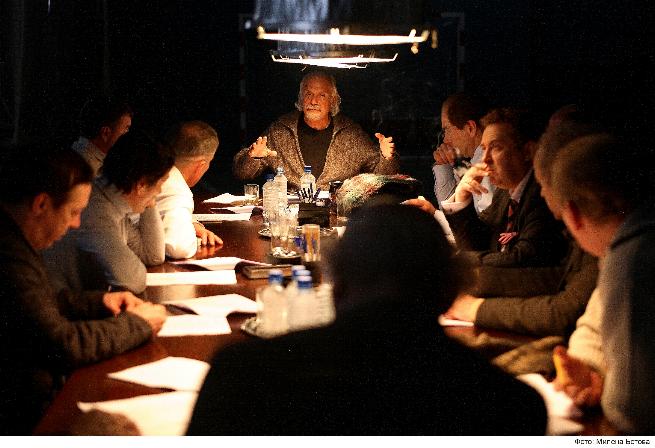
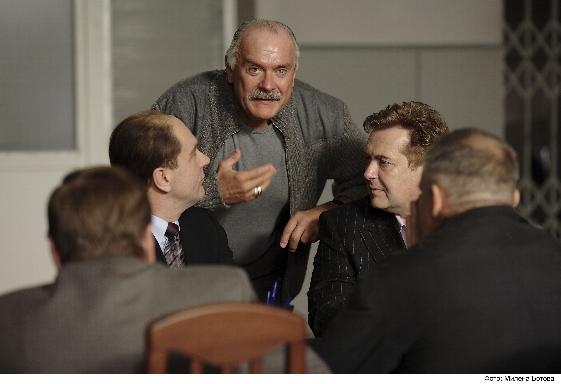
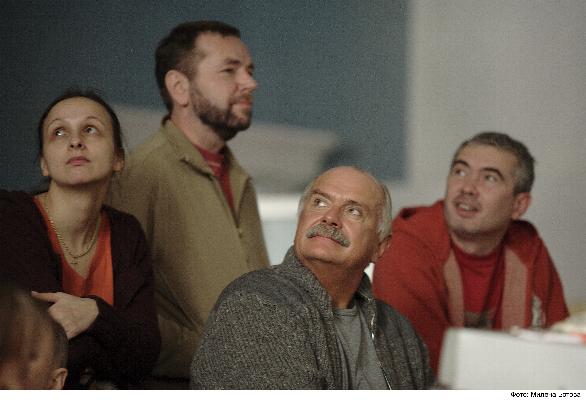
A loose remake of 12 Angry Men (1957), set in a Russian school in the war-torn republic of Chechnya. 12 jurors are struggling to decide the fate of a Chechen teenager who allegedly killed his Russian stepfather. The jurors: a racist taxi-driver, a suspicious doctor, a vacillating TV producer, a Holocaust survivor, a flamboyant musician, a cemetery manager, and others represent the fragmented society of modern day Russia. Amidst the battle between Chechens and Russians outside, a stray bird (a touch of New Age cinema) is flying above the jurors’ heads, alluding to tolerance.
A remake of a famous praised film is always a high-risk project, because a director takes risks to lapse into blind imitation. Fortunately Mikhalkov has enough talent and experience to rethink "12 Angry Men" by Sidney Lumet, to pass it through his own identity and produce an absolutely new and fresh film. This thought-provoking film surpassed all my expectations. Though it is a remake of an American movie, its plot is rooted in Russian reality. It reflects a lot of society’s ills and nation’s fears. I was deeply moved and fully satisfied with totally naturalistic dialogues. To my mind all-star cast played with miraculous virtuosity. The characters are true to life and I am sure that any Russian will be able to recognize himself in one of these 12 men. "12" is a stunning and intense drama with a large pool of talented actors, which leaves a lasting impression with you.
From Sony Classics:
Remake of the motion picture 12 Angry Men, which was awarded Golden Bear in Berlin in 1957 and three Oscar nominations. The picture by Lumet was shot based on the play by Reginald Rose, which Nikita Mikhalkov already staged once at Shchukinsky Theater School. The original film told about 12 jurors who were deciding the fate of a Latin American youth accused of murdering his father. First they all voted death sentence, and only one suggested that the case should be reviewed in every detail and swung the verdict as a result.
In Mikhalkov’s version the story unveils in the snow bound Moscow where, in a conventional gym, 12 Jurors are deciding the fate of a young boy accused of the 1st degree murder. That is the first work of the director over the last 8 years. The two months shooting period was preceded by a long time of rehearsals and detailed analysis of scenes and episodes. Mikhalkov was shooting his picture step by step following the logic of story development in the process. The final stage of work was in the setting of Aberbeevka village in Krasnodar Region. There, battle engagements in Chechyna were being shot for a few days in a row. According to Director, those are flashbacks of the youth’s memories as he is accused of murder of his stepfather. Those episodes will be cut into the main action of the film.
Chechen youth is played by actor-debutant Apti Magamaev; his younger brother Abdi was trusted with a role of his brother as a child. The seven year old Abdi stoically endured shooting under pouring rain and in an ice cold cellar under a barrage of a machinegun rounds. At the end he was to play an episode when he escapes bullets of the militants, but his parents are shot as he watches. For crowd scenes local villagers were enrolled. Music for the film was written by Nikita Mikhalkov’s friend Edward Artemiev. The psychological drama is developing accompanied by a piercing symphony of music with augmenting and fading rhythms at critical moments, lyrical deviations and a solemn gala finale. A thriller and a symphony, Chechen melodies and the sound of machinegun rounds, sobbing melodies which get to one’s heart and a philosophical rendition of what life is all about – those are the main musical themes underlying the canvas of the cinematographic artistry of “12” motion picture.
"This guy knows all the gossip, the ins and outs, the lashon hara of the Orthodox world. He’s an [expert] in... all the inner workings of the Orthodox world." (Rabbi Aaron Rakeffet-Rothkoff)