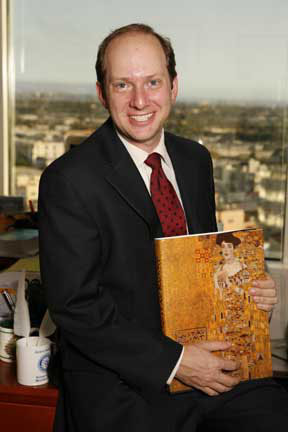
Tamar Fox Interview

She’s an elegant writer. Check out her her blog and her work on Jewcy.com and MyJewishLearning.com.

We talk over the phone for an hour today..

From Chicago, Tamar, 24, lives in New York. She recently got her MFA in Creative Writing from Vanderbilt.

Luke: "Tamar, when you were a child, what did you want to be when you grew up?"

Tamar: "I’ve wanted to be a writer since I was seven. I recently found a whole bunch of stories I wrote at that point. The only other thing I really wanted to be was a farmer."

"The practicalities of being a farmer are not attractive to me but the ideology of being a farmer is really nice… I don’t like living far away from other people."

Luke: "Could you tell me the story of you and Judaism?"

Tamar: "I grew up in a family that was not a member of an offical synagogue. My parents started a minyan when they were just married. It is unaffiliated and doesn’t have a rabbi and is lay-led. It’s a fantastic tight-knit community. We kept Shabbat and kashrut in the house. My sisters and I went to Jewish day school. [Tamar is the middle child.] I went to a Modern Orthodox high school. I was pretty unhappy. It was Modern Orthodox getting less modern and more orthodox. A lot of what I was hearing in classes was, ‘If you don’t do this, then you’re not a good Jew.’ Sometimes it was framed in a not-a-good-person kind of way. My family didn’t do a lot of the things they thought we should do. It was a complicated and upsetting experience. I should’ve talked to my parents about why they made the choices they made.

"I went to the University of Iowa where myself and the Chabad couple were the only shomer shabbat people. That was strange but also great because I didn’t have people looking over my shoulder and telling me I wasn’t being frum enough. As a result, I became much more religious than I would of if I had gone to a school with a huge Jewish community.

"I studied abroad. I had an excellent experience in Oxford, which has a small but fantastic Jewish community. When I graduated, I had half a year teaching and figuring out what I wanted to do with my life and was offered a position at a graduate program at Vanderbilt in Nashville… The Orthodox rabbi in Nashville is married to a friend of mine. When I saw that the two of them were doing OK, I decided to give it a shot. I loved Nashville and had a positive experience with the Jewish community there.

"I spent the summer between my two years at grad school learning at an egalitarian yeshiva in New York City. It was a renaissance for me in terms of how fun it can be to learn, what it can mean to be part of a community that is into the same things you are.

"After grad school, I made my way to New York City where I’m an editor for MyJewishLearning.com."

Luke: "Is it interesting that you made no reference to God while describing your Jewish journey?"

Tamar: "It’s somewhat interesting but not really because my relationship with Judaism has changed a lot but my relationship with God has not changed at all… I believe in God wholeheartedly but I don’t have a super-clear vision of what that means. If I didn’t believe in God, I’d be done with Judaism entirely."

Luke: "What do you love and hate about Orthodox Judaism?"

Tamar: "I don’t want to say that I hate it more than I love it, but I am definitely not Orthodox. For me, the benefits don’t outweigh the costs. I don’t want to say that I hate it. The things that I hate about it are how often it is close-minded, the narrow understanding of what it means to be Jewish, always trying to out-frum each other… I love the incredible warmth, how well they take care of each other in times of need, and the learning of Torah, which unfortunately is not as big a deal in non-Orthodox communities…"

Luke: "When will we see a book from you?"

Tamar: "I don’t know. I’m working on a novel. It’s about a family who moves to Ireland. It focuses on the mother figure. In the midst of writing it, my mother got ill and died. I’m not overjoyed about writing a novel about a mother right now."

Luke: "There’s a Tamar Fox who wrote a book on Holocaust survivors. That’s not you."

Tamar: "That’s not me, though a lot of times on first dates people are like, ‘I see you’ve written a book on the Holocaust.’ I’m like, no, but thank you for Googling me."

Luke: "How important is it to you to count in a minyan?"

Tamar: "Pretty important… It feels really debasing and upsetting [to not count]."

"I’m upset that a lot of my religion bores me now because it has been reduced to being pro-Israel and against intermarriage."

Tamar says she’d prefer to live in Chicago or England. It doesn’t affect her happiness whether she lives among Jews or non-Jews.

Luke: "How do you notice the practice of Judaism affecting people?"

Tamar: "I went to a minyan on Sunday. It was a lot of young Modern Orthodox guys who were all in jeans and sweatshirts. I ran into them for Ma’ariv. It occurred to me that these guys are in the same room twice a day. If you spend that much time with people, that’s a big deal and is going to affect your life in many ways. Not every Jew I know is socially adept, but it’s going to make you comfortable in certain situations. You’ll get to know communities pretty well pretty quickly, especially if you move to a new place. The way people interact with text if they’ve done serious Torah learning is different."

"I find that people who are seriously involved with a Jewish community are usually pretty socially graceful. That gets you pretty far in life. I sometimes find myself wondering when I’m watching movies and stuff where there’s a real bad character, I think that I don’t know anyone who fits that bill. I can’t think of ever having met any of them. I do think that most people who are really invested in a religious community are likely to be [decent]. Most of the people I know who are religious are pretty self-critical. They’re thinking about what they do and are not just going through the motions."

I ask Tamar about men.

Tamar: "I am one of those people who’s monogamous because the thought of having to deal with more than one man at a time is horrifying. I really like my boyfriend but I don’t think I could deal with anyone on the side."

Luke: "Do you think men and women can be friends without one side wanting more?"

Tamar: "I wish that I did but I don’t think so. I don’t have any guy friends that I’ve never felt like some tinge of something with, which isn’t to say that I hook up with my friends. I think there’s always a little bit of sexual chemistry. I don’t think that’s a problem."

Tamar wishes she could go out on Friday night once. "I have no idea what happens in the real world on Saturdays. I’m always in shul or with friends or napping."

Posted in Blogging | Tagged , , , , , , , , , , , , | Comments Off on Tamar Fox Interview

The Demise Of A Once-Powerful Law Firm

Thelen Reid Brown Raysman & Steiner was the biggest in LA. No longer. It is getting evicted from its office space and is closing shop.

Case Type: UD/Commercial (not Drugs/Evict) (General Jurisdiction) Case#: SC100700 CASE NAME: CENTURY PARK, L.P. VS THELEN REID BROWN RAYSMAN & STEINER Parties: CENTURY PARK L.P. – Plaintiff,THELEN LLP. – Defendant,THELEN REID BROWN RAYMAN & STEINER LLP. – Defendant Attorneys: GOODKIN DANIEL L – Attorney for Plaintiff Date Filed: 11/21/2008

Larry Bodine blogs:

According to a report in New York Lawyer, the Partnership Council of 400-lawyer Thelen announced it voted to dissolve the firm. The firm expected to close on Dec. 1.

An early sign of trouble for Thelen Reid Brown Raysman & Steiner came last March, when the firm laid off 26 associates (which was 10% of their associates) and 85 members of its support staff, including members of the west coast marketing staff. In March the firm had 600 lawyers. Recent reports surfaced lately that top Thelen lawyers, including Chairman Stephen O’Neal was negotiating for a spot at to Howrey and rainmaking energy partner Ellen Bastier was on the cusp of joining Reed Smith

Thelen was an international AmLaw 100 law firm with offices in Hartford, Los Angeles, New York, Northern New Jersey, San Francisco, Shanghai, Silicon Valley, San Jose, and Washington, DC.

The news report says that about 60 lawyers could end up at Nixon Peabody — which until recent weeks had been viewed as a potential merger partner for Thelen. "Was it a surprise today? No. Was it a surprise overall? Yes," a San Francisco associate told Law.com. "I mean, two years ago we were in a strong position."

"It’s very disappointing, even though it was just a matter of time," said a legal secretary, asking not to be named. She will be at Thelen until the end of November, and said she doesn’t know what’s next for her. But even some partners don’t know where they will end up, she added.

Posted in Law | Tagged , , , , , | Comments Off on The Demise Of A Once-Powerful Law Firm

Novelist Adam Mansbach Interview II

Read it here.

Posted in Jewish Literature | Comments Off on Novelist Adam Mansbach Interview II

Novelist Adam Mansbach ‘The End of the Jews’

Read it here.

Posted in Jewish Literature | Comments Off on Novelist Adam Mansbach ‘The End of the Jews’

Have You Broken Up Over A Book?

I don’t think I’ve ever broken up over a book, but a certain woman’s love for Emmanuel Levinas certainly put a strain on our relationship. She always wanted that intimate face-to-face I-thou stuff. It was exhausting.

Josh:  i actually broke up with a girl back in 2002 over everything is illuminated.  i couldn’t be with someone that actually like that book.
Josh:  9 months down the toilet.
Josh:  i think she had a secret crush on foer and i couldn’t handle it

Posted in Books | Tagged , , , , | Comments Off on Have You Broken Up Over A Book?

‘The End of the Jews’ II

On Monday, I interview Adam Mansbach about his new novel, "The End of the Jews." Here’s part one.

Luke: "How did your white peers react to your interest in black culture?"

Adam: "They were the ones who gave me s— about it. They were the ones who wanted to make fun of me and let me know that they thought this was strange. A lot of kids in junior high called me "Mansblack." When some of the black kids I was hanging out with, some of the black mentors I had in high school, heard that they called me that, they thought it was hilarious and they started calling me that. What started out as a derisive nickname became a symbol of acceptance by this other community.

"This abuse was pretty minor. I don’t want to give the impression that I suffered greatly from my junior high classmates. I was somebody who didn’t care much what they thought and I realized quickly that I’d be somebody who’d navigate different worlds. More often than anything else, I was asked to play the role of a cultural translator. There are a lot of white people who are intrigued by other cultures but don’t want to approach somebody from that culture and ask them but will approach this crossover white boy. I’ve become used to fielding questions from white people about black culture. Sometimes it would be ridiculous. ‘Adam, why is the black community so angry?’"

Luke: "What has been your attitude towards the Jewish tradition?"

Adam: "I was raised by very secular parents who were the children of very secular parents. We didn’t go to synagogue. Out of a vague feeling that I should know something about Judaism, they sent me to a Jewish Sunday school at a junior college. I got kicked out of that school because I had this overtly racist old teacher who I got into big confrontations with. It came to a head when I sang ‘Living on a Prayer’ into a microphone at a school assembly instead of the prayer I was supposed to read.

"Because the community I was growing up in was pretty Jewish, I conflated Jewish with white as a kid. I was very critical about what whiteness meant, the historic economic social and judicial privilege of whiteness. I didn’t want much to do with either one of those traditions. It wasn’t until I got to college that I started thinking more deeply about what it meant to be Jewish, what the unique strains of that tradition looked like in terms of religion and culture and also a tradition of progressiveness and social justice.

"It was in the course of writing ‘The End of the Jews’, I worked on the book for about seven years, that I started thinking more deeply and in a sustained way about Jewishness… How was I to understand my grandfather? Part of understanding him was understanding that religion. I set out to write a book about his generation and mine."

Luke: "One thing that struck me with your book. There’s the title ‘The End of the Jews.’ Then I read the book and none of the characters have much of an interest in the Jewish tradition."

Adam: "Yeah. That’s true. Everybody in the book is relatively secular… One of the things I tried to deal with in the book is how identity for all of these characters is constantly in flux. At times the characters wield Jewish identity as a weapon and at times they try to distance themselves from it. For Tristan, being Jewish is central to his life and writing, but in a way that is particular to him and doesn’t have much to do with religion. As he goes through various stages of being accepted and rejected by the Jewish community and is asked in various ways to adopt the mantle of a Jewish writer, it emerges as something important to him…"

Luke: "I was struck by how all the protagonists in the book work hard at their heart yet they expend no serious effort to grapple with their tradition. They don’t try to learn Hebrew or study Talmud or live in Israel. They don’t work at it one tenth as much as their art."

Adam: "Yeah… The people who live on the margins and who don’t want to come into the fold, those are the ones who become artists. The position engenders a lot of perspective and a lot of pain and it gets channeled into art. You look at the pantheon of 20th Century Jewish-American writers (Bernard Malamud, Alfred Kazin, Saul Bellow, Philip Roth, Woody Allen, Lenny Bruce), you see people who occupy those margins. It’s the tortured relationship to the religion and to everything else…that allows people the space and the energy to create art. It might be to work against the tradition, to define the tradition for themselves, but it’s probably not going to come from these traditional forms of identification."

Luke: "Do you feel obligations to the Jewish tradition?"

Adam: "What do you mean?"

Luke: "You may not eat shrimp because you feel obliged, you may have an instinctive protective reaction towards Israel, you may feel obliged to know some Yiddish or Hebrew, do you feel commanded in any way by any part of the Jewish tradition?"

Adam: "The way you phrase it is interesting and is making me unsure of how to answer it. I wouldn’t say that I feel commanded. I’m having trouble working out the idea of being commanded by a tradition as opposed to being commanded by something in yourself that seeks knowledge or inclusion or something. There are things I react to in a certain way because I’m Jewish, because my entire family is Jewish, because most of them got wiped out in the Holocaust, but the thing I connect to most strongly is not a prohibition against eating shrimp and certainly not a desire to protect Israel uncritically, to me the crux of the tradition, or the crux of what connect with, is the notion of questioning. The notion that the Jewish tradition is one of constantly discussing, arguing, trying to resolve the unresolvable."

Luke: "Challenging the status quo."

"What have you loved and hated dealing with the Jews once this book came out?"

Adam: "I feel most frustrated by the way most events are a smokescreen for getting young Jews together to marry each other and have Jewish babies…

"If you are convening a panel to talk about community service or Jewish books, those topics…shouldn’t be an excuse to get this population in a room to meet each other. It’s been frustrating for me to be invited to some of these events…

"Some of my frustrations mirror some of the characters frustrations in the book. The idea that one is always supposed to lead with religion and is reducible to it and should only be concerned with, ‘What’s good for the Jews?’

"I’ve been struck by the conservatism and defensiveness and skepticism of the older Jewish generation when the topic turns to things like black-Jewish relations. It’s probably stupid of me to go to a JCC and speak to a bunch of people in their seventies and eighties about Jewish disinvestment from the civil rights movement and how it is time to get over being mad at Farrakhan… Someone will raise their hand and say, ‘What about Jeremiah Wright?’ I will say, ‘What about Jeremiah Wright?’

"’Well, he said some anti-semitic things.’ I’ll be like, ‘What did he say?’ And no one would be able to answer. And I’d start to realize that in the imagination of this audience any black leader who said anything controversial and was in hot water must automatically be anti-semitic. You can feel frustrated when you put together a talk and people are only interested in finding out why you talk the way you do."

Luke: "How much of a driving force in your life is the desire to affect social change?"

Adam: "It’s a big desire. One of the struggles of writers is to justify what we do. Writing books take a lot of time, time spent in a room alone, and in a way it’s one of the most self-indulgent things you can do. If you care about social change, and you want to be a writer, you have to think that your books can play a role. It’s something I struggle with — should I be in this room writing this book or should I be knocking on doors and handing out flyers and organizing marches. The writing always wins out."

I read Adam these excerpts of an essay on blacks and Jews by an academic historian and Orthodox Jew, Edward S. Shapiro:

…If support for blacks is an ineluctable result of Jewish values, then one would expect that the most Jewish of American Jews — the Orthodox of Brooklyn — would be the most sympathetic towards blacks. The exact opposite, however, is true. Secure in their Jewish identity, they do not require close relations with blacks to define it. Their Jewishness rests on more substantial grounds.

…If the most Jewish of Jews are the least receptive to blacks, the Jews most supportive of blacks have often been alienated from Jewish culture and religion. (pg. 240)

…Jews needed blacks to authenticate their image of themselves as liberals, but blacks did not need Jews to authenticate their image of themselves as blacks. (Pg. 243)

Blacks have resented Jews not because they did not do enough for them but because they did too much. (Pg. 244)

In academia there is not one black scholar, apart from Julius Lester, a convert to Judaism, whose major field of interest is Jewish studies.

Adam: "I think it’s interesting. There are a couple of logical fallacies.The first is cause and effect. If the least Jewish of Jews are the most likely to be receptive to blacks, what is the cause and what is the effect?"

"The writer is defining Judaism as a matter of adherence to religion and to traditional ritual. It would not be a definition accepted by the people he’s talking about. He’s bringing a set of assumptions that the people he’s trying to analyze would object strongly to."

"What makes one group of Jews more Jewish than another group?"

Luke: "Do you think the Orthodox are more Jewish than you?"

Adam: "They’re certainly more religious than me. I couldn’t be less interested in deciding who’s more religious or claiming any level of Jewishness and asserting my right to be as Jewish as somebody else… Everybody in my family is Jewish and my blood is as Jewish as their’s. I’m not religious in the ways they would define it. They would probably view me as not Jewish.

"I can’t walk through an Orthodox neighborhood without thinking about whether I am being viewed as Jewish or not. Rather than think about the people I’m looking at, I’m thinking about what they would think of me. That’s the case for most secular Jews. Our judgments of the Orthodox end up getting deflected by our assumptions of their opinions of us."

Adam mentions his secular writer-friends such as Peter Orner, Sam Lipsyte, T Cooper, Keith Gessen, Darrin Strauss, Lauren Grodstein, Danny Hoch, Elisa Albert). "They are also publishing works considered Jewish literature. ‘The End of the Jews’ is my third novel but it is the first time somebody put me in the category of Jewish writer. I doubt that Sam Lipsyte does a lot of Jewish writer gigs."

"This time out of the box I’m doing these talks at synagogues. The Jewish community didn’t ask me to come talk about ‘Angry Black White Boy,’ my previous novel. Even though I’ve written a book on topics related to Judaism, I’m pretty sure they won’t invite me when my next book is published.

"A.J. Jacobs did a lot of Jewish-related stuff with The Year of Living Biblically, but I doubt he was doing it before that.

"Peter Orner did a bunch of [Jewish] stuff with his first book, but when his novel came out, his phone stopped ringing with Jewish programmers on the other end. T. Cooper did some Jewish book fairs for his last novel, but for his first one, nothing. T. and I co-edited a book of short stories, A Fictional History of the United States With Huge Chunks Missing (Akashic, 2006). That’s two Jewish writers co-editing a book of short stories with a decent number of Jewish writers in it but it wasn’t directed at or made visible to Jewish communities, so there was nothing.

"It seems to be on a book-by-book basis that the Jewish community on a formal level, the Jewish book circuit, the synagogues, the JCCs, there doesn’t seem to be a sustained interest in the careers of young Jewish writers except when those writers are talking about Jewish subjects."

Luke: "When you encounter somebody who says, ‘I’m a proud Jew,’ what do you think?"

Adam: "I don’t think I’ve encountered people who say that… I’m frustrated with the way that Judaism has been marketed. You go to these festivals marketed at young people and there’s all this ‘rah-rah, It’s cool to be Jewish’ stuff going on. ‘You should be proud to be Jewish. Jewish is cool.’ Why should it be cool? Cool shouldn’t enter into it. It’s a flimsy reason for wanting to do anything. If it’s cool this year, then almost by definition that means it is not cool next year. You’re talking about a fashion statement or an album. For me it would depend on what that pride is based on. If it is based on somebody telling you it is cool to be Jewish, then it is meaningless. If it is based on something more deeply felt, deeply understood, deeply studied connection with the religion or culture, then great. I’d also ask, is this the only thing you are proud of? Is it the only element of your identity?

"How does that pride translate? How does being Jewish inform the way you see yourself in the world?"

We talk about the absence of black scholar in Jewish Studies departments.

Adam: "The scholars I know who are black and do stuff that is totally unconnected to blackness are constantly having to answer for it. A good friend of mine is at Yale Divinity School. His work is on Kant and Erasmus. He constantly has to explain why a 38-year old black man studies those things."

Luke: "There seems to be much more of an eager need on the part of some Jews to be embraced by blacks than blacks feel to be embraced by Jews."

Adam: "Not necessarily."

"Jews are a sub-set of white people. They are seen in the world predominantly as white and have the privileges endemic to that. That has to do with validation that semantically divorces you from privilege so you don’t have to feel guilty. If black people accept you, then you don’t have to grapple with what it means to have all these unearned inherited privileges granted to you by society. That’s been the dynamic of my generation, the hip hop generation, that constant affirmation from black people…is a way to divorce yourself from privilege instead of confronting it and seeing how it might be dismantled."

"I can’t even tell you how many black Jew-aphiles I know, how many black friends I have who said, ‘I wanted to be Jewish when I grew up.’"

Luke: "Is there anything about your new book that I should’ve asked you and haven’t asked you?"

Adam: "Probably. It’s always interesting to me that any time I get talking to somebody ostensibly about my book, particularly someone smart and interesting like yourself, we always end up totally far afield. Sometimes I yearn to talk about craft and sentence structure and the book itself in some sustained way instead of using it as a point of departure for a whole other conversation."

Posted in Blacks, Jewish Literature | Tagged , , , , , , , | Comments Off on ‘The End of the Jews’ II

Rabbi Emanuel Rackman Dead

I got an email from a shul saying: "The funeral will be in [Israel]."

Emanuel Rackman was one of the great minds of Modern Orthodoxy, a far greater intellect than Shalom Auslander‘s uncle Norman Lamm who beat him out for chancellor of Yeshiva University.

From the Jerusalem Post:

Rabbi Prof. Emanuel Rackman, who passed away on Monday in New York at age 98, will be remembered as one of the most profound and daring figures in Jewish life and thought of the 20th century.

His 70-year-long career in the rabbinate was marked by fearlessness; he stood out, bravely, ahead of the Orthodox mainstream. He was concurrently beloved and controversial.

Rackman began to make his mark as rabbi of the prestigious Shaaray Tefila (Far Rockaway, Queens) and Fifth Avenue (Manhattan) synagogues, and as a professor of political philosophy and jurisprudence at New York University, City University of New York and Yeshiva University. His eloquence, erudition in both Jewish and secular law, prolific publication schedule, and his compassion for his congregants, made him a rabbi’s rabbi.

His congregations grew rapidly, serving as an inspiration to the generation that made American Orthodoxy a viable alternative to the Conservative movement, which was still capturing Orthodox synagogues into the 1950s.

As president of the New York Board of Rabbis and the Rabbinical Council of America, he was a religious humanist. His heart embraced all the diversities and contrasts from which Judaism and the Jewish people suffer, and he constantly sought to harmonize and build bridges.

His commitment to Jewish unity explains, as well, his belief in Bar-Ilan University, whose presidency he assumed in 1977, and whose chancellor he remained until his passing. He opened Bar-Ilan’s doors to students of all stripes, turning it into one of the major Israeli campuses, while insisting that everybody could and would study basic Jewish studies – together.

Yet Rackman was no muddled, cuddly or homogenizing liberal. His modern Orthodoxy was deeply and firmly rooted in a rigorously developed philosophy of Halacha which emphasized creativity and justice.

Posted in Modern Orthodox | Tagged , , , , , , , , , | Comments Off on Rabbi Emanuel Rackman Dead

‘The End of the Jews’

I was sucked right in by Adam Mansbach‘s provocative new novel, "The End of the Jews."

Here’s part two of the interview.

The beginning of the book is good ol’ fashioned storytelling. It has the making of an epic, an up from poverty all-American novel about individual triumph through hard work.

Then the book takes a disconcerting turn. It’s no Triumph of the Will. It’s something much more true to life. It’s literature, not genre fiction. It’s an independent production, not a studio film.

I call Adam in San Francisco Monday morning. We talk for 90 minutes.

Luke: "When you were a kid, what did you want to be when you grew up?"

Adam, the eldest of two kids: "I wanted to be a writer."

"It was always pretty clear to me. I was always making up stories, making people take dictation for me before I could write. I have writers in my family. Nobody seemed to think it was that strange. It wasn’t until I was in graduate school that I was surrounded by people who were like having phone calls every day with their parents, ‘Why don’t you go to law school?’ ‘What’s this bulls— you’re going to do?’"

"My grandmother (Felicia Lamport) was a poet. My grandfather (Ben Kaplan) was a judge but he seemed always to be writing. He was a law professor first. He was known as a pretty great legal writer. My father (Charles Mansbach) is a journalist. He works at the Boston Globe. My mother (Nancy Mansbach), when they met, was a reporter. Her brother is a sportswriter."

"My earliest trajectory as a writer was poetry and lyrics. I was pretty serious about hip hop. I was an MC. Probably the first thing my parents saw me doing circa junior high was writing a lot of rhymes and performing them and recording them. They were perplexed by that because hip hop was not something they were too familiar with. Nobody was in 1987 aside from those committed to it. They appreciated that I was doing something artistic… Hip hop was very political at the time and they were able to make those connections. My father, being a journalist, had a collection of sixties paperbacks on his shelf. I’d be listening to Public Enemy and they’d mention Bobby Seal or Eldridge Cleaver and those were books that were in my house. I was able to make those connections and my parents saw it happening.

"My grandmother’s poetry was analogous. Her s— was satirical and pointed and political and it rhymed. Her wordplay was fantastic. She had a weekly column that was syndicated in a number of newspapers called, ‘The Muse of the Week in Review.’ She’d take classical forms, rewrite them, remix them, about current events. She did a famous piece called ‘The Love Song of R. Millhouse Nixon.’ She took [T.S.] Elliott and turned it on its head. ‘Do I dare them to impeach?’

"In a funny way, my grandmother’s writing was very similar to hip hop. It was rhythmic, it was rhyming. My family was able to see what I was doing without freaking out too much."

"I grew up in Newton, Massachusetts. It’s a close suburb to Boston. It’s pretty white, about 40% Jewish. The schools that I went to were fairly diverse, public schools that were part of the bussing program, which was Boston’s unilateral form of school integration. Boston’s a pretty segregated and racist city and it took about 20 years after Brown vs. the Board of Education to desegregate their schools and the way they did it was by bussing black kids from the inner city to suburban schools."

Luke: "Do you have a black accent?"

Adam: "You mean like Barack Obama or Colin Powell?"

Luke: "Umm, I don’t know how to say it. I’m sure there are right and wrong ways how to say it. Has anyone ever? I guess the polite term is urban. Has anyone ever said that to you? Maybe I’m totally out in left field."

Adam: "Yeah, every time I do any kind of public event, to a mostly white or Jewish audience, somebody asks me some kinda questions about the way I speak. I always try to get them to think a little bit critically about what it might mean to sound black or to sound Jewish or to sound urban because we tend to think monolithically about these things. Like anyone else, the way I speak is the some of various experiences and travels. So people always want to ask me that and sometimes they don’t know how to say it. They talk around it. Sometimes they come right out and say, ‘You sound black.’ My impulse is always to f— with people when they ask me that. I don’t know exactly what sounding black means. Who sounds quintessentially black? Jay Zee or Bill Cosby? It’s not a question I have a particularly good answer for except to wonder what it means."

Chaim Amalek emails: "Now who would you rather sound like, James Earl Jones (the voice of Darth Vader), or Woody Allen?"

Josh:  he stresses certain consonants like the blacks do
Josh:  the hyPOCrisy

Luke: "Barack Obama sometimes speaks differently to a black audience than a white audience. The intonation and accent he uses will change."

Adam: "Yeah, that’s very true. I think there are occasions with all of us, there are infinite variations with the way we present ourselves and speak. The funny thing is I try to sound… I’ve been doing these Jewish book fairs the past couple of months, and I’m certainly trying to come off, I’d really like to avoid that question because I’d like to talk about other s— at these festivals. I try to come off as straight forward. I try to sound as vocally uninteresting and undifferent as possible. I still get this question so maybe there are limits to the amount of control I have over this."

Luke: "At what age did you fall in love with blacks? Or did you?"

Adam: "I don’t fall in love with blacks. I don’t think that ever happened. I got into hip hop when I was about eleven, largely because it was articulating realities that I wasn’t seeing personally but that I knew were out there. It was talking about subjects that were taboo such as racism, police brutality, the inequality in the school systems. These were things I had seen a little bit but nobody I knew was talking honestly about. I was moved by the world-expanding nature of the music. That led me to explore other black cultural forms. When I was 14, I became friends with Delfeayo Marsalis, Branford and Wynton’s younger brother and a trombone player, he was friends with a teacher at my school who was a mentor of mine. He would come to town and I would hang out with him for the week and he would put me on all kinds of jazz which led me to writers like [Ralph] Ellison, Amiri Baraka (formerly Leroi Jones), [James] Baldwin.

"I don’t think per se that I ever fell in love with black people. I found inspiration in the art produced under such duress, art made by people who were profoundly marginalized, whose humanity was called into question, and who in some cases responded with works of astounding beauty, honesty and humanism, particularly somebody like Baldwin who was doubly marginalized by being gay and black.

"I started to notice a certain kind of hypocrisy, complacency on the part of a lot of the white kids and families that I was around. That pissed me off and it was more a desire to distance myself or to be critical in some way of white privilege than  a desire to be black or falling in love with black people or black culture."

Luke: "Have you seen white people or Jews fall in love with blacks or black culture?"

Adam: "I don’t know. I don’t spend too much time ascribing motives to people for what they do. In the world of hip hop, there’s plenty of white people and there’s a predominant portion of them who are Jewish. Partly because hip hop is a New York-based form and partly because there are certain historical resonances between blacks and Jews that I try to explore in this book.

"The people I’m personally friends with who are white and are involved in some way with hip hop or black culture tend to have traveled a somewhat similar path where some form of black music and in this generation it’s generally going to be hip hop made them aware and critical of what it meant to be white in this country. It’s more of a critical response to whiteness than a falling in love with blackness.

"In this country there’s an enormous sense of voyeurism particularly around hip hop and the fetishization of black bodies, so on a larger level, there’s been a real split in this country where privilege is located. Traditional forms of privilege, economic privilege, has resided where it always has, but cultural privilege and cultural capital has increasingly been associated with blackness. There’s been a lot of confusion for young white kids in particular because they don’t understand that they’re still at the center. They turn on the TV and all of the most glamorous flashy conspicuous wealth they see is in rap videos. So they end up feeling like they don’t have a cultural identity and they’ve been marginalized and that black people are at the center of the universe. There’s a combination of desire and resentment that I’ve seen a lot when I’ve talked to some of these kids."

Adam graduated high school in 1994.

Luke: "What do Jews and blacks have in common in America?"

Adam: "Both groups are dealing with the after-effects of diaspora, whether in the case of blacks the legacy and horrors of slavery and in the case of Jews they kind of repeated banishments from the different countries in Europe. Both groups come to America under a kind of duress that I think is unique. In both groups there is a sense that identity is a multi-faceted and complicated thing. There are wide margins in both communities. For Jews it’s this conflation of ethnicity, religion, culture, history. There are many ways to feel Jewish and also many ways to feel marginal and push away from the core of the Jewish community. You’ve got Jews who say s— like, ‘I’m Jewish but I’m well Buddhist.’ Or people who connect ethnically but not religiously. There is a sense of double consciousness, a sense of being part of a community but also being distant or alienated.

"The same is true for blacks. There’s an essentialization of what it means to be black. An identity that doesn’t fit for a lot of people. There is also the double consciousness inherent to black life in America where you are aware of both yourself and the other, where you’re unseen in the white world and able to gain a certain perspective on it."

"There’s been a progressive alliance, a civil rights alliance, a lot of history of artistic interplay, whether it is jazz in the twenties where Fletcher Henderson is writing all of the arrangements for Benny Goodman’s band. In the 1930s, the Duke Ellington Band got pulled off a train in Germany and harassed by all these Nazi soldiers and they kept calling jazz ‘nigger Jew music.’

"There are great letters between [Ralph] Ellison and [Saul] Bellow. Some of this stuff Bernard Malamud said about wanting to be seen as a writer and not a Jewish writer, wanting to be allowed to speak universally instead of for his marginalized group. It was identical almost to the stuff Frederick Douglass was saying 90 years earlier. And then all the way up to the breakdown of that civil rights alliance in the 1980s. It’s been a subject of conversation even in this presidential race with Obama talking about how he wants to repair relationships in the black and Jewish communities. He was asked to distance himself from Louis Farrakhan. It’s a rich and interesting history, really collaborative at points and tense and fraught at others, particularly in the eighties. These comments that people like Farrakhan, Jackson, Sharpton made have been frozen in amber by the older Jewish generation as a reason for a pullback emotionally and practically from the civil rights alliance of the sixties.

"I think it has to do with Jewish assimilation, a desire to change bedfellows… If you ask a room full of Jewish people over 50 about Jesse Jackson, they’ll all go, ‘He called New York Hymietown in 1983.’ Well, what has he done since then, anything? I’m more disturbed that Jesse Jackson called New York ‘hymietown’ in 1983 is so fixed and central to Jewish memory than the fact that he said it. It implies a lot of things that I’m not too happy about."

"I’d like to be able to say that Jews have more progressive attitudes [than regular white folk] but I don’t know that that is the case. Certainly that was an issue in this election. The New York Times did a good job of going to Florida and finding Jews who were horrifyingly racist and saying ridiculous things. I’d like to think that that is out of the mainstream but it is hard for me to tell. It’s more of a generational thing than anything else."

I ask Adam if he thinks Barack Obama would’ve been elected president if he were white.

Adam: "I have no way of answering that question."

Luke: "How have blacks reacted to your interest in their culture?"

Adam: "Pretty well. I’ve never really had any problems doing what I do. The only people who seem to have a problem with it are white people."

"Anybody who navigates black culture with a sense of respect, a sense of the history, awareness of the tremendous legacies of exploitation and cooption, is usually welcomed. Expectations of white people in black culture are so low, there’s such an expectation that they will act like assholes, that anyone who doesn’t is welcomed probably more than they should be."

Luke emails: Pendergast seems to play for Tristan what Jews have done for blacks — blaze the trail, fund the NAACP, etc…and blacks resent Jews for this for the same reason Tristan resents Pendergast — not for doing too little but for doing too much.

It’s human nature to resent those who help us.

What do you think?

Adam replies:

Interesting. I think there’s some truth to the notion, in the abstract, that we resent those who help us – if the help is condescending, comes from self-interest, etc.  Not categorically.  In terms of blacks and Jews, it doesn’t ring particularly true to me. First of all, I question the assumption that blacks (who, of course, cannot be spoken of monolithically) resent Jews. What is the evidence of this as a tendency prevalent enough to dwell on?  In my personal life, in which I interact with blacks and Jews more than any other groups of people, I hardly ever see it; if anything, being Jewish gives you an alternate identity to being white, creates a point of connection: you know, bigots hate you both, that kind of thing.

Secondly, even if we do accept the notion, I don’t think the facts support it: what is the "too much" Jews have done?  How can anyone have done "too much" when structural racism remains a fact of American life, from judicial bias to the recent Princeton study indicating that a black job applicant has the same chances of being granted an interview as a white felon?  No, I think any resentment stems from the more obvious reasons: a Jewish pullback from the progressive alliance, and old resentments of the kinds created by proximity and changing group fortunes (like the notion of Jews as slumlords, in the first chapter of my book, when Tristan goes to Harlem).  I think that when you see conspiracy theories about the influence and power of Jews (in government, in the media) from segments of the black community, this is in large part code for "you assimilated into the mainstream and turned your backs on us – and your assimilation relied on your "otherness" playing off of ours, being more mutable than ours."  And I see some truth in that.  To connect to something I was saying earlier: 25 years after the "Hymietown" remark, for which he’s apologized repeatedly, after which he’s done major outreach to the Jewish community, Jesse Jackson remains a pariah to many Jews. Meanwhile, the ADL accepts Mel Gibson’s half-assed, incoherent apology, and rabbis line up to meet with him.  To me, the deeper story is that keeping Jesse or Sharpton or Farrakhan’s old comments alive well past their expiration date helps to creating excuses for a practical, financial, emotional connection to black people, through the whipped-up specter of black anti-Semitism.

As far as Pendergast, Tristan’s resentment is complicated, but he’s actually happy to accept the benefits of Pendergast’s meddling; it’s the reasons behind them, and the implicit acceptance of Pendergast as an artistic equal, that rankle him.  He’s pissed off, on some level, that this guy is even in a position to help him, is venerated as a writer, etc.  And he suspects impure, selfish motives for the help, suspects that Pendergast is really reinforcing the differences between them… which, again, I think is usually at the heart of resentments toward those who help us.

Here’s part two of the interview.

Posted in Jewish Literature | Tagged , , , , , | Comments Off on ‘The End of the Jews’

How Did One Little Old Lady In Los Angeles Get About $300 Million From The Holocaust?

Frequent contributor to this website, Yisroel Pensack, tipped me off to this story.

Maria Altmann, 89, wasn’t in the Holocaust but as a niece of the late Czech sugar baron Ferdinand Bloch she (along with four other heirs) was awarded the ownership of his five paintings by Austrian Gustav Klimt (the paintings sold in 2006 for about $280 million) and she got a separate $12 million from a Swiss banks fund in 2005 as compensation for money stolen from her relations during World War II.

Tom Tugend wrote for JTA April 17, 2005:

LOS ANGELES, April 17 (JTA) — On April 14, Maria Altmann, a tall, animated lady of 89, found her story splashed on the front pages of The New York Times and the Los Angeles Times.

What had made her newsworthy, and had kept her phone ringing incessantly, was an award of $21.8 million to her and her extended family for losses suffered during the Holocaust era.

The award money was derived from a $1.25 billion fund established by Swiss banks in 1998 to settle a vast class-action suit. Subsequently, a Claims Resolution Tribunal was set up by federal Judge Edward Korman to adjudicate some 32,000 claims, mainly from Jews who had lost their deposits in Swiss bank accounts. Gideon Taylor, executive vice president of the Claims Conference, which transfers the authorized awards to the claimants, said that so far some $254 million had been paid to 3,000 applicants. He said that the award to the Altmann family was the largest paid out so far.

…Altmann said she’s planning to make donations to some Jewish causes, although she has no connections to the Los Angeles Jewish community. “Unfortunately, I wasn’t really raised Jewish,” she said. “My husband, whose family came from Poland, was very strongly Jewish. We used to have arguments about that. I agreed to have a ritual circumcision for our sons, if he let me have a Christmas tree.”

From Wikipedia:

Maria Altmann (born 18 February 1916), was a refugee of Nazi Austria, living in the Netherlands briefly before moving to Hollywood, California, in the United States. Her ultimately successful attempts to regain five Gustav Klimt paintings owned by her family that had been stolen by the Nazis during World War II made international headlines more than five decades after the war’s end, and involved the courts of two nations.

Born Maria Bloch-Bauer, in Vienna, she married Fritz Altmann in 1937. Fritz Altman was arrested in Vienna in 1938 and held hostage at the Dachau concentration camp to force his brother Bernhard, by then safely in France, to transfer the B. Altmann textile factory into German hands. Fritz was released and the couple fled to America via England in 1940, leaving behind most of their property, including jewelry that later found its way into the hands of Hermann Göring. Maria was naturalized an American citizen in 1945; the couple had four children.

Maria Altmann is a niece of Czech sugar magnate Ferdinand Bloch, who owned a small collection of artwork by the Austrian master Gustav Klimt, including two portraits of his wife Adele Bloch-Bauer. During the Nazi Anschluss of 1938, these paintings were looted. Bloch died in 1946, soon after World War II, leaving his estate to a nephew and two nieces, including Altmann. By this time, after the paintings had changed hands a number of times, five of these paintings were in the possession of the Austrian Government.

Attorney E. Randol Schoenberg represented Altmann in both cases. If he received the normal compensation of 30% to 40% for these type of cases, he would’ve snagged about $100 million for his work.

Altmann began her litigation with the Austrian government to claim the paintings in 1999. In 2001, Schoenberg told her she had a potential claim against Swiss banks.

From the AP in April 2005:

The case demonstrated that "having marketed themselves to the Jews of Europe as a safe haven for their property, Swiss banks repeatedly turned Jewish-owned property over the Nazis in order to curry favor with them," the tribunal wrote.

D. emails: Still staying current, sunny Jim… “Frequent contributor to this website, Yisroel Pensack, tipped me off to this story,” my lad breathlessly writes…of a story that made international news in 2005 and 2006. Good job, Sunny Jim. I can hardly wait until to you finally get about to relating other breaking news like Hurricane Katrina, the papal transition, and the Indian Ocean tsunami. You’re a pathetic little ponce, lad, and I regret to this day that I didn’t suffocate you in your crib when I had the chance.

Posted in Holocaust | Tagged , , , , | Comments Off on How Did One Little Old Lady In Los Angeles Get About $300 Million From The Holocaust?

A Tale Of One Night Stands

I want to tell you about two of my female friends — one is a prude and one is a slut.

The prude recently had her first one night stand of her life. The result? Her on the fence boyfriend decided the next day that he wanted to commit to her.

The slut? She too had a one-night stand. What did she get? Chlamydia.

"It’s the best STD," I’m told. "It’s easy to cure."

Posted in Personal, Sex | Tagged , , , , | Comments Off on A Tale Of One Night Stands