The Rabbi’s Chapter Seven Bankruptcy Filing As A Literary Genre

A week ago, I posted about the $7.25 million fraud judgment against Antony Gordon (attorney, hedge fund king, motivational speaker, Orthodox rabbi) and his Chapter Seven bankruptcy.

I’ve never had any money and given my WASP background, I’ve never been comfortable with the buccaneering approach to finance so I’m totally out to sea when I try to understand how the plucky roll.

My interest here is primarily poetic. I want to understand the Orthodox Jewish bankruptcy filing as a literary genre. You don’t read a love note the same way you read a gas bill and you don’t analyze a rabbi’s Chapter Seven filing the same way you would a Federalist Paper.

Before I begin, let me just say that it would be for the best if the goyim read no further.

Now, let’s say you have five kids in Jewish day school and you roll up $400,000 in credit card debt living like a mentch. You find yourself in a bit of bother and you’d like a clean slate. As a God-fearing Orthodox Jew, you have a divine obligation to live as well as you can, to provide for your family and friends, to donate to Torah and to express the light of HaShem wherever you go. This costs a pretty sheckel and business does not always go well and so you might find yourself on a sticky wicket with 18 runs to chase and just three balls to go before the end of the match.

So you pray to God, you meditate, you get in touch with your feelings, you find your conscience, you consult with the wisdom of your ancestors, you seek guidance from the sacred text and you talk to the various rabbis you’ve supported over the years and you begin to see that you did not accumulate this outrageous amount of debt, God did. You’re the victim! Now the heavens part and you see opportunities in a well-done bankruptcy. The gematria of “bankruptcy” is “redemption.”

You have assets but you want to be rid of your creditors. What’s a Yid to do?

Let’s say you have $500,000 in assets but $1,000,000 in debts and you want to keep some of the good things you own. So when you report your debts, you list off all these Orthodox Jews you owe money to so that you inflate your debts to, say, $6,000,000. Now your goyisha creditors think, “Ohmygod, this guy is really upside down. We’ll take any deal he offers us.” So you defraud your creditors by inventing debts you hold to friends.

You’ll notice on Antony Gordon’s bankruptcy filing that many of his creditors are Othodox Jewish friends such as attorney David Schwarcz, Richard Horowitz, Tony Namvar. I am sure Rabbi Gordon is on the up and up, but less ethical people are prone to abuse this process.

The judge in his case is named “Deborah J. Saltzman.” How wonderful are the ways of God!

The one thing, however, that bankruptcy cannot discharge is a fraud judgment.

Rabbi Menachem Gottesman of Harkham Hillel fame has a son who declared a bankruptcy about a four years ago (with credit card debt around $300,000) that was a thing of poetic beauty only equaled in the Jewish tradition by the prophet Isaiah.

In the late 1990s, accountant and real estate developer Brian Dror, an Orthodox Jew in Fairfax – La Brea, was rocking and rolling. He ran in the David Rubin crowd. He put his house in a special trust in the late 1990s. Then he went bankrupt in circa 2008 and creditors were not able to get his home. There was a big pharmacist in the Los Angeles Orthodox community who was arrested in 2011 and Brian Dror put up his home for her bail.

Chaim Amalek writes:

When Moshiach comes, all the goyim we owed money to will bankrupt themselves for the honor of cancelling that debt and repaying double it to us. Just so that they might boast to the goyim they know, “I gave money to a Jew.”
Posted in Bankruptcy, Orthodoxy | Comments Off on The Rabbi’s Chapter Seven Bankruptcy Filing As A Literary Genre

Because Portland Is White

This Washington Post articles fails to mention that Portland has the highest percentage of white people of any American city. That’s the only way it can sustain all these cool quirky collaborative ventures. Imagine public vegetable gardens in the downtown of a city filled with blacks? Imagine a tool sharing economy? A bike sharing economy in Detroit? It would not work.

America’s new sharing economy will only work as long as it remains the overwhelming province of whites and asians. If blacks begin using Uber and AirBNB in high numbers, the sharing economy will go to hell.

The Washington Post reports: “Of all the Very Portland things that exist in Portland, there is a plot of land next to City Hall, right outside the building’s front portico, where the city is growing its own Swiss chard.”

How much respect would downtown black youth give a Swiss chard garden?

America was a country of neighborliness when it was 90% white (the 1950s and earlier).

There’s not a whisper about race in this Washington Post story. I guess it is too obvious and too boring of an angle.

In another article, the Post writes: “Racial discrimination in housing wasn’t merely commonplace in the 1940s and ’50s; it was government policy. The Federal Housing Administration helped finance the construction of many suburban places like Levittown on the condition that they exclude blacks. And it underwrote mortgages to white families there with the expectation that their property values would only hold if blacks did not move in.”

Now we know better of course about how much the presence of blacks enhances property values and that kindly neighborly feeling.

Jason Richwine writes about Harvard Political Scientist Robert Putnam‘s finding that racial diversity, in particular the presence of blacks and latinos, is inversely proportionate to a neighborhood’s social capital:

Putnam walked us through how he came to his conclusion. At first, it was just a simple correlation. Looking at his list of the most trusting places, Putnam found whole states such as New Hampshire and Montana, rural areas in West Virginia and East Tennessee, and cities such as Bismarck, North Dakota and Fremont, Michigan. Among the least trusting places were the cities of Los Angeles, San Francisco, and Houston. The most trusting places tended to be homogenously white, while the least trusting places were highly diverse.

Putnam told us he had been fairly certain the correlation would go away once other factors were taken into account. But it didn’t. He entered a long list of control variables into regression analyses that predict elements of social capital such as neighborly trust and civic participation. Many factors—especially younger age, less education, and higher poverty and crime rates—seem to damage community relations. But none of these factors could explain the robust, negative relationship between ethnic diversity and social capital. Sounding almost defeated, Putnam told us that ethnic diversity is not merely correlated with certain community problems—it causes them.

After finishing his presentation of the data, Putnam began a class discussion. He asked us whether we thought that all relevant scientific findings, no matter how disagreeable, deserve a public airing. Perhaps he was just trying to get us to think about difficult issues, but Putnam seemed genuinely conflicted himself. His concerns were rooted, understandably, in his personal politics. A man of the Left, he told us that he was deeply worried about being seen as advocating some form of “ethnic cleansing,” or being associated with the far Right in general.

From Robert Putnam’s Wikipedia entry:

In recent years, Putnam has been engaged in a comprehensive study of the relationship between trust within communities and their ethnic diversity. His conclusion based on over 40 cases and 30 000 people within the United States is that, other things being equal, more diversity in a community is associated with less trust both between and within ethnic groups. Although limited to American data, it puts into question both the contact hypothesis and conflict theory in inter-ethnic relations. According to conflict theory, distrust between the ethnic groups will rise with diversity, but not within a group. In contrast, contact theory proposes that distrust will decline as members of different ethnic groups get to know and interact with each other. Putnam describes people of all races, sex, socioeconomic statuses, and ages as “hunkering down,” avoiding engagement with their local community—both among different ethnic groups and within their own ethnic group. Even when controlling for income inequality and crime rates, two factors which conflict theory states should be the prime causal factors in declining inter-ethnic group trust, more diversity is still associated with less communal trust.

Lowered trust in areas with high diversity is also associated with:

Lower confidence in local government, local leaders and the local news media.
Lower political efficacy – that is, confidence in one’s own influence.
Lower frequency of registering to vote, but more interest and knowledge about politics and more participation in protest marches and social reform groups.
Higher political advocacy, but lower expectations that it will bring about a desirable result.
Less expectation that others will cooperate to solve dilemmas of collective action (e.g., voluntary conservation to ease a water or energy shortage).
Less likelihood of working on a community project.
Less likelihood of giving to charity or volunteering.
Fewer close friends and confidants.
Less happiness and lower perceived quality of life.
More time spent watching television and more agreement that “television is my most important form of entertainment”.
Putnam published his data set from this study in 2001[4][5] and subsequently published the full paper in 2007.[6]

Putnam has been criticized for the lag between his initial study and his publication of his article. In 2006, Putnam was quoted in the Financial Times as saying he had delayed publishing the article until he could “develop proposals to compensate for the negative effects of diversity” (quote from John Lloyd of Financial Times).[7] In 2007, writing in City Journal, John Leo questioned whether this suppression of publication was ethical behavior for a scholar, noting that “Academics aren’t supposed to withhold negative data until they can suggest antidotes to their findings.”[8] On the other hand, Putnam did release the data in 2001 and publicized this fact.[9] The proposals that the paper contains are located in a section called “Becoming Comfortable with Diversity” at the end of his article. This section has been criticized for lacking the rigor of the preceding sections. According to Ilana Mercer “Putnam concludes the gloomy facts with a stern pep talk”.[10]

In 2007 he briefly met Libyan dictator Muammar Gaddafi to discuss the role of civil society in the Libyan political context.

Posted in Blacks, Portland, Whites | Comments Off on Because Portland Is White

Who Are The Victims Of Domestic Violence?

From the blog Just Not Said:

Glen Filthie said:

A cop friend summed up domestic abuse beautifully, as far as I am concerned. He says, and I quote almost verbatim – that domestic violence is almost always a case of two idiots fighting, and the smaller or weaker idiot losing.

Having been ‘volunteered’ for charity work at the local battered women’s shelter on occasion – I wholeheartedly agree. 99% of those ‘abused women’ are anything but victims.

And Andrew said:

I recently spoke to girl who worked at a battered women’s shelter and she said exactly this:

“After half a day working there I wanted to go and get drunk and beat the shit out of them.”

Posted in Crime | Comments Off on Who Are The Victims Of Domestic Violence?

Call Chabad

I’m reading Rabbi Joseph Telushkin’s biography (Rebbe: The Life and Teachings of Menachem M. Schneerson, the Most Influential Rabbi in Modern History) and he writes on pages 451:

The head of one of the largest Jewish federations in the United States told R. Telushkin that upon assuming leadership, he made a dozen phone calls to a variety of synagogues, posing as a married man in his early 30s with two children who had been unemployed for more than a year. He was broke and wanted a synagogue home for the holidays. The range of responses and the level of sympathy extended varied, but there was only one bit of advice that was uniformly offered by all twelve institutions.

“Call Chabad.”

Posted in Chabad | Comments Off on Call Chabad

Protestant Countries Are Particularly Vulnerable To Political Correctness

British thinker Derek Turner says: “Political correctness derives from the 1960s and the University of California Berkeley campus and then extended across the Western world. Protestant countries are particularly susceptible to it because of the guilt complex built into Calvinism and Presbyterianism. It is more deep-seated in Northern Europe, America, Canada, and Australia than Italy and Spain. I understand the term was first used by Trotsky in the 1920s.”

“There’s a great temptation among conservatives to want to have lost. There’s a gothic sensibility, that I am the last of my type. It’s an exciting romantic image, a want to be defeated. I’m drawn that way myself.”

“Conservatives are naturally melancholic and want to believe the worst. The neo-conservatives tend to be more upbeat and utopian. That’s one of the reasons we dislike them so much because they’re extraordinarily naive.”

“Islam is already under siege [in Europe]. I see nothing wrong with Islam in its own right but it poses difficulties to Christendom (aka the West). The history of our confrontation is an unfortunate one.”

“Every European country has a folk memory of Islamic subjugation… I don’t think Islam belongs in Europe.”

Posted in Conservatives, Islam | Comments Off on Protestant Countries Are Particularly Vulnerable To Political Correctness

Aish Ha Torah New York Vs Jacob Fetman

Jacob Fetman petitioned the Supreme Court of the State of New York, Kings County, to hear his appeal and it was denied by Justice Demarest.

Jacob Fetman maintains he is innocent. He says on an invite-only blog that “Aish NY used a sham ‘rabbinical arbitration’ that after 3 meetings decided I owe 20 million dollars!”

On May 28, 2014, Jacob Fetman wrote:

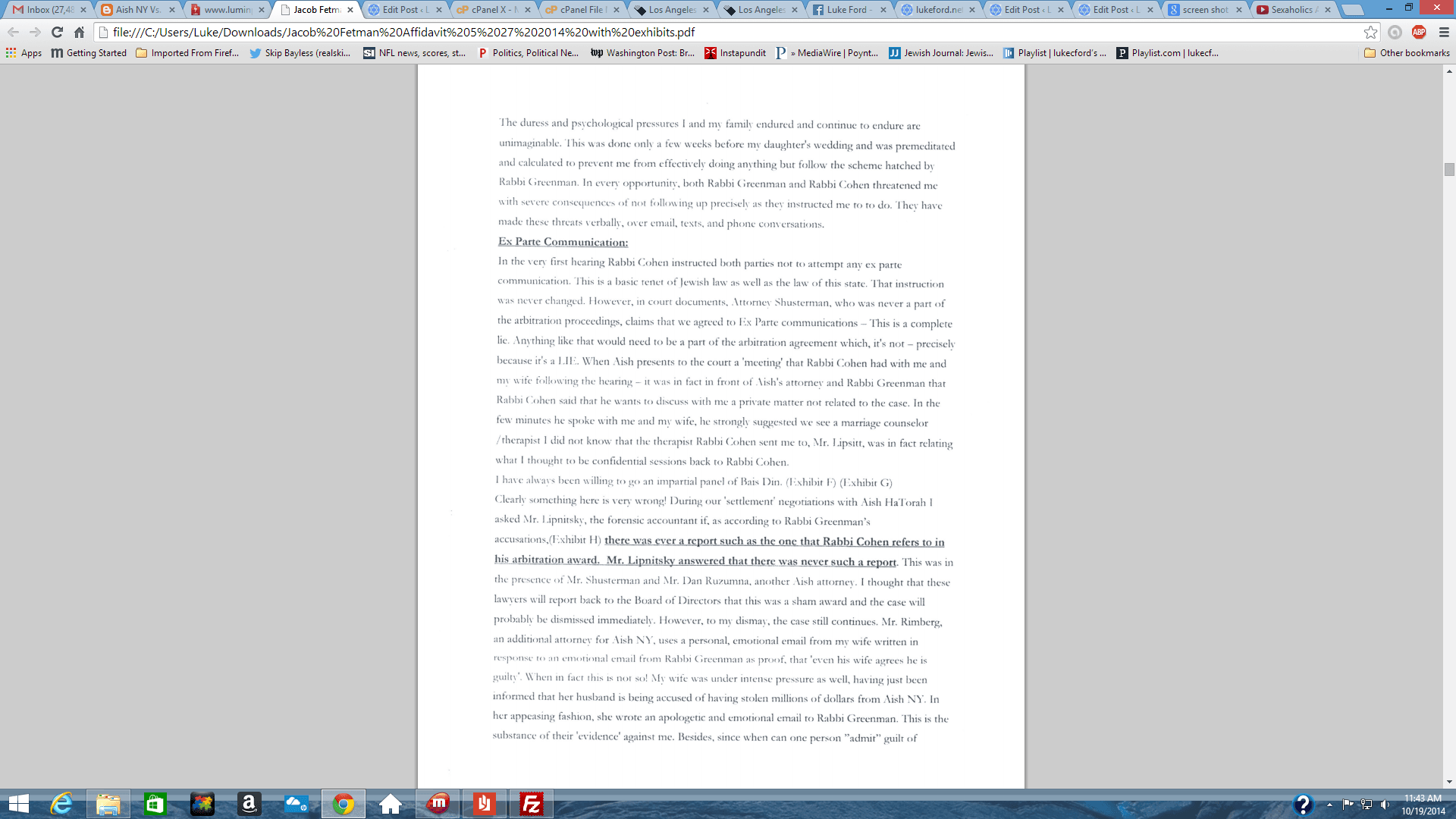
On May 27, 2014 I gave the court an affidavit showing the truth – the extreme duress of this ‘arbitration’ process, the illegalities of it (Ex Parte communication etc.) I hope and pray that Judge Demarest will take the time to review my affidavit and the suggestion I was making in the very last paragraph.

Rabbi Cohen made a huge mistake – the fact is I did not steal money from Aish! not $2.4 million and certainly not $20,000,000

I hope that an investigation will commence and I hope that the guilty parties will pay for what they did, the TERROR they put me and my family thru, the heartache, literary blackmailing me – abusing me, emotionally and physically to such an extent that I can no longer function properly.

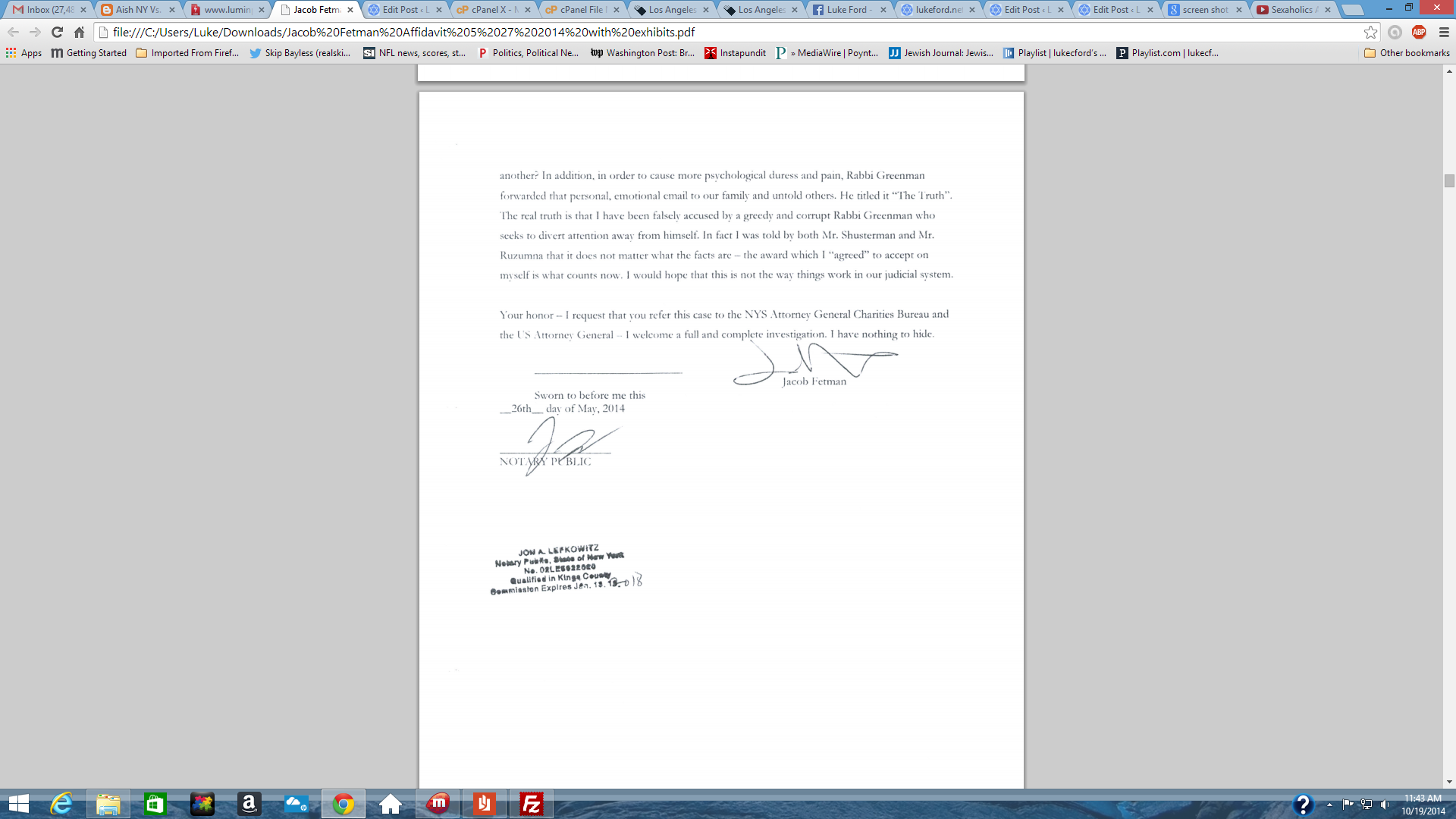
In his appeal, Jacob Fetman asked: “Your Honor — I request that you refer this case to the NYS Attorney General Charities Bureau and the US Attorney General — I welcome and full and complete investigation. I have nothing to hide.”

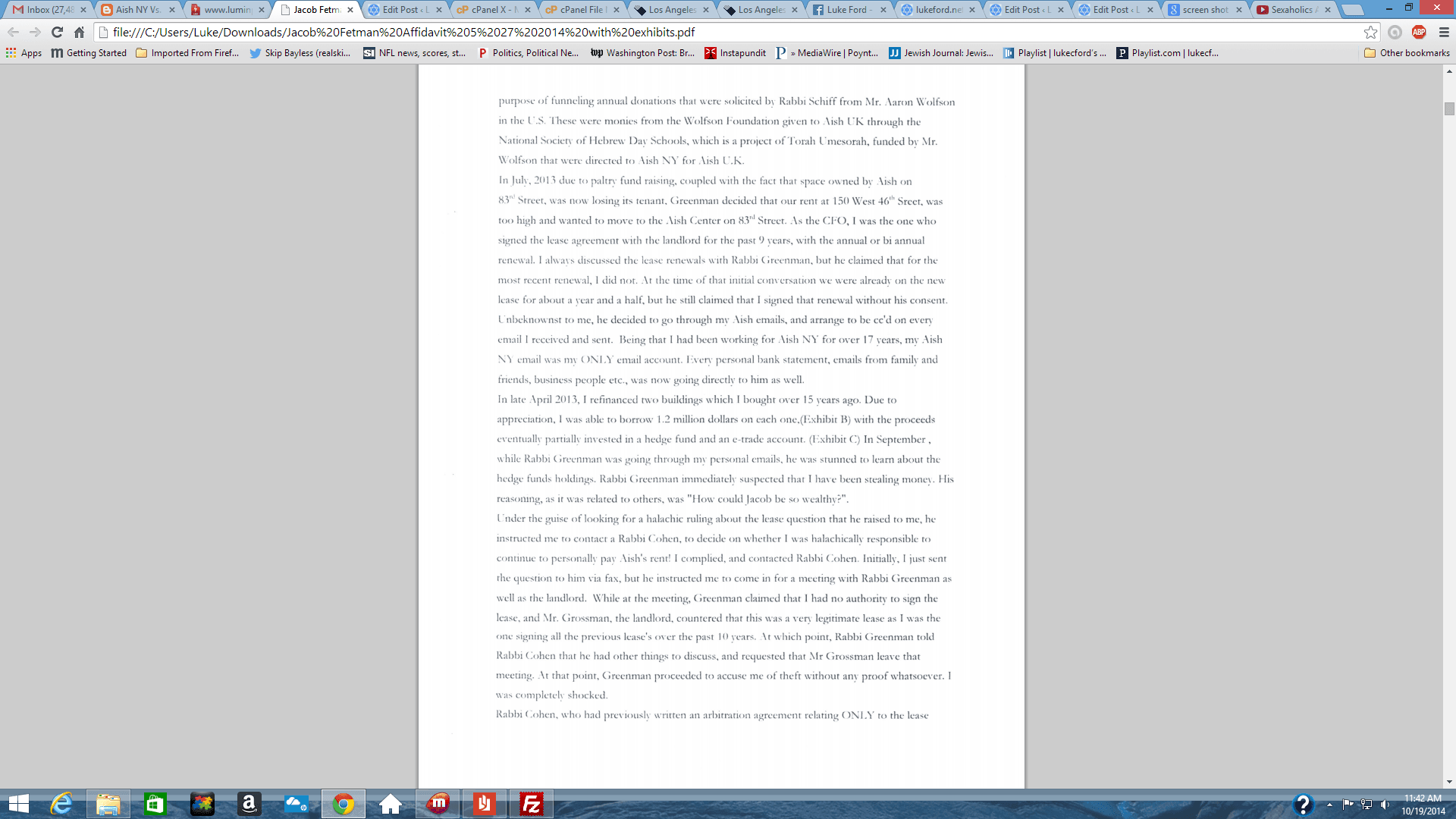
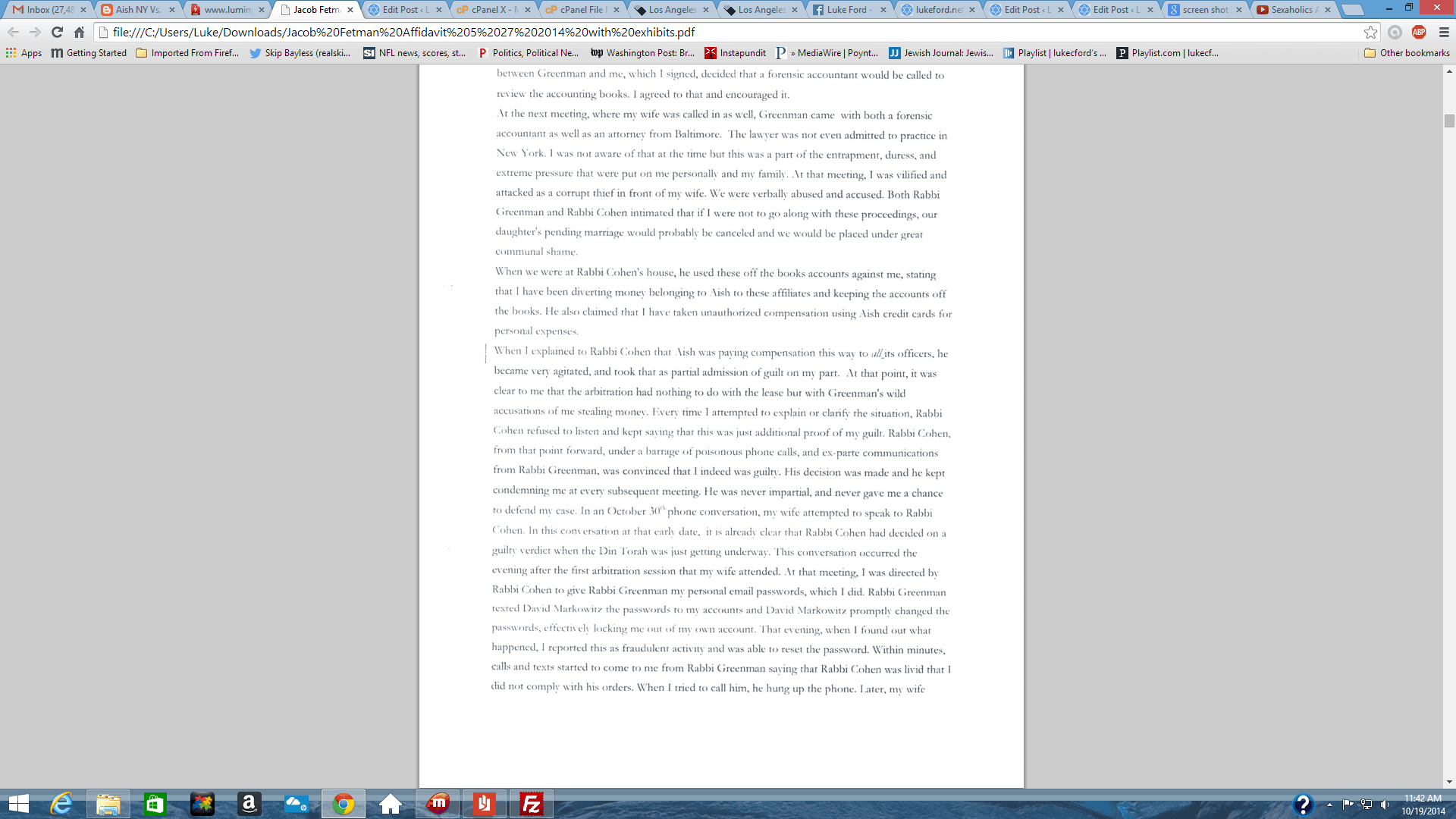
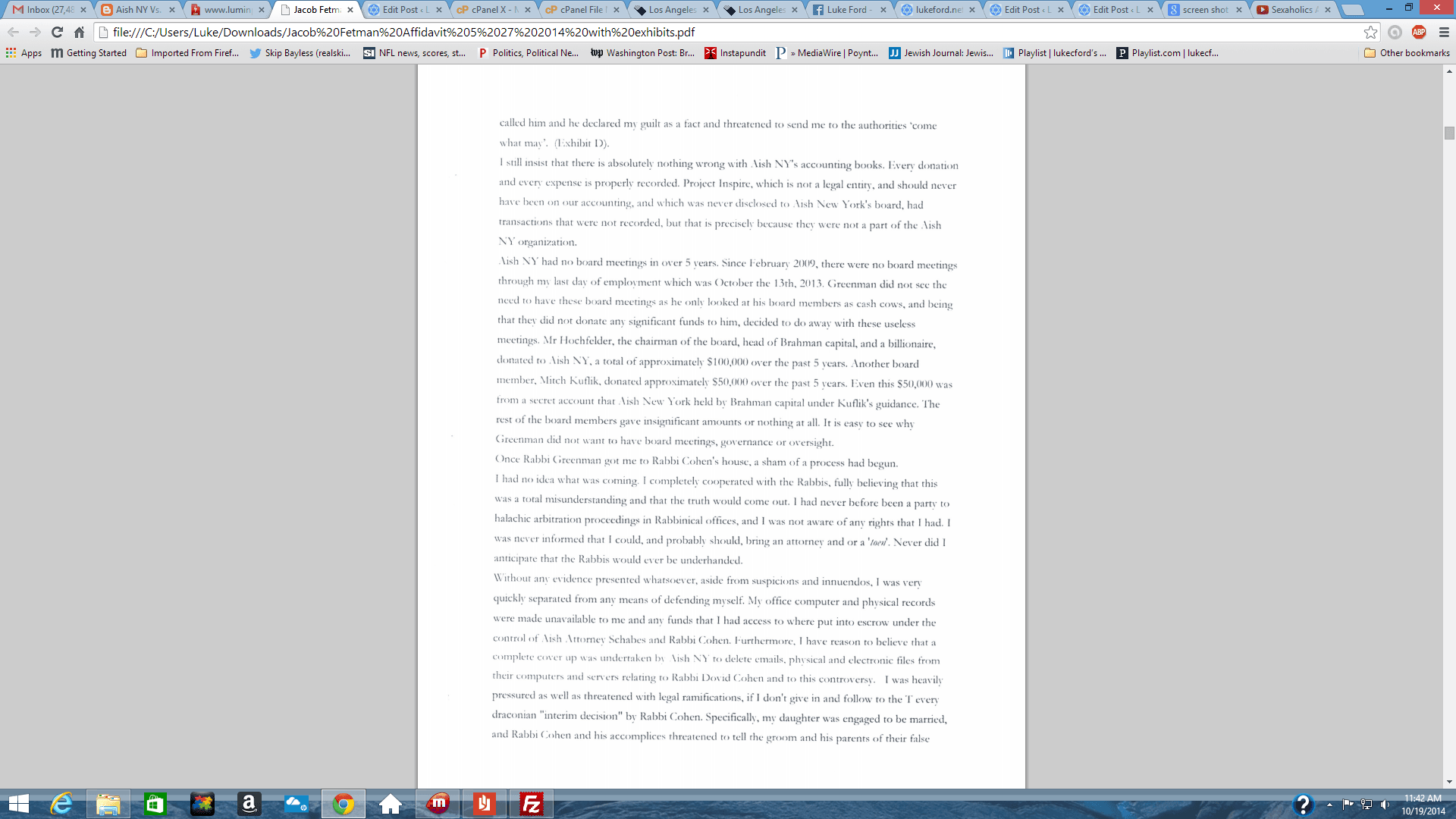
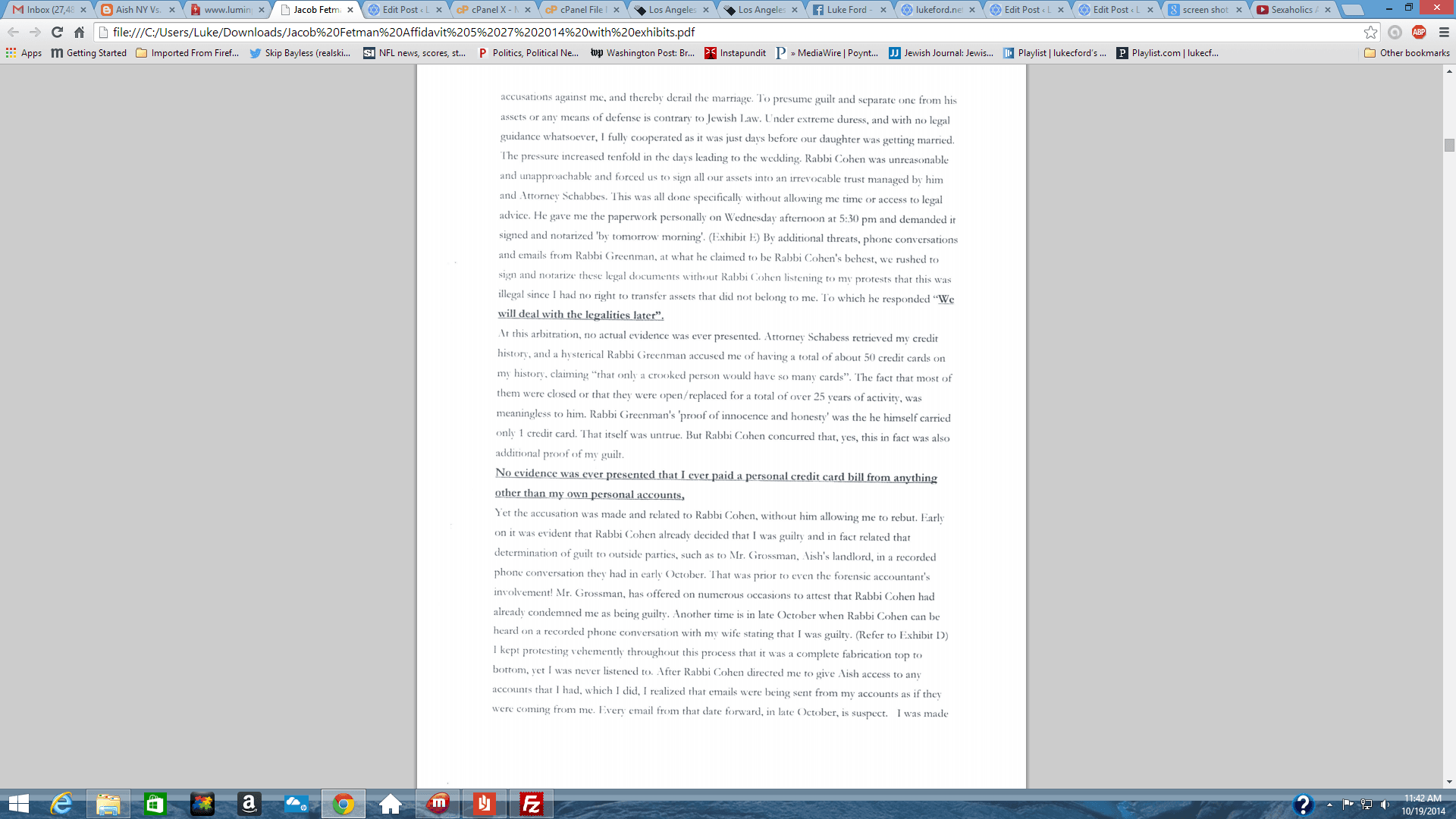
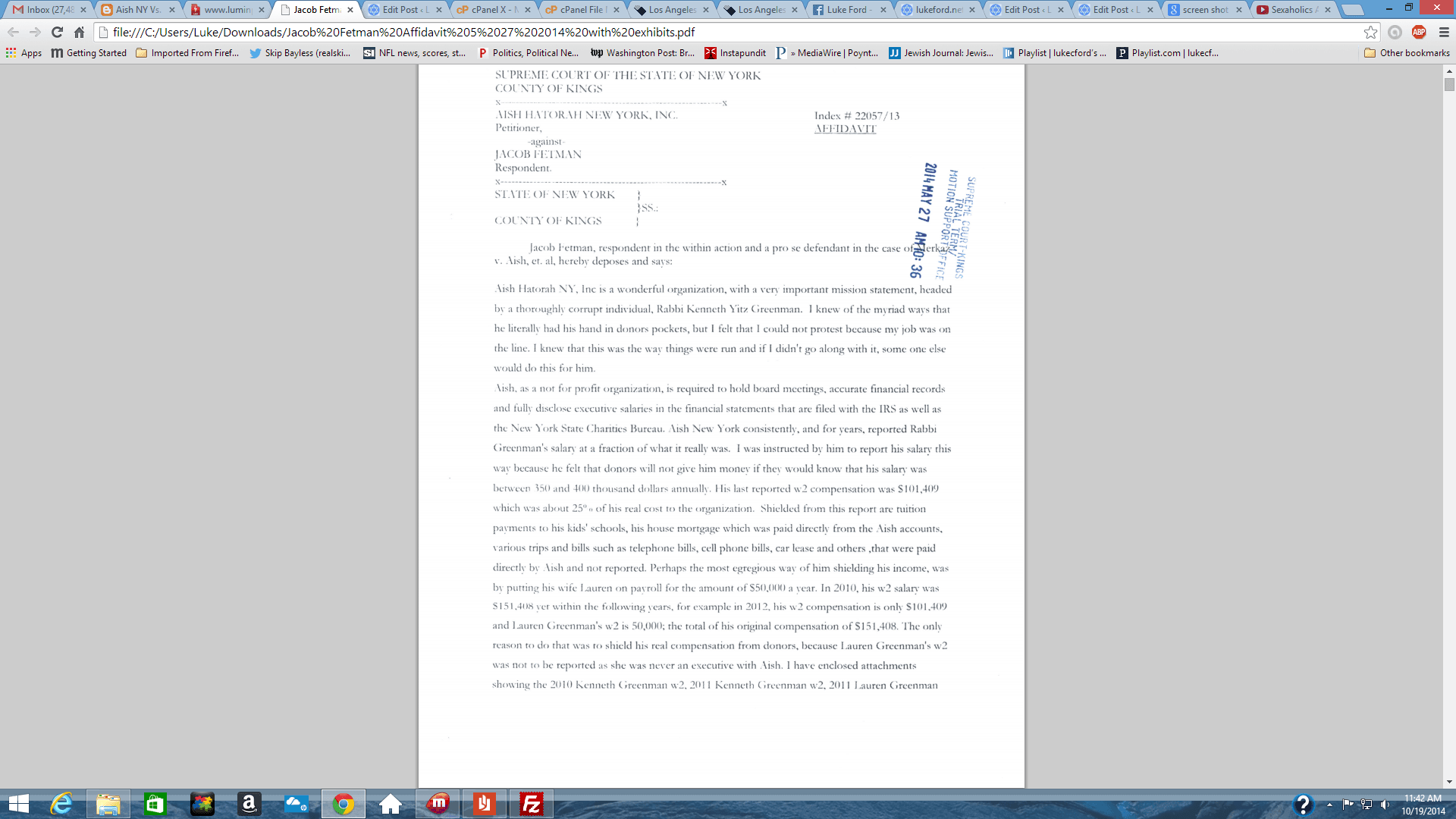
Here are excerpts from Jacob Fetman’s appeal:

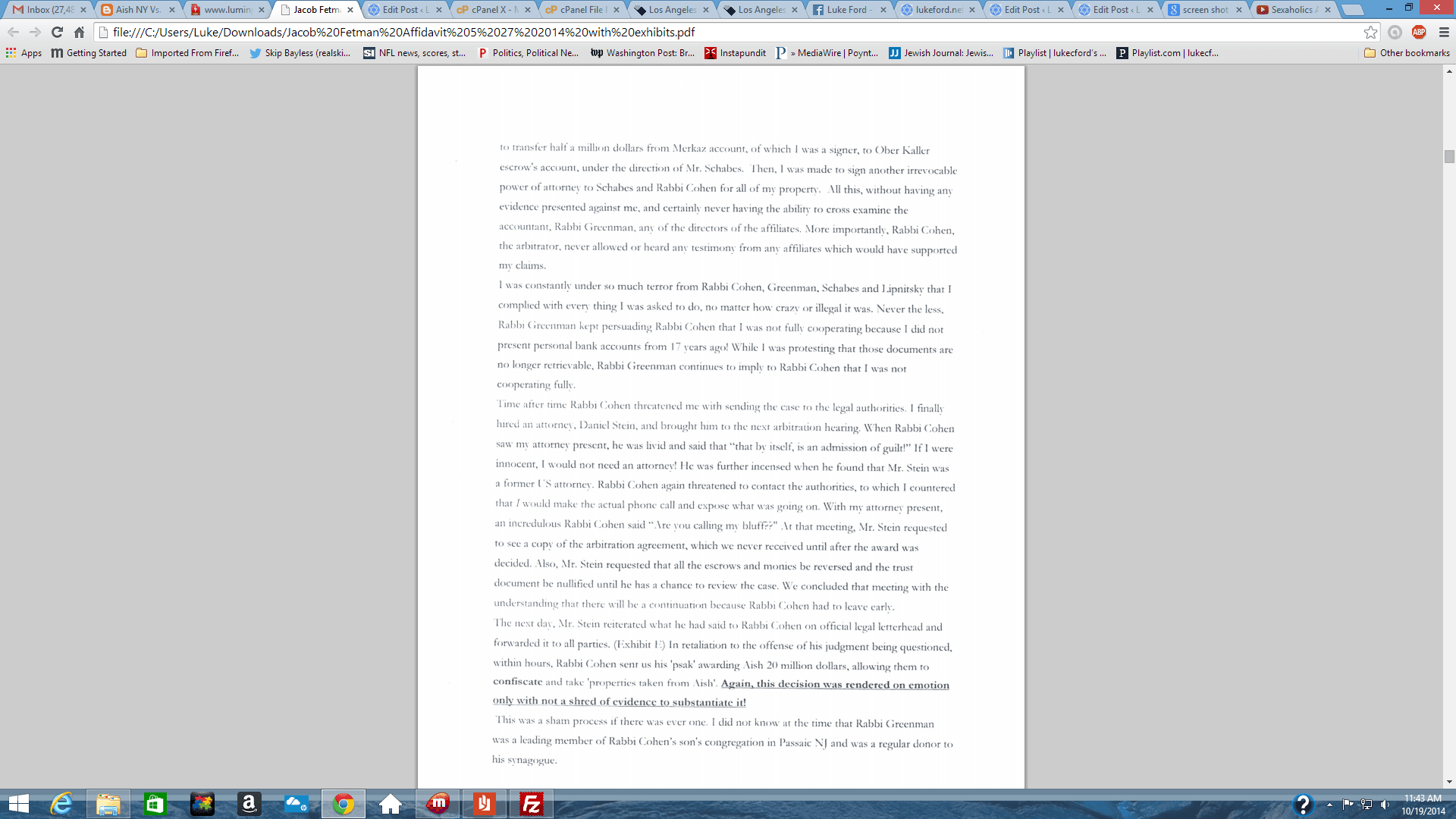
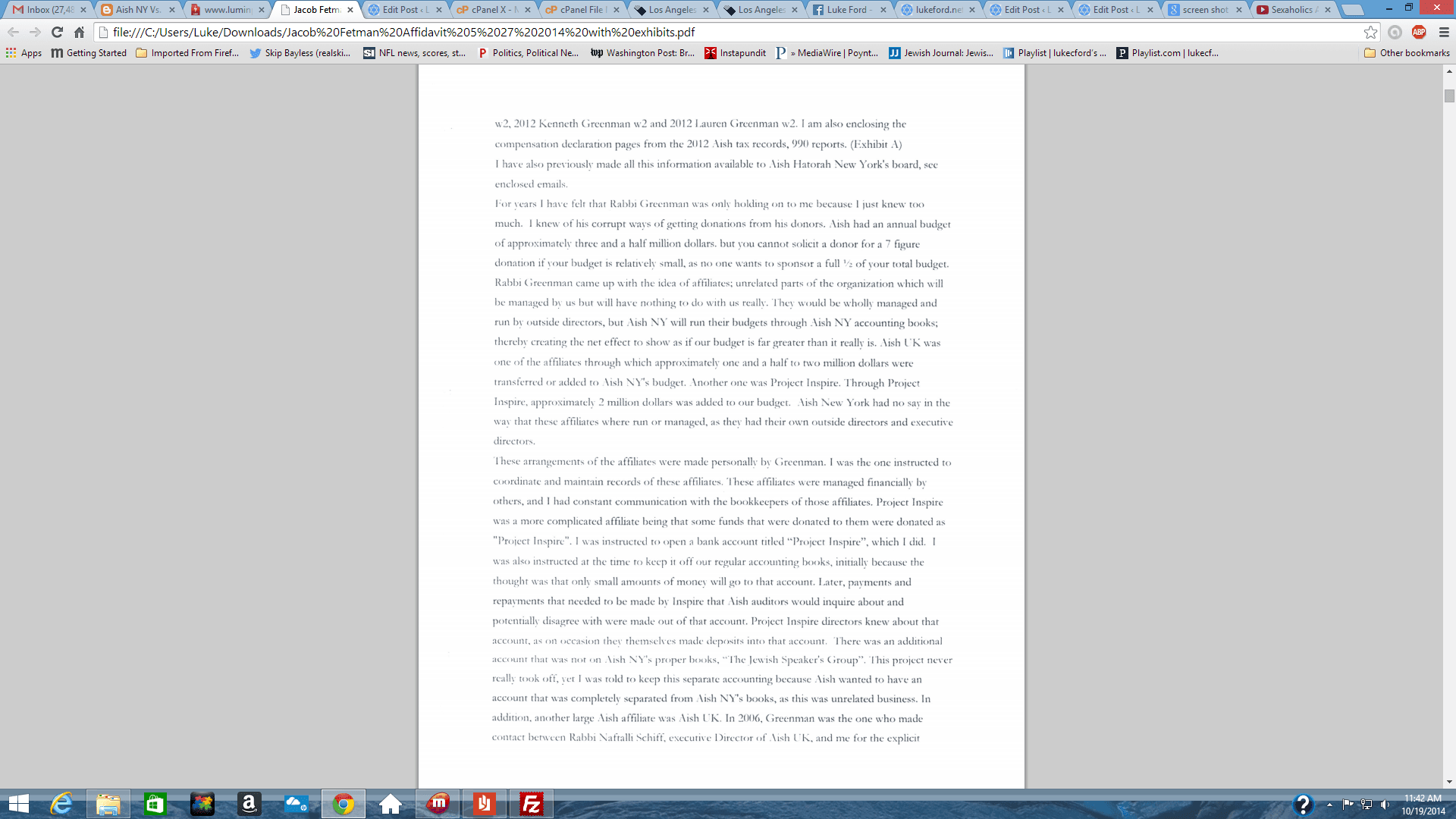
Aish HaTorah NY is a wonderful organization with a very important mission statement, headed by a thoroughly corrupt individual, Rabbi Kenneth Yitz Greenman. I knew of the myriad ways that he literally had his hands in donors pockets, but I felt that I could not protest because my job was on the line. I knew that this was the way things were run and if I didn’t go along with it, someone else would do this for him.

…Aish New York consistently and for years has reported Rabbi Greenman’s salary at a fraction of what it was. I was instructed by him to report his salary this way because he felt that donors will not give him money if they would know that his salary was between $350,000 and $400,000 per annum. His last reported W2 compensation was $101,409 which was about 25% of his real cost to the organization. Shielded from this report are tuition payments to his kids’ schools, his house mortgage which was paid direct from the Aish accounts, various trips and bills…that were paid directly by Aish and not reported. Perhaps the most egregious way of him shielding his income was by putting his wife Lauren on payroll for $50,000 a year.

For years I have felt that Rabbi Greenman was only holding on to me because I just knew too much. I knew of his corrupt ways of getting donations from his donors. Aish had an annual budget of approximately three and a half million dollars, but you cannot solicit a donor for a seven figure donation if your budget is relatively small, as no one wants to sponsor half of your annual budget. Rabbi Greenman came up with the idea of affiliates; unrelated parts of the organization which will be managed by us but will have nothing to do with us really. They would be wholly managed and run by outside directors, but Aish NY will run their budgets through Aish NY accounting books; thereby creating the net effect to show as if our budget is far greater than it really is…

Screenshot (1)

Screenshot (2)

Screenshot (3)

Screenshot (4)

Screenshot (5)

Screenshot (6)

Screenshot (7)

Screenshot (8)

Screenshot (9)

UPDATE JULY 22, 2015:

A source emails:

With regards to the allegations against Jacob Fetman, an attorney familiar with the case points out that Justice Demarest in her decision to confirm Rabbi Cohen’s award of $20,000,000 (twenty million dollars), made it clear that she did not review the merits of the case – her focus was to confirm or reject this award. As it is the public policy in NY state to uphold arbitration awards and because of the fact that there were no transcripts of the arbitration sessions (4 sessions totaling 140 minutes) she had no choice but to confirm the award – despite her reservations about Fetman’s allegations of the many violations of his Due Process. For example, in court it was acknowledged that a forensic report, which R’ Cohen bases his award on, was never provided to Fetman and in fact, once the judge ordered Aish to produce it (April 25, 2015 – almost 18 months after the award was issued), it was found to be dated AFTER the last session and on the date of the AWARD. Clearly, there was no chance for Fetman to dispute any of its ‘findings’.

It is note worthy that a criminal complaint which was alleged by Aish against Jacob Fetman is still pending in Brooklyn Supreme court for the alleged theft of $236,000 over five years – Mr. Fetman plead Not Guilty to this allegation and a trial is pending.

While Aish is a wonderful organization, with a very important mission, in court papers it was alleged by Fetman that executive compensation was substantially under reported and disguised as activities. Rabbi Greenman’s compensation over 2012 reported as (aish 990 filing) $101,409 taxable income and an additional $94,000 non taxable income was in fact almost double that. David Markowitz’s taxable compensation of $62,500 with an additional $50,000 non taxable compensation was in fact about $150,000. 2013 reported income for Rabbi Greenman was $118,310 taxable and combined compensation (with non taxable compensation) $216,929. Aish chose not to divulge any other executive compensation.

If the allegation against Fetman is correct – Aish NY, an organization with an internal budget of about $3 million dollars annually could have not “noticed” that $1.2 million annually was being stolen from it?? Why is it that Aish will not submit to examination of the ‘forensic report’ – what was the rush to issue an award when an attorney intervened on behalf of Fetman?

See attached Justice Demarest’s decision that Aish must produce the ‘forensic report’ to Fetman – when it was acknowledged that Fetman never received it. The award was issued 12/17/2013 – This decision by the court is 4/25/2015.

See the attached DA statement – Aish NY used Fetman and Merkaz the Center as a funnel to transfer monies from Project Inspire to Aish NY. Hundreds of thousand of dollars were transferred this way.

Lastly, see Dan Stein’s (Fetman’s original attorney and now the Chief of the Criminal Division at the US attorney General’s Office NY Western District) letter to R’ Cohen right after the award was issued and another letter to Mel Zachter, a noted accountant who agreed to examine the ‘forensic report’ but Aish never agreed.

R. Cohen’s decision states that Fetman took property from Aish which was proven in court that those properties were purchased prior to Fetman even working at Aish. That part of the award was struck out by the judge. The confirmation is pending an appeal.

~~~~~~~~~~~~~~~~~~~~~~~~~~~~~~~~~~~~~~~~~~~~~~~~~~~~~~~~~~~~~~~~~~~~~~~~~~~~~~~

As a recent article in the Forward states – its well known that Courts rubber stamp arbitration awards. Rabbi Greenman and his excellent attorneys took advantage of this perfectly.

G – Dan Stein letter to R Cohen 12 27 2013 Mel Zachter agreement 5 30 2014 brooklyn DA press release Jacob-Fetman-grand-larceny-indictment decision of judge demarest that aish must get me the report before the beis din session

Posted in Aish HaTorah | Comments Off on Aish Ha Torah New York Vs Jacob Fetman

Are Wives Grateful For Their Husbands?

I never go to Orthodox homes for a meal where the husband expresses contempt for the wife but about a third of the time (though never in Chabad), I see the wife express her contempt for her husband’s looks, his kiddush, his clumsy way making the table, etc.

Do wives today ever say to their husbands, “Please, I have a headache tonight, please take the Guatemalan maid servant?” Or are they less understanding than during Torah times?

Darren: “That’s a great fantasy, but the Jewish wives pick the most hideous help, so that there isn’t even that urge.”

I’ve noticed that. Latino women are often hot in their teens but rarely afterward.

Posted in Jews | Comments Off on Are Wives Grateful For Their Husbands?

The Rebbe Vs The Organized Jewish Community

I sometimes think, and here I must gulp before I can summon the courage to express my shameful thought, and I am sure I must be wrong here and I should not even say this out loud, but between you and me, I am not always thrilled with the political positions of the organized Jewish community (largely run by Ashkenazim of East European origin). Ashkenazi Jews are the smartest group around and therefore they are the most capable of doing great good and great harm.

Here’s the primary reason I fear the mainstream Jewish organizations — they all (including the Orthodox Union and Agudas Yisrael) support immigration amnesty, which will hurt America.

Here are more reasons I fear the big Jewish groups (and, by contrast, love the Rebbe and Chabad and the typical hard-working law-abiding Orthodox Jew who loathes third-world immigration and does not care about civil rights for trannies and sodomites). I’m reading Rabbi Joseph Telushkin’s biography (Rebbe: The Life and Teachings of Menachem M. Schneerson, the Most Influential Rabbi in Modern History) and he writes on pages 255-258:

Public opposition to the prayer [in public schools] came largely, though by no means exclusively, from the organized Jewish community; secular organizations such as the American Civil Liberties Union, which had a disproportionately high percentage of Jewish members, were heavily involved in this battle as well. A brief urging the Court to outlaw all such prayers in public schools was submitted by the Synagogue Council of America, a national organization representing rabbis in the different denominations, and the National Jewish Community Relations Council, representing Jewish communities throughout the United States. The brief’s essential argument was that although the New York State prayer did not advocate a specific religion — it spoke rather of “Almighty God” — it still violated the First Amendment, which ordains that “Congress shall make no law respecting an establishment of religion.” Although this constitutional provision is popularly understood as meaning that Congress is forbidden to establish a state religion, the Jewish organizations argued that a prayer promoting an “acknowledgment of dependence upon God and the invocation of his blessings” constitutes a preference for theistic religions that affirm a personal God, over nontheistic religions, such as Buddhism, which do not. In the view of these organizations, such a prayer has no place in a public school. The government, they argued, is obliged not only to be neutral among competing faiths “but also between religion and non-religion.” The state, quite simply, has no business participating in any way in religious affairs. The signatories emphasized that their opposition to prayer in public schools had nothing to do with opposition to religion. Indeed, they had submitted this brief “on behalf of the coordinating bodies of 70 Jewish organizations, including the national bodies representing congregations and rabbis of Orthodox, Conservative and Reform Judaism….
The [1962] ruling [of the US Supreme Court prohibiting prayer in public schools] was widely hailed throughout the American Jewish community, many of whose older members recalled a time when readings from the New Testament were commonly conducted in public schools. The fact that the New York State prayer was decidedly nondenominational had not allayed the common Jewish fear that any opening in the wall between religion and state could eventually lead to the favoring of Christianity over other religions.
The most noted leader within the Jewish community who stood out almost alone in opposition to this commonly enunciated Jewish position was the Rebbe.

The Rebbe also pushed for government support of religious schools, something the organized Jewish community opposed (pg. 266-268).

The Rebbe started Chabad’s public celebrations of Hanukkah in the early 1970s, again opposing the Jewish establishment.

The head of the Reform rabbinate in America, Joseph Glaser, wrote to the Rebbe:

It has come to my attention that Lubavitcher Chasidim are erecting Hanukkiot and holding religious services in connection therewith on public property in various locations throughout the United States.

This is as much a violation of the constitutional principle of separation of church and state as is the erection of Christmas trees and creches depicting the birth of Jesus. It weakens our hand when we protest this intrusion of Christian doctrine into the public life of American citizens and thus, it is really not worth the value received…

On pg. 264, R. Telushkin wrote:

…Glaser offered a rationale rooted in Jewish law for his position: Since the obligation to light Chanukah candles is fulfilled when the menorah is lit on Jewish property, there is “no halachic necessity for doing so on public property.” Glaser insisted, therefore, that in addition to being unnecessary, such an act also is undesirable. Jewish comfort in the United States has resulted in large part from the constitutionally guaranteed separation of church and state… If Jews do not want to be exposed to Christian observances that they find “offensive”…then it is equally wrong for them to carry out Jewish religious rituals in the public square.

The Rebbe was unmoved.

Posted in Agudath Israel, Chabad, Haredi, Hasidim, Jews, Orthodox Union | Comments Off on The Rebbe Vs The Organized Jewish Community

The Brilliant Black Guy Was Also The Coolest Guy You Could Meet

Half-Japanese, half-white blogger John Craig reflects on this brilliant black card counter he knew, the coolest cat around, and how their 30-year friendship ended after John’s blog post speculating that Obama might be gay:

When I first heard a few days ago that Obama might be gay, my initial reaction was, that’s ridiculous. He’s married, has two kids, and he’s never set off my gaydar. I had read a couple years ago about Larry Sinclair’s claims of having given Obama oral sex in the back of a limousine when Obama was a state senator. But at the time I just figured that any famous person is bound to attract a few loonies who will say anything to get publicity.

But after I read the article linked two posts ago (and directly below), I started reading more about the rumors of Obama’s gay life, and after a while, it just made too much sense not to be true.

In his article in WND.com, Jerome Corsi, a Harvard Ph.D. in political science, said that Obama (along with Rahm Emanuel) was a lifetime member of Man’s Country, a gay bathhouse in Chicago. Obama was evidently well known there and many of the older clientele remembered him:

Investigative journalist Wayne Madsen, who worked with the National Security Agency from 1984 to 1988 as a Navy intelligence analyst, confirmed DuJan’s claims.

“It is common knowledge in the Chicago gay community that Obama actively visited the gay bars and bathhouses in Chicago while he was an Illinois state senator,” Madsen told WND.

Obama’s reputation in gay circles, by the way, was that he liked to receive oral sex but not to give it, which squares with what Larry Sinclair had said about him. (It’s his “signature.” And receiving blow jobs but not giving them would be consistent with Obama’s narcissistic personality.)

As a member of the Reverend Jeremiah Wright’s Trinity United Church of Christ, Obama was known to have a “close friendship” with Donald Young, the openly gay choir director of the church. Young was murdered execution-style on December 23, 2007, just as Obama began his climb toward the Presidency. Another gay member of the church, Larry Bland, had also been killed execution-style a month earlier. Neither man was robbed, and both cases remain unsolved. Donald Young’s mother believes to this day that her son was killed in order to silence him before he spoke out about Obama.

Jerome Corsi is dismissed by the Left as a “Tea Party activist and conspiracy theorist.” But even if you regard Corsi and Madsen and Dujan with suspicion, what they say fits the larger picture of Obama’s life far better than any heterosexual narrative would. The circumstantial evidence — away from his public image as a family man — fits the homosexual narrative perfectly.

Chaim Amalek: “This article lost me at “his rigidly leftist mindset”. Which appears almost at the end of the article, so yes, I read it all. Back in my day, in order to be regarded a rigid leftist you had to be an acolyte of Lenin, Trotsky, or perhaps Mao. And Obama is not any of those. Nor is HRC or any other Property-Of-GoldmanSachs Democrat I can think of. Now then, is he gay? I’ve always thought open borders, free trade fetishists like Obama and our ruling elites had a touch of the gay in them, but likely that reaches too far. Still, the idea that our president is so selfish as to no even have the common courtesy to give a man a reacharound and a blow job is very disturbing. What must the Russians think of us? Won’t anyone think of the Russians?”

“Concerning the lack of old girlfriends from his salad days, it is possible that he never had a particularly strong sex drive. Not every red blooded young man is obsessed with sex. Some of us were more concerned with organizing our communities.”

Posted in Barack Obama | Comments Off on The Brilliant Black Guy Was Also The Coolest Guy You Could Meet

Returning Goods Lightly Used Is Not Unknown Among Jews

I hope there is not a higher percentage of Jews doing this than non-Jews.

There’s a mentality among some Jews (and some goyim) that they are free to return items after they’ve used them and to keep playing this game as long as they can get away with it.

I must confess that I briefly did this in the years following my Reform conversion and I would never have considered committing this abuse prior to my conversion. For me, there was something about belonging to a tribe that decreased the feeling that I owed things to the wider society.

I don’t think this tribal mentality that I tapped into is unique to me or unique to Jews. I suspect it applies to most tribes most of the time, whether they are black or Chinese or Jewish, etc (as opposed to WASPs).

Which groups are the least likely to abuse a store’s return policy? I’d say WASPs would be the least likely. Those who feel the least identification with their host nation would be the most likely.

Here’s a comment from an Orthodox Jewish board discussing the Wallmart in the Catskills: “When the Wal-Mart in Monticello had to send a letter to the Agudah discussing the horrible chillul hashem made in many ways over the summer months, it wasn’t because they hate us. They love every one of the millions of dollars we spend in their store, summer after summer after summer. What they DO NOT like, and rightfully so, is that we take advantage of a return policy in ways not intended. Is there a reason Wal-Mart has been reffered to as the Toy Gemach, Bike Gemach and A/C Gemach? That we take advantage of a large air conditioned store and use it as a babysitting service.”

I wonder if this Wal-Mart had to scrap its return policy over this?

Chaim Amalek: “When Moshiach comes, the goyim will compete with one another to sell us their goods just that they might receive returns from us.”

Daniel de Jew: “Neither I, nor my family have ever purchased anything with the intention of returning it later. I have entertained the though of, for example, buying a nice camera for a special event and then returning it after it was over. But I never did, because I know I’d be violating my Jewish values and feel terribly guilty as a result. The Jews who commit this crime of ethics are, I hope, a very small minority. If they would study some Mussar, they’d realize the gravity of their deeds, and cease their activity immediately.”

Stores that accurately racially and religiously profile their customers and get away with it legally will be more profitable than those that don’t profile. Countries that racially and religiously profile their citizens and base their immigration an visitor policies, in part, on such profiling are more likely to survive and perpetuate themselves than countries that don’t. For instance, not admitting people from countries with high rates of Ebola seems like a good idea right now.

Posted in Jews | Comments Off on Returning Goods Lightly Used Is Not Unknown Among Jews