Jewish Press Gloats That Anti-Jewish MP George Galloway Was Assaulted

Tzvi Ben Gedalyahu is apparently a graduate in Journalism and Economics from The George Washington University and he writes for The Jewish Press:

Galloway has been released from the hospital, but it is doubtful that the attacker was able to beat some sense into his head.

The MP, who has built his political career on loving Saddam Hussein and Hamas and hating Jews and Israel, was posing for pictures in west London Friday night when the attacker jumped on him while calling him “Hitler.”

The assault “appears to be connected with his comments about Israel because the guy was shouting about the Holocaust,” said Galloway’s spokesman. The name of his one-MP party is Respect, which indicates his ignorance of the English language.

The party’s name is a very contrived acronym for Respect, Equality, Socialism, Peace, Environmentalism, Community and Trade Unionism. A more accurate acronym would be “Racist, Extremist, Satanic, Pisher, Ethnic=hatingt, Crude and Twisted.

Galloway has been under police investigation since his call earlier this month that the city of Bradford, which he represents, be an “Israel-free” zone that would bar Israeli tourist and place a total ban on anything related to Israel.

We wish Galloway a speedy recovery and hope that some of the medicine he needs is made in Israel.

Do Jews think that publicly rejoicing over the Jewish assault of a Gentile politician for his anti-Jewish beliefs is good for the Jews? Do Jews think that by encouraging such attacks this will redound to the benefit of the Tribe?

Posted in Anti-Semitism | Comments Off on Jewish Press Gloats That Anti-Jewish MP George Galloway Was Assaulted

Liberation Rape

Steve Sailer writes:

According to federal statistics for 2001-2003, there were 15,400 cases of black-on-white single perpetrator rape versus 900 cases of white-on-black rape: a 17 to 1 ratio…

Black Panther Eldridge Cleaver summed up his racial motivations in the 1968 bestseller Soul on Ice, which was on the required reading list at my high school in the mid-1970s:

“[W]hen I considered myself smooth enough, I crossed the tracks and sought out white prey. I did this consciously, deliberately, willfully, methodically … Rape was an insurrectionary act. It delighted me that I was defying and trampling upon the white man’s law, upon his system of values, and that I was defiling his women … I felt I was getting revenge. … I wanted to send waves of consternation throughout the white race.”

The icy Boer novelist J.M. Coetzee won the Nobel Prize in Literature for his 1999 novel, Disgrace, about a professor’s lesbian daughter being gang raped by liberated blacks. It was made into a memorable 2009 movie starring John Malkovich as Coetzee’s alter ego. The laureate fled to Australia when the ruling African National Congress made threatening noises.

Posted in Blacks, Rape | Comments Off on Liberation Rape

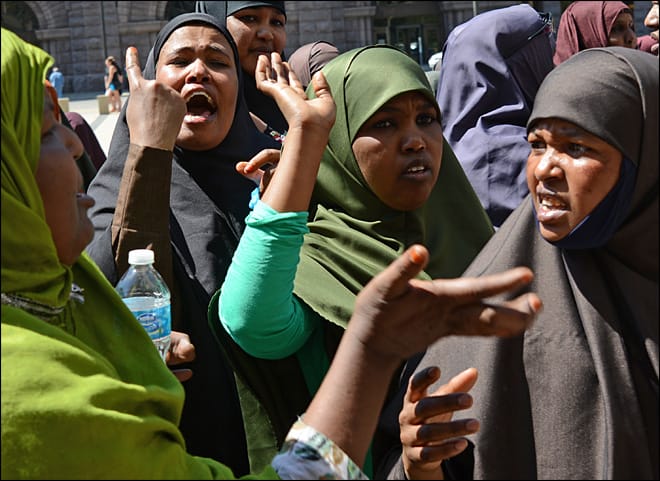
Why Does America Import Somalis?

Chaim Amalek: “Minnesota WASPS, that’s who! And you can’t blame the Jews for how Lutheran churches act to subvert White society. Luke, are any Chabad or other orthodox Jewish temples importing any Somalis or Sudanese these days?”

Luke Ford: “No, Chaim. That’s repellent to all the Hasidim I know.”

Chaim Amalek: “Scott, you have to have a culture with pretensions of being “universal” to behave in such a way. And Christianity sees itself as universal. The more insular the culture/religion, the less likely they are to entertain such thoughts. I think it would be a mitzvah and an example to your community, Luke, were you to adopt a few Somali teenaged boys. Maybe you could make good Aussies out of them.”

Washington Times:

The State Department has helped to relocate tens of thousands of refugees from the war-torn African nation of Somalia to Minnesota, where they can take advantage of some of America’s most generous welfare and charity programs.

But the effort is having the unintended consequence of creating an enclave of immigrants with high unemployment that is both stressing the state’s safety net and creating a rich pool of potential recruiting targets for Islamist terror groups.

In the fiscal year that ended in September, Minnesota welcomed 1,118 Somali refugees arriving directly from Africa, most of them without family ties to the state, according to State Department statistics. Overall, more than 30,000 Somalis live in the midwestern state comprising the nation’s largest concentration of Somali immigrants, according to U.S. Census data.

Many of the refugees settle near the Twin Cities, with Minneapolis being dubbed “Little Mogadishu” after the capital of Somalia.

This population is also being targeted by Islamist terror organizations like the Islamic State and al-Shabab, a Somalia-based group with links to al Qaeda, according to U.S. officials.

Among Minnesota-based Somali-Americans, American converts to Islam or Somali refugees, there have been numerous convictions for various levels of collaboration with Islamist terror groups, plus reports of fighting with al-Shabab or other Islamist groups.

On Sunday, al-Shabab made a propaganda video warning of an attack on shopping malls around the world, including the Mall of America in Minnesota. Al-Shabab claimed responsibility for the terror attack on the Westgate shopping mall in Kenya two years ago, which left 67 dead.

Somalis

Posted in Blacks, Immigration, Islam | Comments Off on Why Does America Import Somalis?

What Do You Think Of Husbands Who Always Put Their Clients On Hold To Take Calls From Their Wives?

When Rudy Guiliani ran for president in 2008, he was knocked for taking a call in the middle of a speech and putting the audience on hold so he could talk to his wife.

I notice a lot of guys 100% of the time put their clients on hold to talk to their spouse. She calls and he picks up.

I think it is unprofessional when a guy always puts a client on hold so he can talk to his wife.

Now some wives and children object that their husbands and fathers don’t 100% of the time put work on hold to talk to them.

Men I know (middle class Jewish men mainly) tend to fear their wives more than wives tend to fear their husbands. Husbands tend to appreciate their wives more than wives tend to appreciate their husbands (John Gray told Dennis Prager this).

Men are weak these days.

A hot Jewish chick tells me: “Yes – they are. Why are they so weak? I hate it. They’re a bunch of pussies especially the guys around here. Why do you think I am attracted to white nationalists? Because they are the only men left that have any balls and will actually stand up for themselves. I was talking to my girl friend about this yesterday. She wants to be dominated. She needs a guy that will dominate her. And they are very rare, especially if you are an alpha female – which we both are.”

Another thing I notice is that wives feel much more comfortable ripping apart their husbands in public rather than vice versa, and wives tend to support their kids against their husbands much more than husbands support their kids against their wives.

It’s weird how involved middle-class parents are with their kids. I know some who’ll give their kids a ride if work or school is a mile away. I’d bike a few miles to and from school every day. I never wanted my parents to show up to any of my school events but I notice parents do this routinely these days. My parents played almost no role with my homework.

There’s no parenting style that has been shown to have regular statistical results. As the New York Times wrote:

First, researchers have been unable to find any child-rearing practice that predicts children’s personalities, achievements or problems outside the home. Parents don’t have a single child-rearing style anyway, because how they treat their children depends largely on what the children are like. They are more permissive with easy children and more punitive with defiant ones.

Second, even when parents do treat their children the same way, the children turn out differently. The majority of children of troubled and even abusive parents are resilient and do not suffer lasting psychological damage. Conversely, many children of the kindest and most nurturing parents succumb to drugs, mental illness or gangs.

Third, there is no correlation — zero — between the personality traits of adopted children and their adoptive parents or other children in the home, as there should be if ”home environment” had a strong influence.

Fourth, how children are raised — in day care or at home, with one parent or two, with gay parents or straight ones, with an employed mom or one who stays home — has little or no influence on children’s personalities.

Finally, what parents do with and for their children affects children mainly when they are with their parents. For instance, mothers influence their children’s play only while the children are playing with them; when the child is playing alone or with a playmate, it makes no difference what games were played with mom.

Most psychologists have done what anyone would do when faced with this astonishing, counterintuitive evidence — they’ve tried to dismiss it. Yet eventually the most unlikely idea wins if it has the evidence to back it up. As Carole Wade, a behavioral scientist, puts it, trying to squeeze existing facts into an outdated theory is like trying to fit a double-sized sheet onto a queen-sized bed. One corner fits, but another pops out. You need a new sheet or a new bed.

I think it is unprofessional when parents at work automatically drop everything when their kids call. Their lives should not revolve around their kids. I think it sends the wrong message when a father lets his wife and kids know that he will drop everything to be at their beck and call. Women don’t want to be in charge. They’ll nag and nag, but they need a man to take the reins.

A buddy says: “We committed, life-long bachelors, living utterly apart from the fair sex, have as much business discussing such matters as the pope has of issuing rulings on birth control and divorce. Let us instead focus on our blogging, cats, and issues of personal grooming. How would you be living your life today if the Internet had never been invented?”

Posted in Parenting, Personal | Comments Off on What Do You Think Of Husbands Who Always Put Their Clients On Hold To Take Calls From Their Wives?

Islamic State Refuses To ‘Work’ With Boko Haram Because They’re Black

Some days it seems like nobody likes blacks, not even Muslims.

Blog: This begs the following question: Since President Obama takes issues like racism more seriously than terrorism, will this revelation inspire him to go after the Islamic State with the same ferocity he displayed when he slammed the Cambridge, MA, officers who arrested Professor Henry Louise Gates, Jr.?

It should briefly be noted that not everybody buys the racism angle. For instance, International Business Times contributor Elizabeth Whitman points out the way in which the Islamic State tried to use the Ferguson fiasco to convince black Americans to embrace Islam. Mind you, there is a drastic difference between exploiting someone for your advantage and inviting someone to fight alongside you. A big difference!

Posted in Blacks, Islam | Comments Off on Islamic State Refuses To ‘Work’ With Boko Haram Because They’re Black

What kind of man rapes a 93yo woman?

safe_image

REPORT: A legally blind 93-year-old woman was able to pull an alarm and summon help from neighbors as a stranger battered and then sexually assaulted her in her apartment, the Broward Sheriff’s Office said.

About 2:30 a.m. Monday, the woman had taken trash to the receptacle at the end of her hall and was surprised by Clyde Alvims Leandre, 22, of Delray Beach, according to Detective Ian Kuechler…

“In her condition, with sight issues and she is technically, legally blind, she knew where to reach for that cord when she was forced upon that bed,” Kuechler said during a press conference Monday at the Broward Sheriff’s headquarters in Fort Lauderdale.

The alarm, her cries for help as well as the light drew the attention of three neighbors who entered the apartment through its unlocked front door, Kuechler wrote in his report.

“Initially some of the other residents of the building attempted to subdue the subject,” the detective said. “However, they basically explained that he seemed to have about the strength of 10 men and was oblivious to them being in the room. He continued to grasp on to the female victim and restrained her in her bedroom.”

Posted in Blacks, Rape | Comments Off on What kind of man rapes a 93yo woman?

German Jews Oppose Publication Of Mein Kampf

I’d say that banning the book is an argument that its contents have a dangerous alluring power. Best to let it be discussed and debated in the public domain to remove the mystery.

I hate it when I keep reading how Jewish groups are pushing for criminalizing speech they don’t like. Mein Kampf was one of the top ten most influential books of the 20th Century. It deserves attention.

I found the book hard to put down. My pulse raced all the way through it. I knew it was forbidden to read it. That it was supposedly the most evil document out there. How could one’s pulse not race?

When I read Mein Kampf, I felt like I understood Hitler better. I could see the world through his eyes. I felt like I had a better understanding of why the 20th Century turned out like it did.

At the time I first read it (late 1999, I think), I was writing extensively about the sex industry, which was disproportionately dominated by Jews. I noted that Hitler blamed the Jews for pushing sexual degeneracy. From my own research, I knew that Jews have played a big role in the sex trade for over a century, and they have played a big role in changing sexual mores in the West towards the permissive.

I think it is sad that Bavaria backed down on subsidizing an extensively annotated politically correct new edition of Mein Kampf because of criticism from Holocaust survivors. “Because Holocaust” is a much abused argument. How come you never hear “Because communism” or “Because of the Jewish role as Stalin’s willing executioners”?

I don’t view Jews or Nazis as the personification of evil. I see groups down through history as acting in their self-interest as they perceived it. Communism was not just a failed experiment and a horror show. It also fit a need that certain groups had at the time.

If Mein Kampf creates a hostile environment for Jews, perhaps that’s because it brings to fore hidden resentments that are a ticking time bomb for Jews anyway, and that Jews should just leave for some place more hospitable?

I wonder if the hysterical reactions of Jews to this republication, while completely understandable, will hasten an anti-Jewish backlash? Most people don’t like to be told what books they may read.

When world Jewry attacked the Nazis during the 1930s, did that do the Jews of Europe a favor or was it a factor in their demise? I wonder if Jews had concentrated on getting Jews out of Europe and into Palestine as the Nazis wanted (the Nazis were Zionists), instead of declaring their hatred of the Nazis, perhaps the Nazis might not have acted as they did with the Holocaust?

Not every country is going to be suited to Jewish prosperity just as not every country is equally suited for blacks and Muslims and Mexicans or any group.

Groups should do what is in their interests rather than simply what feels good. It feels good for many Jews to throw a fit over the republishing of Mein Kampf in Germany, but does it do Jews good?

There are a lot of sacred Jewish books (such as the Torah and Talmud) that contain hatred towards Gentiles. How would Jews feel about these books being banned? You might argue, well, Jews have never committed genocide so this hatred is harmless. Well, the victims of Stalin’s genocides that were in part carried out by Jews may differ. It was because Stalin’s executioners were frequently not Russian but Jewish or Georgian etc that they were able to carry out these genocides.

Hasidic Jews don’t campaign against the goyim reading whatever books they want, including Mein Kampf. They don’t obsess about the Holocaust. They don’t build museums about the Holocaust. They don’t monitor the speech of Gentiles for anti-Semitism. They don’t fight anti-Semitism. In short, they don’t worry about the goyim because they have their own full rich lives to lead. I think the Jews who get in a tizzy about what books the goyim are reading are leading lives so empty that they have to make up a pointless and destructive crusade to give themselves purpose in life.

As far as I am aware, our mesora (Jewish tradition) does not say anything about which goyisha books the goyim are allowed to read.

From the Washington Post:

Although authorities here struck deals with online sellers such as Amazon.com to prohibit sales in Germany, new copies of “Mein Kampf” have become widely available via the Internet around the globe. In retail stores in India, it is enjoying strong popularity as a self-help book for Hindu nationalists. A comic-book edition was issued in Japan. A new generation of aficionados is also rising among the surging ranks of the far right in Europe. The neo-Nazi Golden Dawn party in Greece, for instance, has stocked “Mein Kampf” at its bookstore in Athens.

Regardless of the academic context provided by the new volume, critics say the new German edition will ultimately allow Hitler’s voice to rise from beyond the grave.

“I am absolutely against the publication of ‘Mein Kampf,’ even with annotations. Can you annotate the Devil? Can you annotate a person like Hitler?” said Levi Salomon, spokesman for the Berlin-based Jewish Forum for Democracy and Against Anti-Semitism. “This book is outside of human logic.”

Not surprisingly, the new edition has become a political hot potato, illustrating the always-awkward question of how modern Germany should deal with its past. Initially, Bavaria, for instance, had pledged $575,000 to directly support publication of the new edition for historical purposes. But it backed out after the Bavarian governor’s 2012 visit to Israel, where he heard withering criticism of the proposal from Holocaust survivors…

Despite the chorus of opposition, particularly from Jewish groups and Holocaust survivors, the institute has opted to go ahead with publication, funding it from its general budget — a task made easier by the fact that Bavaria allowed it to keep the original grant for other research purposes…

Brechtken said the new print version will point out, for instance, how Hitler appeared to borrow his views from other sources, and it will refute his racist claims. Bavarian officials also say they will seek to apply incitement-to-hate laws to any attempt to publish unannotated versions in the future. But so far, they say they will not seek to block publication of the institute’s expanded version, citing the benefits it may bring to historical research.

Yet vocal opposition appears to be growing. Charlotte Knobloch, head of the Jewish community in Munich, said she had not vigorously opposed it when the project first surfaced. But her position, she said, hardened after hearing from outraged Holocaust survivors.

“This book is most evil; it is the worst anti-Semitic pamphlet and a guidebook for the Holocaust,” she said. “It is a Pandora’s box that, once opened again, cannot be closed.”

Posted in Adolf Hitler, Anti-Semitism, Jews, Nazi | Comments Off on German Jews Oppose Publication Of Mein Kampf

Stop The Presses! An Indian Commits Fraud!

REPORT: A MAN of Indian descent who thought he’d get more online dating profile hits pretending to be a blond caucasian has narrowly avoided jail after taking his deceit too far.

Deepak Dhankar, an Indian-born father of three, used photos of a muscular, blond stranger and adopted the name “Jamie” for a dating profile he used to arrange a tryst with a Melbourne woman.

Dhankar, a financial planner, turned to online dating in 2012 after his third child was born and his wife became ill.

In October that year, he started chatting and exchanging explicit photos with the victim before they agreed to meet at her house for a sexual liaison.

Dhankar let himself in through the unlocked door and entered the bedroom where the woman was naked and facedown on the bed.

The two had agreed beforehand that “Jamie” would play the role of a dominant and the woman would be a submissive.

As part of that arrangement, Dhankar insisted she keep her eyes closed and never look at “Jamie”.

The woman consented to this and Dhankar performed sex acts on her while she lay on the bed.

He then told her to go into her bathroom where their sexual activity continued until the woman’s small child stirred.

When the woman went to settle her child, she saw Dhankar’s hand and realised he was not the blond he’d described himself to be.

She decided to play along because she was afraid of what might happen if she let on she was aware he wasn’t “Jamie”.

In her victim impact statement, she told the court the incident left her feeling violated.

Posted in India, Sex | Comments Off on Stop The Presses! An Indian Commits Fraud!

When The Israelites Were Strong In The Land

In this morning’s daf yomi (page of Talmud), I learned there’s a Mishna that when a woman is taken captive during a time that the hand of Israel is strong in the land, she is not presumed to be raped, but if the hand of the idolaters dominates the land, she is presumed to be raped.

Social norms vary depending upon who holds power. When Christianity is strong in the land, for example, Christian norms dominate public life. When women take over a part of life, female norms of cooperation dominate.

When America had a dominant majority and when America had lynching (and almost all of it was for horrendous behavior such as rape and murder and most Americans who were lynched were white), there was much less rape and murder and crime than there is today. Once the hand of the majority was weakened, after the civil rights revolution of the 1960s, we got an explosion of black crime.

Similarly, in the 1970s, when homosexual behavior became more accepted, we got AIDS and an explosion of diseases among gays because they could now act on their natural instincts towards promiscuity.

A healthy society has one dominant culture. America was healthier 60 years ago. It had more social trust and more social cohesion and fewer civil rights and less violent crime.

Dennis Prager notes that every individual exerts a force field. I’ve seen how when Dennis Prager walks into a room, the room changes. People tend to up their game. They become more polite. They’re intimidated by Prager’s social status. When I had a difference with Prager, every single person I knew sided with the top dog.

Groups also exert force fields. In some circumstances, Jews rise to the top and dominate parts of life (such as academia, law, medicine, entertainment, media). Jewish social norms become the group’s social norms. For example, when Jews came to dominate medicine, the Jewish practice of circumcision became the American practice. In Australia, a country with relatively little Jewish influence compared to America, everybody in December says Merry Christmas. In cities with lots of Jews such as Los Angeles and New York, that greeting is not the default.

In some parts of American life, blacks rise to the top and dominate (sports, music, comedy, preaching, politics). Since blacks have come to power in the NFL and the NBA, you have more exuberant celebrations and more left-wing politics. Non-blacks often feel bullied.

Jews and blacks shape American culture, for example, more than Mexicans do. Jews and blacks exert force fields that change how outsiders think, speak and behave.

Why would any group not want to create a strong force field aligned with its best interests? The more cohesive the group, the more powerful it can be.

The opposite of cohesive is diverse. Diversity means we have nothing in common. A diverse community is a weak community. There’s nothing uniting us. Why do people think that is a good thing?

I’ve often heard Islam described as the most powerful religion in the world because so many of its adherents are willing to kill for it. That’s a force field that intimidates critics.

Why would Christians not want to build the strongest force field possible? To the extent that Christianity does not dominate, non-Christianity dominates. Why would Christians want that?

According to a Jewish teaching, God is wherever you let Him in. God is real in the world to the extent that believers in God make him real in the world.

Why would you not want your god, your hero system, to be real in the world? Your hero system is an objective reality to the extent that you make it concrete and force other hero systems to bow to it.

On Dec. 30, 2013, I wrote:

On Friday, I posted to FB: “Phil Robertson stood tall for his beliefs [about homosexuality] and A&E caved.”

My friend Michael responded: “Phil’s “beliefs” include black people supposedly enjoying living under racist Jim Crow laws.”

Michael, Phil didn’t give any “beliefs” as you describe. He said this: “I never, with my eyes, saw the mistreatment of any black person. Not once. Where we lived was all farmers. The blacks worked for the farmers. I hoed cotton with them. I’m with the blacks, because we’re white trash. We’re going across the field…. They’re singing and happy. I never heard one of them, one black person, say, ‘I tell you what: These doggone white people’—not a word!… Pre-entitlement, pre-welfare, you say: Were they happy? They were godly; they were happy; no one was singing the blues.”

In this GQ interview excerpt, Phil simply described what he saw. That was his experience. But let’s extrapolate out from what Phil Robertson saw to the general condition of blacks in America under Jim Crow and today. The black family under Jim Crow was in better shape than the white family. As the black economist Walter Williams wrote: “In 1960, only 28 percent of black females between the ages of 15 and 44 were never married. Today, it’s 56 percent. In 1940, the illegitimacy rate among blacks was 19 percent, in 1960, 22 percent, and today, it’s 70 percent. Some argue that the state of the black family is the result of the legacy of slavery, discrimination and poverty. That has to be nonsense. A study of 1880 family structure in Philadelphia shows that three-quarters of black families were nuclear families, comprised of two parents and children. In New York City in 1925, 85 percent of kin-related black households had two parents. In fact, according to Herbert Gutman in “The Black Family in Slavery and Freedom: 1750-1925,” “Five in six children under the age of 6 lived with both parents.” ”

So, yes, in some ways blacks in America were happier and better off under Jim Crow laws than they are today under rap culture. Do I want America to go back to Jim Crow culture? No.

In many ways, Gays were better off under a repressive America than under today’s permissive America. Just look at AIDS. AIDS exploded after it became socially acceptable to publicly identify as gay. Black crime rates exploded after the 1960s Civil Rights legislation. South Africa’s average life expectancy has plunged a decade since the end of apartheid. The average black (and white) in South Africa was better off under apartheid than he is today.

In many ways, Jews in America were better off with a mildly anti-semitic America that did not always allow them into certain hotels and country clubs and limited their admission to Ivy League schools because that segregation promoted group cohesion and discouraged inter-marriage and assimilation.

Freedom and equality of opportunity are not always the greatest values.

John* emails:

There are a couple of very important points about Jim Crow laws that are usually ignored by people who view segregation as unspeakably evil. Under segregation, there was generally a thriving black business class who catered to blacks. Once segregation was lifted, and blacks could shop anywhere, some did and that cut into the black owners’ business but whites did not start patronizing black owned establishments. So integration had the unintended consequence of eviscerating black stores (excepting undertakers, barbers and hair salons.)

The other problem arose with school segregation. Within the black community, teachers, administrators and principals formed a respected middle and upper class. When the schools were desegregated, many of the teachers lost their positions. They may have been graduates of Negro teacher’s colleges, but those schools were thought of as inferior to their white counterparts. Black principals were not put in charge of an integrated or white faculty.

This also had the unintended consequence of undermining discipline in the schools. If a kid acted up, the principal and/or teachers knew the family and would speak with the family about the problems with the child. With white teachers and principals, this didn’t apply. They may have held positions of authority, but they didn’t personally know the family or interact in the community in the same way.

On the anniversary of Brown v Board of Education, I read some interviews with prominent blacks who had received education in the segregated south and then were part of the first wave of desegregation. They said that they felt that the education they received from their segregated teachers surpassed what they received in an integrated environment. Some of this may be due to white racism, but at least part of it, is that they could identify more closely with their black teachers and their black teachers understood them better.

If you want to read more about the impact of the Brown case on education, Raymond Wolters, a history professor at the University of Delaware, has written a couple of books about it.

Steve Sailer wrote January 15, 2007:

“In the presence of [ethnic] diversity, we hunker down. We act like turtles. The effect of diversity is worse than had been imagined. And it’s not just that we don’t trust people who are not like us. In diverse communities, we don’t trust people who do look like us.”
—Harvard professor Robert D. Putnam

It was one of the more irony-laden incidents in the history of celebrity social scientists. While in Sweden to receive a $50,000 academic prize as political science professor of the year, Harvard’s Robert D. Putnam, a former Carter administration official who made his reputation writing about the decline of social trust in America in his bestseller Bowling Alone, confessed to Financial Times columnist John Lloyd that his latest research discovery—that ethnic diversity decreases trust and co-operation in communities—was so explosive that for the last half decade he hadn’t dared announce it “until he could develop proposals to compensate for the negative effects of diversity, saying it ‘would have been irresponsible to publish without that.’”

In a column headlined “Harvard study paints bleak picture of ethnic diversity,” Lloyd summarized the results of the largest study ever of “civic engagement,” a survey of 26,200 people in 40 American communities:

“When the data were adjusted for class, income and other factors, they showed that the more people of different races lived in the same community, the greater the loss of trust. ‘They don’t trust the local mayor, they don’t trust the local paper, they don’t trust other people and they don’t trust institutions,’ said Prof Putnam. ‘The only thing there’s more of is protest marches and TV watching.’”

Lloyd noted, “Prof Putnam found trust was lowest in Los Angeles, ‘the most diverse human habitation in human history.’”

As if to prove his own point that diversity creates minefields of mistrust, Putnam later protested to the Harvard Crimson that the Financial Times essay left him feeling betrayed, calling it “by two degrees of magnitude, the worst experience I have ever had with the media.” To Putnam’s horror, hundreds of “racists and anti-immigrant activists” sent him e-mails congratulating him for finally coming clean about his findings.

Lloyd stoutly stood by his reporting, and Putnam couldn’t cite any mistakes of fact, just a failure to accentuate the positive. It was “almost criminal,” Putnam grumbled, that Lloyd had not sufficiently emphasized the spin that he had spent five years concocting. Yet considering the quality of Putnam’s talking points that Lloyd did pass on, perhaps the journalist was being merciful in not giving the professor more rope with which to hang himself. For example, Putnam’s line—“What we shouldn’t do is to say that they [immigrants] should be more like us. We should construct a new us”—sounds like a weak parody of Bertolt Brecht’s parody of Communist propaganda after the failed 1953 uprising against the East German puppet regime: “Would it not be easier for the government to dissolve the people and elect another?”

Before Putnam hid his study away, his research had appeared on March 1, 2001 in a Los Angeles Times article entitled “Love Thy Neighbor? Not in L.A.” Reporter Peter Y. Hong recounted, “Those who live in more homogeneous places, such as New Hampshire, Montana or Lewiston, Maine, do more with friends and are more involved in community affairs or politics than residents of more cosmopolitan areas, the study said.”

Putnam’s discovery is hardly shocking to anyone who has tried to organize a civic betterment project in a multi-ethnic neighborhood. My wife and I lived for 12 years in Chicago’s Uptown district, which claims to be the most diverse two square miles in America, with about 100 different languages being spoken. She helped launch a neighborhood drive to repair the dilapidated playlot across the street. To get Mayor Daley’s administration to chip in, we needed to raise matching funds and sign up volunteer laborers.

This kind of Robert D. Putnam-endorsed good citizenship proved difficult in Uptown, however, precisely because of its remarkable diversity. The most obvious stumbling block was that it’s hard to talk neighbors into donating money or time if they don’t speak the same language as you. Then there’s the fundamental difficulty of making multiculturalism work—namely, multiple cultures. Getting Koreans, Russians, Mexicans, Nigerians, and Assyrians (Christian Iraqis) to agree on how to landscape a park is harder than fostering consensus among people who all grew up with the same mental picture of what a park should look like. For example, Russian women like to sunbathe. But most of the immigrant ladies from more southerly countries stick to the shade, since their cultures discriminate in favor of fairer-skinned women. So do you plant a lot of shade trees or not?

The high crime rate didn’t help either. The affluent South Vietnamese merchants from the nearby Little Saigon district showed scant enthusiasm for sending their small children to play in a park that would also be used by large black kids from the local public-housing project.

Exotic inter-immigrant hatreds also got in the way. The Eritreans and Ethiopians are both slender, elegant-looking brown people with thin Arab noses, who appear identical to undiscerning American eyes. But their compatriots in the Horn of Africa were fighting a vicious war.

Finally, most of the immigrants, with the possible exception of the Eritreans, came from countries where only a chump would trust neighbors he wasn’t related to, much less count on the government for an even break. If the South Vietnamese, for example, had been less clannish and more ready to sacrifice for the national good in 1964-75, they wouldn’t be so proficient at running family-owned restaurants on Argyle Street today. But they might still have their own country.

In the end, boring old middle-class, English-speaking, native-born Americans (mostly white, but with some black-white couples) did the bulk of the work. When the ordeal of organizing was over, everybody seemed to give up on trying to bring Uptown together for civic improvement for the rest of the decade.

The importance of co-operativeness has fallen in and out of intellectual fashion over the centuries. An early advocate of the role of cohesion in history’s cycles was the 14th-century Arab statesman and scholar Ibn Khaldun, who documented that North African dynasties typically began as desert tribes poor in everything but what he termed asabiya or social solidarity. Their willingness to sacrifice for each other made them formidable in battle. But once they conquered a civilized state along the coast, the inevitable growth in inequality began to sap their asabiya, until after several generations their growing fractiousness allowed another cohesive clan to emerge from the desert and overthrow them.

Recently, Princeton biologist Peter Turchin has extended Ibn Khaldun’s analysis in a disquieting direction, pointing out that nothing generates asabiya like having a common enemy. Turchin notes that powerful states arise mostly on ethnic frontiers, where conflicts with very different peoples persuade co-ethnics to overcome their minor differences and all hang together, or assuredly they would all hang separately. Thus the German heartland remained divided up among numerous squabbling principalities until 1870. Meanwhile, powerful German kingdoms emerged on Prussia’s border with the Balts and Slavs and Austria’s border with the Slavs and Magyars.

Similarly, the 13 American colonies came together by fighting first the French and Indians, then the British. In this century, two world wars helped forge from the heavy immigration of 1890 to 1924 what Putnam calls the “long civic generation” that reached its peak in the 1940s and ’50s.

Half a millennium after Ibn Khaldun, Alexis de Tocqueville famously attributed much of America’s success to its “forever forming associations. There are not only commercial and industrial associations in which all take part, but others of a thousand different types—religious, moral, serious, futile, very general and very limited, immensely large and very minute. Nothing, in my view, deserves more attention than the intellectual and moral associations in America.”

The transformation of economics into a technical rather than empirical field discouraged hard thinking about co-operation. It was much simpler to create mathematical models based on the assumption that rational individual self-interest drove human behavior, even though that perspective could hardly explain such vast events as the First World War, that abattoir of asabiya.

In the 1990s, the importance of civil society was widely talked up as crucial in transitioning post-Soviet states away from totalitarianism, but the free-market economists’ prescription of “shock therapy” prevailed disastrously in Russia, as gangsters looted the nations’ assets.

An important contribution to the scholarly revival came in Francis Fukuyama’s 1995 book Trust: The Social Virtues & the Creation of Prosperity. Fukuyama raised the hot-potato issue that Americans, Northwestern Europeans, and Japanese tend to work together well to create huge corporations, while the companies of other advanced countries, such as Italy and Taiwan, can seldom grow beyond family firms. (As Luigi Barzini remarked in The Italians, only a fool would be a minority shareholder in Sicily, so nobody is one.) Fukuyama prudently ignored, though, the large swaths of the world that are low both in trust and technology, such as Africa, Latin America, and the Middle East.

As an economics major and libertarian fellow-traveler in the late 1970s, I assumed that individualism made America great. But a couple of trips south of the border raised questions. Venturing onto a Buenos Aires freeway in 1978, I discovered a carnival of rugged individualists. Back home in Los Angeles, everybody drove between the lane-markers painted on the pavement, but only about one in three Argentineans followed that custom. Another third straddled the stripes, apparently convinced that the idiots driving between the lines were unleashing vehicular chaos. And the final third ignored the maricón lanes altogether and drove wherever they wanted.

The next year, I was sitting on an Acapulco beach with some college friends, trying to shoo away peddlers. When we tried to brush off one especially persistent drug dealer by claiming we had no cash, he whipped out his credit-card machine, which was impressively enterprising for the 1970s. That set me thinking about why we Americans were luxuriating on the Mexicans’ beach instead of vice-versa. Clearly, the individual entrepreneurs pestering us were at least as hardworking and ambitious as we were. Mexico’s economic shortcoming had to be its corrupt and feckless large organizations. Mexicans didn’t seem to team up well beyond family-scale.

In America, you don’t need to belong to a family-based mafia for protection because the state will enforce your contracts with some degree of equality before the law. In Mexico, though, as former New York Times correspondent Alan Riding wrote in his 1984 bestseller Distant Neighbors: A Portrait of the Mexicans, “Public life could be defined as the abuse of power to achieve wealth and the abuse of wealth to achieve power.” Anyone outside the extended family is assumed to have predatory intentions, which explains the famous warmth and solidarity of Mexican families. “Mexicans need few friends,” Riding observed, “because they have many relatives.”

Mexico is a notoriously low-trust culture and a notoriously unequal one. The great traveler Alexander von Humboldt observed two centuries ago, in words that are arguably still true, “Mexico is the country of inequality. Perhaps nowhere in the world is there a more horrendous distribution of wealth, civilization, cultivation of land, and population.” Jorge G. Castañeda, Vicente Fox’s first foreign minister, noted the ethnic substratum of Mexico’s disparities in 1995:

“The business or intellectual elites of the nation tend to be white (there are still exceptions, but they are becoming more scarce with the years). By the 1980s, Mexico was once again a country of three nations: the criollo minority of elites and the upper-middle class, living in style and affluence; the huge, poor, mestizo majority; and the utterly destitute minority of what in colonial times was called the Republic of Indians…
Castañeda pointed out, “These divisions partly explain why Mexico is as violent and unruly, as surprising and unfathomable as it has always prided itself on being. The pervasiveness of the violence was obfuscated for years by the fact that much of it was generally directed by the state and the elites against society and the masses, not the other way around. The current rash of violence by society against the state and elites is simply a retargeting.””

These deep-rooted Mexican attitudes largely account for why, in Putnam’s “Social Capital Community Benchmark Survey,” Los Angeles ended up looking a lot like it did in the Oscar-winning movie “Crash.” I once asked a Hollywood agent why there are so many brother acts among filmmakers these days, such as the Coens, Wachowskis, Farrellys, and Wayans. “Who else can you trust?” he shrugged.

But what primarily drove down L.A.’s rating in Putnam’s 130-question survey were the high levels of distrust displayed by Hispanics. While no more than 12 percent of L.A.’s whites said they trusted other races “only a little or not at all,” 37 percent of L.A.’s Latinos distrusted whites. And whites were the most reliable in Hispanic eyes. Forty percent of Latinos doubted Asians, 43 percent distrusted other Hispanics, and 54 percent were anxious about blacks.

Some of this white-Hispanic difference stems merely from Latinos’ failure to tell politically correct lies to the researchers about how much they trust other races. Yet the L.A. survey results also reflect a very real and deleterious lack of co-operativeness and social capital among Latinos. As columnist Gregory Rodriguez stated in the L.A. Times: “In Los Angeles, home to more Mexicans than any other city in the U.S., there is not one ethnic Mexican hospital, college, cemetery, or broad-based charity.”

Since they seldom self-organize beyond the extended family, Los Angeles’s millions of Mexican-Americans make strangely little contribution to local civic and artistic life. L.A. is awash in underemployed creative talent who occupy their abundant spare time putting on plays, constructing spectacular haunted houses each Halloween, and otherwise trying to attract Jerry Bruckheimer’s attention. Yet there is little overlap between the enormous entertainment industry and the huge Mexican-American community.

In late October, I pored over the 64-page Sunday Calendar section of the L.A. Times, which listed a thousand or more upcoming cultural events. I found just seven that were clearly organized by Latinos. While it’s a journalistic cliché to describe Mexican-American neighborhoods as “vibrant,” they aren’t.

Some of this lack of social capital is class-related—Miami indeed has a vibrant Hispanic culture, but it’s anomalous because it attracts Latin America’s affluent and educated. In contrast, Los Angeles is a representative harbinger of America’s future because it imports peasants and laborers.

It’s often assumed that low-trust societies can be fixed just by everyone deciding to trust each other more. But that can only work if people become not just more trusting but more trustworthy.

Although most Asian-Americans originate in low-trust cultures centered around the family, they typically adapt well to middle-class American life because their high degree of honesty makes them dependable neighbors and co-workers. Hispanics in America, in contrast, have a relatively high crime rate—while their imprisonment rate is less than half that of blacks, it is 2.9 times worse than that of whites and 13 times that of Asians. Alarmingly, the Latino crime rate goes up after the immigrant generation, suggesting a troubling future. While many American-born Hispanics assimilate into the middle class, others descend into the gang-ridden underclass. Further, the illegitimacy rate has reached 48 percent among Hispanics (versus 25 percent among whites), and it’s higher among Mexican-Americans born here than among newcomers from Mexico.

The problems caused by diversity can be partly ameliorated, but the handful of techniques that actually work generally appall liberal intellectuals, so we hear about them only when they come under attack.

Putnam points out one success story but draws an unsophisticated lesson: “I think we can do a lot to push change along more rapidly. There was a lot of racial tension around the time of the Vietnam War. Now, polls show that US military personnel have many more friendships across ethnic lines than civilians. If officers were told they wouldn’t make colonel if they were seen to discriminate, they changed.”

Imposing martial law on the rest of America might prove impractical, however. And negative sanctions can hardly account fully for the growth of positive relationships within the military.

One important aspect that Putnam ignores is the military’s relentless use of IQ tests. From 1992-2004, the military accepted almost no applicants for enlistment who scored below the 30th percentile on the Armed Forces Qualification Test. This eliminated within the ranks the majority of the IQ gap that causes so much discord in civilian America. Contra John Kerry, enlistees of all races averaged above the national mean in IQ: white recruits scored 107, Hispanics 103, and blacks 102.

Another untold story is the beneficial effect on race relations of the growth of Christian fundamentalism. Among soldiers and college football players, for instance, co-operation between the races is up due to an increased emphasis on a common transracial identity as Christians. According to military correspondent Robert D. Kaplan of The Atlantic, “The rise of Christian evangelicalism had helped stop the indiscipline of the Vietnam-era Army.” And that has helped build bridges among the races. Military sociologists Charles C. Moskos and John Sibley Butler wrote in All That We Can Be: Black Leadership and Racial Integration the Army Way, “Perhaps the most vivid example of the ‘blackening’ of enlisted culture is seen in religion. Black Pentecostal congregations have also begun to influence the style of worship in mainstream Protestant services in post chapels. Sunday worship in the Army finds both the congregation and the spirit of the service racially integrated.”

Similarly, it’s now common to see college football coaches leading their teams in prayer. Fisher DeBerry, the outstanding coach of the Air Force Academy, who has led players with no hope of making the NFL to a record of 169-108-1, hung a banner in the locker room bearing the Fellowship of Christian Athletes’ Competitor’s Creed, which begins, “I am a Christian first and last.” When the administration found out, he was asked to take it down.

Because policymakers almost certainly won’t do what it would take to alleviate the harms caused by diversity—indeed, they won’t even talk honestly about what would have to be done—it’s crazy to exacerbate the problem through more mass immigration. As the issue of co-operation becomes ever more pressing, the quality of intellectual discourse on the topic declines—as Putnam’s self-censorship revealed—precisely because of a lack of trust due to the mounting political power of “the diverse” to punish frank discussion.

Posted in Blacks, Jews, Latino, Los Angeles, Mexicans, Mexico, Rape | Comments Off on When The Israelites Were Strong In The Land

Out Of The Loop

It’s dark. I know there’s no parking, but I don’t want to pay for Uber or a taxi. I must go to the party because I am honored to be invited and because UCLA makes my heart race (it was the repository of my grandest dreams in my early 20s).

So I park on Westwood Blvd near Coffee Bean and begin a mile trek north. It’s 6:45 p.m. and there’s a light rain. I’m not worried. I have an umbrella.

Fifteen minutes into my walk, the rain comes down in buckets. I’m soaked through. My sweater is soaked. My jeans are soaked. My shoes and socks are soaked.

I try to guess at the best directions to the party, branching off from the instructions on Google Maps, but as I climb the hill and the street I seek doesn’t appear, I start asking asians for help. They’re very nice. They say it’s up there.

When it doesn’t appear, I pull out my Blackberry and open the Maps app and locate my destination 300 yards away.

I finally arrive 15 minutes after the starting time. I figure I’ll be the first guest. I know it will operate on Jewish time, people won’t start showing up until at least an hour late, but I was raised a WASP, and I’d rather be tied to a cross and have nails pounded through my hands than to be late.

I knock on the door and there’s no answer. I knock again and there’s no answer. I keep knocking and there’s never an answer. There’s just noise upstairs.

A bloke who looks like a rabbi goes past. He barely glances at me, probably notes I was not born Jewish, and then goes his own way, leaving me shivering.

I knock on the next door but there’s no answer.

I’m mad. I pull out my phone and review the Facebook invitation. I’m at the right address. I post on the event’s page and I message the bloke who invited me.

I get nothing back.

I’m cold and wet and standing in the dark. It makes me mad that everyone else knows where the party is at but me. I’m mad that I came at all. I knew it was going to rain. I would have been better off staying home and staying warm.

Throughout my life, I’ve felt out of the loop. I know I lack awareness and commonsense, that everyone has gotten the program but not me, and I want to bolt and funnel my fury from the safety of my keyboard. **** ’em all!

I’m proud of myself for not bolting. A younger Luke in this situation would have left after ten minutes.

Fifteen minutes go by and a frum Jew walks up the steps and our eyes meet and I say the name of the party. “It’s upstairs,” he says and I follow him into the light (where I quickly delete my clueless FB inquiry on the event page).

How does everyone else know that the party is not at the address listed but in the social hall at the top of the building? Where do people pick up this stuff?

That’s why reporting attracts me, particularly if I can master a beat, because then I am the guy in the know.

Grrrr, there’s nothing wrong with me that a good scoop can’t cure.

The next day, I tell my story to my therapist and he says, “I want you to rewrite this story as a comedy, but without demeaning yourself.”

That’s funny.

01083110

I tell my therapist: “So what these two girls did at the party was so stupid, they squealed with delight when they saw each other and they ran to each other and had a big hug.”
Therapist: “Did you wish that you could be squealing and hugging?”
Luke, abashed: “Yeah.”
“I want to change topic. Can we talk about my friend who really needs therapy? He’s locked in a hell of his own making. He needs a therapist to slice him open.”
Therapist: “Let me slice you open. What were you avoiding earlier?”
Luke: “It was awkward and yucky. I want to get away from it. I guess the more I participate and interact with people, the happier I am.”
Therapist: “That’s the content. What’s the emotion behind the content?”
Luke: “I felt important, connected. I had a place in the family. So much of my life, I haven’t felt that.”
Therapist: “Do you have a sense of self?”
Luke, after a long pause: “What does that mean?”

* All of my therapists tell me that when I let my cynical guard down, I am easier to get close to.

* Most of the time I was living in Northern California (1977 to 1993), I was yearning to move to Southern California, where I thought my life would really begin. Walking down Gayley Avenue in Westwood last night filled me with emotion because when I was young, I invested so many hopes and dreams into the glorious life I’d create at UCLA. And then when I got there at age 22, I’d regularly walk past this weird foreboding building I’d mispronounce – Chabad. Now Chabad feels like home. I can go home again.

Posted in Personal | Comments Off on Out Of The Loop