
Republicans Need New Intellectuals

Comments to Steve Sailer:

* Part of the problem is that the nationalist, isolationist & race realist ideas are too close to common sense to signal elite intellectualism.

If the regular folk are saying X, the intelligentsia must distinguish themselves from the uneducated rabble by saying Y. Even — maybe even especially — if reality is closer to X.

* But the Internet has changed things, with popular sites like Breitbart and Drudge being practically friendly to white nationalism and making National Review and the Weekly Standard completely irrelevant.

2016 may be an electoral disaster for the right, but it’s the start of something greater.

* But when I go down the list of people on the right hand side of the page here, for example, I get maybe four people under 50. Over 75 you don’t want to know. And that’s not including dead people who make terrible new intellectuals.

* I think conservatives just don’t do the intellectual thing very well on average, the same way liberals don’t do the business thing very well (except for Hollywood) or the family thing very well. People who are willing to give up money to think about ideas all the time tend to lean to the left. The left-wing control of the universities doesn’t help matters either.

* We **DO** have intellectuals, but they are not “respectable.” They don’t have pedigrees, fancy university stamps, and lots of social connnections. But Heartiste/Roissy, La Griffe du Lion, Lion of the Blogosphere/Half Sigma, Jayman, Peter Frost, Mencius Moldbug, HBD Chick, and of course yourself have publicly thought about the challenges of the West and where we are going, and how to avoid utter disaster.

I would rather Trump and the Republican Party spend say, $100,000 annually on each one of you to publicly explore and think about policy from both a short term and long term perspective than any money be spent on public intellectuals.

I have the following reasons –

Firstly the comments sections will keep you all honest. If you have faulty data, or more likely flawed/faulty assumptions, the breadth of internet knowledge will soon set you right. This is impossible in a public policy institution because of the slow, leisurely pace and insular setting.

Secondly, policy proposals that are sound are quick to be adopted, because they will be disseminated quickly and openly, far more so than an AEI talk by Charles Murray. Who has done good work but has not the temperament or ability to rapidly develop policies and modify them which the demands of the time require. I am talking tempo here — an “Open Source Agile Policy” recommendation system would allow incremental, constantly improving development rather than a “waterfall” of complex, sure to fail policies raining down. And importantly, it will be done in the open, with contributions by all even those on the opposite partisan ends, making the policy more able to withstand criticism of those whose rice bowls are upset. That is, the grafters having an end to their graft.

Thirdly I like the idea of being open because more smart and pressed SWPL will come away at least half convinced than something raining down from a new institute. Because they will have seen it develop, and be more comfortable with it, and perhaps even see their own advantages in the policy. Look at Neal Gabler who can’t make ends meet — he’s already halfway there to seeing a need for a big policy change.

* Trump has, of course, been derided as a shallow, unthinking ignoramus with no coherent views.

But the more I’ve thought about it, the more it seems to me that the positions he has staked out are, in fact, far more coherent and sensible than the traditional views on either the right or the left. I don’t mean to imply that Trump put together his views after careful contemplation of theory and history. Mostly, he’s just followed his nose (and noticing) to his views, and doing so created a fairly consistent and compelling position (though with some obvious glitches).

At the base of his positions seems to be a hard commitment to “citizenism”. From this, combined with his secular orientation, pretty much all else follows. His basic idea is that we, as Americans, need to stick up for and support our fellow Americans, and to abandon the quest to accommodate, win over, conquer, or meddle in the affairs of others. We defend our borders, we defeat any enemies who attack us, and we make sure that immigration is restricted to suit the purposes of current citizens. We defend our workers against avoidable losses of jobs and incomes due to too much immigration or outsourcing of jobs. We forge trade deals entirely in this light and for that purpose.

But his citizenism has another set of consequences that generally render Trump anathema to most on the right. That is his apparently quite sincere commitment to the importance of entitlements, including, obviously, Social Security and Medicare. In fact, Trump has even spoken positively of the possibility of something akin to Medicare for All. This may seem like a contradiction to many conservatives, but it isn’t, working from Trump’s basic principles. For Trump, it’s all about doing well by American citizens — supporting them and providing for them and allowing them to look forward to stable lives in which the government can smooth over the vicissitudes of the economy and their circumstances. And, frankly, it’s hard not to see the good in this. Germany seems to be a good example of a country that has managed to create a very prosperous and stable environments for its workers. They enjoy good incomes, steady jobs, and vacations that put us to shame.

One of the most important pieces of research on our socio-political environment in the last 50 years is that of Robert Putnam, who found that social harmony was negatively correlated to diversity. On the right, this has been taken as a sign that we must minimize the amount of diversity if we want to have a country with minimal discord. That’s a fair enough conclusion. But they seem quite reluctant to acknowledge the obverse: if we minimize diversity, focus on American citizens, strengthen harmony and bonds among American citizens, the psychologically inevitable — and, I think, reasonable — consequence is more commitment to social safety nets, to the fate of “the common man”, to organizations and laws protecting workers. Such a socio-political setting is indeed found in Germany and other European welfare states — though no doubt it’s now being undermined by their own problems with diversity. The real challenge, in both Europe and America, is to maintain the trust and bonds inherent in our societies while not extending the compassionate attitudes lying behind such feelings to every human being everywhere–which is ultimately self-defeating. (And perhaps western societies must go through the experience of excessive diversity in order to oppose it. It’s a societal level game of Tit-for-Tat. Trump both understands — and embodies a play in — this game. (Trump would be, I suppose, Tit.))

This seems to be the position and solution that Trump is, in effect, pointing toward. Rather than being the mindless, incoherent set of beliefs everybody has been characterizing Trump as putting forth, his stand — though it appears radical — is driven by a vision that is quite consistent, sensible, and even scientifically validated and evolutionarily sound.

Is there indeed a better or deeper vision?

I’m not sure what it might be.

* Pat, I get what you’re saying in your desire for an intellectual standard bearer to take National Discourse to the next level, and shift the Overton in a more refined, methodical (yet vigorous) way than, say, presumptive nominee Trump. This takes a bit of showbiz combined with intellect. Steve is a smart, self-aware man who knows his own strengths. He works on spec, on his own schedule, which gives him time to distill what the internet/media panopticon sends him. He Notices, and he nudges by way of analogy.

Steve relentlessly skewers hypocrisy, but his observations are also leavened by a sense of the absurd. This is appealing to those of us who spend time here. He is a civil, hat-tipping calm Cassandra, a barometer that is read by smart ‘lurkers.’ Commenter “anonguy” once alluded to this blog’s “long tail” of influence. There has likely been a ripple effect on other, more mainstream, thinkfluencers. (Does Matt Groening still do those Forbidden Words lists?)

Now here’s the bad news: What you are talking about (“be Editor in Chief of a website”) is fields of text in clearing houses for ‘ideas’ like the old National Review, that the Candy Crushing, Vice City playing masses aren’t reading. How many read anything on Unz, etc., let alone know what is on the front page of the New York Times?

Now, I’ve never personally met Steve (s’up bro!) but judging from this interview, Steve, while having an earnest, decent sounding voice and appearance, doesn’t have the (commanding? entertaining?) presence to directly take his ideas to the general public. His blinking, searching expressions are distracting. He could get professional training, I suppose, but that’s assuming that at this stage in life he would even want to become a tv/video ‘personality’. It’s certainly not for everyone, and yet that is what is required to take influence to the next level.

The best the “alt-right” could do to go mainstream and have universal ‘household’ impact amongst Millenials and younger would be to have a youngish (late 20s to 30s) commentator with his (or her) channel on YouTube that gets so popular it would be hard to “shut it down!” This person would have to be an erudite, attractive, entertaining shitlord (in Heartiste parlance) and not just talk to the camera, but make use of satirical acting, comical/shocking cutaways, asides, etc. Maybe someone like a Tosh.O minus the fey delivery, and with deadly serious content…

Like that old malediction may you live in interesting times: Many “core Americans,” “the middle,” whatever you want to call them, are Noticing by way of their own Lying Eyes. Where I live, a once ‘lily white’ region is being steadily Diversified. I mean you now see straight up off-the-boat Africans (and others) walking around. These are not polished, professional, right-side-of-the-bell-curve kids gets accepted to all the Ivies types.

People are Noticing, and they don’t like it. Trump is a sign of that. The record-breaking volume of gun buying is a sign of that. The progress curve of postwar mass immigration to the West has been described by the aphorism “gradually, then suddenly.” The same can describe the likely upcoming (violent) backlash. When the temple comes tumbling down, and all the ‘best people’ are wailing to the heavens, at least Steve can say: You were warned.

* Some of Trump’s nationalistic policies have streams in the camps of Buchanan and Samuel Francis. Buckley purged Buchanan from Conservatism back in the day, he seldom ever made mention of Sam Francis, which would suggest either: He never heard of Sam Francis, or, he couldn’t stomach such a person (after all, Francis was from “The South”. Not in Buckley’s conception of the South but the south a la Jesse Helms. While born in LA, Buckley was most at home in NYC and more or less identified as a Northeasterner, though he’d play up his southern roots when it was convenient to do so. Much the way GWB and W have done).

Or rather, what did Buckley ever think of Donald Trump personally before passing in ’08? Also, what does his son Christopher think of Donald Trump’s candidacy? The apple doesn’t fall far from the tree.

Anyone know what Christopher Buckley thinks of Donald Trump?

If anything, it’s probably a snobbish class thing. To the Buckley’s of the US, Trump, Buchanan, and Francis are the proles, the bumpkins, the “wrong sort” of folks to emulate, to aspire to, and are best ignored or dismissed altogether.

Another conservative intellectual, though admittedly a bit risky, would be Jared Taylor, who, in the ideal world would be a counterpart of Buckley’s in the Conservative Movement at large.

* And dammit Steve Sailer, why haven’t you cured cancer, settled the Israeli-Palestinian conflict, deposed Kim-Jong Un, cleansed our air, purified our water, and sent the Starship Enterprise beyond the speed of light to explore new galaxies and go where no man has gone before! Steve, you slacker!

From the SPLC:

Since its founding in 2007, Breitbart News Network has grown to become one of the most popular news outlets on the right.

Over the past year however, the outlet has undergone a noticeable shift toward embracing ideas on the extremist fringe of the conservative right. Racist ideas. Race-baiting ideas. Anti-Muslim and anti-Immigrant ideas –– all key tenants making up an emerging racist ideology known as the “Alt-Right.”

The Alt-Right is a loose set of far-right ideologies at the core of which is a belief that “white identity” is under attack through policies prioritizing multiculturalism, political correctness and social justice and must be preserved, usually through white-identified online communities and physical ethno-states.

The Alt-Right has received a lot of mainstream media attention over the past six months or so with media outlets such as the Washington Post and the National Review covering the subject.

Breitbart recently published a lengthy defense of the Alt-Right, claiming the white nationalists such as Richard Spencer and Jared Taylor who created the ideology “have been accused of racism,” choosing to ignore the well-documented openly-racist views.

But Breitbart’s open defense of the Alt-Right didn’t appear out of thin air.

Over the past year the media outlet has been openly promoting the core issues of the Alt-Right, introducing these racist ideas to its readership – much to the delight of many in the white nationalist world who could never dream of reaching such a vast number of people.

Breitbart has always given a platform to parts of the radical right, most notably elements of the organized anti-Muslim and anti-immigrant movements. Breitbart has also organized conferences featuring nativist speakers and published op-eds and interviews with movement leaders. But since 2015, Breitbart began publishing more overtly racist diatribes about Muslims and immigrants.

In May 2015, Breitbart published an article defending Pamela Geller for hosting a “Draw Mohammed Cartoon Contest” in Garland, Texas, a tactic viewed by many as act to incite and anger American Muslims. Two armed men with links to ISIS targeted the event and killed by police as they attempted to storm the venue.

A Breitbart article, written six days after the contest, was titled, “6 Reasons Pamela Geller’s Cartoon Contest is No Different from Selma.” The article came complete with a picture of Geller alongside a photo of the late Martin Luther King Jr., as if to liken the notorious Muslim-basher with the great civil rights leader.

Earlier this year, in February, Breibart produced a short anti-Muslim video about South Carolina introducing an anti-Shariah law bill. The 51-second video pieced together video of stoning executions and harsh punishments to warn that Shariah law would undercut American justice. The claim echoed similar statements made by Anti-Muslim activists who fear that “creeping Shariah” will soon preempt the Constitution.

“Shariah Law [sic] relegates women and non-Muslims to a lesser status,” text in the video claimed, before adding that Shariah “permits primate punishments including honor-killings.”

A month earlier, Breitbart published an article resembling a white nationalist screed by longtime anti-immigrant politician Tom Tancredo titled, “Political Correctness Protects Muslim Rape Culture.” In it, Tancredo warned about an “epidemic” of rape across Europe and concluded with, “The Muslim rape culture is not a ‘dirty little secret — it is widely recognized as integral to Islam as taught in the Koran and the Hadith. Like honor killings and other parts of Sharia, it will not be wished away. And like honor killings, with massive Muslim immigration on the horizon, it could be coming to a town near you all too soon.”

In September 2015, a piece on the Breitbart website attacked Pope Francis for his comments about the United States welcoming more refugees by invoking the racist novel Camp of the Saints – a popular book in Alt-Right circles.

The book depicts an invasion of France and the white Western world by a fleet of starving, dark-skinned refugees, characterized as horrific and uncivilized “monsters” who will stop at nothing to greedily and violently seize what rightfully belongs to the white man. The Breitbart piece lauded the book and quoted white nationalist Pat Buchanan. Just a month after the Breitbart piece was published, white nationalist Derek Turner published a similar piece titled, “The Camp of the Saints: Where Literature and Life Collide” for Radix, one of the most prominent Alt-Right websites, run by white nationalist Richard Spencer.

In January of 2016, Breitbart published a piece imploring its readership to watch an Identitarian video published by a German branch of the movement. The Identitarian strain of the Alt-Right define themselves in opposition to multiculturalism and advocate for ethnically and culturally homogenous regions. The racist video attacks German politicians for Germany’s immigration policies stating, “You preach of the diversity of cultures yet you destroy them” and “you create yourselves a new people and turn us into foreigners.”

The slow, but steady, shift toward more radical ideological content is troubling considering Breitbart’s reach. Breitbart.com is one the top 1,000 most popular websites on the Internet, and just outside the top 200 most popular websites in the United States, according to Alexa. Contrast that with Identitäre Bewegung Deutschland, the group who made the video, whose website ranks outside the top 1.4 million most popular websites worldwide and outside the top 120,000 in Germany, according to Alexa.

Another popular racist conspiracy theory that Breitbart has propagated is the trope that African-Americans are committing crimes against whites at alarming rates.

Following the August 2015 murder of a white journalist and a cameraman live on air by a disgruntled African-American former co-worker, Breitbart published the race-baiting headline, “Race Murder in Virginia: Black Reporter Suspected of Executing White Colleagues – On Live Television!” The headline is remarkably similar to ones seen on the website of the white nationalist group Council of Conservative Citizens (CCC), which is dedicated to spreading the falsehood to the public about the “epidemic” of black on white crime.

Charleston shooter Dylann Roof credited the CCC website as being his gateway into white nationalism after he stumbled upon it when searching Google for information on black on white crime. Following the murder of the journalist and cameraman, the CCC’s headline was actually more benign than Breitbart’s. The CCC article, published by white nationalist Brad Griffin read, “Black Male Shoots Former White Co-Workers On Live Television.”

Breitbart’s Alt-Right primer, published at the end of March, is possibly its most disturbing piece to date. The piece ignores the racist views of the Alt-Right founders –– white nationalists Richard Spencer, Jared Taylor and others –– instead referring to them as the movement’s “intellectuals.” The piece is a striking example of the direction the network has moved over the past year.

Breitbart’s unabashed support for Donald Trump, a candidate whose campaign has helped to mobilize and mainstream racist tenants has had internal ramifications at Breitbart. In March, a number of journalists and editor, Ben Shaprio, quit after one of its reporters, Michelle Fields, was assaulted by Trump campaign manager Cory Lewandowski. The former Breitbart employees were disgusted at the company’s lack of support for their journalist after the incident.

But a number of journalists remain, such as Katie McHugh, who support the core tenants of the racist Alt-Right. McHugh, a journalist with Breitbart since 2014, doesn’t shy away from her racist beliefs. As a 2015 Raw Story piece revealed, McHugh’s Twitter page is full of racist rants such as calling for a ban on Muslim immigration and stating, “Indian tribes never bothered to build any kind of civilization. They killed each other and chased bison. Yawn~” McHugh also follows a number of white nationalists on Twitter including RamZPaul, an Alt-Right YouTube sensation, English anti-Muslim activist Stephen Lennon and Andrew Auernheimer, a swastika-tattooed neo-Nazi hacker.

Former Breitbart journalist Jordan Schachtel put it best in his resignation letter following the Michelle Fields incident in March, “The company no longer resembles the ideals that inspired me to start writing for them three years ago.”
Posted in Republicans | Comments Off on Republicans Need New Intellectuals

Rob Eshman: Julia Ioffe, meet the real Donald Trump

Jewish Journal Editor Rob Eshman writes:

Screen_Shot_2016-04-29_at_10.55.26_AM_539_332_c1

Back in February as the winds began to shift toward Donald Trump, they picked up a distinct anti-Semitic odor. It was more subtle then, like rotting jasmine in the night air, but if you inhaled deep enough, it really stank.
I wrote a column, “Donald Trump Has a White Supremicist Problem.” This is what I sniffed:
“White nationalist leaders including Jared Taylor and former Klansman David Duke have endorsed Trump. On Vanguard News Network, the largest white supremacist website, Trump is regularly referred to as “Glorious Leader.” Bloggers compare him to Hitler, treating him like the Second Coming of the Third Reich. In January, William Johnson, leader of the white supremacist American Freedom Party, paid for a series of robocalls in Iowa in support of Trump. Johnson convened a 2015 white power political event in Bakersfield at which Matthew Heimbach of the Traditionalist Youth Network gave a speech blaming Jews for destroying the white race.”
As Trump has gained ground, he has not done anything—not a speech, not a campaign strategy, nothing—to wash the stench off. If anything, the same hate-filled, marginal voices that rose up to support him them feel even more empowered.
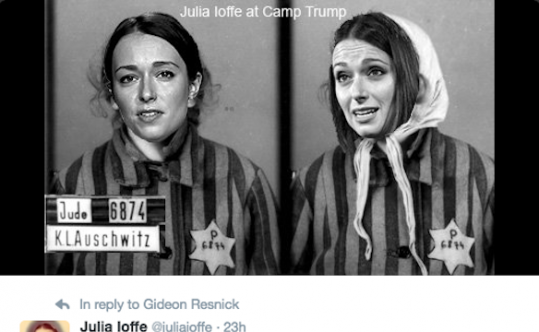
New evidence of that emerged this week in the vicious anti-semitic responses to a profile of Melania Trump.
Melania didn’t like the GQ journalist Julia Ioffee’s feature profile of her, and let it be known that she was suspicious of Ioffe’s motives. That mobilized the Trumpfers, whose Internet comments directed to Ioffe, who is Jewish, tell a story of rabid, unbridled, unchecked, and growing anti-Semitism, as documented in a Mediate column….

Will Donald speak out? Will his Jewish daughter and son-in-law at least publicly keep their mouths shut about this issue? I don’t know. But it stinks.

Luke says: What’s the big deal? I routinely received this kind of abuse during my 19 years of blogging. Ann Coulter gets it all the time. Conservatives get it all the time. We just don’t complain about it.

I don’t recall Rob Eshman writing any columns against death threats against Donald Trump. I don’t recall Rob Eshman writing any columns about the violence directed at Donald Trump and his supporters. I don’t recall Rob Eshman writing any columns about Israelis yelling, “Death to the Arabs.”

So when Rob Eshman and company slur those who care about white cohesion, white identity and the white future, why should they be surprised when white advocates fight back against them?

Different groups have different interests and they are often engaged in a brutal struggle for scarce resources. No group has an automatic right to exist and flourish in peace because the actions of every group affect others and when others are hurt, they retaliate.

Posted in Anti-Semitism | Comments Off on Rob Eshman: Julia Ioffe, meet the real Donald Trump

If It Is Wrong For Americans To Put America First, What Country Should They Put First?

Is it wrong for Israelis to put Israel first? Is it wrong for Jews to put Jews first? So why is is wrong for Americans to put America first?

Eli Lake writes for Bloomberg:

Trump’s New Slogan Has Old Baggage From Nazi Era

Donald Trump has given up on winning historically literate voters. Consider the theme of his major foreign policy speech Wednesday: “America first.”

This slogan is most associated with aviator Charles Lindbergh, who spent a great deal of time in the late 1930s gushing at how wonderful the Third Reich was. Before the Japanese bombed Pearl Harbor, Lindbergh helped form “America First” committees that campaigned to keep the U.S. from fighting the Axis Powers. Lindbergh rose to become a demagogue and accused President Franklin Roosevelt of colluding with a Jewish lobby and Britain to drag America into World War II.

For years this phrase was toxic. Pat Buchanan has used it from time to time, but “America first” and the idea it represented — American neutrality towards the Nazis — has been largely banished from respectable discourse.

Now Trump is bringing the phrase back to the mainstream. He deploys it at his campaign rallies. And in his major foreign policy speech Wednesday, there it was right at the top. The real-estate magnate promised to “always put the interests of the American people first.” He said: “That will be the foundation of every single decision I will make. ‘America first’ will be the major and overriding theme of our administration.”

In fairness to Trump, the world is very different than it was when Nazis ruled Berlin. Historian Ron Radosh told me that Trump was channeling the memory of the isolationists of that era, but he also allowed that Trump “differentiates himself because clearly unlike Lindbergh, he is not an enemy of Jews or the Jewish state.” (Though on the substance, Radosh added that he did not think it was “good for Israel to have a president who is so isolationist.”)

Nonetheless, Trump’s Lindbergh-like instincts were apparent in his speech Wednesday. He said he intended to hold NATO allies more accountable to pay a fair share for their defense. If they don’t, he said, “the U.S. must be prepared to let them defend themselves.”

You don’t need a history textbook to know what that means. It’s been in the headlines since 2008: Russian forces invaded Georgia that year. In 2014, Russia annexed Crimea from Ukraine. To this day Russia occupies large swaths of both countries. These developments have rightly frightened many U.S. NATO allies, particularly the vulnerable Baltic States that joined the alliance after the collapse of the Soviet Union.

Trump also said he hoped to repair relations with Russia because both countries share a common enemy in radical Islam. In this respect, Trump sounds like George W. Bush after 9/11, when he looked into the Russian president’s soul, or Senator Barack Obama on the trail in 2008, when he too promised to reset relations with Russia in the aftermath of its invasion of Georgia. The fact that Trump now promises another reset eight years later is instructive about the chances for success.

Posted in America, Anti-Semitism | Comments Off on If It Is Wrong For Americans To Put America First, What Country Should They Put First?

I just got my first AARP card.

I turn 50 May 28.

No, I’m not retiring from blogging.

Mike Pearson: Old Geezers will have a new and powerful ally with word-smithery skills.

Chaim Amalek: It is too bad you don’t own a house with a lawn. Then you’d be able to shout at neighborhood kids when they cut across your lawn.

Posted in Personal | Comments Off on I just got my first AARP card.

London Ex-Mayor Ken Livingstone Suspended from Labour for Saying Hitler Was ‘Zionist’

REUTERS:

Britain’s opposition Labour Party suspended former London mayor Ken Livingstone on Thursday in a row over anti-Semitism, as the party struggles with deep divisions since electing a hard-left leader last summer.
Dozens of Labour lawmakers had demanded that leader Jeremy Corbyn suspend Livingstone – his ally and a party veteran – over remarks he made about Hitler being a Zionist in defense of a colleague the party suspended a day earlier over anti-Semitic remarks.
The Labour party has been struggling to pull together after Corbyn swept into the leadership in September on a wave of enthusiasm, particularly among younger members, for change and an end to ‘establishment politics’.
Corbyn’s views have often jarred with many Labour lawmakers in parliament, however, dividing the party at a time when it is trying to hold the government, which is also deeply split over Britain’s membership of the European Union, to account.
“Ken Livingstone has been suspended by the Labour Party, pending an investigation, for bringing the Party into disrepute,” the Labour Party said in a statement.
It said another lawmaker, John Mann, had been summoned over his behavior after he was filmed shouting “You’ve lost it” at Livingstone and accusing him of being a “Nazi apologist” over the former mayor’s comments that Hitler had supported Zionism “before he went mad and ended up killing 6 million Jews.”
Prime Minister David Cameron condemned the comments, saying anti-Semitism, like racism, was unacceptable. “It is quite clear that the Labour Party has a problem with anti-Semitism.”
Jewish leaders said the party should introduce a zero-tolerance policy against anti-Semitism, and some Labour lawmakers, including the party’s candidate for mayor in an election next week, distanced themselves from Livingstone.
In an interview with BBC London, Livingstone said neither Shah nor the Labour Party were anti-Semitic.
“I’ve heard a lot of criticism of the state of Israel and its abuse of Palestinians, but I’ve never heard someone be anti-Semitic,” Livingstone said.
“Let’s remember when Hitler won his election in 1932, his policy then was that Jews should be moved to Israel. He was supporting Zionism – this before he went mad and ended up killing 6 million Jews.”

According to Wikipedia:

The Haavara Agreement (Hebrew: הסכם העברה Translit.: heskem haavara Translated: “transfer agreement”) was an agreement between Nazi Germany and Zionist German Jews signed on 25 August 1933. The agreement was finalized after three months of talks by the Zionist Federation of Germany, the Anglo-Palestine Bank (under the directive of the Jewish Agency) and the economic authorities of Nazi Germany. The agreement was designed to help facilitate the emigration of German Jews to Palestine. While it helped Jews emigrate, it forced them to temporarily give up possessions to Germany before departing. Those possessions could later be re-obtained by transferring them to Palestine as German export goods.[1][2] The agreement was controversial at the time, and was criticised by many Jewish leaders both within the Zionist movement (such as the Revisionist Zionist leader Vladimir Jabotinsky) and outside it.

Hanotea (Hebrew: הנוטע), a Zionist citrus planting company, applied in May 1933 for the ability to transfer capital from Germany to Palestine. Hanotea served to assist German Jews’ immigration to Palestine as part of the Zionist endeavor. In a deal worked out with the German government, Hanotea would receive money from prospective immigrants and use this money to buy German goods. These goods, along with the immigrants, would then be shipped to Palestine. In Palestine, import merchants would then buy the goods from the immigrants, liquidating their investment. This arrangement appeared to be operating successfully, and so paved the way for the later Haavara Agreement. Connected to Hanotea was a Polish Zionist Jew, Sam Cohen. He represented Zionist interests in direct negotiation with the Nazis beginning in March 1933.[4]

“ CERTIFICATE
The Trust and Transfer Office “Haavara” Ltd. places at the disposal of the Banks in Palestine amounts in Reichmarks which have been put at its disposal by the Jewish immigrants from Germany. The Banks avail themselves of these amounts in Reichmarks in order to make payments on behalf of Palestinian merchants for goods imported by them from Germany. The merchants pay in the value of the goods to the Banks and the “Haavara” Ltd. pays the countervalue to the Jewish immigrants from Germany. To the same extent that local merchants will make use of this arrangement, the import of German goods will serve to withdraw Jewish capital from Germany.
The Trust and Transfer Office,
HAAVARA, LTD.


— Example of the certificate issued by Haavara to Jews emigrating to Palestine
[5]
The Haavara (Transfer) Agreement was agreed to by the German government in 1933 to allow German Jews to transfer property from Germany to Palestine, for the purpose of encouraging Jewish emigration from Germany. The Haavara company operated under a similar plan as the earlier Hanotea company. The Haavara Company required immigrants to pay at least 1000 pounds sterling into the banking company. This money would then be used to buy German exports for import to Palestine.

For German Jews, the Agreement offered a way to leave an increasingly hostile environment in Nazi Germany; for the Yishuv, the new Jewish community in Palestine, it offered access to both immigrants and some economic support; and for the Nazis it was seen as a way of breaking the Anti-Nazi boycott of 1933, which had mass support among European Jews and was seen by the German state as a potential threat to a fragile German economy.[6]

The Haavara Agreement was thought among some Nazi circles to be a possible way to rid the country of its supposed “Jewish problem.” The head of the Middle Eastern division of the foreign ministry, the anti-Nazi Werner Otto von Hentig, supported the policy of concentrating Jews in Palestine. Von Hentig believed that if the Jewish population was concentrated in a single foreign entity, then foreign diplomatic policy and containment of the Jews would become easier.[7] Hitler’s own support of the Haavara Agreement was unclear and varied throughout the 1930s. Initially, Hitler criticized the agreement, but reversed his opinion and supported it in the period 1937-1939.[8]

After the invasion of Poland and the onset of World War II in 1939, the practical continuation of the Haavara agreement became impossible.

According to Wikipedia:

Leopold Itz, Edler von Mildenstein (30 November 1902 – November 1968[1]) was an SS officer of the 1930s and 1940s who is remembered as a leader of the Nazi Party’s support during the 1930s for the aims of Zionism.

He sometimes worked as a writer and used the pen name LIM (his initials). He was occasionally called an English “Baron” although his rank of Edler meant “nobleman” and has no exact English language equivalent; perhaps the nearest neighbor would be “Esquire.”

After the Second World War Mildenstein continued to live in West Germany, where he joined the Free Democratic Party and was elected to its Press Committee. In 1956, he went to Egypt to work for a radio station, and after the capture of Adolf Eichmann in 1960 he claimed immunity as an intelligence agent of the U. S. Central Intelligence Agency, a claim which was neither confirmed nor denied. Nothing was heard of him after 1964, when he published a book on cocktails.

Born in 1902 in Prague, then part of Austria-Hungary, Mildenstein belonged to the lowest tier of the Austrian nobility and was brought up as a Roman Catholic. He trained as an engineer and joined the Nazi Party in 1929, receiving the membership number 106,678. In 1932 he joined the SS, becoming one of the first Austrians to do so. According to his former SS colleague Dieter Wisliceny, from the First World War until 1935 Mildenstein visited the Middle East, including Palestine, several times.[2][3]

Mildenstein had taken an early interest in Zionism, even going so far as to attend Zionist conferences to help deepen his understanding of the movement. He actively promoted Zionism as a way out of the official impasse on the Jewish question: as a way of making Germany Judenrein (free of Jews). Some Zionists, whose movement had grown tremendously in popularity among German Jews since Hitler came to power, co-operated.[citation needed] On 7 April 1933, the Juedische Rundschau, the bi-weekly paper of the movement, declared that of all Jewish groups only the Zionist Federation of Germany was capable of approaching the Nazis in good faith as “honest partners”.[4][5] The Federation then commissioned Kurt Tuchler to make contact with possible Zionist sympathisers within the Nazi Party, with the aim of easing emigration to Palestine, and Tuchler approached Mildenstein, who was asked to write something positive about Jewish Palestine in the press. Mildenstein agreed, on condition that he be allowed to visit the country in person, with Tuchler as his guide. So, in the spring of 1933 an odd little party of four set out from Berlin, consisting of Mildenstein, Tuchler and their wives. They spent a month together in Palestine,.[2][6] Mildenstein came to write a series of articles for Der Angriff, the Berlin newspaper Goebbels founded in 1927. Mildenstein himself remaining for a total of six months before his return to Germany as an enthusiast for Zionism. He even began to study Hebrew.[7]

On his return, Mildenstein’s suggestion that the solution to the Jewish problem lay in mass migration to Palestine was accepted by his superiors within the SS. From August 1934 to June 1936 Mildenstein was put in charge of the Jewish Desk with the title of Judenreferent (Jewish Affairs Officer) in the headquarters of the Sicherheitsdienst (SD), the Security service of the SS, Section II/112; his title meaning that he was responsible for reporting on “Jewish Affairs,” under the overall command of Reinhard Heydrich.[8] During those years Mildenstein favoured a policy of encouraging Germany’s Jewish population to emigrate to Palestine, and in pursuit of this policy he developed positive contacts with Zionist organizations. SS officials were even instructed to encourage the activities of the Zionists within the Jewish community, who were to be favoured over the assimilationists, said to be the real danger to National Socialism. Even the anti-Jewish Nuremberg Laws of September 1935 had a special Zionist provision, allowing the Jews to fly their own flag.[2][6]

Adolf Eichmann, later one of the most significant organizers of the Holocaust, believed that his big break came in 1934, when he had a meeting with Mildenstein, a fellow-Austrian, in the Wilhelmstrasse and was invited to join Mildenstein’s department.[9][10] Eichmann later stated that Mildenstein rejected the vulgar anti-semitism of Streicher. Soon after his arrival in the section Mildenstein had given him a book on Judaism by Adolf Boehm, a leading Jew from Vienna.[11]

Between 9 September and 9 October 1934 the Nazi Party Berlin newspaper Der Angriff, founded and controlled by Joseph Goebbels, published a series of twelve pro-Zionist articles by Mildenstein under the title A Nazi Goes to Palestine. In honour of his visit, the newspaper issued a commemorative medallion, with the swastika on one side and the Star of David on the other.[2][6]

In the summer of 1935, then holding the rank of SS-Untersturmführer, Mildenstein attended the 19th Congress of the Zionist Organization in Lucerne, Switzerland, as an observer attached to the German Jewish delegation.[12] Mildenstein’s apparently pro-Zionist line was overtaken by events, and after a dispute with Reinhard Heydrich in 1936 he was removed from his post and transferred to the Foreign Ministry’s press department. He had fallen out of favour because migration to Palestine was not proceeding at a fast enough rate. His departure from the SD also saw a shift in SS policy, marked by the publication of a pamphlet warning of the dangers of a strong Jewish state in the Middle East, written by another “expert” on Jewish matters who had been invited to join Section II/112 by Mildenstein himself, Eichmann.[2][13] Mildenstein was replaced as the head of his former section by Kuno Schroeder.[14] Later in December 1939, Eichmann was made chief of the Jewish Department Referat IV B4 of the RSHA, which the SD became a part in September, 1939.[15][16]

As Germany moved into the Second World War, Mildenstein continued to write propaganda articles and books. After the war, his “Around the Burning Land of the Jordan” (1938)[17] and “The Middle East Seen from the Roadside” (1941)[18] were placed on the list of proscribed literature in the Soviet occupation zone and later in the German Democratic Republic.

Like the Haavara Agreement, Mildenstein’s 1933 visit to Palestine and the medal to commemorate it were later sometimes used by anti-Israel authors to argue that there was a relationship between Nazism and Zionism.[2]

Posted in Adolf Hitler, Anti-Semitism, England, Israel, Nazi | Comments Off on London Ex-Mayor Ken Livingstone Suspended from Labour for Saying Hitler Was ‘Zionist’

Donald Trump Vs Professional Consultants

From the Journal of American Greatness: The Weekly Standard highlights a perceptive memo, “What Trump Saw and Cruz Did Not,” by Rich Danker on the extraordinary success of the Trump campaign. Danker’s essential point is that Trump is on the cusp of victory because he ignored all the usual advice of Republican campaign consultants and did things that they considered impossible. Instead of “targeting” select constituencies with “big data,” Trump simply campaigned to win every state. Instead of rigidly adhering to a “disciplined” (scripted) message, Trump spoke off the cuff and responded directly to issues of the day. Instead of avoiding national media and favoring “conservative” outlets, Trump gave interviews to virtually anyone, seemingly all the time. Instead of relying on cheesy SuperPac ads, Trump garnered “earned media” by essentially turning his candidacy into the news itself.

Echoing thoughts which have appeared in this Journal on several occasions, Danker writes:
“Political professionals have gotten so much power in presidential campaigns that they have diluted the candidates of a message and put up barriers to getting votes…Why? Being stage-managed gives more power to the consultants. It makes the candidates more dependent on staff and vendors to navigate them through the torture chamber those people make the election into. The consultants become the smart people and the candidate is a commodity. This attitude is shared by the political media, whose access to the candidates is dependent on sharing a worldview about campaigns with those consultants.
It’s giving Trump too much credit to say that he meant to expose the stupidity of professionalized politics, but that’s what he ended up doing. And he got lucky in the sense that his final primary opponent–although in just about every other way the type voters were looking for in 2016–was somebody who leaned on that professionalism.”

Insightful as Danker’s commentary is, however, it overlooks the most critical aspect of Trump’s success. For Trump did not overturn convention merely with his campaign style, but most importantly in taking rather intuitive positions that Republican “professionals” considered politically impossible.

We have discussed Trump’s Greatness Agenda extensively elsewhere, but certain key elements bear repeating: Instead of bowing to the abstract theories of professional economists, Trump has argued that American workers would be better served by policies that would limit jobs being moved out of the country while reducing the number of unskilled laborers flowing into it. Instead of arguing that the Iraq war was a success because…terrible dictator…democracy…surge…Trump did not hesitate to call it an obvious failure. Instead of arguing that we should fight Assad, Russia, ISIS, Egypt, Turkey, etc., all at once, in hopes of democratizing the Middle East, Trump proposed to let Russia bomb ISIS and to let Arabs fight their own sectarian civil wars while the U.S. should simply do whatever is necessary to prevent the conflict and its terrorism from spilling across our own borders. One could go on.

To say that Trump is an iconoclast only in his get-out-the-vote approach, or “framing” of the message, is thus somewhat self-serving. What Trump saw that others did not was that not only were Republican campaign methods self-defeating, but that Republican ideological orthodoxy had become self-contradictory. Indeed, given that “professionalism” or “managerialism” is the defining characteristic of both, it is hard to see one without the other.

It is worth noting that the only remaining Republican candidates all attempted to define their campaigns with a spirit of rebellion, further proof of how discredited conservatism is. Cruz styled himself as the most strident opponent of the “Washington cartel” from his first days in Washington. Kasich showed his independence from conservative orthodoxy in accepting Medicare funding for his state and demonstrating that opposition to Obamacare was not the fundamental issue Republican pundits claimed it was (not to mention his intransigence in staying in the race). Trump is, well, Trump.

Posted in Donald Trump | Comments Off on Donald Trump Vs Professional Consultants

Trump v. the Council on Foreign Relations

The Journal of American Greatness:

Trump’s foreign policy speech is being criticized by all the usual sources for all the usual reasons. If you’ve been following the foreign policy establishment and their cheerleader commentariat for any length of time, it must seem like déjà vu. They always say the same things, almost always in the same words, any time and outsider dares to speak on the sacred mysteries. “Incoherent” is of course the go-to, and it was trotted out many times today, by left and right alike.

But the speech, while not problem-free, was far from “incoherent.” It just said things that the foreign policy clerisy doesn’t like. That clerisy has never been very good at articulating its own policies in ways that the American people can understand—much less, in ways that persuade the American people that those policies are actually good for them. It prefers the smoke-and-mirrors approach: obfuscate, obfuscate, obfuscate. Specifically, insist that the simple is really complicated and the complex actually quite simple. Hence the distinction between victory and defeat in war is too complicated for mere simpleton citizens to understand, while of course it’s well within America’s power to democratize the Muslim world and only a racist Islamophobe would say otherwise.

When this rhetorical squid ink fails—and, surprisingly, it rarely does, which is one reason we’ve been stuck with the same mandarins for so long—they default to the pose and tone that “We, your superiors in wisdom and sophistication, simply know better about these things and you must defer to us.” Now, that is actually an ancient and largely true argument about the conduct of foreign affairs, which in nearly all successful nations has been placed in the hands of an elite. Thinkers from Plato and Aristotle to Machiavelli and Montesquieu to the American Founders saw no way around this and no reason to find it unjust or worrisome.

But it becomes a problem when the elite doesn’t know what it’s doing. Which has been America’s problem since then end of Cold War (if not before). And which Trump pointed out in pungent language. No wonder that, after today, they hate him all the more.

Of course, they will say (and already are saying) that their opposition is all about the substance. We doubt that explanation is exhaustive. One fundamental objection to Trump is that he threatens the American foreign policy guild—the most closed, arrogant, insular, smug and incompetent guild operating in the world today. Worse, unlike the guilds of old, which in order to join you had to know something—say, how to make beer—to join this one, you don’t have to know anything. You just have to go to the right schools, learn to mouth the right words, and pay your dues by carrying some senior guildmaster’s golf bag for a decade or so, making sure to praise his every slice and hook (and help cover up a mulligan now and then). If you do that, no amount or degree of failure will ever be held against you.

But even to the extent that the clerisy does object to Trump on substance, that only further illustrates the problem. Our elites are so out of touch that they freak out over many of the fundamentally sensible things that Trump said.

So let’s look at what he said. The structure of the speech was simple: two main sections—the first outlining five recent or current mistakes, the second explaining three ways that Trump will remedy them—bracketed by an introduction and a conclusion.

The mistakes:
Overextending our resources
Not insisting that our allies pay their fair share
Alienating our friends
Losing the respect of rivals
Lack of clear foreign policy goals.
Trump’s proposed remedies:
Long term plan to halt the spread and reach of radical Islam
Rebuild our military and economy
Develop a foreign policy based on American interests.
How radical!

The most obvious problem with the above is the apparent contradiction between mistakes 2 & 3. How can he say in one breath that he is going to squeeze our allies, and in the next lament that Obama has alienated them? Many critics seized on that point. We actually find something problematic here. But first, let’s get something straight. It’s quite possible to be taken for a ride by allies and gratuitously alienate them at the same time, or to insist that allies meet their obligations just as we meet ours. There is no inherent contradiction here. “The whole world will be safer if our allies do their part to support our common defense and security,” Trump said. Of course it will. That’s almost tautological.

Posted in Donald Trump | Comments Off on Trump v. the Council on Foreign Relations

Listening To The Other

One smart goy writes:

The first time I was told white men didn’t listen enough, I was in 9th grade, and we were reading The House on Mango Street, or A Raisin in the Sun, or To Kill a Mockingbird. But I was a person of conscience, so I read those books, and many more, including books about lesbians, books about Asians-Americans, books about women hating men, books about suicidal women, books about gay men, books about colonialism. And I didn’t stop there: I didn’t just want to make my teachers think I could listen to “the other,” I wanted to really hear what it was like to be “the other,” so I read up on atheism and became an atheist, I read up on Buddhism and practice Zen meditation for a while. I read up on Kundalini Yoga and did that. I tried drugs. I committed sexual sins. I watched Kurosawa movies in a room with gay black men and lesbians and anarchists. Then I moved to the South, and I learned to attend Baptist church, to watch NASCAR, to eat and appreciate the differences between Eastern and Western Carolina BBQ. I watched hours of YouTube videos about orthodox Judaism, I have read and taught the Koran. I could go on, but you know, at this point, I know who is reading: Michael, Mark, and possibly Luke. And I’m not trying to convince them. I was trying to convince others, but you see how it’s a hapless project. I will be accused of not listening, of always dominating, and they will not hear my rebuttal. And to satisfy Michael, I will even say that I understand that “reading books about lesbians” is not the same as really listening, because books are a white male construct or somethingrather and basically a cis-person can never understand. Well, fine. But I can hardly become a lesbian at this point, and I think I’m okay with that.

Posted in America | Comments Off on Listening To The Other

God and the Religions

One smart goy writes:

Go read Deuteronomy 13:1-11. Come on. Just do it. What do you think about this part:

“If your very own brother, or your son or daughter, or the wife you love, or your closest friend secretly entices you, saying, “Let us go and worship other gods” (gods that neither you nor your ancestors have known, 7 gods of the peoples around you, whether near or far, from one end of the land to the other), 8 do not yield to them or listen to them. Show them no pity. Do not spare them or shield them. 9 You must certainly put them to death. Your hand must be the first in putting them to death, and then the hands of all the people. 10 Stone them to death, because they tried to turn you away from the Lord your God, who brought you out of Egypt, out of the land of slavery.”

Could there be a clearer, non-metaphorical, divine command than this? The older and better read I get, the more I am not comfortable with Christianity’s comfortable evasion of Mosaic Law. All evidence points to the idea that this YHWH of Judaism is a fascist, and not a benevolent one. Imagine that your own daughter, age 21, comes home from college over Thanksgiving and invites you to Yoga class with her. The class begins with an invocation to Shiva. According to the Bible, you are to put her to death by your own hand.

Posted in God | Comments Off on God and the Religions

America First

A goy tweets:

Those who are reacting negatively to #Trump and #AmericaFirst as a foreign policy: what would be “first” in your view? Help me understand.

Susan Dunn writes:

(CNN)”My foreign policy will always put the interests of the American people, and American security, above all else. That will be the foundation of every decision that I will make. America First will be the major and overriding theme of my administration.”

It is extremely unfortunate that in his speech Wednesday outlining his foreign policy goals, Donald Trump chose to brand his foreign policy with the noxious slogan “America First,” the name of the isolationist, defeatist, anti-Semitic national organization that urged the United States to appease Adolf Hitler.

The America First Committee actually began at Yale University, where Douglas Stuart Jr., the son of a vice president of Quaker Oats, began organizing his fellow students in spring 1940. He and Gerald Ford, the future American president, and Potter Stewart, the future Supreme Court justice, drafted a petition stating, “We demand that Congress refrain from war, even if England is on the verge of defeat.”

Their solution to the international crisis lay in a negotiated peace with Hitler. Other Yale students — including Sargent Shriver, who served in the Kennedy and Johnson administrations, and Kingman Brewster, the chairman of the Yale Daily News, future president of Yale and ambassador to the Court of St. James — joined their isolationist crusade.

It’s amazing that a philosophy of putting America first ostracizes you from America’s elites. Supporters of Israel, for instance, have no problem putting Israel’s interests first. But when gentiles do the same thing for their country, oh the horror.

All gentile nationalisms tend to exclude Jews and so Jews tend to fear when gentiles become religiously, racially or nationally cohesive.

Nobody described the pain of social exclusion better than Charles Lindbergh’s wife, Anne Morrow Lindbergh. From her diary (as quoted in Culture of Critique):

September 11, 1941:

Then [he gave] his speech—throwing me into black gloom. He names the ‘war agitators’—chiefly the British, the Jews, and the Administration. He does it truthfully, moderately, and with no bitterness or rancor—but I hate to have him touch the Jews at all. For I dread the reaction on him. No one else mentions this subject out loud (though many seethe bitterly and intolerantly underneath). C. [Charles], as usual, must bear the brunt of being frank and open. What he is saying in public is not intolerant or inciting or bitter and it is just what he says in private, while the other soft-spoken cautious people who say terrible things in private would never dare be as frank in public as he. They do not want to pay the price. And the price will be terrible. Headlines will flame “Lindbergh attacks Jews.” He will be branded anti-Semitic, Nazi, Führer-seeking, etc. I can hardly bear it. For he is a moderate. . . .

September 13, 1941:

He is attacked on all sides—Administration, pressure groups, and Jews, as now openly a Nazi, following Nazi doctrine.

September 14, 1941:

I cannot explain my revulsion of feeling by logic. Is it my lack of courage to face the problem? Is it my lack of vision and seeing the thing through? Or is my intuition founded on something profound and valid?

I do not know and am only very disturbed, which is upsetting for him. I have the greatest faith in him as a person—in his integrity, his courage, and his essential goodness, fairness, and kindness—his nobility really. . . . How then explain my profound feeling of grief about what he is doing? If what he said is the truth (and I am inclined to think it is), why was it wrong to state it? He was naming the groups that were pro-war. No one minds his naming the British or the Administration. But to name “Jew” is un-American—even if it is done without hate or even criticism. Why? Because it is segregating them as a group, setting the ground for anti-Semitism. . . .

I say that I would prefer to see this country at war than shaken by violent anti-Semitism. (Because it seems to me that the kind of person the human being is turned into when the instinct of Jew-baiting is let loose is worse than the kind of person he becomes on the battlefield.)

September 15, 1941:

The storm is beginning to blow up hard. America First is in a turmoil. . . . He is universally condemned by all moderates. . . . The Jews demand a retraction. . . . I sense that this is the
beginning of a fight and consequent loneliness and isolation that we have not known before. . . . For I am really much more attached to the worldly things than he is, mind more giving up friends, popularity, etc., mind much more criticism and coldness and loneliness.

September 18, 1941:

Will I be able to shop in New York at all now? I am always stared at—but now to be stared at with hate, to walk through aisles of hate!5 (A. M. Lindbergh 1980, 220–230)

FROM CHARLES LINDBERG’S WIKIPEDIA ENTRY:

In late 1940, he became spokesman of the antiwar America First Committee.[133] He soon became its most prominent public spokesman, speaking to overflowing crowds in Madison Square Garden in New York City and Soldier Field in Chicago. His speeches were heard by millions. During this time, Lindbergh lived in Lloyd Neck, on Long Island, New York.

Lindbergh argued that America did not have any business attacking Germany and believed in upholding the Monroe Doctrine, which his interventionist rivals felt was outdated. In his autobiography, he wrote:

“ I was deeply concerned that the potentially gigantic power of America, guided by uninformed and impractical idealism, might crusade into Europe to destroy Hitler without realizing that Hitler’s destruction would lay Europe open to the rape, loot and barbarism of Soviet Russia’s forces, causing possibly the fatal wounding of western civilization.[134] ”

In his January 23, 1941, testimony in opposition to the Lend-Lease bill before the House Committee on Foreign Affairs, Lindbergh proposed that the United States negotiate a neutrality pact with Germany.[135] President Roosevelt publicly criticized Lindbergh’s views on neutrality three months later during a White House press conference on April 25, 1941, as being those of a “defeatist and appeaser” and compared him to U.S. Rep. Clement L. Vallandigham (D-OH), the leader of the “Copperhead” movement that had opposed the American Civil War. Three days later, Lindbergh resigned his commission as a colonel in the U.S. Army Air Corps in an April 28 letter to the President in which he said he could find “no honorable alternative” to his taking such an action after Roosevelt had publicly questioned his loyalty.[136]

In a speech at an America First rally at the Des Moines Coliseum on September 11, 1941, “Who Are the War Agitators?”, Lindbergh claimed the three groups, “pressing this country toward war [are] the British, the Jewish, and the Roosevelt Administration” and said of Jewish groups,

“ Instead of agitating for war, the Jewish groups in this country should be opposing it in every possible way for they will be among the first to feel its consequences. Tolerance is a virtue that depends upon peace and strength. History shows that it cannot survive war and devastation.[137] ”
In the speech, he warned of the Jewish people’s “large ownership and influence in our motion pictures, our press, our radio, and our government”. He went on to condemn Nazi Germany’s antisemitism: “No person with a sense of the dignity of mankind can condone the persecution of the Jewish race in Germany.” Lindbergh declared,

“ I am not attacking either the Jewish or the British people. Both races, I admire. But I am saying that the leaders of both the British and the Jewish races, for reasons which are as understandable from their viewpoint as they are inadvisable from ours, for reasons which are not American, wish to involve us in the war. We cannot blame them for looking out for what they believe to be their own interests, but we also must look out for ours. We cannot allow the natural passions and prejudices of other peoples to lead our country to destruction.[138] ”
The speech was heavily criticized as being anti-Semitic.[139] In response, Lindbergh stated again he was not anti-Semitic, but he did not back away from his statements.

Lindbergh’s wife, Anne Morrow Lindbergh, had concerns about the reaction to the speech and how it would affect his reputation, wrongfully in her view. From her diary:

“ … I have the greatest faith in [Lindbergh] as a person — in his integrity, his courage, and his essential goodness, fairness, and kindness — his nobility really … How then explain my profound feeling of grief about what he is doing? If what he said is the truth (and I am inclined to think it is), why was it wrong to state it? He was naming the groups that were pro-war. No one minds his naming the British or the Administration. But to name “Jew” is un-American — even if it is done without hate or even criticism. Why?[140] ”
Interventionists created pamphlets pointing out his efforts were praised in Nazi Germany and included quotations such as “Racial strength is vital; politics, a luxury”. They included pictures of him and other America Firsters using the stiff-armed Bellamy salute (a hand gesture described by Francis Bellamy to accompany his Pledge of Allegiance to the American flag); the photos were taken from an angle not showing the flag, so to observers it was indistinguishable from the Hitler salute.[141]

President Franklin D. Roosevelt disliked Lindbergh’s outspoken opposition to intervention and his administration’s policies, such as the Lend-Lease Act, and said to Treasury Secretary Henry Morgenthau in May 1940, “if I should die tomorrow, I want you to know this, I am absolutely convinced Lindbergh is a Nazi.”[142] On April 26, 1941, Roosevelt wrote to Secretary of War Henry Stimson: “When I read Lindbergh’s speech I felt that it could not have been better put if it had been written by [Nazi propaganda minister Joseph] Goebbels himself. What a pity that this youngster has completely abandoned his belief in our form of government and has accepted Nazi methods because apparently they are efficient.”[143]

Lindbergh elucidated his beliefs about the white race in an article he published in Reader’s Digest in 1939:

We can have peace and security only so long as we band together to preserve that most priceless possession, our inheritance of European blood, only so long as we guard ourselves against attack by foreign armies and dilution by foreign races.[144]

Because of his trips to Nazi Germany, combined with a belief in eugenics,[145] Lindbergh was suspected of being a Nazi sympathizer.

Lindbergh’s reaction to Kristallnacht was entrusted to his diary: “I do not understand these riots on the part of the Germans,” he wrote. “It seems so contrary to their sense of order and intelligence. They have undoubtedly had a difficult ‘Jewish problem’, but why is it necessary to handle it so unreasonably?”[146] Lindbergh had planned to move to Berlin for the winter of 1938–39, after Kristallnacht, a time when many Americans reacted with revulsion at Nazi barbarism.[citation needed] He had provisionally found a house in Wannsee, but after Nazi friends discouraged him from leasing it because it had been formerly owned by Jews,[147] it was recommended that he contact Albert Speer, who said he would build the Lindberghs a house anywhere they wanted. On the advice of his close friend, the eugenicist Alexis Carrel, he cancelled the trip.[147]

In his diaries, he wrote: “We must limit to a reasonable amount the Jewish influence … Whenever the Jewish percentage of total population becomes too high, a reaction seems to invariably occur. It is too bad because a few Jews of the right type are, I believe, an asset to any country.”

Lindbergh’s anticommunism resonated deeply with many Americans, while eugenics and Nordicism enjoyed social acceptance.[132]

Although Lindbergh considered Hitler a fanatic and avowed a belief in American democracy,[148][149] he clearly stated elsewhere that he believed the survival of the white race was more important than the survival of democracy in Europe: “Our bond with Europe is one of race and not of political ideology,” he declared.[150] Critics have noticed an apparent influence of German philosopher Oswald Spengler on Lindbergh.[151] Spengler was a conservative authoritarian and during the interwar era, was widely read throughout the Western World, though by this point he had fallen out of favor with the Nazis because he had not wholly subscribed to their theories of racial purity.[151]

Lindbergh developed a long-term friendship with the automobile pioneer Henry Ford, who was well known for his anti-Semitic newspaper The Dearborn Independent. In a famous comment about Lindbergh to Detroit’s former FBI field office special agent in charge in July 1940, Ford said: “When Charles comes out here, we only talk about the Jews.”[152][153]

Lindbergh considered Russia to be a “semi-Asiatic” country compared to Germany, and he found Communism to be an ideology that would destroy the West’s “racial strength” and replace everyone of European descent with “a pressing sea of Yellow, Black, and Brown.” He stated that if he had to choose, he would rather see America allied with Nazi Germany than Soviet Russia. He preferred Nordics, but he believed, after Soviet Communism was defeated, Russia would be a valuable ally against potential aggression from East Asia.[151][154]

Lindbergh said certain races have “demonstrated superior ability in the design, manufacture, and operation of machines.”[155] He further said, “The growth of our western civilization has been closely related to this superiority.”[156] Lindbergh admired “the German genius for science and organization, the English genius for government and commerce, the French genius for living and the understanding of life.” He believed that “in America they can be blended to form the greatest genius of all.”[157] His message was popular throughout many Northern communities and especially well received in the Midwest, while the American South was anglophilic and supported a pro-British foreign policy.[158] The South was the most pro-British and interventionist part of the country.[159]

Holocaust researcher and investigative journalist Max Wallace in his book, The American Axis, agreed with Franklin Roosevelt’s assessment that Lindbergh was “pro-Nazi.” Wallace finds the Roosevelt Administration’s accusations of dual loyalty or treason as unsubstantiated. Wallace considers Lindbergh a well-intentioned, but bigoted and misguided, Nazi sympathizer whose career as the leader of the isolationist movement had a destructive impact on Jewish people.[160]

Lindbergh’s Pulitzer Prize-winning biographer, A. Scott Berg, contends Lindbergh was not so much a supporter of the Nazi regime as someone so stubborn in his convictions and relatively inexperienced in political maneuvering that he easily allowed rivals to portray him as one. Lindbergh’s receipt of the German medal was approved without objection by the American embassy; the war had not yet begun in Europe. The award did not cause controversy until the war began and Lindbergh returned to the United States in 1939 to spread his message of nonintervention. Berg contends Lindbergh’s views were commonplace in the United States in the pre–World War II era. Lindbergh’s support for the America First Committee was representative of the sentiments of a number of American people.[149]

Yet Berg also notes that “As late as April 1939 – after Germany overtook Czechoslovakia – Lindbergh was willing to make excuses for Hitler. ‘Much as I disapprove of many things Hitler had done,’ he wrote in his diary on April 2, 1939, ‘I believe she [Germany] has pursued the only consistent policy in Europe in recent years. I cannot support her broken promises, but she has only moved a little faster than other nations … in breaking promises. The question of right and wrong is one thing by law and another thing by history.'” Berg also explains that leading up to the war, in Lindbergh’s mind, the great battle would be between the Soviet Union and Germany, not fascism and democracy.

Wallace noted that it was difficult to find social scientists among Lindbergh’s contemporaries in the 1930s who found validity in racial explanations for human behavior. Wallace went on to observe that “throughout his life, eugenics would remain one of Lindbergh’s enduring passions.”[161] In Pat Buchanan’s book A Republic, Not an Empire: Reclaiming America’s Destiny, he portrays Lindbergh and other pre-war isolationists as American patriots who were smeared by interventionists during the months leading up to the attack on Pearl Harbor. Buchanan suggests the backlash against Lindbergh highlights “the explosiveness of mixing ethnic politics with foreign policy.

After the war, while touring the Nazi concentration camps, Lindbergh wrote in his autobiography that he was disgusted and angered…

With most of Eastern Europe having fallen under Communist control, Lindbergh believed most of his pre-war assessments were correct all along. But Berg reports after witnessing the defeat of Germany and the Holocaust firsthand shortly after his service in the Pacific, “he knew the American public no longer gave a hoot about his opinions.”

Posted in America, Nationalism | Comments Off on America First