
This strikes me as a pointless feud because Chris Rufo and Nathan Cofnas operate in different genres. Rufo is an activist and not a scholar. Cofnas is a scholar and not an activist. I would never look to Rufo for philosophical truth and I would never look to Cofnas for activism advice.
That which is useful to say bears no relationship to truth. Rufo is great at coming up with useful things to say for his side while Cofnas keeps his focus on ultimate truth.
Rufo helps the right build a winning coalition. Given that government has coercive power, this pragmatic approach has more tangible benefit to the right than truth.
Rufo and Cofnas do not just disagree on facts; they disagree on what “winning” looks like. While they appear to be on the same “side” of the anti-woke movement, their roles and end goals are fundamentally different, which makes their conflict a battle over the movement’s soul.
Rufo’s genre is power politics, while Cofnas’s is foundational philosophy. Rufo views the world as a series of institutional levers. To Rufo, “truth” is often less important than narrative control. His “playbook” involves using investigative reporting to trigger public scandals (like the Claudine Gay plagiarism case) to force administrative changes. Cofnas argues that Rufo’s victories are superficial because they don’t address the “equality thesis”—the belief that all groups are innately the same. He believes that as long as elites believe this, they will interpret any disparity as proof of “systemic racism,” making “woke” policies a moral necessity that no amount of legislation can stop.
Even though they operate in different spheres, the feud is intense because their strategies are mutually exclusive in their current forms:
Rufo’s Barrier to Success: To win over “liberal elites” and maintain political viability, Rufo must distance himself from controversial biological theories. He views Cofnas’s focus on heredity as a “strategic disaster” that makes the movement look like a “fringe” racialist group, which would destroy his ability to influence governors and university trustees.
Cofnas’s Barrier to Success: Cofnas views Rufo as a “grifter” because Rufo claims to be “fixing” the problem while (in Cofnas’s view) merely pruning the leaves of a tree with poisonous roots. To Cofnas, Rufo is providing a false sense of victory that prevents the Right from having the “uncomfortable” conversations he believes are required for a real revolution.
To some people, this feud illustrates a variation of [Wallace] Sayre’s Law: the more closely two people share a goal (dismantling DEI), the more viciously they will fight over the 10% difference in how to achieve it.
Because both are high-profile figures in the same “Anti-Woke” ecosystem, they theoretically compete for the same donors, prestige, and followers. I wonder if Cofnas and Rufo regard themselves as competing? To me, they operate in different worlds.
Rufo has now moved into an “establishment” role as a university trustee and policy advisor. Cofnas remains a “dissident” scholar. This status difference adds a layer of personal resentment to the intellectual disagreement.
Chris Rufo is a grifter who is leading the right to disaster. His alleged victories against wokism are almost entirely imaginary.
Whenever someone criticizes Rufo, he likes to compare his track record to theirs. In his own words, these are the highlights of his career:
“We broke BLM, CRT, Kendi, Gay, etc., and my conversations with the New York Times over the past five years, which are a good proxy for elite consensus, have shifted very favorably in our direction, meaning that those ‘elites’ sense we have damaged woke and reduced its relative status. We’ve also set the stage for the president to defund the Left, tame the universities, abolish DEI, and rescind affirmative action.”
Let’s examine these claims one by one, and then consider why the right always loses in the end.
Helping the Left Take Out Its Own Trash
A couple years ago, Rufo helped get Harvard’s DEI President Claudine Gay booted on the pretext of plagiarism. As I predicted would happen, she was simply replaced by someone worse. Under the more effective leadership of Alan Garber, Harvard continues to flout the Supreme Court’s ruling against affirmative action, and it is spearheading the resistance to Trump.
The Left Has Moral and Intellectual Standards
At the height of the Great Awokening, Ibram X. Kendi was the doyen of DEI. Kendi (whose SAT scores barely cracked 1000) gave us insights such as defining “racism” as “a collection of racist policies that lead to racial inequity that are substantiated by racist ideas.” He received a MacArthur Fellowship (aka “genius grant”) and set his speaking fee to $35,000 an hour. In July 2020 he became the founding director of the Center for Antiracist Research at Boston University funded by $55 million in donations.
After several years, Kendi’s Center for Antiracist Research failed to produce anything resembling research. He fired half of his staff because the money had disappeared to who-knows-where. The whole operation was shut down in 2025. Kendi left BU and now directs the so-called Institute for Advanced Study at Howard University.
The fall of Kendi is a testament to the left’s capacity for self-correction, not evidence that it is in retreat. (I’m not sure what role Rufo thinks “anti-woke” reporting had in any of this, but it makes no difference either way.) The right would never have a Kendi scandal because a right-wing Kendi would never be held accountable. Can you think of a single example in recent history where a right-wing leader was marginalized for stupidity or grifting? If the right held its leaders accountable for these things, almost everyone would be gone (including Rufo).
BLM Lives On
After gaining steam from several hoaxes such as the Michael Brown “hands up, don’t shoot” incident, BLM reached its high point after the death of George Floyd in the summer of 2020. The movement was unofficially led by the Black Lives Matter Global Network Foundation (BLMGNF), which, in 2020, received more than $90 million in donations.
BLMGNF was run like Zimbabwe. Its leaders paid themselves lavish salaries. They funneled large sums of money to their friends and family. Director Patrisse Cullors’s baby daddy was paid $970,000 for “creative services.” Cullors resigned her position at BLMGNF when her private purchase of more than $3 million in real estate attracted scrutiny. The left-wing New York Magazine broke the story that BLMGNF secretly bought a house for $6 million, apparently for private use by senior members of the organization. Local BLM chapters faced similar scandals.
Rufo can gloat about how embarrassing this was for the left. But the left exposed corruption on its own side and took measures to fix the problem without retreating from its ideological goals.
BLM attracted a flurry of support, then started going off the rails due to corruption and purity spirals. The left-wing establishment responded by quietly switching its focus to institutional capture so it can wield real power instead of just burning down police stations.
CRT Didn’t Go Anywhere
“Critical Race Theory” is a fancy name for the idea that racial disparities favoring whites are caused by past or present racism. It is simply the philosophy that follows from taking the equality thesis (all races have the same innate distribution of socially relevant traits) seriously.
Rufo played a role in passing legislation in some Republican-controlled states to prohibit educators from teaching CRT. Having anti-CRT laws on the books makes it marginally easier to push back against the most noxious expressions of anti-whitism. But elites remain committed to CRT, whether they call it CRT or something else like “American history.” Children spend seven hours a day, five days a week at school. As long as educators remain overwhelmingly left and woke, they are going to find a way to impart their beliefs to students.
Elite Consensus
Nothing happening at the New York Times indicates that “elite consensus [has] shifted very favorably in our direction.” Some mainstream left-wing outlets have recently expressed cautious skepticism about mutilating “trans” children. But gender theory is philosophically and historically separate from wokism. I always said there could be a backlash against it. The Times has not backed one inch away from the idea that all groups of people are on average the same and we need to strive for equality of outcome.
How the Left Actually Won
Howard Zinn was the author of A People’s History of the United States, which sold more than two million copies and played a major role in radicalizing American education. In 1967, the political science department at Boston University voted to award him tenure. However, its recommendation had to be approved by the trustees, who were scheduled to meet for the annual Founders Day banquet. Zinn then accepted some students’ invitation to speak at an anti-war rally, not knowing that the purpose of the rally was to protest Secretary of State Dean Rusk…who had been invited to speak at the Founders Day banquet! But he did not pull out. On the same day the trustees were voting on his tenure case, Zinn gave a 45-minute speech railing against their honored guest, the government, and America’s founders. He went home assuming he would be fired. Unbeknownst to him, the trustees had already voted to approve his tenure before the banquet.
Bill Ayers spent time in jail.
Noam Chomsky’s wife went to college so she would be able to support the family when her husband got what they expected would be a long prison sentence.
For 70 years, the woke project has inspired commitment from a large proportion of intelligent and idealistic people. That’s why the ideology prevailed. There was no conspiratorial “long march through the institutions.” As long as they believe that all groups are on average innately the same, intelligent, morally sensitive people will recognize that there is a moral emergency to correct the environment and bring about equality of outcome. Insofar as society is a meritocracy, institutions staffed by qualified individuals will spontaneously wokify.
In a revealing moment, Chris Rufo mocked me for being fired from Cambridge for talking about hereditarianism. (In fact I wasn’t fired from Cambridge, but leave that aside.) For Rufo the nihilist, the idea of sacrificing your immediate self-interest on behalf of a worthy cause is incomprehensible. He and his fellow trolls only know how to kick their opponents when they are down—a strategy that, besides being dishonorable, is generally ineffective in the long run, when eventually your enemy (perhaps Gavin Newsom?) gets up and starts kicking you.
The right may have the political power to defund cancer research, but it is currently not a position to retake the institutions and run them effectively. Note that, even with virtually unlimited funding, the right-wing University of Austin (UATX) is teaching college students middle-school-level algebra and appears to be on the verge of shutting down. To defeat race communism, it will be necessary to persuade a critical mass of liberal elites to join the right. Holding up people like Rufo as representatives of anti-wokism is pushing these potential allies—and therefore real victory—further and further away.
The tension between Nathan Cofnas and Christopher Rufo represents a fundamental divide in right-wing strategy: the struggle between institutional “hereditarianism” and “tactical activism.”
Cofnas argues from a philosophical and biological perspective, suggesting that unless the “equality thesis” is defeated at a scientific level, “race communism” will remain the inevitable conclusion of any meritocratic system. Rufo, conversely, operates as a high-level political operative who views culture and policy as a series of levers to be pulled.
To follow Cofnas’s logic, a real victory would require a “critical mass of liberal elites” to abandon the equality thesis. This is a much higher bar than passing state-level bans on CRT. It requires changing what the most “intelligent and morally sensitive” people believe to be true about human nature.
If Rufo is a “grifter” in Cofnas’s eyes, it is because Rufo treats the symptoms (slogans, administrators, specific grants) while Cofnas believes the disease is a fundamental misunderstanding of biology and sociology.
The argument against Rufo being a “grifter” centers on his strategic effectiveness, his intellectual foundations, and his sincerity of mission. While critics like Cofnas see him as a nihilistic opportunist, his supporters and defenders view him as a pragmatic operative who understands how to win in a modern media environment.
1. Strategic Effectiveness over Pure Theory
The most common defense of Rufo is that he produces tangible results where traditional conservative intellectuals have failed.
Actionable Impact: Supporters point to his influence on policy, such as inspiring a 2020 executive order and legislation in over 20 states.
The “Siege” Strategy: Rufo argues that one must “lay siege to the institutions” using legal and administrative levers rather than just winning a philosophical debate. To his defenders, this isn’t grifting; it is the necessary application of power to a “post-truth” academic world.
2. Narrative Control as a Tool of War
Rufo has been transparent about his method of “decodifying” and “recodifying” terms like Critical Race Theory.
The “Brawler” Persona: Supporters see his aggressive rhetoric—like using the term “scalped” after Claudine Gay’s resignation—not as empty posturing, but as a morale-boosting tactic for a side that has historically been on the defensive.
Journalistic Rigor: While Cofnas critiqued the plagiarism “pretext,” defenders argue the plagiarism was factually real. They contend that Rufo’s work at City Journal and the Manhattan Institute is grounded in deep research into the historical roots of “race communism” and radical left-wing movements of the 1960s.
3. Sincerity of Evolution
Rufo often shares his personal journey from a “left-leaning documentary filmmaker” to a conservative activist as evidence of his sincerity.
Direct Observation: He claims his shift was driven by years of traveling through American cities and observing how “elite” university theories like DEI disintegrated when they made contact with the reality of poverty and broken social connections.
Institutional Loyalty: Defenders argue that his work on the board of the New College of Florida shows he is willing to do the “boring” work of governance and institutional rebuilding, rather than just chasing headlines and donations.
4. Intellectual Legitimacy
While Cofnas dismisses him, other prominent figures like Tucker Carlson, Glenn Greenwald, and Ben Shapiro have praised him as one of the most effective journalists in the country. They argue that he has successfully identified a “long march through the institutions” that was previously ignored by the mainstream Right.
For Cofnas and Rufo, the stakes are perceived as existential, and the differences are not “small”—they are foundational.
In a typical faculty feud, professors might destroy each other’s reputations over a parking spot or a footnote. However, Cofnas and Rufo see the stakes as massive:
Both men believe they are fighting for the future of Western civilization. Rufo believes he is dismantling a state-sponsored ideology (DEI/CRT) that threatens meritocracy. Cofnas believes that unless the “equality thesis” is defeated at a biological level, Rufo’s victories are merely cosmetic and doomed to fail.
This isn’t a “small difference.” It is a clash between tactical activism and biological realism.
Rufo is a “siege” strategist; he wants to use administrative power to purge institutions.
Cofnas is an “intellectual revolutionary”; he argues that you cannot purge an institution if the people inside it still believe the underlying premise (innate equality) that makes “woke” policies feel like a moral necessity.
Nathan Cofnas posts this exchanged with Rufo:
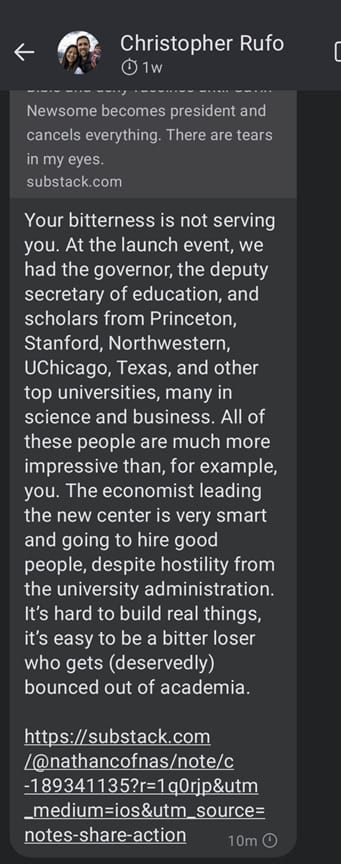
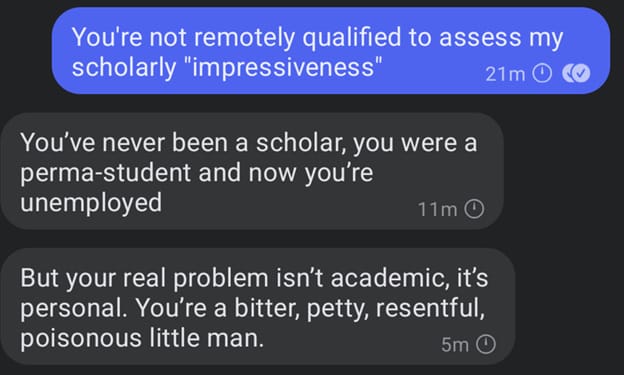
These screenshots captures the shift from a high-level strategic debate to a personal confrontation. The exchange perfectly illustrates the “bitter and petty” nature of academic and political feuds, even when the participants believe they are fighting for civilization-level stakes.
The dialogue reveals the specific insecurities each man targets in the other:
Rufo’s Attack on Status: By calling Cofnas a “perma-student” and “unemployed,” Rufo strikes at the lack of institutional power. For a strategist like Rufo, who measures success by policy wins and executive orders, an academic without a tenure-track position or a paycheck has no “impressiveness.”
Cofnas’s Defense of Scholarly Merit: His response suggests that Rufo lacks the intellectual credentials to even evaluate his work. This reinforces the core of their feud: Cofnas views Rufo as a mere “activist” who doesn’t understand the deeper philosophical or biological truths at play.
The “Poisonous Little Man” Remark: This is the peak of the personal animosity. It moves past their disagreement over “Hereditarianism” versus “Institutional Siege” and enters the realm of character assassination.
This exchange is a textbook example of how the “narcissism of small differences” can explode. If they are both competing for the same audience on the Right, then the need to delegitimize the other becomes total. It isn’t just that their strategies differ; it’s that the other person is, in their eyes, a “grifter” or a “resentful” failure.
This private exchange marks the total breakdown of the movement’s “big tent” strategy, where tactical activists and intellectual dissidents previously coexisted. The leak shifted the “anti-woke” discourse from policy to a fundamental question of establishment vs. dissident identity.
The fallout has forced various factions within the Right to take sides, effectively splitting the movement along lines of temperament and methodology.
The “Victory” Faction: Figures like Rufo and Richard Hanania have moved toward a more institutional role, working with the current administration to turn “anti-woke” ideas into concrete policy, such as rescinding executive orders on affirmative action and dismantling DEI bureaucracies. They prioritize “practical politics” over online dissident excitement.
The “Dissident” Faction: Others, like Cofnas, remain as gadflies, focusing on what they view as deeper biological or philosophical truths that the “establishment” Right is too timid to address. Rufo has explicitly warned that these elements are falling into “ideological rabbit holes” like racialism and conspiracism, which he views as a disaster for governing.
Despite the personal nature of the leaked messages, Rufo’s standing among conservative power-brokers appears largely intact. He is viewed as a decisive figure in the administration’s successful efforts to defund DEI and reform higher education. Supporters continue to champion his “playbook”—using investigative reporting to surface issues like plagiarism and leveraging media pressure to force institutional change—as the only effective way to move the needle.
Rufo has leveraged the feud to distinguish between “serious” governing conservatives and “influencers” who sap energy by stirring “dark emotions” and fixating on negativity.
Richard Hanania often serves as the intellectual bridge between these worlds. While he has been grouped with Rufo in celebrations of their policy impact, his approach remains more legalistic and bureaucratic. He argues that “wokeness” is a result of state policy (like Title IX and civil rights law) and can only be undone through government routine, rather than just winning cultural arguments.
Last year, Christopher Rufo published a series of essays that crystallized the divide between the “Establishment Right” and the “Dissident Right,” effectively serving as his manifesto for a new era of conservative governance.
Rufo argues that the Right has reached a critical “crossroads” where it must transition from a movement of online rebels to a durable governing force. He posits that because many “anti-woke” ideas—such as dismantling DEI bureaucracies and rescinding affirmative action executive orders—have become actual government policy, the Right can no longer afford the luxury of being “lone wolf” gadflies. He distinguishes between those who have assumed the “responsibilities that come with victory” and those who prefer to remain as professional dissidents.
Rufo has specifically targeted what he calls “Schizo-Politics”—a paranoid variant of right-wing thought characterized by conspiracy theories and “rabbit holes”. He argues that ideologies rooted in racialism, anti-Semitism, and conspiracism are optimized only for “online attention” and “clicks,” making them a “disaster in the realm of practical politics”.
In a widely discussed moment, Rufo urged young men on the “Dissident Right” to stop fixating on abstract online grievances and instead take “real-world” jobs—even suggesting management roles at chains like Panda Express—to build practical skills and support families.
He views the “Dissident Right” as a mirror image of the Left, driven by “envy, resentment, and fear,” and warns that both seek to abandon the American principles of colorblind meritocracy in favor of their own identity-based hierarchies.
Rufo serves as a senior fellow at the Manhattan Institute and a bridge to figures like Ron DeSantis and the current administration. His “playbook”—using investigative journalism and legislative pressure to trigger institutional change—continues to be the dominant model for conservative activism.
On the campaign trail, President Donald Trump promised to end federal spending on diversity, equity, and inclusion (DEI) programs. Yet the government has continued to award contracts based on race and sex. Despite rampant fraud and multiple court rulings against the practice, the Small Business Administration (SBA) has used “disadvantage” essays from business owners to skirt the rules and continue discriminatory programs that dole out billions in government contracts.
For decades, the federal government has awarded certain special contracts exclusively to so-called disadvantaged businesses and women-owned small businesses. Until 2023, SBA presumed that racial minorities were “disadvantaged.” The resulting discrimination was absolute: according to an analysis conducted between 2020 and 2023, these programs made not a single award to white men.
Though the second Trump administration has taken steps to limit these contracts, the largest disadvantaged-business initiative—the SBA’s 8(a) program—is thriving. The program “is still one of the most lucrative and sought after” SBA certificates, one contracting lawyer said in November. In fact, fiscal year 2025 saw the largest 8(a) spending on record, totaling $26 billion.
President Trump signed an executive order forbidding federal DEI discrimination, and a federal district court struck down the SBA’s presumption that minorities are disadvantaged. How, then, has 8(a) survived?
An Italian philosopher wrote May 16, 2024:
Cofnas does not intend to create new elites, but to conquer existing ones and bring them into the conservative camp. The author of the essay is honest to the point of brutality in recognizing how at the moment the cultural but also “intellectual” (IQ is mentioned several times) elites are resolutely on the side of wokeism, but this can change by showing them how and why the prospect goes to undermine the very foundations of their being elites (in a manner similar to how the intellectual enlightenment of many rulers in the latter part of the ancien regime detonated the revolutionary phenomena that would dethrone them). In Cofnas’ exquisitely elitist vision, then, it is power, and power alone, that pulls the strings of the political and philosophical discourse of nations.
According to Alliance Theory, developed by David Pinsof and company, political ideologies are not reflections of deep-seated moral values like “equality” or “authority,” but are instead patchwork narratives designed to coordinate support for allies and mobilize against rivals. In this framework, “truth” is subordinate to the strategic needs of the coalition.
Alliance Theory would likely analyze Nathan Cofnas’s demand that the Right embrace hereditarianism through the following strategic lenses:
1. The Function of “Status Biases”
Alliance Theory suggests that groups resolve conflicts over status and resources by making specific attributions about the causes of success and failure. If a group attributes their success to internal traits (like intelligence or talent), they are making a strategic bid to legitimize their status. Cofnas argues that the Right must embrace heredity to counter the Left’s “moral emergency” of equality. From an Alliance Theory perspective, Cofnas is trying to force a shift from a victim-based bias (where disadvantages are blamed on “evil” rivals) to an internal dispositional bias that is not likely to be popular.
2. Propaganda and Strategic Consistency
Alliance Theory posits that partisans use propagandistic tactics to defend their allies and attack their rivals.
Rufo’s strategy focuses on “decodifying” and “recodifying” slogans (like CRT or DEI) to damage the status of rivals. He views Cofnas’s focus as a “strategic disaster” because it breaks the current alliance with a portion of “liberal elites” and moderate voters. According to Alliance Theory, a belief that is “true” but damages the alliance’s status or makes it harder to recruit partners is a strategic failure that the coalition will naturally reject.
3. Alliances are More Important than Principles
The theory argues that people choose their allies based on similarity, transitivity, and interdependence, and then adopt whatever beliefs protect that alliance.
The current “anti-woke” alliance includes everyone from religious conservatives to classical liberals.
Why Rufo Wins in This Framework: Rufo’s tactical activism allows diverse groups to coordinate around a common enemy (the “managerial elite”) without requiring them to agree on the “biological” truths Cofnas prioritizes. Under Alliance Theory, a coalition that requires its members to adopt a high-cost, socially stigmatized belief (like hereditarianism) is likely to fragment or shrink.
Alliance Theory would suggest that Rufo and Cofnas are fighting over which “markers” or “identities” should define the Right-wing alliance.
Rufo wants a marker of institutional competence and “normalcy” to capture elite power.
Cofnas wants a marker of scientific realism to prevent what he views as an inevitable intellectual retreat.
From Pinsof’s perspective, the “correct” belief is simply the one that most effectively holds the coalition together while damaging the status of the rival Left.
In his analysis at Everything Is Bullshit, David Pinsof provides a framework that strips the Cofnas-Rufo feud of its moral and philosophical dimensions, viewing it instead as a conflict over coalitional fitness.
According to Pinsof’s Alliance Theory, the debate is not about which man has discovered the “truth,” but about which narrative better serves the strategic interests of the right-wing alliance.
Pinsof’s work suggests that Cofnas’s insistence on hereditarianism functions as a “radical” signal that tests coalitional loyalty. Alliance Theory posits that humans do not evolve to seek truth, but to seek allies. By demanding the Right embrace a socially stigmatized scientific theory, Cofnas is essentially asking the coalition to adopt a “high-cost” belief. From Pinsof’s perspective, if a belief makes it harder to coordinate with powerful partners—such as the “liberal elites” Rufo seeks to flip—then that belief is a strategic liability, regardless of its factual accuracy.
Pinsof’s analysis of how groups use “bullshit” to maintain status applies directly to Rufo’s tactical activism. Rufo’s strategy involves shifting the “elite consensus” by attacking specific administrative symbols like DEI and CRT. Pinsof argues that these narratives are successful not because they are “true” in an academic sense, but because they effectively damage the status of rivals while providing a “socially acceptable” way for people to join the Right-wing alliance.
Unlike Cofnas’s rigid biological claims, Rufo’s “siege” strategy is ideologically flexible. It allows the alliance to remain broad, including religious conservatives, secular moderates, and former liberals who might be repelled by hereditarianism but are unified by their opposition to the “managerial class”.
Pinsof’s blog often highlights that internal feuds are frequently competitions for dominance within the coalition.
By labeling Cofnas a “bitter loser” and a “perma-student,” Rufo is attempting to lower Cofnas’s status within the alliance to ensure his own “governing” faction remains the dominant one.
Both sides use “moral” language—Cofnas speaks of “intellectual honesty” while Rufo speaks of “governing responsibility”—but Pinsof would argue these are merely tools used to justify why their specific faction should lead the movement.
Pinsof’s ultimate takeaway would be that the Right will not “embrace hereditarianism” because it is true; it will only embrace it if the benefits of doing so—in terms of attracting allies and hurting enemies—outweigh the massive social and political costs. Currently, the “Rufo model” of tactical ambiguity provides a much better return on investment for coalitional power.
Nathan Cofnas wrote: “For 70 years, the woke project has inspired commitment from a large proportion of intelligent and idealistic people. That’s why the ideology prevailed.”
Given that this high-minded commitment would not lead to reproductive advantage, we know that the claims behind it are BS. If our ancestors had acted this way, their genetic line would have died out.
This idea that woke prevailed because of inspired commitment from smart idealistic people is a classic example of ideological bullshit—a high-minded narrative that masks the underlying strategic and status-driven motivations of the participants.
According to Pinsof’s Alliance Theory, humans do not commit to ideologies because of their “idealism” or “intellectual depth,” but because those ideologies serve as patchwork narratives that coordinate support for allies and mobilize against rivals.
Pinsof argues that the primary reason we have big brains is to figure out how to achieve primal goals—like status, power, and loyalty—in complex modern environments. He would likely contend that “intelligent” people are not more likely to seek truth; rather, they are simply better at generating sophisticated “bullshit” to justify the status and power of their preferred alliance.
Pinsof views opinions as status-seeking tools disguised as objective judgments. When Cofnas describes “idealistic people” committing to a project, Pinsof would see this as participants engaging in the “opinion game”—an attempt to make themselves look “smart and cool” (virtuous and sophisticated) while labeling their rivals as “dumb and cringe”.
Pinsof posits that we are designed by evolution to conceal our desire for status behind “high-minded values” because looking like a mere status-seeker would be self-defeating. He would argue that “idealism” is the name we give to the stories we tell ourselves to feel noble while we are actually competing for social approval and institutional dominance.
Under Alliance Theory, a movement like the “woke project” prevails not because it is intellectually superior, but because it creates a highly effective alliance structure. If an ideology allows its members to effectively coordinate to capture institutional power, “intelligent” people will naturally flock to it because the downstream benefits of being in that winning alliance are tangible.
Pinsof emphasizes that partisans use propagandistic tactics to support their side in conflicts. He would view Cofnas’s framing—that the Right “always loses” because it lacks the “idealism” of the Left—as an internal status move within the conservative coalition, rather than a factual historical assessment.
In Pinsof’s view, the Right’s “loss” or “win” is determined by the shifting fitness of its alliance structures, not by the amount of “idealism” or “truth” its members possess.
When you choose an ideology that hurts your social prospects and appears bad for reproductive success this is a sophisticated status play aimed at securing long-term social and institutional dominance. “Idealism” is the name we give to the stories we tell ourselves to feel noble while we compete for social approval.
Under Alliance Theory, “idealistic” people in elite circles may prioritize social status over high birth rates because status is the primary currency for capturing institutional power. High status allows individuals to command more resources and influence, which historically improved reproductive success.
In the modern world, the pursuit of status can “mismatch” with actual reproduction (e.g., spending child-bearing years in elite grad schools), but the underlying psychological drive remains the same: to climb the social hierarchy to win the “opinion game”.
Embracing “woke” project goals acts as a high-cost signal (akin to wearing a yarmulke to signal your commitment to Judaism) that one belongs to the educated elite class. For a “status monkey,” it is often better to have one child in the Ivy League than five children in the working class.
Pinsof would likely disagree that “intelligence” leads people to woke project ideals out of pure reason. Instead, he argues that intelligent people are simply better at generating patchwork narratives—sophisticated “bullshit”—to justify the interests of their coalition. What Cofnas calls “idealism,” Pinsof would call a propagandistic tactic designed to mobilize support for allies while making rivals look “dumb and cringe”.
From Pinsof’s perspective, the woke ideology prevailed because it formed a more effective alliance structure. If an ideology helps a group capture the most influential institutions (media, academia, HR), intelligent people will naturally join that alliance because it is where the status and power are located.
Nobody admits they want status; intellectuals claim they want “equality” or “justice” because our brains are designed to hide our status-seeking motives behind flattering stories.
On Dec. 15, 2025, David Pinsof wrote:
I spend a lot of time with intellectuals—writers, thinkers, social scientists, etc. If I had to sum up their worldview in one sentence, I could hardly do better than this one:
“Everything that’s wrong in the world is caused by misunderstanding.”
Political polarization? Misunderstanding. If only people could get over their primitive “tribalism” and “confirmation bias,” they could have reasonable discourse and work together to solve humanity’s problems.
Misinformation? Misunderstanding. If only people knew how to “vaccinate” themselves against the “virus” of fake news, they’d stop being such gullible idiots and vote for the Democrats.
Bigotry? Misunderstanding. If only people realized that members of other ethnic groups were normal, decent human beings like them, there would be no bigotry.
Stereotypes? Misunderstanding. If only people knew that stereotypes were false and pernicious, there would be no stereotypes—and no bigotry.
War? Misunderstanding. If only people knew that war is pointless and evil, a product of bigotry and misinformation, there would be world peace.
Capitalism? False consciousness. If only people knew how much greedy corporations were exploiting them, the workers of the world would unite.
Wikipedia’s list of 265 cognitive biases? 265 misunderstandings! If only people joined the rationality movement and memorized these biases in elementary school, humans would conquer the galaxy.
Ineffective altruism? Misunderstanding. If only people knew that slacktivism and virtue signaling accomplish nothing, they’d become utilitarians and donate their money to shrimp welfare or preventing the AI apocalypse.
Unhappiness? Misunderstanding. If only people learned some positive psychology, they’d stop comparing themselves to sexier people on Instagram and start meditating and gratitude journaling.
Ahh, it’s the perfect story. If all the world’s problems are caused by misunderstanding, then that makes intellectuals—the people whose job it is to understand things—the most important people ever. Just by doing what they’re doing, they’re saving the world.
Wow. Intellectuals. Saving the world. Pretty cool thing for intellectuals to believe.
This essay by David Pinsof illuminates why the Cofnas-Rufo feud is so personal and why both men view each other as a threat to the movement’s survival. It frames their conflict not as a debate over facts, but as a struggle for status and institutional utility.
Cofnas fits perfectly into Pinsof’s description of the intellectual who believes the world’s problems are caused by a “misunderstanding” of biological reality.
Cofnas argues that if the Right simply understood and embraced “hereditarianism,” they would solve the “problem” of the Left’s moral emergency. This makes Cofnas (the scholar) the “most important person ever” in his own narrative. If the solution is a complex scientific truth, then only someone with Cofnas’s specific scholarly “impressiveness” can save the movement.
This explains why Rufo’s attack on Cofnas’s status—calling him a “perma-student” and “unemployed”—is so effective. He is attacking the very foundation of Cofnas’s “intellectual” status play by claiming he isn’t even a successful member of the class he claims to represent.
Rufo, meanwhile, rejects the “intellectual” framework in favor of what Pinsof would call a strategic alliance play. Rufo does not care if “misunderstandings” exist; he cares about narrative coordination. If a truth (like hereditarianism) is a strategic liability that prevents him from forming an alliance with “liberal elites,” he views it as “bullshit” in the political sense.
Rufo’s status comes from his proximity to governors, trustees, and the New York Times. He views himself as a “builder” and a “governor,” which Pinsof would identify as a different kind of “opinion game” where the goal is to look like the “serious” adult in the room.
Using Pinsof’s analysis, the feud persists because both men are using the “Anti-Woke” cause to pursue different status-seeking goals:
Cofnas is playing the “Rationality/Truth” game. He needs the movement to acknowledge his scholarship and his foundational truths.
Rufo is playing the “Institutional Power” game. He needs the movement to remain respectable enough to capture state power and run a university.
Pinsof would argue that these two are not actually trying to “solve” a misunderstanding; they are competing to decide who gets to lead the alliance. To Rufo, Cofnas is a “poisonous little man” because his “truth” threatens the respectability of Rufo’s alliance. To Cofnas, Rufo is a “grifter” because Rufo’s “activism” ignores the foundational truth that Cofnas has spent his life understanding.
In the end, Pinsof’s essay suggests that both men are engaged in the “opinion game,” telling themselves flattering stories about how they are “saving the world”—one through deep understanding, the other through effective action.