How Does Jewish Nationalism Compare With White Nationalism?

“Nationalism is all about creating myths about how wonderful your country is,” says John Mearsheimer in a recent video.

In many ways, Jewish nationalism and white nationalism have more in common with each other than either do with Christianity. Both forms of nationalism prioritize action over belief, this world over the next world, peoplehood over theories, interests over principles.

A crude way to compare Jewish nationalism with white nationalism would be to compare the modern state of Israel with pre-1965 America (when the country was about 90% white and about 95% Christian), England and Australia. Where is social trust higher? In the Anglo nations.

While Protestantism focuses on individual salvation, Catholicism and Islam focus on the community, and nationalisms naturally focus on the nation. Race is real. Race matters. Race is the foundation of identity, notes Richard Spencer. Sometimes, however, other identities may have more importance to an individual than his racial one.

In a recent lecture, John Mearsheimer disagreed with Samuel Huntington’s book, The Clash of Civilizations, saying that religion does not matter nearly as much as nationalism for understanding how the world words. For example, the 30 Years War was mainly about national interests not religion.

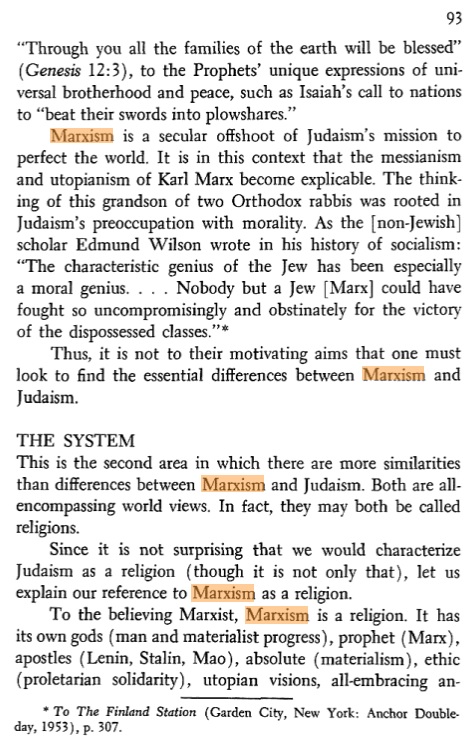
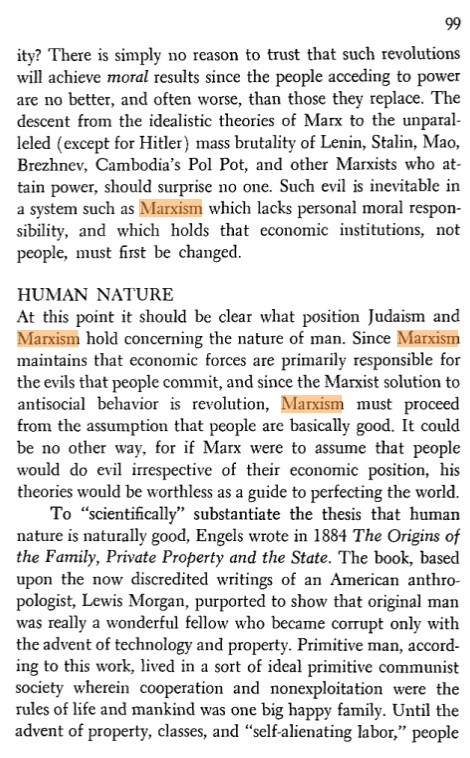
What is human nature? Good or evil? White nationalism, influenced by Darwin, would view people first and foremost as animals competing with other forms of life for survival. Human nature is savage. In the Christian view, it is evil. In the Marxist view, it is good, it only needs a just and communist society to flourish. In the Jewish view, human nature contains urges to good and bad but it is usually easier to do bad and therefore man needs a ton of commandments to morally elevate him.

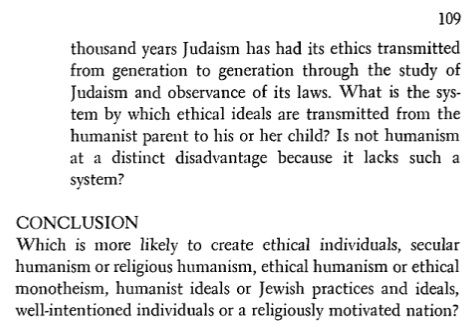
How do you morally educate people? From a nationalist perspective, you inculcate in-group identity and prioritize the well-being of your own kind over their competitors. From a Christian perspective, you change the heart through faith in God. From a Jewish perspective, you live by the Torah.

So which of these approaches have been the most successful? Well, the most successful, the most high-trust societies have been Anglo.

What is the meaning of life? From a nationalist perspective, the first meaning is to survive and the second meaning is to propagate your genes and to create a good and safe space for future generations of your people. From a Christian perspective, the purpose of life is salvation to the next life. From a Marxism perspective, the purpose of life is to create heaven on earth through the promotion of communism.

What are nationalist ethics? Those that promote the well-being of the nation. Jewish ethics mean what is best for Jews, white ethics mean what is best for whites, Japanese ethics mean what is best for Japanese.

What are religious ethics? Those that are taught by sacred texts (based in divine revelation in the monotheist faiths).

Almost all ethical systems practice dual morality — one morality for how you treat your in-group and a more relaxed morality for how you treat out-groups. The major exception to this trend is Christianity, in particular Anglo Christianity. That’s why Anglos make the best countries and the best citizens.

What is the source of morality? I asked Greg Johnson (Editor Counter-Currents.com) on Sunday.

Luke: “Do you believe in objective morality and objective good and evil?”

Greg: “Yes. I think that morality and good and evil and things like that are based on nature. I follow the classical Greek notion of Natural Law and Natural Right. I believe those are reasonable views, that we can come up with an ethics that is based on nature, that’s not based simply on social convention or simply on revelation and appeals to religion. Science and socio-biology gives us a lot of useful information for constructing this ethic. Larry Arnhart has written a book called Darwinian Natural Rights. He’s influenced by classical political philosophy and natural right thinking and yet he shows that socio-biology supports a lot of the naturalistic ethical ideas that you find in classical Greek and Roman political philosophy. That is the outlook that I think is most promising. By appealing to science and to classical philosophy, we can come up with a moral consensus and political consensus that is reason-based and science-based and that allows us to sidestep inherently contentious and sometimes violence-inducing things like appeals to religious revelation.”

On November 26, 2017, I asked Richard Spencer: “What is the source of morality?”

Richard: “That’s a very deep question.”

Richard’s phone rings. “Morality and theology are ways of building a group consensus without using direct force so that people feel like they are… I’m going to have to go. Someone just told me there is a major emergency.”

“There’s an evolutionary origin of morality.”

An orthodox Jew or Christian or Muslim will say that God is the source of morality and that God’s will was revealed in the Torah, from a Jewish perspective, or in the Bible and the person of Christ from a Christian perspective, and in the Koran from a Muslim perspective. Without a transcendent source for morality, we simply have different opinions on morality. There is no objective good and evil without God, but then there is only objective good and evil after one makes a subjective leap of faith to God and to His revelation, so how objective is this objective good and evil when it depends, at least in part, on subjective faith?

I quote from Dennis Prager’s book, The Nine Questions People Ask About Judaism:
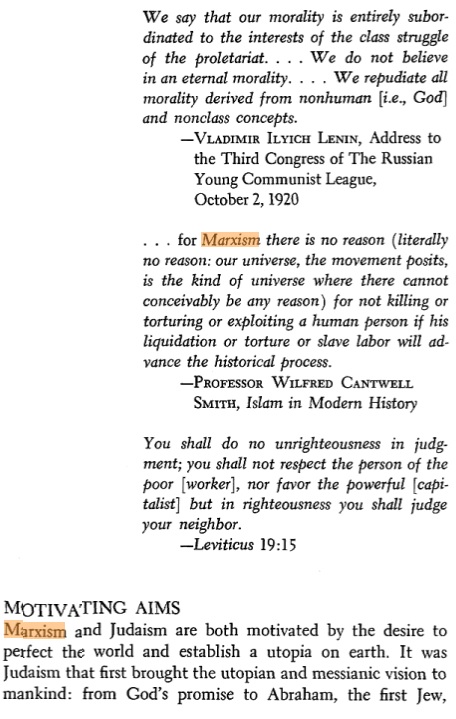
And yet, for all these beautiful words, in much of the world, the word “Jew” is synonymous with dishonesty in business. How is that so ethical? Stalin’s Jews were among the biggest mass murderers of the 20th Century.

Posted in Judaism, Nationalism | Comments Off on How Does Jewish Nationalism Compare With White Nationalism?

Parasha Vayeshev (Genesis 37:1–40:23)

Listen here.

Wikipedia: “The parashah tells the stories of how Jacob’s other sons sold Joseph into captivity in Egypt, of how Judah wronged his daughter-in-law Tamar and discovered his transgression, and how Joseph served Potiphar and was imprisoned when falsely accused of assaulting Potiphar’s wife.”

* New Yorker: The French Origins of “You Will Not Replace Us” – The European thinkers behind the white-nationalist rallying cry

The United States is not Western Europe. Not only is America full of immigrants; they are seen as part of what makes America American. Unlike France, the United States has only ever been a nation in the legal sense, even if immigration was long restricted to Europeans, and even if the Founding Fathers organized their country along the bloody basis of what we now tend to understand as white supremacy. The fact remains that, unless you are Native American, it is ludicrous for a resident of the United States to talk about “blood and soil.” And yet the country has nonetheless arrived at a moment when once unmentionable ideas have gone mainstream, and the most important political division is no longer between left and right but between globalist and nationalist.

* Steve Sailer writes: “There’s a saying in Brazil, “White women for marriage, black women for work, and mulata women for [fornication].”

I’m guessing that as a collateral royal, Prince Harry is prioritizing getting royally served. I wish the royal couple all happiness in their coupling.”

* New York Times: “A Voice of Hate in America’s Heartland”

When the media profiles white nationalists and other crime thinkers, their main focus tends to be — how did they get this way? But they won’t trace the person’s intellectual journey with care. No, they want to find discrediting personal details. The MSM can’t match up against the Alt Right in the world of ideas so they have to descend to personal attacks. (Steve Sailer More More)

* New Yorker profile of Mike Enoch: “But Mike E.’s conversion was more quotidian than that, and therefore more unsettling; somehow, over time, he had fallen into a particularly dark rabbit hole, where some of the most disturbing and discredited ideas in modern history were repackaged as the solution to twenty-first-century malaise.”

“Then, in January, 2015, Enoch read “The Culture of Critique: An Evolutionary Analysis of Jewish Involvement in Twentieth-Century Intellectual and Political Movements,” by Kevin MacDonald, a former psychology professor at California State University, Long Beach. The book—published in 1998, heavily footnoted, and roundly debunked by mainstream social scientists—is a touchstone of contemporary intellectualized anti-Semitism.”

* The Atlantic: The Making of an American Nazi: How did Andrew Anglin go from being an antiracist vegan to the alt-right’s most vicious troll and propagandist—and how might he be stopped?

The Atlantic podcast:

Andrew Anglin spent his formative years flirting with hippie progressivism, then tried his hand at becoming a tribal hunter-gatherer. But he only achieved notoriety after he founded the Daily Stormer, the world’s biggest website for neo-Nazis. Anglin and his mob of followers have terrorized people around the world, and their influence has been cited by the perpetrators of fatal violence.

What lessons should be learned from Anglin’s radicalization? And what is society’s best response to his ideas? Luke O’Brien and Rosie Gray join Jeff and Matt to discuss these questions, and how far-right extremism is evolving.

In the podcast, Luke says that rejection is what made Anglin a Nazi and that Anglin lacked critical thinking skills.

The podcast says that people who join the Alt Right are looking for a tribe.

What do you make of the MSM’s constant use of “extremist” for the Alt Right?

* Joseph would bring evil reports about the sons of Bilhah and Zilpah to his father Jacob. I’ve always hated tattletales.

* “3 Now Israel loved Joseph more than any of his other sons, because he had been born to him in his old age; and he made an ornate[a] robe for him. 4 When his brothers saw that their father loved him more than any of them, they hated him and could not speak a kind word to him.” It’s natural that you might love one child more than another, but you don’t want to show it by displaying your loved child with special gifts.

* Jacob had a dream that his brothers bowed down to him and so they hated him even more.

A key teaching of 12-Step work is that nobody is above you or below you. You’re never better than or worse than others.

* If you are a slave, you have to go along with your master’s wishes, or the consequences can be dire. By allowing himself to be alone with Potiphar’s wife, Joseph put himself in harm’s way. Also, the story teaches us that women have been known to make false allegations of rape.

* Gen. 40:8: Joseph said to them, “Do not interpretations belong to God? Tell me your dreams.”

That’s a great line.

Posted in Torah | Comments Off on Parasha Vayeshev (Genesis 37:1–40:23)

Ali: A Life

From the new biography:

* The Nation of Islam orators spoke of power. They offered proof, divine and historical, that white people were devils and destined to fall. Allah Himself had revealed this to His prophet, the Honorable Elijah Muhammad. The crowds gazed attentively and hopefully. To [Dick] Schaap, it was a sign of the young boxer’s gullibility. Clay, he said, was so “malleable  .  .  . I could’ve converted him to Judaism.”

But Schaap, as a white man, could not have understood why a young black man from the South might be excited to have divine confirmation of his experiences, to learn that there was a reason black people had been mistreated for so long, and that their suffering would soon end. As James Baldwin wrote, Elijah Muhammad’s messages had power because they articulated the historical suffering of black people and offered a way to end it, investing followers “with a pride and serenity that hang about them like an unfailing light.”

* Then there was Ferdie Pacheco, a doctor who worked in a medical clinic in Miami’s poverty-stricken Overtown neighborhood and hung around the Fifth Street Gym until he became the unofficial physician for Chris and Angelo Dundee’s fighters; “the clap doctor,” the boxing men called Pacheco, because much of his work was devoted to clearing up the boxers’ sexually transmitted diseases.

* Ali: “I like the Muslims. I’m not going to get killed trying to force myself on people who don’t want me. I like my life. Integration is wrong. The white people don’t want integration. I don’t believe in forcing it, and the Muslims don’t believe in it. So what’s wrong with the Muslims?”

* One day, while complaining about the state of his finances to his friend Tim Shanahan, Ali said he was thinking about bringing in a new manager to straighten things out. “Get me a Jewish lawyer!” he said, half joking.

* The radiologist’s report in 1981 had found Ali’s brain to be normal, but the doctors reviewing the scans at the behest of the magazine were more familiar with boxing-related brain injuries than most radiologists, and they disagreed with the earlier conclusion. They saw signs of significant brain atrophy— specifically, enlarged ventricles and a cavum septum pellucidum, a cave in the septum that shouldn’t be there.

“They read this as normal?” asked Dr. Ira Casson, a neurologist at the Long Island Jewish Medical Center. “I wouldn’t have read this as normal. I don’t see how you can say in a thirty-nine-year-old man that these ventricles aren’t too big. His third ventricle’s big. His lateral ventricles are big. He has a cavum septum pellucidum.” The Mayo Clinic had spotted some of the same things but had deemed them unrelated to boxing. In an interview decades later, Dr. Casson strongly disagreed with that conclusion: “It was all consistent with brain damage from boxing,” he said.

* Ali’s second wife, Khalilah (formerly known as Belinda), had also moved to Los Angeles in the late 1970s, which further complicated matters. In 1979, Khalilah had landed a part in The China Syndrome, which starred Jane Fonda and Jack Lemmon. But after that, her acting career foundered, and she burned through most of the money she had received in the divorce. By the 1980s, she was working as a housecleaner in the same Los Angeles neighborhood in which her ex-husband and his new family resided. She had also been reduced to selling her plasma for ninety dollars a week.

Posted in Blacks, Boxing | Comments Off on Ali: A Life

Stupidity Kills

According to Linda Gottfredson, 40% of urban out-patients don’t understand when their next doctor’s appointment is scheduled, 70% don’t understand how many pills of a prescription to take, and 95% don’t understand the informed consent form. Stupidity kills and it is not evenly distributed among the races.

Posted in Blacks | Comments Off on Stupidity Kills

Why Was There A Sudden Explosion Of Gay Pedophilia In The Catholic Church In The 1960s? And Why Did It Die Down The Last 15 Years?

Comments at Steve Sailer:

* Here are the stats:

Victims’ ages: 5.8% under 7; 16% ages 8-10; 50.9% ages 11-14; 27.3% ages 15-17.
Victims’ gender: 81% male, 19% female

http://archives.weirdload.com/stats.html

So there were indeed pepophile priests. 3/4s of the victims were age 14 or less – this is disgusting by any standard. Age of consent laws in the US vary from 16 to 18 but even for those over the age of consent (and who actually consented) the priest is supposed to be in a relationship of trust and not having sex with his parishioners or students. Even putting aside that in the eyes of the Church itself, to whom the priests swore sacred vows, priests should (A) not be having sex at all , (B) not be having sex outside of marriage and (C) not be having gay sex. In other words, 100% of these priests were in the wrong one way or another.

* The data issued by the Diocese of Syracuse suggests that the point of origin was with cohorts ordained in the late 1920s with the peak of trouble being with the ordination classes of the mid-1960s. National data suggested the problem was at its worst with the 1970 class. Also, the type of accusation changed over time. Accusations of male on male activity were more common in all eras, but in supposed incidents from 1955, the ratio of one to the other was 1.8 to one. Re incidents occurring ca. 1985, it was 6 to 1. About 80% of the accusations on file were male-on-male incidents.

The Syracuse data suggest the propensity to report misconduct was quite low prior to 1980, something you can also see in larger diocese when looking at the Bishop Accountability case files. It’s doubtful that bishops of that era were all that aware of the problems. There was an abrupt shift in the ecosystem around about 1983, when bishops who might have fielded one accusation a decade were now fielding two or three a year. By and large, offenses are not reported in real time. Roughly 15 years after the fact is about normal with the accusations lobbed in 2002 and 2003 often 3, 4, 5 decades after the fact.

There were a great many accusations of offenses against presumptively prepubescent males. I think about 40% concerned males past their 14th birthday. Accusations of fondling were the mode, not actual sex acts (much less ‘rapes’).

The ‘cover-up’ meme is largely nonsense. Bishops were assessing accusations made long after the supposed fact without corroborating information. If a priest confessed or if a priest was the subject of multiple accusations from persons unknown to each other, that was one thing. For the most part, though, these cases were impossible. Corporate organizations do not publish their personnel files, but people retrospectively expect bishops to do so. Nearly all civil disputes are settled with negotiations and pecuniary transfers, no matter what sort of party brings suit and what sort is the defendant, but, somehow, this is sinister when a bishop does this. Criminal prosecution was never feasible in the vast majority of the cases. The accusations were made after statutes of limitations had run out or were of a nature that they’d make insufficient evidence in most cases. The prosecutors in the John Geoghan case were able to find just one case which was not time-barred and the witness in that case was so scatter-brained that the prosecutors were relying on inverted jury nullification to put Fr. Geoghan away. (Recall that what Geoghan was accused of doing in that case was squeezing the rear end of a 14 year old youth).

If you can locate Paul Mankowski’s article ‘Tames in Clerical Culture’, that I think will provide you with a better explanation for the behavior of men like Cdl. Law (who is not known to have been a member of any gay social networks). (Most bishops were more prudent than Law and pulled accused priests out of circulation). You did have some bishops were were known to be part of gay social networks. The lay organization Roman Catholic Faithful identified a few. (The founder of RCF had a business to run so shut down the organization a number of years ago).

The real problem was the quality of those recruited to the priesthood. They seem to have developed after 1970 methods which screened out the most troublesome characters. The very real threat of exposure after 1983 persuaded nearly all the rest to keep it in their pants.

* I think its pretty clear that the crisis concerned one generation of priests. The number of ordained priests in America doubled between 1950 and 1960. And the real trouble started in 1960, and peaked in 1975. After 1985, incidents sharply and steadily declined. That would seem to pretty well chart one cohorts’ sex drive, plus their position of power. A priest ordained in 1960 would be responsible for scheduling altar boys, but he would become a pastor about 1975 and be responsible for qualifying and largely attracting them, and he would enter middle age about 1985 when his libido went away.

I find it highly probable that Fulton Sheen attracted a wave of gay men into the priesthood during the 50s. He was very popular on TV from 1951-1968. Watching old videos of him now, I gotta say, he looks like an awfully commanding man with a sensationally gay wardrobe and a delicate if authorial voice.

* The gay bishops did the most covering up, followed by the gay-friendly bishops, and both continue to do so. Cardinal Dolan in New York, for example, has allowed a gay priest in the Bronx to embezzle church funds to cavort with a gay-for-pay prostitute, and hasn’t removed him from his post/ job.

Most of these bishops have had evidence for years of which priests in their parish are gay, and instead of rooting them out, they cover for them. When a “scandal” breaks, its almost always on a priest who is already “known” by the diocese/bishop for his gay behavior. And they did almost zero investigation, just moved a priest until the heat was off.

It’s like with Weinstein. No one in Hollywood is surprised at the allegations because anyone in Hollywood had heard rumors or seen Weinstein’s behavior before, they just ignored it or covered up.

* Rod Dreher: A longer look, from 1950 to 2002, found 10,667 children allegedly victimized by 4,392 priests. Half of their victims were found to have been between 11 and 14 years of age; about 80 percent of them were male…

In my reporting on the scandal, I learned (from Sipe and others) that the clerical gay networks, especially in seminaries, sought to draw in gay priests in part to neutralize them. If a seminarian became sexually involved with other men, even if that seminarian never abused a minor, the network had his name, and had compromised him. He knew that he could never rat out those who did abuse minors, because they had his own sexual secrets to hold over his head…. The point I want to make here is that the lavender mafia phenomenon is pretty well known among journalists, both religious and secular, who cover or did cover the church and the scandal. And in many cases, it was deliberately not reported on, mostly, in my opinion, out of fear that it would validate the views of those journalists considered bigots.

Despite the gruesome example of defrocked Boston priest John Geoghan, whose case started the current tidal wave of revelations, the overwhelming majority of priests who have molested minors are not pedophiles – that is, like Geoghan, among the rare adults sexually attracted to pre- pubescent children. They are, rather, “ephebophiles” – adults who are sexually attracted to post-pubescent youths, generally aged 12 to 17. And their victims have been almost exclusively boys.

Stephen Rubino, a New Jersey lawyer, says that of the over 300 alleged victims of priest sex abuse he has represented, roughly 85 percent are boys, and were teenagers when the abuse occurred. Dr. Richard Fitzgibbons, an eminent Catholic psychiatrist who has treated scores of victims and priest-perpetrators, says 90 percent of his patients were either teen male victims of priests, or priests who abused teen boys.

“I think we have to ask the question: Why are 90 percent to 95 percent, and some estimates say as high as 98 percent, of the victims of clergy [abuse] teenage boys? . . . We need to ask that question, and I think there’s a certain reluctance to raise that issue,” said the Rev. Donald B. Cozzens, author of The Changing Face of the Priesthood, on a recent Meet the Press.

* The elephant in the room is that male-female relations are essentially a zero-sum game. What’s good for men as a group is necessarily bad for women as a group, and vice-versa. Crudely, from a biological standpoint, men seek to inseminate whomever they want without any further commitment, and women seek to be inseminated by the hottest guys and then be supported by whoever is able and willing to do so (generally not the same guys they want impregnating them).

These biological imperatives manifest themselves differently according to culture, but, when boiled down, one finds the same fundamental ingredients.

Today in the US we are arguably closer to an unalloyed matriarchy than any society in history has been (except maybe Sweden(?)), and the latest moral panic is bringing us even closer. Ultimately, feminists want the ability to destroy the reputation of any man at whim (if not have him imprisoned or killed). This is what the “always believe the victim” thing is about. By definition, to reflexively believe the accuser means one must disbelieve the accused (unless the accused admits to the accusation).

Weinstein, Spacey and Moore have been proven to be scum beyond a reasonable doubt, although it’s likely that at least some of their accusers are not being entirely truthful. As for everyone else, we should not jump on the bandwagon simply because we dislike them. Franken is a case in point.

* Not zero-sum at all. There are stable setups that would make both men and women better off overall. Go ask the Mormons about it.

* Male-female relations are indeed sort of zero-sum in our current feminist environment everywoman-for-herself environment where the sexes have been sundered from their culture and each other. Sure in it, women want free provisioning–welfare, child support, soft-jobs, AA promotions, etc. etc. etc.–without having to make any commitment, plus sexual freedom–play the field, blow up marriages on demand. Men–who can–will pump and dump–as long as they can.

But traditionally we had this non-zero-sum thing called “marriage”, where both sexes gave up some freedom in order and had to resist some of their sexual impulses, but were both rewarded with an overall better deal–for both long term happiness and genetic survival. It was the bedrock of civilization.

Now, after the feminist blew this up, with sluts and the divorce industry, the grotesquely slanted playing field makes marriage more and more unpalatable to men. But, of course, that doesn’t actually benefit women whom as they age and thoughts turn to children, tend to really really want the goodies that marriage provides, not just the “free” provisioning the super-state provides as husband-replacement.

But the positive sum solution between men and women is still out there. We just have to roll back a lot of the cultural damage that the left has inflicted to get back there.

Posted in Abuse, Catholics | Comments Off on Why Was There A Sudden Explosion Of Gay Pedophilia In The Catholic Church In The 1960s? And Why Did It Die Down The Last 15 Years?

Tom Wolfe On Firing Line Regarding His First Novel ‘Bonfire of the Vanities’

Comments at Steve Sailer:

*

And many other of Wolfe’s appearances can be seen on the official youtube page.
Slightly related is the appearance talking about Radical Chic:

What is peculiar here is the ethnic subtext between Wolfe, Southerner, and the critic, Jason Epstein, Jewish liberal, Buckely is citing against Wolfe. Tom mentions Jewish liberals at one point but aside from that it doesn’t come up from either side. The same is true of political motivations. A piece like that today would instantly identify Wolfe as being on the right, whether correct or not. Being far too young I’m also basing this view on Steve mentioning that Wolfe’s leanings only became clearer to the literati decades later.
Not sure how to make sense of it except that the era was still marked by the then dying age of big tent WASP liberalism that was confident in the appeal and ideal of objectivity. As such Tom Wolfe could get away with claiming the mantle of being apolitical.

Instead, it was a Panther’s response who portended the coming form of discourse:

When Time magazine later interviewed a minister of the Black Panthers about Bernstein’s party, the official said of Wolfe: “You mean that dirty, blatant, lying, racist dog who wrote that fascist disgusting thing in New York magazine?”

https://en.wikipedia.org/wiki/Radical_Chic_%26_Mau-Mauing_the_Flak_Catchers

* Ahh, the good old days. What the younguns probably can’t imagine is that America in 1987 was still basically a white and black country. Even New York, while it had its Chinatown and had always suffered the presence of Puerto Ricans (think “West Side Story”), it was basically a white and black town. Of course in New York the power structure has since the 1800s included Jews, and sure enough there were plenty of Jews and Jewish dominated media promoting the Brawley hoax. But the battle lines were bi-racial, not multi-racial like we have now. If this happened today, the protests would have far more whites, Asians and Arabs at them, siding against whitey, which would have ticked off Mason, Sharpton and the crew, because all along it was just a political power grab.

The story was an obvious fake from the get-go, but the media — even then in a “get whitey” mode — presented it without any doubt, at least at first, other than for radio personality Bob Grant, who was on top of the thing from the start.

Similarly, the media had just come off an orgy of anti-white abuse attending the Howard Beach incident, another giant farce. This nonsense totally consumed the city for a very long time. That was when I was really waking up to the reality that the media isn’t remotely interested in the facts, and is openly hostile to the kinds of whites we now call Deplorables. We didn’t call it The Narrative back then, and even if you did there was no where you could get the word out, other than calling into a radio talk show.

Finally, Sharpton is one clever bastard. Even now, he manages to skirt the issue and he dances around it with consummate skill. And he looked a lot better when he was fat.

* Would this be a good time to point out that the % of rapes involving a male white rapist(s) and a female black victim is (still) perilously close to 0%.

Posted in Tom Wolfe | Comments Off on Tom Wolfe On Firing Line Regarding His First Novel ‘Bonfire of the Vanities’

‘Ali: A Life’

From the New York Times Book Review:

As early as 1970 Ali’s physician Ferdie Pacheco (the “Fight Doctor”) began numbing Ali’s fists before fights with cortisone and an anesthetic called Xylazine. “Ali’s hands were so shot he couldn’t hit a pillow,” Ali’s business manager said. It was suspected by his handlers that Ali had incurred “lasting brain damage after the Frazier fight in 1971,” but his final fight, a shameful debacle in which he could scarcely defend himself against the much younger Trevor Berbick, was in 1981…

Asked why he’d continued to work with Ali despite his diminishing skills, Ferdie Pacheco replied angrily: “You’re in the corner to keep them fighting … not to tell them not to fight. If you didn’t tell them to fight, you were fired immediately.” Ali’s famous “rope-a-dope” strategy, which allowed him to win the Rumble in the Jungle against the younger, stronger George Foreman by absorbing as many powerful blows as Foreman could throw, was in the short run a triumph; in the long run, a medical disaster. The later years of Ali’s decline are depicted in chapters in Eig’s biography with such ominous titles as “‘They May Not Let Me Quit,’” “Staggered,” “Old,” “The Last Hurrah” and “Too Many Punches” that take us 18 years beyond the brightly lit terrain of Remnick’s biography into a hellish twilight of irreversible neurological damage…

“Some writers said that Ali had ‘transcended’ race. It was an attempt to whitewash his legacy, and it was dead wrong. Race was the theme of Ali’s life.”

Ali was illiterate and had an IQ of about 78.

Posted in Boxing | Comments Off on ‘Ali: A Life’

‘The French Origins of “You Will Not Replace Us” – The European thinkers behind the white-nationalist rallying cry’

From The New Yorker:

Although Camus presents his definition of “Frenchness” as reasonable and urbane, it is of a piece with a less benign perspective on ethnicity, Islam, and territory which has circulated in his country for decades. Never the sole preserve of the far right, this view was conveyed most bluntly in a 1959 letter, from Charles de Gaulle to his confidant Alain Peyrefitte, which advocates withdrawal from French Algeria:
It is very good that there are yellow Frenchmen, black Frenchmen, brown Frenchmen. They prove that France is open to all races and that she has a universal mission. But [it is good] on condition that they remain a small minority. Otherwise, France would no longer be France. We are, after all, primarily a European people of the white race, Greek and Latin culture, and the Christian religion.
De Gaulle then declares that Muslims, “with their turbans and djellabahs,” are “not French.” He asks, “Do you believe that the French nation can absorb 10 million Muslims, who tomorrow will be 20 million and the day after 40 million?” If this were to happen, he concludes, “my village would no longer be called Colombey-les-Deux-Églises, but Colombey-les-Deux-Mosquées!”

…Shortly after Trump’s Inauguration, Richard Spencer, the thirty-nine-year-old white nationalist who has become the public face of the American alt-right, was sucker-punched by a protester while being interviewed on a street corner in Washington, D.C. A video of the incident went viral, but little attention was paid to what Spencer said on the clip. “I’m not a neo-Nazi,” he declared. “They kind of hate me, actually.” In order to deflect the frequent charge that he is a racist, he defines himself with the very term that Camus rejects: identitarian. The word sidesteps the question of racial superiority and co-opts the left’s inclusive language of diversity and its critique of forced assimilation in order to reclaim the right to difference—for whites.
Identitarianism is a distinctly French innovation. In 1968, in Nice, several dozen far-right activists created the Research and Study Group for European Civilization, better known by its French acronym, grece. The think tank eventually began promoting its ideas under the rubric the Nouvelle Droite, or the New Right. One of its founders, and its most influential member, was Alain de Benoist, a hermetic aristocrat and scholar who has written more than a hundred books. In “View from the Right” (1977), Benoist declared that he and other members of grece considered “the gradual homogenization of the world, advocated and realized by the two-thousand-year-old discourse of egalitarian ideology, to be an evil.”

…Although Benoist claims not to be affiliated with the alt-right—or even to understand “what Richard Spencer can know or have learned from my thoughts”—he has travelled to Washington, D.C., to speak at the National Policy Institute, a white-nationalist group run by Spencer, and he has sat for long interviews with Jared Taylor, the founder of the virulently white-supremacist magazine American Renaissance. In one exchange, Taylor, who was educated in France, asked Benoist how he saw himself “as different from identitarians.” Benoist responded, “I am aware of race and of the importance of race, but I do not give to it the excessive importance that you do.” He went on, “I am not fighting for the white race. I am not fighting for France. I am fighting for a world view. . . . Immigration is clearly a problem. It gives rise to much social pathologies. But our identity, the identity of the immigrants, all the identities in the world have a common enemy, and this common enemy is the system that destroys identities and differences everywhere. This system is the enemy, not the Other.”

…One of the group’s founders, Guillaume Faye, a journalist with a Ph.D. from Sciences-Po, split off and began releasing explicitly racist books. In a 1998 tract, “Archeofuturism,” he argued, “To be a nationalist today is to assign this concept its original etymological meaning, ‘to defend the native members of a people.’ ” The book, which appeared in English in 2010, argues that “European people” are “under threat” and must become “politically organized for their self-defense.” Faye assures native Frenchmen that their “sub-continental motherland” is “an organic and vital part of the common folk, whose natural and historical territory—whose fortress, I would say—extends from Brest to the Bering Strait.”
Faye, like Renaud Camus, is appalled by the dictates of modern statecraft, which define nationality in legal rather than ethnic terms. The liberal American writer Sasha Polakow-Suransky, in his recent book, “Go Back to Where You Came From: The Backlash Against Immigration and the Fate of Western Democracy,” quotes Camus lamenting that “a veiled woman speaking our language badly, completely ignorant of our culture” could declare that she is just as French as an “indigenous” man who is “passionate for Roman churches, and for the verbal and syntactic delicacies of Montaigne and Rousseau, for Burgundy wines, for Proust, and whose family has lived for generations in the same valley.” What appalls Camus, Polakow-Suransky notes, is that “legally, if she has French nationality, she is completely correct.”
Faye’s work helps to explain the rupture that has emerged in many Western democracies between the mainstream right, which may support strict enforcement of immigration limits but does not inherently object to the presence of Muslims, and the alt-right, which portrays Muslim immigration as an existential threat. In this light, the growing admiration by Western conservatives for the President of Russia, Vladimir Putin, is easier to comprehend. Not only do thinkers like Faye admire Putin as an emblem of proudly heterosexual white masculinity; they fantasize that Russian military might will help create a “Eurosiberian” federation of white ethno-states. “The only hope for salvation in this dark age of ours,” Faye has declared, is “a protected and self-centered continental economic space” that is capable of “curbing the rise of Islam and demographic colonization from Africa and Asia.” In Faye’s 2016 book, “The Colonisation of Europe,” he writes, of Muslims in Europe, “No solution can be found unless a civil war breaks out.”

…Richard Spencer told me, “I would say that the alt-right in the United States is radically un-conservative.” Whereas the American conservative movement celebrates “the eternal value of freedom and capitalism and the Constitution,” Spencer said, he and his followers were “willing to use socialism in order to protect our identity.” He added, “Many of the countries that lived under Soviet hegemony are actually far better off, in terms of having a protected identity, than Western Europe or the United States.”
Spencer said that “clearly racialist” writers such as Benoist and Faye were “central influences” on his own thinking as an identitarian. He first discovered the work of Nouvelle Droite figures in the pages of Telos, an American journal of political theory. Most identitarians have a less scholarly bent. In 2002, a right-wing French insurrectionary, Maxime Brunerie, shot at President Jacques Chirac as he rode down the Champs-Élysées; the political group that Brunerie was affiliated with, Unité Radicale, became known as part of the identitaire movement. In 2004, a group known as the Bloc Identitaire became notorious for distributing soup containing pork to the homeless, in order to exclude Muslims and Jews. It was the sort of puerile joke now associated with alt-right pranksters in America such as Milo Yiannopoulos.
Copycat groups began emerging across Europe. In 2009, a Swedish former mining executive, Daniel Friberg, founded, in Denmark, the publishing house Arktos, which is now the world’s largest distributor of far- and alt-right literature. The son of highly educated, left-leaning parents, Friberg grew up in a wealthy suburb of Gothenburg. He embraced right-wing thought after attending a diverse high school, which he described as overrun with crime. In 2016, he told the Daily Beast, “I had been taught to think multiculturalism was great, until I experienced it.”
Few European nations have changed as drastically or as quickly as Sweden. Since 1960, it has added one and a half million immigrants to its population, which is currently just under ten million; a nationalist party, the Sweden Democrats, has become the country’s main opposition group. During this period, Friberg began to devour books on European identity—specifically, those of Benoist and Faye, whose key works impressed him as much as they impressed Richard Spencer. When Friberg launched Arktos, he acquired the rights to books by Benoist and Faye and had them translated into Swedish and English. Spencer told me that Arktos “was a very important development” in the international popularization of far-right identitarian thought…

On August 11th, the Unite the Right procession marched through the campus of the University of Virginia. White-supremacist protesters mashed together Nazi and Confederate iconography while chanting variations of Renaud Camus’s grand remplacement credo: “You will not replace us”; “Jews will not replace us.” Few, if any, of these khaki-clad young men had likely heard of Guillaume Faye, Renaud Camus, or Alain de Benoist. They didn’t know that their rhetoric had been imported from France, like some dusty wine. But they didn’t need to. All they had to do was pick up the tiki torches and light them.

Posted in Alt Right, Richard Spencer | Comments Off on ‘The French Origins of “You Will Not Replace Us” – The European thinkers behind the white-nationalist rallying cry’

Remembering Bob Grant

From the New York Times profile of Sean Hannity:

Grant is today best remembered for his declaration, in 1991, that the United States was being taken over by “millions of subhumanoids, savages, who really would feel more at home careening along the sands of the Kalahari.” He was adept at toggling between genteel patter, with guests he agreed with, and explosions of indignant fury, at those he didn’t. In one memorable exchange from the late 1980s, he demanded to know the whereabouts of a caller who called him a “bigot,” roaring: “I want to meet you to kill you, you skunk! Get off my phone!”

Posted in America | Comments Off on Remembering Bob Grant

Forward: No, You Can’t Be A Feminist And A Zionist

Here’s the op/ed:

When I hear anyone championing Zionism while also identifying as a feminist, my mind turns to images of night raids, to the torture of children and to the bulldozing of homes. But I also think of those female soldiers who casually partake in it all, including ex-Israeli soldier and “Wonder Woman” Gal Gadot, who expressed her love and support for the Israel Defense Forcesas they bombed and killed thousands of Palestinians in Gaza in 2014.

Being a feminist and a Zionist is a contradiction in terms because the Zionist feminist is complicit in propagating supremacy and domination over a people on the one hand, while on the other hand calling for an end to patriarchy.

Indeed, the Zionist feminist is reminiscent of another kind of feminist: the white feminist. Women of color have been historically marginalized within the feminist movement, mostly due to white women stifling racial justice issues and de-emphasizing the specific oppressions faced by people of color because of their race, ethnicity and class. This negligence was often justified as working for collective sisterhood. But as Hooks eloquently explains, “As long as women are using class or race or power to dominate other women, feminist sisterhood cannot be fully realized.” Fundamentally speaking, feminism cannot support racism, supremacy and oppressive domination in any form.

Zionism is often preached as a call for a Jewish homeland to ensure that the horrors of anti-Semitic oppression do not occur again. In this simplified narrative, however, what is obscured is the fact that this quest for a homeland was initiated by a colonizing agency, which meant ipso facto appropriating land and culture, and dispossessing the people who lived in the region for thousands of years. These land thefts and violations of human dignity and international law continue in the name of Zionism on a regular basis, perpetuating the suffering of an entire population and the denial of their basic human rights on the premise of ethnicity and race. This is why I am weary and distrustful of the Zionist feminist. She willfully ignores that Zionism has advanced itself through myriad human rights violations.

I think she might be right — feminism and Zionism are incompatible. In fact, feminism and any healthy form of social arrangement are impossible.

Are leftism and Zionism compatible? Probably not. Zionism, like all nationalisms, is a movements of the right (against equality). People are conservative about their own interests.

Posted in Feminism, Israel | Comments Off on Forward: No, You Can’t Be A Feminist And A Zionist