
The Beautiful Films & Empty Ideas Of Adam Curtis

When you listen to Barack Obama and Tony Blair speak, you often feel that you are hearing something profound, but when you read their speeches, you realize there is no there there. So too with filmmaker Adam Curtis. There’s nothing there. The visual and aural tracks of Adam Curtis’s documentaries are compelling, but when you look at his ideas in black and white, do they stand up? Not so much. There’s no sin in loving entertainment but confusing that which looks good for that which is good is a mistake.

Also, many Americans think that because something is said in an English accent, it must be deep. Not really. Kerwin tweets: “I’m going to re-dub all of Adam Curtis’s documentaries, swapping his voice out with a guy who has an Appalachian hillbilly accent. We’ll see how intellectually insightful and mature he really is…”

Obama and Blair can write lyrical passages, but beneath the surface shimmer, there’s nothing. Curtis makes stunning films, but the arguments he presents are nothing but unverifiable assertions.

Time magazines says Feb. 23, 2021:

He is best known as the pioneer of a radical and unique style of filmmaking, combining reels of unseen archive footage, evocative music, and winding narratives to tell sweeping stories of 20th and 21st century history that challenge the conventional wisdom. “I’ve never thought of myself as a documentary maker,” he says. “I’m a journalist.”

On Feb. 11, Curtis dropped his latest epic: Can’t Get You Out of My Head, an eight hour history of individualism, split up over six episodes. Subtitled “An emotional history of the modern world,” the goal of the series, Curtis says, was to unpack how we came to live in a society designed around the individual, but where people increasingly feel anxious and uncertain.

The reason that some of us live in societies designed around the individual is primarily biological. Individualism is not something constructed by society. Rather, states filled with people who have an individualist orientation (they are usually Northern European in origin) tend to be individualist. Nicholas Wade wrote in his 2014 book Our Troublesome Inheritance:

Contrary to the central belief of multiculturalists, Western culture has achieved far more than other cultures in many significant spheres and has done so because Europeans, probably for reasons of both evolution and history, have been able to create open and innovative societies, starkly different from the default human arrangements of tribalism or autocracy…

Tribal societies, for instance, are organized on the basis of kinship and differ from modern states chiefly in that people’s radius of trust does not extend too far beyond the family and tribe. But in this small variation is rooted the vast difference in political and economic structures between tribal and modern societies. Variations in another genetically based behavior, the readiness to punish those who violate social rules, may explain why some societies are more conformist than others.

The entry to the modern industrial world has two principal requirements. The first is to develop institutions that enable a society to break away, at least to some substantial extent, from the default human institution of tribalism. Tribalism, being built around kinship ties, is incompatible with the institutions of a modern state. The break from tribalism probably requires a population to evolve such behaviors as higher levels of trust toward those outside the family or tribe. A second required evolutionary change is the transformation of a population’s social traits from the violent, short-term, impulsive behavior typical of many hunter-gatherer and tribal societies into the more disciplined, future-oriented behavior seen in East Asian societies and documented by Clark for English workers at the dawn of the Industrial Revolution.

Looking at the three principal races, one can see that each has followed a different evolutionary path as it adapted to its local circumstances… Consider first Caucasians, the grouping of populations that includes Europeans, Middle Easterners and people of the Indian subcontinent (Indians and Pakistanis). Most European countries followed England almost immediately in transitioning to modern economies. Their populations, like that of England, had abandoned tribalism in the early Middle Ages.

As Samuel Francis noted: “The civilization that we as whites created in Europe and America could not have developed apart from the genetic endowments of the creating people, nor is there any reason to believe that the civilization can be successfully transmitted to a different people.”

If a different people than the English had settled North America, the United States today would be less individualist. As a declining proportion of the American people can trace their genetic heritage to England, individualism retreats and collectivism increases.

Professor Geert Hofstede analyzes cultures on six dimensions including individualism vs collectivism:

The high side of this dimension, called Individualism, can be defined as a preference for a loosely-knit social framework in which individuals are expected to take care of only themselves and their immediate families.

Its opposite, Collectivism, represents a preference for a tightly-knit framework in society in which individuals can expect their relatives or members of a particular ingroup to look after them in exchange for unquestioning loyalty. A society’s position on this dimension is reflected in whether people’s self-image is defined in terms of “I” or “we.”

The most individualist countries according to Hofstede’s index are in order: United States, Australia, United Kingdom, Netherlands, and New Zealand. These are all states developed by northern Europeans, who also orient towards individualist religions such as Protestantism. DNA is upstream of religion, culture and politics.

Adam Curtis tells Time magazine: “I have no problem with identity politics. The left retreated from economics in the 1980s, because the right got into power everywhere. And in response to that, the left did some extraordinary things with identity politics, which actually did liberate lots and lots of people. I think it’s an amazing achievement. I think my criticism, which I think is clear in the films, is that they lost control of economics, and it ran out of control, and money took control.”

Well, only some groups are allowed to play the identity politics games. Whites, for example, are not. For all the people the left liberated with its civil rights law, there were as many people enslaved. As Christopher Caldwell pointed out, the founding American constitution has been superceded by the new constitution of civil rights, which has diminished freedom of association.

Adam: “But you voted for the wrong person. He’s going to con you, which Trump did. Because actually the truth of the last four years is that Trump completely failed. He didn’t do any of what he said he was going to do domestically. He said he was going to get rid of the corruption in Washington. It spread. He said he was going to rebuild the infrastructure of America. He did nothing and it is still falling apart. He said he was going to bring the factories back home. He didn’t. And the opioid crisis increased. He said he was going to end the futile wars abroad. He didn’t. By any measure, he was a total failure. And in a way, he’s another of these examples of these people coming up with this great wave of anger behind them. Because there are a lot of people who are very angry. And you can still see from the voting patterns in the most recent presidential election, in 2020, that they’re still there. Yet, nothing actually changed. What I was astonished by was that there was this sound and fury. But actually, no one was doing anything.”

Martin Gurri has a more coherent explanation — the explosion of information has reduced the power of the elites and fueled anger by raising unrealistic expectations. The notion that Trump was a total failure is purely polemical. It might sound great to Adam’s friends but it does not accord with reality (real wages started rising in America for the working class, immigration was slashed, etc).

Adam: “The readership for newspapers began to collapse in the early ‘90s. Which is the point at which journalism became very boring, because it had nothing else to say. It didn’t have any dramatic narratives.”

Journalism is a business. The business collapsed, not because of a lack of dramatic narratives, but because its business model of packaging news to assemble eyeballs to sell advertising to could not compete with the age of increasing information.

Adam: “Individualism is born out of mass democracy. It’s a natural consequence of it.”

No. Japan and South Korea are democracies but they are not individualist. There’s no evidence for the assertion that mass democracy promotes individualism.

Adam: “Black Lives Matter is great because it’s the first movement that comes along and says, this is structural, this is about power. Because in the age of individualism, the word power has disappeared. You’re supposed to be empowered, yourself. What is reemerging is that old idea that actually, it’s about changing the structure. That’s what Black Lives Matter is saying, and it won’t go away. And it’s very interesting that it took a group which has been excluded from that system to come smashing through to the mainstream, and bring that debate into the mainstream. I think it’s great. I think, in boring terms, it’s the return of sociology. It says that actually, the reason you feel shit doesn’t just come from inside you, it isn’t your failure, which is what a lot of modern positive psychology says. What Black Lives Matter says, and the wider movement which they’re part of says, is no: a lot of the reason you feel shit is because you live in a shit society, or where you are in the power structure is horrible and unequal, and it’s not your fault.”

BLM is the first movement to says that the problem is structural? That’s absurd. Marx and Marxist critiques for over a century have argued that our principle problems are structural. If life is so bad for BLM activists, why don’t they move to where things are much much better? The notion that your problem are not your fault has long been a popular one. It is not new to BLM.

Adam: “I think the COVID pandemic has shown, brutally, that the further you are away from the system of power, the more likely you are to fall ill and die. Whereas the higher you are up the hierarchy of power, the safer you are.”

Covid has shown that the stupider and fatter you are, the more likely you are to die. Covid does not kill on the basis of how close you are to power. It kills people with comorbidities such as obesity, high blood pressure, diabetes, etc. It has always been thus. Stupid fat people near the center of power die quicker than smart healthy people away from the center of power. The center of power has next to nothing to do with whether you live or die. Medical care makes very little difference for most people’s quality of life and life expectancy. Genetics matter for your quality and length of life much more than medical care.

Adam: “The reason you got Brexit and the reason you got Trump was because of the response to the banking crisis in 2008. And in both America and Britain, people realized that those lower down the chain were being asked to pay for the rich’s corruption and criminality.”

Do you know why virtually no bankers went to prison for the Global Financial Crash of 2008? Because, by and large, they obeyed the laws of the game established by the U.S. government which forced banks to lend to people who were unlikely to pay back their loans. Countries that did not require affirmative action in lending did not have banking crises unless they had significant exposure to the American mess.

Adam: “The people who have to drive a bus in order to make society work are more likely to die than those who run a hedge fund. I think that’s going to go very deep, I really do. So there are good things to this pandemic. It’s shone a very powerful searchlight on exactly what we’re talking about: social class and power.”

This life expectancy difference has next to nothing to do with social class and power and almost everything to do with genetics. The genetics of the people who run hedge funds predict a longer life than the less intelligent people who run buses. Life is an IQ test and smart people live longer, on average, than dumb people.

Adam: “A lot of people in advertising are beginning to question whether Google’s magic ability to target people and predict how they as individuals behave may not be true.”

See George Gilder’s 2018 book, Life After Google: The Fall of Big Data and the Rise of the Blockchain Economy.

Spiked: “He portrays suburban life as detached from reality, as if this state of alienation was more a product of lifestyle or architecture and planning than politics. But the suburbs were once thriving hubs of popular participation (though as John Carey’s The Intellectuals and the Masses demonstrates, this participation was held in contempt by the elites).”

Has Adam Curtis ever lived in the suburbs? On what basis can one argue that life in the suburbs or life in any particular place is detached from reality? Life is not more real in the country or in the city.

Spiked: “Our rulers have persuaded themselves that free will is a sham and that ordinary people are easily manipulated.”

That’s nonsense. Read Not Born Yesterday: The Science of Who We Trust and What We Believe.

Spiked: “Brits and Americans withdrew from churches, sports clubs, book clubs, parent-teacher associations, the Boy Scouts, the Red Cross, rotary clubs, you name it.”

And why was that? Because the left’s civil rights legislation destroyed freedom of association. Men could no longer gather only with men except in certain religious settings or in a strip club.

New Statesman: “The commanding belief of humanity is individualism, the idea that the individual – their thoughts, actions and feelings – is superior to the societies in which they live.”

No. Individualism is not inherently superior to collectivism. It depends on people and circumstance. Collectivist solutions to Covid-19, for example, have generally approved far more effective than individualist ones.

New Statesman: “Just like the great 19th-century novelists such as Dostoevsky, Curtis is deeply concerned with how we came to hold such a pessimistic view of human nature.”

People on the right take for granted that the human is a dangerous animal. You’d have to be an idiot to think otherwise.

Adam: “What I’m asking in these films is why in the great age of individualism, which promised empowered individuals, have we ended up with entire societies that are uncertain, anxious and distrustful – not just of those in power, not just not just of each other, but of themselves? That is the fundamental thing that is stopping us from having the confidence to imagine different kinds of worlds.”

The lack of freedom of association has more to do with this than anything.

Adam: “The ultimate hidden truth of the world is that it is something we make and could just as easily make differently.”

No, the world is as it is, and our ability to change it is severely limited by biology and geology and genetics.

Adam: “This [conspiracy] theory was going to have a very powerful effect in the future because it would lead to a profound shift in how many people understood the world. Because what it said was that, in a dark world of hidden power, you couldn’t expect everything to make sense, that it was pointless to try and understand the meaning of why something happened, because that would always be concealed. What you looked for were the patterns.”

The problem is not that the world makes no sense, the problem is that the world does not make perfect sense.

The New Yorker describes Adam’s method as “a stream of unusual, evocative images from the past, richly scored with pop music, that are overlaid with his own, plainly delivered, often unverifiable analysis.”

Adam: “I’m fundamentally an emotional journalist. The mood my films create—and possibly the reason why people like that mood—is because it somehow feels real, even though it seems dreamy and odd. It actually gets at what’s going on in people’s heads, which is sort of what realism always is. People in the nineteenth century did not think and feel like we do today.”

Adam delivers feelz, whether they bear any resemblance to reality is debatable.

The New Yorker: “Curtis finds writing much harder than what he calls “cutting the archive,” which he does briskly and without particular effort.”

Of course he does. Writing is a mirror to the mind. When you read Adam’s writings, you realize there isn’t much there.

The New Yorker: “[W]e live in societies without narrative coherence.”

You can’t have narrative coherence shared by diverse peoples.

The New Yorker: “Each of his projects is anchored by a single, provocative idea, and the claim of his new series is that we have become unable to imagine the future—we are citizens of an eternal present stilled by dubious technology, hollow politicians, and catastrophic self-doubt.”

The future is not knowable. We are not stilled by dubious technology and hollow politicians and catastrophic self doubt. Talk for yourself, mate. Religious people, by and large, have an optimistic outlook on life. For example, within my Orthodox Jewish community, technology, politicians and self-doubt is not a widespread problem.

The New Yorker: “As a storyteller, Curtis is drawn either to revolutionaries, who want to change the world, or to engineers, who plan to stabilize and control human society with the help of machines. (He generally takes the side of the revolutionaries, even though he acknowledges that they are often wrong.)”

He likes to tell stories and to make unverifiable assertions. I don’t see any reason to believe that what he does has anything beyond an entertainment value.

Jon Boone writes in 2015:

Curtis’s story, as simplistic as anything told by ‘those in power’, is made to seem frightfully clever by his acid-trip filmmaking style, perfectly spoofed by Ben Woodham (watch below) as the ‘televisual equivalent of a drunken late night Wikipedia binge with pretension for narrative coherence’.

Anyone really interested in the complexity behind the ‘lost war’ story might remind themselves that the US and its allies easily secured their basic military aims in 2001, swiftly destroying al-Qaida’s operational base in Afghanistan and ousting their Taliban landlords.

Nor have the west’s subsidiary ‘nation building’ efforts been completely disastrous. Curtis has much to choose from on this front: the reconstruction of a national infrastructure destroyed by civil war, the revival of vast tracts of farmland by landmine clearing charities, the giant leaps in health and education.

Or how about just one interview with any of the 5.7m refugees who have returned to the country since 2001? Dwell on that a moment. Nearly 20 per cent of Afghans have escaped the indignity of wasted lives in refugee camps because of a supposedly failed war. They are still coming back, by the way, despite all those psychotic Americans: 39,665 in 2013, the last year for which UNHCR have published statistics…

But it’s pretty clear Curtis is as uninterested in such ‘complexity’ as he is in Afghans, a people he really doesn’t seem to like very much. His most insidious story is that they are irredeemable savages who will always reject, steal or subvert the help of the most well-meaning of outsiders.

The New Yorker:

Curtis is conscious of what even his admirers call his “wild leaps.” He says that his interpretations stick out only because they are recognizable as his own. “As a critique, I’m aware of that, but I’m also aware that that’s what all journalists do,” he said.

That’s why I prefer academic analysis.

The New Yorker:

He accuses media organizations, including the Times and magazines like this one, of profiting from the frenzy and uncertainty of the past four years, obsessing over Trump’s personal corruption and mendacity rather than the alienation and anger that brought about his Presidency in the first place. “The link between journalism and democracy has been sort of broken because of what actually has happened with journalism,” Curtis told me. “It mythologizes the world into a darkness around us, full of shady figures who are completely beyond our control to do anything about, so we feel more helpless, more disempowered to do anything about. . . . It’s the frozen world.”

Yes, there’s no inherent connection between journalism and truth and there never has been. “Journalism” is just another business. The frozen world might be what Adam feels inside but it is not true to the lived experience of the people I love.

I first met Curtis on the morning after the Brexit vote, when I was interviewing him for another story. It was the biggest political shock of my lifetime. The country had taken a nationalist, inward turn. I had been up since five o’clock in the morning, watching the results come in. The Prime Minister, David Cameron, had just resigned. You could feel the ground shifting uneasily. Curtis and I met in a café around the corner from the BBC. He seemed entirely unmoved. I remember him saying, “It’s just a pantomime, isn’t it?”

No. There’s a middle ground between regarding politics that does not go your way as the end of the world, and understanding that politics has some significance. The election of Joe Biden, for example, did not mark the end of the United States of America (contrary to what Michael Anton claimed). It was not the last presidential election where a Republican had a chance to win.

Wired: “He wanted to know why the progressive ideas of our time seem to manifest in doom mongering and inaction.”

Because it is harder to get things done in less intelligent and more diverse societies.

Wired: “His fans commend his prescience and his global perspective; his detractors – “the rationalists who hate me” – say that he makes connections that aren’t there: that his work can be a bit ‘galaxy brain’. Everyone agrees his films are beautiful – Curtis has a sixth sense for combining image and sound in a way that heightens both.”

Wired:

Followers of Curtis’s work will recognise one theme – he tries again to square the circle of the individual and the collective. In Curtis’s eyes, this is pretty much the definitive theme of the 20th century. Individualism, he argues, began as a utopian ideal: freedom through self-expression. Then it morphed into consumerist enslavement. In other words, Curtis hates hippies. “The great big shift, which is the root of our age, is that somewhere in the late 1960s, the radical left who talked in terms of power, society, overthrowing the power structure – all that rhetoric – gave up. And instead, encouraged by radical psychotherapy, they went for an alternative idea which said, ‘Okay, if you can’t change the world, in terms of power structure, what you do is change yourself.’”

When this culture of narcissism didn’t bring the Me Generation the nirvana they hoped for, corporations stepped into this emotional void. They offered these people other ways of pacifying their emptiness, like products to buy and pills to swallow – Robert Sackler, the developer of OxyContin, enters stage left – while the ideology that was actually generating this pain mushroomed. Fast forward to now, narcissism remains a generational diagnosis and the enemy of collective action.

From AnotherMag.com: “Curtis is right about our current predicament – society is breaking, people feel helpless, and despite the emotional and social closeness theoretically made possible by technology, there is an unshakeable aura of disconnect lingering like smoke on the walls.”

Yes, as we get more diversity, we get less social trust.
Posted in Adam Curtis | Comments Off on The Beautiful Films & Empty Ideas Of Adam Curtis

Tiger Woods Car Crash (2-24-21)

https://nypost.com/2021/02/24/fans-say-tiger-woods-looked-zoned-out-on-tv-before-crash/
https://www.the-sun.com/news/2395280/tiger-woods-smashed-director-car-crash/
https://en.wikipedia.org/wiki/Fleabag
https://www.jaywalkerlodge.com/tag/the-jaywalker-parable/
https://history.catholic.edu/faculty-and-research/faculty-profiles/muller-jerry/index.html
https://press.princeton.edu/books/paperback/9780691008233/the-other-god-that-failed

Posted in Addiction | Comments Off on Tiger Woods Car Crash (2-24-21)

How a Montana Mom Became a Leader in Fighting Antisemitism (2-23-21)

00:00 Why Republicans Can’t Find the Big Voter Fraud Conspiracy, https://lukeford.net/blog/?p=137280
04:00 Howard Stern and mom fight in 2019 about bar mitzvah, https://www.youtube.com/watch?v=moqQEo8a7aM
09:10 How to be an awesome co-host, https://rachelcorbett.com.au/blog/how-to-podcast/
10:40 Hosts are Tapping Pros to Polish Their Podcasts, https://www.wsj.com/articles/hosts-are-tapping-pros-to-polish-their-podcasts-11614092401?mod=hp_lead_pos12
20:40 What is Borderline Personality Disorder?, https://www.youtube.com/watch?v=zPopjuKuweg
34:00 Tanya Gersh vs Richard Spencer’s mom, Sherry Spencer, https://lukeford.net/blog/?p=110412
38:00 How a Montana Mom Became a Leader in Fighting Antisemitism, https://www.youtube.com/watch?v=6IIke7LcZJ0
48:00 Neo-Nazi Website Founder Accused of Ignoring $14M Judgment, https://flatheadbeacon.com/2020/12/11/neo-nazi-website-founder-accused-ignoring-14m-judgment/
54:00 Where was the Goyim Defense League?
1:30:00 Watching Young Pharaoh going off for getting banned from white media outlets, https://www.youtube.com/watch?v=k4XM6X-0R-4
1:32:00 Young Pharaoh Calls CPAC Ban Over Anti-Semitism ‘Censorship at its Best’, https://www.newsweek.com/young-pharaoh-calls-cpac-2021-ban-censorship-offers-debate-rabbi-1571238
1:46:00 Rick Wiles Wants To Seize The Wealth Of Billionaires And Give It To The Poor
1:49:20 Actor Kevin Sorbo speaks out after Facebook removed his page
1:53:00 Mersh on Nick Fuentes, Beardson, Bitcoin donations, Federal investigations, Patrick Casey
2:08:40 JF Gariepy on Young Pharoah, https://www.youtube.com/watch?v=fh0IhjnwPpo
2:12:00 Elon Musk vs Jeff Bezos
2:14:00 Young Pharaoh | Why the Democrats Created the KKK and Why Barack Obama Is a Terrible Human, https://www.youtube.com/watch?v=W4C5QIGJegw
2:20:00 Apollonian Germ: The You-Know-Who Fears the Rabbit Hole, https://www.youtube.com/watch?v=d5_veuo84Rc
2:22:00 NYT: Don’t Go Down the Rabbit Hole, https://www.nytimes.com/2021/02/18/opinion/fake-news-media-attention.html
2:29:00 Not Born Yesterday: The Science of Who We Trust and What We Believe, https://lukeford.net/blog/?p=130046
3:08:00 Tucker Carlson on disinformation
3:24:30 Stefan Molyneux AND Paul Gottfried LIVE on Millennial/Zoomer despair, https://twitter.com/CottoGottfried
4:47:00 John Michael Greer on Donald Trump, https://www.youtube.com/watch?v=D7FuY8bfPMg
4:49:00 White Noise documentary

Posted in America | Comments Off on How a Montana Mom Became a Leader in Fighting Antisemitism (2-23-21)

WSJ: METRO MONEY Hosts are Tapping Pros to Polish Their Podcasts

When I moved to Los Angeles in 1994, I ended up spending about $8000 pursuing my new-found acting dream. I had a nagging sense that much of my money was wasted, that I was getting taken in by scams, but looking back, I think I was willing to part with the money to enable my fantasies. When you’re a rube, there are always people willing to take advantage.

A friend says about this WSJ story: “The money is in selling people the dream of being podcast stars.”

The Wall Street Journal says:

Annette Perel knows that anyone with a laptop and a microphone can produce their own podcast at home. The Manhattan doula tried a few years ago, recording a pop-culture show with her niece. It lasted four episodes.

So last year, in launching a more ambitious effort—an interview podcast featuring people of color working in the birthing world—she decided to get help.

Most weeks, she goes to Gotham Podcast Studio in Manhattan to record her hourlong the Clearbirth Podcast with a guest. The studio charges her about $400 for each episode to handle the production, recording, editing and digital distribution—no drop in the bucket. Ms. Perel, who works full time running her doula business, says she’d rather invest the money than spend time producing a podcast.

And though it’s been slow to take off, getting 40 downloads an episode, the show has produced several new clients, not to mention new connections with guests. “I’m talking with the people I want to meet,” Ms. Perel says.

Posted in Podcasts | Comments Off on WSJ: METRO MONEY Hosts are Tapping Pros to Polish Their Podcasts

Why Republicans Can’t Find the Big Voter Fraud Conspiracy

Lisa Rab writes for Politico April 2, 2017:

In the fall of 2002, just over a year after the 9/11 attacks, U.S. Attorney General John Ashcroft summoned a group of federal prosecutors to Washington. He had a new mission he wanted them to focus on: voter fraud. “Votes have been bought, voters intimidated and ballot boxes stuffed,” he told the attendees of the Justice Department’s inaugural Voting Integrity Symposium. “Voters have been duped into signing absentee ballots believing they were applications for public relief. And the residents of cemeteries have infamously shown up at the polls on Election Day.”

This might seem an unusually dark portrait of America’s electoral system, coming from the nation’s top prosecutor. But Ashcroft spoke from personal experience. In 2000, as a U.S. senator from Missouri, he lost his reelection bid to a dead man. His opponent, Democratic Governor Mel Carnahan, died in a plane crash three weeks before Election Day. It was too late to remove the governor’s name from the ballot, so his wife, Jean, announced she would serve his term. Mel Carnahan won by 49,000 votes. Ashcroft and his fellow Missouri Republicans were outraged. Skeptical that voters might simply have preferred any Carnahan to him, Ashcroft and other Republicans accused Democrats in St. Louis of trying to steal the election by keeping the polls open later than usual. They dubbed it a “major criminal enterprise.” That December, George W. Bush nominated the out-of-work Ashcroft to be his first attorney general.

Ashcroft didn’t mention any of this in his speech, but the subtext was hard to ignore. “There is nothing funny about winning an election with stolen votes,” he said. “All of us pay the price for voting fraud.” To combat this, he declared, the Justice Department had launched a new “voting access and integrity initiative.” This was not the kind of announcement that was grabbing headlines at the time. Much of the country’s attention was focused on the mounting discussion of Iraq’s alleged weapons of mass destruction. But voter fraud was a preoccupation of conservatives, who had nursed a variety of conspiracy theories stemming from the disputed 2000 election that put Bush in office.

In the closest presidential race in a century, Bush had eked out just 271 electoral votes. His opponent, Al Gore, had taken the popular vote by 540,000 ballots. Many Republicans believed the popular vote had been stolen and voter fraud was to blame. They talked of fraudulent absentee ballots and ex-felons voting illegally in Florida. Scott Jennings, who worked with Karl Rove as the White House associate director of political affairs, told investigators from the Office of the Inspector General that “many Republicans believed that fraudulent registration by Democratic Party voters in New Mexico was a widespread problem and that it had cost President Bush the state in the 2000 presidential election.” (Gore won New Mexico by 366 votes.) Later, when Bush ran for reelection in 2004, Rove himself went on Fox News and told Sean Hannity he was concerned about voter fraud in Ohio and other battleground states. “There are multiple registrations on the rolls,” Rove said. “There are felons who are ineligible to vote who are registered on the rolls.”

Democrats, for their part, complained that voter fraud wasn’t the crime that needed investigating. It was voter suppression, like the purge of voter rolls in Florida, that they said had disproportionately targeted African-American voters. But Democrats weren’t in power, so they didn’t get to decide what the Justice Department would spend its time on.

Ashcroft commissioned the nation’s 93 U.S. attorneys to make voting fraud a priority of their offices. Over the next four years, those prosecutors launched more than 300 investigations. But in the end, the government had little to show for it. On July 26, 2006, the day before Bush signed a renewal of the Voting Rights Act, the Justice Department released a fact sheet summarizing the Voting Integrity Initiative’s accomplishments. Federal prosecutors had charged 119 people with election crimes and convicted just 86. The worst examples were vote-buying schemes in eastern Kentucky and West Virginia that helped keep local politicians in power. Cases that had fixated GOP officials—like the “major criminal enterprise” in St. Louis—were not substantiated. Instead, most of the cases involved individuals who had cast a single ballot that they shouldn’t have, or hadn’t even voted at all but simply had registered improperly. Some of them went to prison. At least one person was deported. The targets that ended up getting the most attention weren’t the alleged fraudsters but the handful of U.S. attorneys who didn’t push hard enough for prosecutions and were forced to resign.

…Eleven years after the books were closed on Ashcroft’s probe, another voter fraud investigation is gearing up. Once again, it is being driven by a Republican president who is convinced that he was robbed of the popular vote by a massive conspiracy, larger perhaps than even Bush’s administration had contemplated. In late November, Donald Trump tweeted: “I won the popular vote if you deduct the millions of people who voted illegally.” In January, he told congressional leaders that 3 million to 5 million people voted illegally and cost him the popular vote. He didn’t stop there. Trump promised to form a commission, headed by Vice President Mike Pence, to investigate. In a March 22 interview with Time magazine, Trump said, “I think I will be proved right” about the 3 million illegal votes. He elaborated: “When I say that, I mean mostly they register wrong, in other words, for the votes, they register incorrectly, and/or illegally. And they then vote. You have tremendous numbers of people. In fact I’m forming a committee on it.”

Pence has yet to launch his version of what Ashcroft attempted in 2002, and the very fact that the inquiry is not being run out of the Justice Department indicates that it might proceed very differently. But it wouldn’t be a waste of time for the former Indiana governor (who himself was accused of voter suppression in October) to spend some time studying what happened the last time a Republican administration went looking for a national web of illegal activity at the ballot box. If anything, the results of Pence’s commission might be even less spectacular than before. Elections experts say that’s because voter rolls are cleaner now than they were then, voting systems have been updated in many jurisdictions and stricter voter ID laws are in force. Yet, despite skepticism from high-ranking Republicans in Congress, some conservatives who were involved in the original investigation and who are pushing hardest for the new inquiry insist that the failure to prove widespread fraud is not evidence it doesn’t exist, only that the pursuit wasn’t aggressive enough. It’s a fixation that makes voting experts shake their heads.

…their counterparts in Washington state were busy pressuring U.S. Attorney John McKay to investigate that state’s highly contested 2004 governor’s race. After three recounts, Democrat Christine Gregoire beat Republican Dino Rossi by 129 votes. Newspapers called it the closest gubernatorial race in American history. Rossi sued to have the results overturned, alleging that hundreds of felons had voted illegally and there were mistakes in the way ballots were counted. But the Republicans never discovered which candidate the felons voted for, so Superior Court Judge John Bridges could not determine whether they swayed the outcome of the election. He also found no evidence of voter fraud.

…Some U.S. Attorneys had better luck finding election crimes to prosecute than others, but they weren’t in the big cities like Los Angeles and New York, where Democrats typically rack up their biggest wins. In Appalachia, local politicians had a long tradition of paying constituents for their votes. In Wisconsin, felons voted before their civil rights had been restored. In Florida and Alaska, undocumented immigrants registered to vote when they received a card in the mail or at the DMV. This wasn’t the widespread identity fraud Republicans decried in news conferences, but it did send people to prison.

The feds convicted 27 people in vote-buying schemes in eastern Kentucky and southern West Virginia. One Democratic county manager paid poor, handicapped and illiterate people to vote for him. He was still in office in 2004 when he was sentenced to just over two years in prison.

Other criminals included a sheriff, city police chief and a Circuit Court clerk in West Virginia. Prosecutors said the clerk, a Democrat, and his associates got precinct captains to pay people $20 to vote for a slate of preferred candidates in a May 2004 primary, with the goal of controlling county government. “This seems to be something that is just in the blood of people in southern West Virginia,” former West Virginia Secretary of State Ken Hechler told the Associated Press in 2005. “They’re always looking for ways to get away with this.”

…In 2012, the nonpartisan Pew Center on the States gave like-minded Republicans reason to cheer. Pew released a report declaring 24 million voter registration records were no longer valid and the nation’s registration systems needed a major upgrade. “Study: 1.8 million dead people still registered to vote,” read a National Public Radio headline when the report was first released. The findings gave ammunition to conservative groups like True the Vote, who were mobilizing volunteers around the country to analyze registration rolls and raise fears about voter fraud.

But Pew was not trying to scare people; it was trying to solve the problem. “There was no indication of fraud,” says David Becker, lead author of the Pew study. “It is a big leap from having an out-of-date record to intentionally attempting to cast a fraudulent ballot.” Along with the study, Pew launched a nonprofit, the Electronic Registration Information Center (ERIC), and several red and blue states immediately signed up to join. The center compares voter registration data to information from DMVs, the U.S. Postal Service, and the Social Security Index, and allows states to share data to verify whether a voter has moved or died.

Much has changed in the five years since the report was released. Thirty-four states now offer online voter registration, and 20 are part of ERIC. Becker says it has helped correct about 5 million records and register 1 million to 2 million more voters. “The states have gone a long way toward correcting that administrative inefficiency in the system,” he says.

…“Just because someone can fill out a registration form doesn’t meant they get on a [voter] list, doesn’t mean they cast a ballot, doesn’t meant the ballot is counted,” Becker says. “There’s a variety of checks in place … that would easily prevent widespread fraud.”

Studies conducted by academics and secretaries of state have found noncitizen voting to be extremely rare. There are small-scale examples, such as the Texas city councilwoman who was sentenced to five years in prison for registering noncitizens to vote during a 2006 primary. But Lorraine Minnite, a public policy professor at Rutgers, studied the Justice Department’s voter fraud crackdown during the Bush years and found that only 14 noncitizens were convicted of voting between 2002 and 2005.

Posted in Voter Fraud | Comments Off on Why Republicans Can’t Find the Big Voter Fraud Conspiracy

Kazuo Ishiguro Sees What the Future Is Doing to Us

From the New York Times:

* As a man is, so he writes, and Ishiguro’s sentences have nothing to prove. In the hands of some of his contemporaries — Martin Amis, say, or Salman Rushdie — the novel can sometimes feel like a vehicle for talent; high-burnish prose comes at the reader in a blaze of virtuosity, but the aesthetic whole isn’t always equal to the sum of its parts. Ishiguro, a practitioner of self-effacing craft, takes a contrary approach. At first glance, his books can appear ordinary. “It seems increasingly likely that I really will undertake the expedition that has been preoccupying my imagination now for some days” is the far from dazzling first sentence of “The Remains of the Day.” The real action happens between the lines, or behind them, as when Stevens justifies his taste for sentimental romance novels on the grounds that they provide “an extremely efficient way to maintain and develop one’s command of the English language.” That they might also provide a dose of wish-fulfillment to a disconsolate, middle-aged bachelor is something we are left to infer for ourselves. It is not for nothing that Ishiguro has named Charlotte Brontë as the novelist who has influenced him most. From “Jane Eyre,” he learned how to write first-person narrators who hide their feelings from themselves but are transparent to other people.

* His family believed it was important to respect local ways, however odd they might appear.

Posted in Literature | Comments Off on Kazuo Ishiguro Sees What the Future Is Doing to Us

Is Your Penis Racist? The Answer May Shock You. (2-22-21)

Steve Sailer asks if love is colorblind.

00:00 Your swiping is racist, https://nypost.com/2021/02/19/heres-why-racism-is-rampant-on-dating-apps/
15:00 Anna Khachiyan, Ep. #017​ of The Portal (with Eric Weinstein) – Reconstructing The Mystical Feminine, https://www.youtube.com/watch?v=Gs8NGrWs3mc
43:20 The Homosexuals (CBS Reports 1967 episode), https://www.youtube.com/watch?v=zWNEdoXo0Yg
51:30 What is liberalism? https://www.pscp.tv/w/1ynJOBWoyyyGR
1:13:15 Scott Greer: R.I.P. Rush Limbaugh, https://www.youtube.com/watch?v=AvS2_n19Ql0
1:32:00 Racism in entertainment
1:39:00 Dooovid joins
1:40:00 The “Jewish Blackness” Thesis Revisited, https://www.mdpi.com/2077-1444/9/7/222/htm?fbclid=IwAR36inml5RedtUMFT_aeMvBAMCCF_MR0WtjWr-CIz8pY92ch8YReQne9i0g
1:41:00 The Curse of Ham: Race and Slavery in Early Judaism, Christianity, and Islam (Jews, Christians, and Muslims from the Ancient to the Modern World) , https://www.amazon.com/Curse-Ham-Slavery-Christianity-Christians/dp/0691123705
1:42:00 Early Jewish and Christian Views of Blacks, https://glc.yale.edu/sites/default/files/files/events/race/Goldenberg.pdf?fbclid=IwAR0Be01ujwx-Fdf6TYfZEnDl8Eck8a4NNm3DXJCbIEk4T7vUR-s9Xytbzq4
2:13:30 Canada Charges A Political Party’s Leader With Promoting Anti-semitism, https://vosizneias.com/2021/02/22/in-a-first-canada-charges-a-political-partys-leader-with-promoting-anti-semitism/
2:31:50 Tucker Carlson on Naomi Wolf and over-reaction to Covid
2:44:30 Lorraine C. Minnite – The Myth of Voter Fraud, https://www.youtube.com/watch?t=1207

From the New York Post:

In a new book, “The Dating Divide: Race and Desire in the Era of Online Romance,” sociologists Jennifer Lundquist, Celeste Vaughan Curington and Ken Hou-Lin show how online dating sites exacerbate racial divisions.

They found that race-related “preference” filters on digital dating platforms help foster racist attitudes — especially toward black women.

Black women had a hard time matching on dating apps, as did black and Asian men.

(The 2014 study also found that preferring to date within one’s race was fairly common. For instance, black women preferred to date black men at a rate surpassed only by Asian women’s preference for Asian men.)…

The authors found that racial filtering on mating forums exposed black women to more exclusion and rejection than white, Latina and Asian female daters. Black women were the most likely to be excluded from searches, as well as the most likely recipients of offensive messages.

While plenty of people have “a type” when it comes to dating, the researchers found that filtering for race also let “people feel free to express their biases and racial misogyny towards women of color in a way they typically wouldn’t in a face-to-face encounter,” Lundquist said.

…So, how did users go from being ignored to harassed? One possible explanation: When the average dating-app user doesn’t see black women because of the filters they’ve set, you end up with a higher percentage of users seeking black women as a “fetish.”

For Nicole, a 39-year-old Afro Caribbean single mother from Brooklyn, receiving overly sexual overtures from non-black men on apps has become an unwelcome norm.

“Right off the bat these guys are approaching me with, ‘Hey, sexy chocolate,’ or ‘I love your beautiful black body. Can you twerk?,’” the registered nurse told The Post.

Nicole and other black daters who’ve endured racist attitudes while online dating declined to share their full names with The Post for privacy reasons.

“I’m on these apps hoping to find a meaningful relationship and these guys are treating me like a sex object before even extending a proper ‘Hello,’” the Brooklyn resident added.

The authors found that black women on matchmaking platforms must frequently contend with racist stereotypes such as the sexually insatiable “Jezebel,” which has roots in slavery, and the “angry black woman” — a belief that black women are innately unruly and ill-tempered.

“We talked to a number of educated black women who were thriving in their careers and looking for comparable partners,” Curington told The Post. “But there’s a disconnect between who they are in real life versus the Jezebel stereotype they’re being subjected to online.”

Posted in Dating, Race | Comments Off on Is Your Penis Racist? The Answer May Shock You. (2-22-21)

Why Do People Want To Ban Nazis? (2-21-21)

00:00 LAT: Before far-right UCLA student stormed Capitol, he faced furor over incendiary tweets, https://www.latimes.com/california/story/2021-02-21/ucla-student-charged-in-capitol-riot-had-stirred-political-tensions-at-ucla
05:00 Noah Smith on the case for banning nazis, https://noahpinion.substack.com/p/insurrection-thoughts-113
07:00 Decoding Slate Star Codex | Robert Wright & Will Wilkinson, https://www.youtube.com/watch?v=XcGyJQnpPas
09:00 The Slate Star Codex Blog & Its New York Time Profile, https://lukeford.net/blog/?p=137240
59:00 Mersh on Patrick Casey, Beardson, Nick Fuentes e-drama, https://www.youtube.com/watch?v=f2cWad400HQ
1:04:00 Why do people like Casey, Fuentes live in big cities?
1:13:00 Racism in Online Dating, https://www.umass.edu/newsoffice/article/new-book-co-authored-umass-amherst-0
1:14:00 Boomers & Their Dismal Legacy: Talking w Helen Andrews, https://amgreatness.com/2021/02/21/boomers-their-dismal-legacy-talking-w-helen-andrews/
1:15:40 Economist Jeffrey Sachs and his role in privatizing the Russian economy, https://en.wikipedia.org/wiki/Jeffrey_Sachs
1:17:00 Jeffrey Sachs and Bandy Lee: The Stupidest Experts in America, https://www.takimag.com/article/jeffrey_sachs_and_bandy_lee_the_stupidest_experts_in_america_degroot/
1:18:00 Stanley Fischer’s Role in Piratizing Russia’s Wealth, https://www.unz.com/isteve/stanley-fischers-role-in-piratizing/
1:19:00 Did Israel Use Russian Software to Spy on U.S.?, https://www.unz.com/isteve/did-israel-use-russian-software-to-spy-on-u-s/
1:20:00 The Real Larry Summers Scandal?, https://www.unz.com/isteve/real-larry-summers-scandal/
1:24:00 #MalkinLive​: Rush Limbaugh RIP & Kyle update, https://www.youtube.com/watch?v=ylQadpiDD-I
1:27:00 Kyle Rittenhouse update
1:34:00 ‘I want to choose my covid vaccine.’ Strong opinions on Oxford vs. Pfizer emerge in U.K., https://www.washingtonpost.com/world/europe/covid-vaccines-choice-pfizer-astrazeneca/2021/02/20/0beaceb0-5f2f-11eb-a177-7765f29a9524_story.html
1:35:00 Keith Woods: The Future After Youtube, https://www.youtube.com/watch?v=UojhHLUiaos
1:42:00 ‘What an evil human’: Sick moment Australian YouTuber Katboy Kami paints his face black and uses the N-word as he mocks the death of George Floyd in racist stunt, https://www.dailymail.co.uk/news/article-8523333/Australian-Youtuber-painted-face-black-used-N-word-mocked-death-George-Floyd.html
1:42:30 Augustus Invictus, Eric Striker talk about finding legal representation for nationalists
1:45:00 Richard Spencer, Ed Dutton, Keith Woods, Sean Last on Generation Identitaire, https://en.wikipedia.org/wiki/Les_Identitaires
2:04:00 ​Macron and the Oedipus Complex
2:10:00 Rush Limbaugh: The 1991 60 Minutes Interview, https://www.youtube.com/watch?v=017VvbOOQLo
2:22:00 What if there is a Nigerian princess out there who truly wants to fund the movement but she only gets cynicism and blocking?
2:24:00 Alt Tech: Bitchute, LBRY, Odyssey
2:26:00 How do dissidents overcome deplatforming?
2:28:00 The Alt Right has been kicked off 109 platforms, maybe they’re doing something wrong?
2:44:30 JF Gariepy is the only person who understands Youtube’s guidelines
2:46:00 The ADL is an anti-autism hate group
2:54:00 Gina Carano, the Holocaust, and Cancel Culture
2:56:00 What are you allowed to compare to the Holocaust?
2:57:00 Ben Shapiro’s new Hollywood studio

Posted in America | Comments Off on Why Do People Want To Ban Nazis? (2-21-21)

WP: His pastors tried to steer him away from social media rage. He stormed the Capitol anyway.

From the Washington Post:

Facebook was making him angry.

For weeks last spring and summer, Michael Sparks had watched video of protests for racial justice around the country with growing unease. He could not turn away from his phone, even as he feared it was changing him. He posted his outrage. He posted that he hated seeing what was happening to his country. He posted that it made him want to kill people.

The 43-year-old husband and father didn’t believe that he actually would, but he knew even just saying so fell short of the Christian witness he wanted to bring to the world. His pastor at Franklin Crossroads Baptist Church in Cecilia, Ky., advised him to leave Facebook. He considered it. Instead, the rage that had begun online led him to Washington, D.C., not long after the new year.

According to the FBI, Sparks was the first to enter the Capitol through a smashed window near the Ohio Clock Corridor…

The attack on the Capitol was for many involved a Christian insurrection, urged along by passages of scripture and culminating with prayers intoned in the occupied Senate. But as Sparks’s story shows, his faith played a more complicated role in his journey to Jan. 6. While his social media posts make clear he connected the election and his religious beliefs, his church community had also been a force cautioning him against letting online resentment take over his life. That tension — religious rhetoric as a goad to extremism on the one hand; community accountability as a safeguard against it on the other — highlights the complex influence some churches have had through the past tumultuous months, and may yet in the future…

His occupation at the time of his arrest is unclear. One relative said he has been working at an auto parts company. He once owned a small construction firm, but state corporation records indicate it is no longer active…

However, facets of his social media persona also present a reflective man struggling with fears of what he was becoming, in particular a 17-minute video he shared with his “church family.”

Speaking directly into the camera in July, Sparks acknowledged that his attitude online had become extreme. With an air both abashed for things he had said and hopeful that he had put those things behind him, he recounted multiple attempts at community intervention and vowed to resist forces that ultimately would overwhelm him.

“As you know I consider myself a devout Christian, a follower of Jesus Christ, and that’s my passion, has been for many years now,” he said. “As of late, with everything that’s been going on, boy it’s been a rough time for me, honestly. And I’ve been fighting really hard with anger. And seeing everything that’s been going on — whew, it is just … it’s eatin’ my lunch.”

Much of his message was devoted to the importance of going to church, relying on others to keep one on the straight and narrow. He spoke often of gratitude and love for people in his life who had helped him through a hard time. But he could not let go of the notion of a world under siege.

The problem, as he saw it, began with Black Lives Matter, which he regarded as “an absolute racist … horrible … non-Christian organization.” The protests in dozens of cities following the death of George Floyd in police custody had driven him over the edge.

“I’m a patriot. I love the United States of America. I love our freedom,” he said in the video. “This is the greatest country in the entire world. And that being said, we are under attack. There’s — It’s good versus evil now.”

But it wasn’t just the fact of what was happening. It was also the way seeing it felt impossible to escape. “It’s really got me, and it has had me, very angry,” he said in the video. “Because if you watch, Facebook is where they’re feeding this anger and hatred. … They’ll find out what you are for or against and they’re gonna feed anger, that’s what they’re doing.”

That wasn’t the reason for the video, though.

“I want to apologize,” he continued. “I have definitely not been showing godly things on there. You know, I’ve even said as far as I would shoot that person in the head, I would shoot this person in the head. Whether I would or not doesn’t matter; I don’t need to get on there and spread this because I’m not showing the love of Christ.”

Posted in Internet, Voter Fraud | Comments Off on WP: His pastors tried to steer him away from social media rage. He stormed the Capitol anyway.

The Slate Star Codex Blog & Its New York Time Profile

Here’s a timeline:

* A New York Times journalist wants to write an article about you and your online community.
* You don’t want to face that you have threatened your own well being and you fear that exposure of your choices will reveal some things many people won’t like.
* So you freak out and delete your whole blog and blame the New York Times for that.
* Your community reacts by viciously going after the New York Times.
* The New York Times is confirmed in its suspicion that there are dark sides to you and your community and writes that story.

Scott Alexander Suskin created a self-fulfilling prophecy.

As Elizabeth Spiers wrote:

I suggest an easier route than summoning an army of bots, oppo researchers, Dark Enlightenment (ironic labeling for whatever that constitutes) warriors, etc., to go after journalists whose work you don’t like: pay careful attention to what you’re afraid they’re going to write, and why you wouldn’t want it to be public. Then apply some rational thinking.

The New Yorker wrote July 9, 2020:

In a parenthetical aside, he asked that his supporters remain courteous: “Remember that you are representing me and the SSC community, and I will be very sad if you are a jerk to anybody. Please just explain the situation and ask them to stop doxxing random bloggers for clicks. If you are some sort of important tech person who the New York Times technology section might want to maintain good relations with, mention that.” This plea conformed with the online persona he has publicly cultivated over the years—that of a gentle headmaster preparing to chaperone a rambunctious group of boys on a museum outing—but, in this case, it seemed to lend plausible deniability to what he surely knew would be taken as incitement.

…Alexander’s appeal elicited an instant reaction from members of the local intelligentsia in Silicon Valley and its satellite principalities. Within a few days, a petition collected more than six thousand signatories, including the cognitive psychologist Steven Pinker, the economist Tyler Cowen, the social psychologist Jonathan Haidt, the cryptocurrency oracle Vitalik Buterin, the quantum physicist David Deutsch, the philosopher Peter Singer, and the OpenAI C.E.O. Sam Altman. Much of the support Alexander received was motivated simply by a love for his writing. The blogger Scott Aaronson, a professor of computer science at the University of Texas at Austin, wrote, “In my view, for SSC to be permanently deleted would be an intellectual loss on the scale of, let’s say, John Stuart Mill or Mark Twain burning their collected works.” Other responses seemed unwarranted by the matter at hand. Alexander had not named the reporter in question, but the former venture capitalist and cryptocurrency enthusiast Balaji Srinivasan, who has a quarrelsome Twitter personality, tweeted—some three hours after the post appeared, at 2:33 a.m. in San Francisco—that this example of “journalism as the non-consensual invasion of privacy for profit” was courtesy of Cade Metz, a technology writer ordinarily given over to enthusiastic stories on the subject of artificial intelligence. Alexander’s plea for civility went unheeded, and Metz and his editor were flooded with angry messages. In another tweet, Srinivasan turned to address Silicon Valley investors, entrepreneurs, and C.E.O.s: “The New York Times tried to doxx Scott Alexander for clicks. Just unsubscribing won’t change much. They can afford it. What will is freezing them out. By RTing #ghostnyt you commit to not talking to NYT reporters or giving them quotes. Go direct if you have something to say.”

Other prominent figures in Silicon Valley, including Paul Graham, the co-founder of the foremost startup incubator, Y Combinator, followed suit. Graham did not expect, as many seemed to, that the article would prove to be a “hit piece,” he wrote. “It’s revealing that so many worry it will be, though. Few would have 10 years ago. But it’s a more dangerous time for ideas now than 10 years ago, and the NYT is also less to be trusted.” This atmosphere of danger and mistrust gave rise to a spate of conspiracy theories: Alexander was being “doxxed” or “cancelled” because of his support for a Michigan State professor accused of racism, or because he’d recently written a post about his dislike for paywalls, or because the Times was simply afraid of the independent power of the proudly heterodox Slate Star Codex cohort.

The proliferation of such elaborate conjectures was hardly commensurate with the vision of Slate Star Codex as a touchstone of patience and disinterest. Alexander’s initial account of his exchange with Metz seemed to have seeded the escalation. For one thing, the S.S.C. code prioritizes semantic precision, but Metz—if Alexander’s account is to be taken at its word—had proposed not to “doxx” Alexander but to de-anonymize him. Additionally, it seems difficult to fathom that a professional journalist of Metz’s experience and standing would assure a subject, especially at the beginning of a process, that he planned to write a “mostly positive” story; although there often seems to be some confusion about this matter in Silicon Valley, journalism and public relations are distinct enterprises. Finally, the business model of the Times has little to do with chasing “clicks,” per se, and, even if it did, no self-respecting journalist would conclude that the pursuit of clicks was best served by the de-anonymization of a “random blogger.” The Times, although its policy permits exceptions for a variety of reasons, errs on the side of the transparency and accountability that accompany the use of real names. S.S.C. supporters on Twitter were quick to identify some of the Times’ recent concessions to pseudonymous quotation—Virgil Texas, a co-host of the podcast “Chapo Trap House,” was mentioned, as were Banksy and a member of isis—as if these supposed inconsistencies were dispositive proof of the paper’s secret agenda, rather than an ad-hoc and perhaps clumsy application of a flexible policy. Had the issue been with Facebook and its contentious moderation policies, which are applied in a similarly ad-hoc and sometimes clumsy way, the reaction in Silicon Valley would likely have been more magnanimous.

Until recently, I was a writer for the Times Magazine, and the idea that anyone on the organization’s masthead would direct a reporter to take down a niche blogger because he didn’t like paywalls, or he promoted a petition about a professor, or, really, for any other reason, is ludicrous; stories emerge from casual interactions between curious reporters and their overtaxed editors.

…But the rationalists, despite their fixation with cognitive bias, read into the contingencies a darkly meaningful pattern. Alexander, whose role has been to help explain Silicon Valley to itself, was taken up as a mascot and a martyr in a struggle against the Times, which, in the tweets of Srinivasan, Graham, and others, was enlisted as a proxy for all of the gatekeepers—the arbiters of what it is and is not O.K. to say, and who is allowed, by virtue of their identity, to say it.

…These conversations, about race and genetic or biological differences between the sexes, have rightfully drawn criticism from outsiders. But the rationalists, despite their fixation with cognitive bias, read into the contingencies a darkly meaningful pattern. Alexander, whose role has been to help explain Silicon Valley to itself, was taken up as a mascot and a martyr in a struggle against the Times, which, in the tweets of Srinivasan, Graham, and others, was enlisted as a proxy for all of the gatekeepers—the arbiters of what it is and is not O.K. to say, and who is allowed, by virtue of their identity, to say it.

…Alexander has long fretted over the likelihood that the presence of these fringe figures could tarnish the reputation of the blog and its community. In late 2013, he published “The Anti-Reactionary FAQ,” a thirty-thousand-word post now regarded as one of his first major contributions to the rationalist canon. The post describes the world view of a group, centered around a figure called Curtis Yarvin, also known as Mencius Moldbug, whose “neoreactionary” views—including an open desire for the restoration of feudalism and racial hierarchy—contributed to the intellectual normalization of what became known as the alt-right. Alexander could have banned neoreactionaries from his comments section, but, on the basis of the view that vile ideas should be countenanced and refuted rather than left to accrue the status of forbidden knowledge, he took their arguments seriously and at almost comical length—even at the risk that he might lend them legitimacy. Ultimately, he circumscribed or curtailed certain “culture war” threads. Still, the rationalists’ general willingness to pursue orderly exchanges on objectionable topics, often with monstrous people, remains not only a point of pride but a constitutive part of the subculture’s self-understanding.

They have given safe harbor to some genuinely egregious ideas, and controversial opinions have not been limited to the comments.

…It remains possible that Alexander vaporized his blog not because he thought it would force Metz’s hand but because he feared that a Times reporter wouldn’t have to poke around for very long to turn up a creditable reason for negative coverage.

…Are they wrong to worry that a reporter would want to make them pay for it? In the case of Slate Star Codex versus the Times, the stridency and hyperbole of the reactions of Alexander’s cohort to his cause bear the classic markers of grandiosity: the conviction that they are at once potent and beleaguered.

The Nation posted Dec. 5, 2019:

The online magazine of the “intellectual dark web” is repackaging discredited race science

Quillette is Reid Ross’s fascist creep par excellence; it’s fascism creeping so close to liberalism that the radical ethicist Peter Singer was willing to write a short statement for the magazine condemning a protest against a racist professor, and erstwhile liberal Steven Pinker praised it as “a gust of fresh air.”

The constitutive ideology of Quillette comes out most clearly in the arena of race. At least five Quillette contributors—Kevin M. Beaver, Brian Boutwell, Adam Perkins, Jason Richwine, and John Paul Wright—have gone on white nationalist Stefan Molyneux’s show to discuss their “research” on topics like race, intelligence, and “criminality.” Richwine, who in the past wrote for white nationalist Richard Spencer’s website alternativeright.com, agreed with Molyneux’s assertion that there is a “hierarchy” of IQ extending from “Ashkenazi Jews and East Asians” on down in decreasing order to “the whites, and then the Hispanics, and then the blacks.” Boutwell declared, “It’s no secret…that there are differences that emerge across racial and ethnic groups for involvement in crime.” Wright has written that African Americans have a deficit in “executive function,” “self-control and IQ” that leads them to “commit more violent crime than any other group.” Perkins, who claims welfare recipients have a genetically based capacity to be “aggressive, antisocial,” and “unemployable,” has also appeared on the white nationalist show Reality Calls, which had a celebratory feature called “This Week on the Alt-Right.”

Quillette takes this racist HBD theory and launders it in lifeless prose. For example, one article declared its support for Charles Murray’s 1994 book The Bell Curve, and included the blandly articulated claim, “There are race differences in intelligence, with East Asians scoring roughly 103 on IQ tests, whites scoring 100, and Blacks scoring 85.” The Quillette authors themselves concluded, “There are, as yet, no good alternative explanations” for “racial differences in IQ scores” other than “genetics.”

Noah Smith writes:

I think Americans dramatically underrate how much better life will be without Nazis around.

And by “Nazis”, I do not mean Republicans, or conservatives, or Trump supporters, or people with racist attitudes in general. I specifically mean hardcore passionate white supremacists for whom white supremacist activism is a lifestyle. This is a relatively small fringe; most racists don’t make a lifestyle out of it.

But even though Nazis are a small fringe in America, they are a fractal fringe — they branch out and ramify and flow into any space that allows them. In the 1980s, a Nazi fringe tried to be part of the punk subculture. Punks responded by punching Nazis in the face and kicking them out of the subculture. In recent years, Nazis have tried to be part of the Black Metal subculture. Black Metal fans are responding by systematically excluding Nazis. Gamer culture has also tried to kick out infiltrating Nazis, with less success. And Nazis successfully infiltrated and destroyed 4chan.

The lesson is that Nazis will relentlessly infiltrate anywhere where the powers that be fail to expel them with extreme prejudice. They will infiltrate your web forum. They will infiltrate your blog comments. They will go anywhere where they are not forcibly expelled. And once they are allowed in a space, they will make it awful for everyone else in that space, like a single rat turd floating in your bowl of cereal.

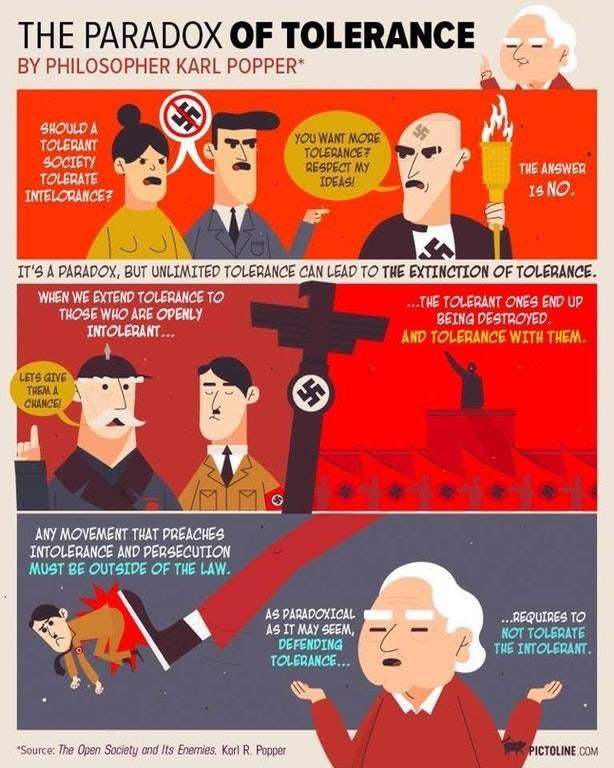
The lesson the punks and metalheads learn is: Ban the Nazis, and things just get better. Yes, it can feel intolerant. But that’s the Paradox of Tolerance:

I suspect most people vastly underestimate how much better America as a whole will get when our current crop of Nazis finally gives up and goes away.

Given the dominant anti-social ethos of white nationalism in America, Noah Smith’s suggestion is not absurd. I don’t agree with it either because I like free speech, but I recognize it is economical for most people to automatically dismiss anyone associated with white nationalism due to the poor quality of the people in America who espouse white nationalism (e.g., the large numbers of criminals, deviants, fantasists and under-achievers in the movement). Just as many people are extreme left for psychological and social reasons, surely many people are extreme right for psychological and social reasons? White nationalism, antifa and BLM probably give many people an opportunity to burn and destroy and the ideological reasons for this behavior are not important to most participants. They just want release from moral norms.

If you spend hours posting/reading 4chan/pol, you’re probably anti-social.

Similarly, normies probably have rational reasons for wanting to avoid association with anybody in the porn industry, even though that might limit connection with some interesting people. For normies, that which is so different as to be socially unacceptable is disturbing.

Will Wilkinson writes:

Journalism isn’t science. It’s often more like low-grade war with hostile subjects. People who are newsworthy often wish that they weren’t and are often straight-up antagonistic. If you’re a reporter, they will respond as if you personally have it out for them (very unlikely) and are an enemy of their interests (often true, because people often don’t want others to know the truth about them). They will lie to you. They will recruit people you’re less likely to suspect of lying to you to lie to you. They may try to intimidate you and your family — or wink and look the other way when their allies do. They may refuse to give their real name, even if you already found it. They may even hurt themselves to hurt your story if they really, really, really don’t want it written.

Reporting is a hard job devoted in large measure to ferreting out truths that the subjects of the story you are writing are actively trying to conceal. I think it’s important to emphasize that there is simply no sense — none! — in which people who like to talk about epistemology on the Internet are more committed to objectivity and truth than experienced reporters who, in the service of truth, navigate mazes of lies, gaslighting, spin, bullshit and threats for a living.

That Scott Siskind’s name is Scott Siskind is a fact relevant to a story about him, period. That’s why it seems insanely paranoid to journalists like Lewis-Kraus to infer that Cade Metz, or the New York Times itself, in all its abstract corporate majesty, must harbor some vendetta because they think it makes sense to use your name in a story about you.

…He’s come to see that nobody at the Times was animated by ill will or had undertaken some nefarious ideological mission. It was just a guy doing his job all along. So, when Scott utterly lost his shit, it wasn’t because Metz or the Times had done anything that reasonable person would anticipate leading to such an operatic response. Siskind seems to see that now. He gets that he’s responsible for his reaction to his perception of the consequences that might have been brought about by his loss of anonymity. Neither Metz nor the Times sought to bring them about. The critical, volatile variable in the whole episode is the surprising ferocity of his attachment to anonymity, and he knows it…

Siskind sees that’s it’s definitely reasonable to see him as an entitled jerk, but he’s not actually admitting that he is. On the contrary, he ends up arguing (in typically illuminating and entertaining terms!) that, sure, he was irrational … but! There’s a higher rationality to acting so crazy that folks you feel so antagonized by decide to back away and just leave the rabid dog alone. As he goes on, Siskind continues to tendentiously characterize reporting true, publicly available facts about people, such as their names, with “doxxing,” the exposure of identifying information with malicious intent to cause harm.

I think he does this, despite having conceded that there was no malicious intent in his case, because he thinks it’s nevertheless seriously wrong to communicate certain facts about a person if they’d rather they stay under their hat. More than that, Siskind suggests that people should not be allowed to freely communicate those facts without express permission — even if others have good reason to want to know. He seems to me to be saying that our interest in the privacy and impunity of anonymity generally outweigh our interest in freely speaking and receiving information about identity without the subject’s consent.

…A bunch of people in the community, Scott included, really are interested in neoreactionary thinking. In a recently leaked email exchange, Siskind admits to finding a lot worthwhile in it and confesses that he’s hard on neo-reactionaries in public in part to throw people off the scent. Curtis Yarvin/Mencius Moldbug really is a familiar and known quantity who does hang around the community, even if he’s not a central figure. Peter Thiel gives him money…

I want to urge Siskind’s irked supporters to consider that when Metz brings up Charles Murray, Voldemort feminists, unusually collegial engagement with neo-reactionary thought, and speculation about tech being male-heavy because women for some reason just get bored by numbers and gadgets, it’s not because he’s writing a hit job — it’s because these are the kinds of things Siskind was terrified his employer and patients would connect to him. Huh? Why would you aim directly at the realization of Siskind’s fears if not out of spite and malice? Well, the most interesting things about Slate Star Codex, from an outside perspective, are (1) that it’s influential in Silicon Valley, and its enthusiastic fans include incredibly rich and powerful people whose technologies and businesses affect all our lives; (2) one day Siskind burnt it all down and summoned a vengeful horde to attack an innocent reporter and assail America’s best newspaper.

Now, the rules of America’s best newspaper don’t allow for speculation about motives and Siskind wasn’t talking. But the rules definitely allow for laying out facts and letting readers draw their own conclusions. Well, all the allegedly “negative” stuff on SSC is illustrative of why Siskind might panic and spike his blog. That powerful and influential men like Thiel and Balaji, who infamously harbor vitriolic hatred for snooping journalists, number among Siskind’s fans is very interesting given how Siskind weaponized his rationalist readership to protect the anonymity that protects his reputation — especially since Siskind himself tells us that Balaji was advising him on how to fuck over journalists. Creating a mob of rationalists may seem a bit puzzling. Why would such smart people be so willing to enlist in a mercenary army fighting for the greater glory of Scott Siskind’s psychiatric practice? Well, if you see it in the light of the Siskind’s relentless promotion of the idea that the marketplace of ideas will end up abandoned and shuttered unless we come to treat anonymity as a basic right, it starts to make sense.

Posted in Internet | Comments Off on The Slate Star Codex Blog & Its New York Time Profile