Race & Morality

Jonathan Haidt writes:
Nationalists see patriotism as a virtue; they think their country and its culture are unique and worth preserving. This is a real moral commitment, not a pose to cover up racist bigotry. Some nationalists do believe that their country is better than all others, and some nationalisms are plainly illiberal and overtly racist. But as many defenders of patriotism have pointed out, you love your spouse because she or he is yours, not because you think your spouse is superior to all others. Nationalists feel a bond with their country, and they believe that this bond imposes moral obligations both ways: Citizens have a duty to love and serve their country, and governments are duty bound to protect their own people. Governments should place their citizens interests above the interests of people in other countries.
There is nothing necessarily racist or base about this arrangement or social contract. Having a shared sense of identity, norms, and history generally promotes trust. Having no such shared sense leads to the condition that the sociologist Émile Durkheim described as “anomie” or normlessness. Societies with high trust, or high social capital, produce many beneficial outcomes for their citizens: lower crime rates, lower transaction costs for businesses, higher levels of prosperity, and a propensity toward generosity, among others…
On closer inspection, racism usually turns out to be deeply bound up with moral concerns. (I use the term “moral” here in a purely descriptive sense to mean concerns that seem—for the people we are discussing—to be matters of good and evil; I am not saying that racism is in fact morally good or morally correct.) People don’t hate others just because they have darker skin or differently shaped noses; they hate people whom they perceive as having values that are incompatible with their own, or who (they believe) engage in behaviors they find abhorrent, or whom they perceive to be a threat to something they hold dear. These moral concerns may be out of touch with reality, and they are routinely amplified by demagogues. But if we want to understand the recent rise of right-wing populist movements, then “racism” can’t be the stopping point; it must be the beginning of the inquiry.
Among the most important guides in this inquiry is the political scientist Karen Stenner. In 2005 Stenner published a book called The Authoritarian Dynamic, an academic work full of graphs, descriptions of regression analyses, and discussions of scholarly disputes over the nature of authoritarianism. (It therefore has not had a wide readership.) Her core finding is that authoritarianism is not a stable personality trait. It is rather a psychological predisposition to become intolerant when the person perceives a certain kind of threat. It’s as though some people have a button on their foreheads, and when the button is pushed, they suddenly become intensely focused on defending their in-group, kicking out foreigners and non-conformists, and stamping out dissent within the group. At those times they are more attracted to strongmen and the use of force. At other times, when they perceive no such threat, they are not unusually intolerant. So the key is to understand what pushes that button.
The answer, Stenner suggests, is what she calls “normative threat,” which basically means a threat to the integrity of the moral order (as they perceive it). It is the perception that “we” are coming apart:
The experience or perception of disobedience to group authorities or authorities unworthy of respect, nonconformity to group norms or norms proving questionable, lack of consensus in group values and beliefs and, in general, diversity and freedom ‘run amok’ should activate the predisposition and increase the manifestation of these characteristic attitudes and behaviors.

“So authoritarians are not being selfish. They are not trying to protect their wallets or even their families. They are trying to protect their group or society. Some authoritarians see their race or bloodline as the thing to be protected, and these people make up the deeply racist subset of right-wing populist movements, including the fringe that is sometimes attracted to neo-Nazism. They would not even accept immigrants who fully assimilated to the culture. But more typically, in modern Europe and America, it is the nation and its culture that nationalists want to preserve.”

Stenner identifies authoritarians in her many studies by the degree to which they endorse a few items about the most important values children should learn at home, for example, “obedience” (vs. “independence” and “tolerance and respect for other people”). She then describes a series of studies she did using a variety of methods and cross-national datasets. In one set of experiments she asked Americans to read fabricated news stories about how their nation is changing. When they read that Americans are changing in ways that make them more similar to each other, authoritarians were no more racist and intolerant than others. But when Stenner gave them a news story suggesting that Americans are becoming more morally diverse, the button got pushed, the “authoritarian dynamic” kicked in, and they became more racist and intolerant. For example, “maintaining order in the nation” became a higher national priority while “protecting freedom of speech” became a lower priority. They became more critical of homosexuality, abortion, and divorce.
One of Stenner’s most helpful contributions is her finding that authoritarians are psychologically distinct from “status quo conservatives” who are the more prototypical conservatives—cautious about radical change. Status quo conservatives compose the long and distinguished lineage from Edmund Burke’s prescient reflections and fears about the early years of the French revolution through William F. Buckley’s statement that his conservative magazine National Review would “stand athwart history yelling ‘Stop!’”
Status quo conservatives are not natural allies of authoritarians, who often favor radical change and are willing to take big risks to implement untested policies. This is why so many Republicans—and nearly all conservative intellectuals—oppose Donald Trump; he is simply not a conservative by the test of temperament or values. But status quo conservatives can be drawn into alliance with authoritarians when they perceive that progressives have subverted the country’s traditions and identity so badly that dramatic political actions (such as Brexit, or banning Muslim immigration to the United States) are seen as the only remaining way of yelling “Stop!” Brexit can seem less radical than the prospect of absorption into the “ever closer union” of the EU.
So now we can see why immigration—particularly the recent surge in Muslim immigration from Syria—has caused such powerfully polarized reactions in so many European countries, and even in the United States where the number of Muslim immigrants is low. Muslim Middle Eastern immigrants are seen by nationalists as posing a far greater threat of terrorism than are immigrants from any other region or religion. But Stenner invites us to look past the security threat and examine the normative threat. Islam asks adherents to live in ways that can make assimilation into secular egalitarian Western societies more difficult compared to other groups. (The same can be said for Orthodox Jews, and Stenner’s authoritarian dynamic can help explain why we are seeing a resurgence of right-wing anti-Semitism in the United States.) Muslims don’t just observe different customs in their private lives; they often request and receive accommodations in law and policy from their host countries, particularly in matters related to gender. Some of the most pitched battles of recent decades in France and other European countries have been fought over the veiling and covering of women, and the related need for privacy and gender segregation. For example, some public swimming pools in Sweden now offer times of day when only women are allowed to swim. This runs contrary to strong Swedish values regarding gender equality and non-differentiation.
So whether you are a status quo conservative concerned about rapid change or an authoritarian who is hypersensitive to normative threat, high levels of Muslim immigration into your Western nation are likely to threaten your core moral concerns. But as soon as you speak up to voice those concerns, globalists will scorn you as a racist and a rube. When the globalists—even those who run the center-right parties in your country—come down on you like that, where can you turn? The answer, increasingly, is to the far right-wing nationalist parties in Europe, and to Donald Trump, who just engineered a hostile takeover of the Republican Party in America.
The Authoritarian Dynamic was published in 2005 and the word “Muslim” occurs just six times (in contrast to 100 appearances of the word “black”). But Stenner’s book offers a kind of Rosetta stone for interpreting the rise of right-wing populism and its focus on Muslims in 2016. Stenner notes that her theory “explains the kind of intolerance that seems to ‘come out of nowhere,’ that can spring up in tolerant and intolerant cultures alike, producing sudden changes in behavior that cannot be accounted for by slowly changing cultural traditions.”
She contrasts her theory with those who see an unstoppable tide of history moving away from traditions and “toward greater respect for individual freedom and difference,” and who expect people to continue evolving “into more perfect liberal democratic citizens.“ She does not say which theorists she has in mind, but Welzel and his World Values Survey collaborators, as well as Francis Fukuyama’s “end of history” thesis, seem to be likely candidates. Stenner does not share the optimism of those theorists about the future of Western liberal democracies. She acknowledges the general trends toward tolerance, but she predicts that these very trends create conditions that hyper-activate authoritarians and produce a powerful backlash. She offered this prophecy:
“[T]he increasing license allowed by those evolving cultures generates the very conditions guaranteed to goad latent authoritarians to sudden and intense, perhaps violent, and almost certainly unexpected, expressions of intolerance. Likewise, then, if intolerance is more a product of individual psychology than of cultural norms…we get a different vision of the future, and a different understanding of whose problem this is and will be, than if intolerance is an almost accidental by-product of simple attachment to tradition. The kind of intolerance that springs from aberrant individual psychology, rather than the disinterested absorption of pervasive cultural norms, is bound to be more passionate and irrational, less predictable, less amenable to persuasion, and more aggravated than educated by the cultural promotion of tolerance [emphasis added].”

Writing in 2004, Stenner predicted that “intolerance is not a thing of the past, it is very much a thing of the future.”

…Stenner ends The Authoritarian Dynamic with some specific and constructive advice:

“[A]ll the available evidence indicates that exposure to difference, talking about difference, and applauding difference—the hallmarks of liberal democracy—are the surest ways to aggravate those who are innately intolerant, and to guarantee the increased expression of their predispositions in manifestly intolerant attitudes and behaviors. Paradoxically, then, it would seem that we can best limit intolerance of difference by parading, talking about, and applauding our sameness…. Ultimately, nothing inspires greater tolerance from the intolerant than an abundance of common and unifying beliefs, practices, rituals, institutions, and processes. And regrettably, nothing is more certain to provoke increased expression of their latent predispositions than the likes of “multicultural education,” bilingual policies, and nonassimilation.”

If Stenner is correct, then her work has profound implications, not just for America, which was the focus of her book, but perhaps even more so for Europe. Donald Tusk, the current president of the European Council, recently gave a speech to a conclave of center-right Christian Democratic leaders (who, as members of the educated elite, are still generally globalists). Painfully aware of the new authoritarian supremacy in his native Poland, he chastised himself and his colleagues for pushing a “utopia of Europe without nation-states.” This, he said, has caused the recent Euroskeptic backlash: “Obsessed with the idea of instant and total integration, we failed to notice that ordinary people, the citizens of Europe, do not share our Euro-enthusiasm.”

BRETT STEVENS BLOGS:

Nationalism on the other hand is common sense based in knowledge of nature: each species produces results based in how it behaves. If you have a group of dogs, you get dog-society; if you have pigeons, you get a different society than if you have hawks. With humans, this varies between groups.

This leads to realizations of this nature — that America was not the result of its laws, but of its founding Western European stock:

“The civilization that we as whites created in Europe and America could not have developed apart from the genetic endowments of the creating people, nor is there any reason to believe that the civilization can be successfully transmitted to a different people. “

Most people who are coming to Nationalism are not doing so through political means, but through cultural values and day-to-day revelations. In particular, they are seeing what a country run by the Other looks like, and whether we can “objectively” claim it is similar or “equal” to the old way, the fact is that it is not compatible with what we the majority need.

Throughout history, diversity has failed for this reason: with many groups occupying the same space, no group gets to choose a values system, and so the society is torn apart by internal conflict over individual values because it cannot select a values system as a whole. We are in that process right now.


Posted in Nationalism | Comments Off on Race & Morality

The Birth Of The Alt-Right

Neo-reaction thinker Henry Dampier says:

The Alternative Right really derives from Richard Spencer and his organization. I’ve become a bigger believer in the impact of individuals, so I’m going to focus on the individual there. Spencer wanted to come up with a new brand of right-wing thought that was more connected to the European zeitgeist. I imagine that he had been disheartened by what had happened to the American Conservative, which began as Pat Buchanan’s organ to float an alternative to George W. Bush’s compassionate invade-the-world invite-the-world conservativism.

Spencer attempted to abandon the Alternative Right term when he renamed his website to Radix and redirected his domain. Then, it took a life of its own. He seemed to want to promote a term, ‘identitarianism,’ that has never really caught on all that well. Identitarianism is a higher brow white nationalism that tries to shun Cletus the stereotypical ex-con white nationalist without overtly shunning Cletus and telling them that he is not wanted at the party…

So you get a few types of people who write for this kind of fringe audience:

Bright and interesting writers who contribute fascinating work until they burn out and move on to other projects, like Moldbug.

Attention whores who will do anything for a ‘fav’

People who try really, really, really hard to make it a full time job when the audience won’t support it, which makes everything they do seem cloying and grasping as they lurch from personal disaster to disaster. “Please like and subscribe!”

A small number of professionals like Vox Day who, through superhuman work ethic, actually make it work

Posted in Alt Right, Dark Enlightenment | Comments Off on The Birth Of The Alt-Right

The Genius Famine by Edward Dutton and Bruce G. Charlton

Link:

In other words, until about 1800 only the minority of people with (on average) the ‘best genes’ (i.e. the lowest mutation load) would be able to survive and reproduce; and among the great majority of the population only a very small proportion of their offspring (averaging much less than two, probably less than one, per woman) would survive to a healthy adulthood, reproduce and raise children of their own. In this context, which was for almost all of human history until about two hundred years ago; both new and inherited deleterious mutations were filtered-out, or purged, from the population every generation by this very harsh form of natural selection. (39)

In a society of declining intelligence, we would expect: rising crime and corruption; decreasing civic participation and lower voter turn-out; higher rates of illegitimacy; poorer health and greater obesity, an increased interest in the instinctive, especially sex; greater political instability and decline in democracy; higher levels of social conflict; higher levels of selfishness and so a decline in any welfare state; a growing unemployable underclass; falling educational standards; and a lack of intellectualism and thus decreasing interest in education as a good in itself. We would also expect more and more little things to go wrong that we didn’t used to notice: buses running out of petrol, trains delayed, aeroplanes landing badly, roads not being repaired, people arriving late and thinking it’s perfectly okay; several large and lots of little lies . . . (185)

Indeed modern institutions are not even trying to select primarily by intelligence – the reality of which they often deny; but instead are implicitly – by the nature of their evaluations – and also by explicitly-stated policies – selecting on other grounds, especially for the ‘Head Girl’ personality – the conscientious, empathic, socially integrated all-rounders. Modern society is, of course, run by Head Girls, of both sexes (plus a smattering of charming or charismatic psychopaths), hence there is no assigned place for the creative genius. Modern colleges aim at recruiting Head Girls, so do universities, so does science, so do the arts, so does the mass media, so does the legal profession, so does medicine, so does the military. And in doing so, except insofar as they make errors; they filter-out and exclude even the possibility of creative genius. (189)

Posted in Ed Dutton, Eugenics, IQ | Comments Off on The Genius Famine by Edward Dutton and Bruce G. Charlton

Congressman who once feared Guam could capsize compares Jewish settlers to ‘termites’

FoxNews:

A Democratic member of the House Armed Services Committee compared Jewish Israeli settlers to termites on Monday while speaking at an event sponsored by an anti-Israel organization that supports boycotts of the Jewish state.

Rep. Hank Johnson, D- Ga., launched into a tirade against Israel and its policies toward the Palestinians, comparing Jewish people who live in disputed territories to “termites” that destroy homes. Johnson also compared Israeli Defense Minister Avigdor Lieberman to Republican presidential candidate Donald Trump, a remark that drew vocal agreement from those in the room.

“There has been a steady [stream], almost like termites can get into a residence and eat before you know that you’ve been eaten up and you fall in on yourself, there has been settlement activity that has marched forward with impunity and at an ever increasing rate to the point where it has become alarming,” Johnson said during an event sponsored by the U.S. Campaign to End the Israeli Occupation, an anti-Israel organization that galvanizes supporters of the Boycott, Divestment, and Sanctions movement, or BDS.

Johnson, who in 2010 voiced his fears that Guam would tip over and capsize if too many people resided on the island, said that “Jewish people” routinely steal land and property from Palestinians.

Donald Templer writes:

The present research found that the Muslim country mean IQ of 81 is half a standard deviation below the mean IQ of non-Muslim nations and is not related to strength of Muslim culture as defined by the percentage of Muslims in the country. The mean IQ of 84 in Arab countries is not associated with per capita income and is incompatible with the intellectual achievements of the golden age of the Muslim Empire. Possible explanations for this decline include hybridization with sub-Saharan Africans, dysgenic decrease in the more educated Muslims employing birth control as suggested by Meisenberg, the Muslim religion not fostering critical thinking, and the intellectual contributions being both exaggerated and made by non-Muslims.

1. Introduction

The purpose of the present study was to compare the mean IQs of Muslim and non-Muslim countries. The great intellectual achievements of the Muslim Empire from the 7th to the 12th century have been written about by numerous authors (e.g., Bloom & Blair, 2000; Lyons, 2009; Masood, 2009). These achievements have been especially noted in science, mathematics, architecture and medicine. However, the contemporary Muslim world is underrepresentated in highly creative contributions published in prestigious scientific journals. Lynn (1991) presented the total number of Nobel Prizes in science, literature, and economics combined with the Fields award in mathematics as a function of five major categories of ethnic origin. Europeans had a total of 541, North East Asians 23, South Asians and North Africans combined 10, Africans one (in literature), and Southeast Asians none. It is apparent that the predominantly Muslim countries are in the bottom three categories. Such a dearth of superlative scholarly achievement is consistent with the Lynn & Vanhanen (2006) Table 6.5 listing of mean IQs of the world’s countries. Indonesia, the most populous Muslim country, has a mean IQ of 87. If the standard deviation in Indonesia is 15, two standard deviations above the mean is only 117, which probably is not a high enough IQ to obtain a Ph.D. in physics from prestigious universities in high mean IQ countries. Even if mean IQ differences between two countries are modest, the disparity of extremely gifted persons can be huge.

The IQs of the Muslim populations in non-Muslim countries tend to be lower than those of the majority population (Lynn, 2008a). In the Netherlands, the mean IQ of Turks is 83, of Moroccans 81, and Indonesians 94 (Lynn, 2008a). Mackintosh (2007) reported that in the United Kingdom Pakistanis score 4 to 6 IQ points below the Indians. It is unlikely that this can be attributed entirely to minority status. The Chinese are a minority in many countries of the world and yet obtain higher mean IQs than the majority populations. They generate and/or control over half the wealth in Southeast Asian countries. In Indonesia the Chinese constitute 3.8 % of the population and generate/control 73% of the wealth. In Malaysia they constitute 28% of the population and generate/control 69% of the wealth (Lynn, 2008a). Caution should be employed because of the possibility of selective migration.

Special attention is given here to the Arab countries for two reasons. One is to examine the role of the great variation in per capita income. At the high end are Kuwait with $25,314, Qatar with $20,987, and the United Arab Emirates with $20,585. At the low end areYemen with $2,588 and Syria with $2,892. The second reason is to raise for consideration an incongruity between the achievements of the past and the state of the present. The Muslim Empire began in the Arabian Peninsula and the Arabs played a dominant role in its expansion and rise to greatness. Islam did not become established until the 15th century in Indonesia and in what is now Pakistan. The 16 countries regarded as Arab are Algeria, Bahrain, Egypt, Iraq, Jordan, Kuwait, Lebanon, Libya, Morocco, Oman, Qatar, Saudi Arabia, Syria, Tunisia, United Arab Emirates and Yemen.

Posted in Arabs, Blacks, Israel | Comments Off on Congressman who once feared Guam could capsize compares Jewish settlers to ‘termites’

Ellen Alperstein: Why Don’t You Get It?

Ellen Alperstein writes:

If they can get past Rupert Murdoch’s lovely parting gift of $40 million, a lot of people will revel in the denouement of Roger Ailes’ Fox News career. But just because the hens at Fox might be safer from some predators, it’s a limited victory. Sexual harassment remains a seemingly intractable problem in the U.S. workplace because a lot of fully civilized people don’t know what it is….

Until I told him, he hadn’t heard that Fox had dumped Ailes after investigating harassment allegations by Gretchen Carlson and apparently finding that she wasn’t singing solo. Alluding to the generally blond, youthful good looks of the women he supposedly harassed, my friend commented, “Why would he ever think women like that would be attracted to him?”

I was stunned. How could someone so smart be so ignorant? Was his disconnect just a momentary departure from humanity? Could someone I know so well be a misogynist?

Nah. Some white people just don’t get that virtually all black people, at some time in their lives, have been treated differently just because they aren’t white and, more important, that even if that unfairness was unconscious, it’s still racist. Reflexive treatment based on someone’s immutable traits is insidious, and it won’t stop until empathy is a default response to human pain.

Trying to follow Ellen Alperstein’s argument means makes my head hurt, but as for her anti-discrimination point — do you approach pitbulls the same way you approach cockerspaniels? Do approach dobermans the same way you approach pomeranians?

Pomeranian-1

download

Human breeds are different just as dog breeds are different. I suspect that Ellen Alperstein is more concerned about her personal safety in black and latino parts of town as compared to the white areas of Beverly Hills and Bel Air.

small-fluffy-dog-breeds

download (1)

Posted in Race | Comments Off on Ellen Alperstein: Why Don’t You Get It?

Blacks & Crime

People with high IQs commit fewer crimes than people with low IQs. They have more empathy (which depends on the ability for abstract thought to put yourself in the place of others) and they see the future more clearly.

Joe Domanick wrote two books about the LAPD: “To Protect and to Serve” and “Blue: The LAPD and the Battle to Redeem American Policing.”

Rob Eshman of the Jewish Journal conducts the following interview:

Rob Eshman: What was your reaction as the events of last week unfolded?
Joe Domanick: I wasn’t at all surprised about either one of the two killings by the officers, because [each is] just one of the string of shootings that have come to public attention, really, ever since Ferguson [Mo.], because of cameras and other technologies.
And then when the five officers were killed in Dallas, that made me very anxious because, No. 1, we had a chief of police in Dallas who was really doing all of the right things to alleviate these kinds of situations.
RE: You’ve said there were 900 officer-involved shootings that led to fatalities in 2015, and 2016 is on track to have even more. Why? Iceland has one in 71 years. Germany has six.
JD: An even better comparison is Canada, which per capita has more guns than the United States, but has very few shootings.
I just think that America is a very, very violent country. It was born in violence. It started with genocide. Then it followed up with the most brutal, dehumanizing kind of slavery, which was enforced strictly through brutality. Then you had the Fugitive Slave Law in 1850, when it really became the job of the police to closely monitor African-Americans, and that became a tradition. And the whole country, of course, was racist — it wasn’t just the South.
So I think that this is a very violent country. We worship violence. We see it everywhere in our advertisements. It’s hard for me to think of a movie star, man or woman, who I haven’t seen on a billboard off Sunset Boulevard holding a gun, holding a .45, wearing a police badge. So I think that we worship violence, we do, and I think that’s a big part of it.
RE: You really can draw a direct connection from the Fugitive Slave Law to what’s going on now in these communities?
JD: You had decades of people living in very violent communities, and the violence becoming almost a norm. And the African-American people that could get out of the ghettos got out, but what you had left was a kind of social pathology that imploded. That’s what’s made our ghettos so dangerous. We refuse as a society to do anything about it, to take the steps to alleviate, to change the values in that subculture.

Posted in Africa, Blacks, BLM, Crime, Police | Comments Off on Blacks & Crime

Liberalism and Group Identity

A Jew can be a leftist, but leftism does not mesh easily with Judaism. Leftism does not accept race and religion as valid ways of organizing people. The essence of Judaism is separation — separation between Jews and non-Jews, between men and women, adults and children, the Sabbath and the other days of the week, etc.

The Hebrew word for holiness — “Kadosh” — literally means “separate.” Judaism conceives of Jews as a people who dwell apart.

If you are a normal Orthodox Jew, you put your Jewish identity first before all other identities. You see what is going on in the world in terms of whether or not it is good for the Jews. One of the major advantages in being an Orthodox Jew is that you know who you are. Your choices in life are simplified.

The stronger your in-group identity, be it as Jewish or black or Muslim, the less likely you are to be liberal (to live and let live and to be ok with diversity) and the more likely you are to have negative views of outsiders.

Shmuel Rosner writes:

The more liberal they are, the less their tendency to be actively “Jewish.” The level of liberalism is high among those who raise non-Jewish children “or who are married to non-Jews.” Liberal Jews feel less responsible for other Jews. They have a somewhat lesser sense of belonging to the Jewish people. Only a third of the “very liberal” (34%) feel that “being Jewish is very important” – compared to 54% of “right of center” non-Orthodox Jews. The “very liberal” don’t belong to synagogues (18%), have less Jewish friends, and tend less than others to fast on Yom Kippur or light Shabbat candles. Their attachment to Israel is markedly lower than the attachment of less liberal Jews.
That is to say: all across the board – feelings, activities, traditions, and affiliations – the liberals show a lesser level of engagement. The correlation between liberalism and disengagement is “modest” when it comes to “feelings” (Feel responsible for Jews in need, Feel a sense of belonging to the Jewish people, Feel being Jewish is very important). It is “strong” when it comes to “religious engagement” (Being religious very important, Kosher home, Shabbat candles usually+, Attends services monthly). It is also “strong” when it comes to “Israel attachment” (Israel essential to being Jewish, Feel very attached to Israel). In other words: liberal Jews feel moderately passionate about being Jewish; but they do not appreciate religion and do not appreciate Israel, and they especially do not appreciate hawkish views on Israel…

Why is it so difficult to seriously discusses these numbers and this reality? That’s simple: because often times liberal Jews tend to value their “liberalism” more than they value their “Jewishness” (this is me speaking, not Cohen. I am not sure he’d agree). If the numbers tell a story from which one learns that liberalism and Judaism cannot go hand in hand, the liberals will choose liberalism. So the obvious policy of Jewish leaders and institutions is to avoid this seeming contradiction – to hide it for as long as possible and thus not force the choice on a growing group of Jewish liberals…

These numbers have meaning. They have implications, and these implications could be of three possible types:
– Judaism and liberalism cannot go hand in hand, and we ought to understand that some Jewish Americans are lost to us, Jews.
– There is a need to make Jews slightly less liberal – at least when it comes to the kind of liberalism that seems to make it difficult for them to be actively Jewish.
– There is a need to make Jewish Americanism more adaptable to the priorities of liberal Americanism.
In all likelihood, to succeed in an enterprise whose aim is to strengthen the active Jewishness of American Jewish liberals, it will have to be a combination of both points two and three (that is, if you do not accept point one). But the exact prescription will not be easy, as the numbers – while telling us a story – do not reveal its source. As Cohen framed it: “What about being liberal makes them ‘less Jewish?’”
In other words: as hard as it is to spell it out with such bluntness, as a general rule, liberal American Jews seem to be less Jewish.

Posted in Jews | Comments Off on Liberalism and Group Identity

‘Fear Fades With Repetition’

In talk 50 of the Beginners Talks at Underearners Anonymous, the founder of the program, Andrew says:

* Underearning is a disease of hiding. In terms of visibility, fear fades with prayer. Fear fades with action. Fear fades with repetition.

* For many years, I went through attempts to have a better life. At age 16, I had my first go round with magical thinking. I was thinking about being a photographer, a professional guitarist, and I couldn’t commit to preparing myself. I couldn’t commit to doing the work. Success and failure have one word in common — process.

* I had no idea how sick I was. I had no idea how much of an addict I was. Most people I know in recovery are multiply-addicted people. Three or four fellowships is the norm.

* I remember going to a Broadway play and I said to the guitar player and said, ‘I would like to sub for you.’ Who would go into a Broadway pit and say they would like to sub unless they could do it? But I couldn’t do it. I didn’t have the sanity to know what was required to do that. Why did I go? Because I was sick and I didn’t care. One of the things about underearners is that we don’t really care about serving the community. We don’t equip ourselves to want to do a good job. Why? Because we’re sick. I just wanted to be in the cave. This is a disease of experiential isolation, where I choose to hide in a substandard life because I am under the illusion that I am being safe.

For many years, I would go from one vision to another. Whether it was studying guitar or studying acting or writing or comedy, I didn’t know that I was under the bondage of self. This manifested itself a total cutoff of energy for anything my soul wanted to do.

The disease of underearning will not tolerate visibility, risk, criticism, praise.

I had a desire to do voiceovers. I got hired for my first voiceover and I looked in the control room and one of the guys was shaking his head, as they often do, and I couldn’t tolerate being visible. I got my first check and never did a voiceover again.

Over and over again for 20 years, the energy for the vision was cut off like electricity for a house. The energy goes and you don’t know why and you don’t care why because I was deep in this addiction.

I would always try to spin relatives. I would BS. But all I wanted to do was hide. The disease would always cut off the energy for my vision…and the visions I had were always blurry.

I was powerless over this cutoff of energy, just like an alcoholic is powerless over alcohol.

I learned to come up with excuses. All I wanted to do was go home and I didn’t know why I was terrified of visibility.

We have five character defects — fear, self-seeking, selfishness, inconsideration and dishonesty. We have three healthy instincts — social, sexual and survival. Those five defects will trample on those three instincts over and over again.

My character defects were part of my childhood. I could not control them but I was responsible for them.

I worked the 12 Steps. I was able to get the fog out of my head so that I was able to commit to time accountability with my action partner.

Posted in Addiction | Comments Off on ‘Fear Fades With Repetition’

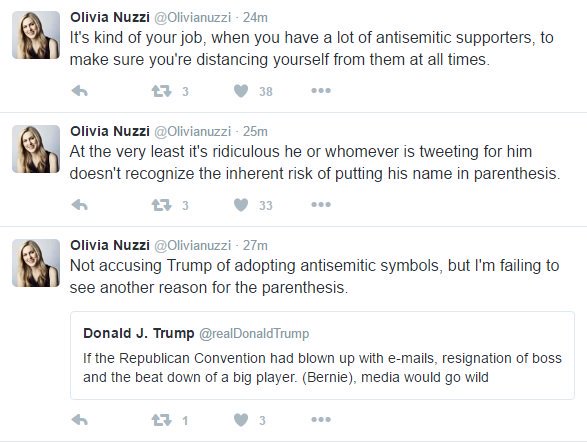
Please Be Careful Where You Put Your Parentheses

CoKr7waVYAA1H2o

Posted in Anti-Semitism | Comments Off on Please Be Careful Where You Put Your Parentheses

PHOTOS: DNC erects four-mile eight-foot tall fence around Philly convention site

Walls are not for little people. Only the elites get to protect themselves.

REPORT: To the Democratic National Committee elites, keeping average Americans away from their convention is a good idea, while protecting the southern border from intruding terrorists, rapists and murderers is a bad one.

The DNC has erected a four-mile fence around its convention site at Philadelphia’s Wells Fargo Center. (Isn’t it ironic they’re doing so much to protect a site named after a bank?)

The fence, which appears to be about 8 feet tall, is intended to keep out any individuals with whom Democratic Party leaders, delegates and other liberal elites would rather not mingle.

Fox 29’s Steve Keeley shared a picture of a portion of the fence he said was erected near the intersection of Pattison and Broad.

Here’s another shot from a CNN Headline News report:

Twitter user @brokencarpenter visited the DNC border wall and noted there was “acres and acres and acres of fence.”

Posted in America | Comments Off on PHOTOS: DNC erects four-mile eight-foot tall fence around Philly convention site