
When Criticism Helps

Comments at Steve Sailer:

* The internet is turning into a disaster for Jews. It is the ultimate dis-intermediary which is a big problem if your job is to get in between transactions. This is especially true if you control the media and depend on it to hide and punish your enemies. I am sure part of what is bothering Howard Lovey is that not only is Jeffrey Epstein’s exposure bad for his tribe’s image but it distracts of the more important mission of making the goys out to be Satan. We will resume our regularly scheduled programming tomorrow.

* “Personally, as somebody who has been criticized upon occasion, I find that criticism, while unpleasant, tends to make people better.”

What are some specific examples of criticisms directed to your race and ethnicity that you have personally found unpleasant, but that made you a better person?

I ask Steve, but I’d be curious for others’ examples too.

Personally, I cannot think of any.

* – NW Europeans approach geopolitics with universalism, wide-eyed enthusiasm and the ability to organize. This has caused a great deal of past suffering in the Americas and Africa, and most recently in the Middle East. Everyone would be better off if NW Europeans did not attempt to “rescue” cultures.

– NW Europeans put way too high of a priority on courting in their teens and early 20’s, in which input from parents and grandparents is ignored. This is likely baked-in culturally and genetically, considering Romeo & Juliet has always been considered a tragedy in western cannon, as opposed to a tragicomedy about two moronic kids.

– NW Europeans have a unique mix of intelligence, testosterone, and off-the-charts creativity. This has lead to major breakthroughs, but also a great number of atrocities.

* The lovely and talented actress Rachel Weisz said in 2001:

“RACHEL: Hollywood’s run by Jews. I was advised by an American agent when I was about 19 to change my surname. And I said “Why? Jews run Hollywood.” He said “Exactly.” He had a theory that all the executives think acting’s a job for shiksas. … In some way acting is prostitution, and Hollywood Jews don’t want their own women to participate. Also, there’s an element of Portnoy’s Complaint — they all fancy Aryan blondes.”

* It doesn’t piss me off that Jews run Hollywood, but it does piss me off that it can’t be spoken of, or the implications of it. Same with the national news media. Local media still does a pretty decent job. Or I guess, same with banking, and political donations.

Maybe if we were all allowed to say this stuff openly without fear of professional retribution (most people, middle class anyway, couldn’t care less about losing friends over this) it would make the country stronger. But, alas, it devolves into the old saw about paronoia.

* The Netanyahus, father and son, are playing up the Epstein scandal because he is connected to rival former PM Barak.

* We have a similar problem in the UK: the perception that Pakistani muslims rape a lot of English girls. But what the Pakistanis have to realise is that it doesn’t matter how many girls they rape because the prejudice against them is wholly irrational and has nothing to do with their behaviour.

* The problem with stereotypes (when you are a victim of them) is that while they may contain a nugget of truth in relation to certain members of your race they don’t necessarily apply to you and it feels very unfair to you when you are tarred with that brush. Maybe Italian-Americans are (or were – it seems like a fading phenomenon) members of organized crime families more often than other Americans, but most Italian-Americans aren’t. Maybe blacks mug taxi drivers at far higher rates than whites but if you are a black banker trying to get a cab in NYC it seems unfair that the cabs keep driving past you – YOU never mugged anyone. My grandfather was not an international banker as imagined by Henry Ford and Adolf Hitler, he was a poor fisherman.

One of the beauties of the American constitutional system (when it works) is that it is based upon notions of individual responsibility and not collective guilt. Race prejudice is based on collective guilt, which is why it is so “anti-American” and repulsive to all fair minded Americans (and not just Leftists).
Posted in Jews | Comments Off on When Criticism Helps

Reality Vs Propaganda

A friend in the academy: “The approach of giving straightforward arguments/evidence isn’t working. We just get steamrolled by emotional propaganda. I think it’s important for race realists to be focused on results–what is actually going to lead to positive change. Rational arguments have the potential to influence people (if not directly then indirectly), but we’re not presenting them in the right way. Or we’re making some kind of strategic error.”

Buddy:

When I think of examples of race realists winning debates, they seem to depend on ‘facts and logic.’ Big case would be kraut&tea vs JF and Alt-Hype. When I think of more successful race realists in terms of staying in the debate they seem to depend on ‘facts and logic’ approaches, William Shockley, JP Rushton, Charles Murray. Those who use emotional approaches seem to get crushed like pathetic bugs. Your Spencers, your Enochs. People LOVE technobabble explanations for things. That’s why KMac is popular for instance. His idea is complete nonsense but sounds technical. So people think ‘whoa, deep’.’Ozone hole’ rhetoric gets regulation. ‘Silent spring’ rhetoric gets legislation passed. ‘Global warming’. These are all very technical ideas, not something broad and emotional like the sierra clubs environmentalism. ‘Peak oil’. I don’t see a lot of race realists running around giving straightforward arguments and evidence, and those that do seem to be moderately successful – those I mentioned before, Cochran, Emil Kirkegaard – they aren’t doing anywhere close to as terribly as the alt-right. The race realists who give good arguments don’t tend to be political zealots, not coincidentally. Political zealots make terrible scientists. I think political fervor needs to be combined with race realism in a healthy way, which means race realism can’t and shouldn’t be the main focus. The HBD umbrella should be the focus – individuals are different, genders are different, races are different, classes are different, age groups are different, every individual and group is meaningfully different – so politics that depends on a blank slate can’t work. I think this lends itself fundamentally to conservative and libertarian ideology – assume people are where they are for good reason.

Friend: “I’m not sure I agree with this. Shockely and Rushton were/are written off by the mainstream as Nazi cranks. Charles Murray has been successful in a sense, but only because he is very wishy washy about race realism. In TBC there’s only a vague statement about how genes probably make a contribution to black-white IQ differences, and when it matters Murray often denies even this. (There’s the notorious incident on the Stephen Colbert show where Colbert asked Murray if he said that genes play a role in IQ differences and Murray responded, “I never said that.”) Murray would never make a serious effort to think through the *political* implications of race differences, or at least he wouldn’t comment on this publicly. Emil Kirkegaard is so toxic in mainstream academia that even being associated with him can sink your career.”

Jones Very: “Why won’t the racial underclasses recognize their low station? — are we, the privileged & enlightened Sino-Jewish overcaste selling it wrong?”

“How can we explain to the masses that the status quo is actually good and that the Jewish-Asian global elite class that rules over them is necessary and just in a way that they’ll agree and submit to a yoke of slavery?”

Friend: “Watching now. I agree with KMG that deplatforming conservatives might might hurt Trump’s reelection. I’m not sure this matters in the long run, since Trump’s actual policies (e.g., de facto open borders) are difficult to distinguish from the democrats’. I still don’t think it will do much to suppress the ideas/ideologies the censors are targeting. There are different ideas about what it means for deplatforming to “work” or not.”

Posted in HBD | Comments Off on Reality Vs Propaganda

Deplatforming Won’t Work

Nathan Cofnas writes for Quillette:

Last year Robert Bowers shot up a synagogue in Pittsburgh, killing eleven people. Before committing this atrocity he wrote on Gab: “HIAS [Hebrew Immigrant Aid Society] likes to bring invaders in that kill our people. I can’t sit by and watch my people get slaughtered. Screw your optics, I’m going in.”

Gab is a Twitter alternative used by many neo-Nazis and alt-righters who have been (or know they would be) banned from actual Twitter. The unintended—but entirely predictable—consequence of throwing extremists off Twitter has been to create a large community of exiles on Gab. In Gabland, it is people who question Jewish conspiracy theories or the idea that the US should be a white ethnostate who are considered “trolls.” A similar community is developing on the YouTube alternative BitChute, whose Alexa ranking is rising quickly.

Bowers’s threat of imminent violence (“Screw your optics, I’m going in”) didn’t alarm any of his fellow extremists on Gab. What if he had written the same thing on Twitter? Someone would have been much more likely to contact the police. Perhaps at that point there wouldn’t have been enough time to stop him anyway. But if he had been on Twitter, it’s possible that someone would have reported him to the police long before the shooting for some ominous statements he had made in the past. In any case, relegating Bowers to a non-mainstream platform didn’t stop him from committing the deadliest attack on Jews in US history.

In the last few weeks, the leading social media companies have doubled down on their strategy of deplatforming people and censoring content. Alt-right accounts are disappearing from Twitter, videos on controversial topics are being deleted from YouTube, and even some politically moderate YouTube streamers/content creators who didn’t violate the terms of service are being demonetized in an effort to drive them away. But deplatforming won’t work.

This claim needs clarification. Whether something “works” or not depends on what you’re trying to accomplish. If Twitter/YouTube/Facebook want to virtue signal by showing that they oppose controversial views (which could well be their true aim), then deplatforming controversial people will work. What I mean is that it won’t accomplish the noble goals that these companies say is motiving them: to prevent violence and the spread of socially destructive misinformation. If these are their goals then deplatforming will backfire—and already has backfired.

Advocates of deplatforming tend to think only one step ahead: Throw people with opinions you don’t like off mainstream social media and you won’t see them again—out of sight, out of mind. But the deplatformers should try thinking two, maybe even three, steps ahead: What will people do after they’re banned? How will their followers react? How will this be perceived by more or less neutral observers? With some forethought, it’s easy to see that banning people with supposedly “bad” or “wrong” views may not be the victory that deplatformers think it is.

Banning people from social media doesn’t make them change their minds. In fact, it makes them less likely to change their minds. It makes them more alienated from mainstream society, and, as noted, it drives them to create alternative communities where the views that got them banned are only reinforced.

Banning people for expressing controversial ideas also denies them the opportunity to be challenged. People with extremist or non-mainstream opinions are often written off as deranged monsters who could not possibly respond to rational argument. There are, of course, some neo-Nazis, Holocaust deniers, and the like, who conform to this cartoonish stereotype. With these people, reason and evidence go in one ear and come out the other. But not everyone outside the mainstream, and not everyone who falls for a misguided conspiracy theory, deserves to be written off. People do sometimes change their minds in response to reason. If they didn’t there would be no point in debating anything.

Posted in Censorship | Comments Off on Deplatforming Won’t Work

Ethnonationalism: The Quest for Understanding (Princeton University Press) By Walker Connor

Ethnonationalism: The Quest for Understanding by Walker Connor

#270 7-1-19 Ethnonationalism: The Quest For Understanding (Princeton University Press) Walker Connor

#271 7-2-19 Ethnonationalism: The Quest For Understanding By Walker Connor II

#272 7-3-19 Ethnonationalism: The Quest For Understanding By Walker Connor III

#273 7-4-19 Ethnonationalism: The Quest For Understanding By Walker Connor IV

#274 7-5-19 Ethnonationalism: The Quest For Understanding By Walker Connor V

#275 7-8-19 Ethnonationalism: The Quest For Understanding By Walker Connor VI

#276 7-9-19 Ethnonationalism: The Quest For Understanding By Walker Connor VII

#277 7-10-19 Ethnonationalism: The Quest For Understanding By Walker Connor VIII

#278 7-11-19 Ethnonationalism: The Quest For Understanding By Walker Connor IX

#279 7-11-19 Ethnonationalism: The Quest For Understanding By Walker Connor X

#280 7-15-19 Ethnonationalism: The Quest For Understanding By Walker Connor XI

#281 7-16-19 Ethnonationalism: The Quest For Understanding By Walker Connor XII

#282 7-17-19 Ethnonationalism: The Quest For Understanding By Walker Connor XIII

#283 7-18-19 Ethnonationalism: The Quest for Understanding by Walker Connor XIV

#284 7-19-19 Ethnonationalism: The Quest for Understanding by Walker Connor XV

#285 7-22-19 Ethnonationalism: The Quest for Understanding by Walker Connor XVI

#285 7-22-19 Ethnonationalism: The Quest for Understanding by Walker Connor XVI Part 2

#286 7-23-19 Ethnonationalism: The Quest for Understanding by Walker Connor XVII

#287 7-24-19 Ethnonationalism: The Quest for Understanding by Walker Connor XVIII

#288 7-25-19 Ethnonationalism: The Quest for Understanding by Walker Connor XIX

#290 7-29-19 Ethnonationalism: The Quest for Understanding by Walker Connor XX

#291 7-30-19 Ethnonationalism: The Quest for Understanding by Walker Connor XXI

#292 7-31-19 Ethnonationalism: The Quest for Understanding by Walker Connor XXII

#293 8-1-19 Ethnonationalism: The Quest for Understanding by Walker Connor XXIII

#295 8-5-19 Ethnonationalism: The Quest for Understanding by Walker Connor XXIV

#296 8-6-19 Ethnonationalism: The Quest for Understanding by Walker Connor XXV

#297 8-7-19 Ethnonationalism: The Quest for Understanding by Walker Connor XXVI

#298 8-8-19 Ethnonationalism: The Quest for Understanding by Walker Connor XXVII

#299 8-9-19 Ethnonationalism: The Quest for Understanding Walker Connor XXVIII

#300 8-12-19 Ethnonationalism: The Quest for Understanding by Walker Connor XXIX

Posted in Nationalism | Comments Off on Ethnonationalism: The Quest for Understanding (Princeton University Press) By Walker Connor

The Adventurer

Posted in Personal | Comments Off on The Adventurer

The word racism and its definition changed in the 1930’s from earlier definitions

Joe emails:

Even Wikipedia states this clearly.

An entry in the Oxford English Dictionary (2008) simply defines racialism as “[a]n earlier term than racism, but now largely superseded by it”, and cites it in a 1902 quote.[12] The revised Oxford English Dictionary cites the shortened term “racism” in a quote from the following year, 1903.[13][14] It was first defined by the Oxford English Dictionary (2nd edition, 1989) as “[t]he theory that distinctive human characteristics and abilities are determined by race”; the same dictionary termed racism a synonym of racialism: “belief in the superiority of a particular race”. By the end of World War II, racism had acquired the same supremacist connotations formerly associated with racialism: racism now implied racial discrimination, racial supremacism, and a harmful intent. (The term “race hatred” had also been used by sociologist Frederick Hertz in the late 1920s.)

As its history indicates, the popular use of the word racism is relatively recent. The word came into widespread usage in the Western world in the 1930s, when it was used to describe the social and political ideology of Nazism, which saw “race” as a naturally given political unit.[15] It is commonly agreed that racism existed before the coinage of the word, but there is not a wide agreement on a single definition of what racism is and what it is not. Today, some scholars of racism prefer to use the concept in the plural racisms, in order to emphasize its many different forms that do not easily fall under a single definition. They also argue that different forms of racism have characterized different historical periods and geographical areas.[16] Garner (2009: p. 11) summarizes different existing definitions of racism and identifies three common elements contained in those definitions of racism. First, a historical, hierarchical power relationship between groups; second, a set of ideas (an ideology) about racial differences; and, third, discriminatory actions (practices).[1]

Posted in Race | Comments Off on The word racism and its definition changed in the 1930’s from earlier definitions

I Was Livestreaming When The Earthquake Rolled Through

Posted in Steve Bannon | Comments Off on I Was Livestreaming When The Earthquake Rolled Through

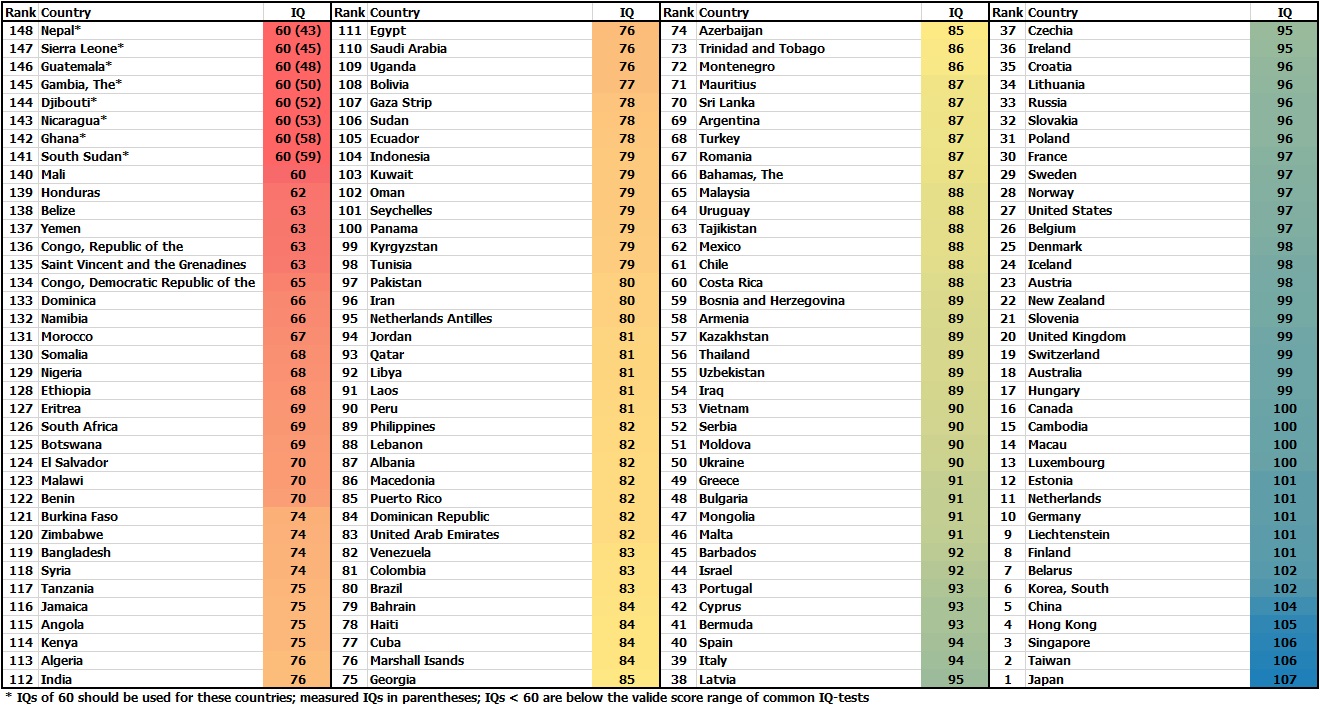
The Average World IQ Is 82

James Thompson has more.

Posted in IQ | Comments Off on The Average World IQ Is 82

Wife of fugitive Rancho Mirage doctor returned to U.S. from Israel, faces new charges

David and Linda Morrow were a prominent part of the Orthodox Jewish community of Beverly Hills.

From the Desert Sun:

The wife of a Rancho Mirage plastic surgeon was returned to the United States and entered not guilty pleas on Monday in federal court in Los Angeles to new charges involving flight while on probation and contempt of court, records show.

Linda Morrow, 67, with her husband and their business, Morrow Institute Medical Group Inc., were charged in 2016 with dozens of counts of fraudulently billing insurance companies for surgeries that were not covered.

David M. Morrow, 74, worked out a plea deal in 2017 with federal prosecutors in which he admitted guilt to one count of conspiracy to commit mail fraud. But both fled the country to Israel before he could be sentenced and she could be charged.

“Linda Morrow arrived today in Southern California after being deported from Israel,” Thom Mrozek, spokesman for the U.S. Attorney’s Office in Los Angeles said in an emailed response to questions on Monday. “She is pending charges in the health care fraud case.”

He said David Morrow is pending extradition from Israel.

Both were taken into custody in Israel on June 16.

In his plea deal, Morrow admitted he participated in a scheme to obtain money from insurance companies by “false or fraudulent pretenses.”

Morrow operated two plastic surgery centers in Rancho Mirage and authorities said that for four years his medical practice billed insurance companies for cosmetic surgeries falsely described as “medically necessary.” The loss to insurance companies was estimated at $3.5 million.

He faced up to 20 years in prison — and charges against Linda Morrow had not yet proceeded to trial — when they disappeared in 2017 and later turned up in Israel.

Investigators say the Morrows sold their Beverly Hills home for about $9.5 million and also sold several of their vehicles shortly before disappearing.

“Before slinking away, they had wire-transferred millions of dollars, most likely to fund their flight and disappearance,” officials wrote in 2017 in a summary of the case.

Posted in Beverly Hills | Comments Off on Wife of fugitive Rancho Mirage doctor returned to U.S. from Israel, faces new charges

Ethnonationalism: The Quest for Understanding by Walker Connor

Political Science professor Rupert Emerson defined nation: “the largest community, which when the chips are down, effectively commands men’s loyalty, overriding the claims both of lesser communities within it and those which cut across it or potentially enfold it within a still greater society.”

PDF of Ethnonationalism: The Quest for Understanding by Walker Connor

From Wikipedia:

…Connor is best known for his work on nationalism, and is considered one of the founders of the interdisciplinary field of nationalism studies.[1]

Before the collapse of European communism that began in the late 1980s, nationalism was not a subject of significant academic study and was generally neglected,[citation needed] with the exception of some major contributions by authors such as Ernest Gellner, Benedict Anderson, and Anthony D. Smith.[2][3][4] Connor’s work is another exception to this rule, and today he is regarded as “one of the scholars of nationalism and ethnic conflict who has contributed most towards establishing a conceptual grounding” for the study of nationalism.[5]

Widely cited for his insistence on the inherently ethnic character of nationalism, which he calls ethnonationalism to emphasize the point, Connor has long held that the most significant obstacle to advancing the study of nationalism is terminological imprecision. Particularly problematic, he contends, is the tendency to conflate the distinct concepts of state and nation, as well as the respective concepts of patriotism and nationalism which derive from them.[6]

Another significant theme in Connor’s work is the passionate, nonrational character of nationalism. When trying to understand national sentiment, he argues, the key is not chronological or factual history, but sentient or felt history. National identity is based on the emotional psychology of perceived kinship ties – a sense of the nation as the fully extended family – and accordingly belongs to the realm of the subconscious and nonrational.

Mons writes:

The notion of ethnic group or nation as arbitrary social construct can be likened to the construction of a cathedral or pyramid. True, the artifice is distinctly human and can be said to be commanded by elites. But the act of building the cathedral cannot be a hollow order but must involve labor brought forth from the masses. Without the buy-in of the people, no progress can be made. Secondly, it is an act of great effort. Cathedrals can be built, but doing so takes many, many years and much treasure. It cannot be done on a whim.

All such criticisms of social constructs are founded on the notion that the social construct is arbitrary and also that it can be destroyed and remade at a whim. But houses are social constructs. There can be significant variation in the form of a house, but certain key characteristics remain cross-culturally. This is because the house must always satisfy the needs of a house. A house that is a shitty house ceases to be built. You can have brutalist houses, Modernist houses, rococo houses, but all houses fundamentally must shelter the inhabitants in a reasonably pleasant way.

Nations are ultimately the greatest social constructs. They are constructed, yes, but through the efforts of generations and the treasure of whole states. To do so lightly is folly. To ignore the existing construction to start anew is almost always an act of madness.

Such things cannot be boiled down to mere feelz. Law is a social construct, but law is one of the most real things a person has to deal with. The unreality of social constructs is one of the key push points of the Left, and we must clarify that socially constructed is not the same as arbitrary.

Posted in Nationalism | Comments Off on Ethnonationalism: The Quest for Understanding by Walker Connor