
- https://PayPal.Me/lukeisback
"Luke Ford reports all of the 'juicy' quotes, and has been doing it for years." (Marc B. Shapiro)
"This guy knows all the gossip, the ins and outs, the lashon hara of the Orthodox world. He’s an [expert] in... all the inner workings of the Orthodox world." (Rabbi Aaron Rakeffet-Rothkoff) LATEST POSTS:
- What is a ‘Received Idea’?
- Jordan Bardella: The Manufacture of Normality
- Everyone Became Television: Bourdieu’s Warning and the 2026 Iran War
- Marine Le Pen
- The Coalition-Proximity Rule
- Nigel Farage
- Bernard Haykel: A Life Between the Text and the Gun
- Walker Connor (1926-2017)
- Benedict Anderson and the Nation as Imagination
- Anthony D. Smith: The Student Who Kept the Question and Rejected the Answer
- Ernest Gellner
- Eric Kaufmann: The Man Who Made the Majority Visible
- Dominic Cummings: A Biography
- Steve Lopez: The Last City Columnist
- California Historian Kevin Starr
- Stephen Kotkin: A Life in Power
- William T. Vollmann: An American Life in Excess
- Rod Dreher: A Life in Exile
- The Cross at Sinjar: Tom Holland’s Dominion
- Rick Warren: A Biography
BEST POSTS:
- * The Enlightenment Wasn’t Enlightened (6-23-26)
* Mr. Burge Draws The Line (6-23-26)
* 'Improving on Democracy' (6-17-26)
* People Leak To People Who Are Fun (6-11-26)
* Why Does Australia Produce So Many Great Journalists? (6-11-26)
* Steve Wynn and the Press: Power, Litigation, and the Contest Over Las Vegas (6-3-26)
* Sheldon Adelson and the Journalists (6-3-26)
* The Vigilant Animal: Thinkers Who Reject the Myth of Human Gullibility (6-2-26)
* The Cost of Refusing the Misunderstanding Myth (6-2-26)
* Show Me How It Travels (6-2-26)
* The Norm Explainers (6-2-26)
* Centering Marginalized Voices (6-1-26)
* What would it look like if the Washington Post put its reader first? (6-1-26)
* What would it look like if the Financial Times put its reader first? (6-1-26)
* What It Would Mean for the Los Angeles Times to Put the Reader First? (6-1-26)
* What It Would Mean for The New York Times to Put the Reader First? (6-1-26)
* Why Wembanyama Lives on the Perimeter (5-31-26)
* The Emotional Palettes Of San Diego, Los Angeles, San Francisco & Sacramento (5-27-26)
* The Administrative Capital: Sacramento Legal Culture (5-27-26)
* San Diego - The Quiet Republic (5-27-26)
* The Quiet Bar: San Diego Legal Culture (5-27-26)
* SF v LA Legal Culture (5-27-26)
* Why Talent Travels Poorly Between San Francisco and Los Angeles (5-27-26)
* San Francisco and Los Angeles as Rival Models of Urban Access (5-27-26)
* Social Cliques in New York, 2026 (5-25-26)
* Social Cliques in San Francisco, 2026 (5-25-26)
* The Rival Courts of Washington (5-25-26)
* The City of Private Rooms (5-25-26)
Games Primates Play: An Undercover Investigation of the Evolution and Economics of Human Relationships
Here are some highlights from this 2012 book:
* Even when we are alone, relationships play a central role in our lives. For instance, while traveling for business, working out at the gym, or lying in bed with insomnia in the middle of the night, our thoughts revolve around relationships: we remember and revisit past events involving ourselves and other people, plan social strategies, or worry about potential future social failures. And as if what goes on in our own relationships were not enough to keep us busy twenty-four hours a day, we also gossip about the relationships of other people we know and even enjoy following the relationships of people we don’t know on reality television or in People magazine. Relationships have a pervasive influence on all aspects of our lives and affect our thoughts, our emotions, and our health virtually from the cradle to the grave.
* One important difference, however, [between primates and other animals] is that success in survival and reproduction for primates depends to a much larger extent on the behavior of conspecifics than it does in most other animals.
* The disappearance or death of an individual is largely inconsequential for the rest of the group and may even go unnoticed. The life of a chimpanzee, in contrast, is intertwined with the lives of all the other chimpanzees in the group, forming a thick web of intricate connections. Every move a chimpanzee makes on the social chessboard has an effect on every other chimpanzee’s life, whether they like it or not. This has many implications for the behavior of individuals and for what it takes to be socially successful in a chimpanzee group. Chimpanzees and humans live in highly competitive societies. Instead of fighting all the time, individuals establish dominance hierarchies within their group. High-ranking individuals have preferred access to food, shelter, and attractive mating partners. In addition to the difficulties in finding food and mates and their exposure to more risks, low-ranking chimpanzees are also chronically stressed by aggression and intimidation from above. As a result, low-ranking individuals are more likely to be in poor health, to die younger, and to leave fewer descendants than their high-ranking brethren. To attain high social status, chimpanzees must form alliances with other individuals and receive their support. For example, chimpanzee males form alliances with their brothers and occasionally with unrelated but powerful adult males to win fights against other group members. Competition and cooperation with other group members are pervasive aspects of the social lives of chimpanzees, other apes, and Old World monkeys—and the social lives of humans—to an extent that, with a few exceptions, is not seen in other animals.
* An underlying theme of Games Primates Play is that human nature is manifested in our social interactions more than in any other aspect of our behavior or intellectual activity. This has two major implications. First, since our social behavior has been strongly shaped by evolutionary processes such as natural and sexual selection, we can explain it using cost-benefit analyses and other rational models of behavior (for example, game theory) developed by evolutionary biologists and behavioral economists. Second, the same selective pressures from the social environment that shaped our behavior and that of our primate ancestors may have shaped the behavior of other extant primate species and their ancestors. Therefore, there may be important similarities in social behavior between ourselves and other primate species because we have adapted to similar social environments.
* In Paleolithic days, murder was an acceptable way to get out of socially awkward situations (the way we use an early morning doctor’s appointment today as an excuse to leave a dinner party early).
* If the two monkeys have never met before, the risk of serious fighting rises even higher. Macaque monkeys don’t like strangers, so unless the other individual is a potential sexual partner, its presence could immediately elicit a hostile response.
* The times and places when fights take place, however, are rarely random. …Over the evolutionary history of our species and that of other primates, the individuals with genetic predispositions for resisting the impulse to fight in the wrong place have had longer lives and produced more offspring than their indiscriminately belligerent counterparts.
* When I ride in an elevator with an attractive woman, I’m generally treated with indifference, and I have a hard time believing that response stems from fear or intimidation. When my girlfriend rides in an elevator with a man, he will often strike up a conversation with her and end up asking for her phone number.
* Although our high-tech way of communicating might seem to preclude a strong influence of our evolutionary past on the way we act, the rules regulating primate relationships resurface even when we sit down at our keyboards to catch up with friends or reply to work memos. For example, the concern with social status that characterizes the relationships of other primates such as macaques, baboons, and chimpanzees has not disappeared in cyberspace, but is simply expressed in a new and different form. There are some clear patterns in the way we use email. First of all, email communication between people who know each other well occurs in “conversation” bouts in which several messages are exchanged back and forth over the course of minutes, hours, or a few days. Who starts and who ends the conversation, the time taken to reply, and the length of the transmissions are not random. Let me illustrate this point by taking as an example an email exchange with an imaginary graduate student in my research group whom I’ll call Jennifer. One day Jennifer—who has not seen me around for a while because I’ve been hiding in a coffee shop, trying to write a book without being interrupted—begins an email exchange by sending me a long message. It contains numerous questions and requests for information and for action (there is always something my students need from me). It’s quite clear that a response is needed with some urgency. Jennifer obviously put a lot of effort into writing this email—time, energy, and the cognitive resources expended in the production of grammatically correct sentences—but the cost of this initiative, so Jennifer hopes, will be offset by the great benefit that my reply will bring her. By hitting Send and beginning the conversation, Jennifer has made an investment that she hopes will bring a significant return. From my perspective, writing to Jennifer entails a cost—I am being distracted from my book!—and little to no benefit, if we forget for a moment that I get paid a decent salary for advising students. So I procrastinate in responding to her email, and when I do finally respond, I compose a brief missive in which I provide all the requested information while keeping the word count as low as possible. Jennifer finds my reply encouraging—the investment is beginning to produce a return—and within seconds of hitting the Reply button, I receive another message from her, as long as the first, with more questions and requests. My conversation with Jennifer continues along this pattern: her emails progressively get quicker and longer, while mine get slower and shorter. After responding five times, I let Jennifer’s email number six sit indefinitely in my inbox without a reply. According to the rules and etiquette of email communication, a lack of response ends the conversation.
What students and professors have in common with employees and their superiors is a clear dominance relationship—one individual is dominant, the other is subordinate. The costs and benefits of exchanging emails are different for the dominant and subordinate parties, and as a result a distinctive pattern of email exchange emerges.
A former student of mine who, like Jennifer, used to write me long unsolicited emails, has become a professor in a top-notch university. Now when we exchange emails, either one of us is equally likely to start or end the conversation, and he shoots off one-line responses he never would have sent me before. His style of email has changed gradually over time as his career has advanced and he’s caught up with me.
* Show me your emails and I will tell you whether you are on a fast track to become a leader of your company, or whether it’s unlikely that you will have secretaries answering your emails anytime soon.
* A problem that arises in all relationships is one of conflicting interests—individuals want to act in ways that benefit themselves at the expense of their partner. This is true for every human relationship, including those between parents and children, siblings, romantic partners, friends, and coworkers.
* Continuous fighting or negotiation also makes relationships unstable and stressful. Mother Nature—who shapes the minds and behavior of living organisms through natural selection—always tries to find cost-effective solutions to the problems these organisms encounter in their environments. Humans and many other primates live in complex societies in which even the closest and strongest social relationships feature strong competitive elements. Individuals with close social relationships interact regularly, and their interests clash multiple times a day. Yet I know of no primate species in which individuals fight or negotiate all the time. No, Mother Nature has found a better solution to the problem. It’s called dominance. Two individuals in a relationship establish dominance with each other so that every time a potential disagreement arises, there is no need for fighting or negotiation. The outcome is always known in advance because it’s always the same: the dominant individual gets what he or she wants and the subordinate doesn’t. There is no risk of injury, no waste of time or energy or cognitive or emotional resources. The relationship is stable and predictable, which is good for mental health. The resolution of disagreements through dominance has a cost, of course, but as we’ll see later, this cost is paid entirely by the subordinate. If the dominant individual in the relationship is smart, however, he or she will help reduce the cost of losing by making sure the subordinate gets something out of it—or by giving the appearance that this is the case.
* The struggle for dominance during adolescence doesn’t happen the same way in every parent-child relationship. Some parents make concessions to their children and become less authoritarian, but maintain their dominance over their children for the rest of their lives. Some children are successful in reverting the dominance relationship and start calling the shots; their parents acquiesce and accept their new subordinate role. Finally, in some cases, neither party wants to give in, dominance remains unresolved, and parents and children bicker for the rest of their lives—or simply stop speaking.
* The most stable and long-lasting sibling relationships are those in which dominance is clearly established from the beginning and is never challenged—for instance, when one sibling is significantly older than the other.
* Girls dominate a potential rival by spreading nasty rumors aimed at damaging her reputation; by excluding, ignoring, and socially isolating her, thus making her an unattractive social partner to other girls or boys; or by actively disrupting her attempts at alliance formation. Dominant children, both male and female, use both aggression and affiliation strategies to establish and maintain dominance: they simultaneously attack the child they want to dominate and befriend others who might help them in the process, forming alliances with them.
* Dominance in romantic or married couples is an important but underappreciated phenomenon. The most stable romantic relationships and marriages seem to be those in which dominance is clear from the beginning. The dominant partner makes all the decisions, from what show to watch on TV in the evening to where to go on vacation in the summer, and the subordinate partner acquiesces and takes a supporting role. If what people expect from marriage is not necessarily everlasting passionate love but a stable partnership that will allow joint ventures such as buying a home and raising children together, or an opportunity to concentrate on one’s career without worrying about house chores, then an asymmetrical relationship with uncontested dominance probably guarantees the best outcome.
* Dominance is so intrinsic to human social relationships that we don’t even notice it. However, I suspect that if I asked you to make a list of one hundred people you know, including family members, friends, and coworkers, and indicate whether you are dominant or subordinate in your relationship with each of these people, you could give a clear answer for at least ninety-five of them.
* Dominant individuals are better at interpreting others and persuading them to do what they want with all possible means, including deception. The ability to charm and befriend others and to form alliances with them through the exchange of favors is also crucial. Considering that autism spectrum disorders—which involve deficits in social intelligence skills—are highly heritable, it is likely that individuals at the other end of the continuum, who excel at these skills, may have their genes to thank for some of their talents.
* In married couples, the spouse who perceives himself or herself to be subordinate in the relationship shows a higher increase in blood pressure reactivity during marital disagreements. Just as an increase in testosterone following a victory may increase one’s self-confidence, ambition, and motivation to fight again, a decrease in testosterone and an increase in cortisol following repeated defeats or in association with chronic subordination can result in depression and shame, which can lead to submissive behavior: avoidance of eye contact, hunching body posture, social avoidance. These physiological and behavioral changes promote acceptance of and adjustment to subordination.13
* We have physiological, emotional, and learning mechanisms that allow us to constantly assess our own performance in agonistic confrontations, that tell us whether we are dominant or subordinate in a relationship, and that help us adjust to the situation. When we win a contest and become dominant, we feel good about it and we want more of the same. When we lose and become subordinate, we feel bad and either cut our losses and adjust to the situation or start preparing for a future rebellion.
* The experience of wins and losses with other individuals influences not just individuals’ perception of their own RHP [resource holding position] but also their assessment of other individuals’ RHP and their estimation of their probability of winning or losing.
* Dominance, however, is an integral component of all our social relationships and has a pervasive influence on all aspects of our everyday social lives. The sooner we recognize this, the better we will understand why our relationships work the way they do. Humans and some other primates are obsessed with dominance, although not necessarily at a conscious level. Dominance is so entrenched in human nature that thinking we can have social relationships without it is unrealistic.
* A few years ago, Ezio Capizzano, a sixty-six-year-old law professor at the University of Camerino, made the national headlines in Italy because it turned out that for years he had been having sex with his female students on a couch in his office and making videotapes with a camera hidden under the table.6 The students in his tapes always passed his course exam with flying colors. The professor even negotiated good grades for his young lovers with other baroni, when the students had to take courses with them. When he was caught, Professor Capizzano claimed in his defense that his sexual relations with the students were all fully consensual. Judging from the photos in the newspapers, I didn’t get the sense that he was particularly attractive, and it’s likely that his female students had sex with him for business purposes: they exchanged sex for good grades and raccomandazioni.
* Here are the golden rules of nepotism: First, don’t embarrass the patron. Since the protégé’s actions and conduct reflect on the patron, accept the nepotistic help but don’t make the patron look bad. Second, don’t embarrass yourself. If you are the beneficiary of nepotistic help at someone else’s expense, you must work hard to counteract the resentment of those who are fregati. If possible, you should give them a consolation prize. Third, pass it on. If you are the recipient of nepotistic help from your parents, express your gratitude to them in the form of nepotism toward your own children. It is okay to receive generous nepotistic help if you become, in turn, generous toward others (as long as you keep it within the family, of course).
* Even though most people who enter a new workplace have been hired, which means that they are wanted and welcomed by someone in the organization, they must contend there with an established power structure that is generally resistant to change. As discussed in Chapter 2, human workplaces—whether they are large corporations, military organizations, theater companies, or schools and colleges—have dominance hierarchies, just like monkey groups. People who have worked hard to climb the ladder—whether they are now all the way at the top or simply one step up from the bottom—are not happy to step aside and make room for a newcomer. In both macaque and human societies, the newcomer is seen as a competitor, and therefore his or her arrival into the group is likely to be met with indifference, resistance, or outright rejection. The newcomer, then, must cultivate relationships with these strangers and try to obtain their support through exchanges of favors or other means. When there are no relatives around to help, success depends not on nepotism but on politics.
* Sarah had learned from experience that low-status coworkers could cause a lot of damage to the career of someone they didn’t like by spreading malicious gossip. And someone as socially savvy as Sarah could obtain everyone’s loyalty with a relatively small investment made at the beginning. Sarah wanted to rise to the top quickly, and she knew that given her personality and her skills with people, this could be best accomplished through politics: alliance formation and social manipulation.
* The ability to charm and lead others—what we call charisma—is an important skill in forming effective political alliances. And in any kind of human social organization, from academic departments to business companies to entire countries, strong political alliances are necessary for anyone to climb to the top of the ladder and stay there for a while.
* Essentially, a good reputation is an extension of our spending limit on our credit card. With no reputation, we get no credit from others. As we build a reputation with acts of cooperation, there is a corresponding increase in others’ willingness to give us credit for larger and larger amounts in future business transactions.
* Your boss at work can tell you that you are a valuable employee and praise your work constantly, but the best indicator of how valuable you are to your boss is the salary he or she is willing to pay you. Words are cheap, but money isn’t.
* when biologist E. O. Wilson became excited about the power of evolutionary explanations of behavior and announced in his book Sociobiology: The New Synthesis (1975) that sociobiology was going to take over all the other behavioral disciplines, he did more harm than good to the field: sociobiology was criticized on multiple fronts and eventually evolutionary behavioral scientists stopped using this term so that they could work in peace.12 In academia there is a lot of territoriality, and threats of intellectual takeovers by new theories or disciplines inevitably elicit strong defensive reactions; some react with an outright rejection and dismissal of the new paradigm, while others are prompted to an extensive scrutiny of the new paradigm, which usually brings to light some of its weaknesses and limitations.
* a young capuchin monkey may walk up to his favorite social partner, stick a finger up his nose, and wait for a reaction. If their relationship is good, nothing will happen, but if the partner has lost some of the initial enthusiasm about the partnership, the annoying monkey will get smacked. Perry noticed that two capuchin monkeys who have a strong social bond sometimes simultaneously insert their fingers up each other’s nose and “sit in this pose for up to several minutes with trance-like expressions on their faces, sometimes swaying.”
* Lovers who exchange long and passionate kisses stick their tongues in each other’s mouth; that’s quite intrusive and even carries the risk of transmitting disease. Only people who are highly committed to a romantic relationship accept this type of imposition from their partner. According to Zahavi, bond-testing through costly or stressful love signals is frequent especially when the relationship is new and not yet well established, because this is the time when information is most needed. When partners in a long-term relationship stop exchanging French kisses, it may be that they are not as physically attracted to each other as they were at the beginning, but it also could be that their relationship is strong and bond-testing is no longer necessary. You will not be surprised to hear, at this point, that Zahavi thinks that sex is the ultimate mechanism for bond-testing. The intrusiveness of many forms of sexual behavior, according to him, makes sex an ideal handicap signal for conveying and receiving detailed information about each lover’s commitment to the relationship.
* Commitments can change from day to day as a function of an individual’s financial situation, or reputation, or age, health, stress, or status. A woman who overestimates her lover’s commitment risks abandonment, damage to her reputation, and the hard work of raising a child alone. Overestimating commitment also leads to opportunity costs: the time spent with an undercommitted partner reduces the chance to attract a better mate. Underestimating the true level of a partner’s commitment can also be costly, leading to a self-fulfilling prophecy. Miscalculating, for example, could cause you to reduce your own commitment, impelling your partner to do the same, thereby producing a downward spiral of mutual retreat and resentment. The bitter result could dissolve the relationship as both partners search their social world for deeper, more meaningful engagement.
* Walking on the streets of Bangkok a few years ago, I couldn’t help but notice the high number of heterosexual “mixed” couples made up of a white Caucasian man and a Thai woman. In virtually all cases, the man was older and rather unattractive (bald, with a potbelly and thick glasses), while the woman was young and good-looking. We see well-matched couples all the time: the young and the beautiful typically go with their own kind (like Brad and Angelina), and average-looking middle-aged people are typically married to other average-looking middle-aged people. Occasionally, we run into a very attractive young woman accompanied by an older man, but the man is typically well groomed, in good physical shape, and wearing an expensive Armani suit. In other words, he is wealthy and successful. In the United States or in Europe, you don’t typically see unattractive and socially awkward middle-class men in the company of beautiful young women.
* Individuals who have low value and little bargaining power in one market can move into another, where their characteristics are more in demand.
* The biographies of famous artists, musicians, scientists, philosophers, spiritual leaders, and other remarkable individuals provide unique insights into human nature. The accomplishments of these individuals influenced the lives and work of millions of other people. Just think about how many human lives have been touched by Mozart and Picasso, Einstein and Darwin, Plato and Aristotle, or Gandhi and Mother Teresa of Calcutta. Yet, if one examines the social lives of many of these intellectual and spiritual overachievers, they come across as far less virtuous and remarkable than their “professional” legacies would have us believe. Spanish painter Pablo Picasso took advantage of his fame and artistic talent to sleep with almost every woman he met in his adult life (including a seventeen-year-old model he met when he was forty-five and with whom he later had a child). According to biographer Patrick O’Brian, Picasso married twice and had four children by three different women, and regardless of his marital situation, he always kept several mistresses in the background. Picasso was a tremendously productive artist—his oeuvre comprises more than fifty thousand paintings, drawings, and sculptures—but work was clearly not the only thing he had on his mind. In that respect, he is in good company. Hundreds of thousands of men who have achieved fame through art, music, science, or other intellectual activities also cheated on their wives and used their fame to maintain harems of women to satiate their voracious sexual appetites. Just as some great minds are susceptible to the temptations of promiscuous sex, others are lured by the prospect of political power.
* [Konrad] Lorenz was not the first intellectual to strike a deal with a dictatorial regime—or more generally, to align himself with political power to advance his own career. He followed an illustrious tradition that originated in the ancient world and became well established in Europe during the Renaissance: scientists, artists, and musicians seeking patronage from emperors, kings, and popes and often not only obtaining employment, support, and protection in the process but also amassing a great deal of political power themselves. Finally, many spiritual and religious leaders who encouraged their followers to live a virtuous life simultaneously showed a keen interest in the material benefits of this world. Mother Teresa of Calcutta, an Albanian Roman Catholic nun who received the Nobel Peace Prize in 1979 and was declared a saint by Pope John Paul II in 2003, did not hesitate to support wealthy and corrupt individuals, including Haitian dictator Jean-Claude Duvalier and former financial executive and white-collar criminal Charles Keating, to gain millions of tax-free dollars from them. In his 1997 book The Missionary Position: Mother Teresa in Theory and Practice, author and columnist Christopher Hitchens argues that Mother Teresa was less interested in helping the poor than in stashing away vast amounts of cash with which to fuel the expansion of her fundamentalist Roman Catholic beliefs.
Clearly, exceptional individuals—people with superior education, intelligence, artistic talents, or religious and moral principles—share many traits with the rest of the human race: social and political ambitions, greed for money, rivalries with contemporaries, unrestrained sexual appetites, and marital problems. In many cases, there seems to be a sharp disconnect between the intellectual or spiritual achievements of these famous individuals and the content and quality of their social lives. Why this disconnect? The answer, I think, is that human social behavior comes with a heavy load of evolutionary baggage—we all have strong biological predispositions to behave in certain ways and to pursue similar goals in our personal lives. In the end, we all want the same things: money, power, fame, sex, love, and children. In contrast, our intellectual potential is almost infinite and can be realized in a thousand different ways—or not realized at all.
…all it takes to fully understand the social lives of many Nobel laureates is some knowledge of primate social behavior. The social behavior of intellectual and spiritual leaders (as well as that of kings and emperors, politicians and army generals, and rock-and-roll, movie, and sports celebrities) is generally similar not only to the behavior of non-achievers but also to that of monkeys and apes and other animals as well.
* How is it possible that the product of free will ends up resembling what monkeys and apes in the jungle have been doing for millions of years?
* Free will and anthropocentrism go hand in hand. The seventeenth-century French philosopher Descartes, who came up with the brilliant phrase Cogito, ergo sum (“I think, therefore I am”), believed that humans are unique in possessing free will and that all other animals act like robots. Accordingly, Descartes placed humans right at the center of the universe. Many embraced Descartes’s view, including the psychologist William James, who wrote in 1890 that the whole “sting and excitement” of life comes from “our sense that in it things are really being decided from one moment to another, and that it is not the dull rattling off of a chain that was forged innumerable ages ago.” Well, for over two centuries people have had to disabuse themselves of the notion that humans are fundamentally different from other animals. Beliefs about the uniqueness of human behavior might well be the last bastion of our superiority complex, but even this redoubt may be crumbling. As for free will, experiments in psychology and neuroscience suggest that—to paraphrase The Princess Bride—“I don’t think it is what you think it is.”
* For some evolutionary biologists, evolution stays confined within the walls of their laboratory. For others, it stops at their doorstep: it can happen in the jungle, but they don’t want it in their house. They don’t want to hear about how evolution affects their own behavior. They are like those Catholics who go to Mass every Sunday but, forgetting all about religion once they’re outside the church, spend the rest of the week going about their business as usual. Surprisingly, among the skeptics are also some evolutionary psychologists who believe that natural selection shaped the human mind, yet maintain that what we do with our behavior has little to do with evolution. I for one have a hard time accepting the notion that natural selection has left its mark on human mental processes but not on contemporary human behavior.
* Evolutionary psychologists don’t believe that the human mind is a tabula rasa—an empty container we fill with all kinds of information that we acquire from the environment with our amazing learning skills. Rather, they believe that the mind has some biological predispositions to produce specific emotions over others in response to particular situations, to learn certain things better than others, to solve problems in a certain way, and even to make certain mistakes in the perception and processing of information from the surrounding environment. For example, children are biologically predisposed to learn languages until they reach puberty; after that, changes in their brain make it very difficult to learn a new language—as people who have learned a second language later in life know all too well. Studies by social psychologists have shown that people generally have a better view of themselves than others have of them. We see ourselves as being nicer, more intelligent, and more successful than others do. The human mind is the device that drives our bodies in the race for survival and reproduction, so it makes sense that it gives us the impression that we are at the center of the universe—anthropocentrism is a psychological adaptation—and that it has many mechanisms to protect us from the challenges, not only physical but also psychological, that come from the outside world.
Called algorithms by evolutionary psychologists, the human mind’s predispositions are akin to computer programs in that they were designed to solve particular problems or tasks. They have a significant genetic basis and evolved by natural selection, so that individuals with the genes for particular algorithms were more successful in survival and reproduction than the individuals without these genes. Algorithms represent solutions to the recurring problems that early humans and their ancestors were constantly confronted with in their environment, including: how to navigate and orient oneself; how to find food and discriminate between edible/nutritional substances and toxic/non-nutritional ones; how to detect predators and escape predator attacks (as well as avoiding dangerous animals such as venomous snakes and spiders); how to avoid a potentially deadly aggression from a member of another group or harmful and coercive behavior from a member of one’s own group; how to learn to communicate with members of one’s own community; how to discriminate family members from nonkin; how to make friends and practice important social skills with them; how to establish cooperative relationships with others based on reciprocation and how to identify and punish cheaters; how to make effective political alliances that allow one to outcompete other individuals and gain status; how to find and choose appropriate and willing mates for short-term sexual relationships; how to establish a long-term relationship with an opposite-sex individual that will lead to successful reproduction and child-rearing; how to support and shape children’s development so that they will become successful adults; and how to obtain assistance and support from caregivers early or late in life, periods when individuals cannot make it on their own.
* anger motivates assertive and threatening behavior, and sometimes acting self-confident or threatening is all that’s needed to settle a contest to your advantage. An angry dog will growl and bark loudly to another one he meets in the park; if this display is effective, he becomes dominant over the other without any need for physical aggression.
* Clearly, there are strong differences among breeds: some dogs can easily be trained to retrieve or to help a shepherd keep his flock of sheep together. There are also differences in how aggressive or friendly different breeds of dogs are toward other dogs and toward people, how docile and cuddly they are, and how excitable or laid back. These differences are largely genetic and the result of selective breeding. To produce highly aggressive Dobermans, a dog breeder picks the most aggressive males and females he can find and allows them to breed, while not breeding the docile Dobermans. After generations of this selective breeding, Dobermans, on average, tend to be aggressive. Darwin used this example of behavior-based selective breeding of domestic animals extensively in On the Origin of Species to prove the point that behavior is heritable and that natural selection favors certain traits over others, the way an animal breeder does.
* Science produces knowledge and explanations, not philosophical, moral, or religious justifications. Evolutionary biology is a scientific discipline; its job is to help us understand what life is and how it works. Evolutionary biology has no business telling us whether or not life is worth living and why.
* Instead of realizing that the only way to become happier is to improve the quality of one’s life, many people need reassurance that all stories have a happy ending, that humans are fundamentally good, that bad things don’t happen to good people, or that there is a supernatural being who takes care of us and makes sure everything is okay. If a scientist attempts to explain nature or human nature but doesn’t provide a positive message that makes people feel better about themselves, some of them will simply shoot the messenger.
Posted in Evolution
Comments Off on Games Primates Play: An Undercover Investigation of the Evolution and Economics of Human Relationships
Bite the Hand That Feeds You: Essays and Provocations by Henry Fairlie
Here are some highlights from the late essayist at The New Republic:
* Parliament still unites freedom and order in a way which is the envy of the world, and probably its hope.
[LF: Does parliament unite freedom and order or does it reflect it?]
* He accepts Bagehot’s definition of the real function of the House of Commons as being to “express the mind of the people,” to “teach the nation what it does not know,” and to make us “hear what otherwise we should not.”3
[LF: I don’t buy any of this.]
* It works because, as he says, the members of Parliament are “ordinary people with a fair slice of ambition…. What the democratic system does is to harness a man’s ambition. . . .” Sir Ivor Jennings says that this is the worst that can be said about the members. It is also the best. The enduring virtue of the House of Commons, through centuries, is that it has been composed largely of ordinary people: drab, honest, foolish, bumptious, confused, worried, happy, unhappy, ordinary people.
[LF: Ordinary people who just so happen to be lawyers.]
* Sir Isaiah Berlin: “It is one of the stratagems of totalitarian regimes to present all situations as critical emergencies, demanding manding ruthless elimination of all goals, interpretations, pretations, forms of behaviour save for one absolutely lutely specific, concrete, immediate end, binding on everyone, which calls for ends and means so narrowly rowly and clearly definable that it is easy to impose sanctions for failing to pursue them.”
* I am extremely doubtful whether we have anything to learn from either the Fifth Republic in France or the Federal Republic in West Germany about the manner of ordering and sustaining a free society; I am not even sure whether we have much to learn in the matter from the French and Germans as peoples.
* [Churchill] was, remained, and proclaimed himself to be a Zionist. Few of his attacks on the Labour government that succeeded him were more brutal, more contemptuous, than his criticism of its Palestine policy. Ernest Bevin, the great trade union leader brought forward by Churchill during the war as secretary of labor, and then dramatically made foreign secretary by Attlee (one of Attlee’s soundest judgments)-a man who had fought communism all his life in the unions was unlikely to back down before the Soviet menace-was unquestionably pro-Arab, even anti-Semitic. Churchill, with all his admiration for Bevin, made Bevin look like the scoundrel he was over Palestine, which was, in Churchill’s mind, the historical entity of Israel. Why? Churchill chill loved the rowdiness of the Jews. He welcomed members of Parliament banging the lids of their desks in the chamber; and the best desk-lid bangers in history are the Jews.
* The old man, Hodge related, liked to watch old movies in a private cinema. Like all old men, he nodded off in the middle of it. And like all old men, he would wake up with a start, and say to young Hodge, “Tell me which are the baddies and which are the goodies, and then I can work out the rest for myself.” Which, of course, was more or less what he did with Hitler and Stalin.
* As the barge progressed down the Thames, the dockside cranes all dipped as it passed. The sight of these bowing cranes moved a nation (and me) to tears. For dockers, stevedores, are a nation’s most Bolshie workers. In Britain, certainly, none of them ever could have voted for Winston Churchill. Yet they, these proud proletarians, by their own bidding, on a day off, and not on the orders of their employers, lowered their cranes like guardsmen making an arch of their swords over the passing of a monarch.
* But television is only a step to the real goal, the lecture circuit. There is the big money for utterances that require a minimum of thought or creative work. The fundamental principle of the lecture circuit is simple: to make much the same speech to organizations nizations that wish to hear much the same thing. The system would break down if the lecturers suddenly made new speeches with original opinions. George Will addressing the National Soft Drink Association, David Brinkley addressing the Mohawk Executive Forum or the National Pork Producers Council, James J. Kilpatrick addressing ing the Potato Chip/Snack Food Association-they really do not have to think very hard in deciding what it is that their high-paying paying audiences wish to hear, and what kind of undangerous speeches will keep them on the lecture agents’ lists.
The lecture circuit today is a continuous road show in which the star performers are the media creatures, each of them projected by television, their essential instrument of self-advertisement. Thus we have the newspapers tolerating columnists who use their space to get on television, and television then tolerating the use of its political programs as a way onto the lecture circuit. Is there no editor or producer who will clean the stables of these pious self-advertisers and self-seekers? Is there not one who is aware that in such performers there is a conflict of interest?
* It gives me no pleasure to say that George Will’s columns, which promised so much seven years ago, have significantly deteriorated, in quality of writing, in force of ideas, in range of interest, since he began to devote so much time first to television, vision, and then to the lecture circuit. Lecturing from 8o to roo times a year is a time-consuming, intellectually debilitating exercise. The common criticism that one hears made of his journalism now, often said more in sorrow than in anger, is that it has become predictable; and this surely points to his surrender of time to being a performer.
The repetitiveness and predictability of most of the columns on the op-ed page of the Washington Post are directly related to their unimportance in the eyes of their authors. They are hackwork, work, which, if their authors were not media stars, any self-respecting respecting editor would drop.
* Take not a crust of bread from a politician. Take not a cab fare from a corporation. The effect on Washington is that, trading in celebrity, the media trade also in the wealth surrounding the celebrity. The very profession that should be the acid, relentless critic of the affluence and cynicism of Washington is now the most ostentatiously tatiously affluent and cynical profession in the city.
Posted in Politics
Comments Off on Bite the Hand That Feeds You: Essays and Provocations by Henry Fairlie
Looking Down From Heaven
I love this picture.

I feel like this is the true perspective on life. How could one get petty from here?
The photo tells me there are many ways of living a life, and one small turn can make an enormous difference. Just a tilt of the wheel and you are off on a whole new adventure, leaving behind everything you’ve known.
I look at the picture and I feel a touch of the infinite. Surely God is in this place.
I had the same sensation driving into Yosemite. I was awestruck by the natural grandeur. I felt tiny and it felt good to be tiny.
I feel lonely looking at this picture and I like it. It reminds me of climbing to the top of a tree at Pacific Union College once I no longer lived there, circa 1982 when I was only visiting, and I was swaying in the breeze on top of the tree looking over the community that was home to the people I loved most in the world. Sitting there, I felt that my future was limitless. Looking at this picture, I feel the same way. This image connects me to the infinite in each moment, in each person, in each interaction, in each idea, in each connection.
Like sands through the hourglass, so are the days of our lives.
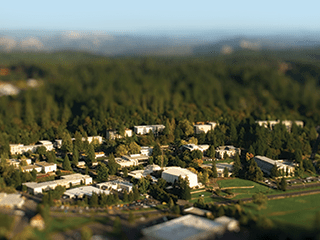
Here’s some background on the young photographer Ian Beckley. My logo photo is of New Mexico.
Posted in Personal
Comments Off on Looking Down From Heaven
‘The Idiocy Of Rural Life’
That’s the unforgettable title (quoting Karl Marx) of the cover story in The New Republic, December 8, 1986. I never read the essay nor its follow-up by the late Henry Fairlie, though I did read other articles in those issues at that time.
I remembered these unread essays today when we had some gorgeous bloodsports between regulars Kyle Rowland and Elliott Blatt, starting at 1:34:20.
Here are some highlights from that original 1986 essay by academic Jeffrey L. Pasley, who grew up outside Topeka, Kansas (Idiocy of Rural Life):
HOW, THEN, did American family farmers become, in Harkin’s words, “the most efficient and productive in the world”? Family farmers can keep labor costs very low because the family provides the bulk of the labor. Family farms operate under vastly different labor standards than the rest of American industry. “Child labor laws do not apply to family farms because family farms must have child labor to survive,” wrote Minnesota politician and family farm alumnus Darrell McKigney. “Twenty or thirty years ago farm families commonly had ten or more children. [With automation] today five or six is a more common size.” From a very early age, family farm children participate in every phase of the operation, from work with dangerous heavy equipment to close contact
with carcinogenic chemicals and disease-carrying animals. In numerous farm areas, so many children are taken out of school at harvest time that the schools officially close until the harvest is finished. Practices that would be outrageous at a textile mill suddenly become all warm and cuddly when they appear on the family farm.Family farmers also achieve efficiency through a draconian work schedule that no self-respecting union would allow. “The farm family does physically demanding and highly stressful work at least 14 hours a day (often at least 18 hours a day during harvest season), seven days a Week, 365 days a year without a scheduled vacation or weekends off,” wrote McKigney. “The farmer must endure all of this without the benefit of a health plan, safety regulations, a retirement plan, workmen’s compensation, or any of the benefits that most U.S. labor unions demand.” Psychologist Peter Keller, past president of the Association for Rural Mental Health, pointed out that many farmers are permanently tied to their farms. A dairy farmer, for instance, cannot just take off for a two-week vacation and not milk his cows. “Farmers lose perspective on the other things in life,” said Keller. “The farm literally consumes them.”
And the family farm physically consumes those who work on it, too. According to the National Safety Council, farming is the nation’s most dangerous job—more dangerous even than working in a mine. In 1983 farming clocked in at 55 job-related deaths per 100,000 workers, or five times the rate for all major industries combined. In 1984 Tom Knudson of the Des Moines Register published a Pulitzer Prize-winning series that cataloged the myriad health and safety risks run by farmers. Farmers working with powerful farm machinery face death or maiming by crushing, chopping, asphyxiation, or electrocution. (“As he reached for a stalk of corn dangling from the corn picker, Vern Tigges of Dexter felt a jolt. In the next moments in a fierce and frantic struggle with the machine, three fingers were ripped from his hand.”) They may be poisoned by the nitrogen dioxide gas that accumulates in grain silos, or have their lungs permanently damaged from breathing the air in enclosed hog pens. They may be crippled by “farmer’s lung disease,” caused by moldy grain dust. They may develop leukemia from contact with herbicides used on corn. (Iowa farmers contract leukemia 24 percent more frequently than the average American.) Knudson wrote that recent health findings exploded “the myth of farming as the good life of fresh air and sunshine.”
BUT WHAT ABOUT the benefits of good-old-fashioned-lemonade values and the supportive friendliness of a rural community? Though hard data is difficult to come by, many small towns appear to suffer from teenage pregnancy, alcoholism, and other social maladies at rates that are higher than average…
THE USUAL lesson gleaned from the facts of farm life is that there is nothing wrong with the family farm that higher commodity prices won’t solve. Yet farm programs have come and farm programs have gone, and still farmers (and especially farmer’s children) have left, for the simple reason that life is usually better off the farm. “It is a way of life, but so was the village blacksmith,” says economist William H. Peterson. The urban “wage-slave” worker, for all his lack of “independence” and supposed alienation from his work^ has some decided advantages over the rural yeoman. He has the security of a regular income, and definite hours set aside for his leisure. More often than not, the law guarantees the non-farmer a safe place to work, and protects him from the whims of his employer. The urban wage-earner has daily contact with a wide variety of other people, and access to cultural events and decent public services…
Tyrants from Stalin to Mao to Pol Pot have subjugated their populations by forcing them to “stay on the land.” Given the conditions of life on the family farm, if ATT or Chevron or Tenneco really does try to force some family farmers off their land, they might well be doing them a favor.

Henry Fairlie responded with the essay “The Idiocy of Urban Life”:
…bring the rat race.
[LF: One chooses how much one must participates in the rat race. How is a tough schedule in the city any different from a tough schedule in the country where cows must be milked every day?]
* Urban life today is aggressively individualistic and atomized. Cities are not social places.
[LF: It depends. Orthodox Judaism is highly social. Traditional religion tends to be highly social. If you want to be a writer, it helps to live in the city where you can meet regularly with other writers. I don’t “aggressively individualistic” is a good way to live, but that’s my subjective opinion. People in East Coast cities tend to be more socially connected to family and community than people in West Coast cities. Religion, schooling, family ties strike me as more traditional on the East Coast of America.]
* The lunacy of modern city life lies first in the fact that most city dwellers who can do so try to live outside the city boundaries…
[LF: How is that lunacy? People want what they want from cities and country and adjust themselves to maximize the things they want and minimize the things they don’t want.]
* Disdaining rural life, they try to create simulations of it.
[LF: What’s wrong with maximizing what you want? Some people want wifi when they go to Yosemite. So my girlfriend and I paid $10 for some lodge wifi one day on our visit. Some married people want to create simulations of single life so they play games. Some Orthodox Jews like to intellectually explore heretical opinions or they eat kosher versions of trafe food such as fake meats.]
* The homes, restaurants, and even offices of city dwellers are planted thick with vegetation.
[LF: And why is this worthy of contempt?]
* The professional people buy second homes in the country as soon as they can afford them, and as early as possible on Friday head out of the city they have created. The New York intellectuals tuals and artists quaintly say they are “going to the country” for the weekend or summer, but in fact they have created a little Manhattan-by-the-Sea around the Hamptons, spreading over the Long Island potato fields whose earlier solitude was presumably sumably the reason why they first went there. City dwellers take the city with them to the country, for they will not live without its pamperings.
[LF: Everybody takes their past and their preferences with them wherever they go. So?]
* Every European points out that Americans are the most round-shouldered people in the world. Few of them carry themselves selves with an upright stance, although a correct stance and gait is the first precondition of letting your lungs breathe naturally and deeply. Electric typewriters cut down the amount of physical cal exertion needed to hit the keys; the buttons on a word processor need even less effort, as you can tell from the posture of those who use them. They might as well be in armchairs. They rush out to jog or otherwise Fonda-ize their leisure to try to repair the damage done during the day. Dieting is an urban obsession. Country dwellers eat what they please, and work it off in useful physical employments, and in the open air, cold or hot, rainy or sunny. Mailmen are the healthiest city workers.
* Work still gives meaning to rural life, the family, and churches. But in the city today work and home, family and church, are separated.
[LF: Work, family and church give meaning to people in cities as well. Many people find great advantage in separating home and work and church. I don’t see anything inherently wrong in this separation.]
* What the office workers do for a living is not part of their home life. At the same time they maintain the pointless frenzy of their work hours in their hours off.
[LF: Not true. Everything we do affects us. How is hard work pointless frenzy? Some people choose to live busy lives. What’s wrong with that?]
* They rush from the office to jog, to the gym or the YMCA pool, to work at their play with the same joylessness.
[LF: Orthodox Jews don’t tend to dawdle. People with busy lives don’t dawdle. So? I haven’t noticed any difference in happiness between rural and urban living.]
* As the farmer walks down to his farm in the morning, the city dweller is dressing for the first idiocy of his day, which he not only accepts but even seeks-the journey to work.
[LF: How is commuting idiocy? It represents a trade-off between where we want to live and where we need to be for work. Why is compromise idiocy? I have created a life where I’ve not had a daily commute longer than 20 minutes.]
* There are no more grim faces than those of the single drivers we pedestrians can glimpse at the stoplights during the rush hour. It is hard to know why they are so impatient tient in the morning to get to their useless and wearisome employments;
[LF: I guess that’s why they call it work.]
I think Henry Fairlie got the worst of this exchange. Jeffrey L. Pasley gave killer facts and insights, Fairlie just evoked some feelings. I don’t see it as terribly significant that city dwellers want to recapture some parts of country life. We all want what we don’t have. Every man with a Ten yearns to have sex with someone new. That doesn’t make the Ten defective.
I grew up in the Seventh-Day Adventist tradition that regarded cities as dens of iniquity. Almost all of my experiences were rural until age 27 when I went to live in Orlando and then Los Angeles. I love cities. I love country. I don’t think either is an objectively superior way of living.
Posted in Rural
Comments Off on ‘The Idiocy Of Rural Life’
Is Human Nature Good Or Bad?
Australian journalist Chris Masters wrote in this 2002 book Not For Publication: “But journalists do have to hold to one strong belief– that people are basically decent. I still believe that if any ordinary Australian sat down with an ordinary Afghani who had been through the hell of a serial civil war, and the Afghani was able to give the Australian an honest account of their story, the Australian would do what they could to help.”
What a great summary of the journalistic mindset! And what stupidity! First of all, to state that journalists have to hold to one strong belief that has nothing to do with the craft of reporting is absurd. Second, to state that people are basically decent defies reality. Third, the idea that ordinary members of an in-group (in this case Australians) would love to do everything they could to help a despised out-group (Afghan Muslims) is staggeringly blind to reality. People don’t care about out-groups.
Posted in Journalism
Comments Off on Is Human Nature Good Or Bad?
Hitler and the Power of Aesthetics (2009)
From the 2009 edition Introduction by the author Frederic Spotts:
* You can discuss Stalin, Mao and Pol Pot with calm reason. But it is almost impossible to talk about Hitler rationally. When, in 2000, Time magazine was considering whom to designate its “Man of the Century,” the rum or that Hitler was a candidate caused a minor uproar. That Hitler had more of an impact on the century than anyone else few historians would deny. But historical fact had to give way to irrational emotion, and so Time timidly
selected Einstein. There was an irony in this. Einstein himself once belittled his work by pointing out that his theories had always existed in nature and were just waiting to be propounded by one physicist or another. But a Beethoven, he said, was a unique phenomenon.
Hitler was also unique; he made history, history did not make him. His singularity as someone who rose almost literally from the gutter to become master of Europe is recognized. What is not accepted is that there is anything more to be said of him. When CBS television announced plans for a film on Hitler’s early life, a prominent Jewish leader protested. “We know who he is, we know what he did, what are we going to learn?” That Hitler might after all be found to be human, with normal, decent traits is indeed terrifying. If he is a bit like us, then we may be a bit like him, validating Thomas Mann’s assertion that “perhaps there is a little Hitler in us.”
…Even Stormfront White Nationalist Comm unity found the book “a riveting and highly original work” in showing that Hitler’s interest in the arts was as intense as his racism. Writers in Christian publications highlighted the moral contradictions inherent in Hitler’s aesthetics, and one of the most thoughtful discussions of the book appeared in Christianity Today.
A writer for The Independent praised Hitler as one of the best books of 2002. A freelance critic listed it as his 51st favorite book— but considering that Dickens’s Tale of Two Cities was number 56 and Orwell’s 1984 was number 59, this turned out to be high praise. A writer for the national Jewish student magazine was so impressed by one of Hitler’s watercolors reproduced in the book that he conducted an experiment to compare other reactions to his own. “I showed the painting to Yeshiva University students standing on Amsterdam Avenue at 185th Street in Manhattan’s Washington Heights neighbourhood. They praised the sunnyness of the piece, the happy mood, and the ‘pretty colours.’ I then showed them the by-line: Adolf Hitler. Dispositions changed from pleasure to shock, horror, and embarrassment.”
* There he sits, deep in thought, studying a grand model of his home town of Linz. The model shows the city as it will look after being transformed into the culture centre of Europe. It had been delivered the day before and lighting arrangements were installed to enable him to envisage how the buildings would appear at various times of the day as well as by moonlight. The date is 13 February 1945. The place is the bunker under the Reich chancellery in Berlin. The Russians are at the Oder, a hundred miles away; the British and Americans are near the Rhine some 300 miles to the west. Yet Hitler spends hours absorbed in his model. He worries that the bell tower in the centre of town may be too tall; it must not eclipse the spire of the cathedral at Ulm further up the Danube since that would hurt the pride of the people living there. But it must be high enough to catch the first beams of the sun in the morning and the last in the evening. ‘In the tower I want a carillon to play — not every day but on special days — a theme from Bruckner’s Fourth, the Romantic Symphony, ’ he tells his architect. During the weeks and months to follow, the model will continue to offer him solace, even as his Reich – and it was his Reich — collapses around him.
* Although Hider enjoyed looking at movies, he had no interest in the film as an art form and left it to Joseph Goebbels to exploit cinema for propaganda purposes. Relatively fond of the theatre though he was, he paid little attention to it after becoming chancellor. Although in his youth he loved adventure stories — not just Karl May’s Wild West fantasies, as is often thought, but also such works as Robinson Crusoe, Gulliver’s Travels, Uncle Tom’s Cabin and especially Don Quixote — serious literature held no interest for him.
* The origin of this aesthetic bent of mind is a mystery. It was certainly neither genetic nor environmental. The family was uncultured. His father, Alois, was a rough customs official; his mother, Klara, an uneducated hausfrau. His sole brush with culture occurred in the form of singing and piano lessons, and participation in the local church choir, all of it very brief.
* Biographic orthodoxy has it that Hitler now, even more than earlier in his life, was nothing more than a feckless wastrel who led ‘a parasitical existence’, ‘a drone’s life’. But in fact he differed scarcely at all from thousands of young people of artistic bent throughout history. Such aspiring artists spend years in a tormented struggle trying to realize themselves. Those who achieve success are praised for their perseverance, those who fail are considered lazy drifters. Hitler’s problem — in a way his tragedy — was that he confused aesthetic drive with aesthetic talent.
* Hitler was not saying that he did not want war or Lebensraum in the East or to make Germany the dominant power of Europe. What he was saying was that after he had achieved his military and political ambitions, he would devote himself to what really interested him and what he considered of ultimate importance. This was to create a German culture state where the arts were supreme and where he could construct his buildings, hold art shows, stage operas, encourage artists and promote the music, painting and sculpture he loved.
* Unlike Lenin, who never set foot in an art gallery, or Stalin, whose art collection was pictures torn out of an illustrated magazine, or Mussolini, who despised the arts, he held a deep and genuine interest in music, painting, sculpture and architecture. He regarded politics not art as a means to an end, the end of which was art. Hence the paradox of a man who wanted to be an artist but lacked the talent, who hated politics but was a political genius.
* Hitler was heir to the Central European Romantic tradition. Typically, Romantics worshipped the artist and his achievement as the embodiment of the highest social aspirations of an age. At the same time they were lost in admiration for, as Isaiah Berlin said with Napoleon in mind, ‘the sinister artist whose materials are men – the destroyer of old societies and the creator of new ones — no matter at what human cost: the superhuman leader who tortures and destroys in order to build on new foundations . . . .’ Hitler was a Romantic in both senses.
* Hider too ingested but never fully digested bits of literature, art, history, music, theatre, politics, philosophy and most everything between. And what spilled out in his conversations was an ill-digested jumble of fact, pseudo-fact and non-fact. Yet in the course of his cultural musings he also showed real sense and came to grips with some of the central issues concerning the relationship between culture and the state, the artist and society, art and politics. Out of this plethora of words emerged a set of ideas that amounts to a philosophy of culture. Race was the keystone, and it established an indivisible link between his cultural and political views.
* In the cultural sphere the dispute had been openly joined in 1893 when Max Nordau, a pioneer Zionist, published his widely read book, Degeneration, which applied the concept of biological degeneration to cultural decline. According to this, societies were living organisms, subject to the ordinary human process of birth, development, decay and death. By the same token, degenerate painting was the product of biologically degenerate painters, who suffered from, among other ailments, brain debilitation and optical disease. Impressionists, for example, were victims of disorders of the nervous system and the retina. Such degenerates were enemies of society, ‘anti-social vermin’ who must be ‘mercilessly crush[ed]’. Nordau proposed that they should be tried as criminals or committed to insane asylums. Picking up on such ideas, the popular writer Julius Langbehn maintained that the arts reflected a society’s health; changes of style and fashions in art were not only anti-artistic but antisocial.
* The man responsible for more death and destruction than anyone else in modern times wished to forge a state whose cultural achievements would rival those of the greatest civilizations of the past. And inside that paradox lay another. The warlord who built up the greatest land army since Napoleon regretted having to spend money on weapons that could have been devoted to the arts.
Posted in Adolf Hitler, Art
Comments Off on Hitler and the Power of Aesthetics (2009)
A Farrakhan Supporter Led the LA Black Lives Matter Rally That Became a Pogrom
“It’s no coincidence that the riots here escalated in Fairfax, the icon of the Jewish community. I saw the Watts and the Rodney King riots. They never touched a synagogue or house of prayer. The graffiti showed blatant antisemitism. It’s Kristallnacht all over again,” Rabbi Shimon Raichik, a Chabad Rabbi in Los Angeles, wrote.
These scenes from what the media has falsely called peaceful protests and the Jewish community in the Fairfax neighborhood of Los Angeles has called the Shavuot Riots, after the biblical holiday during which the worst of the attacks on the community occurred, has fundamentally divided Los Angeles Jews.
Allyson Rowen Taylor, the former Associate Director of the American Jewish Congress in LA, and a co-founder of StandWithUs, passed on an account of hearing chants of, “F___ the police and kill the Jews.”
“The antisemitic chants are not being widely reported. This is insane and very, very scary,” she noted.
After the conclusion of Shavuot and the Shabbat, members of the Jewish community went to pick up the pieces, battling looters and checking out the damage. Even synagogues that had been untouched began evacuating their Torah scrolls to places of safety, unprecedented outside of a major natural disaster.
Aryeh Rosenfeld, an Orthodox Jewish small business owner in the area, described to the Jerusalem Post hearing screams of, “F___ Jews” during the riots and looting as he tried to protect his store.
The looting not only devastated countless small businesses in the area, but graffiti, some of it explicitly anti-Semitic, was scrawled across at least 5 Orthodox Jewish synagogues and 3 religious schools.
“The attack on our community last night was vicious and criminal. Fairfax is the center of the oldest Jewish community in Los Angeles,” Councilman Paul Koretz said. “As we watched the fires and looting, what didn’t get covered were the anti-Semitic hate crimes and incidents.”
Melina Abdullah, the lead organizer of Black Lives Matter in LA and a professor of Pan-African Studies at Cal State, had been very clear about her motive for bringing her hateful campaign to the area.
“We’ve been very deliberate in saying that the violence and pain and hurt that’s experienced on a daily basis by black folks at the hands of a repressive system should also be visited upon, to a degree, to those who think that they can just retreat to white affluence,” the BLM-LA co-founder ranted.
Posted in Anti-Semitism
Comments Off on A Farrakhan Supporter Led the LA Black Lives Matter Rally That Became a Pogrom
The Gift of Fear: And Other Survival Signals That Protect Us from Violence
Here are some highlights from this Gavin de Becker book:
* You have the gift of a brilliant internal guardian that stands ready to warn you of hazards and guide you through risky situations.
* When free of judgment, we inherently respect the intuition of others. Sensing that someone else is in that special state of assessing hazard, we are alerted, just as when we see the cat or dog awaken suddenly from a nap and stare intently into a dark hallway.
* Zen master, Shunryu Suzuki said, “The mind of the beginner is empty, free of the habits of the expert, ready to accept, to doubt, and open to all the possibilities.”
* We tend to give our full attention to risks that are beyond our control (air crashes, nuclear-plant disasters) while ignoring those we feel in charge of (dying from smoking, poor diet, car accidents), accidents), even though the latter are far more likely to harm us.
* Nicholas Humphrey of Cambridge University explains that evolution gave us introspection specifically so we could “model other human beings and therefore predict their behavior.”
Posted in Crime
Comments Off on The Gift of Fear: And Other Survival Signals That Protect Us from Violence
Orthodox Jews & Bob Grant
Marc B. Shapiro blogs: “I actually know of one gadol who used to listen to the Bob Grant show at home.”
Comments: “A very reliable and exact friend of mine accompanied Meir Kahana to a live radio interview with Grant. After the interview my friend remarked to Kahana: It seems Grant is an אוהב ישראל. Kahana replied: Do not think for a moment Grant is such an אוהב ישראל. Grant understands very well that to prosper in the New York City media one has to be on the side of the Jews and Israel.”
“Gadol: RAM. It was well known at the time. By the way, he wasn’t anti Semitic, but closetly didn’t like Jews. Like the current mayor of NYC. Let’s not get into that here either.”
Jason Maoz wrote for the Jewish Press in 2014:
The recent death of longtime radio talker Bob Grant elicited a number of gushing tributes from readers on several Orthodox websites.
Grant’s popularity in segments of the Orthodox community had to have been a puzzlement, not to say an embarrassment, to thoughtful conservatives. Not only was Grant given to routinely expressing nakedly racist sentiments, he also played the cordial host to neo-Nazis and assorted other white supremacists and Jew haters (more on that later).
The anti-black statements were legion. “Savages” and “subhumanoids” were two of his more favored epithets. At least one black caller was informed by Grant that “on the evolutionary scale, you’re about 25 generations behind me.” He’d hang up on identifiably black callers with such charming locutions as “I don’t need the windows washed today” and “We don’t need the toilets cleaned today.”
In fact, his pet insult for David Dinkins, the hapless mayor of New York in the early 1990s, was “washroom attendant.” Even Dinkins’s harshest critics have to acknowledge the ugly stereotyping inherent in that phrase. Grant viewed many white politicians with at least equal disdain but never called any of them a “washroom attendant,” for the obvious reason that the phrase has overt racial connotations.
One of the excuses or rationalizations offered for Grant’s hold on his Jewish listeners is that he was pro-Israel. But the fact that he was particularly popular in certain Orthodox enclaves hardly known for their Zionism certainly gives the lie to that one.
(Besides, a pro-Israel radio host on the air in New York isn’t exactly a rare commodity, as witness the popularity, over the years, of Barry Gray and Barry Farber and Ed Koch and John Batchelor and Dennis Prager and Mike Gallagher and Rush Limbaugh and Michael Medved, among many others, so it’s not like Grant was a lone voice for truth whose flaws had to be overlooked for the sake of solidarity with Israel.)
But what really makes one wonder about the affinity felt by certain Jews for Grant was the welcome mat he put out for some of the country’s most pernicious anti-Semites.
For example, on several occasions, including the 1995 premiere of his nationally syndicated show, Grant gave generous air time to Tom Metzger, a former grand dragon of the Ku Klux Klan and the founder of White Aryan Resistance – two members of which had been convicted of the 1989 murder of an Ethiopian man attending college in the U.S.
And as The New York Times noted in its obituary, Grant had the notorious David Duke as “a frequent guest on his show in the 1970s.” Duke, like Metzger a former KKK grand dragon, is one of the world’s best-known white supremacists and frequently speaks at anti-Israel and Holocaust denial conferences.
(In 1993 a caller to Grant’s show praised the National Association for the Advancement of White People, a David Duke creation, and asked if he could give listeners the group’s contact information. “Go right ahead,” said Grant.)
And then there’s William Pierce, the late white nationalist who in the 1960s was a lieutenant of American Nazi Party founder George Lincoln Rockwell before going on to form the National Alliance, which advocated the violent overthrow of the American government.
When a caller praised the group on a 1995 program, Grant responded, “I have no problem with the National Alliance.”
Pierce himself was a guest on Grant’s show for a full hour in 2001. He would write of that experience: “Despite my reputation as being no friend of the Jews, Bob Grant was quite cordial to me.”
Grant did press Pierce on his belief that prominent Jews were trying to destroy American society and said he found the notion hard to believe, though even that was a double-edged sword as it gave Pierce the opportunity to explain his beliefs at length to Grant and his radio audience.
The fact that Grant was yet again giving a platform to one of the country’s preeminent haters, as he’d done with Duke and Metzger and other like-minded but lesser known figures, should have been the last straw for his Jewish fans. Apparently, for many if not most of them, it wasn’t.
Posted in Orthodoxy
Comments Off on Orthodox Jews & Bob Grant