
Stephen Walt: Julia Pierson’s ouster is the exception that proves the rule: In Washington it is nearly impossible to get fired.

Stephen Walt writes October 3, 2014:

Something unusual happened in Washington, D.C., this week: A federal official was fired ("resigned under pressure") for doing her job badly. I refer to former Secret Service chief Julia Pierson, who stepped down after a series of embarrassing revelations, most notably the recent incident during which an intruder managed to scale the fence, get across the grounds, and then get all the way inside the White House. And the Secret Service couldn’t even get its version of events straight for several days.

But the remarkable thing about Pierson’s departure is how rare something like this is. Politicians and government bureaucrats are sometimes ousted over a sex scandal, embezzlement, or bribery, or for saying something that is wildly inappropriate, but they rarely get fired for just doing their jobs poorly, especially in the realm of foreign and national security policy. This inadvertent form of job security may help explain why U.S. foreign policy hasn’t performed very well in recent decades, and it may also explain why some major foreign-policy endeavors — such as reconstruction efforts in Iraq and Afghanistan — have been plagued by mismanagement and billions of squandered dollars.

For starters, take George W. Bush’s administration (please!). Its foreign policy was mostly a train wreck — 9/11, Iraq, Afghanistan, Hamas’s rise to power in Gaza, a declining global image, Abu Ghraib, the torture regime, North Korea’s nuclear test, the failure to find Osama bin Laden, etc. — but the architects of all these failures kept their jobs for years. In those days, the only people who lost their jobs were folks who pointed out the cliffs Bush was steering toward — such as economic advisor Larry Lindsey.

Donald Rumsfeld was one of the least competent defense secretaries since the post was created, yet he remained in place into Bush’s second term. Bush thought it was a good idea to hire convicted (and pardoned) Iran-Contra felon Elliott Abrams to run Middle East policy at the White House, only to watch as Abrams helped engineer an ill-fated coup in Gaza that left Hamas in charge. Bush also thought it made sense to have Gen. Tommy Franks command the invasion of Iraq, even though Franks’s flawed command over U.S. forces in Afghanistan had allowed bin Laden to evade capture in 2001.

The list goes on. Paul Wolfowitz’s performance as deputy secretary of defense was woefully deficient (as was his optimistic forecast that the occupation of Iraq would pay for itself), but that didn’t stop Bush from nominating him to be president of the World Bank. (Making matters worse, Wolfowitz was neither an economist nor a development expert and left the bank after two years amid a flurry of accusations about ethics violations.) Condoleezza Rice was by most accounts a failure as Bush’s national security advisor, yet he promoted her to be secretary of state in his second term. And so on.

Barack Obama’s administration is scarcely better on this score, however. To be sure, Dennis Blair did not last long as Obama’s initial director of central intelligence, and neither did national security advisor James Jones. But both men departed because they never found their footing inside Obama’s highly politicized White House, not because of any obvious policy failures. Obama also fired Afghanistan commander Stanley McChrystal for indiscreet (that is, insubordinate) remarks to a Rolling Stone reporter, and Veteran Affairs Secretary Eric Shinseki took the fall following embarrassing revelations about deficient care at Veteran Affairs hospitals.

But the number of officials let go for poor job performance is small, and even dramatic failures don’t seem to have much (any?) impact on prominent foreign-policy careers. By most accounts, Samantha Power and Susan Rice led the charge behind the ill-advised U.S. decision to topple Muammar al-Qaddafi in Libya; the result is a failed state there, yet both women received important new posts in Obama’s second term. Director of Central Intelligence James Clapper has admitted to misleading (i.e., lying to) Congress regarding the National Security Agency’s surveillance, yet Obama has kept him in his post. CIA chief John Brennan has displayed even more impressive Teflon-like qualities: Obama apparently still retains "full confidence" in him despite his prior role in Bush-era torture, his false or misleading statements about various CIA activities, and his declining public support. And it’s not like the CIA has doing such a great job in its principal mission — providing intelligence — given its failure to anticipate a) the Arab Spring, b) Russia’s response to events in Ukraine, or c) the recent emergence of the Islamic State. One might also ask why the geniuses who helped provoke the crisis in Ukraine still have their jobs too, but that’s another story.

What’s going on here? Why is there so little accountability in the conduct of foreign policy? (This problem also applies to the punditocracy, of course. How else to explain why so many commentators who have been repeatedly and tragically wrong somehow retain positions of prominence inside the U.S. foreign-policy establishment)…

Fifth, lack of vigorous accountability is also an artifact of America’s dominant global position. It isn’t good when U.S. foreign policy fails, and it does involve real costs (especially to others). But none of the mistakes of the past 20 years — and there have been some real doozies — has left the United States open to invasion or even at much risk of a genuine threat to Americans’ way of life. If pressed, I might even argue that the 2008 financial collapse did more to harm to America than any single foreign policy screw-up. Because the United States is so powerful and so secure, it can fail big time in lots of places and still end up mostly OK. When this is the case, however, the need to bring in the A Team and let it do its job will decline.

There is a final reason that accountability is rare. Members of the foreign-policy elite are often reluctant to hold each other to account because they know that it may eventually be their turn in the cross-hairs. "Judge not, lest ye be judged" is a sound career principle for foreign-policy insiders, and it encourages them to pull their punches when dealing with their counterparts’ failings. Really big and visible mistakes can’t be ignored and will have professional consequences, but even these errors tend to be forgiven over time.
Posted in America | Comments Off on Stephen Walt: Julia Pierson’s ouster is the exception that proves the rule: In Washington it is nearly impossible to get fired.

The Future Of Europe

Harvard professor Stephen Walt writes:

I had the privilege of testifying to the House Foreign Affairs Committee’s Subcommittee on Europe, Eurasia, and Emerging Threats on Tuesday on the topic of “The Future of the EU.” With some updates and editing, here’s what I told the subcommittee:

The European Union is in many ways a remarkable political achievement. Economic and political integration encouraged economic growth, gave Europe a stronger voice in international economic affairs, and reduced the risk of war. EU membership also facilitated the creation of post-communist democracies following the collapse of the Soviet empire.

Unfortunately, it is hard to be optimistic about the EU’s prospects today, especially its stated goal of an “ever closer union.” Despite its past achievements, the EU now suffers from growing tensions and several self-inflicted wounds. The EU is likely to experience repeated crises and internal divisions, and one cannot rule out a gradual and irreversible decline in its cohesion and influence. Because a prosperous and tranquil Europe is in America’s interest, this is not good news for the United States.

Today, the EU faces five fundamental challenges. None of them will be easy to overcome.

Problem No. 1: Overexpansion

The EU today is a victim of its past success. What began as a limited arrangement among six countries to coordinate coal and steel production has become an elaborate supranational organization of 28 members governed by a bewildering array of institutions and subsidiary agencies and hamstrung by the need to reach consensus before taking important decisions. At the same time, its members are still independent nation-states with their own governments and their own complicated internal political arrangements. America’s complex federal system is a model of simplicity by comparison.

Moreover, as the EU has expanded, its membership has become increasingly heterogeneous. Germany’s GDP is more than 300 times larger than Malta’s, and Luxembourg’s per capita income is nearly seven times higher than Latvia’s and five times higher than Greece’s. The geographic size, population, and economic resources of the member states are vastly different, and their respective cultures and national histories have become less similar as the EU has grown. Not surprisingly, expansion has made the EU more cumbersome, more divided, and less popular. In 2014, more than 70 percent of EU citizens surveyed believed their voices do not count in EU decision-making, and nearly two-thirds declared that the EU does not understand the needs of its citizens.

Problem No. 2: The collapse of the Soviet empire

Although the disappearance of the Soviet Union was a welcome development, it removed one of the main motivations for European unity. The EU is often seen as a purely economic and political project, but security concerns were a key part of its rationale from the start. That rationale faded as NATO grew stronger, and it disappeared when the Warsaw Pact collapsed. The absence of an external danger encouraged European leaders to focus more on selfish national concerns and to see the EU as a way to limit and constrain German dominance. (That last goal, needless to say, has not worked out quite as well as they hoped.) Since the early 1990s, EU members have repeatedly pledged to develop a “common foreign and security policy,” but they have never succeeded in doing so. Today, the incoherent European response to events in Ukraine highlights the lack of consensus on basic security issues.

Problem No. 3: The euro crisis

The third problem facing the EU today, of course, is the euro crisis. It is now clear that the decision to create the euro was an enormous blunder, as skeptics warned at the time. It was done for political rather than economic reasons: to renew momentum for unity, to bind a reunified Germany more tightly inside European institutions, and to put Europe on a more equal footing with the United States.

But as the euro’s critics emphasized early on, the EU lacked the political and institutional mechanisms needed to make a currency union work. Instead, the euro’s proponents simply assumed the common-currency members would never let themselves get into serious financial trouble, and if this happened anyway (as, of course, it did), they further assumed that it would be easy to create the institutions that the eurozone lacked.

The 2008 financial crisis exposed their follies. Seven years have passed since the crisis hit, and the EU still lacks the political institutions needed to sustain a genuine currency union. If Greece eventually exits, its departure will demonstrate that the euro is not irreversible, and it will raise new doubts about its long-term prospects. If Greece stays in the currency union but cannot implement the herculean reforms now being demanded by its creditors, another crisis is inevitable.

The economic costs of the crisis have been enormous, but the political costs have also been substantial. Every hour that Europe’s leaders have spent trying to dig themselves out of this mess is an hour they could not devote to responding to China’s rise, the upheavals in the Middle East, the Ukraine debacle, or any number of pressing domestic issues.

Even worse, the crisis has sown deeper divisions within the continent, with debtors and creditors exhibiting a level of resentment and hostility not seen for many years. Instead of demonstrating a powerful commitment to European unity, EU member states now try to get what they want by threatening to blow up the entire enterprise. Greece used the threat of Grexit to try to win concessions from its creditors, and France used much the same threat to force Germany to soften its demands (however slightly).

Next up: British Prime Minster David Cameron will use the threat of a referendum on the United Kingdom’s membership in the EU to extract some special deals from the other members. When different states keep threatening to exit in order to blackmail their supposed partners, it hardly conveys the “one for all, all for one” spirit that is supposed to inspire and justify the broader European project. Needless to say, this situation is not what the euro’s creators had in mind when they took that fateful step.

Problem No. 4: A deteriorating regional environment

The EU now faces serious turmoil on its periphery, with direct consequences for Europe itself. State failures in Libya, Syria, Yemen, and sub-Saharan Africa have produced a flood of refugees seeking to get in, while the emergence of al Qaeda, the Islamic State, and other extremist movements has had worrisome repercussions among some of Europe’s Muslim populations. The danger of homegrown or lone-wolf terrorism is often exaggerated, but it is not zero. And some Europeans now want to roll back the open internal borders that were a key achievement of the 1986 Single European Act. Meanwhile, the conflict in Ukraine raises new concerns about the security of the EU’s eastern frontier. The EU has been unable to agree on new measures to address any of these challenges, however, further underscoring its dysfunctional decision-making process.

Problem No. 5: The persistence of nationalism

The EU’s final challenge is the stubborn hold that nationalism exerts on the populations of the individual member states. The elites who launched the original European project hoped it would transcend existing national loyalties, but nationalism remains alive and well throughout the continent. Britain may vote to leave the EU next year (though I believe this is unlikely), Scottish nationalism may lead it to exit the United Kingdom, and nationalist sentiments continue to simmer in Catalonia and elsewhere.

Economic stagnation, high youth unemployment, and concerns about immigration have also fueled a resurgence of Euroskeptic nationalist parties that reject the core principles on which the EU is built. Add to this mix Europe’s unfavorable demography — its overall population is declining and the median age is rising rapidly — and you have a recipe for slow economic growth and growing dissatisfaction with mainstream parties and existing political institutions. If these trends eventually allow groups like the National Front in France to gain real power, support for an “ever closer union” will erode even further.

Looking ahead, one can imagine three possible futures for the European Union. First, Europe’s leaders could find creative new ways to overcome the challenges identified above. In theory, bold and determined leadership could build the institutions to support the euro, assimilate immigrant populations more effectively, and adopt reforms to produce stronger economic growth.

Unfortunately, this optimistic scenario for a reinvigorated EU is unlikely. There are no European leaders today with the vision and stature of an Adenauer, de Gaulle, or Thatcher, and it would take years for serious reforms to work their way through the EU’s elaborate consensus-based governing machinery.

Instead of an “ever closer union,” therefore, the EU is more likely to simply muddle through. It will keep applying Band-Aids to contain the euro crisis and will hope that trade deals with the United States and China will provide an economic boost. In this scenario — which I regard as the most likely — the EU will stay in business, but robust growth will remain elusive, support for the union will decline, and Europe’s global influence will continue to wane.

But there is a third possibility: The EU experiment could start to unravel. A Greek exit from the eurozone would set a dangerous precedent, nationalist resentments could deepen, leaders with more authoritarian inclinations could come to power (as has already occurred in Hungary), and Greece could dissolve into widespread social unrest (or worse). Some European states might even look to Moscow for help (though they are unlikely to get much). If disintegration begins, the only question will be: How far and how fast will it go?

Make no mistake, the latter two possibilities — either “muddling through” or a gradual unraveling — would be bad news for the United States. Slow economic growth in Europe means slower growth in the United States, and a weaker Europe will be less useful as the United States tries to deal with a rising China and a turbulent Middle East. Trouble in Europe will also distract U.S. leaders from other regions and issues that demand attention.

To sum up: Since the end of World War II, stability and prosperity in Europe have been of enormous benefit to the United States. The European Union has been a key ingredient in a world order that has been highly favorable for America. If the EU’s best days are behind it, Americans will have to prepare for a world that is less stable, secure, and prosperous than the one to which they have become accustomed. We should hope this is not the case, but it is the most likely outcome given where Europe is today.

Posted in Europe | Comments Off on The Future Of Europe

Follies and Fiascoes: Why Does US Foreign Policy Keep Failing?

“Stephen M. Walt, Robert and Renée Belfer Professor of International Affairs, discusses US foreign policy since the end of the Cold War at IDEASpHERE at Harvard Kennedy School on May 16, 2014.”

Stephen Walt: “Almost all the senior members of the Obama administration, first term, with the exception of Obama himself, supported the invasion of Iraq in 2003… There’s an imbalance of power between [American] organizations that favor a lot of global activism and those that might favor restraint… There are few groups that favor a restrained view. The one I can think of is the CATO institute… You have a powerful tendency for the US to get over-committed because most groups in our foreign policy world favor greater involvement. If each group gets some of what it wants, the US ends up very busy… People get interested in foreign policy because they want to do something to make the world better. Nobody seeks a position in Washington to do nothing. Global activism is in their self-interest. The more ambitious American foreign policy is, the more influence, power and money these organizations are likely to get. This community is more supportive of foreign activism than the American people at large.”

Stephen Walt writes:

Over the past few weeks, proponents of the nuclear deal with Iran — from President Barack Obama on down — have marshaled a powerful attack on some of the deal’s most prominent opponents. Specifically, they’ve been pointing out an indisputable fact: Many of the individuals and organizations that are most actively lobbying and speaking out against the deal helped dream up the idea of invading Iraq or worked hard to convince Congress and the American people to go along with the idea. The logic of the pro-deal camp is simple: Given that the opponents were so catastrophically wrong about the Iraq War, no one should listen to their advice today.

I agree with this basic argument, of course, but opponents of the deal do have one line of defense against the “Wrong on Iraq, Wrong on Iran” meme. It is possible someone could have been dead wrong about the wisdom of invading Iraq in 2003, but nonetheless be correct to oppose the nuclear deal with Iran today. None of us is infallible, and it is at least conceivable that Bill Kristol, Elliott Abrams, James Woolsey, Fred Hiatt, Max Boot, et al. could have blown it big-time in 2002 — but be absolutely right this time around.

Conceivable, I suppose, but highly unlikely. Why? Because their views in 2002 aren’t independent from the views they’re expressing today. On the contrary, their earlier support for the Iraq War and their opposition to the Iran deal stem from the basic neoconservative worldview that informs their entire approach to foreign policy.

To be more specific, the problem isn’t that these people just happened to be embarrassingly wrong about Iraq. After all, plenty of other people were equally misguided back then, including many people who now support the deal today. Nor is the problem the neocons’ stubborn and morally dubious refusal to admit they were wrong and take responsibility for the lives and money they squandered.

No, the real problem is that the neoconservative worldview — one that still informs the thinking of many of the groups and individuals who are most vocal in opposing the Iran deal — is fundamentally flawed. Getting Iraq wrong wasn’t just an unfortunate miscalculation, it happened because their theories of world politics were dubious and their understanding of how the world works was goofy. When your strategic software is riddled with bugs, you should expect a lot of error messages.

What are the main flaws that consistently lead neoconservatives astray?

For starters, neoconservatives think balance-of-power politics doesn’t really work in international affairs and that states are strongly inclined to “bandwagon” instead. In other words, they think weaker states are easy to bully and never stand up to powerful adversaries. Their faulty logic follows that other states will do whatever Washington dictates provided we demonstrate how strong and tough we are. This belief led them to conclude that toppling Saddam would send a powerful message and cause other states in the Middle East to kowtow to us. If we kept up the pressure, our vast military power would quickly transform the region into a sea of docile pro-American democracies.

…Fourth, as befits a group of armchair ideologues whose primary goal has been winning power inside the Beltway, neoconservatives are often surprisingly ignorant about the actual conditions of the countries whose politics and society they want to transform. Hardly any neoconservatives knew very much about Iraq before the United States invaded — if they had, they might have reconsidered the whole scheme — and their characterizations of Iran today consist of scary caricatures bearing little resemblance to Iran’s complicated political and social reality. In addition to flawed theories, in short, the neoconservative worldview also depends on an inaccurate reading of the facts on the ground.

…Last but not least, the neoconservatives’ prescriptions for U.S. foreign policy are perennially distorted by a strong attachment to Israel, which Max Boot (and others) have described as a “key tenet” of the entire movement. There’s nothing wrong with such attachments per se, of course, but it has crippled their ability to give sensible policy advice to U.S. politicians. In particular, neoconservatives tend to believe that what’s good for Israel is good for the United States — and vice versa — which is why they see no conflict between their attachment to Israel and their loyalty to the United States. But no two states have identical interests all the time, and when the interests of two countries conflict, people who feel strongly about both are forced to decide which of these feelings is going to take priority.

Over the past few weeks, some proponents of the deal have pointed out — correctly — that some opponents don’t like the deal because they think it is bad for Israel and because the Netanyahu government is dead set against it. As one might expect, pointing out these obvious facts has led some opponents of the deal to accuse proponents (including President Obama) of anti-Semitism. But as Lara Friedman, J.J. Goldberg, and Peter Beinart have made clear, this charge is absurd, even laughable. Among other things, it appears a majority of American Jews support the deal — and so do plenty of distinguished figures in Israel’s own national security establishment. If anything, it is Netanyahu’s efforts to persuade American Jews that it is their duty to support him, rather than their own president, that echoes those hateful anti-Semitic canards about “dual loyalty.”

Instead of being a serious criticism, this familiar smear is really just a way to change the subject and to put proponents of the deal on the defensive for pointing out the obvious. Fortunately, in this case the charge just doesn’t seem to be sticking, and its appearance is just another sign that opponents don’t have rational arguments or solid evidence to justify their opposition.

The bottom line: The fact that the neoconservatives, AIPAC, the Conference of Presidents, and other groups in the Israel lobby were wrong about the Iraq War does not by itself mean that they are necessarily wrong about the Iran deal. But when you examine their basic views on world politics and their consistent approach to U.S. Middle East policy, it becomes clear this is not a coincidence at all. Support for the Iraq War and opposition to the Iran deal flow from the same flawed premises, and that’s why following their advice today would be as foolish as it was back in 2003.

Posted in America, Israel, Neoconservatives | Comments Off on Follies and Fiascoes: Why Does US Foreign Policy Keep Failing?

4 Rituals That Will Make You Happy, According to Neuroscience

Eric Barker writes: UCLA neuroscience researcher Alex Korb has some insights that can create an upward spiral of happiness in your life. Here’s what you and I can learn from the people who really have answers:

1. The Most Important Question To Ask When You Feel Down

Sometimes it doesn’t feel like your brain wants you to be happy. You may feel guilty or shameful. Why?

Believe it or not, guilt and shame activate the brain’s reward center.

Despite their differences, pride, shame, and guilt all activate similar neural circuits, including the dorsomedial prefrontal cortex, amygdala, insula, and the nucleus accumbens. Interestingly, pride is the most powerful of these emotions at triggering activity in these regions — except in the nucleus accumbens, where guilt and shame win out. This explains why it can be so appealing to heap guilt and shame on ourselves — they’re activating the brain’s reward center.

And you worry a lot too. Why? In the short term, worrying makes your brain feel a little better — at least you’re doing something about your problems.

In fact, worrying can help calm the limbic system by increasing activity in the medial prefrontal cortex and decreasing activity in the amygdala. That might seem counterintuitive, but it just goes to show that if you’re feeling anxiety, doing something about it — even worrying — is better than doing nothing.

But guilt, shame and worry are horrible long-term solutions. So what do neuroscientists say you should do? Ask yourself this question:

What am I grateful for?

Yeah, gratitude is awesome… but does it really affect your brain at the biological level? Yup.

You know what the antidepressant Wellbutrin does? Boosts the neurotransmitter dopamine. So does gratitude.

The benefits of gratitude start with the dopamine system, because feeling grateful activates the brain stem region that produces dopamine. Additionally, gratitude toward others increases activity in social dopamine circuits, which makes social interactions more enjoyable…

Know what Prozac does? Boosts the neurotransmitter serotonin. So does gratitude.

One powerful effect of gratitude is that it can boost serotonin. Trying to think of things you are grateful for forces you to focus on the positive aspects of your life. This simple act increases serotonin production in the anterior cingulate cortex.

I know, sometimes life lands a really mean punch in the gut and it feels like there’s nothing to be grateful for. Guess what?

Doesn’t matter. You don’t have to find anything. It’s the searching that counts.

It’s not finding gratitude that matters most; it’s remembering to look in the first place. Remembering to be grateful is a form of emotional intelligence. One study found that it actually affected neuron density in both the ventromedial and lateral prefrontal cortex. These density changes suggest that as emotional intelligence increases, the neurons in these areas become more efficient. With higher emotional intelligence, it simply takes less effort to be grateful.

And gratitude doesn’t just make your brain happy — it can also create a positive feedback loop in your relationships. So express that gratitude to the people you care about.

(For more on how gratitude can make you happier and more successful, click here.)

But what happens when bad feelings completely overtake you? When you’re really in the dumps and don’t even know how to deal with it? There’s an easy answer…

2. Label Negative Feelings

You feel awful. Okay, give that awfulness a name. Sad? Anxious? Angry?

Boom. It’s that simple. Sound stupid? Your noggin disagrees.

…in one fMRI study, appropriately titled “Putting Feelings into Words” participants viewed pictures of people with emotional facial expressions. Predictably, each participant’s amygdala activated to the emotions in the picture. But when they were asked to name the emotion, the ventrolateral prefrontal cortex activated and reduced the emotional amygdala reactivity. In other words, consciously recognizing the emotions reduced their impact.

Suppressing emotions doesn’t work and can backfire on you.

Gross found that people who tried to suppress a negative emotional experience failed to do so. While they thought they looked fine outwardly, inwardly their limbic system was just as aroused as without suppression, and in some cases, even more aroused. Kevin Ochsner, at Columbia, repeated these findings using an fMRI. Trying not to feel something doesn’t work, and in some cases even backfires.

But labeling, on the other hand, makes a big difference.

To reduce arousal, you need to use just a few words to describe an emotion, and ideally use symbolic language, which means using indirect metaphors, metrics, and simplifications of your experience. This requires you to activate your prefrontal cortex, which reduces the arousal in the limbic system. Here’s the bottom line: describe an emotion in just a word or two, and it helps reduce the emotion.

Ancient methods were way ahead of us on this one. Meditation has employed this for centuries. Labeling is a fundamental tool of mindfulness.

In fact, labeling affects the brain so powerfully it works with other people too. Labeling emotions is one of the primary tools used by FBI hostage negotiators.

(To learn more of the secrets of FBI hostage negotiators, click here.)

Posted in Happiness | Comments Off on 4 Rituals That Will Make You Happy, According to Neuroscience

JewishPress: HIAS Facing Jewish Resistance to Its Role in Promoting Muslim Immigration

Most Jews do not want more Muslim immigration into the West, most Jews probably do not want non-white immigration into the West, and yet all major Jewish organizations push for this for the West but not for Israel.

(JNi.media) The Hebrew Immigrant Aid Society (HIAS) has not been in the Hebrew Immigrant business for generations. It was founded in 1881 to assist Jews fleeing pogroms in Eastern Europe, and for a while became synonymous with American aid to Jewish families coming to America. In 1904, HIAS established a bureau on Ellis Island to provide translation and other guidance to Jewish immigrants undergoing their medical screenings, argue before the authorities to prevent deportations, and obtain bonds to guarantee their status. “We lent some the $25 landing fee and sold railroad tickets at reduced rates to those headed for other cities,” boasts the HIAS website. “We even installed a kosher kitchen, which provided more than half a million meals to new arrivals on Ellis Island.”

From 1945 to 1951, HIAS sponsored and assisted a total 167,450 emigrants: 79,675 of them came to the US, 24,049 to the British Commonwealth, 24,806 to Latin America, and 38,920 to Israel and other countries. Since 1950, HIAS’ activities followed world events—becoming available wherever and whenever Jews needed help fleeing their home countries to safety. During the 40 years of Soviet Jewish emigration, HIAS assisted more than 400,000 Soviet Jews to immigrate to the US.

Now, with the growing wave of immigrants from Muslim countries reaching US shores, HIAS saw its natural role in doing what it always has done — raise funds in the Jewish communities and then turn around and provide the newcomers with trauma counseling, art therapy, legal advice, and humanitarian assistance.

The HIAS website quotes, among several others, Julie Smolyansky, the CEO & President of Lifeway Foods, whose Jewish family was resettled in the United States from the former Soviet Union at the height of the Cold War. “When I was a little girl, kids would call me names. I didn’t even know what a ‘communist’ was at the time. I’m not sure they did, either. But that’s what they called me,” Smolyansky recalls, adding, “As a refugee myself, I cannot sit quietly during the biggest refugee crisis of our time.”

HIAS President and CEO Mark Hetfield has complained that when he made an appeal at a synagogues to promote Muslim immigration to America, the members asked him why they should support bringing in people who would eventually burn down their synagogues. But, according to the Jewish Week, 3,500 synagogues have signed a HIAS petition urging the US to admit 100,000 Syrian refugees—ten times the number Obama suggested.

For the record, HIAS—which has dropped the “Hebrew” from its official name and relocated its headquarters from New York City to Silver Spring—is one of nine major federal refugee contractors, meaning that the more Syrians come, the more HIAS makes.

“If massive numbers of Muslim immigrants are allowed to enter, there is no question mark. The Golden Age of American Jewry will be at an end,” threatens Ruth King in a recent essay titled “A Watershed for America’s Jews?” She points out that the HIAS initiative “means a huge increase in Muslim immigrants, much larger than even that number suggests. … in 2013 there were 280,276 immigrants from Moslem-majority countries. Of these just under 40,000 were refugees.”

“There is no doubt that the American Jewish community is the one most threatened by this immigration,” King warns, predicting that “the radical growth in the Muslim population will have a dramatic effect on the small US Jewish population.”

Hetfield has pointed out to his Jewish audiences that the additional Syrian refugees coming to America would improve Israel’s safety. “The crisis in Syria threatens to destabilize Jordan, Lebanon, and perhaps even Turkey and Egypt,” he said. “This cannot be good for Israel.”
Daniel Greenfield, not a big fan of Hatfield, notes that Hetfield has been receiving funding from “the radical anti-Israel organization, J Street. Mark Hetfield has been no stranger to attacking the Jewish State so the alliance with the anti-Israel group is a natural one.” He suggests that “J Street’s aggressive promotion of HIAS should give pause to any former backers of HIAS as to its agenda. J Street has been fundraising for HIAS. Why would it do that?”

Greenfield answers: “J Street’s agenda is to tilt America’s politics to be anti-Israel. And there’s more than one way to skin a cat. … Consider the political impact of dramatically increasing the number of Muslim settlers in America. Congressional districts would tilt. More terror supporters would end up in Congress. It’s the J Street agenda.”

Granted, the theory is bit reaching, but HIAS and J Street, two organizations that have worked their way in and out of the Jewish American consensus, make for powerful bedfellows. On the other hand, if anyone were to merge these two groups’ good works with the aspirations of many Arabs in post-1967 Israel and Gaza—to emigrate to the land where the streets are paved with gold—should they call Mark Hetfield or Jeremy Ben-Ami?

Posted in Immigration, Islam | Comments Off on JewishPress: HIAS Facing Jewish Resistance to Its Role in Promoting Muslim Immigration

SANTA MONICA POLICE ISSUE PUBLIC BULLETIN RELATING TO RABBI SHOLOM DOVBER LEVITANSKY

* My previous blogging on this.

JCW: Santa Monica Police Detectives are seeking information or additional victims in connection with the arrest of Rabbi Sholom Doyber Levitansky.

On Sept. 30, 2015 Levitansky was booked into the Santa Monica Police Department’s jail on a felony warrant for sexual abuse of a child. Levitansky is a resident of Sherman Oaks.

The allegations of abuse took place between the years of 1998 and 2002. Levitansky met his victims while working at the Living Torah Center in Santa Monica. The two victims were 15 and 16 years old at the time.

Levitansky who was in his mid-20s during the time of the alleged acts has been charged by the Los Angeles County District Attorney’s Office with five counts of oral copulation of a person under 18 years of age, five counts of sexual penetration by a foreign object, and one count of lewd act upon a child.

The Santa Monica Police Department urges anyone with additional information to contact Detective Roy Brown at 310-458-8960, Sgt. William Heric at 310-458-8453, or the Watch Commander at 310-458-8427.

FROM SMMIRROR.com:

Santa Monica Police Detectives are seeking information or additional victims in connection with the arrest of Rabbi Sholom Doyber Levitansky.

On Sept. 30, 2015 Levitansky was booked into the Santa Monica Police Department’s jail on a felony warrant for sexual abuse of a child. Levitansky is a resident of Sherman Oaks.

The allegations of abuse took place between the years of 1998 and 2002. Levitansky met his victims while working at the Living Torah Center in Santa Monica. The two victims were 15 and 16 years old at the time.

Levitansky who was in his mid-20s during the time of the alleged acts has been charged by the Los Angeles County District Attorney’s Office with five counts of oral copulation of a person under 18 years of age, five counts of sexual penetration by a foreign object, and one count of lewd act upon a child.

Posted in Abuse | Comments Off on SANTA MONICA POLICE ISSUE PUBLIC BULLETIN RELATING TO RABBI SHOLOM DOVBER LEVITANSKY

Charles Johnson: John Boehner Replacement Kevin McCarthy Carrying on Long Running Affair?

Mickey Kaus comments on WSJ profile of McCarthy: “WSJ-McCarthy’s “personal touch” produced “Deep Web of Relationships”? Hmm. Am I oversensitive to possible undernews?”

Charles Johnson writes:

GotNews.com first published this article earlier this year and has received numerous confirmations about it since then.

Neither McCarthy, nor Ellmers has denied it and now that McCarthy is next in line for the speakership of the House the affair has taken on new relevance.

Multiple sources within Bakersfield, North Carolina, & on Capitol Hill tell Gotnews.com that Majority Leader Kevin McCarthy (R-CA) and Renee Ellmers (R-NC) have been carrying on a long-running affair since 2011.

The affair is something of an open secret in Washington, D.C. Reporters at other publications, lobbyists, congressional staffers of both parties all know about it. One staffer for a congressman describes it as the “biggest open secret” in D.C. A lobbyist describes Ellmers as a “social climber who has ingratiated herself” with McCarthy.

House leadership also knows about the affair. Speaker John Boehner reportedly told McCarthy to stop the affair once McCarthy was elected Majority Leader says a well placed congressional staffer. At least one leadership staffer doesn’t think the affair ended. “They are unusually close,” says the staffer who insists that the affair is going on. “It’s weird if he’s not fucking her.”

Ellmers, who was elected in 2010, has traveled with Kevin McCarthy throughout North Carolina on the campaign trail in 2014. McCarthy campaigned for Ellmers during her 2014 primary challenge with radio talk show host Frank Roche.

The New York Times discussed McCarthy and Ellmers’s working relationship in a 2011 article.

McCarthy, who can’t stand the sight of blood, appreciates the ex-nurse’s toughness. Ellmers is one of nine women in this high-testosterone freshman class and has to find her own way of being heard. She barraged McCarthy with e-mails and phone calls saying she saw little sense in the G.O.P. leadership’s decision in June to send the White House a message by bringing to the floor a ”clean” (or condition-free) debt ceiling and then resoundingly voting it down. Sometimes when Ellmers is talking to the whip and doesn’t think she’s getting through to him, she claps her hands loudly in front of his face. Sometimes McCarthy giggles and claps back.

The two Republicans travel together, campaign together, and support one another in conferences.

McCarthy has also made a number of trips to North Carolina to visit with Ellmers in North Carolina.

Posted in Adultery | Comments Off on Charles Johnson: John Boehner Replacement Kevin McCarthy Carrying on Long Running Affair?

J Street Backing HIAS Push For More Muslim Immigration To Make America Anti-Israel

Pro-Muslim immigration liberal Jews just want everyone to talk about Israel more and 100K Muslims from the Levant will do that for them, and the more destruction the Muslims sow, the more these Jews can cry about anti-Semitism. This will be helpful as the Holocaust card on its own fades over time. These rampaging Muslims will help give them that support. A few synagogues go up in flames and this will make Kristallnacht current. Regular Jews never wanted Muslims. HIAS has hidden their own polling which was in-line with AJC and CIS saying Jews don’t want immigration period, never mind Muslim immigration. But these are tribal activist goy-hating Jews. And Tribal Jews need to be perceived as victims today to continue to play minority when convenient, and majority when convenient.

Big Jews will always offer a korban (sacrifice) for continued manipulation and to keep “affiliation” (tribal loyalties and priorities) high. It isn’t because they don’t know what they are doing. Rather, they know exactly what they are doing, albeit subconsciously. If this sounds conspiratorial, ask yourself do today’s Jews seem at all concerned with assimilation and lack of “identity” among liberal Jews? How many BILLIONS do they poor into “affiliation” programs? One hundred thousand mostly Sunni Arab Muslims from Syria who are furious at Jews will make these programs go a lot further.

HIAS is now just a factory for importing hundreds of thousands of anti-Semites to America.

Daniel Greenfield writes: HIAS boss Mark Hetfield was whining that when he came to synagogues to promote Muslim immigration to America, sensible congregants asked him why they should support the immigration of people who would burn their synagogues down.

But now Hetfield is touting backing from the radical anti-Israel organization, J Street. Mark Hetfield has been no stranger to attacking the Jewish State so the alliance with the anti-Israel group is a natural one.

J Street’s aggressive promotion of HIAS should give pause to any former backers of HIAS as to its agenda. J Street has been fundraising for HIAS. Why would it do that?

Well J Street’s agenda is to tilt America’s politics to be anti-Israel. And there’s more than one way to skin a cat. HIAS has been aggressively lobbying to import 100,000 Syrian Muslim migrants.

Consider the political impact of dramatically increasing the number of Muslim settlers in America. Congressional districts would tilt. More terror supporters would end up in Congress. It’s the J Street agenda.

J Street and HIAS now share a common agenda of terrorizing Israeli and American Jews. The Muslims imported to America will indeed burn synagogues. And they’ll burn Israel.

That’s the endgame here. This is a wakeup call for any Jews who still support HIAS to end their support. If your relatives support HIAS, educate them about the role of the organization in endangering Jews in America and Israel.

HIAS is now just a factory for importing hundreds of thousands of anti-Semites to America. And why would any Jewish person support that?

Posted in Immigration, Islam | Comments Off on J Street Backing HIAS Push For More Muslim Immigration To Make America Anti-Israel

Tel Aviv Orgy Girl Was Drunk

Link: “Girl gets drunk [in Tel Aviv], has massive orgy in a club. The funny thing is, even the fact that the “victim” herself claims it was consensual doesn’t bother the police and the feminist media, who continue investigating what is now dubbed “a horrible rape case” across the country.”

Orit Arfa writes in 2005: “Allenby 40 is known as the sleaziest dance bar in Israel; but if you ask the owner, an Orthodox Jew named Mendy, he would say it’s not sleazy but liberating. So, what would a Jew who grew-up Chabad know about liberation? A lot, it seems. At Allenby 40, Orthodox men can gulp a beer and three chasers with their kippah on — guilt-free. And if the religious feel that way, you can imagine how the secular Jew gets down at Allenby 40. The decor is minimalist — just some walls painted flesh and a few dangling disco balls, but the DJs and overly gregarious bartenders get Jews of all streams dancing together, which, of course, would make the Lubbavitcher Rebbe proud.”

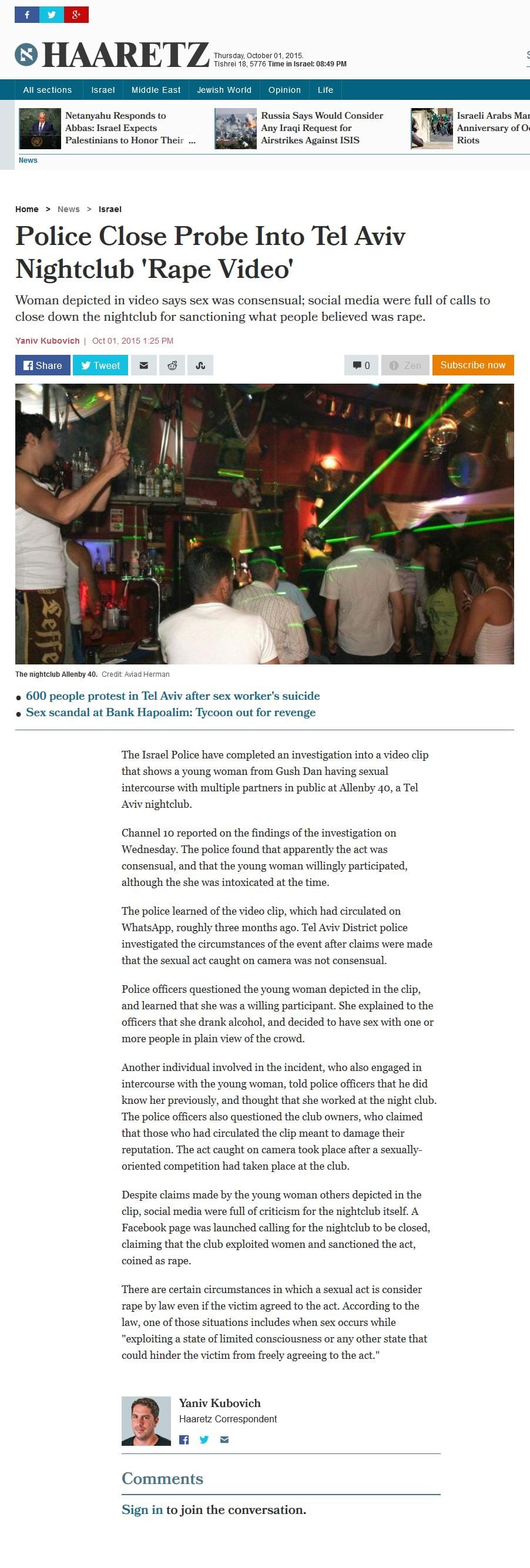
From Haaretz: Israeli Police have completed an investigation into a video clip showing a young woman having sexual intercourse with multiple partners in public at Allenby 40, a frequented Tel Aviv nightclub.
The video clip in question, which was circulated on WhatsApp after the incident occured roughly three months ago, showed a woman having sex with multiple partners in fullview at the Tel Aviv club.
After opening an investigation this summer on the grounds that the sexual act caught on camera may not have been consensual, police discovered that the public intercourse, which took place after an undefined sexually oriented competition in the club, was consensual, and not rape, as some on social media claimed. Upon questioning the young woman from the video, a Gush Dan resident, police discovered that though she was intoxicated at the time, she knowingly and willingly engaged in the act with one or multiple men, Channel 10 reported Wednesday.
One of the men shown in the video told police that he did not know the woman in question, and he thought she worked at the night club.
Despite the fact that the woman says the sex was consensual, social media exploded with criticism of the nightclub. An entire Facebook page was launched solely calling for the nightclub to be closed, claiming that the club exploited women and sanctioned the act, which detractors labeled rape.
Police questioned the club owners, who claimed that those who had circulated the clip meant to damage their reputation.
read more: http://www.haaretz.com/news/israel/.premium-1.678383

7Fh5HIS

From Haaretz in 2005:

Mendy Katan, owner of one of the wildest and most successful nightclubs in Tel Aviv, comes from an ultra-Orthodox family from Kfar Chabad, wears a black skullcap and observes the religious commandments. How does he resolve the contradiction?
By Asaf Carmel

Five and a half years ago, Mendy [Menachem Mendel] Katan tried and failed to pass the selection at the entrance to a club at Allenby 40 in Tel Aviv. “There was a small nightclub there called Dream Dance,” says Katan, “and Omer Efrat, who is now a partner, was working there as a DJ and had invited me to come. The guard at the entrance looked me up and down and saw a guy with a white shirt, black pants and a black kippa [skullcap]. He said to me, `Sorry, but you don’t belong here. You can’t come in.’ At the same time he passed a hand over my head and caressed the kippa. I explained to him that I had only come to visit a friend, but he didn’t even bother to throw another glance in my direction. He only said, `This isn’t the place for you, get a move on.’

“Meanwhile, everyone was looking at me, and I felt as though I had horns. In the end I asked somebody who did go in to approach the DJ and tell him that a guy from Kfar Chabad named Mendy was standing at the door, and they weren’t letting him in. Only after Omer intervened did the guard deign to let me in.” (Kfar Chabad is a village founded by members of the Lubavitch Hasidic sect).

This humiliating experience outside the nightclub had a profound effect on Katan. “I then got it into my head that I had to do something significant in the area of night life. It created a strong drive in me; I felt as though it was me against all of Tel Aviv. Probably if I had removed my kippa they would have let me into the nightclub without any problem, but I swore to myself that I would not take off the kippa just for a beer. The kippa is a value on which I grew up and was educated, and I won’t sell my values in order to enter any bar in the world.”

Posted in Israel, Sex | Comments Off on Tel Aviv Orgy Girl Was Drunk

How Has Cyprus Avoided The Islamic Migrant Stampede?

Link: “A recent article in Reuters sheds some insight on why Cyprus has avoided the fate of the Greek island of Kos, Malta, the Hungarian border, and other EU fringes:

…[A]ccording to a dozen refugees and migrants interviewed this summer, Cyprus’ asylum policies are the main reason they shun that country in favor of southern Europe. In Cyprus last year, only 3 percent of asylum-seekers were granted refugee status, which allows them to live and work legally. Fifty-six percent were granted subsidiary protection, a kind of second-tier international protection with fewer rights than refugee status… Most European countries make little distinction between the two. But in 2014, Cyprus amended its laws so that those who are granted subsidiary protection are not able to bring family members to Cyprus from their home countries or other nations to which they’d escaped — known as the right to family reunification — or to travel freely outside Cyprus. Subsidiary protection also comes with very limited work opportunities — which means those who get it can’t support themselves — and does not protect people from expulsion.

The radical idea that people respond to incentives—such as the enforcement of immigration and refugee laws—and that countries should control who they allow into their borders—like selecting a roommate—are common sense observations that I have touched on before. By making itself less attractive to the Afro-Islamic Völkerwanderung, Cyprus has more or less completely avoided the human biomass of “Syrian refugees” that are invading Central Europe, despite being the closest EU country to Syria. Hmmmm. Must have something to do with enforcing those strict laws. Apparently the wave of migration can be stopped; it doesn’t have to be succumbed to. The deterministic cucking of Germany and Sweden is rooted in fallacious thinking at best. Incentives, goyim. Incentives.”

It just highlights what I and numerous others have been saying for some time now. That the leaders of Germany and Sweden and other Western European countries are insane and incredibly stupid for allowing this refugee tsunami to take place.

BTW does anybody know what the Greek authorities on Lesbos do with those rubber rafts and the pilots who steer them after they arrive on Lesbos? I would hope that they either impound or destroy the rubber rafts and arrest the crew members, but I have a feeling that they allow both to return to Turkey to pick up another load.

Posted in Immigration | Comments Off on How Has Cyprus Avoided The Islamic Migrant Stampede?