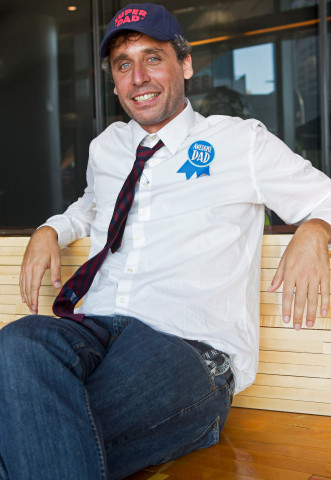
New York Post: On a busy night last week at the Target on Atlantic Avenue in Brooklyn, Ari Nagel, 40, emerged from the men’s bathroom looking a little flushed and quite pleased with himself.
“It’s better when it’s fresh,” he told them.
“It” is Nagel’s semen, and it’s in demand. The 6-foot-2 CUNY Kingsborough math professor has served as a sperm donor for dozens of locals, siring 22 kids over the past 12 years with 18 women of various backgrounds.
For lesbian couples and single ladies looking to have a baby without the expense of going through a sperm bank (which can run in the thousands of dollars), he’s the No. 1 dad.
“This isn’t time-consuming, and I’m doing it anyway,” he says of his hands-on hobby. “It’s very easy for me to do.”
His oldest child, now 12, was conceived with a woman he was in a committed relationship with, but all of his offspring since, he says, have resulted from his donations.
About half the time, he provides his seed the old-fashioned way. Sometimes, a lesbian looking to conceive will have her partner in the bed for moral support while she and Nagel engage in intercourse.
“She’s never slept with a guy before, so the partner’s in bed, holding her hand,” Nagel explains. “Sometimes, it could be a little painful, then after a few times, they’re comfortable to do it on their own.”
Other times, he supplies his goods in a cup, which he prefers…
The prolific professor is often successful, which he attributes to a high sperm count: 85 million per milliliter.
“It’s off the charts,” he boasts. “The clinic said they’ve never seen anything like it.”
(The Mayo Clinic says normal sperm density ranges from 15 million to greater than 200 million sperm per milliliter.)…
And Nagel, who grew up in an Orthodox Jewish family with six siblings, says he gets the benefits of having a large brood without the hassle…
And Nagel’s seed-sowing isn’t a drain on his love life. He doesn’t make a point of mentioning it on dates, but when it comes up, ladies typically don’t mind.
Modal Trigger
Nagel with satisfied customer Shaniece Cromer of The Bronx and her 11-month-old daughter, Taraji.Photo: Shaniece Cromer
“Never underestimate the desperation of a single woman on the Upper West Side,” he says.
But it’s not all sunshine and babies.
The first five women he worked with successfully sued him for child support, and nearly half of his paycheck is garnished for his offspring.
“I don’t know what’s more surprising: that five sued or that 17 didn’t,” Nagel says. “They were all well aware there was no financial obligation on my part. They all promise in advance they won’t sue.”
Posted inJews|Comments Off on Jewish Professor who donates sperm in city bathrooms has sired 22 kids
Delicious! I don’t think macho Mexicans care much for political correctness.
New York Times: The Mexican soccer star Javier Hernández, known as Chicharito, has condemned it in a public service announcement. Hashtags have spread to raise awareness of its offensiveness and to try to put an end to it. And after the massacre in an Orlando nightclub popular with gay Latinos, commentators have urged fans to abandon it once and for all.
But still, as is customary when the Mexican national team is playing in an international tournament, it could be heard: the roar of “Eeeh … puto!” by Mexican fans trying to distract the opposing goalkeeper punting the ball upfield.
“Puto,” roughly translated as “male prostitute,” is a slur often hurled at gay men in Mexico, but fans who chant it say they use it out of the more generalized meaning of “coward” (or, in the adjective form, simply an unpleasant thing).
On Monday, two days after a gunman killed 49 people in Orlando, Fla., including at least four Mexican nationals, the chant could be heard during Mexico’s match against Venezuela in Houston during the Copa América regional tournament, being held in the United States for the first time.
Some people even believe they heard it chanted with a little more gusto, as if in defiance over the criticism of the term.
Mexico’s national team was fined $20,700 in January by FIFA, the world soccer body, over fans’ use of the chant in a World Cup qualifying game against El Salvador in November. In theory, FIFA could move to take away points in the World Cup standings, which could derail the team’s advancement to the 2018 finals.
On Thursday, without mentioning Mexico, Concacaf, the governing body for soccer in North and Central America and the Caribbean, issued a statement denouncing “chants or actions that are derogatory or offensive” and said that “they must be stopped.” It did not mention what action, if any, it would take.
Mexico next plays on Saturday night in a Copa América quarterfinal match against Chile at Levi’s Stadium in Santa Clara, Calif.
In Mexico, the chant is largely seen as much ado about nothing, and penalizing the team over it a sign of political correctness.
Luis Fernando Lara, the editor of the Diccionario del español de Mexico (Dictionary of Mexican Spanish), said in an interview that the word derives from a Latin root that means “child.” In its feminine form, it came to mean “prostitute,” and its male form took that meaning as well, particularly in the gay community. It evolved to mean “coward” or “scaredy-cat.”
In soccer matches, he said, it is intended simply to insult the goalkeeper, not to call him gay.
* From a political perspective, the liberal left is very impressive in its ability to monopolise minority political discourse. Little or nothing gets said by a woman, gay, black, lesbian, trannie etc without official approval from rainbow coalition central. For example, only about one in ten white women are strongly left wing, yet the liberal left has made itself the political go to group on women’s issues. Similarly, you almost never here a black person say anything critical about immigration, even though its likely that the majority of black people are immigration restrictionists. About the only group the liberal left truly represents is androgynous Jews. My gut instinct tells me about 60 percent of androgynous Jews are hard left.
* I was a university student during the tail end of the formative years of political correctness (think of the 1994 movie PCU), and we always shrugged and figured, oh well, at least when these people get out in the real world, they will be unequipped to thrive.
Unfortunately that may not be the case. This was before the days of Twitter mobs, extreme SJW mentality in all aspects of popular culture, and the regular occurrence of people losing their jobs for their transgressions.
We now have a whole generation of corporate managers — led by HR, the front line infantry who secured the cultural beachhead inside most large organizations — who continue to acquiesce to, accommodate, and coddle the aggrieved just like campus administrators do. So there are few sectors of the economy left that are true meritocracies.
Life seems to be plenty comfortable on the outside for the “dissed” crowd now.
* There is a myopia in the grievance world that prevents the participants from seeing the impacts of their selfish acts. If they all pursue their program actions separately to kill the goose, who will give them any golden eggs? They don’t appear to understand, or care, that nobody else will produce for them without a literal or figurative gun to their head.
Rewatch Idiocracy and count how many predictions have come true, or are well on the way to coming true.
* PBS NewsHour did a segment this week on San Francisco’s elite Lowell High School. Blacks are complaining about being 2 percent of the school despite, according to the report, San Francisco only being 4 percent black. The Asians are assisting them in their victimhood. The Japanese principal says maybe the school shouldn’t require such high test scores and grades for entry (read: blacks are stupid).”
In that segment, they say Lowell has very few People Of Color even though 58 percent of the student body is Asian. I wonder if Asians feel offended when Blacks exclude them from the People Of Color label?
Also since Blacks at Lowell feel uncomfortable being racially outnumbered by Asians, wouldn’t that make them racist against Asians? Can you imagine if a White student said he or she felt racially uncomfortable at Lowell?
* There’s probably some political daylight that would allow a popular anti-affirmative action movement to grow, maybe by linking it to other corrupt hiring practices, but time and money requirements would make it a slog. We’re stuck, as far as I can tell, with the idea that the cure for the occasional de facto anti-Black racism and misogyny of the past is permanent, de jure anti-White racism and misandry extending indefinitely.
* PC ideology is a white creation. Blacks create no ideologies but simply go with those that promise them more. Most all of this catering to the fringes is just moral blackmailing of the majority. They’re able to make noise and carry picket signs but that’s about it. It’s not that they’re strong but rather that we’re weak and deliberately so. When the white population gets tired of being bullied it’ll end.
* I was saying exactly the same thing 25 years ago, when I was an 11-year-old junior high school student exposed to the full brunt of the PC theology for the first time. It was obvious to me, even at that young age, that political correctness was no reality-based philosophy, but merely a conceit of those with axes to grind, who found in it a ready-made cache of rallying catchwords and handy weapons with which to pry at the joints of functioning society. It’s not even about the money; pecuniary interests are not the primary driver of this. It’s really about hatred and egotism and affect compensation.
The real heroes of this day and age are the people who aren’t “successful” by the gaudy, materialistic standards of the culture, but who still refuse to play the victimology card or cannibalize the public weal—the honest small potatoes. These are the “poor” to whom Jesus refers to in the Beatitudes, along with anyone else who suffers honorably and unjustly, and not the rampaging canaille with their EBT cards, Affirmative Action, and safe spaces. The latter are simply low-grade pirates aided and abetted by cuckolded SJWs.
* Jonathan Haidt writes: Universities are among the most progressive and anti-racist institutions in American society. Many Americans therefore found it confusing to see dozens of our top universities racked by racial protests since last September. To add to the puzzle, many of the most high-profile actions occurred at universities widely perceived to be the most devoted to social justice and racial equality -– schools such as Brown, Yale, Amherst, Wesleyan, and Oberlin. (Every one of these schools earned a red or yellow light from the Intercollegiate Studies Institute, indicating schools that are not recommended for conservative students.) What is going on?
A simple resolution of the puzzle is the hypothesis that the anti-racist policies these schools pursue give rise, indirectly, to experiences of marginalization for black students. Lee Jussim and I suggested this hypothesis in an essay last Saturday in the Wall Street Journal. We noted that we support affirmative action in general – taking vigorous steps to increase the recruitment, training, retention, and ultimate success of black students. But we raised concerns about the most controversial element of affirmative action: the use of racial preferences in admissions. Here is the key passage:
But as practiced in most of the top American universities, affirmative action also involves using different admissions standards for applicants of different races, which automatically creates differences in academic readiness and achievement. Although these gaps vary from college to college, studies have found that Asian students enter with combined math/verbal SAT scores on the order of 80 points higher than white students and 200 points higher than black students. A similar pattern occurs for high-school grades. These differences are large, and they matter: High-school grades and SAT scores predict later success as measured by college grades and graduation rates.
As a result of these disparate admissions standards, many students spend four years in a social environment where race conveys useful information about the academic capacity of their peers. People notice useful social cues, and one of the strongest causes of stereotypes is exposure to real group differences. If a school commits to doubling the number of black students, it will have to reach deeper into its pool of black applicants, admitting those with weaker qualifications, particularly if most other schools are doing the same thing. This is likely to make racial gaps larger, which would strengthen the negative stereotypes that students of color find when they arrive on campus.
We also analyzed other policies widely used on campus that seem, on the basis of current evidence, to be likely to backfire and exacerbate racial conflict and grievance: creating “ethnic enclaves” such as identity studies centers and departments, and diversity training, particularly if it discusses “microaggressions.”
As that essay was going to press, Heterodox Academy member Amy Wax sent us the text of an astonishing letter written in 1969, at the dawn of racial preferences, from Macklin Fleming, Justice of the California Court of Appeal. Judge Fleming had written a personal letter to Louis Pollak, the dean of Yale Law School. Fleming was concerned about the plan Dean Pollak had recently announced under which Yale would essentially implement a racial quota – 10% of each entering class would be composed of black students. To achieve this goal, Yale had just admitted 43 black students, only five of whom had qualified under their normal standards. (The exchange of letters was later made public with the consent of both parties; you can read the full text of both letters here.)
Judge Fleming explained why he believed this new policy was a dangerous experiment that was likely to cause harmful stereotypes, rather than reduce them. His argument is essentially the one that Jussim and I made 47 years later. Here is what he wrote:
The immediate damage to the standards of Yale Law School needs no elaboration. But beyond this, it seems to me the admission policy adopted by the Law School faculty will serve to perpetuate the very ideas and prejudices it is designed to combat. If in a given class the great majority of the black students are at the bottom of the class, this factor is bound to instill, unconsciously at least, some sense of intellectual superiority among the white students and some sense of intellectual inferiority among the black students. Such a pairing in the same school of the brightest white students in the country with black students of mediocre academic qualifications is social experiment with loaded dice and a stacked deck. The faculty can talk around the clock about disadvantaged background, and it can excuse inferior performance because of poverty, environment, inadequate cultural tradition, lack of educational opportunity, etc. The fact remains that black and white students will be exposed to each other under circumstances in which demonstrated intellectual superiority rests with the whites.
But Judge Fleming went much further. He made specific predictions about what the new policy would do to black students over the years, and how they would react. Here is his prophecy:
No one can be expected to accept an inferior status willingly. The black students, unable to compete on even terms in the study of law, inevitably will seek other means to achieve recognition and self-expression. This is likely to take two forms. First, agitation to change the environment from one in which they are unable to compete to one in which they can. Demands will be made for elimination of competition, reduction in standards of performance, adoption of courses of study which do not require intensive legal analysis, and recognition for academic credit of sociological activities which have only an indirect relationship to legal training. Second, it seems probable that this group will seek personal satisfaction and public recognition by aggressive conduct, which, although ostensibly directed at external injustices and problems, will in fact be primarily motivated by the psychological needs of the members of the group to overcome feelings of inferiority caused by lack of success in their studies. Since the common denominator of the group of students with lower qualifications is one of race this aggressive expression will undoubtedly take the form of racial demands–the employment of faculty on the basis of race, a marking system based on race, the establishment of a black curriculum and a black law journal, an increase in black financial aid, and a rule against expulsion of black students who fail to satisfy minimum academic standards.
If you read Judge Fleming’s predictions after watching the videos of student protests, and then reading the lists of demands posted at TheDemands.org, the match is uncanny. And if you look at the way Brown University responded to these demands (to take one of the most detailed responses), you can see a university doubling down. Brown’s response does many things right — it offers creative ideas for enhanced outreach, recruitment, and mentoring of potential faculty and students from under represented groups; it aims to discover and remove obstacles to their success; and it calls for enhanced data collection to keep track of progress. But it also commits Brown to achieving very large increases in the total number of black faculty, graduate students, and undergraduates, and it is clear (and explicit for its medical school) that much of this increase will be accomplished by increasing the size of racial preferences. In addition, the report calls for expanding ethnic enclaves (e.g., “expanding research centers focused on issues of race, ethnicity, and social justice”); expanding diversity training that, while not mandatory, would be strongly encouraged (e.g., department heads would be held accountable for getting their numbers up); and greatly increasing the importance and visibility of race as a focal topic on campus and in the curriculum (e.g., “Double the number of first-year and sophomore seminars related to issues of power, privilege, inequality, and social justice.”) These additional steps are all things that Jussim and I concluded are likely to do no good, and that might make things worse. (See Conor Friedersdorf’s analysis of the Brown plan at The Atlantic.)
I close with two short excerpts from Judge Fleming’s extraordinary letter:
The American creed, one that Yale has proudly espoused, holds that an American should be judged as an individual and not as a member of a group. To me it seems axiomatic that a system which ignores this creed and introduces the factor of race in the selection of students for a professional school is inherently malignant, no matter how high-minded the purpose nor how benign the motives of those making the selection….
The present policy of admitting students on two bases and thereafter purporting to judge their performance on one basis is a highly explosive sociological experiment almost certain to achieve undesirable results.
Nearly all selective American universities have engaged in this “explosive sociological experiment” for more than 40 years, and things have played out largely as Judge Fleming predicted. The experiment may have helped black students in some ways, but it seems to have harmed them in other ways. We cannot evaluate the net effect of the experiment because social scientists are generally reluctant to talk about the downsides of affirmative action. (The fear of discussing politically unpopular hypotheses is a problem we are trying to fix at Heterodox Academy.)
And so the experiment continues, and it is likely to continue for many more decades unless the Supreme Court intervenes. Black students are (at least in some ways) the victims of the experiment. And in response to their legitimate anger, universities will now intensify their commitment to the experiment.
What’s the alternative? In our WSJ article, Jussim and I praised the US Army for the principled way that it addressed its severe racism problem in the 1970s by implementing affirmative action without racial preferences. (See this brief summary of Moskos & Butler, 1996, All That We Can Be: Racial Integration the Army Way.)
Let us hope that a few bold university presidents break from the pack, break the cycle, and try a different approach.
* Totally OT, but has anyone else noticed the almost complete blackout in the press regarding the accused in the rape and murder of an Okinawa woman by a contractor for the U.S. military? Most articles don’t even mention his name, and even fewer show his picture. This murder has set off an international incident and once again compromised the U.S. base on Okinawa, but somehow the perp is irrelevant.
His name is Kenneth Shinzato, and if Obama had a son…
The mismatch effect happens when a school extends to a student such a large admissions preference — sometimes because of a student’s athletic prowess or legacy connection to the school, but usually because of the student’s race — that the student finds himself in a class where he has weaker academic preparation than nearly all of his classmates. The student who would flourish at, say, Wake Forest or the University of Richmond, instead finds himself at Duke, where the professors are not teaching at a pace designed for him — they are teaching to the “middle” of the class, introducing terms and concepts at a speed that is unnerving even to the best-prepared student.
The student who is underprepared relative to others in that class falls behind from the start and becomes increasingly lost as the professor and his classmates race ahead. His grades on his first exams or papers put him at the bottom of the class. Worse, the experience may well induce panic and self-doubt, making learning even harder.
When explaining to friends how academic mismatch works, we sometimes say: Think back to high school and recall a subject at which you did fine but did not excel. Suppose you had suddenly been transferred into an advanced class in that subject with a friend who was about at your level and 18 other students who excelled in the subject and had already taken the intermediate course you just skipped. You would, in all likelihood, soon be struggling to keep up. The teacher might give you some extra attention but, in class, would be focusing on the median student, not you and your friend, and would probably be covering the material at what, to you, was a bewildering pace.
Wouldn’t you have quickly fallen behind and then continued to fall farther and farther behind as the school year progressed? Now assume that you and the friend who joined you at the bottom of that class were both black and everyone else was Asian or white. How would that have felt? Might you have imagined that this could reinforce in the minds of your classmates the stereotype that blacks are weak students?
According to this article, “About half of black college students rank in the bottom 20 percent of their classes (and the bottom 10 percent in law school).”
And remember that weak students tend to take easy classes. If all undergrads took the same classes, the ranking of black undergrads would be more like the situation in laws schools.
At most American colleges and universities, the black students are a tribe of village idiots, relative to the other students. It’s no fun being a village idiot.
Posted inAmerica|Comments Off on Dennis Dale: Mediocrity and Its Discontents
Washington Post: After doubling down on his proposal to ban immigrants from countries with a history of terrorism, Donald Trump is now doubling down on another controversial idea in the wake of the Orlando massacre: profiling Muslims already in the United States.
In an interview with CBS’s John Dickerson that aired Sunday on “Face the Nation,” Trump called profiling Muslims “common sense.”
“Well, I think profiling is something that we’re going to have to start thinking about as a country,” he said when Dickerson asked Trump whether he still supports the idea, which he has floated before. “And other countries do it; you look at Israel and you look at others and they do it and they do it successfully. You know, I hate the concept of profiling. But we have to start using common sense, and we have to use, you know, we have to use our heads…we really have to look at profiling. We have to look at it seriously.”
In the wake of the San Bernardino, Calif., shooting in December, Trump first indicated that he would support profiling Muslims — if neighbors or relatives seemed suspicious.
“Well, I think there can be profiling,” he told Dickerson at the time. “If they thought there was something wrong with that group and they saw what was happening, and they didn’t want to call the police because they didn’t want to be profiling, I think that’s pretty bad.”
In the interview that aired Sunday, Trump appeared to indicate that he would support broader profiling of Muslims. He appeared to suggest, for example, that ethnic profiling could be useful at his political rallies to keep people safe:
“People that obviously had no guns, no weapons, didn’t know anything and they were going through screening and they were going through the same, the same, you know, scrutiny. The absolute same scrutiny as somebody else that looked like it could have been a possible person. So we really have to look at profiling.”
Posted inIslam|Comments Off on WP: Donald Trump calls profiling Muslims ‘common sense’
I agree that it is silly to expect individuals and societies to transcend race. Race is as fundamental as sex. You can no more change your race than you can change your sex.
Most of the time, most people are going to prefer their own kind. The more races and religions in a society, the more divided and weak it is. The more homogenous a white or asian country, the stronger.
Blacks, with few exceptions, will always feel like outsiders in first world countries, just as gentiles will always feel second-class in a Jewish state, and whites will feel weird in a black state and non-Japanese will feel like strangers in a Japanese state.
Simpson’s story is that of a black man who came of age during the civil rights era and spent his entire adult life trying to “transcend race” — to claim that strange accolade bestowed on blacks spanning from Pelé to Prince to Nelson Mandela to Muhammad Ali. Which is to say, it’s the story of a halfback trying, and failing, to outrun his own blackness.
This country was built on the backs of black slaves whose lives and labor were stolen by their white masters. That theft created a caste system in which both groups of people could occupy the same spaces yet have completely different experiences: a white America and a black America. This was true in 1619, in 1865 and in 1947, when Simpson was born; it holds true today.
Yet there are a few blacks — the most singular and spectacular among us — who have unique and priceless gifts to offer. Racial transcendence happens when white America takes these gifts for itself, in exchange for acceptance within white culture. It is the mechanism through which whites acknowledge the humanity of black superhumans and which allows these few to move, supposedly, beyond blackness, their talents granting them safe passage through white spaces, mouths and memories. Every black person, successful or not, has to overcome a steep handicap; the idea of racial transcendence is anchored in the fallacy that the handicap is blackness itself, rather than a society that terrorizes and undermines blacks at every turn.
Racial transcendence is a lie, but it’s one that Simpson believed in deeply. In the first installment of “O. J.: Made in America,” a sociologist and activist named Dr. Harry Edwards describes his efforts to recruit Simpson into a collective of black athletes working for civil rights in the late 1960s — people like Muhammad Ali, Lew Alcindor (later Kareem Abdul-Jabbar), Jim Brown and the Olympic sprinters Tommie Smith and John Carlos, who raised their fists in a black-power salute at the 1968 Olympics.
Simpson refused. After just one season at the University of Southern California, it was obvious that he was a priceless talent. It wasn’t just that he was stronger and faster than everyone else was; Simpson ran almost daintily, tiptoeing through seams visible only to him, leaving defenders diving at air. He had emerged from nowhere, fully formed, already one of the best college running backs of all time and already more famous than most of the athletes in Edwards’s collective.
“His response,” Edwards remembers in the documentary, “was, ‘I’m not black, I’m O. J.’ ” In 1968, the same year Martin Luther King Jr. was assassinated, Simpson believed he could escape race in America.
Posted inBlacks|Comments Off on NYT: Why ‘Transcending Race’ Is a Lie
Los Angeles Times: Pastor Roger Jimenez touched off a firestorm of controversy after he posted a YouTube video of his sermon in which he praised the June 11 massacre of 49 people and called the victims pedophiles and predators.
“I think Orlando, Fla., is a little safer tonight,” he told his congregation, equating members of the lesbian, gay, bisexual, and transgender community to sexual predators. “The tragedy is more of them didn’t die…. I’m kind of upset he didn’t finish the job!”
Jimenez also said if it were up to him, gays and lesbians would be lined up against a wall so a firing squad could “blow their brains out.”
The video, which has since been removed, triggered backlash against the church and pastor from religious leaders and the LGBT community.
Sacramento Mayor Kevin Johnson condemned Jimenez’s statements and a group of 700 area pastors known as the Sacramento City Pastors Fellowship issued a statement to denounce the pastor’s comments.
Posted inChristianity|Comments Off on Pastor Praises Gay Massacre
1 Samuel said to Saul, “I am the one the LORD sent to anoint you king over his people Israel; so listen now to the message from the LORD.
2 This is what the LORD Almighty says: ‘I will punish the Amalekites for what they did to Israel when they waylaid them as they came up from Egypt.
3 Now go, attack the Amalekites and totally destroy all that belongs to them. Do not spare them; put to death men and women, children and infants, cattle and sheep, camels and donkeys.’ ”
Posted inBible, Genocide|Comments Off on Chaim Amalek: Shouldn’t there be a Holocaust Remembrance Day for the lost people of Amalek?
It’s a hot night in Los Angeles. Around 1 a.m. Sunday, I give up trying to sleep and watch the fifth and final installment of this superb ESPN documentary series.
I spent most of the previous six years in bed afflicted with what doctors called “Chronic Fatigue Syndrome.” Through the medication Nardil, I made a partial recovery. As long as I did not exert myself, I had about two-thirds of my normal health and could largely function normally. I was registered to return to UCLA in the fall but I dreaded going back to the study regime where I had gotten so very sick in 1988 and never quite recovered. I also feared I could no longer hack it. I didn’t feel strong enough to tackle anything difficult. I needed to stay on easy street for a while.
I had several primal drives that year, perhaps none bigger than my desire to get some lovin’. Within three days of landing in LA, I was meeting women in shul and at Passover tables. I then placed a singles ad and met a Julia Roberts lookalike movie editor for a couple of passionate dates. I also hooked up with a girl from my dorm floor at UCLA 1988-89, the one I’d fantasized about for six lonely years. I was her first and it was absolutely awful.
I reunited with my UCLA girlfriend for a couple of evenings and when I didn’t have a real girl, I enjoyed Jules’s video porn collection.
During my first week in LA, Jules padded into my room one night, excited by my tales of my torrid dating life, and on his knees, asked me if I wanted a blowjob. I said no. He asked me if I was sure. I said, yes, I am sure [I don’t want a blowjob from him].
Our friendship was never the same after that. In May, he asked me to move out by June 15. He said he considered allowing me to stay with him longer but I was not a considerate roommate. I left dirty dishes in the sink and made long distance phone calls without asking permission (though I made sure to let him know afterward and to pay him promptly when his phone bill came in).
Memorial Day weekend, an heiress about five years my senior, flew in from New York and stayed with me for me for three days (that Saturday, May 28, I turned 28 and we went to the Mountaintop Minyan that morning at Stephen S. Wise temple). In August, she paid for me to fly to New York to stay with her for three weeks on Manhattan’s Upper West Side and she took me to Broadway shows and gave me spending money every day. I had virtually no money of my own (except for what I earned as a non-union extra in movies and TV).
Beginning in the fall of 1988, I became a devotee of Dennis Prager. Now in 1994, I listened to him on KABC radio every weekday and saw him at Stephen S. Wise temple most Saturday mornings. Most of my new friends in LA were people I knew in common with Dennis.
Nicole Simpson and Ron Goldman were murdered June 12 while I slept a couple of miles east in Westwood.
When I got up Monday morning, June 13, 1994, and turned on the radio, KABC was filled with reports of O.J. Simpson flying back from Chicago and police detectives wanted to interview him about the murders of his ex-wife Nicole and a waiter named Ron Goldman.
I learned from friends that Ron was Jewish.
I had no feelings about OJ. His football heyday was before I began paying attention. The news event did not seem any more important to me than any other murder except that it took place near me.
On his radio show, Dennis Prager refused to talk about OJ. He said the case had no great significance. He wouldn’t lower himself to gossip. Prager was my mentor, the things he said made sense, so I paid as little attention to the case as I could. I didn’t read articles about it. I didn’t watch news about it. I didn’t discuss it. I despised gossip. I was bigger than that.
In some ways, Dennis Prager was a good influence on me, and in other ways, he was a bad influence. In this case, he was a fool. In my fervent Pragerism of the time, I was not well served by trying to ignore reality (such as uncomfortable racial differences, which, to his credit, Prager acknowledged more than any other talkshow host I knew).
Earlier this year, I watched the ten-part FX series on OJ Simpson and was fascinated. I felt stupid for trying to ignore the case when it was going on.
My primary concern that first week of the OJ murders was where I was going to live now that I had to move out by Wednesday, June 15, 1994. I decided to take the easy way out and live out of my car. Surely something better would turn up. I was the type of guy who was doomed to rely on the kindness of strangers (aka women I was bedding). Jules said I could collect my mail from his place and come by daily to shower.
The World Cup of soccer was going on in Southern California. I was excited about rejoining life after six years on the sick bed. I loved soccer. I loved LA. I loved sliding inside woman after woman after woman. I was idolizing Dennis Prager and going to every Jewish event I could. I was applying for acting and modeling work, taking background parts for a little money, and I had an agent sending me out for auditions. I was weak and scared and broke. I loved LA. I had loved it since I discovered MTV in 1982 and saw all the pretty Southern California girls in music videos. Now I was having a good time with the girls and nothing in the world was sweeter to me than those varied connections. For an hour or two at a time, they made me feel whole.
With summer beginning June 21, my life oscillated from extremes of pleasure and excitement in the big city to feelings of genuine satisfaction from the community and substitute family I developed in the Jewish community to the desperation of my poverty and poor health and my frustration with the unnecessary turbulence I created with some people around me. Dennis Prager, as with most people I met that year, like me, but he also kept his distance. They could tell there was something unusual about me, something not quite right.
I spent my first night ever sleeping in my car Wednesday, June 15. It turned out not to be a big deal. I showered at Dr. Zentner’s place Thursday and Friday morning. Friday afternoon, as I listened to KABC radio, O.J. Simpson was dominating the news. He had not turned himself in as agreed.
I loved living in the middle of where things were happening. That made me feel important. All the TV channels were showing his white Bronco going down the freeway (from that point on, I had no doubt about his guilt) and there was a big basketball game that evening between the New York Knicks and the Houston Rockets. My primary attention was on the singles get-together that night at Mogen David synagogue on Pico Blvd.
I loved it that the Jews I knew weren’t so religious that we couldn’t talk about news and sports and anything else we wanted on the Sabbath. I was developing a relationship at the time with a UCLA nurse about five years older than me. We would last about three months, but what our thing lacked in length it made up for in intensity. It also gave me a nice place to stay that was Beverly Hills adjacent near the library. Much better than living out of my car.
When we ended in late September, I borrowed $500 to pay the mechanic and get my car out of his shop so I’d have a place to sleep. I paid her back a month later.
What I’m trying to say is that when I watch this ESPN documentary on OJ Simpson, I remember living right next door to where this was happening and I feel like I understand many of OJ’s troubles such as his sex addiction, his desire to pull himself up from nothing to get ahead and to get along and to do well in polite society and to be loved and adored and to hone your manipulative skills to get a maximum of that, to be worshiped as a god even while your body and mind are failing you, but somehow no matter how much you get what you want, your life doesn’t work, and you get flooded by blinding all-consuming jealous rages and you do stupid things. I felt those same things at that time. I too lived in the midst of plenty, got a lot, more than I ever would again, and yet the highs didn’t last as long as the lows and the fundamentals of my life didn’t build towards something holy.
Like OJ, I was a lousy actor.
Usually when I watch something, I try to imagine that that’s me on the screen and I think about how I would handle myself in that situation. Perhaps only narcissists do this?
As I ricocheted from woman to woman in my first 18 months in LA (my promiscuity ended when I decided in September of 1995 to write a book on the porn industry, I think the subject drove me to be more religious and conservative in my private life to maintain my sanity), I maintained certain basic ethical standards such as no cheating, no married women, no drugs, no unsafe sex, no getting anyone pregnant, no lying and deception. Despite my morals, I felt myself being pulled into a quicksand around sex. I despaired that I would ever be able to say no to a sexual exchange with a pretty woman even if it violated everything I held sacred.
When I did intimate things with a woman, I quickly developed intimate feelings, and I viscerally understood why people kill over this stuff. By sleeping around, I was playing with fire. When I thought a woman belonged to me and then she got with another guy, I felt sick to my stomach. When women teased me but didn’t please me, I felt rage.
I’ve never hit a woman, never gotten close, I can’t even spank them the way some of them want to be spanked. But even a beta male like me can feel things like jealousy and rage and try to sublimate through promiscuity.
Because of my illness, I didn’t leave home until the summer of 1993 and it was only in the beginning of 1994 that I regained enough strength to lead two-thirds of a normal life.
When the largely black jury acquitted OJ of murder on October 3, 1995, I realized that blacks and whites saw the world very differently. I realized that blacks would side with blacks even when they murdered people. I didn’t want to think this way. Influenced by Dennis Prager, I wanted to divide the world between the moral and the immoral, not between black and white. I wanted values to be most important, not skin color. With the OJ verdict, however, reality splintered my prefered worldview.
In the fall of 1995, I began borrowing computers from friends, and I started writing my book. My life as I know it today, however, didn’t begin until I bought myself a proper PC for about a $1000 on July 3, 1997, and connected to the internet and began to blog within an hour of getting home.
The original score for this ESPN documentary is gorgeous. It embodies why I want to live in LA. I don’t know how to write musical criticism, but when I listen to this theme, when I hear it soar, it makes me feel that LA is the place for me, that it’s the place where I will get to feel what I want to feel. This is the city where I will become a hero.
I am rewatching the series. It begins with OJ saying that growing up, the thing he wanted most was fame. Ditto.
He talks about his humiliating work in jail as a porter and janitor. Boy, do I identify with that. I have lived my life dreaming about grandeur while in reality I swallowed constant humiliation.
When I put myself in his shoes, I feel bad for him. There is nothing that is human that is foreign to me. Is it wrong for a person to feel empathy with a murderer? No. Feelings can never be wrong. You’re not a bad person for having feelings. You’re only a bad person if you do bad things that outweigh the good you do.
So what if this documentary was about Hitler? I watched Downfall (2004) about Hitler’s last days and I felt empathy for Hitler. Watching that movie, I felt like I understood him a little bit.
I don’t think anybody views themselves as a bad person.
From the perspective of the universe, there are no good guys and bad guys. There are just forms of life struggling for survival. Only when we see things through the lens of faith are we able to distinguish good from evil. I have faith and I have belief in God and in objective good and evil, but sometimes I like to step away from that and just look at life as war without any good guys and bad guys. I think this is called realism. In real life, the good guys don’t win more than the bad guys. In real life, who’s good and bad depends upon your perspective.
There are thousands of stories of charming black men who turn out to be murderers. The Australian one is called The Chant of Jimmy Blacksmith. Only whites who want to believe that race is not real are surprised.
What do you think Father’s Day is like on an aboriginal reservation? Do you think it’s a big holiday in Africa?
Do I lack a life? I’m now watching the OJ Simpson documentary for the second time. I wish someone could explain the theme music to me. It feels like something out LA noire. It makes my heart ache with love for this city.
The documentary features a lot of professional blacks, including ones so pale that they could pass for white, such as Danny Bakewell and Walter Mosley (who also identifies as Jewish).
Like Barack Obama, these guys identify as “black” because it gives them an advantage.
According to the doco, the population of blacks in Los Angeles went up 600% between 1940 and 1960 while other groups merely went up 100%.
Mosley: “The hope is that all the troubles I’ve known will be gone. I will no longer be held down by this notion held against my skin and my hair.”
What notion? That race is real? That blacks on their own are incapable of first world civilization? That blacks everywhere in the world have crime rates many times higher than that of whites and East Asians? How many people would like to ride a 100-story elevator exclusively designed and built by dark-skinned blacks? That’s as ridiculous as expecting a white guy to start at cornerback in the NFL.
Bernard Parks, the former black chief of the LAPD, notes that Chief Parker transformed the LAPD into non-corrupt agency.
Parks: “Everything in the police academy and command structure was white.”
Gee, I wonder if that had anything to do with the LAPD’s efficiency? As the LAPD has become more diverse, it has become more corrupt. The more affirmative action it institutes, the more corrupt and incompetent the cops.
When there’s corruption and brutality in the LAPD these days, smart observers immediately suspect the affirmative action latino officers.
The more diverse an institution, the weaker and more divided it is likely to be. A homogenous white or East Asian police force is much more likely to be honest and upstanding than a force with lots of affirmative action hires.
OJ’s USC teammate Fred Khasigian: “USC controls TV, Hollywood, banking, finance, law, medicine, in Los Angeles. The alumni are very powerful and their whole existence revolves around the success of the football team.”
Dumb goy. It’s not USC that controls “TV, Hollywood, banking, finance, law, medicine.”
"This guy knows all the gossip, the ins and outs, the lashon hara of the Orthodox world. He’s an [expert] in... all the inner workings of the Orthodox world." (Rabbi Aaron Rakeffet-Rothkoff)