Deliberative Democratic Theory and Empirical Political Science

Harvard Political Science professor Dennis F. Thompson writes in 2008:

* Citizens and their representatives are expected to justify the laws they would impose on one another by giving reasons for their political claims and responding to others’ reasons in return.

* The most insistently skeptical work in this mode is Hibbing & Theiss-Morse’s Stealth Democracy (2002). Reviewing the results of their own focus groups and other studies of discussion in settings they consider deliberative, they argue that “real life deliberation can fan emotions unproductively, can exacerbate rather than diminish power differentials among those deliberating, can make people feel frustrated with the system
that made them deliberate, is ill-suited to many issues and can lead to worse decisions than would have occurred if no deliberation had taken place”

* In a survey of French citizens about government assistance for the unemployed, Jackman & Sniderman (2006) found that deliberation does not lead to “better grounded judgments—that is, judgments that reflect one’s considered view of the best course of action all in all” (p. 272). Deliberation leads “many people to ideologically inconsistent positions.” A study of discussions about race in five town meetings in New Jersey
(Mendelberg & Oleske 2000) found that in the integrated meetings (which had the diversity that deliberative democrats seek) the deliberation failed to lessen conflict, increase mutual understanding and tolerance, or reduce the use of group-interested arguments. The meetings with all white participants produced consensus, but consensus against school integration—not the result that deliberative democrats presumably favor.

* The objection prompted by these studies—that deliberative theory is not realistic—has never impressed normative theorists.

* When confronted with findings that seem to confute his theory, Habermas is unfazed. He reads the “contradicting data as indicators of contingent constraints that deserve serious inquiry and. . .as detectors for the discovery of specific causes for existing lacks of legitimacy” (Habermas 2006, p. 420). His article is pointedly subtitled “the impact of normative theory on empirical research.” It implicitly relegates empirical research to the job of being merely a helping hand. In that role, it poses no risk of becoming a disruptive voice in the deliberative project.

* Groups such as juries that are charged with reaching consequential decisions often polarize…

* The most systematic study of the capacity of deliberation to produce just outcomes in actual political settings finds no significant relationship between the quality of the discourse (as measured by the index cited above) and weak egalitarian decisions (as indicated by the extent to which they help the least well off). The outcomes seem to be best explained by the pre-existing preferences of the majority, which may suggest that the distribution of power has a greater effect than the quality of the reasoning.

* In many cases, politicians who deliberate in private are more inclined to make candid arguments, recognize complexities, and offer concessions (see Chambers 2004, 2005). Moreover, even if private discussions present more opportunities for capture by special interests and for collusion among parties against the public interest, greater transparency often does not help, simply because most citizens do not pay attention…

* Publicity can promote (a) rationality—justifying one’s beliefs, articulating premises and conclusions, taking account of opposing points of view; (b) generality—appealing to the common good or the general interest; and (c) plebiscitary reason—appealing to what seems to be the common good, but with “shallow, poorly reasoned pandering to the worst we have in common” (p. 260). Public forums, she suspects, are more prone to irrationality and plebiscitary reason, whereas private discussions are more vulnerable to capture by special interests and may not even avoid plebiscitary reason completely…

* Deliberation is less successful when opinion is extremely polarized, as on the question of abortion. But for many other important issues, institutional conditions are significant. Among the conditions favorable to deliberation are coalition cabinets, multiparty systems, proportional representation, veto provisions,
and second-chamber debates.

* Some cultural consensus on the value of settling disputes by mutual accommodation is probably necessary. That would suggest deliberation is not possible in segmented societies and in many international disputes, where the parties are divided by deep cultural differences about how to deal with fundamental disagreements.

* The benefits of deliberation are presumed to go together: As citizens engage in deliberation, they learn more about the issues, gain respect for opposing views, employ more public-spirited arguments, and so on. Or if citizens fail to deliberate, they learn less, disrespect more, pursue self-interested goals, and so on. We miss the complexity and power of deliberative democracy if we do not recognize the possibility that its elements may conflict with one another, that not all the goods it promises can be secured at the same time, and that we have to make hard choices among them.

* the more citizens discuss politics with people whose views differ from theirs, the less likely they are to engage in political activity (pp.˜89–124). The more they deliberate, the less they participate. The moderate attitudes encouraged by deliberation weaken some of the most powerful incentives to participate. Opponents seem less like enemies; mobilizing to bring about their defeat seems less urgent. Unlike citizens who talk mostly with like-minded compatriots, deliberating citizens find themselves cross-pressured, and their views challenged rather than reinforced.

* Consensus systems (grand coalitions, multi-party structures, veto powers) tend to produce better deliberation than competitive systems, but at the cost of less transparency in policy making and less accountability of officials…

* how to incorporate the need for expertise and technical administration in a deliberative democracy….

Posted in Politics | Comments Off on Deliberative Democratic Theory and Empirical Political Science

Rabbi Shlomo Einhorn’s New Learning Systems For Torah

I’ve learned to my chagrin over the past 30 years that the more charismatic the rabbi, the bigger the chance that he’s a charlatan. This bloke, however, seems to be different. I just hope he doesn’t release a book on modesty filled with praise of himself.

With fear and trembling, I’m surfing over to his website, and, heart be still, G-d, don’t let me down here, I’ve been disappointed before, I’m vulnerable, my father was a charismatic preacher man, I’ve had some charisma myself at times and not always used it wisely, big intake of breath, let me click on the About page, and, please L-rd, let not the praise be too fulsome:

“Rabbi Shlomo Einhorn is one of America’s brightest and best young rabbis and this new book tells us why.… Engaging, inspiring and challenging, these are essays to cherish and apply day by day. A fine work by a fine man.”

Rabbi Lord Jonathan Sacks, Chief Rabbi of the United Hebrew Congregations: 1991–2013

“The top young Orthodox rabbi in America…as well as one of the most dynamic educators that the Jewish people have. Judaism Alive…challenges your assumptions and inspires you to grow, think, and experience life in a more profound way.”

Rabbi Steven Weil, Senior Managing Director of the Orthodox Union

“Here is an accessible, wise guide to getting more life from your years. Rabbi Einhorn moves easily from Sanhedrin to Springsteen, illuminating corners of our souls all along the way.”

Rabbi David Wolpe, Rabbi of Sinai Temple in Los Angeles, California; acclaimed author; Newsweek’s “most influential rabbi in America”

Have you ever felt that you are just not living up to your potential? That you could be getting more out of life? In this introspective guide, Rabbi Shlomo Einhorn taps into the wisdom of the wisest of men – Abraham, Joseph, and Moses – to reveal ancient secrets of productivity and success. With a wit and charm honed from his varied experiences as a rabbi, lecturer, and teacher, Rabbi Einhorn melds the ancient Jewish sources with the best of modernity to guide readers to a better, more fulfilled life. Discover a vibrant and spiritual way of life – a Judaism Alive!

Rabbi Shlomo Einhorn

Rabbi, lecturer, educator, author, songwriter, dean, and most recently, record-holder for the longest continuous Torah class at 19 Hours, which he delivered as a wildly successful fundraiser on May 3rd, 2018 – and Rabbi Shlomo Einhorn is just getting started.

After receiving Semicha and a Masters in Education from Yeshiva University, Einhorn began his rabbinic career as an intern rabbi in Manhattan’s legendary Lincoln Square Synagogue. In 2005 he became the head Rabbi of New York’s West Side Institutional Synagogue. Seven years later this once empty Shul was drawing over 400 people every week. Einhorn’s out of the box approach was so successful that in 2010 the Orthodox Union gave him his own think tank to craft programming for other synagogues across America.

In 2012, Einhorn moved back to his hometown of Los Angeles to serve as Rav and Dean of Yavneh Hebrew Academy, an elite Orthodox prep school, and as the rabbi of its congregation. A soft spot in his heart for teenagers, Rabbi Einhorn has been working with at-risk teens in the Jewish Community for over 15 years.

In 2015, released an introspective guide that weaves together the best of pop culture with ancient Jewish wisdom, and its complementary music album, both titled Judaism Alive, hit the Amazon Best Seller and #1 on ITunes World Music chart, respectively. This was followed up by a 2017 musical release called “The Return”, featuring collbaroations with some of Jewish music’s biggest names.

Look, if someone had said these wonderful things about me and my work, I’d be featuring them too on my About page. Rabbis aren’t pastors. There’s no mitzvah in Judaism to be humble.

Not too many typos. Fewer than the average Orthodox rabbi. At least the praise is primarily about his work. I give the rabbi props for not offering a high resolution download picture of himself.

I’ve got my own About page and it is not the product of a modest man:

“…he breaks legitimate stories that have a huge impact.”

Emmanuelle Richard, Online Journalism Review (July 9, 1998)

“…aggressive, eloquent, he’s a kind of shaggy-haired, acid-washed Brad Pitt…”

The Weekly Standard (Sept. 21, 1998)

“Smart, insightful and with a charming Australian accent, Ford is one of the most fascinating characters…”

Michelle Goldberg, Speak magazine (Jan. 1999 issue)

It must be the Seventh-Day Adventist in me, but I believe we should leave praise of ourselves to others, and yet, once again, I do not live up to my own standard.

A fair analysis of my own offerings and the rabbi’s lectures would show that I am 100 times more narcissistic than the rabbi, so who the hell am I to critique anyone?

Stop. I don’t like where I’m going with this blog post. I’m using cheap and easy definitions of “humility” to get a cheap and easy blog post. Perhaps this one time I should not take the easy way out and instead I should say what I believe. So let’s roll:

Here I stand. I can do no other. So help me God.

Here’s the definition of “humility” that most speaks to me, and by this definition, the rabbi is a humble man, and I am more humble today than I was five years ago: “a clear recognition of what and who we really are, followed by a sincere attempt to become what we could be.” (Twelve Steps and Twelve Traditions)

So yes, if it is true, we can take pride in our humility.

I used to be modern (meaning a believer in the power of reason and narrative and the transcendent objectivity of my religion’s God-based, Torah-based hero system), but in my old age, I’m increasingly post-modern (suspicious of reason, narrative and progress). I’m not a fan of the Apostle Paul, but I have a little bit of sympathy for this expression from Romans 7: “I do not understand what I do. For what I want to do I do not do, but what I hate I do.”

Back to my regularly scheduled programming:

Rabbi Shlomo Einhorn from Hancock Park combines new approaches to Torah with the wisdom of the Jewish tradition. He has hundreds of lectures on YUTorah.org and they’re consistently thought-provoking. I am particularly enjoying his latest series on the Talmudic tractate Chagiga.

According to Wikipedia:

In 2015, Einhorn released an introspective guide, weaving together pop culture and ancient Jewish wisdom, and its complementary music album, both titled Judaism Alive. Einhorn uses New Age thought, self-help ethos, and pop culture ideas to help explain the Torah. The New Age band Enigma, for example, inspired his “Social Sermon” concept and he once brought Roger Daltrey of the Who to his synagogue to talk about the importance of giving charity.

Einhorn added a second album to Judaism Alive called “Teshuva”. This album tells the story of repentance and return through music and Jewish ideas. Celebrity musicians and vocalists are featured throughout the album. The album is produced by Kaela Sinclair, lead vocalist of M83. In 2020, Einhorn produced a Hebrew Bible designed for teens.

I’m listening to Rabbi Einhorn’s series on the Talmudic tractate of Hagiga. According to Wikipedia: “Hagigah or Chagigah (Hebrew: חגיגה, lit. “Festival Offering”) is one of the tractates comprising Moed, one of the six orders of the Mishnah, a collection of Jewish traditions included in the Talmud. It deals with the Three Pilgrimage Festivals (Passover, Shavuot, Sukkot) and the pilgrimage offering that men were supposed to bring in Jerusalem. At the middle of the second chapter, the text discusses topics of ritual purity.”

The rabbi blends the virtues of Daf Yomi (a quick page of Talmud typically covered in about 45 minutes) with other Jewish methods of study combined with modern modes of learning text. I’ve not encountered this approach before. The rabbi may have his faults, but he’s never boring. And this is a big deal because in an increasingly secular world, religion keeps losing. For example, when clergy emphasize there’s no contradiction between religion and science, this means they don’t want to compete with science for authority because they know they will lose.

In 1966, sociologist Steve Bruce produced his classic work, Religion in Secular Society. He noted:

The availability of other opportunities for the exercise of leadership was obviously associated with the replacement of religion and church by secular activities in fulfilment of some of religion’s erstwhile
functions. Diversity of leisure opportunities meant that for recreational pursuits other possibilities were open, particularly in the sphere of educational and intellectual recreation, which had previously been almost exclusively the province of the Churches. The growth of new techniques for the presentation of information necessarily led to the emergence of new occupations expert in production and in presentation—the development of the film industry illustrates the process most vividly.

The technical achievement in itself was sufficient to confer interest and stimulate enthusiasm. Its detachment from the agencies of social control, its competitiveness, and its profit-seeking meant that from the outset it appealed to immediate appetites and emotions. There was never any inbuilt or implicit restraint about what it might offer, and it was not in the service of any particular class, national, political or governmental agency. It was ideologically uncommitted, prepared to test the market to discover what people would pay to see as entertainment, and prepared to defy social conventions and accepted morality, whenever it appeared to be in the interests of profits to do so, and until governmental interference might occur. Thus the entertainment industry—and it became an industry in the full sense only with the development of advanced technical means of presentation—was from the outset a challenge to religion, offering diversion, other reinterpretations of daily life, and competing for the time, attention and money of the public. In its actual content it may be seen as more than an alternative way of spending time, but also as an alternative set of norms and values. It replaced religion’s attempt to awaken public sentiments by offering titillation of private emotions.

In this whole development, and it is necessarily a complex one, relating to the expansion of literacy and the development of a secular Press, as well as to the cinema and subsequently to the radio and television, the Church was steadily losing its near-monopoly, and at least its dominance, of the media of communication. From the times when public communication was largely from the pulpit or by notices appended to the church door, when intellectual stimulation was almost necessarily religious exhortation, the nineteenth and twentieth centuries saw the Church’s influence as a source of information rapidly eroded as the relative significance and effectiveness of its channels of communication were reduced. From being a very powerful voice in the local community, the clergyman became one of several voices with divergent religious messages, and subsequently competed further with the increasingly effective voices using the new technical means of mass communication offering non-religious distractions.

Today, even though the Church is able to use the means of mass communication, it does so only marginally—marginally to its own total communication, which still relies on the nexus of pulpit and pew and on religious literature, and marginally to the total content of the mass media as a whole. Compared to the amount of entertainment, music, news, drama, secular education and all the other types of item carried by television, radio, Press and cinema, religious information has become a very tiny part indeed. Nor are religionists as good at using the media as those who are instructing or entertaining. They have developed few, if any, new techniques for its use, and they use it by courtesy and on sufferance. They tend to be older and middle-aged men using media increasingly dominated by the young. It might not be untrue to say that they are the deference note of the mass communicators, ‘employed’ to whiten the image of an industry which is frequently charged with subversive, immoral and deleterious presentations.

As long as the Church connives in using the media, the media controllers can use this fact in their own defence, as evidence of their social responsibility. But, given the religionist’s necessary assumption that religious truth is pre-eminent and that it ought to take a dominant place in our minds, the relegation of religious
material to a marginal place in the programmes of the mass communications is itself a derogation of the religious message. In using the mass media the Churches permit their own material to be reduced to the level of the medium, to be put forth without much differentiation of presentation from a wide variety of highly heterogeneous and at times incongruous material. This in itself must detract from the high claims to pre-eminence which—of necessity—religion makes for itself.

There is indeed some evidence that the use of mass media themselves alters the image of the Church. In the secularized society, religion must accept a marginal position in the communications agencies in defiance of its own self-assessment of the relative importance of different types of information!

The rabbi has an excellent speaking voice. He employs a moderate amount of melody and rising intonation so that you feel happy and excited when you listen to him, but there’s not so much melody that you think he’s gay.

In his 2016 book Set Your Voice Free, celebrity voice coach Roger Love notes:

Brendon [Burchard] makes sure that his volume is strong to showcase how happy he really is, and that his melody takes a very specific “upturn” when he gets to commas or periods. This helps viewers stay connected and positive. At each pause, Brendon consciously makes his voice rise in pitch. I often talk about my distaste for the way kids learn the English language in school, specifically how they learn cadence and phrasing. We are taught that when we get to a comma or a period, we should make the last syllable go lower and softer.

The problem with this use of sound is that it sends a subconscious signal to the viewer or listener that the speaker is done after each pause. The voice goes down, it gets softer, and, essentially, it waves goodbye. If you were listening to an orchestra and the sound trailed off every five seconds or so, then jumped back to life and blasted out more music for another five to eight seconds, you would get up and leave. It would be hard to endure even the most exquisite sonata if the flow were broken and the energy drained away at annoyingly frequent intervals. Yet we’re taught that it’s fine to do something quite comparable when we give a talk or read aloud. Let me just say this: Don’t do it. You’re pushing your audience away.

Instead, use the commas and periods to put more melody into your voice and make people feel happy. It sounds like this (audio 43) when you use Brendon’s technique and raise the pitch of your voice, or stay on the same note, when you get to a comma, a period, or the last part of a word.

This technique will keep your viewers excited, looking forward to your next words. You have to master this tip if you want people to think you are happy. And believe me, you DO want that. It’s the best way to start communicating with someone you don’t know yet. Brendon always leads with Happy.

After Happy, Brendon moves into Grateful, sounds that are very similar to Bethany’s. He, too, gets slower and softer and stretches out his words. The sounds of Grateful are less defined by age-appropriateness or attention than Happy is. I think that’s because the whole concept of being grateful comes from a more adult perspective. A child is first happy to have a new toy, lost in the joy of playing with it. The idea of gratitude tends to come in only when a parent or gift-giver says, “Do you know how lucky you are to be the first one on your block with that toy?” or, “You’d better thank Nana right now for giving you such an awesome present.”

In my mind, gratitude is a more mature concept, filled with self-awareness and perhaps a greater awareness of the outside world. So when Bethany sounds grateful, she sounds a little older, and when Brendon sounds grateful, he sounds his age.

Posted in R. Shlomo Einhorn | Comments Off on Rabbi Shlomo Einhorn’s New Learning Systems For Torah

What’s The Difference Between Modernism & Post-Modernism?

From the Tate:

Postmodernism was a reaction against modernism. Modernism was generally based on idealism and a utopian vision of human life and society and a belief in progress. It assumed that certain ultimate universal principles or truths such as those formulated by religion or science could be used to understand or explain reality. Modernist artists experimented with form, technique and processes rather than focusing on subjects, believing they could find a way of purely reflecting the modern world.

While modernism was based on idealism and reason, postmodernism was born of scepticism and a suspicion of reason. It challenged the notion that there are universal certainties or truths. Postmodern art drew on philosophy of the mid to late twentieth century, and advocated that individual experience and interpretation of our experience was more concrete than abstract principles. While the modernists championed clarity and simplicity; postmodernism embraced complex and often contradictory layers of meaning.

THE MANY FACES OF POSTMODERNISM

Anti-authoritarian by nature, postmodernism refused to recognise the authority of any single style or definition of what art should be. It collapsed the distinction between high culture and mass or popular culture, between art and everyday life. Because postmodernism broke the established rules about style, it introduced a new era of freedom and a sense that ‘anything goes’. Often funny, tongue-in-cheek or ludicrous; it can be confrontational and controversial, challenging the boundaries of taste; but most crucially, it reflects a self-awareness of style itself. Often mixing different artistic and popular styles and media, postmodernist art can also consciously and self-consciously borrow from or ironically comment on a range of styles from the past.

From DifferenceBetween.net:

“Modern” and “post-modern” were terms that were developed in the 20th century. “Modern” is the term that describes the period from the 1890s to 1945, and “post-modern” refers to the period after the Second World War, mainly after 1968.

Modern is related to logical and rational thinking whereas post-modern has denied this logical thinking. While the modern approach was theoretical, objective and analytical, the post-modern approach was subjective.

The modernist was in search of an abstract truth of life whereas the post-modernist did not believe in abstract truth or in universal truth. In modernism, there was an attempt to develop a coherent worldview. But in post-modernism, there is an attempt to remove the differences between the high and the low.

A modern thinker believes in learning from the experiences of the past and also has much trust in the text that tells about the past. On the contrary, a post-modern thinker does not have such beliefs. The post-modernist thinks that the text that tells about the past is of no use in the present times.

When a modern thinker analyses a subject by going deep into it, the post-modern thinker does not believe in in-depth analysis. A post-modern thinker bases his views on hyper-reality whereas the modern thinker only considered original works as genuine. A post-modern thinker considers morality as relative.

When considering the arts, modern and post-modern art have many differences. While modern art is based on elegance and simplicity, post-modern art is considered elaborate and decorative.

When modern philosophy is based on effect and cause, post-modern philosophy is based on chance only. When modern thinkers consider truth as objective, the post-modern thinkers consider truth as relative and socially based. It can also be seen that post-modernists involve politics in everything whereas modernists are not that political.

Robert Kerr writes in 2015’s How Postmodernism Explains Football and Football Explains Postmodernism: The Billy Clyde Conundrum:

* In his insightful Reading Football, Oriard made the argument that football’s narrative structure proved to be so rich it made it easy for even run-of-the-mill sportswriters to give readers of newspapers and
magazines a sense of thrills, suspense, and athletic prowess. The audience responded enthusiastically, finding in football “an irresistible duality” that was “at once mythic and visceral, liberating and lethal . . . rolled
into one compact drama,” as Almond put it. And once all that became evident to individuals and groups alert to social trends that presented opportunity for commercial exploitation, the boom was really on. “Football succeeded as a spectacle because the games’ own structure made narrative drama possible,” Oriard pointed out, “but also because these narrative possibilities were exploited by football’s promoters.”

* Time and again, colleges and universities have ultimately embraced the compromise that football represented between their traditional missions and values and the many undermining forces the game brought to campus. Clearly those forces—including the violence and other antisocial behaviors, the mockery of academic standards, the corruption of money, etc.—have been there from the start. But so has the game’s irresistible appeal to audiences that enables colleges to attract students, alumni support, political influence, financial support, etc. The history of higher education is replete with examples of university leaders tapping into the force field of football in order to build their institutions.

* For well beyond his team’s games, influential narratives produced and shaped by [Oklahoma coach Bud] Wilkinson reached larger audiences with the potential to create “systems of meaning and standards of reality shared by writer and audience,” as media historian James Carey has characterized such message making. Wilkinson contributed narratively to his times in ways both tangible and intangible. One of the former that stands as a formal effort to utilize mass media is his Football Letter. Wilkinson’s renown came as one the game’s winningest coaches ever—his teams from the Fifties still hold the record for most consecutive victories by a major college football team—but his institutional newsletter offers narrative-making insights beyond football.

* Over the seventeen years Wilkinson was head coach at Oklahoma, his newsletters consistently articulated an idealistic vision of college football as a metaphorical realm where wholesome warriors strive for collective
progress. Especially in his early years that emphasis on self-sacrifice in the name of team progress dovetailed with the formative wartime experience of both Wilkinson and his newsletter audience, most of whom had just returned from World War II service at the time Wilkinson began his coaching career at Oklahoma. And his early athletes at Oklahoma, most of them World War II veterans, validated his metaphorical vision. However, in the second half of Wilkinson’s career, that vision began to be challenged by a younger generation of athletes raised on affluence, television, and individualism instead of wartime sacrifice and collective effort.

* Byron Searcy told Gary King for a 1988 account of the era. “I saw in ‘57 an entirely different bunch of guys and it began a whole different era for Bud in dealing with the boys. There were guys on that team who questioned; they didn’t see the importance of discipline.”

* In stark contrast, one of Wilkinson’s last All-Americans was Joe Don Looney, an unruly hedonist who spent his days on the Oklahoma team capriciously defying the head coach. When Looney was dismissed from the team in 1963, the Oklahoman made it the lead story on its front page.

Though Looney played only a little more than one season at Oklahoma, and only sporadically in professional football later, his anti-hero antics contributed to a popular following that continued even after his death in
1988 in a motorcycle accident.

* In that same early-Seventies era, writer Roy Blount spent six months with professional football players for a nonfiction book and found a world not significantly dissimilar to that of Billy Clyde’s. Blount found pro players to be “adults who fly through the air in plastic hats and smash each other for a living.” He ended up titling his book Three Bricks Shy of a Load, inspired by a conversation in which a defensive lineman told him, “You picked the right team. Oh, a great bunch of guys! And a bunch of crazy fuckers! I’m crazy too! We’re all about three bricks shy of a load!” Blount concluded that last sentence “summed up my six months with the Pittsburgh National Football League team better than anything else.” Those “crazy” Steelers went on to win three Super Bowls that decade.

Football historian and former NFL player Michael Oriard declared Semi-Tough transformational in that it contributed to changes in the way people think about the game and its participants. “Football was not always the most sexually charged of American sports; this part of its myth is a recent trend since the rise of professional football to prominence in the late fifties,” he has written. For most of football’s history before Semi-Tough, he said, the dominant image of a football player was Frank Merriwell, who wooed his long-time sweetheart with “two kisses over a period of several years” before finally marrying her and starting a family. Most influential in refocusing popular imagery of football players on “the sexual ‘stud,’ ” in Oriard’s assessment, have been media representations that highlight “the excessively sexed male such as Billy Clyde Puckett of Dan Jenkin’s Semi-Tough.” He called it “the most complete portrait of the stud football player in American fiction. . . . In fact, sex is the foundation of Billy Clyde’s ideal world—everyone enjoys it and nobody is hurt.”

* The bestselling novel found a huge audience for its fictional world in which every sort of vice, indulgence,
depravity, and mayhem played out with a cartoonish harmlessness, because somehow it all contributed toward successful football. However audacious an assertion it may have been, as we shall see, it has been rather widely embraced ever since.

* The best articulations of postmodernist theory show us that so much of what we pretend is consistently and clearly explainable actually is not. The worst suggests that nothing is explainable.

* Postmodernist thought represents a source of wisdom that knows our modernist impulses always crave simple, sure answers. But it keeps finding ways to tell us, sometimes gently, sometimes annoyingly, sometimes rather arrogantly that no matter how much we do want such answers—or reliable metanarratives, etc—we can’t have them, because they so often don’t exist.

* For truly one can consider any game of football, from kickoff to final play, and extending even before and after those moments, to be nothing without the narratives that sponsors, participants, media, fans, and others impose upon it.

For example, the fans must embrace the notion that there is great significance for them in deeply bonding with one group of individual players wearing a particular uniform (rather than those wearing another), when in fact any player in theory could potentially be wearing one uniform or another. How, for example, would fans respond if the two teams in any given game decided at halftime to swap uniforms? Would fans still maintain the same bond with different players wearing “their” team’s uniforms? Or would the supposedly deep union between the fans and “their” players wearing one uniform endure when the players switched to the other team’s uniforms?

In essence, what actually happens in all games of football at even the highest levels of play is no more than what happens when a bunch of kids take a football out in the yard, choose up sides, and see which can do the things that will count as scores more often than the other team can. To that end, the participants will shove and chase each other about for some period of time. And beyond that, all meaning imposed upon those activities is narrative—an effort to develop stories with explanatory power. It offers textbook examples of processes that sociological scholars and others would call meaning-making, the social construction of reality, or narrative creation.

* Before, during and after the games, such narratives seek to impose meaning upon what will happen, what is happening, what has happened.

The appetite for such narratives among audiences seems to have no limit. And only football truly feeds the hunger. As journalist Warren St. Moon has written, “without football to generate controversies and scandals”
once the season ends, even the most successful sports talk-show hosts like Paul Finebaum in Alabama have to “improvise—sometimes desperately—to keep listeners tuning in for four hours a day.”

* Oriard has noted, “it is most important to recognize that no single interpretation of football’s place
in American life has ever achieved consensus. The value of the games was debated from the outset and never resolved.” Recalling the clash of two dominant figures at the University of Chicago around the turn of
the nineteenth and twentieth centuries, “In what [Coach Amos Alonzo] Stagg called sportsmanship, [Thorstein] Veblen found exploitation and the desire to inflict damage on others,” Oriard mused, “Who spoke for America, Stagg or Veblen? Both did from different vantage points.”

So postmodernist theory tells us, perhaps, what we should have recognized all along—that football is not likely ever to give us definitive answers, but always it will give us the endless narratives that we may need even more. And just maybe, that is why the game exists and endures and flourishes and means so much to so many Americans anyway.

Posted in Modernism, Post-Modernism | Comments Off on What’s The Difference Between Modernism & Post-Modernism?

The God Idea

I like to spend Sunday mornings journaling on the Big Book of Alcoholics Anonymous.

I read the Big Book with HerbK’s three questions in mind:

* Why am I doing this work?
* Why am I doing this work now?
* In what parts of my life am I being dishonest with myself and others?

I’m currently journaling on chapter four — “We Agnostics.”

This morning I read the following:

We had to ask ourselves why we shouldn’t apply to our human problems this same readiness to change our point of view. We were having trouble with personal relationships, we couldn’t control our emotional natures, we were a prey to misery and depression, we couldn’t make a living, we had a feeling of uselessness, we were full of fear, we were unhappy, we couldn’t seem to be of real help to other people…

When we saw others solve their problems by a simple reliance upon the Spirit of the Universe, we had to stop doubting the power of God. Our ideas did not work. But the God idea did.

I rejoiced that thanks to my 12-step programs, I no longer have extensive trouble with personal relationships, that I generally feel in control of my emotions, that I’m rarely prey to misery and depression, that I make a living, that I never have a feeling of uselessness, that I’m rarely overwhelmed by fear, that I’m happy, and that I feel myself regularly being of real help to others.

Then I read: “Our ideas did not work. But the God idea did.” I stopped. For most of my life, I believed in God and it did next to nothing for my emotional addictions. So why did the 12-step approach to God work for me when the Christian and Jewish approaches to God do next to nothing for my addictions?

I realized the 12-step approach gave me:

* Specificity with regard to the relationship between God and to recovery from my particular addiction.
* I got a community with my specific problem and then I felt the joy of bonding with people who’d been where I had been and gotten better.
* I heard stories from people with my specific problem talk about how the program enabled them to overcome their addiction. I identified with large parts of these stories, and then I felt comfortable sharing my story (what it was like, what happened, what it’s like now).
* I made friends and acquaintances with people with my specific problem and I opened up to them, I got honest with them, and I was willing to take guidance from them (because virtually none of them wanted to judge my life or to run my life, they only wanted to share their experience, strength and hope to the extent I wanted to hear it).
* In each program, I got 12 steps, 12 tools and 12 traditions that had enabled thousands of other people to overcome their compulsions.
* I got sponsorship that wasn’t overwhelming or bossy or intrusive or judgmental. Instead, it simply held me accountable.
* Nobody preached at me and nobody tried to abuse me. In my 12 years in 12-step program, I never recall suffering a loss from gossip. I am sure people have gossiped about me, but I don’t ever recall suffering any harm from it. Nobody, for example, took my social media posts and reported them to a higher authority (which frequently happened to me in Judaism). Nobody tried to bully me and nobody threatened to exclude me or to ban me.
* I got something that was incredibly pragmatic and flexible.
* Nobody I knew was making money from this thing. I’ve seen very little abuse of power and prestige. Twelve-step programs are the only things I know where they don’t want money from outsiders, and they limit the amount of money they will take from insiders (usually no more than $2,000 a year).
* Ego deflation at depth that enabled me to consistently transcends my heretofore crippling narcissism.

Prior to my first 12-step program in 2011, I had contempt for spirituality and too much faith in religion, therapy, psychiatric drugs, self-help, and the power of self-control and self-sufficiency.

I’ve been listening to the Audible book Verbal Judo. It was a sobering experience because I realized how little willingness I have at times to put my ego aside and ignore the insults of others.

So why am I doing this work? Because it works for me.

So why am I doing this work now? Among other things, I notice I have this hair-trigger temper that does not serve me. Also, I consistently lack consideration for others and for myself. I go into my interactions with what I want and I pay inadequate attention to what others want. There’s a reason I got the nickname “User.”

Where am I being dishonest with myself and others? In my lack of concern about my temper and my inconsideration. I love a good joke, even if it makes the rest of the Succoth table uncomfortable.

Posted in Addiction | Comments Off on The God Idea

Senses of Style By Jeff Dolven (2017)

Here are some highlights:

* Nonetheless the claim there are only interpretations is as flattening as the claim style is everything…

* Style holds things together, things and people, schools and movements and periods. It makes us see wholes where we might be bewildered by parts.—But it makes us see parts, too. Say you are asked to identify or describe a style, to account for an act of recognition. ( That sounds like Gertrude Stein , or that looks like a Holbein .) You might pick out a detail like a figure of speech or a quality of line, and you might well find a name for it, isocolon or crosshatching. Style, with all of this specialized language, is manifestly an art, a technical accomplishment with terms and rules that can be taught and learned.—Then again, can’t style feel like something you are simply born with? Something that is in your gait or your hands, something you couldn’t lose if you tried? A long habit, or even your nature, whether you like it or not. Style’s idiosyncrasy is the individual signature that modernity, and not only modernity, wants from every great artist.—And yet, is it not style that dissolves the artist into her time, his country or city, her circle of friends? Everyone and everything has a style, a style that is nothing more or less than location in social and historical space. None of us can escape that space, nor could we ever finally want to.

* If style is continuing, one mode of that continuing is across social space: synchronic style, the kind that affords a sense of being oriented in the present. In the poem “My Heart”—looking back six years, to 1955, when O’Hara, who worked the front desk when he first got to New York, had just returned to the Museum of Modern Art as an assistant curator—he explains that he wears work shirts to the opera. (“I / don’t wear brown and grey suits all the time, / do I? No.”) At the opera, there are other men in work shirts, in among the tuxedos and the suits and the women in gowns and dresses and skirts and, here and there, in the middle of a well-dressed decade, smart pants. He and his friends are like one another, and they recognize each other by virtue of sharing a style. They are also different from other patrons. Aesthetically, socially, erotically, their distinctive continuity orients them in the world. Such social space can align with real space, with the cheap seats or, more broadly, with a neighborhood or a nation. It can also be the imaginary landscape of affinity that makes people who share a mixed space with others feel as though they are somehow particularly there together, situated or moving particularly in relation to one another, among other communities different and indifferent.

* Style continues inside occasions, too: conversations, parties, giving them their particular feeling, at the time and afterward even more. There is a silent count at a good party, maybe the music helps or maybe it’s just the talk, everybody keeping it going, noticeable sometimes only when it’s broken.

Posted in Literature | Comments Off on Senses of Style By Jeff Dolven (2017)

NYRB: To what extent did newspapers influence public opinion in the US and Britain before and during World War II?

From the New York Review of Books:

* In The Newspaper Axis: Six Press Barons Who Enabled Hitler, Kathryn S. Olmsted claims that these monstrous moguls exercised a clear and malign influence on American and British policy, and that their desire not to “confront the fascist dictators made a war against fascism both more likely and more difficult to win,” while Alexander G. Lovelace’s theme in The Media Offensive is summed up in his subtitle, “How the Press and Public Opinion Shaped Allied Strategy During World War II.” Both books are informative and stimulating; whether they succeed in making their respective cases is another matter.

* The problem comes with Olmsted’s claims about the power of the press. She has no difficulty showing what a ghastly crew Hearst, McCormick, and the Pattersons were, as well as Beaverbrook and Rothermere, but she fails to demonstrate that they wielded great influence, since the evidence is to the contrary. For years on end the American press barons ferociously savaged Roosevelt. And with what result?

* In England the limits of the press lords’ power had already been dramatically demonstrated by their one attempt to unseat a party leader. In 1930, while Stanley Baldwin led the Tories in opposition, “Beethameer” launched a concerted attack on him, even running parliamentary candidates. He saw them off in a single speech, and with a single phrase (provided by his cousin Rudyard Kipling), denouncing the press lords for seeking “power without responsibility—the prerogative of the harlot throughout the ages.” Whatever his other difficulties, Baldwin was never again troubled by “Lord Copper and Lord Zinc,” as the two ogres of Fleet Street became in Evelyn Waugh’s Scoop.

What frustrated critics of the right-wing press are reluctant to concede is the extent to which popular papers become popular by reflecting opinion rather than directing it. From Northcliffe and Hearst on, the press lords have succeeded by tapping into sentiment—often ugly enough—that was already there. The Daily Mail beat the drum for the Boer War and then the Great War, but it didn’t cause them. In Citizen Kane, a movie plainly inspired by Hearst, there is an episode supposedly taken from Hearst’s life, when Kane sends a correspondent to Cuba to foment the 1898 Spanish-American War. The correspondent cables, “Could send you prose poems about scenery…there is no war in Cuba,” to which Kane replies, “You provide the prose poems—I’ll provide the war.” As it happens, those last words were exactly the sense that Tony Blair conveyed to John Scarlett, chairman of the British Joint Intelligence Committee, twenty years ago. Scarlett duly provided the prose poems in the form of distorted or exaggerated intelligence, and Blair provided the Iraq War, or the British contribution to it. But again, although the London press allowed itself to be manipulated by Blair, and although Murdoch warmly supported that disastrous enterprise, he didn’t start it.

* Olmsted writes that “British public opinion was, of course, partly shaped by one of Britain’s best-selling newspapers, the Daily Express.” But was it? She quotes Ernest Bevin, the great Labour politician: “I object to the country being ruled from Fleet Street, however big the circulation, instead of from Parliament.” That was at the time of the 1945 general election, when almost every important British newspaper apart from the Daily Mirror supported Churchill and the Tories and roasted Labour, as Wodehouse might have said, with Beaverbrook’s Express doing so in poisonous fashion. After Churchill’s outrageous radio broadcast warning that a Labour government might mean “some sort of Gestapo,” the front-page headline in the Express read “Gestapo in Britain If Labour Win.” That evening Clement Attlee, the Labour leader, broadcast a masterly reply, in which he said, “The voice we heard last night was that of Mr. Churchill, but the mind was that of Lord Beaverbrook.” Within weeks Labour had won one of the greatest landslide victories in British electoral history. It’s hard to see much “shaping” there.

* If, as Olmsted writes, “the conservative British and American media titans had achieved little in their efforts to influence domestic policies before 1937” (or after 1937 either, she could have added)…

* Murdoch may at one time have had a knack for backing winners, but he has not dictated the course of British politics any more than Fox News has stopped the Democrats winning the popular vote in seven of the last eight presidential elections.

Posted in Journalism | Comments Off on NYRB: To what extent did newspapers influence public opinion in the US and Britain before and during World War II?

The Rapid-Response Novel

Giles Harvey writes in the New York Review of Books:

* Over the past decade, but especially since the epochal events of 2016, a growing number of writers have been running a sort of stress test on the form, stuffing their books to the point of bursting with headlines, social media posts, and other such glittering ephemera. I am thinking, among others, of Ali Smith’s Autumn (2016), Olivia Laing’s Crudo (2018), Jenny Offill’s Weather (2020), Patricia Lockwood’s No One Is Talking About This (2021)—short, frenetic, highly praised books, from which, it can sometimes seem, almost all the standard novelistic furniture (scene, plot, character) has been removed in order to accommodate the surplus of up-to-the-minute information.

Like Twitter, whose influence is everywhere in these novels, the results can be engaging and often quite funny, at least for a time.

* A page of this writing—spare, kinetic, boisterously relentless—may be thrilling, but over the course of an entire novel, even quite a short one, the effect begins to pall, especially in the absence of an organizing principle beyond keeping pace with the headlines.

That is the problem with… rapid responders. They seem content merely to replicate the chaos and confusion, the interminable shapelessness, of our news-crazed lives—something readers might reasonably expect a novel to deliver them from.

* In most rapid-response novels, that circle is never drawn. There is simply a quick-fire accretion of harrowing data, together with the breathless, telegraphic commentary it inspires. For all its surface agitation, such fiction is actually founded on a complacent premise: that all that’s needed to achieve profundity is to write down what happens. How this material is shaped and ordered, by what geometry it is finessed into meaning, remains, at best, a secondary concern.

* [Ian McEwan’s new novel Lessons] provide[s] something lacking in most rapid-response novels: a sense of perspective. The everything-all-of-the-time quality of today’s online news coverage (“Twitter’s ABLAZE gurl”) can lead us into thinking we live in unprecedentedly awful times. Without downplaying the nightmare that is our current political situation, McEwan exposes this attitude as a form of historical narcissism. Far from being exceptional, the sense of looming annihilation, of going about our daily business on the edge of an abyss, has been the norm for quite some time.

* McEwan’s rejection, or partial revision, of his deterministic view of human character comes with a political corollary. Roland is an avid consumer of the news, but what does he do about any of it? The answer is not nothing. In the 1970s he befriends a couple in East Berlin (his girlfriend at the time has a diplomatic pass) to whom he smuggles banned books and records through Checkpoint Charlie. When they are arrested for a subversive remark, he tries to intervene on their behalf, though to little effect. Back home, he does some pamphleting for Labour but is generally less engaged. Later on, when he looks around him at the world his grandchildren will inherit, he is haunted by a sense of squandered opportunity, though (as in his private life) he finds a measure of bleak consolation in the idea that there is nothing he can do about it: “Who cared what an obscure Mr. Baines of Lloyd Square thought about the future of the open society or the planet’s fate? He was powerless.”

* Because of its formal fragmentation and ultra-contemporary subject matter, the rapid-response novel carries an aura of modernist innovation. Life itself has grown more manic and fractured (the implicit argument of these books seems to run), and novels ought to reflect this. Looked at another way, however, the genre could be seen as a capitulation. Working from the premise that readers today, conditioned by social media, have trouble focusing on anything for longer than thirty seconds at a time, the rapid-response novelist decides to cater to their ravaged attention spans by writing brief, topical books comprised of tweet-like fragments generously set off by quantities of white space.

* Roland’s inner life is as dense and vivid as the outer life bearing down on him. In contrast to the thinly drawn characters who populate the work of Laing et al., he isn’t buried beneath the weight of current events.

Posted in Literature | Comments Off on The Rapid-Response Novel

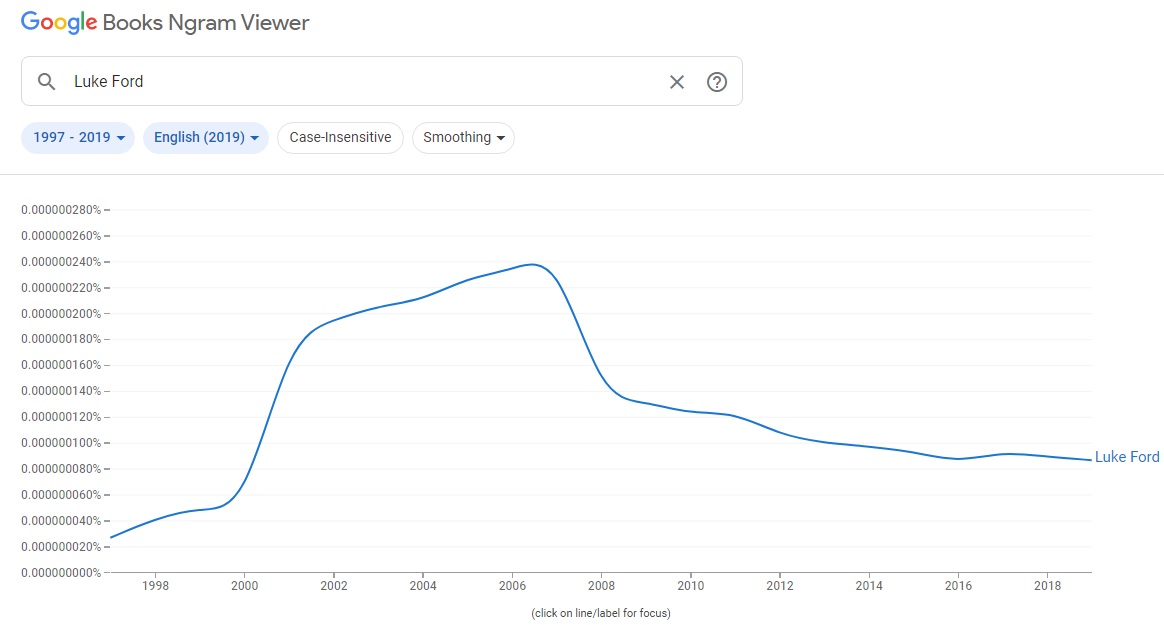
My Fame Peaked In 2006

Google’s Ngram viewer tracks mentions in published books.

Posted in Personal | Comments Off on My Fame Peaked In 2006

American Universities Began Asking For A Personal Statement Essay To Weed Out Jews

College admissions in America operate with the tools of the last century that were enacted to limit the admission of Jews. In most countries, admission to university is done on the basis of test scores, but American universities in the 20th Century moved away from that objective standard to subjective standards that allowed them to reduce their intake of Jews without overtly stating they didn’t want Jews.

To increase their intake flexibility, American colleges added requirements for demographic information, personal essays, and extracurricular activities. Why? So they could exclude Jews and anyone else they didn’t want on the public basis that the university was looking for gentlemen rather than drones. What constitutes a Harvard man? This is subjective, ergo, Harvard gets to choose who it admits.

Universities assumed that Jews would fall short of their moral character standards, but moral character is a fiction. We don’t have a moral character. We have moral characters in different situations. Our traits are domain-specific. We may be honest in our marriage but not at work. We may be nice to strangers but vicious to our family. Who we are depends upon the situations we find ourselves in. The situation is frequently more determinative of how we behave than any supposedly innate character traits. Nobody is always brave. Some people are brave in certain circumstances and other people are brave in different circumstances. The person who is a hero on the football field Friday night may well be a docile lamb Sunday morning in church with his mom and then a rapist at a party that night with a stranger and then a life-saver when he stops on his drive home and rescues someone from a burning car.

America’s elite universities today use subjective admission criteria to limit their intake of Whites. Without these subjective standards, there would be more Whites on the best campuses and fewer of every other ethnic group.

Professor Merve Emre, the author of the following essay, is a Turkish-American professor at the Oxford Centre for Life Writing.

Though I was born to blog, to quote journalist Rob Eshman, I’ve never been much good at writing essays. My friend Dave Deutsch compared me to a porn star who can’t give a hand job.

I don’t believe the individual is a fiction, but we are primarily the product of time, place and heritage. I wouldn’t be who I am right now if I weren’t writing these words in anticipation of you reading them. I wouldn’t be saying these words alone to a wall. I don’t exist as I am without you. Without you, I am not me.

I am a historicist. I believe everything and everyone has to be understood in their time and place. I don’t see the world as the classical liberal does — a collection of individuals with inalienable rights. Rather, I see the world composed of nations. I don’t see individuals primarily as individuals but primarily as members of nations and whatever rights those nations can afford will be circumscribed by circumstances.

Most people who talk about themselves publicly are boring because most people don’t see themselves accurately. The winning formula for first-person writing, then, is to keep the focus on what fills you with shame. We all prefers to read about others’ troubles rather than their triumphs.

Merve Emre writes in the New York Review of Books:

A more specific genealogy for the genre—and an explanation of its distinctively American quality today—is the “personal statement” that high school students applying to US colleges and universities were asked to produce starting around 1920, and which has evolved into a cornerstone of the admissions process. Although it is difficult to pinpoint how many students per year write personal statements, more than 5.6 million applications were submitted in 2019–2020 through the Common App, a generic college admission application that requires the applicant to write at least one personal essay. Orbiting these millions of essays is a burgeoning industry of tutoring, prepping, and editing services, evinced by the popularity of books such as How to Write the Perfect Personal Statement, The Berkeley Book of College Essays, College Essays That Made a Difference, and How to Write a Winning Personal Statement. The personal narrative is the designated genre to reveal the writer’s “inner self,” an “opportunity to differentiate yourself from everyone else,” writes Alan Gelb in Conquering the College Admissions Essay in 10 Steps.

The first mention of the personal essay as an admissions requirement, according to Jerome Karabel’s The Chosen: The Hidden History of Admission Exclusion at Harvard, Yale, and Princeton (2005), came during Harvard’s drastic changes to its admissions practices in the 1920s. Since the turn of the century, selection based on exam scores had created what administrators called a “Jewish problem”: the admission of more Jewish applicants than the university deemed acceptable. “We can reduce the number of Jews by talking about other qualifications than those of admission examination,” wrote Harvard president Abbott Lawrence Lowell in 1922, advocating for a subjective set of criteria. The other qualifications he listed, “character” and “leadership,” were to be assessed through three new genres, as Karabel writes: “Demographic information, a personal essay, and a detailed description of extracurricular activities.” The assumption was that Jewish applicants would fall short of the school’s desired “character standard”—that their “centuries of oppression and degradation” meant that they were characterized not by a commitment to individual and personal self-assertion but by a “martyr air.”

To weed out Jewish applicants, universities mobilized the essay as an heir to the Catholic tradition of confession and the later Protestant tradition of narratives of “saving faith,” notes the historian Charles Petersen in his dissertation on meritocracy. No doubt the version of individualism championed by administrators drew on the moral culture of the Protestant bourgeoisie, what Max Weber described as its use of education to cultivate a rational, self-assertive personality. This type was marked by its ability to adhere to a consistent and subjective set of values in a disenchanted world. Forced to conceive the meaning of things, and even man’s relationship to reality, as an individual matter, Weber’s rational personality type formed intellectual arrangements to anoint himself the master and the arbiter of his own destiny, and eventually the destinies of those around him.

The premise of elite college admissions was that this relation could be cinched, and indeed enhanced, by reversing its terms: that the ability to demonstrate, through the genre of the essay, one’s commitment to an idealized model of private and rational individualism marked the applicant as someone well-suited to higher education. Whereas in previous centuries, higher education would have secured a career in the ministry, now it led to executive roles in industry and government. Beyond its discriminatory function, the personal essay sought to identify the students whom the university could transform into the political and economic leaders of the future. Learning how to “game the system” was only a sign of the system’s success at shaping applicants’ behavior.

The overtly discriminatory origins of the admissions essay have been superseded by more covert models of calibrating personhood by ethnicity, as in the recent case of Harvard University admissions officers accused of assigning Asian American applicants lower scores in subjective categories such as “positive personality.” Yet the value the admissions essay—and the college application process in general—places on the private individual as a self-reflective and self-governing subject, the rightful heir to the spoils of capitalism, remains as powerful as ever. Kathryn Murphy and Thomas Karshan, in On Essays: Montaigne to the Present (2020), write:

Applicants are encouraged to draw a moral out of a personal anecdote, often about struggle, and enriched by some element of their reading or studies: “failure,” an expert on the admissions essay tells us, “is essayistic gold.”

Far from signaling weakness, the proud narration of failure speaks of character in precisely the terms set by the educated bourgeoisie of the early twentieth century: character as the capacity to maintain one’s self-comportment in a moment of distress, to tell a tale of hardship lit by the glow of self-knowledge.

At the start of the last century what Petersen has described as the “Catholic tradition of confession,” with its ponderous moral and spiritual accent, its desire for masochistic public exposure and redemption, had yet to enter the scene of personal essay writing and did not do so until the mid-1960s. Almost all the guides mentioned earlier warn applicants away from striking a tone that is too testimonial or therapeutic, working hard to buffer the admissions essay from the sins and perils of what is commonly called confessional writing. Unlike the admissions essay, whose rules and stakes are firmly pegged to educational institutions, confessional writing speaks to a shift in the importance of the individual and the technologies used to conceptualize new notions of personhood. “Its development coincides with new cold war cultures of privacy and surveillance, with therapy/pop psychology culture, with the falling away of modernist and ‘New Critical’ approaches to art and literature, with the rise of the television talk show and the cult of the celebrity,” writes Jo Gill in Modern Confessional Writing (2006).

Posted in Academia, Jews | Comments Off on American Universities Began Asking For A Personal Statement Essay To Weed Out Jews

LA’s Anti-White Coalition of the Fringe Falls Apart (10-12-22)

00:30 LAT: Listen to audio of L.A. council members making racist, crude remarks
02:00 Tucker on PA’s senate race
12:00 Reb Dooovid joins
29:00 Why couldn’t priests with defects serve in the Temple?
31:00 List of disqualifications for the Jewish priesthood
39:00 Kanye West accused of anti-semitism
1:07:00 Mickey Kaus says he’s no longer a character voter
1:12:00 Lack of Character: Personality and Moral Behavior

Posted in America | Comments Off on LA’s Anti-White Coalition of the Fringe Falls Apart (10-12-22)