
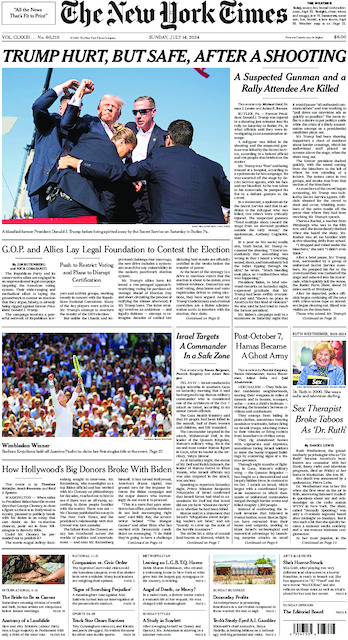
Donald Trump Shot – Why Did The Secret Service Operate With Reckless Disregard? (7-14-24)

01:00 The Secret Service’s Reckless Disregard For Donald Trump’s Safety, https://lukeford.net/blog/?p=156382
1:25:00 The case for forcing the mentally ill into treatment, https://nymag.com/intelligencer/article/the-case-for-forcing-the-mentally-ill-into-treatment.html
1:36:00 Charles Murray. The collapse of the social sciences in the West, https://www.youtube.com/watch?v=kaCA7j9iLrA
1:41:00 Trump ASSASSINATION Plot Details REVEALED
1:44:00 I Wish The News Media Had Given Joe Biden As Much Scrutiny As An NFL Coach, https://lukeford.net/blog/?p=156302
1:51:00 Stephen J. James joins the show
1:55:00 Candor vs courtesy
2:05:00 Is Lizzo attractive?
2:26:10 Stephen J. James reflects on his recent visit to America
3:25:00 Secret Service protocol is to not fire on a shooter until he fires first?

Transcript.

Podnotes summary: I’m reflecting on the Secret Service’s response during an incident where a shooter targeted Donald Trump. The assailant fired eight shots before being stopped by security. This raises questions about why law enforcement didn’t act sooner despite having the shooter in sight and warnings from the crowd.

I’m speaking from Los Angeles at 6:10 AM on July 14th, analyzing video footage of the event. It seems that trained snipers had ample time to react but failed to do so until after numerous shots were fired. Additionally, it’s perplexing that no officers were stationed on a nearby roof with a clear view of Trump—a prime spot for an attempt on his life.

The Secret Service is currently under scrutiny; their history includes scandals and apparent incompetence which overshadow their recent emphasis on diversity within their ranks. Despite this focus, there was still a significant lapse in protecting President Trump effectively.

Furthermore, some Democratic legislators have previously sought to remove Trump’s Secret Service protection—actions that align with rhetoric painting him as a danger to democracy. Such language can dangerously imply justification for violence against him.

In light of these events, one must question whether protocol was followed or if priorities were misplaced leading up to this serious breach in presidential security—an investigation led by agencies like the FBI will hopefully provide answers soon.

Lastly, while media coverage initially downplayed the situation as “loud noises” disrupting a rally rather than acknowledging it as an assassination attempt against Donald Trump—a narrative shift only occurred hours later when officials addressed it directly. This highlights potential bias and reluctance among news outlets when reporting incidents involving controversial figures like Trump.

Imagine if Trump hadn’t ducked when he did; he saved his life, that’s a fact. The evacuation failed; Secret Service should cover and evacuate but didn’t act right. Dan Bongino, an ex-agent, says they failed massively and suggests the director resigns due to repeated ignored security requests for Trump.

The Secret Service focused on trivial things like agents’ tie colors instead of real threats—such a failure in their primary duty: protecting lives. Structural issues within the organization lead to incompetence despite having capable individuals.

Dan emphasizes structural excellence over personalities; without it, even good people fail in their roles. This recent incident is not isolated but part of a pattern of Secret Service failures needing congressional investigation.

There was also criticism about gender diversity priorities potentially compromising physical capability requirements for protective agents—a controversial stance questioning women’s roles based on strength stereotypes.

After an assassination attempt on Trump, there were delays in official communication and speculation about motives and political violence biases—raising questions about law enforcement transparency and media narratives surrounding such incidents.

Tim Mc, a former security detail member for presidential and vice-presidential events, shared insights on Twitter about the assassination attempt on Donald Trump. He explained that the Secret Service uses a multi-tiered defense system. The inner tier provides close protection; these are agents who rush to shield Trump after an incident. The second tier involves mid-range threat identification and response, often staffed by local law enforcement attached to the detail temporarily—this is where Tim worked.

The extended tier covers long-distance threats like snipers. When shots were fired at Trump, counter-snipers couldn’t react immediately because they focus on distant threats beyond 150 meters—the range within which the shooter appeared. Consequently, when responding to this closer threat, a sniper had to significantly adjust his aim.

A serious question arises: how could someone get onto a rooftop with clear sight of Trump despite prior scouting of vulnerable spots? It suggests there was a failure in the middle tier responsible for securing nearby buildings—a role typically filled by local law enforcement rather than Secret Service.

Witnesses reportedly saw someone with a gun but police failed to act quickly enough due to limited communication between local officers and Secret Service liaisons. This inefficiency can be exacerbated when multiple agencies work together without familiarity or adequate information sharing.

In 2004 during President Bush’s tenure, miscommunication nearly led to disaster when Secret Service mistook positioned SWAT teams as threats. Delays in identifying real threats can stem from confusion over whether armed individuals belong to security teams or not.

Blame for this breakdown seems directed at whoever was supposed to secure areas around buildings where shooters could perch—an assignment likely given to local law enforcement officers present at such events.

As investigations continue into new security measures following this event and its impact on political discourse surrounding Donald Trump’s safety becomes more heated, many questions remain unanswered regarding how such an attack could happen amidst supposedly tight security protocols.

New York magazine: Many people who worry about subway safety are infrequent riders. There’s a stigma against fearing subway violence, but it’s a justified fear that should be met with compassion. Some argue that disturbed individuals on the subway aren’t bothersome, ignoring the link between mental illness and violence. To truly help those with severe mental illnesses, we must grasp their deep-rooted issues.

New York City isn’t facing a surge in violent crime; there was an increase in murders and gun crimes in 2021 due to various debated reasons, including police reluctance. However, crime rates have since fallen significantly.

Despite lower crime rates, many New Yorkers still fear crime, especially on subways. This disconnect may stem from policies around mental illness treatment which are too lenient and endanger public safety. For instance, in Toronto 2015, a mentally ill woman killed someone but was released within seven years.

The U.S has struggled with treating severe mental illness since state psychiatric hospitals began closing after the Community Mental Health Act of 1963. Today’s inadequate facilities and overburdened doctors can’t meet demand – yet some advocate for even less government intervention.

Contrary to popular belief among educated circles, we’ve become less heavy-handed with involuntary treatments due to policy changes like Medicaid incentivizing private care over state-run facilities.

The current approach is failing by most standards; reforms are needed to make it easier for professionals to treat individuals without consent when necessary.

After decades of tearing down institutional care options for the severely mentally ill and homeless populations at risk of untreated psychosis or paranoia – conditions linked to higher criminality – society hasn’t found effective solutions despite knowing better approaches exist.

Some resist acknowledging any connection between serious mental illness and violence under misguided social justice views while others incorrectly assert that because many groups are more likely victims than perpetrators of violent crimes this means they’re not more likely offenders themselves – this logic fails as it doesn’t accurately assess risks associated with untreated severe mental illnesses which studies show do correlate with increased likelihoods of committing grave acts of violence.

In summary: Fear of subway violence is rational given links between untreated severe mental illnesses and heightened risks of violent behavior; however societal attitudes towards treatment remain conflicted amid persistent misconceptions about danger levels posed by those suffering from such conditions despite clear evidence suggesting otherwise.

Luke: Many conservatives distrust mainstream media, citing delayed recognition of Joe Biden’s apparent cognitive decline—a topic not covered in academic articles despite many on Donald Trump’s fitness for office. In 2020, a study by public health experts found no evidence of major cognitive challenges for either Biden or Trump.

The shooter, Thomas Matthew Crooks from Pennsylvania, donated $15 to ActBlue after Biden’s inauguration but later registered as a Republican. His online presence is minimal with only speculation about his political activities.

A former Secret Service agent highlighted security concerns at rallies like Trump’s where securing all areas is challenging. Local law enforcement typically assists but it’s unclear if they secured the building where the shooter was positioned.

Molly Hemingway suggests Attorney General Merrick Garland and FBI Director Christopher Wray should recuse themselves from investigating this assassination attempt due to potential conflicts of interest.

In response to this incident, discussions have emerged about whether such moments will be remembered vividly like other historical events and how people engage with news through alternative media seeking candid perspectives over polished mainstream narratives. There’s also debate over when it’s appropriate to comment on someone’s physical appearance in public discourse—highlighting tensions between candor and courtesy.

Women often excel in various aspects of life. For instance, during TV interviews with female journalists, I tend to perform better; their presence motivates me to do well. Similarly, a caring conversation with a woman once reenergized me when I was battling fatigue on a film set.

Women can also be more effective in certain professional roles. Many talent bookers for TV shows are women because they excel at the job. Jane Goodall’s success is another example—she was specifically hired because it was believed that her nurturing qualities would make her ideal for studying chimpanzees.

However, there are times when being around attractive women can be distracting. If I were injured and attended by an attractive female agent, it might distract me from the task at hand due to natural attraction.

Discussing public figures candidly could lead to more honest conversations about their capabilities or shortcomings without unnecessary politeness masking important truths. This shift towards openness may mean acknowledging uncomfortable facts like Joe Biden’s aging or Kamala Harris’ perceived lack of competence without sugarcoating them.

Physical appearance does have an impact on how we’re treated and how we navigate through life—it’s almost unavoidable. While beauty standards still dominate places like Las Vegas where attractiveness is marketed heavily, views on body image are changing—with both positive and negative reactions to weight loss becoming apparent in society.

Ultimately though, while physicality plays a significant role in our lives and interactions with others—in many ways acting as destiny—it doesn’t define everything about us or our potential outcomes entirely.

People with mental illness commit a disproportionate amount of violent crime.

Mike reacts by recalling an experience where he noticed a stark contrast between attendees at two parties—one with blue-collar workers and another with college-educated professionals—leading to a discussion on whether wealth influences attractiveness.

Claire argues that judging people solely on looks is shallow, advocating for evaluating individuals based on their honesty and willingness to accept facts. She also touches upon gender biases in society.

The conversation shifts to politics, discussing the portrayal of Donald Trump as a threat to democracy and how such rhetoric may incite violence. Claire condemns the media’s role in creating hostile atmospheres while emphasizing the need for greater scrutiny of journalists’ actions.

Mike adds his thoughts on free speech and double standards in public discourse, questioning what constitutes good or bad speech. The dialogue concludes with speculation about Joe Biden’s presidential campaign viability amid concerns about his mental fitness and potential successors if he withdraws from the race.

Finally, there are reflections on security measures following an assassination attempt at a Trump rally, highlighting issues within government competence rather than conspiracy theories.

Larry and his wife attended a Trump rally in Pennsylvania, an election battleground state. During the event, discourse escalated as President Biden was criticized for incendiary comments targeting Trump. The rhetoric on both sides has been heated; some have irresponsibly likened Trump to Hitler or called him a Nazi, stirring dangerous emotions.

The left’s language is under scrutiny following past events where political figures were targeted with violence. Now, after Biden’s remarks about putting Trump “in a bull’s eye,” concerns rise over potential harm fueled by such statements.

Political violence isn’t new in U.S. history; it has sadly recurred throughout time. Recent events have reignited these fears, prompting calls for calm and responsible speech from leaders across the spectrum.

As election tensions mount, Democrats express frustration with Biden’s candidacy while Republicans capitalize on recent incidents to bolster support for Trump. Some speculate whether this could shift electoral outcomes or even lead to changes in candidates.

Amidst security concerns following an assassination attempt at the rally—where heroic actions saved lives—the Secret Service faces criticism for not preventing the shooter’s access to a vantage point near President Trump.

This incident raises questions about resource allocation within federal agencies and their focus amidst rising political strife as America heads into another charged election season.

The Secret Service’s protocol is under fire for allowing a gunman to shoot eight times before responding. Critics argue that private security would have acted faster, deeming the Secret Service unfit for protecting figures like Donald Trump. Despite praise for a counter-sniper’s quick 3-second response, many view their performance as inadequate.

There are calls for transparency and regular updates from law enforcement to prevent conspiracy theories and political tension. Oversight has been welcomed by some who trust field agents but question leadership in Washington due to past controversies.

After the recent incident, there is an urgent need to review and change security protocols, just as they were transformed following Reagan’s shooting in 1981. The focus should be on preventing such events at outdoor venues which pose significant challenges.

Leadership must take responsibility, ensuring agencies have the resources needed solely for protection missions—nothing else should distract from this goal.

Updates are anticipated from both President Biden and the FBI regarding this matter and how it will be investigated further. Speaker Mike Johnson also announced a full House investigation into what led up to this event.
Posted in America | Comments Off on Donald Trump Shot – Why Did The Secret Service Operate With Reckless Disregard? (7-14-24)

We Learned Everything We Needed to Know About Biden in 1988

Alexander Stille, a professor of international journalism at the Graduate School of Journalism at Columbia University, writes in The New Republic:

Biden was preparing his first run for president in January 1988, his closest aides made an emergency trip to Wilmington to talk the candidate out of what they considered a disastrous folly: buying another house. Biden was already struggling to pay off the debt on another equally grand house, a 10,000-square-foot Du Pont mansion whose upkeep had put his finances in disarray. As Richard Ben Cramer describes it in his book What It Takes: The Way to the White House, a masterpiece about the 1988 election and a remarkably prescient portrait of Biden, the 44-year-old senator drove his advisers all around Wilmington in his Bronco truck, trying to explain why he absolutely must have this other house on top of the one he couldn’t afford.

“The first thing you’ve got to know about Joe is the house. Probably the first thing he will show you,” Cramer begins, referring to Biden’s Du Pont mansion. “It’s the kind of a place 1,000 Italian guys died building. A library fit for a Carnegie, a living room about half an acre … whatever he gets, the house eats for breakfast. That house loves cash.… So that’s why Joe decided he had to have another house this time. It was 17 acres, a $1.1 million estate … an enormous main house with a sauna in the master bath, a swell apartment over the four-car garage … and the outdoor pool had a separate cabana that was itself like a nice suburban home.… And then there was the tennis house with the other sauna and the indoor pool … and, of course, the indoor tennis court … it was a compound … it was … Hyannisport! He could see the goddamn thing in Life magazine.”

One of Biden’s aides told him, “You can’t run as a Democrat, a guy who’s in touch with middle-class values when you’re on TV in your indoor tennis court.” But Biden wasn’t listening, Cramer reports: “No, he said, with a dazzling Biden smile, into the sudden silence … there was another house. (‘Believe it or not … this other thing happened.…’) And this time, he got all three of them into the Bronco for the trip to the city.”

Cramer’s book, published in 1992, describes a whole range of Biden behavior and reflexes that we are seeing all too clearly in the current stand-off between the president and those who are trying to persuade him to drop out of the presidential race: single-minded fixation on a goal; a stubborn refusal to listen to advice or contrary evidence; a willingness to act and never to doubt or second-guess himself; a seemingly infinite belief in his ability to beat the odds, to talk anyone into anything; and a conviction of being a man destined for greatness. “The house, the world, were malleable to his will,” Cramer writes.

These behaviors have often served him well—he did eventually become president—although it is worth recalling that in 1988 he was forced to withdraw from the race after it was discovered he plagiarized a speech by the British politician Neil Kinnock. Biden’s aides were also not wrong about his real estate obsession: He spent much of his life juggling multiple mortgages, underwater in debt, and when he retired from the Senate he was the chamber’s poorest member. “There was (to be perfectly blunt, as Joe would say) a breathtaking element of balls,” Cramer writes. “Joe Biden had balls. Lots of times, more balls than sense. This was from the jump—as a little kid. He was little, too, but you didn’t want to fight him—or dare him. There was nothing he wouldn’t do.” 

What Cramer shows beautifully is that you have to be a little crazy to want to run for president, to believe you can and should be the most powerful person in the world. It requires an almost pathological belief in yourself and your destiny. In Biden’s case, Cramer describes the strange combination of inferiority and superiority complex, failure and success, that become fused into a powerful, stubborn, preternatural determination that he can overcome any obstacle.

But Biden appears to have failed to heed a lesson his mother imparted to him, according to Cramer: “The most important was: tell the truth, and do what you promised.”

Biden in 2020 promised to be a “bridge” or “transition” candidate, reportedly telling his advisers he wouldn’t seek a second term, and now is failing to face—and tell—the truth about his obvious cognitive decline, about his historically low approval rating, and the widespread view among voters that he should step aside. The world at 81 years old looks very different from when he was 44, and his deep-seated character traits now have hardened into something quite different. His gritty determination looks like blind obstinacy, his boundless belief in himself seems like arrogant self-regard, and his attempt to bend the world to his will appears like a delusion of grandeur.

Posted in Joe Biden | Comments Off on We Learned Everything We Needed to Know About Biden in 1988

The Secret Service’s Reckless Disregard For Donald Trump’s Safety

The Secret Service operates with reckless disregard for Donald Trump’s safety. Yesterday they allowed a killer to scale to the top of a building just 140 yards away from Donald Trump with a clear shot to the former president, and despite people bringing their attention to the killer for several minutes, they did not protect Trump. The Secret Service sharpshooter had the killer in his sights prior to the attack and he did not take a shot until after the killer had squeezed off eight shots at Trump.

When you look at the public facts as we know them as of Sunday at 5:30 AM PST, it looks like the Secret Service was happy to let Trump to get shot. They only did enough to appear professional.

I don’t believe the Secret Service was in on the assassination attempt. I believe they were so incompetent that they made it look like they were in on the hit.

The Conservative Treehouse writes:

I’m not going to narrate what you can witness with your own eyes and ears. The camera lens is pointed toward two U.S Secret Service protective detail snipers on the roof behind President Trump. One is the spotter. Turn on sound. You can clearly see both USSS spot the shooter, do nothing, wait for the incoming fire, then respond.

We will soon hear, “mistakes were made.”

The FBI is investigating.

TMZ reports: “We’re told he shimmied up, then army crawled to his final position on the roof — all with a rifle in hand, mind you — and then he lined up his shot, despite people clearly noticing him down below and attempting to flag cops or whoever else would listen, we’re told.”

I wonder why the police sniper did not shoot the killer until after the killer had squeezed off eight shots.

Joe Biden called out the shooting as “inappropriate.”

The MSM under-played the story for as long as they could, avoiding the obvious truth that Donald Trump was the victim of an assassination attempt.

I just checked The New Republic website (4:33 am PDT, 7-14-24) and there is no mention of the Donald Trump assassination attempt.

Democrats argue that democracy is on the ballot. That Donald Trump is an existential threat to democracy. That if Trump wins, this will be America’s last election. So their primary argument against Trump provided all the justification needed for an assassination attempt on Trump. There is no similar rhetoric by Republicans. No prominent Republican argues that a Joe Biden presidency ends democracy in America. In fact, the primary line of attack on Joe Biden by Republicans is the very opposite — that Joe Biden is senile. There’s nothing in a senility charge against Joe Biden that encourages violence.

When Trump made the case after the 2020 elections that the vote was rigged, he removed all moral constraints for those who believed him. When conservatives argue that abortion is murder, they remove all moral constraints for dealing with people who perform abortions.

Many people don’t like moral constraints, and they embrace any opportunity to drop constraints.

I don’t know much about the shooter, but no man is an island. He operated within a context that allowed him to do what he did. In a different situation, he would not have shot anyone.

Steve Sailer writes:

How soon until we start hearing Frontlash “concerns” from people who have been condemning Donald Trump as an existential threat to Our Democracy about a possible Backlash by Trump supporters?
By the way, are we ever going to have a Conversation about the uselessness of a petite lady Secret Service agent at shielding a 6’3” 250 pound candidate with her body?

I was watching CBS News Saturday night. Anchor Margaret Brennan urged people to stay off social media, where she was getting ripped for criticizing Republicans for not dialing down their rhetoric.

Posted in America | Comments Off on The Secret Service’s Reckless Disregard For Donald Trump’s Safety

Black Pill: How I Witnessed the Darkest Corners of the Internet Come to Life, Poison Society, and Capture American Politics

Elle Reeve’s new book just came out. Here are some excerpts:

* You can dabble in racism, hang out on racist websites, read fascist literature, and later come back to the normal world, but when you use your real name in the movement you have passed the point of no return. You can quit, but you can’t leave. No one will forget what you’ve done. The movement takes away your friends and gives you new ones, but they don’t really like you, and they’ll turn on you the moment you become a liability, or “cringe,” an embarrassment. After the movement ruins you, it will laugh at you. You deserve it. You were never really good enough, but the movement had fun while it lasted, You, of course, did not.
At the center of the movement is a group of old men. The old men provide the money — but there is never enough money to do much of anything, and the old men are always pushing the young men to find a new source. When the wealthy inventor Walter Kistler developed an interest in race science in his later years, one of his aides told me a significant part of his job was to stand between Kistler and the grifters who wanted to extract money from him. “He was like a childlike genius — brilliant, but naïve, easily manipulable,” the aide said. “We were basically all policemen… because Walter’s checkbook would be in his pocket and whoever walked in, he said, ‘Okay, here is a check.’ ”
The old men offer validation. They have overlapping clubs and conferences, and when a young man gets an invitation, it’s a sign he has promise. One of those old men was Bill Regnery…

* Richard Spencer calls these old men vampires. “They see something that is alive, and they want to go suck its blood. And then the second they don’t think it’s alive, or it’s objectively dead, they want to move on to something else,” Spencer said. Regnery was Spencer’s chief vampire, and backed him for a decade. When Regnery died in the summer of 2021, Spencer did not go to the funeral.
The old men cultivate young men to be public faces for the movement. They give them just enough praise to get them hooked and working for more.

* [Matt Parrott] mentioned he was antisocial. He’d testified he was an introvert, an accidental revelation of some vulnerability. Afterward, he’d said, “It’s really hard to not be yourself after several hours of that kind of drilling. The real you boils out.”
I tested the waters with one of my favorite questions: Are you left – handed? Parrott said he was. [Matt] Heimbach was left – handed, too, which I’d noticed while looking closely at a photo of him in the middle of a brawl — he had a puffy red left hand. I asked Parrott, in a tone of shamelessly fake casualness, what he thought of the ubiquity of the word “autist” in white nationalism.
It was like whispering the secret password in a fairy tale — the whole side of a mountain opened up. He said he’d been diagnosed with Asperger’s in the nineties, and that Heimbach had, too.

* The movement will get you punched, sued, jailed, divorced, bankrupted. But it will never let you go. Matt Heimbach had a round face with thick black hair and eyebrows, and he was always grinning, but underneath it was a seething anger. “My biggest advice to people in the movement is like, Don’t fucking leave , because there’s no point,” Heimbach said. “If you’re already in, your life is fucked.” It will leave you with no one to confide in but the journalists who’ve exposed what you’ve done.
Heimbach had been blackpilled, trapped in a nihilistic hopelessness that the only thing to look forward to was to watch the world burn. I reminded him that quitting the movement might provide some benefits that he hadn’t considered. When white nationalists kill people, they tend to kill each other. I said quitting would reduce his risk of being one of those killed.

* Heimbach was fired from McDonald’s after management discovered he’d been a professional racist. He read me his termination letter and said, “They never forgive you. They never forgive you…. There’s no expiration date for how long your life will be ruined.” His voice had more edge than usual. “You get to a certain point where everything is just like that Springsteen song, ‘Glory Days.’ You just sit around like, Man, remember 2015?

* [Evan McLaren] spent a decade in white nationalism before coming to the realization he’d been a fool. In 2022, he posted a statement online, saying, “My revulsion for conservatism and the political right wing is total. I reject and disavow my past actions, views, and associations.” He apologized for what he’d done and said he didn’t expect to be forgiven. In conversations with me, he was unsparing: the movement was toxic and destructive and ruined people’s lives. He’d met many people he thought would have serious psychological problems even if they weren’t involved in it.

* “Sometimes when you hate something so much, you’re so motivated that you’ll make these connections, and they might be correct almost despite your motivations,” Richard Spencer told me. He was talking about a rival white nationalist [Greg Johnson] he thought was a vicious gossip. They’d feuded for years. But his rival had once accused him of auditioning to be on the Kremlin’s payroll, and years later Spencer admitted that, in retrospect, that catty bitch was on to something.

* It was March 2022, and I’d called him about the divide among white nationalists over which side to support in Russia’s invasion of Ukraine. I wanted the lay of the land, but Spencer kept talking about himself.
I’d first spoken to him by phone in 2016, when he was one of the few willing to be associated with the alt – right by name and on the record. Spencer said he was a narcissist, but this made talking to him easier, because he felt no shame and so he didn’t conceal his motivations. But it also meant he often failed to notice telling details about other people and why they did what they did, because his attention was elsewhere, on himself. He’d continued to answer my questions in all the years since, as the fortunes of the alt – right rose and fell, and so did his. There were times he’d gotten so lost in his own monologue that if I interjected an “uh – huh” to show I was listening, he sounded startled, as if he had forgotten someone was on the other side of the call.
* Russia found the far – right activists useful in the United States and Europe. It cultivated relationships with them both online and in real life. Russian trolls had used fake social media accounts and fake news sites to inflame racial tensions and stage protests. The state – controlled TV network RT had interviewed as “experts” a variety of extremists, including Spencer himself. Maria Butina had become intimately close with conservative activists, particularly in the National Rifle Association, before she was convicted in 2018 of acting as an unregistered foreign agent on behalf of Russia. Russia had invited fringe political parties to Crimea to build legitimacy for its annexation.

* Spencer was in a mood to reflect on his marriage in a way he hadn’t been before. “All these things that I overlooked — you look back now and it’s like, Holy shit, she was trying to do something .” He admitted he’d adopted some of Kouprianova’s views as his own. But he thought he was too smart to get played by the Kremlin. “I feel like I am an unrecruitable asset, in the sense that if someone suggests something to me, that makes me almost more skeptical. I march to the beat of my own drum,” he said. “Isn’t it much more easy to work with dumb people who are easily suggestible?”
Spencer and Kouprianova met on Facebook in 2009 and married the next year. He thought she was very smart, but that he was smarter. Most people who’ve met both told me they thought it was the other way around.

* Each told me they suspected the other was suffering from a personality disorder. They’d surreptitiously recorded each other during fights. Kouprianova had accused Spencer of physical and emotional abuse. They fought over child support. Kouprianova’s first lawyer withdrew from the case, in part, the lawyer wrote, because of “your desire for vengeance and taking down the Spencer family.” Some of Spencer’s lawyers dropped him, too.

* “He came across as a shy and nerdy grad student,” she said. “The way he comes across in his John Travolta suits — this really cheesy, sometimes scary, but very extroverted person in the last couple years — that would have been such a turnoff for me.” He knew all these obscure black – and – white Soviet films, and at the time, she thought it was cool he liked what she liked. But looking back, she said, it was all a manipulation, just narcissistic love bombing. He was flooding the zone with these references to impress her, and to drown any second thoughts she might have with affection and attention.
She didn’t see this coming, she said, this obsession with race and eugenics. When they met, Spencer was a libertarian. He’d had a Jewish mentor and dated an Asian – American woman. He told her the political book that had influenced him the most was by Justin Raimondo, a gay antiwar activist. She’d explained it the same way to the Huffington Post : “I didn’t understand the nuances of American politics. I knew he was conservative, but…”

* Spencer did not have the self – control to match his ambition, Kouprianova thought. When she compared his personality to historic political figures, they were more motivated, more organized, more Machiavellian than he was.

* Spencer made an ideal spokesman. He didn’t look like a guy who had nothing in his life to be proud of so he was proud of being white. In crowds, he could project confidence and self – control. That facade faded over time and under pressure. In a smaller group, he could be awkward and self – conscious, and fail to read the room. He once walked into an interview in a hotel room and asked my producer for a cigarette, as if he could smoke in a hotel, and as if he could smoke in the interview like it was the 1950s. He told me he can’t stand it when people don’t like him.

* “I’ve always been very lonely,” Spencer said. As a child, he’d never felt like he was part of the world around him; he couldn’t connect with other kids. Maybe they could sense even back then that he felt superior to them. But Spencer was not good at anything — not math, not English, not sports. He was awkward, goofy. In middle school, his teachers told his parents he wouldn’t be able to go to college, he said, “because I was almost retarded because of my dyslexia.”

In therapy for dyslexia, he’d listened to Mozart and recorded himself repeating words, and then played them back over and over again. He thought it rewired his brain. By the end of high school, he’d caught up to the other kids in math and sports, and he did well on the SAT. But it was not enough. He didn’t get into Princeton.
It stung, even if he knew it was embarrassing to be stung by it. Spencer asked me once why the journalists who wrote about him were so desperate to figure out his origin story. I told him it was probably because the popular image of a racist was a broken – down old man in an Alabama trailer park, but he was upper middle class, and most elite journalists were upper middle class, and so they were confused why someone like them would do what he’d done. He paused for a second, then said it was because he didn’t get into Princeton.

* The first time Matt Heimbach met Spencer was at a hotel room party after a conference. As some guys were leaving on a booze run, Spencer requested bourbon or whiskey — Heimbach didn’t remember what exactly, just that it was fancy. They brought back Mad Dog 2020 and were partying in the room when Spencer returned. “He just looks disgusted and asks, ‘Did you get me my whiskey?’ ” They told him to drink a beer like a real man. “He started to throw a hissy fit. One of the guys was like, ‘Richard, go in the hallway.’ Like ten seconds later, we just hear ka – thump and we run outside…. Richard has been lifted off his feet and is being slammed into the wall by a drunken college white nationalist going, ‘You drink’ — thump — ‘what we give you’ — thump — ‘Richard!’ — thump .” Heimbach remembered Spencer squealing, “Put me down!” He seemed to cherish the memory.

* Spencer was in search of a donor. He’d always wanted a donor. He wanted to run a think tank and publish essays and research on the superiority of white people and the West, and he wanted someone to pay for it who was not his mother. Regnery had founded the National Policy Institute, a white nationalist think tank, a few years earlier as a vehicle for a friend who’d since died. Spencer thought it was an empty shell. After exchanging emails, Spencer flew to Florida and made his pitch. In January 2011, Regnery made Spencer head of NPI and a sister organization, Washington Summit Publishers.
Regnery had a lot of money, but he didn’t want to dump much of it into NPI. Instead, he urged Spencer to find some other external source of funding.

* Spencer brought Kouprianova. She knew her husband wasn’t there to celebrate Murray. He’d talked about other old men, she said, and the possibility they would leave him large donations in their wills. [Walter] Kistler was a prime example: “This guy is in his nineties, so God knows about his state of mind at this stage.” They did see Murray briefly, but she thought he snubbed her husband.
Even so, they had a great time, partying with “all these Seattle society hags,” Spencer said. He felt momentum, like things were coming together. “I was flying high…. I was like, We’re gonna have a billionaire, we’re gonna have a billionaire …”

* Spencer had a contract with Kistler. Eventually, Spencer was offered a $50,000 kill fee. He took it. He bragged to his wife that he’d played hardball and won.

* Greg Johnson, who ran the white nationalist website Counter – Currents, noticed an element of the drama that most of the mainstream media coverage barely touched. “The Russian angle, I think, leads to the most plausible hypothesis for why this conference was shut down: NPI and Radix are Russian propaganda organs; Dugin, the chief speaker, is an ideologue of Russian chauvinism and an apologist for Stalin…. Jobbik, which was also associated with the conference, is pro – Russian, which is rather tricky in a country invaded twice by Russia in the last century,” Johnson wrote. He didn’t like Spencer’s new direction: “He has basically abandoned ethnonationalism and turned into an apologist for Dugin and reactionary Russian chauvinism.”

* Spencer had created the Alternative Right website in 2010, and ran it with a couple of writers for a while. Then he got mad at the writers and killed the site. He wanted to focus on his pretentious journal, Radix , and be the next Nietzsche. But the term “alt – right” was catchy, one white nationalist wrote, because it signaled distance from mainstream conservatism without endorsing national socialism or white nationalism.

* When Spencer finally realized the alt – right wave was swelling, he tried to surf it. Because he was willing to use his real name when few others would, he became the face of it by default.

* Kouprianova thought Spencer enjoyed the negative attention, because it was any attention, and that he wanted to be feared, because it made him feel alpha. She thought he had no sense of self without a reaction from others. People called her Spencer’s beard, and she was in a way — not to make him look straight, but to make him look like he had it together. She felt forced into a role of “Russian Suzie homemaker,” which she resented, because she’d lived abroad and spoke three languages. He told her, You make me look normal.

* Spencer was a draw. He shapeshifted to fit the desires of the people around him. From back in Montana, Kouprianova had watched her husband morph into this flashy, cheesy “alpha” persona. When people called him chubby on the internet, he went on a diet and ate only one meal a day. When they started calling him gay, she said, “all of a sudden these groupies appear, proving to the outside world he’s not.”

* Spencer and Froelich were spotted leaving the afterparty together at Charlottesville 1.0. Gossip spread quickly, and Identity Evropa investigated her. Both she and Spencer denied they’d done anything other than talk. Kouprianova was pregnant with Spencer’s second child — it was not a good look.
Froelich heard another guy, who went by Eli Mosley, was interested in her. “Eli has claimed me,” she texted Spencer. “Did he inform you of his decision? Or full white sharia?” Spencer asked. She said, “I guess white sharia.” Within a few weeks, Mosley was doxxed. His real name was Elliot Kline. He was pudgy, with a reddish beard and his hair cut like Spencer’s, and he liked to say he looked like a potato. Froelich offered him a place to stay for a bit. He never left.
He didn’t have a normal job, and she made the money working at a restaurant. But the texts show they liked the idea of being a power couple.

* Through the summer, Spencer felt euphoric. He was at the height of his power within the alt – right. He bragged to Froelich that people worshiped him like a God, and she watched the teenagers in awe of him at the nazi parties. He told her he was the L. Ron Hubbard of the alt – right, that he was building a new religion.
“You can’t go back,” Spencer told me later. “I just wish I could have asked myself, Do you like these guys? Richard, I know how you feel about ugly people …”
Back in Montana, Kouprianova looked at the photos posted online of the crowd Spencer was hanging around. The elderly men in tweed were gone, and now there were these younger, rougher – looking guys. Every six months there’d be someone new who served as his right – hand man, and now it was Elliot Kline. Kline was named Identity Evropa’s public representative for Charlottesville 2.0, but he also served as Spencer’s representative for its planning. Kline texted Spencer, “This is going to be a violent summer.”
Kline had a reputation as a clout chaser and a name – dropper. In private, he saw Spencer as a useful tool. Kline thought he was smarter and better. He told Froelich he needed to work out more to prepare for Rahowa, or “racial holy war,” she later said under oath. He was building a militia for Spencer, and he would lead them into victory, and then depose him. Once a white ethnostate was established, Spencer would be the first against the wall, Froelich said in a deposition. When a lawyer asked her to state explicitly what that meant, she explained, “That he would put Richard Spencer against a wall and shoot him dead.”
Spencer thought those guys loved him because he was great, not because they wanted to establish a base of power before stomping on his face to seize the crown.

* “The movement is magnetized to shit,” Spencer said. “Any form of shit it sees, it wants to go die on that hill…. It’s just like, Oh look — more shit! Let’s go involve ourselves. Let’s at least endorse it. It’s just so insane.” The alt – right was a shit magnet because some people were attracted to it not despite the stigma around it, but because of it. It was bad, and it made people angry, especially their parents. Spencer had imagined himself as the next Nietzsche, but instead he was the next Marilyn Manson.
After Froelich invited Spencer to the AltRight Discord server, he texted her, “Wow, the forum is insane.” He asked if someone could create an elite room with no shitposting, and she replied, “You are Richard Spencer. All you need to do is demand it and say who you want in and it is yours.” He declined: “It’s better to have intermediaries, like you, then for me to simply demand stuff.”

* [Christopher Cantwell] was also the most emotionally volatile person I have ever met — man or woman, adult or baby. In a few days he would tell me, “I find myself in tears more often than a man my age probably should.” So as a man of “reason,” he framed his emotions, like anger, as a rational response to the news. His voice got higher, and he spoke faster, even as he insisted he was genetically predisposed to appreciating the cold, hard facts of capitalism. He wasn’t going to Charlottesville to debate UVA students about public policy. He was going to create a massive spectacle to provoke an emotional response — to make his enemies afraid, and to make young white guys think he looked cool.

* In the park, Robert “Azzmador” Ray was filming the scene for the Daily Stormer. Azzmador had a gray wizard beard, a thin braid down his back, and a criminal record that began with a 1990 arrest in Dallas for illegally selling an interracial porno tape called Three Way Cum.

* Parrott did not eat right and did not exercise, and most of the time he tried to forget he had a physical body. If there were people eager to punch a nazi in the face, he was a soft target. But Parrott waded through the brawl unpunched. People who wanted to fight were high on adrenaline, and their eyes were searching for other fighters.

* There were about half a dozen guys, among them Elliot Kline, Nathan Damigo, Jason Kessler, and Richard Spencer. They asked one another, What should we do? What should we say? Spencer stood to address his men. They’d been drinking, and when Spencer began ranting, someone in the room was secretly taping.
“We are coming back here like a hundred fucking times! I am so mad! I am so fucking mad at these people! They don’t do this to fucking me! We are going to fucking ritualistically humiliate them! I am coming back here every fucking weekend if I have to! Like this is never over. I win! They fucking lose! That’s how the world fucking works. Little fucking kikes — they get ruled by people like me. Little fucking octoroons — I fucking — my ancestors fucking enslaved those little pieces of fucking shit! I RULE THE FUCKING WORLD! Those pieces of fucking shit get ruled by people like me. They look up and see a face like mine looking down at them. That’s how the fucking world works. We are going to destroy this fucking town!”

There was no pretense of irony, or that this was one big cosmic joke, or that he simply wanted open debate among reasonable people. Spencer sounded sweaty and crazy. A couple guys clapped lightly, and one offered a soft “yeah.” But right there, in that room, Spencer lost the movement.
Evan McLaren, who was then Spencer’s loyal right – hand man, could feel the other guys turn on their icon. McLaren felt a shift in himself, too — maybe it had not been a good idea to make peace with Spencer’s narcissism. So many people had been implicated in so much damage, dozens were bloody and three were dead, but all Spencer cared about was his wounded pride.
Long after he’d quit the movement, and apologized, and moved across the Atlantic Ocean, McLaren smiled as he quoted the rant from memory: “They don’t do this to me .” Spencer’s greatest flaw, in its purest expression, at the climax of the disaster it had created. It had been like watching a villain’s final monologue in a play.

* Unite the Right’s attendees had been so proud to show their faces in public, but activists methodically identified them one by one and published their names on social media. They became pariahs in their towns or colleges or even in their families, and they were fired from their jobs. They were kicked off their own social media accounts, so they couldn’t defend themselves or reach new supporters.

* I learned a lot about Cantwell just by standing in his apartment, saying nothing, as the crew set up our interview. His home was hostile to the human psyche. Every corner was stacked with some kind of object for self – improvement — weights, protein powder, supplements, niche kitchen appliances. He’d printed out signs on computer paper in big bold text that read, “STOP SAYING FUCK,” and he’d taped them under his television, by his bathroom mirror, on his fridge. The windows were covered with blackout curtains. He was slamming Sugar Free Red Bulls and taking huge rips from a vape. When I asked how he slept at night, he leaned his head back, his voice tight as he held the smoke in his lungs, and said, “It’s a struggle.”
The night he’d gotten home from Virginia, he said he noticed a big bottle of whiskey on a shelf, and he took it down and drank it till he blacked out. All he remembered was the hangover the next day. After that lapse, he was trying to control his alcoholism.

* Matt Heimbach and Matt Parrott found themselves in a love triangle. Heimbach was having an affair with Parrott’s third wife, Jessica. The Parrotts had just had their first child, a girl. Heimbach was married to Parrott’s stepdaughter, Brooke, and they had two small boys. This meant that Heimbach was having an affair with a woman who was both his best friend’s wife and his wife’s stepmom. At the time, Heimbach and Brooke were living in a trailer on Parrott’s property in Indiana.
The affair ended, but in early March, according to a police report, Jessica and Brooke decided to test Heimbach’s commitment to ending the relationship. Was it really over? They made a plan: Jessica would try to seduce Heimbach, and Brooke and Parrott would film through a window outside. In one sense, it worked: Heimbach responded to Jessica’s romantic overtures. But as Jessica and Heimbach began to get physical, Brooke got upset and ran away, and Parrott fell through the box he was standing on. Then Parrott ran around the home and confronted Heimbach. He ordered his best friend to leave his property, jabbing Heimbach in the chest with his finger. Heimbach put Parrott in a headlock and choked him out.
When Parrott came to, Jessica was standing over him. He ran into the house, and Heimbach entered. Parrott demanded Heimbach leave, and when he didn’t, Parrott threw a chair at Heimbach. Heimbach choked him out again. When Parrott got himself together, he grabbed his four – month – old daughter, ran to Walmart, Walmart, and called the cops. When police arrived, they heard Heimbach yelling at Brooke to tell the cops everything was fine and ask them to leave. She refused, and Heimbach kicked a wall and grabbed Brooke’s cheeks and pushed her on the bed. Cops entered and arrested Heimbach. Heimbach was already on probation for pushing a Black woman at a Trump rally in 2016. A judge sentenced him to thirty – eight days in jail for violating his probation, and a few months later, Heimbach pled guilty to battery for attacking Parrott.

* The divorce took eighteen months. Kouprianova said it cost her $40,000 in legal fees. Spencer was held in contempt of court for failing to pay $60,000 to the court – appointed investigator who determined the best custody arrangement. Multiple third parties involved in the case said they thought both Spencer and Kouprianova were acting irrationally. Kouprianova had originally decided to move to Winnipeg to be near her parents, but in April 2019, changed her mind and decided to stay in Whitefish. She and Spencer both still live in the same mountain town of 8,500 people.

* Parrott was living in Indiana, in the same town where he grew up, with his three kids and his fourth wife. It was ten years since he’d met Matt Heimbach, who was now living far away with his own two children. A few weeks earlier they’d gotten on the phone to gossip about the movement, and Heimbach reflected, “We really did get mixed up with the most despicable evil stupid motherfuckers in America.” Parrott agreed, but it was worse: “We did, bro. We followed those guys into battle.”
Heimbach had found another job, though he knew that eventually someone would recognize him and he’d be fired again. He’d accepted that the decisions he’d made at nineteen meant he might be stuck in this cycle for the rest of his life. It required some finesse in his personal life, he said. “I have to begin every first date with ‘By the way, you should know…’ Do you know how not sexy that is? To be like, ‘You should read my Wikipedia page before our second date’?”

* In 2022, Richard Spencer told me he was no longer a white nationalist. “I care about civilization more than race,” he said. He hadn’t quit trying to be a public figure, tweeting his commentary on politics and old far – right rivals. The most attention he’d gotten in years came with the revelation that he’d listed his political affiliation as “moderate” in his profile on Bumble, a dating app whose best – known rule is that women speak first.
Spencer would take only limited accountability for his starring role in the “Summer of Hate.” He’d said during the Charlottesville trial that he’d been “slumming it” by hanging out with the alt – right. He’d later told me that in 2016 and 2017, he was the most racist he’d ever been, and that he’d felt pressure to be the most far – right guy in the room.
But at his core, he was who he was. Spencer told me he liked Christian nationalism, because he thought associating the religion with the mania of QAnon would help destroy it. “I hate Christianity, okay?” Spencer said. “I hate Jesus Christ. I would have fucking oppressed that hell out of — I know that I come from Roman blood, the kind of people who would fucking crucify him, who would go in and knock down your stupid fucking temple — that’s who I fucking am , Elle,” he said. “In case there’s any ambiguity about the type of person I am, that is the type of person I am.”
Spencer still wanted to be the guy, but he was thinking bigger than politics. He’d turned his energy to building a cult of Apollo. He thought his new religion would eventually take down Christianity, and with it, its slave morality, as Nietzsche called it, which held that humility and obedience were good and power and wealth were bad. Spencer’s Apollonian cult would value strength, beauty, and intellect.
“Everyone’s like, Oh, we need more democracy, or We need more rights — it’s like, what are you fucking talking about?” he said. “We’ve had more democracy and liberalism and all this Christian Semitic stuff — we have more of that than we’ve ever had. How many Abrahamics are there on the planet at the moment, five billion?… We’ve tried the shit, sister.” He wanted humanity to make a covenant with a better god, like Zeus. But of the race stuff, Spencer said, “You have to move past it.”

Posted in Alt Lite, Alt Right, Richard Spencer | Comments Off on Black Pill: How I Witnessed the Darkest Corners of the Internet Come to Life, Poison Society, and Capture American Politics

Journalism’s “Crazy Old Aunt” Helen Thomas and Paradigm Repair

Elizabeth Blanks Hindman and Ryan J. Thomas published April 18, 2013:

Veteran White House correspondent Helen Thomas abruptly retired in summer 2010 after she gave unscripted remarks widely perceived to be anti-Semitic. This case study applies paradigm repair and attribution theories to explore how mainstream journalists repaired the damage to their profession’s reputation. It concludes that they (1) situated Thomas’s remark against a backdrop of journalistic excellence, subtly reinforcing the point that her career should now come to an end; (2) suggested Thomas’s remarks were caused by senility; (3) condemned her remarks as racist; and (4) raised the norm of objectivity.

On June 7, 2010, the career of veteran journalist Helen Thomas, who had covered the White House since the days of President Dwight Eisenhower, came to an abrupt and ignominious end. The previous month, she had been interviewed on camera by New York rabbi David Nesenoff, who asked if she had any “comments on Israel,” to which Thomas responded, “tell them to get the hell out of Palestine.” When Nesenoff asked if she had “any better comments on Israel,” Thomas replied that “they” (Jews) should “go home” to “Poland, Germany . . . and America and everywhere else.” The interview was posted to the rabbi’s website, RabbiLive.com, on June 3 and quickly attracted media attention and comment. Thomas’s speakers agency, Nine Speakers, Inc., dropped her,2 and her comments were condemned by the White House Correspondents’ Association,3 the Society of Professional Journalists,4 and President Barack Obama, who said her comments were “offensive” and “out of line.”5 On June 7, Thomas announced her resignation from her position as an opinion columnist with Hearst Newspapers and her retirement from journalism effective immediately.6 In her statement, she apologized for her comments, saying they did “not reflect [her] heartfelt belief that peace will come to the Middle East only when all parties recognize the need for mutual respect and tolerance.”7 However, her sixty-year career covering presidential politics was officially over…

To retain good standing within “a group with systematic relations,”10 members must function in accordance with the normative behaviors and standards of the paradigm.

Furthermore, such behaviors become unassailable, for the paradigm “restrict[s] the range of questions deemed appropriate for study,” rendering paradigms as hegemonic. However, they are not impervious; for Kuhn, a paradigm “fails” when the fundamental assumptions on which it is built come into question and are found to be inadequate.

As members of the journalistic paradigm, journalists can be said to be an “interpretive community,” policing their profession and defining, shaping, and reinforcing its norms, values, standards, and practices.

Posted in Journalism | Comments Off on Journalism’s “Crazy Old Aunt” Helen Thomas and Paradigm Repair

So how did the three books on the Biden administration deal with his decline?

Christian Lorentzen writes for the July 18, 2024 London Review of Books about the three books that have come out on the Biden administration:

The Last Politician: Inside Joe Biden’s White House and the Struggle for America’s Future by Franklin Foer.
The Fight of His Life: Inside Joe Biden’s White House by Chris Whipple.
The Internationalists: The Fight to Restore American Foreign Policy after Trump by Alexander Ward.

It’s difficult to divine from the histories of the Biden administration written so far just how active a role the president has played in governing the country…

Whereas accounts of the Trump White House varied from clown show to cesspool, with backstabbing among hacks, mercenaries and scumbags, the histories of the Biden administration present a succession of earnest and credentialled professionals lining up to help the president better the country and the world.

…The issue​ of Biden’s age is not much discussed in these books. Whipple, whose previous books include a study of the job of White House chief of staff, recounts a Zoom meeting between Klain and some of his predecessors during the transition in 2020. Jim Jones, the 82-year-old former chief of staff to LBJ, asked: ‘Could a soon to be 82-year-old man, battered by four years of stress and crisis, serve effectively for another full term as president?’ The question became pertinent in April 2022 when at a ceremony at the White House to unveil a proposed expansion of Obamacare, the former president was mobbed by admirers while Biden, in Whipple’s phrase, ‘looked a little lost’. Republican Senator Rick Scott of Florida said: ‘Let’s be honest here. Joe Biden is unwell. He’s unfit for office. He’s incoherent, incapacitated and confused. He doesn’t know where he is half the time.’ ‘This was, of course, false,’ Whipple insists. ‘Biden was mentally sharp, even if he appeared physically frail.’ Bruce Reed, the deputy chief of staff, told Whipple of a long flight home from Geneva in 2021 during which Biden regaled his jetlagged entourage with old stories, including the one about the time he visited the Kremlin and told Putin he had no soul, until everyone except the president passed out. But Foer writes that Senate Republicans ‘doubted Joe Biden was running his own show. Because of his advanced age, they whispered that he was a marionette, wiggling his arms as Klain manipulated him from above. Aides to Mitch McConnell were blunt in their analysis. They dubbed Klain “prime minister”.’ Tucker Carlson has made Biden’s age one of the central themes of his twerpy routine. Defenders of the president have written off such claims as ‘right-wing talking points’, but like left-wing and centrist talking points, right-wing talking points occasionally have some basis in fact.

A search of Google Scholar July 12, 2024, revealed there have been no academic articles on Joe Biden’s cognitive decline.

Posted in Joe Biden, Journalism | Comments Off on So how did the three books on the Biden administration deal with his decline?

No Country For Old Men

So how concerned have scholars been with Joe Biden’s mental acuity over the past six years? Very little. They do hate Trump, however.

I just put “Biden senile” into Google Scholar. The third result is an article from the December 2023 edition of the journal Political Thought (written by German scholars):

Ulrich Haltern is Chair of Public Law, EU Law, International Law and Comparative Law at Albert-Ludwigs-University Freiburg (Germany) and Martin Flynn Professor of Global Law at the University of Connecticut Law School. He writes:

NO COUNTRY FOR OLD MEN? AMERICA’S ELDERLY PRESIDENTIAL CANDIDATES AS A CRISIS OF THE BODY OF POPULAR SOVEREIGNTY

The world’s oldest democracy is currently also the oldest with regard to its highest decision-makers.

The question whether a person over 80 can ideally or at least reliably fulfil an office such as president of the US is undoubtedly important, for it is rather worrying that Americans discuss the presidential elections with the same concerns as the question whether their parents should still be driving a car. More interesting, however, is the influence of this kind of gerontocracy on the relation between voters and elected, as well as on the system of democratic representation in general. It is not daring to think that a political system, in which the president is more than twice as old as the average citizen (namely 38 years), lacks sufficient contact with its very population…

However, it remains unexplained why other democracies are not gerontocratic. In Europe, the exact opposite is the case: while the population is getting older, political decision-makers are getting younger and younger. Examples include Volodymyr Zelensky, 45, Great Britain’s Rishi Sunak, 43, Italy’s Giorgia Meloni, 46, Spain’s Pedro Sánchez, 51, and Finland’s Petteri Orpo, 53. The latter succeeded Sanna Marin, who had just turned 34 when she got elected in 2019…

The age of American political leaders is alienating younger people from politics. The Economist has shown that the extent to which older voters outrival younger ones is considerably greater in the USA than in other OECD countries. Other studies have proven that the average age of participants in local elections in the USA is 57, almost one generation older than the average eligible voter…

Political identity describes how individuals situate themselves within the political sphere, melding individual and collective identity. Its reference point is the political collective referred to as state or, sometimes, nation.

In the USA, this reference point is much more imagined as an organism than in Europe, where the organic structure of the state has given way to discourse and communication, and where political identity is much more found in the word. The American idea of corporeality − a fusion of body politic and body of the people, reminiscent of the frontispiece of Thomas Hobbes’ Leviathan in its composite nature − provides the state with a life and a value of its own, as an organic appearance of the people. When we as Europeans set foot on American soil, we cannot escape the manifestations of the idea of this value of its own, however strange they may seem to us, from the flag to the civil-religious rituals such as the Pledge of Allegiance, an oath of loyalty towards the nation and the flag of the United States. The higher idea embodied in the body politic of the state justifies its absolute demands towards the civic body that constitutes it, and the individual puts himself at its service: “Nothing is more typical of the American character than to give everything for a greater cause”, said Barack Obama in his inaugural address. Herein lies an ambivalence of American identity, which, on the one hand, emphasises great individuality and freedom, which should strive under the rule of law, but at the same time wraps this individuality into a great collective narrative…

Since this kind of imaginative space cannot be comprehended by intuition, it requires a powerful myth. In the USA, it is the myth of the revolution, in which the sovereign people, We the People, manifested itself and brought the state into existence. It is this big bang that unleashed political power and liberal self-government (unlike Europe’s revolutions, which politically restricted existing monarchic power), and therefore legitimation and legitimacy revolve around this moment of emergence only. The revolutionaries become the heroic founding fathers that the following post-heroic generations are to keep referring to…

American presidents are not only seen as leaders who coin and implement political programmes, but always also as elements of America’s imagined past, in which the nation recognises itself. The nation wants to be led, but it also wants to see its reflection. This reflection is twofold, corporeal and ideal….

At first, the corporeal reflection is as comprehensible as it is enigmatic. It is comprehensible because the public is endlessly fascinated by looking at presidential bodies and because presidents stage themselves as physically identifiable transubstantiations of the popular sovereign. Barack Obama, for instance, who, being black, did not reflect the majority of Americans, put it the way that American history “has seared into my genetic makeup the idea that this nation is more than the sum of its parts — that out of many, we are truly one.” Even more enigmatic it seems that in 2024, two about eighty-year-old men are expected to run for presidency…

Meanwhile, reflection requires positioning oneself in the national narrative of origin. This collective imagination is the corridor of argumentation in which the presidents
have to position themselves in terms of history of ideas. Again, we can learn from Obama. He closely followed Lincoln’s example and adopted his civil religious, morally charged vision of a fusion between the individual and the collective body. Lincoln had fully developed this vision in his Gettysburg speech, in which the semantic of patriotism
and love finds its vehicle, culminating in the theme of sacrifice and not ignoring the willingness to sacrifice oneself. At the very end of his book The Audacity of Hope, Obama
describes how his Washington evening jogging routes lead him to the Lincoln Memorial and the Lincoln Memorial Reflecting Pool. Lincoln and Martin Luther King play a key role in Obama’s account. He, both actually and figuratively, runs towards the two of them, as if they were present for real (and not only their memorials and memories), or as if Obama was able to transcend time. He is reading Lincoln’s Gettysburg speech and second inaugural address. In his head, he hears King’s famous “I have a dream” speech and sees the audience of 250.000 at the Reflecting Pool. Lincoln, King, Obama and the nation become one, thus wondrously and wonderfully suspending the rules of time and space and sweeping along all Americans.

…If we still want to say something unifying with regard to the representants’ age, then that could be that, in their increasingly senile frailness, they represent the disintegrating state of the American Constitution and its institutions. Only with good will can we still discern the might and glory of the political power that rests on popular sovereign representation and spreads apart there. However, even a quick glimpse reveals that the coat of power has been hanging loosely over brittle bones for a long time, and that the end of legitimate representation and its reliable decisions could soon be nigh. Ruffling up their feathers, but short of breath and emaciated, the staff runs across the scene, freezes, stumbles or forgets the sentence just started, but that does not matter: the political itself has broken in two, and its standard performers do not represent a nation.

I don’t recall feeling a fascination for the bodies of presidents.

Posted in America | Comments Off on No Country For Old Men

I Wish The News Media Had Given Joe Biden As Much Scrutiny As An NFL Coach

Imagine if the New York Times and company had covered Joe Biden’s mental acuity with as much scrutiny as the media gave former Dallas Cowboys coach Tom Landry in his declining years?

The Chicago Tribune published Nov. 6, 1988:

The legendary football coach, known for his fedora and his impassive expression on the sidelines, offered no excuses and few plausible explanations for the Dallas Cowboys` fifth straight loss, which dropped the club`s record to 2-7, the team`s worst start in 25 seasons.

In Dallas, however, many fans and critics thought they knew the reason:

Tom Landry.

He`s ”senile,” sportswriters and fans cried after the 64-year-old coach became confused about the ball`s position in the final seconds of a recent game. The confusion led to a disastrous Dallas error and a 24-23 loss to the Philadelphia Eagles in the final four seconds.

”Petrified cells beneath the funny hat,” one columnist diagnosed, decrying Landry`s quirky play-calling and his refusal to delegate authority to his assistants.

The Chicago Tribune published July 29, 1990:

Dallas sports columnist Skip Bayless labeled Landry ”senile” during the 1988 season when a 3-13 record and a change in ownership ended one of the most remarkable success stories in sports history.

…Calling him ”a prisoner of his myth,” Bayless also writes Landry ”was just a small-town guy with a mild speech impediment who sometimes couldn`t remember the names of his players. . . . The real Landry at times seemed to blank out under pressure on the sideline, forgetting plays or calling ones that didn`t exist or made no sense. . . . Yes, beneath the stoneface facade, the coat and tie, Landry sometimes came unraveled, at the expense of his quarterback. Yet the real Landry was too insecure to ever accept any blame.”

…”God`s Coach” is not on Landry`s shelf.

”No, I don`t read Skip Bayless. I think he`s probably spoken to me about twice in the last four years, so I don`t think he has my feelings or my thoughts,” Landry said.

The one time I was next to Tom Landry was in the locker room after the Dec. 22, 1985 game when the 49ers defeated the Cowboys 31-16 at Candlestick Park. I was a news reporter for KAHI/KHYL radio. I was walking out of the 49ers press conference and towards the visitors locker room. Tom Landry was standing in the hallway talking to several journalists. I stuck my microphone into the mix and heard Tom say, “I haven’t talked to Skip Bayless in four years.”

Ditka remembers Landry botching plays and worse. As the team`s offensive and defensive coordinator refusing to delegate authority, Landry changed a game plan and cost the Cowboys their first Super Bowl in 1970.

”He tried to do it again the next year, and we wouldn`t let him,” Ditka said.

…Pete Gent didn`t understand Landry either. A former Cowboy and author who has made a living writing about the Cowboys, Gent told Bayless: ”What many guys wanted was for Tom to be their father figure. The two guys he had the most trouble with, Duane Thomas and Thomas Henderson, had lost their fathers, and they looked to Tom. But there was this erratic split in Tom`s personality, the business and the religion. Here`s a man dealing in human flesh and crippling injuries, betraying men, possibly lying to them about their physical conditions, deceiving them about why they`ve been released, keeping them ignorant and scared. I just don`t believe a man can preach moral ethics and do what he did.”

Ron Fimrite writes in the Sep. 3, 1990 edition of Sports Illustrated:

Bayless sees Landry, Cowboy president Tex Schramm and personnel director Gil Brandt—all of whom left the organization last year when the team was sold to Arkansas businessman Jerry Jones—as an “unholy trinity.” Schramm, who built the franchise from scratch, is dismissed as a bibulous blowhard whose steadfast promotion of the Cowboys as America’s Team served primarily as a motivational tool for opponents enraged by such presumption.

Brandt, widely credited with introducing computer technology to scouting, is, in Bayless’s hard-eyed view, a phony who knows virtually nothing about either football or technology. Bayless suggests that Brandt lasted 29 years in the game only by calling in markers from college coaches he had treated to favors. And team owner Clint Murchison was, for Bayless, an incorrigible philanderer who sank so low as to steal the wife of one of his employees-Brandt’s, as it turned out…

In one of his newspaper columns cited in this book, Bayless even suggested that the once-revered stone face had grown senile. At his best, says Bayless, Landry wouldn’t have won the “big ones” without quarterback Roger Staubach countermanding his orders and calling his own plays.

A search of Google Scholar July 12, 2024, revealed there have been no academic articles analyzing Joe Biden’s cognitive decline but there have been many articles decrying any notice given to Joe Biden’s cognitive decline.

The Journal of Active Aging released this study in 2020 by S. Jay Olshansky, PhD (Professor of Public Health, University of Illinois at Chicago, Chicago, Illinois), Hiram Beltrán-Sánchez, PhD, UCLA, Yang Claire Yang, PhD, University of North Carolina at Chapel Hill, Yi Li, PhD, University of Macao Nir Barzilai, MD, Ingeborg and Ira Leon Rennert Chair in Aging Research, and Director, Institute for Aging Research, Albert Einstein College of Medicine, Paola Rode, MD, Former Medical Director of Hematology Oncology, Lahey North Medical Center; and Former Assistant Clinical Professor of Medicine, Tufts School of Medicine, and Bradley Willcox, MD, Professor and Director of Research, Department of Geriatric Medicine, John A. Burns School of Medicine University of Hawaii:

…Biden is expected to outlive Trump, even though he is three years older. The reasons are that Biden has an exceptional health profile for a man his age (e.g., ideal Body Mass Index [BMI], physically active, few ability of surviving a full term in office after the election.

* There is no evidence available in the public record to indicate that either candidate is facing a major cognitive functioning challenge—either now or during the next four years. Trump does face an elevated risk of Alzheimer’s disease due to a family history of the disease on his father’s side. It may be tempting to conclude that evidence of cognitive decline does not exist because extensive diagnostic assessments of cognitive functioning have not been completed, and if done, something significant might be revealed.

* …from independent reviews of publicly available medical record data on both candidates by three independent physicians with expertise in aging; it is our conclusion that chronological age is not a relevant factor for either candidate running for president of the United States. Both candidates face a lower than average risk of experiencing significant health or cognitive functioning challenges during the next four years.

Gerontologist Kate de Medeiros PhD published in 2024 in the journal of Age Culture Humanities:

The U.S. presidential elections have been the site of racism, sexism, classism, ableism, and ageism among other problematic issues. While the 2024 U.S. presidential election continues to be fraught with numerous “isms” and accusations, the focus in this essay is on a new and powerful discrediting tactic: the whisper of cognitive decline. Accusations of cognitive decline not only cast doubt on a politician’s ability to think and act clearly—an unpardonable sin in leadership1—but also builds on ageist stereotypes that make such accusations seem credible despite evidence. Ultimately, I argue that because Donald Trump and Joe Biden are wealthy, white, educated men of roughly similar ages, seventy-seven and eighty-one respectively, targeting their cognitive status feeds into social stigmas and fears that are difficult to counter and that, unfortunately, the harm caused by this new level of attack negatively affects older people and people living with neurocognitive disorders…

Although candidate age is still an issue in the 2024 elections, cognitive competence rather than age alone has taken precedence for both candidates. Cries about Biden’s cognitive state have been furthered by Special Counsel Robert Hur’s report regarding Biden’s unauthorized possession of classified documents. Hur writes:

“We have also considered that, at trial, Mr. Biden would likely present himself to a jury, as he did during our interview of him, as a sympathetic, well-meaning elderly man with a poor memory. Based on our direct interactions with and observations of him, he is someone for whom many jurors will want to identify reasonable doubt. It would be difficult to convince a jury that they should convict him—by then a former president well into his eighties—of a serious felony that requires a mental state of willfulness.”

…Throughout the report, Hur notes lapses in Biden’s memory related to how he obtained various classified documents, whether he recalled returning documents to the National Archives, what he told his ghostwriter about the documents, and other details…

As neurologists remind us, everyone forgets, and forgetfulness with age is normal, not an indicator of dementia. Charan Ranganath writes: “Generally, memory functions begin to decline in our 30s and continue to fade into old age. However, age in and of itself doesn’t indicate the presence of memory deficits that would affect an individual’s ability to perform in a demanding leadership role. And an apparent memory lapse may or may not be consequential, depending on the reasons it occurred.”

Yet, questions about Biden’s cognition continue..

On the Trump side, an increasing number of experts are suggesting that he is currently living with dementia (Phillips). For example, a March 2024 article in Newsweek quotes several psychiatrists who claim that Trump is not forgetful, which is not a clear indicator of dementia as mentioned earlier, but rather confuses reality and changes the meaning of sentences midstream, which can be indicators of dementia. Reporter Aleks Phillips writes: “John Gartner, a psychologist and former professor at Johns Hopkins University Medical School, has defended Biden’s forgetfulness as a natural sign of his age, but authored a petition that argues Trump is “showing unmistakable signs strongly suggesting dementia.” He wrote at the start of March that the former president showed “progressive deterioration in memory, thinking, ability to use language, behavior, and both gross and fine motor skills,” adding that he felt “an ethical obligation to warn the public, and urge the media to cover this national emergency.”

Other specialists and professionals are also quoted in the article, supporting the dementia claim…

Social stigmatization, a type of public disapproval of a person or groups based on an attribute such as memory loss, can lead to devaluation and exclusion from social participation… the public scrutiny of the cognitive abilities of the two leading presidential contenders has consequences beyond the election. Discrediting through the suggestion of decline actively contributes to discrimination of older people and people living with a type of neurocognitive disorder, regardless of their age.

Resolute Square claims that “today’s GOP and their media mouthpieces are actively working to end democracy in the United States.”

Brian Daitzman writes June 19, 2024 for Resolute Square:

President Joe Biden’s cognitive health has been under intense scrutiny, particularly by conservative and far-right media outlets. These narratives often misrepresent normal age-related lapses and overlook Biden’s lifelong challenge with a childhood stutter.

Born in 1942, Biden experiences some normal cognitive changes typical of aging, such as occasional forgetfulness or slight pauses in speech. These are common in individuals of his age and do not indicate severe cognitive impairment. More importantly, Biden’s history with a stutter has influenced his speech patterns, leading to pauses as he carefully constructs his words. His stutter, a challenge since childhood, has been a source of mockery during the Trump era.

Dr. Geraldine Williams, a speech pathologist, emphasizes that Biden’s pauses are strategic, reflecting a coping mechanism for his stutter rather than cognitive decline. “His speech patterns are indicative of someone managing a stutter effectively, not someone suffering from dementia,” Dr. Williams explains.

Despite these challenges, Biden’s cognitive health remains robust. His 2023 medical examination described him as “healthy, vigorous, and fit to successfully execute the duties of the presidency.” Cognitive assessments by his physician, Dr. Kevin O’Connor, confirm that Biden maintains the mental acuity required for his role.

Dr. Leo Gugerty, Professor Emeritus in Psychology at Clemson University, asserts that Biden exhibits strong cognitive capacities crucial for presidential leadership. “His ability to make deliberate decisions, manage complex issues, and demonstrate extensive knowledge is consistent with someone who has preserved critical cognitive functions,” says Dr. Gugerty.

Trump’s Cognitive Decline: Expert Analysis

Observations from Experts

Experts in neurology and psychology have noted signs of cognitive decline in Donald Trump, raising concerns about his mental fitness.

Dr. John Gartner, a psychologist and former professor at Johns Hopkins University Medical School, describes Trump as showing “progressive deterioration in memory, thinking, language, behavior, and both gross and fine motor skills.” Dr. Gartner’s analysis suggests a decline beyond typical age-related changes, pointing to serious cognitive impairments.

Dr. Lance Dodes, a retired professor from Harvard Medical School, adds that Trump’s behavior reflects “gross paranoid psychosis” and “confusion about reality.” Dr. Dodes notes that Trump’s inability to distinguish between reality and delusion is a hallmark of severe cognitive issues, exacerbated by his narcissistic tendencies.

Physical signs also suggest cognitive decline. Trump’s walk appears wide-based, with a noticeable right leg swing. He seems unnaturally immobile when standing still and struggles with coherent speech, often going off on tangents and repeating phrases.

Dr. Elisabeth Zoffmann suggests Trump might have Behavioral Variant Fronto-Temporal Dementia (FTD). “My clinical experience and these collected observations are congruent with the diagnostic criteria for Behavioral Variant Fronto-Temporal Dementia (FTD),” she notes. Dr. Gartner contrasts Trump’s decline with Biden’s normal aging, stating, “Biden’s brain is aging. Trump’s brain is dementing.”

Cognitive and Psychological Defects

Dr. Suzanne Lachmann observes significant changes in Trump’s speech patterns, noting that he often “forgets how the sentence began and invents something in the middle,” resulting in “an incomprehensible word salad.” These patterns suggest severe cognitive impairment, contrasting starkly with his earlier ability to communicate more coherently.

In public appearances, Trump has struggled with word retrieval, often defaulting to vague or incorrect terms. His frequent misstatements, such as referring to “wall mongers” instead of “warmongers” and confusing former and current presidents, illustrate his growing cognitive challenges.

Ramin Setoodeh on Trump’s Memory Issues

Ramin Setoodeh, co-editor-in-chief at Variety, provides firsthand accounts of Trump’s severe memory issues. Setoodeh, who interacted extensively with Trump, notes that the former president often could not remember basic details or even recall Setoodeh during repeated interactions. “Donald Trump had severe memory issues. As the journalist who spent the most time with him, I have to say, he couldn’t remember things. He couldn’t even remember me,” Setoodeh recounts.

Trump’s Mental Illness: Expert Analysis

Malignant Narcissism and Delusions of Grandeur

Experts consistently point to Trump’s malignant narcissism, characterized by a grandiose self-perception and complete disregard for truth and honesty.

Dr. Lance Dodes describes Trump’s mental state as dominated by “severe narcissistic, antisocial character disorder,” manifesting in an inability to tolerate losses and a propensity for destructive behavior when faced with accountability.

Mary Trump, a clinical psychologist, and Donald Trump’s niece, reinforces this view, noting her uncle’s “untreated psychiatric disorders,” including delusions of grandeur and extreme narcissism. Mary Trump describes him as having been “reasonably adept at getting his point across” in his younger years but now exhibiting clear signs of “mental confusion” and an “inability to communicate effectively.”

Cruel Sadism and Lack of Empathy

Trump’s behavior has also been characterized by a lack of empathy and a penchant for cruelty. Dr. Justin Frank, a psychiatrist, describes Trump as a “cruel sadist” who takes pleasure in inflicting pain on others. His policies and public statements often reflect a disregard for the suffering of others, consistent with traits of malignant narcissism.

Donald Trump’s Aberrant Behavior

Donald Trump’s behavior has often been characterized as erratic and unconventional, raising questions about his fitness for leadership. Numerous anecdotes from his presidency illustrate a pattern of aberrant behavior that departs from expected presidential norms.

Ranting About Wind Turbines: In a bizarre speech, Trump ranted about wind turbines causing cancer, a claim without any scientific basis. His obsession with wind turbines’ supposed dangers became a frequent, unfounded talking point.

The Sharpie Incident: During Hurricane Dorian, Trump displayed a map altered with a Sharpie to falsely extend the hurricane’s projected path into Alabama, contradicting official forecasts. This incident, dubbed “Sharpiegate,” epitomized his disregard for factual information.

Covfefe Tweet: Trump’s infamous tweet, “Despite the constant negative press covfefe” left many confused, as the term “covfefe” had no meaning. The tweet remained up for hours, and the White House never clarified its intent, leaving it as a symbol of his erratic communication style.

Injecting Disinfectant: During a press briefing, Trump suggested injecting disinfectant as a potential COVID-19 treatment. This dangerous and scientifically unfounded advice led to public health warnings and ridicule from the medical community.

These anecdotes reflect a pattern of unpredictable and often irrational behavior, undermining confidence in Trump’s capacity for rational decision-making.

The Montreal Cognitive Assessment (MoCA) and Trump’s Misleading Claims

Trump’s boastfulness about his MoCA score perfectly illustrates his lack of depth in understanding cognitive assessments. Regularly bragging about his performance on the Montreal Cognitive Assessment (MoCA), Trump seemed to think it was equivalent to an IQ test or the SATs, viewing it as evidence of intellectual giftedness. This delusion reflects a fundamental misunderstanding of the MoCA’s purpose. Its tasks—like distinguishing animals or recalling words—assess basic cognitive functions necessary for daily life, not the profound intellectual depth required for the presidency.

Trump reportedly boasted about his MoCA score during White House meetings. An anonymous attendee recalled his overemphasis, noting, “I just remember when I walked out, saying to a coworker, ‘That was nuts,’” in reference to Trump’s lengthy discussion of the test during a crucial campaign meeting.

The Montreal Cognitive Assessment (MoCA), developed by Dr. Ziad Nasreddine in 1996, is a tool designed to screen for mild cognitive impairment (MCI). It evaluates memory, attention, language, visuospatial skills, executive functions, and orientation, aiming to detect early signs of cognitive decline. Dr. Nasreddine explains, “The MoCA’s elements are selected with an intent to assess multiple cognitive domains that relate to human memory and brain function.” Scored on a 30-point scale, with 26 or above considered normal, it is a preliminary screening tool, not a comprehensive measure of intelligence or capability for complex tasks.

Dr. Jonathan Reiner criticized Trump’s claims, stating, “It’s a very, very low bar for somebody who carries the nuclear launch codes in their pocket to pass and certainly nothing to brag about.” The MoCA does not assess the high-level cognitive functions required for nuanced decision-making or executive responsibilities. It is designed to identify potential cognitive impairments, not to measure intelligence or suitability for leadership.

The MoCA’s simplicity allows it to screen effectively for cognitive issues but does not gauge the sophisticated abilities required for national governance or crisis management. Trump’s misuse of the MoCA as a measure of intellectual aptitude highlights his misapprehensions and demonstrates his lack of readiness to tackle the multifaceted challenges of the presidency.

False Equivalence and Cognitive Health: Trump vs. Biden

Claims equating the cognitive health of former President Donald Trump and President Joe Biden lack a factual basis and serve to obscure significant differences. Cognitive health assessments and observable behavior point to a clear distinction. Trump’s erratic behavior, frequent lapses in speech, and questionable decision-making have raised concerns about his cognitive decline. Specific incidents, such as his difficulty with common words, repeated falsehoods, and erratic public conduct, underscore this decline.

In contrast, despite being older, President Biden has shown no similar cognitive decline.
His administration’s management of complex policy issues and his public speeches indicate intact cognitive function. Leading medical experts, including Dr. Sanjay Gupta, have noted that while Biden’s age naturally raises questions, there is no substantial evidence of cognitive impairment.

Bibliography:

Achenbach, Joel, and Mark Johnson. “What Science Tells Us About Biden, Trump and Evaluating an Aging Brain.” Washington Post, May 18, 2024.

Blake, Aaron. “Our Flawed Comparisons of the Mental Faculties of Biden and Trump.” Washington Post, June 10, 2024.

Devega, Chauncey. “Dr. Lance Dodes on Trump’s Courtroom Antics: ‘Decompensate to the Point of Gross Paranoid Psychosis.’” Salon, November 7, 2023.

Gugerty, Leo. “Biden and Trump May Forget Names or Personal Details, but Here Is What Really Matters in Assessing Whether They’re Cognitively Up for the Job.” The Conversation, June 10, 2024.

Johnson, Ted. “‘Rupert Murdoch’s Sad Little Super PAC’: White House Pushes Back Again at New York Post, This Time Over Biden-Obama L.A. Fundraiser Video.” Yahoo News, June 17, 2024.

Joyella, Mark. “Biographer Says Trump ‘Has Severe Memory Issues’ and ‘He Couldn’t Even Remember Me.’” Forbes, June 17, 2024.

Lewis, Tanya. “The ‘Shared Psychosis’ of Donald Trump and His Loyalists.” Scientific American, January 11, 2021.

Olmsted, Edith. “Trump’s Bizarre New Excuse for His Milwaukee Comment.” New Republic, June 17, 2024.

Parker, Ashley, and Dan Diamond. “A ‘Whale’ of a Tale: Trump Continues to Distort Cognitive Test He Took.” Washington Post, January 19, 2024.

Phillips, Aleks. “Donald Trump Dementia Evidence ‘Overwhelming,’ Says Top Psychiatrist.” Newsweek, March 20, 2024.

Phillips, Aleks. “Donald Trump’s ‘Ability to Communicate Has Deteriorated’: Mary Trump.” Newsweek, March 5, 2024.

Scotten, Marin. “He Couldn’t Even Remember Me: Trump Has ‘Severe Memory Issues,’ Says Author Who Interviewed Him.” Salon, June 17, 2024.

Margaret Morganroth Gullette, a resident scholar at the Women’s Studies Research Center at Brandeis University, writes in 2024 prior to the June 28 debate:

Everyone who has noticed the ageism in US Presidential politics has an opinion as to (1) whether the incumbent Joe Biden is indeed “too old” and/or (2) how best to rebut the Republican-leaning accusation…

In February 2024, a US special counsel, Robert J. Hur, when recommending that charges be dismissed against President Joe Biden for his alleged mishandling of classified documents, released an inappropriate comment on Biden’s mental acuity. Hur’s report concluded that Biden would “likely present himself to a jury, as he did during our interview of him, as a sympathetic, well-meaning, elderly man with a poor memory” (Doherty and Thompson). Leave aside the condescension. The word “elderly” alone is disparaging in social usage and may be experienced as hurtful to those who feel targeted. Even those rebutting the Hur description scrupulously quoted the slur again. And again.

The rebuttals were forceful. David Moye, writing in Huffpost, announced, “Robert Hur Admits Telling Biden He Seemed to Have ‘Photographic Recall’.” On Vox, another rebuttal, by Andrew Prokop, appeared under the headline, “Robert Hur’s report exaggerated Biden’s memory issues.” In a Congressional hearing, CNN reported, Representative Adam Schiff (Democrat of California) charged that Hur, a registered Republican, had to know that his generalization would be used to demean Biden in his run for re-election. In terms of the rules for special counsels, “You don’t gratuitously add language that you know will be used in a political campaign […] That was a political choice. That was the wrong choice.”

…No doubt, ageism is an unworthy distraction in so pivotal an election, with dictatorship and the end of Social Security as prospects the Republican candidate has already announced. Will “mental acuity” resound six months hence? Republican surrogates will try to keep all the negatives around Biden’s age alive. But there may be another crisis that only a sitting president can handle. On the one hand we have a healthy incumbent with a humorous, friendly, even soothing paternal presence and many recent accomplishments in economics and policy. On the other, a former president who incited an insurrection with lies about his 2020 election defeat, has been charged with 91 separate felony indictments and was convicted of committing fraud and sexual assault. Other questions will be whether democracy, reproductive rights, and similar values matter to more voters than the fearful salience of age.

Posted in Joe Biden, Journalism | Comments Off on I Wish The News Media Had Given Joe Biden As Much Scrutiny As An NFL Coach

WP Op/Ed: How the media sleepwalked into Biden’s debate disaster

Megan McCardle writes July 11, 2024 in the Washington Post:

[M]ainstream outlets did report on the president’s age, even if too gently. Why were we so gentle? Well, there’s a broad journalistic norm against picking on physical characteristics (which is why even certified Donald Trump-hating columnists have made remarkably few cracks about his comb-over).

Obviously, it was a mistake to treat age, which affects job performance, like hairstyling, which doesn’t. But that error was bipartisan — over the years, I’ve heard a lot of people talking about Trump’s senior moments without ever putting those thoughts on the page.

We all take note of physical characteristics. The more safe we feel with someone, the more likely we are to confide on physical characteristics. The more spontaneous we are, the more likely we are to note physical characteristics. The less of a filter we have (such as with many old people or delirious people), the more likely we are to note physical characteristics.

One reason for the popularity of live streams is that you can comment on physical characteristics and you can say things like, “Physiognomy is destiny.”

Great writers closely describe physical characteristics. Dabblewriter.com notes: “When writing a character description, begin with their physical appearance, including their height, weight, hair and eye color, and any distinctive features. Make sure you also include information about their age, ethnicity, and any scars or tattoos, or anything else of note.”

When did it become socially unacceptable to remark on physical characteristics? When I Googled this topic, I could find no defense of it. That means, I could find no defense of telling this truth. I recognize the virtues of courtesy, but they often come at the price of truth, and sometimes truth is more important than courtesy.

A spontaneous cutting remark has the power to change your life for the good. The late writer Greg Critser was getting out of his car when a stranger driving by yelled, “Get out of the way, fatso.” That inspired Critser to research fat, to lose weight, and to write a best-selling book, Fat Land: How Americans Became the Fattest People in the World.

I suspect that in the more spontaneous world of the middle ages, people were quicker to comment on physical characteristics.

In his work-in-progress, Conservative Claims of Cultural Oppression, philosopher Rony Guldmann writes:

Medievals were distinguished, not by any generalized amorality or egoism, but by a fundamentally different mental and emotional landscape. They lived in a society where individuals gave way to their impulses and drives with an ease, spontaneity, and openness that is foreign to us today. And so they had emotional lives that were comparatively unregulated and liable to oscillate violently and unpredictably between extremes.

“…a moment ago they were joking, now they mock each other, one word leads to another, and suddenly from the midst of laughter they find themselves in the fiercest feud. Much that appears contradictory to us—the intensity of their piety, the violence of their fear of hell, their guilt feelings, their penitence, the immense outbursts of joy and gaiety, the sudden flaring and the uncontrollable force of their hatred and belligerence—all these, like the rapid changes of mood, are in reality symptoms of the same social and personality structure. The instincts, the emotions were vented more freely, more directly, more openly than later. It is only to us, in whom everything is more subdued, moderate, and calculated, and in whom social taboos are built much more deeply into the fabric of instinctual life as self-restraints, that this unveiled intensity of piety, belligerence, or cruelty appears as contradictory.”

One of the decisive developments in the Western civilizing process, writes Elias, was the transformation of warriors into courtiers. This political transition entailed a set of thoroughgoing psychological changes that would eventually spread beyond the monarchic courts and profoundly affect the identity of the modern West, shaping our basic concept of what it means to be “civilized.” Elias writes that the affects of the independent, self-sufficient feudal lord of old had, like those of medievals in general, enjoyed “rather free and unfettered play in all the terrors and joys of life.”

With the feudal lord’s time being “only very slightly subject to the continuous division and regulation imposed by dependence on others,” he did not develop a strict and stable super-ego through which compulsions stemming from others became self-restraints. But all this changes with the rise of the great royal courts of the absolutist period. Now “his value has its real foundation not in the wealth or even the achievements or ability of the individual, but in the favour he enjoys with the king, the influence he has with other mighty ones, his importance in the play of courtly cliques.” Under these new conditions, “He is no longer the relatively free man, the master of his own castle, whose castle is his homeland. He now lives at court. He serves the prince. He waits on him at table. And at court he lives surrounded by people. He must behave toward each of them in exact accordance with their rank and his own. He must learn to adjust his gestures exactly to the different ranks and standing of the people at court, to measure his language exactly, and even to control his eyes exactly. It is a new self-discipline, an incomparably stronger reserve that is imposed on people by this new social space and the new ties of interdependence.”

…Medieval mayhem and wantonness were now suppressed, as power became less and less a matter of brute physical force and was instead exercised through words and surveillance. This left individuals more socially vulnerable than before, and this changed their relationship to themselves. With the radical heightening of the level of the day-to-day coercion people could exert on one another, “the demand for ‘good behavior’ is raised more emphatically,” and that “[a]ll problems concerned with behavior take on new importance.”

…The moderation of spontaneous emotion, the extension of mental space beyond the moment into the past and future, and the habit of connecting events in terms of cause and effect are not timeless human faculties, but specific transformations in the human make-up made possible by the monopolization of physical violence in the state and the social interdependencies this fostered. Only with these did ever-broader segments of society develop the “strict, continuous, and uniform” modes of drive-control that were once exclusive to monks and courtiers.126The development of modernity can thus be viewed as the democratization of courtly civility and secularization of monkish asceticism.

Behavioral norms that were originally used to tame an unruly military aristocracy through court service or estate management were over later centuries deployed to tame the general population—to which end religion became conscripted, offering as it did a theological justification for disciplining wide swaths of the population away from the wantonness and license of an earlier period. Thus, explains Taylor, did the ethic of “active state intervention,” promoted by absolutistic governments combine with Calvinism so as to “introduce a rationalized, disciplined, professionalized mode of life” into the populace as a whole. These “ordering impulses” sought to “create a stable order in society by training people into ‘settled courses,’ through dedication to some profession, whose goals were defined in terms of service to our fellow human beings: in the private sector, through productive labor.”

…Occupying his social position with relative security, the independent knight of old felt no need to banish coarseness and vulgarity from his life. But with the court having become a kind of “stock exchange” in which the his value was being continually assessed and reassessed, he could no longer afford this former freedom. Gone were the days in which joking could lead to mockery and from there to violent disagreement and violence itself in the span of a few minutes. Gone were the days in which one could leap from the most exuberant pleasure to the deepest despondency on the basis of slight impressions. What mattered now was others’ impressions, not one’s own, and the foremost task became impression-management, which also meant self-management. A new self-consciousness emerged on the scene, not because essential human nature had been liberated from the confining horizons of a benighted past, but because a new social milieu created inner depths out of outer necessity. Whereas political standing was formerly decided by the sword, it is now “[c]ontinuous reflection, foresight, and calculation, self-control, precise and articulate regulation of one’s own affects, knowledge of the whole terrain, human and non-human, in which one acts, [that] become more and more indispensable preconditions of social success.”102People now “mold themselves more deliberately than in the Middle Ages” and increasingly “observe themselves and others.” Directly or indirectly, the “intertwining of all activities with which everyone at court is inevitably confronted, compels…[the courtier] to observe constant vigilance, and to subject everything he says and does to minute scrutiny.”

…The courtiers had to become more calculating and less wholehearted—less “sincere” and “authentic,” we might say. Such was necessitated by the new social interdependence.

…The lengthier and more intricate the chains of social interdependency became, the stronger the need to impose self-discipline…

The development of modernity can thus be viewed as the democratization of courtly civility and secularization of monkish asceticism.

To be on the right means to be more medieval than liberals. Perhaps right-wing instinctual spontaneity allowed conservative to more quickly note that Joe Biden appeared senile while more civilized people would hold back on those comments for fears of sounding ageist and ableist.

How many courtiers would have felt comfortable stating publicly that the king is senile? Not many. When there were two competitors for the throne, how many courtiers would have felt comfortable stating publicly that the competitor favored by most courtiers is senile? Not many.

On the other hand, a lord of the manor would have felt more comfortable saying publicly what he believed to be true. Once he was forced to live at court to retain his status, his willingness to state unpopular truths would go down.

Courtier morality discourages saying unpopular truths. The more that power is “exercised through words and surveillance,” “[w]ith the radical heightening of the level of the day-to-day coercion people could exert on one another,” the more care people will take with what they say.

The more vulnerable members of the press feel, the more they will take care not to say risky things.

In his 1988 essay, A Secure Base, psychiatrist Dr. John Bowlby wrote that “life is best organized as a series of daring ventures from a secure base.” The less secure your base, the less likely you are to launch into daring ventures. Journalism is more financially insecure now than at any time in the past century.

In a video published July 10, 2024, Charles Murray said: “The press is staffed now by members of the cognitive elite. Journalism in the 1940s, 1950s, was a working class profession. A lot of journalists hadn’t even gone to college. Now if you look at the staffs of the New York Times, Washington Post, Wall Street Journal, you go through all of the big magazines, the people who run the television networks, they come out of the same elite schools [as the ruling class]. They are full participants in a semi-conspiracy. If you follow what has happened in the United States for the last week or so, after Joe Biden’s debate appearance, you have observed the exposure of the extent to which journalists covered up what they knew to be true of Joe Biden’s mental frailty. Only now after the debate exposed it are they rushing to expose it. None of them are willing to say we covered it up. The same thing happens with intelligence, genetics, racial difference. They will not report. Social pressure to be part of your in-group is extremely strong. Complaints about the fake news are all true.”

Posted in Journalism | Comments Off on WP Op/Ed: How the media sleepwalked into Biden’s debate disaster

Joe Biden Press Conference (7-11-24)

01:00 Live coverage of Joe Biden’s press conference
03:00 Joe Biden takes questions
54:40 Megan McCardle: How the media sleepwalked into Biden’s debate disaster, https://www.washingtonpost.com/opinions/2024/07/11/media-coverage-biden-conspiracy-failure/
1:00:00 Rabbis, Converts & Jewish Law, https://lukeford.net/blog/?p=8844
1:01:00 Can Converts Become Rabbis?, https://lukeford.net/blog/?p=8577
1:07:00 Dissecting the trope: “This is Joe Biden’s decision.”
1:25:00 Dooovid joins, https://x.com/RebDoooovid
1:30:30 Did Biden Thrive, Survive, or Die Politically? | Mark Halperin, https://www.youtube.com/live/YVSCgs4F4bs
2:11:00 When Joe Biden steps down, what will it look like? A rally? A national TV address?

Posted in Joe Biden | Comments Off on Joe Biden Press Conference (7-11-24)