Comment: The Bills recently played Cleveland and Robert Griffin III was the Browns’ starting QB. A Buffalo cornerback, Nickell Robey-Coleman made the following eye popping comment about RGIII: “He wasn’t just a regular African-American quarterback. I felt like, when he came into the league, he had the mental capacity as a Tom Brady-type guy. When you hear him talk, he’s so articulate, he’s very intelligent….” Nickell, which rhymes with Michelle, is an African-American. Try adding that quote to your CV and see how far you progress in any role that includes inter action with the press. The quote is from the Buffalo News, December 17, 2016 front page of the sports section. No retraction was printed as far as I know. Place this quote next to what Limbaugh said about Donovan McNabb that got Rush trashed as a racist.
Posted inBlacks, Football|Comments Off on Blacks Being Racist
Wikipedia: Who Are We? The Challenges to America’s National Identity (2004) is a treatise by political scientist and historian Samuel P. Huntington (1927–2008). The book attempts to understand the nature of American identity and the challenges it will face in the future.
In describing the American identity, Huntington first contests the notion that the country is, as often repeated, “a nation of immigrants”. He writes that America’s founders were not immigrants, but settlers, since British settlers came to North America to establish a new society, as opposed to migrating from one existing society to another one as immigrants do. Later peoples who joined the culture present in the original British colonies, already established by these settlers, were indeed immigrants.
Many people point to the American Creed as the core of American identity. Huntington defines the American Creed as embodying the “principles of liberty, equality, individualism, representative government, and private property”.[1] Yet Huntington asks:
Would America be the America it is today if in the 17th and 18th centuries it had been settled not by British Protestants but by French, Spanish, or Portuguese Catholics? The answer is no. It would not be America; it would be Quebec, Mexico, or Brazil.[2]
Huntington argues that, of all the nations in Europe, and of all the colonies, America alone developed the American Creed, and that this simple observation requires explanation. This observation leads to two conclusions: that America was an English colony, and that America alone was formed as a result of the Reformation.
To advance his argument about the contribution to America of its English heritage, he says:
The political and legal institutions the settlers created in the seventeenth and eighteenth centuries embodied in large part the institutions and practices of England’s late-sixteenth-century and early-seventeenth-century “Tudor constitution.” These included: the concept of a fundamental law superior to and limiting government; the fusion of executive, legislative, and judicial functions and the division of power among separate institutions and governments; the relative power of the legislature and chief executive; the merger of the “dignified” and “efficient” functions in the chief executive; a two-house legislature; the responsibility of the legislature to their local constituencies; a legislative committee system; and primary reliance for defense on militia rather than a standing army.[3]
As for the importance of Protestantism, Huntington states: “The American Creed is the unique creation of a dissenting Protestant culture”. In particular, he highlights the:
Protestant emphasis on the individual conscience and the responsibility of individuals to learn God’s truths directly from the Bible promoted American commitment to individualism, equality, and the rights to freedom of religion and opinion. Protestantism stressed the work ethic and the responsibility of the individual for his own success or failure in life…With its congregational forms of church organization, Protestantism fostered opposition to hierarchy and the assumption that similar democratic forms should be employed in government.[4]
Challenges to American identity[edit]
Huntington argues that it is during the 1960s that American identity begins to erode. This was the result of several factors:
The beginning of economic globalization and the rise of global subnational identities
The easing of the Cold War and its end in 1989 reduced the importance of national identity
Attempts by candidates for political offices to win over groups of voters
The desire of subnational group leaders to enhance the status of their respective groups and their personal status within them
The interpretation of Congressional acts that led to their execution in expedient ways, but not necessarily in the ways the framers intended
The passing on of feelings of sympathy and guilt for past actions as encouraged by academic elites and intellectuals
The changes in views of race and ethnicity as promoted by civil rights and immigration laws
Huntington places the passage and subsequent misinterpretation of the Civil Rights Act of 1964 and the Voting Rights Act of 1965 at the center of government actions that eroded the American Creed. Huntington writes:
Senator Hubert Humphrey, the floor manager of the bill, assured the Senate that nothing in the bill gave courts or executive agencies the power “to require hiring, firing, or promotion of employees in order to meet a racial ‘quota’ or to achieve a certain balance…Title VII prohibits discrimination…[and] is designed to encourage hiring on the basis of ability and qualifications, not race or religion.”[5]
Yet these acts gave rise to a system of quotas and affirmative action, so that “the Court derived from Title VII a legal requirement that the proponents of the law had expressly disclaimed”.[6] Another component of American identity that Huntington sees as under attack is the use of English. Up until the late 20th century, English has been the dominant language of America and was actively taught to immigrants. This was not only because Americans throughout history had spoken this language, but also because, with a variety of languages brought by different immigrant groups to the United States, teaching everyone to learn to speak and write English ensured communication among these groups. This tradition was inadvertently undermined by Title VI of the Civil Rights Act, which prohibited discrimination on the basis of “national origin”. The act was interpreted to mean that potential voters who did not speak English were entitled to assistance under this “national origin” clause so that they would not be disadvantaged. This led to bilingual voting ballots and the beginning of bilingual education. In 1974, the Civil Rights Act “was amended to require schools to provide instruction in a student’s native language and culture ‘to the extent necessary to allow the child to progress effectively through the education system.'” However, Huntington states that the result was, as stated by 1985 Secretary of Education William Bennett, that the program became:
a way of enhancing students’ knowledge of their native language and culture. Bilingual education was no longer seen so much as a means to ensure that students learned English, or as a transitional method until students learned English. Rather, it became an emblem of cultural pride, a means of producing a positive self-image in the student.[7]
Finally, the single most imposing challenge to America, in Huntington’s view, is the problem of Mexican immigration and the resulting “Hispanization” of those regions of the United States adjacent to and acquired from Mexico. He fears that the result of Mexican immigration could be a “bifurcated” America. Huntington argues that Mexican immigration differs from previous waves of immigration in several fundamental ways, including:
Contiguity: America is the only First World country in the world sharing a long, undefended border with a Third World country, making the crossing both easy and appealing to Mexicans.[8]
Numbers: In the 1990s, Mexican immigration accounted for 25% of all legal immigration, much larger than the influx of Irish or German immigrants earlier in American history.[9]
Illegality: Roughly 8–10 million illegal immigrants were in the United States by 2003, 58% of which were Mexican.[10]
Regional concentration: “In 2000, nearly two thirds of Mexican immigrants lived in the West, and nearly half in California”.[11]
Persistence: It is estimated that nearly half a million Mexicans will immigrate to the United States each year until 2030, culminating in nearly a half century of high immigration from a single country.[12]
Historical presence: “No other immigrant group in American history has asserted or has been able to assert a historical claim to American territory. Mexicans and Mexican-Americans can and do make that claim”.[13]
Not only does Mexican immigration differ from previous immigration in these ways, but Huntington argues that Mexicans lag other immigrants in their assimilation into American society for several reasons, including:
Language: Different from other immigrants, Hispanic immigrants emphasize the need for their children to be fluent in Spanish.
Education: Mexicans were less likely to graduate high school and attend college than other immigrant groups.[14]
Occupation and income: Mexican immigrants were far less likely to hold professional or managerial positions, and had low rates of self-employment and entrepreneurship. This parallels their educational attainment. Mexican immigrants were also more likely to live in poverty and to be on welfare than any other ethnic group, except Dominicans.[15]
Citizenship: The rate of naturalization of Mexican immigrants was among the lowest of all immigrant groups. At least part of this may be attributable to the influence of illegal immigration.
Intermarriage: Rates of Hispanic intermarriage are roughly equivalent to that of other immigrant groups.
Identity: Mexican immigrants and their children generally refer to themselves as Mexican first and American second. However, approximately one quarter of Hispanics convert to Protestantism, a fact that Huntington attributes to assimilation of American culture, as many Hispanics come from a Catholic tradition.[16]
Huntington argues that these differences are the result of cultural differences between American Anglo Protestant culture and Hispanic “culture of Catholicism”. Lionel Sosa, a Texas Mexican-American businessman, summarizes these differences as “mistrust of people outside the family; lack of initiative, self-reliance, and ambition; low priority for education; acceptance of poverty as a virtue necessary for entrance into heaven”.[17]
Huntington argues that this persistent pattern of a massive influx of immigrants from Latin America, especially Mexico, has already resulted in changes in culture, business, language, and education in the Southwestern United States. If the trend continues, this could result in the consolidation of this part of the country into a distinct cultural bloc within the United States that threatens to bifurcate America.
Finally, Huntington lists other ways in which America’s identity has weakened. These include: the collapse of the Soviet Union left the United States without an enemy against which to define itself; the denationalization of business, professional, intellectual, and academic elites; and the influence of diasporas. By “denationalization”, Huntington means that these Americans think of themselves mostly as members of an international community and not really as citizens of the United States.
Renewing American identity[edit]
After laying out the concerns for the weakening and subsequent dissolution of America, which could plausibly occur due to cultural bifurcation and/or a government formed of denationalized elites that increasingly ignore the will of the public, Huntington attempts to formulate a solution to these problems. He argues that adherence to the American Creed is by itself not enough to sustain an American identity. An example of a state that attempted to use ideology alone was the Soviet Union, which attempted to impose communism on different cultures and nationalities, and eventually collapsed. A similar fate could lie in store for the United States unless Americans “participate in American life, learn America’s language [English], history, and customs, absorb America’s Anglo-Protestant culture, and identify primarily with America rather than with their country of birth”.[18] In particular, Huntington suggests that Americans turn to Protestantism, and recognize that what distinguishes America from other countries is that it is an extremely religious Western country, founded on the principles of the Enlightenment and Protestant Reformation.
Posted inAmerica|Comments Off on Who Are We? The Challenges to America’s National Identity (2004)
During the last few months I’ve seen on TV and read in Newsmax the views of an earnest American patriot, Zudhi Jasser. A onetime naval officer, distinguished cardiologist and more recently, an inspired leader of the American Islamic Forum for Democracy, Dr. Yasser has been second to none in denouncing Islamicist terror and in exhorting his fellow-Muslims in the US and throughout the West to turn in suspected terrorists. It pains me to criticize such a decent fellow, but much of what I hear him saying about purifying Islam of Sharia and making Muslims accept “human rights,” “gender equality” and “secular governance” as part of their belief system is arrant nonsense. I make this point not because I wish to savage Islam, in either its Sunni or Shiite form, but because it is hard for me to imagine that anyone who accepts the claims of a traditional religion could in good conscience adopt Yasser’s position. Biblical or Koranic religion antedates by many centuries the modern principles or attitudes around which Yasser proposes to restructure his faith tradition (Yes, I have availed myself of this insipid commodified term).
A believer may try to accommodate himself to the new order but it is foolish to insist that his millennial faith and the rules that it enjoins are entirely compatible with the latest version of American liberal democracy. Why should a devout Muslim care if Dr. Jasser wishes to put him “on the right side of History”? Like Rabbinic Judaism or Canon Law, Sharia dictates a way of life for those who accept the authority of their faith. Are we to say, as Dr. Yasser sometimes seem to be suggesting, that pious Muslims should now accept only those of their precepts and injunctions that don’t conflict with the concept of democratic equality and with the ongoing feminist revolution?
I once had friends who were members of the American Council for Judaism. These friends would insist that Judaism, at least as they understood it, was a universal ethical religion that had nothing to do with accepting Israel as a homeland. From my own more thorough knowledge of the subject, it seemed to me that what they said was hot air. Being Jewish is about observing complicated dietary laws and rituals, which only in some cases have a relation to ethics. Moreover, there is no way that national identity can be viewed as extraneous to being Jewish. Jewish prayers and Hebrew Scriptures abound in references to Israel as the Jewish homeland. Jewish messianic hopes center on having all Jews return to Zion. While my friends in the American Council for Judaism were expressing feel-good sentiments, these sentiments do not belong to traditional Rabbinic Judaism. Like Yasser’s plan to make secular democratic equality the basis of Islamic religion, the ACJ was (and is) equating an inherited religious and communal faith with certain modern notions.
There is of course nothing wrong with groups disputing our late modern form of democracy or our current worship of the equality principle. I myself have been ripping into these idols, as an old-fashioned American constitutionalist, for many decades and can cite other authors who do the same. But there is a critical difference between me and those devout Muslims who are waging Jihad. My contrarian views do not lead me into being violent; nor do I have any desire to set up a caliphate on this continent or in Europe. What makes Muslims different from others who question certain modernist dogmas is the possibility that they may turn violent and that they may want to impose their way of life on others by force.
THANE, India — Betsy Broder, who tracks international fraud at the Federal Trade Commission, was in her office in Washington last summer when she got a call from two Indian teenagers.
Calling from a high-rise building in a suburb of Mumbai, they told her, in tones that were alternately earnest and melodramatic, that they wanted to share the details of a sprawling criminal operation targeting Americans. Ms. Broder, who was no stranger to whistle-blowers, pressed the young men for details.
“He said his name was Adam,” she said, referring to one of the pair. “I said, ‘Your name is not Adam. What does your grandmother call you?’ He said, ‘Babu.’”
Babu was Jayesh Dubey, a skinny 19-year-old with hair gelled into vertical bristles, a little like a chimney brush. He told her that he was working in a seven-story building and that everyone there was engaged in the same activity: impersonating Internal Revenue Service officials and threatening Americans, demanding immediate payment to cover back taxes.
If they reached a person who was sufficiently terrified or gullible — this was known in the business as a “sale” — they would instruct that person to buy thousands of dollars’ worth of iTunes cards to avoid prosecution, they said; the most rattled among them complied. The victim would then send the codes from the iTunes cards to the swindlers, giving them access to the money on the card.
As it happened, the United States government had been tracking this India-based scheme since 2013, a period during which Americans, many of them recent immigrants, have lost $100 million to it.
Though India had no reputation as a large-scale exporter of fraud in the past, it is now seen as a major center for cyberfraud, said Suhel Daud, an F.B.I. agent who serves as assistant legal attaché at the embassy in New Delhi. Several trends have converged to make this happen, he said: a demographic bulge of computer-savvy, young, English-speaking job seekers; a vast call-center culture; super-efficient technology; and what can only be described as ingenuity…
But those who believe that the drop is permanent should consider this: In the weeks after Mr. Poojary and Mr. Dubey left the call center, several lucrative job opportunities were presented to them. Each involved a telephone scheme targeting Americans, they said. There was the Viagra scam, in which the callers offered to sell cut-rate Viagra; there was a low-interest loan scam, in which people were asked to deposit $1,000 as proof of income. There was a tech scam, which warned Americans that their computer had been infected by a virus, and an American Express scam, which involved gathering personal information to break through security barriers on online accounts.
Posted inIndia|Comments Off on NYT: India’s Call-Center Talents Put to a Criminal Use: Swindling Americans
Yeah, I notice that pressure all around me. Almost everyone I know is loudly pushing for the Federal Reserve to make a diverse pick. Diversity on the Federal Reserve is the most important issue of our time. It is time for the Federal Reserve to allot its posts to Gentiles according to their share of the population.
Well, looking at the story, the Gentiles get no love. But if diversity is the issue, then you wouldn’t want Jews occupying a disproportionate number of seats, would you?
How about we make the NFL and the NBA use players according to their race’s share of the general population? How long will we tolerate black supremacy? And what about bus drivers? It seems like more than 90% of bus drivers in American cities are black. Don’t non-blacks know how to drive a bus?
selection of a regional Federal Reserve bank president normally takes place in relative obscurity, followed only by local business leaders, financial executives and analysts who track monetary policy.
But amid concerns about a lack of diversity at the highest levels of the nation’s central banking system, great attention is being focused on who will be chosen as the next head of the Federal Reserve Bank of Atlanta.
The search is being watched closely by members of Congress and advocacy groups that have complained publicly in recent months that the Fed’s top leadership is nearly all white.
The Atlanta region, which has a large African American population, presents the perfect opportunity to start changing that, they said.
Posted inDiversity|Comments Off on LAT: The pressure’s on the Federal Reserve to make a diverse pick for Atlanta post
Neo-Nazi blogger Andrew Anglin says he plans to make good on threats to stage an anti-Semitic armed march through Whitefish next month, despite dismissive comments this week by Richard Spencer, the white nationalist and part-time Whitefish resident who inspired the idea.
Anglin’s insistence comes after Spencer said he doesn’t believe the march will take place, describing Anglin’s scheme as simply a “troll” of Whitefish residents. In an email Thursday, Anglin said Spencer is wrong, and that Anglin plans to apply for a permit that would allow him and a cohort of fellow skinheads to demonstrate in the streets.
“This is not about backing up Richard Spencer,” Anglin wrote of his proposed march, “this is about justice, and making it clear to the Jewish mafia that we will no longer tolerate their criminal gangsterism, their attacks on the families of those they disagree with politically.”
The proposed march was spun out of a recent dispute between Spencer, his mother, and local real estate agent Tanya Gersh, with the Spencers accusing Gersh of a “shake down” aimed at forcing Sherry Spencer to sell a commercial building she owns in Whitefish. Anglin took up the cause, calling for a “trollstorm” against Gersh, who is Jewish, and other Jewish residents of Whitefish. That threat later escalated when Anglin began promoting a “March on Whitefish” for which he would recruit California skinhead groups to carry assault-style rifles through the town.
The situation garnered international attention, prompting Spencer on Wednesday to tell the Daily Interlake and Missoulian newspapers he thought Anglin’s call to arms was just a joke—much as Spencer dismissed his own “Hail Trump” salute at a recent white nationalist conference as ironic play. Spencer did not, however, explicitly call for Anglin to call off the march, saying only that he is powerless to influence the blogger, but has become weary of the spotlight the controversy has put on Whitefish.
“I’m not telling Anglin to do anything,” Spencer now tells the Indy. “I just assumed it was a troll. Can he really bring out people for a march on a ski village in remote Montana?”
…Earlier this month, Anglin and Spencer appeared together on a right-wing podcast. An excerpt reported by the Institute for Research and Education on Human Rights shows the two men’s difference in approach.
Spencer: “They [Jews] kind of need us in a way… But in a weird way, it’s the people that shall not dwell alone, to borrow a title from Kevin McDonald’s book. They do need us.”
Anglin: “It’s a virus. They’re a human disease” [laughter].
Spencer: “Somewhat inflammatory language, but I understand what you’re saying.”
This week, Spencer told the Daily Interlake that Anglin is “totally wild—that’s not my kind of thing,” while also calling him a “rational” person who wouldn’t engage in physical violence.
Asked Friday morning whether he would call upon Anglin to stand down, Spencer offered this statement: “It’s time to bring this to an end.” He then pointed the Indy to a Youtube video he posted on Friday in which Spencer says that Whitefish residents can end the controversy by renouncing Love Lives Here, and specifically the Jewish rabbis involved.
Posted inAnti-Semitism, Richard Spencer|Comments Off on Daily Stormer’s Andrew Anglin insists anti-Semitic demonstration in Whitefish will happen, names nonexistent “Jewish center” as location
On November 28, 2000, Steve Sailer laid out the Republican path to presidential victory (used by Donald Trump in 2016) in what has become known as “the Sailer Strategy.”
Donald Trump declared his campaign for president on June 16, 2015.
The next headline came a day later: “Claude Monet Is the New Donald Trump”
Further headlines came slowly.
July 15: “One Clinton Denounces Trump; Other Clinton Mum About His Continued Membership at Trump National Golf Club”
July 27: “What Donald Trump Is Up to”
July 31: “Bernie Sanders Ruining “Isolate Trump” Strategy”
August 4: “The Debate on Immigration We Need: Donald Trump v. Carlos Slim”
August 5: “Bill Clinton Encouraged His Golf Buddy Donald Trump in May”
August 6: “Q. What Is Trump’s Appeal? A. ItIS”
August 12: “Sailer in Taki’s Magazine: “Obama, Trump, and Daffy Duck”
August 18: “Scott “Dilbert” Adams on Trump’s Sales Techniques”
August 19: “Sailer in “Taki’s” on Trump’s Immigration Position Paper”
The first Steve Sailer commenter to mention Donald Trump after he announced his run for president was a bloke named “Jefferson” who wrote June 17: “And of course Donald Trump is never boring.”
The next comment was June 20. Poster “Sailer has an interesting life” wrote: “Any comment on The Donald? Far be it for me to comment on the stupid party, but selecting a rich blowhard during a recession doesn’t sound like a winning strategy.”
Maj. Kong responds: “Bush. Clinton. Perot.
Bush. Clinton. Trump.”
The next person to comment appears to be the first Steve Sailer commentator to take Donald Trump seriously as a candidate for president. Nathan Wartooth wrote June 20, 2015 on Sailer’s site:
I liked his speech. He was talking about how the middle class gets raped by trade deals and that he wants to actually enforce immigration laws.
If I vote in the Republican primary, I would probably vote for him. He looks like a God compared to the other candidates. The Republicans can’t manage to get anyone to run that is even half decent.
At least the far left has Bernie Sanders to represent them, we don’t have anyone.
After that, the Donald becomes a prime focus of Steve Sailer’s commentators, and of my own blogging.
On election night, Steve wrote that Trump was “heroic” for his entering the race to become president. Anyone notice a thru-line to Steve’s writings on Trump? Was there a time when he began warming up to Trump? When did Steve start taking Trump seriously? Was there a time when he seemed to think that Trump would win? I’d love to know the light bulb moments when Steve realized that Trump was worth taking seriously, that he would win the Republican nomination, that he would win the presidency.
Could someone please post a three-act play about Steve’s evolving thinking about Trump.
Steve Sailer replies: “By the 4th of July 2015, I was noticing that Trump was putting his businesses on the line over the immigration issue, not backing down when the golf tour, NBC, Univision, and Macy’s were boycotting him. Everybody else in America collapses under that kind of pressure.
Also the Kate Steinle murder of early July 2015 by an often deported illegal alien in San Francisco suggested Trump had a method and was willing to use it to break through the media cordon on immigration.”
* Maybe his relative diffidence is strategic, out of some consideration for the Trump team and the importance of this moment for the American people. Compare Richard Spencer.
It may also be said that Trump was and remains somewhat of a wild card. Although he has surrounded himself with good people on immigration, there is still some uncertainty.
Oddly, Mark Krikorian, one of the leading public figure restrictionists in the country, was very cool on Trump for much of the campaign.
* Steve is a journalist and an analyst. Consider whether it would be unbecoming (in our eyes and others’), as well as self-sabotaging of his credibility, for him to come out as a “supporter” of a candidate.
* I started to really like Trump around the time he released a policy paper on immigration that called for large cuts in legal immigration. The paper sounds like it was written word-for-word by Jeff Sessions and Stephen Miller, but at least Trump accepted it. Both Sessions and Miller are now in the Trump administration.
As for Sanders, he’s good on a lot of issues (trade, wage inequality, healthcare, fighting oligarchs, foreign policy, ending wars), but he’s soft on immigration and race. During the beginning of his campaign, he criticized the large scale importation of foreign workers. Unfortunately, he later went silent on the immigration issue, most likely due to pressure from immigrant activists on the left.
* I ended up with Trump after the other candidates blamed him for the threats that cancelled the Chicago Trump rally. That’s kindergarten-level fail.
It was a Holmesian process.
* When did Sailer become enthusiastic about Trump?
Yeah, when was that actually? Never I think, as you suggest. He did spend a lot of words skewering various idiotic forms of anti-Trumpism, but I saw no enthusiasm for Trump (or Cruz, for that matter).
Posted inSteve Sailer|Comments Off on What’s Steve Sailer’s History With The Donald Trump Candidacy?
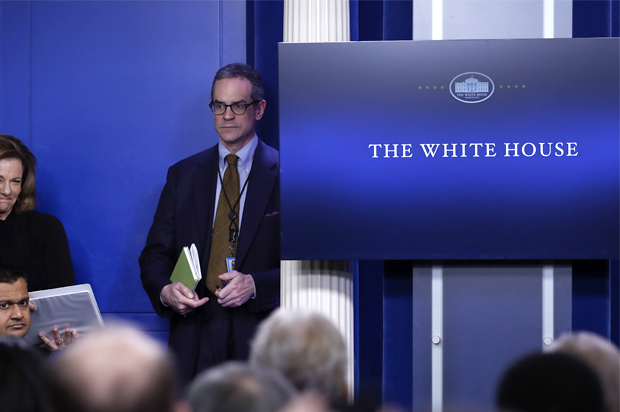
National Security Adviser Michael Flynn, left, stands with K. T. McFarland, and Michael Anton during the daily news briefing at the White House, in Washington, Wednesday, Feb. 1, 2017. Flynn said the administration is putting Iran “on notice” after it tested a ballistic missile. (AP Photo/Carolyn Kaster)
The enigmatic writer’s real name is Michael Anton, and he’s a fast-talking 47-year-old intellectual who, unlike most of his colleagues, can readily quote Roman histories and Renaissance thinkers. But readers knew him throughout 2016 as Publius Decius Mus, first at a now-defunct website called the Journal of American Greatness and later in the online pages of the Claremont Review of Books. As Decius, Anton insisted that electing Trump and implementing Trumpism was the best and only way to stave off American decline—making a cerebral case to make America great again…
After working as a speechwriter and press secretary for New York mayor Rudy Giuliani, he entered Bush’s White House in 2001 as a communications aide for the National Security Council—a job that took on greater weight after 9/11. Anton was part of the team that made the case within the administration and to the public for invading Iraq—and he was enthusiastic about the war. That team** helped craft one of the more infamous sentences in a State of the Union address, from Bush’s in 2003: “The British government has learned that Saddam Hussein recently sought significant quantities of uranium from Africa.”
His evolution on the issue of Iraq is perhaps Anton’s most notable shift, but it’s not the only one informed by his experience as a member of the governing class he so artfully assailed as Decius. After leaving the Bush administration in 2005, Anton was a speechwriter for Rupert Murdoch at the media conglomerate News Corporation, then the director of communications at megabank Citigroup. For the last year and a half, he’s been a managing director at the investment firm BlackRock. With that résumé, it’s no wonder the man who referred to the “Davos class” as a “junta” and wrote that it would “be better for the nation to divide up more equitably a slightly smaller pie than to add one extra slice” chose to write under a pseudonym. Anton would no doubt happily accept that he is a “traitor to his class,” which is what his Journal of American Greatness compatriot Julius Krein called Donald Trump in these pages. (Anton himself has contributed many pieces to THE WEEKLY STANDARD and its website, as recently as last year.)
Anton may also be a traitor to his class of conservative intellectuals, though his writings on Trump rejected by the Claremont Review of Books in early 2016 eventually found their home there by the end of the election. More consequential, in his new position as senior director of strategic communications at the National Security Council, he brings his brand of intellectual Trumpism right to the White House and the locus of power. The job was initially given to Monica Crowley, the writer and television pundit, with the intention that she be a public face for the Trump White House on national-security issues. But Crowley was forced to withdraw just days before Trump was inaugurated after reports revealed she had plagiarized her last book and her Ph.D. thesis. Anton’s role will likely involve less camera time and more shaping of the White House’s national-security message behind the scenes.
A new journal aims to lay the intellectual foundation for the Trump movement.
A 30-year-old conservative wunderkind is out to intellectualize Trumpism, the amorphous ideology that lifted its namesake to the presidency in November.
Until recently, the idea itself was an oxymoron, since Trumpism has consisted in large part of the President-elect’s ruthless evisceration of the country’s intellectual elite. But next month, Julius Krein, a 2008 Harvard graduate who has spent most of his admittedly short career in finance, is launching a journal of public policy and political philosophy with an eye toward laying the intellectual foundation for the Trump movement. If his nerdy swagger is any indication, he has big ambitions: He noted wryly that he is — “coincidentally”— the same age that William F. Buckley Jr. was six decades ago when he founded National Review, the magazine that became the flagship of the conservative movement…
Krein isn’t starting from scratch. During the campaign, the most muscular and controversial defense of Trump came from an anonymous author calling himself Publius Decius Mus in a piece titled “The Flight 93 Election,” published in the Claremont Review of Books. He argued that there was actually some intellectual coherence to Trump’s views, even “if incompletely and inconsistently” articulated. Trump, he wrote, had taken “the right stances on the right issues — immigration, trade, and war — right from the beginning.”
Before he published the article, Decius was writing for an obscure, now-defunct blog, the Journal for American Greatness, where a band of reprobate conservative academics loosely affiliated with the Claremont Institute, a California-based conservative think tank, had gathered to mount a case for Trump.
Krein served as the blog’s day-to-day administrator while holding down a job at a Boston-based hedge fund until the site’s editors shut it down, telling readers that their audience for what was mostly intended as “an inside joke” had “expanded beyond any of our expectations.” Krein deleted all off the archives. But the Journal’s unexpected popularity, the editors said, made it clear that “many others similarly felt the desirability of breaking out of conservatism’s self-imposed intellectual stagnation.”
Krein said American Affairs will be an extension of the Journal, and that several of the blog’s heretofore anonymous contributors will write for him under their own names. He fleshed out the idea for the journal on a phone call in early December with Charles Kesler, the editor of the Claremont Review of Books, and Decius himself, though the latter said he will not be involved with the new publication. They determined that American Affairs would aim to be a crossbreed of the Claremont Institute, which concerns itself more with literature and philosophy than with public policy, and Levin’s National Affairs, which is devoted exclusively to public policy.
Gladden Pappin, a professor of political science at the University of Notre Dame, will be the journal’s assistant editor. Krein emphasized that the journal will include both well-known authors and new voices from the the right and left.
New quarterly journal to be launched in wake of Trump’s win
A new journal is launching next month in reaction to Donald Trump’s presidential victory.
American Affairs journal, a quarterly, will begin publication in February, an outgrowth of the anonymous The Journal of American Greatness blog, which drew praise from conservative writers Peggy Noonan, Christopher Caldwell and Steve Hayward during the presidential campaign.
“It attempts to understand the ideological and political transitions, of which Trump is the most prominent one,” said founder Julius Krein in an interview.
The journal, which will be published by the American Affairs Foundation, will be edited by Krein, as well as Gladden Pappin, a professor at Notre Dame, who will serve as associate editor.
Krein, who will scale back his work at a Boston hedge fund, has been successfully fundraising for his magazine and hasn’t ruled out serving in the Trump administration in the future. “For the time being I’m focused on getting the journal off the ground,” he said.
“Our goal is to provide a forum for people who believe that the conventional ideological categories and policy prescriptions of recent decades are no longer relevant to the most pressing problems and debates facing our country,” Krein said in a statement.
“The journal’s contributors will include well-known authors and new voices, both from the ‘right’ and the ‘left.’ We hope not only to encourage a rethinking of the theoretical foundations of “conservatism” but also to promote a broader realignment of American politics,” Krein added, describing his forthcoming “journal of public policy and political thought.”
So Julius Krein looks like or close to the famous Publius Decius Mus, author of The Flight 93 Election.
The giant intellect behind all of this, however, is Steve Sailer, who is not mentioned in the following superb New Yorker article. Sailer pushes the political philosophy of “citizenism.”
INTELLECTUALS FOR TRUMP: A rogue group of conservative thinkers try to build a governing ideology around a President-elect who disdains ideology.
The most cogent argument for electing Donald Trump was made not by Trump, or by his campaign, but by a writer who, unlike Trump, betrayed no eagerness to attach his name to his creations. He called himself Publius Decius Mus, after the Roman consul known for sacrificing himself in battle, although the author used a pseudonym precisely because he hoped not to suffer any repercussions. In September, on the Web site of the Claremont Review of Books, Decius published “The Flight 93 Election,” which likened the country to a hijacked airplane, and argued that voting for Trump was like charging the cockpit: the consequences were possibly dire, but the consequences of inaction were surely so. Decius sought to be clear-eyed about the candidate he was endorsing. “Only in a corrupt republic, in corrupt times, could a Trump rise,” he wrote. But he argued that this corruption was also evidence of a national crisis, one that could be addressed only by a politician untethered to political piety. The author hailed Trump for his willingness to defend American workers and America’s borders. “Trump,” he wrote, “alone among candidates for high office in this or in the last seven (at least) cycles, has stood up to say: I want to live. I want my party to live. I want my country to live.” By holding the line on unauthorized immigration and rethinking free trade, Decius argued, Trump could help foster “solidarity among the working, lower-middle, and middle classes of all races and ethnicities.” Decius identified himself as a conservative, but he saved much of his criticism for “house-broken conservatives,” who warned of the perils of progressivism while doing nothing in particular to stop it. Electing Trump was a way to take a stand against both ambitious liberalism and insufficiently ambitious conservatism…
Decius, the faceless blogger, is hoping instead that Trump’s Presidency will mark the dawn of a new kind of conservative movement. He is one of a handful of pro-Trump intellectuals who have been laboring to establish an ideological foundation for the political tendency sometimes known as Trumpism…
So it was something of a surprise when, this past February, an academically inclined online publication appeared, full of erudite arguments in favor of Trump. It was called the Journal of American Greatness, in tribute to Trump’s pledge to “Make America Great Again,” although its sensibility was more tweed jacket than red baseball cap. A charmingly bare-bones site, hosted at a lowly blogspot.com Web address, it evoked an earlier, nerdier version of the Internet, and its wry tone seemed calculated to contrast with the bombastic style of its chosen candidate. This was where Publius Decius Mus began his career, alongside a handful of other writers, most of whom adopted Latin pseudonyms. The hidden identities of Decius and the other Journal contributors may have made the essays more seductive, by making their authors seem like fugitives, desperate to stay one step ahead of the ideological authorities. Their facelessness also conveyed a faint sense of menace, as if these were the distant, Plato-quoting cousins of the balaclava-wearing hooligans who are a regular presence at nationalist marches throughout Europe.
The Journal eventually published a hundred and twenty-nine articles, the first of which acknowledged the perversity of the project:
“It may seem absurd to speak of Trumpism when Trump himself does not speak of Trumpism. Indeed, Trump’s surprising popularity is perhaps most surprising insofar as it appears to have been attained in the absence of anything approximating a Trumpian intellectual persuasion or conventionally partisan organization. Yet, Trump’s unique charisma notwithstanding, it is simply impossible for a candidate to have motivated such a passionate following for so long by dint of sheer personality or media antics alone.”
At times, the authors even sought to separate Trump from Trumpism, suggesting that the candidate was a powerful but inconstant champion of his namesake philosophy, which Decius summarized as “secure borders, economic nationalism, interests-based foreign policy.” After Andrew Sullivan, the pioneering blogger, published a widely read New York story suggesting that Trump might be just the kind of tyrant against whom Plato once warned, Decius responded with an essay that was nearly as long and much more abstruse. He argued that Sullivan had misread Plato, and proposed, not very reassuringly, that in our current political climate an overdue recognition of “the people’s sovereignty” might entail, for a time, “more control and less freedom in certain areas.” Like virtually everything written in the Journal, this essay expressed seemingly sincere convictions in a faintly ironic tone, which was disorienting: we didn’t really know who these people were, or how serious they were, even though the political movement they sought to explicate was anything but marginal. Then, in June, the Journal signed off and deleted its archives, declaring that it had been “an inside joke,” which, in the course of a few months, attracted a large following, and “ceased to be a joke.” In this last respect, the Journal had more than a little in common with the man who inspired it…
Evidently, Decius was not quite prepared to quit the debate. That may explain why, in September, he published “The Flight 93 Election.” It may explain, too, why he agreed to meet, a few weeks after Trump’s election, on the condition that his pseudonymity be maintained. He chose a private club in midtown, where he had been attending a lecture. (He hastened to point out that he was not a member himself.) Then he strolled over to a suitably anonymous location: the tatty food court in the basement of Grand Central Terminal, where he endeavored to fold his long legs beneath a small table. The man known as Decius was tall and fit, a youthful middle-aged professional dressed in a well-tailored gray suit and a pink shirt. He has worked in the finance world, but he talked about political philosophy with the enthusiasm of someone who would do it for fun, which is essentially what he does. Before he began to speak, he held out an iPhone showing a picture of his family: if he was unmasked, he said, his family would suffer, because he works for a company that might not want to be connected to an apostle of Trumpism.
It is not necessarily absurd for Decius to suggest that he might suffer a fate like that which befell Brendan Eich, who resigned under pressure from Mozilla Corporation, the tech company he co-founded, after he was discovered to have donated to an anti-same-sex-marriage initiative. By obscuring his real name, Decius is also claiming a new kind of civil right, one often claimed by political activists in the era of social media: the right not to be doxed—that is, not to have one’s online activity linked to one’s offline identity.
Decius is a longtime conservative, though a heterodox one. He had grown frustrated with the Republican Party’s devotion to laissez-faire economics (or, in his description, “the free market über alles”), which left Republican politicians ill-prepared to address rising inequality. “The conservative talking point on income inequality has always been, It’s the aggregate that matters—don’t worry, as long as everyone can afford food, clothing, and shelter,” he says. “I think that rising income inequality actually has a negative effect on social cohesion.” He rejects what he calls “punitive taxation”—like many conservatives, he suspects that Democrats’ complaints about inequality are calculated to mask the Party’s true identity as the political home of the cosmopolitan élite. But he suggests that a government might justifiably hamper international trade, or subsidize an ailing industry, in order to sustain particular communities and particular jobs. A farm subsidy, a tariff, a targeted tax incentive, a restrictive approach to immigration: these may be defensible, he thought, not on narrowly economic grounds but as expressions of a country’s determination to preserve its own ways of life, and as evidence of the fundamental principle that the citizenry has the right to ignore economic experts, especially when their track records are dubious. (In this respect, Trumpism resembles the ideologically heterogeneous populist-nationalist movements that have lately been ascendant in Europe.) Most important, he thinks that conservatives should pay more attention to the shifting needs of the citizens whom government ought to serve, instead of assuming that Reagan’s solutions will always and everywhere be applicable. “In 1980, after a decade of stagnation, we needed an infusion of individualism,” he wrote. “In 2016, we are too fragmented and atomized—united for the most part only by being equally under the thumb of the administrative state—and desperately need more unity.”
Decius takes perverse pride in having been late to come around to Trump; as a populist, he likes the fact that everyday American voters recognized Trump’s potential before he did. When Decius started paying serious attention, around January, he discerned the outlines of a simple and, in his view, eminently sensible political program: “less foreign intervention, less trade, and more immigration restrictions.” Decius cited, as one unlikely precursor, the 2004 Presidential campaign of Dick Gephardt, the Democratic congressman, who ran as a fierce opponent of nafta and other free-trade agreements. (During one debate, Gephardt argued, “We have jobs leaving South Carolina, North Carolina, Missouri—my home state—that originally went to Mexico; they’re now going from Mexico to China, because they can get the cheapest labor in the world in China.”) In his “Flight 93” essay, Decius called Trump “the most liberal Republican nominee since Thomas Dewey,” and he didn’t mean it as an insult. Trump argues that the government should do more to insure that workers have good jobs, speaks very little about religious imperatives, and excoriates the war in Iraq and wars of occupation in general. Decius says that he isn’t concerned about Trump’s seeming fondness for Russia; in his view, thoughtless provocations would be much more dangerous. In his telling, Trump is a political centrist who is misconstrued as an extremist.
Decius says that he learned to accept what he calls Trump’s “unconventionality as a candidate,” and maintains that his support never wavered, even when Trump said things that he found indefensible. (The worst, Decius says, was Trump’s suggestion that Gonzalo Curiel, a federal judge presiding over a fraud case against him, had “an absolute conflict of interest,” because he was of Mexican descent. “I thought that was exactly the wrong thing to do,” Decius said.) But he also thinks that Trump’s occasional crudeness and more than occasional intemperance are inseparable from his “larger-than-life personality,” which was what allowed him to challenge conservative orthodoxy in the first place…
To Decius and his comrades, the language of citizenship is central to Trumpism, which encourages Americans to think of themselves as members of a wonderful club, besieged by gate-crashers. In Trump’s view, loyal American citizens can never fail, only be failed—either by their own leaders, who are (sadly) stupid, or by leaders of competitor countries like Mexico and China, who are (even more sadly) smart. Decius contrasts the Trumpist belief in a “common citizenship,” entrusted with sovereignty, with the bipartisan tendency to leave consequential government decisions in the hands of agencies staffed by technocrats.
Julius Krein was not very late to the Trump party.
What differentiates Trump is not what he says, or how he says it, but why he says it. The unifying thread running through his seemingly incoherent policies, what defines him as a candidate and forms the essence of his appeal, is that he seeks to speak for America. He speaks, that is, not for America as an abstraction but for real, living Americans and for their interests as distinct from those of people in other places. He does not apologize for having interests as an American, and he does not apologize for demanding that the American government vigorously prosecute those interests.
What Trump offers is permission to conceive of an American interest as a national interest separate from the “international community” and permission to wish to see that interest triumph. What makes him popular on immigration is not how extreme his policies are, but the emphasis he puts on the interests of Americans rather than everyone else. His slogan is “Make America Great Again,” and he is not ashamed of the fact that this means making it better than other places, perhaps even at their expense.
His least practical suggestion—making Mexico pay for the border wall—is precisely the most significant: It shows that a President Trump would be willing to take something from someone else in order to give it to the American people. Whether he could achieve this is of secondary importance; the fact that he is willing to say it is everything. Nothing is more terrifying to the business and donor class—as well as the media and the entire elite—than Trump’s embrace of a tangible American nationalism. The fact that Trump should by all rights be a member of this class and is in fact a traitor to it makes him all the more attractive to his supporters and all the more baffling to pundits.
Trump’s campaign is predicated on restoring American greatness here and now, and he is seen to select policies in support of that overarching purpose. Others, in contrast, appear to pursue public office mostly for the sake of implementing favored policies so that they can read about the results of their grand experiments in future economics textbooks. They are like doctors who use patients to advance medical research for its own sake, rather than physicians who use medicine to cure the patients before them.
Investment Analyst
Boston, MassachusettsInvestment Management
Previous
Natural Resources/Ag Investment Firm in Africa, The Blackstone Group, Banc of America Securities
Education
Harvard University
Experience
Consultant
Natural Resources/Ag Investment Firm in Africa
January 2010 – 2013 (3 years)
Analyst
The Blackstone Group
January 2008 – March 2010 (2 years 3 months)
Restructuring (beginning July 2008)
Summer Analyst
Banc of America Securities
June 2007 – August 2007 (3 months)
Mergers and Acquisitions
Intern
U.S. Senate
June 2005 – August 2005 (3 months)
Senate Banking, Housing, and Urban Affairs Committee intern affiliated with Senator Tim Johnson
Education
Harvard University
Harvard University
A.B., Social Studies
2004 – 2008
Activities and Societies: Harvard Student Agencies, Phi Beta Kappa
* I Googled the names that were associated with this forthcoming journal. They seem quite interesting. However, they could stand to be more active as bloggers / tweeters. On the other hand, that would leave them less time to write long articles.
* Whoever wrote this is a regular reader here. He name checks Ben Franklin, Invade/Invite, importing ringers, noblesse oblige etc. Shame he did not extend the courtesy to name the devil. Also a shame to not explicitly name whites. Only “white privelege”. It is a modern idiocy to think that culture is malleable across large ethnic gaps. And a conservative idiocy of the Washington General type.
* Decius: I tried to name Steve but the editors were … well, they … well I’ll stop there.
Anyway, I don’t want anyone to think I am stealing furtively. I know where these things come from and I am willing to give credit where credit is due.
In a prior article (now deleted), I referred to Steve as “perhaps the closest thing the blogosphere has to a political philosopher.” I will leave to readers to unpack the various layers of irony in that comment. But one genuine intellectual historian objected and said so. Steve has no such training, and so on.
[To the extent that the philosopher undermines belief in that common opinion, he undermines the basis of society. He also, not incidentally, puts himself in danger, as the fate of Socrates shows. Steve Sailer, perhaps the closest thing the blogosphere has to a political philosopher, enjoys pointing out the error at the heart of the “Emperor’s New Clothes” parable. In real life, the little child—whom we may analogize to the philosopher—would be torn limb from limb for exposing everyone’s ignorance.]
To be sure.
My comment was meant in jest, but only partly. I think Steve’s grasp of political theory is weaker than my own. However, a long time ago, we got into an argument about political theory and despite my book-learnin’, I lost. He was right and I was wrong. It took me a long time to understand that but eventually I did.
I also came to understand (or think I did; “all knowledge is provisional”) that Steve’s understanding is truer to the great thinkers I studied and cherish than my own had been. The larger question of the relation of the universal to the particular still looms (for me) but Steve has been a big help.
While Steve is not a political philosopher in any overt or obvious sense, he is one in the most decisive sense. He thinks about political life directly, not through the filer of any preconceived theory. Which is what Plato and Aristotle did. Plus, with maybe five exceptions, Steve is better than all those who are formally classified as political philosophers in our time.
* “Trump is the most liberal Republican nominee since Thomas Dewey.”
It’s the first time I’ve seen this point being made. He is the most anti-war Republican candidate in decades, and his concern about the displacement of American blue-collar jobs is something traditionally associated with liberals. His policies are everything liberals claim to believe in – apart from their desire for unlimited immigration.
* Decius very generously acknowledges Sailer’s talent as a political thinker.
Note that Steve also has great instincts as a rhetorician! Must be the background in marketing. He immediately spotted the passage that should have come at the end of the essay, and put it at the end of his excerpt:
“I want to live. I want my party to live. I want my country to live. I want my people to live.”
That is very, very potent stuff. It cannot be followed by another twelve paragraphs of thoughtful analysis without dissipating the animal spirits that have been summoned up. The speech has to end there – except for the wild cheering that follows.
Stephen Miller, just in case you’re listening: you should bring Decius on board as a speech-writer, with Steve Sailer as his editor.
* Rush read this entire excerpt on the air this morning and gave it his full-throated agreement. I’m not a huge fan, but getting this such wide exposure is fantastic and further evidence of the shift that’s happening.
* If mainstream conservatism uses the alt-right as a virtue signalling tool, then it’s just playing the left’s game by the left’s rules like it always has. Conservatism has not and will not accomplish anything by that method.
Constitution and the rule of law are reasonable, but it takes a reasonable civilization, a healthy nation, to uphold them. What do conservatives do on these matters of civilization and nation but cave in and get cucked over and over?
The alt-right is not here to prop up conservatism.
* After reading the article, it is clear that Publius Decius Mus is not from the alt-right. That does not mean that his analysis is wrong of course. However please note he did not mention the possibility (read: de facto certaintity) of the collapse and breakup of the U.S. and the civil war, race war and the ethnic cleansing that will go with that collapse.
Imagine the reactions if had included that in his article.
* True Conservatism, Inc., has become a cult, hence the need for Decius to remain anonymous. Everyone has seen what the Scientologists will do to an apostate, so imagine how vicious someone like Ben Shapiro is now that his Uncle Abie act no longer is in demand.
* Although not being from the alt-right makes it EVEN BETTER; he’s a recovering conservative who INDEPENDENTLY came to many of the exact same conclusions. He’s not a joiner, he’s one of those few people who is able to correctly identify relevant facts and derive from them logical conclusions.
* It’s interesting, is it not, that a man who advocates moderate, limited goals – sane immigration policy, limited government, respect for the constitution, and the presidential candidacy of Donald J Trump – should feel safer under the cloak of a pseudonym?
And yet you can call the white race “a cancer”, openly advocate socialism, glorify communism, demand the slaughter of the unborn “on demand and without apology”, indoctrinate little children into homosexuality and transgenderism, gleefully caper and cavort as you promote every imaginable sort of sickness and depravity, and not only does it not damage your career, but – if you’re in academia, the media, or the public sector – will probably enhance it?
* Taking the Flight 93 image a bit further, French and the rest of the cucks are back in the galley sipping tea while telling each other how brave they are. Consoling the cabin crew with promises to “fix this problem very soon, just after getting consensus on what exactly the plan should be”, and sneering at the men in the corner praying for victory.
Meanwhile Trump has grabbed a drink cart and is rolling towards the cockpit door.
First is the objection to anonymity and specifically to the pseudonym. Anonymity supposedly proves that I am a coward, while the use of “Decius” shows that I am a hypocrite. What am I risking? I freely admit that I don’t expect to die. But I do have something to lose, and may well yet lose it. I could easily have not written anything. How could speaking up possibly have been more cowardly than silence?
…The first is simply that Trump might win. He is not playing his assigned role of gentlemanly loser the way McCain and Romney did, and may well have tapped into some previously untapped sentiment that he can ride to victory. This is a problem for both the Right and the Left. The professional Right (correctly) fears that a Trump victory will finally make their irrelevance undeniable. The Left knows that so long as Republicans kept playing by the same rules and appealing to the same dwindling base of voters, there was no danger. Even if one of the old breed had won, nothing much would have changed, since their positions on the most decisive issues were effectively the same as the Democrats and because they posed no serious challenge to the administrative state.
… the current governing arrangement of the United States is rule by a transnational managerial class in conjunction with the administrative state.
Trump is the first candidate since Reagan to threaten this arrangement. To again oversimplify Marini (and Aristotle), the question here is: who rules? The many or the few? The people or the oligarchs? Our Constitution says: the people are sovereign, and their rule is mediated through representative institutions, limited by written Constitutional norms. The administrative state says: experts must rule because various advances (the march of history) have made governing too complicated for public deliberation, and besides, the unwise people often lack knowledge of their own best interests even on rudimentary matters. When the people want something that they shouldn’t want or mustn’t have, the administrative state prevents it, no matter what the people vote for. When the people don’t want something that the administrative state sees as salutary or necessary, it is simply imposed by fiat.
Don’t want more immigration? Too bad, we know what’s best. Think bathrooms should be reserved for the two biological sexes? Too bad, we rule. And so on and on.
To all the “conservatives” yammering about my supposed opposition to Constitutional principle (more on that below) and who hate Trump, I say: Trump is mounting the first serious national-political defense of the Constitution in a generation. He may not see himself in those terms. I believe he sees himself as a straightforward patriot who just wants to do what is best for his country and its people. Whatever the case, he is asserting the right of the sovereign people to make their government do what they want it to do, and not do things they don’t want it to do, in the teeth of determined opposition from a managerial class and administrative state that want not merely different policies but above all to perpetuate their own rule…
Trump, right now, is right and the conservatives are wrong. His moderate program of secure borders, economic nationalism, and America-first foreign policy—all things that liberals and conservatives alike used to take for granted, if they disagreed on implementation—holds the promise of fostering more unity. But today, liberals are apoplectic at the mere mention of this program—controlling borders is “extreme” but a “borderless world” is the “ultimate wisdom”—and the Finlandized conservatives aid them in attacking the candidate who promotes it. Conservatives claim to deplore the way the Democrats slice and dice the electorate, reduce it to voting blocs and interest groups, and stoke resentments to boost turnout. But faced with a candidate explicitly running on a unity agenda they insist he is too extreme to trust with the reins of power. One wants to ask, again: which is it, conservatives? Is Trump to be rejected because he is too moderate or because he is too extreme? The answer appears to be that it doesn’t matter, so long as Trump is rejected.
So that’s my “immoderate” case for Trump: do things that are in the interests of lower, working, and middle class Americans in order to improve their lives and increase unity across all swaths and sectors of society…
Every four years the electorate becomes more unfavorable to Republican candidates, owing above all to mass immigration, which so many Republicans still self-sabotagingly support. We could not even deny reelection to Barack Obama, whose first term was a dismal failure by every measure, because he was able to overwhelm us with sheer demographics. “Quantity has a quality all its own.” It will be worse in 2020 than it is now in 2016, just as 2016 is worse than 2012. Not to get all Rubio on you, but they know exactly what they’re doing.
If Hillary wins, there will still be a country, in the sense of a geographic territory with a people, a government, and various institutions. Things will mostly look the same, just as—outwardly—Rome changed little on the ascension of Augustus. It will not be tyranny or Caesarism—not yet. But it will represent, in my view, an irreversible triumph for the administrative state. Consider that no president has been denied reelection since 1992. If we can’t beat the Democrats now, what makes anyone think we could in 2020, when they will have all the advantages of incumbency plus four more years of demographic change in their favor? And if we can’t win in 2016 or 2020, what reason is there to hope for 2024? Will the electorate be more Republican? More conservative? Will constitutional norms be stronger?
The country will go on, but it will not be a constitutional republic. It will be a blue state on a national scale. Only one party will really matter. A Republican may win now and again—once in a generation, perhaps—but only a neutered one who has “updated” all his positions so as to be more in tune with the new electorate. I.e., who has done exactly what the Left has for years been concern-trolling us to do: move left and become more like them. Yet another irony: the “conservatives” who object to Trump as too liberal are working to guarantee that only a Republican far more liberal than Trump could ever win the presidency again.
Steve Sailer writes: “Eventually, people will notice that if nonplayer Selig is in the Hall of Fame, statistical writer Bill James deserves to be in the Hall of Fame at least as much. But then they might notice that, like Selig, James went out of his way to not notice the Steroids Era.”
Posted inBaseball|Comments Off on “Hall of Fame Voters Soften Stance on Stars of Steroids Era”
"This guy knows all the gossip, the ins and outs, the lashon hara of the Orthodox world. He’s an [expert] in... all the inner workings of the Orthodox world." (Rabbi Aaron Rakeffet-Rothkoff)