
RUPTURE AND RECONSTRUCTION:THE TRANSFORMATION OF CONTEMPORARY ORTHODOXY by Haym Soloveitchik

Published in Tradition, Vol. 28, No. 4 (Summer 1994). Reprinted here with permission.

Haym Soloveitchik teaches Jewish history and thought in the Bernard Revel Graduate School and Stern College for Woman at Yeshiva University.

     This essay is an attempt to understand the developments that have occurred within my lifetime in the community in which I live. The orthodoxy in which I, and other people my age, were raised scarcely exists anymore. This change is often described as "the swing to the Right." In one sense, this is an accurate description. Many practices, especially the new rigor in religious observance now current among the younger modern orthodox community, did indeed originate in what is called "the Right." Yet, in another sense, the description seems a misnomer. A generation ago, two things primarily separated modern Orthodoxy from, what was then called, "ultra-Orthodoxy" or "the Right." First, the attitude to Western culture, that is, secular education; second, the relation to political nationalism, i.e. Zionism and the state of Israel. Little, however, has changed in these areas. Modern Orthodoxy still attends college, albeit with somewhat less enthusiasm than before, and is more strongly Zionist than ever. The "ultra-orthodox," or what is now called the "haredi"1 camp is still opposed to higher secular education, though the form that the opposition now takes has local nuance. In Israel, the opposition remains total; in America, the utility, even the necessity of a college degree is conceded by most, and various arrangements are made to enable many haredi youths to obtain it. However, the value of a secular education, of Western culture generally, is still denigrated. And the haredi camp remains strongly anti-Zionist, at the very least, emotionally distant and unidentified with the Zionist enterprise. The ideological differences over the posture towards modernity remain on the whole unabated, in theory certainly, in practice generally. Yet so much has changed, and irrecognizably so. Most of the fundamental changes, however, have been across the board. What had been a stringency peculiar to the "Right" in 1960, a "Lakewood or Bnei Brak humra,” as—to take an example that we shall later discuss shiurim (minimal requisite quantities), had become, in the 1990’s, a widespread practice in modern orthodox circles, and among its younger members, an axiomatic one. The phenomena were, indeed, most advanced among the haredim and were to be found there in a more intensive form. However, most of these developments swiftly manifested themselves among their co-religionists to their left. The time gap between developments in the haredi world and the emerging modern orthodox one was some fifteen years, at most.

    It seemed to me to that what had changed radically was the very texture of religious life and the entire religious atmosphere. Put differently, the nature of contemporary spirituality has undergone a transformation; the ground of religiosity had altered far more than the ideological positions adopted thereon. It further appeared that this change could best be studied in the haredi camp, for there it takes its swiftest and most intense form. With this in mind, I read widely in the literature of the haredim, listened to their burgeoning cassette literature, and spent more time than was my wont in their neighborhoods. I tried my best to understand what they were doing in their terms and what it meant in mine. And the more I studied them, I became convinced that I was, indeed, studying myself and my own community. I uncovered no new facts about them or us, but thought that I did perceive some pattern to the well-known ones. As all these facts are familiar to my readers, the value of my interpretation depends entirely on the degree of persuasive correspondence that they find between my characterizations and their own experiences.

*  *  *

    If I were asked to characterize in a phrase the change that religious Jewry has undergone in the past generation, I would say that it was the new and controlling role that texts now play in contemporary religious life. And in saying that, I open myself to an obvious question: What is new in this role? Has not traditional Jewish society always been regulated by the normative written word, the Halakhah? Have not scholars, for well over a millennium, pored over the Talmud and its codes to provide Jews with guidance in their daily round of observances? Is not Jewish religiosity proudly legalistic and isn’t exegesis its classic mode of expression? Was not "their portable homeland," their indwelling in their sacred texts, what sustained the Jewish people throughout its long exile?

    The answer is, of course, yes. However, as the Halakhah is a sweepingly comprehensive regula of daily life-covering not only prayer and divine service, but equally food, drink, dress, sexual relations between man and wife, the rhythms of work and patterns of rest-it constitutes a way of life. And a way of life is not learned but rather absorbed. Its transmission is mimetic, imbibed from parents and friends, and patterned on conduct regularly observed in home and street, synagogue and school.

    Did these mimetic norms—the culturally prescriptive–conform with the legal ones? The answer is, at times, yes; at times, no. And the significance of the no may best be brought home by an example with which all are familiar—the kosher kitchen, with its rigid separation of milk and meat—separate dishes, sinks, dish racks, towels, tablecloths, even separate cupboards. Actually little of this has a basis in Halakhah. Strictly speaking, there is no need for separate sinks, for separate dishtowels or cupboards. In fact, if the food is served cold, there is no need for separate dishware altogether. The simple fact is that the traditional Jewish kitchen, transmitted from mother to daughter over generations, has been immeasurably and unrecognizably amplified beyond all halakhic requirements. Its classic contours are the product not of legal exegesis, but of the housewife’s religious intuition imparted in kitchen apprenticeship.

    An augmented tradition is one thing, a diminished one another. So the question arises: did this mimetic tradition have an acknowledged position even when it went against the written law? I say "acknowledged", because the question is not simply whether it continued in practice (though this too is of significance), but whether it was accepted as legitimate? Was it even formally legitimized? Often yes; and, once again, a concrete example best brings the matter home. There is an injunction against "borer"—sorting  or separating on Sabbath. And we, indeed, do refrain from sorting clothes, not to speak of separating actual wheat from chaff. However, we do eat fish, and in eating fish we must, if we are not to choke, separate the bones from the meat. Yet in so doing we are separating the chaff (bones) from the wheat (meat). The upshot is that all Jews who ate fish on Sabbath (and Jews have been eating fish on Sabbath for, at least, some two thousand years2) have violated the Sabbath. This seems absurd, but the truth of the matter is that it is very difficult to provide a cogent justification for separating bones from fish. In the late nineteenth century, a scholar took up this problem and gave some very unpersuasive answers3 It is difficult to imagine he was unaware of their inadequacies. Rather his underlying assumption was that it was permissible. There must be some valid explanation for the practice, if not necessarily his. Otherwise hundreds of thousands, perhaps, millions of well-intending, observant Jews had inconceivably been desecrating the Sabbath for some twenty centuries. His attitude was neither unique nor novel. A similar disposition informs the multi-volumed Arukh ha-Shulhan, the late nineteenth century reformulation of the Shulhan Arukh.4 Indeed, this was the classic Ashkenazic position for centuries, one which saw the practice of the people as an expression of halakhic truth. It is no exaggeration to say that the Ashkenazic community saw the law as manifesting itself in two forms: in the canonized written corpus (the Talmud and codes), and in the regnant practices of the people. Custom was a correlative datum of the halakhic system. And, on frequent occasions, the written word was reread in light of traditional behavior.5

    This dual tradition of the intellectual and the mimetic, law as taught and law as practiced, which stretched back for centuries, begins to break down in the twilight years of the author of the Arukh ha-Shulhan, in the closing decades of the nineteenth century. The change is strikingly attested to in the famous code of the next generation, the Mishnah Berurah.6 This influential work reflects no such reflexive justification of established religious practice, which is not to say that it condemns received practice. Its author, the Hafetz Hayyim, was hardly a revolutionary. His instincts were conservative and strongly inclined him toward some post facto justification. The difference between his posture and that of his predecessor, the author of the Arukh ha-Shulhan, is that he surveys the entire literature and then shows that the practice is plausibly justifiable in terms of that literature. His interpretations, while not necessarily persuasive, always stay within the bounds of the reasonable. And the legal coordinates upon which the Mishnah Berurah plots the issue are the written literature and the written literature alone.7 With sufficient erudition and inclination, received practice can almost invariably be charted on these axes, but it is no longer inherently valid. It can stand on its own no more.

    Common practice in the Mishnah Berurah has lost its independent status and needs to be squared with the written word. Nevertheless, the practices there evaluated are what someone writing a commentary upon Shulhan Arukh would normally remark on. General practice as such is not under scrutiny or investigation in the Mishnah Berurah. It is very much so in the religious community of today.

    One of the most striking phenomena of the contemporary community is the explosion of halakhic works on practical observance. I do not refer to the stream of works on Sabbath laws, as these can be explained simply as attempts to determine the status, that is to say, the permissibility of use, of many new artifacts of modern technology, similar to the spate of recent works on definition of death and the status of organ transplants. Nor do I have in mind the halakhic questions raised by the endless proffer of new goods in an affluent society. I refer rather to the publications on tallit and tefillin, works on the daily round of prayers and blessings in synagogue and home, tomes on High Holiday and Passover observance, books and pamphlets on every imaginable topic. The vast halakhic corpus is being scoured, new doctrines discovered and elicited, old ones given new prominence, and the results collated and published. Abruptly and within a generation, a rich literature of religious observance has been created and, this should be underscored, it focuses on performances Jews have engaged in and articles they have used for thousands of years.8 These books, moreover, are avidly purchased and on a mass scale; sales are in the thousands, occasionally in the tens of thousands. It would be surprising if such popularity did not indicate some degree of adoption. Intellectual curiosity per se is rarely that widespread. Much of the traditional religious practice has been undergoing massive reevaluation, and by popular demand or, at the very least, by unsolicited popular consent. In Bnei Brak and in Borough Park, and to a lesser, but still very real extent, in Kiryat Shmuel and Teaneck, religious observance is being both amplified and raised to new, rigorous heights.

    Significantly, this massive, critical audit did not emerge from the ranks of the left or centrist Orthodoxy, some of whose predecessors might have justly been suspect of religious laxity9, but from the inner sanctum of the haredi world, from the ranks of the Kolel Hazon Ish and the Lakewood Yeshivah. It issued forth from men whose teachers and parents were beyond any suspicion of ritual negligence or casualness. Moreover, it scarcely focused on areas where remissness had been common, even on the left. Indeed, its earliest manifestations were in spheres of religious performance where there had been universal compliance. The audit, rather, has encompassed all aspects of religious life, and its conclusions have left little untouched. And the best example and, also, one of the earliest ones, is shiurim (minimal requisite quantities). On Pesach evening one is obliged to a minimal amount of matzah—a quantity equal to the size of an olive. Jews have been practicing the Seder for thousands of years, and no one paid very much attention to what that shiur was. One knew it automatically, for one had seen it eaten at one’s parents table on innumerable Passover eves; one simply did as one’s parents had done. Around the year 1940, R. Yeshayahu Karelitz, the Hazon Ish, published an essay in which he vigorously questioned whether scholars had not, in effect, seriously underestimated the size of an olive in Talmudic times. He then insisted on a minimal standard about twice the size of the commonly accepted one.10 Within a decade his doctrine began to seep down into popular practice, and by now has become almost de rigeur in religious, certainly younger religious circles.11

    This development takes on significance when placed in historical perspective. The problem of "minimal requisite quantities" (shiurim) has been known since the mid-eighteenth century, when scholars in both Central and Eastern Europe discovered that the shiurim commonly employed with regard to solid food did not square with the liquid-volume shiurim that we know in other aspects of Jewish law. The ineluctable conclusion was that the standard requisite quantity of solid food consumption should be roughly doubled. Though the men who raised this issue, the GRA and the Noda Beyehuda,12 were some of the most famous Talmudists of the modern era, whose works are, to this day, staples of rabbinic study, nevertheless, their words fell on deaf ears and were without any impact, even in the most scholarly and religiously meticulous circles.13 It was perfectly clear to all concerned that Jews had been eating matzot for thousands of years, and that no textual analysis could affect in any way a millennia-old tradition. The problem was theoretically interesting, but practically irrelevant.

    And then a dramatic shift occurs. A theoretical position that had been around for close to two centuries suddenly begins in the 1950’s to assume practical significance and within a decade becomes authoritative. From then on, traditional conduct, no matter how venerable, how elementary, or how closely remembered, yields to the demands of theoretical knowledge. Established practice can no longer hold its own against the demands of the written word.

    Significantly, this loss by the home of its standing as religious authenticator has taken place not simply among the modem orthodox, but first, indeed foremost, among the haredim, and in their innermost recess—the home. The zealously sheltered hearth of the haredi world can no longer validate religious practice. The authenticity of tradition is now in question in the ultra-orthodox world itself.

*  *  *

    This development is related to the salient events of Ashkenazic Jewish history of the past century.14 In the multi-ethnic, corporate states of central and Eastern Europe, nationalities lived for hundreds of years side by side, each with its own language, its own religion, its way of dress and diet. Living together, these groups had much in common, yet at the same time they remained distinctly apart. Each had its own way of life, its own code of conduct, which was transmitted formally in the school, informally in the home and street—these are the acculturating agencies—each complementing and reinforcing one another. Equally significant, each way of life seemed inevitable to its members. Crossing over, while theoretically possible, was inconceivable, especially when it entailed a change of religion.

    These societies were traditional, taking their values and code of conduct as a given, acting unselfconsciously, unaware that life could be lived differently. This is best epitomized in the title of one of the four units of the Shulhan Arukh. The one treating religious law is called Orah Hayyim—The  Way of Life. And aptly so. In the enclaves of Eastern Europe, going to shul (synagogue) in the morning, putting on a tallit katan (fringed garment) and wearing pe’ot (side locks) were for centuries the way of life of the Jew. These acts were done with the same naturalness and sense of inevitability as we experience in putting on those two strange Western garments, socks and ties. Clothes are a second skin.
Posted in Torah | Tagged , , , , , | Comments Off on RUPTURE AND RECONSTRUCTION:THE TRANSFORMATION OF CONTEMPORARY ORTHODOXY by Haym Soloveitchik

How Many Times Should You Remind A Friend That He Owes You Money?

About ten years ago, I gave a friend a credit card in his name for which I was responsible.

After a few months, I became uncomfortable with how long it was taking him to pay me back and I canceled his card.

He got angry and refused to pay me back for about $500 he billed on the card.

Over the past decade, I’ve tried three times to discuss this matter with him to no avail.

In response, I’ve let the friendship wither. We still chitchat on the phone about once a month — he’s been in poor health for about a decade — but I don’t go out of my way to see him or to help him because of his failure to this matter.

I’d say three times is my limit for reminding a friend he owes me money. After that, I write off the friendship (but not explicitly so, I believe in keeping cordial relations with as many people as possible, even people I don’t like or trust or respect).

(This blog post is not directed at anyone currently in my life with whom I’m doing business. Your accounts are all good with me. I was inspired to write this blog post by a friendly phone message from my former best friend who’s owed me $500 for a decade.)

Posted in Personal | Tagged , , , , | Comments Off on How Many Times Should You Remind A Friend That He Owes You Money?

Fascist Hides Out As Spiritual Guide

From the New York Times:

In Serbia, more details about Mr. Karadzic’s life as a fugitive emerged on Wednesday, with local media saying he had a mistress, regularly visited a local pub called the Madhouse and invented an imaginary family in the United States.

Blic, a Serbian newspaper, reported that Mr. Karadzic, who went by the name Dragan Dabic, had been smitten by an attractive middle-aged woman named Mila, whom he took everywhere. During his time as a fugitive he posed as an alternative medicine and lifestyle guru. Colleagues of Mr. Karadzic who worked with him at the health magazine Healthy Life told Blic that he introduced Mila as his wife and the great love of his life.

If I know nothing else about a person except that he is a spiritual teacher, I am suspicious. By contrast, religious teachers can be held accountable to a religious tradition and religious practices and a religious community. A Modern Orthodox pulpit rabbi, for instance, is accountable to his congregation, to his peers in the Rabbinical Council of America, to the yeshiva and rabbis who ordained him, and to pretty much any Jew who can mount a fact-based attack on his life and work. A spiritual artist such as Marc Gafni can do his own thing. There’s no union for spiritual artists that can expel him for bad behavior.  On the one hand, this allows him freedom to do great things that organization men can not do. The downsides to this approach are also obvious.

I’m a blogger. I am primarily accountable to whom? I’m not a member of an organization. If I worked for CBS News and I made a mistake, CBS News would be held accountable for my behavior and they would have every incentive to make sure I abided by their guidelines. If I’m rude or wrong, who suffers? My reputation suffers but I can still get up and keep blogging the next day if I feel like it.

Marc and I can basically do whatever our conscience allows. I don’t know about Marc, but my conscience is a frighteningly flexible thing, easily fooled. My still small internal voice is all too often too still and too small.

Posted in Marc Gafni, Personal | Tagged , , , , , | Comments Off on Fascist Hides Out As Spiritual Guide

Touching History: The Untold Story of the Drama That Unfolded in the Skies Over America on 9/11

It’s causing me great pain to put down this book long enough to do a little blogging.

It’s mesmerizing.

All the juicy details on 9/11, many of them not in the commission’s report.

From Publishers Weekly
Starred Review. While most Americans watched the 9/11 attacks on television, the guardians of the nation’s air-control and air-defense systems had the unenviable task of trying to halt them. Working from interviews and tape archives, Spencer’s minute-by-minute chronicle recreates their heroics in nerve-racking detail. In her telling, air-traffic controllers panicked as a seemingly routine—and quickly spotted—initial hijacking metastasized into a coordinated terror attack of unknown size and direction, and tried to divine which of thousands of planes on their radars had become guided missiles. Airline pilots dodged through suddenly chaotic skies while assuring suspicious control towers that they weren’t hijackers themselves. Meanwhile, Air National Guard fighter pilots, hobbled by bad communications and misdirection, scrambled to defend against a murky threat. (Spencer’s sources insist there was a fighter in position to stop United 93, had its passengers not brought it down, by having the pilot ram the airliner with his F-16.) Spencer, a flight instructor, expertly elucidates the complexities and pitfalls of American aviation as it faced a staggering challenge. (June 3)
Copyright © Reed Business Information, a division of Reed Elsevier Inc. All rights reserved.

Product Description
On the azure blue morning of 9/11 the skies were pronounced "severe clear," in the parlance of airline pilots; a gorgeous day for flying. Nearly 5,000 flights were cruising the skies over America when FAA Operations Manager Ben Sliney arrived at the Command Center for his first day on that job. He could never have anticipated the historic drama that was about to unfold as Americans who found themselves on the front lines of a totally unprecedented attack on our homeland sprang into action to defend our country and save lives.In this gripping moment-to-moment narrative, based on groundbreaking reporting, Lynn Spencer brings the inspiring true drama of their unflinching and heroic response vividly to life for the first time, taking us right inside the airliner cockpits and control towers, the fighter jets and the military battle cabs. She makes vital corrections to the findings of the 9/11 Commission Report, and reveals many startling, utterly unknown elements of the story.As a commercial pilot herself, for whom the attacks hit terribly close to home, she knew that the true scope and nature of the response so brilliantly improvised that morning by those in the thick of the action — with so little guidance from those at the highest levels — had not at all been captured by the news coverage or the 9/11 Commission. To get to the truth, she went on a three-year quest, interviewing hundreds of key players, listening to untold hours of tapes and pouring through voluminous transcripts to re-create each heart-stopping moment as it happened through their eyes and in their words as the drama unfolded.From the shocking moment at 7:59 a.m. that American 11 fails to respond to a controller’s call, until the last commercial flight has safely landed and military jets rule the skies, all Americans will find themselves deeply moved and amazed by the grace and fierce determination of these steely men and women as they draw on all of their exquisite training to grasp, through the fog of war, what is happening, put their lives on the line, and mount an astonishing response.This beautifully crafted and deeply affecting account of the full story of their courageous actions is a vital addition to the country’s understanding of a day that has forever changed our nation.

Posted in Book Reviews | Tagged , , , , , | Comments Off on Touching History: The Untold Story of the Drama That Unfolded in the Skies Over America on 9/11

The Origins Of The Awareness Center

Vicki Polin emails:

Believe it or not this was the cover story of the UIC Alumni News (University of Illinois – Chicago).  Several months after this article was written my private practice outgrew the time and space available at The Awakening Center.  I struck out on my own and created a holistic counseling center/cooperative that focused on trauma called "The Awareness Center."   A few years later the direction of The Awareness Center changed and turned into the first international Jewish Coaliltion Against Sexual Abuse/Assault.

———————————————
Comfort zone
Three alumni put mind, body and spirit in harmony at The Awakening Center

by: Carla Beecher-Moehn
UIC Alumni Magazine
January/February 1997 
(Volume 1, Issue 2)
http://www.uiaa.org/pubindex/article.asp?id=1059

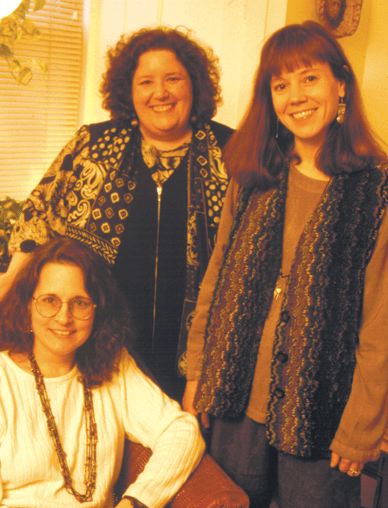
 Making people feel comfortable is the goal of therapists Amy Grabowski (left), Victoria Polin and Kate Fiello.

“More than anything, we want people to feel comfortable and safe here," said Amy Grabowski, M.A. ’86, the director and founder of the Awakening Center on North Lincoln Avenue just south of Belmont. So it’s no coincidence that visitors are greeted in the center’s small waiting room by classical music playing quietly, herbal teas sitting in a box waiting to be steeped and literature offering information on such topics as sexual abuse, eating disorders and surviving trauma.

As the literature suggests, the Awakening Center’s therapists counsel people for depression and anxiety and specialize in eating disorders and physical, mental and sexual abuse.

Of the four therapists who staff the center, three are UIC alumni. Grabowski earned a master’s in art therapy. Victoria Polin, M.A. ’91 received a master’s in art therapy, and Kate Fiello, M.S.W. ’89, a movement therapist, received a master’s in social work. The fourth associate, Marianne Evans-Ramsay, is a licensed and registered dietitian/nutritionist who specializes in disordered eating.

The four women not only share a home-like office space, complete with comfy couches and pictures on the walls, but also a similar philosophy about the need for the mind, body and spirit to work in harmony.

"Whether it’s with individuals or groups, each of us works toward helping clients establish a balance and harmony within themselves," said Grabowski. "We help them achieve a sense of calmness, compassion and inner strength within their core self."

"The result," she continued, "is a feeling of balance and the ability to love the person that they were meant to be."

Grabowski started the center two years ago after running a private practice for seven years. She wanted a place that would offer counseling, treatment and solace for those suffering from depression, anxiety and low self-esteem. She also wanted to help couples and parents who needed help with communication and parenting skills. As a result, the center’s staff provides clients with a safe haven from their fears. Some clients also need to work out such traumatic experiences as incest, rape, physical and/or mental abuse, and even the anguish of political terrorism.

As a creative therapist and a licensed clinical professional counselor, Grabowski specializes in women’s issues, especially eating disorders, body image problems and anxiety. She uses art therapy and phototherapy to help her clients work through their problems.

"I focus on emotional attunement," she said, "and use a theory called Internal Family Systems Therapy whose goal is to create an inner peace and cooperation among the personality’s different parts."

The theory’s premise is that people have many facets of themselves — some are in harmony and some are polarized. The therapy tries to create a balance between them.

A basket on the coffee table in Grabowski’s office holds figures that clients use to help them understand themselves better: there are Barbie dolls, gargoyles, a potato person, an Oreo cookie figure, a witch, an angel and mythical figures.

"These figures represent different aspects of ourselves," she said while setting up several of the dolls. "We use them to symbolize the relationship between the parts. There are pairs of parts that are polarized in extreme roles — which is often where problems arise.

"As we try to get the two parts to become less extreme and more in balance, clients begin to see how one part of them may be very critical of the part of them that is fearful or playful.

"They set up a sort of diorama with these figures that helps them talk with each part of themselves individually, as opposed to having their many parts arguing in their head all the time."
Clients pick one figure to represent their core self. "I like to call that figure the conductor — it’s conducting the orchestra of our different selves. Many people don’t have a good feeling about who that part is. While we’re uncovering who that person is, the figure is always on the table so they can see what they’re working toward becoming."

When Grabowski uses phototherapy, clients bring in several photos of themselves at various young ages. If they were traumatized, a part of them is typically stuck at that age and may keep reliving the experience. Grabowski makes a photo copy of the picture which the client uses to draw on or cut out for use in a collage.

"People have strong feelings toward themselves at a certain age," she continued. "With the photos, they can see themselves and it often softens their feelings about who they were then. They become more compassionate toward that part of themselves. They think, ‘I was so young.’ There are many aspects of therapy that tap into those parts, unburdening them or letting go of something from the past."

Kate Fiello uses movement to help clients get back in touch with their bodies. Many of her clients have eating disorders like anorexia nervosa or may be overweight.

"Many of my clients are disconnected from their bodies — they may view them as a bad object and have difficulty relating to it," said Fiello from the large office that serves as a studio for the movement and art therapy sessions. The space is comfortable and warm.

Fiello’s clients have undergone some type of abuse or trauma that has caused them to separate their minds from their bodies. Fiello’s goal is to get them back in touch with their bodies through movement in hopes that the reconnection will free them from the fear of feeling their bodies.
"I start slowly, because at some level, my clients realize they need to be in their bodies to heal, but they’re terrified of their bodies because that’s where they were traumatized."

Fiello, who is a licensed clinical social worker, begins with breathing awareness — clients begin to notice the rhythm of their breath. What does it feel like? Where is it moving? Does their chest move, their stomach? Is there a part of the body that’s not letting the breath in? What might that tell them about how they’re feeling?

"For instance, when you’re scared, your breath shortens and your chest tightens up," Fiello said. "When you’re relaxed, the breath is more fluid. I want my clients to gently listen to their breath and then scan their body from head to toe to see how it’s feeling. Is their head light or heavy? It’s basic kinesthetic sensing and gets them to start being comfortable with their bodies."

Most of her clients are women who are stuck. They intellectually understand their eating disorders — they know all the dynamics of the disorder in their head, but they haven’t integrated it with their bodies. They’re emotionally repressed. The sensing exercise brings them closer to those feelings.

According to Fiello, many of these women fear that if they get in touch with their feelings, they’ll explode. They don’t have a sense of where their bodies begin and end.

"They think, ‘If my body feels numb now, how will I deal with all the emotions once I start feeling again.’ So I help them with their body boundaries and we try to modulate the degree of the feelings."

One woman in a session with Fiello got angry and had the urge to kick her feet, but was afraid that if she really let her feet feel her anger, she might kick apart the room. So Fiello regulated her kicking from one to 10. Once the woman reached the highest level and kicked the hardest at 10, Fiello helped her control it and bring it back down to one.

"It doesn’t have to be overwhelming," Fiello said. "They can learn to feel a little bit at a time."
A highly distorted body image is a hallmark of anorexia. It is hard to fathom how anorexics think they are fat when they are literally wasting away. To gauge how far off their image is of themselves, Fiello asks new patients to close their eyes and measure with their extended hands how wide they think their hips are. They then lower their arms and open their eyes to see how much wider they imagine themselves to be than they really are.

It’s also common for overeaters to imagine they are smaller than they truly are, added Fiello.
"Culturally, we are just not taught to be in tune with our bodies. We’re taught to intellectualize."
One reason trauma victims become anorexic, according to Fiello, is on an unconscious level, the smaller they become, the less they’ll be seen, and, therefore, won’t get hurt.

"Many times my clients don’t know how to say no or how to stand up for themselves," Fiello said. "To protect themselves, trauma survivors dissociated from their bodies when they were being abused — they just left their bodies and went away in their minds. So over time, when things get stressful, they have the same reaction, which leaves them powerless. I try to teach them to be present in their bodies and become aware of that pattern of dissociation. Then they can start taking care of themselves.

"By thinking of their body as a container, they can feel their boundaries and take control of their lives.

"I love seeing people come alive again, when they begin to embody themselves again. I get to witness the fullness of them. Their personalities become richer as they grow and evolve. It’s wonderful to help them find that."

Vicki Polin also loves seeing her clients grow and change.
"I like watching people fulfill their dreams and wishes and do the things I know they can do," she said.

Polin, who works with victims as young as age 4, directs the Trauma, Recovery and Empowerment Services at the center. Also a licensed clinical professional counselor and a registered art therapist, Polin uses an eclectic approach of both verbal and creative therapies.

"Because many of us get stuck in self-defeating and unfulfilling life patterns in an attempt to re-create our own personal universe, psychotherapy offers a way to rediscover our own potential and bring a balance of mind, body and spirit," Polin said.

Previously, Polin coordinated an international organization for adult survivors of child sexual abuse and has volunteered as a rape crisis advocate in hospitals.

"That job inspired me to get a master’s in art therapy from UIC in work that I thought was important," she said.

Last January, Polin started a free group for adult survivors of childhood sexual abuse at the Awakening Center. The group meets Saturday mornings at the center and represents people from all racial and economic backgrounds. When Polin found that men weren’t attending because of the stigma attached to being sexually abused as children, she changed the name of the program from survivors of sexual abuse to survivors of childhood trauma.

"All of the sudden, I started getting Holocaust survivors and victims of political terrorism. It was very interesting how things opened up."

But no matter what the abuse, the ramifications were the same: having low self-esteem, being unable to do things they wanted to do, and having flashbacks and nightmares — the same symptoms as post traumatic stress disorder.

Polin has noticed a new trend in clients: children of Flower Children.

"Lately I’ve seen several clients who grew up traveling across the country in a van with their parents where there was free sex, and drugs and alcohol abuse," noted Polin. "It’s a whole different kind of abuse that we haven’t paid attention to. These young adults, who are now in their 20s, had very little structure. Some of these people try to be free and wild, but they’ll have flashbacks of their parents having sex, which can be traumatizing to a 3- or 4-year-old child. These clients are trying to figure out if they were sexually abused or just very sexualized as children."

Polin has found art therapy especially useful when patients are trying to understand a trauma that happened when they were very young — before their language skills were fully developed.

"Non-verbal therapy, like art work, seems to help. They draw a picture of the feeling, whether it’s realistic or abstract, or they may do a collage. The pictures may seem cryptic at first, but over time, the pictures come together and clients seem to find some resolution."

Polin recalls Harriet Wadeson, UIC associate professor of art and design, saying, "Memorize every theory we give you while you’re in school and the day you graduate, forget it all and you’ll learn it all over again when you get out in the field."

"It’s true," Polin said. "Unless you’re out there working with people, you’re clueless. It was two years of hell, that program. But if you can make it through, you can make it through anything. It was really helpful."

UIC’s art therapy program teaches its students ways to recognize when a patient is on the mend. Polin knows when clients are getting ready to leave therapy when their lives start to change for the better.

"If they go back to school, or divorce an abusive husband, or maybe go after a new job they’ve been talking about — I know that something is happening there. If I think they’re ready, I’ll try to nudge them out. Sometimes it’s scary for them to leave because this is a safe place."

As clients work through their problems, they begin to realize they’re not to blame for what happened to them, and they learn to deal with their anger and rage. They begin to see they can live life on their own terms.

"I try to follow their lead, because most have let choice be taken away from them," she said. "I know many times clients want to think I will tell them what to do to make their lives better, but the answers are really within them."

In summing up the philosophy of the center, Grabowski added, "Our name, the Awakening Center, means that we hope to awaken the balanced self inside us that is there, but dormant. As we become enlightened, we awaken ourselves to the core person
inside."

Victoria Polin recently compiled the "1997 Chicagoland Area Sexual Abuse Resource Guide for Care Providers and Consumers".

Posted in Awareness Center, Vicki Polin | Tagged , , , , , | Comments Off on The Origins Of The Awareness Center

Why Is The MSM Ignoring The John Edwards Love Child Story?

Mickey Kaus blogs:

Edwards, Rielle Hunter, Busted: HuffPo ‘s Sam Stein, who got the story rolling, appears to be vindicated. … P.S.: Always trust content from kausfiles! Never trust content from Jerome Armstrong. … P.P.S.: Will this be the first presidential-contender level scandal to occur completely in the undernews, without ever being reported in the cautious, respectable MSM? That’s always seemed an interesting theoretical possibility–a prominent politician just disappears from the scene, after blogs and tabloids dig up dirt on him, but nobody who relies on the Times, Post, network news or Mark Halperin has the faintest idea why. If this is that case, it will have come along sooner than I would have thought. … P.P.P.S.: But it’s hard to believe the MSM can ignore the story now. Don’t think Obama will! …

"Get it first, but first get it second." The old Newsweek rule! I hope that’s the rule the MSM is following. If so, here’s an MSM mention! And here. Business Week is what, chopped liver? And doesn’t Jack Shafer count? … I fear there is a new rule: "We don’t want to get it at all. Not even just a mention of the ‘allegation.’ Not even second." Why? Jon Fine’s Business Week piece summarizes some likely reasons. A couple of points:

–Fine notes that "Edwards isn’t considered a likely vice-presidential candidate by the press." That’s true. But he is a likely Obama cabinet official. Many Dems would like to see him as Attorney-General. That’s what’s at stake in the love-child coverage. The Enquirer has killed him as a VP candidate. But if the MSM goes into full "protect Elizabeth" mode the damage might yet not quite be enough to stop his confirmation by a Democratic Senate next year. "Protect Elizabeth" = "protect A.G. John."

If the Enquirer story is true, Edwards didn’t just cheat on his sick wife after making a big deal of his loyalty to her in the campaign. He also presided over an elaborate cover-up, involving lies and duplicitous lobbying of the MSM. What is it the CW says about cover-ups? Eliot Spitzer looks like a Boy Scout in comparison.

P.S.: If the MSM can discuss the charges in meta form ("It’s so easy to jump to conclusions—and I admit, this looks bad") in blogs, chat rooms, and in press commentaries, why not on the front page in political commentaries? As things stand, here’s a rundown of media performance on the John Edwards front:

–The New York Times doesn’t tell you what happened yesterday.

–The print edition of the Washington Post doesn’t tell you what happened yesterday.

Newsweek doesn’t tell you what happened yesterday.

Time doesn’t tell you what happened yesterday.

–Katie Couric didn’t tell you what happened yesterday.

–Brian Williams didn’t tell you what happened yesterday.

–Charlie Gibson didn’t tell you what happened yesterday.

RealClearPolitics doesn’t tell you what happened yesterday.

HuffingtonPost doesn’t tell you what happened yesterday (and it’s their story!). I blame the commenters.

–Mark Halperin doesn’t tell you what happened yesterday.

–Mark Ambinder doesn’t tell you what happened yesterday.

–One Roger Simon tells you what happened yesterday–but the other Roger Simon doesn’t!

Has the gap between what the MSM lets you know and what happened–and what you can easily find out happened–ever been greater? …

Posted in John Edwards, Mickey Kaus, Rielle Hunter | Tagged , , , , , | Comments Off on Why Is The MSM Ignoring The John Edwards Love Child Story?

How Did The National Enquirer Scoop Everybody On The John Edwards Love Child Story?

From death by thousand paper cuts:

National Enquirer

How did the supermarket checkout staple, The National Enquirer, scoop the combined forces of CNN, CBS, ABC, NBC, Fox News, Time Magazine, Newsweek, USA Today, New York Times and the rest of the mainstream press in the John Edwards-Rielle Hunter Love Child affair?

Inquiring minds want to know.

After an hour-long interview with David Perel, Editor-in-Chief of the National Enquirer, we can now say with certainty: it was easy. The steadfast “cone of silence” placed on the story by the Mainstream Media (MSM) made it easy for anyone willing to do the legwork to grab the story from a decidedly-uninterested “respectable” press.

Perel, who was promoted to Editor-in-Chief of the Enquirer in 2005, has overseen the John Edwards Scandal investigation from the very start and provided DBKP with some interesting insights on Edwards, the Love Child Scandal and the Mainstream Media.

Mondoreb: Hi David, congratulations on the National Enquirer’s scoop of the mainstream press–again.

David Perel: Thank you. It was nice to finally have the “smoking gun”.

Mondo: This story has been on-going over the last–what–ten months?

DP: Yes, something like that. Certainly, it’s taken some time.

Mondo: Do you feel vindicated by the latest turn of events in the John Edwards Love Child Story–after the Enquirer’s reporters cornered Edwards in the Beverly Hilton?

DP: Absolutely. We’d gotten information and tips that Edwards was seeing Rielle Hunter and the baby. On Monday, we got some good intel that there was going to be a meeting at the Beverly Hilton hotel and we got the information in time to get everyone in place when it happened. We had a big team on it.

Posted in John Edwards, Rielle Hunter | Tagged , , , , , | Comments Off on How Did The National Enquirer Scoop Everybody On The John Edwards Love Child Story?

The Triumph Of Deborah


PRAISE FOR THE TRIUMPH OF DEBORAH

 "… add[s] sparkle to an ancient story. . . illustrate[s] the pervasiveness of sexual politics. . . in a world bereft of even the semblance of political and sexual equality."–Lilith, Summer 2008


“This novel will be devoured by lovers of historical fiction and romance alike.”—Library Journal, February, 2008.


Recently published by Plume/Penguin, it brings to life the riveting tale of one of the most beloved biblical figures: the revered leader, judge and prophetess Deborah.

In ancient Israel, war is looming. Deborah has coerced warrior Barak into launching a strike against the neighboring Canaanites, who threaten their people with destruction. Against all odds he succeeds, returning triumphantly with two daughters of the Canaanite King as his captives. But military victory is only the beginning of the turmoil, as a complex love triangle develops between Barak and the two princesses.

Deborah, recently cast off by her husband, becomes part of the turmoil. Yet she struggles to rebuild her existence on her own terms, while also groping her way toward the greatest triumph of her life: the attainment of peace.

Based on the book of JUDGES, and filled with brilliantly vivid historical detail, the novel pays tribute to Deborah’s feminine strength and independence from which present day women may derive inspiration to reach their potential. The lesson that women today can learn from Deborah is: I can do it. No matter how difficult and limiting the circumstances, I can overcome them.
 
THE TRIUMPH OF DEBORAH comes in the wake of my two previous very successful biblical novels THE SONG OF HANNAH and THE
GARDEN OF RUTH, which have already had six printings, each.


All three novels are not necessarily just for those with an affinity to the Scripture. They all have intriguing plots, have frequently been referred to as "page turners" and are written in a light style, first and foremost for reading pleasure. They should appeal to a large audience, being the kind of books that people will want to take with them on a vacation, or spend a cozy evening with at home."


For more information, please see my website: www.evaetzionihalevy.com
  
CRITICAL ACLAIM FOR THE BOOKS

The Triumph of Deborah

"… add[s] sparkle to an ancient story. . . illustrate[s] the pervasiveness of sexual politics. . . in a world bereft of even the semblance of political and sexual equality."

–Lilith

"This novel will be devoured by lovers of historical fiction and romance alike."  Library Journal

"A triumph of Storytelling, this is a tribute to the power and strength of all women." Romantic Times

"Despite millennia of separation, this book illustrates that the archetypal themes of love and war never age." Publishers Weekly

"The story explodes from the pages in a menagerie of fascination . . . a perfect piece for anyone who enjoys romance and history mixed into a compelling plot." Metro Spirit – Augusta‘s Independent Voice

"Etzioni-Halevy does an amazing Job of turning ancient Deborah into a living, breathing woman." Atlanta Jewish Times 

". . . a creative banquet of art and skill, knowledge and passion . . . help to hook the reader from page one . . . a tangled web of deceit and passionate love . . . a hymn to Feminine leadership, which has a good chance of being repeated at the next elections in the US. Readers will not rest until they reach the last word." Lily Azerad-Goldman, Bookpleasures.com

"The Triumph of Deborah offers readers an amazing biblical journey full of romance, suspense, and inspiration." Rebecca Honig Friedman, Jewess

 "A spellbinding narrative revealing loves. . . sexuality, and tribulations. . . This work, like the earlier two, is amazing and mesmerizing." Sybil Kaplan, The Indiana Jewish Post & Opinion.


The Garden of Ruth

"Etzioni-Halevy’s choice to fashion the novel as a bit of a mystery helps provoke the readers’ curiosity . . . it is satisfying to compare the ancient struggles of women to those of today."  Elissa Strauss, Forward

"A beautifully sensitive, lustily feminist romance inspired by the Book of Ruth . . . A brazen rendering of the biblical material breathes fire into a ripping good saga." Kirkus Reviews (starred review)  

"A delightful explicit look at the plight of women in ancient times." The Midwest Book Review

"Ruth leaves reader eagerly waiting for author’s next work… An enthralling, sensual work that carries the reader to biblical times . . ." Atara Beck, Jewish Tribune.

"The mystery is intriguing, and Etzioni-Halevy depicts ancient women chafing at limited choices with verve."  Publishers Weekly

"Excellent choice for a book group . . . I could not wait to reach the next chapter . . . Lots of sex and passion and love . . . The mystery plot . . . is absorbing and intriguing . . . among the messages in this work are those on feminism [and] tolerance . . ."Sybil Kaplan,  The Indiana Jewish Post & Opinion

"[The] Novel offers a dramatic new perspective on an ancient tale." Detroit Jewish News

The Song of Hannah

"A thought provoking new look at an old Bible Story." Harriet P. Gross, The Dallas Morning News

"This dramatic retelling of Samuel’s story reminds the reader that even God’s beloved servants are susceptible to temptation . . ." Booklist  

"I was impressed with the force of its courage and imaginative leaps . . . It has many suggestive passages that are authentic to the times of the Bible and to human nature . . . The book was thought-provoking and enjoyable . . ." Mordechai Ben Dat,  Canadian Jewish News

. . . a well written, compelling novel. . . I wanted to read it at one sitting. . . highly sensual. . . one gets a good idea of the role of women in biblical times and in a patriarchal society. . . a very good choice for a book reading group. There are lots of lively issues to discuss." Sybil Kaplan, The Indiana Jewish Post & Opinion

"Speaks in two women’s voices weaving the whole into one tale of sorrow, revenge and redemption through feminine strength and love." Wisconsin Jewish Chronicle

"The Song of Hannah gets top marks for its sheer delight and will surely sweep you off your feet, keeping you enthralled until the last word." Lily Azerad-Goldman, Bookpleasures.com

"The Song of Hannah does not disappoint. It is engrossing without being preachy, spiritual without being overly religious." Curledupwithagoodbook.com  


General

"Bible stories like you’ve never read before . . . strong and graceful writing that provides a real page-turner, and offers a perfect weekend read. The bonus is some biblical education. When arriving at the last page, you’ll want more." Harriette Ellis, Orange County Jewish Life

Posted in Book Reviews | Tagged , , , , , | Comments Off on The Triumph Of Deborah

The Miserable Jews

I just watched this cool 1998 movie starring Rabbi Yosef Blau as Inspector Javert and Rabbi Marc Winiarz as Jean Valjean.

It was a thriller!

Winiarz was imprisoned at age nineteen for stealing forbidden fourteen year old loving when he was a starving yeshiva student.

After serving hard labor at a shul in Boca Raton, he escapes to Israel and constructs a new life for himself.

But wherever he goes, R. Blau is after him.

Winiarz is required to carry a yellow star, which marks him as a convict. Rejected by shul keepers, who do not want to take in a convict, Winiarz sleeps on the streets of Jerusalem. However, the benevolent Rabbi Shlomo Carlebach takes him in and gives him shelter. In the night, Winiarz steals Carlebach’s silverware and runs. He is caught, but Holy Brother Shlomo rescues him by claiming that the silver was a gift and at that point gives him two candlesticks as well. Shlomo then tells him he must become an honest man and must perform good deeds for others. As Winiarz broods over these words, he steals a young woman’s virtue and chases her father away.

Soon after he realizes his mistake, and decides to follow Shlomo’s advice. He searches the city for the girl whose virtue he stole. At the same time, his theft is reported to the rabbis, which now look for him as a repeat offender.

Six years later, Winiarz, having assumed the pseudonym of Mordecai Gafni to avoid capture, has become a wealthy un-Orthodox rabbi and is appointed mayor of his adopted home town of Bayit Chadash in Israel.

He meets the dying Sarah, who had been fired from her job as his assistant and resorted to prostitution. She has a young daughter, Cosette, who lives with a corrupt Orthodox rabbi and his selfish, cruel rebbetzin.

Sarah is dying of AIDS.

Winiarz, seeing in Sarah similarities to his former life of hardship, promises her that he will take care of Cosette, despite the imminent threat of arrest on trumped up rape charges.

Inspector Javert has already suspected the identity of Winiarz and Sarah.

He tips off his minstrel friend Gary Rosenblatt, Editor of The Jewish Week, who writes a column questioning if Gafni is trustworthy after his fooling around 25 years prior. This leads to an article in Ma’ariv and harassing blogs by Vicki Polin (played by Kathy Bates) and Luke Ford (played by Guy Pearce).

Falsely charged with rape at Bayit Chadash, Winiarz runs to a convent in Salt Lake City with Cosette.

Rabbi Joseph Telushkin goes to rescue him.

Their dialogue goes like this:

Sir Telushkin: We were in the nick of time. You were in great peril.
Sir Gafni: I don’t think I was.
Sir Telushkin: Yes, you were. You were in terrible peril.
Sir Gafni: Look, let me go back in there and face the peril.
Sir Telushkin: No, it’s too perilous.
Sir Gafni: Look, it’s my duty as a knight to sample as much peril as I can.
Sir Telushkin: No, we’ve got to find the Holy Grail. Come on.
Sir Gafni: Oh, let me have just a little bit of peril?
Sir Telushkin: No. It’s unhealthy.
Sir Gafni: I bet you’re gay.
Sir Telushkin: Am not.

Gafni returns to the convent and faces his destiny at the hands of Mother Superior Dingo.

Dingo: You must spank her well, and after you are done with her, you may deal with her as you like… and then… spank me.
All: And me. And me too. And me.
Dingo: Yes. Yes, you must give us all a good spanking. 
Dingo: And after the spanking, the oral sex.
Gafni: Well, I could stay a bit longer…

Much debauchery and spiritual enlightenment ensue.

With his minstrel Gary Rosenblatt, R. Blau tracks Winiarz’s radioactive body fluids across the Utah desert.

Minstrel: [singing] Bravely bold Sir Blau rode forth from Yeshiva University. He was not afraid to die, oh brave Sir Blau. He was not at all afraid to be killed in nasty ways, brave, brave, brave, brave Sir Blau. He was not in the least bit scared to be mashed into a pulp, or to have his eyes gouged out, and his elbows broken. To have his kneecaps split, and his body burned away, and his limbs all hacked and mangled, brave Sir Blau. His head smashed in and heart cut out, and his liver removed, and his bowels unplugged, and his nostrils raped and his bottom burned off and his penis…
Sir Blau: That’s, uh, that’s enough music for now, lads… looks like there’s dirty work afoot.

Woman: Oh. How do you do?
Rabbi Blau: How do you do, good lady? I am Blau, King of the Jews. Whose castle is that?
Woman: King of the who?
Rabbi Blau: King of the Jews.
Woman: Who are the Jews?
Rabbi Blau: Well, we all are. We are all Jews. And I am your king.
Woman: I didn’t know we had a king. I thought we were an autonomous collective.
Dennis Prager: You’re foolin’ yourself! We’re living in a dictatorship. A self-perpetuating autocracy in which the working class…
Woman: Oh, there you go bringing class into it again.
Dennis Prager: Well, that’s what it’s all about! If only people would…
Rabbi Blau: Please, please, good people, I am in haste. Who lives in that castle?
Woman: No one lives there.
Rabbi Blau: Then who is your lord?
Woman: We don’t have a lord.
Dennis: I told you, we’re an anarco-sydicalist commune. We take it in turns to be a sort of executive officer for the week…
Rabbi Blau: Yes…
Dennis: …but all the decisions of that officer have to be ratified at a special bi-weekly meeting…
Rabbi Blau: Yes I see…
Dennis: …by a simple majority in the case of purely internal affairs…
Rabbi Blau: Be quiet!
Dennis: …but by a two thirds majority in the case of…
Rabbi Blau: Be quiet! I order you to be quiet!
Woman: Order, eh? Who does he think he is?

Rabbi Blau: Old woman.
Dennis: Man.
Rabbi Blau: Man, sorry. What knight lives in that castle over there?
Dennis: I’m 37.
Rabbi Blau: What?
Dennis: I’m 37. I’m not old.
Rabbi Blau: Well I can’t just call you "man".
Dennis: Well you could say "Dennis".
Rabbi Blau: I didn’t know you were called Dennis.
Dennis: Well you didn’t bother to find out did you?
Rabbi Blau: I did say sorry about the "old woman", but from behind you looked…
Dennis: What I object to is you automatically treat me like an inferior.
Rabbi Blau: Well I am king.
Dennis: Oh, king eh? Very nice. And how’d you get that, eh? By exploiting the workers. By hanging on to outdated imperialist dogma which perpetuates the economic and social differences in our society.
Rabbi Blau: I am your king.
Woman: Well I didn’t vote for you.
Rabbi Blau: You don’t vote for kings.
Woman: Well how’d you become king then?
[Angelic music plays… ]
Rabbi Blau: The Lady of the Lake, her arm clad in the purest shimmering samite held aloft Excalibur from the bosom of the water, signifying by divine providence that I, Blau, was to carry Excalibur. THAT is why I am your king.
Dennis: [interrupting] Listen, strange women lyin’ in ponds distributin’ swords is no basis for a system of government. Supreme executive power derives from a mandate from the masses, not from some farcical aquatic ceremony.
Dennis: Oh, but you can’t expect to wield supreme executive power just because some watery tart threw a sword at you.
Dennis: Oh but if I went ’round sayin’ I was Emperor, just because some moistened bint lobbed a scimitar at me, they’d put me away.
Dennis: Come and see the violence inherent in the system. Help! Help! I’m being repressed!
Rabbi Blau: Bloody peasant!
Dennis: Oh, what a giveaway! Did you hear that? Did you hear that, eh? That’s what I’m on about! Did you see him repressing me? You saw him, Didn’t you?

Winiarz and Cosette flee into the desert.

There’s a final showdown on a cliff in Capitol Reef National Park.

Winiarz and Blau draw their swords.

Blau: "I’m going to get you!"
Winiarz: "Why don’t you take care of your own home first?"

There’s a great thwacking about until Blau cuts Gafni’s arms off.

Rabbi Blau: Look, you stupid bastard. You’ve got no arms left.
Gafni: Yes I have.
Rabbi Blau: *Look*!
Gafni: It’s just a flesh wound.

Blau cuts Marc’s legs off.

Gafni keeps threatening him. "Right, I’ll do you for that."
Blau: "You’ll what?"
Gafni: "Come here!"
Blau: "What are you going to do? Bleed on me?"
Gafni: "I’m invincible."
Blau: "You’re a loony!"

Posted in Satire | Tagged , , , , , | Comments Off on The Miserable Jews

I Catch Up With My Best Friend From High School

We talk tonight for the first time in 16 years.

We went to Placer High School together. Just before graduation, we made a movie together called "The Adventures of Shannon and Luke."

I put it on YouTube.

After graduation, I went to Australia for a year. Shannon got a cyst on his brain requiring major surgery.

He’d just met a girl.

He married her after the surgery.

They went on to have three kids.

He’s now a prosecutor in Arizona.

Like me, he hasn’t kept up with anyone from high school.

We make plans to go to our 25th anniversary reunion next June.

We talk about our classmates.

The guy who edited our high school newspaper the year before me, Eric Schulzke, is now a political scientist. He linked me a year ago but didn’t reply to my email.

I don’t hear from Rob Stutzman either, who was a spokesman for Governor Schwarzeneger.

Luke: "I Googled you a bunch but couldn’t track you down. I saw you were a prosecutor in King County… I thought when I put up ‘The Adventures of Shannon and Luke’ that would flush you out."

Shannon: "That was just a catalyst for you, man. You’ve had quite an adventure."

"Are you still attacking the porno industry?"

Luke: "I quit that last October."

Shannon: "How come?"

Luke: "My rabbi put an end to it."

Shannon: "The rabbi’s got to be the first person on the planet who’s ever successfully told Luke Ford what to do."

Luke: "Remember April White [a year below us at Placer]?"

Shannon: "Yeah."

Luke: "She went on to write and produce erotic movies."

We remember her as a shy quiet girl who played some basketball and worked on the yearbook.

I look up her entry on imdb.com.

Here are some of her writing credits:

  • Three Hunters (2008) (in production) (screenplay)
  • Kinky Pleasures (2006) (V) (screenplay)
  • Naked Sins (2006) (V) (writer)
  • Naked Players (2006) (V) (writer)
  • Sexual Cravings (2006) (TV) (writer)
  • Shameless Co-eds (2006) (V) (screenplay)
  • Young and Tempting (2006) (TV) (writer)
  • Forbidden Passions (2006) (V) (screenplay)
  • Carnal Cravings (2006) (V) (writer)
  • Busty Models (2006) (V) (written by)
  • Secrets Sins (2006) (TV) (screenplay)
  • Naked Encounters (2005) (V) (screenplay)
  • Naked Ambition (2005) (TV) (writer)
  • Sexual Indiscretion (2005) (V) (screenplay)
  • Insatiable Needs (2005) (TV) (writer)
  • The Sex Spa II: Body Work (2005) (V) (screenplay)
  • Young and Seductive (2004) (TV) (screenplay)
  • "The Extreme Truth" (2004) TV series (unknown episodes)
  • Sexual Revenge (2004) (TV) (writer)
  • Candid Sex (2004) (V) (writer)
  • Naked and Betrayed (2004) (TV) (screenplay)
  • The Secret Cellar (2003) (V) (writer)
    … aka Blood & Roses (USA)
  • Voyeurs Sex Club (2003) (V) (writer)
  • Bare Sex (2003) (V) (screenplay)
  • Illicit Sins (2003) (V) (screenplay)
  • Private Sex Club (2003) (TV) (screenplay)
  • Naked Passions (2003) (TV) (writer)
  • "The Best Sex Ever" (2 episodes, 2002)
        – For Love of Art (2002) TV episode (teleplay)
        – Not on the Menu (2002) TV episode (teleplay)
  • "Sexy Urban Legends" (1 episode)
        – Sleeping with Strangers (????) TV episode (host material) (writer)
  • Deviant Desires (2002) (TV) (teleplay)
  • Embrace the Darkness II (2002) (V) (writer)
  • Sinful Desires (2002) (V) (screenplay)
  • Personals II: CasualSex.com (2002) (V) (writer)
  • Erotic Obsessions (2002) (V) (writer)
  • "Lady Chatterley’s Stories" (5 episodes, 2000-2001)
        – Switch (2001) TV episode (teleplay)
        – Passion (2001) TV episode (teleplay)
        – One Night Stand (2001) TV episode (teleplay)
        – Fantasy (2001) TV episode (teleplay)
        – A Real Man (2000) TV episode (teleplay)
  • Carnal Sins (2001) (V) (writer)
  • Carnal Passion (2001) (V) (screenplay)
  • "Kama Sutra" (1 episode, 2000)
        – The Art of Biting (2000) TV episode (writer)
  • Risk (2000) (uncredited)
  • "Bedtime Stories" (6 episodes, 2000)
        – Another Woman (2000) TV episode (writer)
        – Blindfold (2000) TV episode (writer)
        – First Love (2000) TV episode (writer)
        – No Names, Please (2000) TV episode (writer)
        – Strangers (2000) TV episode (writer)
          (1 more)
  • Forbidden Highway (1999) (writer)
  • "Nightcap" (2 episodes)
        – One Night Affair (????) TV episode (teleplay)
        – Physical Desire (????) TV episode (teleplay)

    guest89:  hey dude
    guest89:  i just read your blog about the stand
    guest89:  but dude, dont you keep kosher
    YourMoralLeader:  hi
    YourMoralLeader:  yes, i keep kosher
    YourMoralLeader:  it was an ad
    guest89:  but why do you gove off the impression that you ate there
    YourMoralLeader:  i didnt write it
    guest89:  but you posted it
    YourMoralLeader:  true, it is labeled an ad
    guest89:  oh
    guest89:  its weird just watching you
    guest89:  you know i can hear your phonecall
    guest89:  ddue are you into all that
    guest89:  porn scrips
    YourMoralLeader:  girl from my high school wrote that
    guest89:  awesome
    guest89:  did you like eat kosher and watch porn
    guest89:  thats hilarious
    YourMoralLeader:  lol
    guest89:  so i bet you do
    guest89:  i dont want to start a discussion abot it, but do you feel that its wrong to do that
    YourMoralLeader:  i dont watch porn, i used to write on the industry
    guest89:  how can you be an expert on an industry if you dont know the products
    YourMoralLeader:  long time ago
    guest89:  so the entire time you were working in porn that you were religious, you never watched a single porn, or masterbated to it or had sex with any of those chicks?
    guest89:  haha thats great for a question from an anonymous chat user
    guest89:  in a public forum
    YourMoralLeader:  i … a few chicks, watched a couple hundred pornos and practiced some self abuse
    YourMoralLeader:  but I also tied tefillin and studied gemara
    guest89:  wow i dont get it
    guest89:  must have been great fun though

    I went to bed early and listened to music from the 1980s. I was awash in memories. I was excited. I couldn’t sleep. I got angry. I turned off the music. I tossed and turned. I must’ve nodded off after 2 a.m.


  • Posted in Personal | Tagged , , , , | Comments Off on I Catch Up With My Best Friend From High School