The Very Hot Melissa Scott

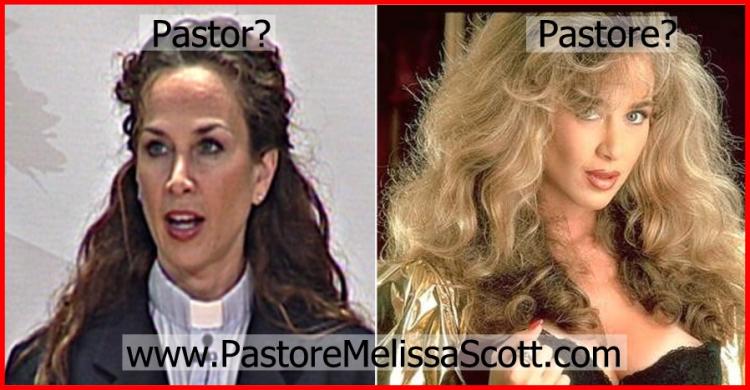
The pastor finally confesses, sort of, to Marie Claire magazine, that she was the nude model Barbie Bridges.

Here is my previous coverage of Melissa Scott.

I only tell this story — not to get hits to my website — but to share an inspiring example of God’s grace, the way He can reach down and lift up the greatest of sinners.

Will you turn to the person next to you right on and say. "Amen! Preach on, Guru Luke!"

What many don’t realize is that Melissa Scott and Sarah Palin are identical twins who were separated at birth:

Gretch Voss writes for the May issue of Marie Claire:

Pastor Melissa Scott presides over a televangelist empire. Hard to believe that she was once a triple-X plaything known as Barbie Bridges.

Shortly after his funeral, Doc Scott’s comely young wife assumed University’s pulpit. But after her first sermon, someone anonymously mailed churchgoers Easter cards featuring snap shots of a porn star known as Barbie Bridges who looked remarkably similar to Pastor Melissa Scott. One image showed the woman with her legs spread wide, Virgin Mary and baby Jesus postage stamps covering her privates. Another featured a "See You Sunday!" banner plastered across her bare chest; underneath it read, "The Church Where You Can Do Anything…Anything."

…Web newsgroups devoted to the church were overrun by users posting more damning photos. ("Who else wants to bang the bejesus out of Pastor Melissa Scott?" inquired one.)

…But Scott would cop to nothing, dismissing the incident as an expert Photoshop job, part of a sick smear campaign by religious nuts. She even trotted out a Hollywood attorney to threaten her congregants with lawsuits should any more anonymous missives materialize.

…By 1998, they were an item. Dr. Scott ordained her his administrative pastor, though she has no formal theological training. Two years later, they wed in Reno.

…Melissa Scott really was a porn star. …Though it’s unclear when she adopted the moniker, she’d already nabbed a title — Miss Nude CanAm Exotic — under the name… Scott was married to Paul Pastore, who worked for an exotic dancing agency named Fantasy Creations before launching a porn distribution outfit called Barbie Bridges Enterprises. (Among its titles: Backdoor Diaries and Heidi’s High Heeled Hookers.)

….Scott didn’t cultivate her relationship with Dr. Scott in church, say former associates, but at his California ranch where the fiery televangelist frequently entertained nude models like Penthouse Pet Chloe Jones and and Playboy Playmate Elke Jeinsen. Congregants dubbed them his "pony girls," because he often filmed them riding his stallions in thong bikinis and broadcast the footage during his Sunday sermons. ("Now that you see what I’ve got waitin’ for me at home," he told his audience, "you should all be extra nice to me for comin’ down here to talk to ya.") "Melissa was there, always dancing for doc topless, showing her tits right away," recalls Jeinsen, now a swimsuit model and sometime actress. Doc often paid his pony girls to attend church, where they acted as a kind of cheerleading squad. "[Melissa] sat in the front row in skimpy outfits. When she came around, I just thought, gold digger," says Christian Shaw, son of Playboy Playmate Christine Shaw, a longtime girlfriend of Doc Scott.

Anyone with this much to hide who still won’t talk about her life seems like a prime character to crack up. Her knowledge of Hebrew seems much less than she advertises and I warrant it is the same way with the other 19 languages she says she taught herself.

Steve Crump writes for MagicValley.com:

Arguably the strangest celebrity the Magic Valley ever produced was televangelist Gene Scott, a flamboyant Buhl native who ran a series of mega-churches and a broadcasting empire in Southern California …

Scott died four years ago at age 75, but his ministry is being continued by his widow, Melissa, herself an interesting story…

Gene Scott was born in 1929 and eventually earned a doctorate in philosophy at Stanford University in 1957 … Ordained by the Assemblies of God, he was a traveling teacher who eventually became pastor of the Protestant Westcott Christian Center and Faith Center in Glendale, Calif., and then the Los Angeles University Cathedral …

In 1975, Scott took his preaching to the airwaves, doing a nightly TV broadcast called the "Festival of Faith." … His sermons were blunt and sometimes peppered with profanity, and he often tangled with the Federal Communications Commission over allegations of illegal fundraising …

Eventually, the FCC pulled his broadcast licenses because Scott refused to turn over donor records …

Undeterred, in 1983 Scott’s University Network began broadcasting the first 24-hour-a-day religious television network via satellite to North America and much of Mexico and the Caribbean … Affiliate television and radio stations transmitted Scott’s services …

In 1990, he became an international shortwave radio voice which, at its peak, was heard worldwide …

Scott’s unconventional preaching earned him a reputation as an eccentric … He chomped on cigars, delighted at having beautiful young women dance at his broadcasts and occasionally conducted services wearing a sombrero … "With his white mane and beard, half-frame reading glasses cocked on his forehead, the Rev. Scott was a caricature of a modern day prophet … He would alternately grin with his white – and dentally enhanced – teeth and berate his congregation," according to a 2005 obituary in the Los Angeles Times …

When Scott died of prostate cancer, his pulpit and his media ministry passed to his wife, 37-year-old, Italian born Melissa Pastore, who had once been married to a producer of adult films … Melissa Scott bought hours of time over broadcast, cable, and satellite television for the presentation of hour-long programs of her husband’s messages from Gene Scott’s later years, as well as many more recent lectures done by herself … Still available are the 24-hour-a-day satellite, Internet and short-wave broadcasts, carrying the raw network feed, featuring 30 years of Scott’s recorded teachings …

She’s been a controversial pastor in her own right, both for her lifestyle and her teachings … You can visit her Web site at www.pastormelissascott.com

Posted in Melissa Scott | Tagged , , , , , , , , | Comments Off on The Very Hot Melissa Scott

Boy-Crazy Orthodox Jewish Girls Loose In Pico-Robertson

I found this on Jewlicious:

Posted in Pico/Robertson | Tagged | Comments Off on Boy-Crazy Orthodox Jewish Girls Loose In Pico-Robertson

I Am In Torah-Drunk Ecstasy

Go here for a link and code to download all the Torah you want for free from Torah In Motion. I’ve been downloading Marc Shapiro all morning.

Dr. Shapiro tells a story of a secular Sephardic girl in Israel who got pregnant outside of marriage. She was scared to tell her father, who was a baal teshuva (returnee to Orthodox Judaism).

So R. Ovadia Yosef has his secretary call the father just before Rosh Hashanah and tell him that R. Yosef wants to see him

When the man gets there, there are several rabbis. There’s cake and alcohol.

"Join me for a l’chaim," says R. Yosef.

"What’s the occasion?" asks the man.

"The occasion is that your daughter is giving birth and I want you to welcome your grandchild into the family."

Posted in Hirhurim | Tagged , , , , | Comments Off on I Am In Torah-Drunk Ecstasy

Biblical Criticism Vs. Orthodox Judaism

Orthodox rabbi Gil Student writes:

Dr. James Kugel responds to Dr. Moshe Bernstein’s opinion piece about his speech at YU (link to Dr. Bernstein’s, link to Dr. Kugel’s). In my opinion, Dr. Kugel’s letter is disingenuous because:

  1. He implies that his views are traditional without directly responding to Dr. Bernstein’s assertions that he denies Torah from Sinai and is not consistent with even a minority view within the Jewish tradition.
  2. He suggests that Dr. Bernstein believes in hiding from modern scholarship when Dr. Bernstein explicitly advocates studying it, including Dr. Kugel’s contributions, but in the appropriate venues and in ways that do not glamorize non-traditional views.

However, I think that Dr. Kugel is correct (and I am sure that Dr. Bernstein agrees) that today, modern scholarship of the Bible is so pervasive in our culture that we cannot hide from it. The question is how to confront it in a format appropriate for laypeople. Even if you were to accept Dr. Kugel’s idiosyncratic views — and do not think that he is within the consensus of academic scholars because he is not — his book was evidently so vague that many (most?) readers are misunderstanding it.

Yair posts: "Dr. Kugel is too traditional to be within the scholarly consensus on Tanach. To fall within the consensus of academic scholars he would need to remove his personal theology from the picture and present something more ‘secular’ on the documentary nature of Tanach and the theories surrounding its historicity and origins."

Tzvee posts: I don’t know how the discussion got so far without recognizing what most young college aged students take for granted once they study substantive course materials. That is, a great deal of what has been produced in modern studies of the Bible has much positive value to offer to anybody – even to the most fundamentalist and reactionary Orthodox Jew with no dangerous down side to accompany it.

Just one quick substantive example of what I mean. In teaching my course at the U of M, The Bible: Wisdom, Poetry and Apocalyptic, http://www.tzvee.com/syllabi-of-…and- apocalyptic — I included the scholarly works of Robert Alter, The Art of Biblical Poetry, and of James Kugel, The Idea of Biblical Poetry, along with other readings from the academic study of Tanakh. There’s never been a doubt in my mind that this was a vibrant and successful way to construct the course syllabus – and at no time did I feel that I was teaching anything that contradicted the tenets of my faith.

Bottom line, to puzzled readers of this blog post about this controversy. It’s moot. The preponderance of modern studies of Tanakh by all kinds of authors has much to commend it and little to render it taboo.

MEIR POSTS: Unfortunately Kugel’s letter was far more interesting and better written and argued than Bernstein’s. I was very disappointed with Bernstein’s article. Teiku?! On the most fundemental issue of Judaism?! Is that the best Bernstein can do? For Judaism’s sake, I hope not.

I still would like to see a well-written, intelligent "Guide for the Perplexed" on this issue. I, and I assume others, truly need such a book.

SS (Solomon Schimmel?) writes: His take is that traditional Judaism is incompatible with the findings of modern scholarship, but takeh takeh the findings are emes, so nebach we’ll just have to deal with it. That’s not reconciling, it’s more like reconciling yourself to defeat.

The meanings of "Orthodox" that Kugel tries to make peace with Bible scholarship are the label and observance; no other definition could possibly mesh with his thesis of irreconcilability. And–to bring this back to the origial point–in this way Kugel is entirely in agreement with the consensus of academic scholarship, in that they both believe that certain fundamental tenets of Orthodox Judaism are not true. What differentiates Kugel is not his approach to reconciling modern scholarship with Orthodoxy (which he doesn’t, final chapter notwithstanding) but that he a) is nonetheless observant and b) has some theology of divine origin of the Torah.

ANON POSTS: You’ve already lost this argument as decisively as the Chareidim have lost the ‘World is 6,000 years old’ argument. The global consensus (apart from a few fundamentalist die hards) is that based on multiple lines of evidence the Bible was written by multiple people over hundreds of years. There has been no move from this position in 50 years, except in the details of who wrote which piece and when. The consensus currently is that you can’t divide it so neatly into JEPD and that at this point the text is a mish mash. You can argue they’re all wrong, just as the Chareidim argue that Carbon Dating is flawed and all scientists are biased. It’s very silly though. Either ignore the problem or give in. ‘Facing up to it’ within the ‘bounds of the mesorah’, ‘sticking to safe areas’, only learning BC from someone with ‘yirat shamayim’ and all the other apologetics made by fundamentalist types are just plain silly at this point. I know plenty of frum hard core Bible Academics, with way more in depth knowledge of the text than you, who all say its poshut that Bib Crit is true. What’s so noble about fighting against the obvious truth? Give it up already! Chag Sameach.

ROBERT WRITES: I am a frum jew NOT because I believe that BC is a sham, but rather DESPITE all the academic scholarship that exists. It would be intelectually dishonest of me ( or anyone) to dismiss BC because it is inconsistent with our mesorah.

In my macro view of life, my faith in mesorah trumps the accepted academic scholarship.

In the micro view of life, academic scholarship can (and probably does) trump the view of traditional orthodox judaism.

It is the dialectic of being a thinking orthodox jew.

Same with bircas hachamah: I do not say the bracha because I believe in all the calculations as stated in the Talmud ("micro" consideration), but rather I say the bracha to praise HKB’H for being the Boray olam AND for continuing to be the Manhig ha’olam ("macro" consideration).

SS WRITES: "For the Nth time, the challenges from modern scholarship have noting to do with divine inspiration, and everything to do with composition and dating. There is no reason why the scholarship couldn’t have concluded that the Torah is the work of one person from the time period of Moshe. But instead of that, the opposite consensus emerged. No conclusion has or ever will be raised about the divine or not divine origin of the Torah. The only question is which human or humans wrote it and when; Orthodox say Moshe, modern scholarship says many people later than him."

RABBI GIL STUDENT WRITES: "People lose their faith because they are dazzled by the scholarship. Scholarship that uses traditional assumptions needs to be promoted that takes away a lot of that dazzle. There are many, many Christian scholars who have retained their faith after studying the Bible academically. That is because they have developed respectable scholarship that can stand up to non-Christian scholarship, even if it is nowhere near the academic mainstream. Jews need to do the same."

SS WRITES: "Wellhausen himself wrote about how his scholarship was affecting his own (obviously Christian) students’s faith negatively! And the uproars and controversies of the 1800s about Bible scholarship made the mainstream newspapers. Take a look at the NYTimes archives for proof. Look at the history of battles between the Vatican and the Catholic priests spearheading the modernism movement (who were excommunicated). The Christian faithful are simply oblivious to what Bible scholarship has learned about the Bible, New Testament included. If they weren’t, they’d be a lot less faithful. Just ask Bart Ehrman or Bishop Spong.

"The respectable scholarship is of no more help to believing Christians than it is to Orthodox Jews. Evangelical and post-modern apologetics are neither respectable nor scholarship (your "nowhere near the academic mainstream" is a euphemism for "crank"). And anyway, the masses don’t use them, because they aren’t aware of the need. It wouldn’t work if they tried, and their leaders know it.

"Christians have not "tamed" Bible scholarship, they’ve just sequestered it in ivory halls. Popular Christian pastors are not quoting "respectable scholarship that can stand up to non-Christian scholarship" from the pulpits, fully confident that it will defeat modern scholarship in the minds of their parishioners. This fantasy world you’re dreaming of where Christians have beat down modern Bible scholarship in ways that we can copy is wholly illusory."

ANON POSTS: People lose their faith because they look at the modern scholarship, then they look at 2,000 years of ‘meforshim’, and they see whose answers actually fit with linguistics, history etc (and of course the actual text itself) and whose answers seem entirely made up to try and fit everything into a specific religious belief. It’s not about dazzle, it’s about plain sechel. YOu don’t need to be a rocket scientist, or even a biblical scholar, or even know anything much about the DH to spot all the doublets, inconsistencies and different language. Breishis reads very differently than the rest of the Torah, both in style and content. Yes of course you can make up bookloads of beautiful peshatim on all that (and there’s nothing wrong with that endeavor, le’hefech in fact) but it’s pretty obvious once you take off the blinders. The plain and simple reason why you don’t want to accept this is NOT at all because you think that the text reads better with single authorship but rather is entirely because multiple authorship would deal a severe blow to your preconceived religious beliefs.

I’m also amazed why you would say any frum people would be ‘dazzled’ by scholarship thats only a hundred or so years old, whereas we have had the greatest talmidei chachomim in the history of the world toiling away with mesiras nefesh night and day for almost 3,000 years on the very same topic – yet you say ‘they have developed respectable scholarship that can stand up to non-Christian scholarship, even if it is nowhere near the academic mainstream. Jews need to do the same.’ Jews need to develop ‘new scholarship’ ??!! What have they been doing for the past 3,000 years? Why doesn’t that help?

YEHUDA POSTS: My general reaction to this controversy is a feeling of disappointment with Moshe Bernstein’s comments; not only did I expect something far more nuanced, but I was also stunned by utter lack of perspective from someone I consider my "rebbe" in Tanakh and for whom I have an enourmous amount of respect, intellectual and otherwise; years ago I studied intensely with MJ for a period of at least five years.

For the legitimacy of a lecture by Kugel at YU to be challenged is ridiculous.

As far as Kugel goes, I agree with the overall approach but feel that one thing has been ignored (as I was surprised that MJ ignored it too). I certainly agree that Kugel’s presentation of the history of biblical interpretation is both excellent and representative modern scholarship. His religious conclusions based on this are also well stated and although I don’t think they are the only approach, they are certainly a basic way a dealing with things that one would expect to surface quickly in a discussion of these issues. An all-or-nothing approach somewhat analogous to Isaiah Leibowitz’s perspective on Zionism…

However, there is also something that has been entirely ignored in Kugel’s presentation; ignoring it is morally wrong in my opinion. And that is his disrespectful dismissal of a relatively new field in biblical research that has made great strides in the past generation, namely that of poetics and the literary reading of the Bible. Kugel not only dismisses any implications this field might (or might not) have for traditional source-criticism (which is OK because maybe it doesn’t), but even ridicules the very legitimacy of the field. At one point he compares "discovered" poetic techniques to the "discoveries" of the Bible Codes!

I wonder what Kugel’s motivations are for ridiculing a productive, fascinating field and minimizing its achievements. What does he gain by comparing the likes of Adele Berlin, Robert Alter, Meir Sternberg, etc. to the bible codes? If I recall correctly, he himself even wrote a book of this type once…

NACHUM LAMM POSTS: Yehudah, much of the poetic research and similar fields (chiasms and so on) point to more of a unity of text(s). An uncharitable view might say that Kugel’s life work is "threatened" by such things; a more charitable view is that Kugel has seen so much bunk in this area that he’s naturally skeptical of newer things, however solid.

In reality, the two may be viewed independently, as two ways of approaching the text. I will admit that I was very much put off by Kugel’s tone in his internet appendices to his book, an image that was greatly contradicted when I met him in person (say what you want, he’s a great mentch).

SIMCHA S. POSTS: The key to Kugel’s letter and to Gil’s post is recognition of the obvious realities of biblical scholarship and the daunting challenges they pose to traditional orthodox belief. Professor Bernstein’s objections to Kugel are correct from a religious and perhaps even halachic standpoint. But they do little if anything to address the substance of Kugel specifically and biblical scholarship as a whole.

The corpus of this scholarship and the evidence upon which it is based is simply too expansive too be dismissed with religious epithets. Calling something apikorsus (while perhaps halachically accurate) will do nothing to assuage the honest ben torah who is genuinely disturbed by the challenges of bible scholarship and higher criticism.

At some point, the torah world will have to address these issues. Name calling and hiding will only go so far. The information is out there and accessible. In fact, its appearance on Gil’s blog alone is indicative of how widespread it is becoming. If the torah communities do not come up with an intelligent, substantive and sustainable response to Professor Kugel and his ilk, we will hear of generations at risk instead of kids at risk.

RABBI GIL STUDENT WRITES: "I actually once tried to get together a symposium of scholars to post on this blog about Orthodox responses to biblical criticism. The overwhelming response was that blogs are full of mockers who will reduce the discussion to unthoughtful platitudes and name-calling."

Posted in Bible, Orthodoxy | Tagged , , , , , , , | Comments Off on Biblical Criticism Vs. Orthodox Judaism

JB’s Taped Conversations

Rabbi Gil Student writes:

R. David Holzer published a fascinating book of his many taped conversations of R. Joseph B. Soloveitchik, titled The Rav Thinking Aloud. R. Holzer was R. Soloveitchik’s assistant for a few years and carried around a tape recorder to record their conversations. He also has notes from other conversations that he did not record. What we end up having is topic after topic of word-for-word conversations with R. Soloveitchik.

It’s a fascinating book. To add to the experience, R. Holzer selected some of discussions in which R. Soloveitchik said some very surprising things. Such as:

  • His opposition to kohanim becoming doctors (p. 110)
  • His belief in the miracles described in the Talmud (p. 92)
  • His statement that the Patriarchs worked so unless you think you are more righteous than them, you should work also (p. 128)
  • His opposition to using financial concerns as a reason to permit the use of birth control (p. 95)
  • How he introduced the Lubavitcher Rebbe to the Brisker approach to studying Talmud when they were in Berlin (p. 42)

There is much more in the book than I mentioned. However, I find it hard to believe that R. Soloveitchik would have approved the publication of this book. He was a perfectionist and these are just off-the-cuff remarks. Granted, he knew he was being recorded and there are plenty of disclaimers by the author that these were not polished remarks, but I still feel a little voyeuristic reading these conversations. Especially since there is at least one comment in the book (about R. Soloveitchik’s less than stellar opinion of a leading rabbi’s learning) that I do not think should have been published.

Simcha posts: "I confess that I thumbed through it and found it fascinating. But I agree with Mycroft. These were private conversations that the Rov has with David. Unless the Rov gave him permission to publish these private conversations, I vehemently object to their publication. I understand that the family is quite upset with this book."

Anon posts: "Interesting that Rav Shachter seems to take a completely oposite opproach with regard to financial concerns and birth control. In more than one public shiur he has criticised people who have children if they cannnot afford it and end up having other people supporting them (e.g. subsidising their tuition)."

Steven writes: While I agree that context is critical, I have no problem with the tapes being used. Unless you are going to be equally strident against all the private discussions quoted by any of his students. This would then include R’ Rakeffet who has also generated some controversy and made extensive use of tapes.

His perfectionism not withstanding, he knew that he was being taped. The tapes become part of the historical record. Access / ownership of the tapes is not the families to control.

NATE POSTS: The author writes that there were times where RYBS refused to allow him to be recorded. This implies that he was asked permission. Also, Tape recorders back then were not ipods and could not be easily hidden. There is a picture of the tape recorder he used and it is quite large.

It’s hard to believe that he didn’t know he was being recorded.

THE LATEST ISSUE OF THE YU COMMENTATOR:

  • Yeshiva’s Endowment Long Adopted High-Risk, High-Reward Strategies
  • Board of Trustees Adopts New Rules To Limit Conflict of Interests
  • Professor Signs Anti-Israel Letter, Draws Strong Student Response
  • Click here to read moreNews

  • Desta To Leave For Harvard Law
  • Does Going Green Mean Losing Greens?
  • Yeshiva’s Search For New Chief Investment Officer Progressing
  • Students Search For Jobs In Tough Market
  • Kol Hamevaser Pulls Issue On Relationships & Sexuality
  • Rafi Katz Wins YSU Vice Presidency
  • Joel Announces New Cheating Policy at Town Hall Meeting
  • New Plans for Fifth-Year Scholarship
  • Physical Education Requirements Reduced From Two to One
  • Athletic Trainer Passes Away
  • YU Unveils New Branding System
  • Features

  • Student Complaints Against Mandatory Attendance Draw Attention
  • Bible Criticism
  • Interview with Rabbi Dr. Aaron Glatt: Practicing Torah u-Medicine
  • Editorials

  • Slinging Rocks At Israel From The Ivory Tower
  • No Editor Like Moses
  • Opinion

  • SOY Seforim Sale, Reconsidered
  • An Open Letter to Professor Moshe Bernstein
  • Letters to the Editor — Israel Club Condemns Stalcup’s Letter
  • Review of Exalted Evening: The Passover Haggadah with a Commentary Based on the Teachings of Rabbi Joseph B. Soloveitchik by Dr. Arnold Lustiger
  • New Windows for the New Beit Medrash
  • Sports

  • From the Majors to the Macs
  • Crowning a Champion
  • Fallen Macs
  • Playoff Bound
  • Arts and Culture

  • Phish’s Return Exuberates Yeshiva Students
  • Museum News
  • Visit to Valmadonna
  • Y. Aharon posts: The issue of the type of investments that a charitable organization such as YU is allowed to entertain is a halachic matter that should be judged by its halachic authorities. There is a vast difference between investing your own funds and those which have been contributed. You can risk your own money as much as you wish (your spouse may have a say, however), but not those of others. The fact that YU had invested most of its endowment in riskier hedge funds besides the fund "managed" by Merkin is a good sign that no rabbinic approval was sought or given. There is an "interesting" dichotomy at work here where the rabbinic arm of YU appears to be kept at arms length from financial issues, as if halacha is irrelevant in monetary matters. This is all besides the conflict of interest issue in allowing Merkin to invest endowment money in his own fund. It’s time for YU to greatly improve its business ethics. A start would be to consult with its rabbinic staff on what the halacha has to say on the subject.

    Posted in Rabbis | Tagged , , , , , | Comments Off on JB’s Taped Conversations

    John T. Bone

    Gregory Conley emails:

    Luke,

    I know you’re done with porn journalism, but I felt the need to e-mail you.  I’m working on a book about straight-to-video genre films, and I wanted an example of a guy known for filthy porn films crossing over and doing a couple b-movies (other than Greg Dark).  I read your old postings on him before interviewing him, and one thing talked about how was charming he can be — that posting was right on the money. 

    I previously e-mailed you about reading History of X and really enjoying it.  I read XXX-Communicated over the weekend and had a great time.  I’ve always liked how you would print people criticizing you and saying horrible things about you, but then not respond to the criticism — most writers, including myself, would feel the need to defend themselves.

    Posted in Personal, Pornography | Tagged , , , , | Comments Off on John T. Bone

    Seeking Absolution For My Sins

    Though I try to hold myself back in my interviews, when I feel like they are going well enough, I set my demons loose among the hens.

    For example, see this interview with Robert Cait and these two reports from EmpowerTech.

    In second grade, these disabled kids came to school and volunteers from my class took them around the campus.

    I did not volunteer. Instead, I made fun of the disabled kids after they’d gone.

    My best friend Wayne Cherry was appalled at my cruelty.

    In fourth and fifth grade, my friend’s family moved close to a home for the mentally ill. These people would traipse by every day on the way into town.

    Seeing that they weren’t in their right mind, I tried to barter with them. I offered them my underwear in exchange for the radios they carried around.

    None of them went for my deal, which made me conclude they weren’t so daft.

    I’ve always been obsessed with getting ahead and breaking into the cool crowd, which is usually populated by the beautiful people. Sickness and disability make me uncomfortable. I want to be cool and beautiful and I want to get there by doing the things that are most congenial to me, such as charming the pants off chicks.

    Then I got sick for six years and all my peers left me in the dust. On the other hand, all the people who were nice to me were in the second half of life.

    So I resolved when I was sick that if I got well, I’d reach out to those less fortunate and give of myself to them.

    I’ve done a bit of that, but I’m haunted by the fear that I’m not a good person and that I need to do less onanism and more chesed.

    Hmm, let me ponder my lofty thoughts for a moment. I know I can be cruel but I’m so exquisitely sensitive about it. Yes, yes, yes, that is just right. Now don’t move. Perfect.

    PS. Many people ask me if a blog can have too much self-loathing. In my view, no, not as long as the loathing is genuine.

    Posted in Disability, Ethics, Personal | Tagged , , , , , | Comments Off on Seeking Absolution For My Sins

    Orthodox Harvard Student Takes On Barney Frank

    Watch the video on the left:

    CAMBRIDGE, Mass. (myfoxboston) – It all started with a question: "How much responsibility, if any, do you have for the financial crisis?"

    Rep. Barney Frank (D-Mass) and a conservative Harvard law student debated over how Frank should have handled his role as the House Chairman of the Financial Services Committee. Frank was at Harvard University for a speech at the Kennedy School of Government.

    Frank said the student wasn’t backing up his claims, invoking some laughter from the crowd, and the student told Frank he wasn’t answering his question.

    Posted in Economics, Orthodoxy | Tagged , , , , | Comments Off on Orthodox Harvard Student Takes On Barney Frank

    Who’s The Man Around Here?

    I offered this woman a hug after her tough day at the corporate office and she said she had to go pump iron.

    Good thing I’m secure in my masculinity.

    Posted in Personal | Tagged , | Comments Off on Who’s The Man Around Here?

    JTA’s New Media Guru Sets Me Straight

    Daniel Sieradski aka Orthodox Anarchist, JTA’s director of digital media, posts to my blog:

    Luke, tell me, since you got rid of your porn gossip site, who actually pays you to write for them? Aren’t you, by your own admission “not a businessman” nor “a conventional journalist” but “a story teller/entertainer/lunatic”? When was the last time you had a paying gig as a professional writer? I can’t find a single link online to any article you’ve ever written that’s not published exclusively on your own site except for one op-ed in the LA Times.

    You make enough off your Adsense revenue to make a living? Shkoyach. They’re here for the porn, I’m sure.

    But JTA does, in fact, use Adsense and our monthly earnings are nowhere near enough to cover the operations of an international news agency with over a dozen staff members, a dozen more freelancers, 100 client newspapers, a midtown Manhattan and downtown DC office and a website with at least 6x as much traffic and 6x as much functionality as yours.

    In addition to Adsense, we use Commission Junction affiliate network ads, Spark Networks affiliate ads, and we have David Kelsey and Jewish Media Group doing direct ad sales for us. Add to that the revenue from our client papers and organizations, which constitutes the bulk of our annual revenue, and our donations from philanthropists and readers, and we’re still operating in a deficit while completely understaffed and under-resourced.

    And it’s not only JTA that’s in such a bind. It’s every newspaper in business today, with players far bigger than us folding under even better circumstances than those we’re in.

    So please Mr. All Knowing Pontificate of the News Industry, tell me how your passive Google ad revenue is going to fill the gap that we’re asking our readers to fill?

    And by the way, when people like you steal our content and thus our web traffic and then profit from the sale of ads on our content and then you WHINE ABOUT IT when we ask you to stop, it makes it much harder for us to maximize our profits.

    Pesach sameach.

    Posted in Daniel Sieradski, JTA | Tagged , , , , , | Comments Off on JTA’s New Media Guru Sets Me Straight