
Who Was The Last American Politician Who Was a Public Intellectual?

I think it was the sociologist and politician Daniel Patrick Moynihan, who noted that Americans tend to behave more sanely the closer to Canada they live. Newt Gingrich thinks of himself as one but none of his books stand up on their own without his famous name.

I spent part of my weekend studying the 1939-1940 Winter War between Finland and the Soviet Union.

Finland has traditionally been near the top of the heap for educational test scores. Why? What’s their secret? Lots of Finns.

Here’s a great story from Finland. The Prime Minister wouldn’t debate the ideas of his father on race.

According to Wikipedia:

Tatu Vanhanen (born April 17, 1929 in Vuoksenranta, Finland, now Ozyorskoye, Russia) is a Professor Emeritus of Political Science at the University of Tampere in Tampere, Finland. Vanhanen is a co-author (with Richard Lynn) of IQ and the Wealth of Nations (2002) and IQ and Global Inequality (2006), and author of Ethnic Conflicts Explained by Ethnic Nepotism (1999) and many other works. His son, Matti Vanhanen, is a former Prime Minister of Finland.
Vanhanen developed interest in evolutionary biology after studying Edward O. Wilson’s sociobiology. Most of his academic works are about democratization which he has studied with international comparative methods.[1]
From 2002 to 2004, he was investigated for incitement of “racial hatred” by the Finnish National Bureau of Investigations.[2] An interview he had given with a magazine, in which he contended that whites and Asians were more intelligent than blacks for evolutionary reasons and should therefore be given many of the top political and financial positions in Africa, had apparently been the object of complaint by Finland’s “Ombudsman for Minorities”, Mikko Puumalainen, who said he feared the former professor’s remarks would boost racism. “Whereas the average IQ of Finns is 97, in Africa it is between 60 and 70. Differences in intelligence are the most significant factor in explaining poverty,” Vanhanen had said. Eventually, the police dropped the investigation.
His son, former Prime Minister of Finland Matti Vanhanen, told journalists he did not intend to engage in a public debate with his father.

News report:

The National Bureau of Investigation (NBI) is considering whether or not to launch a criminal investigation into comments made by Professor Emeritus Tatu Vanhanen in an interview with Kuukausiliite, a monthly magazine supplement of Helsingin Sanomat.
In the interview Professor Vanhanen, a former Professor of Political Science at the University of Tampere, said that evolution has made Europeans and North Americans more intelligent than Africans. Prime Minister Matti Vanhanen said on Wednesday that he regrets the controversy sparked by Tatu Vanhanen, who is his father.

Professor Vanhanen told Kuukausiliite that African poverty is not the fault of the white man.
“Whereas the average IQ of Finns is 97, in Africa it is between 60 and 70. Differences in intelligence are the most significant factor in explaining poverty”, Vanhanen said.
He also said that it might be a good thing if as many Europeans, Americans, and Asians as possible were to take on leading economic posts in African countries. “Only they are capable of creating prosperity”, he said.
On the other hand, Tatu Vanhanen said that he favours economic solidarity toward poor countries, and he hopes that immigrants in Finland would inter-marry and assimilate into the population at large.
Jari Liukku, deputy head of the NBI, says that the police are investigating whether or not Vanhanen’s comments constitute public incitement against a national group, which is a crime under Finnish law.

Finland’s minority Ombudsman Mikko Puumalainen hopes that a police investigation will be launched. He says that although freedom of expression is a fundamental right in Finland, the right is not unlimited.
Puumalainen also dismissed the scientific validity of Vanhanen’s claims.
The Finnish League for Human Rights fears that Vanhanen’s interview could aggravate the racism experienced by immigrants and ethnic minorities in Finland.
“This interview could strengthen movements of the far right”, says Aysu Shakir, a project head at the league.
Shakir notes that after the publication of the interview, Internet chat rooms have filled up with comments by extreme right-wing groups and individuals who “swear by Vanhanen’s name”.

Commenting on his father’s interview, Prime Minister Matti Vanhanen said that it case was “more a sad matter than a burden” for him.
Speaking to reporters on Wednesday, the Prime Minister said that the controversy would not have arisen if the person making the comments were not his father.
Asked if he felt a need to distance himself from the views that Tatu Vanhanen expressed, he said that he does not plan to engage in public debate with his father.
Posted in Finland, Race | Comments Off on Who Was The Last American Politician Who Was a Public Intellectual?

Baby Richard

Beginning in April 1995, Dennis Prager devoted every hour of his radio show for six weeks, much to the dismay of his bosses and many of his listeners, to the Baby Richard controversy. Why this obsession? Because the story exemplified Prager’s belief that blood means nothing and values mean everything.
In his March 25, 2002 column, Dennis wrote:

I took the news of the forced resignation of
Chicago Tribune columnist Bob Greene — for having had sexual contact with an 18- or 19-year-old woman 11 years earlier — very hard.
You see, in 1995, Greene and I were the two most vocal voices in
America in defense of a 4-year-old boy taken away from his family and given over to a birth father whom the boy had never seen. The boy, Danny Warburton, was known as “Baby Richard,” though at the age of four, he was hardly a baby.
The Illinois Supreme Court, in a vote of 5 to 2, overturned a
lower-court ruling to leave Danny with his parents and his brother, and to hand him over forever to a birth father who soon after abandoned the boy again. The justices did not even provide a way for Danny to communicate with his family, the only family he had ever known.
At Danny’s birth, the birth mother had legally given adoption rights over to the Warburtons, a fireman and homemaker — his parents virtually from birth.
Bob Greene in the Chicago Tribune and I, through my radio talk show and writings, poured our hearts out for this boy. I devoted half a year to writing an analysis of that horrific decision and the
blood-is-more-important-than-love thinking that made it possible.
How could these Illinois Supreme Court justices use their power to
hurt, rather than protect, a child? As the case involved Chicago
residents, Bob’s voice was uniquely powerful. Against the judgment of those in the media who believe that the public easily gets bored with any issue, he devoted column after column to making readers like me weep for Danny Warburton and for his mother, father and brother.
Were it not for Bob Greene, I would have known much less about the
situation and not obtained the information I desperately needed to make my daily case against Illinois Supreme Court. Also, knowing that I had a major ally in the media enabled me to do something I have never done in 20 years on the radio — devote more than a month to the same subject, every day, for three hours. 

Said Dennis Sept. 17, 2010: “I spoke at a rally on his [Baby Richard’s] behalf in Chicago. And I cried in the middle of my own talk, it was so painful, that whole issue, in part because my child [Aaron] was the same age and also adopted at birth and the thought of his being taken away was nightmarish.”
According to Wikipedia Susan Brandenburg reported July 4, 2007:

Moriarty’s dramatic account of the four-year battle by Czechoslovakian immigrant Otto Kirchner to regain custody of his son from the couple who had adopted him at birth is in direct contrast to the condemnation of him that defined the case back in the mid-1990’s. It ultimately changed adoption laws in several states.

Although it appeared to the public that the biological
father of the boy had suddenly appeared on the scene to rip his 4-year-old son from the loving arms of his adoptive parents, the father’s court battle for custody actually began before his child was three months old.

One aspect of Moriarty’s “rest of the story” is that
the adoptive parents, Kim and Jay Warburton, and their attorney had actually coerced Daniela Kirchner, a young, vulnerable, then-single immigrant mother, into signing away rights to her baby without the knowledge or permission of the birth father. For years, beginning when the child was a tiny infant, the conflict between the adoptive parents and the biological parents raged through courts and state legislatures, fueled by intense media coverage of a highly toxic nature against the biological parents.

In Think A Second Time, Dennis wrote:

Nothing in the history of the human race has
caused more evil than the belief in the importance of blood.
Many of the greatest evils in history — from the universal practice of slavery to the caste system that has permeated the Hindu world — have emanated from the blood-based belief that I owe allegiance only to my group.
But it is in the twentiest century that blood-based beliefs have caused the most cruelty and destruction:
* The Turkish slaughter of the Armenians.
* The German near-extermination of the Jews of Europe (the Holocaust).
* The Japanese mass slaughter and enslavement of other Asians.
* The Chinese slaughter of the Tibetans.
* The mutual mass slaughter of Hutus and Tutsis in Rwanda.
* Apartheid in South Africa and racist laws against blacks in America.
* The enslavement and mass slaughter of blacks in the Sudan.
* The “ethnic cleansing” by Serbians in Bosnia.
Every one of these evils was a result of blood-based beliefs.
The only great twentieth-century evil that did not result from
blood-based beliefs was communism, which dehumanized people by defining them according to class or Party affiliation rather than race.
As regards children, blood-based thinking has been at the root of the belief in parental ownership of children — “you are my blood, I own you.” A feeling of ownership over children has led to or justified the enormous amount of abuse and humiliation of children and to such practices as male relatives murdering a daughter/sister for losing her virginity before marrying.
Of course, blood-based values aren’t entirely destructive… They have led to one positive development: the fostering of love and
responsibility toward family members. Yet even these two positive
results have often had negative consequences…
Obligations toward blood relations have frequently led to believing
that one has no obligations to non-blood. The more people have based love
for people on blood, the more they have tended to diminish the value of people who are not blood related.
Hence, the great amount of inter-tribal, inter-clan, inter-racial, inter-ethnic, and
inter-national hatreds.
Another negative consequence of blood-based values has been
described…as “familism”, not trusting anyone outside of one’s
family… [A] major explanation for the development of North America and the relative non-development of South America has been the prevalence of familism in South America.
…[F]eelings of responsibility and even love toward family members are created; they are not the “natural” result of blood relationships…
When people do care for family members it is because they are family members, not because they are blood (even though most people believe that it is blood that is the source of that caring). We think that blood love is natural, almost instinctive. It isn’t.
The desire to eat or to engage in sexual relations is natural, but
caring for blood relations has been culturally cultivated…
If blood were a factor of any significance in determining family love, biological parents would be considerably more likely than adoptive parents to love their children. However, by any measurement we are capable of making, parents of both adopted and biological children love them identically…
Adoption also provides proof that obligation toward family members
emanates more from cultural values than from blood ties. Members of
adoptive families feel just as obligated toward (and close to) family members as do members of blood families…
Husbands and wives are family — indeed, they are often the individual to whom one feels closest in life — yet they are not blood related…
Throughout the world the family of one’s spouse is considered one’s
family — yet, like our spouse, none of this family is blood related…
Friends provide the most obvious example of non-blood love…
If parents loved their children because they are blood related, why do they continue to love their child even if they come to loathe the child’s other blood parent?

You could just as easily argue that nothing in the history of the human race has caused more good than the belief in the importance of blood as it has been the foundation (we like people who are like us more than we like people who are different from us) of almost all flourishing families, tribes and communities. All the evils Prager lists above are the flip side of genetic altruism — sacrificing for your own.

Prager’s theses are easy to test. Does genetic similarity predict
closer ties or not?

J. Philippe Rushton found:

For Homo sapiens, inclusive fitness theory goes well beyond ‘kin’. As William Hamilton hypothesized, genes can
increase the probability of their own survival by bringing about the reproduction of not only family members with whom they share copies, but also of any individuals with whom they share copies. Research with Hamilton’s theory on people is less well known and remains controversial. This review shows: (1) spouses and close friends assort on blood groups and that similarity predicts fertility; (2) twin and adoption studies find genes rather than upbringing cause people to positively assort; (3) phenotype matching is more pronounced on more heritable items within sets of homogeneous traits; (4) bereavement studies find grief is greater following the death of a more similar co-twin or child; (5) studies of face perception find people prefer and trust those who look like them; and (6) DNA variance within and between ethnic groups is equivalent to that within and between families.

Kin-selection theory predicts that animals increase their fitness by allocating more cooperation to kin than to non-kin. Hamilton (1964) showed that altruism (or, conversely, reduced aggression) is favored when rb – c > 0, where r is the genetic relatedness between two individuals, b is the (genetic) fitness benefit to the beneficiary, and c is the fitness cost to the altruist. However, to benefit kin over non-kin, altruists must be able to detect genetic relatedness. Mechanisms proposed for this to occur include familiarity, imprinting on self or others, and innate feature detectors that work in the absence of learning…

A study of 263 child bereavements found that: (1) spouses agreed 74% of the time on which side of the family a child ‘took after’ the most, their own or that of their spouse, and (2) the grief intensity reported by mothers, fathers, and grandparents was greater for children who resembled their side of the family than for children resembling the other side of the family…

Several studies have found that people rate faces as more attractive when they resemble their own. Platek et al. (2002) morphed people’s faces with those of toddlers and asked questions such as ‘Which one of these children would you like to spend time with?’ and ‘Which child would you adopt?’ People responded more positively toward children’s faces that had been morphed with their own. During debriefing, the participants expressed surprise that any morphing had occurred. DeBruine (2002) found people trusted a stranger’s face more when it had been morphed with their own than when it was left unchanged…

The pull of genetic similarity does not stop at family and friends. Malat & Hamilton (2006) found that people prefer same-race health providers and perceive them as more trustworthy. Putnam (2004) found that the more ethnically diverse a community, the less likely its inhabitants are to trust others, from nextdoor
neighbours to local governments.

Inclusive fitness theory has been used to explain why members of ethnic groups move into the same neighbourhoods, join together in clubs and societies, and are prone to develop ethnocentric attitudes toward those who differ in dress, dialect, and other appearance…

In retrospect, it is not surprising that people are able to detect and prefer those who resemble themselves. Similarity, whether actual or perceived, is one of the most important factors in human relationships. It is more surprising to find just how fine-tuned the recognition process can be. The studies reviewed above show that the preference for similarity occurs within ethnic groups and within families and on the more heritable items from within sets of related traits.

In another paper, Rushton found:

Genetic Similarity Theory extends Anthony D. Smith’s theory of ethno-symbolism by anchoring ethnic nepotism in the evolutionary psychology of altruism. Altruism toward kin and similar others evolved in order to help replicate shared genes. Since ethnic groups are repositories of shared genes, xenophobia is the ‘dark side’ of human altruism. A review of the literature demonstrates the pull of genetic similarity in dyads such as marriage partners and friendships, and even large groups, both national and international. The evidence that genes incline people to prefer others who are genetically similar to themselves comes from studies of social assortment, differential heritabilities, the comparison of identical and fraternal twins, blood tests, and family bereavements. DNA sequencing studies confirm some origin
myths and disconfirm others; they also show that in comparison to the total genetic variance around the world, random co-ethnics are related to each other on the order of first cousins.

Most theories of ethno-political conflict and nationalism focus on cultural, cognitive and economic factors, often with the assumption that modernisation will gradually reduce the effect of local antagonisms and promote the growth of more universalistic societies (Smith 1998). However, purely socio-economic explanations seem inadequate to account for the rapid rise of nationalism in the former Soviet Bloc and too weak to explain the lethality of the conflicts between Tutsis and Hutus in Rwanda, Hindus, Muslims and Sikhs in the Indian subcontinent, and Croats, Serbs, Bosnians and Albanians in the former Yugoslavia, or even the level of animosity between Blacks, Whites and Hispanics in the US…

Patriotism is almost always seen as a virtue and
extension of family loyalty and is typically preached using kinship terms. Countries are called the ‘motherland’ or the ‘fatherland’. Ethnic identity builds on real as well as putative similarity. At the core of human nature, people are genetically motivated to prefer others genetically similar to themselves…

In 1964, evolutionary biologist William Hamilton
finally provided a generally accepted solution to the problem of altruism based on the concept of inclusive fitness, not just individual fitness. It is the genes that survive and are passed on. Some of the individual’s most distinctive genes will be found in
siblings, nephews, cousins and grandchildren as well as in offspring. Siblings share fifty per cent, nephews and nieces twenty-five per cent, and cousins about twelve and a half per cent of their distinctive genes. So when an altruist sacrifices its life for its kin, it ensures the survival of these common genes. The
vehicle has been sacrificed to preserve copies of its precious cargo. From an evolutionary point of view, an individual organism is only a vehicle, part of an elaborate device, which ensures the survival and reproduction of genes with the least possible biochemical alteration.

‘Hamilton’s Rule’ states that across all species,
altruism (or, conversely, reduced aggression) is favoured when rbc40, where r is the genetic relatedness between two individuals, b is the (genetic) fitness benefit to the beneficiary, and c is the fitness cost to the altruist. Evolutionary biologists have used Hamilton’s ‘gene’s eye’ point of view to carry out research
on a wide range of social interactions including altruism, aggression, selfishness and spite. The formulation was dubbed ‘kin selection theory’ by John Maynard Smith (1964) and became widely known through influential books such as The Selfish Gene by Richard Dawkins (1976) and Sociobiology: the New Synthesis by Edward O. Wilson (1975).

With Arthur Jensen, Rushton sketched:

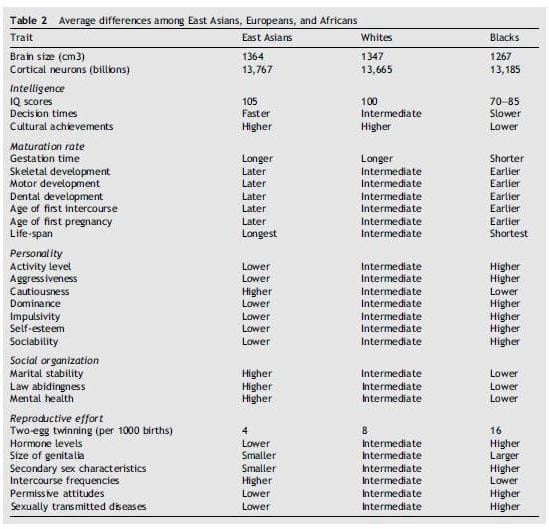
…the poverty of predictions from culture-only explanations. The preponderance of evidence demonstrates that in intelligence, brain size, and other life-history variables, East Asians average a higher IQ and larger brain than Europeans who average a higher IQ and larger brain than Africans. Further, these group differences are 50–80% heritable. These are facts, not opinions and science must be governed by data. There is no place for the ‘‘moralistic fallacy’’ that reality must conform to our social, political, or ethical desires.

[James Watson] is but the latest in a long line of academics that have been pilloried and defamed. The others include Nobel-Prize winner William
Shockley
, Hans Eysenck, Linda Gottfredson, Richard Lynn, Richard Hernstein, Charles Murray, Christopher Brand, Glayde Whitney, Helmuth Nyborg, and Tatu Vanhanen. The present writers too have endured their share of attacks. The taboo on race will surely become a major topic of investigation by sociologists of knowledge. There is no parallel to it in the history of science. It is uniquely imposed, mainly through self-censorship, by members of the Western intelligentsia in their own academy – which prides itself on a tradition of academic freedom, open inquiry, and the unfettered discovery, systematization, and pursuit of knowledge and its dissemination to the general public.

Based on the book Race, Evolution & Behavior by J. Philippe Rushton

Based on the book Race, Evolution & Behavior by J. Philippe Rushton

Posted in Dennis Prager, Race | Comments Off on Baby Richard

He Said His Colleagues Were ‘Jew-leftie-commies’

I’m fascinated by the story of British psychologist Christopher Brand. How does one balance academic freedom with social responsibility?

According to Wikipedia:

In October 1996 Brand came to the defence of Nobel laureate Daniel Carleton Gajdusek who had been charged with paedophilia. Brand argued that sex with a consenting partner over the age of 12 was not harmful so long as both partners had an above-average IQ.[15][16]
The proceedings were initiated in 1996 after the dean of social sciences complained.[16] Edinburgh University’s Chaplain, a supporter of the Anti-Nazi League, had taken Brand’s e-mailed reflections on pederasty to the Scottish press. Edinburgh’s Student newspaper’s frontpage banner headline was FIRST IT WAS BLACKS, THEN IT WAS WOMEN, NOW IT’S KIDS.
Brand was fired a year later after hearings from his 27-year tenured position at Edinburgh University in 1997.[17][18] The University said this was for conduct that “brought the university into disrepute.”
Brand appealed and sued the University for unfair dismissal, and received £12,000 (in those days the maximum obtainable from an Employment Tribunal) in an out-of-court settlement.[19] His case became a cause célèbre among advocates of academic freedom. Marek Kohn cited the Brand incident in a defence of intellectual freedom on the Internet.[20] Others, however, including a former Brand student, considered academic freedom a privilege that carried with it an expectation of “social responsibility”.[21]
Eric Barendt (University College London), in the chapter “The Chris Brand Case” in his 2010 book Academic Freedom, said Brand should have tried harder to get on with his colleagues[22] – who Brand replied were “Jew-leftie-commie[s]”.[23]

Posted in Abuse | Comments Off on He Said His Colleagues Were ‘Jew-leftie-commies’

Blood vs Values

In his book, Think A Second Time, Dennis wrote on page 311: “We must educate the American public and humanity as a whole as to the infinite worth of the individual child, the lesser significance of blood, and the greatness of adoption.”
Dennis Prager believed in the “proposition nation” (a country primarily united by common beliefs) as well as the “proposition family” (a unit primarily based upon shared morals). He wrote: “As a father, my purpose is not to pass on my seed, but to pass on my values.”
James Kirkpatrick argued: “Nor can any real family hold together on the ground of ideology. We love our parents and our children because they are ours—not because we agree with their view of the Constitution.”
In the second edition of Ultimate Issues, Prager wrote that the Jews’ greatest problem is that “fewer Jews know that they have a message.” The solution? “Jews must be taught why to be Jewish.” In other words, Jews must be taught that they are a proposition nation.
In the Winter 1986 edition of Ultimate Issues, Dennis wrote that the Mormons should be allowed to build a study center in Jerusalem:

The opposition to the building of a non-Jewish center in the Jewish state is very instructive of the moral and psychological state of many Jews today. Most obviously, it reveals a strong strain of intolerance. Just imagine, for example, if another country forbade the construction of a Jewish center. Wouldn’t these very same Jews cry — correctly — “bigotry” and “anti-semitism”? Apparently, to many Jews the tolerance that is demanded of non-Jews is not be demanded of Jews…
Israel and Jewry would appear [if they back out of the deal] — not without reason — to non-Jews as religious bigots and as a people that demands rights for itself that it is unwilling to extend to others…
Between the illusory assurances of a non-democratic, hermetically sealed Jewish state and the risks of an open and democratic one, I choose the latter…
Finally, as far as this religious Jew is concerned, let every religion on earth set up a center in Jerusalem and thereby become acquainted with Jews and Judaism.

A critique of Jews is that they stand for racism for us, multi-racialism for you. In this video put on Youtube in 2013, an Englishman asks Jared Taylor: “You mentioned dual standards… You have a situation where America like our country [Britain] is dominated by a particular ethnic group… You say the Jews have their homeland and they have announced it is a homeland for Jews. Yet the same people in America through their various organizations like AIPAC and all the rest of it have announced that they want America to ease its immigration controls and to proclaim an amnesty for illegal immigrants. That’s millions and millions of people. In our country, the Board of Deputies of British Jews in the early 1950s promulgated the first draft of what was to become the notorious Race Relations Act in the Group Libel bill, and this is now part of our law, part of the Public Order act, whereby if you criticize particular ethnic groups, particularly the Jews themselves, you face on conviction for a first offense, going to prison for six months. These people are an ethnic group, they play the ethnic minority card, and their behavior in Palestine and Israel and their behavior outside Palestine, in Britain and America, is racism for us, but multi-racialism for you. Now it wouldn’t matter if an ethnic group in America like the Eskimos or the Red Indians or the Navajo or even the Mexicans had that sort of hypocritical view because they haven’t got the clout, the power, the money power and the media power and therefore the political power of Jewry, but they have got that power and therefore what they do and what they think and how they’re brainwashing our people is very important. I don’t think you can get to grips of how our people are stampeding to the cliff like lemmings, you can’t get to the nub of this matter until you address Jewish duplicity on the question of race.”
Jared Taylor: “There is no question that the aggregate impact of Jews has been overwhelmingly unfavorable on all of the questions that I touched on. There’s no question that Jews have been extremely vocal about promoting diversity in the United States while maintaining homogeneity in Israel. As far as American Renaissance, we have been focused exclusively on race. One can’t afford to be a crank on more than one subject at a time. There are a plenty of places where one can learn about the Jewish question.”

Another reason that Dennis supported the Mormons building a center in Jerusalem corresponds with his desire for increased immigration to America: “I want members of other religions exposed to Judaism. I believe that Judaism is so impressive…”

Many Muslims, including the 9/11 terrorists and Sayyid Qutb, a founder of the Muslim Brotherhood, came to America, hated it, and set about to murder Americans. Not every group is equally suited to appreciating the First World.

So what best predicts a child’s education attainment (and with it future income and family stability)? Blood or home? As the Times of London reported: “NATURE not nurture is the main determinant of how well children perform at school and university…”
Psychologist J. Philippe Rushton said: “It doesn’t matter whether you look at longevity or obesity, studies on thousands of children show that the best predictor of whether or not you are obese or die early is the biological parent you never saw. Absolutely no prediction occurs from knowledge of the adopting parents.”
“IQ and educational achievement is the same as longevity and obesity. Biological parents are the best predictors for how children perform, not the parents who bring them up for 17 or 20 years.”
“Russell W.” wrote to Lawrence Auster about Prager:

He also has a sometimes bizarre anti-biology approach to all ethical matters. For instance, he considers racism as the most grievous human sin throughout history, and so anything at all that even acknowledges race as a reality is offensive. He was (completely rightly, in my opinion) appalled at the “Baby Richard” episode during the 90s, where an adopted child who had lived with his new parents from near-infancy to around age four or five was removed and given back to the formerly absentee biological father. He described the danger in ascribing so much importance to blood (and again, this seems like a perfectly valid point), but he takes this view to the extreme and says blood is completely meaningless. For instance, he has said many times that if the hospital mistakenly gave him another person’s baby and he kept that child for a day, he would not want to bring it back to switch it for his biological child. Of course, for every sane and decent person there’s a threshold of time after which the emotional connection overrides biology, but one day?

Auster replied:

I was just talking with a Jewish friend the last couple of days who has the same absolute opposition to the slightest hint that “blood,” i.e., descent, matters in the definition of a people, particularly the Jewish people. He said this rejection of any racial or ethnic component is central to Judaism, since what makes a Jew is the covenant with God. To non-Jews, of course, this staunch Jewish rejection of ethnic tribalism seems risible, as Jews are the oldest and most famous tribal people on earth.

Economist Gregory Clark wrote in the New York Times Feb. 21, 2014:
To a striking extent, your overall life chances can be predicted not just from your parents’ status but also from your great-great-great-grandparents’. The recent study suggests that 10 percent of variation in income can be predicted based on your parents’ earnings. In contrast, my colleagues and I estimate that 50 to 60 percent of variation in overall status is determined by your lineage…
Does this imply that individuals have no control over their life outcomes? No. In modern meritocratic societies, success still depends on individual effort. Our findings suggest, however, that the compulsion to strive, the talent to prosper and the ability to overcome failure are strongly inherited. We can’t know for certain what the mechanism of that inheritance is, though we know that genetics plays a surprisingly strong role. Alternative explanations that are in vogue — cultural traits, family economic resources, social networks — don’t hold up to scrutiny.

Family names tell you, for better or worse, a lot: The average life span of an American with the typically Jewish surname Katz is 80.2 years, compared with 64.6 years for those with the surname Begay (or Begaye), which is strongly associated with Native Americans. Heberts, whites of New France descent, live on average three years less than Dohertys, whites of Irish descent…

The notion of genetic transmission of “social competence” — some mysterious mix of drive and ability — may unsettle us. But studies of adoption, in some ways the most dramatic of social interventions, support this view. A number of studies of adopted children in the United States and Nordic countries show convincingly that their life chances are more strongly predicted from their biological parents than their adoptive families. In America, for example, the I.Q. of adopted children correlates with their adoptive parents’ when they are young, but the correlation is close to zero by adulthood. There is a low correlation between the incomes and educational attainment of adopted children and those of their adoptive parents.

These studies, along with studies of correlations across various types of siblings (identical twins, fraternal twins, half siblings) suggest that genetics is the main carrier of social status.

Posted in Dennis Prager | Comments Off on Blood vs Values

Zero

A friend asked me: “If you had known at every age what your life would be like today regarding women, which, if any, of the women you had a shot at might you have then decided to marry?” I think my answer is “Zero.”

Posted in Personal | Comments Off on Zero

Narco Cultura

This documentary will turn your stomach at the number of Mexicans dancing to songs glorifying drug dealers. Here are some sample lyrics: “With an AK-47 and a bazooka on my shoulder/Cross my path and I’ll chop your head off/We’re bloodthirsty, crazy and we like to kill.”

Wikipedia says: A narcocorrido (Spanish pronunciation: [narkokoˈriðo], Drug Ballad) is a type of Mexican music and song tradition which evolved out of the norteño folk corrido tradition. This type of music is heard on both sides of the US–Mexican border. It uses a danceable, accordion-based polka as a rhythmic base. The first corridos that focus on drug smugglers—the narco comes from “narcotics”—have been dated by Juan Ramírez-Pimienta to the 1930s. Early corridos (non-narco) go back as far to the Mexican Revolution of 1910, telling the stories of revolutionary fighters. Music critics have also compared narcocorrido music to gangster rap.

Narcocorrido lyrics refer to particular events and include real dates and places.[3] The lyrics tend to speak approvingly of illegal activities such as murder, torture, racketeering, extortion, drug smuggling, illegal immigration, and sometimes political protest due to government corruption.

Posted in Mexicans | Comments Off on Narco Cultura

Are All Men Pedophiles?

Important movie. Makes the point that what we are attracted to doesn’t change as we age, it only expands. So when we first start falling in love, from age 11-16 for most of us, that remains tempting (though of course the good person limits his desire to what is right). The average age of women that men find most attractive is 16. Pedophilia means attraction to the pre-pubescent, hebophilia refers to finding teens attractive.

Documentary: “The age at which we find other people attractive does not change, it only expands. When we are young, we find children our own age attractive. As we grow older, children under the age of 18 do not become less attractive. Pedophiles also find children under the age of 18 attractive, so what is the differences between you and pedophiles?”

Posted in Abuse | Comments Off on Are All Men Pedophiles?

When Dennis Prager Debated Meir Kahane About Israel

On Aug. 27, 1985, Dennis Prager debated Rabbi Meir Kahane on the Ray Briem show. “It was one of the ugliest debates of my life,” says Dennis in a 2004 lecture on Deuteronomy 15. “He was insulting the whole night.”

Here are some highlights of the debate as transcribed by Dennis Prager and published in his Fall 1985 edition of Ultimate Issues:

Briem: “Why in Israel, that always has had such compassion for people, invited the Arabs to come and stay in Israel when it was formed…would you want to kick them?”

Kahane: “Because the people of Israel and especially the Sephardic Jews of Israel, the Jews who came from Arab countries, didn’t learn about Arabs in seminars on the West Coast. They lived with Arabs, they know what it means to have lived under Arabs, and they’d never again want to.

“The problem is that the Arabs who live inside Israel hate Israel. And they understand that the Arabs, if they could, would do the Jews what they do to themselves every day in Beirut. They don’t want that to happen. They’re not troubled by the niceties of Western democracy.”

“I don’t hate Arabs. I love Jews. And I intend to save the Jewish people, both from Arabs and from themselves.”

“If there is anyone…who thinks that there is one Arab in Israel who would rather live in a country which is defined legally as the Jewish state, he has greater contempt for the Arabs than I thought that even liberals could have.”

“There is a basic contradiction between Zionism and Western democracy. A Jewish state at the very minimum means a state with a majority of Jews, because only in that way can Jews solve their own destiny, be masters of their own fate. Western democracy postulates the basic axiom that it doesn’t matter who’s the majority. It doesn’t matter if you’re Jewish or non-Jewish, whoever’s the majority is it. Therefore there is a basic contradiction, since most western Jews are basically schizophrenic, with one foot inside Judaism and the other half inside western culture, and they would like to believe that Judaism is Thomas Jefferson. It isn’t.”

Prager: “I’d like to defend Judaism from the smear campaign taht Meir Kahane has directed against it.”

“[Kahane] is [antisemitism’s] tragic echo, produced to a large extent by the Holocaust and by the Arab desire to destroy Israel. He is a classic product of Jews being hated for all these centuries, and he has incorporated a mirror image of the non-Jew in his psyche. He hates non-Jews as he feels non-Jews hate him. His answer to Arafat is to be the Jewish Arafat.”

“Ray, you asked him, and he dismissed it as a lunacy, what really differentiates Meir Kahane’s attitude to Arabs from Hitler’s to German Jews. He didn’t answer you, because the difference is minimal.”

“This is a Jewish fascist. It is a tragedy that he cites that he is rooted in Judaism when there isn’t anything normative in Judaism — Orthodox, Conservative or Reform — that supports him.”

“One could cry over the fact that there is some popularity to someone who has such views when the Torah instructs the Jew to love the stranger because the Jews themselves were strangers in Egypt and know how it feels to be one.”

Kahane: “The Torah and the Talmud say any appointment of authority in Israel shall only be Jewish. That’s not democracy. Maimonides states clearly that no non-Jew shall ever be appointed over a Jew, even as a clerk concerning the water carriers.”

“Judaism states clearly that the Jews, when they create a Jewish state, will not grant citizenship to a non-Jew.”

Prager: “Rabbi Kahane is by and large considered in the Jewish world an immoral aberration.”

Kahane: “Assuming the Arabs would become a majority, what would Dennis Prager say?”

Prager: “In theory, the Jewish state has a right to remain a Jewish state. Just as during WWII, England suspended certain democratic processes.”

Caller1: “Mr. Prager, do you believe that the Arabs, if they have a chance to destroy Israel, will do that?’

Prager: “Most Arabs would.”

Caller1: “Then from that standpoint alone you must admit that Mr. Kahane has a reason for doing that [throwing Arabs out] because the Arabs will unite and destroy Israel the first chance they get.”

Prager: “Yes, but one of the reasons that it is important to have a Jewish state is in order to preserve Judaism. But if Israel becomes like its Arab neighbors in moral outlook, then the only difference between a Kahaneized Israel and an Arafatized Jordan is the language they speak. So Israel’s reason for being, if it becomes a state as morally low as many of its neighbors, [is undermined]. Israel can continue to be a light unto the nations, as a democratic state in the midst of tyranny, and need not be compromised just because of its enemies.”

Kahane: “If all the Arabs tomorrow become saints, and I was now living in a state with 730,000 Arab saints who in 20 years will be two and a half or three million Arab saints, and in 30 years will be the majority of the country but saintly, I don’t want to live as a minority under any saints.”

Caller4: “I would rather see a strong Israel that everybody hates, rather than an Auschwitz that everyone loves.”

Prager: “I agree with you… Part of the giveaway on Rabbi Kahane’s moral understanding is as he said, ‘even if all the Arabs were saints.’ In other words, the issue is not morality, it is race. It is Arab blood that is detested, not Arab morality. In other words, no matter how decent they might be, he wants to kick them out. Morality is foreign to his understanding. it is a blood-based understanding.”

Kahane: “You know very well taht if any Arab came to me and said, I would like to become Jewish, and he converted according to the proper standards, of course, just as any other non-Jew, that he would be welcome, blood and all… My problem with the Arabs has nothing to do with their blood. It’s that they want Jewish blood.”

Prager: “You respect [Arabs] so much that you want to chase them out.”

Kahane: “Exactly.”

Dec. 13, 2001, Prager said that almost all of Kahane’s proposed laws for Israel (making it a crime for a Jew to sleep with a non-Jew, to swim in the ocean with a non-Jew, etc) came from Torah Law.

Wikipedia said: “Kahane’s legislative proposals focused on transferring the Arab population out from the Land of Israel, revoking Israeli citizenship from non-Jews, and banning Jewish-Gentile marriages and sexual relations, based on the Code of Jewish Law compiled by Maimonides in the Mishneh Torah.”

Posted in Dennis Prager, R. Meir Kahane | Comments Off on When Dennis Prager Debated Meir Kahane About Israel

Craniosacral Therapy & The Alexander Technique

“Daska Hatton, an Alexander Technique teacher and criniosacral therapist in London, England, talks with Robert Rickover about the connections between the Alexander Technique and Craniosascral Therapy.”

Robert: “The two processes are complimentary.”

“Cranio work is less demanding of a student. You could even fall asleep during a cranio session and it would be OK. You don’t have to present the whole time while most Alexander teachers would prefer you have your eyes open and be present and notice what is going on and even do some simple movement experiments while you are lying down.

“Table work in the Alexander Technique world is just one of several procedures, most of which are more active than lying on a table, while cranio work is all table work.”

“Alexander Technique is about learning to change the way you think about yourself in movement. The goal is always to get the student thinking.”

“Cranio work can get at these subtle, internal twists and turns in your musculature that are so complex that it might take many lifetimes of self-directing to release these on their own. It helps to have another person there to do the thinking for you and release those. Alexander Technique is about consciousness and cranio is about letting someone help you and physical therapy and manipulation is about having someone whack you into a new relationship.”

Posted in Alexander Technique, Craniosacral Therapy | Comments Off on Craniosacral Therapy & The Alexander Technique

Rabbi Shmuley Boteach Blasts His Chabad Critics

Shmuley Boteach writes:

Since 1994 I have visited South Africa many times for lecture tours. On some occasions I was brought by my publishers to do national media tours on my books on marriage and relationships. On other occasions I was a guest of the Jewish community to address eroding support for Israel in an otherwise staunchly Zionist community. I have watched this incredible country evolve from the end of apartheid when I first arrived to the multi-ethnic, harmonious society which has become an inspiration to the world.

I have also watched the standing of the State of Israel slowly devolve as more and more South Africans accept the superficial comparison of Israel as an apartheid state. The popularity I have been fortunate to earn in South African media as a promoter of the family – and few continents love family as much as Africa – has allowed me to emerge as a credible defender of Israel explaining that we Jews, as the Christian Bible makes clear, are analogous to Black South Africans as the indigenous people of the Holy Land who were invaded by a white, oppressive, European, colonial power who destroyed our temple, murdered us, and exiled us from our land. For two thousand years we have prayed to return, never losing contact with our soil. And now that we have come back and rebuilt our country, we granted equal citizenship to our Arab brothers and sisters who came to the land over the centuries in our absence, when we Jews were forcibly denied entry, and who have, even more so, come to Israel over the past century as Zionist pioneers have made the country more habitable and prosperous.

Posted in Chabad, Shmuley Boteach, South Africa | Comments Off on Rabbi Shmuley Boteach Blasts His Chabad Critics