Robert Stark Interviews Me About Narcissism

Topics include:

How Luke was diagnosed with Narcissistic Personality Disorder(from Luke’s Bio)

Maladaptive Daydreaming and the Fantasy World

How Narcissists are dependent on constant attention or narcissistic supply

How Narcissism affects Luke’s blogging and the topics he writes about

How attention is a substitute for connection, intensity for intimacy

How Luke’s Narcissistic symptoms are subdued when he connects with other people

How if you don’t have an identity with a group you are forced to create one as an individual

Posted in Narcissism, Personal | Comments Off on Robert Stark Interviews Me About Narcissism

Principles vs Interests

Many people could benefit from an approach that prioritizes their interests over loyalty to abstract principles.

Should not loyalty to your group be a principle?

Extending this type of thinking to the West might well lead to more rights for majorities and fewer rights for minorities. How could a country with one dominant religious and racial identity become stronger from the admission of many races and religions? Then it would be up to the minority groups to make the case that their presence is a blessing.

When a country is at war, it employs censorship in its group interest.

Maybe it is impossible to have complete free speech. Perhaps every society has to hold certain things, certain symbols, certain identities, sacred. Perhaps every society to survive needs a soft totalitarianism in certain areas.

Is this fierce protection of Jews in the following story anti-Christian? Jews and the Christian missionaries described have clashing interests and when Jews assert their interests, that is not good for the Christians. Similarly, when Gentiles assert their group interests, that is called anti-Semitism when it clashes with Jewish interests.

From the group Jewish Israel:

JewishIsrael is pleased to see that a growing number of concerned columnists across the religious and political divide are covering the severity of the missionary problem in Israel. Writers such as Diane Bederman and Donny Fuchs have persevered despite the controversy and unpleasant challenges that come with exploring territory which is deemed “untouchable” in an era marked by Israel’s enormous dependence on evangelical Christian support.

Sacrificing principles which are fundamental to Judaism, Jewish identity and Jewish continuity should not be done in the name of “democracy”, “tolerance” or” freedom of religion and expression”. This is an issue all Jews can agree on regardless of political views or degree of religious observance…

The issue of increasing fundamental Christian influence in Israel should be of worry to every Jew concerned with the continuity of Judaism. This is an issue which should unify the Diaspora and Israeli communities rather than cause divisions along political and religious lines. JewishIsrael encourages thinking Jewish writers and activists to honestly explore this very challenging problem via a Jewish perspective, which requires putting partisan politics aside and prioritizing the survival of Israel as a unique Jewish nation.

Historian Paul Johnson writes in his book Modern Times about the 20th Century:

The new Weimar constitution was drawn up under the guidance of
the great sociologist Max Weber. It gave parliament full financial
sovereignty for the first time. It was supposed to embody all the best
features of the American constitution. But it had one serious
weakness. The President, elected for a seven-year term, was not the
head of government: that was the Chancellor, a party figure respon-
sible to parliament. But the President, under Article 48, was endowed
with emergency powers when parliament was not in session. From
1923 onwards this article was pervertedly invoked whenever par-
liament was deadlocked. And parliament was often deadlocked,
because proportional representation prevented the development of a
two-party system and absolute majorities. To many Germans, who
had been brought up on the notion that Germany and the Germans
were a metaphysical, organic unity, the spectacle of a divided,
jammed parliament was unnatural. The argument that parliament
was the forum in which quite genuine and unavoidable conflicts of
interest were peacefully resolved was alien to them, unacceptable.
Instead they saw the Reichstag as a mere theatre for the enactment of
‘the game of the parties’, while the real, eternal, organic and
honourable Germany was embodied in the person of the President
and Article 48…

The cleavage within the constitution might not have mattered so
much had it not reflected a much deeper division in German
society, and indeed in German minds. I call this the East— West
division, and it is one of the central themes of modern times, in so
far as they have been influenced by Germany’s destiny. The princi-
pal characteristic of the pre-war German regime of princes, generals
and landowners, the law-professors who endowed it with academic
legitimacy, and the Lutheran pastors who gave it moral authority,
was illiberalism. This ruling caste hated the West with passionate
loathing, both for its liberal ideas and for the gross materialism and
lack of spirituality which (in their view) those ideas embodied. They
wanted to keep Germany ‘pure’ of the West, and this was one
motive for their plans to resume the medieval conquest and set-
tlement of the East, carving out a continental empire for Germany
which would make her independent of the Anglo-Saxon world
system. These Easterners drew a fundamental distinction between
‘civilization’, which they defined as rootless, cosmopolitan, immo-
ral, un-German, Western, materialistic and racially defiled; and
‘culture’, which was pure, national, German, spiritual and authen-
tic. 17 Civilization pulled Germany to the West, culture to the East.
The real Germany was not part of international civilization but a
national race-culture of its own. When Germany responded to the
pull of the West, it met disaster; when it pursued its destiny in the
East, it fulfilled itself.

In point of fact, it was the Easterners who had ruled Germany
throughout, who had created the war-anxiety, got Germany into
war, and then lost it. In the minds of most Germans, however, the
‘stab-in-the-back’ mythology refuted this factual analysis because it
attributed the loss of the war to the defeatism and treachery of the
Westerners, who had then signed the armistice, accepted the disas-
trous peace, introduced the Republic and enthroned ‘the rule of the
parties’. It was thus the Westerners who were responsible for all
Germany’s misfortunes in the post-war world, as was only logical,
for they were the puppets or paid agents of the politicians of the West
in Paris and London, and of the international financial community in
Wall Street and the City. Their outpost in Germany was the
parliament in Weimar. But authentic German culture still had its
redoubt within the Republic, in the person of President Hindenburg,
an Easterner par excellence, and in the authority of Article 48. In
time, that vital bridgehead could be extended.

For the moment, however, the Westerners were triumphant.
Weimar was a ‘Western’ republic. It stood for civilization rather than
culture: civilization was in office, culture in opposition. It is no
coincidence, either, that German civilization reached its gaudiest
flowering during the 1920s, when Germany, for a brief period,
became the world-centre of ideas and art. This triumph had been
building up for a long time. Germany was by far the best-educated
nation in the world – as long ago as the late eighteenth century it had
passed the 50 per cent literacy mark. During the nineteenth century it
had progressively established a system of higher education which for
thoroughness and diversity of scholarship was without equal. There
were world-famous universities at Munich, Berlin, Hamburg,
Gottingen, Marburg, Freiburg, Heidelberg and Frankfurt. The Ger-
man liberal intelligentsia had opted out of public and political life in
the 1860s, leaving the field to Bismarck and his successors. But it had
not emigrated; indeed, it had spread itself, and when it began to
resurface just before the Great War, and took command in 1918,
what was most striking about it was its polycentral strength.

Of course Berlin, with its 4 million population, held the primacy.
But, unlike Paris, it did not drain all the country’s intellectual and
artistic energies into itself. While Berlin had its Alexanderplatz and
Kurfurstendamm, there were plenty of other cultural magnets: the
Bruehl in Dresden, the Jungfernsteg in Hamburg, the Schweidnitzter-
strasse in Breslau or the Kaiserstrasse in Frankfurt. The centre of
architectural experiment, the famous Bauhaus, was in Weimar, later
moving to Dessau. The most important centre of art studies, the
Warburg Institute, was in Hamburg. Dresden had one of the finest
art galleries in the world as well as a leading European opera house,
under Fritz Busch, where two of Richard Strauss’s operas had their
first performance. Munich had a score of theatres, as well as another
great gallery; it was the home of Simplicissimus, the leading satirical
magazine, and of Thomas Mann, the leading novelist. Frankfurter
Zeitung was Germany’s best newspaper, and Frankfurt was a leading
theatrical and operatic centre (as was Munich); and other cities,
such as Nuremberg, Darmstadt, Leipzig and Diisseldorf, saw the first
performances of some of the most important plays of the Twenties. 18

What particularly distinguished Berlin was its theatre, by far the
world’s richest in the 1920s, with a strongly political tone. Its
pre-eminence had begun before the war, with Max Reinhardt’s reign
at the Deutsche Theater, but in 1918 republicanism took over
completely. Some playwrights were committed revolutionaries, like
Friedrich Wolf and Ernst Toller, who worked for Erwin Piscator’s
‘Proletarian Theatre’, for which George Grosz designed scenery.
Bertholt Brecht, whose play Drums in the Night was first staged in
Berlin in 1922, when he was twenty-four, wrote political allegories.
He was attracted to Communism by its violence, as he was to
American gangsterism, and his friend Arnolt Bronnen to fascism;
Brecht designed his own ‘uniform’, the first of the Leftist outfits –
leather cap, steel-rimmed glasses, leather coat. When The
Threepenny Opera, which he wrote with the composer Kurt Weill,
was put on in 1928 it set an all-time record for an opera by receiving
over 4,000 performances throughout Europe in a single year. 1 ^ But
the bulk of the Berlin successes were written by liberal sophisticates,
more notable for being ‘daring’, pessimistic, problematical, above all
‘disturbing’, than directly political: men like Georg Kaiser, Carl
Sternheim, Arthur Schnitzler, Walter Hasenclever, Ferdinand Bruck-
ner and Ferenc Molnar. 20 Sometimes the ‘cultural Right’ went for a
particular play, as when it tried to disrupt the first night of Der
frohliche Weinberg by Carl Zuckmayer (who also wrote the script
for The Blue Angel). But it was really the theatre as a whole to which
conservatives objected, for there were no right-wing or nationalist
plays whatever put on in Berlin. After watching a Gerhart Haupt-
mann play, a German prefect of police summed up the reaction of
Kw/tar-Germany: ‘The whole trend ought to be liquidated.’ 21

Berlin was also the world-capital in the related fields of opera and
film. It was crowded with first-class directors, impresarios, conduc-
tors and producers: Reinhardt, Leopold Jessner, Max Ophuls, Victor
Barnowsky, Otto Klemperer, Bruno Walter, Leo Blech, Joseph von
Sternberg {The Blue Angel), Ernst Lubitsch, Billy Wilder {Emil and
the Detectives), Fritz Lang {Metropolis). In designing and making
scenery and costumes, lighting-effects, the standards of orchestral
playing and choral singing, in sheer attention to detail, Berlin had no
rivals anywhere. When Wozzeck, a new opera written by Arnold
Schoenberg’s gifted pupil Alban Berg, received its premiere at the
Berlin State Opera in 1925, the conductor Erich Kleiber insisted on
no less than 130 rehearsals. 22 The 1929 Berlin Music Festival
featured Richard Strauss, Bruno Walter, Furtwangler, George Szell,
Klemperer, Toscanini, Gigli, Casals, Cortot and Thibaud. 23 Against
this background of talent, craftsmanship and expertise, Germany was
able to develop the world’s leading film industry, producing more
films in the 1920s than the rest of Europe put together; 646 in the
year 1922 alone…

The Right, in short, could practise violence with little fear of legal
retribution. Judges and juries felt they were participating in the battle between German culture and alien civilization: it was right to
recognize that violence might be a legitimate response to cultural
provocation. Thus when the great liberal journalist Maximilian
Harden, who was also a Jew, was nearly beaten to death by two
thugs in 1922, the would-be killers got only a nominal sentence. The
defence argued that Harden provoked the attack by his ‘unpatriotic
articles’, and the jury found ‘mitigating circumstances’.

The universities and especially the professoriate were overwhelm-
ingly on the side of Kultur. The jurists and the teachers of German
literature and language were stridently nationalist. The historians
were the worst of the lot. Heinrich von Treitschke had written of
Germany’s appointment with destiny and warned the Jews not to
get in the way of the ‘young nation’. His hugely influential History
of Germany in the Nineteenth Century, a Wilhelmine classic, went
into another big popular edition in 1920. Contemporary historians
like Erich Marcks, Georg von Below and Dietrich Schafer still
celebrated the achievements of Bismarck (the anniversaries of Sedan
and the founding of the empire were both public universities’
holidays) and the lessons they drew from the Great War centred
around Germany’s lack of ‘relentlessness’. They provided academic
backing for the ‘stab-in-the-back’ myth. The academic community
as a whole was a forcing-house for nationalist mythology. Instead
of encouraging self-criticism and scepticism, the professors called
for ‘spiritual revivals’ and peddled panaceas. 51

By sheer bad luck, the most widely read and influential book in
1920s Germany was The Decline of the West by Oswald Spengler,
a foolish and pedantic schoolteacher. He conceived his book in
1911 as a warning against undue German optimism. He wrote it
during the war in anticipation of a German victory. Its first volume
actually appeared in 1918, when defeat gave it an astonishing
relevance and topicality. Thus it became a best-seller. The essence
of the book was social Darwinism. He defined eight historic cul-
tures and argued that the ‘laws of morphology’ applied to them.
The last, the culture of the West, was already showing symptoms of
decay, such as democracy, plutocracy and technology, indicating
that’ ‘civilization’ was taking over from ‘culture’. It seemed to
explain why Germany had been defeated. It also heralded a coming
age of cruel war in which would arise new Caesars, and democrats
and humanitarians would have to be replaced by new elites of
steel-hardened heroes who would look not for personal gain but
for service to the community. 52 He followed it up in 1920 with a
sensational essay, Prussianism and Socialism, which called for a
classless, national socialism, in which the entire nation worked
together under a dictator. It was exactly the sort of argument
Mussolini was beginning to put forward in Italy.

Neatly complementing Spengler’s analysis was the work of two
other important Easterners. Carl Schmitt, Germany’s leading legal
philosopher, who poured out a flood of books and articles during
these years, constantly stressed the argument that order could only
be restored when the demands of the state were given preference
over the quest for an illusory ‘freedom’. The Reich would not be
secure until Weimar was remodelled as an authoritarian state around
the principle embodied in Article 48. 53 The point was restated in a
historical perspective by the cultural historian Arthur Moeller van
den Bruck in a brilliant book published in 1923. The Germans, he
argued, were the leading European creators. Their first Reich, the
medieval empire, had formed Europe. Their second creation, Bis-
marck’s, was artificial because it had admitted the corruption of
liberalism: that, of course, was why it had collapsed under test.
Weimar was a mere interlude of chaos. Now the Germans had
another opportunity: by purging society of liberalism and capitalism,
they could build the third and final state which would embody all
Germany’s values and endure for a thousand years. He entitled this
remarkable exercise in historical prophecy The Third Reich, 54

Spurred on by their professors, the German student body, which
averaged about 100,000 during the Weimar period, gave an enthusias-
tic reception to these Easterner philosophies. The notion that the
student body is in some constitutional way a depository of humanita-
rian idealism will not survive a study of the Weimar period. Next to
the ex-servicemen, the students provided the chief manpower res-
ervoir of the violent extremists, especially of the Right. Student
politics were dominated by the right-wing Hochschulring movement
throughout the 1920s until it was replaced by the Nazis. 55 The Right
extremists proceeded by converting half a dozen students on a
campus, turning them into full-time activists, paid not to study. The
activists could then swing the mass of the student body behind them.
The Nazis did consistently better among the students than among the
population as a whole and their electoral gains were always preceded
by advances on the campus, students proving their best proselytizers.
Students saw Nazism as a radical movement. They liked its egalita-
rianism. They liked its anti-Semitism too. Indeed, the students were
more anti-Semitic than either the working class or the bourgeoisie.
Most German student societies had excluded Jews even before 1914.
In 1919 the fraternities subscribed to the ‘Eisenach Resolution’,
which stated that the racial objection to Jews was insuperable and
could not be removed by baptism. The next year they deprived
Jewish students of the ‘honour’ of duelling. In 1922 the authorities at
Berlin University cancelled a memorial service in honour of the
murdered Walther Rathenau rather than risk a violent student
demonstration. This policy of appeasement towards student violence
became the pattern of the 1920s, the rectors and faculties always
capitulating to the most outrageous demands of student leaders
rather than risk trouble. By 1929 the universities had passed almost
wholly into the Easterner camp…

It is probably true to say that Hitler’s cultural assets were the
source of his appeal. Popular detestation of Weimar culture was an
enormous source of political energy, which he tapped with relish.
Lenin’s notion of giving up music to concentrate on politics would
have been incomprehensible to him. In Germany, music was politics;
and especially music-drama. Hitler exemplifies the truth that ar-
chitectural and theatrical skills are closely related. His romantic-
artistic instincts led him to rediscover a truth almost as old as the
polls itself, which certainly goes back to the Pharaohs: that the
presentation of the charismatic leader, whether Renaissance mon-
arch or modern democratic politician, is at least as important as the
content. One of the reasons Hitler admired Wagner was that he
learnt so much from him, especially from Parsifal, which became the
model for his political spectaculars. The lesson he derived from the
Western Front was that wars could be won or lost by propaganda: a
thought which inspired his famous sixth chapter of Mein Kampf. The
object of all propaganda, he wrote, was ‘an encroachment upon
man’s freedom of will’. 67 This could be achieved by the ‘mysterious
magic’ of Bayreuth, the ‘artificial twilight of Catholic Gothic chur-
ches’, and both these effects he used; but he also plundered the tricks
of Reinhardt and other despised Weimar producers and the cinema of
Fritz Lang. The scenes of his oratory were designed and set with
enviable professional skill; the attention to detail was fanatical.
Hitler was the first to appreciate the power of amplification and the
devilry of the searchlight: he seems to have invented son et lumiere
and used it with devastating effect at his mass night-meetings. He
imported political costumery and insignia from Mussolini’s Italy but
improved upon them, so that Hitlerian uniforms remain the standard
of excellence in totalitarian sumptuary. Both Stalinism and Maoism
imitated Hitler’s staging, exceeding it in scale but not in style.

Posted in Adolf Hitler, Christianity, Islam, Israel | Comments Off on Principles vs Interests

Jewish Press Gloats That Anti-Jewish MP George Galloway Was Assaulted

Tzvi Ben Gedalyahu is apparently a graduate in Journalism and Economics from The George Washington University and he writes for The Jewish Press:

Galloway has been released from the hospital, but it is doubtful that the attacker was able to beat some sense into his head.

The MP, who has built his political career on loving Saddam Hussein and Hamas and hating Jews and Israel, was posing for pictures in west London Friday night when the attacker jumped on him while calling him “Hitler.”

The assault “appears to be connected with his comments about Israel because the guy was shouting about the Holocaust,” said Galloway’s spokesman. The name of his one-MP party is Respect, which indicates his ignorance of the English language.

The party’s name is a very contrived acronym for Respect, Equality, Socialism, Peace, Environmentalism, Community and Trade Unionism. A more accurate acronym would be “Racist, Extremist, Satanic, Pisher, Ethnic=hatingt, Crude and Twisted.

Galloway has been under police investigation since his call earlier this month that the city of Bradford, which he represents, be an “Israel-free” zone that would bar Israeli tourist and place a total ban on anything related to Israel.

We wish Galloway a speedy recovery and hope that some of the medicine he needs is made in Israel.

Do Jews think that publicly rejoicing over the Jewish assault of a Gentile politician for his anti-Jewish beliefs is good for the Jews? Do Jews think that by encouraging such attacks this will redound to the benefit of the Tribe?

Posted in Anti-Semitism | Comments Off on Jewish Press Gloats That Anti-Jewish MP George Galloway Was Assaulted

Liberation Rape

Steve Sailer writes:

According to federal statistics for 2001-2003, there were 15,400 cases of black-on-white single perpetrator rape versus 900 cases of white-on-black rape: a 17 to 1 ratio…

Black Panther Eldridge Cleaver summed up his racial motivations in the 1968 bestseller Soul on Ice, which was on the required reading list at my high school in the mid-1970s:

“[W]hen I considered myself smooth enough, I crossed the tracks and sought out white prey. I did this consciously, deliberately, willfully, methodically … Rape was an insurrectionary act. It delighted me that I was defying and trampling upon the white man’s law, upon his system of values, and that I was defiling his women … I felt I was getting revenge. … I wanted to send waves of consternation throughout the white race.”

The icy Boer novelist J.M. Coetzee won the Nobel Prize in Literature for his 1999 novel, Disgrace, about a professor’s lesbian daughter being gang raped by liberated blacks. It was made into a memorable 2009 movie starring John Malkovich as Coetzee’s alter ego. The laureate fled to Australia when the ruling African National Congress made threatening noises.

Posted in Blacks, Rape | Comments Off on Liberation Rape

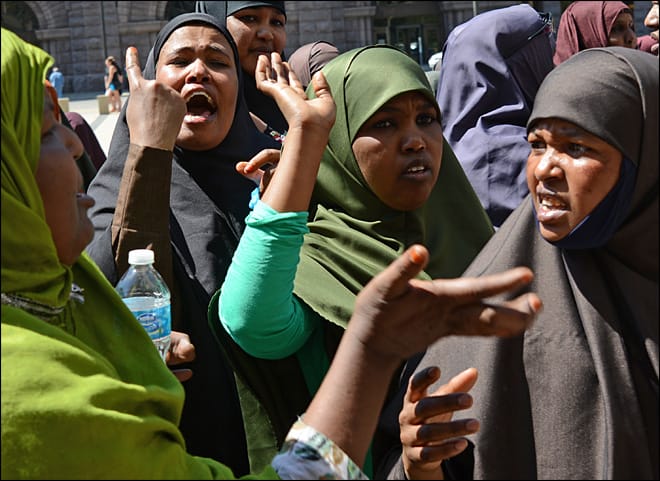
Why Does America Import Somalis?

Chaim Amalek: “Minnesota WASPS, that’s who! And you can’t blame the Jews for how Lutheran churches act to subvert White society. Luke, are any Chabad or other orthodox Jewish temples importing any Somalis or Sudanese these days?”

Luke Ford: “No, Chaim. That’s repellent to all the Hasidim I know.”

Chaim Amalek: “Scott, you have to have a culture with pretensions of being “universal” to behave in such a way. And Christianity sees itself as universal. The more insular the culture/religion, the less likely they are to entertain such thoughts. I think it would be a mitzvah and an example to your community, Luke, were you to adopt a few Somali teenaged boys. Maybe you could make good Aussies out of them.”

Washington Times:

The State Department has helped to relocate tens of thousands of refugees from the war-torn African nation of Somalia to Minnesota, where they can take advantage of some of America’s most generous welfare and charity programs.

But the effort is having the unintended consequence of creating an enclave of immigrants with high unemployment that is both stressing the state’s safety net and creating a rich pool of potential recruiting targets for Islamist terror groups.

In the fiscal year that ended in September, Minnesota welcomed 1,118 Somali refugees arriving directly from Africa, most of them without family ties to the state, according to State Department statistics. Overall, more than 30,000 Somalis live in the midwestern state comprising the nation’s largest concentration of Somali immigrants, according to U.S. Census data.

Many of the refugees settle near the Twin Cities, with Minneapolis being dubbed “Little Mogadishu” after the capital of Somalia.

This population is also being targeted by Islamist terror organizations like the Islamic State and al-Shabab, a Somalia-based group with links to al Qaeda, according to U.S. officials.

Among Minnesota-based Somali-Americans, American converts to Islam or Somali refugees, there have been numerous convictions for various levels of collaboration with Islamist terror groups, plus reports of fighting with al-Shabab or other Islamist groups.

On Sunday, al-Shabab made a propaganda video warning of an attack on shopping malls around the world, including the Mall of America in Minnesota. Al-Shabab claimed responsibility for the terror attack on the Westgate shopping mall in Kenya two years ago, which left 67 dead.

Somalis

Posted in Blacks, Immigration, Islam | Comments Off on Why Does America Import Somalis?

What Do You Think Of Husbands Who Always Put Their Clients On Hold To Take Calls From Their Wives?

When Rudy Guiliani ran for president in 2008, he was knocked for taking a call in the middle of a speech and putting the audience on hold so he could talk to his wife.

I notice a lot of guys 100% of the time put their clients on hold to talk to their spouse. She calls and he picks up.

I think it is unprofessional when a guy always puts a client on hold so he can talk to his wife.

Now some wives and children object that their husbands and fathers don’t 100% of the time put work on hold to talk to them.

Men I know (middle class Jewish men mainly) tend to fear their wives more than wives tend to fear their husbands. Husbands tend to appreciate their wives more than wives tend to appreciate their husbands (John Gray told Dennis Prager this).

Men are weak these days.

A hot Jewish chick tells me: “Yes – they are. Why are they so weak? I hate it. They’re a bunch of pussies especially the guys around here. Why do you think I am attracted to white nationalists? Because they are the only men left that have any balls and will actually stand up for themselves. I was talking to my girl friend about this yesterday. She wants to be dominated. She needs a guy that will dominate her. And they are very rare, especially if you are an alpha female – which we both are.”

Another thing I notice is that wives feel much more comfortable ripping apart their husbands in public rather than vice versa, and wives tend to support their kids against their husbands much more than husbands support their kids against their wives.

It’s weird how involved middle-class parents are with their kids. I know some who’ll give their kids a ride if work or school is a mile away. I’d bike a few miles to and from school every day. I never wanted my parents to show up to any of my school events but I notice parents do this routinely these days. My parents played almost no role with my homework.

There’s no parenting style that has been shown to have regular statistical results. As the New York Times wrote:

First, researchers have been unable to find any child-rearing practice that predicts children’s personalities, achievements or problems outside the home. Parents don’t have a single child-rearing style anyway, because how they treat their children depends largely on what the children are like. They are more permissive with easy children and more punitive with defiant ones.

Second, even when parents do treat their children the same way, the children turn out differently. The majority of children of troubled and even abusive parents are resilient and do not suffer lasting psychological damage. Conversely, many children of the kindest and most nurturing parents succumb to drugs, mental illness or gangs.

Third, there is no correlation — zero — between the personality traits of adopted children and their adoptive parents or other children in the home, as there should be if ”home environment” had a strong influence.

Fourth, how children are raised — in day care or at home, with one parent or two, with gay parents or straight ones, with an employed mom or one who stays home — has little or no influence on children’s personalities.

Finally, what parents do with and for their children affects children mainly when they are with their parents. For instance, mothers influence their children’s play only while the children are playing with them; when the child is playing alone or with a playmate, it makes no difference what games were played with mom.

Most psychologists have done what anyone would do when faced with this astonishing, counterintuitive evidence — they’ve tried to dismiss it. Yet eventually the most unlikely idea wins if it has the evidence to back it up. As Carole Wade, a behavioral scientist, puts it, trying to squeeze existing facts into an outdated theory is like trying to fit a double-sized sheet onto a queen-sized bed. One corner fits, but another pops out. You need a new sheet or a new bed.

I think it is unprofessional when parents at work automatically drop everything when their kids call. Their lives should not revolve around their kids. I think it sends the wrong message when a father lets his wife and kids know that he will drop everything to be at their beck and call. Women don’t want to be in charge. They’ll nag and nag, but they need a man to take the reins.

A buddy says: “We committed, life-long bachelors, living utterly apart from the fair sex, have as much business discussing such matters as the pope has of issuing rulings on birth control and divorce. Let us instead focus on our blogging, cats, and issues of personal grooming. How would you be living your life today if the Internet had never been invented?”

Posted in Parenting, Personal | Comments Off on What Do You Think Of Husbands Who Always Put Their Clients On Hold To Take Calls From Their Wives?

Islamic State Refuses To ‘Work’ With Boko Haram Because They’re Black

Some days it seems like nobody likes blacks, not even Muslims.

Blog: This begs the following question: Since President Obama takes issues like racism more seriously than terrorism, will this revelation inspire him to go after the Islamic State with the same ferocity he displayed when he slammed the Cambridge, MA, officers who arrested Professor Henry Louise Gates, Jr.?

It should briefly be noted that not everybody buys the racism angle. For instance, International Business Times contributor Elizabeth Whitman points out the way in which the Islamic State tried to use the Ferguson fiasco to convince black Americans to embrace Islam. Mind you, there is a drastic difference between exploiting someone for your advantage and inviting someone to fight alongside you. A big difference!

Posted in Blacks, Islam | Comments Off on Islamic State Refuses To ‘Work’ With Boko Haram Because They’re Black

What kind of man rapes a 93yo woman?

safe_image

REPORT: A legally blind 93-year-old woman was able to pull an alarm and summon help from neighbors as a stranger battered and then sexually assaulted her in her apartment, the Broward Sheriff’s Office said.

About 2:30 a.m. Monday, the woman had taken trash to the receptacle at the end of her hall and was surprised by Clyde Alvims Leandre, 22, of Delray Beach, according to Detective Ian Kuechler…

“In her condition, with sight issues and she is technically, legally blind, she knew where to reach for that cord when she was forced upon that bed,” Kuechler said during a press conference Monday at the Broward Sheriff’s headquarters in Fort Lauderdale.

The alarm, her cries for help as well as the light drew the attention of three neighbors who entered the apartment through its unlocked front door, Kuechler wrote in his report.

“Initially some of the other residents of the building attempted to subdue the subject,” the detective said. “However, they basically explained that he seemed to have about the strength of 10 men and was oblivious to them being in the room. He continued to grasp on to the female victim and restrained her in her bedroom.”

Posted in Blacks, Rape | Comments Off on What kind of man rapes a 93yo woman?

German Jews Oppose Publication Of Mein Kampf

I’d say that banning the book is an argument that its contents have a dangerous alluring power. Best to let it be discussed and debated in the public domain to remove the mystery.

I hate it when I keep reading how Jewish groups are pushing for criminalizing speech they don’t like. Mein Kampf was one of the top ten most influential books of the 20th Century. It deserves attention.

I found the book hard to put down. My pulse raced all the way through it. I knew it was forbidden to read it. That it was supposedly the most evil document out there. How could one’s pulse not race?

When I read Mein Kampf, I felt like I understood Hitler better. I could see the world through his eyes. I felt like I had a better understanding of why the 20th Century turned out like it did.

At the time I first read it (late 1999, I think), I was writing extensively about the sex industry, which was disproportionately dominated by Jews. I noted that Hitler blamed the Jews for pushing sexual degeneracy. From my own research, I knew that Jews have played a big role in the sex trade for over a century, and they have played a big role in changing sexual mores in the West towards the permissive.

I think it is sad that Bavaria backed down on subsidizing an extensively annotated politically correct new edition of Mein Kampf because of criticism from Holocaust survivors. “Because Holocaust” is a much abused argument. How come you never hear “Because communism” or “Because of the Jewish role as Stalin’s willing executioners”?

I don’t view Jews or Nazis as the personification of evil. I see groups down through history as acting in their self-interest as they perceived it. Communism was not just a failed experiment and a horror show. It also fit a need that certain groups had at the time.

If Mein Kampf creates a hostile environment for Jews, perhaps that’s because it brings to fore hidden resentments that are a ticking time bomb for Jews anyway, and that Jews should just leave for some place more hospitable?

I wonder if the hysterical reactions of Jews to this republication, while completely understandable, will hasten an anti-Jewish backlash? Most people don’t like to be told what books they may read.

When world Jewry attacked the Nazis during the 1930s, did that do the Jews of Europe a favor or was it a factor in their demise? I wonder if Jews had concentrated on getting Jews out of Europe and into Palestine as the Nazis wanted (the Nazis were Zionists), instead of declaring their hatred of the Nazis, perhaps the Nazis might not have acted as they did with the Holocaust?

Not every country is going to be suited to Jewish prosperity just as not every country is equally suited for blacks and Muslims and Mexicans or any group.

Groups should do what is in their interests rather than simply what feels good. It feels good for many Jews to throw a fit over the republishing of Mein Kampf in Germany, but does it do Jews good?

There are a lot of sacred Jewish books (such as the Torah and Talmud) that contain hatred towards Gentiles. How would Jews feel about these books being banned? You might argue, well, Jews have never committed genocide so this hatred is harmless. Well, the victims of Stalin’s genocides that were in part carried out by Jews may differ. It was because Stalin’s executioners were frequently not Russian but Jewish or Georgian etc that they were able to carry out these genocides.

Hasidic Jews don’t campaign against the goyim reading whatever books they want, including Mein Kampf. They don’t obsess about the Holocaust. They don’t build museums about the Holocaust. They don’t monitor the speech of Gentiles for anti-Semitism. They don’t fight anti-Semitism. In short, they don’t worry about the goyim because they have their own full rich lives to lead. I think the Jews who get in a tizzy about what books the goyim are reading are leading lives so empty that they have to make up a pointless and destructive crusade to give themselves purpose in life.

As far as I am aware, our mesora (Jewish tradition) does not say anything about which goyisha books the goyim are allowed to read.

From the Washington Post:

Although authorities here struck deals with online sellers such as Amazon.com to prohibit sales in Germany, new copies of “Mein Kampf” have become widely available via the Internet around the globe. In retail stores in India, it is enjoying strong popularity as a self-help book for Hindu nationalists. A comic-book edition was issued in Japan. A new generation of aficionados is also rising among the surging ranks of the far right in Europe. The neo-Nazi Golden Dawn party in Greece, for instance, has stocked “Mein Kampf” at its bookstore in Athens.

Regardless of the academic context provided by the new volume, critics say the new German edition will ultimately allow Hitler’s voice to rise from beyond the grave.

“I am absolutely against the publication of ‘Mein Kampf,’ even with annotations. Can you annotate the Devil? Can you annotate a person like Hitler?” said Levi Salomon, spokesman for the Berlin-based Jewish Forum for Democracy and Against Anti-Semitism. “This book is outside of human logic.”

Not surprisingly, the new edition has become a political hot potato, illustrating the always-awkward question of how modern Germany should deal with its past. Initially, Bavaria, for instance, had pledged $575,000 to directly support publication of the new edition for historical purposes. But it backed out after the Bavarian governor’s 2012 visit to Israel, where he heard withering criticism of the proposal from Holocaust survivors…

Despite the chorus of opposition, particularly from Jewish groups and Holocaust survivors, the institute has opted to go ahead with publication, funding it from its general budget — a task made easier by the fact that Bavaria allowed it to keep the original grant for other research purposes…

Brechtken said the new print version will point out, for instance, how Hitler appeared to borrow his views from other sources, and it will refute his racist claims. Bavarian officials also say they will seek to apply incitement-to-hate laws to any attempt to publish unannotated versions in the future. But so far, they say they will not seek to block publication of the institute’s expanded version, citing the benefits it may bring to historical research.

Yet vocal opposition appears to be growing. Charlotte Knobloch, head of the Jewish community in Munich, said she had not vigorously opposed it when the project first surfaced. But her position, she said, hardened after hearing from outraged Holocaust survivors.

“This book is most evil; it is the worst anti-Semitic pamphlet and a guidebook for the Holocaust,” she said. “It is a Pandora’s box that, once opened again, cannot be closed.”

Posted in Adolf Hitler, Anti-Semitism, Jews, Nazi | Comments Off on German Jews Oppose Publication Of Mein Kampf

Stop The Presses! An Indian Commits Fraud!

REPORT: A MAN of Indian descent who thought he’d get more online dating profile hits pretending to be a blond caucasian has narrowly avoided jail after taking his deceit too far.

Deepak Dhankar, an Indian-born father of three, used photos of a muscular, blond stranger and adopted the name “Jamie” for a dating profile he used to arrange a tryst with a Melbourne woman.

Dhankar, a financial planner, turned to online dating in 2012 after his third child was born and his wife became ill.

In October that year, he started chatting and exchanging explicit photos with the victim before they agreed to meet at her house for a sexual liaison.

Dhankar let himself in through the unlocked door and entered the bedroom where the woman was naked and facedown on the bed.

The two had agreed beforehand that “Jamie” would play the role of a dominant and the woman would be a submissive.

As part of that arrangement, Dhankar insisted she keep her eyes closed and never look at “Jamie”.

The woman consented to this and Dhankar performed sex acts on her while she lay on the bed.

He then told her to go into her bathroom where their sexual activity continued until the woman’s small child stirred.

When the woman went to settle her child, she saw Dhankar’s hand and realised he was not the blond he’d described himself to be.

She decided to play along because she was afraid of what might happen if she let on she was aware he wasn’t “Jamie”.

In her victim impact statement, she told the court the incident left her feeling violated.

Posted in India, Sex | Comments Off on Stop The Presses! An Indian Commits Fraud!